




Abstract
In the present era of fragmentation and instability, there is an urge to recreate “islands of solidarity,” sometimes by establishing what we define as “intergenerational heroes.” They are expected to carry a bonding memory, interpreting the past in light of present challenges and future dreams. The media fashions the role of these heroes following their death. By examining the reportage of Haim Guri, a prominent Israeli poet, we decode the character of the intergenerational hero. Through a qualitative analysis of articles and visual images, we discovered four qualities: First, he embodies a generational foundational event, drawing moral authority from having “been there.” Second, he establishes strong bonds with other generational units. Third, throughout his life he is immersed in public events, and fourth, he is portrayed as consisting of inherently contradictory traits that attract a variety of audiences. We conclude by considering the “shelf life” of the intergenerational hero.
Keywords
In this liquid-like, late-modern era, there is a yearning for shared memories that can establish cross-generational bonds. “Memory carriers” may take on the mission of connecting generational units through their presence and their vocabulary. They revive foundational events and evoke a common ethos, as they interpret the past in light of present challenges and future dreams. We conceptualize these memory carriers, who inhabit a position of a connecting axis (Wydra, 2018), as “intergenerational heroes.”
By looking into the case study of Haim Guri, a prominent Israeli poet, we follow the qualities that fashioned him as an intergenerational hero. His role as a mediator was exceptionally evident when he died in 2018. In his eulogy for Guri, the president expressed concern, fearing a break of continuity: “A hollow has been opened in our heart [. . .] He was the most important contemporary national poet, a man turned into a symbol. A teacher for life and a guide offering a path.” 1
While already during his lifetime Guri undertook the role of bridging generational units, upon his death other agents wished to solidify this unifying mission. The public media was a central arena for these attempts, reflecting the urgency to maintain intergenerational bonds. Through a qualitative analysis of articles and visual images published immediately after Guri’s death, we explore the intergenerational hero as a unique cultural model.
Theoretical background
In “The problem of generations,” Karl Mannheim argued that a generational consciousness is consolidated through shared experiences of youth and young adulthood, impacting the evolution of separate, well-defined generational units (Mannheim, 1952 [1927] Pilcher, 1994). Mannheim’s seminal work shaped the study of generations in later years, leading to an emphasis on intergenerational boundaries. Each generational unit was assumed to be carrying its particular consciousness (Edmunds and Turner, 2005; Eyerman and Turner, 1998; Milkman, 2017). Since boundaries between generational units are often associated with a specific baggage of memory, emerging generations are preoccupied with breaking the silence of previous ones and exposing hidden pasts (Aguilar and Ramírez-Barat, 2019; Badilla Rajevic, 2020; Kidman and O’Malley, 2020).
In contrast to the Mannheimian emphasis on a rather stable and well-defined generational unit, operating within distinct boundaries, Harald Wydra (2018) recently explored the dynamics of cross-generational mediation. Like Mannheim, he perceives of generational consciousness as a product of formative shared moments (often ones of crisis), but those do not necessarily lead to a divide. For him, generational units find themselves on “thresholds of experiences” that bind past and future. Drawing on historical examples such as post-colonial memories, the holocaust, and the 1968 protests, Wydra describes generational units as if they are an axis, transmitting narratives that bind past, present, and future. Hence, he highlights their “in-betweenness” (Wydra, 2018: 13). Such a process manufactures meanings that are accessible and comprehensible to other generations. Wydra does not overlook the unique experiences of each generational unit, but sets it within a time sequence, highlighting its connecting potential. Generational units, he argues, can also produce a bonding memory that establishes trust and reciprocal responsibilities across generations. Other studies show that cross-generational exchange of unifying memories materializes at sites of memory such as museums (Kantola, 2014) as well as social media networks (Pohrib, 2019), fostering communicative memory)Assmann, 2008). In these intergenerational encounters, memory carriers play a salient role in the production of continuity.
While some memory carriers, such as historians, teachers, or journalists, produce knowledge about the past, others embody it. The latter are cultural-political heroes, who can either stand for revolutionary generations, such as Martin Luther King (Bruyneel, 2014) or George Washington (Schwartz, 1991), or figures associated with a canonical literary corpus, such as Wilfred Owen and Siegfried Sassoon (Fussell, 1975). These figures define a vocabulary and circulate a set of images to describe a foundational event. For the members of their generation, they give voice and character to a salient shared experience, while for other generations, they offer ways of empathizing and establishing affinity. A canonical corpus can foster cultural continuity, thus becoming auxiliary to the transcendence of divisions (Assmann, 2008; Grabes, 2008). These figures are conduits who mediate the past to a contemporary audience, re-fashioning ideas and values, thereby making them relevant.
Establishing such continuity is a particular challenge in the late-modern age, when the future looms as unpredictable and uncontrollable, and the past has become fractured and discontinuous (Bauman, 2000). The media, including new media, is a major sphere for memory production (Hoskins, 2001) and participates in the crafting of cultural heroes, at times presented as celebrities (Bauman, 1995).
The death of such late-modern cultural heroes is a moment open to renewed interpretation. The hero, who participated in creating his or her public persona, steps down and leaves the stage (Wydra, 2018: 29). If until then the cultural hero was an active subject, now he or she becomes the object of memory. This passage from a living cultural hero to one that has passed away is at the focus of this study. We dwell on this moment in which the voice of a cultural hero turns silent, and other actors dominate the stage. We ask, how is a cultural hero constructed as a memory carrier and an intergenerational mediator at this moment of change? We address this question by analyzing the media’s discourse following the death of Haim Guri.
Contextualizing Haim Guri: The voice of a founding generation
Some poets turn into symbols of their generation. Such was Haim Guri, a member of Israel’s 1948 generation, translated into Hebrew as “dor tashah.” “Dor tashah” was a generation associated with the 1948 War—a War that led to the establishment of the State and the destruction of Palestinian society. Guri was also a member of the Palmach, a semi-underground Jewish-Zionist militia established in 1941, considered an elite unit. Its fighters epitomized “the new Jew”—young, born in Palestine (rather than in the Diaspora), moral, and patriotic (Almog, 1997). Guri personified the “tashah” generation and the Palmach. He and his generation were venerated for their association with the War of Independence and their willingness to sacrifice themselves for the nascent state. Indeed, one out of five Palmach members perished on the War. 2 In the decades that followed, veterans of the Palmach enjoyed prominent positions in the state’s political, economic, and military echelons.
While many writers emerged from this generation, Haim Guri was possibly the most famous. His poems were popular, reaching beyond his social milieu. Some were composed and sung at commemoration ceremonies, gradually becoming part of a canonical literary repertoire of bereavement (Lomsky-Feder, 2004). They were integral to school curricula and historical museums (Ben-Ze’ev and Lomsky-Feder, 2020).
The seemingly immaculate image of the Palmach Generation and its heroes eroded with time. The War of 1973, understood as a fiasco (ha-mehdal), led to the fall of the Labor party, with which the Palmach was associated. The Labor party lost the 1977 elections, and the right-wing Likud party rose to power. This generated a major political-cultural change, with critical voices now more clearly heard, competing over the historical narrative. Those included the Palestinians, the Ultra-Orthodox Jews, and the Jewish immigrants who arrived from Arab countries (Ram, 1998). In addition, as the years went by, the members of the Palmach were growing old and losing some of their symbolic capital. Nevertheless, they remained central within the memory struggle and in many ways were still part of the hegemonic narrative.
Another factor that played into the downfall of the Palmach’s status was the reassessment of Israel’s militarism, partially due to the continuous occupation of Palestinian Territories. The outbreak of the first Palestinian uprising (the Intifada) in 1988 further contributed to the Palestinians’ visibility and made their claims more widely known. Now there were two evident competing master-narratives regarding 1948—the nation-building narrative of a return to an ancestral home versus the Jewish immigration to Palestine framed as a local version of settler-colonialism. By the 1990s, what used to be the dominant master narrative of Jewish return was disseminated against a tension-fraught cultural background. It was undermined by the now more palpable recognition of the Palestinian catastrophe of 1948 and the ongoing military control over millions of Palestinians (Ram, 2000).
In parallel, the heroic image of Guri and the Palmach further deteriorated by a preoccupation with the price paid by soldiers. A new discourse highlighted their role as victims even though they continued to be agents of military violence (Levy, 2012). This perspective blurred the enormous gap in power between Palestinians and Israelis (Lomsky-Feder and Ben-Ari, 2007). These discursive trends eroded the Palmach’s image by downplaying the issue of self-sacrifice and shifting to a language of victimhood and trauma (Zerubavel, 2002).
As the society grew more divided, there was a growing desire to find common ground, a legacy that could unite diverging worldviews. One way to achieve this was to establish a cultural hero who could cross social boundaries and be a bridge between generations. We should also bear in mind that despite the challenges that faced the founding generation, 1948 remained “the good war” for many of the Jews as Haim Guri embodied it.
Methodology
The media has long been a central agent in fashioning images and defining a vocabulary that impact the contours of collective memory (Hoskins, 2001; Neiger et al., 2011). Here, we focus on newspapers’ articles published immediately after Guri’s death (on 31 January 2018). Our assumption is that those who write about key cultural figures shortly after their death pay special attention to the bond between the personal and more public components of their biography. These writers are often aware of the selection processes that they apply, knowing that they are participants in sealing a certain image. Therefore, we relate to the articles as eulogies and obituaries even when they were not defined as such (Gavriely-Nuri and Lachover, 2012).
While most of the articles were published in the days that followed Guri’s death, we extend our analysis to publications from the entire first month of mourning, as well as those of the jahrzeit. Both the first 30 days of mourning and the first jahrzeit are significant dates in the Jewish memorial calendar.
We consider online newspapers (Ynet), online versions of printed daily papers (Haaretz, Israel Today), and weeklies (Makor Rishon). The online versions also offer hyperlinks to previous articles on the same topic, adding “historical depth.” Like the readers, we opened these hyperlinks occasionally, reaching out to older material concerning Guri. In this way, it became evident that there was a difference between what was highlighted during the month of mourning and previous publications.
We followed three criteria in our choice of newspapers. First, we sought those with a relatively high distribution; second, those representing diverging ideologies (primarily “left” and “right”); and third, “intellectual” newspapers (such as the secular Haaretz and the religious-oriented Makor Rishon), alongside the more populist ones (Israel Hayom and Ynet). Those we nickname here as “intellectual” included a variety of genres such as op-eds, literary reviews, and profile articles. Altogether we collected 45 articles and 7 radio and television shows, the latter accessed through hyperlinks that followed the newspapers’ articles.
It came as no surprise that Guri’s image in each of the newspapers corresponded to its agenda. While in Makor Rishon Guri’s right-wing inclinations were underlined, Haaretz stressed his left-leaning, critical stance. Of course, Guri’s descriptions were also determined by the authors’ background. Yet altogether, there were no great gaps in the way Guri was pictured across all the sources. This strengthened our sense that Guri was a hero who appealed to a variety of audiences.
Our qualitative analysis is based on an inductive-interpretative approach of extracting themes from the texts and photographs. We assumed that the photographs encapsulated core messages, allowing for more interpretation when compared to texts. Therefore, some themes evolved first from the photographs and then we turned to the texts, checking whether they reverberated there too. While insights from both sources often converged, occasionally they did not, and that called for an explanation. We also chose to consider topics that conspicuously were missing from both the texts and photos.
The study’s limitations should be spelled out at the onset. We are not literary critics and do not offer an analysis of Guri’s work, although many of his poems were reprinted in newspapers following his death. We are also not media specialists and cannot dwell on the ways messages are transmitted and received. Our analysis aims to decipher the process of shaping a common memory through the ways Guri and his work are offered to the public.
The construction of an intergenerational hero
Haim Guri’s death, at the age of 94, was a moment when 1948 and 2018 intersected. Guri’s death was covered extensively. Newspapers dwelled on his biography, personality, and legacy. His poems were reprinted, literary critics re-interpreted his contribution in retrospect, and pictures from his childhood to old age accompanied the articles. Journalists and guest-writers from across the political spectrum expressed their respect for Guri, using picturesque metaphors such as “the beating heart,” “the lighthouse,” “the oracle,” “a mentor for life,” and “the clan leader.” 3 We now turn the features that established Guri as an intergenerational hero following his death.
The clan elder
The image of Guri as an elder dominates the visual representations: Close-up photographs of his face reveal droopy eyelids, slumped cheeks and chin, and skin discolorations (see image 1). In pictures taken from a distance, Guri seems shorter than those who surround him, a thin and bent man. 4
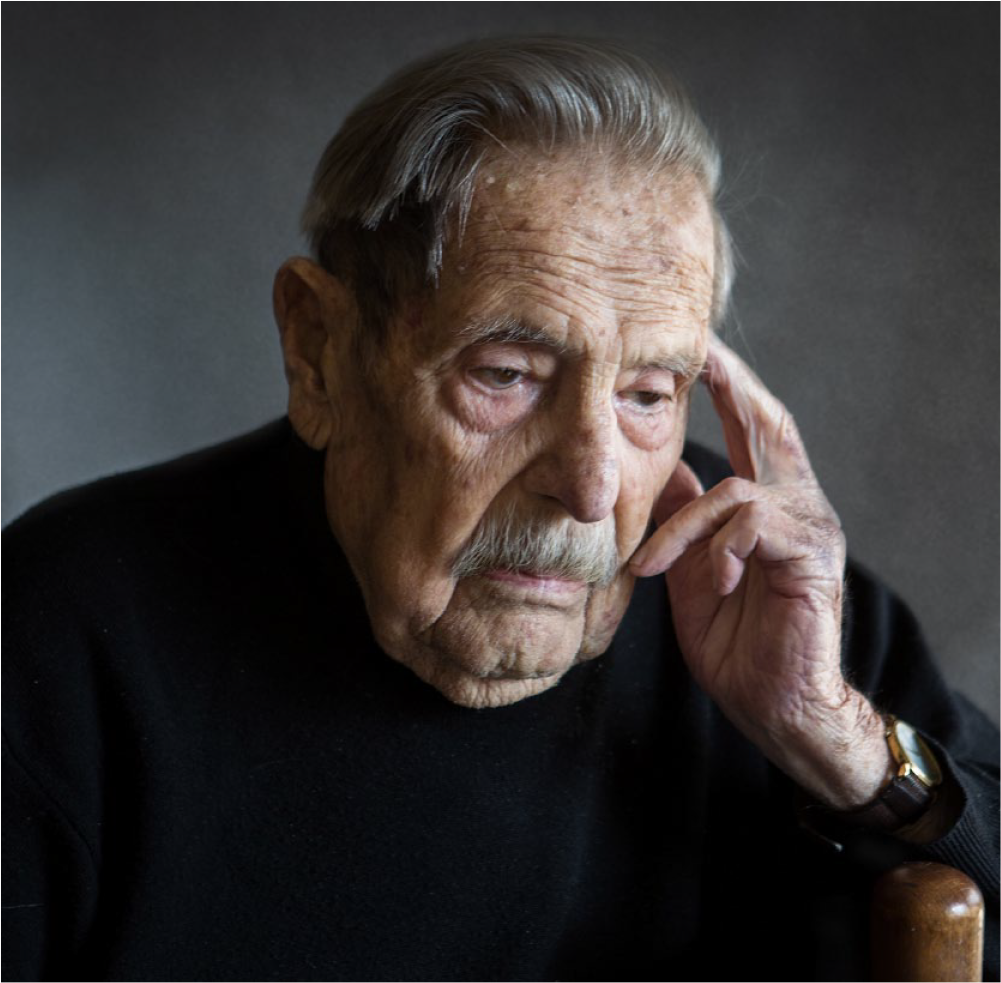
Guri as the clan elder. Photograph by Alex Kolomoisky, Yedioth Ahronot, all rights reserved.
Since Guri reached old age, it seemingly made sense to use pictures of his later life. However, they are somewhat surprising, not merely because they disclose the fragility of the hero but because this image stands in stark contrast to the one associated with the 1948 generation. The Palmach fighters are described as “almost children” (Sivan, 1991) and “ultimately young” (Alterman, 1947), an image that persisted even when they grew old (Spector-Mersel, 2008). At the Palmach Museum, the protagonists are depicted as young heroes and the narrative ends in the early 1950s, so they remain forever young (Ben-Ze’ev and Lomsky-Feder, 2020).
Unlike these young heroes, Guri’s image in the media is that of an elderly man of wisdom. His death is described as the departure of the clan elder, the last giant of a disappearing generation. Renowned author A. B. Yehoshua described the symbolic capital that Guri accumulated: “He was not simply another poet. He was an authority, even though he was not a rabbi, and he had no court.” 5
Guri is instated as the clan’s elder in other manners too. In many of his photographs, his head is leaning toward his left hand or simply touching it. It resonates August Rodin’s famous sculpture Le Penseur, hinting at his status. This image is also expressed through his often-present smoking pipe, an artifact associated with intellectualism.
Yet despite this intellectual aura, Guri is not portrayed as reclusive but rather as accessible: Many of his photographs are of his home, where he is sitting at his working desk or in the living room. We observe his environment with intimacy—armchairs, pictures, shelves, carpets, flowerpots, computer, books. His personal artifacts are exposed to our gaze. His apartment comes across as cozy and modest, laden with books. This relaxed atmosphere is part of the message: Guri belonged to the people of all walks of life, hosting them at his home, intellectuals, and commoners. In the photos, his wife often appears by his side and is described as his sweetheart from the days of the Palmach. 6
Alongside these homely pictures, Guri the elder is documented in the public sphere, including a set of photographs that appeared in many of the newspapers and documented president Rivlin hugging Guri. Guri is standing with eyes shut and seems small and fragile in Rivlin’s arms. In these pictures, Guri is portrayed as having a harmonious relationship with the state’s symbol, also evident in Rivlin’s eulogy: You were our national poet, not for the significance of your role as poet but rather for the respect with which you treated our people, our nation, our state [. . .]. You were loving and aching concurrently, a sharp critic and a raging prophet. You wrote poetry like a fighter, and you fought like a poet. You had not a single private bone, as you were the nation. We studied chapters of the state’s history through your pen. I wonder if we can face reality without you, and I promise we will continue where your pen has fallen. We will fight the enemies and protect the homeland with dedication of spirit.
7
Rivlin’s farewell expresses his apprehension from the future. He describes Guri’s death as a breakdown that endangers time’s continuity. Rivlin fashions Guri as a memory capsule—a man who carried the legacy of an important past into the present.
Drawing authority from the 1948 War
While Guri the elder was a prevalent theme in the photographs published following his death, his youth and early adulthood were also common. A set of pictures of the young Guri and his wife Aliza captures the prototypical image of the new Zionist. Both are young and handsome, looking to the horizon, with a bright sky and a tree hood from above. Guri wears a white shirt; his hair is pulled back in a forelock, and Aliza is wearing a black embroidered shirt. It is clearly a staged image, inspired by the iconography of the period (see image 2). 8
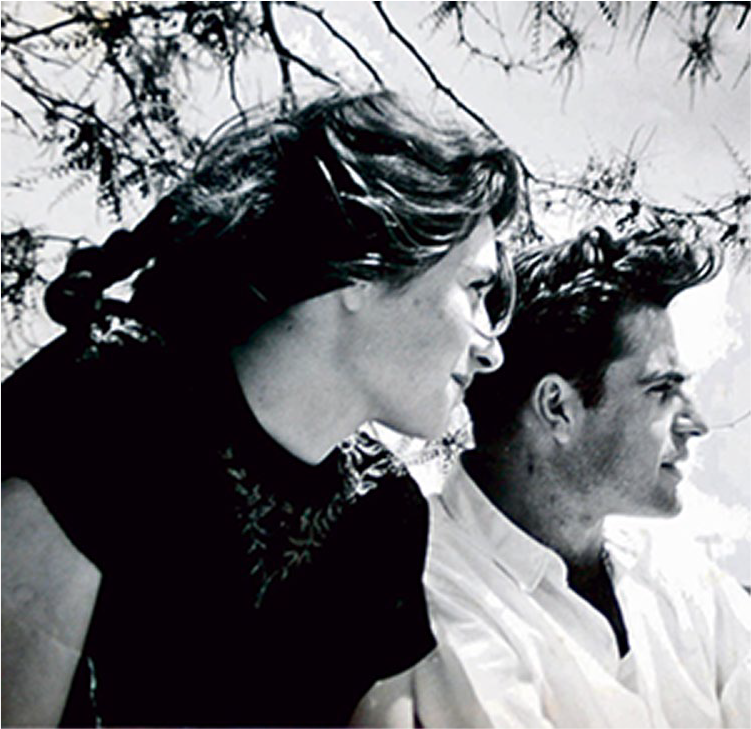
Haim Guri and his wife Aliza. The National Library, Haim Guri’s Archive. All rights reserved.
In contrast, other photographs of Guri the young emanate neither romance nor a similar sense of anticipation from the future. They portray Guri with his comrades, identified by their improvised uniforms and high forelocks. Those are pictures of young men at rest, rather than fighters heading for battle or coming back from one. They disclose neither the long difficult war, nor the loss and mourning it engendered.
There is an evident gap between the photographs’ spirit and that of Guri’s poems. His three most famous poems describe the dead soldiers who speak up (“Behold, here our bodies are laid”), the rare comradeship of soldiers (“Hareut”), and a pledge made by the dead that the valley leading to Jerusalem will remember them (“Bab al-Wad”). These poems have come to symbolize the 1948 War and were reprinted in the media following Guri’s death. 9 They highlight the dread of war while praising the fighters’ heroism.
Guri poetry shaped Israel’s image of 1948. Poet Tamir Greenberg wrote that Guri voiced his generation’s historical role: If we compare his poem [“Behold, here our bodies are laid”] to another war poet, Wilfrid Owen, we will grasp how different are the two: Owen was sent to fight a war of trenches, against his will [. . .] His poetry is the outcry of a single soldier telling the horrors of war. In contrast, Guri’s poetry stems from elsewhere [. . .] His war is right and justified, being fought by the Jewish people following the Holocaust.
10
Perhaps Greenberg over-emphasizes the contrast between the two poets while there are evident similarities. Owen volunteered for World War I before the draft law was passed in 1916, and he chose to return to the front after a time of convalescence in England. At least initially, Owen, like Guri, felt that the war was justified.
Although Guri is described as the voice of his generation, the newspapers also remind us that his military experience was unique. He spent much of his wartime on mission in Hungary and Czechoslovakia, organizing operations for Holocaust survivors. We are told that he was haunted by the fact that he did not participate in the decisive battles back home, and he is quoted as saying, “I should have been there [in the War with my friends].”
11
At the same time, his engagement with the Holocaust survivors remained central to the way he understood the world, as he himself testified: My encounter [with Holocaust survivors], which I define as an engagement with the unknown brother, was deep and meaningful, impacting my whole life, as well as my poetry. There is hardly a single day that passes in which I do not think of what happened there.
12
Guri’s sensitivity to the Holocaust stands in contrast to his generation’s alienation from survivors, associated with the Zionist movement’s critical attitude toward the Jews who remained in the Diaspora (Dror, 1996; Segev, 1993).
13
Guri was ahead of his time. By 2018, the Holocaust’s standing in Israel had changed dramatically, and it became a basis for national identity. Therefore, at the time of Guri’s death, the media stressed his commitment to the documentation and commemoration of the Holocaust. We are told that he did not miss out on a single court hearing of Eichmann’s trial while working as a journalist. Guri also directed a trilogy of documentaries on the Holocaust, the first nominated to the Oscar Prize in 1975. Journalist Arianna Melamed related to the topic following Guri’s death: I wish to remember that for thirteen years he insisted on creating three documentaries on Holocaust survivors, while the latter were still stigmatized as “sheep led to the slaughter” and “soaps” in the mouth of the new Israeli, the perfect Sabar, whom Guri was one of its prototypes.
14
Although Guri is prototypical of his generation, he is also described as atypical. It is this duality, we argue, that contributes for his boundary-crossing. The well-known author A. B. Yehoshua spelled this out:
15
While he was the most representative symbol of his generation, that of the War of Independence, and though he was known as the poet of the Palmach [. . .] he curiously managed to cross generational boundaries and converse with younger and older generations.
Guri strived to converse with the young and the old and stood for an ethos that connected different strata of society. However, was he everyone’s hero?
Guri, everyone’s hero?
Yehoshua was not the only one who chose to highlight Guri’s talent to cross-generational boundaries. Literary critic Dan Meron also dwelled on Guri’s skill to break free from his generation’s particularities: If there is an Israeli culture, then Guri is its most prominent figure, because he was adaptable and able to transform himself [. . .] He, who began as the poet of the Palmach generation, and of the War of Independence [. . .]. But his great secret was that he did shut himself down. He changed his persona [. . .]. He was connected to the changing political and social reality [. . .]. It is significant that he belongs to the Palmach generation because his figure generates continuity.
16
Guri, no doubt, was rooted in the nation’s key scenario (Eilon, 2011): He was a native, his parents were active in the Zionist Movement, he grew up on a kibbutz, he came of age at the prestigious Kedouri boarding school (where Itzhak Rabin boarded), and he volunteered for the Palmach. After the War, he acquired higher education, worked as a journalist, married, and had three daughters. Unlike other literary peers, the newspapers highlighted this somewhat typical conservative background. He was not portrayed as part of the avant-garde, nor was he described as one who drinks, keeps lovers, or is part of bohemian circles. Though he spent time in Paris as a young man, there are very few references to this stay. As a journalist, he was sent to cover the anti-colonial uprising in Algeria, but these also go unmentioned following his death. The scenery of his life is described as local and consensual.
Many of the photographs reflect this image, portraying him alongside Israeli Jewish political and military figures, and showing him at national events. 17 In the photograph below (see image 3), Guri is conversing with Benny Gantz, the chief of staff, during a commemorative ceremony to the 1948 fighters. Gantz is in uniform, formal, masculine, leaning over to hear Guri’s words. Guri is his antithesis, or possibly his complementarity, possessing the authority of the elderly national poet.
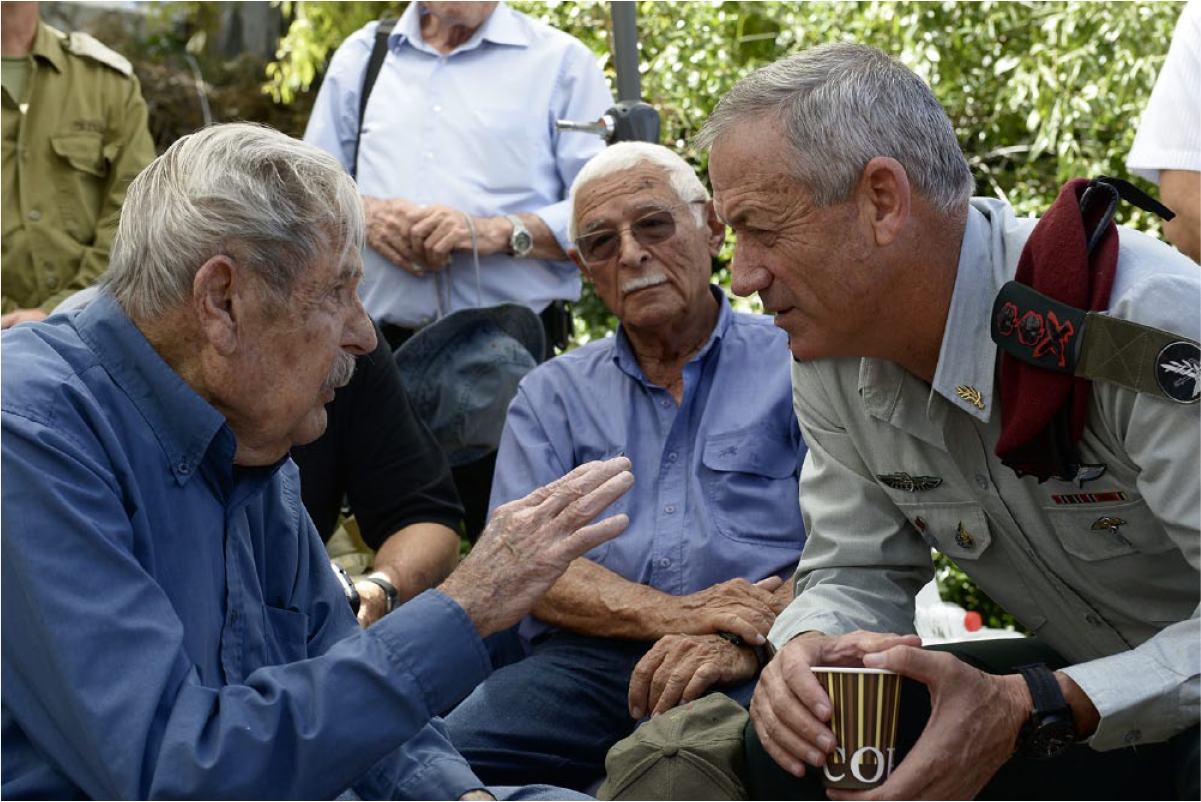
Guri and the then chief of staff, Benny Gantz, during a commemoration ceremony for the 1948 fallen soldiers, Kiryat Anavim’s cemetery, 2014. Photographer: Ohad Zwigenberg, Yedioth Ahronot, all rights reserved.
Alongside Guri’s bond to the army, he is portrayed as having strong ties to younger poets, including some associated with the Settlers’ Movement (in the Occupied Territories). Poet Eliaz Cohen writes of Guri that he was “an important bridge connecting Judaism with Israeli-ness” 18 and “a cross-generational bridge.” 19 During his lifetime, Guri reflected on his choice to maintain such contacts: “I need the interaction with young friends; it is my connection to the world.” 20
Guri aspired for a more pluralistic society, hinting at his disapproval of the Zionist movement’s negation of the Diaspora and the religious Jewish tradition. Following his death, he is quoted as saying, My suggestion to every person in Israel is to encompass as many identity-components as possible, rather than limit them. No person will be saved from the terrible contradictions in which we exist. If you undertake a “spiritual diet” and deny major episodes of our nation’s spiritual identity, you are left with over-simplifications.
21
It is therefore not surprising that when Guri died, he was described as a mediator who downplayed ideological schisms, a socially unifying figure who concealed the social and cultural specificity of the Sabra, who originally stood for the secular Ashkenazi elite of European descent. Journalist Amnon Lourd wrote of him: “Be it Left or Right, he remained the beating heart of the Land of Israel” 22 and along a similar streak, poet Gilead Meiri wrote, “He believed in a heterogenic tribe encompassing all of those who loved the land. 23
While his attraction to Holocaust survivors and to young Jewish poets is highlighted following his death, some of Guri’s contacts are tuned down. His meetings with intellectuals in Egypt following the Peace Agreement go unmentioned. His participation in a 2012 event that brought together Jordanian and Israeli veterans who fought in Jerusalem in the 1967 War is also absent. For this occasion, his poem “Behold, here our bodies are laid” was translated into Arabic. 24 Moreover, his numerous meetings with Palestinian poets and intellectuals, both within Israel and in the Occupied Territories, are also overlooked. They are not part of his obituaries, and we learn of them through occasional links. The Jewish-Israeli media ignores his ties with Arabs, and it also works the other way around: the Palestinians in Israel ignore his death. Guri is fashioned as the hero of particular social segments, which do not include all citizens.
The more radical Mizrahi Jews, some defining themselves as Arab Jews, stay silent following his death. A telling example is exposed indirectly, when Guri is quoted (in a 2015 interview) regarding his attitude toward a Mizrahi poets’ collective Ars Poetica. Guri said, “One does not become a better poet by a reign of contempt. In this bunch [Ars Poetica] they express real hatred; they are predisposed to ruining people.” 25
The media describes Guri as belonging to everyone, but once we tune ourselves to the absent voices, we discover the boundaries of “the tribe” to which he belonged: Arab-Palestinians in Israel, radical young Mizrahi Jews, and ultra-Orthodox Jews are not part of it. Guri’s association with the hegemony is bound to his image as a poet who did not voice criticism in an outright manner.
Soft criticism
Guri’s portrayals following his death describe him as having undergone an ideological conversion toward the end of his life. He is quoted as expressing disappointment, noting that the society he envisioned strayed from the way it should have gone. Journalist Amnon Lourd writes that Guri told him the following 9 months before his death: “I no longer know this nation. This is what is hardest on me.” 26 Guri, supposedly the voice of the nation, has grown alienated from it.
This strand within Guri’s description—the critical one—is often exposed to the readers in an indirect manner, through links, such as one leading to an interview following the publication of his book Ebal (Guri, 2009, Eival in Hebrew). Guri was asked, “Why Ebal, the cursed mountain?” and he replied, “This book is about soul-searching and the curse is about a brutal, tragic life, one of blood and sword; wars, hatred, failures. A life of contradictions.” 27
Guri the elder was placing “the contradictions” on the public palate. When he reached 90, he published an article titled “The Declaration of Independence is crying out.” Israel’s declaration of independence, an attempt to create a basis for a constitution, was written in 1948 and signed by dignitaries. In the article, Guri argued that this important document was being undermined. He decried the rift that had opened between the values of the state’s early days and those that have become prevalent. Guri said, As the son of this land who had reached ninety, I am a witness to extra-ordinary sights and sounds. Above all I hear the Declaration of Independence crying out, but its voice is not being heard, or is being lost to an indifferent apathy.
28
Guri’s article is neither quoted nor discussed during his month of mourning. His lament for the nation’s condition did not fit the occasion.
To some extent, Guri himself set the tone of his soft criticism. For example, he expressed remorse for what had been done to the Palestinians in 1948, yet at the same time he argued that the disaster brought upon them was inevitable, the outcome of a long dispute within the clan: “We inherited thousands of years of hatred between two brothers.” 29 Guri framed the conflict as biblical, downplaying contemporary politics. He interpreted the injustice as an outcome of an ancient conflict lasting thousands of years. By framing it as such, one bypasses contemporary power relations of ruler and ruled.
Guri’s biblical mind frame is also manifested in articles that describe him as having a deep bond to the “land of the forefathers.” Following the 1967 War, Guri signed a petition for a Greater Land of Israel (that would annex the Occupied Territories). Though he had since changed his mind, the right-wing leaning media outlets highlighted his early inclination and marginalized his withdrawal. We learn of his transformation through links to articles published prior to his death, such as an interview with Nir Baram about this conversion. Guri said, As a youngster, I believed in the Greater Land of Israel, and looked forward to the day that it will be unified [with “smaller Israel”]. I fought for it. My encounter with the Greater land of Israel following the 1967 War was astounding. It was like the day of resurrection [. . .] But the tormented friction with the other nation, which we control, changed this dream.
30
Despite the availability of texts that highlight Guri’s change of mind and his wish for a territorial compromise with the Palestinians, little is said of that when he dies. Unlike other members of his generation (such as Netiva Ben Yehuda or Uri Avneri), Guri is described neither as a visionary nor as a subversive figure. He stands for the normative, a key symbol of his generation. Sociologist Dan Horowitz, himself a member of Guri’s generation, described it as follows: The Palmach generation slowly became associated with the pragmatic moderate Left, willing to compromise land for peace [. . .]. The 1948 generation gradually returned to its moderate roots in its attitude to the Palestinians. This was due to its secular-educated background, growing older and fearing for the fate of the younger generations, particularly following the Right-wing Likkud rise to power in 1977. (Horowitz, 1993: 141)
The media clings to Guri’s moderate image and emphasizes it. He is also framed as a man who incorporated pessimism alongside hope and could hold the stick from both its ends. This, we suggest, contributed to his role as an intergenerational hero, who could bridge a quasi-mythical past with a sectorial, ruptured present.
Discussion
In the present era of fragmentation rather than unity, a time of instability rather than certainty, there is a growing urge to recreate islands of solidarity. This is sometimes implemented by establishing cultural figures as heroes who represent a common ethos and who stand for memories that bond the community. These figures have roots in a constitutive past and at the same time are highly engaged with present affairs. Their authority draws on their artwork as well as their biography, and they act as an axis or a threshold that connects different generations.
At the time of Haim Guri’s death, deep social schisms divided society in Israel, resonating discontinuities that were part and parcel of the Zionist project from its inception. It was a project that turned its back on the Jews in the Diaspora, emptied the land of the indigenous Palestinian population, and settled it with newcomers drawn from around the world. Many of the newly arrived immigrants were Jews uprooted from Arab States due to the 1948 War. Perhaps it is precisely these ruptures, old and new, that led to the concerted efforts to establish Guri as an intergenerational hero.
What, then, are the main features of an intergenerational hero, as they emanate through the media’s discourse? First, the hero (or heroine) is bound to a constitutive event, which molded his generational consciousness. He is a witness to a crucial moment in the nation’s history and tells its story in an artistic manner, trying to outline its essence for those who were not there. Guri is identified with “The Good War,” which he recreated in his poetry. The bond between the hero and the event grants the former moral authority. To enhance the continuity between “The Good War” and the present, the media focuses on photographs from two points in time: Guri’s 1948 pictures and those of his late life, as the clan elder.
Second, while the intergenerational hero is rooted in his generation, he also transcends it by establishing bonds with other generational units. He is a memory carrier, who is described as one creating bridges, inhabiting a cultural space of in-betweeness (Wydra, 2018). Guri embodies the 1948 fighters and at the same time converses with Holocaust survivors, younger poets, and generations of fighters. Some of the mechanisms used by the media to ascertain Guri’s role are “unifying strategic discourses” (Gavriely-Nuri and Lachover, 2012): He is generally portrayed as restrained and uncritical, a man who chooses to bypass controversies. Even when he had taken a critical stand, he is de-politicized upon his death. However, all along he remains within the boundaries of the hegemonic segments of society.
Third, the intergenerational hero is not frozen in time. As he grows older, he adapts to winds of change. Moreover, his biography is described as interwoven into the social fabric; articles and photographs depict him as a key player in public events. In Zygmunt Bauman’s (2005) terms, he is a hero of a national era who gradually becomes a public figure of late modernity and is recreated as a semi-celebrity.
The fourth and last point relates to the dual nature of the intergenerational hero. He embodies his own generation’s ethos yet at the same time transcends it; he explores his inner world yet is understood as voicing national concerns; he writes of heroism yet hints at trauma; he can be pessimistic yet seek to sow hope; he can be critical yet within the confines of the consensus. Therefore, individuals and groups of varied backgrounds can identify with some facet in this broad spectrum.
The urge to construct Guri as an intergenerational hero was exceptionally evident in the weeks that followed his death. Moreover, it continued in the years that followed and included the printing of a postal stamp with his image and a line of poetry; a quote from one of his famous poems on a museum’s wall at Bab al-Wad, adjacent to the road to Jerusalem; establishing an annual cultural event after his name; and re-naming his favorite café “The Guri Café.”
However, despite these evident efforts to maintain Guri’s role and presence, there are counter forces trying to undermine his status. A fortnight after his death, an article was published in Haaretz titled “I have discovered two national poets who can be Haim Guri’s successors.” The author suggests two poets—Noam Partom (b. 1986, woman), a spoken-word artist, and Roy Hasan (b. 1983, man), a leading critical Mizrahi poet. The intention behind these choices is evident—to inaugurate the younger generation’s poets who stand as an alternative to what used to be the canon. The author states so explicitly: “Imagine these two scenarios: The president eulogizes a national poet who is a Mizrahi or a woman.” Moreover, we should ask whether the national Israeli poet must write about “love imbued in blood” (a famous line from Guri’s poem). 31
While the above column may be treated as anecdotal, we should nevertheless ask, what are the chances for Guri to survive the test of time and fulfill the role of an intergenerational hero? At least three factors may have an impact. First, the perseverance of such a hero depends on the political forces that stand behind him. Guri is associated with Israel’s former hegemony, which is gradually losing its capital. Will there be powerful agents invested in Guri’s maintenance? Second, in this digital age, literature’s role is declining, and a literary canon has grown rare (Gluzman, 2022). Will poets continue to play a role as cultural heroes? Finally, in this late-modern, liquid age, when cultural forms are constantly destabilized, will cultural heroes be able to survive the transformations from one generation to the other? Time, as well as comparative research into other intergenerational heroes, may hold the answers.
Footnotes
Acknowledgements
We would like to thank Na'ama Sheffi (Sapir College) for initiating the collective memory and visual images group, where this article came into being. We thank the group members for enriching discussions. We would also like to thank our exceptional research assistants, Anna Rosenfeld and Nour Abu-Ras. Finally, we appreciate the useful comments made by the anonymous reviewers.
Funding
The author(s) disclosed receipt of the following financial support for the research, authorship, and/or publication of this article: We would like to thank the Ruppin Academic Center for its financial support.
