




Abstract
This article starts from the notion of collective memory as a source of power and meaning and draws from the concepts of activist memory to reflect on the existence of a racialised regime of memory in Brazil. Considering the social struggles involving Black people and the decades of fights for voice and justice, this investigation will deliberate on the media practices and general public recollections around the death of Black children under the optics of Hall’s concept of racialised regimes of representation. Employing an online survey and content analysis, this work uncovers evidence of a different set of practices to report and remember the death of White and Black children and considers the impact of those practices by analysing the remembrance rates on the survey.
Keywords
Memory is the social phenomenon (Halbwachs, 1992) that binds people together. It is, then, more than mere records of the past, but a ‘source of both power and meaning in the present’ (Simko, 2016: 458). There are many questions about the preservation of memories of marginalised and prejudiced groups. Often ignored or depicted in a negative way by the official narrative, they end up creating their own dynamics to ‘engage with personal, collective, shared and cultural memories in connective ways in order to preserve their heritage’ (Garde-Hansen, 2011: 6). These dynamics eventually become part of that heritage themselves. According to Merrill et al. (2020), although early social and collective memory studies were not concerned with issues involving activism and protest, this scenario began to change in the 1980s. Scholars in the field started to give greater emphasis to activism, turning to the analysis of counter-memories and eventually evolving to study mnemonic resilience and the ‘role that memory and commemoration play within the political processes of conflict transformation, resolution and reconciliation’ (Merrill et al., 2020: 3). Recently, memory activism that we can refer as the mnemonic practices involved in the construction of counter-memories by marginalised groups to challenge the status quo and offer a narrative of their own history and memories, gained influence within the subject.
It is easily observed that marginalised groups constantly have their history told by the dominant group through narratives dominated by misrepresentation, perpetuating ideas and prejudices that favour the maintenance of power, be it economic, political or social. We are now witnessing an explosion of social movements claiming these narratives back to the marginalised groups (Amaral, 2021; Custódio, 2017; de Oliveira Maia, 2017; Souza and Maia, 2016) by means of protests, counter-narratives that gain strength aided by digital tools and counter-memories that defy the version previously considered official. In Brazil, black movements for black pride and black history, or even the massive use of the hashtag #nóspornós, meaning ‘us by us’ referring to favela residents, who are mostly black (Meirelles and Athayde, 2014), telling their own narratives of the events that happen inside the favelas, are examples of this desire (and the struggle) to take back the narratives about their people, their culture and their home.
This article will engage with Hall’s (1997) reflections on racialised regimes of representation and with the concept of activist memory aiming to ascertain the existence of a racialised regime of memory and memorialisation in Brazil. Employing surveys and content analysis of media articles, this work brings evidence of a different set of practices to report and remember the deaths of Black children when compared to White children. Anchored on Hall (1997), it converses with the notions of ‘letting disappear’, proposed by Denyer Willis (2021), as well as the ‘White fear of Black souls’ (Chalhoub, 1988) and the optics of ‘anti-black cities’ (Alves, 2018), to navigate the intricate threads surrounding reporting and remembering the violent loss of Black children’s lives in contemporary Brazil.
First, presenting robust background research that shed light on the irrefutable marginalisation of Black people in Brazil, this article then goes on to present data collected through a mixed questionnaire with closed and open questions, in order to corroborate the existence of such a profound racialised system that it extends even after the death of the concerned individuals. Complementing the questionnaire, an extensive content analysis bringing material from different sources poured more evidence to verify the hypothesis raised by this research, substantiating the existence of a completely different system to report and remember the murders of Black children and the impacts of these differences.
Black life in Brazil: free from the slavery whip, trapped in the squalor of the favelas
Black people in Brazil exist in a post-slavery society that still resists abandoning rooted prejudices to maintain the status quo through power relations. Although they represent the majority of the Brazilian population (Brazilian Institute of Geography and Statistics (IBGE), 2020) and 133 years have passed since the signing of the law that freed Black people from slavery in the country, this population still suffers from the ills of an unequal society, marked by racialised regimes of representation, violence, prejudice, social invisibility and the difficulty of social and professional ascension among Black people. Before diving further into this discussion, it is necessary to better understand how the ethnic-racial characteristics of the Brazilian population are defined. According to the IBGE (Brazilian Institute of Geography and Statistics), the main provider of geographic information and statistics in Brazil, over 56% of the Brazilian population identifies as Black or Brown (IBGE, 2020). Osorio (2003) explains that in Brazil, in most administrative records, such as birth or death records, the identification of racial belonging is done by self-attribution or, when the subject is not yet able to provide this identification (e.g. in records of birth), by hetero-attribution (usually from a family member). For research purposes, IBGE also uses self-attribution in its surveys (or hetero-attribution when a family member is responding to the others). Since the 1980s, the colour or race categories presented to respondents in those surveys are White, Black, Brown, Yellow and Indigenous; in this classification, according to the interviewers’ manual, Brown refers to those who have some miscegenation, while Yellow refers to those of Asian descent and Indigenous to those who descend from Brazilian native people. The main critique of that classification is that in a country where Black people still suffer discrimination and have greater difficulty in social mobility, there is a tendency to reject identifying as Black, inflating the numbers of those who declare themselves to be Brown, a group that suffers less discrimination than Blacks in Latin America (Telles and Lim, 1998), or even White: ‘in light of the prevailing Whiteness ideal, it is to be expected that people who have fewer black traits in their appearance tend to consider themselves White’ (Osorio, 2003: 13). On that note, it is important to highlight that although that reality still prevails, the recent strengthening of black movements in the country has been causing an increase in the identification of racial belonging among Black and Brown people, through black pride movements and the reconnection with their origins and traditions. This change in the perception and identification of the Black population has already been noticed in the official records (contributing to the recent increase of these populations) but also becomes more evident in the strengthening of the racial identity subjectively constructed and perceived both by the subject and also society.
Although the country’s claims of an apparent ‘racial democracy’, the Black population ‘continues to be marginalized economically and socially’, suffering from dehumanisation in favour of maintaining the present state of affairs, which perpetuates a ‘logic of class and colour’ in a society of ‘dominant (European Whites) and dominated (Black, Indigenous and mestizo)’ (da Silva, 2014: 14). The country’s cities become, then, the place for ‘a racial project produced through a dialectic relation of “terror and civility” represented by the Black threat and “endangered civil society”’ (Alves, 2018: 3), in which to defend and maintain the desired order a ‘permanent urban warfare against Black Brazilians’ is waged, orchestrated by an ‘essentially anti-black’ civil society (Alves, 2018). The Black population is, for example, the biggest victim of police violence in the country (over 70% of the victims are Black, according to the last report from Fórum Brasileiro de Segurança Pública (2019)). Black and Brown people are the majority in the favelas and peripheries (Meirelles and Athayde, 2014) and also account for 75% of the poorest in Brazil, while Whites account for 70% of the richest (IBGE, 2019). Although 133 years have passed since the end of legal slavery in Brazil, the Black and Brown population still occupies the majority of the manual or domestic work positions. They are underrepresented in higher education, corresponding to only 35% of the universities student body in Brazil (Bermúdez, 2020) and also ‘under a cultural subjection’, suffering, for decades, of lack of opportunity and voice to narrate their own stories, resulting in ‘the deep pain of perceiving themselves marginalised by the history constructed by the dominators’ (da Silva, 2014: 15).
Recovering the notion that memory is a source of power and meaning (Simko, 2016), the manipulation of collective memory can be considered a tool to maintain structures of power and domination in modern societies. Foucault defended that memory ‘is actually a very important factor in struggle . . . If one controls people’s memory, one controls their dynamism’. 1 Le Goff (1992) argued that collective memory is an important asset in power struggles and stated that the groups that dominated historical societies were concerned with ‘make themselves the master of memory and forgetfulness’ (p. 54) and that ‘things forgotten or not mentioned by history reveal these mechanisms for manipulation of collective memory’ (Le Goff, 1992). Reflecting further on this idea of memory as a source of power and meaning (Simko, 2016) and as a tool for consolidating collective rights (Bizello and Ferreira, 2010), one can question whether the Brazilian national memory, ‘synonymous with official history’ is in fact representative of ‘all social groups’ (Bizello and Ferreira, 2010: 259) or whether it operates, in fact, a racialised regime of remembrance.
Slavery-based ideals are still very present in the Brazilian social hierarchy. Officially abolished in 1888, the end of slavery did not bring immediate changes to the situation of Black Brazilians. With the transition from Black slave labour to White labour (mainly European), emancipation meant that the Black population was no more enslaved without, however, offering real opportunities for their integration into society. Without a job and still seen as inferior by the White Brazilians, the segregation and social invisibility among this group only increased, pushing Black people to live on the margins and become victims of poverty, criminalisation and violence. When we consider this panorama to analyse the recognition of the importance of Black memory in the country over the years, there is ample evidence of the state’s disregard for its preservation. Bizello and Ferreira (2010) offer strong evidence of this neglect when pointing out that the preservation of the memory of Black people in Brazil was anchored in social movements to fight against racism. The memory of Black people on Brazilian soil is practically devoid of written documentation (since the enslaved did not produce documentation) being based exclusively on official records where they appeared as merchandise and the focus was on the transaction (purchase, sale, inheritance, etc.) and not the individual. The strengthening of groups and associations of Black people across the country, united mainly in the fight for rights, increased document production and at this point, some form of organisation and preservation initiative from the state would be expected. What was observed, however, was that ‘the custody and preservation of that same documentation suffer from the neglect of the state’ (Bizello and Ferreira, 2010: 262), resulting in the erasure of Black memory in the country.
The signs of a system that discriminates by race those who deserve to be celebrated or not are abundant when we analyse Black history in Brazil. One piece of evidence is the current school curriculum. It does not contemplate the history of Black Africans prior to being brought to the country as slaves and it is limited to a shallow presentation of the Brazilian slave system, representing Black people as a passive figure in this system and placing little emphasis on Black resistance and the counter-narratives that already appeared at that time (de Oliveira, 2012). Although Law 10.639/2003 obliges the inclusion, in textbooks, of content about African and Afro-Brazilian history and culture for elementary school students, this inclusion, which is still quite superficial, is not yet capable of changing the Eurocentric focus of the current didactic material. This is clearly observed when we reflect, for example, on the fact that there are many relevant but little-known Black names in the country’s history (such as Luís Gama, poet, journalist and responsible for the liberation of more than 500 enslaved people and even Dandara, wife of one of the rare Black personalities that are celebrated in the country; Zumbi dos Palmares, having participated with him in the Black resistance in Quilombo dos Palmares) but the celebration of these names are scarce and disproportionate and holidays to celebrate milestones and names in Black history are still exceptions (Bizello and Ferreira, 2010). When analysing the progress of modern society, Black people were excluded from the simplest forms of tribute and remembrance. Even in the preservation of urban structures and Black history landmarks, dozens are the points of interest that have been completely abandoned by the state. Martins and dos Santos Júnior (2017) argue that ‘what is chosen to be preserved is part of a project on identity and collective memory’ (p. 37) and in Brazil, even street names reveal the neglect of Black history, as Black personalities are systematically forgotten in this form of historical perpetuation. This systematic forgetting of Black personalities and Black history can be reflected under the umbrella of the concept of ‘unthinkable history’, explained by Trouillot (2015) to elaborate on history and silence.
Supported by Bourdieu’s notion that the unthinkable is ‘that for which one has no adequate instruments to conceptualize’ (Trouillot, 2015: 82), Trouillot (2015) draws a narrative to explain the general silence about the Haitian Revolution, ‘the most important slave insurrection in recorded history’ (p. 72). The author argues that at the time, a slave insurrection was so unthinkable, so unlikely, that contemporary scholars and philosophers did not have the adequate intellectual resources to deal with those events, thus remaining mostly silent: The Haitian Revolution thus entered history with the peculiar characteristic of being unthinkable even as it happened. [. . .] reveal the incapacity of most contemporaries to understand the ongoing revolution on its own terms. They could read the news only with their ready-made categories, and these categories were incompatible with the idea of a slave revolution. (Trouillot, 2015: 73)
This inability to understand a slave revolution for freedom, according to the author, was anchored in the widely rooted idea of the inferiority of Black people and their indisputable obedience. Those who rebelled were seen as the exceptions, ill-adjusted specimens, deviants. Accepting the idea of a mass rebellion against slavery, Troillout explains, was to ‘acknowledge the possibility that something is wrong with the system’ (Trouillot, 2015: 84) which, of course, would not benefit the planters and slave masters in the Americas. Therefore, the idea of a slave insurrection was not only unthinkable even as it happened, but also deemed too damaging to the status quo to be acknowledged, being, thus, relegated to silence. Here, we can draw a parallel between the silence discussed by Trouillot and the erasure of Black history and memory in Brazil. As the Black population is still a source of cheap work today due to the difficulty of social ascension linked to structural racism and cities that are essentially ‘anti-black’(Alves, 2018), there is a profound disinterest in telling these stories and celebrating these personalities, since the silence collaborates with the difficulty of social mobility and benefits the elites. The contemporary elite that is interested in continuing to exploit the cheap labour of the descendants of the enslaved that today populate the favelas and suburbs resembles the planters cited by Trouillot (2015), who in light of having to recognise a rebellion for freedom and validate the idea that there was something wrong with the slavery system preferred to remain in silence. Both recognising the structural racism that plagues the country and is at the root of problems such as state violence, and making room for Black history, recognising relevant Black personalities in Brazilian National History would open up opportunities to disturb the social system currently in place from which they benefit largely. Furthermore, it is necessary to consider the state’s perspective in (not) recognising the Black genocide occurring in the favelas and suburbs, as recognising these stories (and safeguarding these memories) would also mean recognising that there is something wrong with the very system; just as mundane disappearances are convenient for the state (Denyer Willis, 2021), so is ignoring and relegating state violence against Black bodies to oblivion.
Considering the relevance of collective memory in social and political relations, it is also important to reflect on the process not only of erasing Black heroes from the history of Brazil but also of barbarising Black people in general. On that note, Amaral (2021) writes that during slavery and soon after its abolition, the current thinking about life in Africa was of pure barbarism, opposed to the sense of civility in the Americas and Europe, for example. The discourse, to a certain extent used to justify the enslavement of the African Black people (according to Hall (1997) based on the work of Frederickson), was that Black people lived in Africa in complete disorder, cannibalism, and savagery. (Amaral, 2021: 57)
Hall (1997) himself pointed out that even the philosopher Hegel declared that ‘Africa was “no historical part of the world . . . it has no movement or development to exhibit”’ and that in the nineteenth century, ‘Africa was regarded as “marooned and historically abandoned . . . a fetish land, inhabited by cannibals, dervishes and witch doctors”’ (Hall, 1997: 239). This notion reverberates in the dialectical representation of the city brought up by Alves (2018), in which there is an opposition between ‘terror and civility’ (in which Black people are terror; Alves, 2018: 3) and also dialogues with Chalhoub (1988) who explains the ‘White fear of Black souls’ in which the White Brazilian population attributed chaos and danger to Black and poor people and constantly placed themselves in a position to defend civility against the barbarism of the Black and the poor. Although recent laws are aiming at an anti-racist education, in practice the school remains a place that perpetuates the view of Black people as descendants of slaves (and not enslaved people), represented by ‘stereotypes of ugliness, rudeness, ignorance, primitivism and aggressiveness’ (Madureira, 2020). This representation maintains social divisions that determine that White lives are worth more than Black lives and that ‘some people are more human than others’ (Costa, 2020). The manipulation of collective memory through neglect of Black history plays a central role in this division that hinders the social rise of Black people in Brazil. As people without memory do not know their own history risking becoming devoid of meaning and power, this neglect affects directly their ability to enter political and economical sectors that were hitherto typically White thus serving the purpose of maintaining the status quo that benefits from cheap labour and unchallenged political power.
Having established the racial discrimination in the perpetuation of the Brazilian national history, the very erasure of Black participation in said history (Moreira and Pereti, 2020) as either an asset in its construction or a liability in being a victim of it, and, finally, the impacts of this practices of erasure on social and power relations, we move on to the primary reflection of this article on whether a racialised regime of remembrance is in place in the country. The existence of a hegemonic representation structure in Brazil that reduces non-Whites to ‘fixed in Nature by a few, simplified characteristics’ (Hall, 1997: 247) stereotypes, a practice that Hall calls ‘racialized regimes of representation’ (Hall, 1997) is very clear (Amaral, 2021). This regime employs strategies to establish the ‘differences’ between Whites and Blacks to determine what is ‘normal and acceptable’ and then ‘exclude or expel everything which does not fit, which is different’ (Hall, 1997: 258). The very existence of such practices of representation in the mainstream media was addressed recently (Amaral, 2021; Custódio, 2017) and the fact we are discussing an intrinsically racist society (de Oliveira, 2012: 82) brings this study to propose an extension of Hall’s definitions and argue for the existence of a racialised regime of remembrance in Brazil. Such hegemonic practices dictate not only those who should be celebrated (mostly White) but also those who deserve to be even remembered and how they should be remembered (if not completely forgotten). It collaborates to the perpetuation of the historical violence against Black and poor people that is not properly addressed and consequently, is quickly forgotten along with those who suffer such violence. This continues a cycle of prejudice, exclusion and abuse that reinforces the social invisibility and dehumanisation of Black and Brown people in Brazil, strengthening legacies of pain and suffering as well as preventing their participation in the democratic arena, hindering their chances to claim rights (Capriglione, 2015). Police violence, for example, is among the biggest public security crisis in Brazil but there is a gap in memory studies knowledge related to it. Existing studies on memories of state Violence in Brazil are mainly focused on the period comprising the country’s military dictatorship (1964–1985) but little is produced on memories of police violence during democratic times. Not coincidentally, Black people are currently the overwhelming majority of victims of police violence, raising doubts about whether the lack of interest is not linked to socio-racial issues and leading to the question: how are we remembering the violence of democracy in the anti-black cities (Alves, 2018) of Brazil?
Media and memory – mediating our future recollections
In the present time, it is essential to consider the role of the media in the recording and circulation of memories. Garde-Hansen (2011) argues that ‘our engagement with history has become almost entirely mediated’ (p. 1) and that ‘media and events of historical significance are inseparable’ (Garde-Hansen, 2011), therefore, we can recognise that the media, in all its forms, is responsible for reporting, archiving and disseminating memories. The role of the media in building our memories can easily be made tangible when one thinks of significant events in recent history such as the 9/11 attacks on the Twin Towers, for example. Most of those who are old enough to have followed the event while it happened through news coverage will remember the image of the second plane crashing into the tower when referring to it. That footage, caught by live cameras, was globally hammered over and over and even today it is still one of the most striking images of the attack. It is clear then the power of the media not only to report but in selecting and prioritising images and information being able to imprint the same image in the collective imagination, practically programming collective memories framed by news coverage. We can also consider that this power is enhanced the less global the event is, since local events tend to have less attention than global ones and fewer people coming forward to challenge the media version, implying greater power for them to write history without arising counter-narratives.
Counter-narratives are a vital tool for misrepresented and disadvantaged groups (Amaral, 2021) and recently, the conviction of the police officer who killed George Floyd has raised yet another debate: what if the assault that led to Floyd’s death had not been caught on video? Protesters in North America were seen holding the question written on posters during marches for justice for Floyd and turning the discussion back to Brazil, recent cases have shown the strength of raw footage as evidence in cases of police violence (Amaral, 2021). In 2015, for example, police officers fired without warning at unarmed youths who were playing in the favela of Palmeirinha, in Rio de Janeiro. One of them, Alan Lima, that was just 15 years old, died and the other, Chauan Cezario, 19 years, was shot in the chest but survived and was arrested on the spot. The police officers’ version was that the young men were local drug dealers and shot at the police vehicle, which responded with fire in self-defence (Amaral, 2019). Alan, however, was recording a video with his cell phone and ended up filming his own death. The video, which went viral on social media, shows a group of unarmed youth talking and riding their bikes when, suddenly, the police arrives shooting, killing Alan and wounding Chauan. There is no evidence in the video that the boys were involved in any wrongdoing and they definitely did not attack the police or have guns. This video became a key part of the investigations, playing a central role in the release of Chauan from Police custody, and the redemption of the boys in the mainstream media (that previously published the official version offered by the police, portraying the victims as criminals) and, finally, in the arrest of the police officers involved. But, what if there was no flagrant on video?
Statistics clearly show that cases of police violence against Black and poor people in Brazil tend to be ignored by the public, misrepresented by the media and overlooked by the justice system. In Rio de Janeiro, one of the Brazilian counties with the highest number of police killings, only 3.7% of these killings (registered as ‘resistance followed by death’ or ‘homicide resulting from opposition to police intervention’) produced a lawsuit in 2015 (Misse, 2011) and ‘out of a total of 220 investigations of police killings opened in 2011 in Rio, after four years, only one case led to a police officer being charged’ (Amaral, 2019: 168). This contributes to most cases of police violence being forgotten by society – that is when they even reach some visibility apart from the movements of mothers who fight for justice and memory. In a society in which crimes against Black people are routinely overlooked (over 75% of homicide victims in the country are Black; Black women accounted for 68% of all murdered women (Cerqueira et al., 2020)) and ingrained practices and prejudices teach that some lives are worth more than others, it cannot be surprising that the deaths of White middle-class children cause more commotion than the deaths of Black and poor children.
Methodology, data and results
For this study, an online survey of closed questions was applied with only ‘yes’ or ‘no’ answers to the question ‘Do you remember (name of the child)?’ followed by an open question where the respondent was asked to give details of what they remembered about that specific child. The online survey was answered by 301 people from all regions of the country. However, dealing in a country as big as Brazil, the concept of local news is very stretched, therefore the survey focused on respondents from the south and southeast regions where all cases covered by this investigation occurred (85.7% of respondents are from the south and southeast regions of Brazil). Seven cases of children who were brutally killed were selected to be presented in the survey, three White children and four Black children: Maicon de Souza Silva, Black, 2 years old, killed by the Police in the Acari favela in 1996 while playing with another children in front of his house; João Hélio Fernandes, White, 6 years old, killed in 2007 by criminals who stole his family’s car on gunpoint and started the car before his mother finished freeing him from his seat resulting in João being stuck by his feet on his seatbelt and hanging outside the car, being dragged through the streets; Isabella Nardoni, White, 5 years old, killed in 2008 by her father and stepmother when she was thrown from her father’s sixth floor apartment window; Bernardo Boldrini, White, 11 years old, killed in 2014 with an intentional medication overdose by his stepmother aided by his father; Eduardo de Jesus, Black, 9 years old, killed in 2015 with a rifle shot to the head fired by the police while sitting at the door of his house in Complexo do Alemão; Marcos Vinícius, Black, 14 years old, gunned down on his way to school during a police operation in Maré in 2018 and Ágatha Félix, Black, 8 years old, killed by a stray bullet while on a public transport in 2019 in Complexo do Alemão.
In the global analysis of the survey results, the first and most relevant information to come up is that while the three White children were remembered by more than 70% of the respondents, Isabella Nardoni being remembered by over 90% of them, none of the Black children reached the 50% recall mark. In fact, except for Ágatha Félix, the most recent death of all presented (occurred in 2019) and remembered by 40.5% of respondents, none of the three Black boys was remembered by more than 10% of the respondents, while João Hélio, who died in 2007, was remembered by 73.75% of respondents, Bernardo Boldrini by 74.42% and Isabella Nardoni by an impressive 98.34%. Isabella died in 2008, while Eduardo, who died in 2015, was only remembered by 4.98% of the respondents. Another important piece of information to note is that the cases of Black children presented involved police violence and were rarely remembered as shown in the chart below. The White children, however, were murdered by their parents (Isabella and Bernardo) or, in the case of João Hélio, killed during a robbery.
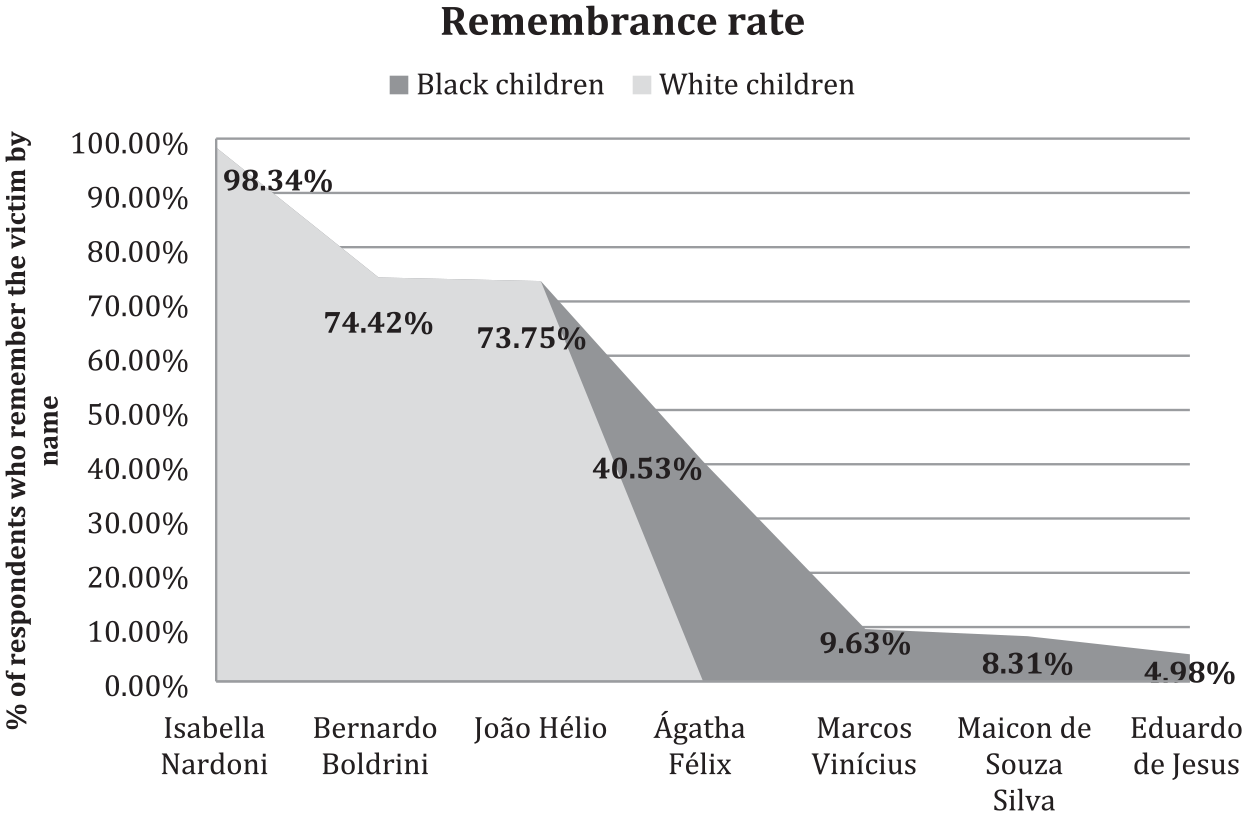
In the case of Maicon, when analysing the answers to the open question asking for more details about the case, it is clear that of the 25 participants who answered ‘yes’ to the question ‘Do you remember Maicon de Souza Silva?’ only eight actually remembered the case, that is, only 2.65% of respondents. The others have mistaken it for other cases. Of these eight, seven are aged in the 30–50 age group and one is aged between 25 and 29 years, indicating a tendency of cases involving Black and poor children to be forgotten over time: Maicon was murdered in 1996, no respondents below 24 years of age remembered the case and only 2.8% of respondents between 25 and 29 years of age did. When considering the death of João Hélio, which occurred in 2007, 66.67% of respondents aged 15–24 and 65.71% of respondents aged 25–29 said they remembered him. Isabella Nardoni, who died in 2008, was remembered by 100% of respondents below 29 years old. This evidence points to a tendency for the cases involving White children to survive in the popular imagination even with the passage of time, being remembered even by those who were not even adults when the fact occurred, while the opposite happens with Black children.
When looking at the open-ended questions to which the participant gives details of what they remember about the children, it is also possible to ascertain that the respondents remember more details about the White children. When asking about the Black victims, except for Ágatha Félix, the most recent death discussed and to which people gave answers a little more detailed, the survey received many vague answers, some just an array of three or four words such as ‘death by a police officer’, ‘murdered by the police’ and ‘stray bullet’. When describing the deaths of White children, however, respondents recalled more details about the crimes such as the neighbourhood where the crime occurred or where the victim lived, specific details like the fact that the victim had asked for help from family members or from the Child Protective Services, the involvement of politicians in the trial of the culprits and even how they felt following the case at the time of the event. Some examples of the answers are below, showing the stark contrast:
What do you remember about João Hélio/Bernardo/Isabella?
‘The brutal way he was killed during the car robbery he was in. I was pregnant with my first child at the time, and I was extremely impacted by the violent world in which my child was going to be born . . . I felt a sense of impotence that still disturbs me today’. (41–50 years old)
‘A child from the south of the country killed by his stepmother and his father. He was neglected by his family, he was constantly asking neighbours for help, he even went to Child Protective Services and the Public Ministry for help and was ignored’. (30–35 years old)
‘Isabella was a 5-year-old child who was spending her days at her father and stepmother’s house and was assaulted by both, suffocated and thrown out of the apartment window by her father’s hands, who have said at the beginning (of the investigations) that the child had cut the protective net with a pair of scissors and fallen . . .’. (30–35 years old)
‘The coldness with which her father and stepmother commented on the crime against her. And I felt the pain of the girl’s mother, even without ever having gone through anything like what she went through’. (41–50 years old)
What do you remember about Maicon/Eduardo/Marcos Vinicius?
‘Killed by the police in front of his house’. (25–29 years old)
‘Stray bullet’. (36–40 years old)
‘Shot in school uniform’. (30–35 years old)
‘I remember the name, but I don’t remember what happened to him, I just know he died’. (41–50 years old)
Two cases that occurred in Rio de Janeiro in 2021 only a few weeks apart are very illustrative of what has been discussed in this article. In both, children were beaten to death by their guardians, one child was White and one was Black. The first is the boy Henry Borel, 4 years old, beaten to death in the luxurious apartment where he lived with his mother and stepfather on the 8th of March 2021. The second is the case of the girl Ketelen Vitória Oliveira da Rocha, 6 years old, who died on 24 April 2021, after spending 6 days in a coma for being beaten by her mother and her partner.
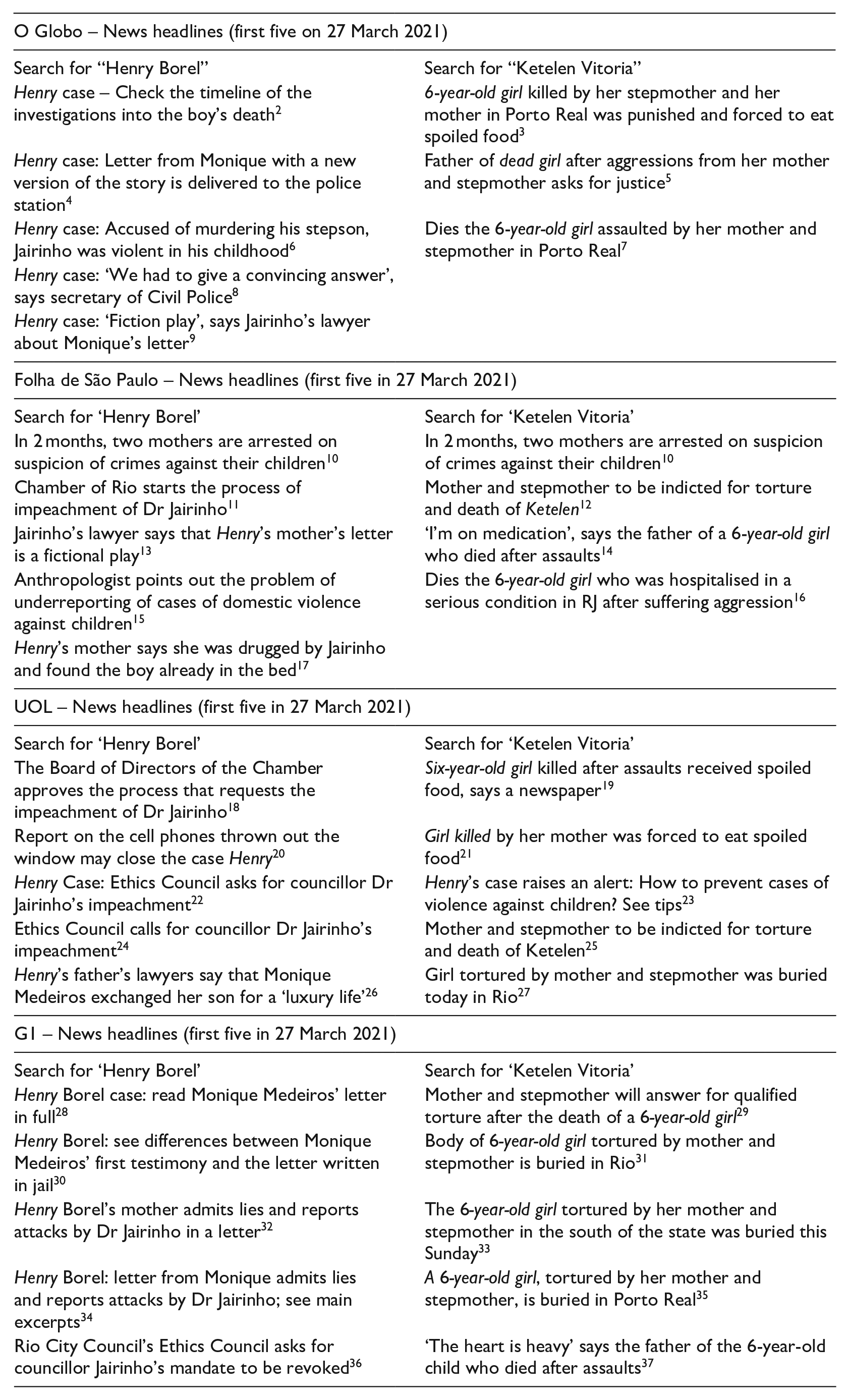
When reporting the death of Henry, an upper-middle-class White boy, the mainstream media uses his name extensively in the headlines. The case came to be called the ‘Henry case’ (as happened to similar ones in the past such as the ‘Nardoni case’ and the ‘Bernardo case’) evidencing that just the first name is enough to identify the boy. However, when reporting the death of Ketelen, a poor Black girl, her name is rarely mentioned in the headlines, often replaced by ‘dead six-year-old girl’, ‘tortured 6-year-old girl’ or simply ‘tortured girl’. On 27th April, a keyword search was carried out using the names of the victims in the main news outlets in the country in order to observe the headlines. The media companies surveyed were ‘O Globo’ and ‘Folha de São Paulo’, the largest newspapers in the country, and ‘UOL’ and ‘G1’, two of the main online news agencies. The headlines of the first five articles on the list of results were considered, in each of the sources. When searching for ‘Henry Borel’, Henry’s name is cited in 14 of the 20 headlines found. When searching for ‘Ketelen Vitória’, Ketelen’s name is mentioned only twice out of a total of 17 headlines found on that day and, interestingly, Henry’s name is mentioned once (even though the name searched was Ketelen’s).
Conclusion
This study brings to light interesting aspects of racialised regimes of memory and commemoration in Brazil. It is quite clear from the data obtained from the closed questionnaire, the poorly detailed open responses and the media coverage of the recent cases detailed earlier that it does not matter what type of death they suffer (whether the result of a crime, police violence or violent parents), Black children receive less attention and cause less commotion resulting in them being, therefore, less remembered.
Highlighting that all Black children presented in the survey were victims of police violence also evidenced the bias of trivialisation of these deaths by state agents, which is directly connected to the ideological militarisation of public security in Brazil (Valente, 2016). Even though some of the common attempts of justifying this normalisation, such as ‘parents must love above all, the police provide a service’, for example, it is noticeable how public opinion is intimately connected to the discourse that trivialises a constant state of exception (Agamben, 2005) in large Brazilian cities. This discourse is offered by the mainstream media, which ‘socially organizes and reverberates the language of urban violence’ (Palermo, 2018). The state, which holds the monopoly of violence, in a tacit agreement with the media that still has ownership of the public discourse in countries like Brazil, guides this narrative in order to legitimise state violence in the name of the peace and quiet of the ‘standard citizen’ (opposed to the ‘standard suspect’ (Amaral, in press)).
Police violence becomes trivialised through the discourse that criminalises Black, poor and peripheral people, culminating in the banalisation of the death of victims of the police, even children. Those children often lose the presumption of innocence (inherent characteristic to their own condition of being a child) becoming themselves victims of the rooted criminalised discourse towards those groups. Eduardo de Jesus, for example, was a victim of fake news after his death when photographs of an unidentified boy holding a rifle were circulated in online apps claiming that the boy pictured was Eduardo and implying he was not an innocent boy killed by the police while seating in his door frame, but a criminal child who was shot during an exchange of fire. This offers evidence that the discourse that criminalises the favela and places victims as criminals simply because they are there (in the favelas) is so ingrained that it does not spare anyone, not even the children. Why do we, as a society, feel shocked by the middle-class White child who is brutally murdered by his parents but not pity the peripheral Black child who is brutally murdered by the police? And still, even when a Black child is brutally murdered by their parents, as in the case of the girl Ketelen Vitoria, why does the media coverage follow a pattern opposite to that reserved for White children? Murdered Black children have no name or face. They become ‘beaten boys’, ‘battered girls’, ‘tortured children’. Meanwhile, the White middle-class children become ‘the boy Bernardo’, ‘the boy João Hélio’. The state is interested in forgetting Eduardos, Marcos, Ketelens and Maicons so that there is no significant pressure from the people for accountability, for the recognition of the problem by the Government, be it the problem of state violence or the one of extreme poverty and the inefficiency of child protection services.
Denyer Willis (2021) discusses the existence of a ‘letting disappear’ policy in Brazil, which the author argues serves the objective of preserving the status quo, as well as the power to use violence (reserved to the state): Better still for that project now, it seems, is the analogous category of fading away: the Inuit, migrant, and the urban poor who disappear. Disappearance offers political order the ability to step back from, on the one hand, having to account for direct lethal violence on these bodies, and, on the other, from the minimalist but costly techniques of maintaining the condition of ‘being disturbed’. Power doesn’t have to kill, nor bear the price tag of cumulative hospital stays or an ‘Indian Residential School’ if people cease to be known. Mundane disappearance is convenient. (p. 302)
When considering the memory of murdered Black children, one can observe a very similar panorama to that described by Denyer Willis, one of ‘letting forget’, of ignoring the deaths until these children are forgotten, faded, victims of whatever killed them in the first place but also of the state’s neglect. The official discourse is one of negligence and forgetfulness. Through the lack of compassion and interest in these deaths, the government trivialises them, practising the idea of ‘letting forget’ and setting the tone of the discourse. This discourse is followed by the mainstream media that is finely tuned with the official narrative, changing it only according to the perspective presented by the public security agencies themselves (Castro, 2015) and, in turn, assuming its role as the most dynamic piece in the ideological structure of a class, capable of influencing public opinion (Gramsci, 2001) and setting the agenda of people’s conversations, interests and even, as evidenced by this article, compassion. The last link in the chain is the people themselves, who, when reacting disinterested and anesthetised to these deaths, by not connecting to the pain of these victims in the same way they connect to the pain of White victims, allow, albeit unintentionally, that these children soon become mere numbers in a sad statistic, faceless and nameless briefly after their brutal deaths.
Necropolitics, the power the state has to decide who can live and who can die (Mbembé, 2003), is here mixed with a guided stupor in which people are constantly in a mood of acceptance of high levels of violence, of normalisation of the excessive everyday brutality in large Brazilian cities and the banalisation even of the death of those who normally attract the absolute presumption of innocence and compassion: children. This leads us, finally, to question the ways to experience democracy in Brazil. The democracy in which middle and upper-class Whites live in Brazil is not the same democracy experienced in the favelas, composed mostly of Black residents. Steeped in violence and tyranny within the heart of the large cities, navigating between the rule of the state (during the military dictatorship up to the late 1980s), to the rule of the powerful criminal organisations that command drug trafficking in the country and recently perishing under the power of the militias, people are born and die in the favelas without ever experiencing democracy in its full.
In response, grassroots activist memory movements started to emerge. The documentary ‘Our dead have a voice’ (2018), by directors Fernando Souza and Gabriel Barbosa, for example, was produced with the support of the movements Rede de Mães e Familiares na Baixada Fluminense and Rede de Comunidades e Movimentos contra a Violência. Both groups work to promote support for victims of state violence and although not focused exclusively on memory, actions aimed at discussing the memory of victims of violence, many of them Black children, are becoming increasingly stronger. Actions with an exclusive focus on history and memory are also beginning to gain strength. An example is the ‘Museu da Maré’, a social museum created by residents of Maré (favela) to preserve memories and challenge the misrepresentation of the favela and its residents. Also in Maré, the Núcleo de Memórias e Identidades dos Moradores da Maré, a more academic initiative of the non-governmental organization (NGO) Redes da Maré, aims to consolidate the history and memory of Maré residents through research, publications and seminars.
In conclusion, this study presents compelling data to argue the existence of a racialised regime of memory and memorialisation in Brazil, in which a set of social, ideological and political factors, guided by the mainstream media, the dominant classes and the state, decide not only those who will be celebrated but even those who will be remembered (and, therefore, the ones that can be forgotten) and how they will be remembered, based on their race, social status or place of residence.
Footnotes
Funding
The author received no financial support for the research, authorship and/or publication of this article.
