




Abstract
The National Memorial for Peace and Justice is the first national memorial to Black victims of lynching. Its purpose is to provoke a confrontation with the United States’ racial past, in the hope that truth will lead to racial justice. This article argues that in remembering the dead, the Lynching Memorial also allows and encourages visitors to mourn. During the peak of racial lynchings in the early twentieth century, it could be difficult or even dangerous for the bereaved to publicly mourn Black victims. The National Memorial for Peace and Justice, therefore, provides a delayed opportunity for the Black community to mourn those losses. But it also encourages visitors of other races to mourn too. The memorial facilitates mourning through the visitors’ relationship to the monuments, and the echoing of Black mourning traditions. In publicly mourning for these victims, visitors acknowledge and insist on the grievability of Black lives, something which white supremacy has long sought to deny. This article, therefore, argues for the radical potential for mourning at sites of commemoration as a step towards justice.
Elbert Williams and his wife, Annie, were getting ready for bed on the evening of 20 June 1940, when there was a knock at the front door of their home in Brownsville, Tennessee. When Annie answered, a city police officer demanded to see her husband. Elbert emerged in his pyjama bottoms and vest and, at the insistence of the officer, got into a car parked out front. Annie, immediately alarmed as the car drove away with Elbert inside, went to City Hall to try to find him. She was told he wasn’t there. Annie got the same answer the next morning when she asked at the jail. The officer in charge at the jail told her that they (the men who had taken Elbert) ‘ain’t going to hurt him; they may just ask him a few questions but they’ll let him loose’. (Later investigations suggested that Williams was wanted for trying to organise a meeting of the National Association for the Advancement of Colored People.) For the next two days, Annie tried to find out what had happened to her husband; a friend insisted he had seen Elbert at City Hall that night, but no-one would admit to seeing him since. Elbert’s family and friends held out hope that the reassurances that white officials simply wanted to ‘talk’ to him were true and that he would be returned safely. It was first thing Sunday morning that Annie Williams got word that, these reassurances notwithstanding, she must have been fearfully anticipating. The undertaker told her a body had been found in the Hatchee River and she had to go to identify it. There she found her husband. Annie had to insist that the coroner uncover him so she could see his full body. It was, she reported, ‘all beaten and bruised and there were holes in the chest’. The coroner told her Elbert had to be buried at once. And so, powerless to stop them, Annie watched as her husband’s body was ‘taken out of the water, put into a box and taken away and buried’ (NAACP Papers, 1940).
In her testimony, Annie does not say whether she was able to whisper a goodbye or take a final touch of her husband before his body was removed. Elbert Williams was interred in an unmarked grave. Annie and Elbert’s sister fled to New York in fear for their safety. White supremacist violence was not only responsible for Elbert Williams’ lynching; it also meant that his death could not be fully and publicly mourned. It would be 76 years before the rituals of mourning could be properly completed by his family. Three-quarters of a century later, three of Williams’ nieces gathered on the riverbank where their uncle’s body was found and collected soil into jars marked with his name (EJI, 2016). One of the jars remained in Tennessee, the other forms part of a large collection of lynching site soil. While Elbert Williams’ name does not appear on a gravestone, it is now engraved into a steel memorial, along with those of three other victims of lynching from Haywood County.
Elbert Williams was one of the thousands of African Americans who were lynched in the United States between the end of the nineteenth century and the first half of the twentieth. The ‘lesson’ of lynching was that African Americans were disposable and unimportant, that Black lives did not matter. The lynch mob asserted that Black deaths did not matter. Judith Butler (2004: 20) asks, ‘Whose lives count as lives? . . . What makes for a grievable life?’ Butler (2004: 32) continues, ‘if someone is lost, and that person is not someone, then what and where is the loss, and how does mourning take place?’ At the turn of the twentieth century, a Black person was not, in the eyes of the white majority, a ‘someone’. The logic of white supremacy meant that African American lives were ‘ungrievable’. Racial violence meant that it was often difficult to publicly mourn victims of lynching. As with the Williams family, relatives were frequently denied the opportunity for proper burial. In some cases, the victim’s body was never found; in others, little remained of the victim once the mob had had its fun. Black mourning could be interrupted by white violence, funeral homes were invaded and the threat of reprisals kept loved ones from burials. bell hooks (in Rosenblatt and Wallace, 2013: 126) explains that ‘African Americans have at times had to hide their grief because revealing it could give white oppressors information about how to hurt and control them and could also give those oppressors sadistic satisfaction’. In the aftermath of a lynching, public displays of Black grief would further gratify the white mob.
This is not to say that African Americans did not mourn victims of lynching. Whenever possible they tended to their dead, they held funerals and they remembered the deceased. But they did so in the face of obstacles that made those acts of mourning politically and socially significant. Furthermore, the mob’s implicit message – of the ungrievability of Black lives – has continued long after the practice of lynching diminished. Therefore, Black mourning continues to have political and social resonance. Mourning is resistance, is survival, is the building and maintaining of community and it is the expression of grief. In this article, I examine the Lynching Memorial as not only a site of commemoration, but also a site of mourning. I consider the ways in which it can facilitate mourning for its visitors and what the possibilities are for mourning at sites of memory. I argue that visitors are permitted and encouraged to mourn, and that this mourning will lead to an acknowledgement of the grievability of Black lives. Once this has been acknowledged, US society can work to end the conditions that result in these deaths.
The National Memorial for Peace and Justice (NMPJ, or Lynching Memorial) opened in Montgomery, Alabama in April 2018. It is the work of the city-based Equal Justice Initiative (EJI), led by attorney and civil rights activist, Bryan Stevenson. It is a memorial to the more than four thousand Black victims of what the EJI calls racial terror lynchings. The main memorial site sits on a low hill in the southwest of the city. There is a Memorial Center, which operates as a visitor centre with gift shop and ticket office. Outside of the Center there is a monument to victims of lynching in the 1950s, and on another city-centre site a newer memorial to the victims of lynching during Reconstruction has been added. Within the NMPJ there are a number of elements, including figural sculptures commemorating enslaved people and the women of the Montgomery bus boycott. The central space is a memorial to the 4084 documented victims of lynching who were killed between 1877 and 1950. Eight hundred 1.8-m-long rectangular corten steel monuments hang from the roof of the memorial square structure, one for every American county where a lynching took place. All of the documented victims (named or unknown) are engraved onto their county’s monument, with the date of their death. Visitors are first confronted with the monuments at eye-level, but as the floor descends the slabs slowly rise overhead. There is a walkway that leads visitors round the central square. On the walls are placards that describe some of the ‘justifications’ for lynching. At the final side of the square, there is a wall with water cascading down it, a memorial to the many unknown victims of racial violence. Next to this, there is a clear box filled with soil taken from lynching sites across the South. Outside, there are duplicates of all the steel monuments lying on the ground, waiting for the counties that bear their name to claim and erect them.
The lynching victims honoured at the memorial are documented in research compiled by the EJI. Its report makes the case for commemorating and publicly acknowledging victims of lynching. It is necessary, the EJI explains, to correct the ‘distorted national narrative’ and address ‘the harms borne by the African American community’. This is why the memorial is only to Black victims of lynching, and does not acknowledge the other races and ethnicities, most notably Mexicans and Native Americans, who were killed by lynch mobs (see, for example, Carrigan and Webb, 2013; Gonzales-Day, 2006; Littlefield, 2017). It was created to recognise a specific history and to emphasise specific legacies. The EJI’s memory work might be understood as one answer to Christina Sharpe’s (2016: 9, 10) question, ‘What does it mean to defend the dead?’ The EJI built the Lynching Memorial to create a confrontation with the past. It was designed to force a reckoning with America’s history of racial violence and its continuing legacy. Here is Sharpe’s ‘wake’, where ‘the past that is not past reappears, always, to rupture the present’.
The EJI report situates the history of lynching alongside other examples of human rights abuses and mass violence, from genocide to apartheid. The EJI (2017: 74) believes that lessons can be learnt from other countries’ responses to these histories, emphasising the need to break silences to heal and to achieve justice. It argues that public commemoration can promote reconciliation. The EJI explicitly places its memory work within a transnational or transcultural context, making clear the influence of commemoration in countries such as Germany, South Africa and Rwanda in its rationale. 1 From the Rwandan context, for example, it draws lessons in the power of mourning at commemorative sites. Grief is central to Rwandan memorialisation. As Ibreck (2010: 336) argues, ‘Memory work [in Rwanda] began as a response to loss and is first and foremost an expression of grief and a practice of mourning’.
I argue that mourning has also informed the design of the NMPJ. The authors of the EJI report quote Martha Minow, who has written about how to respond to genocide and mass violence. Minow (2001) argues that public acknowledgement and commemoration – breaking silences – is necessary for both victims and perpetrators. The NMPJ has been widely understood in these terms. The EJI reports, its website, newspaper reports and scholarly reviews and reflections emphasise that commemoration is necessary for healing and justice. However, Minow (2001: 67) also includes mourning as one of the processes of recovery for the traumatised, arguing that it is part of empowerment and reconnection and therefore one of the ‘building blocks for healing’. I want to go beyond the framing of the NMPJ as a space where commemoration can lead to reconciliation, to understanding how mourning can bring society a step closer to racial justice.
The most influential analysis of mourning for most of the twentieth century was offered by Freud. He argued that ‘for successful mourning to take place the mourner must disengage from the deceased, let go of the past, and move on’ (quoted in Klass and Steffen, 2017: 3). Freud argued for a distinction between mourning and melancholy; melancholy was mourning without end, an inability to resolve grief. This concept has been influential for Memory Studies scholars, who have explored the idea that ‘in melancholia the past remains steadfastly alive in the present’ (Eng and Kazanjian, 2003: 3, 4). I do not examine Freud’s distinction, largely because of the frameworks for grief developed later in the twentieth century which, rather than conceptualising mourning as the need to let go of the dead, found that bonds with the deceased continue. Mourning, using this model, is the ‘reaffirmation or reconstruction of a world of meaning that has been challenged by loss, at social as well as individual levels, in a specific cultural and historical frame’ (Klass and Steffen, 2017: 8). In this article, I do not dwell on the process of mourning, but rather consider what happens when there are obstacles to mourning. I ask what is at stake when mourning is facilitated and consider the social, cultural and political potential of mourning. Kenneth Doka’s theory of disenfranchised grief is also important to my work. Doka (1999: 37) explains disenfranchised grief as that ‘experienced by those who incur a loss that is not, or cannot be, openly acknowledged, publicly mourned or socially supported’. This can make mourning more difficult and complicated. The families and communities of Black victims of lynching were disenfranchised. I explore how the memorial can enfranchise Black grief, and how this can assist the EJI in achieving its goal of restorative justice.
Bryan Stevenson has repeatedly explained that the NMPJ was inspired by memorialisation of Germany’s Nazi past. ‘Germans want you to go to the Holocaust Memorial, and they want to change the narrative’ (Democracy Now, 2019). Holocaust memorials are designed with the intention of forcing confrontation with society’s Nazi past. Stevenson sees them as places for (German) visitors to confront their shame. He suggests a similar function for the Memorial for Peace and Justice. He argues that it is necessary to feel shame in order to feel remorse and regret. Such emotions, he contends, lead to redemption and restoration. The NMPJ is similar, in this way, to an earlier lynching memorial, in Duluth, Minnesota, which was dedicated in 2003. The Duluth lynching memorial is, Erika Doss (2010: 253–260; see also Apel, 2008) argues, a ‘site of shame’. It is framed by ‘bearing witness’ and its emphasis on facing a difficult past to encourage reconciliation is prescient of the EJI’s commemorative work.
The Duluth memorial is one of a number of sites of locally commemorated lynchings. (Duluth is more unusual for its figural sculpture; most local monuments take the forms of historic markers.) Montgomery is home to the first national lynching memorial. In the United States, Bryan Stevenson believes, there hasn’t been a proper facing up to the past. Most sites commemorating histories of race and enslavement tend to avoid confrontation. For example, plantation museums are predominantly spaces of nostalgia, designed to make visitors feel good about the past by obscuring, ignoring or minimising the historical memories of racial subjugation of such places (see, for example, Eichstedt and Small, 2002). The history of lynching has largely been absent from the United States’ national story. There has been what Sherrilyn Ifill (2007) calls a ‘conspiracy of silence’ among white communities about their complicity in America’s lynching past. This stands in contrast to the ‘commemorative vigilance’ of the Black community, which strives to remember even these painful elements of its past. 2 For Stevenson, the silence in historical memory is a terrible burden, which ‘contributes to the legacy of pain’. The absence of memorials to America’s uncomfortable racial past has ‘created empty spaces that leave us vulnerable to tolerating more bigotry’ (Art Forum, 2018). The Lynching Memorial is an attempt to fill those spaces. It is inspired in design and purpose by other international examples, including the Kigali Genocide Memorial, Rwanda and the Apartheid Museum in Johannesburg, South Africa, as well as both those countries’ Truth and Reconciliation work. Stevenson summarises what he sees as the importance of such efforts: ‘They make it impossible for people to forget or to distort that history’ (Democracy Now, 2019). He sees evidence of progress in these countries when these histories are confronted. ‘I really do believe in truth and reconciliation. I just think they’re sequential. You have to tell the truth first’ (Art Forum, 2018). Stevenson and his organisation appear optimistic that remembering will lead to reconciliation, despite the difficulties inherent in this process. 3
The EJI’s project challenges the memorial landscape of the South. In a city, county and state littered with edifices glorifying the Confederacy, this monument makes space for a different history. It also offers an alternative monumental form; marble columns and equestrian sculptures are replaced with abstract steel. As the monuments are claimed by counties across the United States, this disruption to commemorative spaces will spread. In this way, the project is similar to another source of inspiration, the Stolpersteine or stumbling stones, which are stone markers in towns and cities across Germany and beyond placed next to the homes and workplaces from which Jewish families were taken. These memorials reminded Stevenson of the iconography of the Confederacy: ‘You can’t go anywhere in the South without running into some sign or some street or some name that is designed to remind people of this era, which they take great pride in’ (Neiman, 2020: 334). Susan Neiman (2020: 334) explains that ‘the stumbling stones do the same thing in reverse. Instead of pride, they are designed to evoke shame’. For Stevenson they are powerful because they ‘disrupt your experience of space’ (Neiman, 2020: 334). The NMPJ does this too, interrupting a landscape historically dominated by symbols of white supremacy.
The EJI’s mission for restorative justice is best understood when the Lynching Memorial is viewed in conjunction with the Legacy Museum. Indeed, the EJI encourages people to visit both, selling combined tickets and offering a free shuttle bus between the two sites. Like the memorial, the museum reflects on histories of enslavement, lynching, segregation and the racial bias and damage of mass incarceration and the death penalty. This past is told roughly chronologically (visitors are first confronted with the fact that the museum is in a building where enslaved people were once held to be sold). However, the main museum space is open and there are no delineations between the different subject areas. There is no obvious route round the space and, therefore, visitors wander at will and perhaps randomly, encountering different parts of the narrative in different orders. This has the effect of emphasising the interconnectedness of these pasts and of the way this history impinges on the present. It encourages a reckoning with what Saidiya Hartman (2007: 6) calls the ‘afterlife of slavery’.
The Lynching Memorial is a place for reflection and contemplation. When Stevenson visited the Holocaust Memorial in Berlin, he was disturbed to see children climbing on and running across it. He told his staff that he wanted to be ‘very intentional in calling [their memorial] a sacred space’. He explains, ‘This is a somber place for reflection, much like Arlington Cemetery – a place that silences you’ (Schilling, 2018). It was designed as a place in which visitors should be quiet and contemplative. There are frequent signs around the site, reminding visitors it is a ‘sacred place’ and asking them to be ‘respectful’. Visitors generally seem to take heed of this; on my visits the atmosphere was muted. The comparison with a cemetery is instructive. The memorial, like a graveyard, is a place where the dead are named and remembered. The monuments, especially when laid out on the ground, resemble gravestones or coffins. Visitors are confronted with the reality of death, of these thousands of deaths.
There is a Peace and Justice Memorial Garden at the NMPJ. This is more traditional in design than the rest of the space; it is a landscaped garden, with bright seasonal flowers in well-maintained beds. It contains a ‘Memory Wall’, a brick arch taken from the Montgomery Theatre, which was built in 1860 by enslaved masons. The label of ‘Memorial Garden’ makes its purpose as a space for contemplation and reflection explicit (memorial gardens are designed as places of remembrance for the dead). However, it is less effective as a space for mourning because it is separate from the ‘main’ part of the memorial (it is before the ticketed entrance and, while some visitors may follow its path to the memorial entrance, it is not the obvious route from the car park or shuttle bus stop). The limitations of the garden suggest that memorials cannot simply create a space for mourning, they must also encourage or facilitate mourning. It is not enough to develop a sacred space to remember the dead; in this case, a ‘cemetery’ is insufficient. This is because, while the bereaved do not need additional prompts to mourn at a cemetery, visitors to the Lynching Memorial are not usually directly bereaved. Therefore, they need to experience, albeit in a very diluted and abstracted form, a kind of bereavement.
At the NMPJ, it is the experience of moving through the memorial space that facilitates mourning. Visitors are confronted with the deaths of lynching victims, and they re-enact the experiences of the bereaved as they move around the space. The design encourages visitors to form a relationship with the steel monuments: at first, they are at eye level, tangible and corporeal; then they are lifted away, out of reach (Figure 1). Each column represents a place and its numerous victims, but it also, in the symbolism of the memorial, represents a singular person or victim. Bryan Stevenson said, of visiting, ‘You’re going to have to navigate this difficult terrain. . . . You’re going to have to get closer to this history than might be comfortable. And we’re not going to make it shaded and padded and beautiful’ (Bey, 2018). The physical experience of travelling through the memorial should be uncomfortable because the history is uncomfortable. Stevenson has said the design was influenced by the Apartheid Museum in Johannesburg, which, according to Rankin and Schmidt (2009: 79), ‘performs [apartheid’s] complexities and contradictions through the building’s location, its architecture and the physical form of its displays’. The Memorial for Peace and Justice is not only performing lynching; it is also performing the loss and despair of those who remain in the aftermath of lynching.
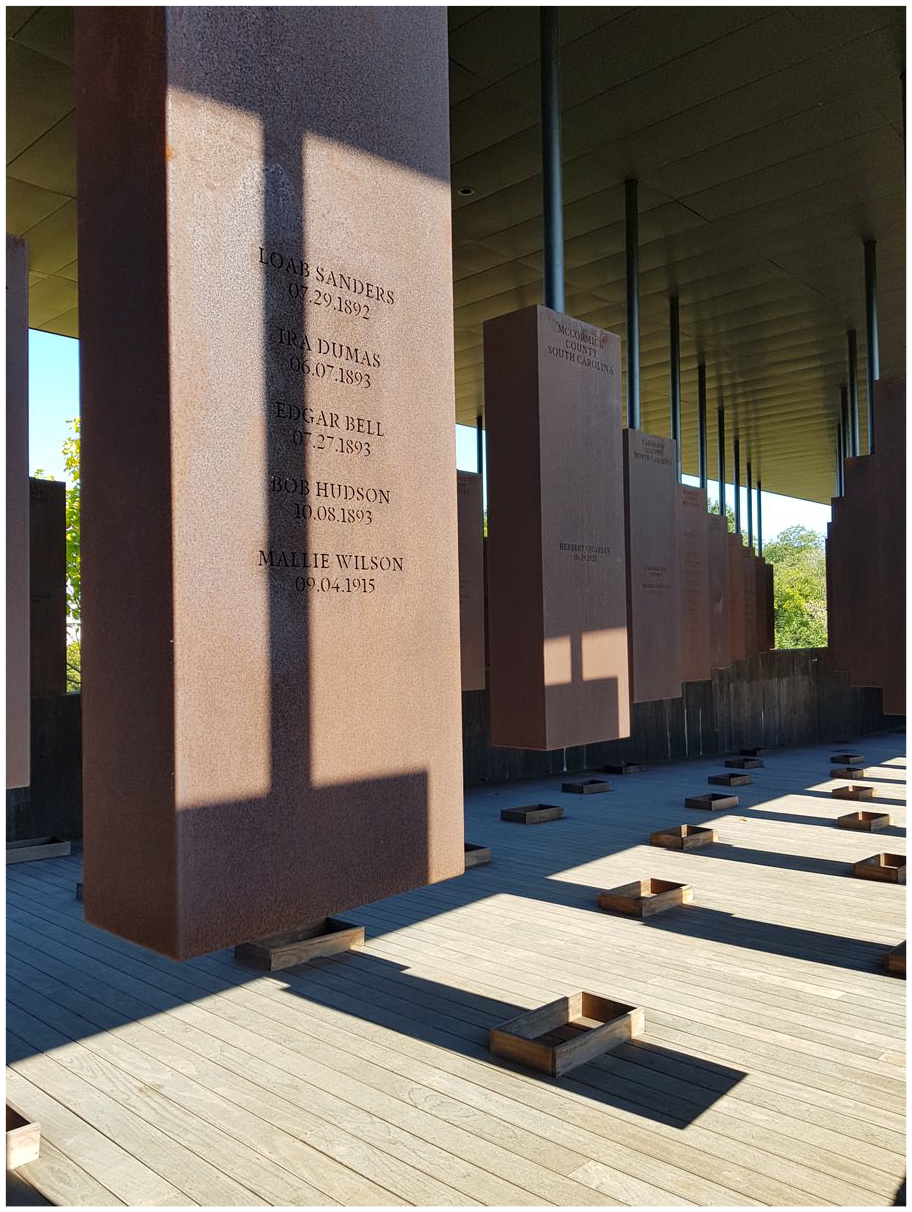
Steel monuments hang from the ceiling of the central memorial space. The floor begins to slope, raising the monuments higher. Author’s photo.
Visitors are directed round the memorial by the design flow; there is one route from entry to exit. But in the main memorial area, each person has to navigate their way round and between the individual columns. The path is neither straightforward nor linear. The floor begins to slope downwards, adding to the sense of uncertainty. The columns rise above your head, a change of perspective which is disorienting. This disorientation is similar to that experienced at the Memorial to the Murdered Jews of Europe in Berlin, another site which was an inspiration for the EJI’s design. Berlin’s Holocaust memorial is composed of 2711 concrete pillars, or stelae, which are laid vertically across a large site. The gaps between the pillars are small and visitors have to navigate their way through the space. The architect Peter Eisenman explained he wanted to create an ‘experience that generates insecurity . . . [a] feeling of being lost’ (Dekel, 2013: 50). Being in the Lynching Memorial can feel oppressive, particularly when the monuments hang above your head. Visitors may feel powerless and overwhelmed. These are the experiences and emotions of the bereaved. The memorial space is marked by stains: rust from the steel columns drips to the floor, leaving patches which evoke blood. The water cascading down the wall splashes and marks the wooden floor. The rust and water provide symbols of what is left behind in the wake of racial violence: the grieving families and friends.
There is anecdotal evidence that the memorial elicits an emotional response from visitors, one which echoes expressions of grief. Visitors to the memorial are frequently moved, often to tears, by the experience. Stevenson told a reporter, ‘You’ll see people – black and white – just weeping’ (Schilling, 2018). In online reviews visitors described their experience as ‘moving’, ‘emotional’, ‘heart-breaking’, ‘overwhelming’ and ‘painful’. They describe being in tears when they move round the memorial. 4 The scholar Renée Ater (2019) writes on her blog, ‘I am surprised at the strength of my emotion when I enter the memorial space. I cannot stop the tears from flowing and my heart aching. I am overwhelmed’. James Johnson recalls visiting the Memorial for the first time and looking for the name of his cousin, Wes Johnson, who was lynched. James encountered a woman looking for the name of her lynched father. ‘It’s sort of like being at a wake, where you can cry on each other’s shoulder’, Johnson told a reporter (Solomon, 2019).
The engraved names on the steel monuments similarly bring forth the traditions of burial and mourning. After all, the names of the dead are inscribed onto gravestones and memorial plaques. Naming is a common trope of memorials where loss and mourning are central themes. At the National September 11 Memorial, the names of those who were killed are engraved around the edge of the central void. The aim, Marita Sturken (2020: 319) writes, is ‘to render the dead present through naming’. People touch the names and there is ‘a kind of intimacy between the visitors and the names’. There is a similar relationship to the names at the NMPJ, though this is complicated when the monuments – and the names – begin to rise out of reach. (As discussed further below, I believe this part of the design re-enacts a kind of bereavement or loss.) Names are the central feature of America’s most influential countermonument, the Vietnam Veterans Memorial (Sturken, 1997). They are also an important element of the design of the Oklahoma City National Memorial (Linenthal, 2001). But there are also several powerful examples of memorials without names (see Apel, 2020: 61–67). Dora Apel (2020: 67) explains that the Lynching Memorial combines two forms of memorialising: ‘the known and the unknown, representing the void of loss without attempting to fill it with redemptive or consoling meaning, while resurrecting the names of those whose names have not been lost and thereby concretizing the loss’.
At the NMPJ, visitors are encouraged to mourn for both the named and the unnamed, the documented and the undocumented. It is significant that there are two explicit references to mourning in the texts at the memorial and both relate to undocumented victims of lynching (i.e. lynching victims who have not been found in the archives, as distinct from those whose deaths were recorded but whose names remain unknown). Near the memorial entrance, one of the boards explains that its purpose is to remember the ‘thousands killed’ and also to remember ‘the countless victims whose deaths were not recorded in news archives and cannot be documented, who are recognized solely in the mournful memories of those who loved them’. After you have left the memorial square and before you reach the duplicates, there is a steel column (Figure 2), the same material and type face as each county monument, which
stands in honor of the countless thousands of men, women, and children who are undocumented victims of racial terror and lynching. . . . Although their names and stories may never be known, we remember and mourn all whose lives were lost during this tragic era of racial terror.
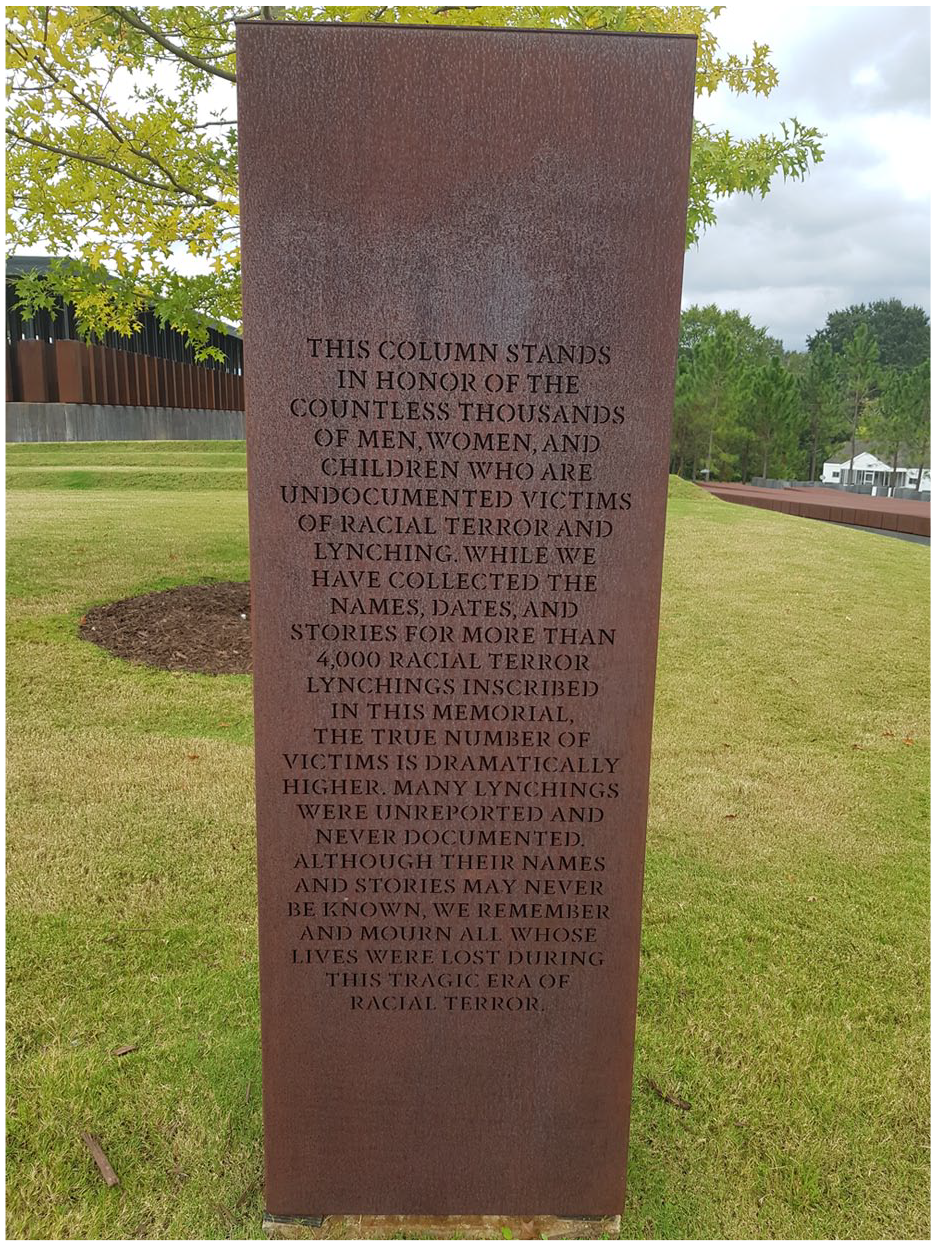
Monument to undocumented victims of lynching. Author’s photo.
At the beginning of the memorial, it is the victims’ loved ones who mourn them but later in the memorial it is ‘we’ who will mourn the undocumented. The experience of moving through the memorial space has transformed us into mourners. This explicit instruction to mourn the undocumented has two-fold significance: it affirms the assumption that visitors will mourn the named (the memorial does not need to ‘tell’ us to do this as it already facilitates this mourning); and it demonstrates that the NMPJ is intended to be a place to mourn even those not named or listed.
Anne Hilker (2014: 30, 35) finds that the 9/11 Memorial, as well as memorials to Vietnam Veterans and the dead of Gettysburg, assists the mourning process ‘by using visual cues of that loss’. They force visitors ‘to perform, or mime, melancholy, to adopt its tradition of downcast glance, preoccupied gaze, and inner questioning’. At the NMPJ there isn’t the downcast gaze of the melancholy. Your gaze is directed upwards, even as you descend downwards. This is due to the specificity of the historical experience being enacted; lynching victims were often hanged, or their bodies were left hanging. One may assume that members of the Black community, who were often required to remove the bodies, would view the victims from this perspective, their eyes pulled upwards by the terrible agony above them.
The comparison with lynched bodies is deliberate. As Stevenson says, ‘the entire point of lynching was to raise up this violence. They wanted the entire African-American community to see the battered, bloodied bodies they destroyed’. Stevenson explains the shift in perspective as you move around the memorial. ‘We want people to have an intimate relationship with these structures. We want you to read the names and touch them’ (Yawn, 2018). Visitors do touch the monuments; their material and their presence make them very tactile. This intimacy allows visitors to forge a connection or relationship to the ‘victim’. As visitors move through the memorial, the monuments begin to rise out of reach. The memorial thus allows the visitor to perform, in a small way, the relationship of the bereaved with their loved one – from intimacy and touch, to unreachable in death. Visitors experience a kind of loss as they move from the first to the second corridor. Tanović (2019: 102) explains that the ‘sensory features of a memorial are normally intended to provide mourners with the necessary environment for facilitating the process of mourning, through the presentation, confrontation and recognition of loss’. The Lynching Memorial re-enacts Black loss in the wake of racial violence.
Visitors encounter the memorials, or victims, again, outside the memorial square. Here the replica monuments are laid out like coffins (Figure 3). The comparison has been made between the Lynching Memorial and a cemetery, but here it is as if the victims are awaiting burial. It is as if they are waiting to be reclaimed and taken back to their place of death, for their final ‘internment’. In this part of the memorial space your gaze is directed downwards. Jay Winter (2017: 150, 145) discusses the ‘horizontality of mourning’, finding in memorials’ horizontal axis ‘the language of mourning and loss’. For most of the NMPJ, the monumental axis is vertical but here it switches to horizontal. This is visitors’ final encounter with the memorials, perhaps a final goodbye. Here the victims of lynching are back within reach: bodies being prepared for burial; open caskets for the final embrace. Indeed, open casket funerals were common in African American communities. A ‘laying-on of hands, touching, kissing, and expressing one’s grief by viewing the remains have traditionally mattered deeply’. The ‘emotional power of the presence of the deceased’ recalled West African funeral traditions and allowed the public display of evidence of the violence committed against Black bodies (Holloway, 2002: 25). The design of the Lynching Memorial allows visitors to perform these rituals so important to Black mourning traditions – to touch and embrace and feel the ‘presence of the deceased’. This is particularly significant because of the ways that, historically, African Americans’ opportunity to perform these rituals was denied. Furthermore, through the act of mourning, evidence of racial violence is publicly presented, with the inscribed monument standing in for the lynched body. 5
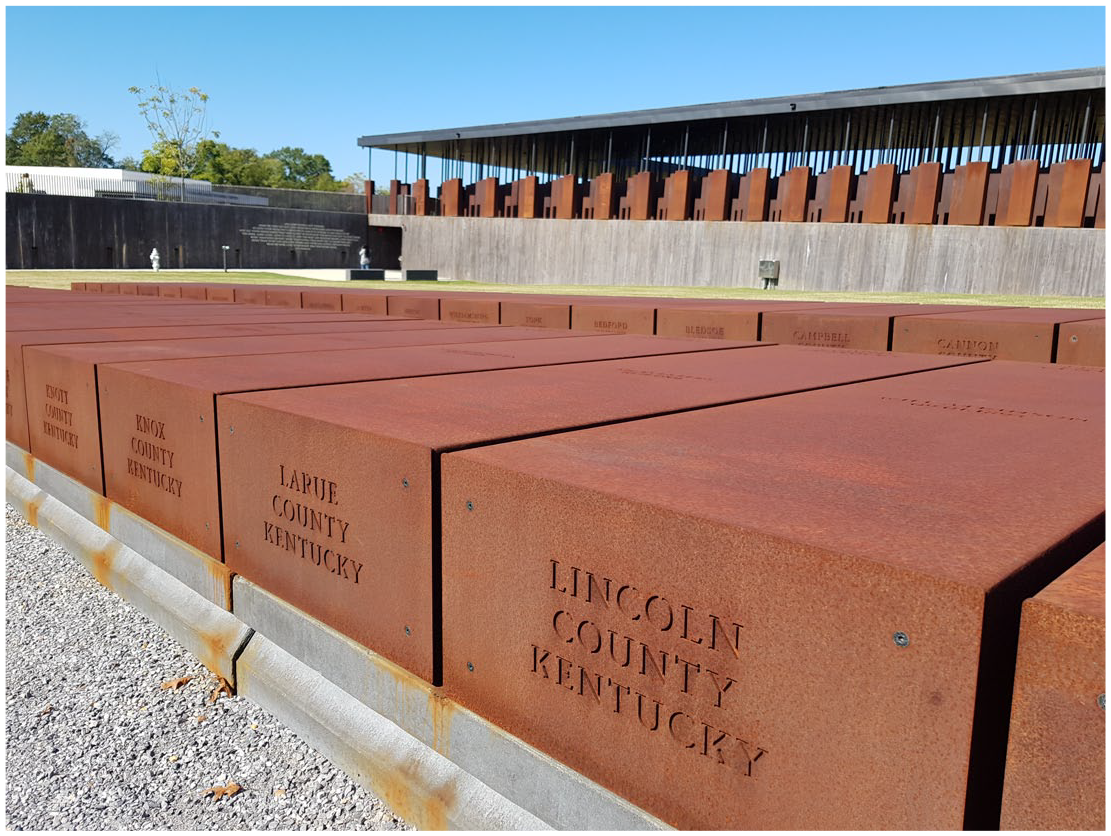
Duplicates of monuments, waiting to be claimed by counties. Author’s photo.
As the ‘bodies’ are claimed for ‘burial’, and counties retrieve their monuments, gaps will appear. The EJI positioned the replica monuments as a way of accounting. Once counties claim their monuments and erect them at new sites, those which remain will provide a ‘report card’ of the communities that have not done the work to secure their memorial (Schilling, 2018). But their position outside the memorial square serves another purpose: laid out by geographical location and arranged alphabetically they are the easiest way for visitors to find individual counties and names. In the main memorial square it is not possible to read the names on all the monuments: some are too far above your head; on others the names have weathered almost to the point of illegibility. It is yet to be seen how the slow removal will affect the experience of mourning at the NMPJ. What will happen when this horizontal axis, this final goodbye, is removed from the memorial space? Similarly, what will an individual monument, alone in its new location, come to mean? Perhaps it will even more closely resemble a gravestone, perhaps the intimacy of touch will be restored, and with this there will be a revival of mourning within the community. Maybe this will be the final ‘homegoing’ for victims of lynching.
Within the NMPJ’s design there is a tension between the individual and the totality of death. The memorial’s purpose requires the scale of violence to be imagined but we cannot mourn a number, only people. Whereas the naming of victims of lynching requires visitors to consider the individuals who died, the uniformity in size and design of the monuments and the geographical arrangement of names, give little sense of the individual lives. In some ways it is a surprising element of the design of the NMPJ. Personalising individual deaths is a common aspect of exhibits at memorial museums. For example, at the Kigali Genocide Memorial Centre there is a wall of photographs of victims and identity cards, which echoes the US Holocaust Memorial Museum’s Tower of Faces. This ‘common memorial trope is intended to restore individuality, humanity, and vitality to those who were killed’ (Sodaro, 2018: 100). Berlin’s Holocaust memorial is striking for its absence of ‘authentic’ objects, such as the piles of shoes or personal effects common at other sites commemorating genocide. In the memorial space above ground, there is no testimony of or from victims (Dekel, 2013: 38). The NMPJ has no authentic objects, no testimony from victims, and, like the Berlin memorial, it is not built on the exact location of the acts being remembered. Some details of individual lynchings are provided on the wall of the memorial, giving details of why and how the victims were killed. But these serve to emphasise the cruel power of white supremacy, not affirm the lives and experiences of those killed. The memorial commemorates the death, and not the lives, of lynching victims. Instead, I contend that the individuality and humanity of victims of racial violence are restored through mourning. It is by marking their deaths through the proper rites and rituals of mourning that their lives are reaffirmed. This is why facilitating mourning is such an important aspect of the memorial. We mourn people, not numbers or statistics, and so it resurrects the individual from the collective. Public mourning insists that these deaths mattered; this is crucial if racial justice is to be achieved.
If there is anything comparable with the authentic artefacts of memorial museums, it is the jars of soil which are displayed in the NMPJ’s visitor centre and in the Legacy Museum, and the cabinet of soil in the memorial itself. These contain soil collected from lynching sites across the United States. The presence of the soil brings the location of the lynchings into the memorial space. It is a spatial sleight of hand that collapses the geographies of racial violence and makes the NMPJ a site of the history it commemorates. The soil, and its collection, is a further reflection of the relationship between memory work and mourning. The soil collections are part of the EJI’s Community Remembrance Project. Soil collections have taken place across the country; sometimes just a couple of people and their jar, others bring together communities and involve family members and direct descendants of lynching victims. Like visitors to the NMPJ, participants in these events enact rituals of mourning. Soil is symbolic of burial and the ceremony of soil collection evokes a funeral. This comparison is often made by those taking part. We can ‘give him [the] funeral that he never had’ said one participant. ‘It was almost as if I was attending his funeral’, reflected another (Anderson, 2019; Poole, 2019). Soil collection is performed as a ‘ceremony’; it is a solemn occasion at which prayers are said and spirituals sung. Flowers are often laid at the site. Descendants of lynching victims sometimes travel considerable distances to attend, just as they would for funerals. Those who participate in the soil collection often describe it as an act to honour the victim. Antony Ray Hinton speaks to the victim whose soil he collects: ‘I hope now that your body is at peace, and that you are at peace’. 6 There is an individualising and humanising aspect to the soil collection. The displays of soil jars at the Memorial Center and Legacy Museum ‘resemble a columbarium, a consecrated space where the dead are named and can be remembered as more than just data or disfigured remains’ (Pierce and Heitz, 2020: 968).
Furthermore, soil collections enact specifically Black traditions of mourning. The ritualistic gathering of the earth is a second burial for lynching victims. The ‘second funeral’ has its roots in West African mourning traditions and was important to enslaved people in the antebellum period. It was ‘considered essential because it allowed all family members to gather to honor the deceased’ and its timing was determined by the availability of a Black preacher to perform the sermon (Smith, 2010: 29; see also Roediger, 1981: 174). Elaine Nichols (1989: 21) describes the continuation of this tradition among Black communities in South Carolina: burial took place as soon as possible (before embalming became common practice) and a ‘second burial’ or ‘pre-sermon’ would occur weeks or months later. In isolated rural areas this allowed time for a preacher and family and friends to attend.
Research into the death practices and beliefs of enslaved people has found that ‘death was often imagined as the ultimate “freedom” from a life of oppression’. It was embraced as the final ‘homegoing’. Death ‘was not only mourned as a loss but also celebrated, since the afterlife signified complete emancipation from the oppression of enslavement’ (Smith, 2010: 17–18). Smith (2010: 3) describes the ways in which this concept of ‘homegoing’ shaped Black funeral traditions through the twentieth and into the twenty-first century, from the ‘settin’ up’ or wake, through the long and emotive funeral service, to the ‘banquet’ to honour the dead. EJI’s commemorative practices share some elements of the homegoing. For example, in Abbeville, South Carolina, the EJI helped place a marker to commemorate the 1916 lynching of Anthony Crawford. At the unveiling, Bryan Stevenson gave a rousing speech about the lynching of Crawford, what happened to him and why. ‘We are here’, the crowd of mostly African Americans, many of them descendants of Crawford, began to chant (Abbeville, 2019). It was a cry of defiance and survival. Those present took no joy in mourning this death or remembering this violence and injustice. But there was joy in celebrating the collective spirit and survival; a celebration which echoes the Black ‘homegoing’ tradition.
This celebration in the midst of mourning – this homegoing – is reflected in the large inscription visitors at the Lynching Memorial see as they leave the main square. On the wall is a famous passage from Toni Morrison’s Beloved:
. . . And O my people, out yonder, hear me, they do not love your neck unnoosed and straight. So love your neck; put a hand on it, grace it, stroke it and hold it up. And all your inside parts that they’d just as soon slop for hogs, you got to love them. The dark, dark liver – love it, love it, and the beat and beating heart, love that too. More than eyes or feet. More than lungs that have yet to draw free air. More than your life-holding womb and your life-giving private parts, hear me now, love your heart. For this is the prize.
At a memorial to victims of lynching, the passage reminds visitors of the violence committed against Black bodies. But it is not a cry of despair. Writing to and for African Americans, Morrison sends a message of strength, of resilience, of love. This is communicated through the context of mourning. Beloved is a novel about loss and grief. As Karla Holloway (2002: 3), in her important work on African American mourning traditions, explains, ‘Black death is a cultural haunting, a “re-memory” along the lines of that found in Toni Morrison’s novel Beloved, which insists that “not a house in the country ain’t packed to the rafters with some dead Negro’s grief”’. This passage on the walls of the Lynching Memorial, as visitors emerge from the dark oppressive memorial square into the daylight, is a reminder of Black resilience, of surviving beyond their grief. It is a reminder to celebrate Black life while remembering death.
The NMPJ has become a popular tourist destination. 700,000 people visited the memorial and museum within the first 2 years of opening (Schult, 2020: 38). To be truly effective as a place for reconciliation, the memorial must speak to as many of those visitors as possible. The significance and experience of visiting the Lynching Memorial will differ depending on a range of factors, not least race. The memorial is a Black space, one which is created by and for African Americans (particularly when viewed in contrast to historic spaces, such as plantations, which have been claimed as ‘white’, through marginalising or annihilating Black histories). However, it is clear that the creators also intended non-Black visitors to engage with the space. Bryan Stevenson sees the memorial as somewhere for white visitors to feel shame. There are compelling arguments for the utility of shame in a commemorative space and I believe it is necessary for white people to acknowledge their complicity in both these histories and their ongoing legacies. However, I believe that the more important element of the memorial’s design is the way in which it elicits mourning. Mourning is more inclusive than other emotions, such as shame, and therefore has greater transformative potential. Black visitors to the memorial have no reason to feel shame, and many other, particularly non-US, visitors may also reject those feelings of shame (even if that rejection is misguided). But visitors of all races, ethnicities and nationalities can mourn. Indeed, some scholars have argued that mourning is a way to create community. Linenthal (2001: 111), discussing commemoration of the Oklahoma City bombing, argues bereavement is ‘one of the only ways Americans can imagine themselves as one; being “together” with millions of others through expressions of mourning bypasses or transcends the many ways in which people are divided’. Memorials can establish a community which is ‘united in mourning and in the resolve to prevent the cause for such grief and suffering in the future’ (Arnold-de Simine, 2013: 76).
Judith Butler (2004: 30) asks, ‘Is there something to be gained from grieving?’ They suggest that mourning might return us to a sense of both ‘human vulnerability’ and ‘collective responsibility’ for others. It might make us identify and work to challenge the conditions which mean ‘certain human lives are more grievable than others’. Using Butler’s formulation of mourning, the Lynching Memorial allows and encourages us all to mourn for its dead and for us all to seek to change the conditions which produced not just these deaths but the continuing deaths of those otherwise deemed ungrievable. Sturken (2018: 70) powerfully summarises Butler’s argument: ‘It is a deeply radical act to mourn a stranger’. Landsberg (2004) uses the concept of ‘prosthetic memory’ to explore how people can have a personal and felt memory of a past that is not their own. The NMPJ does not need to create this prosthetic memory for visitors (who are not African American) to develop a personal connection to this past, precisely because it uses the rituals of mourning. As Silke Arnold-de Simine (2013: 125) explains, Butler’s theory means there is no need for prosthetic memory because it suggests that we are ‘implicated in the lives of others’ and this allows us to recognise our collective responsibility. The NMPJ can be seen as a model for the radical potential of mourning. It creates a space in which all visitors can mourn for the victims of lynching. In that mourning, they reaffirm the grievability of those deaths and the importance of those lives.
Visitors are asked to question how and why the deaths took place. If the NMPJ and the Legacy Museum are successful in realising the EJI’s aims, then those questions are answered by understanding the continuing legacies of enslavement and white supremacy. After all, the EJI’s memory work insists that visitors have a collective responsibility to acknowledge not just the crimes of the past, but also their continued presence and ramifications. This is most powerfully articulated at the memorial site through Hank Willis Thomas’s sculpture, Raise Up, in which the arms and heads of Black men emerge from a concrete wall. Stevenson describes it as a ‘police-violence sculpture’, and while it was based on a photograph of South African miners, it now evokes the cries of ‘Hands up, don’t shoot’ from Ferguson’s Black Lives Matter protests (Battaglia, 2019; Goldstein, 2020). Claudia Rankine (2015) calls for a ‘sustained state of national mourning for black lives’. Grief for the dead, she suggests, ‘might align some of us, for the first time, with the living’. The NMPJ, by encouraging visitors of all races to grieve for the victims, is one part of that national mourning. It is mourning, rather than shame, which has the greater potential to move society towards racial justice.
For the African American community, the experience and the importance and potential of mourning at the Lynching Memorial is different. Mourning is not only a way to create a political community for action but is a radical act in itself. Since the earliest days of slavery, Black people have been told that they should not grieve for the lives they have lost. It was an act of resistance to mourn during the lynch mob’s heyday; it is an act of resistance to mourn now. The EJI’s commemorative work, from the memorial through to the soil collection ceremonies, provide an opportunity to mourn collectively. The families, friends and communities of lynching victims were so often denied the chance to publicly mourn. Their grief was disenfranchised. Romanoff and Terenzio (1998: 705) explain, ‘Successful grief resolution requires . . . disenfranchised grievers to publicly take their places in the community of mourners’. The legitimacy of their loss must be acknowledged. This is what commemorative mourning does. Present-day members of the African American community stand in for those original disenfranchised mourners. These commemorative spaces and actions thus offer the potential for healing. The NMPJ provides a place for Black people to safely talk about – and experience – the anguish of history. In this way, the Lynching Memorial should be understood as a Black commemorative space and a site of Black mourning.
Black mourning – the mourning of and by Black Americans – is not only significant because it is political or can be understood as resistance. It is important to recognise these emotions and these experiences in their own right. Sasha Turner’s and Rhaisa Williams’ work on grieving Black mothers is instructive here. Turner (2017) seeks to ‘affirm’ the loss of enslaved mothers and Williams (2016: 27) explains that Black maternal grief has been dismissed. She calls for us to ‘honor the private, individualizing experiences of grief, while equally honoring the social and communal aspects that grief reverberates against and affects’. Their work provides an important reminder when considering Black collective grief, such as that prompted by racial violence. It is necessary to acknowledge that Black Americans visiting the NMPJ may feel intense emotions of sadness, loss and grief, even if they are not directly related to or descended from victims of lynching. Rosenblatt and Wallace (2013: 168, xx) explain that African Americans often experience a ‘cultural grief’, a ‘collective loss from the ongoing oppression’ and ‘grieving about losses in general, not about the death of any particular person’. A respondent in their study of Black grief told them, ‘We’ve got to reclaim our grief, and we’ve got to insist on it. . . . And we’ve got to grieve both individually and collectively’. Claudia Rankine (2015) puts it even more succinctly: ‘the condition of Black life is one of mourning’. The NMPJ acknowledges Black mourning by providing a space for that mourning. The Memorial is an acknowledgement of the loss and trauma of lynching, and of the mourning that followed it. It also provides necessary space to acknowledge the continued trauma and grief of racial violence.
As visitors reach the end of the Lynching Memorial, they may pause in front of a final monument. Inscribed on the simple black column is an ‘Invocation’, written by the poet, Elizabeth Alexander. She speaks to the dead: ‘Here you endure and are luminous/. . .Nothing is lost’. Her poem beautifully captures the purpose of the EJI’s monument to the thousands of African Americans killed by lynch mobs: the need to reclaim and to remember. In acknowledging not just the dead but also those left behind and their loss – we hear ‘a moan, a sorrow song/ a keen’ – it also powerfully encapsulates the importance of mourning in this commemorative space. Enacting rituals of mourning forces a reckoning not just with the act of lynching, but with what was left in its wake. Society needs to understand the grief and the loss caused by white supremacy, if its members are going to work to prevent further loss. It is through mourning that the grievability of Black lives is affirmed. The hope is that it becomes impossible for Black life to be disregarded by white society. Creating a memorial which is a site of mourning provokes a confrontation with the aftermath of racial violence; perhaps it is only in this way that true justice can be achieved.
Footnotes
Funding
The author disclosed receipt of the following financial support for the research, authorship and/or publication of this article: Research for this article was conducted with support from the British Academy.
