




Abstract
Selfies at Auschwitz have become increasingly popular, and have generated agitated public debate. While some see them as an engaged form of witnessing, others denounce them as a narcissistic desecration of the dead. We analyze the taking, composition, and circulation of several of the most popular selfies of Auschwitz and the online reactions to them. The practice of selfies marks a shift from witness to witnessee and from onsite to online presence. Yet it also builds on previous practices: photography, postcards and souvenirs, the affordances of the architecture of the memorial site, the bodily presence of the survivor-witness as mediator of the Holocaust, and the redemptive value assigned to the physical presence of the visitor as “witness of the witness.” We suggest that the combination of continuities with the past alongside the radical break with previous witnessing practices empowers selfie-takers, while arousing the indignation of gatekeepers of Holocaust memory.
Keywords
Introduction
In a short catchy hip-hop satiric video released in January 2018, standup comedians Reggie and Sig (Rotem Weisberg and Tal Michelowitz) play two teenage girls who visit Auschwitz as part of an Israeli school pilgrimage to Poland. 1 They chew gum, wear red lipstick and sunglasses, and speak in youthful slang about Auschwitz. “Wallah, Auschwitz, this is a thing,” one says, while the other muses, “Auschwitz, it’s a dream come true”; “We are so cool we came here, it is so important” says the other. When they arrive at the piles of victims’ shoes on exhibit, one declares she has to take a photograph for her mother’s uncle Effie. To that, her friend responds, “c’mon sister it’s time for a selfie.” Grabbing her friend, the two girls pose for a selfie with the piles of shoes in the background. The teacher and delegation leader immediately intervenes, shouting at them: “to take a selfie in Auschwitz is not respectful!” The line is then repeated over and over in the following song.
The short YouTube video generated furious responses in Israel, ranging from anger to disgust to insults. The performers later read out some of these responses on screen: “Baruch Shapira writes: Is this a song? I want to throw up; two stupid bimbos that, besides bad smell, nothing will be left of them”; “Itzhak Wolesky writes: Disgusting”; “Dalya Burg writes: two anti-Semitic bitches,” and so on. 2 This example shows both the popularity and the disruptive potential of a phenomenon extensively discussed in popular media and, more recently, in academic papers: selfies in Auschwitz. As a death-factory, memorial, and mass cemetery, Auschwitz-Birkenau has become the iconic Holocaust site, with 2.3 million visitors in 2019. Over the last 15 years, visitors increasingly remember the site by taking selfies at Auschwitz, circulating and posting these photos on various social media platforms. This makes Auschwitz selfies an excellent gauge of collective memory of the Holocaust—both as representation of the past and as a way of mediating the present.
The categories through which we understand the Holocaust are mediated, not only by generational distance from the event, but by iconic landscapes, images, and commemorative practices. To the immense literature on Holocaust memory, a literature that is a product as well as generator of the memory boom (Assmann, 2006: 210–211), Amit Pinchevski (2019) adds the key role of media technologies. Technologies mediate memory and therefore determine what we consider as memory. Thus, the shift from analog to digital technologies changes our notions of memory. Among the effects of this shift are commemoration without co-presence (Ebbrecht-Hartmann, 2021: 1103–1109), the detachment of memory from monuments and memorials, the move from a public to a more restricted commemoration (Kook, 2020: 976), and the changing authority of the gatekeepers of memory. While these shifts facilitate the circulation of Holocaust memory, they also arouse the indignation and disgust of those for whom the existing representations have become sacrosanct—indeed, the way the Holocaust should be remembered. In this article, we trace these processes by examining selfies in Auschwitz-Birkenau.
What makes the Auschwitz selfie both popular and controversial in the current digital generation? Is there something about the aesthetic representation or emotional expression of selfies that make them a lightning rod for polemics around representation of the Holocaust? What effect do selfies have on the experience of visiting canonical memorial sites like Auschwitz? How do selfies challenge or empower gatekeepers of memorial sites? To what extent are selfies seen by their takers as an act of witnessing and how do their practices relate to the demise of the last survivor-witnesses? The answers to these questions reflect wider discussions on the importance of place in Holocaust memory, the changing structures of authority in an age of digital and social media, and the importance of the body in bearing witness to the past.
To answer these questions, we first trace how the passage of generational time and changes in media technologies affect the representation of Holocaust memory. We then focus on selfies, exploring their relation to their predecessors—postcards, and photographs at concentration camps, as well as the affordances for selfies at the memorial site. We consider the impact of selfies at three major moments: (1) The production of the selfie, and its effects on social solidarity with on-site and visitor communities; (2) the reproduction of the selfie, through aesthetic centering of the visitor’s face, the facial and bodily expressions chosen to be posted, and the addition of filters and emojis; and (3) the circulation of the diffused image on various platforms, and the reactions to them by viewers and memorial curators. While selfies at Holocaust memorial sites have been analyzed in several recent articles (Bareither, 2021a, 2021b; Commane and Potton, 2019; Dalziel, 2016; Douglas, 2020; Hodalska, 2017; Lundigren, 2020; Margalit, 2014; Nunes, 2017; Zalewska, 2017), most have explained and often justified the (expressed or alleged) motivations of the selfie-takers as acts of engagement and commitment. By charting and historically contextualizing the practices of selfie-takers as well as their denouncers, we provide a thicker description of various stages of selfie production, reproduction, and circulation. We thus illustrate the importance of identification, empathy, and corporeality for a digital generation with only distant links to the Holocaust.
We identified several highly popular images through a search of the keywords “selfie + Auschwitz” on English and Hebrew-language Google searches from Israel, as well as through the popular websites Quora and Reddit from January 2020 to January 2021. We included selfies and responses to selfies from various perspectives, while excluding deliberately provocative ones, such as those displaying Heil Hitler salutes. The selfies that we analyze in greater depth, “Princess Breanna” (Figure 1) and “The Angels of Auschwitz” (Figure 2), generated the most discussion and controversy. These exemplary cases make explicit what is often said briefly about less popular ones. The posted selfies and the reactions they engender trace categories affirmed or challenged in contemporary Holocaust memory discourse.
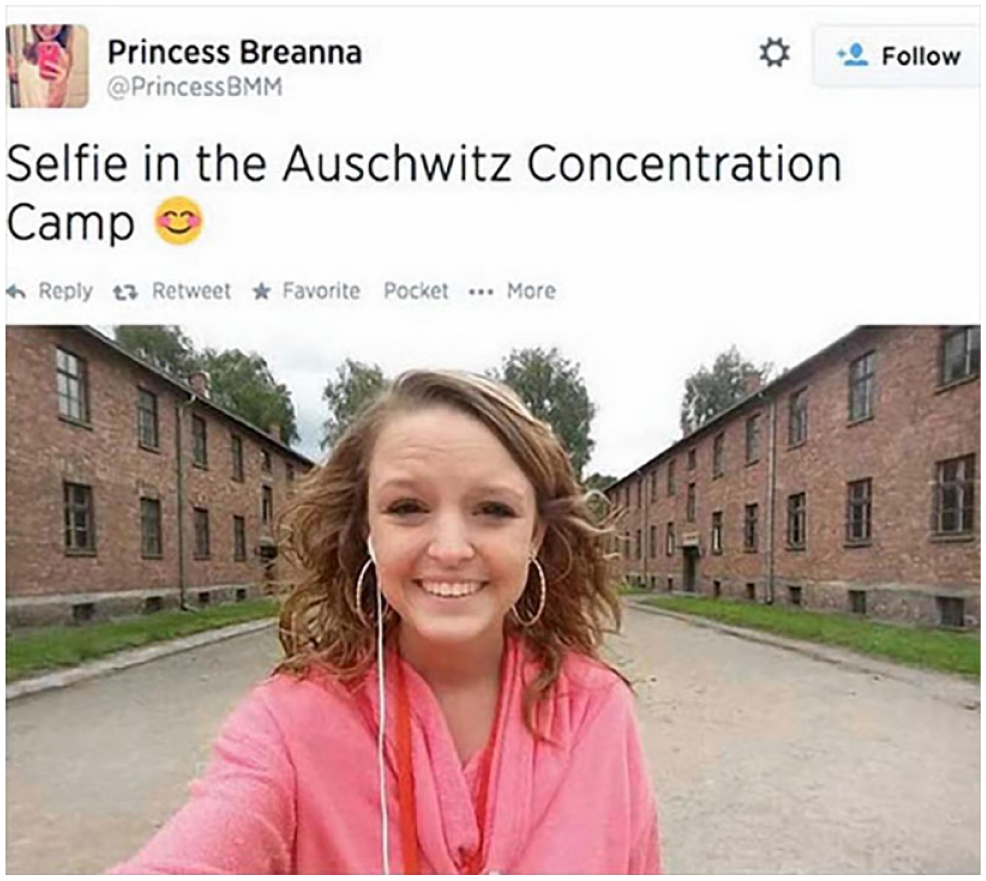
Breanna Mitchel’s selfie as it was posted publicly on her Twitter account on 20 June 2014.
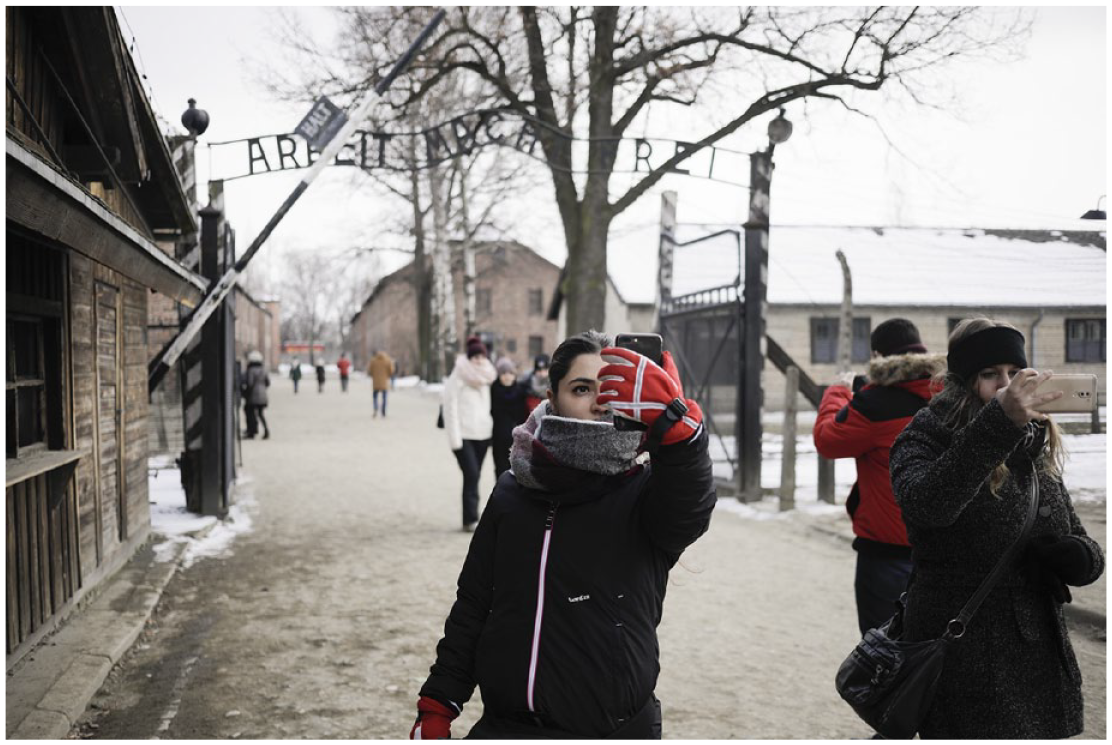
Visitors take “selfie” photographs near the main gate at the Auschwitz-Birkenau concentration camp museum in Auschwitz-Birkenau, Poland, on Wednesday, 28 February 2018. Photographer: Piotr Malecki/Bloomberg via Getty Images.
Shifting generational representations of Holocaust memory 3
Holocaust representations have been shaped by changing political, linguistic, and social circumstances, as well as by the passage of time marked by generations. A generation is a social and cultural group that shares common experiences, even a common destiny, by virtue of historical events that occur in their members’ lifetimes (Corning and Schuman, 2015; Jureit and Schneider, 2010; Mannheim, 1952), as well as by its positionality respective to other generations. In the case of the Holocaust, after an initial post-war period of silence on the part of many survivors and the silencing of the witnesses in Israel as elsewhere, various countries erected memorials and, later, museums. Generations that have little or no access to the event through personal experience or family eyewitness accounts rely on what Marianne Hirsch termed “postmemory,” a memory “mediated not by recall but by imaginative investment, projection, and creation” (Hirsch, 2012: 5). This kind of memory has also been called “prosthetic memory”—a memory transmitted through media (like films, memorials, museums, and ceremonies) that has integrated itself into our recall, even though we have not experienced it directly (Landsberg, 2004).
Historian Annette Wieviorka (2006) named the period from the Eichmann trial in 1960 through the 1990s, “The Era of the Witness.” The recorded eyewitness testimony of the survivors replaced the documents of the perpetrators at center stage. Survivors’ and victims’ objects were collected and the places of their former lives and suffering were marked and signposted. Holocaust museums erected in the 1980s and 1990s throughout the Western world centered on the personal experiences of the victims and survivors. 4 As Levy and Sznaider propound, the Holocaust became a universal “moral touchstone in an age of uncertainty and [in] the absence of master ideological narratives” and “a moral certainty that now stretches across national borders” (Levy and Sznaider, 2002: 88); these forms relied on evoking empathy with the fate of individual victims.
Technological innovations have always changed the nature and possibilities of memory—whether it be the invention of alphabetic writing, photography, or television. In the 1980s, the memory of the Holocaust was shaped by innovations in media technologies and representations, such as the Yale and, later, USC Video Archives (Shandler 2017: 125–175). As a result of this new visual technology, not words (as in documents or written materials) but the bodily presence of the aging witnesses became the sign of authenticity. The facial expressions, tears, stuttering, and silences of the survivor-witnesses became hallmarks of “deep memory” (Langer, 1991; Laub, 1992). In Pinchevski’s words, “the technological unconscious of trauma and testimony discourse is the videotape as an audiovisual technology of recording, processing, and transmission” (Pinchevski, 2012: 144).
Over the last two decades, the generational divide between older and younger generations is most crucially defined through their relation to digital media. Sociologist Hartmut Rosa (2015: 45) argues that “‘digital natives’ belong to another ‘country’ and the ‘digital generation’ is separated by a huge gap from the ‘analog’ generation.” Digital and social media further specific social changes: traditions become detached from moorings in particular locales (Thompson, 1996: 99), while the mediation of tradition, including the social solidarities generated by co-presence, become detached from personal face-to-face interaction (Hoskins, 2017: 85–109). Finally, the greater capacity for user interactivity may bypass the gatekeepers of knowledge and memory, challenging the authority of educational and memorial institutions. The changes incurred by the rise of digital media may be accelerated by the passing away of the last of the eyewitnesses or flesh-witnesses, thus affording greater space for electronically mediated representations to fill in the gap and foster other forms of remembering. These historical-technological shifts may generate new understandings of the relationship between traumatic memories of the Holocaust and new forms of media; but they may also engender resistance and moral indignation from those cognitively and institutionally invested in older memory forms.
Selfies in Auschwitz
In 2013, the Oxford dictionary proclaimed “selfie” as the word of the year, defining selfie as “a photograph that one has taken of oneself, typically one taken with a smartphone or webcam and uploaded to a social media website.” These photographs are reproduced and circulated over digital platforms and thus linked, liked, shared, and saved. Selfies are usually playful, fast, and spontaneous (although frequently carefully framed) and their main purpose is to be seen by other people in the immediate present through social networks. Selfies bear a genealogy going back to painted and photographed self-portraits, while at the same time innovating new relations between the self and the media and the self and the imagined audience of the selfie. From the moment a selfie is uploaded, the production of metadata begins: the date, the time, and the place that the photograph was taken or uploaded, the people that are tagged in the photograph, and the people that are “recognized” in the photographs are added as it circulates.
Photography, Holocaust memory, and self-visualization
Historical photographs show what once was there. Photography reveals things that can no longer be seen in the present, connects us to the past, and provides us a way to remember. As Roland Barthes (2010 (1981)) asserts, photography makes the past as certain as the present, it freezes time and creates certainty about the past (Barthes, 2010 [1981]: 14). In the context of the Holocaust, “it is difficult to contemplate the Holocaust without traces of familiar visual images coming to mind” (Zelizer, 2001: 1). At Auschwitz, photography has been an essential part of Holocaust memory and commemoration, since the liberation of the camps, when German citizens were shown pictures of atrocities in exhibits in nearby concentration camps and in the press (Brink, 2015 [1998]: 23–99). The museum and memorial site legitimize photography by making extended use of it in their exhibitions, staging televised ceremonies and political visits at the site, and holding an active Instagram account.
Unlike postcards of Auschwitz, in which the site appears empty (Reynolds, 2018: 233), group photos at Holocaust death sites may be ways of forging new family and community relationships among the living. The presence of young visitors at the iconic sites of death may be proclaimed as a sign of survival and redemption, as in the case of the masses of Israeli-flag-robed youths, lined up for photos at the entrance to Auschwitz (Feldman, 2008: 138 and see Figure 3). The newspaper and televised images of clerical leaders and politicians at Auschwitz, from John Paul II to Binyamin Netanyahu, have long made the entrance of Auschwitz a legitimizing backdrop for political agendas, often through staged commemorative media events. Thus, the photos of Auschwitz, which precede the invention of selfies, assert the subject’s storytelling rights, proclaim a particular relationship to the Holocaust and may, in turn, be contested (Zubrzycki, 2006).
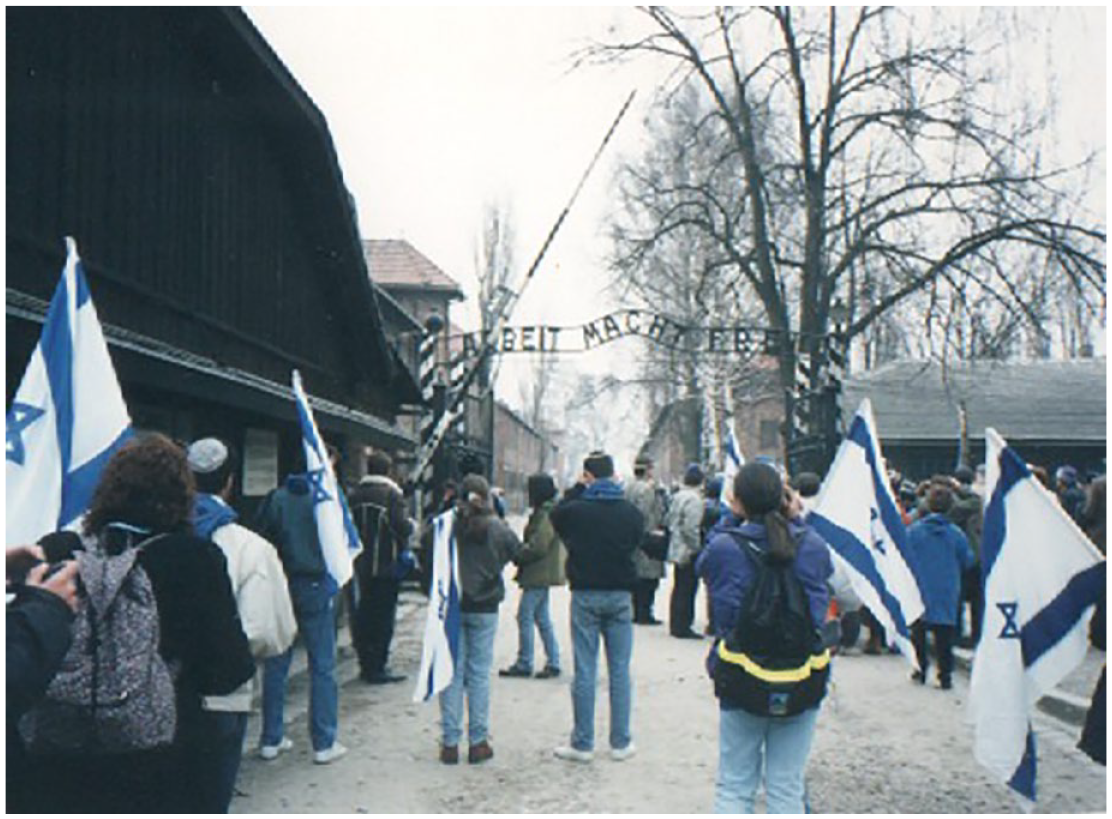
Israeli youth delegation members (1993) taking photos at the iconic entrance to Auschwitz. Photograph by Jackie Feldman.
Photographs that show groups or individuals visiting Auschwitz have circulated since the site opened to the public, and have become part of how the site is experienced (Reynolds, 2018: 111). Based on one author’s experience 30 years ago, the two most prevalent types were photographs of survivor-witnesses at the site, sometimes along with students, and group or individual photos with flags at iconic sites. Organizers and students often spoke of these pictures as an act of testimony, appending to them texts in which they refer to themselves as witnesses or “witnesses of the witnesses” (Figure 4).
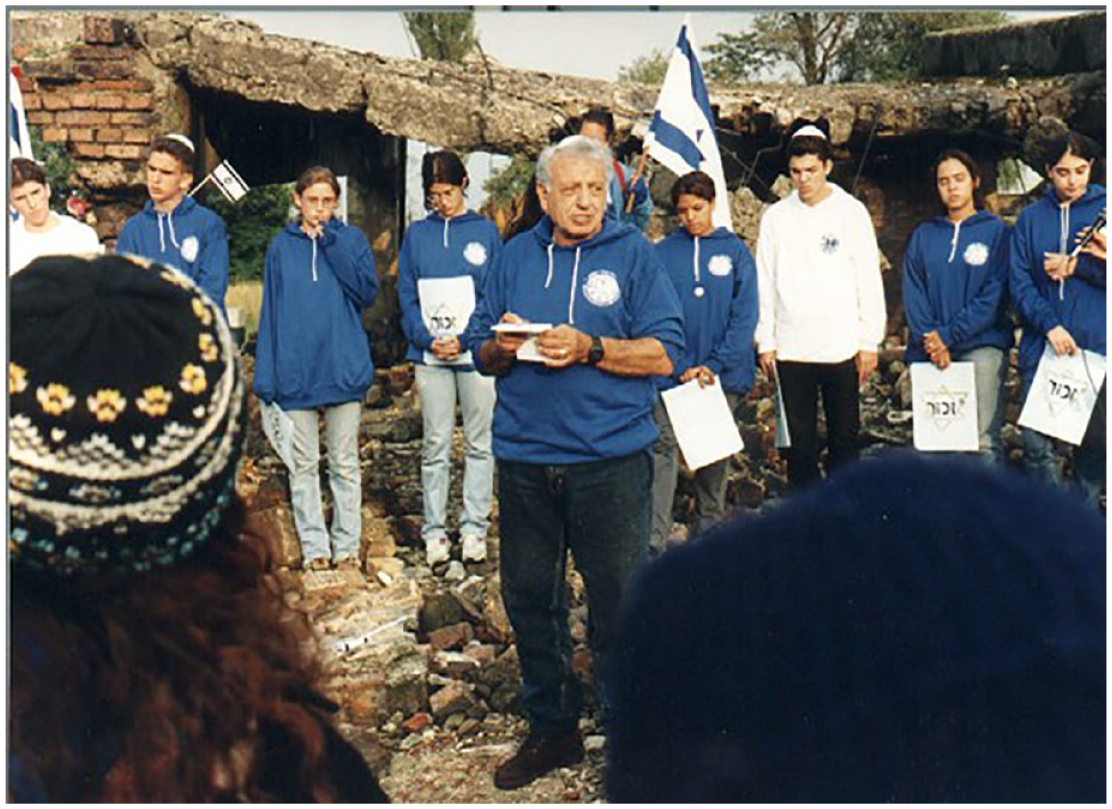
The survivor-witness (1993) reading a tribute to his murdered family at a delegation ceremony on the ruins of the crematoria. Photograph by Jackie Feldman.
Udi Nir, director of the documentary film on Israeli Auschwitz visits #Uploading Holocaust, noted an important change he called, “the touring around of the camera”:
If in the 80s, when these journeys started, people who went there tended to film the places they came to see, as the years went by, people started to film mainly themselves in those places. The people who were commemorating become the center of the commemoration. (Garaev, 2016)
A very common practice is the performance of a lonely “view into the far of the field.” Here, visitors, viewed from behind or from the side, are portrayed as lost in their thoughts while—seemingly unaware of the camera’s presence—remembering the past. (Bareither, 2021a: 584–585).
Thus, selfie-taking has its roots in previous photographic practices and embodied gestures of contemplation, but in the current digital moment, it seems that the mediation of the experience through the photograph is even more necessary than ever. Especially by inserting themselves in the photograph and looking straight forward at the camera, selfie-takers become part of the picture. It is at the moment when the selfie-taker clicks the shutter and thus reproduces the iconic image (viewed in previous selfies) that they know they have been there and part of that “knowing” is that now there is an audience that knows with them.
The most popular image that comes up in digital searches when combining the search words “Selfies + Auschwitz” is the image of Breanna Mitchell, Princess Breanna on Twitter.
In the center of the frame (Figure 1) a young woman looks straight into the camera, at the implied audience of the photograph, smiling. She is positioned exactly at the intersection of the two diagonal lines traced by the buildings on her right and her left, highlighting her heroic centrality. It seems a light wind is touching her hair like in a poster for a teen movie or a shampoo advertisement. In her tweet, Princess Breanna added the following caption: “selfie in the Auschwitz concentration camp” and a blushing smiling emoji. The tweet was re-shared and circulated extensively. Breanna was accused of being insensitive and disrespectful. She received over 6000 hate messages within 24 hours of posting that photograph, including “Why would you be fu—g smiling?”; “so deep wtf”; “guessing you hate Jews?”; “There are some apocalyptic idiots on this planet . . .” and more. Throughout the comments, the opposition focused on Breanna’s turning her back to Auschwitz, her centering of the photo on her face, her smile at the site of death, her right to speak on behalf of the dead, and the overall appropriateness of taking a selfie in Auschwitz.
In a subsequent video interview, Mitchell explained that she spent much time studying history with her father, and that the most recent subject they studied together before his death, exactly 1 year before, was World War II. She took the photo to honor her father. This calmed some of the more vociferous critics, as her selfie might be interpreted as an act of family mourning. Thus, we might say, that through her explanation, Breanna turned around to face the site, placing herself in the position of mourner. Notwithstanding these explanations, Breanna’s tweet continued to generate anger, fury, and indignation that circulated far beyond the limits of her twitter community.
Positioning the self in the frame
The self-visualization of selfies can be understood as part of a long tradition of self-portraits that use different technologies to see and seek to better understand the self. Self-expression and self-production are central to selfies. As art critic Jerry Saltz writes, selfies are never accidental:
Any selfie that you see had to be approved by the sender before being embedded into a network. This implies control as well as the presence of performing, self-criticality, and irony. Since while taking a selfie, its distributor made it to be looked at by us, right now, and when we look at it, we know that (and the maker knows we know that). (Jerry Saltz, 2014)
Self-portraits as selfies create a record of how we want to remember ourselves and how we want to be remembered. That is, the selfie culture creates strategies for reenacting the self through new-old modes of expression but also through new modes of co-presence, of being with others through our disembodied presence on the screen. As Yasmin Ibrahim wrote,
seeking to extend our mortality through the virality and immortality of the screen conveys the complex interplay of tensions in the digital age, where our disembodied presence online and its constant anxieties with death and elongation of mortality carve out strategies to commodify and aestheticize the self through and with the screen. (Yasmin Ibrahim, 2021: viii)
In the case of selfies in a death camp, anxieties about death become even more tangible, and arguably the need to validate the living body is more pressing.
Selfies change the subject position of the photographer. If the photograph documents a place or person, “the selfie validates the authenticity or realness of our presence at a particular time and place” (Kattago, 2020: 13). It documents the selfie-takers endowing them with cultural capital that can then be translated into other forms of capital (social, political) in social media.
If Holocaust memorial sites are places to connect to the previous generation, to acknowledge atrocities, and to learn from the past, the playfulness of the selfies that now mediates the experience of the place may rupture this commemorative reflection (Kattago, 2020: 113–114). Seeking the perfect frame, selfie-takers may remove themselves from the present moment by projecting themselves to the near future (e.g. calculating the number of likes and shares), thus becoming absent from the moment of the present. The selfie photo, once taken, occasionally undergoes selection from among several variants before being posted; it may be posted as black-and-white, or may have emojis or “filters” added to it, as in the case of the “angels from Auschwitz.” It may be shared on a variety of platforms, from Holocaust commemorative groups to dating apps. In this sense, selfies can be understood as a technology of distraction as opposed to experiential immersion. As Andrew Hoskins notes,
there is a digital creeping inversion of the relationship between the sanctity of the occasion and its vulnerability to hyperconnective interruption. The more special the moment, the greater the compulsion to render it grey and digitally deferred to another (and even real-) time, another “social” network, another archive. (Hoskins, 2017: 103)
The sense of disrespect is further aggravated when the selfie-taker strikes a humorous or ironic pose, apparently signaling their distance from the site of memory as a post-tourist gesture. And while flippant bodily positioning, laughing, and horsing around at concentration camps have been documented for decades, selfies, selfie sticks, and social media make these behaviors far more visible.
Selfies invite those who look at them to react in ways from viewing other photographs. Moreover, since selfies are usually uploaded to the web almost at the moment of being taken, they are arguably not a snapshot of the past, but a snapshot of the present that can affect it and eventually change it. As Yasmin Ibrahim notes (2021: 86–88), whereas theorists of photography (such as Barthes) emphasized photography as a way of freezing motion as a kind of death, selfies begin instigating new life at the moment they are taken, since at that point they begin to circulate—they become an act of sociability and active communication. Therefore, selfies are not only the product of an action (the photograph) but also an action in itself, a performative practice. The gesture of holding a camera, looking into it and taking a snapshot is part of the selfie itself, as Paul Frosh (2015: 1621) has noted. It consolidates the selfie as a “reflexive image” and therefore as an image that cannot be analyzed strictly in terms of its aesthetic composition, or visual design. Selfies, then, need to be understood in relation to the affective gesture they perform both at the moment of their taking as well as in the multiple moments of their circulation.
Selfies as Holocaust Souvenirs
Photography has long been an important part of sightseeing at Auschwitz and other sites of atrocity. Among the productions that tourists undertake is the creation of material assemblies that help them explore the relationship between travel and the everyday: photo albums, shopping goods, and souvenirs. These material objects are not just cheap trinkets; they can often be indexical, physical manifestations of the more intangible experiences, memories, and stories that tourism generates. Sharing selfies with friends may be a way of kindling interest in the subject for those who could otherwise care less. Moreover, selfies may extend the life span of experiences of touring or pilgrimage, most recently through the “popping up” of old photos on social media and digital platforms on the anniversaries of their first recording.
As with many pilgrimages to sacred sites, relics of the death-camps serve as authentication of the visit and material anchors for storytelling to others (Feldman, 2008: 233–241). While the demand for multi-sensory accessibility to Holocaust relics and the kind of objects taken home from the visitors site may vary from one visitors’ group to another (Polzer, 2007: 707–714), the iconic photos of the death-camps, especially the Arbeit Macht Frei arch and Birkenau entrances, serve as a kind of universal signifier of the Holocaust.
Furthermore, the Auschwitz Memorial authorities delimited the memorial area of the camp to exclude buildings still in use by residents of Oswiecim or needed for the site administration, emplacing the Arbeit Macht Frei arch as the iconic entrance to the camp-as-Dante’s inferno (Dwork and van Pelt, 1994: 236–237). Consequently, the Arbeit Macht Frei gate, used by few prisoners when the camp was in function, first became the main entrance to the site with the establishment of the Auschwitz-Birkenau Museum and Memorial in 1947. It seems as if the site was shaped with the future iconic photograph (or selfie) in mind; in other terms—the site creates affordances for selfie representation (Bareither, 2021b). The centrality of the arch was reinforced through the postcards produced by the Memorial since the late 1940s (Reynolds, 2018) and continues to be represented through the selfies taken under the gate. Thus the iconic sign calls for iconic photographs (Hariman and Lucaites, 2007; see Figure 5).
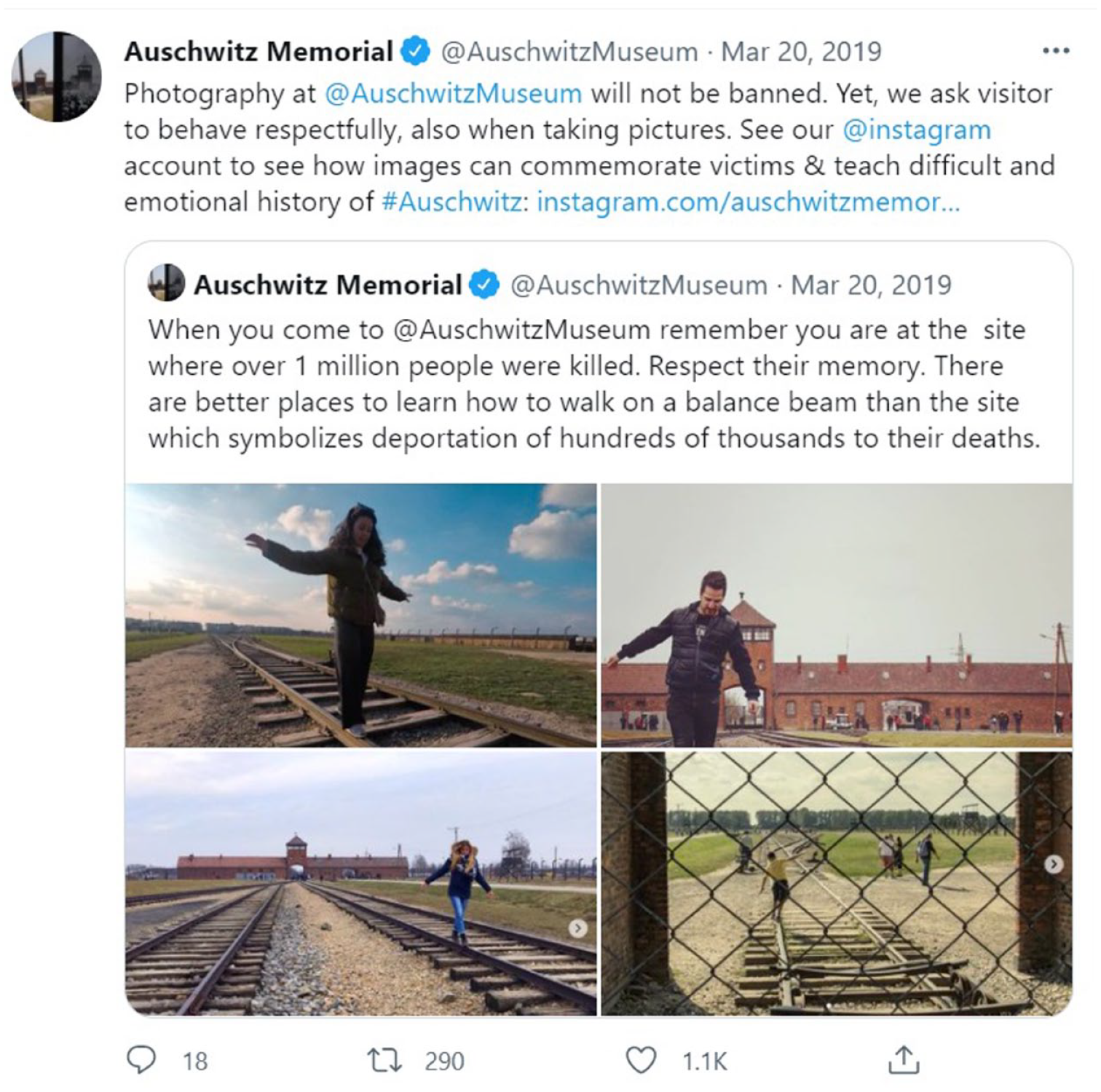
Posted Twitter photos of visitors to Auschwitz-Birkenau doing balancing exercises on the tracks to the selection platform at Birkenau. Copyright AuschwitzMuseum/Twitter.
The meanings attributed to these images precede the invention of selfies. For example, for 35 years, Israeli groups have produced and diffused group and individual photos of young Israelis in blue-and-white delegation uniforms at the Arbeit Macht Frei or Birkenau gates. In those voyages,
through the ritual re–enactment of the path of the witness, the students become witnesses of the witnesses, and their bodily presence—as young, vital Israelis on the site of the murder of the Jewish people—is cast as proof of Jewish continuity, a redemptive answer to the Shoah. (Feldman, 2010: 110)
The framing of the visits and the rituals performed there—including the raising of flags in ceremonies along with survivor-witnesses on the ruins of the crematoria and at the gate—affect the temporary suspension of disbelief, the ritual erasure of time between the prisoner-survivor and the current-day visitor. So, in many ways, the selfie represents survival-as-victory. The flag-bearing proxies for the victims and survivors exit Auschwitz for Israel.
The taking and posting of selfies privilege online social media friends over those in physical proximity. Thus, the performance of digital communication—posing, posting, receiving likes, often for several minutes as the photographer repeatedly attempts to frame the picture in flattering ways—ignores the effect that selfie-taking may have on other visitors to the physical site. The turning of one’s back to the site often obstructs the movement or view of others. 5 The effect of proximity and simultaneity as an expression of social solidarity—the ritual frame of all entering the camp together through the Arbeit Macht Frei gate—is dissolved. At best—the picture unites the two or three closest friends that “fit into the frame” of the selfie. It is hard to remain a solemn pilgrim when surrounded by posing and clicking tourists.
On circulation and public reactions to the selfies
Selfies from Auschwitz circulate through various platforms and forums on social media, and some became a news item in daily papers and evening news programs. The question “is it right to take a selfie at Auschwitz?” appeared as a main trope in the discourse that evolved around the selfie. In one response in Quora, a popular American question-and-answer website, to the question: “is it wrong to take selfies at Auschwitz?”; Mark Lawrence, a keen amateur historian with 1 K answers and 4.2 M answer views simply answers “yes”:
Auschwitz is a place commemorating immeasurable human suffering, the destruction of literally millions of lives, of families, a human tragedy beyond compare. A selfie is taken to draw attention to its taker, and to seek attention for oneself in such a solemn place is disgraceful. It is understandable that recent examples of such behavior have met with outrage and opprobrium.
6
As Rottberg (2014) showed, the stereotypical selfie-taker is a young woman and that may be the reason it is easier to accuse them of being narcissistic or exhibitionistic. Blogger Anne Burns sees the hatred, ridicule, and pathologizing of such women as mechanisms that society uses to discipline (and punish) young women. For her, this kind of mockery is “about power and about who has the right to speak in public or to share images in public.” 7 Women in general, and their selfies in particular, are more socially policed online. Selfies are usually singled out as a form used by young women to express themselves and thus suspected of expressing narcissism and selfishness (Burns, 2015; Dubrofsky, 2018). Many of the comments to Mitchell’s selfie (Figure 3) usually “begin by condemning her for the selfie” using patronizing language to then condemn her “immoral” actions as lacking empathy for the victims. Narcissism and selfishness are personality traits seen as especially problematic in women who are expected to be caregivers and emotionally supportive of others (Burns, 2015; Dubrofsky, 2018).
Some opposition to selfies was voiced by the Auschwitz Museum, who posted tweets to admonish tourists taking selfies of themselves as they performed balancing acts along the rails of Birkenau: “When you come to Auschwitz Museum, remember you are at the site where over 1 million people were killed. Respect their memory,” the post said. “There are better places to learn how to walk on a balance beam than the site which symbolizes deportation of hundreds of thousands to their deaths.” (Twitter account, Auschwitz Memorial, 20 March 2019). 8
This rebuke engendered a thread of responses on the part of visitors; with each reply, the curators of the memorial lost some of their authority, becoming one more voice in the thread. For example, @JimWaln wrote, “Stop it. Stop turning people just relaxing, having fun or simply just smiling into disrespect. It’s not. Stop it.” To this, @jowell96 answered “Is the site of the largest mass murder in history of humanity a place for having fun?”; @JimWaln responded, “from the examples shown, I don’t see it as disrespectful. I think it’s ok when people visit these places to do so as human beings with multiple emotions.”
In response to another tweet, the museum responded: “we ask visitors to behave respectfully, also when taking pictures. See our @instagram account to see how images can commemorate victims and teach difficult and emotional history of #Auschwitz.” Their Instagram page includes multiple historical photographs of victims and survivors, photographs of empty scenes of buildings cast in dramatic light or illustrations to mourning and sorrow (a single flower on the trail tracks or a close up of a wired fence) but almost no selfies or photographs of visitors to the site. The exceptions are group photographs of official delegations visiting the site as is the photograph former US Vice President Mike Pence visiting the site with Polish president Andrzej Duda on 15 February 2019 (Figure 6).
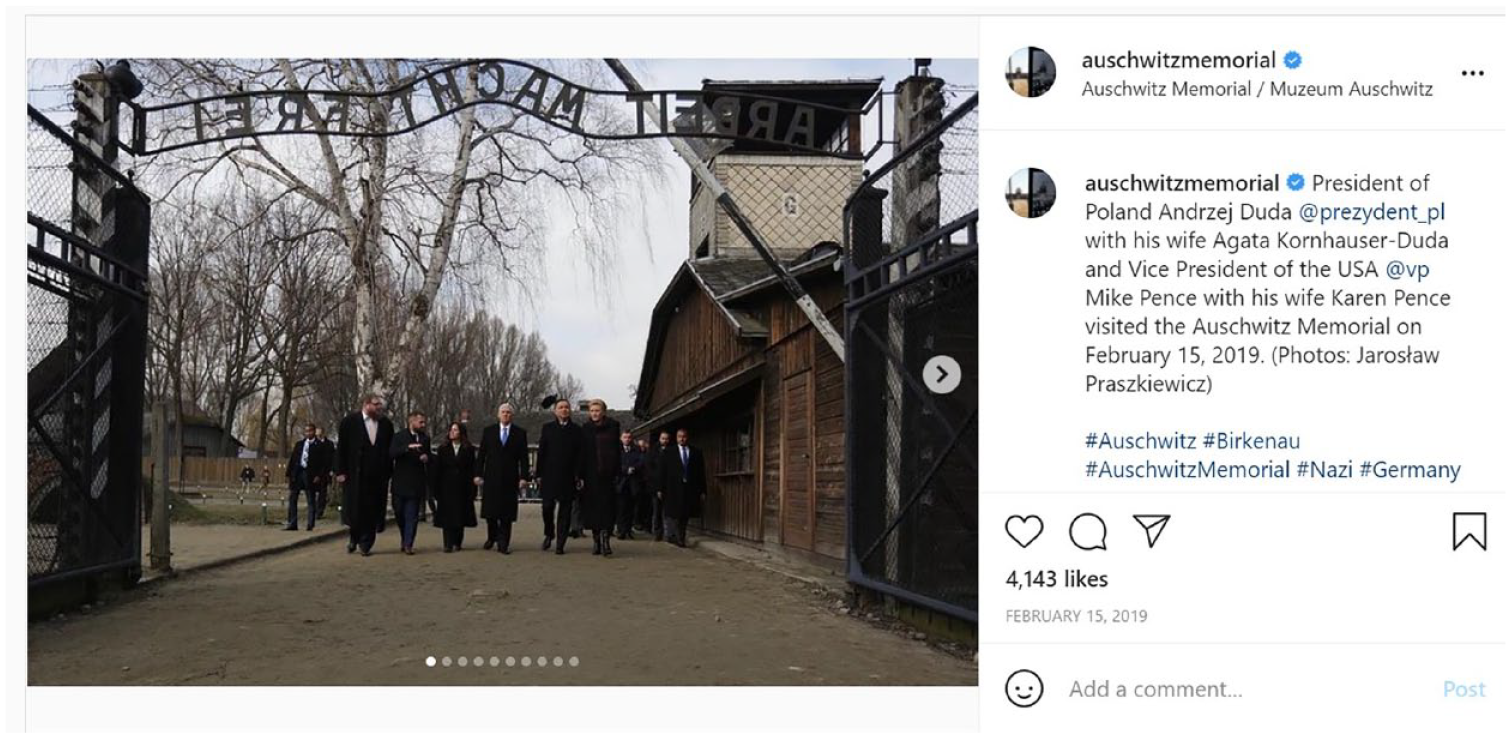
Posted Twitter photos of Polish and American politicians on a visit to Auschwitz. Copyright AuschwitzMuseum/Twitter.
More recently, the current head of the press office at Auschwitz, Pawel Sawicki, has rebuked those whose portraiture is disrespectful, while posting photographs he sees as respectful or exemplary. These are usually photographs taken from a distance in which the people in the photographs seem to be either engaged in quiet conversation, entering through the Auschwitz gate, signing the visitor’s book, or in deep and lonely contemplation. Many times these are photographs of political or public figures that do not look at the camera; it appears as if they have been caught by the camera lens without their knowledge. Arguably, in these uploaded photographs, the visitor directs our gaze away from their face toward something else—the victims, the place, or a relic, summoning us to be fellow witness/observers of something beyond the visitor, whereas the condemned selfies place the visitor at center of the frame looking directly at the camera. Nevertheless, official visits are always photographed and the subjects were undoubtedly aware of the camera, but chose not to face it, in line with photography etiquette in Auschwitz. The criteria for respectful selfies require further investigation: to what extent is the censure of selfies related to conservative rejection of new technologies and means of representation by privileged gatekeepers of memory—as was previously the case with historians’ opposition to reliance on survivor oral testimonies (Laub, 1992: 59–62) or Elie Wiesel’s and Claude Lanzmann’s denigration of Schindler’s List (Pinchevski, 2019: 104)?
The case study of the Auschwitz Museum’s attitude toward visual content shared on social media platforms reveals tensions between individual and institutional agency in digital curatorship of Holocaust memory. It also brings attention to one of the paradoxes of contemporary curatorship of Holocaust memory: to retain a semblance of a human-to-human interaction with social media users, the Museum assumes a position of a social media user itself and engages in a form of online didactics, while other users assume gatekeeping positions that are more conservative than that of the Museum. For example, in response to a call by @SarahButlerMN to ban photography, the Auschwitz Museum answered “Photography will not be banned. It’s a question of educating people how to behave in a historical places like @AuschwitzMuseum and telling them that they should be respectful to the memory also while taking pictures.” Given the ubiquity of social media posts, institutions like the Auschwitz-Birkenau Museum are obliged to valorize, react, and engage with social media content. As the Museum exerts less control over new channels of communication and representation, it places responsibility for the content they choose to post on the users. Thus, as technology progresses, the institutional power over how the Auschwitz-Birkenau Museum and Memorial is represented (specifically) and how Holocaust memory (in general) is curated has eroded (Kansteiner, 2018: 123–127; Zalewska, 2017: 114). The closing of the memorial site and the proliferation of digital communication and commemoration during the Covid-19 crisis accelerated this process (Ebbrecht-Hartmann, 2021).
Conclusion: selfies, empathy, desecration, and embodiment in the digital age
We have seen that the debate over Auschwitz selfies revolves around three major moments: in taking the selfie, the photographer performs an act that may disturb the shared demeanor and social solidarity of other bodily visitors, while seeking connections with a virtual community; they also adopt a mode of distraction, rather than intense concentration on the site. In framing the selfie, the aesthetic centering of the visitor’s face, the direct gaze toward the camera and the addition of filters and emojis may display the reflexivity as well as the narcissism of the selfie-takers. Sometimes, the humorous or distanced captions arouse the indignation of many, even as it makes the image more accessible to others. Finally, the diffusion of the image to other (touristic, dating, or entertainment) websites makes the images more interactive, but often more frivolous. While the selfie-takers may be unconscious of the variety of messages they convey, viewers and commentators may read them either as a declaration of presence here and now and a summons to personal interaction with the memorial site (Douglas, 2020; Walden, 2019a), or as a desecration of sanctified representations of the Holocaust.
The passionate denunciations of selfies at Holocaust sites echo in various ways the teacher’s exclamation in the video referred to at the opening of the article: “to take a selfie in Auschwitz is not respectful!” For their detractors, selfies are an exemplary product of an individualistic, narcissistic, and exhibitionist generation that uses social media in order to create and manufacture the self (Koterba et al., 2021). Others argued that selfies can be tools for “self-improvement and self-knowledge”—acts of “self-reflection” and “self-creation”; in Bareither’s (2021b: 66) words, they are an “aesthetic self-representation and, at the same time, a practice of emotional engagement.”
Furthermore, in the context of the Third Reich’s denial of individual identity to its victims, the claiming of space in an individualized matter through the taking of a selfie may be an act of defiance against the authority of those who would limit the scope of legitimate representations of the genocide. Reynolds (2018: 234–236) notes that if official postcards of the Auschwitz memorial site (and we might add, the official Instagram page as a kind of contemporary postcard), erase the tourist from the place, selfies reclaim the visitor’s presence at the memorial. They may thus be an expression of agency. The facing toward the camera, with one’s back to the gate, may be interpreted as the exit from Auschwitz—an act of survival, of victory over death. 9
For the selfie-taker and their viewers, the Auschwitz selfie may be an expression of collaborative memory through embodied identification, as both the Holocaust and the last survivors recede into historical distance (Walden, 2019b). Christoph Bareither (2021a) suggests that selfies in Holocaust sites can be understood as a kind of emotional work: “By capturing the feeling of the place, they are presencing the past through the enacting of emotional experiences. Such digital memory practices,” Bareither argues, “capture the feeling of place in order to integrate this experience in ongoing social and collective memory practices” (Bareither, 2021a: 588; cf. Nunes, 2017). In other words, selfies can provide a way to navigate the affective, social, and cultural dimensions of young visitors’ experiences in Holocaust sites, and call forth empathetic experiences of their own at Auschwitz (Bareither, 2021b: 62). Some scholars conceptualize the act of taking a selfie at Auschwitz or viewing a selfie taken there, as one of secondary witnessing, “mobile witnessing” of the Holocaust (Reading, 2009). In this vein, Yasmin Ibrahim argues that
by recording, archiving, and re-playing trauma, these technologies can re-distribute trauma to new audiences, making these available “on-demand” and through “click” economies of downloading, co-creation, and curation in the digital economy. In enabling the release of testimony as an artefact, these technologies of trauma produce in renewed terms the audiences as “witnessing” subjects.
Similarly, Kate Douglas (2020: 396) argues that selfies at sites of trauma counter “compassion fatigue” and provide a critical engagement with trauma representation and hence should be empowered.
The selfies, discussions, and objections we surveyed, however, make us hesitant to embrace these claims. Unlike the secondary trauma present among USC indexers who watch Holocaust survivor testimonies for days on end or disorders suffered by those watching catastrophes or drone attacks at close range (Pinchevski 2019: 65–86), there is little evidence of trauma in the selfies of Princess Breanna or the “Angels of Auschwitz.”
10
If what separates the witness from the spectator is the ethical horizon they engage (Dean, 2019; Margalit, 2014), in what way can those selfies be seen as bearing witness to the Holocaust? As reporter Mark Leibovich critiqued,
What does “bearing witness” or “starting a conversation” even mean? It is not really clear, except that they have become catchall proxies for kind of being there, kind of taking note and—in many cases—not really being able to do much of anything. (Leibovich, 2014: 20)
The new digital technologies foster a rapidity of diffusion of information, shortened attention spans, a desire for multi-sensory immersion of distant viewers, a sense of co-presence at a distance, and a greater participation of a wide range of actors in a wide gamut of information about the Holocaust. These changed regimes of reception and interaction generate an entire series of media products: computer-assisted coloring of black-and-white Auschwitz prisoner photos, virtual reality tours of camps led by survivors, algorithm-generated conversations with “holograms” of absent or deceased survivors, and more. All of these demonstrate how even in the digital age, the face and body of the witnesses, and not just their words, continue to be essential for contemporary-mediated Holocaust memory. The Auschwitz selfie is one more example.
The question of witnessing, like the reactions to the Auschwitz selfies in general, reflects the continuities in memorial practices as well as the radical shifts incurred by the death of the last survivors and the generative force of digital technology. Just as the shift from the historian’s documents to the survivor’s aural testimony—what Annette Wieviorka named “the age of the witness” (Wieviorka, 2006)—was ushered in by the aging of the survivors and the advent of video recording, so too, the death of the last of the survivors and the shift to digital media creates a shift from the witness to the witnessee, “the digitally enabled participatory recipient” (Pinchevski, 2019: 104). But the replacement of the witness by the witnessee does not pass uncontested. Even if it engenders wider participation, the media act of “self-witnessing” (Nunes, 2017: 113; Henig and Ebbrecht-Hartmann, 2020) of Breanna or the “Angels of Auschwitz” is seen by many respondents as an immoral appropriation of the voice of the dead.
By displaying a serious demeanor, facing away from the camera toward the death-camp remains, or taking the photo from a greater distance to include more of the scene, the selfie-taker can blunt some of the more vociferous objections by situating themselves as mourners or assuming the subordinate position of “witness of the (more authoritative) witness.” Not incidentally, the latter type of “distant” images are those that appear on the Auschwitz Memorial’s Instagram page, alongside the people-less photos discussed by Reynolds (2018) above.
In conclusion, the taking and posting of Auschwitz selfies and the expressions of disgust and anger they arouse reveal a host of processes relating to the memory of the Holocaust: the authority of the witness and their next-of-kin, the changes incurred by new technologies and sensory regimes (experience economy, the importance of immersion (Kansteiner, 2018), as well as the continued strength of established categories of what constitutes proper memory, especially—but not exclusively—among gatekeepers and the older generation. While increased interactivity at a distance may be seen as heralding the end of the “age of the witness” (Ebbrecht-Hartmann, 2021: 1103), the prominence of the selfies as well as the vehemence of objections to them demonstrate that although survivors may no longer be able to accompany visitors at the site, the need for a visible face and body-like-ours to mediate an empathetic relationship to the Holocaust is greater than ever.
Footnotes
Acknowledgements
We are thankful to our colleagues in the Sociology and Anthropology Department of Ben-Gurion University of the Negev and the members of the Sidney and Esther Rabb Center for Holocaust and Revival Studies, whose comments helped focus and improve the article. Special thanks to Andrea Hajek and the anonymous readers of Memory Studies for their suggestions and criticisms.
Funding
The author(s) disclosed receipt of the following financial support for the research, authorship, and/or publication of this article: The research for this article was made possible by Israel Science Foundation grant 228/19: “Memorial, museum, smartphone: Transmitting Holocaust memory in a digital generation.” A grant from the Bergida Family Foundation at Ben-Gurion University of the Negev for the topic "Remembering the six million on Zoom: Education and commemoration in a digital-only world" provided funding for additional research.
