



Abstract
Working at the intersection of political science, ethnographic sociology, and contemporary historiography, Sarah Gensburger specializes in the social dynamics of memory. In this interview, she talks about her book Memory on My Doorstep: Chronicles of the Bataclan Neighborhood, Paris 2015–2016, which traces the evolving memorialization processes following the 2015 terrorist attacks in Paris, their impact on the local landscape, and the social appropriations of the past by visitors at memorials and commemorative sites. She also discusses her new project Vitrines en confinement—Vetrine in quarantena (“Windows in Lockdown”), which documents public responses to the coronavirus pandemic from different sites across Europe through the creation of a photographic archive of public space. The interview highlights issues around the immediacy of contemporary memorialization practices, the ways in which people engage with their local space during times of crisis, and how we are all actively involved in preserving memory for the future.
I live halfway between the Place de la République and the Bataclan concert hall. On November 13 [2015], my partner, my two young children and I returned home about 9 pm. My son and my daughter were both asleep when the shootings began. At first, we adults heard nothing. And then the deafening sounds of sirens and the avalanche of telephone calls. A night without sleep. A night that was the same for all the residents in our neighborhood. And then the day that came after. There was nothing special about our experience, probably nothing worth writing about.
This is how Sarah Gensburger opens her chronicle when, in December 2015, she begins to record the spontaneous and shifting memorialization processes she observes on a daily basis in the wake of the 2015 terrorist attacks in Paris. What follows is a moving and intricate account of how our day-to-day lives become intertwined with traumatic events and how we try to make sense of them in both public and intimate ways. Now, as we are living through a global pandemic, we are coming to further understand how ordinary lives can be disrupted by contemporary crises and how public memory in response to such situations can become part of the fabric of our ordinary lives.
Gensburger is a political scientist at the CNRS (the French National Centre for Scientific Research) in Paris, where she studies the social dynamics of memory, working at the intersection of political science, ethnographic sociology, and contemporary historiography. Among her latest publications are Memory on My Doorstep: Chronicles of the Bataclan Neighborhood, Paris 2015–2016 (2019) and Beyond Memory: Can We Really Learn from the Past? (2020), which she co-authored with Sandrine Lefranc. Both of these books were translated from French. 1
In this interview, we focus on two of Gensburger’s recent projects. 2 The first is Memory on My Doorstep, which traces the evolving memorialization processes following the 2015 terrorist attacks in Paris and their impact on the local landscape. Memory on My Doorstep is both an academic text and a deeply personal response to these traumatic events. It takes the form of an auto-ethnographic, sociological chronicle of memory and memorialization in the year after the attacks.
Gensburger lives in the city’s 11th district, on the same street as the Bataclan concert hall and also in the direct vicinity of the Charlie Hebdo offices that were attacked in January 2015 and the cafés and restaurants targeted—along with the Bataclan—in November that same year (Image 1).
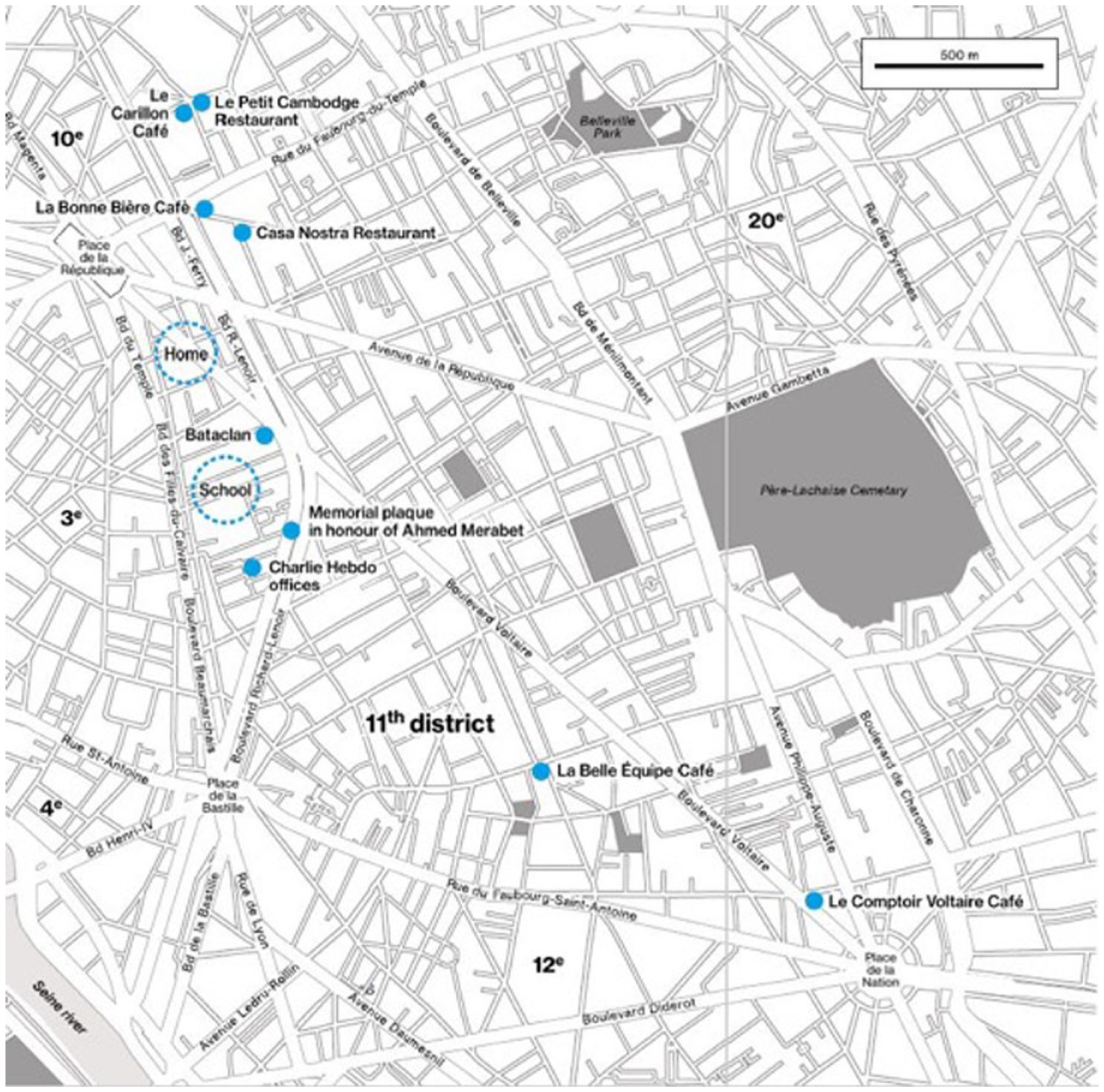
Map of Gensburger’s neighborhood and the sites of the 2015 attacks © Anamosa/Leuven University Press.
In the book, she describes her surprise at finding that, all of a sudden, “social phenomena which [she] [was] used to studying in other places and periods, [were] now unfolding in [her] own neighborhood, on [her] doorstep” (Gensburger, 2019: 26). That observation is what gave the book its title. Memory on My Doorstep consists of a series of diary entries with Gensburger’s observations of and reflections on various aspects of the memorialization processes she saw happening around her in real time over the year that followed the attacks. These entries are accompanied by numerous photographs Gensburger took herself. The book poses a key question that will be central to our discussion: how can we grasp the social dynamics of memory in times of crisis?
In the second part of the interview, we discuss another exciting and even more recent project, Vitrines en confinement—Vetrine in quarantena (“Windows in Lockdown”), on which Gensburger is collaborating with Marta Severo, a professor in media and communication at the University of Paris Nanterre. Vitrines en confinement—Vetrine in quarantena documents public responses to the current coronavirus pandemic from different sites across Europe through the creation of a photographic archive of public space. 3 Everyone is invited to take photos of the messages they see displayed in the streets, in shop windows or on private or public buildings, and to share these on social media or on the project website. The aim is to collectively create a vast visual and verbal record of this extraordinary period, which will constitute a unique resource for future memory studies research.
In the introduction to Memory on My Doorstep, you take issue with the focus in much memory studies research on traumatic memory as ontologically distinct from everyday memory. Many scholars emphasize ideas of rupture rather than continuity. By contrast, you draw attention to the co-existence of traumatic memory and everyday memory: you underline the importance of the ordinary or everyday memory dynamics that are the very core of remembering traumatic events (Gensburger, 2019: 17). You made a conscious decision to move away from the dominant, trauma-driven perspective by considering your neighborhood as a space where people are not just victims but live and interact with one another and with their environment.
In that respect, we thought it was significant that what first gave you the idea for the book, its “point of origin,” was the liberating experience of being able to walk on the pavement in front of the Bataclan again toward the end of December 2015 (Gensburger, 2019: 33). That pavement had been blocked off for more than a month in the wake of the terrorist attacks, but that physical blockage or “rupture” finally gave way to a resumption of normal life. Could you elaborate on this tension that you see between trauma and the everyday, rupture and continuity, and on how you negotiate it in your work?
In previous research, I studied certain social practices of memory such as the process of remembrance through the creation of the title of “Righteous among the Nations” (Gensburger, 2016). I showed that even with the same initial “traumatic experience,” the Jewish people rescued in France did not all make the same social use of their story. This was dependent on who they were from a classic socio-demographic perspective, and also on who they were in relation to the Jewish/non-Jewish and French/Israeli identities. So if I was to describe my epistemological approach to memory, I would label it as “relational.”
When 13 November 2015 happened in France, the media as well as the main research projects that were put together in the immediate aftermath of the event were focused exclusively on the traumatic dimension. The neighborhood where I lived was described by the media as “traumatized.” What is more, most of the research projects that were launched in the immediate aftermath were also structured around the issue of trauma. For example, the main oral history project, labeled as “Programme 13-Novembre,” created four groups of interviewees depending on their spatial proximity to the event, with this proximity being considered to be standing in direct relation to the degree of traumatization. 4 It distinguished four categories of witnesses: people who were actually on the sites of the attacks, the inhabitants of the neighborhood, the rest of the people who live in Paris and its region, and the rest of France. Here, the vicinity of the attacks was supposedly a space of trauma.
This puzzled me immediately for several reasons. Since I was living in this so-called traumatized neighborhood, this label raised several questions in my mind. First, did this characterization help me make sense of anything I was experiencing and seeing? Second, and maybe more important, what had changed in my life? The attacks took place on Friday, and, even though it was difficult, on Monday I took the kids to school, which is located mid-way between the Charlie Hebdo offices and the Bataclan, as you see on the map. I went to work, I went on eating, taking showers, and living my life. My questioning really started with this personal experience of social continuity. Of course, this must not be read as a rejection of trauma as an important variable but as a desire to start from a different perspective, leaving open the possibility of finding trauma again along the way—or not. So I decided to start from where I lived not as a site of traumatic memory but as a place of living from which to look at memory dynamics.
To do so, and in addition to the use of classic ethnographic tools such as observations and interviews, I used auto-ethnography, my children, and photography as additional resources. I took notes about all the everyday conversations I had. My intention was to pay attention to when, in what form, and in which social situation people spoke or did not speak about the event in the neighborhood.
Putting this more “ordinary” methodological perspective into practice was facilitated by the fact that my young son and daughter accompanied me during a large part of the fieldwork. At first, the presence of my children seemed to me to be a burden. However, it turned out to be very fruitful for my research. It even became an integral part of the scientific work. Their views on things were very helpful because of the way children tend to “normalize” what they witness. Children, and especially young children, are likely to express pre-socialized and framed opinions and feelings. Their views helped me see memory research differently and from a fresh perspective (Image 2).
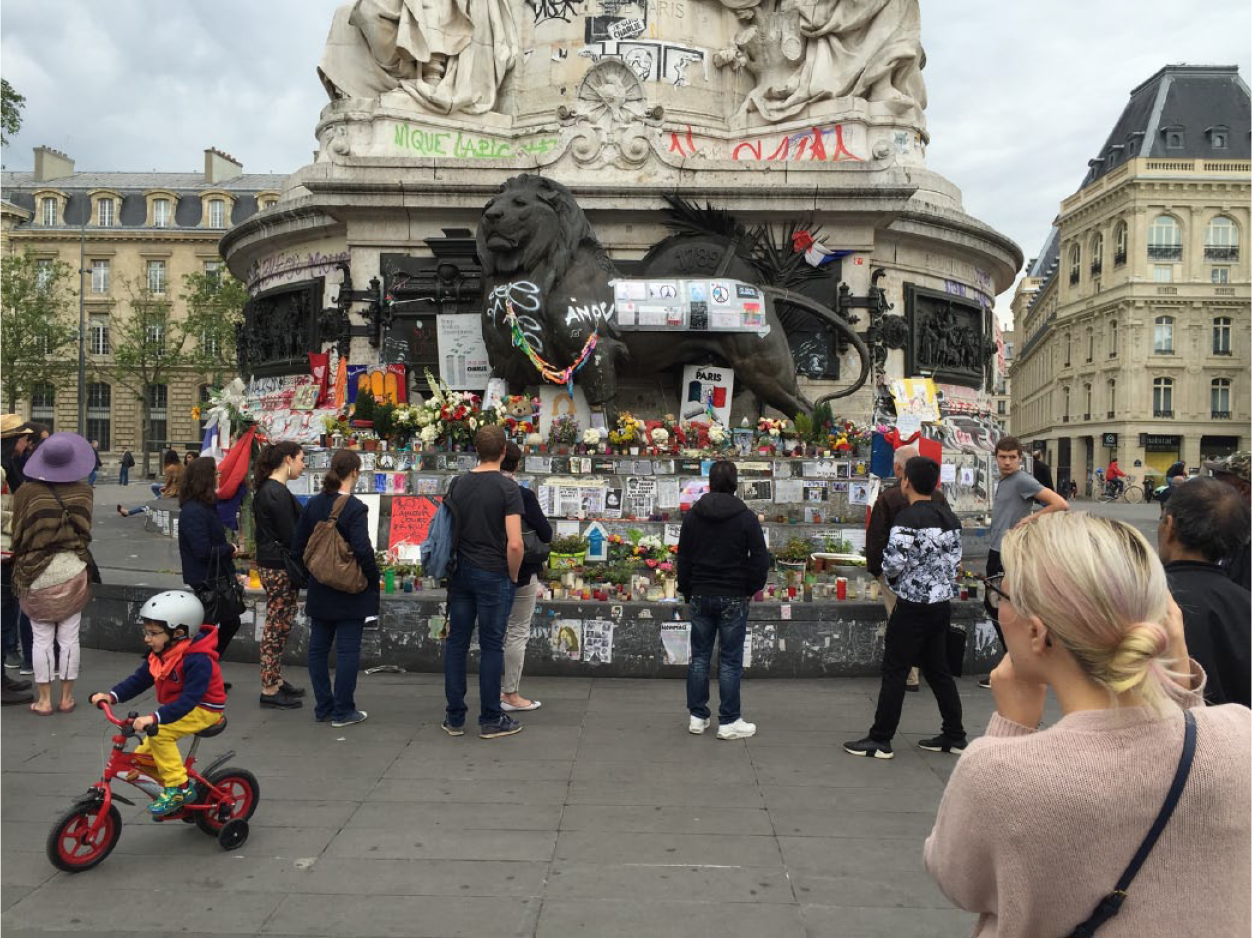
Gensburger’s son on his bicycle during fieldwork, Place de la République © Sarah Gensburger.
This methodological choice had practical consequences. For example, when trying to enter into conversation with people stopping by or staying close to the sites of the attacks, I chose to ask, by way of introduction: “Do you often come to this part of Paris?” This opening question led to the collection of different kinds of materials: in most cases, my interlocutor first explained that he or she was visiting someone nearby, worked nearby, or was visiting Paris for the first time. This methodological framing enabled me to locate some of the commemorative practices I was observing in front of the grassroots memorial as ordinary ones, often embedded in professional, economic, and social mobilities. Moreover, this methodological choice enabled the expression of multiple narrations of the event. These narrations were no longer limited to trauma and suffering, but exposed how the same place continued to function in its everyday capacity after the event while it gave visibility to conflict in a place where consensus at first seemed everywhere.
Indeed, taking notes about and pictures of these ordinary group interactions while facing the places of the terrorist attacks enabled me to embed the messages left there in the group dynamics that led to their writing. Most of the messages denounce the “horror” and express “pain” in an apparently consensual way. However, when we observe and listen to the group conversations that prompted them, it turns out that their initial intentions were often far more controversial, debated, and political. For example, messages would often denounce the French state’s participation in wars in the Middle East and the stigmatization of Muslims as an ethnic group. Paying attention to ordinary conversations in the city made conflict narratives “reappear” under the eyes of the researcher, in contrast to the questions posed by other researchers and/or journalists conducting research in the same place. Their questions were often couched in different psychological and apolitical discourses, including questions such as, “Do you often come here to mourn?”
Finally, this focus on continuity and ordinary life as opposed to rupture and extraordinary events also enabled me to reinject some politicization into a picture where the exclusive stress put on trauma often depoliticizes our understanding of the memorialization of a traumatic event.
I will give one example, which echoes the Occupy Wall Street movement that took place in New York. Indeed, my field study of memorialization in my neighborhood coincided with the Occupy movement in Paris. From 31 March 2016, the Place de la République was no longer exclusively a place for grassroots memorialization. It also became the hub of the social movement of occupation against the reform of labor laws in France, a movement that called itself “Nuit Debout” (which translates as “Night on Your Feet” or “Night Uprising”). “Nuit Debout” marked a new stage in the dispute over public space, and it also revealed more broadly the fragmentation of the memory of the Paris attacks. Beyond the social mobilization, “Nuit Debout” also appeared as a form of memorialization. “Nuit Debout” and the attacks shared not only space but also time. The killings of November 2015 were nocturnal. It was at night that Paris was confronted with horror, and it was at night that they now mobilized. For a regular observer, “Nuit Debout” stemmed in part from a desire to come together, at night, on the Place de la République, in this place and at this time that were those of the attacks. Being “debout,” literally “standing up,” was ultimately a refusal to take it lying down, a refusal to be dead, as so many were on 13 November.
After the Charlie Hebdo attacks in January 2015, 17 trees were due to be planted in memory of the 17 victims killed in the attacks. The planning of the tree-planting was in its advanced stages when the 13 November shootings occurred. Once again, the same neighborhood was at the heart of the attacks. It was quite simply impossible to consider planting a forest of 147 trees in such a small place in the middle of Paris. So it was eventually decided that a single symbolic tree—the “Memory Oak”—would be planted on the edge of the Place de la République. At the base of the Memory Oak is a plaque bearing the following inscription: “In memory of the victims of the terrorist attacks in January and November 2015 in Paris, Montrouge, and Saint-Denis. The French people pay homage to them here.” The Memory Oak was planted 50 meters from the center of the square, where a huge grassroots memorial was still alive. Sadly, the Memory Oak never fully took root, and today it is dying (Image 3).
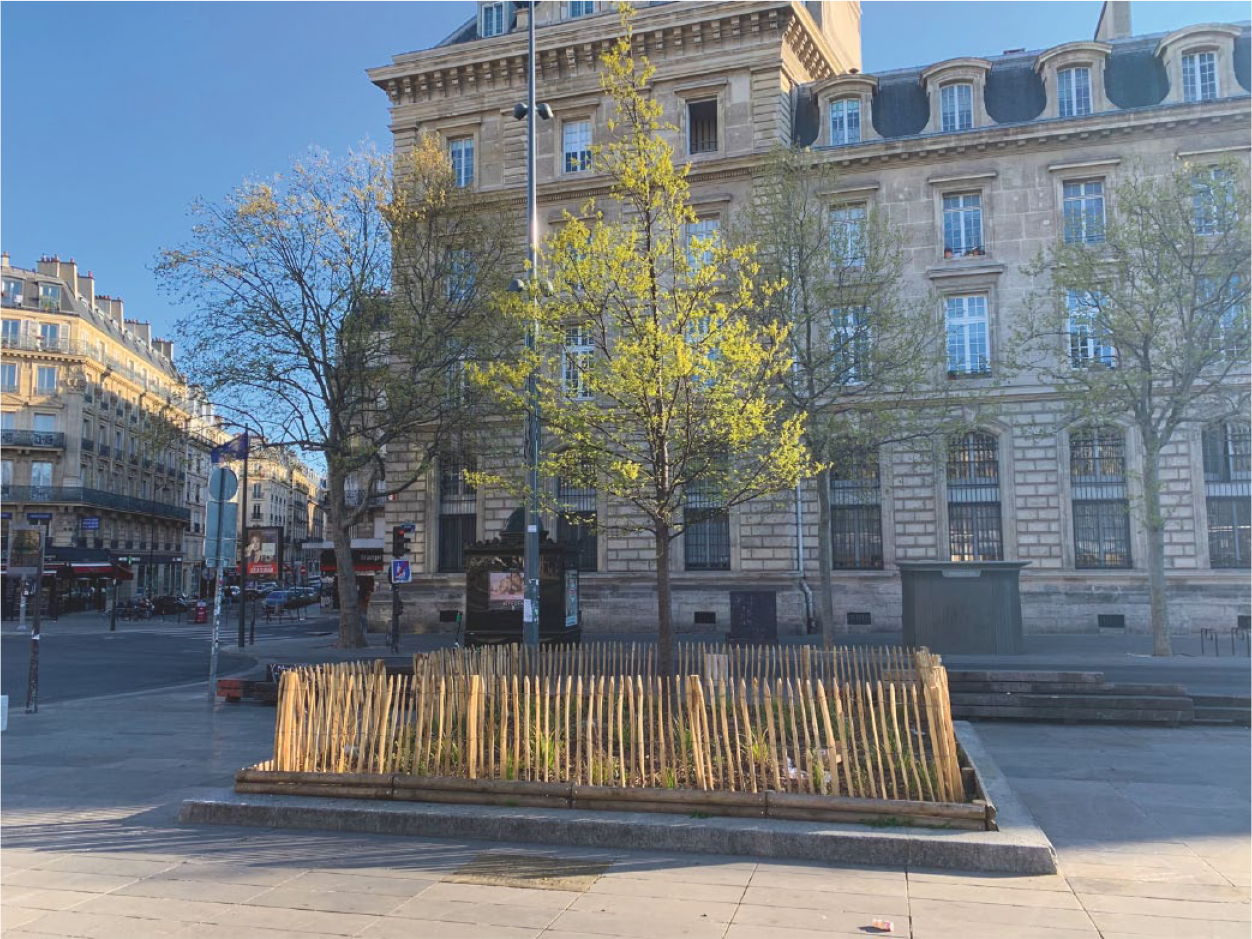
The Memory Oak, Place de la République © Sarah Gensburger.
Moreover, the question of who owns the memory of the attacks was raised from the very start. In January 2015, no public initiatives were taken by the city of Paris. However, some citizens decided to take care of the grassroots memorial on Place de la République and defined themselves as caretakers. They started to select, collect, and laminate the tributes left there by passersby. After 13 November, the pavements and streets were so full of tributes that the city had to take action. The Paris Archives launched a special program. They collected and curated almost 7000 tributes from the grassroots memorials.
Like the testimonies recorded by the oral history campaign I mentioned earlier, “Programme 13-Novembre,” these documents will serve as the “truth” in the future. One of my goals was to gather enough data to allow not just me but anyone to put them into perspective: both researchers and ordinary citizens who are going to use them as “sources” and research material in the future, in one way or another.
I studied the social uses of these messages from the very beginning, from their production to their heritagization. Today, and in a circular manner, this Paris Archives collection is already the subject of multiple social uses. Part of it will be put on display in the Memorial Museum of Societies Facing Terrorism that is currently being planned, following President Macron’s announcement in September 2018, and the city of Paris will soon inaugurate a memorial to 13 November. To whom does the memory of the attacks belong? To the neighborhood, the victims, the city of Paris, the state, or the historians?
The second point I want to stress is that the heritagization of this memory is at stake not only in museums or archives but also in the urban space itself. This will allow me to briefly discuss the pandemic situation.
In November 2016, for the first anniversary of the events, the Paris city council and the French government made the decision to have the memorial topography reflect the cartography of the attacks. A commemorative plaque was inaugurated in each of the sites affected (cafés, concert hall, and football stadium). The use of this commemorative tool was by no means original: such inaugurations happen frequently and are highly codified by French public authorities. The text on the plaques systematically lists the date and the full names of the victims.
However, the plaques inaugurated in November 2016 are an exception to this. They do bear the names of all the victims who died in each place, but—unlike the previous ones—they are not fixed to the walls of the buildings in which the killings took place. So as not to interfere with the return to business as usual, they are all several meters away, attached to public buildings or street fixtures. These sites are torn between mourning the 130 people killed in a single night and returning to normal economic activity, particularly for the cafés and concert hall. It is therefore difficult for commemoration to find its rightful place.
These sites of memory, however, do serve to designate a shared space for commemoration. Each 13 November, the survivors and victims’ families, individually or as part of victims’ associations, return to these sites one after the other. These ceremonies are also attended by the Mayor of Paris, Anne Hildago, and a state representative. They each in turn lay an official wreath, but no one speaks. The ceremonies are completely silent. There is only the reading of the names of the dead, a now global ritual, to break the silence.
The polycentrism of the sites goes with the polymorphic community mobilization. Almost immediately after the night of 13 November, two organizations to support victims emerged. They each bring together survivors, families, and loved ones of people who were killed. Yet they have significantly different sociological profiles. The members of Life for Paris are mostly young, either survivors or loved ones of survivors of the Bataclan. The other organization, 13onze15 Fraternité et Vérité, has older members, who are, for the most part, parents of people who died in cafés or in the Bataclan. They first organized separate commemorations. However, 2018 marked the beginning of a new era with the first joint commemoration between the two organizations.
This new period is organized around the question of the erection of a new commemorative monument. Indeed, in 2018, both the French state and the city of Paris had created commissions and working groups to enable the erection of both a national and a municipal monument. The initiatives by these two government bodies led the two victims’ associations to eventually come together. For the third anniversary, on 13 November 2018, they organized a single shared ceremony, which was held on the steps of the City Hall of the 11th district, where the presidents of both organizations spoke. The new Paris memorial was supposed to be inaugurated in 2020, but its inauguration was postponed because of the Covid-19 pandemic.
Moreover, the project finds you actively collecting instances of grassroots memorialization of the pandemic (Image 4). That is also true for your work on the Paris attacks: Memory on My Doorstep includes numerous photographs of the commemorative texts, images, candles, and other objects left at or near the sites of the attacks, and you have recently published another book—Les Mémoriaux du 13 novembre—which contains hundreds of photographs of those ephemeral memorials, memorials that might otherwise be lost to posterity (Gensburger and Truc, 2020). Instead of positioning yourself as a detached observer, who strives to maintain a certain distance from their research object, you actively help create the archive that will be available to both current and future scholars working on the memory of these events. Do you consider it to be part of your responsibility as a memory scholar to become an active memory agent in this way? Do you have any concerns about that? Are there any risks involved in adopting such an interventionist approach, and if so, how do you manage these?
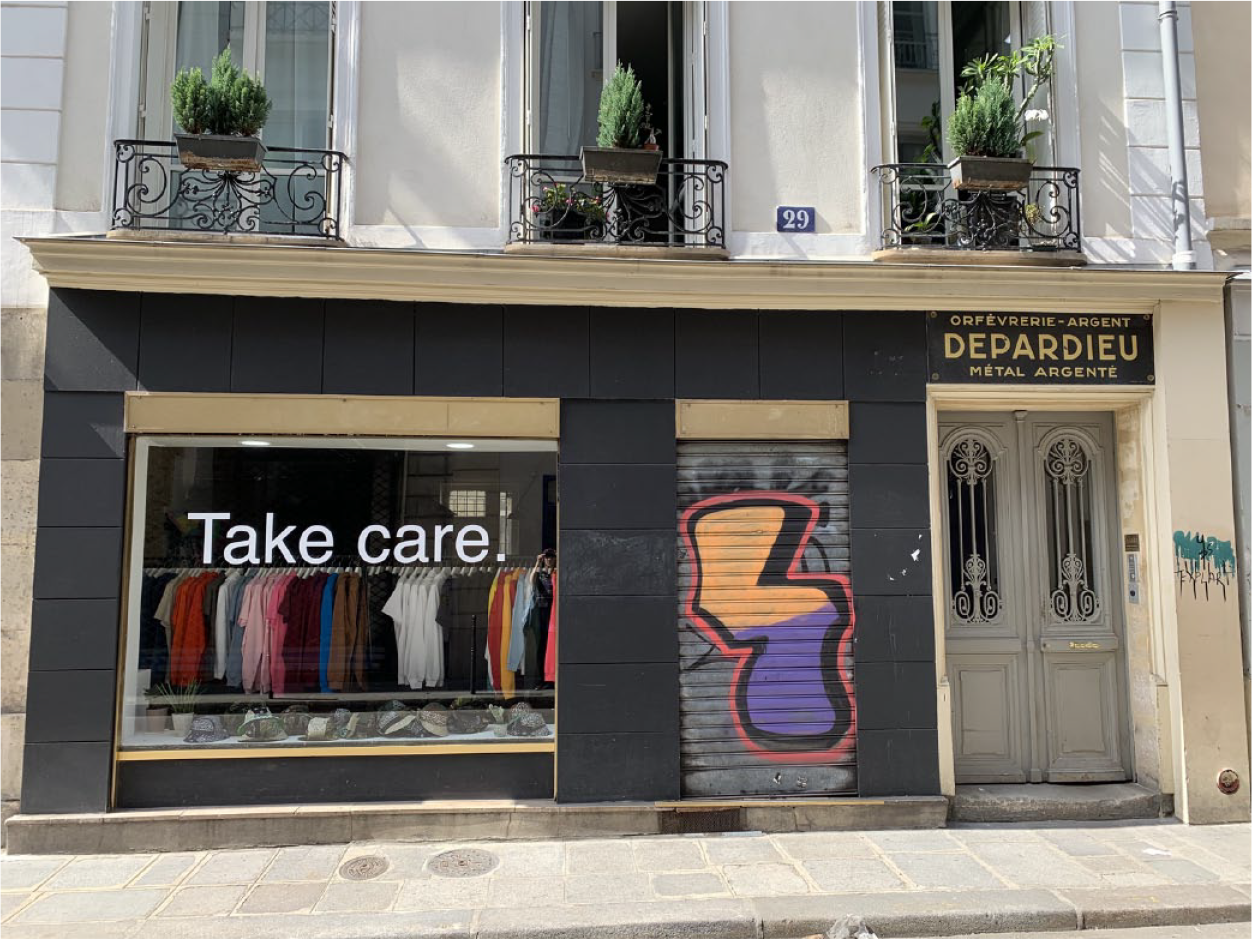
Rue Charlot, Paris 3rd district, April 2020 © Sarah Gensburger.
The questions driving this project include, Why do people display messages in public space while everyone is supposed to be in lockdown and no one is expected to move around? How do we talk about lockdown in these messages displayed publicly? What words and sentences do we use? Who speaks? We collected more than 4000 pictures in France, 1000 in Italy, and 400 in Belgium, via social media mainly. We had more than 1500 participants, and it is still the only such project to be dedicated to the public space.
So, am I an active memory agent? First, I do not consider this project to be about memory. It records traces of what already existed in the public space and does not generate memory, and these documents were not about memorialization but about expressing oneself about a current event and crisis. More importantly, this project was also born as a critical reaction to the blooming of “Covid memory” projects all over the world. Collecting “testimonies,” “diaries,” “pictures,” and other vernacular “objects,” but also “dreams” and “sounds,” became a social emergency for each day, increasing the number of social actors who became engaged in “curating” Covid and “preserving” its memory. These projects claimed to be documenting “people’s experiences,” hearing “grassroots stories,” and collecting “ordinary memory” of the crisis. I think it is necessary to understand this Covid memory boom and to what extent it can also participate in giving a voice to some and not to others, even if the call for “ordinary memory” is born from inclusive intentions. Nevertheless, the ability or right to tell one’s story is not equally distributed across society.
I started “Windows in Lockdown” also as a reaction in order to move the focus beyond the intimate and the private spheres, which I considered to be a tool of depoliticization of the event. So, while I was launching “Windows in Lockdown,” I began a more traditional research project, which is still ongoing, to study this Covid memory boom from a political science perspective. This will become a larger article and maybe more, which I will be writing with Orli Fridman, who has been studying the impact of the pandemic on commemoration as a whole. 6
Beyond offering a description of the social actors behind the more than 400 memory projects, of which “Windows in Lockdown” is the only large project to pay attention to the public space, the idea is to discuss why this Covid memory boom has taken place and what it tells us about our contemporary society and about the relationship between memory, neoliberalism, and politics. Can memory still be a tool for emancipation, or has it become trapped in its own success?
In France, an institute labeled “Ad memoriam” was created as early as October 2020. It is expected to participate in the creation of a collective memory of the Covid-19 pandemic. But it is clear already that the political and social interpretations of the pandemic and of the reactions to it are very diverse and conflictual. One of the reasons I did Memory on My Doorstep was to come back to the very social dimension of any memorialization, not from a collective memory perspective but rather with particular attention to when, where, and with whom people talk about the past or not, and when it makes sense for them to do so or not.
So rather than the issue of the “right time,” I would raise the issue of the “right angle” from which to look at the event. And it is this angle that will determine whether you need to work during the event itself or whether that can wait. In the case of both Memory on My Doorstep and “Windows in Lockdown,” the way I wanted to work on the events and their traces could not wait.
To make things clearer, and if you indulge me, I will switch for one minute from being a sociologist of memory to being a micro-historian of the Holocaust in Paris, which I am also focusing on in other parts of my work. 7 When 13 November 2015 happened, I had been working on the Holocaust in Paris from a micro-historian’s perspective for some time. I then realized that the attention I paid to the social continuity and the ordinary dimension as a way to make sense of the crisis I was living through was exactly the same approach I had been using to study the implementation of the Holocaust in Paris as embedded in the everyday and ordinary lives of Parisians, including Jews, whom I tried not to keep imprisoned in their victim identity but to treat as any other Parisian.
I would like to make one final comment about the issue of time. In the case of Memory on My Doorstep—and from a very selfish perspective—I must say that adopting a reflexive view of what I was experiencing, in a way moving from being an inhabitant to being a sociologist, helped me overcome the situation, and it also helped me as a mother to find a way to activate my children in relation to the event. They became young sociologists in training and started to look around them with a critical perspective while I managed to master the crisis from a personal, psychological point of view thanks to my professional habitus.
We have a related question about the significance of the rather peculiar form of Memory on My Doorstep. The book started out as a blog, “a form of expression”—as you note in the conclusion—“that is still unusual and iconoclastic among researchers in France” (Gensburger, 2019: 237). The blog entries became the core material of the book, which consists of a chronologically ordered series of entries framed (in the English version) by a new introduction and a conclusion. Would it have been possible for you to incorporate this very heterogeneous material into a traditional monograph developing a coherent overarching argument, or did you feel that the nature of the research object did not allow for that and demanded a looser, more fragmented approach? And do you consider the “atypical” format of this book a one-off, or could it serve as a model for future memory studies research, whether your own or other people’s? We got the impression that the latter is the case, since you write at one point that the chronicle you kept “fulfill[ed] [your] long-felt need to establish a form of narration that is different from those of academic studies” (p. 27).
We do not have time to go into this huge issue here, but by way of conclusion, one way to take stock of the fact that our civic expectations have not been met so far may be for us as researchers to invent forms of writing not only as experts but also as facilitators of critical perspectives for citizens. This is why, for example, I try to include pictures in most of the work we talked about, as a way to give readers the opportunity to look by themselves and even to disagree with me. And also, by blogging and asking as many questions as I was giving answers, I intended to move research from behind the scenes, which for me is the best way to fight fake news and conspiracy theories.