




Abstract
The past continuously haunts Japan. It has been more than 75 years since the end of the last war and Japan has never fully reconciled with its Asian neighbors, especially China and South Korea, over the question of how to commemorate Japan’s past wrongs and atone for the physical as well as the psychological wounds it caused in Asia. In this context, also problematized is the question of intergenerational responsibility. Can the members of current generations feel responsibility and obligation to make restitution for wrongs perpetrated before they were born? If so, how? If not, why not? As it is reported that the Japanese public’s sense of affinity toward China and South Korea greatly deteriorated in the 2010s due to a series of memory disputes, it seems imperative to delve into the Japanese youth’s sense of the past. In this exploratory study, by following Barry Schwartz and his colleagues’ Judging the Past framework, we conducted college student surveys (N = 320) in 2017/2018 and interviews (N = 31) in 2017 and explored the cognitive connection between the Japanese youth’s sense of nation and their perceptions of moral responsibility for Japan’s militaristic past.
Introduction
The past continuously haunts Japan. On 14 August 2015, Prime Minister (PM) Abe Shinzo (September 2006–September 2007, December 2012–September 2020) 1 issued the so-called 70th Anniversary Statement in a nationally televised address. Commemorating the end of Japan’s last war in 1945 and reflecting upon Japan’s past wrong in Asia, he pledged that “we must never again repeat the devastation of war.” 2 Earlier in the summer, however, many wondered whether PM Abe was seriously considering revoking the 1995 Murayama Statement, which had long defined Japan’s official position on war responsibility. 3 It was widely reported that he struggled to produce a diplomatically acceptable statement without compromising his revisionist position. There were also reports about the disagreement among his advisers on how to use certain key phrases in the Murayama Statement (such as “colonial rule and aggression,” “feelings of deep remorse,” and “heartfelt apology”). Although the statement eventually included “deepest remorse” and “sincere condolences,” it was by no means uncontroversial. China’s State-run Xinha News Agency called the statement “linguistic tricks” and South Korea’s Yonhap was also disappointed that the statement “made no new apology . . . falling short of South Korea’s expectations.” 4
In his 2015 statement, PM Abe also questioned the so-called intergenerational responsibility of current/future generations (Thompson, 2012). In his address, he stated, “[w]e must not let our children, grandchildren, and even further generations to come, who have nothing to do with that war, be predestined to apologize.” 5 According to Michel-Rolph Trouillot (2000), collective apology of historical wrongs is inherently abortive as it never embodies those original actors who committed the wrongs and who suffered from them. As public remorse is only possible by contemporary proxy (Negash, 2006), apologizers and apologizees who can never truly feel the pain of the past, fail to be relevant actors. PM Abe would certainly concur with this proposition. However, is Trouillot correct? Also, how do the Japanese younger generations themselves perceive and feel about their responsibility and obligation to this?
Theoretically, scholarly works on Japan’s war memories relate to two main foci, that is, (1) who gets the power to write an authoritative history and how (hegemonic memory) (Halbwachs, 1992 [1941]; Hobsbawn, 1983) and (2) the struggle among and the roles of commemorative entrepreneurs (memory pluralism) (Barthel, 1996; Wagner-Pacifici and Schwartz, 1991 cf. Fine, 2001). Empirically, in the Japanese internal context, memory studies tend to focus on domestic power struggles between the Japanese government with “the power to define Japan’s official commemoration” (Saito, 2017: 10), and mnemonic entrepreneurs, including political parties, interest groups, media and NGOs (Hashimoto, 2015; Saito, 2017; Seaton, 2007; Seraphim, 2006). 6 Externally, scholars stress the international memory wars between Japan and the former victim nations, especially China and South Korea (Berger, 2012; Ducke, 2002; Lind, 2008). 7 Although the above-mentioned mainstream “politics of memory” approach (Gills, 1994) is theoretically implicative and empirically rich, it does not necessarily show the whole picture. When the field emphasizes the creators of history narratives (and their production), it tends to overlook the audience, or, receivers in the process (Griswold, 1994). 8 That someone creates a textbook with a particular intention does not necessarily mean that it will be received as intended. It is true that “(c)reators and receivers constitute an interconnected meaning system” (Fine, 2001: 22), yet, this association is neither given nor automatic.
In this exploratory study, we take the issue of collective responsibility in Japan as an empirical inquiry and attempt to delve into Japanese youth’s perceptions of their country’s past and its war responsibility. We followed the Judging the Past framework developed by Schwartz and others (Fukuoka, 2017; Fukuoka and Schwartz, 2010; Schwartz et al., 2005) and conducted college student surveys (N = 320) in 2017/2018 and interviews (N = 31) in 2017. Through the student survey, the study tries to elicit distributional patterns of the sense of national pride and shame and the youth’s perception of collective responsibility for Japan’s past wrongs. Subsequently, the interview data and analysis delve into more nuanced understandings of Japan’s past or, what Pugh (2013) calls, “meta-feeling . . . how we feel about how we feel” (p. 51). Can the members of current generation feel responsibility and obligation to make restitution for wrongs perpetrated before they were born? If so, how? If not, why not? In what follows, we first introduce the theoretical/normative underpinning of the project. After discussing this study’s methodological framework, we introduce and analyze the college student surveys and our original interviews of 31 college students.
Intergenerational responsibility
The study of inheritance of the national past has been situated in the broader analytical framework of what John Stuart Mill (1991 [1861]) calls a “community of recollection” or, in Robert Bellah et al. (1985: 153), a “community of memory.” People do not remember the past as individuals. “Individuals do not know the past singly,” writes Schwartz (2008: 11), since “they know it with and against other individuals situated in conflicting groups and through the knowledge and symbols that predecessors and contemporaries transmit to them.” To put it differently, people remember as members of “mnemonic communities” (Zerubavel, 1996). This Durkheimian understanding is important as the notion of “collective representation” connotes “socially generated sets of ideas that were not simply aggregates of individual ideas but belonged to a reality sui generis” (Coser, 1992: 365; Olick, 1999, Olick, 2003a). Or, in this understanding, the past consists of “publicly available social facts” (Olick, 1999: 335).
In his oft-quoted text of war responsibility, “The Question of German Guilt,” Karl Jaspers (1986 [1965]) articulated the post-War political responsibility of German people in 1946. According to Jaspers, there are four distinctive kinds of guilt, including (1) Criminal Guilt, (2) Political Guilt, (3) Moral Guilt, and (4) Metaphysical Guilt. Criminal guilt is the responsibility of the individuals who committed criminal/illegal acts. Although political guilt mainly comes from the actions of political leaders, according to Jaspers, everyone is responsible because of his or her citizenship. Moral guilt is felt when individuals are, either directly or indirectly, complicit in crimes. People are metaphysically guilty due to the very fact that they are part of the human race and because of this, they are sympathetic to people’s suffering.
Jaspers’s four categories of guilt inevitably pose the question of who is/should be responsible. Along with those who committed offensive crimes (as in his criminal guilt), Jaspers’ political guilt also maintains that every single German was liable as a part of the national community: Politically “[e]very German is made to share the blame for the crimes committed in the name of the Reich” since Germans are “collectively liable” (Jaspers, 1986 [1965]: 398). To be noted, however, while Jaspers assumes collective responsibility of ordinary people, he does not necessarily suggest moral blame (i.e. collective guilt) of them. 9 For the latter should be based on the actions and intentions of actors. Germans are politically liable for reparations due to their membership (and this is a duty of citizenship), yet, moral “blame” is not “transferable” (Schaap, 2001: 752).
Hannah Arendt (1994, 2003) echoes Jaspers eloquently. According to Arendt, “[t]here is such a thing as responsibility for things one has not done; one can be held liable for them” (just as Jaspers assumes political liability of the collective). Yet, “there is no such thing as being or feeling guilty for things that happened without oneself actively participating in them” (Arendt, 2003: 147). “Morally speaking,” she further asserts, “it is as wrong to feel guilty without having done anything specific as it is to feel free of all guilt if one actually is guilty of something” (Arendt, 2003: 28). For to acknowledge collective guilt (potentially) conceals “the particular actions (and inactions) of individuals,” which “amounts to a plea of personal and political irresponsibility” (Schaap, 2001: 752). Arendt famously puts it, “where all are guilty, nobody . . . can be judged (Arendt, 1994: 126).
In this line, Jurgen Habermas (1994) emphasizes the institutional discontinuity from Nazi regime and postulates “a new, constitutional-patriotic identity” for a fresh start (Booth, 1999: 252). This is called constitutional patriotism, through which communal identities are formed based on the universal rational principles exemplified by democratic institutions and cultures (Olick and Coughlin, 2003: 51). In other words, by claiming institutional discontinuity (from the Third Reich), moral responsibility of ordinary (West) Germans (or feelings of guilt, in Arendt’s sense) was not questioned. 10 For Trouillot (2000), in this conjunction, national apologies are unavoidably “abortive rituals.” National apologies are inherently difficult to be meaningful and relevant due to the very distance from the original events for the later generations in both former aggressor and victim nations. 11 In this conjunction, some also stress the inherent limitation of public remorse by political leaders because it is difficult for them to represent the whole society in the first place. In the end, collective apology is reduced to be the act by proxy (Negash, 2006). Similarly, Booth (1999) emphasizes the importance of the “moral-temporal dimension” of political identity since the concept necessarily pertains to “the ways in which we think of a political community as existing continuously over time and as therefore being the subject of attribution, responsible for the past, which belongs to it, and accountable for a future that is also its” (p. 249).
In Japan, in the late-1990s, literary critic Kato Norihiro (1997) called for the re-establishment of a Japanese national self as an entity for collective apology. He suggested a two-step solution: first, let Japan mourn its three million war dead, then, through this self-induced grief, let it mourn Asia’s 20 million dead. The way may then be opened both to true apology and a cleansing of Japan’s collective conscience (Morris-Suzuki, 1998: 23). Criticizing Kato’s argument, Takahashi Tetsuya (1999, 2002) insisted that apology, not mourning, should come first, emphasizing Japan’s debt to its Asian victims. Returning to Hannah Arendt’s (1963) Eichmann in Jerusalem, Takahashi demanded a contemporary judgment based on moral justice: “[I]t might be more productive for the Japanese to remain vulnerable to the war memories embraced by Japanese army sex slaves and other Asian victims and to continue to be shamed by their gaze” because “such a course would ‘open up’ decisively more important ethical and also political possibilities for this country and for us, its citizens” (Quoted in Koschmann, 2000: 749; Emphasis added). 12
It is important to note that the above so-called Historical Subjectivity Debate (Rekishi Shutai Ronsō) also assumes (although implicitly) the so-called “inherited responsibility” of the contemporary generations (Kwak and Nobles, 2013). According to this framework, the contemporary generations bear responsibility for the past through their political membership (Abdel-Nour, 2003; Abdel-Nour and Verdeja, 2013; Kwak and Nobles, 2013). This is “rectificatory obligations” of the Japanese people so that they can right the past wrong (Butt, 2013: 50). For Janna Thompson, therefore, “[c]itizens have obligations to future generations, and they also have a duty to keep the commitments and repair the injustices of their predecessors” (Thompson, 2012: 222). 13 As Saito (2017: 186) points out, this implicit “ethnic nationalist” assumption is also observable in Ienaga Saburo, one of Japan’s foremost scholar-activist in the post-War years, as he claims that Japanese younger generations “automatically inherit responsibility for the war from their preceding generations by virtue of the Japanese nation’s continuity.”
As the literature on intergenerational responsibility still debates on the question of the inheritance of historical debts, this study, by referring to college student surveys and interviews, tries to shed an empirical light on this normative/theoretical debate. Again, can the contemporary Japanese younger generations be responsible for Japan’s past wrongs? How do they perceive it and feel about this?
Data and method
This study is exploratory (thus inductive) in nature and the case examination does not necessarily intend to produce generalizable knowledge of Japanese youth’s perception of the past. Given the relatively small sample size, the purpose of the study is rather heuristic in that the goal is “to find out . . . potentially generalizable relations” in the Japanese context (Eckstein, 1975: 104). 14 Data analysis mainly comprises two sources. First, the study surveys (1) how Japanese college students perceive the historical events of national shame and honor and (2) how they perceive the collective responsibility for Japan’s past wrong. The 2017 data (N = 31) were collected at two comprehensive private universities in the Kyoto area and also a comprehensive public university in Yokohama (those 31 students were also interviewed and are discussed below). 15 The 2018 data (N = 289) were collected at the same university in Yokohama and a public university in Saitama. As a total, we have 320 respondents for the student survey.
Second, the examination of our interview data (with 31 college students in 2017), which constitutes the core analytical section of this study, looks into more nuanced understandings of Japan’s past wrongs in Asia among Japanese respondents. Expressing “emotional connections” that survey research cannot provide (Simko and Olick, 2020) and eliciting “the subtlety of practice-oriented cognition” (Bonikowski, 2016: 441), the interview analysis reveals what Pugh (2013) calls “meta-feeling . . . how we feel about how we feel” (p. 51). 16 To be noted, as they do not constitute a representative sample, the interview data were not intended to accumulate statistical data; rather, the study intends to elicit common features and maximize differences, thus trying to illuminate the vocabularies and logics observable in the Japanese context. Our respondents match on age (18-23) and education/occupation level (college student). 17 Interviews were semi-structured and conducted as a part of the larger projects on Japan’s youth nationalism. By referring to the subjects’ reflections on the survey questions, we asked more specific questions about their sense of the past. 18 Each of the thirty-one interviews took approximately 90 minutes. Ultimately, this study envisions a “mixed-methods research” that “combines the inductive strengths of interviews with the representativeness of surveys” (Bonikowski, 2016: 441).
Our interviewees were drawn from several departments, including International Relations (IR), Policy Science, Social Relations, Sociology, Journalism, International Liberal Arts, Community Management, Environmental Studies, Information Media, and Machine. 19 They were recruited through the combination of (1) in-class solicitation in several IR, International Liberal Arts, and Journalism classes and (2) snow-ball sampling (Small, 2009). There are 4 second-year, 17 third-year, 6 fourth-year, 4 graduate students. There were 17 self-described political liberals (kakushin-teki) (3 “very liberal” and 14 “liberal”) and 8 political conservatives (hoshu-teki) (1 = “very conservative” and 7 = “conservative”). Five informants opted for “do not know / cannot decide”; one said he could not understand the meaning of the concepts. 20
This paper builds upon a series of studies conducted by Barry Schwartz and his colleagues that analyze national shame and pride by referring to socio-cultural and historical contexts in various societies, including the United States, Germany, Korea, and Japan (Fukuoka, 2017; Fukuoka and Schwartz, 2010; Schwartz et al., 2005; Schwartz and Heinrich, 2004; Schwartz and Kim, 2001). By replicating this so-called Judging the Past framework, McDonnell and Fine (2011) investigates pride and shame in national imagining among the youth in Ghana. Most recently, Kasamara et al. (2018) used this model to study national events of pride and shame to be observed in memory perceptions among Russian and American youths. As McDonnell and Fine (2011) assert, what Schwartz and others provide is “the central body of work examining the emotive content of culture of memory, particularly focusing on the dual nature of national pride and shame” (p. 141; footnote #2). The study of national shame and pride is important as they pertain to “emotional intensity” (McDonnell and Fine, 2011: 124) around the sense of nation.
By referring to Ernest Renan’s famous assertion that nation is captured in terms of “the possession in common of a rich legacy of remembrances,” Schwartz and Kim (2001: 209) question: “If nations distinguish themselves by what citizens remember about the past, we need to know how they remember collectively. How do they conceive the virtues—and the sins—of their common past?” (Emphasis added). This is also to discern “how images of the past are ignored, distorted, revised, transmitted, and received in specific cultural contexts” (p. 210). It is important to note that the memory-nation nexus understood in this way also touches upon the very notion of historical responsibility of current/future generations, that is, what Jana Thompson (2012) calls “intergenerational responsibility.” Can the members of a generation feel moral responsibility and an obligation to make restitution for wrongs perpetrated before they were born? To what extent is responsibility a moral burden for ordinary people? Or, to what extent is the expression of responsibility felt as a social obligation rather than the articulation of emotion? In this study, we try to explore and clarify the cognitive connection between the Japanese youth’s sense of nation and their perception of memory and moral responsibility for Japan’s militaristic past. The above data in this study will be compared to a series of previous Judging the Past studies on Japan (Fukuoka, 2017; Fukuoka and Schwartz, 2010; Schwartz et al., 2005). 21
Analysis
Judging the past: college student survey
Again, people remember as members of a mnemonic community (Zerubavel, 1996). Mnemonic communities “maintain ‘mnemonic traditions,’ teach new generations what to remember and forget through ‘mnemonic socialization’ ” (Schwartz, 2000: 278). In other words, this is the “existential fusion” in which “our own personal biography with the history of the groups or communities to which we belong” becomes “an indispensable part of our social identity” (Zerubavel, 1996: 290). In this very sense, therefore, collective memory as “the properties of the ‘collective consciousness’” is “a matter of social interaction” and “ontologically distinct from any aggregate of individual consciousness” (Olick, 2003a: 6). And, this is the reason why we feel from time to time “the sense of pride, pain, or shame . . .with regard to events that had happened to groups and communities . . . long before we joined them” (Zerubavel, 1996: 290).
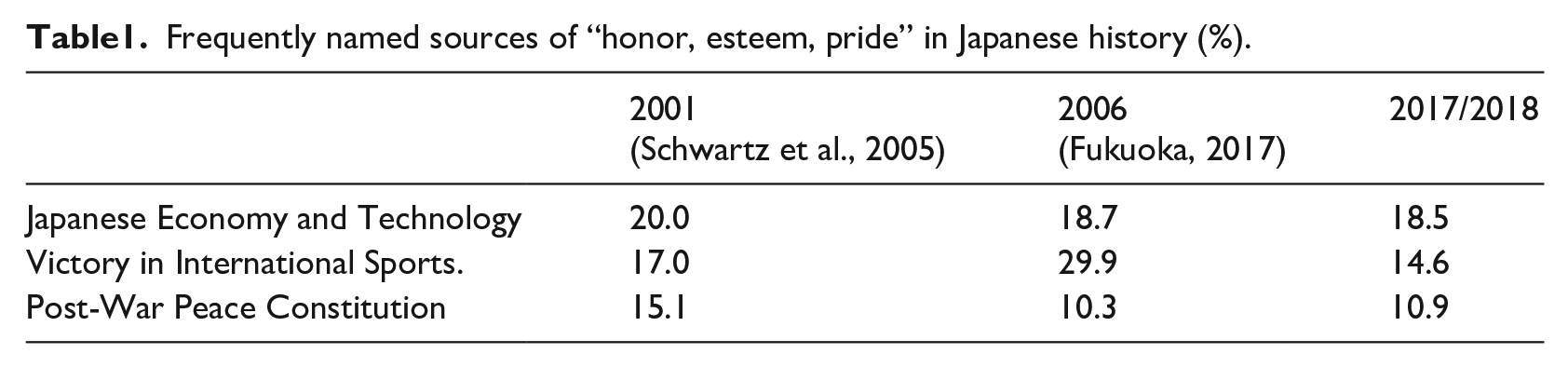
Following Schwartz and his colleagues (Fukuoka, 2017; Fukuoka and Schwartz, 2010; Schwartz et al., 2005), we asked respondents to name three historical events in Japanese history, which would arouse in them as a Japanese national (rather than a private individual) a sense of honor, esteem, dignity, and self-respect. Similar to the previous studies (Fukuoka, 2017; Schwartz et al., 2005), our current data (2017/2018) also named the same top three events, including the Japanese Economy and Technology (18.5 %), followed by Victory in International Sports (14.6 %) and the post-War Peace Constitution (10.9 %) (See Table 1).
Frequently named sources of “honor, esteem, pride” in Japanese history (%).
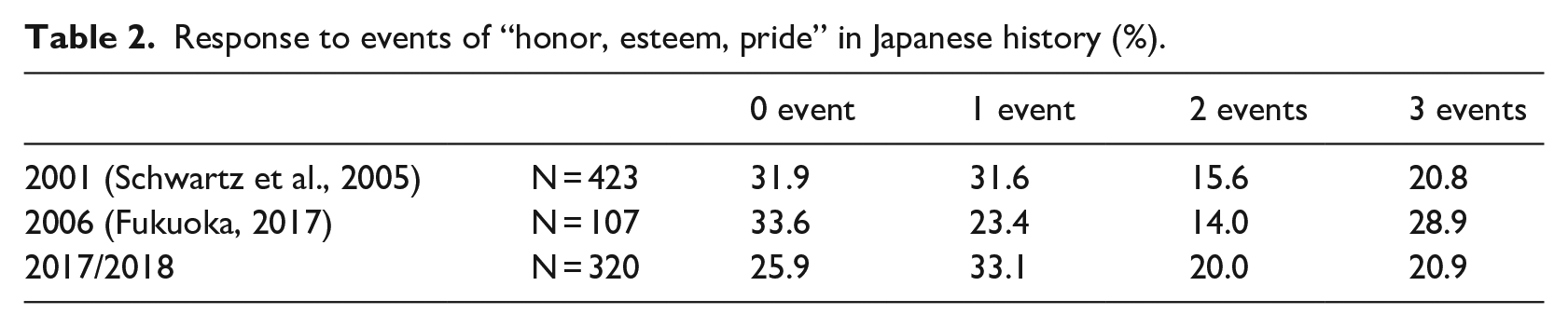
Remarkably, while the same three events were named repeatedly in all three surveys in 2001, 2006, and 2017/2018, when it comes to the question of how the Japanese respondents came up with those items, they had trouble finding them; 63.5 % (2001), 57.0 % (2006) and 59.0% (2017/2018) could not name more than one event of national pride and honor. In the 2001 and 2006 surveys, the response of “no events” (of national honor, esteem, and pride) was the most popular choice (31.9% in 2001; 33.6% in 2006); 25.9% in 2017/2018 could not name a single event of honor (Table 2). To be discussed later, this tendency was also observed in the interview data.
Response to events of “honor, esteem, pride” in Japanese history (%).
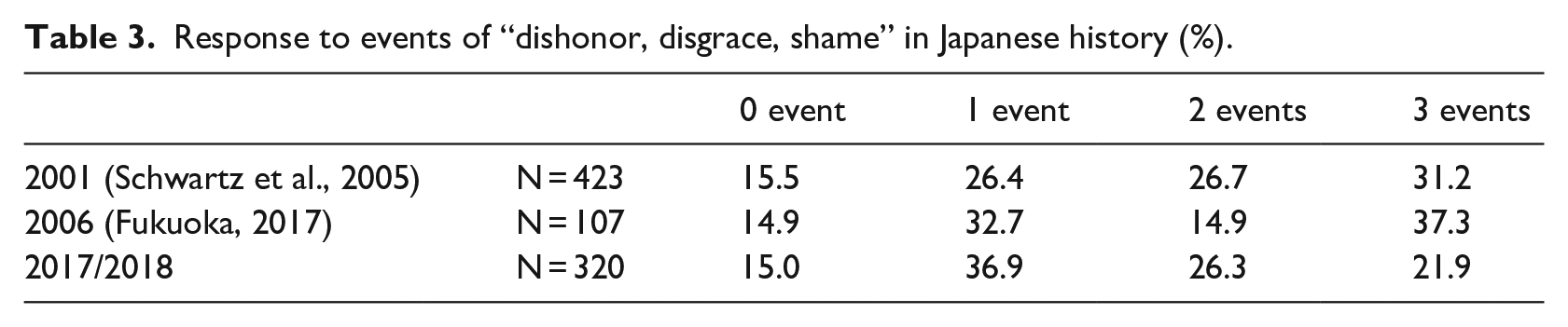
Those figures are still more intriguing when compared to the answers to the question asking to name three historical events of national shame, dishonor, or disgrace (Table 3). Close to 85% in all three surveys responded to that question (84.3% in 2001; 84.9% in 2006; 85.1% in 2017/2018). While 31.2% of the respondents in 2001 and 37.3% in 2006 named three events and the number dropped to 21.9% in 2017/2018, the most frequently mentioned historical events of national shame are still the same in all three surveys: Japan’s War in Asia and the Pacific War / World War II (Table 4). Furthermore, as we take a closer look at our 2017/2018 survey data, those who named either of those two events or both account for 64.4% of all respondents. Excluding those who could not name a single event, the figure goes up to 75.7%. That is, among those who named at least one negative event, more than 75% referred to Japan’s last war. 22
Response to events of “dishonor, disgrace, shame” in Japanese history (%).
Frequently named sources of “dishonor, disgrace, shame” in Japanese history (%).
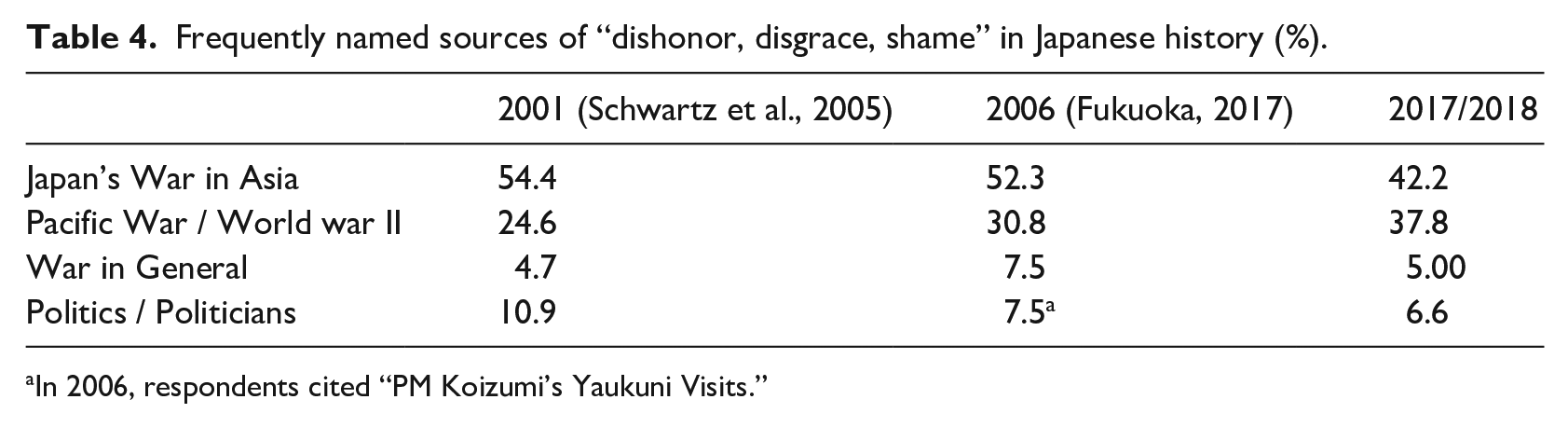
In 2006, respondents cited “PM Koizumi’s Yaukuni Visits.”
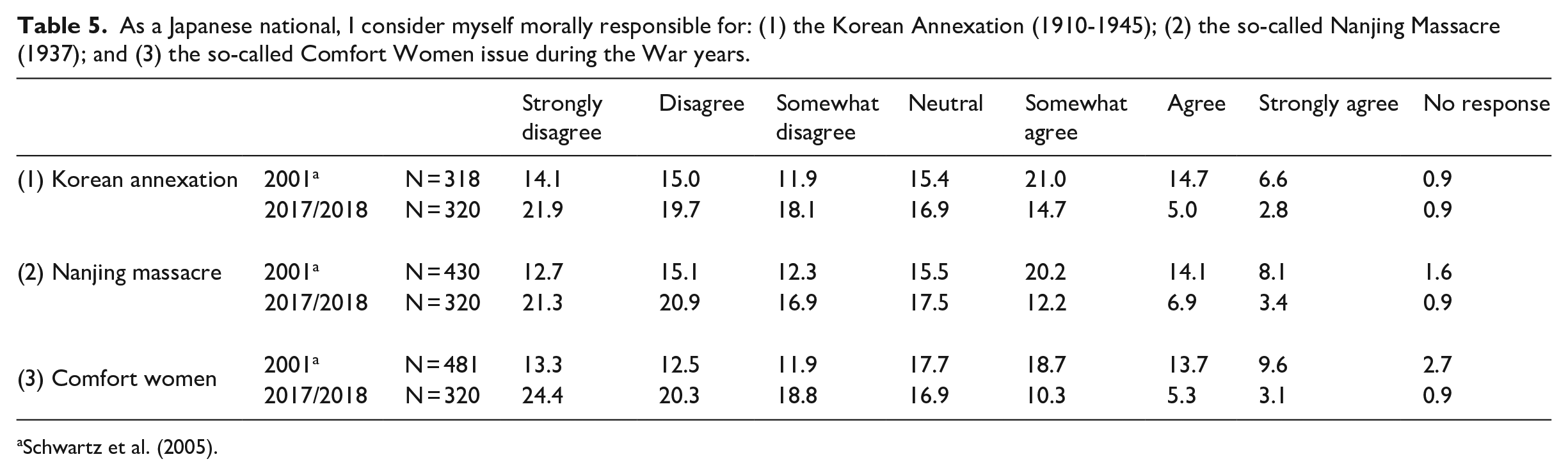
Then, how about the sense of responsibility? Again, we replicated the survey questions by Schwartz and his colleagues (Schwartz et al., 2005) and asked the respondents about their sense of moral responsibility. While the above analysis indicates that the 2017/2018 data is relatively comparable to the previous studies in terms of the questions about national shame and pride, there is a stark difference on the question of collective responsibility. As the tables below shows (Table 5), our 2017/2018 data reveals a sharp decline in respondent’s claim on collective responsibility.
As a Japanese national, I consider myself morally responsible for: (1) the Korean Annexation (1910-1945); (2) the so-called Nanjing Massacre (1937); and (3) the so-called Comfort Women issue during the War years.
In order to contextualize our survey data on intergenerational responsibility, we ran t-tests and compared mean differences in terms of ideology and gender. While there is no observable difference between liberals and conservatives, there is a discernible gender difference (Table 6). Although the average scores for the two groups (male and female) both lie in the range that denies intergenerational responsibility, male respondents are less willing to assume responsibility. It is presumed that female respondents are more sensitive to war crimes in which children and women are more often victimized. The gender gap is most visible on the question of Comfort Women.
Mean difference (t-test): gender.
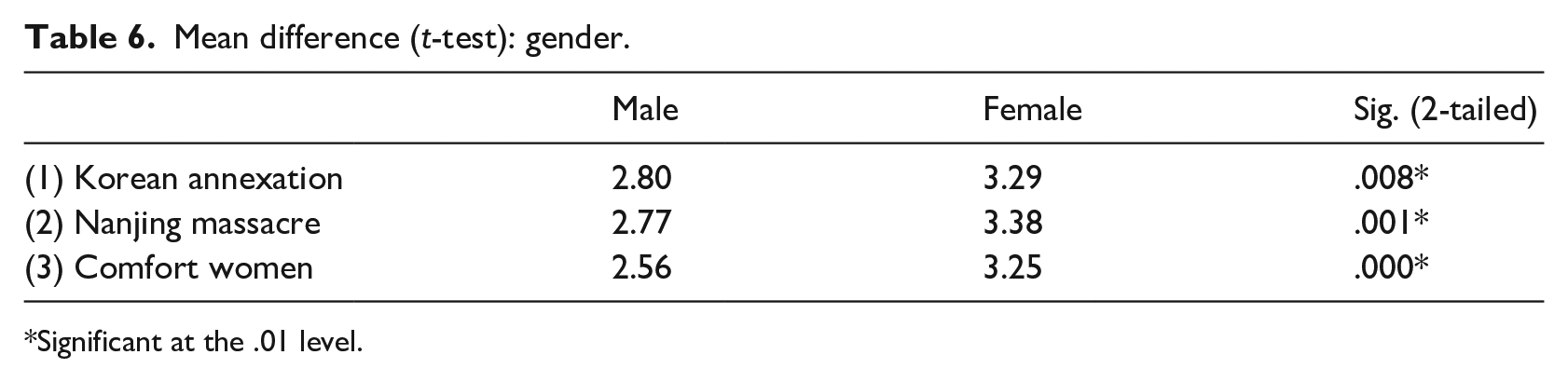
Significant at the .01 level.
While 42.3% in the 2001 study (Schwartz et al., 2005) agreed with the statement that “As a Japanese national, I consider myself morally responsible for the Korean annexation (1910-1945),” our current data (in 2017 and 2018) found only 22.5% think so. Accordingly, 59.7% now disagree (as opposed to 41.0% in 2001). This is also the case for the questions of the Nanjing Massacre (59.1%) and the Comfort Women issue (63.5%). 23
Importantly, this also resonates with recent national opinion polls. Upon PM Abe’s denial of intergenerational responsibility, 63% in the Yomiuri survey (Yomiuri, 18 August 2015) agreed that younger generations should not keep apologizing (as opposed to 23% who thought they should keep apologizing). Similarly, the Asahi survey (Asahi, 25 August 2015) also found 63% who agreed that they should not keep apologizing (as opposed to 21% who thought they should keep apologizing). 24
Questions should be asked. Given the relatively consistent pattern of Japanese respondents’ sense of historical honor and shame over the years, what does this (presumable) shift indicate? Or, what are the cognitive, and perhaps emotional, mechanism(s) behind this? The analysis of interview data in the next section will delve into these questions.
Judging the past: college student interview
Interview data provide more nuanced (and detailed) accounts. Although the number is much smaller, the distribution patterns are roughly comparable to the total survey responses. Among 31 interviewees, 9 could not name a single event of national pride. Also, 8 mentioned only one event. As a total, 17 out of 31 could not name more than one event of national honor (54.8%). Many also maintained that it was much easier to name national past wrongs. Only 2 could not name a single event; 10 named three events (32.3%). In terms of collective responsibility, the results also similarly correspond to the entire sample; 18 respondents (58.1%) disagree with collective responsibility of current generations on the Korean annexation (22.6% for “Strongly Disagree”; 19.4% for “Disagree”; 16.1% for “Somewhat Disagree”), the Nanjing Massacre (19.4%; 35.5%; 3.2%), and the Comfort Women issue (16.1%; 32.3%; 9.7%).
“I am morally responsible as a Japanese person.”
Among 31 interviewees, there are only 3 informants who explicitly expressed their strong sense of moral responsibility (i.e. moral blame). Toshiki (male, third-year Policy Science, conservative) 25 stresses the sense of historical continuity and maintains that the present generations have inherited both positive and negative legacies in the past. He strongly believes that he owes a debt of gratitude to the older generations who built the post-War economic prosperity. Accordingly, Toshiki feels that he is also responsible for Japan’s past wrong. He does stress that he has nothing to do with Japan’s past atrocities in Asia because they happened long before he was born. Yet, at the same time, the sense of continuity as a Japanese citizen (“tsunagari”) is very important to him. Although he did not do anything and his grandfather was just 15 years old in 1945 (and did not go to the war), he can still be perceived as a descendent of wartime soldiers who committed atrocities in Asia. At the same time, however, Toshiki is skeptical about the future reconciliation with Asian neighbors: “Although Japan and Korea may be able to reach a political solution, there will be no solution upon which the entire nation can agree.” Similarly, Naoya (male, third-year Community Management, liberal) stressed the sense of historical continuity, or, what Trouillot (2000: 175) calls “spatio-temporal continuity,” 26 in both Japan and former victim nations. He believes that the future is based on the past. Since “the past leads to the present,” as Naoya stresses, “we just cannot say that our generations are unrelated to the past.” While he is future-oriented, he also knows that the past cannot be undone and claims that we cannot make up for the past wrong (“umeawaseru kotowa dekinai”). In a nutshell, according to Naoya, it is difficult to change the feelings of the people whose family members were killed in the war.
Misuzu (female, third-year Policy Science, liberal) feels morally responsible for Japan’s past wrongs in Asia. She is very proud to be Japanese (“hokori wa ‘danzen’ aru”) and appreciates the fact that she was born and raised in Japan. Also, Misuzu realizes that she is fully imbued with Japanese culture. The very fact that she is Japanese makes her feel responsible. Yet, even though it is okay for the Japanese government to apologize to the former victims, it does not necessarily mean that she is ready to take on the endeavor. As Misuzu emphasizes, her responsibility is to not repeat the mistakes of her ancestors (“ayamachio kurikaesanai sekinin”) and nothing beyond that. Unlike Toshiki above, Misuzu is rather optimistic about the future reconciliation prospect. As Misuzu has helped many international students at her school and has friends from Indonesia and South Korea, she does not necessarily see international relations from the state perspective. For her, it is rather the issue at the individual level (“seiji to kojin wa chigau”).
To be noted, the above three informants point out their strong sense of belonging to the Japanese nation and attribute their sense of national attachment to their sense of moral responsibility. Toshiki and Naoya do so through the importance of generational continuity, and Misuzu in terms of her attachment to Japanese culture, which, according to them, evokes the sense of moral responsibility as a Japanese national. In other words, their love of nation does not necessarily preclude critical reflection upon Japan’s past wrongs (Fukuoka, 2017: 361). 27 However, it is also true that their sense of responsibility is never profound. While they did express regret, they did not necessarily show their emotional commitment to it. Similar to the Japanese respondents in Fukuoka and Schwartz (2010), “they express more regret than they feel” (Kim and Schwartz, 2010: 12; Emphasis in original). As Fukuoka and Schwartz (2010: 77–79) would observe, the expression of moral regret by those three students in this study is, perhaps, more “obligatory” (or, following what Hochschild (1979) calls “feeling rule”) because of their deep sense of belonging to Japan; they may simply refer to their “vocabulary of regret” (C. Wright Mills, 1940) (p. 86). As Thompson (2012) explains, the expression of regret alone is not that difficult since “[b]eing regretful or sympathetic doesn’t require the taking of responsibility and it need not involve a commitment to any future course of action” (p. 221).
Yet, again, they are now a minority (both in survey and interview data). Most interviewees maintain that they simply cannot feel responsible for what they never committed. Also discussed later, some were even skeptical about the very historical claims projected by the Chinese and Korean governments on the Nanjing Massacre and the Comfort Women issue.
“We were not born”
Many respondents unequivocally deny their contemporary moral debts because they personally never participated in Japanese military aggressions in Asia. At the same time, however, they often suggest what they can or should do in response. Yoshiko’s (female, third-year Social Relations, ideology unknown) narrative is typical of our interviewees. She believes that Japan’s military advance was surely a bad thing, which should not be repeated. 28 Also, the Japanese people need to reflect on it (“hansei subeki”). Yet, the state should deal with this (political responsibility of the state). She just cannot agree with the position that ordinary individuals should be also responsible, including her generation. Yoshiko’s image of Japanese history is rather negative. She could not name a single historical event of pride and honor. Instead, she came up with Japan’s wars such as War I, War II (including Japan’s war in Asia), and the Manchuria incident as the historical events of national shame and dishonor. For her, it is more important to “learn from the past” and be “future-oriented”; yet, this does not mean that her generation is responsible. Similarly, Tomomi (female, second-year Int’l Liberal Arts, very liberal) also cannot believe that Japan’s past wrongs are directly related to her (“cyokusetsu kakawariga arutowa omoenai”). Unlike Yoshiko, Tomomi does not necessarily think that the immoral parts of Japanese history outweigh the good. Also, just like Naoya in the previous section, Tomomi claims that what happened cannot be undone. Yet, unlike Naoya, Tomomi does not feel responsible. Very simply put, she cannot be responsible for what she never committed. She thinks that we should be more future-oriented. While she knows that she needs to be serious about Japan’s past wrong as a Japanese citizen (“nihonjin to shite kangaenakutewa ikenai”), she also maintains that this is what the Japanese state (“kuni”) did (not her!).
Like many other respondents, Haruki (male, third-year Environmental Engineering, liberal) understands that Japan committed atrocities (although he also understands that there are a variety of interpretations of what really happened) and he does think that he cannot say that he has nothing to do with the past (because he is Japanese although his sense of nation is not necessarily high). He also knows that the victims and their decendants would hold a grudge against him as a descendant of the Japanese who committed the crimes. Yet, he would not offer an apology. Haruki simply does not think that he should be responsible. He said rather sardonically: “I did not do it (ore yattenēshi. . .).” Similarly, as a Japanese national, Mana (female, third-year Sociology, liberal) feels “sorry (sumanai)” for what happened and she is not happy with the current strained relationship between Japan and Asian countries (“iyadanā”). She also says: “I cannot be fully proud of myself as Japanese [because of the historical debt] especially when I am abroad.” Yet, like Haruki, Mana’s feeling does not necessarily transfer to a sense of moral responsibility for her generation. Although she feels sorry for the victims in Asia, this sentiment does not necessarily compel her to evoke a sense of moral debt (“sekinin tomadewa ikanai”).
Tetsuya (male, fourth-year Sociology, liberal) believes that Japan’s military atrocities in Asia should not be justified. Yet, at the same time, he cannot believe that everything Japan did in Asia was wholly wrong. As for the question of his own responsibility, he just does not take ownership of it. He asks: Who could possibly claim moral responsibility for what he or she never committed? His logic is straightforward: since he did not do anything to be blamed for, he just cannot feel responsible for it; it is a sentiment shared by most interviewees. Similarly, Akane (female, third-year Sociology, liberal) contends that Japan’s past wrong is “unrelated (kankeinai)” to ordinary Japanese. She cannot think of Japan’s militaristic past as her own concern: it is not a common, everyday issue (“mijika de nai”). Their positions also seem to echo PM Abe’s denial of intergenerational responsibility of current/future generations. However, Tetsuya also stresses that his position is different from that of his prime minister. As he further explains, PM Abe simply used the younger generations (“jibuntachio umaku tsukatteiru”) so that he could “evade his own responsibility (sekinin nogare)” as Japan’s prime minister. 29
Hiroshima is famous for its prefecture-wide peace education program in elementary and middle schools. Takehito (male, first-year MA Information Media, liberal) is from Hiroshima and he thus studied/learned about Japan’s war in Asia rather extensively (“tokoton mananda”). When he entered his university in Kyoto, however, he was shocked to find that his friends there knew very little about the war, including Japan’s invasion of Asia: “They do not know anything and they do not care.” Takehito feels that there will be no end to Japan’s history problem with Asian neighbors (“kiriga nai”). Although he believes that Japan made mistakes, he also maintains that it is important to be future-oriented. For him, those who feel responsible must be viewing “the state (kokka) as one community” and he can only half-agree with that. Takehito says that “the state interests should not interfere with individual interests, and vice versa.” In this context, for Akira (male, third-year Policy Science major, ideology unknown), if one feels responsible about the past wrongs, he wonders if that person is simply “hypocritical (gizensha).”
In a similar vein, Junya (male, second-year Sociology, liberal) even denies the current administration’s political liability (including state apologies and legal responsibility for restitutions). According to Junya, the state is different from individuals (“kuni to kojin wa chigau”) and what state and individuals can/should do is totally different. Junya believes that his generation should not be oriented only to the future (“mirainokoto dakeni mewo mukerubekidewanai”) because, without the past, there would be neither the present, nor the future. However, when it comes to the issue of Japan’s history problems, he cannot find relevant the historical continuity between the past and present and claims that the current administration is not morally responsible (dōgiteki sekinin) since it did not commit the atrocities in question. Accordingly, his generation has nothing to do with the past crimes, either. At this point, Junya echoes Trouillot (2000) in that current generations cannot be relevant actors for memory politics. As Truillot asserts, formal apology or statement of official regret could not be meaningful since it would be offered only to and by the descendants of victims and perpetrators; they could never genuinely feel the pain incurred and inflicted. Instead of apology, Junya stresses, it is important to keep the discussion of this history alive and to not repeat these mistakes. That is his responsibility.
Some question the relevance of apology altogether. Aoi’s (female, second-year Int’l Liberal Arts, liberal) sense of generational continuity is much clearer than others. She believes that her generation must teach future generations about Japan’s past wrongdoings, since this is what “my ancestors, the same Japanese people” committed. Yet, at the same time, she questions if her generation could ever “atone for (tsugunau)” Japan’s past wrongs. She also questions: Does apology really suffice? Although Aoi believes that she cannot atone for the past, she also stresses that her generation must “properly teach what really happened (chanto okottakotoo tsutaerubeki),” which is her responsibility. She maintains that teaching history must be unbiased, independent of, for example, Japan’s and /or Korea’s national interests. Rie (female, second-year Social Relations, liberal) is skeptical about the act of apology in the first place. Even though the Japanese people did bad things, she believes that this should not mean that her generation still feels responsible for it. Simply put, according to Rie, children should be free from their parents’ sins: they should find their own path in the future (“mizukarano michio ayumubeki”). Rie does not think that her generation should be apologetic for what happened a long time ago. Otherwise, the current generation (of both former aggressor/victim nations) can never be friends.
Two observations seem possible so far. First, although most interviewees recognize Japan’s past wrongs in Asia and emphasize the importance of pledging that they would not allow them to happen again and teaching and learning from the past, they also stress that they cannot feel responsible. Simply put, they cannot imagine that they can be responsible for the things that happened long before they were born.
Second, in this conjunction, also striking is the (seemingly) widely shared notion of the past’s contemporary irrelevance for the great majority of respondents. This is a clear departure from the past studies in the early and mid-2000s (Fukuoka and Schwartz, 2010; Schwartz et al., 2005). This is also different from Fukuoka’s (2017) recent article in which interviews were conducted in 2006 and 2009. While our respondents do recognize/emphasize the importance of learning / teaching the past and educating themselves (and later generations), they evidently separated themselves from the past offenses committed by the Japanese military in Asia.
Skepticism: “what really happened?”
Although still a minority, some respondents are even skeptical of Chinese/Korean assertions, including the very factual claims around the Nanjing Massacre and the Korean Comfort Women. History problems are now heavily associated with the images of territorial disputes and each nation (Japan, China, and South Korea) is entangled in memory politics. Many are critical and tired of political usage of history/the past. Also important, just like those college students in previous studies (Fukuoka, 2017), most of our informants tried to distance themselves from the ethnocentric, neo-nationalist (or, revisionist) perspectives, including online right-wingers. 30 They do recognize online nationalism and its anti-Chinese and anti-Korean narratives; however, they maintain that those nationalists do not represent them. 31
For example, Hiroshi (male, third-year Community Management, very liberal) is “woolly-minded (moyamoya suru)” about Japan’s history problems. He thinks that Korean claims are “unrelenting (shitsukoi).” Even though the Japanese government has already paid the former victims, the issue never goes away. He wonders if they really want an apology; he even thinks that what they really want is just more money. Hiroshi stressed that he is not susceptible to the influence of online media such as the online forum “2 channel (www.2ch.net)” that has been “a greenhouse for the expression of digital nationalism in Japan” (Maslow, 2011: 301). While he underscored that his generation rather extensively learned what media literacy means in elementary and middle schools, his main source of references is actually online media, including the 2 channel. Hiroshi is interested in Korean pop culture and he also learned from his international friends in college that he should not profile people based on their nationalities. He also knows a Chinese co-worker from his work in a restaurant and expressed his sympathy to the co-worker. Yet, his logic (and his perspective on Asian politics) is often unidimensional.
Some feel that the Chinese and Korean governments (perhaps, the Japanese government, too) cannot be trusted. Although they claim that they are far from online right-wingers, their narratives sound similar. Jun (male, third-year Policy Science, very conservative) 32 is very patriotic and very proud of being Japanese. While it is all right to criticize Japan, Jun at the same time believes that those who cannot wholeheartedly support Japan should live somewhere else. Jun is very skeptical about the factual claims about those three events in our survey questionnaire. Rather, he thinks that they did not happen (“dochiraka to ieba nakatta to omotteiru”). He does not necessarily condone online nationalism; yet, its underlying impact on his narratives is rather obvious. According to Jun, those who participate in hate speech are not necessarily anomalous. Although their behaviors are certainly immoral (“tagaga hazureteiru”) (because they act out), according to Jun, many ordinary people also feel the same way. The only difference is that the latter is able to keep their emotions under control. But, other than that, Jun believes that they are the same. Although Jun’s position is rather extreme, there are also other respondents who are unconvinced by the historical claims of China and South Korea. Kenta (male, third-year Community Management, ideology unknown) thinks that Japan did bad things in Asia and, in our survey questionnaire, he “somewhat agrees” with the statement on the collective moral responsibility of his generation regarding the Korean Annexation and Nanjing Massacre; however, he is skeptical about the Comfort Women issue. Kenta does not trust media at all and the information coming through them is, according to him, like a “muddy stream (dakuryu)” in which ordinary people are swallowed by the media’s political agendas. He even stresses that the only information he can trust is the weather forecast(!). Yet, Kenta still cannot deny the lasting impact of the media on his historical perspective. “Right now,” he says, he “just cannot judge (yoku wakaranai)” which side (Japan or Korea) is correct on this issue. The newspaper to which his family subscribes has been critical of the politics around the Comfort Women issue and he was certainly influenced by their right-leaning narratives.
According to attribution theory in social psychology, people tend to interpret other’s behavior based on “the desirability of that behavior” (Mercer, 1996: 59). That is, “positive behavior by adversaries elicits situational attributions (because it is unexpected), and negative behavior by adversaries elicits dispositional attributions (because it is expected)” (Mercer, 1996). 33 Many Japanese nowadays realize that the Chinese and Korean governments are more diplomatically skilled in the Asian politics of memory, employing the past as a bargaining chip. As China and Korea are not considered trustworthy partners, the underlying suspicion about them are easily translated into the question about their historical claims.
Also, some maintain that they cannot be responsible for what they do not know very well. 34 Aki (female, third-year Community Management, liberal) states that she cannot feel morally responsible for what she does not know well. Since she does not know much about the Nanjing Massacre and the Comfort Women issue, she cannot be responsible. However, as for Japan’s rule over Korea, since she studied the subject matter rather in detail in her first year in college, she feels responsible. That is, “because she is a part of the family called Japan (nihon toiu kazoku no nakani jibunwa irunodakara).” Aki feels morally responsible for only what she thinks she knows well. Yet, when she does so, her sense of responsibility emanates from the fact that she is Japanese (just as with the first three respondents Toshiki, Naoya, and Misuzu)—it does not necessarily come from her moral conscience. Accordingly, unlike other respondents, Aki believes that she would feel responsible if her parents committed a crime. Chiaki (female, third-year Policy Science, liberal) feels the sense of gratitude to the older generations as they brought the post-War economic prosperity. While she does feel the connection to the past, she does not necessarily know much about those historical events in question. While she answers that she feels responsible in our survey, her sense of responsibility is not very high (“somewhat agree” for all three events). “If I knew more about them,” she ponders, “I might feel more responsible.” She is not very sure about how she can possibly take moral responsibility and/or, perhaps, apologize to the former victims; yet, she is sure that her responsibility is to “know” the mistakes (“shirubeki sekinin”) and not repeat them.
Along with the widespread skepticism about (if not disbelief in) their generation’s moral responsibility, another peculiar feature observed throughout the interviews was that most of our informants tried to maintain “objectivity (kyakkansei)” as they approached Japan’s memory problematic. 35 As they distanced themselves from right-winger, revisionist narratives, it may be the case that they were just following the “feeling rule” (Hochschild, 1979) so that they could look level-headed (as opposed to irrational and/or emotional). 36 This also similarly corresponds to Fukuoka’s (2017) analysis on youth nationalism where his interviewees stressed the Japanese fans’ “more civilized manners” (as opposed to the Korean people’s emotional demeanors) in international sporting events (pp. 359-360). To be noted, although Jun (our right-leaning informant above) is largely influenced by the online revisionist narratives, it is also the objective stance that he tries to base his arguments upon (although it is questionable if he is ever objective) 37 and his criticism against China and Korea is based on their (alleged) lack of empirical perspectives on historical issues. As the underlying image of Japan’s militaristic past is closely related to its wartime nationalism, it is understandable that our informants try to avoid any hints of it in their narratives. In this sense, the Japanese case does not necessarily showcase “emotional intensity” (McDonnell and Fine, 2011: 124) often found around the sense of nation, including national shame and pride, as the Judging the Past framework typically assumes.
Encounters with Asian neighbors: “I am now a global citizen”
The last 10 years marked the deterioration of the Japanese public’s sense of affinity toward China and South Korea. The recent territorial disputes over Takeshima/Dokdo (in the case of Japan and South Korea) and Senkaku/Diaoyu (Japan and China) have further complicated the already troubled international relations in East Asia. PM Abe Shinzo’s official pilgrimage to Yasukuni Shrine in December 2013 seems to have added another layer. Not only that, the Comfort Women issues have yet to witness any tangible signs for future resolution. 38 The Japanese people are now much more pessimistic about their future relationship with China and South Korea. According to the Prime Minister’s Office’s (PMO) annual survey on diplomacy, 39 in October 2012, more than ninety percent of the Japanese respondents (92.8%) maintained that the relationship between Japan and China was bad and eighty percent (80.6%) answered that they do not feel close with China. The Japanese people’s sense of affinity to China is continuously very low and the 2014 PMO survey shows that more than eighty percent of the respondents (83.1%) do not feel close with China. In terms of South Korea, seventy-eight percent of the respondents (78.8%) in the 2012 PMO survey also answered that the relationship between Japan and Korea was bad; that figure is a huge jump from the previous year (36.0% in 2011). 40 In terms of the sense of affinity, too, while thirty-five percent (35.3%) in 2011 felt distance toward South Korea, fifty-nine percent (59.0%) thought so in 2012. In 2014, sixty-six percent (66.4%) of the respondents maintained that they do not feel close (with 14% for “feeling close”). The trend has continued. In 2017, almost eighty percent of the respondents answered (78.5%) that they do not feel affinity toward China. As for Korea, about sixty percent (59.7%) answered so. 41
What does this suggest? How could this decreasing sense of affinity be translated into the perception of Japan’s past in Asia among Japanese youth? As our interview data indicates, our respondents’ sense of Asia was rather balanced in general. While many realize that Japan’s relation with Asia (China and South Korea) is not particularly good, they also maintain that the stereotype image of people in specific countries should be differentiated from that of states. Tomomi is one of those respondents. Tomomi is very liberal and, according to her, her image of Korean people totally changed as she actually met them while studying abroad in Canada. She used to look down upon them and she was also inconsiderate of her Japanese friends getting excited about K-pop idols. But, now, she has a globalized vision. Tomomi also told us that her mother does not like Chinese people. As more Chinese people moved into her neighborhood in her hometown, her mother could not stand their (alleged) lack of civility (“reigi no nasa”), including, for example, the way they often jump the queue at grocery stores. She used to echo her mother. But, she is different now. That is, she has become a global citizen.
Although her grandmother hates Korean people, Mana was never influenced by it. Her family ran a department store in Korea during the war and they lost all their fortune as Japan lost the war in 1945. Her father is an engineer and he has been stationed in China for about 5 years. He has a very good opinion of the Chinese people working with him, which, according to Mana, positively impacted the formation of her own good view of China and Chinese people. Junya is from Yokohama. He had a childhood friend who is Korean; his grandfather told Junya not to play with this friend. Junya never understood why his grandfather told him that back then. According to Aoi, her father is anti-Chinese. As soon as he sees Chinese people on the street, he points and says that “they are Chinese” (“chūka ga iru”). Aoi told us that she occasionally has an argument with her father over his racist comments about Asian people. The above respondents are all liberal and they are not necessarily susceptible to the influences of their family members in forming their perceptions about Asian friends. Tomomi and Aoi even argued with their parents over their racist comments. Yet, their positive attitude about Asian others is not necessarily translated into the sense of moral responsibility of their generation.
Tetsuya also changed his perception about Asian people as he met them when he studied abroad in Los Angeles. Simply put, he realized that they are “the same humans in the end.” He confessed that he was “corrupted (dokusarete)” by the online right-wingers before his trip, and he did not want to interact with other Asian people. Armed with what he calls “global perspectives,” Tetsuya now believes that to meet and interact with others is an important first step for mutual understanding. Rie also met many Chinese and Korean students for the first time when she had a study abroad opportunity in San Diego. Before the trip, she thought that she could never understand them because Asian cultures are just very diverse and different. Japanese TV outlets also covered a lot about Chinese travelers’ shopping sprees in Japan, which largely formed her impression of China and Chinese people (i.e. they are not civil and utterly aggressive). Rie now tries to see Asia beyond narrowly-defined national borders. She asserts that “we need to see and feel with our own eyes and heart.”
To meet and interact with Asian people in foreign settings (Tetsuya in Los Angeles and Rie in San Diego) certainly impacted their way of seeing the world and their East Asian neighbors. Yet, this does not mean that they think that they also own moral responsibility for the past. Although Tetsuya tries to go beyond national borders (“kunio koerarereba”), his sense of horizontal (global) ties does not necessarily lead to the facilitation of his vertical (historical) ties with past generations. For Rie, PM Abe’s 2015 statement is actually not farfetched; children should not be limited by the debt of their parents. As she stressed, it is very important to be future-oriented.
Anti-Korean/Chinese sentiment?
Among the Japanese interviewees, no one was explicitly antagonistic toward China and South Korea. While Hiroshi and Jun (referred to earlier in the section, Skepticism: “What Really Happened?”) seem susceptible to the online right-wing narratives, they are by no means outright racists. For Makoto (male, third-year Policy Science, conservative), the defeat in the last war was a shameful event. Japan lost its just cause in the war only because it did not win (“katteireba seigi”). While he cannot understand that his generation should possibly feel morally responsible for what they never committed, he also thinks that those who feel responsible would probably be good-natured (“yasashii”). Makoto also thinks that those anti-Chinese/Korean advocates are certainly extremists (“kyokutan”). Yet, as he confessed, he can also empathize with them since he used to be exposed to and influenced by the online anti-Korean reasonings when he was in high school. According to Makoto, those internet right-wingers in the online forum such as the 2 channel conflated political problems at the state level with individual problems. As Makoto explains, they simply project certain negative images of the state (such as South Korea) onto the impressions of people (South Korean), which, he apologetically admits, was the mistake he used to make. Yoichi (male, first-year MA Machine, ideology unknown) was also influenced by the online right-winger narratives in his high school days. While it is almost surreal that he was following them, he cautions: They rely on blind faith.
Regarding the aforementioned opinion polls that suggest a declining sense of affinity toward China and South Korea, many suggest that things are much more nuanced and polls need to be interpreted with care. As Ichiro (male, first-year MA IR, conservative) told us, if he were asked whether or not he feels close with China / South Korea, his answer would be probably “No.” This is mostly because of the long-standing diplomatic rows over history problems, territorial disputes, and the media images of Chinese travelers, to name just a few. However, it does not mean that he dislikes (or even hates) them. This only means that he does not have a good impression of China and South Korea, which, Ichiro assumes, would be the case with many people. Hiroshi echoes that. Generally speaking, as Hiroshi asserts, Japanese people do not feel affinity toward China and South Korea. For many people, however, this does not mean that the Japanese hate China and South Korea. Rie does understand that there are people who hate Chinese and Korean people. However, she also observes that they are different from those people who do not feel affinity toward China and South Korea. Rie maintained that while “do not feel affinity” may mean “do not like to some degree,” it is not the feeling of hate. Yoichi also suggests that “do not feel affinity” does not necessarily indicate “aggressive feelings.” Those in polls may feel uncomfortable over the history problems, including the Comfort Women issue, but they differ from the haters. Along with this line, Erika (female, third-year Policy Science, very liberal) even suggests that she would find it difficult to tell in street interviews that she loves China and South Korea since, according to her, the public code in contemporary Japan does not expect otherwise. That being the case, again, the above (relatively) balanced gaze of Asian others does not necessarily translate into the sense of collective moral responsibility. While many understand the history problems and admit Japan’s past wrongs in Asia, for most, the history problems are not necessarily the issue with them (Asia Others); the issue may be more about how we (Japanese youth) connect ourselves with the past. Also important, no discernible discrepancies in our informants’ responses arise based on gender and alleged political ideology.
In this conjunction, some underscore the importance of victims’ perspectives. 42 For example, Makiko (female, third-year Sociology, conservative) claims that her sense of historical continuity to the past is weak. Although she cannot be responsible for the past, she also stressed the importance of victim’s perspectives: “Just like bullying, we need to think how the victims feel.” Like Makiko, Koichi (male, fourth-year Journalism, conservative) also understands that how victims feel about the past needs to be given serious consideration. He said: “While aggressors tend to forget the past, victims never forget about it.” Although Ryota (male, second-year MA Environmental Science, ideology unknown) does not feel morally responsible about Japan’s past misconducts, he also maintains that he might feel so “if he meets former victims and is connected emotionally (kanjō inyū) to them.” Similarly, while Yoichi does not necessarily feel responsible for Japan’s past wrong doings, he at the same time empathizes (“kyōkan”) with those victimized. According to Yoichi, his responsibility is to reflect on, not repeat, and teach about these mistakes. He also hints that those who can empathize with victims might feel responsible.
Although not a strong feeling shared among the respondents, a sense of empathy seems still applicable to the above narratives because its manifestation, by “increasing perspective taking and creating common-ingroup identity” (Cehajic-Clancy et al., 2016: 84), would help generate the sense of trustworthiness (or, civic trust) among the offender and offended parties (De Greiff, 2008: 131). This is also coterminous with Lisa Yoneyama’s (1998, 2006; Iwasaki et al., 2006) underlying emphasis on the importance of compassion. Referring to Benjamin’s famous phrase in his Historical Thesis VII (“. . .brush history against the grain”; Benjamin, 1968: 256–257), Yoneyama tries to unearth those subaltern voices hidden in national histories. Although Yoneyama’s concern does not necessarily reside in the issue of intergenerational responsibility, her framework still hints toward a potential path to the sense of solidarity among the descendants of former victims/perpetrators beyond national memories.
Conclusion
As Kim and Schwartz asserted in 2010, the problem of a difficult past in Japan and China/South Korea lies in “a surfeit rather than a deficit of memory” and “unforgettable traumas prevent nations from coming to terms with the problems of the present” (Kim and Schwartz, 2010: 2). A decade later, the situation is still dismal; the diplomatic divide between Japan and those two Asian neighbors is deeper and wider and both sides have resisted necessary compromises. It has been more than 75 years since the end of the war and Japan has not fully reconciled with China and South Korea.
The findings of this exploratory study bear several underlying propositions about the perceptions and feelings of contemporary Japanese youth regarding Japan’s past wrongdoings in Asia. First, the college student surveys showed that they had trouble finding the historical events of national honor, which was also observed in the interview data. While our current survey data is largely comparable to the previous studies in terms of those named historical events of national shame (such as Japan’s war in Asia and Pacific War/World War II), the current study also shows that more respondents now disagree with their own responsibility for Japan’s past wrongs. 43 Second, in this conjunction, most of the Japanese interviewees underscored the emotional disconnection with the past and maintained that they simply cannot imagine how they could possibly have responsibility for sins they never committed. 44 Third, while Japanese respondents were well aware of Japan’s past aggressions in Asia and also highly critical of them, some stressed that they cannot trust the very factual claims that Chinese and South Korean governments have been making regarding the Nanjing Massacre and Comfort Women. Yet, at the same time, they also tried to distance themselves from revisionist historiography and nationalist politics. Fourth, many emphasized that international (state-to-state) relations must be differentiated from international interactions at the individual level. Most of the interviewees had rather balanced perceptions of Asian neighbors and stressed that the direct interactions (i.e. friendship) is an important first step for mutual recognition and understanding. Yet, this rather amicable, balanced position was not necessarily translated into their sense of collective responsibility for the past.
So, what does this indicate? As the analysis of this study’s findings should signify, most of our respondents would probably disagree with the normative implications proposed by Kato and Takahashi. Takahashi’s suggestion would probably sound too ethical. As most of our interviewees could not imagine tangible connections with the past generations, his insistence on the continuous exposure to Asian gaze (for the sake of being “shamed”) does not seem to appeal to the current generation. Also important, Takahashi’s position, although sincere and admirable, also amounts to “ethical extremism” that “makes the other [i.e. victims] absolute and prioritizes the other over the self” (Saito, 2017: 187). Kato’s two-step solution may appeal to those who have a strong sense of national belonging (such as Toshiki, Naoya, and Misuzu from our interviews); however, they constitute only a small minority. Accordingly, our interviewees would also negate Jaspers and Arendt on political responsibility. Arendt (2003: 29) once said, “If young people in Germany, too young to have done anything at all, feel guilty, they are either wrong, confused, or they are playing intellectual games” (Emphasis in original). To Japanese respondents, not only guilt, but also political liability (as a duty of citizens) does not seem transferable. While the past is never a “foreign country” as in Lowenthal (1985), to many, it is far enough cognitively, psychologically, and emotionally. 45 That being the case, it should be noted that our interviewees probably miss an important implication Arendt tried to convey. Although many of our informants stressed the importance of being future-oriented and learning/teaching the past, what is discernible in the Japanese context is the sheer lack of the normative attention to the very historical process in which the past aggressions occurred. As Arendt discerned in Nazi Germany, this is her genuine fear that ordinary people, without ill-intentions and/or evil motives, could be a “cog” (Arendt, 2003: 148, 29–32) – a part of the “machine of administrative mass murder” (Arendt, 1994: 126). 46 The Japanese respondents’ emphasis on the importance of teaching the past does not seem to connect to the realization of this inherent vulnerability (or, weakness) of humans. 47
More recently, Hiro Saito revisited the issue and proposed his pragmatist solution (Saito, 2016, 2017; Saito and Wang, 2014). According to Saito (2017: 186), “younger generations of Japanese citizens . . . do have commemorative responsibility, to fully acknowledge Japan’s past wrong doings and press [the Japanese] government to offer a satisfactory apology, even though [they] did not commit those acts.” This pragmatist position suggests that “the past should not be commemorated for its own sake but for the sake of the future” (Saito, 2017). Furthermore, Saito claims that: “. . . younger generations of Japanese citizens do not have commemorative responsibility because they have inherited war guilt but because the ‘present situation’ . . . demands commemoration of Japan’s past wrongdoings” (Saito, 2017: 186). While Saito’s elaboration seems to better fit the underlying perceptions and feelings of the contemporary Japanese youth, is not his approach a bit too presentist? As Saito himself warns, in this conjunction, any future-oriented claims from the former aggressors (such as Japan) are easily interpreted as “let’s forget the past” to the former victims (Tōgō in Saito, 2017: 187). 48
Again, is Trouillot correct? Fukuoka and Schwartz (2010) claim that he is wrong. For “what makes a ritual [apology] effective is not participants’ ability to experience the feelings of forebears but to experience the feelings of one another” (Fukuoka and Schwartz, 2010: 87). But, are the contemporary Japanese youth necessarily compassionate to their Asian neighbors’ pain? Do they empathize with it? Or, can they feel it? 49 This study’s findings imply the opposite. If the findings of this study provide an indication of an emerging new picture of memory politics among the Japanese youth, our respondents’ observable emotional disconnection with the past is not a helpful sign for the future reconciliation process. At this point, we may have to question the validity of our (although implicit) normative assumption about the contemporary generations as the receivers of historical guilt and responsibility. That is, can we simply assume that the Japanese youth should inherit the historical burdens of the nation? 50 Or, as the findings of this study suggest, is it time to radically re-contextualize Japan’s memory problematic altogether? While this is certainly beyond the scope of the current study, it seems a viable next step for this exploratory study.
The question of Japanese youth’s collective responsibility provides a good case to help us think through the issue of national belonging in the global era. Despite the charge of deep-rooted methodological nationalism in the field, nation still poses “an unescapable framework of solidarity” and “citizens have no choice but to think and feel about the (their) nation” (Duchesne, 2018: 868). Or, this is how ordinary people talk about, talk with, choose, perform, and consume the nation (Fox and Miller-Idriss, 2008). This is also the question of the autonomy of ordinary citizens in memory politics – autonomy from the mnemonic socialization from the above. And this is the analytical realm in which Japan’s memory problematic is contextualized.
Footnotes
Appendix 1
Acknowledgements
We would like to thank the following people for their support in producing this article: Jerdén Björn, Vanessa Frangville, Karl Gustafsson, Linus Hagström, Ernils Larsson, Nao Nomura, Ichiro Miyata, Noboru Miyawaki, Frederik Ponjaert, and Sotetsu Ri. We are also grateful to the editor and anonymous reviewers of Memory Studies. We also thank Margaret Ryan-Atkinson, Tomoki Kiyoshima, and Adam Richwine for editorial/research assistance. This article is dedicated to the late Barry Schwartz of the University of Georgia – our mentor, friend, and inspiration.
Funding
The author(s) disclosed receipt of the following financial support for the research, authorship, and/or publication of this article: This research was supported by the SJU Summer Research Grant (Summer 2017) and the Nealis Program in Asian Studies Travel Grant (Summer 2018) at Saint Joseph’s University.
