




Abstract
Ten years ago, I set out to study the ways in which Finnish children encounter the past. Back then, I found that parents and grandparents play an important role as sources of historical knowledge. In early 2020, I duplicated the same interview study with 78 children between 10 and 12 years of age. Despite the changes in media culture, looking at photographs and visiting historical sites together with family have retained their relevance as historical activities. Storytelling through family mementos is also commonplace. Although the historical discourse of families revolves around everyday topics, the Finnish wars of 1939–1945 are still strongly present in historical storytelling. Against the backdrop of their parents’ and grandparents’ lives, children perceive history as a progress narrative, which inspires them to believe in their nation’s and their own future success. In this article, I explore the significance of family reminiscing for children’s historical consciousness.
Keywords
Introduction
Historical consciousness has moved to the fore of history didactics. The German historical philosopher Rüsen (2004) describes historical consciousness as the ability to incorporate the past as a part of individual or cultural self-awareness, which manifests as a narrative explanation. Historical consciousness is an ongoing dialogue between the individual and his or her past, present and future. Our understandings of the past are understood to have an impact on the present moment and to guide future decisions. The interdependencies between the past, the present and the future are bidirectional: the past affects our future expectations, while, our future expectations affect the way we see the past (Jensen, 1998; Seixas, 2004). 1
Scholarly interest has focused, for example, on the ways in which history is used to construct individual and collective identities and the role history plays in people’s everyday lives. The Youth and History survey, which was conducted in the late 1990s, examined the views of young people in 29 European countries between the ages of 15 and 16 years (Angvik and von Borries, 1997). Since then, historical consciousness has been studied in several countries, including the United States (Rosenzweig and Thelen, 1998), Australia (Ashton and Hamilton, 2010), Finland (Torsti, 2012) and Canada (Conrad et al., 2013). Historical consciousness is sparking scientific interest all over the world, as illustrated by the articles included in a recently published collection (Clark and Peck, 2019). The studies show that the past represents a significant source of leisure activity: people read historical novels, keep a diary, visit museums and historical sites and so on. The studies also reveal that people regard the way history is taught at school as dull or irrelevant (e.g. Rosenzweig and Thelen, 1998; Wineburg et al., 2007) and that instead of national history, the respondents were especially interested in the history of their own family and relatives (e.g. Ribbens, 2007; Rosenzweig and Thelen, 1998).
Ten years ago, Grever (2009: 57) suggested that ‘the coordinates of collective memory are changing’, referring to the disintegration of the idea of nation. As Ahonen (1998) argues, because of the crisis of credibility suffered by traditional political and social concepts, collective identity has lost some of its meaning or at least become more fluid. People are no longer full-time citizens of a country or representatives of their profession – they move between identity groups according to their needs. While many European countries attempted to re-nationalise history education in the 2000s (see Ahonen, 2015), official historical culture as presented in education and national traditions does not have the effect it once used to have on the historical consciousness of individuals due to the diversification of their forms of remembering and their targets of identification (e.g. Korhonen, 2016; Laville, 2004).
Young people are especially impacted by the changes discussed above. We know about the effects that the transformation of media culture has had on young people and their identity construction through international (e.g. Schulz et al., 2018) and national (e.g. State Youth Council, 2020) studies, but apart from a few exceptions (e.g. Dunn and Wyver, 2019; Thorp and Törnqvist, 2017), children have been excluded from these inquiries.
There are several reasons for excluding children from studies on historical consciousness (see, for example, Kölbl and Straub, 2001). The American adults interviewed by Rosenzweig and Thelen stated that their relationship with the past was not formed before adulthood. When they were young, they were only concerned about the present and the future (Rosenzweig and Thelen, 1998: 64–66). It has been suggested that children are not sufficiently mature subjects for a study on historical consciousness (e.g. Haue, 2008: 53–56). Historical consciousness is thought to be constructed of narratives, which in turn rely on so-called grand narratives, such as the story of a nation and its development (Ahonen, 1998). Studying the historical consciousness of children, who are only beginning their historical education journey or who have yet to attend their first history lessons, may have been regarded as futile because of their seemingly insufficient exposure to these narratives. It has also been argued that the construction of historical identity requires the conscious processing of a shared experience, which in turn necessitates a key collective experience (Ahonen, 1998; Mannheim, 1952/1927). Children lack this long-term personal historical perspective that would allow them to reflect on historical matters (see Rosenzweig and Thelen, 1998: 64–66).
The exclusion of children from the study of historical consciousness has also signified a lack of investigation into the early stages of the construction of historical consciousness. Yet, children are in close contact with historical culture (Rantala, 2011; see also Billmann-Mahecha and Hausen, 2005; Cooper, 2000: 169–170). Interviews with children have shown that children’s future expectations are informed by their explanations for the developments that have led to the present moment. They, for instance, harbour fears of human-induced climate change leading to the extinction of certain animal species. On the contrary, the survival stories of their family and their nation reinforce their trust in their ability to cope in the future (Rantala, 2012). In addition, researchers have shown that intergenerational narratives are linked to individuals’ sense of self and well-being (Duke et al., 2008; Fivush, 2019; Fivush and Merrill, 2016). Due to the reasons listed above, the ways in which family narratives are passed down to children and the effects of parents’ and grandparents’ reminiscing on children’s historical consciousness deserve consideration.
The changing sources of historical culture
Early in the millennium, the general sense was that television and films were about to replace books in the formation of historical consciousness (e.g. Landsberg, 2004; Lorenz, 2004: 27; Paxton and Marcus, 2018). Since the aforementioned studies on historical consciousness were conducted, our sources of historical knowledge have undergone a significant transformation. Traditional television has given way to streaming services, Internet has made it easier to study the past and digitalisation has transformed the culture of reading and the way museum exhibitions are set up (De Groot, 2009; Landsberg, 2015).
It is fair to say that the construction of social memory and personal identity has significantly changed. Due to the abundance of historical information and its ease of access, which has resulted from the transformation of media culture and the proliferation of the Internet in particular, the way in which young people construct social memory differs from that of the previous generations. In the era of the Internet and social media, young people seem to be shaping their own identities with the help of sources that are external to the school.
Forms of remembering and targets of identification have become more diverse. School and national traditions play a less significant role in the construction of historical understanding among young people, while the significance of new sources of historical culture, such as the Internet and virtual games, has increased. What Stuurman and Grever (2007) observed more than 10 years ago regarding a development towards a richer and more diverse, but also more fragmented and convoluted, historical culture, is even more relevant in today’s world. While some sources of historical knowledge have persisted, such as family and relatives, school, literature, films, museums and local and national traditions, they have also undergone changes. Traditions and school, for example, have lost some of their significance, while films have become increasingly significant sources of historical knowledge for people (Landsberg, 2004, 2015). With respect to the construction of historical consciousness among the youth, the critical transformation concerns the emergence of new sources of historical culture.
In an interview study conducted in Finland in the late 1970s, more than half of the interviewed families reported having conversations with their children during TV programmes (Kortti, 2007: 309). This combined activity of watching and discussing has been seen as a way for parents to pass their life experience on to their children (Lull, 1990: 29). At the same time, they transfer historical knowledge about the family and the nation to their offspring. These shared viewing experiences and discussions have however decreased. Ten years ago, 10- to 14-year-old Finns consumed a majority of their media through television (Yippee, 2008). Today, however, programmes are watched on computers or smartphones. In 2017, 69% of 10- to 14-year-old Finnish children reported watching television programmes and films online. Many children follow programmes on streaming services, which allows them to watch their favourite programmes when it suits them.
Dillon (2010: 198) argued 10 years ago that television has lost its status as a family custom, a ritual sharing of an evening’s entertainment. It is likely that the changes in media culture that were outlined above have further accelerated the privatisation of children’s media consumption. The ways in which children acquire historical knowledge from new media sources is also likely to be different compared with traditional media.
In the following section, I will examine the sources of historical knowledge children use and the meanings they attribute to the knowledge they acquire. I will compare the results of my interview study of 10- to 12-year-olds with the results of a study I conducted 10 years earlier on children between the ages of 7 and 10 years. 2 During the past 10 years, historical culture and its sources in particular have undergone a transformation. I will investigate whether the strong influence of the family reminiscing on children’s historical consciousness, which was displayed by the results 10 years ago, has diminished due to the spread of the Internet, smartphones and streaming services.
Methodology
Interview questions
The study is based on questions that were used in earlier survey studies but was carried out as an interview study. The study applied a survey questionnaire that was created for the study of adults’ historical consciousness by Rosenzweig and Thelen (1998) and modified by Ashton and Hamilton (2010). Because the informants of this study are children, the number of questions was cut to a third of the original. The questions were also modified to be more applicable to an interview setting (see Appendix 1).
The interview section that focused on past activities sought to investigate the sources of historical knowledge present in the children’s daily lives. In terms of entertainment, the questions solicited the children’s television, gaming and reading habits. The discussion of history with family and relatives was explored through questions about looking at photographs and preserving mementos. In a departure from the previous study, the children were also asked about the ways in which they celebrate Finnish Independence Day. The children’s personal relationships with the past were examined through enquiries regarding collecting and visiting museums and historical sites.
Of the 24 questions, 8 were so-called closed questions, to which the children answered with either a yes or no. If they answered yes, the interviewer posed a follow-up question, which allowed the informant to discuss watching historical television programmes or Independence Day family traditions in more detail. In addition, there were so-called open questions, which explored the people and the topics the children had engaged with regarding the past, as well as what the informants felt children should know about the past.
The four questions concerning the reliability of knowledge sources were excluded from the reporting as problematic, since the children had difficulty with grasping the concept of reliability. The pupils’ answers to questions on collecting and gaming are not reported in this article because they are not closely related to family reminiscing.
Informants and interview methodology
The goal of the interviews was to explore where children acquire their historical knowledge and understanding. At the age of 10–12 years, children are still closely attached to the home, so the narrative traditions of family and relatives are likely to have a great significance to them. Children aged 10 years have not yet started their school history education, so the impact of so-called official historical culture on their historical understanding is likely to be small. Children aged 11–12 years, however, have attended history lessons. At school, they have been taught about pre-nineteenth-century history.
The research interviews were conducted in January and February of 2020 in the Arabia Comprehensive School in Helsinki. Both studies, the current one and the one conducted 10 years ago, observed the pupils of the same school. In terms of its size, the school could be described as a typical Helsinki comprehensive school (a school that caters to pupils in years 1–9). However, the school has fewer pupils whose mother tongue is neither Finnish nor Swedish compared with the Helsinki average. While 6.7% of the pupils at Arabia Comprehensive School have a mother tongue other than the teaching language, in the entire Helsinki region, that number is 21.3%. The number of pupils who need special support is also below the Helsinki average in Finnish-speaking schools – 9.5% compared with 12.1% (Arabia School Principal Mari Suokas-Laaksonen, 2020, personal communication; Helsingin kaupunginvaltuuston päätös, 2019; Helsingin perus- ja 2. asteen opetuksen oppilasmäärät kouluittain, 2019). Arabia Comprehensive School is situated in the district of Helsinki where socio-economic structure is better than the Helsinki average, and the population with a mother tongue other than Finnish or Swedish is smaller in comparison to the city average (Helsinki’s present state and development, 2019: 15, 27).
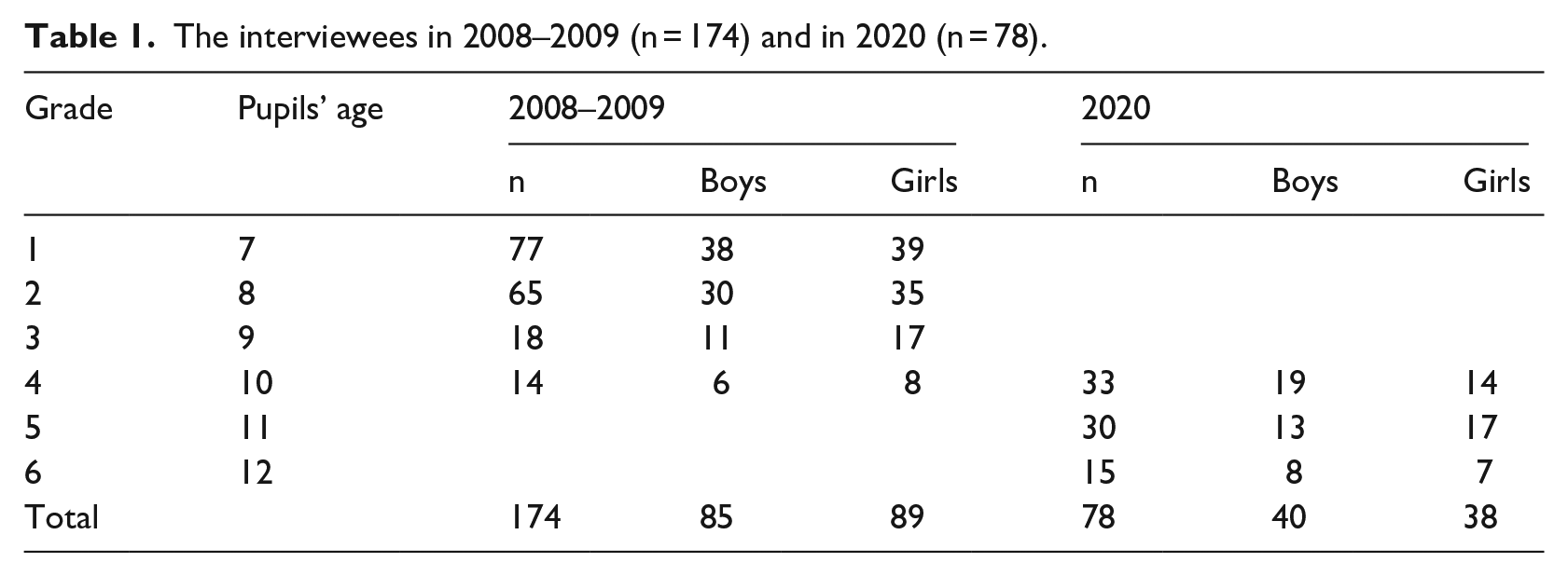
The study is part of a multiannual collaboration between the University of Helsinki and the school in question, which involves teacher students carrying out annual history workshops with pupils at the school. This time, unlike 10 years ago, the workshops were aimed at pupils in grades 4–6. This is why the average age of the informants is higher compared with the previous study (see Table 1).
The interviewees in 2008–2009 (n = 174) and in 2020 (n = 78).
The class teachers informed their pupils on the upcoming interviews beforehand and sent a notification to the families of the pupils. The study was authorised by the City of Helsinki, and 78 pupils’ parents gave their consent to using the interviews as research data.
The interviews were conducted by doctoral student Amna Khawaja and teacher students from the University of Helsinki Faculty of Educational Sciences, who had been instructed on how to conduct interviews. The interviews ranged between 20 and 45 minutes.
Results
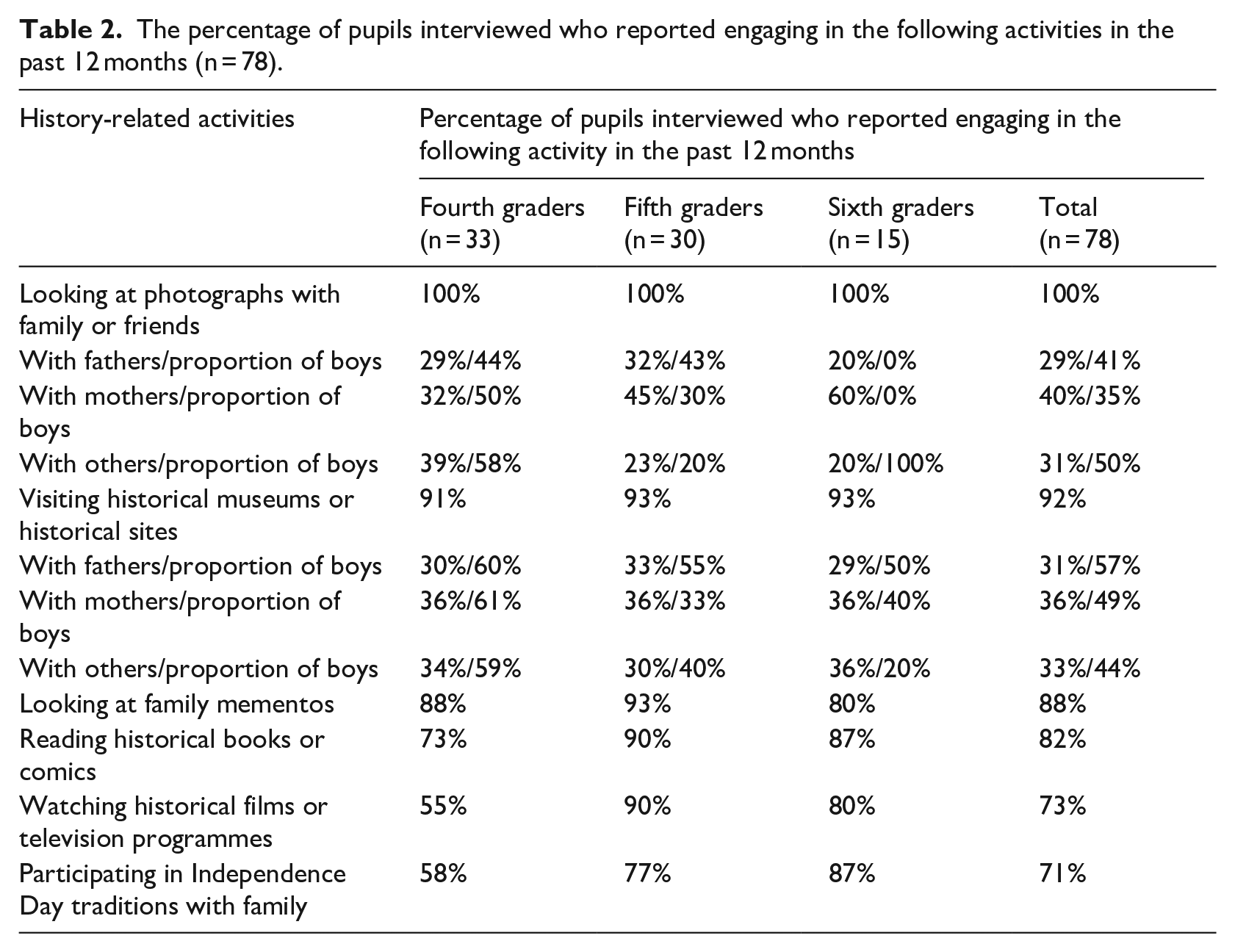
The interviews suggest that history is strongly present in the daily lives of children today. Children watch historical television programmes, read books that are set in the past, discuss with their parents about their family history and collect mementos. In this respect, there have been no changes in the past 10 years. Table 2 presents the history-related activities that the interviewees reported having engaged in over the past 12 months. When the interviewees were discussing about looking at photographs and visiting museums or historical sites, they mentioned with whom they had been doing these things. Discussing other history-related activities did not reveal that as clearly. The mother’s role in these activities seems to be somewhat bigger than the father’s. However, very strong conclusions cannot be made by these results because of the small number of interviewees.
The percentage of pupils interviewed who reported engaging in the following activities in the past 12 months (n = 78).
Looking at photographs with family or friends
The children positioned themselves in the society and in history via their families. Family customs, mementos and photographs helped the children to create narratives about their and their families’ place in the world.
The photographs that the children looked at portrayed both living and dead relatives. The children discussed photographs both as representations of change (grandmother milking a cow) and as representations of continuity (wedding photographs, school photographs). While some photographs conveyed exciting historical events (a picture of a grandfather’s grandmother’s sister, who had survived the Titanic), the majority of the discussions regarding photographs revolved around everyday topics.
The photographs act as the enablers of an intergenerational narrative tradition. While looking at photographs, the children had heard stories about the old days and about their own family. The interviewees attached special importance to their parents’ childhood photos. They were a way for the children to look back on their parents’ lives. The photographs also provided a chance for the children to reminisce on their own lives (‘I laughed a lot as a baby’). Reflecting on one’s past is an integral part of historical consciousness and a method of identity construction.
Visiting historical museums or historical sites and looking at family mementos
The children reported visiting museums and historical sites primarily with their families. The destinations ranged from a historical hanging site near the school through Finnish museums to museums and historical sites in various European locations. While the interviewees were able to describe the places and to list the people who had accompanied them on the visit, most interviews did not reveal how the visits had influenced the children’s thinking.
The interviewees’ discussions of family mementos, however, demonstrated the power of storytelling. Nearly all children reported having family mementos at home. The objects that the children identified as mementos had often belonged to their grandparents, such as ‘grandmother’s sewing kit’ or ‘grandfather’s gold ring’. Grandparents had also left behind furniture and tableware that were in daily use in the families.
The mementos were accompanied by stories, which the children shared during the interviews. One interviewee told about a keycard to a cruise cabin, a memory from a family trip abroad. Family mementos were often everyday items or objects that belonged to the children’s parents or grandparents. Among the objects the children mentioned were a mother’s old colouring pencils and a father’s football. Apart from jewellery, the children did not mention any valuable items. In the interviews that were conducted 10 years ago, many children discussed agrarian objects. This may relate to their parents’ and grandparents’ experiences of moving from the countryside to urban areas, which took place on a grand scale in Finland in the 1960s and 1970s. Such objects were not mentioned in the recent interviews.
Although the children’s personal historical perspectives are short, many of them also have mementos from their own early childhood. Some of the objects were a part of shared family memories, such as a harness racing trophy, while others were personal objects, such as an interviewee’s first pair of shoes. Many interviewees spoke about keeping various first items, such as their first stuffed toy, as mementos. This suggests that children construct their personal recollections with the help of objects.
Reading historical books or comics and watching historical films or television programmes with family
Some interviewees reported reading with their parents. One boy said he was reading Yuval Noah Harari’s Sapiens – A Brief History of Humankind, while one girl was reading One Thousand and One Nights. However, parents were less present in the interviews compared with the previous study. This is likely due to the pupils’ age: 10–12-year-olds are more independent readers compared with 7–10-year-olds, the age group that was observed 10 years ago.
‘Family viewing’, a phenomenon which involves families with educational aspirations for their children watching educational programmes together (see Gray and Bell, 2013: 179), did not emerge in the interviews apart from the presidential Independence Day reception, which one in two interviewees reported having watched with their families. It is the most watched television event in Finland, with nearly every second Finn following it according to audience surveys (Finnpanel, 2020). 3 The interviews suggest watching the reception is a shared family ritual. Some interviewees also reported watching The Unknown Soldier – a film that has become an essential part of the Finnish Independence Day tradition. 4 The children watched these television programmes together with their parents, which implies that they also likely discussed historical matters with their parents and grandparents during the viewing.
Family as a source of historical knowledge
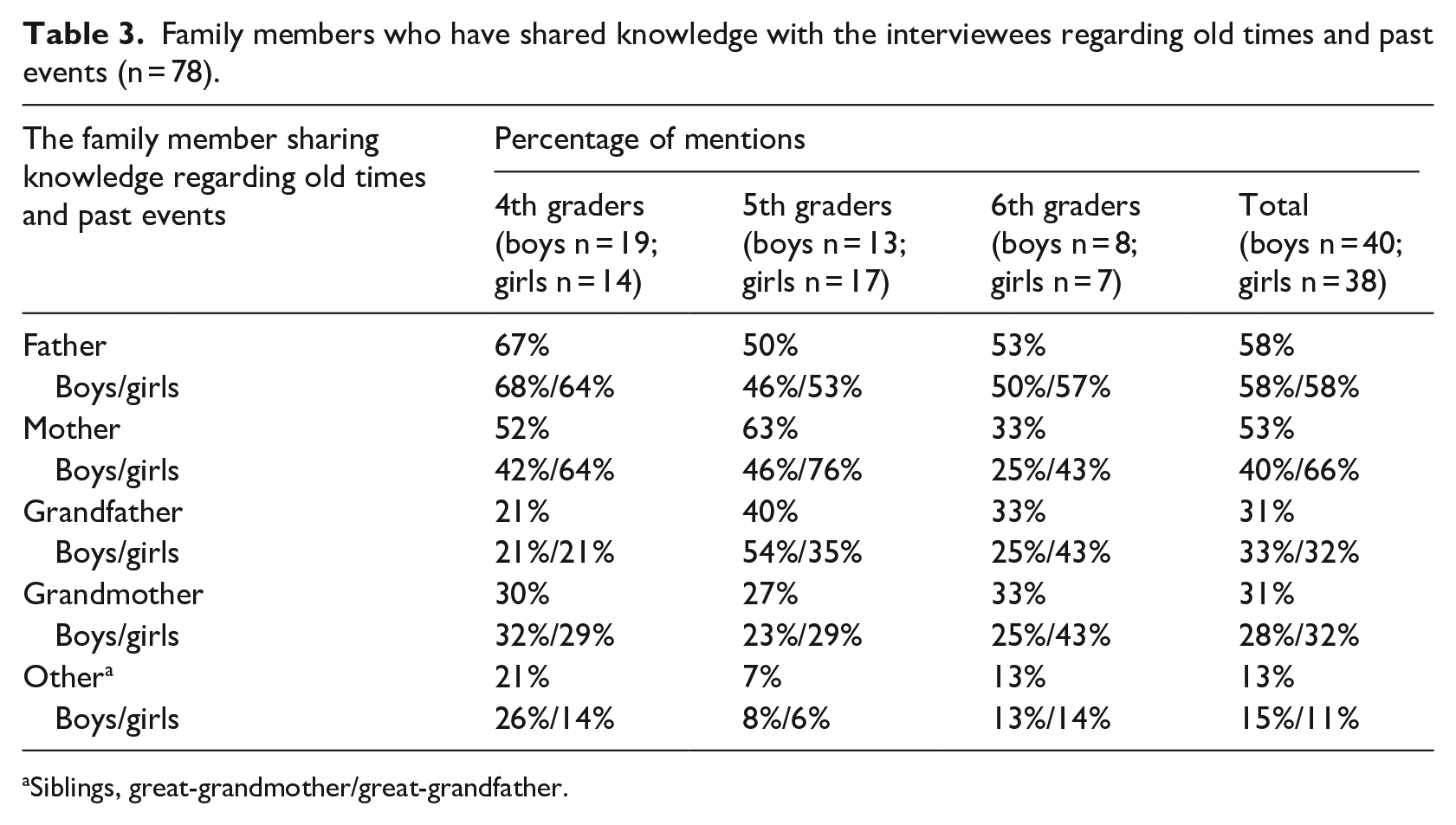
In the interviews, the children were asked with whom they had discussed topics related to the past. What was notable in the results 10 years ago was that women emerged more significantly as sources of historical knowledge compared with men. According to that study, women looked at photographs, discussed their own past and took children to museums more often than men. This study suggests that the current situation is more balanced, as Table 3 shows.
Family members who have shared knowledge with the interviewees regarding old times and past events (n = 78).
Siblings, great-grandmother/great-grandfather.
The interviews indicate that family plays a very significant role in the formation of children’s historical consciousness. Nearly all interviewees reported having discussions about old times and past events with family members. Ten years ago, I suggested that women’s prevalence as storytellers could be explained by the different way women discuss history: women were discussing history in everyday contexts, commenting on the food selection at the supermarket, for example, whereas men were discussing ‘real history’ or ‘chronological history’. This is how the parents of the children I interviewed back then explained the discrepancy. Research has also shown that mothers use more affiliative language than fathers, which could explain why mothers’ reminiscences were more impactful compared with those of fathers (see Fivush, 2019: 63–65). Another explanation I provided for women’s significant role in reminiscing was their stronger presence in the lives of children who are under 10 years old. In fact, one reason for why men were more frequently mentioned as sources of historical stories may be the fact that the interviewees in this study were slightly older.
Table 3 shows that the interviewees see their fathers and mothers as nearly equal sources of historical information. It is noteworthy, however, that fewer boys than girls reported that they had discussed old times and past events with their mothers. The number of the participants in this study though is quite small, which might explain some of these differences. Another explanation might be that boys understood the question concerning the past as ‘real history’ that fathers know about.
The new data indicate no significant differences between women and men with respect to the content or style of historical narratives. Differences emerged only in a few interviews. The number of stories fathers told about their military service had decreased from the previous study, and both men and women discuss the past in everyday contexts. Even wars are discussed in equal measure by both women and men.
Historical consciousness in children’s storytelling
Many interviewees shared stories they had heard from their parents and grandparents in relation to their childhood and schooling. They seem to value modern childhood more than childhood in the old days because their parents did not have smartphones or computers. To them, the childhood their parents and grandparents had is marked by material scarcity. They also associate it with stricter educational culture, stricter teachers and detention practices, in particular, which have been a recurring topic in the discourse of their parents and grandparents.
The interviewees rarely expressed positive associations with the past in their discourse, such as the glory of ancient structures. For them, historical sites are first and foremost ruins. Wars also belong to the past, separate from the present.
The historical consciousness of the interviewees can be understood with the help of the narratives formed by their answers. As an example, a 10-year-old fourth grader said he discusses the past especially with his grandmother, who had shared stories about her own childhood and adolescence. According to the impression of the interviewee, life in the old days was grim – his grandmother had told him about her poor childhood. The interview with the pupil suggests that he sees history as a progress narrative both on the level of the individual (grandmother) and the nation (Finland): today, his grandmother does not suffer scarcity and Finland is a safe country. The interview ends with the interviewee’s expression that other children should know that ‘things were not always this great in Finland’.
Apart from his own family story, the interview relates the pupil’s understanding of the story of Finland, which corresponds to the myth of Finns as resilient survivors observed in recent mass surveys (see Ahonen, 2020). The interviewee also shares a family tradition of lighting two candles in the window on Independence Day. He may not know the meaning of this tradition, but it suggests that the parents want to pass on culturally significant rituals to their child. The family story of this fourth grader is strongly linked to the story of the nation, as is the case with many other interviewees.
Interpreting historical discourse: the special significance of war narratives
Adolescents have been found to regard their own family history as more significant compared with national history. This was observed, among others, by Grever and Ribbens in the studies they conducted on English and Dutch adolescents between the ages of 14 and 16 years. According to them, one in three Dutch adolescents attached primary importance to their own family history, whereas only one in eight saw national history as the most significant historical theme. This tendency was reflected in English adolescents (Ribbens, 2007; Stuurman and Grever, 2007). According to Ribbens and Grever, these preliminary results are a sign of the decreasing significance of national history in historical culture (Ribbens, 2007: 68).
In Finland, this topic has been studied in the late 1990s by Ahonen, who argues that while 16- to 18-year-olds are interested in their family histories, their grandparents and parents practise self-censorship. As representatives of previous generations, they feel that young people do not need to know about unpleasant things. Ahonen’s study reveals the superficial nature of intergenerational dialogue with respect to historical content. In the adolescents’ accounts, the nation had a strong connection to the Finnish wars of 1939–1945, and films promoted the construction of a national identity that is linked to Finland’s fight for survival (Ahonen, 1998).
Fivush and Merrill (2016: 311–312) found that parents’ narratives often relate to topics that are familiar to children, such as school, providing explicit intergenerational links between the parent’s and the child’s experiences. Fivush and Merrill also observed that parents often link their narratives to broader social phenomena, such as the civil rights movement or the Second World War. While the research of Fivush and Merrill focuses on adolescents, the linking of family histories to significant historical phenomena can also be observed in the discourse of the children interviewed for the present study.
The wars were very visible in the data from 10 years ago. They remain visible also in the recent data. The children’s historical discourse was marked by a strong presence of war. Both parents and grandparents had discussed the Finnish wars of 1939–1945 with their offspring. Finland fought two wars, the Winter War and the Continuation war against the Soviet Union, during 1940–1944, and a short war against Germany in 1944–1945. The historical significance of the wars for the children was evident in their accounts about their family histories. The home front during wartime emerged as the most prominent topic.
While the article does not include a narrative analysis of the interviewees’ answers, the interview data can offer insights into how the pupils construct the notion of war.
One interviewee told about his grandfather being sent to Sweden as a child refugee. He reported discussing the event with his grandfather and reading his letters from the war years:
My grandfather was sent to Sweden as a child refugee. He has told about receiving letters in Sweden. He had older brothers, who were either at the front or at home helping their mother. He received letters from them . . .
He discussed how his parents would read those letters to him. War also came up later in the interview. He told about a family visit to the Mannerheim Line on the eastern border, a defensive fortification built before the Second World War.
Another interviewee had learnt about the wartime from reading the ‘war letters’ her grandmother had received from her brothers at the front. War is also visible in family mementos and photographs. One interviewee, for example, described having photographs of the war years and of Karelia, which was ceded to the Soviet Union as part of the peace treaty, on the door of their refrigerator.
The children view war through exciting experiences. During the interviews, they shared stories of even distant relatives. When they were asked what children should know about the past, many mentioned the wars. Some interviewees seemed to regard wars as important phenomena that have changed national borders and the world at large. While one person stressed the importance of being familiar with the Second World War, most interviewees specifically identified the Finnish independence and the wars which are connected with the maintenance of the independence as important historical events. None of the interviewees mentioned a threat of war that would concern Finland today, but several interviewees felt it was important to know why wars still exist.
National narratives often involve shared threats. The narrative of Finland has, especially in earlier times, been shaped by the threat of Russia or the idea of an enemy (Harle and Moisio, 2000: 55–56). What was striking in the study that was conducted 10 years ago was that so many 7- to 10-year-old Finnish children referred to Russia as the historical enemy of Finland. Back then, the children described in the interviews how ‘Russia took the other arm from Finland’ 5 and how ‘Russians came with bombs’. Surprisingly, Russia (Soviet Union) was not mentioned in any of the recent interviews as the adversary of Finland in past wars.
Limitations of the study
The study is affected by a number of limitations. First, this is a small-scale study that concentrates on one Finnish comprehensive school. The results, therefore, cannot be generalised.
Second, the age groups of the children were slightly different. While the previous study focused on 7- to 10-year-olds, who can be included in the category of elementary childhood, the present study focused on 10- to 12-year-olds, who are classified as early adolescents. At the age of 10 years (fourth graders), Finnish children have not yet attended history lessons, while 11- to 12-year-olds are already studying history at school. In this regard, the group that was observed 10 years ago differed from the pupils that were observed in the present study. The age of the children, however, did not seem to have had a major influence on the results of the study. The most obvious difference is the stronger role of fathers and grandfathers as sources of historical knowledge. Perhaps they are more involved in children’s life during early adolescence compared with elementary childhood, driving their children to activities, for example. Another explanation may be the increased participation of fathers in daily family life, which has been indicated by leisure time research. It was, however, impossible to infer from the interviews how elaborative or emotionally expressive the parents were when they were reminiscing with their children, something which has been associated with the stronger influence of mothers in reminiscing conversations (Fivush, 2019; Zaman and Fivush, 2013).
Third, the school where the study was carried out is situated in a district where the socio-economic structure is rather good. Hence, it can be assumed that the pupils of this study have more opportunities to consume historical culture via smartphones and streaming services or visit museums or historic sites, than on average. In addition, the proportion of immigrant pupils is smaller in comparison with the city average. Therefore, the family narratives of the participants’ might be more linked to Finnish history than on average. Like in the study of Finnish historical consciousness, where all of the interviewees had a view about the Finnish wars of 1939–1945 (Torsti, 2012), the pupils’ parents in the present study might possess a similar stance on the Finnish national narrative. We can assume that the historical consciousness of immigrants differs from that of native Finns because the Finnish wars of 1939–1945 are not related to their family history. The immigrant population in Helsinki is bigger on average than in the district of Arabia, and consequently the significance of wars Finland has participated in might not be as important for their historical consciousness as the present study portrays.
Fourth, the children’s preparation for the interviews should be considered. Some interviewees reported having discussed the upcoming interview with their parents on the previous day, which may have led to the overrepresentation of family recollections in the interviews.
The method of data collection must also be considered in connection to limitations. A common practice when studying historical consciousness is to ask pupils to narrate about the past or to do card sorting tasks, which delivers data that allow to study how they understand the past and make it meaningful. However, the number of informants in such studies is usually smaller compared with the present study and the one conducted 10 years prior.
Discussion
Digitalisation that has brought the diversification of individuals’ forms of remembering and their targets of identification does not seem to concern the children of the present study who are still closely attached to the home. Unlike Ahonen’s (1998) study that revealed the superficial nature of intergenerational dialogue among 16- to 18-year-olds with respect to historical content, the present study indicates that parents and grandparents are discussing more profoundly about their family histories with their offspring. In contrast to the studies among adolescents and adults (Grever, 2009; Ribbens, 2007; Rosenzweig and Thelen, 1998), nation has not lost its importance concerning the historical consciousness of primary school pupils who participated in this study. This is because they have been exposed to historical culture concerning the nation particularly through the agency of their parents and grandparents.
Historical consciousness often takes the form of narratives, which are grounded in so-called grand narratives, such as the narrative of a nation state, its historical development and existence. Many Finns tie their family narrative into a national narrative, in which the resilient people of a poor country maintain their independence in the wars and develop into a rich nation. This national grand narrative culminates in the wars of 1939–1945.
It seems that for now, this narrative has retained its status in the narrative tradition of families. Parent–child reminiscing anchors the child to family history but also the national narrative. Many children in the present study associated wars with Finnish history. In their view, the current moment is characterised by an absence of the fear of war. They have confidence in their own future and the future of their nation. One interviewee summed it up as follows: ‘Learning about the past helps you appreciate the current moment – everything we have – and that we don’t have war in Finland’. Another interviewee answered the question regarding what children should know about the past in the following way: [Children should know] ‘how Finland got from a bad situation to this good situation’. Similarly to their family stories, the national story is also viewed as a progress narrative by the children.
Green’s (2019) project on family memory in England demonstrates that family stories about the past are transmitted across generations and that adolescents engage with them while envisioning their own futures. Furthermore, research has found that children’s understanding of familial history has a real influence on their broader sense of collective, historical identity (see Dunn and Wyver, 2019: 362; Murphy and Laugharne, 2013). The present study shows the significance of family stories in children’s historical consciousness. Due to the increased use of personal media equipment and streaming services, children are spending less time on consuming media together with their parents and grandparents. Nonetheless, discussions with parents and grandparents hold a special power, which is why they carry more significance compared with the content provided by the entertainment industry.
The conveying of a historical identity that is based on the national narrative is essential for the preservation of the national identity. In the Finnish context, slight indications of the weakening of national identity have been observed. For example, the International Civic and Citizenship Education Study (ICCS), which reports on civic knowledge and attitudes, found that nearly one in two Finnish 14-year-olds saw themselves primarily as European citizens and only secondarily as Finnish citizens (Suoninen et al., 2010: 128). As a consequence of digitalisation, school and national traditions seem to be less significant for young people when it comes to the construction of their historical understanding. Children, however, are still attached to the home, and family recollections seem to have a strong influence on their views about the past.
The strong presence of war in the recollections of the children’s parents and grandparents raises a question: why is the national narrative so strongly influenced by the wars? Recollections of war have not declined over the past 10 years. Parents and grandparents continue this tradition, which is given legitimacy by the televised Independence Day traditions, for example: the Finnish Independence Day festivities are still largely focused on remembering the war years of 1939–1945. This is why family recollections are also related to them.
The children did not discuss the benefits of the Finnish welfare society – something that their parents and grandparents have also had access to. There was no mention of the availability of free education, including university education, for example, although the creation of the welfare state and the Finnish school system were ranked as the most significant aspects of national history in a study of Finnish historical consciousness (Torsti, 2012). One may conclude based on the interviews with the children that matters related to the welfare state are not discussed within the home, or if they are, children do not remember them. One possible explanation for this may be that they lack the narrative excitement of war stories. As a result, children regard wars as significant past events both for their family and for the nation.
The absence of Russia (Soviet Union) as a historical enemy in the children’s discourse is a notable phenomenon, which is difficult to explain, since the last 10 years have seen no significant change in historical culture – the volume of films, television documentaries and literature about the Finnish wars of 1939–1945 has not decreased over the past 10 years. The shift may be due to the decreasing number of contemporaries: the youngest living individuals who participated in the wars are over 90 years old. Another explanation may be that parents and grandparents avoid referring to Russia or Russians as a historical enemy because they view it as stigmatising. Attitudes towards stigmatising language have changed in the past 10 years, which may have affected the ways in which parents and grandparents discuss the war with their offspring.
The research of Ahonen (1997, 1998) and Torsti (2012) on historical consciousness shows that Finns relate to past experiences as a nation and use them to build their future expectations. The same is true for the children that were observed in this study. Although some interviewees discussed their worries regarding global warming, for example, the data suggest that global issues have not been discussed with the children or that they were unable to bring them up during the interviews. Regardless, we can assume that the children who participated in the study are able to face a crisis like the corona pandemic with resilience, since Fivush (2019) has shown that family reminiscing helps children understand and regulate their emotions and make sense of their experiences when they weather hard times.
Footnotes
Appendix 1
Funding
The author(s) received no financial support for the research, authorship and/or publication of this article.
