



Abstract
Many Lebanese films and documentaries of the last few decades have focused on the hidden legacies of the civil war (1975–1991) that remain unprocessed in public, and often private, life. Unsurprisingly, these works have often been discussed by critics through the lens of traumatic cultural memory. In the first part of this article I argue that this model is productive yet insufficient. I suggest, instead, a methodological approach which acknowledges the intersections between trauma and other processes underpinning everyday life in the city. In the second part of the article I apply this approach to the film A Perfect Day (Hadjithomas and Joreige, 2005). Using the directors’ own concept of latency, I analyse the affective modes of touch, breath and the hidden life of objects to show how the performative existential drama that unfolds in the film opens out onto processes that go beyond the haunting legacies of violence from the civil war and includes a vision of singularity and infinite possibility that relates back to the birth of cinema itself.
Caruth’s (1996) proposition that trauma is unclaimed by cognitive knowledge and representation and attempts ‘to tell us of a reality or truth that is not otherwise available’ (p. 4), is particularly relevant to many recent Lebanese films and documentaries in the wake of the civil war in Lebanon (1975–1991). Rather than attempt to represent the past directly through fictional reconstruction or documentary footage, these works often treat it indirectly, obliquely and allusively, focusing, in particular, on bodies, objects and sites in the present, so that the everyday is made to perform the uncanny drama of a haunted reality. The Caruth-inspired approach to cultural memory which privileges the non-representational language of trauma expressing itself symptomatically in embodied form seems profoundly appropriate to these works.
This approach to memory is possibly even more relevant in Lebanon than in some other post-conflict societies. According to numerous commentators, Lebanon has for long been in a state of amnesia with regard to its history of violence during the civil war. This is largely due to the fact that there are no official archives, memorials, museums or even school history books to record it and, since the official end of the civil war with the Taef agreement of 1991 and the subsequent amnesty the same year, no official channels to deal with culpability, restorative and transitional justice and reconciliation. Not only were there no structures for post-conflict resolution (apart from amnesty) but, in the aftermath of the war, the political and institutional system remained relatively unchanged, the sectarian divides of the framework of ‘confessionalism’ remained in place, many political leaders responsible for the massacres were still the same, and foreign influence (especially that of Syria) remained more or less unchecked. Many of the underlying problems that led to the outbreak of war had, therefore, not been resolved and there was little attempt, or even desire, to undertake a serious process of memorializing a catastrophe that was still so keenly felt (Haugbolle, 2012: 69–71). Moreover, extensive new building projects in the capital Beirut (under the direction of the public-private finance and construction company Solidere) were quickly covering over the traces of war, a process that was (and largely still is) reinforced through state and private security systems patrolling city space (including restrictions on photography and filming). Despite the Cedar Revolution of 2005, following the assassination of the former Prime Minister Rafik Hariri, and other movements for democracy since then – especially the protests of 2011 influenced by the Arab Spring and the uprisings of 2019 – little has changed that would lead to a serious national debate about the civil war, its underlying causes and its continuing legacy. 1
In the absence, then, of an archive to record the violence of the recent past (however complicit archives can be in the violence recorded), and given the difficulties of producing any shared narrative of the civil war due to factionalism, art clearly has a particular role to play, especially one that can covertly summon up the invisible legacy of violence haunting the visible sites and bodies of the present and, hence, allow repressed trauma to return in indirect (often affective) form. Many commentators have, indeed, discussed recent cultural works in Lebanon through this lens. 2 What cannot be dealt with politically – memory, mourning, accountability and justice – can (indeed, must) be treated aesthetically. While researching her book on Lebanese cinema, Khatib (2008) says she was struck by the feeling that ‘all Lebanese films seem to be about the Civil War in one way or another’ (p. xiv) and that it was a cinema that ‘had been consumed by a feeling of loss and emptiness, where violence lurks at every corner’ (p. xvi). These are, predominantly, films that deal with the traces left by the war in the form of aimless characters, a state of melancholy (El-Horr, 2016) and ghosts and vampires haunting the city (Rastegar, 2015; Toufic, 1993, 2009; Westmoreland, 2010).
While agreeing that this approach provides a rich way of understanding works in which ghostly presences abound, I will argue that there are drawbacks too in deploying this model. Like many of the above studies, I will also focus on bodies and sites in the present. I will suggest, however, that, by viewing bodily affectivity exclusively through the lens of the invisible legacy of extreme violence in the past, we risk obscuring the ways in which other factors contribute to the sense of the strangeness of the present and the affective complexity of this cinema. Recognizing the need to shift the focus beyond the legacy of the civil war, Tarraf (2017) considers the intersections between the belated effects of trauma and other forms of political and economic violence in Lebanon, especially those produced by the neoliberal reconstruction programme after the war. Although this broader focus gives us a more nuanced picture of affect and everyday life in modern Lebanese cinema, Tarraf still deploys an interpretive model of violence and crisis to explain it. As she says, her study considers ‘the affective afterlife of trauma that brings the violences of the past into conversation with the injustices of the present’ (p. 40).
The work of Westmoreland (2013) has also opened up new ways of considering affect in the work of experimental cultural practitioners in Lebanon. He applies new anthropological methodologies on the phenomenology of the everyday to works that ‘cannot be reduced to a disembodied, cognitive function, but must be understood as a somatic mode of intersubjective engagement’ (p. 726). While Westmoreland’s focus on ‘ordinary affects’ highlights a significant aspect of many of these works, and while he also acknowledges that many experimental artists in Lebanon ‘insist that they are not “working on the war”’ (p. 728), he nevertheless brings affect and embodiment back to the war as the event that ‘permeates the present’ (p. 728). The ‘alternative aesthetics’ of artists like Jayce Salloum, Walid Raad and Akram Zaatari, he maintains, can therefore ‘open up greater possibilities for what can constitute knowledge (. . .) that may help us better grasp the dynamic confluence of experience amid catastrophic conditions’ (p. 734; see also Westmoreland, 2010).
In the following discussion I will attempt to broaden out the analysis of affect, knowledge and the everyday beyond ‘the confluence of experience amid catastrophic conditions’. The belated (and unprocessed) effects of trauma are certainly powerful drivers of affective behaviour in post-conflict societies. The rhythms and regimes of the body, however, can also be regulated, simultaneously, by other drives and processes, whose affective expression cannot simply be explained by ‘the confluence of experience amid catastrophic conditions’. We therefore need a model that can perceive the articulations between embodied traumatic memory and other affective ‘knowledges’, one that can also account for the singularity, elusive otherness and ‘indeterminate’ nature of the everyday (Blanchot, 1969).
More generally, I suggest that we need to adapt, certainly not reject, the pioneering works in literary and film criticism that employ trauma theory as the lens through which to perceive the belated effects of extreme violence (Caruth, 1996; Felman and Laub, 1992). Hartman’s (1995) argument that literature related to moments of violence (especially the Holocaust) is a figurative expression of the wound of trauma, thereby tying presence to absence and visibility to invisibility, is a powerful way of reading works both symptomatically and through an anti-representational and poststructuralist lens. Nevertheless, it also ties that figuration (no matter how anti-representational) to an original wound. So, even though the poetics of many of the new Lebanese experimental films and documentaries consist of a number of the devices that might be constitutive of a ‘poetics of trauma’ – haunting, split characters, anachronic time, repetition, allusion, affective rather than cognitive ‘knowledges’ and so on (some of which are, themselves, fairly standard modernist techniques) – we risk an over-expansion of the notion of trauma if we bracket this poetics solely under its name. If we are to avoid making ‘trauma’ and ‘life’, or, in the cultural sphere, ‘trauma’ and ‘modernism’, into tautologies, we surely need a more nuanced approach to this poetics.
My argument is influenced by those critics who have previously questioned the model of traumatic cultural memory. Kansteiner (2004) and Radstone (2007) unpick the uneasy alliance between poststructuralist theory and psychological studies of trauma victims that underpins the model, and the Manichaean vision of history that it proposes. Others have noted that it also reads history in terms of a repetitive and melancholic cycle of violence and victimhood. LaCapra (1998) criticizes Shoshana Felman’s championing of Claude Lanzmann’s Shoah (1985) for her vision of ‘a world in which trauma is tantamount to History and true writing is necessarily a writing of disaster’ (p. 112). Traverso (2017) develops a similar line of argument in his critique of the left’s long-standing melancholic obsession with loss and defeat. Rothberg (2014) warns us to be ‘suspicious of overgeneralizing the trauma concept’ and encourages us ‘to think about the relationship between trauma (. . .) and other disruptive social forces’ (p. xiii). 3 More recently, Rigney (2018) has argued for a redirection of memory studies to disconnect it from its exclusive preoccupation with past violence and trauma and connect it to the future and more positive and uplifting themes like hope, while Arnold-de Simine (2019) suggests that the focus on trauma in cultural memory studies makes it ‘difficult to envisage other temporalities’ and ‘threatens to obscure our agency as (political) subjects’ (p. 62).
While broadly following many of these arguments about the drawbacks of reading history and culture through the lens of traumatic memory, I propose, however, a slight shift in focus. Although I agree that, in Rigney’s words, ‘this fixation on violence forecloses an awareness of alternative modes of remembrance and alternative traditions of recall’ (p. 369), I question whether this has to be a binary choice. An alternative strategy would be to read cultural works according to their ability to express both legacies of violence and ‘alternative modes of remembrance’ at the same time, to articulate convergences between multiple chronologies and multiple spaces, to conceive of condensations and displacements of meaning (as in Freud’s description of dream-work or Walter Benjamin’s description of the dialectical image), and, ultimately, to resist all totalising and recuperative interpretive forms by attesting to the singularity and alterity of the present and the past, and the living and the dead.
In a panel discussion on contemporary Lebanese literature in 2015, the Lebanese writer Elias Khoury suggested that it was not the case that, since 1990, Lebanese novelists had only produced novels about the civil war: ‘Most of the novels are situated in the war not because [the novelists] are writing about the war but because they are writing about life’ (HomeWorks 7, 2016). Khoury’s comment on the Lebanese novel is, perhaps, equally applicable to Lebanese cinema. While acknowledging the spectral presences of the war in their work, Hadjithomas and Joreige (2013) have also said ‘for us, art is a life project’ (p. 103). 4 In the following discussion of their film A Perfect Day I attempt to tease out knotted intersections of meaning (in its cognitive and affective senses) in order to see how we might approach an aesthetic-political practice in a post-conflict situation that is neither indebted solely to that conflict, nor solely tied to the traumatic tropes of belatedness and haunting, but deals, more broadly, with the complexity of life itself, in Khoury’s sense. By focusing on certain ‘structures of feeling’ in the film, I will argue that bodies move, or are held, in an ambivalent and paradoxical space in which traumatic memory, loss and mourning are always tied to the unbound desire for life. The radical potential of this film, and perhaps new experimental Lebanese film and documentary culture in general, lies in what we might call a renewed language of everyday life (and here I concur with Westmoreland’s focus on affective knowledge and the everyday). I will use the idea of latency, as defined by Hadjithomas and Joreige (discussed below), to characterize a language whose surface belies the intersections of diverse processes. 5
A Perfect Day: Latency and affective knowledge
Much of the work of the Lebanese film-makers Hadjithomas and Joreige (2013) (which consists of photographic exhibitions and art installations as well as films) adopts an oblique approach to the relationship between past and present. They have said the following of their work: ‘We work very little on the past or on civil wars per se but rather on the traces and the consequences of these in our present’ (p. 103). The word that they frequently use to describe this practice is ‘latency’, which they define as follows: ‘Latency is the state of what exists in a non-apparent manner, but which can manifest itself at any given moment . . . Latency is the introduction to the possible, to the state of becoming’; ‘a diffused state, uncontrollable, underground, as if lurking’ (cited in Westmoreland, 2010: 181 and 185 respectively).
Taken together, these quotes appear to show that, for Hadjithomas and Joreige, the characterization of their work as a present haunted by the ghosts of the civil war is only a partial reading of their practice. The first quote suggests that traces of the past in the present include but go beyond the civil war. The second quote, and the use of the word ‘latency’, suggests that the present itself is not simply the container of ghosts of the past but a far more ambivalent space which combines past, present and future. Their definition of latency is, broadly speaking, in keeping with the process of sublimation at the heart of the latency stage in Freud’s account of child development. For Freud, this is the period between five or six and puberty, during which the libido is repressed beneath more socially acceptable behaviour, with friends, at school and so on. In their definition, however, Hadjithomas and Joreige emphasize not so much the process of sublimation and concealment of desire, more ‘the state of becoming’ of something that only exists in a diffused way. This corresponds to the photographic sense of latency as the moment between the taking of an image and its display (to which I will return later). For Westmoreland (2010), following the work of Toufic (1993, 2009) on vampires in Lebanon, this concept of latency captures the absent presence of the war in the films of Hadjithomas and Joreige – ‘like vampires, the phantoms of Lebanon’s wars bear no reflection and they cannot be imaged directly’ (p. 183) – and functions as ‘an allegory of postwar subjectivity’ (p. 192; see also Naeff, 2014). My own reading, however, suggests that we understand latency not simply as a return of the non-reflected undead of the war, invisibly stalking the streets of Beirut and allegorically present in affective behaviour, but also as a moment of becoming for the future. In the following discussion of A Perfect Day, I will use this paradoxical and open-ended interpretation of latency to show how a complex past and future co-exist in a transformed present. In keeping with the directors’ description of the film as primarily about ‘sensation, bodies, frames of mind, atmosphere’ (Carver, 2006) and their attempts (2013) ‘to create a cinema of feeling, one that produces, in an almost physical way, a sense of the invisible, the latent, of absence but also of otherness’ (p. 103), I will explore this through three prominent affective modes in the film – touch, breath and the affective life of objects.
Touch
If it is true, as Rastegar (2015) has suggested, that a number of films ‘produced in the aftermath of the Lebanese civil war (. . .) represent the cultural memory of the war through stories with haunting ghosts, vampires and characters caught in a liminal space between life and death’ (p. 155), then A Perfect Day would seem to be a good example, as its central story-line relates to disappearance and haunting in the present. The film deals with a day in the life of Malek and his mother Claudia in contemporary Beirut. This is the day when they go to the office of a city lawyer to register formally the death of Malek’s father Riad (Claudia’s husband) who disappeared (along with some 17,000 others) 15 years before during the time of the civil war in Lebanon. 6 Malek is a young man of few words; he hardly communicates with his mother, or anyone else, thus displaying affective characteristics which are, according to psychoanalysts and psychiatrists working with trauma victims, classic signs of a traumatized subject. He is in love with Zeina and is constantly trying to meet up with her in the city, though she continually rebuffs his amorous advances until near the end of the film. Malek has the sleep disorder sleep apnoea, or possibly a combination of apnoea and narcolepsy, (another possible symptom of unresolved trauma), which causes him to fall asleep when he is not moving and interrupts his breathing while he is asleep. The film’s classical structure, following the three unities of action (the aftermath of the disappearance of the father), place (Beirut) and time (1 day), houses a far more complex story which mixes actions, times and places and goes beyond the haunting presence of the civil war.
The official recording of the death of the father at the lawyer’s office is a desultory affair. The lawyer, a tired-looking functionary in an office with wilted flowers in a vase, expresses no emotion as he carries out his official duties. Bureaucracy and officialdom are clearly not up to the task of dealing with the affective weight of the disappearance and loss of the father. At another level, however, something else takes place in this scene (and others) which belies the failure of the institutional setting to do justice to the significance of the occasion. No words are spoken as Malek and Claudia add their signatures to the form, yet Malek’s glances at his mother and touch on her arm transform the empty ritual into one of sensual proximity and affective complexity. A knowledge is produced through the senses which opens up the normalized space of the lawyer’s office onto another scene.
To read this knowledge, however, as the affective response to the disappearance of the father in the present – one that can only be ‘spoken’ performatively through gesture rather than dry officialdom – would give us only a partial understanding of a complex network of meaning attached to the touch. The gesture in this scene reverses the gesture in the opening shot of the film in which Claudia is shown stroking the hair of her sleeping son. This gesture appears to reference the opening of Alain Resnais’s Hiroshima mon Amour (1959) and therefore carries with it the disturbing connection between the erotic, death and guilt that that scene contains. The official space of the lawyer’s office is, therefore, not only invaded by the spectral memory of the father and the civil war in Lebanon, which Claudia and Malek can only negotiate affectively and indirectly, but also by other scenes of violence (Hiroshima and occupied France) and the erotic and guilt with which this scene is filmically associated. In this way, the office is transformed into a site traversed by family, historical and transnational currents and underpinned by the dual drives of Eros and Thanatos.
The palimpsestic nature (Silverman, 2013) of this scene is complicated further when the gesture is repeated. The touch of the female hospital doctor on Malek’s bare chest during his medical examination for his sleep disorder (that I discuss in more detail below) combines the above associations in a different institutional setting (the hospital). And later that night, as Zeina strokes the sleeping Malek amidst the frenetic movement of young people in a night-club, it is the context of hedonistic youth in the city of spectacle and forgetting that becomes the framing device of these associations. Through what Bersani and Dutoit (1993) characterize as ‘associational mobility’ in relation to Resnais’s early filmic practice (especially in Muriel, 1963), in which a metonymic chain draws diverse associations into the same ‘space’, the present is decentred and transformed into a constellation of multiple times, places, desires and fears (often pulling in different directions) in a way that denies a reading that simply refers back to a single source.
The affective power of the touch, however, goes beyond even these knotted intersections. In a particularly poignant moment in the film, Claudia, alone and abstracted in her apartment following her visit with Malek to the lawyer, looks directly at the camera and raises her hand in a gesture of reaching out (Figure 1). In his analysis of this scene, Rastegar (2015) suggests that the camera (and thus the spectator’s viewing position) has adopted the point of view of the ghost that haunts the apartment, while Claudia’s raised hand is the gesture of ‘reaching out from the living towards the undead’ (p. 168). While this interpretation is convincing, it nevertheless fixes Claudia and her disappeared husband (and the spectator) in the positions of living and undead respectively, while reducing the gesture to a functional act within this haunted space. Can one think, instead, of the gesture of reaching out to touch outside this (or any) conceptual framework or representational form, that is, as a moment of affect and a performative act of encounter prior to their containment within a network of relations? This would entail viewing the gesture not only in terms of its intelligibility in a conceptual sense but also as the expression of a feeling, corresponding to the type of ‘movement-image’ in the cinema that Deleuze (1989) called ‘the affection image’? 7 It is, I believe, this understanding of latency that Hadjithomas and Joreige intend when they describe it as ‘the introduction to the possible, to the state of becoming’ and their films as ‘a cinema of feeling, (. . .) of otherness’. Stripped of any social, cultural, historical or psychic explanatory framework and beyond even the framing of embodied memory, the affective bodily gesture endows the image with the potential to ‘pierce’ the known (in Barthes’s (1980) sense of the punctum in the photograph) and open up new worlds. By viewing Claudia’s gesture of reaching out to touch (and also Malek’s touch on his mother’s arm in the lawyer’s office) as latent images, we can imagine cinema as the realm of the possible and the ‘invention of the everyday’ (de Certeau, 1990) rather than simply as the repetitive and melancholic acting out of fixed subject positions determined by the traumatic disappearance of a loved one.
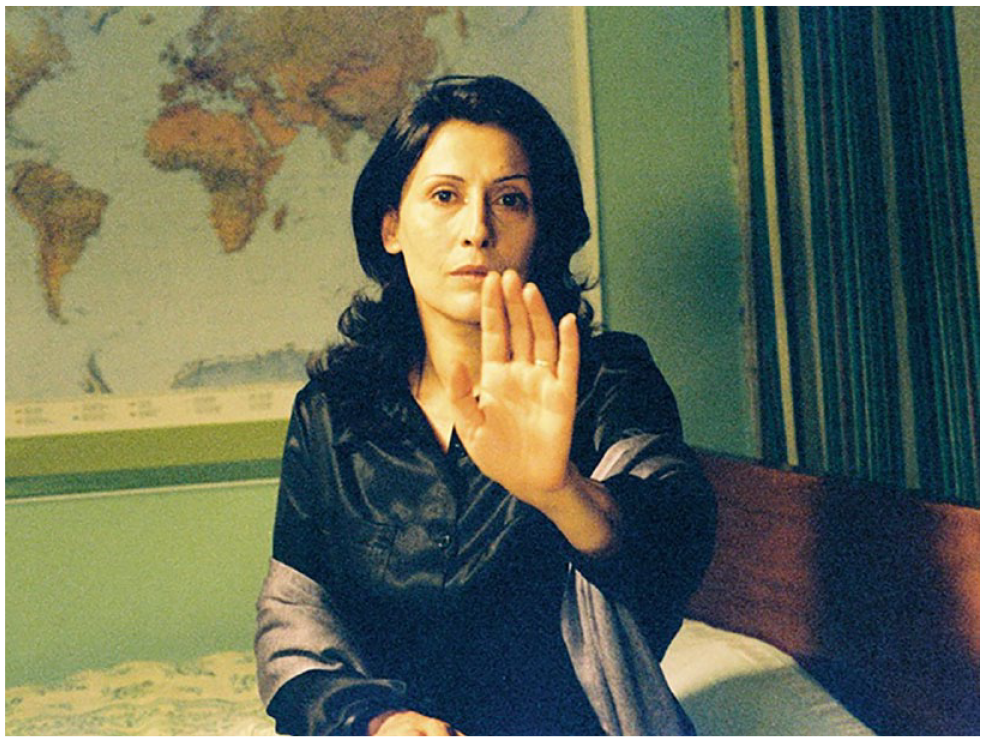
Reaching out to touch.
Breath
Malek’s sleep disorder provides the clearest example in the film of the multiple ways in which affective ‘knowledge’ is transmitted. Here, too, we see how the invisible presence of the civil war is always inflected by other processes. In the opening shots, Malek is sleeping on his bed. Subsequently, he will be shown asleep at work as a building site manager, falling asleep stuck in traffic in his car with Claudia on the way back from the lawyer’s office, asleep in the night-club in his pursuit of Zeina and sleeping on a bench on the corniche as passers-by turn to look at him. His sudden immobility and change of breathing pattern interrupt the normalized rhythms of both corporeal and city space. At these moments, it appears that the disappearance of the father and the reverberations of the trauma of the civil war are acted out somatically through the disappearance of breath in Malek’s body: the city of spectacle and forgetting is, like Malek’s breath, suspended by the ghostly return of the father, creating, as in Shakespeare’s Hamlet, a time and space that are ‘out of joint’ (Derrida, 1993).
However, the interruption to the normalized rhythms of corporate and spectacular Beirut is only partly effected through the spectral return of the father and the embodied memory of the civil war. When Malek is shown asleep on the construction site where he works as site manager, he is awoken to the news of the discovery of a corpse, unearthed during the excavation of the site. The discovery of the dead body ‘from below’ inevitably leads us to speculate that this might actually be the father’s corpse. The corpse, however, is not shown, remains unidentified and, Malek is informed, comes from a time prior to the civil war. Certainly, the corpse functions as an index or trace of another scene – present but invisible – within the here and now of contemporary Beirut. Yet its uncertain time and identity mean that that other scene is ambiguous. We may sense the presence of the absent father but also the dead more generally; we hear the echo of the disappeared of the civil war but also the past more generally. In other words, Malek’s sleep disorder, with which the scene opens, is associated with different but overlapping time-frames.
A similar ambivalent palimpsestic performance occurs when Malek goes to the hospital to receive the results of the medical examination of his sleep disorder (Figure 2). Malek and the young female doctor are seated either side of a table, while between them is the monitor showing an image of the sleeping Malek recorded during the earlier examination. Similar to the jarring effect created by the juxtaposition of the dry and formal setting of the lawyer’s office and the affective force of the look and touch between Malek and his mother, the image of the unconscious Malek on the screen (in a ghostly and grainy black-and-white, looking like a cross between a foetus and a corpse) pierces the institutional setting of the hospital room and the doctor’s medical discourse. ‘There are constant interruptions in your breathing’ she explains, a statement which comments not only on the split between the conscious and unconscious Malek but also, indirectly, on the disturbance this poses to the coherence of the filmic image of the hospital room itself, as it is ‘interrupted’ by the image of the unconscious, breath-less body of Malek on the screen within. Malek’s split self, divided across different physical and psychic states, is mirrored by the split image that the spectator sees, in which a complex network of times, spaces, states and screens are overlaid and condensed.
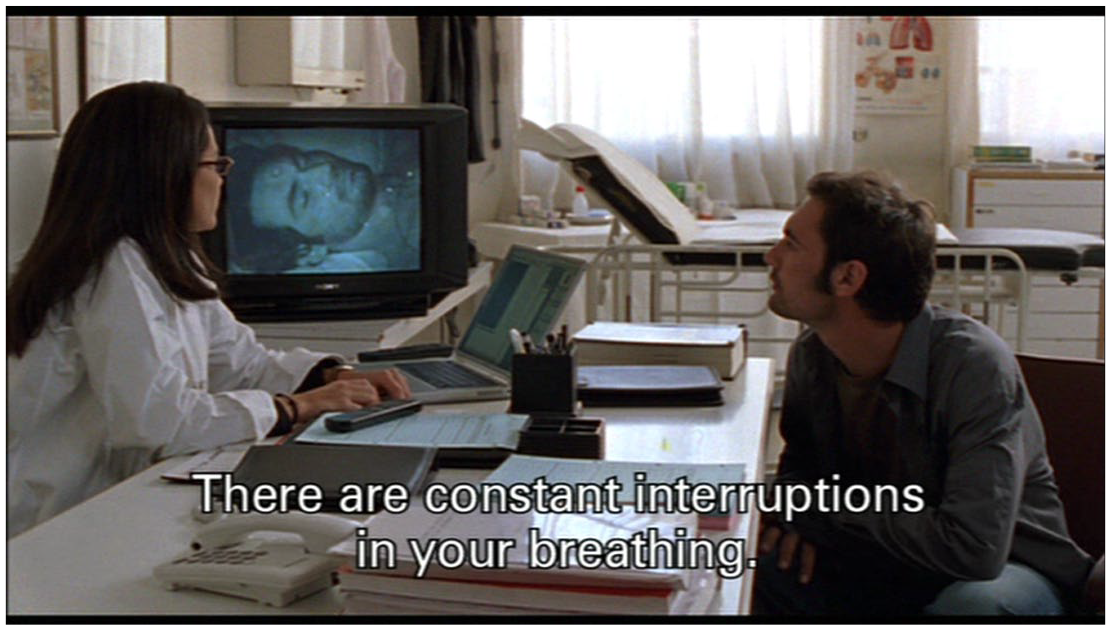
Hospital examination of Malek’s sleep apnoea.
This reading of the scene of the medical examination suggests that the transitions in Malek’s body between breathing and not breathing, movement and stasis and waking life and sleep have a larger resonance in terms of existential patterns than can be explained simply by the spectral return of the father. The liminal space that they open up is a consequence not only of the blurring of the line between the living and the dead through the shady figures of ghosts and vampires, but also the blurring of the lines between the conscious and the unconscious, between ‘reality’ and dream, between creation and oblivion and between birth and death. These transitions enact a surrealist re-enchantment of the city in which the return of the disappeared of the civil war intersects with the act (or at least the possibility) of awakening. Hadjithomas (Hurst, 2013) recognizes the importance of both: ‘we have to learn how to live in this state of haunting, while also constructing a different present. Our aim in this film is to place absent bodies next to bodies in the present that are about to wake up’ (p. 45). Malek’s body is therefore the site of a complex existential drama.
It is, ultimately, the state of altered breathing patterns as a performative act that opens up the latent possibilities of the everyday. The performance of falling asleep on the building site conjures up invisible presences. When Malek is shown sleeping on a bench on the corniche, passers-by stop and stare (Figure 3). In keeping with the directors’ practice of film as partly spontaneous ‘happening’ and encounter – reminiscent of Situationism and French new wave techniques – the unscripted nature of film as performance (and the use of non-professional actors, apart from Julia Kassar as Claudia) takes it into the realm of infinite possibility.
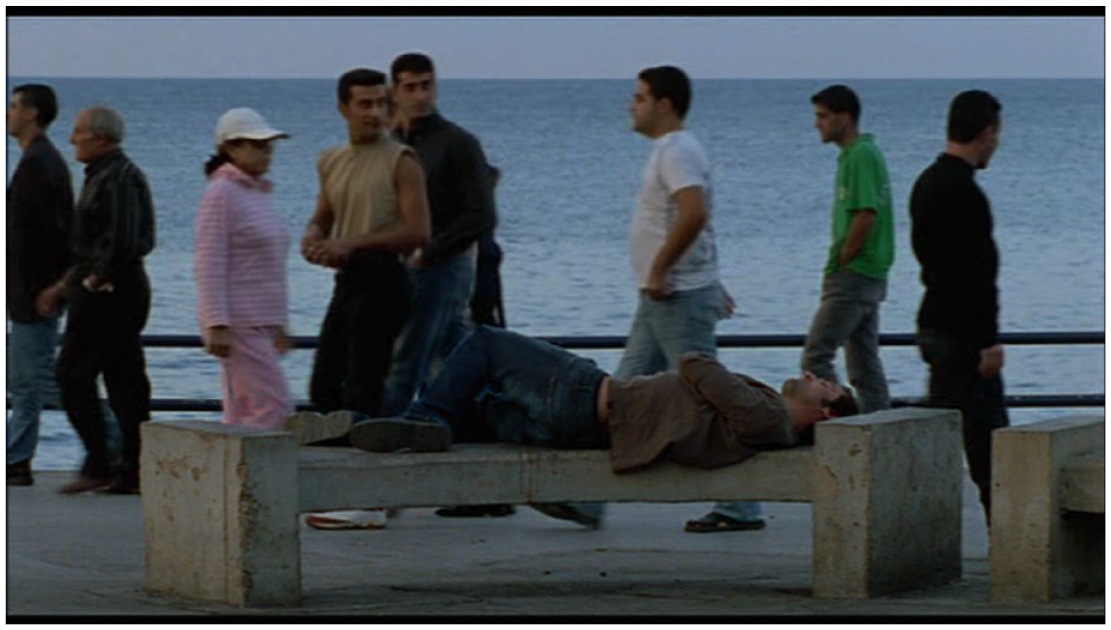
Asleep on the corniche.
The affective life of objects
In A Perfect Day, the affective negotiation with the modern world operates through other channels too, especially through the car, the cigarette and the mobile phone. Malek is, for large parts of the film, seated in his car in the city, smoking and on his phone. These objects are associated with the father: Claudia describes how the sound of every car outside the apartment makes her think of her husband returning home; on the table in the father’s office, untouched for 15 years since he disappeared, are a phone and an ashtray. However, although they are invested with the affect inspired by the original attachment to the father, they do not seem capable of fulfilling their role as ‘transitional objects’ (in the sense ascribed by Winnicott ([1951] 2012) to objects which become a source of comfort for the infant in the course of negotiating subject-object relations): the car is always stuck in traffic (mimicking the stasis of Malek’s body when he falls asleep); cigarettes do not seem to have allowed Malek to progress beyond the oral stage as they have become an addiction (and, as the doctor explains, are also a contributory cause of Malek’s sleep apnoea); the phone fails to carry out its primary function of communication as Malek refuses to answer Claudia’s calls while Zeina refuses to answer his. In terms of proxies through which to negotiate grieving for the disappeared father, these constant repetitions and blockages seem to suggest a failed process of mourning, more like a pervasive melancholia (which, in clinical terms, is known to affect sleep patterns).
This would, however, only be a partial way of reading the affective attachment to objects in the film. First, in the absence of official channels for mourning, and in the absence even of a body to mourn, mourning for the disappeared father has to be carried out, instead, prosthetically through the objects, sites and actions in the modern city (Westmoreland, 2010). For Malek, mourning is an incomplete act and has to be negotiated repeatedly (unlike for Claudia who wants to mourn in the traditional way by staying at home and dressing in black). Nevertheless, the objects of the modern world do channel the affective force of grief and therefore provide a structure for acting out and working through, even if there is never closure.
Second, these objects and actions are not only associated with the father. The car, for example, is ubiquitous in the city as a whole. Its ‘message’ is, therefore, not simply a personal one but one that is ‘transported’ publicly across the city, even the country. 8 Regarding smoking, not only is this Malek’s personal habit but strangers (invariably older men) are continually drawn to him to ask him for a cigarette: outside his apartment, in the street, when he is seated in his car. On the one hand, we can read the fetishization of cars and cigarettes as ways of dealing with loss (even if the process is frequently stalled), not only for Malek but for the whole of Beirut when there is no official way to perform this human need. On the other hand, there seems to be more at stake here. On one occasion when Malek falls asleep in his car and is blocking the traffic, he is helped out by concerned others; when he offers his packet of cigarettes to strangers he and the strangers reach out in a moment of encounter, similar to the touch in the lawyer’s office (Figure 4). Even the lawyer himself reaches for his packet of cigarettes, despite the fact that he has given up and smoking is forbidden in his office. Cars and cigarettes are objects invested with diverse affects: they become proxies for the interconnected performances of mourning and sociality in a city in which communication, memory and habitability appear to have broken down.
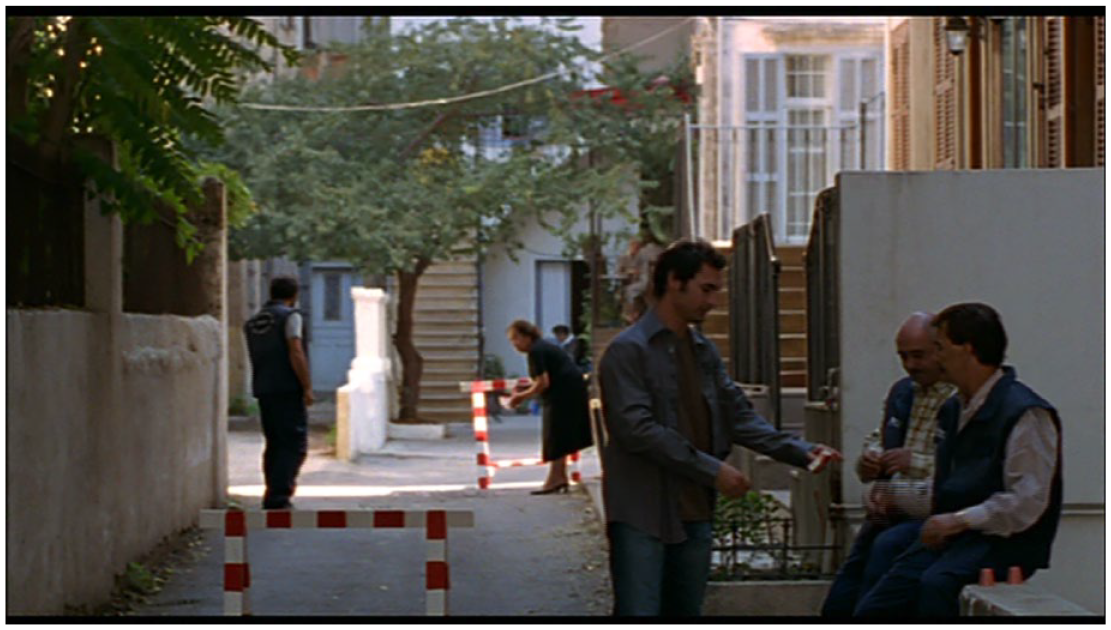
Malek offers his cigarettes to strangers.
The mobile phone is also made to speak this double language. Although it is frequently the site of non-communication, blocking contact between characters, there are occasions when it becomes the vehicle for a significant form of human contact, not in terms of the direct communication that it channels but in a more indirect fashion. In the first of these, Malek receives the news flash announcing the discovery of the corpse on the construction site on his phone (Figure 5). The message ‘Shia worksite closed. Corpse found’ literally flashes up on the screen, like Walter Benjamin’s description of the ‘flash’ of History in the here and now. In the second instance, Malek is approached by a stranger who sees him looking at his phone, recognizes that they share the same make and asks him whether he can help him change his ring tone. What follows is a touching scene of conviviality between two strangers, channelled through the dialogue about banal jingles emanating from Malek’s phone. 9
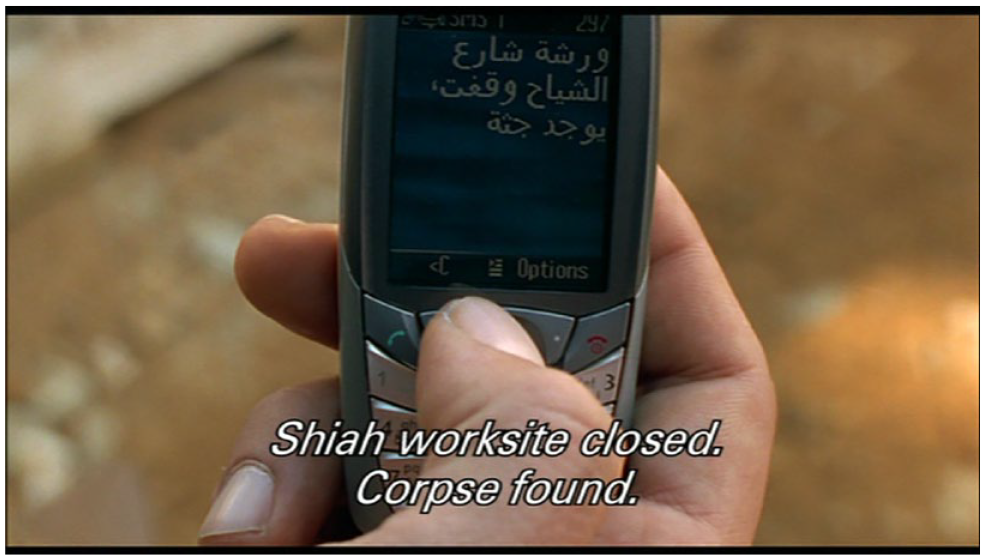
The flash of history.
The ‘associational mobility’ within which objects circulate means that complex affective circuits are established which both channel the trauma of the civil war and other processes. Malek is not simply defined by the belated reverberations of this past but by other desires and fears that one senses but remain inchoate. The same ambivalence also rescues the father from simply being one of the disappeared who will continue to be ‘missing’ (as he is classified in a newspaper photo). The associations between the father and forms of sociality and conviviality replace the unidimensional image of the victim with a multi-layered image of a multi-dimensional self. They therefore transform the father from a received image to the image as invention and possibility (as we noted earlier in the scene in which Claudia is alone in the apartment). If the father can be seen both through and beyond the lens of violence and disappearance, he can be rehumanized, placed within different time sequences, given back a sense of agency that the war has brutally ended and reendowed with the irreducible singularity and alterity that images (including the image of the victim and even the non-image of the vampire) have covered over. Hadjithomas and Joreige (2013) discuss this process eloquently in terms of the disappearance of the face: Against the backdrop of destruction in the region, the media portray faces reduced to a function, to a form of reaction, that of the victim: a nameless victim, with no real history (. . .) Too often, the way faces are presented deprives them of singularity. They become simply a status, that of the victim (. . .) In our part of the world, we have, in a certain way, lost our faces (p. 105).
The material world of modern life in A Perfect Day is therefore the stage for a paradoxical drama, one that shows the erasure and the possible retrieval of the singularity of the face. This is played out through different media as well as through affectively-charged objects. The newspapers, magazines, official documents, monitors, television, advertising billboards, posters and so on, ubiquitous in the film, are not simply the paraphernalia of the new corporate and consumer city, hence ‘screening out’ a complex affective life by rendering everything a surface, and thereby contributing to the objectification, spectacle and amnesia of modern life. These media are also the ‘screens’ on which an amorphous affective life can be negotiated and acted out in prosthetic ways (Landsberg, 2004). The monitor in the hospital room, for example, showing Malek asleep and the screen of Malek’s mobile phone which displays the news of the discovery of the corpse are the vehicles for the transmission of diverse voices from elsewhere in contemporary everyday life – just like the cinema screen itself.
Running on the spot
In the final scene of A Perfect Day, Malek is first shown asleep on a bench on the corniche and then running freely in abandoned fashion against the backdrop of blue sea and sky (Figure 6). He is, however, not getting anywhere as the sequence turns into a repetitive loop and he seems to be running on the spot. The image is a return (a ‘re-run’?) which suspends the onward rush of city life and narrative development in the same way that Malek’s sleep disorder suspends his breathing.
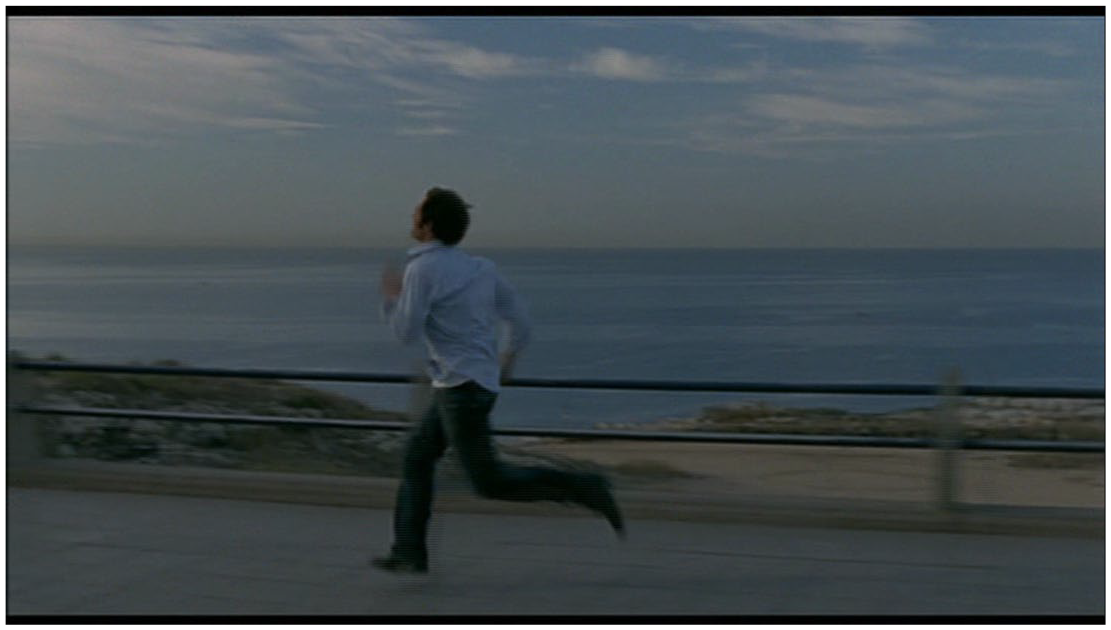
Running on the spot.
This moment between stasis and movement and between still and moving image (cf Chris Marker’s La Jetée) seems to capture, in a tableau, the directors’ concept of latency. It is, as Launchbury (2014) observes, ‘the temporal gap between stimulus and response’ (p. 181): the moment at which something is about to happen but has not already happened, the moment between sleep and awakening, the moment between nothingness and becoming that Malek’s body has been acting out unconsciously throughout the day.
Latency takes us to the origin (and essence?) of film, the moment that our desires, fears and fantasies are animated and projected onto a screen without having yet been fully crystallized, or even seen. In ‘Latent Images’, the third part of their project Wonder Beirut (1997–2006), Hadjithomas and Joreige used the imaginary photographer Abdallah Farah, whom they had invented in the second part of the project ‘Postcards of War’, to accumulate a vast number of reels of film, which he stored in drawers but never developed. The reels contain the infinite possibility of the image prior to the actual developing of visible and fixed images. These are shapes, then, that are latent but not (yet) fully formed, situated at the moment of bringing things (back) to life and hence invoking our imagination and creativity in their production.
10
In philosophical terms this corresponds to Derrida’s (1993) version of the spectre as a ‘re-venant’ heralding an unexpected and unpredicted coming of the other rather than simply a return of what has been, or, more appropriately, a repetition of the moment of coming. In ethical terms, it is that moment of reaching out to the other (to otherness) that has no cognitive form. In political terms, it is, as Jacques Rancière observes in a dialogue with Hadjithomas and Joreige (2013), a means of proposing ‘the principle of a new art of resistance’ by contrasting ‘the latency of images’ to ‘images of domination’ (p. 104). Hadjithomas and Joreige (2013) put it like this: Our images must constantly elude the scopic drive and strip away the fantasy that the representation of war has today shrouded us in; to struggle against the very principle of the mediatized image (‘efficient’, ‘spectacular’) and develop a more intimate relation, an ‘encounter experience’ with the ‘emancipated spectator’ (p. 105).
For Hadjithomas and Joreige, film is that moment of becoming before the image solidifies the ‘encounter experience’ into representation. In their terms, ‘latency is the work of cinema . . . to create a sense of what cannot be seen’ (Silverman, 2014: 536). This rescues Lebanese film from the recurrent tropes of violence, trauma and victims, endlessly playing out scenes whose permanent backdrop is the civil war and from all other fixed images of Lebanon. Latency is Lebanon as process not product. This vision of A Perfect Day means that the title is both deeply ironic and yet perfectly true; in the words of Joreige (Hurst, 2013), ‘this is one day of all those possible’ (p. 44).
Footnotes
Acknowledgements
I am particularly grateful to Claire Launchbury, Marilyn Matar and Robert Watson for our weekly discussions of Lebanese films and documentaries, including A Perfect Day, during the long days of Coronavirus lockdown. I am also grateful to Angelos Koutsourakis for his generous comments on an early draft of the article.
Funding
The author received no financial support for the research, authorship, and/or publication of this article.
