




Abstract
Materials have long been used by individuals reflecting on personal histories, and researchers have evidenced the associated therapeutic value particularly among older populations. In this article, we consider older veterans’ reminiscence through attending interviews and workshops, focussing on the performative potential of engaging with materials collected throughout their service lives. By considering their use of in situ and post-hoc materials, two themes are explored: the use of materials to build a sense of belonging; and making unknown histories knowable. We consider how their sharing of materials (re)produces their past and present military identities, simultaneously drawing boundaries of inclusion and exclusion around what it means to be military or non-military (civilian). Through sharing materials, veterans facilitated discussions with both military and non-military persons, enabling feelings of connection and belonging.
Introduction
Individuals use materials collected and maintained throughout their lives to reminisce about personal histories, and the process of reflecting with materials has been identified as therapeutically valuable for older populations (Butler, 1963). Practices of recording experiences through photography, of collecting materials, and of holding onto, and referring back, has been considered in the literature (Kuhn and McAllister, 2006).
Previous research has considered how materials associated with veterans might contribute to collective memory – where stories and values from the past are transmitted into and reinterpreted/rearticulated in the present, for example through war memorials or obituaries (Beckstead et al., 2011; Taussig, 2016). There is also research on service personnel’s amateur photography practices, particularly in spaces of war, and how photographs are used by others, for example in newspapers and exhibitions (Struk, 2011). Furthermore, there has been interest in veterans who write military memoirs, exploring production, reasons for writing, and themes within and from them (Dyvik, 2016; Hynes, 1997; Woodward and Jenkings, 2018). These studies contribute to understanding veterans’ personal (hi)stories as blurred with narratives of war and collective memory (explained shortly).
This article further contributes by considering how a group of UK veterans – born before 1950 – engage with their military materials collected during service (in situ materials) and developed post-service (post-hoc materials). Rather than exploring how these materials were collected and what they depict/represent, we focus on veterans’ use of their materials to tell personal stories, which are entangled within wider public narratives, in the spaces of research workshops and interviews.
Our study focused on veterans’ storytelling and when attending interviews and workshops, many brought with them, unprompted, various materials they had gathered throughout their service and non-service lives. These included photographs, medals, badges, uniforms, identity cards and brief autobiographies. This article considers their use of and relationship with these materials, showing materials’ performative potential to facilitate veterans’ storytelling. We consider how older veterans used their materials for reminiscence to make the unknown knowable, and community building.
Whilst broad experiences are shared by veterans, such as the fact that they served and transitioned out of service, there are numerous differences. Differences include, but are not limited to, the social, political, cultural and service background experienced. Yet we found that regardless of differences, the veterans established connections between themselves due to them having served. Older veterans’ reflections must be acknowledged as ‘linked with’ and ‘different from’ other generations. Our research demonstrates that older veterans can feel ignored, forgotten, or less important compared to others and many consider themselves as ‘not proper veterans’. Although some had experienced wars considered societally transformative, many of our cohort had not experienced war, and had been conscripted as part of their National Service, sometimes serving no more than 2 years. 1 Often, they situated their stories between the World War II (WWII) era and recent campaigns in Iraq and Afghanistan – relating experiences to more publicly known national histories. We found, regardless of differences, veterans bridged gaps and built a coherent narrative of shared understanding based on service.
Firstly, this paper explores research on collective memory to show that veterans’ (hi)stories are bound up with national histories, transmitting socio-cultural normative values and ideas from past to present. Then we explain the theoretical underpinning of our concept ‘performative potential’ to frame veterans’ relationship with materials. To foreground our focus on telling stories through materials, we consider research on the materiality of reminiscence, focussing on memoirs and photographs. Then, we explore two purposes of veterans using materials: to make personal histories knowable, and to build communities.
Collective memory and veterans
Remembering and reminiscence are both individual practices and embedded within social processes. Collective memory is (re)productive of meaning and practice as values are transmitted though time and brought into, interpreted and maintained within the present. Writers on collective memory have argued that ‘all individual remembering [. . .] takes place with social materials, within social contexts, and in response to social cues’ (Olick et al., 2011: 19). For example, Kuhn (2010) explored how processes of remembering are institutionalised and materialised through cultural means (museums, photographs, monuments and books) and associated practices (commemoration). Engaging with material cultures can construct a sense of a commonly shared history and ‘communities of remembering’ which can be experienced at different scales – personal, familial, regional, national (Kuhn, 2010: 298).
Additionally, Edwards (2006) examined the productive qualities of archiving photographs of British tradition and monuments, showing that the photograph could contribute towards collective memory as values associated with custom, portrayed within these photographs of moments in the past, legitimise national ideologies and practices. However, Edwards found that photographs most closely contributing to these constructions were those found in local libraries not the British Museum. Therefore, there are limitations to what can be achieved in terms of the productive power of photographs on national scale, and perhaps their potential is stronger among smaller groups. This resonates with Kuhn’s (2010) concept of ‘communities of remembering’ which can be experienced variously at different scales.
This article focuses on the memory-work of older veterans. The veteran is a highly politicised figure and they are ‘key protagonists in the negotiation of relations between geopolitics, the state, the military and society’ (Bulmer and Jackson, 2016: 27). Their stories are situated within society as they respond to, reinforce, or contest public narratives (Caddick, 2018). In many instances their stories are told by others. For example, Taussig (2016) demonstrated how public events are woven into the individual life stories in obituaries of WWII and the Vietnam War American veterans. This (re)produced collective memory as events were carefully selected and defined, emphasizing certain details and cultural scripts. Taussig argues that obituaries differ according to the collective memory of each war – where Vietnam is remembered as controversial, and WWII represents a unified America – and obituaries simultaneously maintain this state recollection whilst impacting the identity of the veteran after death. Differently, Struk (2011) examined how collective memory could be challenged. Struk explored the ‘War of Extermination’ exhibition of service personnel’s war photographs. These provocative images challenged national narratives of the nature of violence carried out by the state, leading to criticism and rejection on the basis of perceived inaccuracies and bias.
War is central to the figuration of veterans, and how war is remembered forms part of collective memory. However, not all wars evoke the same level of attention. Bourke (2004) describes transformative effects of WWII and the Vietnam war on generations of Americans, yet contends that other wars did not have the same impact. Quoting Kansteiner, Bourke (2004: 473) states that ‘people who experience traumas such as war will only see their narratives enter the public realm “if their vision meets with compatible social or political objectives and inclinations among other important groups”’. Bourke contends that wars including the Korean War were not forgotten, but rather political and cultural factors rendered them ignored.
In this article, we consider veterans’ reminiscence as linked with collective memory and public narratives due to the blurring of their experiences with national histories. Veterans are liminal figures, sitting between ‘individual memory and the national theatre of collective memory choreographed by social and political leaders’ (Winter, 1999: 41). However, rather than focussing on the productive nature of their (hi)stories at a societal/national level and how their stories are told by others, we focus on the productive potential of memory-work for the individual whose reminiscence represents a subjective truth. We demonstrate how veterans personally shared their stories, using their materials, to make their histories knowable among other veterans and us. This enabled them to describe personal experiences that they thought were less understood or known about as they had not been reflected as fully as other experiences in collective memory, on their terms.
Materialised memory and performative potential
Researchers on material cultures have shown how objects are not only interesting in terms of what they represent or depict, but also their ‘thingness’, and the ways in which they exceed boundaries to directly affect viewers (Edwards, 2002; Levin, 2009; Maynard, 1997). They exist in time and space, in social and cultural experience, and are ‘enmeshed with subjective, embodied and sensuous interactions with them’ (Edwards, 2002: 67).
Our study uses the concept of performative potential to consider older veterans’ use of materials, including photographs, to tell their stories. Theoretically, the notion of performative potential draws upon work within material culture studies generally, and in relation to photography specifically (some of which is discussed here and is explored in depth by Edwards, 2012) that has highlighted the inherently relational and social nature of objects; that photographs for example, do not simply convey what they are of, rather they matter because of the networks within which they are produced and shared (Gell, 1998; Keane, 2005; Miller, 1998; Vokes, 2008). Drawing upon actor-network theory, some of those exploring photographs and other material artefacts as relational constructs, have also emphasised their agentic potential, for instance as enablers of story-telling, reminiscence, singing, and chanting (Brown and Peers, 2006; Edwards, 2006, cited in Edwards, 2012), and in turn, as architects of social history and identity (Edwards, 2012).
Performative potential, we suggest, is a useful tool through which to build upon and advance this existing literature by facilitating an explicit focus on the agentic and affective possibilities of material culture, in our case photographs and other materials, and by bringing to the fore the continually emergent nature of use and meaning. For us, performative potential refers to the possible effects of sharing materials with others to enhance the understanding of the person who was not there, making their histories more accessible/knowable. Yet these effects occur in inherently uncertain and complex ways, and may not necessarily have the effect intended by the owner of the material, so we can only refer to effect in terms of its potential.
Materialising personal stories
Hynes (1997) stated that to know what war is like, we must seek the reality of those who were there and similarly, Harari (2009) introduced the concept of ‘flesh witnessing’ – to only be able to ‘know’ if present. There has been recent interest in how veterans and service personnel tell their stories through military memoirs (Dyvik, 2016; Hynes, 1997; Woodward and Jenkings, 2018). Military memoirs tell stories of factual accounts, ensuring that lived experiences are prioritised, presenting the blurring of national and personal, objective and subjective knowledges (Woodward and Jenkings, 2018). These categories are slippery and claims of authenticity and truth are questioned on these terms (for discussion on reliability of service personnel’s photographs see Struk, 2011). Memoirs cannot, and nor do they intend to, capture the ‘truth’. Rather, they present the veteran’s interpretation of history and their own vernacular experiences, blurring the boundaries between personal and national/political narratives and histories – simultaneously reflecting and resisting formal histories (Ben-Ze’ev and Lomsky-Feder, 2009; Islam et al., 2019). The capacity to resist should not be over-emphasised as veterans’ stories are situated within society, culture and dominant narratives (Caddick, 2018; Islam et al., 2019).
Writing a military memoir enables veterans to bridge the gap between their past and current experiences – no matter how much time has passed. Woodward and Jenkings (2018: 1) explored various memoirs published between 1990 and 2017, defining them as ‘first-person narratives about the experiences of participation with the armed forces, written as non-fiction and published as book for public consumption’. These memoirs document military lives through outlining experiences of historical events, enlistment, transition from civilian to service person, military operations and the impact of this upon the self. Various purposes for writing were identified including: to add to history/correct interpretations, to provide a different type of historical account (lived experiences), to tell a story that the writer feels needs to be told, to fill the time, or because it ‘is the right time’. Each of these intentions may be considered as the performative potential of memoirs and an attempt to make personal histories knowable, or known differently. Whilst the veterans in our study shared printed documents outlining brief autobiographies which could be considered similar to memoirs, they are significantly different as they had not been influenced by an editorial process and were limited to a few pages.
Among other materials, the veterans in our study shared photographs with us and each other. Research has clearly identified the power of photographs in enabling personal reminiscence as they can act as prompts for remembering, are stored in particular ways, and can be shared with intended viewers to tell stories. These relationships with family photographs and albums have been considered by Kuhn (2002, 2010) and Langford (2001, 2006), centring the performativity of materials as repositories of memory and instruments of social performance. By considering the work of social theorists of photography including Bourdieu and Sontag, Langford (2006) suggests that although the interpretation of collections of photographs is best achieved alongside the compiler, their interpretations are not fixed due to the evolution of life-stories over time and memory. Kuhn and McAllister (2006: 4) echo this sentiment, stating that ‘meanings in photographs may be shifted, challenged and renewed over time, and for different purposes, from historical inquiries to quests for personal, familial, postcolonial and national identities’. Additionally, stories are told in different ways according to the relationship between the storyteller and the listener. This speaks to other research on objects’ influence and Gell (1998 in Edwards, 2002: 69) suggested that objects could be considered to be social actors as they construct and influence the social in ways that would not happen if they were not present.
The materials shared with us were deliberately selected by the veterans to tell stories they considered important and, perhaps, appropriate. There may be other materials they did not share with us – those they wanted to remain private (Struk, 2011), those that did not hold meaning for the veteran, those they had no memory of. It is not within the scope of this article to explore how these materials and memories were selected and excluded. Instead, we consider the performative potential of the materials the veterans chose to share with us and each other at workshops and interviews.
Methodology: Working with older veterans
Our empirical work conducted between 2017 and 2019 engaged with over 100 older veterans, who participated in a one-to-one interview and/or a workshop with other veterans. Veterans were recruited via social media (mainly Facebook), organisations working with older adults and veterans (e.g. Age UK; the Royal British Legion [RBL]), word of mouth (snowball sampling) and in response to posters shared in community locations. The research was conducted as part of a research project funded by HM Treasury Aged Veterans Fund and administered by the RBL, though there was no prerequisite to be an RBL member to participate and many veterans had previously not interacted with this organisation. While the focus was on understanding older veterans’ storytelling about their military experiences, veterans’ use of various materials that helped them to tell their stories was a notable finding.
By conducting in-depth interviews with 50 veterans from various services and backgrounds (Table 1) 2 and five workshops across England, we were able to explore how stories of previous military experiences were constructed and shared. In total over 70 veterans attended one of the five workshops (some were also interviewed). All had a range of experiences from different services, types of enlistment and roles. In workshops, most veterans had not previously met, and were introduced to each other for the first time. Brief details were taken from veterans before the workshops, and care was taken to try to include a mix of veterans in each small group discussion.
Interviewees by service, length of service, type of enlistment, age range and gender.
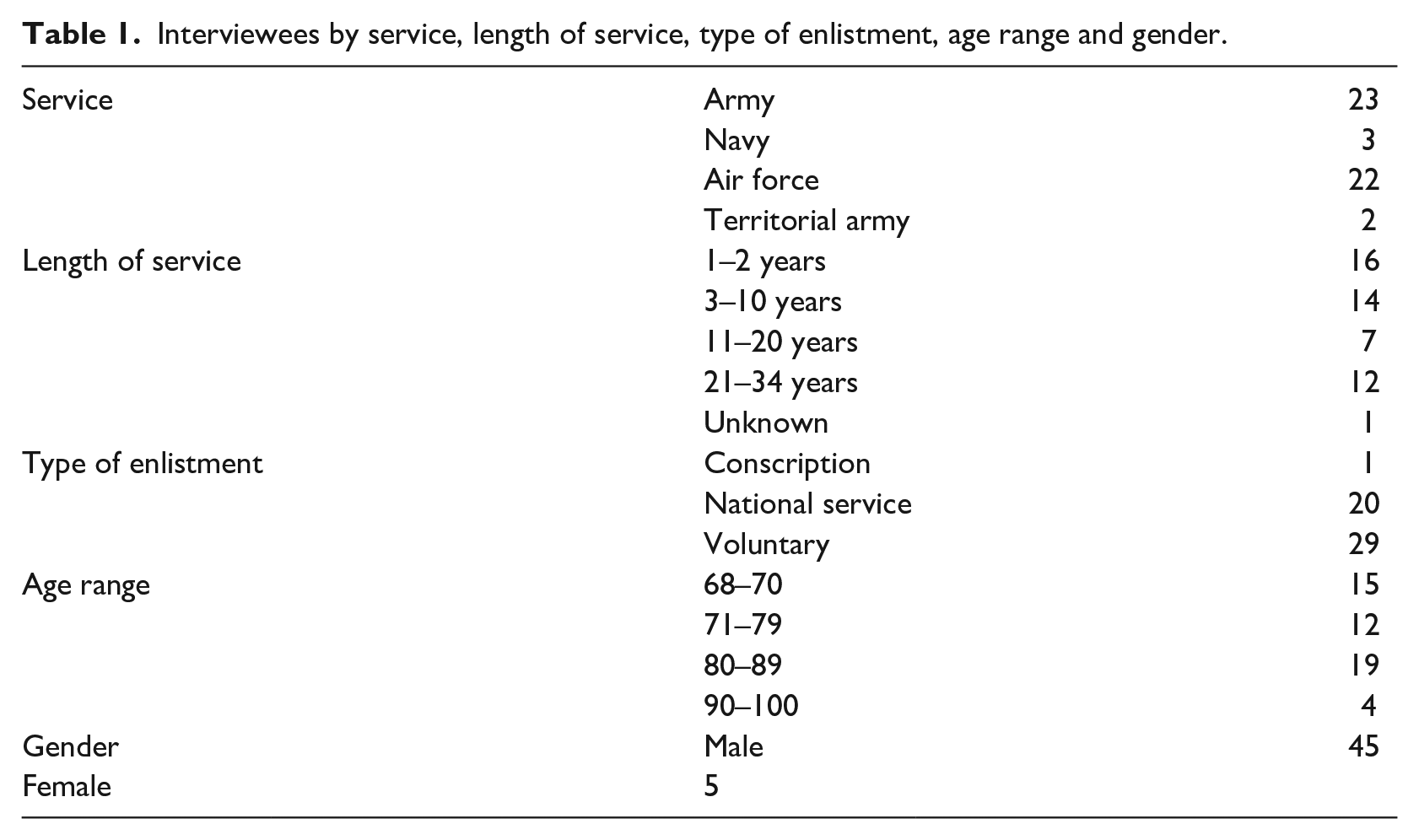
Veterans represented here were much more diverse than can be seen in previous research, which has tended to concentrate on one cohort of veterans (e.g. Gulf War veterans). Our broad remit (those born before 1 January 1950) meant we included those who had served in WWII and other formally-recognised conflicts (the Korean War, the Falklands conflict), and those stationed across the globe, both in peacetime and during other hostilities with locations including Palestine, Kenya, Northern Ireland, Germany, Malta, Hong Kong, Singapore and Malaya.
Interview data were audio-recorded and fully transcribed. Notes were taken in workshops, and data from workshops and interviews were analysed using a constant comparative method (Charmaz, 2006) to identify codes from the data, facilitated by the data analysis software NVivo. We worked together as a research team to establish a coding framework which was applied to all of the data. This coding framework evidenced key themes and was used to shape analytical concepts from the stories told. These concepts included how stories told by veterans could function as a tool for connecting veterans (even those who had not previously known each other), how these stories constructed identity, and how the intersection of age and post-military life affected the support needs (including health, mobility and depleting social networks) of these older adults (Brewster et al., 2020).
In examining the service lives of older veterans, we found that whilst previous generations of veterans had more shared or similar experiences (e.g. in Europe during WWII), this cohort is marked by its diversity of experience. These veterans were concerned about being forgotten and that specific conflicts are not commemorated. They want future generations to be aware of their national histories. Additionally, some consider themselves ‘not proper’ veterans as they did not experience combat, comparing themselves to previous generations of World War veterans and later generations who endured the Gulf Wars.
Before attending workshops, some veterans asked if we wanted them to bring things and many chose to bring various materials along with them to share. Additionally, when interviews were conducted within their homes, some paused conversations to collect materials to show the interviewer. We inadvertently collected a variety of items, unprompted. That veterans chose to bring these items to workshops, and to showcase them during interviews, demonstrates how important they were to those participating. We categorised materials collected and maintained from their service lives as in situ, and materials (re)adapted later in their lives post-service as post-hoc.
In situ materials which were collected during their military service included photographs (and photo albums), military identity cards, medals and certificates of discharge. Many also wore medals and/or uniforms when attending workshops, performing military identity and belonging on their bodies. Others brought their medals without wearing them to show us. We did not formally collect data about what these medals represented but did notice some related specifically to particular deployments, accomplishments and anniversaries. Other materials veterans brought with them, although less frequently, included scanned copies of their identity cards, certificates of discharge, a letter from the Ministry of Defence offering a commission, presentations they had built to share with schools, travel tickets and objects such as a mug.
The veterans we engaged with also presented us with numerous materials which they had developed or adapted after their service, post-hoc, including scanned/digitised copies of physical materials such as photographs and certificates, books about their service lives they had contributed to, and printed documents outlining their personal biographies (with a focus on their military lives). Additionally, many wore the HM Armed Forces Veterans’ Lapel Badge. Although this differs to materials collected in situ and developed post-hoc, the badge was central to many veterans’ meaning-making practices around their identities (see Brewster et al., 2020 for a full discussion of the Veterans badge).
Material practices, personal histories
It is evident that the technological (and cultural) practice of taking photographs during service for our cohort of older veteran service differs from today. The current convenience of taking photographs, facilitated by the increased availability of digital technologies, has led to better images, taken more often, capturing a wider variety of scenarios (Van House, 2011). Additionally, the speed at which images can be shared has increased, enabling rapid viewing and opportunities to share with larger audiences through social media – making images more public and accessible (Van House, 2011). Therefore, meanings accorded to photographs have shifted throughout older veterans’ lifetimes as they become less private (for service personnel’s photography practices see Struk, 2011) and become a tool for communication – ‘photographs as object of memory have traditionally depended heavily on their materiality and durability, both of which are being attenuated by the digital’ (Van House, 2011: 133).
Some of our cohort of veterans had adapted their materials, responding to modern technology and practice. By embracing newer technologies, they could share their histories in different ways, enhancing their ability to build communities of support. By digitising photographs veterans changed their function potential – they could publish them on social media and make physical copies. In purposing them as something to be widely and publicly shared, veterans were sometimes attempting to rekindle old connections, other times trying to develop new connections with other veterans. They also used them to bridge gaps of understanding between themselves and others.
Photographs, and other military materials, were used to seek understanding of lives during service that rendered them both different to civilians, and part of a community of interest formed among other veterans. However, it is important to not exaggerate the degree of change that these adaptations afford older veterans (see Keightley and Pickering, 2014). Many still valued, and shared with us, original photographs and certificates relating to their service. These materials had been kept as souvenirs from service and protected and stored in various ways.
Overall, veterans’ use of materials collected in situ and obtained post-hoc helped them to make personal histories knowable, and forge social connections which will be discussed in the following sections.
Making histories knowable
Many veterans wanted to tell their stories to make their history known: ‘it’s my job really to share it with people so it’s not lost, before we all die off’ [male, RAF, Voluntary Enlisted, served 3 years]. Yet, many also felt that their experiences were of lesser importance compared to those of other veterans. There was a trend for those who had not been deployed for combat and those who had served for 2 years in National Service to compare and situate themselves between older personnel who served in the World Wars and younger personnel who served in the later Gulf Wars. By situating themselves between these periods, they explained that others had it harder suggesting that their experiences were not as interesting or important in comparison. This was noticed particularly among some of the women who attended workshops and some of those who had served 2 years National Service.
However, others wanted to tell these lesser-known stories as they wanted their histories to become known. This is evidence of responding to national collective memory where certain military events such as the World Wars have gained more attention and therefore understanding across society. Instead, our veterans told stories to make their personal military-related histories known which could be considered, on a societal level, as ignored (Bourke, 2004). To do this, many shared in situ and post-hoc materials. Of course, this does not mean they were sharing objective, factual histories – rather, they shared their subjective reflections – subject to their memory and re-remembering (Roper, 2000). Even in terms of the photographs shared, these were subject to the ‘eye of the artist’ (Struk, 2011) and discussions were likely affected in various ways such as by memory.
In situ photographs were the most common material veterans brought with them to interviews and workshops. Images captured were various and commonly depicted their deployment to combat and non-combat zones, and places in which they were stationed within the UK, presenting the variety of their personal and collective experiences of service. Many of these photographs captured ordinary, everyday moments of their military lives, but to them these images were important keepsakes and enabled them to tell stories that were significant to them. Photographs prompted memories and reflections beyond the boundaries of what the photograph depicted – they were prompting stories that would not have been accessible without the veteran’s presence. The photographs reflected the mundane realities of their service, including images of themselves, their comrades and buildings of interest. A common photograph shared depicted the veteran during their basic training, wearing uniforms, with colleagues, in military spaces including their billet or wider barracks. One veteran went through a series of these images with a member of our team showing images of him polishing his boots, the shine on the polished floor, and through this described the weekly inspections of their living area highlighting the discipline of military service: ‘can you see the reflection on the flooring along all the beds?’ [male, RAF, National Service, served 2 years]. Others depicted friends, prompting veterans to tell stories about their military and non-military lives. These images and stories enabled veterans to speak about experiences which were not directly about war, showing another side to military life.
Photographs were also shared with us to express the unique and exciting experiences they had been afforded through military service. Photographs evidenced where they had been, presenting the perceived exotic nature of the places they had travelled to, and technologies they considered to be exciting including aircraft and ships. Images of overseas spaces were of great significance to this cohort of veterans who had lived in a time where travel was uncommon – many considered the military to have given them exceptional opportunities to see the world, and encounter cultures and languages. Similar narratives were told by those who did not travel internationally but lived in locations other to where they grew up. They compared themselves to their non-serving peers, commenting that they did not have opportunities travel as they did, presenting travel as a key feature of difference between them and civilians.
Using materials enabled some to tell stories which might not have arisen without the material being present (Gell, 1998; Edwards, 2006). One veteran [male, Army, Voluntary Enlisted, served 7 years], showed us a photograph which had been ‘spoiled’ as he was caught in a monsoon whilst deployed. He kept the ruined contents of his wallet and was keen to show the water damage to demonstrate what the weather had been like:
I’ve one or two photographs which have been spoiled, they were in my kit, inside a wallet, and to show you how powerful, it was a monsoon burst of rain, and we were sitting in these open trucks, waiting to get into, to get off the train [. . .] I’ll show you it presently.
Some veterans brought post-hoc materials such as printed Microsoft Word documents or short booklets giving an overview of their lives and excerpts of their experiences. Some had developed chronological stories of their personal history documenting various details including date of birth, date of joining/leaving the services and family details including marriages and children. They also included dates of military events that they participated in and medals awarded. Personal, familial, political and national histories were collated together by veterans to tell their own story – showing how their experiences sit between personal and national events. While these printed documents could be considered similar to memoirs, they are quite different in some respects. Those shared with us were limited in scope (two pages long), unpublished (or on occasion ‘locally published’ e.g. previously shared within an existing community). They acted more as aide memoires than as memoir per se, and were sometimes referred to by veterans to legitimise discussion by adding in a relevant detail or fact.
Others used materials to tell stories of accomplishments. These were not accomplishments directly related to war/combat. Instead photographs depicted them completing courses or undertaking roles they were proud to share. One female veteran [RAF, Voluntary Enlisted, served 3 years] worked on a project post-service teaching girls practical tasks, aiming to build their confidence. She enjoyed showing the girls photographs of her service life and the technologies she worked with, and was pleased to see how impressed they were. For her, these images (and her experience of service) are important because they are outside of her perspective of what was normal at the time in terms of roles women did both in the military and civilian employment. Another veteran [male, RAF, National Service, served 12 years] described a photograph given to him which showed the Duchess of Kent presenting the standard – an especially proud day for him as he and his comrades had successfully carried out the drill. These images were shown or described to us presenting the uniqueness of military life both during and after service. They are stories more personal to the veterans and do not feature in collective memory which situated veterans’ experiences within war and the extraordinary.
However, memories and interpretations of veterans’ subjective histories are not fixed. Re-reflection later in life and sharing materials with others changed their understanding of the meanings and importance they had captured in their photographs. As materials move through times and spaces, they continually undergo changing processes of meaning, production, exchange and usage (Edwards, 2002). For one veteran [female, Army, Voluntary Enlisted, served 4 years], being around military apparatus was banal, normal and unremarkable. Yet, later engagement with a photograph changed her perspective of the level of the ‘extraordinary’ depicted:
[. . .] the Borneo Conflict was on, and I’ve got photographs of us sat on the beach with the guns behind us, protecting us. But, do you know, when I think about it now, I think, “Wow,” but at the time, it didn’t bother us. You know, you’re 18, you’re carefree, you’ve got the guns there, you’d chat with the soldiers who were guarding you, and have a good old natter and everything. Never gave it a second thought, and it’s only when I told my daughter and that, and she’s going, “Flipping heck, mum!”.
The relationship between veterans and their photographs is not fixed and can change with the passing of time and engagement with other persons. This has been described by previous researchers; West (2014: 177) stated that ‘memory is constantly (re)negotiated through actions, interactions and reactions’. The meanings around photographs, and by extension other keepsakes, are co-produced between those viewing it (Jenkings et al., 2008). Through discussions veterans (re)develop meanings and negotiate poignancy. The excerpt above also shows how using in situ materials lends civilian family members a glimpse into their service lives, mediating conversation and possibly understanding.
Some veterans’ reflections upon their own photographs changed due to the increased understanding they had of the wider political climate in which they had served, which was gained through reading military histories and memoirs post-service. There was an enduring narrative about learning more about the context of their service and purpose of actions undertaken later in their lives, as information became available. This also resonates with previous research showing how veterans’ understanding of their involvement in specific deployments can change over time due to changing public discourse (Antunes, 2017), showing how veterans’ stories are situated within societal narratives (Caddick, 2018).
Building communities of remembering
During workshops and interviews, veterans forged communities of support, akin to Kuhn’s (2010) ‘communities of remembering’. Building communities of like-minded individuals was particularly important for our cohort of older veterans, as some had experienced loss over recent years due to the illnesses and deaths of family and friends. Some talked about the loneliness and social isolation they were experiencing and how perceptions of fictive kinship might help them to manage this (Brewster et al., 2020). Additionally, those in the later stages of life valued opportunities to reflect and share stories about their younger selves, reflecting Butler’s (1963) observations of the value of reminiscence for older adults.
The veterans brought military materials to the workshops and within that space, built small communities of remembering with one another. Many of those who attended were strangers to one another, with various service-related experiences, yet managed to build connections due to having served. They shared photographs and wore uniforms/medals to tell their stories; opening up about the challenges experienced. Even where differences were significant in terms of military experiences or demographics, many were able to connect through talking about the transformative nature of service and the differences they perceived between themselves and civilians. Through the sharing and wearing of military materials, veterans were able to build a sense of connection with other veterans and join/establish networks that had previously been lost post-service. Individual memories contributed to a sense of connectivity and a shared history, further enhancing the sense of community, regardless of the difference in experience across space and time (e.g. in terms of service, deployments, roles, dates served).
Veterans also described their use of materials outside of our study to build connections with other veterans. Some digitised photographs of people they used to serve with and shared these on social media, hoping that this would lead to reunions. Others shared photographs of places they were deployed during their service, asking if anyone else remembered a particular area, looking to reminisce. Given the age of veterans we spoke with, this sometimes led to them hearing that their comrade was unwell or had passed away which could produce sadness and isolation rather than enjoyment and reconnection.
Not really, no. I have online met one or two people that were at RAF Lyneham at the same time as me, but that’s all. I mean, I’ve posted photographs of my pals on Facebook, but I mean, I’m nearly 80, I’m 80 next year; a lot of them will have passed away, you know? [male, RAF, National Service, served two years]
This veteran later talked about how others rekindled connections from posting images on social media, yet he did not expect that he would be able to reconnect with those he served with.
Many veterans described the uniqueness of military life during service whilst maintaining that although roles were various, they were all cogs in the overall military machine. Whether this was actually the reality for the veterans or not, this idealised trope was mobilised by many to explain the enduring connection between service personnel and veterans, no matter how much time had passed or how experiences differed. The sharing of military materials and stories facilitated small communities of remembering centred on an idealised history of camaraderie and community, enabling strangers to connect with one another, and individuals to re-connect with their past. Their sharing of materials and stories (re)produces and rekindles collective memory of camaraderie within the military, whilst also enabling them to talk about their various and different experiences of service life. Furthermore, their sharing of materials evidences their drawing of boundaries of inclusion around who they consider can know and understand them and their histories – other veterans regardless of service experiences.
Our cohort of veterans also shared materials with us, non-military researchers, which we considered an attempt to increase our ability to start to understand their experiences. One veteran [male, RAF, National Service, served 2 years] shared memories of his time in Sri Lanka:
That’s Ceylon, and that is one of the billets, that isn’t our billet.
In Ceylon, there’s these different levels. You’ve got the padi fields, then you go into the coconuts, then you go into the rubber.
That’s the beach we used to go swimming on.
Well, we were the only ones, it was probably a couple of miles to the beach, so we’d jump on our bikes when it was afternoon off and go down.
No, that’s our billet. Just our billet, that.
Yes. We were supposed to wear-
All their whites were white, yet they’d only bang them out on a rock. We didn’t wash anything. That’s the old ambulance: we didn’t use that very much. That was how we used to spend afternoons.
Yeah.
Images helped veterans to tell their stories and explain what their military lives were like to us, as unknowing civilians. Showing photographs and other materials could be understood as an attempt by veterans to bridge the perceived gap in military-civilian understanding; reflecting Harper’s (2002: 34) suggestion that it is ‘possible to use images as bridges between worlds that are more culturally distinct’.
Yet sharing photographs between the veteran and civilian researcher is also productive of perceived difference between military and civilian experiences and understanding, and thus reproductive of military particularity which veterans consider important. Throughout our study, many veterans reflected on how their experiences changed them, making them more worldly than civilian counterparts of their day.
I changed completely from being this 15 stone country bumpkin to somebody who’d done something and achieved what most people – especially in those days – didn’t achieve. I mean, you know, you didn’t even go to Spain on holiday, let alone go to Singapore, Tripoli, Malta. [female, RAF, Voluntary Enlisted, served four years]
The sharing of materials functioned as a way in which veterans drew boundaries and built upon a perspective of an exclusive extra-ordinary experience – one that could not be understood by those who have not served, who were not there (Hynes, 1997). Through drawing these boundaries, they also demarcate their inclusion within the wider veteran community. Although veterans said that civilians could not understand their experiences, many enjoyed sharing their stories with us.
Discussion
It is important to reflect on the sites in which these materials were shared, showing how they move through spaces. Murakami (2014) reflected on veterans’ pilgrimage to former battlefields and prisoner of war camps, describing the materials engaged with and relationship to history. In their reading of Murakami’s work, Singer and Conway (2014) suggest that these pilgrimages are presented as ‘a way in which individuals within the same culture retain a relationship to past events that has become part of the culture’s history’ (pp. 388–389). On these terms, we make a case that the workshops and interviews we facilitated with groups of veterans may be considered akin to pilgrimage events. The veterans used workshops and interviews as sites of reminiscence and the materials they brought with them helped them to remember, share personal histories, and build connections with strangers. There was a productive and ritual performative nature around veterans’ use of their materials.
The veterans used in situ and post-hoc materials to build communities of remembering (Kuhn, 2010), sometimes showing materials they had adapted, such as digitised photographs on their mobile phones to share them more widely. Murakami (2014) reflected on the centrality that is placed on materialities and communitas within the broader definition of pilgrimage. Communitas, a term coined by Turner and Turner (1978) refers to a sense of togetherness and belonging, a sense that can emerge in the context of pilgrimage amongst people who are otherwise strangers, is associated with shared purpose, shared interests and shared experiences. Here, veterans reminisced with each other during our workshops and sought veteran communities outside of our workshops, enjoying these connections due to a perspective of a shared experience due to having served. However, they also reminisced with us, as civilian researchers who do not share this military experience, and many expressed how much they enjoyed talking with us.
For this cohort of older veterans, photographs, medals, uniforms and other such military materials provided them with an opportunity to stake a claim to the veteran identity. Materials were shared with other veterans to bolster connectivity and shared understanding of one another. Materials were also shared with the research team to bridge a perceived gap in understanding according to our non-military association. The sharing of materials (re)produces the boundaries of inclusion/exclusion in terms of identity and understanding – although they are used to draw civilians in, they are also markers of difference and in this way, civilians are pushed away. This is reminiscent of tropes, evident in many of our interviews, that service changes individuals, for example, turns boys into men (Hynes, 1997) and through doing draws boundaries between themselves and those who have not served.
The opportunity to experience communities of remembering (Kuhn, 2010) might be more limited for our cohort of veterans compared to others whose histories are more frequently acknowledged in collective memory, for example, veterans who fought in the two World Wars. Commemoration and understanding of these wars has been institutionalised for example through war memorials in cities, towns and villages across the United Kingdom, Armistice Day and various projects undertaken to mark the centenary. Many of our veterans’ military experiences have not been institutionalised to an extent nearing that of the World Wars – wars are remembered in different ways and some are forgotten or ignored (Bourke, 2004; Taussig, 2016). National discourses of war and associated memorialisation feature prominently in societal collective memory. Yet, through privileging the productive potential of memory-work enacted by veterans, we found that they keenly spoke of personal experiences beyond war. They used materials to share stories of their less extraordinary experiences, speaking of friendships, personal accomplishments, training and the weather. These were personal histories considered by the veterans to not be known or understood by society.
Through engaging with this cohort of veterans we argue that it is not only wars that may be ignored but also the diversity of veterans’ experiences. Speaking to one another, and us, and sharing their materials afforded these ignored veterans the opportunity to tell their subjective and personal (hi)stories on their terms – where authenticity was not questioned or considered important. Perhaps these personal belongings were particularly important for our cohort of veterans as their experiences had not been recognised in public materials such as the numerous memorials dedicated to the World Wars.
Although veterans found ways to bridge their various experiences towards developing a coherent narrative, there were times when these differences were more obvious. For example, we noticed that at the workshops veterans could more often listen to and engage with those who had served in WWII, and some female veterans initially said that their experiences were ‘not as interesting as others’ as they had not witnessed combat. If a subset of veterans had overlap in their service history this also led to more detailed reminiscences about particular experiences, which made it difficult for others to interject. Regardless of the diversity of their experiences, and the varying ways in which their experiences relate to wider political narrative and collective memory, they found and enjoyed a sense of camaraderie and perceived commonality through reminiscence of personal and multiple experiences. Future research should explore in further detail if and how veterans overcome their different experiences to create a shared coherent narrative of what service is like, and how materials might be used by different populations – this would be particularly interesting in terms of gender, ethnicity, nationality and service experiences.
The importance of developing communities might hold particular nuance for older veterans due to the deaths of family and friends as they age and increasing experiences of loneliness and social isolation. Perhaps this process of sharing materials to build communities could be considered as veterans’ attempts to recover what has been lost (military connection), made noticeable as they experience wider forms of loss (familial). Furthermore, these materials acted as prompts for the veterans, enabling them to speak more broadly of their experiences, beyond the boundaries of that obviously expressed or depicted. After varying periods of time post-service, the veterans used materials to reconnect, perhaps to gain back something they lost (social connections, memories) using materials that endure.
These materials enabled veterans to talk about their experiences, in part filling gaps in collective memory with objects, but there was careful curation of both stories and materials. While veterans shared traumatic experiences as well as positive ones, often in deeply emotional ways, stories still represented a partial picture of personal and national histories. Veterans stories were partly shaped by our (very open) prompts to talk, but still we are aware that they may not have told their stories exactly in their own terms – or not remembered aspects themselves. Materials that could have supported these aspects may have been lost or not valued enough to contribute.
Conclusion
This article explored the attachment of older veterans to their materialised memories which led them to bring photographs and other items, unprompted, to interviews and workshops. Through considering the performative potential of sharing of material objects at our workshops and interviews, we have shown that older veterans mobilise their materials to make unknown personal histories knowable, and forge communities of remembering. Engaging with and sharing photographs and other military materials constitutes and produces meaning in present time (West, 2014). Indeed, materials are (re)viewed and (re)interpreted according to the here and the now, impacted by the viewers’ subjective history and their present. Sharing materials enabled veterans to revisit and renegotiate their memories through interaction with the viewer.
There is value in considering how to integrate materials in explorations of military lives, particularly when considering how to connect with non-military persons. Sharing photographs and other military materials was an unexpected finding of our interaction with older veterans, but one that helped to illuminate how the seemingly mundane act of veterans sharing objects can impact on understandings. It is important to explore meanings within the object/image and what the sharing of that object/image does for the veteran. By examining the performative potential of materials, we can understand how veterans use them as tools to (re)produce communities and move beyond reproducing more expected narratives of commemoration.
Footnotes
Acknowledgements
The authors would like to thank all participants for their contributions.
Author contribution
LB and SC conceived and designed the study. BM, LB, EL and SC collected the data. BM, EL, AE, LB and SC analysed and interpreted the data. EL drafted the article; AE and LB revised it. All authors approve the version to be published.
Declaration of conflicting interests
The authors declare no conflicts of interest.
Funding
The author(s) disclosed receipt of the following financial support for the research, authorship, and/or publication of this article: This work was supported as part of the Royal British Legion Healthy Living Portfolio by the Aged Veterans Fund funded by the Chancellor using LIBOR funds. The funder played no role in the design, execution, analysis and interpretation of the data, or writing of the study.
Statement of ethical approval
Ethical approval for this study was granted by the Lancaster University Faculty of Health and Medicine Research Ethics Committee (ref: FHMREC16125).
