




Abstract
This study explores how memory forms may be understood through an economic lens tracing how the labour of remembering adds value to and (trans)forms memories. The study focuses on embodied memories and imaginaries of migration and belonging and the ways in which these are (trans)formed through mobile and social media witnessing into a collective living archive and into objectified memory forms that include art works and digital artefacts situated within global mnemonic commodity chains. Empirically, the article draws on an arts-based collaborative research project, ‘Moving Hearts’ carried out with the UK Migration Museum in 2016–2018 that examined embodied, artistic, and institutional memories and imaginaries of migration. Theoretically, the article builds on the growing body of research in memory studies on the economies of memory, bringing together a political economy approach to memory and work within participatory arts to provide insights into how memory forms may be understood through mnemonic labour and mnemonic capital. Specifically, it shows how the mnemonic labour of participants making, carrying and walking with clay hearts transforms memories of migration and belonging into new kinds of mnemonic capital.
Introduction
‘Every time we try something new we migrate’ (Workshop participant, White Italian-British Female, Forties. March 2018)
What is the relationship between the labour of remembering and the forms that memories take? In what ways is mnemonic labour informed through existing embodied mnemonic capital and how is this then performed, leading to (trans)formations between the individual and the institutional? This article takes as its case study forms of memory within an arts-based memory project with the UK Migration Museum. We explore how the performative labour of remembering and imagining stories of migration and belonging, making clay hearts in communal workshops – changes memory from embodied forms to the artefactual or objectified within a globalised and digitised political economy of memory that affords further (trans)formations of memories within institutional settings.
The rationale for exploring the topic of migration and forms of migration memories in the museum context is two-fold. Firstly, migration is an important and on-going dimension of people’s everyday lives, as well as being a frequent topic within public debate and policy internationally. Museums of migration have seen an unprecedented growth worldwide over the past 5 years (Cimoli and Vlachou, 2020) with at least 40 museums explicitly documenting the history and memory of human migration, including those in Australia, India, France, and Germany. The UK is no exception: while there has been a rise in violent crimes against migrants, along with a toxic anti-migrant media campaign that went hand in hand with the UK Brexit referendum (Dearden, 2017), Britain also saw the establishment in London of the UK Migration Museum. The museum began as a virtual endeavour in 2013, taking up residency first in an old warehouse and then in a major shopping centre in London. By 2020 it had received 170,000 visitors, with 12,000 students participating in education workshops (UK Migration Museum, 2020). The Museum has been at the forefront of exhibitions, events, lectures, migration history walks, films, and visual and performing arts projects to capture and convey memories of migration (Migration Museum Project, 2018).
Secondly, what made the UK Migration Museum particularly resonant for exploring memory forms is that migration museums tend to lack their own archives and material culture: consequently, their exhibitions are more innovative in terms of form in comparison with the exhibitions in traditional museums or public memory institutions (Curti, 2012: 189; Sutherland, 2014: 120). One of these innovative or ‘form-stretching’ museum projects was ‘Moving Hearts’ (2018) an international collaboration between King’s College, London, the University of New South Wales, Sydney, and the Australian artist Penny Ryan which I co-led with James Bjork, Vinya Mehta, and Aleksandra Kubica. This article analyses this project as a research case study to explore how different forms of memory are created and modified through the participants’ labour of remembering and imagining. I trace how embodied memories of migration and belonging are transformed into art works – single clay hearts and a public procession and a spiral installation of clay hearts – as well as living archives of memories and imaginaries of migration and belonging.
An economic approach to memory forms illuminates the value of participatory labour by memory activists, stakeholders and visitors to museums, demonstrating how this adds value for participants and for public memory institutions. The approach builds on, but is also distinct from, important earlier work on memory forms that has sought to use a typological approach identifying changing forms in terms of historical or sociological conditions (Levy and Sznaider, 2002: 87–106). It diverges from research that seeks to identify forms within a particular medium of memory, such as Kitch’s (2008: 311–320) ground-breaking work on forms of journalism and memory. Instead, this article develops the argument that forms may be illuminated through the economics of memory, enquiring into how forms and transformations are made through the labour of memory work. How does mnemonic labour accumulate value as different states or forms of memory capital? How does mnemonic labour transform memory capital?
Mnemonic labour and memory forms
Approaches that bring an economic lens to the study of memory have grown over the past 10 years. Tomsky’s (2011) work on the trauma economy conceptualises how traumatic memories have different currencies that are ‘overdetermined by capitalism’ and consequently ‘subject to exchange and flux’ (p. 49). Tomsky draws upon Marx to show trauma’s fungible properties within a set of economic social relations that then structure the institutional value, extensity, and level of attention given to different traumatic memories. Although Tomsky deals more with conceptions of mnemonic circulation and scarcity than labour her work sets the stage for other conceptualisations of memory capital, accumulation, and circulation, as well as pointing to the relevance of connecting the global and local scales. Other scholars have shown how what is remembered in museum exhibitions may be understood through the lens of political economy (Autry, 2013). Individual memories of migration have been examined through the analytical language of hard labour (Inowlocki and Lutz, 2000), and performance and theatre memory has been examined through the idea of the marketplace (Pine, 2019). Jessica Rapson (2018) examined how the memory of slave economies in sugar plantations are further ‘refined’ within tourist sites that remove difficult memories of human slavery. Allen (2014) addresses in The Labour of Memory some of the ways in which the circulation and value accrued through material and immaterial resources make remembrance possible. However, as Allen emphasises, although a number of memory scholars have drawn on economic language in their analyses (2014: 12), there is still substantial conceptual work to be done to understand the economies of memory (Allen, 2016).
This research extends some earlier modest contributions to memory economies in which I examined the material economy of mining rare earths to create digital memories (Reading, 2014; Reading and Notley, 2015); developed a blue print for conceptualising digital memory economies (Reading and Notley 2017); and an analytical framework for how feminist memory activists create mnemonic capital (Reading, 2019). What this article adds is an analysis of how the labour of memory produces different forms of memory.
Memory studies has been largely concerned with exploring the aesthetic relationships between memories and forms, often by examining a particular medium and its associated practices to understand how humankind records, stores, and communicates collective memories. Barbie Zelizer’s work, for example, illuminates the important role of journalism in relation to memory forms, arguing that ‘journalistic form takes on numerous guises in association with the past’ as journalists make decisions about which ‘stories play in which medium’ (Zelizer, 2008: 82). Consequently, she argues that the form is ‘a leading sign of memories’ presence’, structured to necessitate memory, invite memory, and indulge memory (Zelizer, 2008: 83).
Noting how memory forms are derived from the technology of the epoch – the wax tablet, the book, the computer – Draisma (2000: 231) has shown how the techno-cultures in which memories are made influence the metaphorical forms used to describe memory. Building on this, Van Dijk (2007: 42) contends that although digitisation changes memory forms, these inform what it is that we remember. Digital forms, although not superseding analogue memory forms, transform how the past is remembered (Van Dijk, 2007: 49).
Media memory research has tended to analyse forms in terms of ‘media’, such as television (Holdsworth, 2011), museums (Arnold-de Simine, 2017), landscapes (Schama, 1995), music (Keightley and Pickering, 2015), literature and testimony (Langer, 1991), as well as the discursive and the monumental (McCredden, 2009). Yet, tellingly, there is no research that considers forms of memory from an economic perspective or that addresses how memory forms change through the labour of remembering. Thus, while we can build on models for the mediated and symbolic role of memorial forms (Brockmeier, 2015; Erll, 2011; Hoskins, 2009; Rigney, 2012), we also need to bring to the surface how mnemonic labour generates forms of memory that may be further transformed through the value accrued in memory work.
An initial model for conceptualising the mnemonic economy, and in particular the economic forms of memory, is implied within Pierre Bourdieu’s insights into the cultural economy. Bourdieu (1986) showed how, in economic terms, capital is not only objectively monetised but may be expressed as social, cultural, or symbolic capital. By extension, a subset of cultural or symbolic capital is mnemonic capital. If, as Bourdieu (1986: 81) shows, cultural and symbolic capital is then understood as the materialised form of accumulated labour, then mnemonic capital is the materialised form of accumulated value created by mnemonic labour or the labour of remembering.
Bourdieu (1986: 81) then explains that cultural capital takes on different ‘forms’ or states. These he terms embodied cultural capital, objectified cultural capital (in the ‘form of goods’) and institutionalised cultural capital. By extension, I suggest that mnemonic capital can also accumulate value in different states or forms: these might include embodied memory capital, objectified memory capital and institutionalised memory capital. They might also be formed as part of a wider ecosystem, landscape, natural or built environment that memory scholars have long noted is part of the broader set of mnemonic relations, which we might then term ecological memory capital. Theoretically, the labour of memory agents (survivors, story-tellers, curators, journalists, artists, archivists, academics) adds value which leads to a transformation of the original mnemonic capital within and across these four memory states: embodied, objectified, institutionalised and environmental (Reading and Notley, 2017). As we shall see with Moving Hearts, participants performatively drew on their embodied mnemonic capital and, through mnemonic labour, added value to create memories in other forms – such as clay hearts or mobile phone photos – which in turn, through further embodied labour (a procession and the creation of an installation) created mnemonic capital in institutional form within the museum. All of these forms were also supported by the obscured but critical mnemonic labour and capital of ‘the globital memory field’ (Reading, 2016). In the next section, drawing on research data from Moving Hearts I trace how the labour of memory informs, is performed, and (trans)forms memory.
Moving Hearts: Research design and methodological approach
Moving Hearts was an engaged migration memory research project. Although there are projects that use creative work with refugees to document their stories in various ways, 1 as well as those developed by migrants using art and new technologies within detention centres and refugee camps (see, e.g. Rae et al., 2018), there are few projects that work to connect across mixed communities on the interrelated topics of migration and belonging. While Moving Hearts built on methods of memory activism that acknowledge the role of participants or activists in creating memories (Gutman, 2017), we also drew insights from the field of socially engaged art to develop a research design model of participatory or engaged memory.
Socially engaged art has recurrent theoretical reference points, including Walter Benjamin and Michel de Certeau, the Situationist International, Paulo Freire, Gilles Deleuze and Felix Guattari as well as Hakim Bey and Guy Debord (Bishop, 2012: 11). While Theodor Adorno (1984) argued that art through the dialectical dynamic between the individual and society can provoke transformations that lead to new forms, it was Guy Debord who developed the idea that collectively produced situations rehumanise a society rendered numb and fragmented by the repressive instrumentality of capitalist production (Bishop, 2012: 11). Whether it is participatory art, interventionist art, agit prop, or interactive installations, the point is to ‘remove art from the gallery and put it back in the street in order to reach audiences that might not ever set foot in an art museum’ (Klein, 2015: 104). Moving Hearts grew from the work of feminist artists such as Mierle Laderman Ukeles, whose ‘Touch Sanitation’ in 1979 involved shaking the hand of every rubbish collector in New York. 2 Penny Ryan’s work, which makes new connections between people, can be understood within the wider global movement of feminist artists such as Yasmeen Mjalli, whose work Bridges not Boycotts bridges Jewish and Muslim communities in Israel and Palestine (Jewell, 2018).
Moving Hearts thus sought to use a model of participatory and engaged memory research that enabled witnesses ‘to share experience, build connections, eliminate barriers by transcending differences’ to work with ‘the whole person in a process of self-discovery’ (Veroff, 2002: 1273). Veroff’s (2002) work sought to examine, but also transform, the insider/outsider status of young Inuits: it shows how socially engaged memory work through art-making not only connects ‘the individual with the whole’ but in the process ‘the artist seizes, holds and transforms intense experience into memory. Memory is transformed into expression which takes on material content and creates form’ (p. 1275). Similarly, Moving Hearts replaced the conventionally ‘extractive’ model of social and cultural research with one that involved communities, enabling transformations and new connections from the process of involvement (Kindon et al., 2007).
Moving Hearts was one of three research work packages within a larger international research programme on the topic of migration and belonging funded through a partnership called Alliance Plus that brought together researchers from Arizona State University, UNSW in Australia and King’s College, London. Moving Hearts involved 21 workshops facilitated over 21days during February and March 2018 in various community contexts in different parts of London. The heart-making process was facilitated Penny Ryan and built on her art work entitled ‘Connecting Hearts’ 3 (2016): a series of socially engaged community based clay heart-making and art installations beginning in Sydney, Australia that witnessed people’s thoughts and feelings around migration with an initial focus on Australia’s off shore detention of asylum seekers on Manus and Nauru Islands. 4 In London, the Moving Hearts project (Ryan, 2018) was also linked to multiple community groups: Claytime Collective, Mora Muslim Women’s Group, Telegraph Hill Community Centre, an addiction recovery centre, and a number of secondary schools, with King’s College, the Migration Museum, and London South Bank University acting as additional gatekeepers for community hosts.
Around 300 participants were taught by the artist to make anatomically realistic (rather than symbolically simplified) human hearts out of clay (see Figure 1). The heart-making involved the artist teaching participants how to make the basic anatomy of the heart, including its chambers and some of the blood supply to sensitise participants to the idea that every human shares the fact that we begin and end life with a beating heart. Around 1000 clay hearts, inscribed with messages from their makers, were fired by Claytime Collective. The fired hearts – the size of the heart-makers hand – were wrapped in small white shrouds by volunteers and transported to the Museum of Migration with one hundred hearts carried in a separate public procession through London (see Figure 2). At the museum, situated in an old warehouse, Penny Ryan arranged the hearts into a giant public installation on the warehouse floor, a double spiral around 25 m in diameter (see Figure 3). Over several weeks, museum visitors were invited to walk around the installation of wrapped hearts and to choose a single heart to unwrap. Visitors then had the opportunity to write a message on the shroud about migration and belonging. The message shrouds were tied up with red ribbons and displayed in dialogue with a tent installation of messages from Penny Ryan’s previous Connecting Hearts exhibition (see Figure 4). The clay heart making element of Connecting Hearts and Moving Hearts was subsequently replicated a third time by Ryan in 2019. Hearts from London were taken to Australia to be displayed alongside those made at the Migration Museum, Australia.
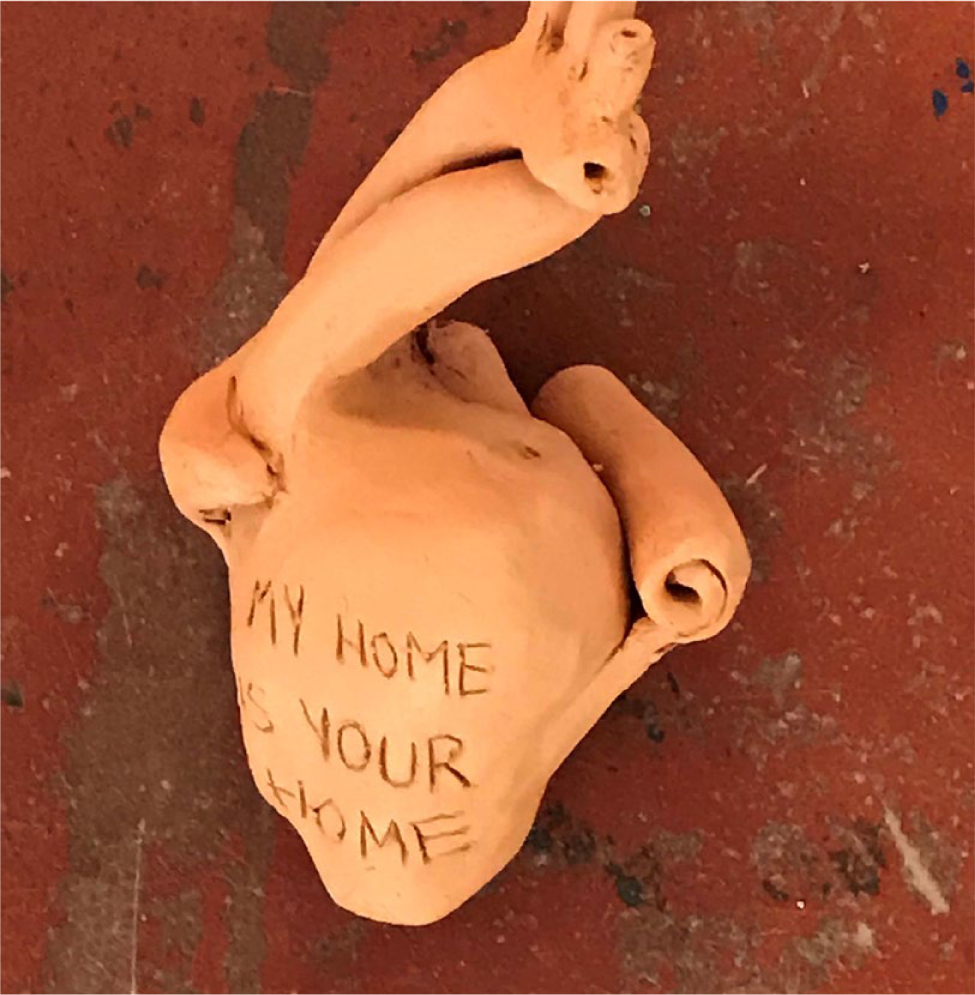
A clay heart inscribed with the maker’s words ‘My home is your home’.
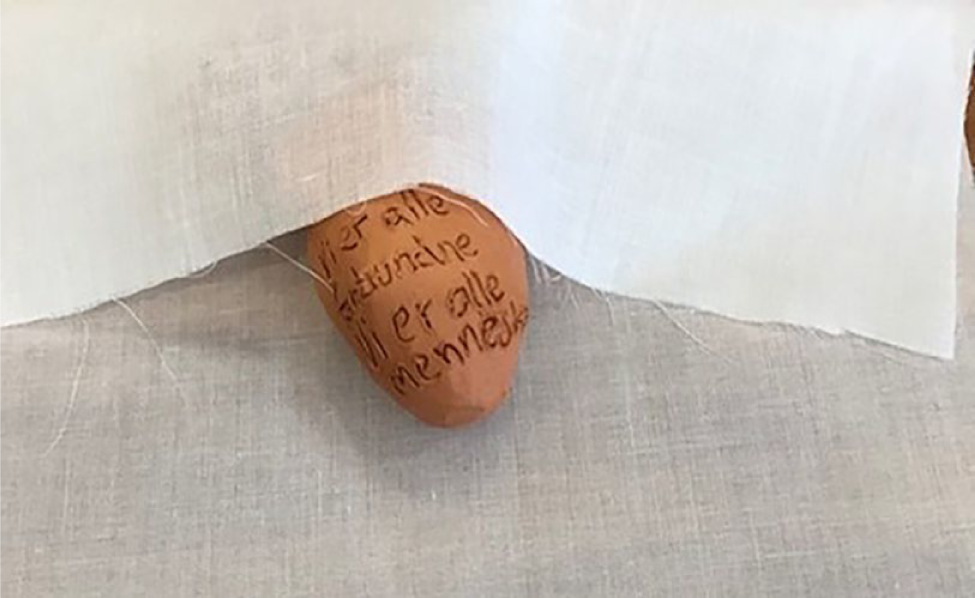
Inscribed heart in the process of being wrapped in a shroud.
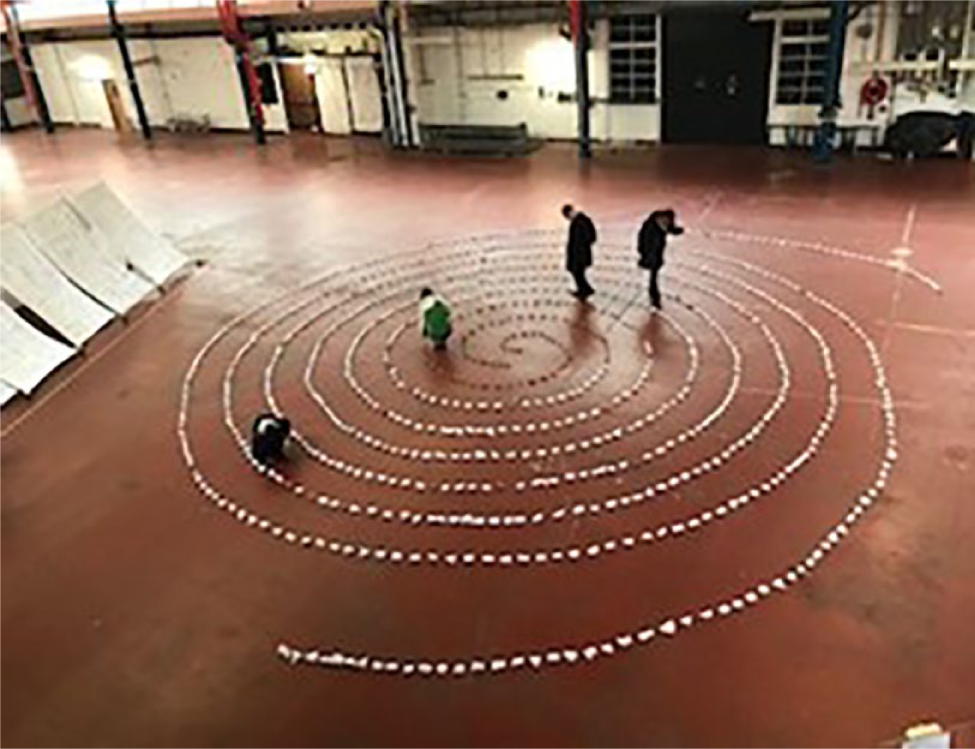
Wrapped hearts in spiral art installation by Penny Ryan, UK Migration Museum.
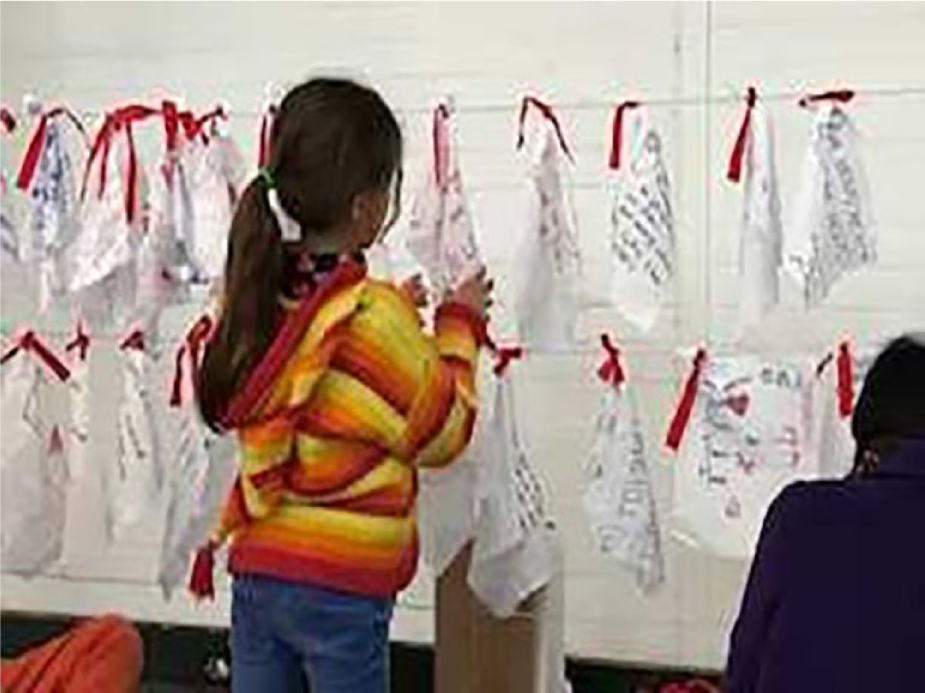
Girl adds her own message to displayed heart shrouds, UK Migration Museum.
Heart-makers were recruited from across London and beyond, with some people travelling up to 100 and 50 km to participate in the workshops. The workshops were advertised through Facebook and Eventbrite, as well as in London based publications such as Time Out. Each workshop drew between 10 and 22 people, around 80% of whom were women. Around 55% were between 20 and 45 years old but there were also children, including several infants under one, those in their teens, and people in their 70s. The ethnicity and cultural background of participants was highly varied and reflected the diverse communities of London.
Heart-makers were subsequently recruited to the second stage of the research – a silent procession of heart carriers who walked en masse over Waterloo Bridge and along the River Thames, pausing opposite the Houses of Parliament before arriving at the Migration Museum where they were given a free hot lunch cooked by the refugee group Delica Sisters. The BBC covered the story and the project was documented through video made available to the public on YouTube. 5 The procession included some people who had made hearts in the earlier workshops, but there were also people recruited just for the day who had come across the event on Eventbrite or Facebook, through word of mouth, by email, or thanks to one of two thousand postcards which we had left at bus stops, libraries, and community centres across London. The heart walkers were, again, mostly women, but there was a higher proportion of children (20%) and men (10%). The age and ethnicities of procession participants, as for the workshops, was highly varied.
The spiral heart installation was followed by a public forum reimagining migration for the 21st century within the main exhibition space of the museum. Around 100 participants were contacted after the workshops and invited to describe in writing or in person their own connection to migration and belonging. Two months later, some of the heart-makers participated in a workshop as co-researchers to code and theme the messages on the shrouds.
Embodied forms
The project generated a large and rich research database (ethnographies, interviews, photographs, participant interviews, messages on the shrouds) that enables an analysis of the changing content of memories and imaginaries of migration and belonging, but also the forms and transformations of memory making. The axiology and analytic scope of this article concerns the latter and draws predominantly on human data related to the embodied memories of participants. It explores how participants added value to embodied memories and transformed them into other forms – objectivised and institutional – through the work of sharing memories of migration and belonging.
An analysis of the ethnographic participant observation of the heart-making workshops, the procession, and art installation at the UK Migration Museum revealed that embodied mnemonic capital was (trans)formed through the performative labour of heart-making, and/or through carrying a heart during the public procession, and through walking the spiral installation. As Costello (2013) notes, the performative is a crucial dynamic in understanding the ways in which history museums combine form and content to prevent the passive reception of memories by visitors and audiences. The performative dimension helps to explain how the labour of memory generates additional embodied memory capital in public memory contexts.
Analysis of observations and data from the workshops revealed four categories of participants. The first group wanted to learn about working with clay and thought that the free workshop would be an enjoyable and entertaining activity for them and their families or partners. These ‘hobby ceramicists’ generated embodied mnemonic value through performative memories and imaginaries of participation in the workshop. This group initially struggled to formulate any imaginaries or memories of migration, saying things like ‘I don’t really have a connection to migration’. Through the labour of the workshop, however, they accrued additional value as witnesses to the stories of others and as part of what became a collective of heart-makers. In addition, there were those whose performative memory labour capitalised on their value as metropolitans seeking free weekend entertainment with their children. At the end of the workshop, members of this category described effectively how they had accrued value through witnessing other’s stories in the workshop, learning something new about migration and belonging that they had not anticipated or expected. This knowledge was transformed into the objectivised forms of the hearts. In both cases, their memories took on new forms again as they posed with their hearts and took photographs which they shared via social media.
The second category of participants drew on their embodied value as ‘proto-activists’: these were people who stated that they had come to the workshop because they were concerned about the plight of migrants and ‘wanted to do something’ (Female, 16 years old). Proto-activists expressed a sense of powerlessness and suffering in response to what was happening to migrants in Europe, especially those trying to cross the Mediterranean or being held in detention centres indefinitely. By the end of the workshop, the proto-activists’ labour had created new forms of memories as a result of building connections within the living archive of relationships with interested others: they often came to a second or third workshop, or joined the later procession, or agreed to meet up with others from the workshops in the future.
The third category of participants drew on their embodied value as ‘migration activists’ involved in various community and NGO projects as direct witnesses of the hardships, abuses, and atrocities committed against migrants: these were people who had come to the workshops because they worked for human rights charities, in the UK Home Office, as charity volunteers, or as socially engaged academics. Their memories were transformed through their mnemonic labour into new connections, often with other activists or proto-activists. They also added to the embodied memories of others by contributing stories and information about conditions for migrants in the UK.
Fourth, there were those whose performative memory work drew on their embodied value as ‘self-identified migrants’ and who stated that their particular life-stories had motivated them to participate in the workshop. Their memories took the form of autobiographical narratives, including stories of forced migration during the Nazi Holocaust or post-War decolonisation; migration as part of the Windrush generation; recent refugee migration from wars in Iraq, Syria, or Afghanistan; economic migration from Turkey or the US; and migration for education and study from China, Taiwan, Malaysia, Brazil, or Mexico. Those from European Union countries, and especially those from Poland, Romania, Bulgaria, Italy, and Ireland, told stories of what they imagined might happen after the UK left the European Union.
A surprising subset emerged of embodied performative memory from the self-identified migrant group. These were people who drew on their value as ‘internal migrants’ within the UK. While some of these were educated and had moved to London as students or for better work opportunities, there were also a number of homeless people who were attending a rehabilitation centre for drug and alcohol addiction. Homeless participants told stories of being forced to leave regional towns to escape poverty, abuse, or unemployment, migrating not across continents but across internal ‘borders’ of dialect and culture from the North to the South of the UK, or from a rural environment to the city, arriving in London young and destitute decades ago. They bore witness to lives of economic and affective precarity living on the street without employment or a sense of belonging. During the workshop, a number of these participants said they felt a strong sense of belonging and of connection with others. Differences became temporarily bridged through the performative labour of witnessing that involved heart-making, listening, and talking. One respondent, who had left Exeter as a boy and was recovering from addiction, said it was the first time in years he had sat in a room and had a conversation with people who were not homeless or addicts. For these participants, the form of their memories changed from that of an isolated individual to the form of a collective, temporary community.
Individuals arrived with different mnemonic and imaginative assets of migration and belonging. Yet, while their performative labour of remembering and imagining drew on their initial assets or mnemonic capital and accrued additional value through their individual performative labour as heart-makers, they also created another mnemonic form – what Eisner (2013) terms the ‘living archive’. The living archive brings together embodied memories, temporarily gathering and connecting people in new ways that challenge the more fixed form of the conventional museum archive (Wolthers, 2013). In this case, individual embodied memories formed a living archive of stories of migration and belonging. As a collective embodied form, this living archive seemed to have transformative capabilities that modified individual memories and imaginaries of migration and belonging, changing perceptions of self and ‘others’ in ways that challenged contemporary fears and misconceptions about migration.
Although temporary, the living archive provided connective shelter from the continuum of isolation and precarity experienced to different degrees by all participants. This was in contrast to the division created by mass media images of asylum seekers and those forced to migrate as distant and other to those with the security of citizenship. As Žižek (2016) argues:
Both the Paris terrorist attacks and the now constant flow of refugees into Europe are momentary reminders of the violent world outside our glasshouse: a world which, for us insiders, appears mostly on TV and in media reports about distant conflicts, not as part of our everyday reality. (p. 6)
Society codes migrants and citizens across fixed binaries in which ‘the visual markers of otherness are coded as eternal newcomers, forever suspended in time, forever “just arriving”, defined by a static foreignness’ (El Tayeb, 2011: xxv). According to Gregory Feldman, it is more helpful to frame migrants and citizens through what he sees as a shared transitional continuum of ‘migranthood’. Migranthood, rather than the dyadic forms of ‘the migrant’ and ‘the citizen’, acknowledges an underlying set of shared economic conditions along a spectrum of precarity within a neoliberal political and economic system. These are obscured by the media’s obsession with the migrant crisis and its twin phenomenon, ‘a growing sense of disenfranchisement with mass party politics in representative democracies’ (Feldman, 2015: 83). The mnemonic form of the living archive thus brings to the surface the false dichotomy between the citizen and the migrant to bridge what is actually a shared condition within neoliberalism in which people are ‘structurally precluded from connecting to other people on negotiated terms to create something stable for themselves’ (Feldman, 2015: 83). The labour that led to the living archive was a form of memory capital held in common that was different from the embodied memories and imaginaries participants arrived with. This ‘memory commons’ (a shared mnemonic resource held in common) rather than memory capital (held by some and not by others), provided new kinds of collective opportunities for people to socially experience together acts of bearing witness within a transitional continuum of ‘migranthood’. It was this creation of the form of a commons that transformed witnessing, queering the fixities of the migrant usually coded as other in relation to the settled or citizen.
Objectified memory forms
Integral to the living archive was also the production of ‘objectified memory forms’: these predominantly took the shape of clay hearts; often three or four made by each person over the 2-hour workshop. Teresa Sordo suggests, in relation to an embroidery project witnessing Mexico’s violent war on drugs, that ‘We embroider, perhaps, because a few hands can transform things and we need to transform them into beautiful things because so many hands are already doing appalling, unmentionable, incomprehensible things’ (Goggin, 2017: 311). Yet, unlike the embroidery project, the clay hearts were not always aesthetically beautiful. Many of the hearts made with refugee women in Australia were informed with memories of torture and trauma; they bore marks of grief and pain (Ryan, 2018). This was also the case in the UK. One homeless man, Lee, made a heart that was distended and flattened. As well as beauty, joy, and hope some hearts were visibly shaped by the maker’s painful memories and inscribed with marks of violence or bore words of agony and shame. Yet, the context of making art together meant that these memory forms were, as Veroff (2002) suggests, ‘no longer just visible but also led to a relational experience with listening’ (p. 1278). Oftentimes, through the heart-makers communal labour, not only did the form of their narratives change but so too were their clay hearts transformed. Thus, one woman, as she made her clay heart, said it reminded her of being a small child growing up in Afghanistan where she made clay cups and teapots. As she talked, she transformed her clay heart into the form of a miniature Afghani teapot.
Making hearts together meant that participants shared the form of the visual and tactile language of the clay heart. Heart-making enabled participants for whom English was a second language to labour equally alongside and with those for whom English was a first language. We all learnt and memorised the six steps required to mould and construct the form of an anatomical replica of a human heart. In this way, as Veroff (2002) suggests, the living archive became a workspace with shared physical, symbolic, and emotional mnemonic labour in which people become workers together, conducting memory work that was creative rather than exploitative (p. 1270). Some heart-makers generated additional forms of visual and embodied witnessing. Mora Muslim Women’s Group baked and shared a Moving Hearts cake (see Figure 5); they also designed and screen-printed Moving Hearts tote bags which they brought to the procession. Most participants took selfies with their clay hearts as well as photographs of friends or family they came with which they then shared on social media.
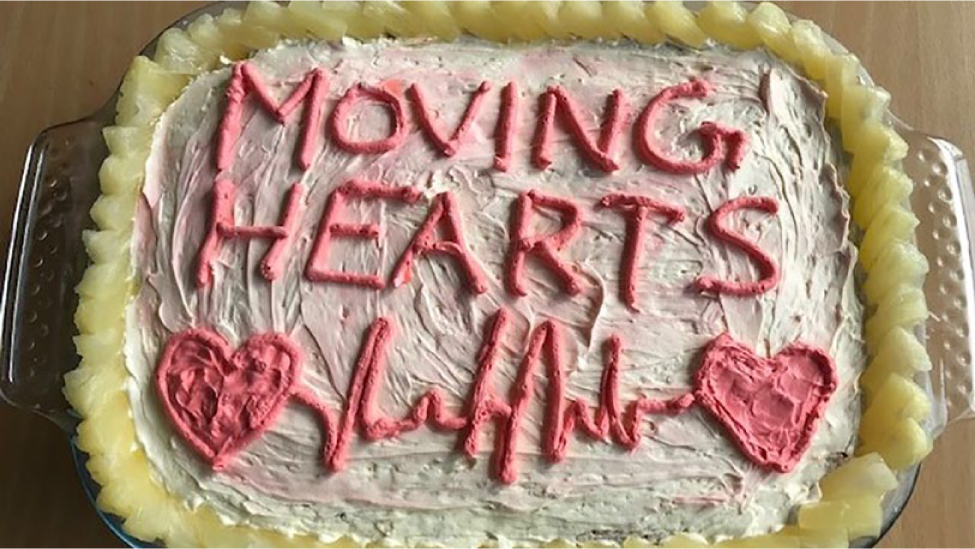
Cake iced with the words ‘Moving Hearts’ baked by Mora Muslim Women’s Group for heart-making workshop, North London. Photo: Anna Reading, February 2018.
As Rounthwaite (2011) argues, one cannot separate the artistic work – or in this case the mnemonic form – from its surrounding relationships and materialities. In Moving Hearts, artworks and photographs were part of ‘a dynamic body that enfolds human bodies and all sorts of material objects’ (p. xx). In the following section, I explore how these memory forms and transformations are also embedded within a globalised and digitised mnemonic political economy that often obscures longer chains of mnemonic labour.
Globital forms and transformations
In the 21st century, memory is made within and through digital forms supported by often unseen infrastructures that I have elsewhere termed ‘the globital memory field’ (Reading, 2016). Akin to what Pierre Bourdieu calls a cultural field of action, this is part of a digital-global field that, as Peters (2015) notes, only becomes visible when there is an interruption in service or sudden lack. Wherever we are on the planet, we are now born, live, and die within an unevenly (dis)connected mnemonic digital-global field in which our lives as data are recorded, modified, and shared. Without our labour within the globital memory field the accumulated value of many 21st-century mnemonic forms would be impossible.
For example, in Moving Hearts we created traditional paper-based postcards, based on photographic memories of earlier workshops in Australia, which were used to advertise the workshops at train stations, bus stops, libraries, and community centres, to recruit heart-makers, and to distribute during the procession. The A5 postcards were the product of the accrued value of mnemonic labour conducted through the globital memory field. This included the artist Penny Ryan’s earlier mnemonic labour to digitally document clay hearts in Australia but also the unseen work of data transfer from Sydney to London via a global network of platforms, data centres and underground and undersea cables created and supported by obscured human labour. I uploaded the images from the King’s College PC to an online instant printing website assisted by the labour of ‘a chatbot’ and unseen humans in a printing shop in the North of England. I digitally crafted the image semi-automatically according to an algorithm which, in itself, was the accumulation of the labour and inherited capital of an unknown human team fluent in computer coding. I proofed the copy, uploaded my debit card details, and two days later several thousand Moving Hearts postcards were driven from the North of England to London and distributed manually by the research team and postal workers around London.
The globital memory field also made possible the international collaboration that led to the research project. It enabled asynchronous email conversations between Penny Ryan, the research team, and the Migration Museum, which accumulated discursive outcomes. It was ultimately the synchronous digital affordances offered by video calls, according to Penny Ryan, that allowed for the various transformations of Moving Hearts as a socially engaged memory project. The discursive accumulations of video call conversations consolidated the agreed forms of witnessing for the project, including the places and numbers of workshops, the idea and logistics of the moving procession, and the place and form of the final spiral installation.
The mnemonic forms of Moving Hearts also inherited value from the institutions involved, including the Universities and the Museum, and other public institutions. For example, the heart procession required permission for a public gathering under the 1988 UK Public Order Act, obtained via an application uploaded to the Metropolitan Police website. The permission granted arose out of the hidden accumulated mnemonic capital of the law and the police. Similarly, the spiral form of Moving Hearts took place within the material ‘ruin’ of an unused warehouse with no heating and a leaking roof. Its use was made possible through the materialised discursive practices of local planning laws and regulations: an applicant who was seeking to build new apartments was required to provide the site for free to charity and artists, thus providing the Museum – and our project – with a free public space.
Thus, the mnemonic capital of the globital memory field facilitated mnemonic labour that generated further mnemonic value as a living archive, materialised through the interaction of humans making clay hearts. Further, the labour of making hearts together within the form of a temporary community of witnessing transformed the embodied memories of heart-makers. As Rowan, one heart-maker said:
It is hard sometimes for me to hear and see any humanity in this world we live in when it comes to belonging. Yet I believe it is in people’s eyes who continue to show kindness and love. I saw it in everyone who attended the Moving hearts workshop that evening and who looked and felt as though they were trying to sweep back the sea - doing an impossible job by not giving up and expressing their views by physically making hearts, using their own hearts. It felt human and honest and there was a bond between us that just enforced that there are other like-minded people like me. (Rowan. Heart-Maker, Moving Hearts. Interview. London May 2018)
Each workshop was also the accumulation of the value of wider obscured labour. Each public heart-making workshop required hours of preparation – unseen facework and footwork visiting potential sites, talking with administrators of community venues, head-teachers, museum directors, and curators. In addition, the clay required transporting, as well as kneading and wedging to remove air pockets and prevent explosions upon firing. Penny Ryan and her partner Jonathan Shaw would prepare 24 clay balls prior to each workshop then transport the clay balls in suitcases on London buses and on foot to each heart-making venue. The finished hearts – mnemonic capital in the objectified form – were transported on trays using London Buses and Black Cabs which, as Shaw noted, led to passengers and taxi drivers sharing their own stories of migration and belonging (Ryan, 2018).
The scale and scope of this article necessarily gives most attention to the mnemonic labour that went into the generation of embodied and objectified memory capital. What is less explored is how this was both supported by forms of institutional capital from King’s College London and the Migration Museum, as well as thereby adding further value to those institutions through the collaboration. The study demonstrates how the global and local flows of mnemonic labour and capital worked against the insularity of the politics of Brexit which ironically sought greater national autonomy against the global networks of labour, capital, and migration. We see how the forms of memory produced through a local community project such as Moving Hearts cannot exist without globalised networks. In this way, conceptions of mnemonic labour and capital seem to undermine nationalist and isolationist policies and narratives.
Ecological memory forms
What is also not addressed in this study is a detailed analysis of the ways in which mnemonic labour devalues or adds value to forms of ecological memory capital. The clay used to form and sculpt the hearts is like any other silica: it was formed over tens of thousands of years and is a non-renewable resource. Just as coal gains its value through processing (Tsing, 2004) silica plus water takes on the value of processed and packaged modelling clay as part of a long commodity chain involving human and non-human labour. We might add to this the fact that the clay of each heart is informed with its maker. It is not only that small hands made small hearts and large hands made large hearts, but the sweat from each maker through pummelling and kneading, stretching and rolling informed each heart and was fired and preserved within it: each clay heart wad dried and fired with its own human DNA.
The clay hearts are also free to travel across boundaries and national borders in ways that people are not. When the UK Migration Museum installation closed, the participants were able to take away a clay heart in exchange for a donation to the museum. The artist left 400 hearts with the museum, along with a DIY mini installations tool kit. Some of the other hearts are with King’s College’s Arts and Humanities Research Institute and some are with a community project called Tooting Transition Town. Some hearts travelled to Australia with the artist and some are now with the Migration Museum in Adelaide. Hearts have been gifted to colleagues in Syria, Iraq, Afghanistan, and China. One heart, inscribed with the word ‘Hope’ by its maker, was gifted to a Mosque in Lund, Sweden, the day after the murder of 51 Muslims in New Zealand on 15 March 2019.
Finally, each single heart accrued additional value through the labour of walkers and visitors, transforming them from discrete entities into part of larger temporary mnemonic assemblages. For example, a Romanian woman, frightened for her future in England, walked the giant spiral in the Migration Museum. She picked up a heart and unwrapped it, to reveal the word ‘pain’ in Arabic and English, a trace memory hinting at its maker’s story of violent displacement. The Romanian woman took the cloth-shroud and wrote the words ‘We all belong’ before pinning it beside a message from a homeless man who had written, ‘I am home’.
Conclusion: Mnemonic labour transforms mnemonic capital
This article has sought to show how we need to go beyond the contributions made by aesthetics or mediated memory work in understanding forms of memory. Research on the economies of memory (Allen, 2016; Autry, 2013; Pine, 2019; Tomsky, 2011) set the stage for this essay which has explored the globalised and localised connections of the mnemonic economy and the different ways in which mnemonic labour accumulates value as different forms of memory capital. Extending Bourdieu’s analytical idea of cultural capital, I argued that forms of memories may be conceptualised in terms of their mnemonic capital state. These include embodied, objectified, institutionalised, and ecological memory capital. These states or forms are unstable and are (trans)formed through the accumulation of value added through chains of mnemonic labour.
The conceptualisation of mnemonic labour and memory forms developed here will be of particular use within engaged memory research and activist memory projects that seek to add to, change or transform embodied memories into archives or art works and provide public memory institutions with lasting collections. In addition, this analysis brings to the surface the remaining need within memory studies to understand the role and significance of the mnemonic economy: it shows how local and extended chains of mnemonic labour are integral to the accumulation of mnemonic capital, materialised and dematerialised into different forms of memory in turn may change again through further mnemonic labour. Forms of memory are not fixed and discrete aesthetic containers for meaning but are made valuable and meaningful through transformations made possible by mnemonic labour. Without mnemonic labour, whether the individual daily labour of repressing a traumatic childhood to function in everyday life, or the mnemonic labour of mobilising public memories of non-violent struggles for suffrage or the labour that creates commemorations for those killed in war, there are no meaningful or valuable forms of memory. All forms of memory require labour, whether this is an embodied individual recollection, the work of curators in a museum, the witnessing of journalists, or the everyday digital craft of sharing images on social media.
Further, all mnemonic labour is always situated within human and non-human labour supported commodity chains that provide a mnemonic infrastructure. This includes the essential materials of memory: air, food, and water for our bodies, materials and memo-technique for human cultural artefacts and built environments. With Moving Hearts, the heart-makers’ and the museum visitors’ heart-felt labour added to the value of much longer and older inherited chains of labour and mnemonic value. This includes the forgotten labour of those in the quarries who extracted the clay from the earth. Each clay heart was still born from the unimaginably long labour of the earth itself, aeons of sunlight with silica combining with wind and rain that made what we humans call clay. In time, as with all human-made memory forms the fired hearts will go undergo another transformation: they will break, becoming fragments and dust; they will travel to landfill, mixing with other remnants of human life, settling and re-joining with the living form of planet earth.
Footnotes
Acknowledgements
Many thanks to research assistants Dr Alexandra Kubica and Vinya Mehta and the wider research team that included Plus Alliance Research Fellow Dr James Bjork and Penny Ryan and supporters Johnathan Shaw and Aphra Harvey-Reading. In addition, heart-felt thanks to all the unnamed heart-makers, heart carriers and installation visitors as well as Claytime Collective, St Dunstan’s College, London South Bank University, Telegraph Hill Community Centre and Mora Muslim Women’s Group.
Declaration of conflicting interests
The author(s) declared no potential conflicts of interest with respect to the research, authorship, and/or publication of this article.
Funding
The author(s) disclosed receipt of the following financial support for the research, authorship, and/or publication of this article: The project was made possible by a seed grant from the Plus Alliance social justice fund provided by King’s College, London, Arizona State University, US and the University of New South Wales, Australia.