




Abstract
While transitional justice processes call upon individuals and societies to recall and remember, memory practices – and more specifically the frequent politicisation of memory in transitional societies – can undermine transitional justice goals, including peace and reconciliation. This interdisciplinary article seeks to re-think the relationship between transitional justice and memory. It does so by introducing the concept of ecological memory, a supra-political form of memory centred on complex ecosystem responses to disturbance events and the development of resilience to future shocks and stressors. Transposing the concept of ecological memory to the novel context of transitional justice can ultimately foster a new alignment between memory and transitional justice that is more conducive to the realisation of the latter’s core goals. Drawing on empirical data, the article seeks to demonstrate that transitional justice processes can contribute to fostering ecological memory by giving attention to the ecological legacies of war crimes and human rights violations.
Introduction
On 16 April 2019, more than 700 people gathered in Ahmići, in central Bosnia-Herzegovina (BiH), for the annual event that takes place to commemorate the 116 Bosniaks who were killed in the village on that day in 1993. The massacre was committed by members of the Croatian Defence Council (HVO). On the same day, more than 50miles way, the community of Trusina, near Konjic, came together to remember the 18 Croat civilians and four members of the HVO who were killed by the BiH army on 16 April 1993. Željko Komšić, the Croat member of BiH’s tripartite presidency, has described the war crimes committed in Ahmići and Trusina as leaving a ‘trajna opomena’ (lasting memory) (Oslobođenje, 2019). In this sense, memory can be understood as the ‘“persistence of something from the past into the present”’ (Berliner, 2005: 78, citing Halbwachs, 1994). Inside a small building next to the mosque in lower Ahmići, for example, a spomen soba (memorial room) has been created. On the wall are photographs of charred and burning homes, injured bodies and the iconic image of the mosque, torn apart by explosives, with its minaret detached and lying on its side.
If the events in Ahmići and Trusina have left lasting memories, they have also created deeply-divided memories. In a country with ‘a diverse memory landscape’ (Karabegović, 2019), the parallel commemorations of these crimes contribute to feeding competing ethnic war narratives, including within Ahmići itself (Clark, 2012: 100, 101). The key point is that processes of remembering are inherently political. As Jelin (2007: 140) argues, ‘After periods of high political conflict and repression or state terrorism, there is an active political struggle around meaning; the meaning of what went on and the meaning of memory itself’.
As part of the process of dealing with the legacies of past human rights abuses, transitional justice – as both a concept and a practice – places a strong emphasis on truth-telling and establishing the facts (Daly, 2008: 23). Even when individuals and communities wish to try and forget the past, their memories are a crucial ‘lubricant’ (Misztal, 2005: 1332) for the basic functioning of transitional justice machinery. Hence, there exists a strong ‘imperative to remember’ (Shaw, 2007: 193). The fact that different memories of an event will often jostle and compete with each other, however, means that memory processes can frustrate core transitional justice goals. Focused on the case of Chile, for example, Lira (2001: 118) comments on ‘the contradictory views on the past, which cannot be reduced to an official history because group identities give way to diverse views and reemerge as expressions of memory, and, therefore, of identity’.
In light of the potential tensions between transitional justice and memory, this interdisciplinary article seeks to re-think the relationship between them. It does so by invoking the concept of ‘ecological memory’, which at its simplest refers to ‘the study of memory as it operates in natural settings’ (Bruce, 1985: 78). Ecological memory is closely intertwined with a broader ‘ecological legacy’, defined as ‘the carryover, or memory, of the system with regard to past events’ (Moorhead et al., 1999: 1009). These concepts, while little used outside the natural sciences, have a wider application within the social sciences, and particularly within the field of transitional justice. In short, while ‘the involvement of states in the commission of international crimes adds a systemic element that largely is beyond the scope of the law of individual responsibility’ (Nollkaemper, 2010: 314), the effects of war crimes and human rights abuses reverberate across different systemic levels. . In this way, they leave their own ecological legacies (Daskin et al., 2016).
The article’s central argument is that memory work in transitional societies should give more attention to these ecological legacies as part of building ecological memory in social systems. Doing so is crucial for fostering adaptive capacity and resilience within and across these interconnecting systems – the layered social ecologies with which war-affected individuals actively interact. As Ungar (2012: 1) underscores, ‘the resilience of individuals growing up in challenging contexts or facing personal adversity is dependent on the social and physical ecologies that surround them as much, and likely far more, than personality traits, cognitions, or talents’. The article’s emphasis on social ecologies and resilience, both critically neglected concepts within transitional justice theory and practice, offers a novel approach to thinking about memory that transcends politicised and divisive forms of remembering and is therefore more conducive to the realisation of transitional justice goals.
The first section gives an overview of the fieldwork on which the article draws, specifically qualitative interviews with victims–/survivors 1 of conflict-related sexual violence. The second section discusses some of the complexities and polemics pertaining to memory in transitional justice contexts. Underscoring the politicisation of memory, it stresses the potentially divisive dynamics of memory practices. The third section draws on the empirical data introduced in section 1 to develop the argument that war crimes and human rights abuses leave ecological legacies, particularly in the sense of affecting how individuals engage with their environments. Addressing these ecological legacies, it maintains, is crucial for developing ecological memory, a concept that is explored in section 4. The challenge is to transform these ecological legacies into ecological memories, thereby strengthening the capacity of societies to deal with future shocks and upheavals. The final section ultimately calls for an ecological reframing of transitional justice that gives greater attention to the interactions between individuals and their environments, and to the resources within these environments.
Methodology
While primarily conceptual, the article draws on empirical data from fieldwork conducted in Bosnia-Herzegovina (BiH), Colombia and Uganda with victims–/survivors of conflict-related sexual violence. This fieldwork was undertaken as part of a 5-year, comparative mixed-methods study aimed at understanding why some victims–/survivors demonstrate high levels of resilience while others do not. The empirical data, which are both quantitative and qualitative, will ultimately inform the development of a new ecological model of transitional justice that contributes to building and fostering resilience by giving greater attention to victims–/survivors in the context of their broader social ecologies.
The rationale for having diverse country case studies from three different continents is essentially threefold. Firstly, it enables deep intersectional analyses of how environmental factors, and more specifically factors such as cultural practices, gender norms and religious beliefs, positively and negatively affect victims–/survivors as they deal with their experiences. Secondly, it facilitates the identification of common risk and protective factors (see Murray, 2003) among victims–/survivors across the three countries, and thus aids the development of a model of transitional justice that is cross-culturally sensitive yet also adaptable to the particular local setting. Thirdly, and relatedly, the cases of BiH, Colombia and Uganda illustrate very different contextual uses of sexual violence in conflict. Combining them in a comparative study is important for ensuring that the project’s new model of transitional justice reflects and responds to the diverse ways in which sexual violence is utilised in situations of war and armed conflict (Leiby, 2009: 447).
A total of 449 victims–/survivors in multiple locations across the three case study sites completed a questionnaire between May and December 2018. The author, who is the principal investigator, and two postdoctoral researchers administered some of the questionnaires and trained the various in-country partner NGOs in how to administer the research tool. In most cases, the NGOs made the initial contact with research participants. The aim was to have 150 completed questionnaires in each country. Practical and logistical issues on the ground, however, meant that while the overall target of 450 questionnaires was almost reached, there was not an equal spread between the three countries. In total, 171 questionnaires were ultimately applied in Colombia, 152 in Uganda and 126 in BiH. Of the 449 respondents, 27 were men (of whom 12 were in BiH), a fact that attests to the difficulties of locating and gaining access to male victims–/survivors of conflict-related sexual violence. Notwithstanding important scholarship on the topic (see Apperley, 2015; Drumond, 2019; Schulz, 2018), female victims–/survivors continue to receive the most attention, and support specifically directed at men remains rare (see Edström and Dolan, 2016).
The youngest research participant was born in 1999 and the oldest in 1938. Overall, participants in BiH were older, with an average age of 55 (at the time that they completed a questionnaire). The average age of participants in Colombia and Uganda was 42 and 40 respectively. 2 All research participants had suffered conflict-related sexual violence, most commonly rape. The Traumatic Events Checklist (TEC) 3 section of the questionnaire showed that the majority of them had additionally experienced a variety of other traumas related to war or armed conflict, including forced displacement, loss of loved-ones, abduction/kidnapping and physical injuries or wounding.
The key section of the questionnaire was the Adult Resilience Measure (ARM), developed by Ungar and colleagues at the Resilience Research Centre in Canada (see Resilience Research Centre, 2016). The ARM approaches resilience as an ecological concept, to emphasise human-environment interactions, and the full version consists of 28 statements, including ‘I cooperate with people around me’ and ‘I know where to get help in my community’. Answers are scored from one to five, with a higher score indicating that a person has more resources necessary for resilience (Resilience Research Centre, 2016).
There was a statistically significant difference between the group means of each country’s total ARM scores, as determined by a one-way ANOVA (F(2,445) = 4.019, p = .019). Post-hoc comparisons using the Tukey LSD test (see Figure 1 below) indicated that the mean score for the BiH group (M = 111.53, SD = 14.43) was significantly different from the Colombia group (M = 106.93, SD = 15.36). However the Uganda group mean score (M = 107.59, SD = 13.89) did not significantly differ from the BiH or Colombia group mean scores.
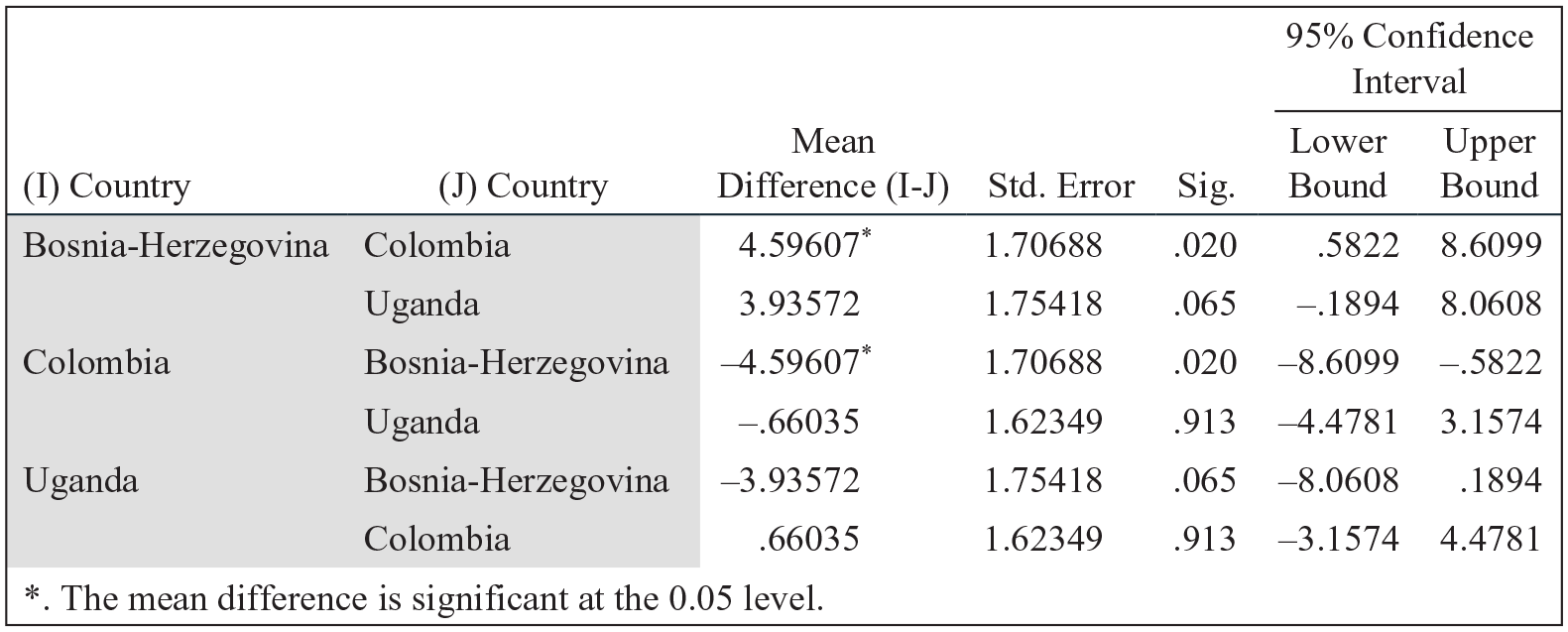
Countries and ARM scores.
It was anticipated that respondents in BiH would have the highest overall ARM scores. Not only has the country received a vast amount of international aid and resources (Tzifikas and Tsardanisis, 2006: 78), but its war – compared to the conflicts in the other two countries – was of the shortest duration (1992–1995). The war between the Ugandan government and the Lord’s Resistance Army (LRA) in northern Uganda lasted for two decades, until 2006. The deeply intractable armed conflict in Colombia has lasted for more than 50 years and despite the signing of a peace agreement between the government and FARC guerrillas in 2016, large parts of the country are still highly insecure and armed groups remain active (Janetsky, 2019).
In other words, BiH has had the most time to ‘recover’ from the war, with significant external support, and this has created a resource environment that is more conducive to fostering resilience. The fact that respondents in BiH were on average older than those in Colombia and Uganda, as discussed above, is also relevant for explaining their higher overall ARM scores. Results of a Spearman correlation indicated that a statistically significant positive correlation association exists between participants’ total ARM scores and their age, (rs(446) = –.133, p = .005), with older respondents having higher average ARM scores (see Figure 2).
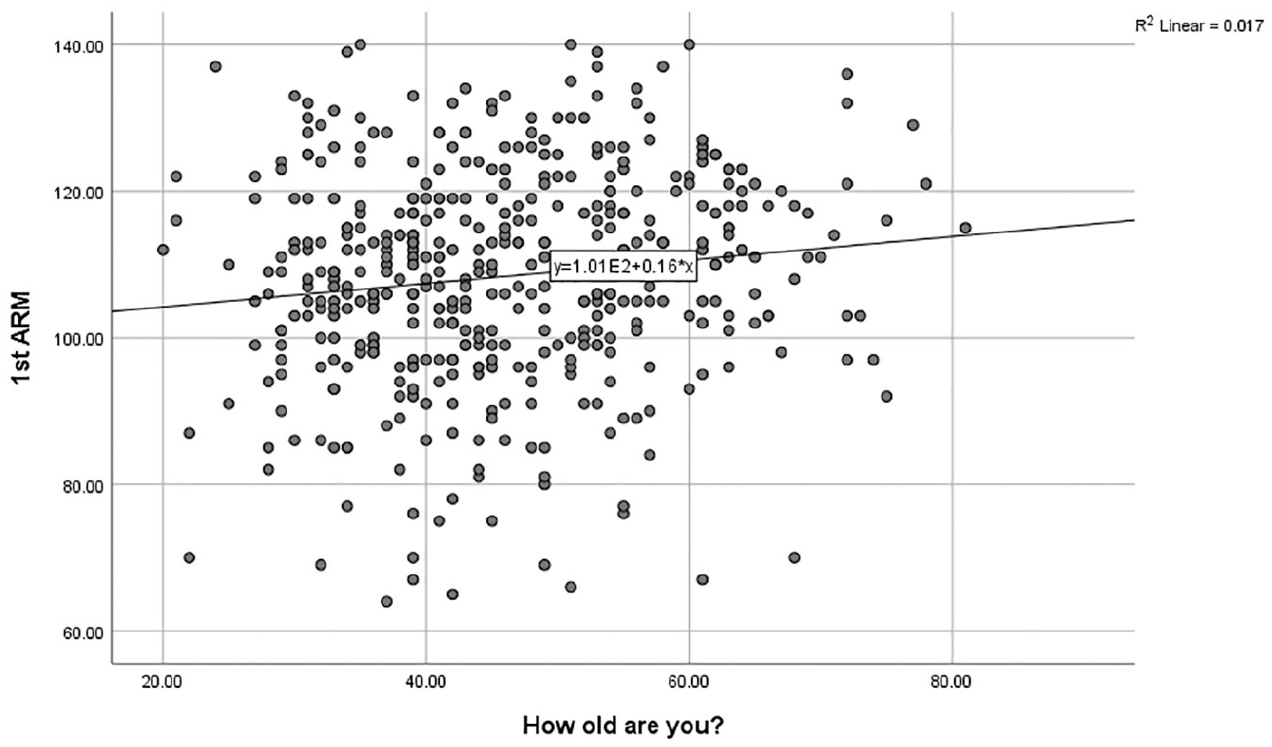
Age and ARM scores.
ARM scores from the quantitative part of the research were used to divide respondents into four quartiles. The author and two postdocs subsequently chose 20 people to interview (five from each quartile) within each country dataset, while also aiming to capture demographic diversity (and in particular gender, age and ethnic/racial diversity) within each quartile. For different reasons, each researcher conducted one additional interview, meaning that 63 people in total were interviewed from the three countries between January and July 2019. The three researchers conducted all of the interviews in the local languages (the author carried out all of the interviews in BiH) and used an interview guide. Interviewees were asked, inter alia, about their lives today, their resources, their sources of support and their experiences, if any, of transitional justice. The average length of an interview was approximately one hour and all interviews were recorded using fully encrypted voice recorders. All research participants received follow-up phone calls from the nearest partner NGO and booklets with information about possible local sources of support.
This article primarily draws on the qualitative data, which was coded using NVivo software. The quantitative data are important and highlight patterns and correlations that help to make sense of individual ARM scores. It is the richness of the qualitative data, however, that provides insights into the crucial ecological legacies of war crimes and human rights abuses.
Transitional justice and the politicisation of memory
Scholars have commented, inter alia, on ‘the metastatic growth of work on, about, related to or employing the concept of “collective memory”’ (Olick, 2008: 26), ‘a remarkable “memory boom” in the late 20th century’ (Lundy, 2011: 90) and ‘the rise of memorialization policies’ (David, 2017: 298). The expansion of transitional justice work has significantly contributed to these growth dynamics. As the set of judicial and non-judicial measures used within a society to address past legacies of human rights abuses (International Center for Transitional Justice, n.d.; United Nations, 2010), transitional justice necessarily entails a core memory dynamic. In effect, the process of ‘dealing with’ the past exhorts individuals and communities to remember (Humphrey, 2003: 177; Manning, 2012: 165).
This emphasis on memory, however, gives rise to two potential tensions. The first is that while there is little place for amnesia within transitional justice theory and practice (Crocker, 1998: 496), some individuals, communities and societies may wish to forget – or not to remember (Buckley-Zistel, 2006; Samii, 2013). Interviewees in all three countries frequently underscored their desire to forget, or even to erase the past as if it never happened. An interviewee in Colombia, for example, talked about how she has put her past – including her abduction and rape by FARC guerrillas – into a ‘trunk of things to forget’ (researcher interview, Colombia, 30 March 2019). Speaking specifically about the sexual violence, an interviewee in BiH lamented that ‘There is no help. . .to erase this from my memory’ (author interview, BiH, 6 March 2019).
The second potential tension, and indeed paradox, is that while memory is a critical part of the mechanics of transitional justice practice, memory processes can obstruct transitional justice goals, including the prevention of further conflict, building peace and reconciliation (United Nations, 2010). 4 Discussing the concept of collective memory, Halbwachs (1992: 38) made the now distinguished argument that ‘It is in society that people normally acquire their memories. It is also in society that they recall, recognise, and localise their memories’. In fractured transitional and ‘post-conflict’ societies, however, where multiple ‘truths’ circulate and collide (Lundy, 2011: 90), these memory processes can become highly politicised and thereby contribute to entrenching existing divides (Andrieu, 2010: 542; Visoka, 2016: 65). In BiH, for example, the cynical instrumentalisation of the 1995 Srebrenica genocide (Nielsen 2013: 30) – reflected in persistent appeals (including via museums, exhibitions and public posters) to remember – does little to foster healing or reconciliation and simply contributes to keeping the past alive.
Srebrenica can be viewed as an illustration of what Primo Levi (2017: 13) termed the ‘memory of offence’. According to Bevernage (2010: 121), ‘The challenge posed by such memories is not so much that they evoke a divisive past but rather. . .that they claim the persistence of this divisive past and conceive of it as an integral part of the present’. At its core, transitional justice is about dealing with the past in order to allow societies to move on and rebuild. However, the relationship between past, present and future is neither simple nor linear. Rather, it often involves a complex ‘politics of time’ (Bevernage, 2010: 113) and a concomitant blurring of temporal boundaries. The central point is that after periods of large-scale violence and human rights violations, the concept of ‘memory’ is about far more than just the factual recall of events. It is also about the ‘packaging’ of these events to promote a particular narrative or version of ‘truth’ that serves present and future objectives (Nuzov, 2017: 137; Radnitz, 2018: 155). In this regard, ‘. . .collective memory is not an inert and passive thing, but a field of activity in which past events are selected, reconstructed, maintained, modified, and endowed with political meaning’ (Said, 2000: 185). It is also, thus, part of a broader chronosystem (Bronfenbrenner, 1986: 724), wherein the passage of time – including its social and historical dimensions (Miller, 2015: 156) – impacts on other system elements, particularly at the individual and community levels.
It is in this context that transitional justice scholars have pointed to significant disconnects, real or potential, between top-down, elite-driven memory policies and localised practices of memorialisation (see Brown, 2012: 444; Millar, 2011: 177; Shaw, 2007: 183). That overt political interests play a key role in determining what is and is not remembered – as indeed do less overtly political factors, including normative aims (Arthur, 2009: 360) – means that they are often central to the construction of the tensions between ‘top’ and ‘bottom’. Baraybar and Blackwell (2014: 35), for example, note that since the end of the armed conflict in Peru in 2000, ‘the living conditions of the descendants of the 75% of the victims of the armed conflict that were indigenous, poor, Quechua-speaking rural people have not improved in any way. . .’. This, they argue, ‘leads us to the question of whether the interest of society as a whole in remembering on behalf of the victims coincides with that of the State’ (Baraybar and Blackwell, 2014: 35).
Kent’s work on East Timor explores how the political leadership has sought to promote a particular meta-narrative about the past that emphasises the themes of resistance and struggle. These ‘official’, top-down memory processes have in turn given rise to ‘a myriad of unofficial local practices of memorialising the violence of the 24-year Indonesian occupation’ (Kent, 2011: 141). Tensions and vertical memory disconnects can also arise when transitional justice processes, such as criminal trials, privilege particular types of knowledge and memory that do not sufficiently resonate with ‘lived’ memories on the ground (Manning, 2012: 117; see also Brown, 2012). This can result in the silencing of particular memories and ‘unacknowledged memory’ (Manning, 2012: 117).
The underlining of these disconnects, and related calls for more attention to be given to local forms of memorialisation situated ‘in the realm of experience’ (Riaño-Alcalá, 2008: 3), can be construed, in part, as attempts to de-politicise memory through a re-positioning of the relationship between ‘top’ and ‘bottom’. This relationship, however, necessarily exists within a broader systemic whole. As Fletcher and Weinstein (2018: 197) underscore, ‘while all of us have our own memories of the past, there is a form of remembrance that lies outside of individuals and is contained within the structures of society’. These structures form part of the social ecologies in which memories are made, shaped and constructed.
The concept of social ecology refers to the enmeshment and intersection of different systems at different levels, or more specifically to ‘a set of nested systems, each inside the next, like a set of Russian dolls’ (Bronfenbrenner, 1979: 3). These systems constitute the ecological environments within which individuals live and negotiate their lives – and which ‘offer a mixture of protection and risks’ (Boothby et al., 2006: 5). The challenge is to maximise the former and minimise the latter. In her study of war-affected youth in Sierra Leone, for example, Betancourt (2012: 351) found that ‘even young people who experienced extreme trauma could reintegrate well if their social ecology was enabling – meaning that they had strong family and community support’. This article posits that part of the process of fostering an ‘enabling social ecology’ in societies that have experienced war/armed conflict and mass violations of human rights requires that attention is given to the ecological legacies of these crimes across multiple systems. These legacies, in turn, highlight the significance of ecological memory, a supra-political form of memory that invites broader questions about the function and purpose of memory in transitional societies.
War crimes and ecological legacies
In a transitional justice context, war crimes and mass violence can seriously impact on the environment (see, for example, Bruch, 2001; Drumbl, 1998; Gaynor et al., 2016; Leebaw, 2014; Moodley et al., 2010), leading one scholar to argue that ‘the environment is often both a victim and a tool of armed conflict’ (Weinstein, 2004: 698). More broadly, however, such abuses can also affect entire ecologies, including families and communities, systems of health, security, justice and education, as well as the meta meaning systems with which these systems synergistically interact (Elcheroth, 2006: 910). This section will use the interview data introduced in the first section to identify and explore some of these ecological effects.
Interviewees in all three countries frequently spoke about their families as their main source of support. However, they also provided insights, directly or indirectly, into the different ways that their experiences of sexual violence had affected their family dynamics and relationships. Some interviewees stressed that they preferred to single-handedly carry the burden of what happened to them, in order not to worry their families. A male interviewee in BiH, for example, revealed: ‘Like, you are ashamed, of course. It is embarrassing talking about it. [very long pause] I am telling you, I have never said anything to my wife, and especially not to my children’. This man’s way of dealing with the past was to spend hours sitting by a local lake, which took him away from his wife and children (author interview, BiH, 10 April 2019). A Ugandan interviewee, similarly, told the in-country researcher: ‘The thing that happened to my body during the war, which I did not even tell my parent [mother], was that, that issue of “forced-sleeping” [a euphemism for sexual violence]. True, I could not tell my parent, even some of my friends, because I find it strange and shameful in my life’ (researcher interview, Uganda, 19 March 2019).
Broader environmental factors often enhanced this silence imperative and its impact on ‘[c]ommunication flow within the family’ (Zhang and Siminoff, 2003: 215). A Colombian interviewee, for example, explained that she had not spoken about what happened to her because of fear. In her words,
Out of fear, you know, like I’ve said, in this country we never know who’s who. It’s more that they want to keep us in fear. . . so that people don’t know if they should make a complaint or not, because the same people who you might be making that complaint to could also be. . . So, what happens? They’re informers. That’s why I’ve never made an official complaint or anything (researcher interview, Colombia, 30 March 2019).
Environments that foster fear also, by extension, exacerbate impunity, and impunity-related concerns can further impact on families. Highlighting this, an interviewee in BiH repeatedly expressed fear in relation to herself and her children. Referring to the case of a local girl from her pre-war hometown, she noted that ‘They [Serb soldiers] killed her with a sniper through the window. No one has ever found out who did it. He. . . He can kill my child, can kill me. This is what I fear’ (author interview, BiH, 3 February 2019).
Results of a Spearman correlation indicated that a significant positive association exists in the questionnaire data between feelings of safety and total ARM scores, (rs(446) = .265, p = .000). As one increased, so too did the other, thus underlining the potential importance of communities as a resource. Some interviewees, however, described how their environments had changed as a result of war/armed conflict and the crimes committed. They talked, inter alia, about altered community dynamics, collective trauma and demographic shifts. These changes had contributed to affecting how some of them interacted with their environments, the very essence of ecology (Harvey, 1996: 5). In this regard, the interview data foreground a meta contraction/expansion dynamic (Clark, 2020). Some interviewees had essentially ‘contracted’ by withdrawing from others and from the interconnected systems around them; their view of the world had changed, they had lost trust, they did not feel part of a community, they dealt with difficult situations alone. Others, in contrast, had ‘expanded’; they were utilising the resources around them, they spoke about personal growth, some of them were helping those around them (including other victims–/survivors of conflict-related sexual violence). In other words, interviewees’ experiences had influenced how they engaged with – and what they contributed to – their environments.
Cultural factors also played a significant role in this regard. Interviewees in Uganda particularly spoke about stigma. In many cases, social stigmatisation was linked not only to sexual violence, but also to interviewees’ wider experiences of being abducted, held in captivity and, in some cases, forced to commit crimes. An interviewee who was abducted by the LRA when she was 18years old described how local people continued to refer to her as ‘Ci-lil’ (Go-tell), local slang for a LRA rebel (researcher interview, Uganda, 12 February 2019). Another interviewee explained that her husband’s family had rejected her due to her past; ‘His family then said that they could not keep a person who returned from the bush [a reference to her time with the LRA]’ (researcher interview, Uganda, 21 February 2019). The situation had forced the interviewee to leave her husband and she was now living alone with her children. These examples illustrate how violence and human rights abuses can leave ecological legacies in the sense of affecting community meaning-making processes, which, in turn, affect individual-community relationships and the extent to which communities function as supportive ecologies.
Human rights abuses can also leave ecological legacies at a political and discursive level. In BiH, for example, the ethnic nature of the Bosnian war and the fact that the country remains ethnically divided has resulted in a meta narrative focused on Serb aggression and Bosniak victimhood. Within this framework, the issue of conflict-related sexual violence has been cynically exploited and manipulated to further promote a particular narrative about the war, notably within the Federation where Bosniak women are positioned as the highest-level victims within a broader ‘hierarchy of harm’ (Graham, 2006: 202). The interview data suggest that many interviewees in BiH had internalised these discursive and narrative legacies. When asked what title they would give their life stories, for example, the majority chose negative titles, including ‘My life has been a sad story since 1992’, ‘Woman, victim of war’ and ‘Broken childhood of a girl’.
The narrative and discursive environment is very different in Colombia, where the government for many years denied the existence of an armed conflict – instead simply blaming ‘terrorists’ (International Center for Transitional Justice, 2011) – and where victims’ organisations have demonstrated ‘their resistance to armed groups’ narratives about what took place’ (Riaño-Alcalá and Uribe, 2016: 16). In this environment, Colombian interviewees commonly emphasised not only what they had gone through, but also what they had overcome. In so doing, they frequently gave their life stories positive titles; these included ‘My new dawn’, ‘A liberated woman’ and ‘A warrior with good luck on my side’.
The above examples illustrate how war crimes and human rights abuses can affect entire social ecologies. This, by extension, highlights the relevance of ecological memory within a transitional justice context. Quintessentially, ecological legacies create ecological memories within and across interconnected systems, and these ecological memories offer new ways of thinking about the relationship between memory and transitional justice processes.
Ecological memory and transitional justice
Ecological memory refers to the way that complex ecosystems respond to disturbance events, such as forest fires, floods and drought. These events create ecological memories – in the form of ‘accumulated abiotic and biotic material and information legacies from past dynamics’ (Schweiger et al., 2019: 3) – which, in turn, shape future responses to new disturbance events (Johnstone et al., 2016: 369). Focusing on semi-arid systems, for example, Ogle et al. (2015: 222) note that ‘antecedent temperature and water availability, averaged over several days or weeks, may be more important than current conditions for plant, soil, and ecosystem carbon exchange’. In their botanical research, Walter et al. (2013: 7) introduce the term ‘ecological stress memory’, maintaining that this can at least partly explain ‘the surprisingly weak effects of repeated extreme drought events on the productivity of grassland communities’.
Ecological memory, however, is about more than just responses to system disturbances. It is also about positive adaptation and resilience to these disturbances. As a crucial component of ecosystem resilience (Schaefer, 2009: 172), ecological memory helps eco-system recovery through more localised recoveries. Coral reef systems, for example, may face numerous disturbances, including storms and coral bleaching. Nyström and Folke’s (2001: 143) research has underlined that ‘whether a coral reef will be able to cope with. . .disturbance and then renew and reorganise itself afterward is strongly influenced by the presence and diversity of the remaining ecological memory in the surrounding seascape mosaic’. In other words, the presence of ecological memory allows for positive adaptations that utilise the ‘memory’ of previous adaptations. Conversely, the absence of ecological memory can impede resilience, resulting in a fundamental ‘change response’ as opposed to an ‘adaptive response’ (Bengtsson et al., 2003: 394).
Applied to a transitional justice context, the crucial point about ecological memory is that it is not about remembering who did what to whom or about promoting a particular narrative that fosters the persistence of us-them divides. More forward- than backward-looking, it is about building adaptive capacity and resilience across multiple systems to ensure that societies are better able to cope with future shocks and stressors as part of addressing and learning from the past. This, by extension, points to a crucial nexus between resilience and transitional justice. Fundamentally, transitional justice practice is about helping societies that have experienced major shocks to deal with what happened and move forward; and, hence, ‘it holds the potential to promote or undermine the resilience of post-conflict societies’ (Wiebelhaus-Brahm, 2017: 142). It is therefore striking that resilience discourse, despite its omnipresence across multiple disciplines – from psychology (Bonanno et al., 2007) and political science (Chandler, 2012) to urban planning (Ahern, 2013) and engineering (Sharma et al., 2018) – remains critically absent from the field of transitional justice theory and practice. Despite some limited references (see Duthie, 2017; Wiebelhaus-Brahm, 2017; Kastner, 2020), there have been no systematic explorations of resilience within a transitional justice framework – or vice versa.
The significance of ecological memory in helping to address this ‘resilience gap’ within transitional justice raises the important question of how to translate a natural sciences concept into transitional justice practice. As a crucial first step, it is necessary for transitional justice processes to widen their primary focus beyond political and judicial systems and beyond victims and perpetrators. An expanded purview would mean that they give far more attention to the ecological legacies of war crimes and human rights abuses, and to their cumulative systemic effects on human-environment interactions. This would contribute to actualising an ecological memory that both reflects and responds to these complex legacies. In short, transitional justice interventions that are responsive to ecological impacts can transform those impacts into ecological memories, thereby changing the social environment, what it offers and the way that individuals engage with it. The aforementioned issue of stigma offers a poignant illustration
A Bosnian interviewee recounted how she had heard people refer to her and to other women as ‘the one who was raped’. Reflecting on this, she explained: ‘Well, I hear it when they tell someone: “Hey, she was raped”. . .The same as if she, well, did something, as if they are saying that she is a whore, that she wants sex, you know. . .’ (author interview, BiH, 6 March 2019). In Uganda, an interviewee emphasised: ‘People have big tongues [meaning that they talk a lot] and if it is known that you suffered sexual abuse, they will verbally abuse you’ (researcher interview, Uganda, 15 April 2019). Some interviewees also spoke, more broadly, about a lack of understanding within their environments; this was not always specifically related to the sexual violence. A Colombian interviewee lamented:
You know what’s happening now? Here in Colombia, RIGHT HERE in Colombia, in Bogotá where they didn’t experience the war, the people don’t know anything about it and they think that. . . we’re lying. Or they think that it didn’t happen because it’s all so terrible that it can’t be true. They didn’t witness the violence and they don’t consider us in Putumayo
5
as victims, nothing. They call us all guerrillas (researcher interview, Colombia, 4 February 2019).
Regarding conflict-related sexual violence, so much of the focus – within both transitional justice and policy discourse more generally – is on the individual needs of those who suffered these crimes. The terminology of ‘survivor-centred approaches’ exemplifies this (see UN Women, 2019). However, individual needs – which are not only linked to the experience of sexual violence – are shaped by wider attitudinal environments and social ecologies. By giving more attention to the issue of stigma as one of the ecological legacies of sexual violence within broader cultural and attitudinal social frameworks, transitional justice processes would gain important leverage in fostering crucial ‘expansion’ dynamics, therefore enhancing individual-environment interactions and potentially building more resilient and positively responsive local environments and communities. Institutional reforms, for example, which are a significant part of transitional justice, are necessarily limited if they ‘are incapable of providing an effective response that is sensitive to the impact of stigma, social exclusion and other rape effects’ (Liebling et al., 2012: 34). Attention to social ecologies and ecological legacies, in turn, is crucial for the development and harnessing of ecological memory as a communitarian resource for dealing with future shocks and disturbance events.
Noting that there has been ‘a steady loosening of a once narrow definition’, Quinn (2014: 64, 66) emphasises ‘the stretching of transitional justice’. Similarly, Szoke-Burke (2015: 475) observes that ‘Transitional justice mechanisms are stretched to their limits even without considering breaches of ESRs [economic and social rights]’. Some transitional justice scholars, therefore, might object that this article’s accent on ecological legacies amounts to a further ‘stretching’. The crucial point, however, is that giving attention to ecological legacies and their ecological memories is important for facilitating the realisation of core transitional justice goals.
In his work on East Timor, Nevins (2003: 690, 691) underlines the impact of Indonesia’s invasion and occupation (1975–1999) on the country’s coffee industry. If, as he argues, ‘coffee embodies the structural violence of Indonesia’s crimes’ (Nevins, 2003: 677), in so doing it also accentuates ‘the dialectical relationship between violence and the socio-physical environment of victimised populations. . .’ (Nevins, 2003: 697). Transitional justice notions of ‘justice’ and ‘truth’ can easily ring hollow if they overlook these dialectics, particularly when victims themselves make ecological demands. Discussing the Madres de Plaza de Mayo in Argentina, for example, and their refusal to accept reparations, Moon (2012: 194) notes that:
Their protest contests the power of the state to take life away with impunity and to subsequently control the political lives of dead bodies by placing them within the new official narrative about the past which seeks to settle claims to justice by finding and acknowledging the dead (through exhumations and lists of the junta’s victims), and attempt repair through memorialisation and public mourning.
The re-inscription of the disappeared into an altered social ecology, controlled by the State and its version of events, affected how the Mothers engaged with that ecology and what they wanted from the system itself. In this regard, ‘The Madres deliberately sustained the liminal (“between life and death”) status of the disappeared in the face of the government’s attempt to confirm them as dead’ (Moon, 2012: 193).
There have been calls for more ‘holistic’ ways of dealing with the past that view different transitional justice mechanisms as ‘mutually reinforcing’ and not ‘in competition with each other’ (Davis, 2010). Based on the interview data, however, this article maintains that simply integrating various transitional justice mechanisms does not go far enough to address the ecological effects of war crimes and mass violence on multiple intersecting systems. It is a conceptualisation of ‘holism’ that works with what already exists, not one that seeks to push boundaries. Ultimately, therefore, what this article is advocating is an ecological reframing of transitional justice. Arthur (2009: 338) notes that ‘In recycling the concept of a “transition”, analysts in the 1970s and 1980s recast it in terms of political reform, rather than social transformation’. Reconceptualising transitional justice in ecological terms essentially represents a return to more traditional, and specifically Marxist, understandings of ‘transition’ as ‘entailing changes at the structural level of society and economy’ (Arthur, 2009: 338).
Ecological transitional justice
Earth jurisprudence is a concept that accentuates the elemental interconnections between humans and their environments, and more specifically their natural environments. Promoting the notion that nature itself has rights (Humphreys, 2017: 459–460), earth jurisprudence is critical of anthropocentric laws that contribute to and legitimise environmental harms (Burdon, 2010: 62). One of the leading authorities on the issue, Cullinan (2011: 6) underlines that ‘our unquestioning adoption of myopically human-centred laws often leads to results that are perverse and obstruct healthy relations between humans and other species’.
Earth jurisprudence offers a poignant illustration of ecological thinking within the legal sphere. By emphasising some of the ecological legacies of mass violence and human rights abuses, this article has sought to demonstrate that ecology also has a role within transitional justice. It has done so specifically by foregrounding the relevance of ecological memory as a systemic form of memory that fosters adaptive capacity and resilience; and is therefore potentially more conducive to the realisation of transitional justice aims than divisive and politicised forms of memory centred on competing facts and ‘truths’. If, as Schaefer (2009: 172) argues, ‘Urban areas can retain a surprisingly large amount of ecological memory’, the same is true of areas that have experienced war, armed conflict and human rights abuses. This illuminates new avenues for exploration within memory studies and transitional justice.
Barahona de Brito (2010: 364) has suggested that memory studies can help us to ‘re-frame transitional justice’, in the sense that the latter ‘can be seen as part of a disjuncture in what is a continuous process generating ongoing cycles of social memory-making’. Beyond demonstrating that the concept of ecological memory can be legitimately transposed to the novel context of transitional justice, this article is calling for an ecological reframing of transitional justice that more fully recognises the interactions between individuals and their environments – and the broader systems within which they take place. Giving attention to these ecologies is crucial not only for exploring how they are impacted during situations of war and armed conflict, but also for understanding how they can aid positive adaptation and resilience.
Resources constitute an important part of these ecologies and of building ecological memory within them. Resilience can thus be defined as ‘the outcome from negotiations between individuals and their environments for the resources to define themselves as healthy amidst conditions collectively viewed as adverse’ (Ungar, 2004: 362). Interviewees talked about the various resources that they use and have access to at different levels of their ecologies, from faith and spirituality, families and friends to NGOs, institutions and professionals (including doctors and psychologists). Some also talked about natural resources, thereby demonstrating that such resources are more than just a ‘curse’ in war-affected environments (Le Billon, 2001; Sachs and Warner, 2001).
Natural resources are an important part of people’s social ecologies. The diminishing or loss of such resources can negatively affect resilience, as Adger’s (2000) discussion of mangrove conversion in Vietnam has demonstrated. The converse of this is that use of natural resources can help to foster resilience (see also Shumsky et al., 2014). In northern Uganda, for example, a male interviewee talked about a local river as a source from which he was no longer able to earn an income. He had thus turned his attention to other natural resources in his environment. In particular, he described collecting chunks of rock and processing them into coarse aggregate for sale. These resources enabled him to earn a living and to sustain his wellbeing (researcher interview, Uganda, 22 February 2019). In BiH, one interviewee came to life when describing her passion for hiking. She explained: ‘Well, I find comfort in hiking. I mean, this is where I feel best, and I recharge my batteries and I heal, simply. Mountain, mountain, mountain. And then there are no problems, I forget about everything’ (author interview, BiH, 2 June 2019). In Colombia, an interviewee talked fondly about a local river. In her words, ‘You sit on the banks of a river and listen to the sound of the water – the water speaks to you, it sings, it murmurs and you just want to keep going back to listen to those murmurs, all that. Music. It’s a rebirth. A new dawn’ (researcher interview, Colombia, 6 March 2019).
In his work on ecological jurisprudence, Cullinan (2011: 8) posits that ‘Reforming national legislation and entering into new international agreements will be insufficient unless these are done on the basis of a new understanding that the essential purpose of human governance systems should be to support people to play a mutually enhancing role within the community of life on Earth’. Transitional justice, it is argued, should not only be about addressing (individual) needs, but also about allowing those who have suffered – and perpetrated – heinous crimes to contribute to their social milieu in meaningful ways, as an aspect of ‘expansion’ and individual-environment interconnectivity. This includes investment in strengthening – or promoting – the various resources that form part of these ecologies and which contribute to the building of ecological memory itself.
Conclusion
Bringing together bodies of literature that have not been previously combined, this article has sought to demonstrate the conceptual and practical utility of ecological memory in relation to transitional justice. Peterson explores how landscape pattern can shape and influence fire spread via ecological memory. Crucially, it is the existence of ecological memory that ‘produces persistent pattern because it establishes a feedback loop between fire spread and landscape pattern’ (Peterson, 2002: 336). It is precisely through this feedback loop that interactions between process and pattern occur (Peterson, 2002: 336).
By way of analogy, war crimes and human rights abuses can be compared to a fire spread that affects the ‘landscape pattern’ across different interconnecting systems. Transitional justice processes should do more to respond to and acknowledge these landscape patterns, and more specifically the ecological legacies that result from war crimes and mass violence, as part of an ecological approach to dealing with the past. This would create new ‘feedback loops’ that could potentially alter some of the dynamics within transitional justice.
Through its exploration of ecological memory, this article has drawn attention to the possibilities for new systemic resilience dynamics within transitional justice theory and practice. In this way, it has stressed the importance of exploring different forms of memory that aid rather than obstruct transitional justice goals. Brants and Klep (2013: 37) argue that ‘Truth, collective memory, and history-telling have become buzzwords in the transitional justice debate, conceptual keys to reconciliation, democracy, and peace in conflict-ridden nations’. In this regard, ecological memory offers a novel ‘conceptual key’ that merits further theoretical and practical attention and analysis.
Footnotes
Declaration of Conflicting Interests
The author(s) declared no potential conflicts of interest with respect to the research, authorship, and/or publication of this article.
Funding
The author(s) disclosed receipt of the following financial support for the research, authorship, and/or publication of this article: This research was supported by the European Research Council under grant number 724518.
