




Abstract
In recent decades, the experience of non-governmental politically motivated violence became a central element of global memory culture. Motivated by several shocking attacks at the beginning of the new millennium, this commemorative culture evolved in a memory ecology, which was significantly shaped by the prosperity of global Holocaust memory. Therefore, public commemoration of politically motivated violence intersects different discursive elements, leading to multidirectional forms of memory. Based on interdisciplinary theoretical approaches, this article examines public memorials commemorating two notable cases of neo-Nazi xenophobic attacks in Germany as discursive spheres referring to the confrontation with the country’s unique past and its impact on Germany’s contemporary self-image challenged by right-wing extremism. We argue that various commemorative actors in the field adopted and appropriated Second World War and Holocaust-related iconography and terminology to shape these memory sites as instruments linking current Germany to the period of National Socialism.
Introduction
Confronting the current rise of nationalist and extremist-right parties and movements all over Europe brings to mind the continent’s no longer recent past, which European unification was supposed to finally overcome. The current developments, however, illustrate that despite the apparent success of European memory politics, right-wing extremism and even violence maintained a constant in European postwar history (Kansteiner, 2006: 138). Already during the last two decades of the twentieth century extremist-right violence increased all over Europe. Germany was not an exception: In the years following the German reunification in 1990, the country suffered a significant surge of right-wing extremist violence both in its eastern and western states, which included various types of attacks targeting foreigners and asylum seekers (Kagedan, 1997: 110–116). In September 1991, neo-Nazis attacked Vietnamese street hawkers and Mozambican contract workers in Hoyerswerda. One year later a xenophobic mob attacked asylum seekers in Rostock. In November that year, right-wing extremists killed three in Mölln, when they set a house on fire inhabited by Turkish families. In May 1993, three girls and two women died after neo-Nazis attacked the house of a Turkish family in Solingen. Right-wing violence continued in Germany even after this devastating peak of xenophobic attacks. Between 2000 and 2007, the terrorist group National Socialist Underground (Nationalsozialistischer Untergrund, NSU) killed ten and injured several more in an undetected series of murders and bomb attacks.
This article analyses public memorials commemorating two significant cases of neo-Nazi xenophobic attacks in Germany, the 1993 Solingen arson attack and the NSU murder campaign, as components of a public discourse regarding the country’s confrontation with its unique past and its influence on Germany’s contemporary self-image. Those two attacks were, until the Hanau shooting in February 2020, the deadliest expressions of extremist-right violence in Germany since unification, and had a huge impact on the public perception of neo-Nazi violence and the threat of right-wing terrorism. Reviewing the palimpsest structure of memories interrelated with the experience of extremist-right violence might help to dispel the blurriness of the current phenomenon and to understand how far memories of extremist-right terrorism intersect with European Holocaust memory on the one hand and the discourse on postwar democracy on the other. In order to analyse this impact of public commemoration of extremist-right violence in the ‘new memory ecology’ (Brown and Hoskins, 2010; Hoskins, 2016), we focus on Germany as a case study, due to the crucial role Germany played in transforming the ‘divisive memory of Nazi aggression and occupation’ into a unifying memory culture that ‘lends legitimacy to the European Union’ (Kansteiner, 2006: 129, 130). We argue that authorities, local initiatives, and social and political agents, used Second World War and Holocaust-related iconography and terminology to shape these commemoration sites as instruments linking current Germany to the period of National Socialism in order to demonstrate the dangers of both extremist right-wing as well as National Socialist ideology, and illuminate the desirable character of the present democratic society.
While acts of terrorism, politically motivated violence conducted by clandestine groups or lone operators that spread fear and communicate ideological messages through violent attacks, clearly affected postwar Germany and Europe during different decades, these experiences only played a minor role for the construction of shared collective memory. Public commemoration of terrorist acts intensified after the 9/11 attacks (Young, 2016). That is also the reason why scholars of terrorism as well as memory studies only recently began focusing on the memories of terrorist violence. Heath-Kelly (2016), who emphasises the importance of studying memory in context of critical terrorism studies, defines this as a ‘new area of research’ (p. 287).
In his analysis of the 2005 London bombings, Hoskins (2011) reviews these attacks as events ‘mediated, remediated and remembered in and through a post-scarcity culture’, in which they gain ‘a substantial and recognisable memorial status in terms of relative extent of their ongoing presence in media-public discourses’ (p. 270). In contrast to similar events from a more distant past, the experience of terrorism marks a ‘shift in perception’ rendering terrorist violence part of ‘more connected and seemingly co-present wars and disasters’ (p. 270). Interpreting the memorial site dedicated to the bombings in London’s Hyde Park, Brown and Hoskins (2010) examine memories of terrorist violence as part of an ‘ecology of memory’ that is characterised by ‘frameworks or forms that are at once individual and collective, personal and cultural, informal and formal.’ (p. 94) In their study, they analyse the monuments’ ‘particular appearance and texture’ (p. 101), and ask for specific commemorative practices determined by the place (p. 102). Through ‘examining some of the forms, flows and iterations’ of the memory of the terrorist attack, Brown and Hoskins are able to identify a ‘set of articulations’, which they describe as ‘new memory ecology’ (p. 104). This allows a ‘holistic perspective for revealing and imagining memory’s multiple connections and functions’ (Hoskins, 2016: 349).
Memorial sites commemorating terrorist violence express particular ‘connections between violence, the framing of terrorism, and subsequent memorialization.’ (Heath-Kelly, 2016: 290). Hence, it is important to critically analyse how a state assimilates and contains the experience of terrorist violence (p. 290). Through retrospectively framing certain attacks, memorials can hide or blur other, more contemporary perceptions of the same events. While some acts of terrorism are remembered, such as the Oklahoma bombing by two American right-wing extremists in 1995, others, such as the 1979 shooting of left-wing activists in Greensboro by the Ku Klux Klan, are forgotten (p. 289). Last but not least, memories of earlier events can frame that of later ones, even though they appear in a different context. The Oklahoma bombing memorial for instance served as a model for the 9/11 memorial in New York.
Memorials play a significant role in a country’s sense of itself. They provide connecting points to past events while simultaneously constituting discursive sites to negotiate the present. In doing so, they establish a complex and complicated relationship between a nation’s official memory and various practices of commemoration. According to Young (1993), this relationship is not one-sided. Memorials do not only serve specific interests, they also ‘take on lives of their own’ (p. 3). This includes a variety of aesthetic features and temporal frames such as ‘the times and places in which they were conceived; their literal construction amid historical and political realities; their finished forms in public spaces; their places in the constellation of national memory; and their ever-evolving lives in the minds of their communities’ (p. 14). Hence, we need to position memorials within a complex network that includes specific actors of memory, practices of commemoration, the surrounding environments, and specific aesthetic features. This corresponds Hoskins’ (2016) approach ‘to identify multiple forms, flows and iterations’ of memorials and review them within a wider ‘environment in which remembering and forgetting takes place’ (p. 353). This is especially necessary in cases like far-right violence, which for many years received only minor academic attention (Köhler 2014a) and have often been overlooked or trivialised (Sundermeyer, 2012: 16, 17).
The incidents and public response
On the night between 28 and 29 May, 1993, a fire broke out inside the house of the Turkish immigrant family Genç in the city of Solingen. As a result, five women and girls between the ages of four and twenty-seven died. Police investigations found that the fire had been caused by arson and within a short while four young male suspects had been arrested. During their interrogations, two of them confessed their involvement in the violent crime, which they carried out of xenophobic motives. The court convicted all of them to long prison sentences ranging from 10 to 15 years (Kurthen et al., 1997: 278).
In the following days, city residents and anti-Fascist organisations organised rallies and demonstrations that called for harsh punishment for the perpetrators, for coexistence, and for establishing a memorial. In addition, the event was intensely covered by national media, similar to the three preceding xenophobic attacks in Hoyerswerda, Rostock, and Mölln, which became constitutive for collective memory of extremist-right violence in Germany (Sundermeyer, 2012: 40). At the memorial service for the Solingen victims, Federal President Richard von Weizsäcker accused right-wing extremists of creating a situation enabling such violent acts and German society of not doing enough to prevent it (New York Times, 1993). In contrast to the Federal President, Chancellor Helmut Kohl attended neither the memorial nor the burial services (Süddeutsche Zeitung, 2013).
A year after the attack a memorial was inaugurated in front of the school of one of the victims of the arson attack, Hatice Genç (Figure 1). Building a human chain, 10.000 people handed five rings with the names of the victims from the actual crime scene over to the memorial site. The crime scene itself was only marked by a memorial plaque and five trees commemorating the victims. In 1995, anti-Fascist activists erected a second, this time non-official, monument in memory of the Solingen arson attack victims in the Bockenheim district of Frankfurt. The memorial sculpture ‘Hammering Man’ imitated an art installation with the same title by Jonathan Borofsky located at Frankfurt city centre as part of a worldwide series symbolising and celebrating workers. In contrast to Borofsky’s original installation, the unofficial ‘Hammering Man’ commemorating the Solingen arson attack showed a human figure smashing with its hammer a swastika, and actively invited the public to engage with a mechanical device that made the sculpture hit the Nazi symbol (Figure 2). Although the memorial, which was supported by a local citizens’ initiative, was at first tolerated by the municipality, it was removed 12 years later because of alleged risks of injury (Frankfurter Rundschau, 2012). When in 2013 a local inhabitant donated a new version of the ‘Hammering Man’ monument, the city announced another dismantlement, this time because the figure was considered too similar to Borofsky’s original sculpture (Frankfurter Rundschau, 2013). After the artist abstained from any action for injunction, the sculpture could legally stay at the renamed Hülya Square, bearing the name of one of the girls killed in the attack. The commemorative ensemble, initiated by a local Turkish cultural association, was completed in 2017 with the erection of a memorial plaque for all victims of the attack (Frankfurter Neue Presse, 2017). This demonstrates the nationwide significance of the Solingen attack, especially for the Turkish community in the Western German federal states.
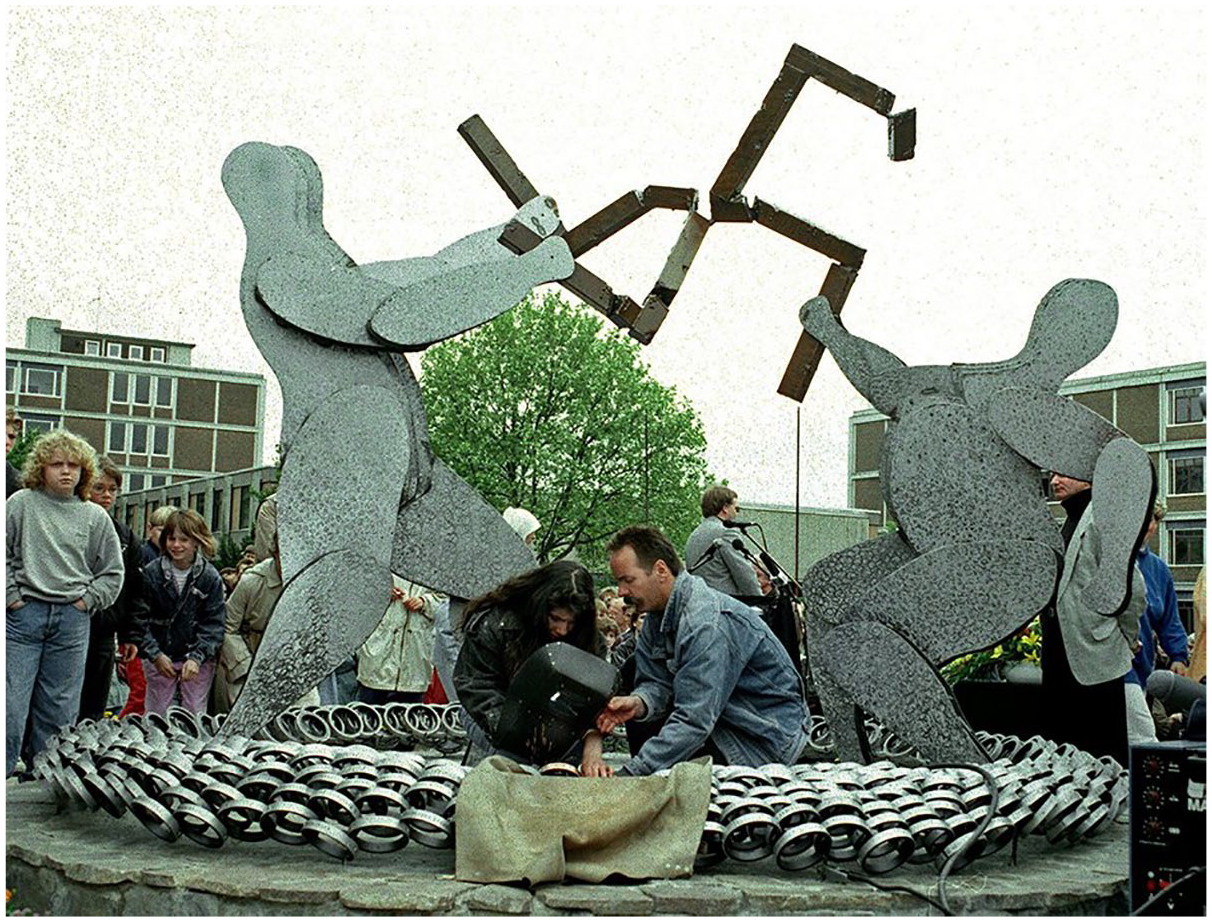
The inauguration of the memorial for the victims of extremist-right violence in Solingen, 1 year after the arson attack.
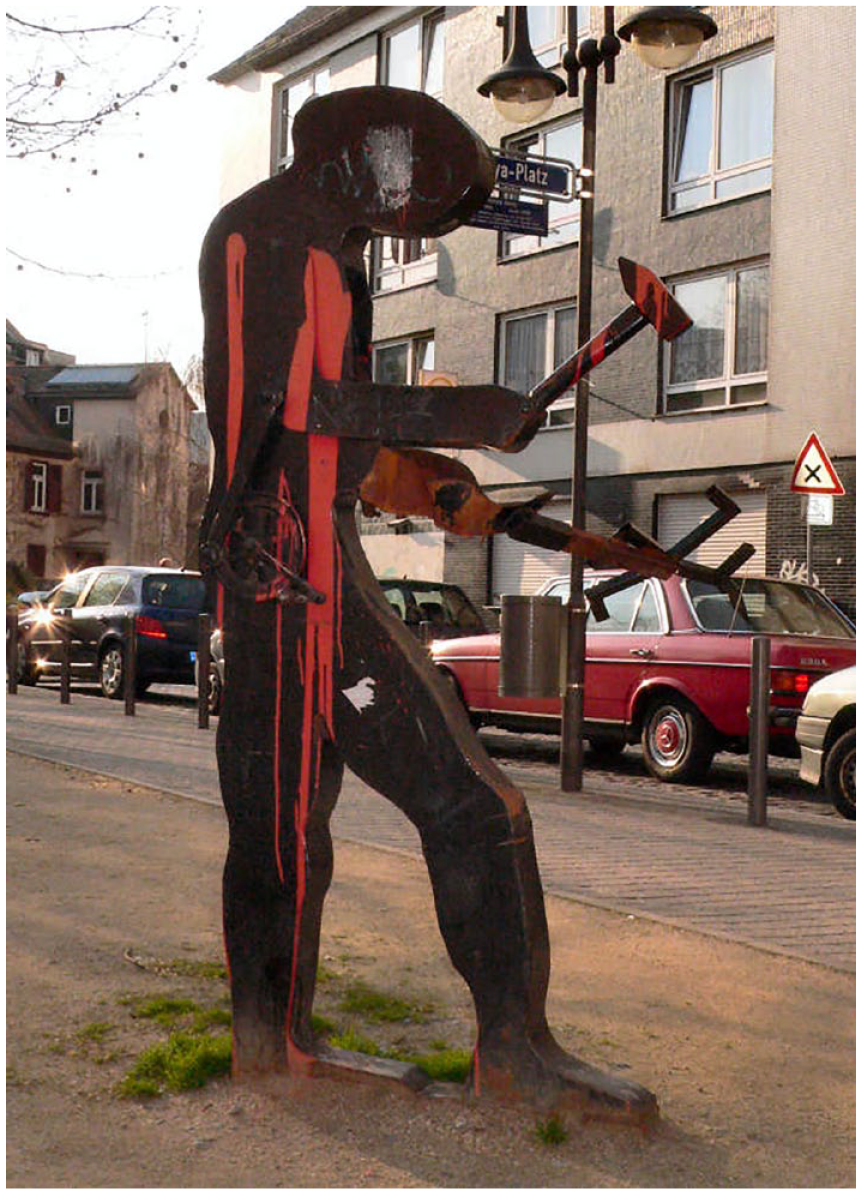
Original version of the memorial hammering man for the victims of the Solingen attack in Frankfurt/M.
In contrast to the immediate political and public recognition of the Solingen arson attack, the NSU activities that were spread over nearly 13 years and occurred in various parts of Germany were for many years not identified as racist or xenophobic acts. Though the violent campaign began in 1999, the identity of the NSU perpetrators and their motives were discovered only in 2011 after two male members of the terrorist cell committed suicide in order to avoid arrest, and a the third, Beate Zschäpe, turned herself in to the police. In total, authorities attribute to the group fifteen bank robberies, two bombings in Turkish neighbourhoods, and ten murders, of which eight were male immigrants from Turkey, one from Greece, and the last one a female police officer (Köhler, 2014b: 126, 127). After the NSU was discovered, a public controversy erupted focusing on how state agencies let the group continue its actions undisturbed and were unable to connect them to the extreme right-wing scene (McGowan, 2014: 204–208).
Unlike the authorities’ cumbersome treatment of the NSU crimes, their treatment of the victim commemorations was rather quick. On 23 February 2012, less than half a year after the NSU was uncovered, an official state ceremony was held in Berlin that included a speech by Chancellor Angela Merkel, in addition to a nationwide moment of silence and lowering of flags to half-mast. In her speech, Merkel asked the families of the victims for forgiveness for the main police investigative line, which maintained that the killings were related to the victims’ families or the Turkish mafia, although none of the victims were involved in any criminal activity (Süddeutsche Zeitung, 2012). In July of the next year, joint memorials had been built in the seven cities struck by the NSU’s deadly attacks, preceded by a mutual statement, which was published in April 2012 (Abendzeitung, 2012).
Memorials as discursive spheres
Memorials are multimodal ensembles of several elements, thus constituting a relational environment for commemorative practices. They can combine a specific form and shape with graphic and figurative depictions, as well as with texts and captions. They resonate with their specific environmental and social surroundings, and they establish implicit or explicit intertextual or stylistic dialogues with other memorials or commemorative events (Stevens and Franck, 2016: 50). They are characterised by specific mnemonic practices and by their context of origin, and, following Young’s (1993) thoughts about the ‘life and texture of Holocaust memorials’ (p. 14), they have their own ‘biography’ made from particular ‘stages of memory’ (Stevens and Franck, 2016: 6; Young, 2016). This includes different stages of preliminary, civil and official commemoration, shared and cross-temporal iconography, specific aesthetic elements and features, as well as symbolic shapes and the creation of new commemorative symbols (Marcuse, 2010: 56).
Following these assumptions, and corresponding Hoskins’ concept of ‘memory ecologies’, we propose to interrelate and integrate various aesthetic, stylistic, textual, topographical, contextual, and commemorative elements into our multimodal analysis. According to Theo Van Leeuwen (2014), ‘multimodality refers to the integrated use of different semiotic resources (e.g. language, image, sound and music) in texts and communicative events’ (p. 281). Analysing memorials as multimodal entities, ‘image’ refers to the physical structure and symbolic shape of memorials, ‘language’ frames them either as integrated text (an inscription or plaque) or as communicative practice (commemoration events or public debates). We reflect their specific intertextual character, which relies on various semiotic modes (p. 282). In doing so we interrelate the interplay of form, text, and context within a specific memorial with its intertextual relations to more general tendencies in memory culture.
We base our relational analysis of memorials on the concept of the discourse-historical approach. This approach integrates ‘multicause, mutual influences’ (Wodak, 2001: 63) and explicitly intends to interrelate and explain ‘the relationships between various “symptoms” which we can study, in a more hermeneutic and interpretative way’ (p. 64). According to Ruth Wodak, the discourse-historical approach helps to interrelate a historical perspective within a social and political context by integrating ‘available knowledge about the historical sources and the background of the social and political fields in which discursive “events” are embedded.’ (p. 65) In order to understand the specific commemorative function of memorials for victims of extremist-right violence we analyse several textual and visual elements. We then relate these elements to contextual factors that reflect specific tendencies in German and global memory culture. This helps us identify characteristic frames of memory that interconnect the memorials with other memories, especially that of the Holocaust.
In our analysis of textual, visual and contextual elements, we intend to identify the application of specific frames that create meaning and intensify the commemorative function of the memorials by situating them into a broader context of cultural memory. According to Robert M. Entman (1993), frames ‘are manifested by the presence or absence of certain keywords, stock phrases, stereotyped images, sources of information, and sentences that provide thematically reinforcing clusters of facts or judgments’ (p. 52). In our analysis of inscriptions, we specifically focus on such elements. However, according to our multimodal approach and in conjunction with Brown and Hoskins’ (2010) concept of the ‘schema’ (p. 88), we also identify formal, stylistic, graphic, and figurative elements as frames. In doing so we propose viewing such textual and formal frameworks as memory frames that intersect memories of extremist-right violence with other topics of commemoration.
We base our model of intersecting memories on what Rothberg (2009) calls ‘multidirectional memory’, a concept that provides the theoretical context for our approach. Multidirectional memory describes the ‘interaction of different historical memories’. By doing so, memory is ‘subject to ongoing negotiation, cross-referencing, and borrowing’ (p. 3). We propose that memorials for victims of extremist-right violence should be seen in the context of increasingly developing public Holocaust memory (Westle and Niedermayer, 1992: 83). Correspondingly, the memory of the Holocaust frames the commemoration of extremist-right and xenophobic attacks; however, this memory is far from being homogeneous. Other memories intersect with Holocaust memory in the context of public commemoration of extremist-right violence, for instance memories of the minority communities that right-wing extremism targets. Finally, all of these different memory frames have to be seen in relation to Germany’s self-conception as an open and democratic society that successfully dealt with its violent past. Hence, memorials for victims of extremist-right violence establish what Rothberg (2009) defines as ‘malleable discursive space’ (p. 5). Correspondingly, we consider these memorials as discursive spheres (Stevens and Franck, 2016: 139).
In order to illustrate this assumption, we briefly contextualise the emergence of Holocaust memorials in relation to the much more recent tradition of publicly commemorating victims of extremist-right violence. In general, each and every memorial establishes a discourse between itself, its viewers, and the society in which it is situated (Young, 1993: xii; 13). Holocaust memorials function, especially in Germany, in a distinctively unique manner because they represent a commemorative culture in which the former ‘persecutor [is] remembering its victims’ (Young, 1993: 22). According to this, it is important to take into consideration the relationship, inherent in most Holocaust-related sites, between past actions and the present, in which those actions are no longer acceptable from a socio-political point of view. By doing so, the memorials function in two connected ways: First, they are being used as a symbol that clarifies contemporary basic values and how the past should be remembered; second, they present a space that stimulates collective mourning and remembering, which creates shared memories – a fundamental element in a community-forging process (Young, 1993: 2, 6, 7).
In the history of Holocaust commemoration, we distinguish different phases, although it is important to emphasise that there is a mutual dripping of elements between those stages. The first phase, which can be described as ‘classical’, had already begun in May 1943 when a group of prisoners succeeded in erecting a memorial column in the Majdanek concentration camp that consisted of three eagles atop a round column, which had hidden in its base a container of human ashes (Marcuse, 2010: 56). This style continued to define Holocaust commemoration during the early postwar years and the following decade. Along with round and square columns, classical memorials also included obelisks, pylons, pyramids, and steles, all designed in traditional forms, that is, perfectly symmetrical geometric shapes, and served the function of mourning rather than communicating interpretative and contemplative meanings (Marcuse, 2010: 54).
Like the emergence of other artistic styles, the second ‘figurative’ stage included preceding examples, which in this case were integrated into classical memorials. One of the earliest was a statue erected in 1950 close to the Dachau crematorium depicting a gaunt and desperate inmate in entirely figurative shape atop a stele. In Western Europe, figurative representations were rare, unlike in the Eastern Bloc, where many memorials referring to the Nazi past portrayed human figures acting together in a shared effort of resistance to and fighting against fascism (Marcuse, 2010: 72–74).
The third stage of Holocaust memorial aesthetics, which was common almost exclusively in Western Europe during the Cold War, commenced in practice following the Auschwitz-Birkenau memorial competition in 1957, which was finally built in 1967 in a highly abstract style. Still today, this style is the common artistic choice for major memorials, for example the Memorial for the Murdered Jews of Europe in Berlin, inaugurated in 2005. This memorial, however, already constitutes a fourth phase of experiential memorials, in which the abstract elements are arranged in order to evoke a specific experiential encounter with the site (Stevens and Franck, 2016).
Even though public commemoration for victims of extremist-right violence in Germany is considerably newer than that of the Holocaust, it can be divided as well into similar stages of aesthetic development. However, unlike the tendencies of Holocaust memorials, those of extremist-right violence changed quicker and are usually interwoven with one another. The earliest memorial of that kind was inaugurated in 1981 for the victims of the 1980 Oktoberfest bombing in Munich. Consisting of just one column that carried a brief inscription mentioning the nature and the date of the event, the memorial can surely be considered classical. Later, in 2008, it went through significant changes, including adding the victims’ names to the back of the column and a perforated metal sheet surrounding the original column visualising the aftermath of the attack (Figure 3). These extensions turned the Oktoberfest Bombing memorial into a more salient commemoration site (Stevens and Franck, 2016: 186).
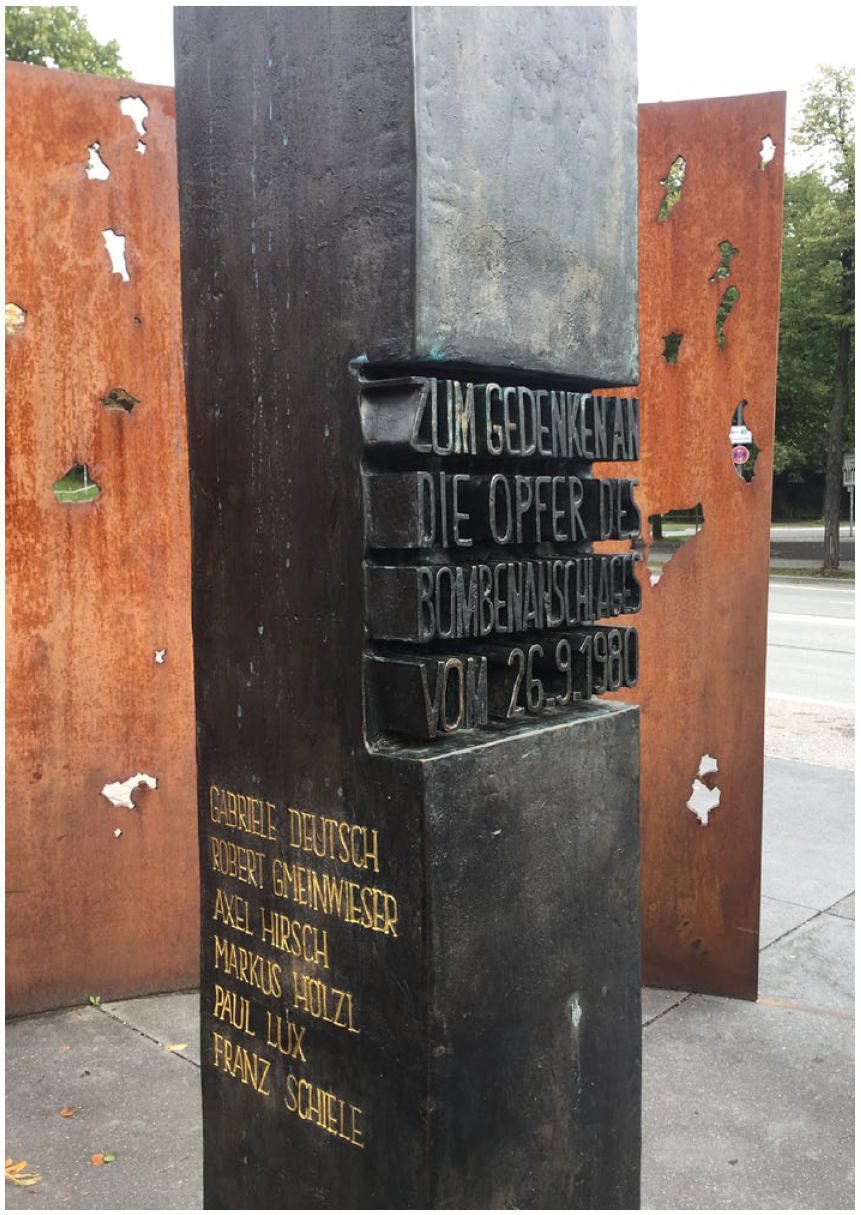
The Munich Oktoberfest memorial with its original stele, the added names and the surrounding perforated metal sheet in the back.
Among numerous other examples of memorials shaped in the classical form are those erected during the 1990s for Rudi Dutschke (Berlin), Celalettin Kesim (Berlin), and Amadeu Antonio Kiowa (Eberswalde), all of which are plaques carrying short inscriptions about the events, the victims, and sometimes the perpetrators. The plaque commemorating Amadeu Antonio contains his name, year and place of birth, year and place of death (1990, Eberswalde) and the inscription: ‘victim of racist violence’ using gothic letters. Its style resembles a tombstone, while the typography evokes a typical although ambivalent symbol of German national heritage. The plaque for Celalettin Kesim who was stabbed to death at Kottbusser Tor in Berlin-Kreuzberg by Turkish right-wing extremists in 1980 similarly resembles a tomb slab. It is, however, placed next to a memorial stele created in 1991 by Berlin based Turkish artist Hanefi Yeter, which combines the classic element of the stele with a figurative engraving of a suffering human body. The relatively unremarkable commemorative site for Rudi Dutschke who was shot by a right-wing extremist at Kurfürstendamm in 1968, a fact not mentioned on the memorial plaque inaugurated in 1990, recently transformed into a temporarily living memorial. On the 50th anniversary of the attack, passers-by began to place shoes encircled with chalk lines next to the plaque. Those shoes re-enacted an iconic photograph that showed Dutschke’s bicycle and shoes on the pavement after the shooting. As informal or extended memorials ‘shoes evoke in a highly visceral way the absence of individuals’ (Stevens and Franck, 2016: 71). The temporary commemoration performance however implicitly evoked also another famous memorial displaying shoes, the ‘Shoes on the Danube Bank’ in Budapest, commemorating Jews murdered by the fascist Hungarian Arrow Cross militia during the Second World War. In a critical opinion piece in the newspaper Die Welt columnist Thomas Schmid even referred to the iconic Holocaust images showing piles of shoes in the extermination camps (Die Welt, 2018).
The 1993 Solingen memorial, which we discuss in detail later in this article, is one of few incorporating figurative elements. In contrast to the Solingen memorial, non-figurative abstract shapes are more commonly used at newer memorials for victims of extremist-right violence, although most of them also include classical elements. A representative example of an abstract memorial is the one commemorating the 1991 Hoyerswerda xenophobic riots, initiated as a permanent commemorative place only in 2014. The monument is a 3-m-high gate-like frame made of black stone, which incorporates a glass rainbow in its gap, while both sides of the crossbar present uninformative inscriptions: ‘Autumn 1991’ and ‘Hoyerswerda does not forget – we remember’. Information concerning the incident can be obtained by scanning a QR code attached to the installation that links to a website containing information regarding the incident and its consequences.
The Hoyerswerda memorial is a late example of the fourth phase. Experiential memorials contain components, whether mechanical or digital, that invite the visitors to communicate and interact with the memorials (Stevens and Franck, 2016: 98). An early example of this category is the man hammering the swastika at Hülya-Platz in Frankfurt that could be manually activated in order to smash the Nazi symbol. The latest, not yet realised, example is the projected memorial site commemorating the NSU bomb attack at Keupstrasse in Cologne. Its physical structure replicates the outline of the barber shop that was the primary target of the xenophobic attack. This concrete slab should serve as a meeting place, initiating cultural activities and public discussions. In addition, visitors can operate an augmented reality application on their mobile devices that adds to the physical site unlimited virtual walls that display short films about experiences with racism. Participants can contribute to the memorial by uploading those films. Thereby the Berlin based designer Ulf Aminde intends to create a virtual space that cannot be attacked by right-wing extremists (ze.tt, 2019).
To conclude, memorials for victims of extremist-right violence in Germany have gone through aesthetic stages similar to those of Holocaust memorials: first classical, then figurative, abstract, and finally experiential. The two nevertheless differ in how they entwine elements from different phases, a practice that is more common for memorials for the victims of extremist-right violence. It is however still possible to spot a connection between them, based on shared elements, motives, and wordings. Such intertextual and multimodal elements will be at the centre of the following discussion of our two case studies.
Memory frames of the holocaust in memorials commemorating victims of extremist-right violence
The memorial for the victims of the 1993 Solingen arson attack was unveiled at the incident’s first anniversary ceremony. The monument presents two large metal figures, a man and a pregnant woman, tearing apart a swastika, surrounded by metal rings, each bearing the name of its donor. The monument was initiated and build by a local youth welfare initiative and workshop, which also preserved it over the last 25 years. Since the initial five rings, sponsored by city residents but carrying the victims’ names, were installed, by May 2014 the number had risen to over 5000 (Solinger Tageblatt, 2014). Every year approximately 150 new rings are added to the living memorial (Figure 4). Thus the rings would gradually hide the figures, a concept, which therein resembles the notion of counter-monuments, and here especially the ‘vanishing monument’, that gained increasing interest in context of Holocaust commemoration in Germany since the 1980s (Young, 1992: 268).
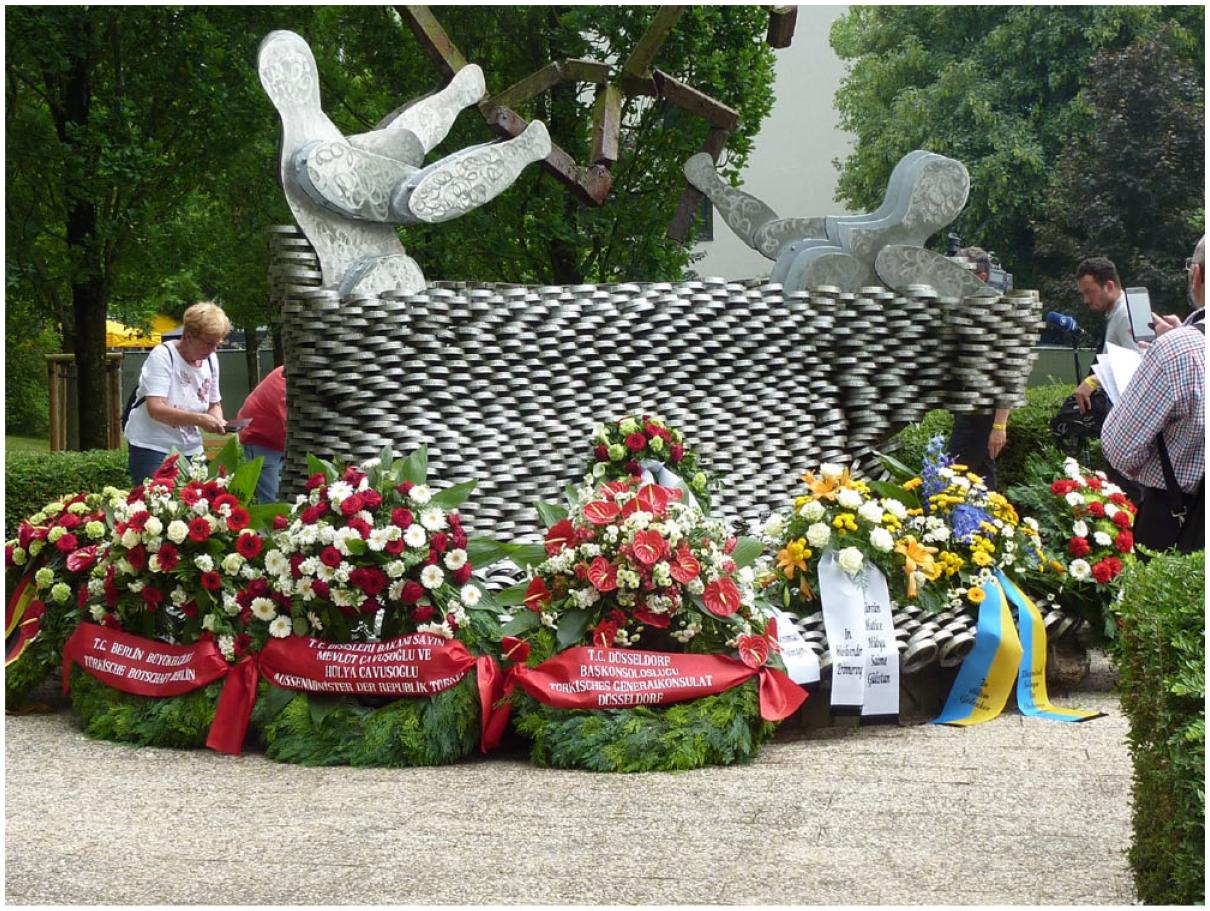
The Solingen memorial surrounded by rings during the 25th anniversary of the attack in 2018.
The donation and production of the rings turns the memorial also into an interactive and experiential site, because the donators usually actively engrave their names into the rings. Some of the rings, which today cover nearly the entire bottom half of the metal figures, were donated by Holocaust survivors and state their names and the camps they survived. Those elements establish multidirectional pathways within the memorial. Due to an increasing number of right-wing extremist attacks and xenophobic attitudes in recent years, the initiators decided that the figures should remain visible and that new rings will only be added to the lower section of the memorial.
In addition to the figures surrounded by the chains of rings, a metal plaque was fixed among the rings with an inscription that reads (Figure 5):
Memorial Citizens of Solingen We do not want to forget. We do not want to look away. We do not want to be silent. Many people in this city remember The victims of the arson attack Of 29 May 1993 Connected like these rings, we want To live together.
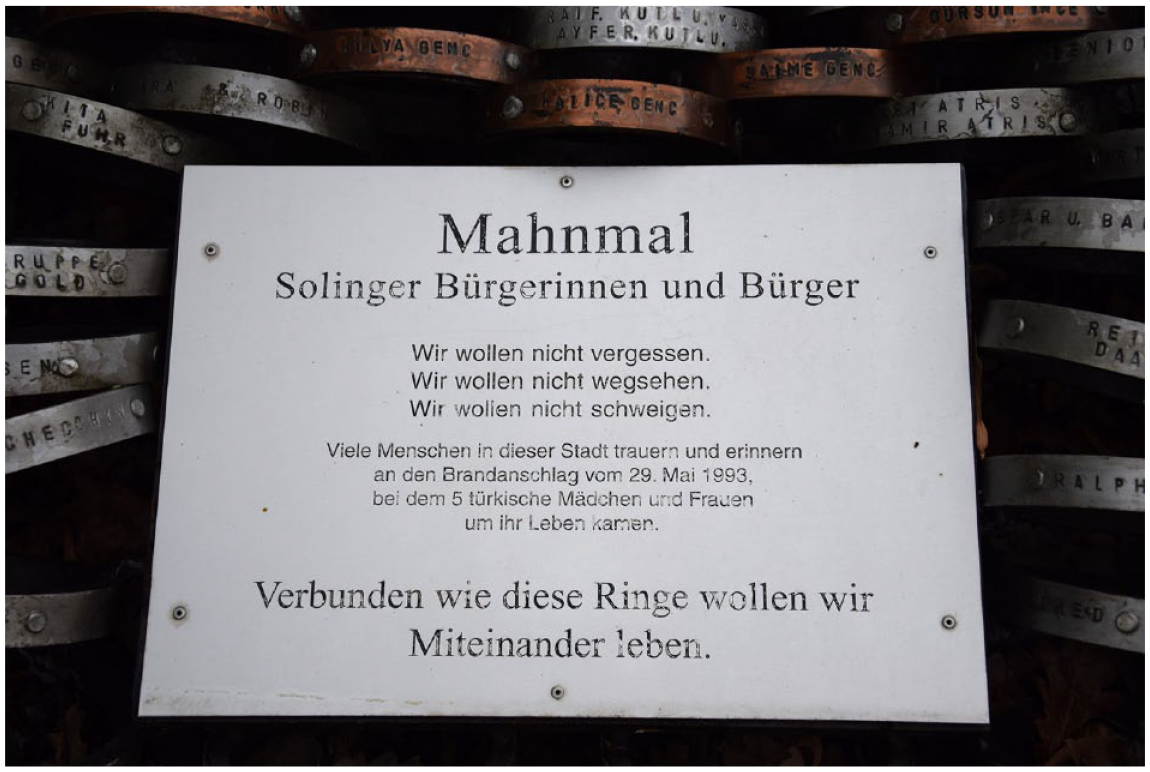
The appellative inscription of the Solingen memorial.
The most prominent element of this memorial is the broken swastika, which constitutes a significant schema in memorials for victims of extremist-right violence. It corresponds, for instance, with the main statue of the Soviet War Memorial in Berlin’s Treptower Park, thus interrelating a specific historical context, liberation from National Socialism, with socio-political struggles against neo-Nazi violence. That massive monument shows a Soviet soldier holding a sword in one hand and a little girl in the other while standing over a broken swastika (Figure 6). A similar schema characterises also Lidy von Lüttwitz’ use of the swastika as torturing wheel in the sculpture ‘Monument of Violence’ (1955) in Berlin (Figure 7) and the arrangement of Alfred Hrdlicka’s unfinished counter-war-monument in Hamburg-Dammtor. In contrast to those monuments that converge figurative and abstract tendencies, the Treptow and the Solingen memorials accentuate the figurative aspect. Nevertheless, their meanings are different. Whereas the Berlin figure has a distinct identity – a Soviet soldier – to symbolise victory over Germany in the war, the Solingen figures simply resemble human beings in a message that seeks to illustrate that in the current struggle against racism, all people who consider themselves anti-fascist can participate. Furthermore, in contrast to the Soviet memorial, the Solingen monument consists of two equal figures, although signified as a man and a pregnant woman, helping each other in the task of destruction. The smashed swastika furthermore interconnects the Solingen memorial with its abovementioned sister memorial in Frankfurt by varying a common icon of anti-fascist activists, showing a fist smashing a swastika. Consequently, the conclusion is that people join forces in order to fight racism together within their social communities, represented by the unity of the circles surrounding the memorial. Those circles were even intended to finally enwrapping the couple and the swastika, demonstrating the victory over neo-Nazi tendencies in Germany’s postwar democracy.
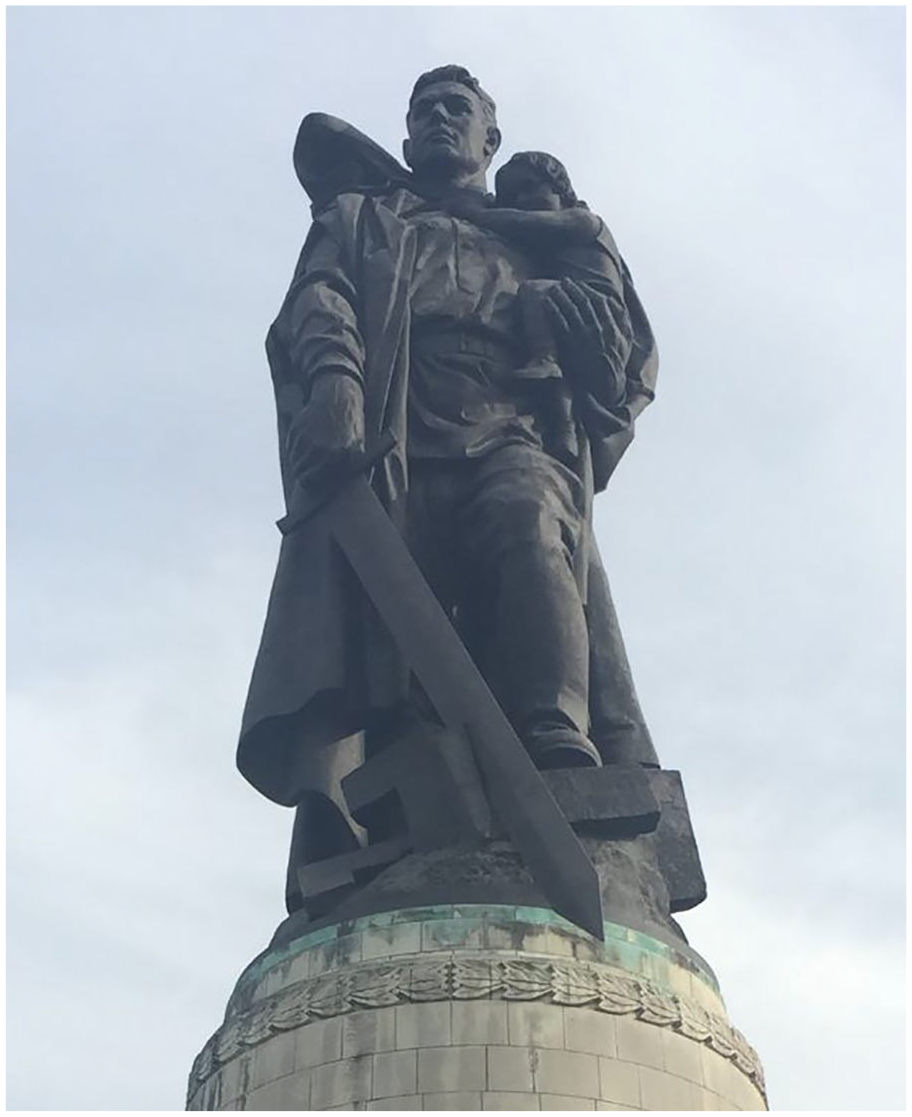
The monumental figure of a Soviet soldier smashing a swastika at the Soviet War Memorial at Treptower Park, Berlin.
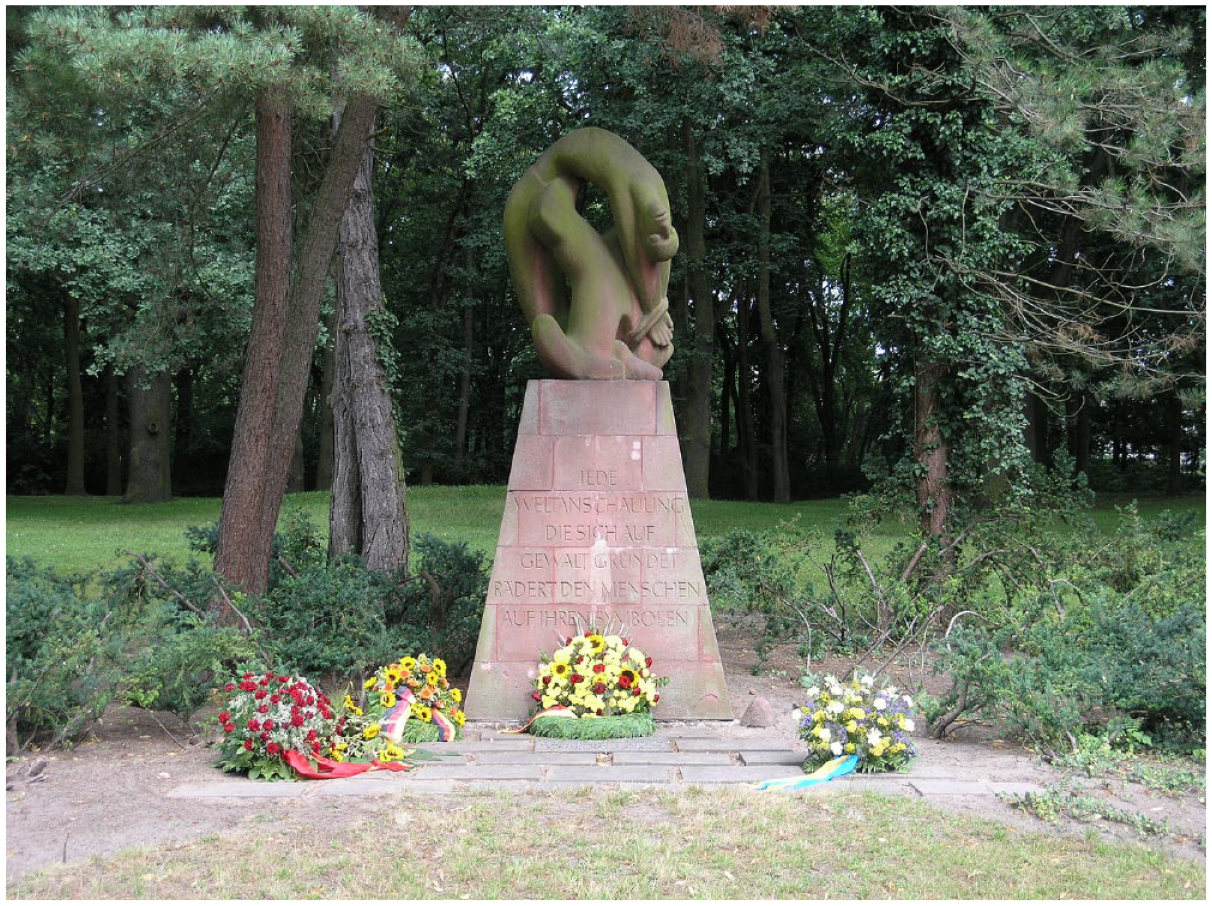
The figurative-abstract monument of violence by Lidy von Lüttwitz in Berlin.
The rings establishing the encircling chains around the figurative ensemble constitute another significant schema of memorials commemorating right-wing violence typically emphasising communal cohesion and solidarity as values mobilised against right-wing attacks. In a similar way, the memorial for the bereaved families on the Utøya memorial site, commemorating the killing of 69 participants of a summer camp by right-wing supremacist Anders Breivik in 2011, displays a steel ring etched with the names of all who died in the massacre enclosing those who stand within it (Young, 2016: 208). The sculpture and landscape installation The Clearing was constructed by volunteers, families and youth organisation activists (Figure 8). Exactly 5 years after Breivik’s attack an 18-year-old German-Iranian gunman targeted migrant youth at the Olympia Mall in Munich. Although the final investigation report described the shooter’s motifs as non-political, experts’ reports stated that the attack was also driven by xenophobia and far-right ideology. The memorial in front of the Olympia Mall consists of several typical elements, a tree, pictures and names of the victims, as well as an oversized ring encircling the tree and framing the pictures. The memorial site thus combines personal mourning with elements signifying unity and the continuation of life (Figure 9).
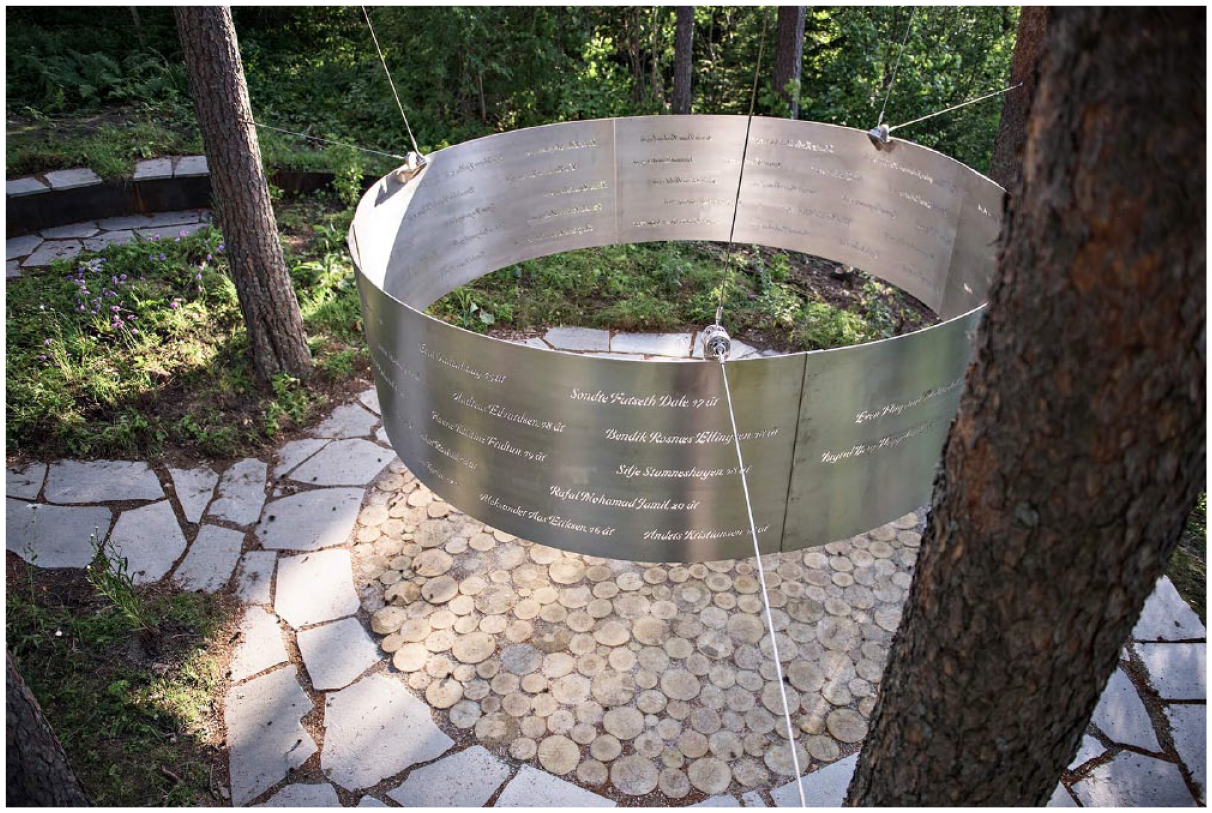
The clearing commemorating the victims of the massacre from 2011 at the family memorial site on the Norwegian island Utøya.
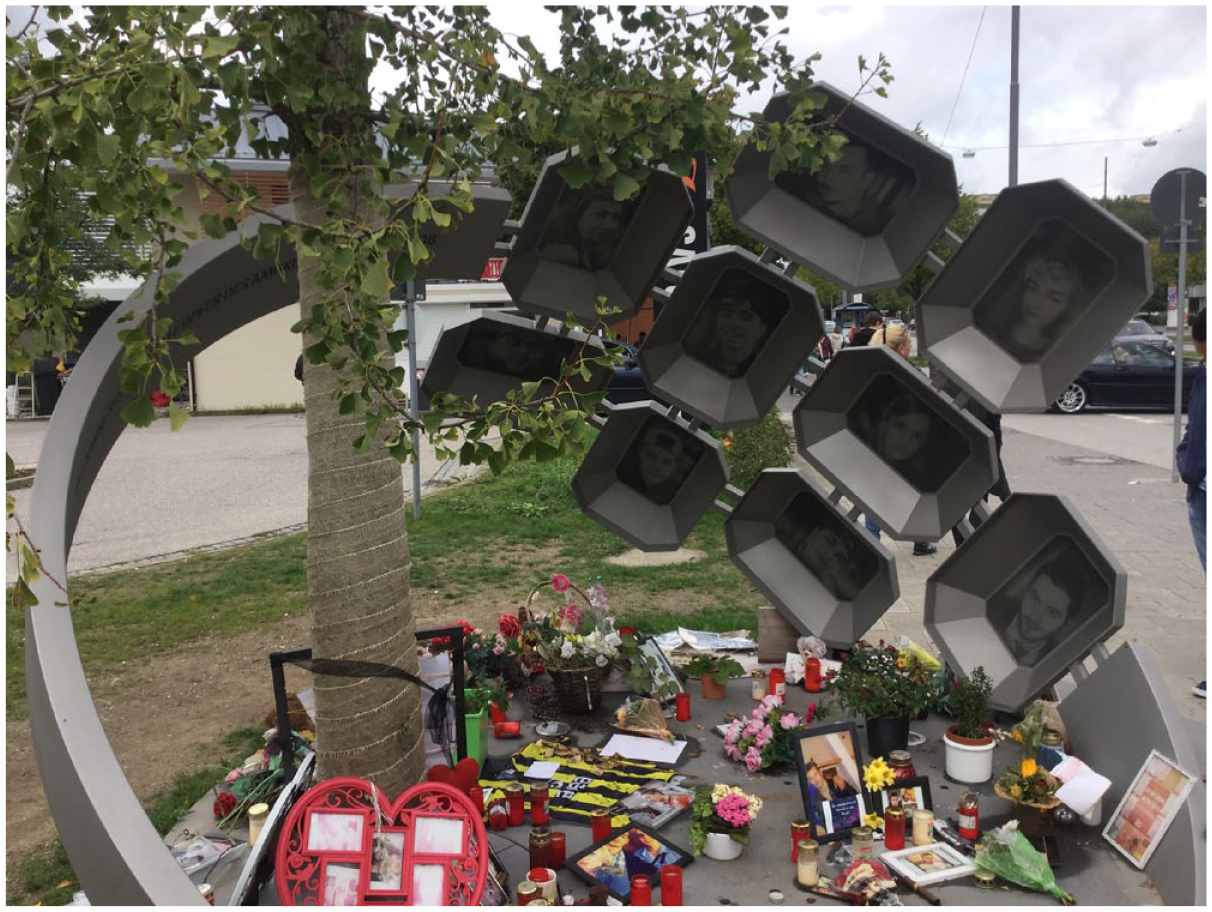
Memorial for the victims of the 2016 Munich shooting in front of the Olympia Mall.
Following this interpretation, community activity is seen as key to coexistence. In Solingen, the figurative ensemble, the rings, the inscription, even the memorial’s solid material, all emphasise the notion of strong community solidarity. The inscription even calls explicitly for coexistence. As a result, a comprehensive picture of an ideal society is created: lone subjects that together develop a containing and strong community that fights attacks threatening it.
Unlike the memorials in Solingen and Frankfurt, the neutral design of the joint NSU victims’ monuments, shaped as large tombstones or memory plaques, combines classical and abstract elements. That is, there are no clear visual elements that imply or indicate to the distant visitor the nature of the events these monuments refer to. But if people approach them in order to understand their purpose, the engraved explanatory inscription communicates the circumstances that led to their establishment.
Of the seven cities that experienced NSU attacks, six established a commemoration site containing the same statement. Only Rostock chose a different style for commemoration. 10 years after the murder, the city replaced an unofficial preliminary memorial plaque displaying a portrait of the victim Mehmet Turgut and information about his death with two shifted concrete benches (Figure 10). For many years, political controversies prevented proper commemoration of the murder, similar to the decade long hesitation to erect a memorial in memory of the Rostock-Lichtenhagen riots from 1992. The two benches constituting the NSU memorial face each other only at one spot, which displays a quotation of the first article of the 1948 UN Universal Declaration of Human Rights with a short inscription explaining that the crime was part of a series of nationwide racist murders without mentioning the NSU or the other victims. According to the Leipzig based artist Tobias-David Albert the memorial should serve as a space for direct as well as silent encounter (Lohro, 2014).
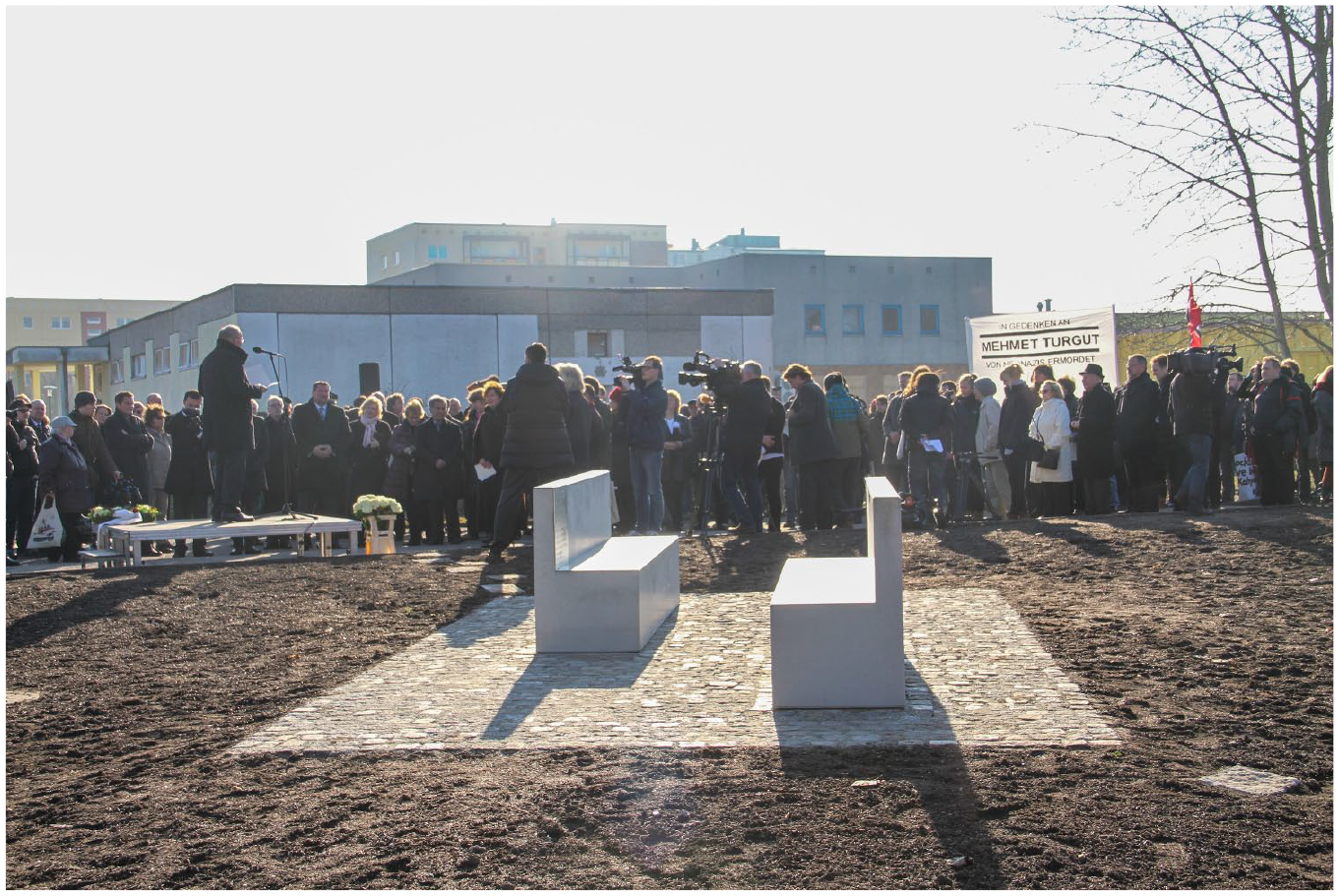
The NSU memorial in Rostock.
The Rostock memorial combines several elements. The empty benches have, on the one hand, a symbolic meaning and signify loss ‘through visible absence’ (Stevens and Franck, 2016: 43). We find this notion also in popular Holocaust memorials from recent years, for instance the 140 empty chairs commemorating the Leipzig Synagogue, which was destroyed during Kristallnacht. The schema of empty chairs thus connects the Rostock memorial in a multidirectional way with figurative elements present in Holocaust memorials as well as with one of the most prominent memorial sites for extremist right-wing violence, the ‘Field of Empty Chairs’ at the Oklahoma City National Memorial, which directly refers to the number of victims (Stevens and Franck, 2016: 45, 151). The empty chairs at the Leipzig Kristallnacht memorial do not only evoke the absence of nearly 14,000 Jewish citizens from Leipzig murdered during the Holocaust. At the inauguration ceremony then Israeli Ambassador Shimon Stein also invited future visitors to rest on the chairs and take the memories with them when leaving the site (RP Online, 2001).
Similarly, the figurative ensemble of the Rostock memorial should invite passers-by to take a seat, either directly facing each other or reflecting about the nature of the crime. In doing so, the memorial offers a mode of interaction. According to the jury decision, the memorial establishes an open and communicative space embracing hope to overcome prejudice through dialogue (Linke, 2014: 25). This corresponds with the community-building notion of the Solingen memorial. The marginal place of the memorial in Rostock as well as the sharp-edged, and cold concrete structure, however, preclude real forms of encounter beyond commemorative events. In contrast, the newly established memorial ensemble commemorating the Rostock-Lichtenhagen riots connects the peripheral crime scene with the social and political centre of the city through five steles representing different aspects of the violent events that also involved a huge number of citizen bystanders. As decentralised ensemble, the steles, according to the artists, also represent ‘five pillars of democracy’ (Frankfurter Allgemeine Zeitung, 2017).
The quotation from the UN declaration on the Rostock NSU memorial introduces a universal dimension to the memorial. It interrelates the lessons from the Second World War and the Holocaust with the preservation of human rights that is a core element of contemporary German self-definition. This reference has, however, a generalising notion, detaching the site from the NSU murder series. A similar universal reference is also part of the central NSU memorial in Nuremberg, which is located close to the Way of Human Rights, an outdoor sculpture bringing to mind past and current violations of human rights, thereby intersecting the memory of victims of xenophobia with a humanitarian discourse. The official memorial site was inaugurated on the ‘International Day for the Elimination of Racial Discrimination’ 2013 and consists of a flat commemoration stele, and behind it four maidenhair trees (Ginko bilboa) signifying the three NSU victims in Nuremberg and all other victims of the terrorist cell (Figure 11). The trees interrelate the political and social struggle for human rights with commemorative practices in different contexts. Starting in 2007 Nuremberg established a citywide social sculpture consisting of 80 maidenhair trees dedicated to the different paragraphs of the Declaration of Human Rights. While adding the NSU memorial to this social sculpture, the trees at the memorial site also intersect it with the chestnut trees planted at the site of the arson attack in Solingen. Furthermore, similar to the ‘Tree of Life’ in the Oklahoma National Memorial or the ‘Survivor Tree’ found at Ground Zero in New York after the 9/11 attacks (Heath-Kelly, 2018) other sites for victims of terrorist violence appropriated trees as symbol for the continuation of life, for instance the ‘Tilted Tree’ memorial for the victims of a terrorist attack at the Hebrew University of Jerusalem in 2002 (Stevens and Franck, 2016: 69). Finally, trees also constitute the corner stone of commemorating the ‘Righteous among the Nations’, non-Jews that risked their life to save Jews during the Holocaust, at the Yad Vashem Holocaust Memorial.
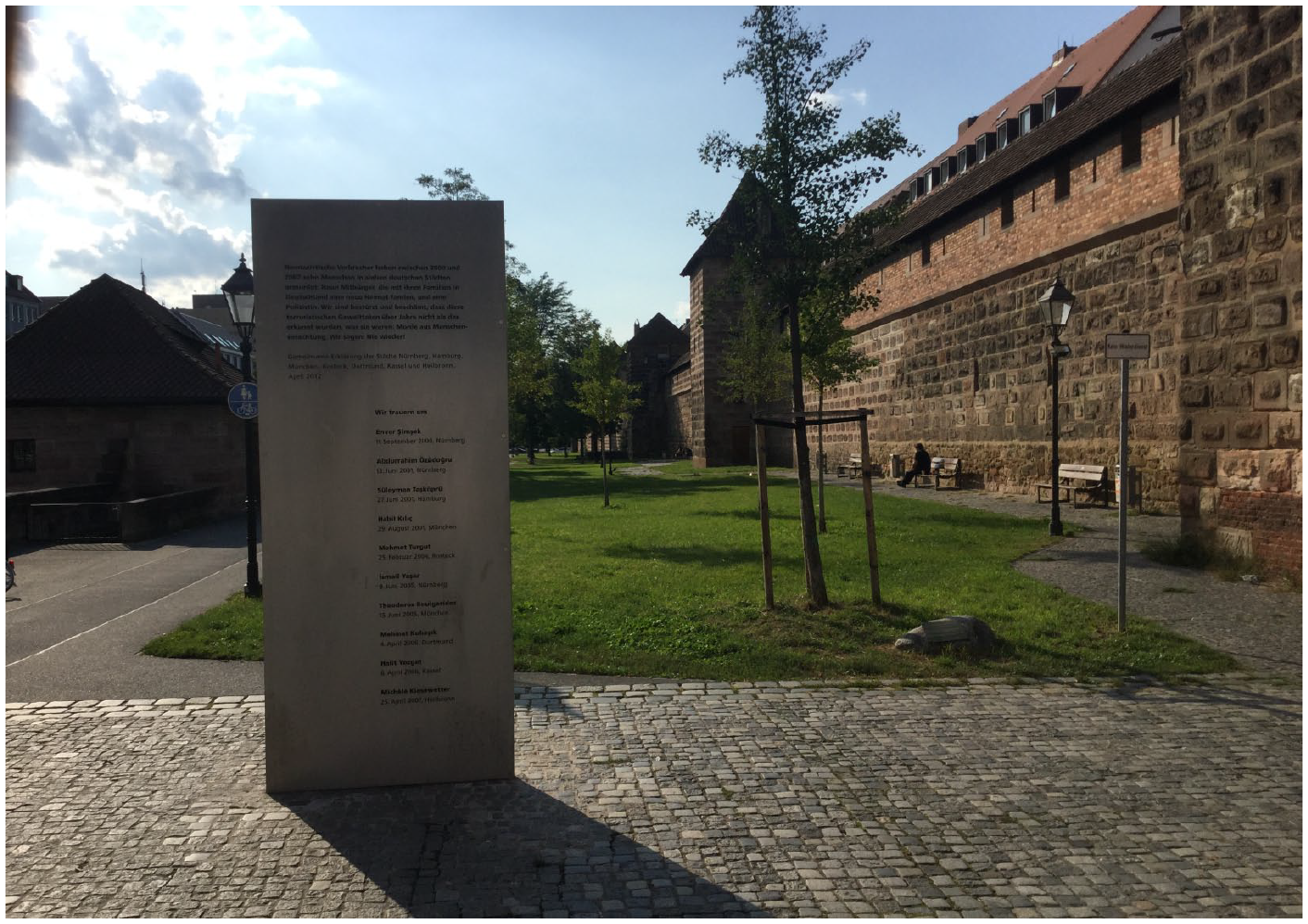
Central NSU memorial in Nuremberg.
However, in contrast to the Rostock memorial the Nuremberg memorial is a great deal plainer in character and has a minimalistic abstract design. This led us to focus on the conscious linguistic choices of the inscriptions, which also mark the much more decentralised crime scenes in various other cities because they include two well-known terms related to German nationality, National Socialism, and Holocaust memorialization in Germany (Figure 12):
Between 2000 and 2007 neo-Nazi Criminals have murdered ten people in seven German cities: Nine fellow citizens that have found in Germany a new homeland together with their families, and one policewoman. We are shocked and ashamed that over the years these violent acts of terror have not been recognized as what they had been: murders in contempt for humans. We say: never again! We mourn: [The victims’ names, and places and dates of death] Mutual statement of the cities Nuremberg, Hamburg, Munich, Rostock, Dortmund, Kassel and Heilbronn, April 2012.
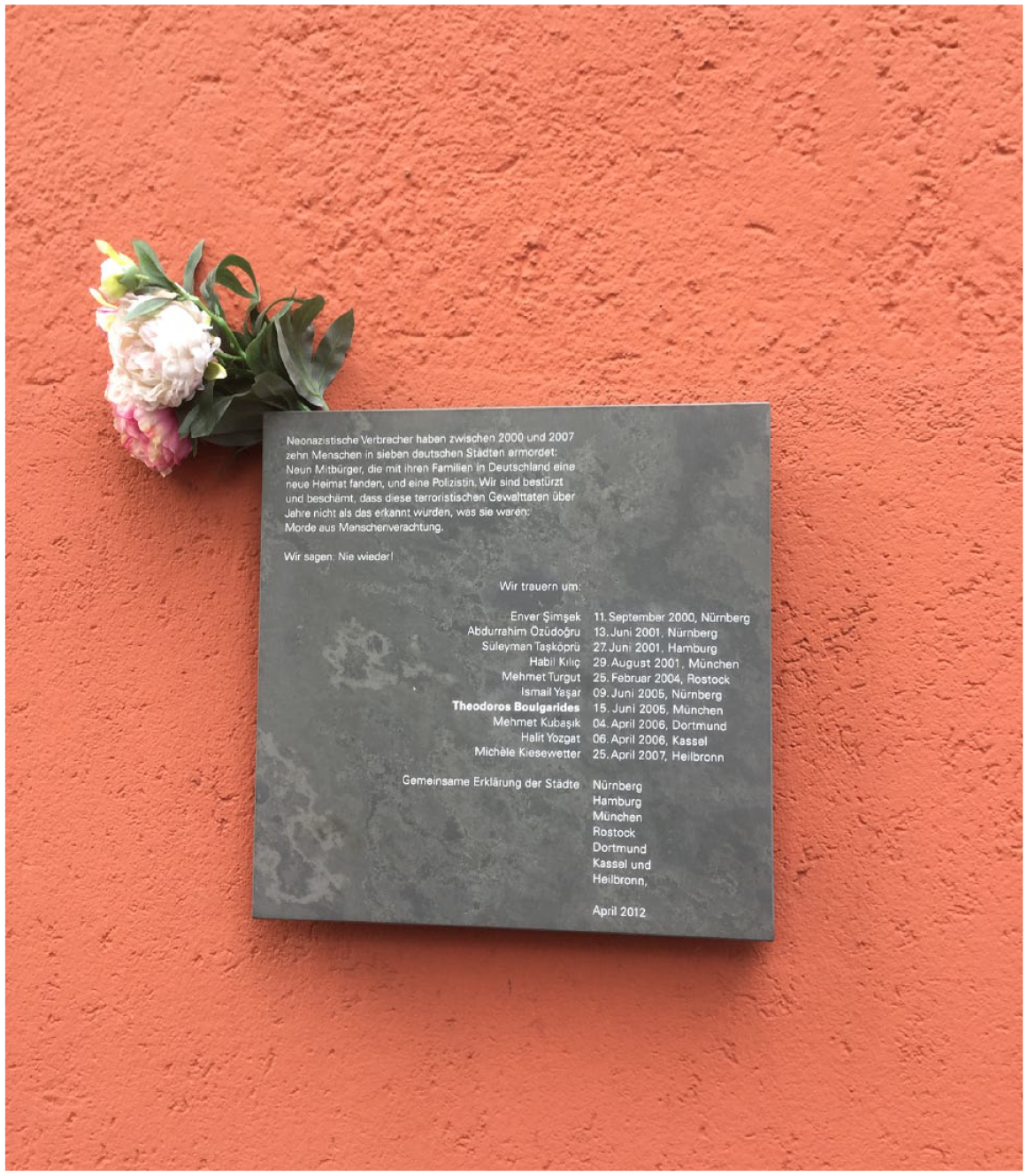
Memorial plaque for NSU victims in Munich.
The first significant term is Heimat, which can be translated into English as ‘homeland’. This term, a major component of the German concept of national belonging since the nineteenth century, was used extensively by National Socialist ideologues to sharply differentiate between the legitimate members of the Volksgemeinschaft and those they considered not belonging to it (Miller-Idriss, 2009: 47–48). Although the concept of Heimat is in fact open to interpretation, one’s homeland is not supposed to be changed. While language, religion, or culture, for example, can be acquired, conversed, or learned, the very birthplace and genealogical origin of a person can never be replaced. Therefore, racist perceptions that stipulate a specifically defined birthplace and heritage in order to be a German citizen perceive the country’s residents through polarised glasses and divide them into citizens and foreigners (Köhler, 2014a: 54).
Therefore, the choice to describe and emphasise the murdered people as citizens who found a new Heimat in Germany works in two discursive directions shared with Holocaust memorials. Firstly, it establishes a semantic field presenting postwar Germany as an inclusive society willing to accept immigrants who wish to be assimilated, as opposed to National Socialist German society that saw itself as exclusive due to the duty to keep it pure. In this sense, the memorials try to use negative memory as a basis for unifying civilians against actions and groups that are unacceptable in contemporary Germany (Young, 1993: 53). Secondly, by combining two terms from different semantic fields – citizenship and Heimat, the first a legal and the second a cultural term – the authorities aim to clarify that the present-day German policy subjugates tradition to liberal law. This means that Heimat can be exchanged through new citizenship in a process that symbolises and reinforces unified Germany as a progressive country that on the one hand protects its minorities and on the other struggles with its domestic enemies. Thus the memorials emphasise a liberal definition of national inclusion and communicate this particular self-perception to visitors as well as to the victims’ families, but also to racist groups and organisations usually opposing this liberal conception.
The second term for discussion is the phrase ‘Never Again’ (Nie Wieder), which intersects with commemorating the Holocaust and the Second World War on three significant sites. On German soil it is part of the International Memorial built in 1968 on the grounds of Dachau concentration camp. KZ-Dachau, the first concentration camp erected by National Socialists, was not a destination for Jews until Kristallnacht. Hence, the memorial on its grounds signifies commemoration of all sorts of NS-victims, such as communists, criminals, and trade unionists, demonstrated in the ‘Never Again’ inscription written in 5 languages (Edkins, 2003: 137). Preceding that in Dachau by 4 years, the Treblinka extermination camp memorial presents a similar inscription, to which a Polish version of the expression has been added, but unlike Dachau, the Treblinka memorial explicitly represents Jewish victims mainly because up to 850,000 of Treblinka’s 900,000 victims were Jews. The inscription stands among stones resembling tombstones of a Jewish cemetery, hundreds of them also bearing the names of Jewish communities destroyed during the period the camp operated. A menorah is carved on top of the rear side of an obelisk, at the foot of which the stone plaque is located (Young, 1993: 186; 188–189). A third commemoration site that exhibits the phrase is located in front of Adolf Hitler’s birthplace in Braunau, Austria. In this case, a memorial stone taken from the KZ-Mauthausen site and put next to the house 2 weeks before Hitler’s one-hundredth birthday (Jungle World, 2014) presents a slightly extended version: ‘Never Again Fascism’. This phrase directly refers to the iconic slogan ‘Never again war, never again Fascism’, used for several commemorative occasions in both Germanys since the 1950s.
Taking into account these highly significant examples, a new kind of discourse is formed by adopting this phrase for the NSU murder series. However, using the phrase without an object in the NSU memorials on the one hand emphasises the iconic use of the words, especially in context of Holocaust memory. On the other hand, the object-less appeal remains vague and less controversial by allowing the public to relate to different ‘lessons’ drawn from extremist right-wing violence.
Conclusion
This article showed, by analysing aesthetical and textual schemata and memory frames in two memorial ensembles for victims of extremist-right violence, that such commemorative sites function to transmit specific messages to visitors by using certain terms or motives related to other events and times. These messages connect with the local audience through an historical discourse that takes them on a journey into the past and ends back in the present. From this point on, observers should understand the present challenges of groups planning to resurrect National Socialism or elements of its ideology, and that they therefore have to participate in a struggle against racism and xenophobia, whether by creating liberal yet solid communities or by supporting the democratic government, which presents itself as a power fighting racism.
In this context, however, it is important to note the locations of the memorial sites, for perhaps they can provide information on the true willingness of authorities to cope with the fact that neo-Nazis reside in their cities. The mayor of Solingen, despite his earlier promise to situate it in city centre, agreed to build the monument only in front of the school, which one of the victims had attended, explaining that ‘social peace’ (soziale[r] Frieden) cannot be jeopardised in the city centre (Die Tageszeitung, 2008). The second Solingen memorial, located in a neighbourhood of Frankfurt not in the city centre, resulted from a local initiative and was accompanied by several controversies and obstacles. These included a debate over whether a swastika can be publicly displayed even when it is clearly set in a critical context (Frankfurter Rundschau, 2013). In contrast, memorials that overtly recognise in their inscriptions the offenders as neo-Nazis appear completely abstract from a distance even though they are, like the abstract NSU memorial in Nuremberg, placed in central areas. However, not all cities, which experienced NSU attacks, established central memory sites; most of them mark the actual crime scenes in urban peripheries. Cities like Munich abstained from indicating the impact of the NSU on local memory beyond hanging two plaques at the decentralised crime scenes. In Rostock, the peripheral location of the NSU memorial precludes its communicative dimension.
Furthermore, by asking what the NSU memorials are actually remembering, we encounter a rather different perception than the one dominating at the time. While the memorials emphasise that the crimes were taken seriously by the German public, investigators, journalists and politicians overlooked or ignored the racist implications of the murder series when it occurred. Finally, the repercussions of Holocaust memory in the appearance and texture of the memorials for victims of extremist-right violence can also have a containing rather than engaging effect. Recognising that Holocaust memory became a master paradigm of remembering collective violence and atrocities, the intertextual references embedded in memorials for more recent victims of nationalist violence can have an increasingly distancing effect that jeopardises the ‘stream of more connected and seemingly co-present wars and disasters’ identified by Hoskins (2011: 270).
However, as multimodal memory sites the memorials for the victims of extremist-right violence also include new forms of intersecting past and present as a ‘dynamically configurated’ discursive ‘set of articulations’ (Brown and Hoskins, 2010: 104, 105) that enables reflexive modes of memory. In doing so, the memorial sites do not only preserve the memory of extremist-right postwar violence. They also integrate these memories into a new memory ecology that intersects in multidirectional ways the memory of the Holocaust with contemporary experiences of terrorist violence, the present assault on democracy by populist-right parties and movements, and the integration of the immigrant other into practices of connective memory (Hoskins, 2011: 272).
Footnotes
Declaration of Conflicting Interests
The author(s) declared no potential conflicts of interest with respect to the research, authorship, and/or publication of this article.
Funding
The author(s) received no financial support for the research, authorship, and/or publication of this article.
