



Abstract
This study examines the discourse ‘Don’t Thai to me’ within the context of the Cambodia–Thailand armed conflict. Data were drawn from Cambodian state media, official Facebook posts, and other authoritative sources from 24–28 July 2025 during the outbreak of armed conflict. The analysis follows Fairclough’s critical discourse analysis, complemented by speech act theory and other relevant linguistic analyses. The discussion addresses three dimensions of this communication event. For text, the term ‘Thai’ shifts from a neutral national identifier to a stigmatized label of dishonesty in a prohibitive, which performs directive, assertive, and expressive speech acts. For discourse practice, production through official communication channels and rapid online circulation demonstrates how digital platforms enable massive engagement and dissemination, resulting also in popular cultural content. At the socio-cultural level, the discourse resonates with long-standing historical antagonisms rooted in Cambodian folklore, further reinforced by concurrent economic and political tensions between the authorities of the two states.
Introduction
Since 24 July 2025, the international community’s attention has been drawn to a critical geopolitical phenomenon in Southeast Asia: the outbreak of armed conflict between Cambodia and Thailand. This confrontation has resulted in a substantial loss of life among both civilians and military personnel. Although a border crisis is universally regarded as a condition to be avoided, it is imperative that both parties take immediate and decisive action to restore peace.
Amid this conflict, language has emerged as a potent instrument, deployed not only to construct and reinforce power relations and ideological positions but also to negotiate and assert legitimacy between the opposing parties. For the Cambodia–Thailand armed conflict of 2025, language has been employed as a strategic instrument alongside physical violence on the battlefield.
Typically, studies of language in the context of linguistic warfare or armed conflict tend to focus on discourse that emerges after a conflict has ended. Generally, when language appears in war narratives, it does so at the end of the story, represented as benign, ancillary parts of those diplomatic relations which bring a conclusion to war, or as sources of useful lessons for the post-war period (Footitt and Kelly, 2012; Roland, 1999). In this study, however, we were able to capture the moment when the conflict was ongoing and at its peak. This became a unique opportunity to study an active international armed conflict discourse in 21st-century Southeast Asia.
The border conflict between Cambodia and Thailand can be classified as an international armed conflict because it aligns with the definition that such a conflict involves hostilities between states, in which the armed forces of at least two states are used against one another, even if one of the states does not recognize the situation as a war (Clapp, 2023; International Institute for Strategic Studies, 2018; Jallo, 2024). Moreover, it has a profound impact on international relations as well as on the formulation and conduct of defence and security policy.
In the context of South and Southeast Asia, it has been observed that socially circulated and institutionally endorsed discourses function as primary instruments in the construction of conflict (Ghosh, 2019). An emerging discourse during the Cambodia–Thailand border crisis of 2025 has assumed a central role in media, with the expression Don’t Thai to me repeatedly invoked as a rhetorical weapon serving armed conflict objectives. This phenomenon holds significant social implications in times of border crisis.
Our goal in this study is not to make moral judgements or determine what is right or wrong. Rather, we aim to describe the use of language as a means of communication during periods of political and social instability in the actual context of border crisis in Southeast Asia, after which there is a risk of valuable materials being erased from open media platforms. We use multiple tools in communication and language studies to dissect subtle sociocultural and linguistic elements in the discourse.
Theoretical background
Language, thought, and ideology of otherness
Language and thought are inseparable. Humans rely on language as a medium to express their thoughts. Simultaneously, language itself generates thought and meaning, psychologically reflecting humans’ mental concept or generalizations through which mutual understanding is established on specific topics (Vygotsky, 1986; Whorf, 1956). This relationship forms a continuous, cyclical process throughout human life, free from cognitive limitations or communicative barriers. Language, however, may be seen as a surface-level embellishment superimposed upon more fundamental processes of consciousness, pre-existing before any form of communication, signalling, or symbolic representation.
It is often observed that, during wartime and border crisis, language continues to play a crucial role as a reflection of the thoughts and sentiments of those experiencing the conflict. Notably, the authorities who hold power and assume central responsibility for selecting language to communicate with the general public are typically state officials. In certain instances, mainstream media are placed under strict state control, particularly concerning the content disseminated to the public. Interestingly, in a context of linguistic warfare, politicians and the media often introduce new words and expressions aimed at emphasizing ethnicity and reinforcing political partisanship through satire (Levinger, 1994; Suleiman, 2004). This is exactly the case for the otherness-provoking use of Thai nationality in the discourse Don’t Thai to me.
Much of human discourse, particularly when articulated in the capacity of group membership, conveys opinions embedded within ideological frameworks (Van Dijk, 1998). This principle was evident when the ideology of otherness was first established within the anthropological lens. Rooted in Lévi-Strauss’s binary opposition for understanding cultural phenomena in 1958, the relationship between language and the construction of otherness has gained increasing attention in cultural research throughout the 20th century. This line of inquiry has been particularly shaped by critiques of Eurocentrism, focusing on how the foreign ‘other’ is constructed through discriminatory language, exclusionary practices, and public discourses. Such processes often involve the exercise of symbolic power, a power that creates realities through words (Gaupp and Hestermeyer, 2021).
Otherness can be defined as the outcome of a discursive process in which a dominant in-group constructs one or more dominated out-groups by stigmatizing difference. Such a shared social belief, be it false consciousness or misguided convictions, often constitutes forms of real or imagined, presenting it as a negation of identity and thereby as a justification for potential discrimination (Staszak, 2009; Van Dijk, 1998). Furthermore, numerous studies have demonstrated that the access to and use of othering strategies can constitute a powerful rhetorical tool (Falkowska and Usiekniewicz, 2025; Fink, 1995; Minets, 2021; Pandey, 2004; Tosolini, 2023). This process is further intertwined with multilayered social dimensions and hidden power relations, which continuously reproduce through discourses and reinforce the ideology of otherness.
In shaping the discourse towards the ideology of otherness, language typically influences the acquisition, internalization, and transformation of ideologies. In this language-driven mechanism, societies construct the ‘other’ and establish invisible social boundaries between speakers of different languages, often shaped by prevailing language ideologies and differing linguistic competencies (Wilmot et al., 2023). The undeniable role of language in the discourse necessitates that this study should consider the context of communication through critical discourse analysis and language use through the lens of speech act theory and other relevant linguistic aspects.
Critical discourse analysis (CDA)
Media discourse has been a major subject of critical discourse analysis (CDA), which often focuses on non-fiction and news media (Cameron and Panović, 2014; Stevenson and Kavka, 2025). The study of media discourses typically uses a three-dimensional model of communicative events as analytic tools, subscribing to the dialectical–relational approach (Fairclough, 1995). This model examines how the three dimensions—text, discourse practice, and socio-cultural practice—are manifested in media discourse (see Figure 1).
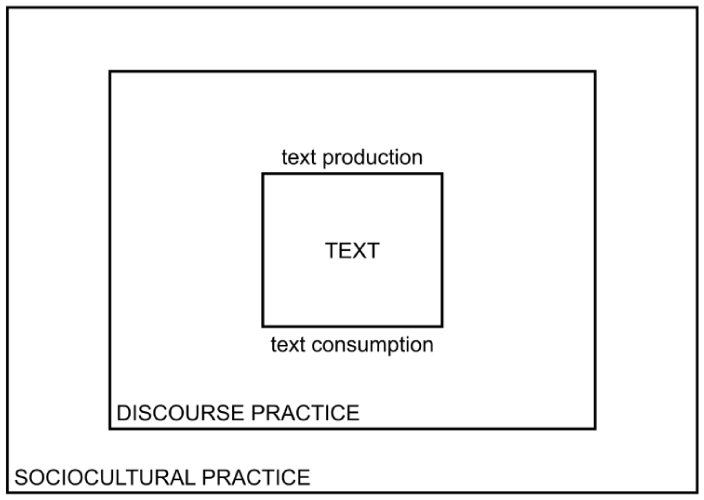
Critical discourse analysis of a communicative event (Fairclough, 1995).
The foundations of CDA investigate how social power, dominance, and inequality are enacted, reproduced, and sometimes resisted by examining various forms of communication within specific social and political contexts (Van Dijk, 2015). In line with this approach, research within the CDA framework also addresses ethical issues related to the misuse of power, structural inequality, and social injustice as constructed and conveyed through discourse. This includes efforts to challenge and resist such injustices (Phanphothong, 2013). This orientation distinguishes CDA from other branches of linguistic analysis, such as stylistics and conventional linguistic research, as it rejects a neutral stance. Instead, the analyst adopts a critical position that aligns with those who are marginalized or exploited in society.
Importantly, discourse can be understood as a system of choices actively made by language users. Therefore, it is not just a linguistic phenomenon. but a process shaped by production and reception, intricately linked to the ideological dimensions of social transformation. Discursive practices are embedded within and often shaped by contested sociocultural classifications of individuals and contexts. As such, they are inextricably bound to communicative situations that are indicative of power relations between communicators and subjects involved (Barker and Galasinski, 2001; Chouliaraki, 1998; Hall, 1997).
Over the past decade, literature on CDA has predominantly focused on the language of war in the Middle East (Amer, 2017), Africa (Nigatu, 2023), and Europe (Latif et al., 2024). This has left Southeast Asia largely underexplored within the CDA framework, due to the absence of major wars in the region in recent decades. This study aims to fill this research gap as the recent Cambodia–Thailand armed conflict in 2025 has provided a good opportunity and research materials to advance the CDA framework for the Southeast Asian context.
Speech act theory
Speech act theory, a foundational paradigm in the pragmatic study of language as a form of action, was introduced by Austin (1962) and refined by Searle (1969). It illustrates an intersection between linguistics and communication Studies. The central idea is that utterances function as essential communicative units, intrinsically interwoven with their socio-pragmatic context in which interaction takes place (Chattopadhyay, 2024; Mabaquiao, 2018; Makhlouf and Amine, 2016).
Austin (1962) argued that utterances do more than just convey information; they are actions that can affect changes in social reality—‘to speak is to act.’ Austin distinguishes three levels of speech acts: (1) locutionary act (the literal meaning of the utterance); (2) illocutionary act (the speaker’s intention); and (3) perlocutionary act (the effect of the utterance on the receiver). For a speech act to be successful or ‘felicitous,’ Austin refers to conditions including the speaker’s sincerity, contextual appropriateness, and adherence to socially accepted procedures.
In his version, Searle (1969, 1979) focuses on the structure of illocutionary acts, further subdividing them into two components: (1) propositional content (the informational aspect); and (2) illocutionary force (the speaker’s communicative intent). Searle’s significant contribution to the theory resulted in a typology of five speech act categories: (1) assertives; (2) directives; (3) commissives; (4) expressives; and (5) declarations. This classification is widely used in modern linguistic research, investigating how language performs various social and communicative functions across different discourse contexts. Although pragmatics touches on context, many studies on speech acts lack integration with critical discourse approaches that examine how power, ideology, and social inequality are encoded in speech acts (Fairclough, 1995; Van Dijk, 2008).
In linguistic warfare research, speech acts have become a prominent focus of scholarly inquiry, particularly in the public communication of national leaders during wartime and border crisis. Notable studies in recent years include analyses of the speech acts of the President of the United States (Hussien and Adel, 2018), the President of Ukraine (Yokossi et al., 2022), and the Prime Minister of Israel (Itani, 2025). However, a clear gap exists in research on border crisis speech acts by political leaders in Southeast Asia, even in the context of previous armed conflicts in the region, such as those in Myanmar, East Timor, and others prior to the outbreak of the Cambodia–Thailand border crisis in 2025.
Data and method
This study uses a qualitative research design with a textual analysis based on frameworks from Tisdell et al. (2025), and Stevenson and Kavka (2025). We used a purposive sampling method to select discourse samples based on specific criteria provided below. This sampling strategy ensured that the selected texts would represent authoritative border crisis communication and carried institutional legitimacy, making them suitable for analysis within the CDA framework.
The discourse must be
The discourse must
The discourse must have been
The discourse must have been
Following these principles, we retrieved research data using the Google search engine to recall the exact phrase Don’t Thai to me, occurring in various media channels of Cambodia. We applied the following specifications to acquire the most suitable data:
Language: English
Region: Cambodia
Time frame: From 24 to 28 July 2025 (the search conducted on 29 July 2025).
The search yielded 1,610 instances of Don’t Thai to me, which had been disseminated during the border crisis period (24–28 July 2025). All materials were found to have been circulated through official state communication channels. All the 1,610 instances do not exhibit significant variation. In later occurrences, they are simply reposted and shared from the original source on the Facebook page of Hun Sen (1952–present), the President of the Senate of Cambodia (2014–present), and news released by the Office of the Council of Ministers, containing the same textual content and accompanying photographs. Nevertheless, we deliberately excluded instances from automated bots or unverifiable ‘sock puppet’ accounts to ensure data authenticity and naturalness. The textual analysis form used in this study was validated by a panel of six experts—three specialists in communication studies and three in linguistics—to ensure its quality, validity and appropriateness.
For the analysis, we used Fairclough’s (1995) three-dimensional model of communicative events, which includes text, discourse practice, and sociocultural practice. The textual analysis also follows Fairclough’s dialectical–relational approach to critical discourse analysis. Linguistic inquiry is also applied where necessary to complement the textual analysis with observations on speech acts and other recurring linguistic patterns. The analysis of the discourse and sociocultural practices, meanwhile, incorporates empirical evidence from various societal, political, and cultural phenomena that preceded the Cambodia–Thailand border crisis in 2025.
Results I: Text
Fairclough’s (1995) CDA text analysis involves traditional forms of linguistic inquiry, including the investigation of vocabulary, semantics, grammar, intertextuality, and other related features.
Vocabulary and semantics
In the expression Don’t Thai to me, the word Thai underwent a process of metonymy, semantically extending beyond its neutral role as a proper noun for nationality to another related but different concept (Chongstitvatana, 2006; Littlemore, 2017). This rhetorical device involves the use of a collective designation to denote not only a particular individual or to those confined within the geographical boundaries of Thailand but also any individuals of Thai nationality. In this border crisis context, Thai constructed the binary opposite with Cambodian, reinforcing a dichotomy of ‘us’ versus ‘them’ in Cambodian media. This lexical choice also uses a rhetorical strategy of ‘colouring,’ whereby negative connotations are deliberately attached to a term that would otherwise be neutral, imbuing it with a sense of repulsion. This colouring strategy imposes an emotional meaning on the word. While it preserves its literal sense, it also carries connotative implications that reflect and evoke the feelings, emotions, and attitudes of language users (Chutintaranond, 2024).
Another essential element is the pronoun me. As a proximal deictic marker, it subjectively positions the speaker at the centre of the utterance and viewpoint, according to the concept of origo (Bühler, 1934: 107). Together with the presupposition that Thai represents the ‘other,’ me reinforces the construction of alterity and the discursive process of othering within the conflict narrative. This strategy is also obvious in Cambodian language co-texts. For example, Cambodian leaders’ Facebook posts usually used the first-person pronoun ខ្ញុំ khñom ‘I/me’ to narrate and engage themselves in the situation as agents. Some content by Cambodian citizens on Facebook, Instagram, and TikTok also followed this strategy.
Grammar and information structure
The deliberate use of the contracted form don’t instead of a full form do not explicates a prohibitive (i.e. negative imperative). In English grammar, this form implicitly allows for the insertion of the subject you (Don’t you Thai to me) (Flagg, 2002). The possibility of inserting the subject you in this imperative construction underscores and accentuates intentionality. It simultaneously presupposes and foregrounds otherness within a binary opposition and an intentional rejection of a shared identity between you and me. Thus, this utterance is not just a standard imperative but a statement that concretely denies affiliation and strengthens the speaker’s sense of being distinct from the ‘other.’
As the discourse developed from its first occurrence, a clear pattern of information structure also emerged. In general, an unmarked and optimal syntax for receivers’ processing is to place ‘old’ before ‘new’ information (Lambrecht, 1994: 61). In the initial post by Hun Sen on 24 July 2025 at 16:29 GMT+7 (see Figure 2), the phrase Don’t Thai to me was given at the end as a strategy to draw the receivers’ attention to a new focal element (Erteschik-Shir, 1986). In later occurrences, the phrase shifted from being a new focal element to a topical element. Subsequently, governmental channels and Cambodian media frequently reproduced the phrase as a headline or a topic preceding new content (see Figure 3). A topical use accounts for 97.39 percent of our data, based on the 1,610 instances of Don’t Thai to me retrieved. This information–structural shift from a focal to a topical position indicates the conventionalization and ritualization of this otherness discourse within the Cambodian media.
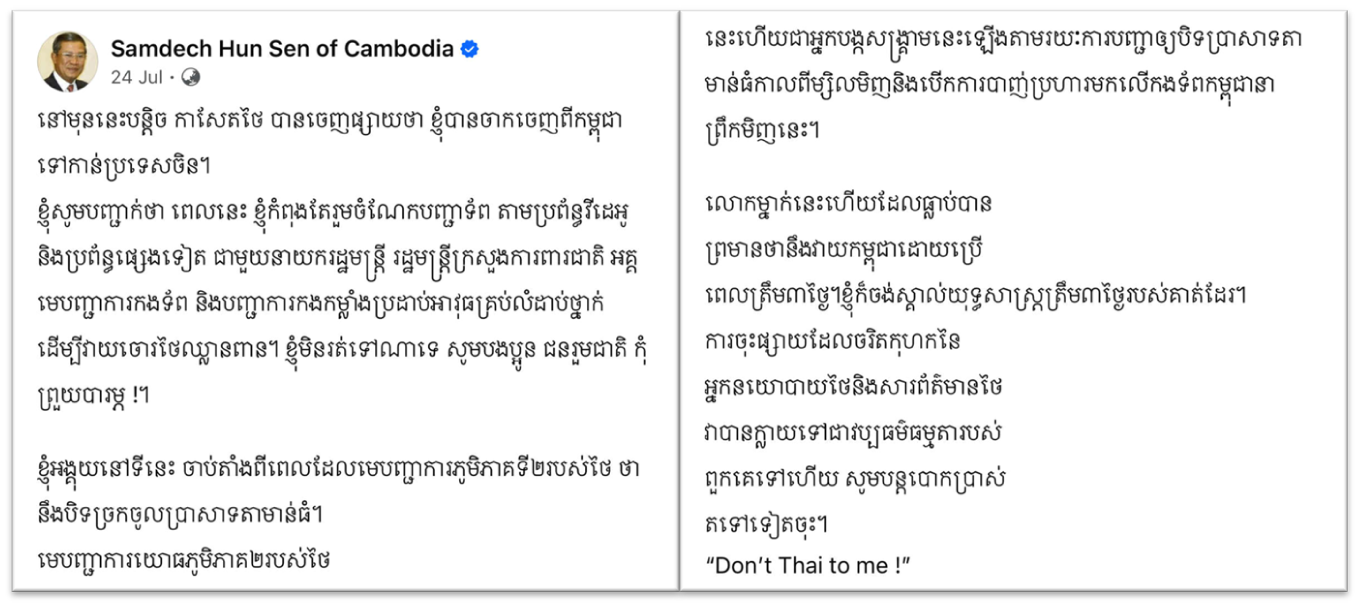
The first use of the discourse Don’t Thai to me in media (Facebook) on 24 July 2025 at 16:29 GMT+7 by Hun Sen. The phrase Don’t Thai to me! was chanted in English in its original form, not as translation from Khmer.
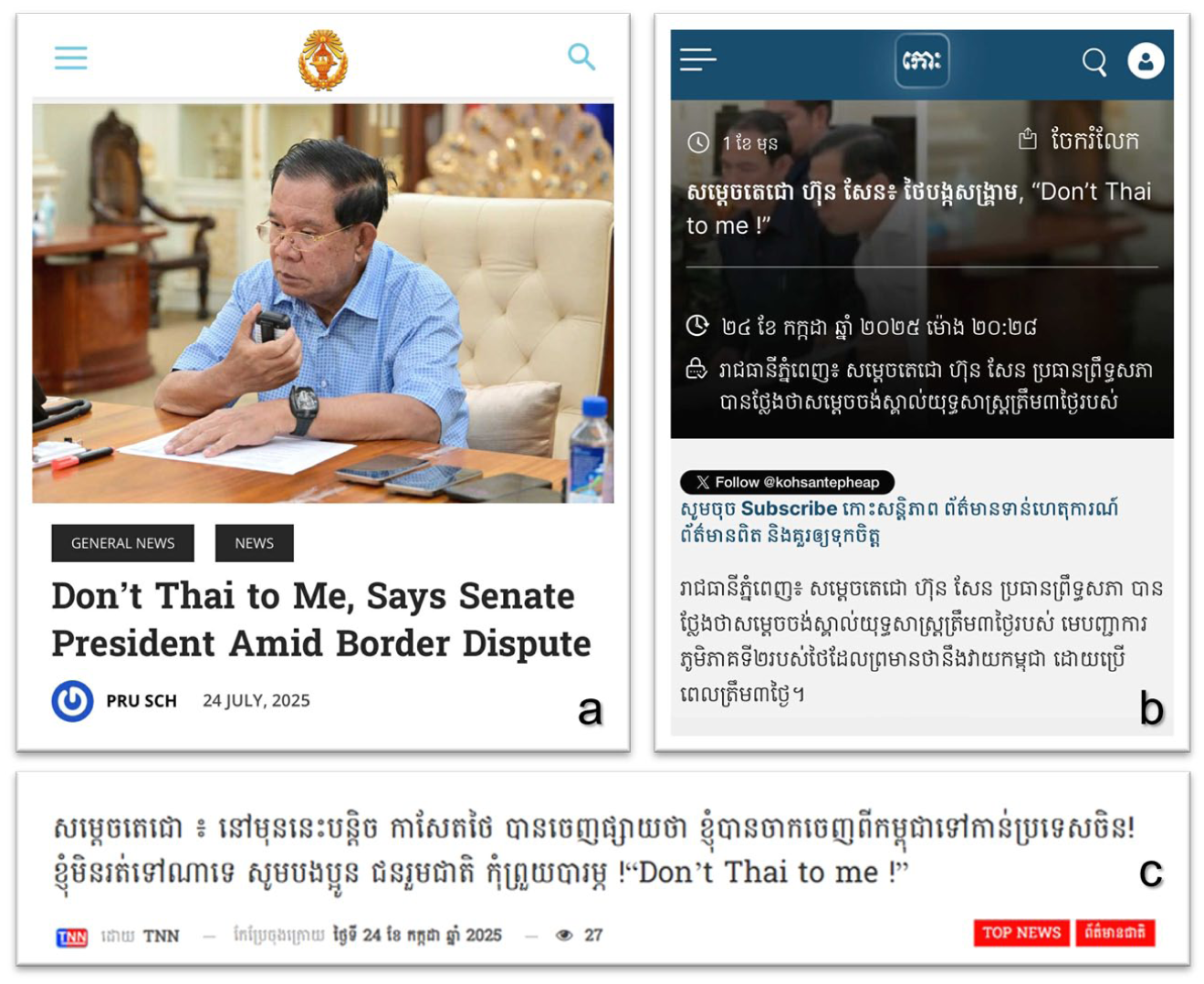
Subsequent uses of the discourse Don’t Thai to me in the Cambodian official media channels: (a) Office of the Council of Ministers in English; (b) Koh Santepheap Daily in Cambodian; and (c) Timely News Network Cambodia (TNN) in Cambodian on 24 July 2025.
Intertextuality
The phrase Don’t Thai to me is not a novel or situationally invented discourse. Rather, it has circulated for over a decade, aligning with the concept of intertextuality, which posits that all texts are constructed through the incorporation of other words and sentences into the production of meaning (Kristeva, 1980, 1986). Don’t Thai to me represents the reinterpretation and pragmatic extension of a pre-existing phrase Don’t lie to me used by people in Malaysia, Hong Kong, and Singapore, first appearing publicly in a commercial context in 2013 (Vanijaka, 2013).
Nevertheless, all texts are subject to human interpretation. As Hall (1973) noted, decoding by the audience may diverge from the text producer’s intent and need not yield the same results across different groups of receivers. In this light, the reproduction of Don’t Thai to me during the Cambodia–Thailand border conflict in 2025 demonstrates interconnections with its earlier textual form, yet its recontextualization shifts the meaning from the realm of commerce to that of linguistic warfare. In this new context, the person who reappropriated the phrase deployed it to colour Thailand as untrustworthy in its communication with the international community, fraudulent, and as persistently producing misleading and distorted information.
Speech acts
In Searle’s (1969, 1979) typology, the phrase Don’t Thai to me is best classified as a directive in the form of a prohibitive. Its locutionary representation can be understood in line with the analyses thus far. Building on that, its illocutionary force expresses prohibition, a strong subtype of directive intended to prevent the receivers from performing an action and to intensify coerciveness compared with a mitigated request, such as please don’t. It additionally embeds an assertive: by forbidding deception, the communicator presupposes the receiver’s inclination to deceive. The prohibition therefore entails an accusatory proposition—‘you lie’ or ‘you cheat’—and an expressive element of disdain or moral censure, producing a multifunctional speech act that is primarily directive but also assertive and expressive. Furthermore, embedding an English phrase into Cambodian texts creates a code-mixing phenomenon (Muysken, 2000). As a result, the prohibitive function is not limited to Cambodian speakers but is intentionally extended to a broader international audience expected to interpret the locutionary message.
In Searle’s model, the propositional content condition of prohibition is satisfied because the discourse concerns the receiver’s prospective action towards the communicator. The preparatory conditions presuppose that the receiver can refrain and that the communicator holds authority to issue the prohibition, whether through institutional authority or situational power. The sincerity condition requires a genuine desire that the receiver not deceive, while the essential condition is that the utterance counts as an attempt to prevent the proscribed act. When broadcasting to a mass audience rather than a single interlocutor, uptake becomes diffuse: the primary receiver may be a targeted out-group, while overhearers such as supporters or international observers ratify the illocution as moral policing.
At the perlocutionary level, anticipated effects include deterrence to prevent deception, shaming to mark the addressee as deceptive, and alignment to rally in-group audience behind the communicator’s authority. Because Thai functions both metonymically and as a general ethnonym, the utterance may expand its perlocutionary force from an individual prohibition to a group-directed stigmatization, facilitating othering and delegitimating. In this sense, the speech act extends beyond interpersonal regulation to symbolic aggression, where language is mobilized to undermine an opponent’s credibility. This shift also contributed to increasing audience uptake, as Cambodian citizens began applying the discourse to various forms of protest against Thailand The protest by Cambodian demonstrators demanded that Thailand remove barbed wire along the border in August 2025, following the reproduction of the discourse Don’t Thai to me by Cambodian authorities in July 2025. The protest leader used a loudspeaker to chant Don’t Thai to me, echoed loudly and repeatedly by the assembled villagers (PPTV, 2025).
The structural components analysed in this section amplify face-threat to the receivers while consolidating the communicator’s authoritative posture (see a synthesis in Discussion). Within Searle’s framework, the act performs not only behavioural control but also status management, positioning the communicator as a norm-enforcer. Repeated public circulation can ritualize it into a catchphrase performative, instantly recognizable in its illocutionary point and prepackaged in its perlocutionary effects, such as deterrence, shaming, and in-group consolidation. Thus, Don’t Thai to me exemplifies how a compact prohibitive construction bundles directive, assertive, and expressive forces to regulate behaviour, construct identities, and wage conflict through language. Moreover, this serves as an example of recontextualization, illustrating that, although the discourse or locution itself is not new, its illocutionary force is.
Results II: Discourse practice
In Fairclough’s (1995) CDA model, the discourse practice dimension of the communicative event is constituted by text production and text consumption.
Text production
The first articulation and dissemination occurred through Hun Sen’s official Facebook page, which has approximately 15 million followers and is publicly accessible (see Figure 2). Although the post was written exclusively in the Cambodian language, it concluded with the English statement Don’t Thai to me! (Hun, 2025), presenting the discourse as focal new information (as discussed in Results I: Text). Alongside the written statement, the post featured 18 photographs which portray Hun Sen overseeing combat operations with Thailand, a visual strategy designed to refute claims that he had fled overseas during the armed conflict.
In tracing the spread of the discourse, it becomes evident that Cambodian media rearticulated and disseminated the discourse in news content, signalling alignment with the Cambodian populace (see Figure 3). Simultaneously, they denigrated Thai politicians, journalists, and others as dishonest and unreliable. The most vocal Cambodian state-run websites and news agencies were the following channels:
Office of the Council of Ministers (https://pressocm.gov.kh/en/archives/113166)
Ministry of Information (https://www.information.gov.kh/articles/166732)
Cambodian Media Broadcasting Corporation (https://cambodianess.com/article/dont-thai-to-me-lies-shelling-and-a-credibility-crisis)
Cambodia New Vision (http://kh.cnv.org.kh/?p=23983)
The Khmer Times (https://www.khmertimeskh.com/501723891/hun-sen-denies-fleeing-cambodia-says-he-is-actively-leading-military-response-to-thai-aggression/)
Koh Santepheap Daily (https://kohsantepheapdaily.com.kh/article/2106477.html)
Timely News Network Cambodia (https://www.tnn-news.com/news/307864.html)
SDSK News (https://www.sapormeansnadaisetreykhmer-kehaktomporsdsk.com.kh/archives/2609).
The rapid dissemination across Cambodian governmental websites and domestic media outlets invites critical reflection on whether it reflects a top-down policy or a concealed form of authoritarian control exercised by border crisis leaders or the government. Its purpose was not limited to communicating with a domestic audience to incite and mobilize collective sentiment but served a key objective to discredit Thailand in the international arena of information border crisis, where competing actors strive to occupy media space and construct perceptions rather than merely present objective facts. This mode of communication may be construed as border crisis propaganda, defined as an incitement to crisis between states and a means of preparing for aggressive conflict. Furthermore, it may amount to non-compliance with the International Covenant on Civil and Political Rights (ICCPR), particularly the prohibition stated under Article 20(1) (Bobrakov, 1966; Kearney, 2007).
Text consumption
The original post on the Facebook page (see Figure 2) achieved approximately 455,000 engagements, including 116,000 shares and nearly 54,000 comments. These numbers demonstrate that the post resonated strongly with its audience, generating not only passive reception but also active participation. The sheer volume of interactions suggests that the message extended beyond individual interpretation to become a collective communicative act, fostering solidarity among supporters and amplifying the discourse within wider social networks. In this way, the text consumption illustrates how digital platforms facilitate the transformation of political communication into mass participation, where discourse is not only read but also recirculated, reinterpreted, and reinforced through public engagement.
In the current digital era, social media exert a powerful influence on public opinion, enabling the pervasive circulation of propaganda to vast audience. Facebook, in particular, has increasingly become a platform for sophisticated forms of disguised propaganda (Farkas, 2018; Ja’afaru and Asemah, 2024). The rapid consumption of discourse disseminated through these platforms illustrates the phenomenon of peer-to-peer submission, a propaganda strategy that diminishes the recipients’ critical thinking over the consumed information and its reliability. This effect is especially pronounced when messages are shared by relatives or friends, as individuals are predisposed to trust their peers and those whom they perceive to resemble themselves (O’Conner and Weatherall, 2019).
The consumption of the discourse was not limited to media platforms, but this catchphrase was also reproduced in music. For instance, the song Don’t Thai to me: APT (Ah Pouk Thai) was released and circulated on social media outlets (Dee, 2025). The lyrics were newly composed to align with the discourse. Meanwhile, the music, although adapted in the reproduction to avoid plagiarism, still echoed the original song APT by Rosé and Bruno Mars to benefit from its worldwide popularity.
Results III: Socio-cultural practice
As emphasized by Fairclough (1995), CDA must identify the contextual matrices relevant to the investigation of discourse practice. Accordingly, our analysis of socio-cultural practices considers economics, politics, and culture in the backdrop. In the Cambodia–Thailand border crisis of 2025, each dimension contributed differently to the background, development, and interpretation of the discourse.
Economics
Prior to the outbreak of armed conflict and the emergence of the discourse Don’t Thai to me, Cambodian–Thai border trade has developed for nearly half a century under the principle of ‘transforming former enemies into trading partners,’ progressing through four successive stages (Chaimadan and Skunrat, 2015): Stage 1 (1988) redefined the concept and scope of state security to address border issues; Stage 2 (1992) shifted trade policy towards bilateral and multilateral economic cooperation under the establishment of the ASEAN Free Trade Area (AFTA) and the Greater Mekong Subregion (GMS) Economic Cooperation Program; Stage 3 (2003) further developed border trade policy under the Ayeyawady–Chao Phraya–Mekong Economic Cooperation Strategy (ACMECS); and Stage 4 (2010) linked border trade with ASEAN integration, upgrading border economic zones in preparation for the ASEAN Community.
Continuing the chronology, we contend that Cambodian–Thai border trade has since 2015 progressed into Stage 5, which implemented border trade policy under the ASEAN Economic Community (AEC) after the official establishment of the ASEAN Community. Within this fifth stage, Cambodia became more dependent on Thailand than vice versa, particularly on Thai consumer goods, fashion products, and healthcare services. Cambodia’s dependence on Thailand through border trade is deeply entrenched and cannot be easily displaced (Rattarasarn and Benjawan, 2022). In contrast, Thailand’s reliance on Cambodia is largely concentrated in the hotel and tourism sectors. Approaching the outbreak of armed conflict, Cambodian–Thai border trade was exceptionally vibrant from January to April 2025. Trade statistics indicate a total value of 64,612 million baht, comprising 50,225 million baht in exports from Thailand and 14,387 million baht in imports into Thailand (Thai PBS, 2025).
This interdependence was disrupted by landmine attacks in the border areas of Chong Bok and Chong An Ma, Nam Yuen District, Ubon Ratchathani Province. The incident resulted in injuries and the subsequent deaths of Thai soldiers, and Cambodian–Thai border trade came to a halt. The attack was presumed to have been carried out by Cambodian forces in violation of the Ottawa Convention. Thailand’s Second Army Region issued Special Order No. 213/2568 (23 July 2025), mandating the closure of crossing points along the Cambodian–Thai border and specifying the following directives:
Border crossing by all types of vehicles was prohibited
Mobility of people across the border, including all forms of trade and tourism for both Thai and foreign nationals, was suspended
Tourist visits to Ta Muean Temple and Ta Kwai Temple were suspended to strengthen security measures, effective from 24 July 2025 onwards.
The following day, 24 July 2025, at approximately 09:40 GMT+7, Cambodia launched a BM-21 rocket strike on a gas station in Sisaket Province, killing innocent civilians. This incident marked the outbreak of armed conflict, coinciding with the emergence of the discourse Don’t Thai to me in its recontextualized use on the same day.
Politics
Border disputes have long been a central source of Cambodian–Thai tension. Decades of negotiation have failed to resolve contested areas. According to Sricham and Aemocha’s (2025) report on BBC referring to Cambodian sources, the immediate trigger for the recent military confrontation was Thailand’s refusal to submit four disputed areas, namely Ta Moan Thom, Ta Moan Toch, Ta Kro Bei and the Mombei Area, for adjudication by the International Court of Justice (ICJ), as proposed by Cambodia.
Cambodia argued that bilateral negotiations had failed to resolve the issue between the two countries. In contrast, a Thai government statement of 5 June 2025 reaffirmed its longstanding stance: ‘Thailand has not accepted the jurisdiction of the ICJ since 1960 and continues to hold this stance at present. Both parties already possess bilateral mechanisms for addressing border issues, as was agreed upon from the outset’ (the Joint Boundary Commission [JBC] and the Regional Border Committee [RBC]). The statement urged Cambodia to address only the specific contested areas rather than expanding the scope of the dispute to a broader region, which would further complicate resolution.
As tensions escalated and culminated in the closure of the Cambodian–Thai border checkpoints on 24 July 2025, a news report circulated via the Facebook page Army Military Force-Samrong. This page, run by an account unaffiliated with the Thai government or news agency, alleged that Hun Sen had fled the country on a private jet at 16:08 (Thairath News, 2025). At 16:29 GMT+7, the discourse Don’t Thai to me was first articulated in Hun Sen’s Facebook post (see Figure 2).
Culture
Cambodia has for centuries orally transmitted folktales that distinguish Cambodian from Thai identities and, over time, often fuelled antagonism towards Thailand. A prominent example is the legend of Preah Ko-Preah Keo (ព្រះគោ ព្រះកែវ). This Cambodian tale recounts the miraculous birth to a poor couple in Lawek, whose supernatural powers brought prosperity. After being brought into the royal palace following winning contests, they were seized by Siamese forces during armed conflict, an event believed to have caused Cambodia’s decline and Siam’s prosperity.
Throughout the country’s modern history, Cambodian leaders have repeatedly invoked this tale to cultivate nationalist sentiment among the citizens, for instance, by embedding it in history curricula (Kanharin, 2025). Moreover, during periods of heightened Cambodian–Thai tension, this legend is often reproduced in the form of traditional Cambodian epic dramas Jak Boran (ចាក់បុរាណ), serving as a cultural instrument for reinforcing nationalism. Oral transmission may have altered the capital name from Yasodharapura (Angkor) to Lawek, enhancing its comprehensibility for later generations and intensifying its emotive power in fostering Cambodian patriotism (Pakdeekham, 2002). As a cultural product, folktales reflect the Cambodian worldview in which Thais have long been cast as adversaries.
Through repeated reproduction and transmission across generations, it cannot be denied that Preah Ko-Preah Keo has cultivated Cambodian nationalism in parallel with the construction of hostility towards Thais. Consequently, the prevailing image of Thais in Cambodian perception is negative, depicting them as those who seize valuable treasures or appropriate Cambodian cultural and artistic heritage as their own.
In addition to folktales, the depiction of Thailand as an adversary also appears prominently in Cambodian historical writings and scholarly texts authored by Cambodian authoritative figures. For example, Penn Nouth, former Prime Minister and Privy Councillor of Cambodia, wrote a book A Brief History of Khmer–Siamese Relations (ប្រវត្តិសាស្ត្រសង្ខេបអំពីទំនាក់ទំនង ខ្មែរ-សៀម). In one section, he makes a strongly negative claim: The clandestine migration of the Thai people into Khmer territories beginning around the late-17th and 18th centuries, a people without civilisation who, upon migrating southward from the Yunnan region, adopted Khmer civilisation. Although the Thai benefited greatly from Khmer civilisation, they showed no gratitude and instead continued to dismantle and eradicate Khmer cultural foundations for more than four centuries. (Nouth, 1958)
Furthermore, in the writings of King Norodom Sihanouk, such as the article The Eaters of Khmer Earth, he forcefully reiterates Cambodia’s territorial claims in disputes with both Thailand and Vietnam. He asserts: All books dealing with the history of Southeast Asia support the fact that our two neighbours, Siam since the 15th century and Annam since the 17th century, have continuously and illegally encroached upon Khmer territory, resulting in the significant shrinkage of our national domain today (Sihanouk, 1965: p.14).
These writings show that Cambodia’s accusations portraying Thailand as an aggressor and invader have been expressed repeatedly and persistently throughout modern history (Buakamsi, 2009). Don’t Thai to me can therefore be understood as discursive evidence of this enduring transmission of such historical consciousness, illustrating how Cambodia’s cultural identity has been shaped in opposition to Thailand through long-standing historical and cultural disputes.
Discussion
The findings from the critical discourse and linguistic analysis of Don’t Thai to me demonstrate that discourse and thought are mutually constitutive. Discourse operates as the product of thought, while thought simultaneously provides the source of discourse, particularly in a border crisis context. This dynamic can be elaborated in relation to ideology and power as follows.
Perpetuating an ideology of otherness through nationality
Although the Cambodia–Thailand border crisis of 2025 originated from territorial disputes, the discourse aggravated hostilities by deepening mutual animosity between Cambodian and Thai citizens through the ideology of otherness. Employing the term Thai in this discourse strategically deflected attention from the substantive issue of land and reframed it as a question of national identity. In doing so, the discourse mobilizes ethnic labels to generate the ideology of otherness, amounting to ethnic bias or discrimination (Loysamut, 2020; Shivaniphat and Nillawannapha, 2021).
Strategically, the discourse functioned to frame Cambodia’s actions as justified, thereby diverting attention from questions of escalation. By contrast, Thailand maintained a defensive posture, promoting solidarity with soldiers at the battle front and emphasizing peace-oriented solutions. Even before armed clashes in July 2025, Thai armed forces, media, and individual social media users collectively rallied around the national anthem line #ไทยนี้รักสงบแต่ถึงรบไม่ขลาด ‘Thais are peace-loving, but do not fear to fight’ (see Figure 4).
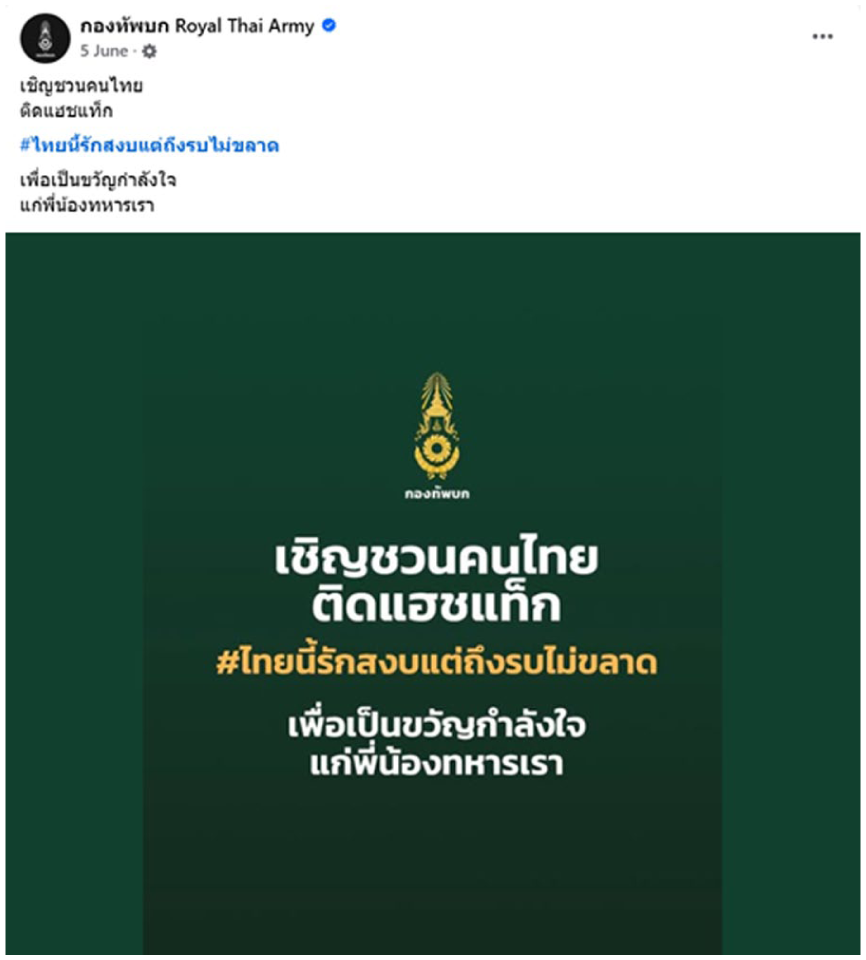
A Facebook post encouraging the use of the hashtag #ไทยนี้รักสงบแต่ถึงรบไม่ขลาด to support Thai soldiers during the Cambodia–Thailand conflict (Royal Thai Army, 2025).
For Cambodians, long groomed to perceive Thailand as their adversary, Don’t Thai to me reactivated entrenched ideology and fuelled the construction of a negative image of Thais. It reflects a linguistic warfare strategy that attacks not only those directly responsible for the conduct of armed conflict but also the entirety of Thai identity. The discourse cognitively reveals binary thinking embedded in the Cambodian worldview. While it constructs the perception that Thais are an out-group counterpart to the Cambodian in-group, it also represents an attempt to invert Thailand’s favourable self-image into a negative one, placing Thailand at a disadvantage in this discursive war context.
In the regional context, this discourse contradicts the ASEAN Community’s ideology, as expressed in the ASEAN Anthem: ‘ASEAN we are bonded as one . . . For peace, our goal from the very start and prosperity to last, we dare to dream, we care to share, together for ASEAN.’ By problematizing nationality, the discourse fragments regional identity and undermines ASEAN solidarity. Its use of ethnicity as a discursive target and a linguistic weapon during border crisis reflects the ideology of otherness and the paradox of ostensibly seeking to end the conflict while simultaneously reinforcing discrimination. Such practices disregard equality, expose underlying prejudice, and ultimately obstruct reconciliation. They also contravene international legal principles prohibiting border crisis propaganda, as enshrined in universally accepted norms.
Additionally, the ASEAN Charter states clearly that ASEAN was established to maintain peace, security, and stability while further strengthening peace-oriented values in the region (Article 1), and ASEAN shall not interfere in the internal affairs of member states (Article 2) (The Association of Southeast Asian Nations, 2008). In contrast, the Cambodian government’s discourse Don’t Thai to me, which reflects an attempt to communicate with global audiences and to draw external actors into the border crisis, not only contributes to constructing a sense of otherness but may also be interpreted as potentially misaligned with ASEAN’s purposes and principles, particularly those related to peace. This suggests a potential tension with the ASEAN Charter, which constitutes a fundamental agreement among ASEAN member states.
This circumstance aligns with Van Dijk’s (1998) idea of ideology as false consciousness or misguided belief, internalized through discourses encountered in the media and in everyday life (as discussed in the section Theoretical Background: Language, Thought, and Ideology of Otherness). In this regard, Don’t Thai to me illustrates how language use in linguistic warfare, mediated through mass communication, operates as a vehicle for the absorption and reinforcement of ideological beliefs, shaping public perceptions and consolidating the ideology of otherness.
Consolidating the leader’s authority and legitimizing violent retaliation
Courage is a desirable armed conflict attribute for leaders, necessary to command both the army and the populace. The discourse Don’t Thai to me was employed deliberately to project aggression towards the adversary, namely the Thai, and to express authority by signalling that the leader possessed power and was unafraid, despite the vast disparity in military strength between Cambodia and Thailand, a gap immeasurably wide.
Here, discourse functioned as a violent linguistic strategy, empowering the communicator with the authority to employ force and legitimate military retaliation in concrete terms. Framed as a struggle of ‘righteousness defeating evil,’ it positioned Thais as embodying malevolence, thereby justifying the communicator’s right to eradicate perceived evils or even to punish them without moral taint. This discursive framing is particularly reinforced by the deliberate fabrication of a positive international image of Cambodia. This reflects the view that discourse is a system of options from which language users make their choices to construct selective realities or reasonings (as discussed in the CDA section of Theoretical Background).
Given the great outreach of mass media, both state authority outlets and social platforms amplified that discourse, shaping public opinion and setting the agenda for international political debate (also discussed in the CDA section of Theoretical Background). An examination of the production and dissemination of the discourse reveals that the use of social media and official state news outlets was intended not only to consolidate domestic perceptions among Cambodians, but also to extend its reach to the international community and secure external support for the nation. In doing so, it sought to divert attention from the fact that Cambodia had initiated the violence and instigated the armed conflict. In this sense, Don’t Thai to me was employed as a means of constructing symbolic power for negotiation. Such actions may be characterized as border conflict propaganda, contravening international law.
Rather than a genuine account to communicate the realities of armed conflict between the two countries, the discourse was a tool for shaping perception and consolidating power. Moreover, the discourse fuelled violence rather than restraining it, contrary to the peace-oriented strategies that national leaders ought to adopt in times of conflict, as it cannot lead to the attainment of peace (compare Thailand’s opposite strategy discussed above). Its reproduction and extensive circulation by both the Cambodian state actors and citizens reflect the role of ‘audience as co-authors,’ who actively and jointly construct and produce the meaning of Don’t Thai to me within the border crisis context (Johnstone, 2018). This nationally inclusive rearticulation of the discourse is well reflected in its information–structural flow (as analysed in Results I: Text). As an outcome, the discourse engenders trust in the leader and legitimized the exercise of power and violence.
Conclusions
This study of the media discourse Don’t Thai to me addresses a significant gap of discourse studies in the Southeast Asian context, regarding the use of discourse as a weapon in times of international armed conflict. The three-dimensional CDA analysis demonstrates not only the pivotal disseminating role of online platforms as powerful channels but also highlights the value and centrality of the message itself as a key communicative resource. The findings further reveal the intricate relationship between language and thought from the perspectives of both sender and receiver, illustrating how these dynamics shape the reproduction of media discourse and reinforce social ideologies. At the same time, the hidden power embedded within discourse warrants exposure and critical reflection to promote informed awareness.
Ultimately, this study affirms that a contemporary border crisis is not confined to the use of physical force. Language itself constitutes a strategic communicative instrument and a potent weapon in the struggle for power and legitimacy. The practical implications are clear. The misuse of national identifiers is ethically inappropriate and obstructs peacebuilding and solidarity among nations. Such confrontational practices should be constructively circumvented through diplomatic negotiation and bilateral communication mechanisms—such as JBC and RBC—which serve as authoritative channels for dialogue, conflict management, and the de-escalation of discursive hostilities.
An additional unexplored dimension of the Cambodia–Thailand border crisis of 2025 concerns Thailand’s counter-discourse Stop Khmering, which surfaced in the aftermath of the ceasefire agreement on 31 July 2025. Although not officially articulated by national or military authorities, but by a minister, this discourse nonetheless represents the discursive battlefield of linguistic warfare. It reveals oppositional narratives constructed by the adversarial side and highlights the broader ideological contest underpinning the conflict. However, this phenomenon illustrates that, even amid an international armed conflict, the construction of counter-discourses by opposing parties constitutes an important strategic practice, one that generates a form of linguistic warfare operating in parallel with the physical battlefield where military hostilities occurred. Worth considering is that the patterns of discourse reflecting ethnic discrimination in South East Asia are not unique to Cambodia, but similar discursive practices can also be observed on the opposing side in this conflict.
Prospectively, future research could expand the scope of analysis by systematically comparing Cambodian and Thai linguistic warfare discourses, thereby clarifying how opposing narratives interact, compete, and co-construct ideological positions. Such comparative studies would not only enrich the field of critical discourse analysis but also contribute to practical understandings of conflict resolution, intercultural communication, and peacebuilding in Southeast Asia and at a global level.
Footnotes
Acknowledgements
An earlier version of this research was presented in an informal meeting among scholars in Linguistics, Communication Studies and Asian Studies on 8 September 2025 at the Faculty of Arts, University of Helsinki. The authors cordially thank the participants in this event as well as the anonymous reviewers for their feedback and suggestions, which contributed to the improvement of this research. The usual disclaimers apply.

Ethical considerations
This research involved no human subject and was exempted from ethical review by the Office of the Research Ethics Review Committee for Research Involving Human Subjects: The Second Allied Academic Group in Social Sciences, Humanities and Fine and Applied Arts at Chulalongkorn University (COA No. 206/68, issued on 14 May 2025).
Consent to participate
Not applicable.
Consent for publication
Not applicable.
Funding
This research was part of the project ‘Typology of authoritative language: Information building and knowledge dissemination’, funded by the Kone Foundation. Additional support for the completion of this article was provided by the Institute of Humanities at Seoul National University.
Declaration of conflicting interests
The authors declared no potential conflicts of interest with respect to the research, authorship, and publication of this article.
Data availability statement
No data were generated from this research.
Author biographies
Address: Department of Speech Communication and Performing Arts, Faculty of Communication Arts, Chulalongkorn University 254 Phayathai Rd, Pathumwan District, Bangkok, Thailand. Email: