



Abstract
Against a background of contemporary hyperconnected warfare and accelerating advances in drone/robotic systems, this article discusses the airborne drone in relation to concepts of surrender, both historic and contemporary, literal and metaphoric. Drawing upon Paul Virilio’s (2002[1991]) observation that, during the first Gulf War, ‘technologies employed are too powerful’, the author examines how continuing military aspirations for technological speed and lethality represent surrender to the lure of techno-power. Two incidents of human beings surrendering to drones, in Kuwait in 1991 and in Ukraine in 2023, anchor an exploration of literal and metaphoric surrender implications. This discussion is expanded through a military aviation history lens and an art historical perspective. The latter includes close visual and contextual analyses of James Rosenquist’s 1964–1965 painting F-111 and the author’s multi-piece 2022–2023 painting Ghost Bat.
Introduction: Drones, drama and surrender
The history of militarized airborne unmanned air vehicles (UAV) or drones can be traced from early 20th-century testing of radio-controlled aerial targets to non-weaponized uses during the Vietnam War (1955–1975), to multi-modal weaponized or weaponize-able 21st-century operations. The deployment by the US of surveillance and targeting non-weaponized Pioneer drones in the first Gulf War (1990–1991), however, marks a milestone event in human–drone relationality. This milestone occurred in February 1991 on Faylaka Island near Kuwait City when a group of Iraqi soldiers indicated to a Pioneer drone their desire to surrender (Deptula, 2021; The Smithsonian, National Air and Space Museum, n.d.b; United States Government, 1993: 9). Just over three decades after the first Gulf War, Russia attacked Ukraine (2022–). This war has seen an escalation in the development and use of military drones and militarized civilian drones, for an array of purposes from surveillance to lethal attack. In May 2023, in a bloodied battlefield, Russian soldier, Ruslan Anitin, indicated to a Ukrainian drone his appeal to surrender ( Wall Street Journal, 2023 ).
The 1991 milestone instance of human beings surrendering, from the ground upwards, to an unmanned remotely operated sky-based machine is a performative and hierarchical historical register of the power and powerlessness associated with machine-enabled asymmetric abilities. This performativity and the recognition of technological power was presciently observed by Paul Virilio in his contemporaneous commentary on the first Gulf War: ‘War is no longer a means but rather a drama. A major accident. The technologies employed are too powerful’ (Virilio, 2002[1991]: 33). Seen as acts in the performance-drama of war, the 1991 and 2023 surrender events are cues to understand how the airborne drone’s asymmetric effects cast ‘too powerful’ technologies into techno-utopic visions of military advantage and triumph. The corollary is the dystopic experience of people surveilled and attacked. As Alex Edney-Brown (2019: 1341) observes in her account of talking with people in Afghanistan, daily-felt fear of drones amounts to a ‘form of psychological colonization’.
Against a background of contemporary hyperconnected warfare and accelerating advances in drone/robotic systems, this article discusses the airborne drone as an emblem of military techno-aspiration and power projection that humanity has metaphorically surrendered to. Particular attention is paid to the promise of multi-modal capabilities, facilitated at signalic speed, in a hyper-networked multi-domain environment. Reliance upon frequencies in the electromagnetic spectrum (EMS) for signal-enabled connectivity, interconnectivity and interoperability of systems and devices, inserts lightspeed into a network-matrix where the drone is a sky-based multi-modal signal-transmitting and signal-receiving protagonist in the drama-accident of war.
To extract and expose the significance of technological multi-modality and speed, this article intersects Virilio’s ‘too powerful technologies’ with concepts of surrender and the drone as protagonist. Using an interdisciplinary approach, the article weaves theoretical concepts and commentaries on techno-warfare with military aviation history, art-historical perspectives, and reflections upon my own creative practice-led research. This unusual approach is offered as a way to understand how a range of experiences and beliefs about technology, from the utopic to the dystopic, can be revealed and examined through the analysis and stimulus of visual art. Given that concepts of utopia and dystopia are experienced, believed or dreamed by human beings and not drones, a key consideration for this article is human-to-drone relationality and concepts of surrender.
While discussed more fully in later paragraphs, I briefly introduce two paintings and their military aircraft subject-matter. Close analyses of each painting draw aviation and art history together in ways that help us examine and visualize links between Virilio’s notion of ‘too powerful’ technologies, surrender and airborne drones. The first painting is James Rosenquist’s monumental multi-piece F-111 (1964–1965), painted while the F-111 combat supersonic aircraft was under development. 1 Created nearly 60 years later, the second painting is my multi-piece Ghost Bat (2022–2023) (Figure 1), also painted during the MQ-28 Ghost-Bat drone’s development. While the airborne militarized drone is a focus of this article, Rosenquist’s painting provides a mid 20th-century aviation and art historical entry point. In the early 1960s, the crewed F-111 was considered a gamechanger, due to its innovative swing-wing design, and multi-role bombing and surveillance capabilities. Decades later, the Royal Australian Air Force (RAAF) and Boeing collaboratively developed MQ-28 Ghost-Bat drone, formerly the Loyal Wingman, is also considered a gamechanger, or ‘pathfinder’ (RAAF, n.d.). Like the F-111, multi-modality contributes to this status. Designed to accompany crewed fighter jets, the Ghost-Bat drone’s multi-role capabilities include advanced intelligence, surveillance and reconnaissance (ISR) systems, autonomous flying functions and artificial intelligence (AI) integration. It is also weaponizable.

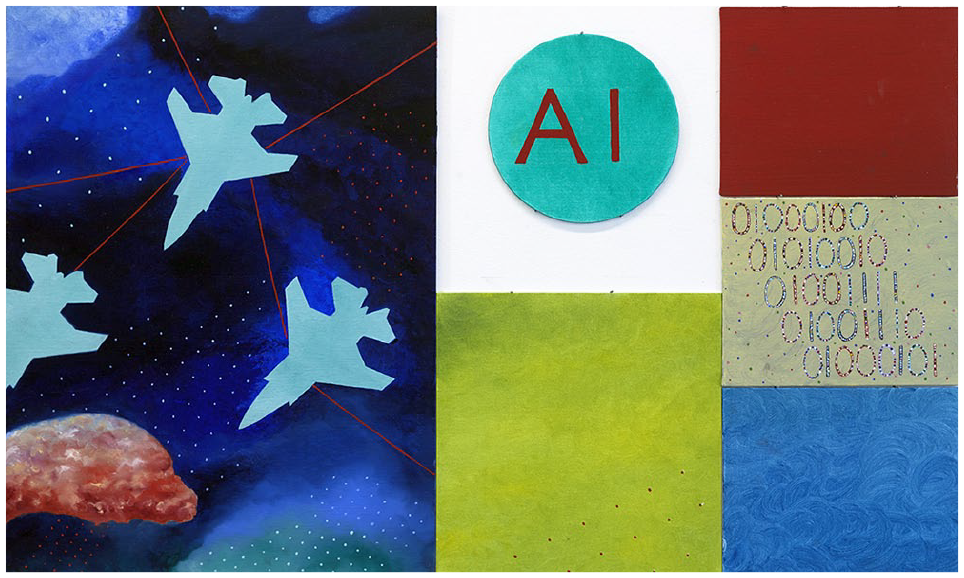
Kathryn Brimblecombe-Fox, Ghost Bat, oil on 30 canvas boards, 61 × 500 cm, 2022–2023. All photos: Rob Frith.
Power: Contagion
Promises of drone-enabled asymmetric advantage were put to the test in the second Gulf War (2003–2011). The US deployed larger numbers of drones, including weaponized Predator and Reaper drones. These drones coupled surveillance and reconnaissance capabilities with destruction and killing capabilities. This positioned multi-modality, delivered in a remotely operated machine, as another asymmetric advantage. However, since the second Gulf War, an increasing number of state and non-state actors have developed or acquired multi-role weaponized or weaponizable drones, deploying them in declared and undeclared battlefields. Drones and their related sensor capabilities are now proliferating across the globe, dispersing Virilio’s ‘too powerful’ technologies as pervasive examples of both aspirational advantage and mortal threat.
This dispersal of ‘too powerful technologies’ is multi-fold, perpetuated via material devices and the electromagnetic signalic systems that enable these devices to connect, interconnect, operate and interoperate. The combination of invisible signals, proliferating militarized drones and militarizable civilian drones, and material infrastructure such as space-based and ground-based assets, creates latent global swarm-ability via potentially interoperable systems. This latency harbours underlying violence that exists, as Caren Kaplan (2018: 213) observes, in an environment of ‘stacked verticality and volumetric spatialization’. Scoping technologies, such as electro optical/infrared (EO/IR) sensors and AI-assisted RADAR systems, use electromagnetic frequencies to collect data to assist anomaly and target identification. Electromagnetic frequencies are then used to transmit information and instructions across and around the volumetric earth-to-orbiting satellite environment. I describe this environment as a techno-colonized landscape, occupied by not only material infrastructure, but also invisible signals that enable connection, interconnection and interoperability across infrastructure (Brimblecombe-Fox, 2023).
Jean Baudrillard (2003) made an observation in The Spirit of Terrorism that sheds light on the underlying violence harboured by global military and security systems geared to both harness and counter ‘too powerful’ technologies. He observes that ‘globalised violence is viral: it operates by contagion, by chain reaction, and it gradually destroys all our communities and our power to resist’ (p. 94). Latent global swarmable-like systems now provide pathways for violence via signal-enabled connectivity, interconnectivity and interoperability across infrastructure. In our contemporary hyperconnected world where Kaplan’s (2018) conception of ‘volumetric spatialization’ expands with proliferating multi-modal technologies and multi-domain warfare, Baudrillard’s suggestion that violence operates by ‘chain reaction’, however, needs to be replaced with ‘mesh reaction’. This ‘mesh reaction’ is multi-planar and volumetric, bolstered and layered by new modes of warfare that insert increasing complexity and speed into traditional kinetic war operations.
New modes of warfare, for example, cyber, information and hybrid warfare, are not only enabled by electromagnetic connectivity and interconnectivity, they also rely upon it. Cyber and information warfare can be perpetrated via signals transmitting data, instructions, computer viruses, disinformation, deepfake media, and more. Invoking Baudrillard (2003), the networked or interconnected system could be described as both the contagion as well as the transmitter of contagion. This presents another example of multi-modal capabilities, perhaps unintended, but attractive for opportunistic manipulation. Matthew Ford and Andrew Hoskins (2022: 17), in Radical War: Data, Attention, Control, make a comment that points to the insidiousness of multi-modality in a digital world; ‘Smart devices become both a way to represent war and a node in its practice.’ By connecting digital representation of war and practice of war, the authors reveal how violence can be transmitted and conducted overtly and insidiously, wittingly and unwittingly, via connected devices. This is ‘radical war’.
Baudrillard’s comment that globalized violence destroys ‘our power to resist’ provides insight into ‘radical war’s’ reach via the arrays of smart devices we wear, hold, drive in and work with. Due to reliance upon them, we have surrendered to technology-driven capabilities that wield power we cannot now resist. The Iraqi soldiers surrendering to a sky-based machine in 1991 augured both the lure and threat of the ‘too powerful’ technologies Virilio cast into the drama-accident of war. If the Iraqi soldiers are viewed as metaphorically representing the human species, the supplication and capitulation to ‘too powerful’ technologies have been normalized during the ensuing three decades. Anitin’s surrender to a Ukrainian drone, therefore, becomes a visible and performative reminder of human acquiescence to what Antoine Bousquet, Jairus Grove and Nisha Shar describe as war’s continuous ‘elusive becoming’ (Bousquet et al., 2020). This becoming, I propose, is now propelled by the destruction of ‘our power to resist’. This destruction, however, is multi-fold, extending from inabilities to resist erosive and violent confrontation by ‘too powerful’ technologies to our inabilities to resist the lure of ‘too powerful’ technologies.
The horror of war, or as Virilio might claim, the accident of war, is that the destruction of our power to resist both the confrontation and lure of ‘too powerful’ technologies holds us hostage to war and its spawning iterations (Virilio, 2002 [1991]: 33). This article’s close critical attention to two paintings, neither reliant on digital, cyber, or connected technologies, is offered as a form of resistance.
F-111
To extrapolate the idea of surrender as an avenue to understand the tension between the confrontation and lure of ‘too powerful’ technologies, I turn to art history as an analytical method of critical and visual disclosure. Three decades before the 1991 surrender event in the Kuwait desert, Rosenquist created his massive 304.8 × 2621.3 cm 59-piece painting, F-111 In the early 1960s, against a backdrop of the Cold War, the Vietnam War and the Space Race, the F-111 combat aircraft constituted a projection of US technological power. Its first test flight was in December 1964, and it was delivered to the United States Air Force (USAF) in 1967 (Lockheed Martin, 2020). A side-view of the aircraft extends along the 26-metre length of Rosenquist’s painting, and its chassis fills the artwork’s 3-metre height. The aircraft’s tail appears to extend beyond the painting and its wing seemingly projects into the surrounding space. The dimensions of Rosenquist’s painted F-111 are a near match to the aircraft’s size. This monumentality captures the lure of technological power, the sheen of technical innovation and the force of militaristic vigour. Rosenquist, however, interrupts the F-111’s reverie of power with seemingly discordant scenes of post-Second World War US consumerism and the burgeoning military–industrial complex of the Cold War and Vietnam War period.
When Rosenquist first exhibited F-111 at the Castelli Gallery in New York in 1965, the painting wrapped around the gallery’s four walls, leaving a space for a doorway (Castelli Gallery, 1965). The painting also filled the gallery’s three-metre-high walls. This encompassing installation achieved Rosenquist’s desire for viewers to feel they were ‘inside the painting’, sensing that something was happening in their peripheral sight (Rosenquist and Dalton, 2009: 155). I note here that this is a different experience to contemporary virtual reality immersion, where headsets elide the viewer–participant’s physical environment. The effect of something happening in peripheral sight was accentuated in F-111 by the interspersion of the seemingly discordant scenes painted in sections along the aircraft. These include images of underwater bubbles, a cake, a new Firestone tyre, lightbulbs, a young girl sitting under a hairdryer, an atomic bomb mushroom cloud behind a beach umbrella, and close-up ‘fields’ of tinned spaghetti. While Metropolitan Museum of Art curator, Henry Geldzahler (1968: 280), commented in 1968 that these visual elements ‘are to an extent problem pictures, there are no correct answers’, Rosenquist, in his autobiography, makes a remark that helps explain their presence. He wrote, ‘In F-111 I used a fighter bomber flying through the flak of consumer society to question the collusion between the Vietnam death machine, consumerism, the media and advertising’ (Rosenquist and Dalton, 2009: 158).
Rosenquist’s aim, when he first exhibited F-111, to make viewers feel they were inside the painting is more than partially achieved in its current ongoing exhibition at the Museum of Modern Art (MOMA), (2022, ongoing), New York. I visited MOMA, to see and be with F-111, in 2023 and 2024. At MOMA, the painting is wrapped around three walls but does not extend from floor to ceiling. However, as I turned back and forth to take in the expanse of the painting, it became clear that keeping elements in one’s peripheral vision is still achieved. This effect keeps the viewer moving around the gallery and the painting, up close, and from a distance. When I sat on the bench in the middle of the room, I also felt the urge to keep swivelling, to take in the painting’s enormity and detail.
Rosenquist’s comment about the ‘collusion between the Vietnam death machine, consumerism, the media and advertising’ indicates his shrewd engagement with several precursors of 21st-century war. These precursors include the lure of speed, the role of war-pitched politics, the military–industrial complex, media influence and the rise of consumerism. While speed is not an obvious issue in Rosenquist’s F-111, the F-111 aircraft was an outcome of 1950s–1960s military aviation research and development aims to fly at the speed of sound. In 1947, the Bell X-1 was the first aircraft to fly supersonically (The Smithsonian, National Air and Space Museum, n.d.a). Further developments in supersonic flight were achieved during the 1950s, and in 1962 General Dynamics won the contract to design the multi-role strike and reconnaissance supersonic F-111 (Lockheed Martin, 2020). In November 1966, the F-111 ‘set a record for the longest low-level supersonic flight’ (Lockheed Martin, 2020).
Rosenquist’s use of the word ‘flak’ to describe his F-111’s flightpath through portrayals of consumerism and violence is clever because ‘flak’ is a military term for anti-aircraft fire (Brimblecombe-Fox, 2023: 51). Notably, he also describes his fields of glutinous spaghetti as ‘flak’ (Rosenquist with Dalton, 2009: 158). It is obvious, however, that Rosenquist’s F-111 aircraft is not destroyed by consumer society ‘flak’ or spaghetti ‘flak’. Equally the aircraft has not destroyed consumer society or the spaghetti, although the spaghetti could be interpreted as entrails, collateral damage, or contagion. The inference is that the bourgeoning 1960s military–industrial complex, the growing influence of the media, escalating consumerism and war, are mutually beneficial. President Dwight D Eisenhower’s (1961) warning in his 1961 farewell speech provides contemporaneous context for Rosenquist’s politically charged painting.
In the councils of government, we must guard against the acquisition of unwarranted influence, whether sought or unsought, by the military–industrial complex. The potential for the disastrous rise of misplaced power exists and will persist.
In F-111, Rosenquist painted the aircraft to represent a pinnacle in Vietnam War and Cold War era military aviation prowess and power. The interspersed scenes imply acquiescence to, and reliance upon, the development and power of technologies supported, wielded and proliferated by the military–industrial complex. Perhaps, wanting viewers to keep elements of the painting in peripheral sight can be ‘read’ as an attempt to warn the public and to hold authorities to account.
In 1968, Geldzahler poses a question about F-111, followed by an appraisal: ‘Will its impact last? For the moment the painting makes a big statement and makes it convincingly’ (Geldzahler, 1968: 281). The question about lasting impact is answered by F-111’s current ongoing exhibition at MOMA, where it continues to provoke questions about human relationships with technologies of war. The most violent interspersed painted scene is the depiction of a colourful umbrella superimposed over an atomic bomb mushroom cloud. Rosenquist painted U.S. AIR FORCE across the scene in a way that denotes both the F-111 and the atomic bomb as military pursuits, emboldened activities of technological progress. The umbrella represents the absurdity of people travelling to Utah resorts where 1950s nuclear bomb tests in neighbouring southern Nevada were marketed as tourist attractions (Rosenquist and Dalton, 2009: 159). The umbrella signifies naivety and futility in the face of nuclear threat and proliferation. Futility is enhanced if the spaghetti-sky, above the umbrella and nuclear cloud, is interpreted as mushrooming radiation, an atmospheric form of both disembowelment and contagion. Thirty years before Virilio’s observations of war and ‘too powerful’ technologies, Rosenquist’s depiction of a nuclear bomb mushroom cloud, juxtaposed with a ‘gamechanger’ military machine, resonates with prescient alarm.
I turn now to Rosenquist’s beguiling depiction of a smiling young girl with a hairdryer placed over her head. Rosenquist described her as ‘really the pilot of the plane, just as middle-class society was really the momentum behind the plane’ (Rosenquist and Dalton, 2009: 160). Rosenquist’s criticism about wealth generated by the production of the ‘death-dealing’ F-111 is implicit. Significantly, he provides two metaphorical readings of the hairdryer; a pilot’s helmet and a bomb (Rosenquist and Dalton, 2009, 160). He has also painted the word QUEEN on the hairdryer-helmet-bomb’s front. This elicits multiple possible interpretations, for example, the practice of writing call-signs and names on military aircraft, pilots’ helmets, and even bombs. It also suggests that the pretty child could be a prom queen when she is older (Brimblecombe-Fox, 2023: 122). Thus, maybe the hairdryer-helmet-bomb is also a Prom-Queen crown? This interpretation of the word QUEEN reinforces Rosenquist’s critique of white middle-class dreams of military-industrial-generated prosperity and privileges.
In our contemporary era of airborne drones, remote piloting, autonomous flying functions and increasingly interoperable systems, Rosenquist’s F-111 child-pilot still provokes questions about who or what is piloting militarized and militarize-able uncrewed aircraft (Brimblecombe-Fox, 2023: 122). Broader questions about ‘piloting’ as a metaphor for command and control in an era of accelerating technological advances, rapidly shifting geo-politics, autonomous systems, and new modes of war, are also prompted. The young girl’s sideway gaze gives the impression that even though she is the ‘pilot’, instructions are coming from elsewhere. If considered as a bomb, her hairdryer indicates that power is both destructive and coercive. Eisenhower’s (1961) warning that the military–industrial complex harbours the ‘potential for the disastrous rise of misplaced power’ looms as a forewarning.
Speed-bomb
If Rosenquist’s painted hairdryer-helmet is considered a visual metaphor for a bomb, what happens if speed is metaphorically considered a bomb? I propose that if it is a ‘bomb’, it has been continuously ‘exploding’ since Virilio’s (2002[1991]: 41) claim that the first Gulf War was a ‘war at the speed of light’. However, the issue of speed and its global blast site, affecting geostrategy, power balances, technological operations and development, has caught militaries and defence departments off guard. This is indicated, for example, in the urgency underpinning the Australian Government’s (2023) public version of the National Defence Strategic Review (DSR), where a ‘rapidly evolving strategic environment’ is considered alarming (p. 21). Failure to keep pace in this environment is evident in a frank statement that the Australian Defence Force (ADF) ‘as currently constituted and equipped is not fully fit for purpose’ (p. 7).
David Kilcullen’s appraisals of irregular and unconventional contemporary warfare provide insights into dilemmas faced by militaries and defence departments around the world. In 2023, he noted that irregular warfare ‘involves both state and non-state armed groups and seeks to influence populations and perceptions’ (Kilcullen, 2023: 167). His ensuing extrapolation of hybrid threats makes it clear why militaries are scrambling, because hybrid threats, involve a mix of traditional, re-purposed and advanced technologies (including, potentially, weapons of mass destruction) and seek to saturate an entire operating environment, forcing opponents to react to multiple simultaneous threats. The aim is simultaneously to create economic instability, foster lack of trust in existing governance, attack information networks, cause humanitarian crises and physically endanger opponents. (p. 167)
With Kilcullen’s words in mind, Ford and Hoskins’ (2022: 27) insight that the ‘use of violence is not exclusively under the control of the state or the military’, reiterates that militaries and defence departments face complex dilemmas that threaten both sovereignty and global order.
Ford and Hoskins’ observation that ‘political violence gains meaning in a 24/7 always online environment’ adds to the complexity of contemporary threats (Ford and Hoskins, 2022, 27). Here, signalic lightspeed (or near lightspeed) 24/7 connectivity perpetuates Baudrillard’s (2003: 94) observation that ‘globalised violence is viral: it operates by contagion.’ Antoine Bousquet’s (2023) conceptualization of 21st-century chaoplexic warfare offers an additional lens to examine the dispersal of control and violence, again underpinned by EMS-enabled always-on lightspeed environment. As he notes, chaoplexic warfare is characterized by multifarious ‘new orders of battle’ that incorporate autonomous systems, swarming, and advanced cyber capabilities operating at the ‘speed of light’ (p. 235). Bousquet also observes that ‘spiralling interactions’ of multiple capabilities produce ‘non-linear effects’ that are ‘inherently unknowable’, partially due to ‘speeds and scale far exceeding human comprehension’ (p. 236). Considered together, Kilcullen’s, Ford and Hoskins’, and Bousquet’s observations highlight that contemporary war’s multi-domain characteristic is enhanced by layered state and non-state agents equipped with multi-model technologies. This reinforces my argument that Baudrillard’s ‘chain reaction’ needs to be replaced with ‘mesh reaction’.
As spiralling, non-linear, and incomprehensible aspects of chaoplexic warfare encroach and engulf, Rosenquist’s F-111 foreshadows the need to keep orienting peripherality in sight. His aim to surround the viewer, to keep aspects of the painting visible in their peripheral vision, provides a lesson that may help mitigate a loss of vision that plunges us into Bousquet’s observation of the ‘inherently unknowable’. This mitigation is particularly important if we consider Kaplan’s (2018: 213) description of a ‘stacked verticality and volumetric spatialization’. To traverse this environment, to see and feel it, maybe we need to slow down? From mid 20th-century military aims to exceed the speed of sound, to 21st-century military aims to harness the speed of light, speed has been an increasingly insidious driver of civilian and military technological development. Ironically, however, speed blinds us to the effects of speed (Brimblecombe-Fox, 2024b). This is particularly so when signalic speed exceeds human dimensions of speed, and therefore time. As Virilio (2012: 36–37) warned, the ‘faster we go, the more we look ahead in anticipation and lose our lateral vision.’ The panacea of speed induces an insidious kind of scopic survival training that annihilates relationality, laterality and peripherality, eliding the kind of contemplative broad enquiry Rosenquist asked of his viewers. Is this insidious scopic survival training a sign of unwitting surrender to speed, an effect of its ongoing explosion?
Insidious scopic training could be considered an instinctive survival quest to maintain orientation, to avoid a sense of spiralling or falling when speed exceeds human perception. Artist, Hito Steyerl (2011) in her provocation, ‘In Free Fall: A Thought Experiment on Vertical Perspective’, offers clues for why scopic ‘looking ahead’, in anticipation, may seem redemptive and strategic, but also desperate (Steyerl, 2011). Anticipatory ‘sight’ presumes a forward-looking linear perspective. However, what if this presumption is a fallacy, an illusion that conceals the ‘non-linear effects’ Bousquet posits? What if presumption and illusion mask free falling, where, as Steyerl suggests, our ‘sense of orientation may start to play additional tricks’, the main ‘trick’ possibly being the presumption of forwardness, both in movement and time.
Steyerl proposes that free fall trickery shatters ‘traditional modes of seeing and feeling’, disrupts ‘any sense of balance’ and twists and multiplies perspectives (Steyerl, 2011). Here, William Merrin and Andrew Hoskins’ recent (2024) conceptualization of contemporary war as ‘sharded war’ echoes the shattering, twisting, and multiplication Steyerl posits. Merrin and Hoskins describe sharded war as ‘split, splintered, fractured, streamed, personalised, and shattered’. Bousquet’s chaoplexic warfare of ‘spiralling interactions’ at ‘speeds and scale far exceeding human comprehension’ also conceptually intersects with Steyerl’s (2011) proposition that free fall causes horizons to quiver in a ‘maze of collapsing lines’.
Steyerl also proposes that free fall causes a loss of ‘any sense of above and below, of before and after’ (Steyerl, 2011). Here, she alerts us to speed’s removal of both geography and time as orientations and signposts. This kind of speed-bomb disruption is reflected in the Australian DSR’s identification that in the ‘contemporary strategic era, we cannot rely on geography or warning time’ (Australian Government, 2023: 24, 25). The reason for this is because, in an age of spawning new modes of digital, cyber and electromagnetic-enabled warfare the ‘threat of the use of military force or coercion against Australia does not require invasion’ (p. 25). In response, the DSR urges rapid deployment of ‘accelerated warfare’ and ‘accelerated military preparedness’ programmes (pp. 75–84). Here, the lure of speed combines with aspirational future capabilities and readiness, potentially reinforcing and normalizing the type of scopic training that elides laterality and peripherality. While militarized imaginations weaponize the future, current wars in Ukraine and the Middle East, however, remind us that kinetic warfare, combined with new technologies and irregular modes of warfare, remains deadly.
Surrender 1991 and 2023
What can the surrenders of Iraqi soldiers and a Russian soldier, over 30 years apart, tell us about the speed-bomb blast site of ongoing ‘becoming’ war? While difficult to find and verify images or footage of the 1991 surrender by Iraqi soldiers to an airborne drone, a 1993 US government report on the first Gulf War verifies that ‘Iraqi troops actually attempted to surrender to a UAV loitering over their position’ (United States Government, 1993: 9). In 2023, Ukrainian drone footage, released publicly, shows a curated portrayal of Anitin’s surrender to what appears to be one of possibly two Ukrainian militarized and/or weaponized civilian drones used in a preceding deadly battle (Wall Street Journal, 2023). Whether the footage’s release is news, public relations, or propaganda, an analysis of Anitin’s surrender reveals poignant insights into human–drone relationality.
Viewers of Anitin’s surrender witness his pleas for life, as he gazes and gestures upwards toward the sky-based drone. Viewers also witness the Ukrainian drone turn from tracker-hunter to saviour. Anitin’s facial, hand and arm gestures, combined with the remote pilot’s instructed nodding and shaking movements of the drone, mark a strange performance in human–machine communication. One significant difference between the 1991 and the 2023 surrender events is that asymmetric effects of hierarchical power and powerlessness have been extended from designated military drones to militarize-able civilian drones. Both surrender events, however, cue us to think about how the upward human gaze to a sky-based robotic machine can act as a metaphor for a more general notion of surrender to ‘too powerful’ technologies that are militarized or militarize-able.
The use of civilian drones in warfare demands questions about the militarize-ability of civilian technology in a connected and interconnected world of irregular, hybrid and multi-domain warfare. The Ukrainian drone footage triggers questions about how quickly and easily civilian drones can be militarized. Rather than recording soaring landscapes of the kind favoured by civilian drone enthusiasts, the Ukrainian footage shows a wretched record of death, destruction, human frailty and resilience. It shows one man’s desperate plea for his life as he peers, like the Iraqi soldiers did decades before, upwards to the sky. While a human being remains in/on the decision-making loop, remotely watching through the drone’s imaging sensors, empathy in war is still possible. This is indicated by a quote from the Ukrainian drone pilot, recorded in a later interview, ‘I felt pity. Despite that he is an enemy, even though he has killed our boys, I still felt sorry for him’ (Wall Street Journal, 2023).
Watching the Ukrainian video, the viewer witnesses from a double-bind vantage point of both the drone pilot and the drone, one human, the other nonhuman. Both vantage points are from above. The viewer witnesses the action, but this is interpolated with how the drone pilot and the drone’s sensors also witnessed the scene. This interpolation intersects with Michael Richardson’s (2024) incisive concerns about ‘how nonhuman entities and processes engage and enfold human experiencing and witnessing’ (p. 45). While there are many questions about the Ukrainian incident, a key one is, what if the drone had autonomous flight, data parsing and target identification functions? Anitin, unlike the Iraqi soldiers (Deptula, 2021) who had white flags, did not have anything white with him to wave as a sign of surrender. Thus, the universally understood sign of surrender was not available to him. A fully or partially autonomous drone would need imaging sensors and AI parsing capabilities that could not only detect, but also recognize Anitin’s gestures of surrender, of seeking reassurance and acquiescence before detention by ground troops. Without white flags, how gestures of surrender are made are likely to vary from person to person, situation to situation.
If the Ukrainian drone Anitin surrendered to had had autonomous functions, operative speeds may have meant that he, an enemy combatant in an immediately recent battle, could have been killed before his gestures were correctly interpreted. Correctness assumes a targeting system’s programming would include information about human, legal, situational and cultural nuances of surrender. Anitin may have ended up as one of the corpses the viewer sees him clamber over, as he followed the drone to the Ukrainian ground troops who apprehended him. The corpses of his comrades, and Anitin’s gestured pleas for life, graphically remind us that, in war, human beings will always stay in/on the loop – as victims (Brimblecombe-Fox 2024a, 108).
Ghost Bat
Rosenquist’s F-111 inspired my multi-piece painting Ghost Bat (2022–2023), a visual examination of the MQ-28 Ghost-Bat drone, Australia’s first military aircraft in over 50 years (Boeing, n.d.). The drone contributes to military aspirations for reignition of sovereign manufacturing capabilities. Its significance as a future ADF asset is clear in its specific mention in the DSR (61,105) and subsequent 2024 publications, the National Defence Strategy (Australian Government, 2024b, 40) and the Integrated Investment Program (Australian Government, 2024a, 20). The drone is ‘designed to fly autonomously alongside crewed aircraft, including fighter jets’, potentially in numbers (Boeing, 2021, 6). Thus, the Ghost-Bat drone could be considered swarm-able. With its interchangeable nose cones enabling multiple payloads and capabilities across a group/swarm of drones, the MQ-28 Ghost Bat represents advanced multi-role technologies, including autonomous functions. Its first test flight was in 2021, and its introduction is pending.
While my painting is not as large as F-111, it is proportional; about a fifth of the size and half the number of pieces. 2 Unlike F-111, Ghost Bat’s pieces can be rearranged. There are many reasons why I planned for possible rearrangement each time Ghost Bat is exhibited, or even during an exhibition. Physically moving pieces provides a deliberate contrast to digital media, where copying and pasting with finger, curser, or AI manipulation, allow quickly rearranged or re-presented images. Physical rearrangement of Ghost Bat’s pieces stimulates thoughts about human physical and cognitive mobility in a world of lightspeed-enabled interconnected multi-role technologies and multi-domain warfare. It draws attention to, and contrasts with, the beyond-human realms of technological connectivity, interconnectivity and interoperability, into what Ford and Hoskins (2022: 18) refer to as ‘planetary-scale computational infrastructures’. These infrastructures, in turn, influence rapidly changing geopolitics, as they facilitate appropriations of civilian technologies and domains for irregular warfare purposes. Physical rearrangement of Ghost Bat’s pieces offers opportunities to slow down, to mitigate free-falling, to pay attention to – and engage with – peripherality and laterality.
Unlike Rosenquist’s F-111 aircraft, the large blue Ghost-Bat drone in my painting does not extend the length of the work (Figures 1 and 3). Rather, its hovering frontally faced fuselage is painted on one moveable piece, confronting viewers. Without the aid of digitally simulated movement, the hovering drone seems to lift viewers to an elevated position. Viewers could imagine being another drone, or the pilot of a friendly or enemy crewed fighter jet, or perhaps the moon, a mythological creature, or a photon. This suggested array of imagined entities shifts viewer perspectives, providing a way to think about Richardson’s incisive quest to understand ‘how nonhuman entities and processes engage and enfold human experiencing and witnessing’ (Richardson, 2024: 45).
The visual confrontation between the painted Ghost-Bat drone and viewers poses questions about power structures embedded in increasingly normalized hierarchies that are scaffolded by martialized downwards vertical drone-sensor scoping. The video footage of Anitin’s upwards plea for surrender is an example of these hierarchies in action. When the Ukrainian drone operator reaches a decision to turn the drone from a scoping-warfighting-killing machine to an implement of salvation, the drone ‘performs’ both operational and metaphoric power. This power is enmeshed with its electromagnetic connectivity, embedding Virilio’s ‘too powerful’ technologies into Ford and Hoskins’ (2022) conception of ‘planetary-scale computational infrastructures’ that disseminate, parse and archive Anitin’s plea for life.
The upward gaze of human beings surrendering to airborne drones in war zones stimulates questions about civilian drone light shows, increasingly used as replacements for fireworks. Unlike fireworks, however, if viewed from above, a drone light show is unlikely to be entertaining or aesthetically coherent. People watch drone light shows, their faces upturned in wonder at choreography designed for ground-based viewing. Is surrender to air-based robotic techno-power insidiously normalized via this kind of entertainment or cultural activity? Kaplan (2024), commenting on drone light shows, poses similar questions, noting that drones, even used for entertainment, are ‘part of the transnational workings of everyday militarisms’ (p. 110). More broadly, Richardson’s (2020: 2) question, ‘What happens when the unmanned aerial system becomes part of the everyday?’ is searing.
While spectacular, drone light shows are swarms of drones, choreographed to gain and maintain human attention. The technical innovation in designing them is impressive, and potentially of military interest. Although fireworks share a history with gunpowder and, therefore, military or insurgent activities, it is worth noting that drone swarming technologies are considered potential force multipliers by the military. In an interconnected world, another question is, could a civilian drone light show be appropriated by state or non-state actors, via signal interference or appropriation, to turn from entertainment to weapon?
With swarming in mind, my painting Ghost Bat features a scene depicting three night-vision green Ghost-Bat drones in flight (Figure 2). The viewer’s positionality can be multi-perspectival, at one instant ‘flying’ above the drones, and the next instant, ‘flying’ around and below them. From above, around, and below, an occupation of the sky is evident, not only by the drones, but also lines and dots that visualize normally invisible signalic and digital infrastructure. This imaginational ‘flight’ around the drones turns veillance, or what I call ‘imaginational metaveillance’, back onto them and the militarized system (Brimblecombe-Fox 2024a, 2024b). Imaginational metaveillance is a creative and critical method of scrutiny that does not require digital or cyber-enabled simulation or augmentation tools to ‘see’. Multi-perspectival viewing in imagination disrupts hierarchies implicit in the distance between martialized downwards vertical drone scoping and the upwards vertical gazing of human acquiescence, surrender and awe. Because imagined perspectival oscillation, stimulated by a painting and imaginational metaveillance, does not rely on connected or interconnected technologies, an independent re/over/view of human–drone relationality is possible. Like Rosenquist’s desire that viewers of F-111 keep elements in peripheral view, I attempt to provoke and inspire imaginational flight as a way for viewers to also keep literal and metaphoric peripheries in sight. Painting, here, is a deliberate resistance.
Detail. Kathryn Brimblecombe-Fox, Ghost Bat (2022–2023), oil on 30 canvas boards, 61 × 500 cm.
Unlike Rosenquist’s F-111 aircraft, the Ghost-Bat drone in my painting does not include images that overlap the aircraft. Rather, the visually unobstructed single drone conveys the increasingly central techno-colonizing role that drones play in our contemporary world. The array of various other painted pieces that make up the rearrange-able painting offer multiple visual metaphors of our digital world, including signal-enabled connectivity, interconnectivity and interoperability. Painted pixel-like squares reference digital-imaging capabilities, from drone sensor imagery, to virtual reality, to AI-generations. To make visible the underlying role algorithms play in contemporary civilian and military technology, painted colourful binary code ‘instructing’ the word DRONE appears on one small piece (Figure 2). This represents a deliberate political aesthetics of resistance to codification.
Ghost Bat also includes scenes that act as visual foils, or counter-protagonists, to my painted spoofs of digital technology. One piece depicts a red tree and its red ‘shadow’, painted against a night-vision green background (see Figure 3). The red and green mimic colours generated on the screens of infrared scoping technologies. However, the tree can be interpreted as the age-old transcultural/religious tree-of-life symbol. The colour red insinuates blood and sap, thus representing human, non-human animal and plant life. Given the context of the tree within an array of images depicting militarization, perhaps the tree’s ‘shadow’ is not a shadow, but the flow of blood due to injury? The tree represents life, its resilience and potential loss, thus metaphorically keeping life in peripheral vision.
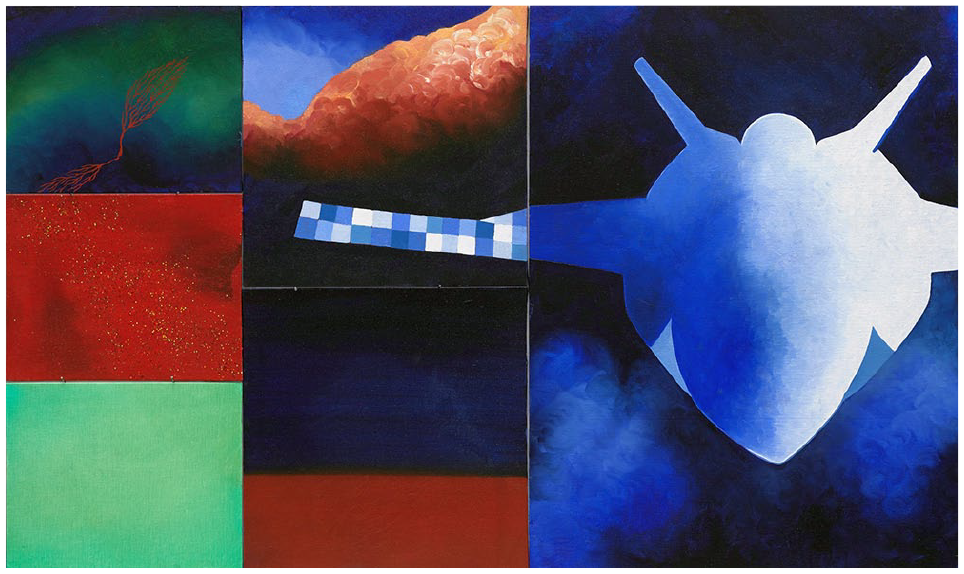
Detail. Kathryn Brimblecombe-Fox, Ghost Bat, oil on 30 canvas boards, 61 × 500 cm, 2022–2023.
I have also included two pieces depicting the Australian carnivorous mammal, the Ghost Bat, after which the MQ-28 Ghost-Bat drone is named (Figures 4 and 5). Multiple question marks, ‘instructed’ by painted binary code, cover one of these mammals (Figure 4). This is a provocation to ask questions about a plethora of issues associated with contemporary militarized technologies, particularly human tendencies to animalize and anthropomorphize technology. These tendencies, I argue, predispose us to beliefs about human–machine relationships that undermine caution and hasten surrender. The issue of anthropomorpization is gaining attention. For this article, James Johnson’s (2024) recent remark is pertinent: In war, perceiving an AI agent as having human-like qualities has significant ethical, moral, and normative implications for both the perceiver and the AI agent. Attributing human characteristics to AI, explicitly or implicitly, can expose soldiers in hybrid teams to considerable physical and psychological risks.
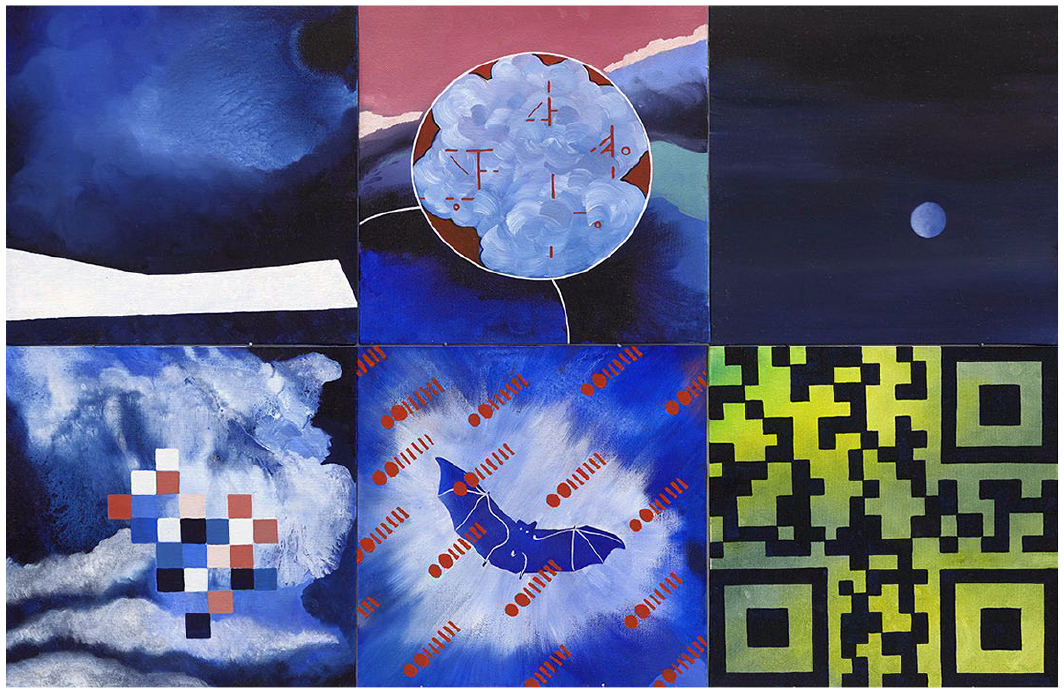
Detail. Kathryn Brimblecombe-Fox, Ghost Bat, oil on 30 canvas boards, 61 × 500 cm, 2022–2023.
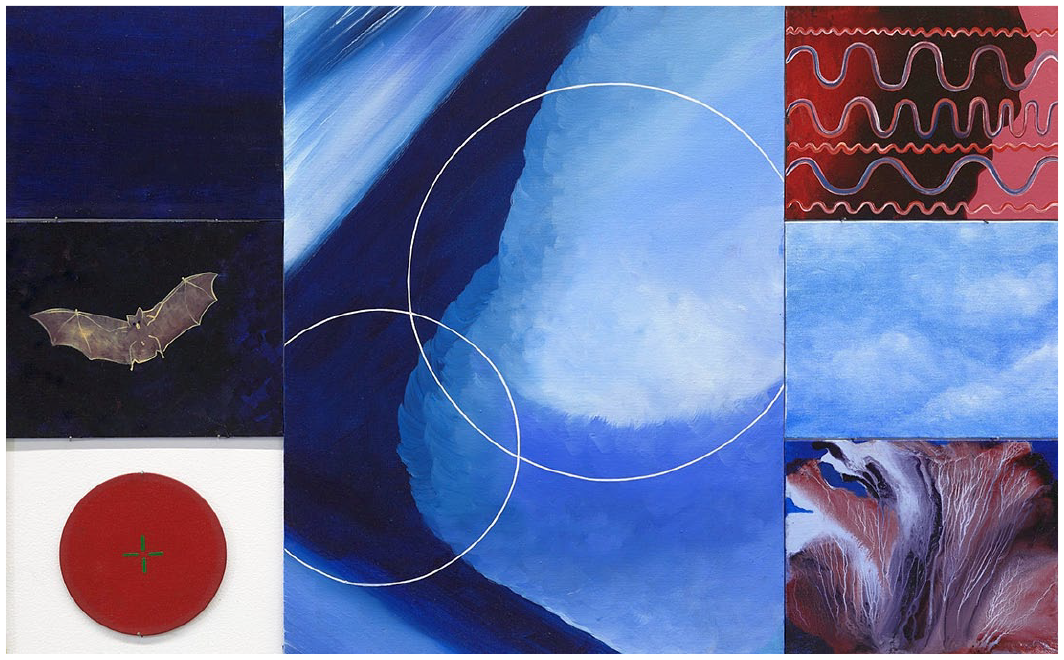
Detail. Kathryn Brimblecombe-Fox, Ghost Bat, oil on 30 canvas boards, 61 × 500 cm, 2022–2023.
In Ghost Bat, instead of an anthropomorphized or animalized character to portray the drone’s autonomous piloting capabilities, I have simply painted ‘AI’ in red on a night-vision green circular piece (Figure 2). The circle echoes Rosenquist’s rounded hairdryer-helmet-bomb, but without a human head. This visually channels contemporary scientific and military research for protection through concepts such as human–machine alignment, trusted autonomy, and responsible AI. The red ‘AI’ on night-vision green visually resonates with the red tree-of-life painted on night-vision green. The tree represents aliveness, the ‘AI’ represents mimicry of life. While the young girl in Rosenquist’s F-111 appears to be receiving ‘piloting’ instructions from somewhere else, my painted AI ‘pilot’ provides no immediate visual clues to how instructions are received. There are, however, hints dispersed across the painting. For example, circles visualizing the techno-cloud or the Internet of Battlefield/War/Military Things (IoBT, IoWT, IoMT), and wavy or straight lines indicating signals, represent interconnectivity, and therfore, the transmission of data and instructions (Figures 2 and 5).
The painted AI in Ghost Bat, like Rosenquist’s child-pilot, questions who or what controls not only the aircraft, but also the military–industrial complex. Who or what are we meant to trust when developers’ techno-utopic aspirations are encoded in hyped claims of progress in technologies that operate beyond human dimensions of speed and time? Here, the quick response (QR) code is an example of rapid – and purportedly trustworthy – access to information, from restaurant menus to art gallery didactics. The painted QR code-spoof in Ghost Bat, however, includes a night-vision green background to denote its surveillance and data gathering capabilities (Figure 4). The increase in QR code use since the Covid-19 pandemic has heightened security concerns, with the Federal Bureau of Investigation (FBI) issuing multiple warnings that cyberciminals can tamper with or spoof QR codes to gain access to a person’s details, for example, login and financial information. The painted QR code in Ghost Bat does not direct to any site; however, it does confuse some smart phone camera-sensors. In the painting it suggests possible quick access to Ghost-Bat drone flying instructions. But it could also represent a portal into sites of malicious intent, raising the question, what are we surrendering to when we scan a QR code with our phone?
Conclusion
The historic route, from crewed military aircraft, to remotely operated drones, to autonomous functions, continues. This continuance is promulgated by military and defence industry future-of-war rhetoric, couched in concepts like accelerated military and war preparedness. Speed is a lure, promising tactical and strategic edges. From defence and military aims to meet or exceed the speed of sound, to aims to harness the speed of light, the lure of speed has an historical thread. This article has tracked historic routes using art history as a visual provocation and guide. Rosenquist’s juxta-positioning of a painted F-111 combat aircraft with visual commentaries referencing consumerism and the bourgeoning military–industrial complex captures the rapture and rupture of 1960s future-of-war rhetoric. This rapture and rupture continue into our present, propelled into our future by fears that other state and non-state actors will outpace us.
The theme of surrender running through this article places a focus on the upward gaze of human beings surrendering to drones. This offers an adjunct perspective to the well-researched issue of the vertical downwards aerial view of airborne military drones, as demonstrated in the footage of Anitin’s surrender. 3 However, if one imagines, in an act of imaginational metaveillance, ‘flying’ beyond, beneath and around the Ukrainian drone, the relationality between Anitin and the drone can be considered from multiple perspectives. ‘Seeing’ the scene in imagination – drone, drone operator, Anitin, landscape, dead bodies, horizon, sky – the upward gaze of the human being becomes a component in a broader panorama. Distance becomes malleable as further infrastructure, for example, satellites, visualized signals and ground-based nodes, can also come into imagined view, all positioned within the techno-colonized earth-to-orbiting-satellite environment. In imagination we can ‘see’ Ford and Hoskins’ (2022: 18) ‘planetary-scale computational infrastructures’. In imagination we can also ‘see’ Kaplan’s (2018: 213) observation of a ‘stacked verticality’, where the drone is one component in a multi-relational context.
If the 1991 surrender of the Iraqi soldiers and Anitin’s 2023 surrender are considered as harbinger events, has humanity metaphorically surrendered to techno-hype in ways that are more pervasive and normalized than we are aware? As Ford and Hoskins (2022: 18) note, ‘People participate in war by virtue of their connected devices.’ Thus, as we peer downwards at our mobile phone screens, or at computer screens in front of us, our surrender is beamed upwards via lightspeed signals that connect and interconnect to satellites and other nodes – ‘planetary-scale computational infrastructures’. This type of unwitting signal-delivered surrender could be called a type of ‘spagettification’, an astrophysics term to describe how objects stretch as they near black holes. As our data is transmitted – stretched – across and around the earth-to-orbiting-satellite environment, resistance and retrieval are virtually impossible. Maybe Rosenquist’s painted spaghetti in F-111 can be interpreted as a warning, to take time to question the hype, threats and lure of ‘too powerful’ technologies?
Footnotes
Funding
The author received no financial support for the research, authorship and publication of this article.
