



Abstract
Since the renewed outbreak of the ongoing crisis in Burundi in May 2015, triggering a media crackdown, over one-third of the country’s reporters have gone into exile. They therefore joined an increasing number of journalists worldwide who are forced into exile. Between 2015 and 2021, many of the exiled Burundian journalists continued reporting for newly founded exile media in neighbouring Rwanda. Before their forced closure in 2021, these exile media had established themselves as successful outlets providing the only independent information from an otherwise blacked-out country. Based on semi-structured interviews with 10 exiled Burundian journalists conducted in Rwanda in 2020, this article exemplifies how the condition of exile impacts journalistic practice and norms, and renegotiates ideas of media professionalism. It is shown how Burundian exiled journalists display a strong personal conscience as journalists highlighting the voice of the voiceless and attempting to separate activism from their journalism. At the same time, the findings identify the main struggles of Burundian exiled journalists in maintaining operational objectivity, which depends on funding, providing balanced reporting without access to official sources and conducting verification of information in the unattainable field. These challenges are in line with the findings of several other case studies with exiled journalists from different regions. Therefore, this article complements the rapidly growing body of literature on exile journalism with a Global South perspective, which to date is not well represented on the map of exile journalism that mostly features cases of exile in the Global North. Furthermore, this article shows that situating exile experiences within existing theories and frameworks of journalism presents limits as exile journalism, as in the Burundian case, is journalism ‘in another form’ with new practices and renegotiated standards of professionalism.
In an era of deteriorating media freedom (Rapucci, 2019) and increasing attacks on independent media, many journalists worldwide are forced to flee their home countries (White et al., 2023). Reports by Reporters Without Borders (RSF, 2023b) and the Committee to Protect Journalists (CJP, 2023) show a significant increase in required support for journalists seeking refuge, while their work from exile contains ‘crucial sources of information about some of the world’s most authoritarian countries’ (White et al., 2023: 1).
Accordingly, scholarly interest in ‘exile media’, which refers to media ‘forced to relocate abroad due to issues of limited press freedom, political conflict, or persecution’ (Crete-Nishihata and Tsui, 2021: 297) has grown. Scholarship, however, mainly consists of case studies of exile media hosted in the West. While the map of exile journalism (Reporters without Borders/RSF, 2023c) shows that exiled journalists ‘mainly find refuge in Europe and North America’, many exile media are also established in non-Western countries, often neighbouring countries and alongside large refugee communities. This is particularly prevalent in Africa, where exile for journalists has become ‘as contemporary as ever’ (Plate, 2021). And yet studies of African exile journalism are scarce. Burundian journalism conducted in Rwandan exile between 2015 and 2021 is one such under-researched case, and this article offers a unique insight into Global South exile journalism.
This study addresses the following research questions:
Can the key journalistic elements of truth, objectivity and power control be upheld by Burundian journalists in Rwandan exile? and
How do Burundian journalists’ role perceptions and motivations change in Rwandan exile?
Using qualitative analysis, this article shows that the initial ‘impossibility of journalism’ (Frère, 2017) from exile for Burundian journalists has turned into journalism ‘in another form’ after several years of operating from Rwanda.
Exile journalism as a global phenomenon
Literature on exile journalism can be generally categorized as: (1) studies from different contexts that highlight the challenges that exile imposes on journalists, their values and adherence to journalistic key elements, or (2) studies situating exile journalism as a practice within existing concepts of transnational media work.
Numerous organizational and media reports have documented various legal, security, socio-psychological and practical challenges that exile imposes on journalists. Chief among these are continued physical and digital vulnerability, inconsistent funding, difficulties in accessing reliable information and reaching audiences, and being privately and professionally isolated and dealing with trauma (inter alia Confidencial, 2023; Hlinovská and De Schutter, 2021; Katz Marston, 2023; Ristow, 2011; Schönert, 2019, 2022; Shah, 2023).
Scholarly analyses have addressed several of these challenges. For example, Nordahl (2009: 74) showed that exiled journalists from Myanmar overcome challenges of accessing and verifying information through their ‘large stringer network inside’ but acknowledge the dangers of biased information or struggling with their own feelings and opinions when trying to be impartial. Analysis of Tibetan exile journalism showed that, despite these challenges, journalistic authority in exile ‘is achieved through networks of sources, communicators and journalists enabled by ICTs’ (Crete-Nishihata and Tsui, 2021: 16) as they provide source protection, information access and news verification, and thus help overcoming information security threats and exile’s psychological impacts. Additionally, these digital networks allow exiled journalists to stay engaged with large home audiences, but government online restrictions and physical distance still make this difficult as seen in the Russian exile case (Yablokov, 2024). Therefore, staying connected with home audiences can often only be achieved through a combination of satellite and internet technology that creates ‘a transnational public sphere that can influence, challenge, and alter the politics of a homelands [sic] from afar’ (Chala, 2018: 192).
In addition, the lack of sustainable funding has been identified as the main challenge across exile journalism case studies. For example, exile media’s financial dependence on the diaspora and international organizations has been highlighted in Ethiopian (Gebremeskel, 2019) and Tibetan contexts (Crete-Nishihata and Tsui, 2021), while in Myanmar ‘donor fatigue’ is evident (Pidduck, 2012; Nordahl, 2009). Consequently, job and financial insecurity, also mentioned by exiled Iranian journalists as the most important challenge (Woicjeszak et al., 2013), remain the main issues across exile contexts. Badran and Smets (2021) looked at the practicalities of ‘making journalism work’ in such conditions and proposed applying the framework of precarity to Syrian exile journalism, as it captures the multiple personal, organizational and contextual layers within exile journalism.
The journalism produced despite precarity might also be analysed through a safety-in-practice approach (Porlezza and Arafat, 2022). This helps identify exiled journalists’ counterstrategies for safety, including collaborations with civil society actors and human rights organizations for safety training and developing codes of conduct.
However, these counterstrategies blur the lines between journalism and activism, which feature in many scholarly analyses assessing exile media. Indeed, Sarıaslan (2020: 4) called her paper on Turkish journalism in German exile ‘This is not journalism’. Other scholars, though, proposed applying existing concepts that suggest combining journalistic professionalism and activism instead of the total dismissal of the former. For instance, Skjerdal (2011) categorized Ethiopian exile journalism as hybrid (based on Deuze, 2005) and, similarly, O’Loughlin and Schafraad (2016) describe ‘liquid’ journalism, where accepted norms are challenged in a transnational setting (based on Bauman, 2000; Deuze, 2005, 2007). Furthermore, Arafat (2021: 2185) suggested situating the work of Syrian exiled journalists ‘within the frame of constructive journalism’ through the lens of advocacy.
Other categorizations focused on exile journalism’s contribution to human rights strategies, as in Eritrea and Sudan (Creta, 2023) or on its support of pro-democracy movements, such as Myanmar (Pidduck, 2012) or Zimbabwe (Moyo, 2007, 2011). Regarding the cooperation between diaspora activists and journalists, exile media have also been described as a ‘cultural brokerage’ (Andén-Papadopoulos and Pantti, 2013) and ‘informative humanitarian support‘ (Kämpe, 2017; see also Arafat, 2021;Saleh, 2017; Sarıaslan, 2020).
While our data shows that aspects of Burundian exile journalism might be placed in some of these categorizations, there seems to be a persisting disconnect between them and journalists’ lived experiences. Exiled journalists often challenge or contradict the proposed scholarly frameworks by describing their work rather as an entirely ‘new brand of journalism’ (Skjerdal, 2011: 739), or, as we will show, as ‘another form of journalism’.
Burundi’s media crackdown and exile in Rwanda
After a long civil war (1993–2003), Burundi’s media sector had become ‘a model of pluralism and journalistic professionalism’ in Francophone Africa (Frère, 2014, 2017: 4). However, after elections in 2005 and 2010 won by Pierre Nkurunziza’s CNDD-FDD party, ‘relations between the ruling party and the media outlets became more difficult’ (Frère, 2017: 4) with the government imposing pressure on independent media to control free speech, and to silence, threaten and arrest journalists (Frère, 2016; Kane and Bizimana, 2016).
In mid-2015, the ongoing crisis continued, this time triggered by then-President Nkurunziza’s announcement that he was to run for a problematic third term and the violent response to demonstrations against it (Frère, 2017; Van Acker, 2015). In May, a coup d’état failed but was broadcast live by independent radio stations. Thereafter government forces burned those stations down, namely Radio Publique Africaine (RPA), Isanganiro, Bonesha FM, Radiotélévision Renaissance, Radiotélévision Rema, and Humuriza FM. This media crackdown forced over a third of Burundi’s journalists to flee, and between 70 and 100 sought refuge in neighbouring Rwanda. Only one independent media house – Iwacu – managed to continue working inside Burundi. However, its director and some staff have been exiled, too, and their website was blocked by the Burundian government for five years (2017–2022) (RSF, 2022).
But not all journalists from the destroyed independent media fled the country. Instead, some left the profession (Yikeze, 2021), joined state media, or signed a controversial government agreement forcing them to be ‘balanced and objective and not threaten the country’s security’ (RSF, 2016). Having signed this pledge, Radio Isanganiro and Rema FM were allowed to resume broadcasting in Burundi in 2016, and in 2021 Bonesha FM reopened (Ndabashinze, 2015; Yikeze, 2021).
However, many journalists did not return due to pending judicial investigations, which remained open despite the signing of the agreement. Additionally, concerns that the undertaking would violate journalistic freedom and keep reopened stations ‘under the government’s thumb’ (RSF, 2016) were substantiated in 2017, when Radio Isanganiro’s editor was interrogated by Burundi’s National Intelligence Service (SNR). This was interpreted as ‘government meddling in the Bujumbura-based radio station’s editorial policies’ (RSF, 2017). Additionally, ‘an offensive against independent media outlets’ was planned, with exiled journalists in Rwanda and those collaborating with them being the main target. Also, foreign media have not been welcomed since 2015, and the BBC and Voice of America (VOA) were officially banned in 2019.
Consequently, in 2019, the United Nations Commission of Inquiry determined that it was ‘extremely dangerous to speak out critically in Burundi’ (Office of the United Nations High Commissioner for Human Rights [OHCHR], 2019). This situation has not improved since the 2020 elections that saw victory for Nkurunziza’s CNDD-FDD comrade Évariste Ndayishimiye. 1 Despite initial positive signs that Burundi’s insularity might be ending and many refugees might be returning, the ‘crackdown on critical voices’ (Hurtado, 2023) and media offensive continued (RSF, 2023a). The 2024 World Press Freedom Index by Reporters Without Borders (RSF, nd) ranked Burundi 108 out of 180 and describes ‘a very hostile environment for journalists’. Consequently, many journalists remain exiled, many operating from Rwanda’s capital, Kigali, between 2015 and 2021. 2
Methodology
Based on semi-structured interviews with 10 Burundian journalists working in Rwanda in January 2020, we generated knowledge about journalistic principles and values in light of their lived exile experiences. All participants were members of the Burundian exile journalism community, hosted in Kigali by the Rwanda Journalists Association (ARJ), a non-governmental organization. The ARJ supported all Burundian journalists arriving in Rwanda by providing workspaces with computers, internet connections and meeting rooms in Kigali. Additionally, the ARJ supported individual Burundian journalists without families to find accommodation. This initiative was financially supported by the International Federation of Journalists (IFJ), the International Media Support (IMS) and the Rory Peck Trust.
With this support, many of the 70–100 Burundian journalists exiled in Rwanda were able to continue working in four ways, which are represented in this study’s sample as shown in Table 1.
Research participant distribution across exile work categories.
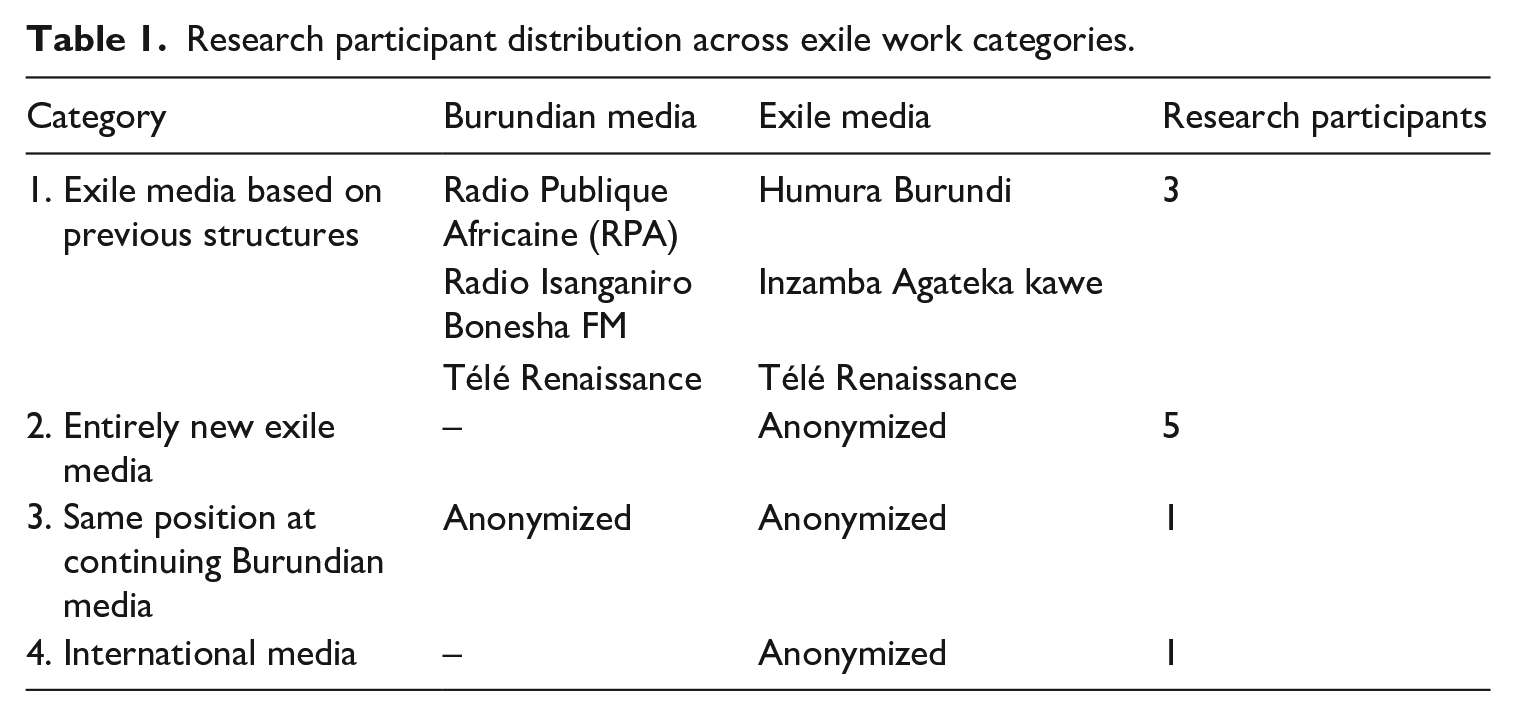
Non-random sampling with participants was conducted through snowballing (David and Sutton, 2011). The initial contact establishment through the ARJ ensured that participants were recognized journalists and, thus, the risk of working with journalists without professional backgrounds (Skjerdal, 2010) was minimized.
The 10 semi-structured interviews of between 40–60 minutes were conducted in French, within a confidential setting. The semi-structured format gave participants agency in shaping answers (David and Sutton, 2011). Five main groups of questions were addressed: Everyday life as a journalist in Rwandan exile; Main challenges of journalistic practice in exile; Access to and verification of information; Personal and professional motivations; and Future plans.
All but one of the interviews were audio-recorded, transcribed and translated, following transcription guidelines to minimize an overly subjective interpretive process (Nowell et al., 2017). One interview (Interview 3) was not audio-recorded upon the participant’s request – instead, handwritten notes were taken. All data was anonymized as per the research ethics protocols at Swansea University. The identities of the interviewees – defined as vulnerable due to their exile – remain confidential so that risks of physical, emotional, or legal harm through this research are minimized (David and Sutton, 2011). Accordingly, hereafter, journalists are referred to as J1, J2 and so forth.
Thematic analysis, which serves many qualitative studies (Braun and Clarke, 2006; Evans, 2017), was applied, allowing primary data to inform and, at the same time, review emerging theories (David and Sutton, 2011; Nordahl, 2009). Consequently, the six phases of thematic analysis by Nowell et al. (2017, based on Braun and Clarke, 2006) were followed: (1) familiarization through the research stage, transcription and translation process; (2) simplification through an initial open in-vivo coding to generate ideas ‘about what is going on’ (Nowell et al., 2017: 5); (3) establishing themes through axial coding; (4) reduction; (5) naming; and (6) analysis as presented in this article.
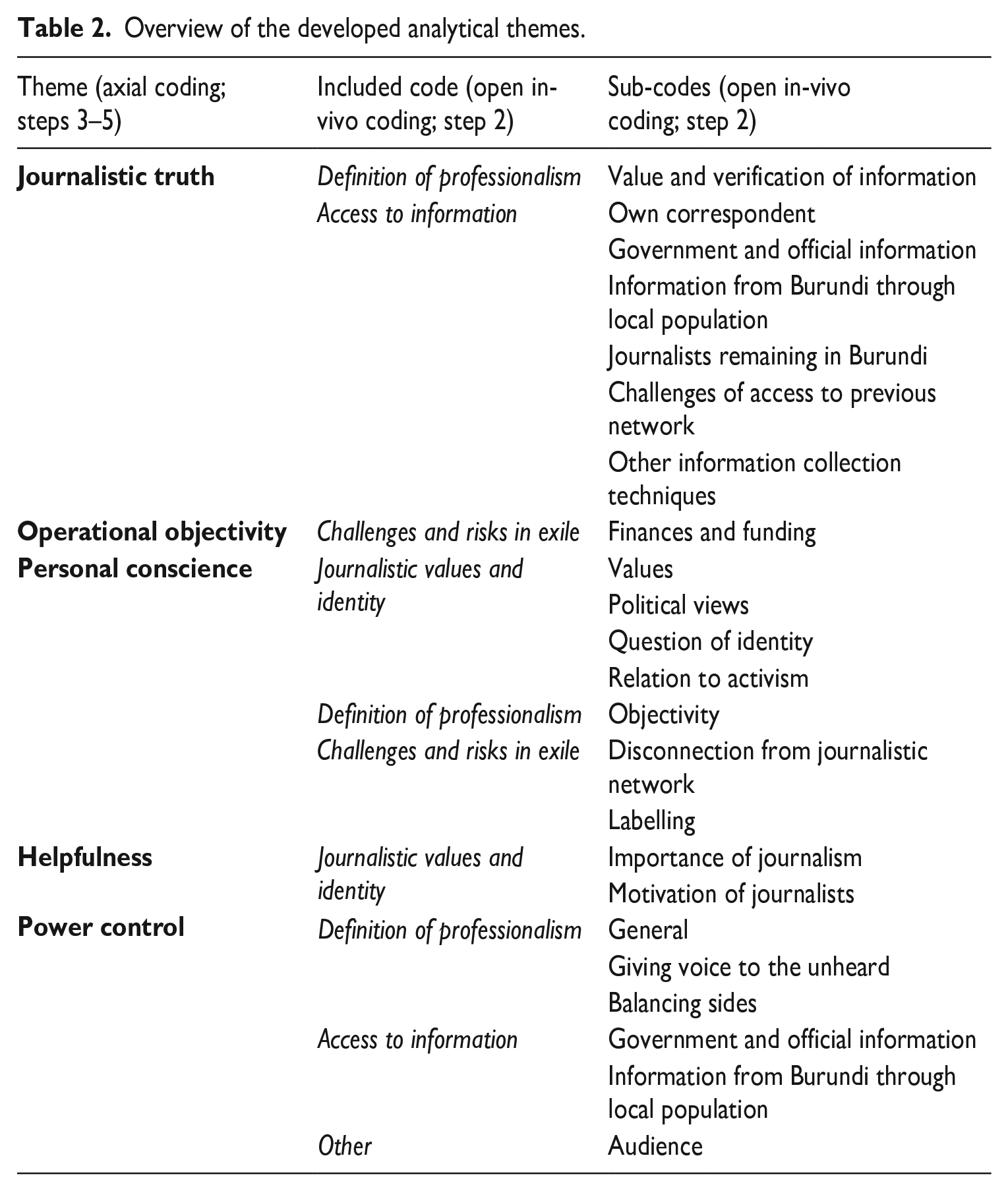
Initial open in-vivo (sub-)coding led to eight codes and 46 sub-codes based on recurrence, repetition and forcefulness (Owen, 1984). Through axial coding, the codes were grouped into categories, creating connections between them. This process led to five analytical themes (Evans, 2017) and five miscellaneous themes for background (King, 2004). The five themes analysed in the following chapters are Journalistic truth, Operational objectivity, Power control, Personal conscience and Helpfulness. The process showing how these themes were synthesized is explained in Table 2 in the Appendix. The axial coding and naming processes were additionally guided by literature on normative theories of conflict reporting, which also informed the research questions and interview guide. Consequently, each code reflects a relationship with the theory, which is shortly introduced throughout the findings.
The analysis is both semantic – to allow for contextualization and transparency using direct quotes – and latent – to present theoretical and practical interpretations, and identify significant patterns within and across themes (King, 2004).
Findings
Based on interviews with Burundian journalists during their first year of exile in Rwanda, Frère (2017: 12) determined that their key roles remained the same as their previous journalism inside Burundi but are considered ‘unreachable goals’. Our research updates these observations after several years of operating in exile. Expectedly, as J9 observes, the most obvious impact remains the same: [Exile journalism] is very different in the sense of not being close to our sources of information.
But, over time, as we now explain, participants have renegotiated journalistic key principles such as truth, objectivity and power control, and have adapted their journalistic role perceptions and motivations according to the condition of exile.
Finding the journalistic truth through other means
A functional approach to journalistic truth (Kovach and Rosenstiel, 2014) is a core principle of normative approaches to conflict reporting. However, upholding journalistic truth requires access to information, thorough verification and transparency of evidence, which implies naming sources and explaining information (Tumber, 2019). The preferred verification method, especially in contested settings of conflicts, should be eye-witnessing (Allan and Zelizer, 2004). Yet, this obviously contradicts the inaccessibility of the field from exile, as explained by J6: [In Burundi] you go yourself. Now, of course, this is not possible anymore. And so, we have to arrive there through other means.
Participants have developed innovative ways of gathering, verifying and disseminating information. Using WhatsApp’s broadcast feature, they send their inquiries to and receive information from contacts they have gathered throughout their careers, including citizens, journalist colleagues and others (J1, J5, J6, J7, J10). J5 explained that WhatsApp networks based on previous contacts in Burundi replaced the field. Benefiting from the Burundian media sector’s positive reputation and focus on citizen involvement and participatory shows before the crackdown (J2, J5, J6; see also Frère, 2017), many participants also continue receiving information from citizens directly, as ‘some people in Burundi remain attached’ (J5).
Additionally, some participants’ exile media evolved further by hiring their own correspondents in the country or other inaccessible areas such as refugee camps (J5, J6). Also, they receive information from journalists remaining in Burundi but now working for state media (J5). However, all of them ‘are, of course, anonymous, because if they were known in Burundi, certainly they’d get their heads cut’ (J6). Besides anonymizing their sources, participants also make use of other WhatsApp tools to mitigate risks: With messages that are, you know, dangerous, we try to programme them so that they disappear afterwards. (J6)
Nonetheless, some informants have become victims due to their association with exiled journalists. For instance, previously one correspondent was severely injured by security forces (J6) and four journalists were detained in Burundi due to a WhatsApp message they had sent to exiled colleagues (J1, J5, J8). Overall, participants’ informant networks are fragile and information verification has become complicated: If I were there, I’d listen, I’d be the witness. But we are condemned to rely on information that comes from . . . other sources. (J5)
Despite the participants’ familiarity with their network, many stress that intensive verification is crucial due to the risk of informants willingly lying and trying to manipulate them (J4, J6) or involuntarily omitting certain elements (J5). Consequently, there is a ‘big risk of broadcasting erroneous information’ (J9). Adapted verification methods include contacting various sources, albeit the numbers of required sources for verifying information vary. Some participants claim more than one source is needed (J5); others mention two to three (J7) or even three to four (J4). However, the consensus is: if it’s only one person who gives you information, you cannot accept this information as true. (J4)
If such verification is impossible, stories are dropped or changed (J7). Thus, editing is important and participants ‘need to cut and recut again’ (J6) many audio messages in order to find the journalistic truth.
Operational objectivity needs financing
Besides the adaptation and additional efforts required to gain access to and verify information, other factors also impacted participants’ adherence to finding the journalistic truth and remaining objective. Frère (2017: 17) observed shortly after Burundian journalists had to flee that ‘huge economic challenges . . . hamper independence for media projects both inside and outside the country.’ This continues to hinder the operational objectivity of the participants years later. Operational objectivity depends on the impartiality of the journalists’ methods (as opposed to their personal impartiality, which will be addressed later). Accordingly, funding systematically impacts journalism generally (Baker, 2002) and the commercial logic of news is especially challenging in the context of conflict coverage (Koehler and Jost, 2019). Therefore, it is unsurprising that all our journalist participants mentioned a lack of funding as their main challenge. Our participants can be classified into three categories: voluntary journalists without a salary, journalists with a regular contract and internationally funded exile media.
Five of the 10 participants worked without a salary or funding during their exile in 2020 (J1, J2, J3, J4, J7) despite money being needed for transportation, communication and equipment (J1). Also, press accreditation cards in Rwanda remain unaffordable for unpaid journalists and, without a press card, access to information in the host country, including about the Burundian refugee community that many participants report about in exile (J1–J4, J7, J8), becomes difficult (J7). Working with the Burundian refugee community as sources and audiences in Rwanda is additionally challenging in other aspects: [We] announce what doesn’t go well for the refugees . . .; however, we are also refugees and need to adapt to survive. (J4)
Unpaid and unfunded participants often take on other jobs, like J7, for example, who sells clothes. Often the little money they can save is re-invested in their journalism (J4). However, insufficient funding remains the biggest obstacle to ‘accomplish the mission of our radio’, as J1 concludes: [If] you work unpaid . . . you will also only do the minimum. You will not work a lot because what we do would require money. (J1)
Only two participants (J5, J8) reported relative financial stability. They work with contracts from non-exiled employers such as international media, albeit their salaries are much lower than those they enjoyed in Burundi. But, similar to unpaid colleagues, these participants still struggle to access basic equipment like recorders or a studio (J5, J6, J7, J8, J9, J10). Yet, support was given by the ARJ, which provided offices (J9) and gave housing to some (J6).
Some of the newly founded exile media managed to obtain external funding from international organizations, such as Free Press Unlimited (FPU). After working for a year without funding, some participants could then afford essential equipment and receive a salary (J6, J7, J9, J10), but insufficient funding remains the main issue expressed in all interviews and J8, for example, explained how this impacts operational objectivity: Some journalists can be instrumentalized under such conditions . . . [When] you don’t have a good salary, and someone comes who tells you ‘do this for me, write me this article, I will pay you’ . . . certain bad habits can tempt these journalists because life is expensive. (J8)
Impossible balance for power control
Journalistic principles of truth and objectivity, as discussed by our participants, are also linked with journalism’s traditional watchdog role. In a normative understanding, journalism should create a transnational public and discursive sphere (Deuze, 2005; Habermas, 1989) and, by representing the whole of society, journalism upholds the claim to exercise power control. This implies that elite sources and all corners of society must be accessible (Kovach and Rosenstiel, 2014). It has become clear that our participants have maintained good access to citizens and Burundian refugees, as, according to J10, ‘Burundi in its entirety expresses itself on our waves’ and some have become the ‘spokesperson for refugees’ (J8). Participants do not only use citizen involvement for information gathering and verification, but also attempt to create a platform for them: These are people who, even if they have something to say, they lack the means, the place where they can express their problems . . . we try to be in their place. (J4)
However, accessing the official versions of news stories remains challenging. Participants said that their calls to official sources remain unanswered (J8) or, if the authorities pick up, they will not cooperate once they know those calling are from exile media (J1). Also, press releases are not made available to exile media (J2) and this indicates a difficult relationship between media and public services (J10). The absence of official sources is ameliorated by including other elites. J6, for example, consults advocates and human rights defenders, while J8 talks to other responsible sources, such as the United Nations Refugee Agency (UNHCR). Reporting is also complemented with information from Burundian state and international media. Consequently, the participants have again developed ‘other means’, as J6 calls them, to represent official narratives.
Perceptions of exiled journalists challenge personal conscience
The practical challenges that limit adherence to journalistic key elements of truth, objectivity and power control are complemented by further psycho-social effects of exile that renegotiate journalists’ values and motivations: Professionalism engages the person . . . In fact, professionalism and personality go together. (J4)
This implies that exile triggers not only a renegotiation of journalistic practice, but also of journalistic identity. Our work establishes three self-perceived identities amongst participants. The identification as a journalist, above all, was most prevalent among those who work under contracts or for an exile media that receives funding: Wherever I am, I am a journalist, so I love my profession (J8).
Yet, among participants working without salary or funding, the identification as refugees was stronger (J1, J2, J3, J4, J7). Regardless of their self-perception as mainly journalists or refugees, there was a shared perception of being victims (J1, J6, J9, J10), leading to a ‘daily struggle to keep the distance’ and remain ‘professional’ (J6). This perception of victimhood mainly derives from the labels applied to Burundi’s exiled journalists by their home government. Participants explained how they were labelled as enemies of the country (J1, J2, J4, J8) and some had pending arrest warrants issued against them in 2015, which still affected their work in 2020: This identity followed me. Even when I work for [an international medium now], this identity of [my former Burundian media] follows me always. (J8)
Consequently, the Burundian public accused some participants of being opposition supporters, of having links to rebel groups, or of just being spiteful (J9, J10): We weren’t understood. They thought that we took the way of the putschists . . . of the people who wanted to destabilise the country, as the power said . . . they thought I was there to take revenge. Even though this is not at all my objective. (J10)
Over time, however, participants observed that the Burundian population became convinced that they broadcast ‘well-verified . . . information of quality’ (J10) because of hard work ‘to overcome . . . our problems with the power to stay honest with our profession’ (J10). Still, some explained that their political views influence their journalism. J7, for example, disagreed with the governing style of the CNDD-FDD and this is reflected in their reporting. J8 also shared their views of Burundi’s opposition, which is why they fled the country. However, all participants displayed a strong dedication to what they call professional journalism at the same time as applying a strong moral compass.
Cross-checking journalistic work through hierarchical editorial processes and constant discussion in newsrooms has been an effective tool to ensure professional and socially responsible journalism (Bell, 2008; Kovach and Rosenstiel, 2014; Nerone, 2012). While two participants did not have such an editorial team, most participants worked in exile newsrooms where editorial hierarchies had been re-established and the importance of this role of cross-checking for bias becomes evident. J6 and J9, for instance, review and edit their exile media’s content. They found that their journalists try to follow their moral compasses rather than letting personal exile experiences shape their work. Still, they occasionally find indicators of victimization in some reporting, which requires editing. For example, they remove unconstructive claims (J9) or change problematic language, which they call the ‘tone of a victim’ (J6). The latter is detected through words like ‘killers’ or ‘terrorists’, as these are personal perceptions rather than official categorizations. Being aware of and mitigating that risk through thorough editing procedures implies that participants pay considerable attention to possible bias in their reporting. Still, opinions of whether their journalism is, or should be activist or not, vary across our sample. One participant said they were ‘working on both sides’ of journalism and activism (J4), while J5 made a clear distinction between the two: The journalism we do here [in exile] is not activism. It’s journalism. But in another form.
Working to be helpful
Rather than defining their work along activist terms, our participants considered the needs of their home population when talking about their motivations to continue working in exile: We are here to recover freedom of expression, press freedom . . . because . . . this is what our country lacks today. (J10)
These values are reflected in normative theories of journalism that state – particularly within the context of conflict – that the focus should be turned to a basic objective of informing a public that needs information for survival (inter alia Allan and Zelizer, 2004; McGoldrick, 2006). The concept of helpfulness (Thomas, 2019) captures this as it places improving citizens’ opportunities as the main objective. This perspective is useful for understanding the participants’ role perception and motivations as they agreed to ‘provide information to a public that needs us’ (J10). Additionally, all expressed ‘hope that it will change the situation in Burundi’ (J2).
Participants explained that the Burundian population only knows what happens inside their own country ‘by listening to us, even though they are the ones who are there’ (J6). Indeed, a report about Burundian exile media quoted by J10 confirms that ‘the radios of journalists in exile are the most listened to today.’
J6 and J9 state that such outreach is important as their programmes are messengers of ‘universal values of humanism’ needed for Burundi to advance peacefully. Also, J2 said that Burundian society should change and their journalism ‘is giving something to the country’ by providing information, not violence (J6, J10). Participants also expressed a wish to contribute something constructive to the crisis while leaving the responsibility to judge to the public (J6, J9). Overall, the participants are motivated by being ‘useful for the country’ (J6) and defending their profession and colleagues remaining in Burundi: When Burundi decided to destroy the media, it was to do the same to journalists. It was crazy to do this to independent media . . . So, I have to, I must keep my head up to defend my profession. (J8)
Discussion
The participants’ explanations of how they access and verify information to find journalistic truth, their operational objectivity being impacted by a lack of funding and the limitations in exercising power control due to the unavailability of official sources show that adherence to key elements of journalism from exile is limited.
However, our findings also show that participants have renegotiated those elements and developed ‘other means’ of journalism ‘in strict respect of ethics and ontology of the profession’ (J10). Similar tendencies were also found in other contexts of exile journalism. For example, Sarıaslan (2020: 10) found that Turkish journalists exiled in Germany are dedicated to delivering journalism ‘in the best way possible under the conditions available’ despite conclusions that ‘this is not journalism’ (Sarıaslan, 2020: title). This supports our assertion that the work of our participants is ‘journalism in another form’ due to their exile. The following sections discuss our findings in light of our research questions:
• Can the key journalistic elements of truth, objectivity, and power control be upheld by Burundian journalists in Rwandan exile?
• How do Burundian journalists’ role perceptions and motivations change in Rwandan exile?
Navigating journalistic key elements in a limiting context
Participants talked about ‘other means’ of finding the truth. O’Loughlin and Schafraad’s (2016) typology of exiled journalists proposed that exiled journalists define the truth as a goal or a means, using it to create a functioning society by counterbalancing government claims. This is reflected in our findings that show that participants prioritize the access to, and verification and dissemination of, information to ‘close this gap in the journalistic information’ (J10) available in Burundi.
Due to the inaccessibility of the field and inability to witness first-hand, the ‘other means’ they developed are highly dependent on social media and the internet, which have become the ‘main conveyors of information’ since the Burundian media crackdown (Frère, 2017; Vircoulon, 2016). This corresponds with the emphasis on digital diaspora networks when studying exile journalism (inter alia Arafat, 2021; Creta, 2023; Skjerdal, 2010, 2011). Journalism produced in a post-geographic setting, meaning reporting on stories while being physically distant from them, like from exile, can be conceptualized as ‘liquid’ journalism (Bauman, 2000; Deuze, 2005; see also O’Loughlin and Schafraad, 2016), which triggers different methods often linked to digitalization processes, as also documented, for instance, in the Turkish exile context. There, Sarıaslan (2020: 10) observed a ‘transformation of journalism as a profession under the conditions of migration or exile and with the advancement of technological possibilities of digitalisation processes.’
Yet, it has been established that exile media and online diaspora networks need to be distinguished from each other (Arafat, 2021). Such a clear distinction is of particular importance given the actual realities in homelands, where restricted internet access often limits the reach of digital networks. Studies in the Zimbabwean context, for instance, showed that digital networks indeed perform a mediator role (Moyo, 2007, 2011; Ncube, 2017), but traditional radio journalism produced in exile continues to be crucial (Batist, 2010; Ndlovu, 2014). This is even more prevalent in contexts such as Myanmar (Pidduck, 2012), Iran (Woicjeszak et al., 2013), or Eritrea, where, despite highly active diasporic online networks, exile satellite television and shortwave radio remain the main route to reach home audiences with little to no internet access (Esther, 2023).
In the Burundian context, participants showed that they operate at the intersection of these realities, having established exile media by innovatively adapting traditional radio journalism to digital platforms like WhatsApp, but without creating social networks. This method also assures a large audience for our participants’ work, as individuals in Burundi can connect to the internet and download audio files without needing an often unavailable or unaffordable continuous connection or participating in a network on an online platform.
Receiving citizens’ information through WhatsApp, however, depends on the journalists’ trustworthiness and the safety measures they have established, as participants confirmed that sources often put themselves at risk by offering information. Receiving information from blacked-out countries like Burundi depends on fragile networks of informants (see also Crete-Nishihata and Tsui, 2021). Therefore, guaranteeing full anonymity to all sources is fundamental but this can jeopardize journalistic credibility and the claim to tell the truth. Without transparency of evidence, the value of the information distributed by exile media fully relies on the trustworthiness of their journalists and methods.
While many studies accordingly analysed exiled journalists’ values, the professionalism of their methods remains under-researched. But Ahmed’s (2019: 1) study of journalistic quality in local and exiled Sudanese media offers some insight, as he found that exile media produce better quality than local media, ‘indicating better journalistic performance given a condition of press freedom’. Seo’s (2020) analysis of removed foreign reporting on North Korea and Iran also concluded that distance can be an advantage in reporting on authoritarian regimes.
Still, the operational objectivity of exile journalism remains vulnerable due to the lack of structural funding. Some participants stated that, due to the absence of funding or a salary, they might not be working to the best of their capabilities or may be influenced depending on who offers them money. Similarly, an organizational report for Körber Stiftung confirmed that exiled journalists must often out of necessity take jobs ‘that would not exactly be viewed as “quality journalism”’ (Schönert, 2019: 5).
Across exile journalism case studies, indeed, funding is identified as the main challenge (see, inter alia Badran and Smets, 2021; Crete-Nishihata and Tsui, 2021; Gebremeskel, 2019; Nordahl, 2009; Pidduck, 2012; Woicjeszak et al., 2013) and as a major influence on exiled journalists’ work, and the stability of their networks (Arafat, 2021). In the Burundian case, Frère’s (2017: 17) study shortly after the journalists’ exile also found that ‘huge economic challenges . . . hamper the independence for media projects both inside and outside the country.’ Our own findings are consistent with this.
Still, in the Burundian case, some participants secured funding for their exile media through international organizations such as Free Press Unlimited. Indeed, experts consider funding or support by non-governmental institutions the only way for exile media to remain independent (Schönert, 2019). Yet, it is difficult to secure as it usually requires exile media to be registered, which conflicted with the reality of most participants’ media in Rwanda. Also, participants stated that the bureaucratic and organizational tasks involving (renewed) funding applications often exceeded their capacities, or that such funding options were not available to them in the Burundi–Rwanda context for political reasons (J6, J9; Frère, 2017). However, Burundian exiled journalists, including our participants, received infrastructural support from the Rwanda Journalists Association (ARJ), which were funded by international organizations (IFJ, IMS, Rory Peck Trust). Our data does not indicate any editorial interference by the ARJ on our participants’ media and, in fact, it is common worldwide that journalist communities in host countries offer financial, infrastructural, or other support to their exiled colleagues. Other international funding, however, is highly dependent on positive monitoring reports, usually conducted by external organizations examining the media’s respect for professional standards, which, again, restricts its accessibility for many participants.
Still, one of the exile media some participants worked for was monitored twice. It received positive reports, confirming unbiased reporting and professionalism, thus assuring continued financial support (J6, J9, J10). This report also confirms our finding that participants remained committed to upholding journalistic key elements despite the financial challenges.
Another of the key journalistic principles we examined was one of power balance. Before the crisis, Burundian journalists were found to be ‘balanced informers’, ‘watchdogs or fourth estates’ (Frère, 2017). Yet, our participants confirm what Frère (2017: 12) found shortly after the media crackdown that a ‘lack of balance is the worst problem they face when producing their programmes in Kigali.’
Our findings facilitate the argument that the transnational setting and use of WhatsApp technology enabled bottom-up participation in public discourse and transmission of knowledge from non-elites (inter alia Blumler and Cushion, 2014; Schudson, 2005). However, the lack of official sources and only limited ‘other means’ of balancing this limit their claim to power control. Instead, participants have accepted their new role as mouthpieces of Burundian citizens and refugees.
This is consistent with other case studies showing that exile journalism displays a stronger focus on citizens rather than elite or official sources. For Syrian exiled journalists, for instance, the ‘limited accessibility to pro-regime sources’ (Arafat, 2021: 2192) restricted a diverse representation of voices. This contrasts with the general trend of marginalizing citizens in traditional conflict coverage (Blumler and Cushion, 2014; Galtung and Ruge, 1965; Peleg, 2007). Therefore, our participants can only adhere to the part of power control focused on ‘watching over the powerful few in society on behalf of the many’ (Kovach and Rosenstiel, 2014: 174).
Changing journalistic values and motivations in exile
Much literature on exile journalism focuses on debates around activism versus journalistic professionalism. While exile media ‘blur boundaries between journalism, activism, human rights advocacy, social movements, and civil society work’ (Arafat, 2021: abstract), the extent to which exiled journalists identify as activists varies. The relationship between exile journalism and activism presents itself on a spectrum ranging from ‘journalists describ[ing] their role as a form of activism’ (Crete-Nishihata and Tsui, 2021: 8), exile media such as the Democratic Voice of Burma moving away from their original activism and bias towards increased professionalism (Nordahl, 2009), or exiled journalists being very clear that journalists ‘shouldn’t drift towards activism’ and that their job is ‘to hold power to account . . . and keep doing quality journalism’ (see Suárez, 2023).
There is a similar variance within our own data, with some participants indicating that their own political views influence their work and, thus, they combine activism and journalism. Others, however, highlighted the clear distinction between the two and referred to editorial measures put in place to remain professional. J5 appropriately summarized self-perceptions among our participants: ‘It’s journalism. But in another form.’
The mix of perceptions is not surprising as this was observed in other exile contexts, too. For instance, Skjerdal (2010: 50) concluded that journalists engaging in digital networks often ‘leave their objectivity behind and become activists’. Yet, Chala (2018: 32) described Skjerdal’s conclusion as ‘largely ignorant of what historical, social, political, and institutional factors drive the diaspora media to politicize their reporting’ and concludes that Ethiopian exile media inspire but do not function as activist online communities (p. 189).
Given such variance within our own data, we propose to apply the lens of personal conscience to analyse experiences, rather than the one of activism. Normative theories of journalism require journalists to adhere to their personal conscience to fulfil the social responsibility of reporting (inter alia Kempf, 2019; Kovach and Rosenstiel, 2014; Nerone, 2012). We have outlined the factors that influence or hamper adherence to such personal conscience in exile. Shifting self-perceptions imposed by exile and the additional defamatory labels applied by the Burundian government have made it challenging for participants to keep their journalistic identity apart from personal struggles as ‘victims’, ‘refugees’, or legally persecuted ‘putschists’. Still, all our participants showed a strong will to follow their moral compasses as journalists, and this observation of remaining journalistic principles and a desire, even struggle, to adhere to them resonates with what Frère (2017) found previously among exiled Burundian journalists.
However, our findings challenge Frère’s (2017: 20) conclusion made shortly after the journalists’ flight to Rwanda. She stated: Within a year, they have switched from the conviction that they could change society, help improve governance, represent the voice of the voiceless, approach and circulate truth about events to the alarming observation of their helplessness.
Instead, we conclude that the operational focus has shifted again to contributing something constructive to the Burundian crisis (J9) and to being ‘useful’ (J6).
Being ‘useful’ resonates with Thomas’s (2019) understanding of journalistic helpfulness. Participants stated that they want to bridge the information gap in Burundi and refugee camps with independent reporting. It can be argued that the participants’ exile media again provided Burundian citizens with a ‘choice architecture’ aiming at expanding and improving their opportunities. Additionally, participants highlighted that they work in the defence of their profession and in support of colleagues remaining in Burundi. However, participants acknowledged the limitations of their reporting from exile despite a desire to adhere to normative journalistic elements. This does not limit their helpfulness, though, as Thomas also states that helpfulness is ‘achieved by excellence, constrained by circumstance’ (p. 376).
Conclusion
This article analysed if and how members of the Burundian journalist community in Rwandan exile could uphold key journalistic elements and how their role perceptions and motivations change. The analysis revealed constraints of applying principles defined in normative theories of journalism to the context of Global South exile yet showed that these continue to serve as a basis for the countermeasures participants have developed to run successful media from exile.
This conclusion resonates with observations in other exile contexts. For example, Nordahl (2009: 102) concluded that ‘ideals of professionalism . . . are hard, or even impossible to implement when operating in exile’, yet the journalists interviewed in Nordahl’s study focused ‘both on raising the level of professionalism of individual staff members, but also the operation as a whole’ (p. 25). Our Burundian participants, too, have shown great dedication and will to adhere to the principles of professional journalism such as truth, objectivity, power control and social responsibility, with the latter emerging from the participants’ accounts of their motivations and values. Consequently, just as Balasundaram (2019: 277) concluded in the case of Sri Lankan exiled journalists, we argue that our participants’ ‘journalistic activities align with normative journalism theories in terms of purpose’.
Despite the importance of context in exile journalism cases and the socio-political, legal, economic and cultural differences between them, the challenges and strategies identified in our research align with findings from other studies on exile journalism. 3 In summary, these are a reliance on fragile and anonymous information networks for information access and verification; the participants’ struggle with their own bias or biased sources and audiences, which is mitigated through editorial processes; the need and strategy of combining traditional media reporting and online techniques to circumvent black-outs and reach the home population; and the dominant issue of funding. Additionally, participants’ desire to be helpful in the home country was identified as the principal journalistic motivation in exile.
The most important finding, however, is that over the years of operating exile media in Rwanda, Burundian exile media that the participants worked for have moved on from the initial ‘impossibility of journalism’ documented by Frère (2017), to ‘another form of journalism’ (J5).
Footnotes
Appendix
Overview of the developed analytical themes.
| Theme (axial coding; steps 3–5) | Included code (open in-vivo coding; step 2) | Sub-codes (open in-vivo coding; step 2) |
|---|---|---|
|
|
Definition of professionalism | Value and verification of information |
| Access to information | Own correspondent | |
| Government and official information | ||
| Information from Burundi through local population | ||
| Journalists remaining in Burundi | ||
| Challenges of access to previous network | ||
| Other information collection techniques | ||
|
|
Challenges and risks in exile | Finances and funding |
|
|
Journalistic values and identity | Values |
| Political views | ||
| Question of identity | ||
| Relation to activism | ||
| Definition of professionalism | Objectivity | |
| Challenges and risks in exile | Disconnection from journalistic network | |
| Labelling | ||
|
|
Journalistic values and identity | Importance of journalism |
| Motivation of journalists | ||
|
|
Definition of professionalism | General |
| Giving voice to the unheard | ||
| Balancing sides | ||
| Access to information | Government and official information | |
| Information from Burundi through local population | ||
| Other | Audience |
Funding
The author(s) disclosed receipt of the following financial support for the research, authorship, and/or publication of this article: Louisa Esther conducted this research while on a scholarship by Cusanuswerk, funding her research stay in Rwanda as part of the Erasmus Mundus MA Journalism Programme. The authors received no financial support for the authorship and publication of this article.
