




Abstract
State militaries increasingly communicate their acceptance of LGBTQIA+ individuals through glossy visuals online. This article takes the Swedish Armed Forces as its case since, through their military marketing, they have suggested not only their protection of LGBTQIA+ rights but also their status as a ‘queer’ force for almost a decade. While the gendered representation of the Swedish military is unstable, the narrative of Nordic states’ ‘progressiveness’ is particularly sticky in international politics. Through a feminist visual narrative analysis of SAF’s Pride campaigns, the author identifies patterns and tensions in the ‘queer’ Swedish military narrative and argues that the Pride campaigns mark attempts at normalizing cis-heteronormativity while consolidating the Swedish nation ‘brand’ as internationalist, feminist and LGBTQIA+ friendly. In the process, they (re)produce conventionally ‘queer’ subjects: the patriot and victim, which through wider discourses of neoliberalism and homonationalism rely on ‘Western’ notions of what it means to be LGBTQIA+ in Sweden and beyond.
Introduction
In 2021, I was scrolling through Instagram and came across the Swedish Armed Forces’ latest Pride campaign. With the caption, ‘A Flag Worth Defending’, the image portrays four soldiers in field uniform with one of them waving a rainbow flag (see Figure 1). Their expressions are barely visible. The values and traditions normally attached to a military hoisting a flag is to conquer territory or mark victory. As I try to make sense of the campaign, I wonder whether the Swedish military is preparing to go to battle over LGBTQIA+ rights or if they imply that the ‘battle’ is already won. Considering the seemingly Nordic fauna in the background and the caption, the campaign narrates a defensive posture, to anchor SAF’s protection of queer rights at home – symbolically and practically. It is an emotional story.
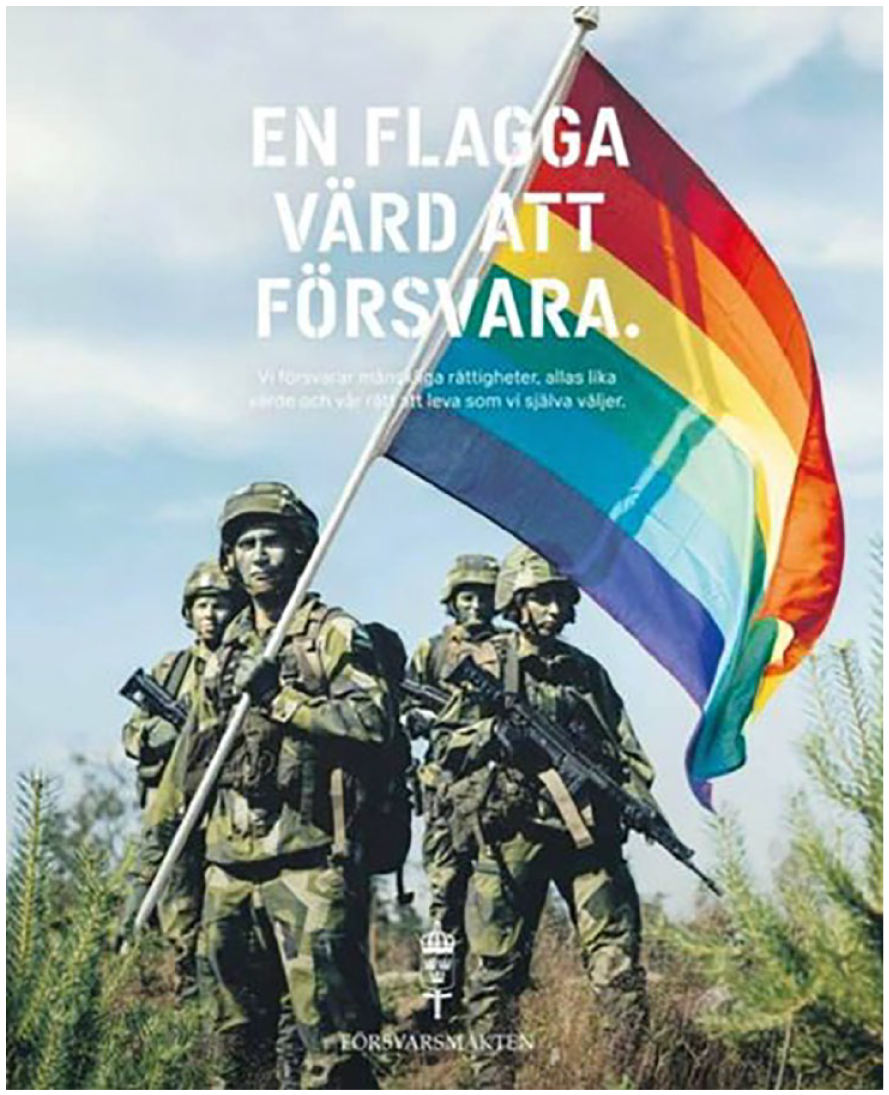
‘A Flag Worth Defending’ (2021). Screenshot from the Swedish Armed Forces’ Instagram. Source: Försvarsmakten [the SAF]: https://www.instagram.com/p/CSEC7y3IOGp/?igshid=MzRlODBiNWFlZA%3D%3D (accessed 15 November 2023).
Governments increasingly manage their ‘brands’ and communicate their political priorities through digital and visual means to anchor a preferred status on the global arena (Bergman Rosamond and Hedling, 2022). ‘State feminism’ as a priority for the Swedish internationalist brand asserts that Sweden as a ‘progressive’ force in the international community contributes to gender equality and lesbian, gay, bisexual, transgender, queer, intersex and asexual (LGBTQIA+) rights at home and abroad (see Bergman Rosamond and Hedling, 2022; Jezierska and Towns, 2018; Strand and Kehl, 2019).
While the literature on nation branding in the Nordics is growing (Browning, 2021), there has been insufficient emphasis on how Nordic states, which are often perceived as safe and peaceful, utilize branding strategies to ‘market’ security (Coetzee et al., 2023: 2). This strand of literature, while critical of the tropes associated with the ‘Nordic brand’, has made the case that its perceived ‘progressiveness’ remains rather unchallenged (Browning, 2021; Coetzee et al., 2023). Upon critical interrogation of security policy and political shifts in the Swedish context, the gendered state representation of Sweden is a sticky yet unstable construction. To maintain the brand, state feminism must be narrated through branding efforts, for instance military marketing, as visible in the introductory vignette. The Swedish Armed Forces (SAF) could be considered pioneers in military marketing as, for almost a decade, they have repeatedly ‘come out’ in support of LGBTQIA+ rights through campaigns that tell the story of an exceptionally progressive military, and in turn, state. In this article, I explore how SAF in these campaigns harnesses language and symbols, and refers to rites of passages expected from Swedish LGBTQIA+ communities to consolidate the preferred state brand, which echoes ‘Western’ ideas of queerness and individuality; coming out of the closet, the right to self-expression, parading in Pride, marrying one’s partner and being a proud ally (Dhoest, 2019; Edenborg, 2021a; Mai and King, 2009). In their ‘representation’, the campaigns tame ‘queer’ and its subversive nature and negative sociality, to simply saying ‘we are normal’ or ‘love is love’’ (Cooper-Cunningham, 2022: 17). This, I argue, is important because it does not upset military gender relations. The campaigns showcase the contradictions innate to Western militaries’ attempts at reconciling entrenched cis-heteronormative ideals with ‘progressive’ nation brands. Whereas some suggest that SAF’s Pride marketing has turned more militaristic over the years and thus reflects a shifting political agenda (Kehl, 2023: 68), I suggest that, when approaching the campaigns as a series, the preferred brand of ‘progressivity’ remains largely the same − irrespective of political changes, shifting policy principles, or societal counter-narratives. In exploring how the campaigns (re)produce, sustain or challenge narratives of the progressive Swedish nation brand through what is considered ‘queer’ stories, this article adds to literature on military marketing and how it is consolidated in wider neoliberal discourses (Jester, 2023; Leander, 2022; Stengel and Shim, 2022; Strand, 2022) while also contributing to queer debates on how LGBTQIA+ rights are instrumentalized for state level narratives (Altman and Symons, 2016; Cooper-Cunningham, 2022; Edenborg, 2021b; Slootmaeckers, 2019; Weber, 2016).
LGBTQIA+ individuals long faced ostracization and exclusion from military spaces upheld by policies of ‘Don’t ask, Don’t tell’ (Belkin, 2012; Brown, 2012; Bulmer, 2013; Yerke and Mitchell, 2013) but pro-gay and pro-military discourses link up in unexpected ways (Kuntsman, 2008). Through their blend, Western militaries emerge as less prone to war, more diverse, softer in masculinity and LGBTQIA+ friendly (see Baker, 2022; Cooper-Cunningham, 2022; Pallas, 2016; Slootmaeckers, 2019; Weber, 2016; Wool, 2015). This is visible in Swedish military marketing, where the defensive posture in relation to LGBTQIA+ rights is anchored by the portrayal of weapons that are not actively used, conveying to the reader that, while violence is possible, it is neither desirable nor necessary at the moment (Jester, 2021: 63). The inclusion of LGBTQIA+ messaging in state military marketing has mainly been explored in the Swedish context (Kehl, 2023; Strand and Kehl, 2019) and in the UK (Baker, 2022). Baker explores the creation of a ‘queer-military home’ through videos and social media imagery in ways that explicitly link the inclusion of LGBTQIA+ individuals in militaries with military marketing, visual media and insights from Queer Studies. While important contributions showcase the narrow (white) ‘Swedishness’ performed in the Pride campaigns and how the campaigns justify (re)armament and the (re)territorialization of the military in Sweden (Kehl, 2023; Strand and Kehl, 2019), more can be said about the ways in which SAF’s Pride marketing sustains, upsets and evolves the ‘progressive’ Swedish nation brand, rendering visible both its stickiness and turbulence. Furthering the scholarship initiated by these authors, I zoom in on the Swedish case (specifically SAF), narrated to be ‘progressive’, ‘feminist’ (Bergman Rosamond and Hedling, 2022) and ‘queer’. Nonetheless, increased visibility by government actors does not equally benefit or capture the multitude of identities under the queer umbrella, often excluding trans, intersex and bi+ perspectives (Schotel, 2022). In narrating the ‘queer’ military and progressive Swedish state, SAF’s Pride campaigns visually (re)produce conventionally ‘queer’ subjects through wider discourses of neoliberalism and homonationalism; the queer patriot and the queer victim (Weber, 2016). Drawing from Weber’s construction of ‘normal’ subjects in International Relations (IR), the patriot typically is understood as a subject for the military to fully embrace without upsetting cis-heteronormative assumptions. Conversely, the protection of the victim (abroad or ‘at home’) justifies increased military spending, recruitment and military authority (Kehl, 2023). While of analytical utility, I demonstrate how the relationship between these queer subject ‘markers’ shifts depending on the context and that their fluidity, multidirectionality and relationality serve to simultaneously restrict and empower the subjectivity of specifically the queer victim.
Feminist visual narrative analysis: Focalization and visuality
In order to understand the narratives underpinning SAF’s military marketing efforts, I take their visuality into consideration (Crilley, 2016: 52). While images do not independently produce meaning but require active interpretation (Barthes, 1977), they have affective potentiality when encountering or engendering various audiences (see Adler-Nissen et al., 2020; Poretski et al., 2019; Rose, 2016; Spyer and Steedly, 2013). To ‘read’ the images and the political context in which they are embedded, I draw from feminist contributions on narrative in the study of security (Bergman Rosamond and Hedling, 2022; Shepherd, 2021; Wibben, 2010). Such narrative research can focus on the concept of ‘focalization’, which entails the relationship between the subject who tells the story and what the ‘reader’ perceives. Focalizers can be external or internal, where the former conveys the presented narrative as one of ‘objectivity’ (Bal, 2009: 137) and the latter narrates individual experiences and life stories (Bergman Rosamond and Hedling, 2022: 308). If a narrative is conveyed by an external focalizer, the message is often closely associated with the ‘author’ or narrating agent (Wibben, 2010: 48). Focalization and visuality thus focus on different aspects of narratives’ presentation. As visuality centres the positionality of the reader, it complements that of focalization and allows me to consider both narrating agent(s) and intended audience(s). While ‘branding, marketing, and image production are communicative activities that presuppose some sort of mediation‘ (Bolin and Ståhlberg, 2015: 3067), my feminist visual narrative approach focuses less on the production or mediation of these images through various forms of traditional and/or social media, and instead focuses on how the stories are told through visual narrative.
Notes on material
In this article, I analyse SAF’s materials for Stockholm Pride in recent years. While the campaigns started in 2016, which heralded the beginning of a military marketing agenda that encompasses LGBTQIA+ symbols, I zoom in on four of the campaign images, 1 specifically those released in 2018, 2019, 2021 and 2022. The Pride campaigns have been made with a similar purpose – to convey SAF’s dedication to LGBTQIA+ rights and are intended primarily for a Swedish audience. The SAF collaborates with public relations agencies in the development of their advertisements and other campaign material, such as Pride. While these agencies’ role in the development and mediation of the campaigns should not be omitted, the campaigns are ordered by SAF as a state agency and represent a preferred strategic narrative that reflects the ‘progressive’ nation brand. Such strategic narratives serve as instruments for political actors, among them states like Sweden, to create shared interpretations of historical, contemporary and future dynamics of domestic and international politics alike (Miskimmon et al., 2013: 14). While some campaigns centre on individual subjects, they represent strategically communicated storylines with an external focalizer, wherein SAF is always the narrating agent.
The campaigns appear across different media, from the front page of newspapers to ‘traditional’ advertising to SAF’s website and social media accounts – Instagram, Facebook, and X (formerly Twitter), where engagement levels are high and often direct. I have engaged primarily with the visual material produced for SAF’s Instagram account and do not draw conclusions about the focalization/visuality across platforms. This article does not discount how various media platforms are not neutral vessels through which information is disseminated but have specific affordances and mediation processes that merit proper analysis (Bolin and Ståhlberg, 2015: 3070). Yet I focus on the campaign images’ representation and not the production of the campaigns, interaction between users, hashtags utilized, or comments. While the campaigns are not necessarily experienced in a linear fashion and other scholars have considered each of them to constitute specific discursive events (Kehl, 2023; Strand and Kehl, 2019), I view the images as sequential and interconnected, forming a series that, when considered together, provides insight into the progressive nation brand, while revealing policy changes and political events in Sweden and beyond. In the following, I read the material to understand what is granted space or time in the story. I probe who is visible, who is granted agency and whether location plays a role and how.
Competing state brands and narratives of inclusion
To read the Pride campaigns and analyse the narrative(s) conveyed, I draw from queer scholarship, which illustrates how gendered state narratives affirm nationalism in the international arena (Bracke, 2012; Slootmaeckers, 2019). Generally, LGB citizens (often excluding other queer identities) may be invoked in nationalist discourse to protect/defend the state, either as pro-military ‘docile’ citizens or active soldiers that may be ‘homosexual’ (Weber, 2016: 130). Drawing from Weber’s (2016) contributions on ‘normal’ homosexual subjects in IR and building on the work of Strand and Kehl (2019) and Kehl (2023), I argue that, through a wider discourse of homonationalism and neoliberalism, specific and conventionally queer subject ‘markers’ are afforded inclusion in Swedish military marketing. First, the queer patriot who emerges to contribute to state security and military effectiveness. Secondly, the queer victim in need of protection – who justifies the existence of a strong military in the first place. In the article, I understand these positions as shifting, fluid, multidirectional and relational. The patriot versus victim may be invoked simultaneously and contradict each other.
In conveying state priorities, gender equality and LGBTQIA+ inclusion can be mobilized to mark progress and power (Bergman Rosamond and Hedling, 2022) with some states being deemed ‘normal’ (or not) based on their level of LGBTQIA+ friendliness and their inclusion of queer bodies in the nation project (see Eastwood, 2019; Puar, 2013; Slootmaeckers, 2019). Yet queer masculinities and femininities remain subordinate in contemporary European and American societies (Slootmaeckers, 2019: 253), notwithstanding their mobilization through the narration of ‘Western’ military marketing or nation branding. Here, Slootmaeckers’ concept of homophobia as ‘a technology of Othering’ is helpful in unpacking how gender hierarchies are maintained globally and nationally. Depending on whether dominant societal narratives are heteronationalist and homonationalist, the location of homophobia in the ‘technology of Othering’ differs (p. 258). In heteronationalism, the concept of the ‘Self’ is characterized as straight, strong and harbouring homophobic sentiments. Conversely, the homonationalist ‘Self’ is embraced as queer, softer and LGBTQIA+ friendly. This promotes the idea of a bipolar world in which LGBTQIA+ politics turn into a competition between ‘progressive’ versus ‘backward’ states (Altman and Symons, 2016; Weber, 2017).
The narrative of a ‘Gay-friendly Europe’, ‘West’ or, in this case – Sweden – (re)produces patriotism and homonationalism ‘at home’ but fosters patriotism and heteronationalism elsewhere. In Russia, for example, queerness is rendered hypervisible, feminized and dangerous (Edenborg, 2021b; Gaufman, 2022). The Russian government explicitly targets LGBTQIA+ individuals and tries to eradicate any ‘queerness’ perceived to threaten the heteropatriarchal masculinity associated with the state (Bias, 2022; Edenborg, 2021b; Persson, 2015). In essence, Russian state-sponsored LGBTQIA+ invisibility or homophobia anchors the support for LGBTQIA+ as a cornerstone of ‘Westernness’ or Swedishness (Kehl, 2023). However, military institutions are inherently gendered institutions and can never be agender or asexual (Woodward and Duncanson, 2017: 2). Military norms can possibly change if individuals who have not previously been included can join as full partners (Stiehm, 1989: 225). Military gender relations may then perhaps be re-conceptualized to become less harmful though gender integration (Connell, 2005; Connell and Messerschmidt, 2005; Demetriou, 2001; Duncanson, 2015), but it is unclear what military marketing and narratives of the LGBTQIA+ friendly military accomplishes in this regard (Bulmer, 2013; Kehl, 2023). This illustrates the tension between the preferred nation brand of ‘progress’ with norms and ideals within Western neoliberal militaries. The acceptance of some queer bodies within the ‘Self’ does not mean that the heteronormativity that underpins nationalism disappears nor that norms of cis-heterosexuality cease to exist (Cooper-Cunningham, 2022: 10; Slootmaeckers, 2019: 257). Homonationalist discourses include (certain) queer bodies (or experiences) (Eastwood, 2019; Puar, 2013; Slootmaeckers, 2019) in which sexuality as an individual marker must be disclosed through the interaction with other members from the community and beyond, including the public display of intimate relationships to be considered ‘credibly’ queer (Akin, 2017).
Progressiveness as Swedish state principle?
Considering the political context in which the first Pride campaign was published in 2016, it can be considered part of a greater policy turn, in which gender integration, including the protection of LGBTQIA+ rights became a stated top priority for SAF. To understand why this happened, we need to return to 2014, when Sweden, as the first country in the world, launched a feminist foreign policy (FFP). The FFP focused on promoting and securing women’s and girls’ full enjoyment of human rights (Aggestam and Bergman-Rosamond, 2016) while calling for an increased awareness around gender and LGBTQIA+ rights. While the feminist ‘turn’ in foreign policy has been thoroughly subject to academic debate, narratives around Swedish progress (and even exceptionalism) as it relates to gender equality predates the policy. In essence, the notion of ‘progressiveness’ encapsulates broader ideas of Swedishness and interplays with tropes associated with the Sweden brand (Coetzee et al., 2023: 6). Following the launch of the FFP, the Swedish government was questioned on how their ‘progressive’ agenda aligned with their export of arms and their violent consequences (Reuterskiöld, 2018). In their response, foreign policy and Swedish arms export were framed as separate spheres, which relates to how Sweden’s security industry portrays itself, allowing companies and lobbyists to exploit the notion of humanitarianism and feminism for marketing objectives (Coetzee et al., 2023: 11). Scholars of nation branding have showcased how Nordic small states harness ‘state feminism’ to take the lead in advancing gender equality norms internationally, affording them leadership positions within the EU and UN to consolidate their state ‘brands’ (Bergman Rosamond and Hedling, 2022; Browning, 2021; Tryggestad, 2014). Western state militaries similarly assume a specific ‘progressiveness’ when prioritizing gender equality in their strategic narratives. This is visible in how SAF exports its ‘gender expertise’ through gender trainings offered through the Nordic Center for Gender in Military Operations (NCGM) to other state militaries, specifically NATO countries (The Swedish Armed Forces, 2024).
In Sweden, the work around gender equality focused largely on diversifying representation in governmental institutions, including the military. The then social democratic and green coalition government announced that, following their advancement of the FFP, the SAF would reintroduce mandatory military conscription, although this time gender-neutral (Strand, 2022). Against the backdrop of the recruitment and retention issues that SAF had faced previously and that CMS scholars have called attention to in Western postmodern contexts (Baker, 2022; Hall, 2021; Jester, 2021; Strand and Berndtsson, 2015), this move toward inclusion was not surprising. To credibly rebuild the national defence, the gendered state representation necessitated an alignment with the feminist brand and ‘progressiveness’. The tension between the FFP in relation to Swedish arms trade and domestic rearmament is visible through the championing of peaceful practices on the international stage while contributing to increased militarization (Coetzee, 2021). Swedish rearmament and the reintroduction of conscription thus happened alongside overt policy principles and priorities of promoting humanitarianism, peacebuilding and feminism. To reassert the ‘brand’, the gender-neutrality component of conscription was important to introduce politically and narrate as a ‘progressive’ policy move, as such obscuring any potentially violent effects.
In 2022, a new coalition government – consisting of the Moderate Conservative party, the Liberal party and the Christian Democrats, and supported by the nationalist right-wing Swedish Democrats – took office and shifted Swedish foreign and security policy focus towards Europe, the Nordics and the Baltic Sea region. In the process, the FFP was abandoned. Tobias Billström, Sweden’s current Minister for Foreign Affairs, emphasized that the government was abandoning the term ‘feminism’ but that the government would continue to prioritize gender equality and human rights as principles. Interestingly, SAF’s Pride campaigns are unaffected (so far) by the change of government. While feminism as an overt principle was abandoned, the continuous LGBTQIA+ military marketing reveals the stickiness of the ‘progressive’ Swedish state brand. while highlighting its unstable narrative construction. It is the aftermath of the previous government’s mobilization of ‘state feminism’ as a brand, coupled with SAF’s previous recruitment crisis, that is the context in which I situate the Pride campaigns.
The Pride series – SAF’s coming out
When browsing SAF’s website for information on LGBTQIA+ rights, one quickly discovers two timelines that depict policy changes and key events to showcase how the organization has progressed in the area. This is further exemplified by the sub-headline ‘from a culture of silence to Pride parades’ 2 (The Swedish Armed Forces, 2022). Highlights include SAF being the first state military to hire an LGBT-advisor, 3 hosting events for the advocacy of LGBTQIA+ rights in military settings, including with an informal NATO working group in 2014 (Alm, 2014), their yearly Stockholm Pride participation and increasing Pride efforts in other cities across Sweden. In a podcast on anti-discrimination, LGBTQIA+ rights and leadership during Pride 2021, SAF’s Supreme Commander Bydén argued that ‘It is incredibly important to be there [on social media] and set things straight. You can say what you want, but this is the Armed Forces’ view. This is our so-called narrative, this is how we work’ (The Swedish Armed Forces, 2021). There is a need to anchor support for the organization among younger generations to garner their active involvement. The statement suggests that there is a ‘counter narrative’ that engenders negative affective responses to the organization’s LGBTQIA+ friendliness ‘out there’. Outrage or mourning can be detrimental to state politics, given their potential to destabilize established narratives along with associated policy principles (Butler, 2016: 40). The military leadership acknowledges that there are voices in Sweden (and in the forces) that vocally disagree with SAF’s Pride involvement. Specifically, the perceived political nature of Pride is emphasized in counter-narratives, arguing that SAF should not partake in demonstrations irrespective of the cause. The branding of Pride as ‘progressive’ but also ‘apolitical’ plays a crucial role in that it limits the inclusion or legitimacy of a wider range of competing national identity narratives (Aronczyk, 2008). In the following, my analysis demonstrates the military’s cis-heterosexual normalization logic in its reading of conventionally ‘queer’ subjects.
Young, blonde and marching queer
Moving to the analysis of the Pride campaigns, some central themes emerge. SAF relies on the visualization and narrative of ‘coming out’ as a necessary (and continuous) rite of passage. The 2018 campaign ‘We don’t always march straight’ (see Figure 2) is distinct from the rest of the Pride series for several reasons. First, the intended audience is ‘international’ and, specifically, European. In 2018, Stockholm hosted EuroPride, which meant that their materials were mainly produced in English. Even though most of the campaigns from SAF can be visually understood without understanding the Swedish language, this campaign facilitates the reading for a particular ‘international’ audience. The campaign and the Pride campaigns reveal a distinct story of an international Swedishness built on whiteness and Eurocentrism (Kehl, 2023: 69). This excludes not only non-white LGBTQIA+ individuals (or non-white Swedes generally) and may reinforce counter-narratives because of the felt exclusion by those who identify as cis-hetero, conservative, or as against the politics of Pride. When we consider the context in which it was published, the #MeToo movement within SAF and more broadly in Sweden had gained traction the previous year (Alvinius and Holmberg, 2019). Sweden had also joined the United Nations Security Council during this period as a non-permanent member (2017–2018), in which the government pushed hard for the overall mainstreaming of the Women, Peace and Security (WPS) agenda, including LGBTQIA+ rights (Olsson et al., 2021). Although the work to anchor the brand of a ‘progressive’ Sweden on the ‘international’ arena started before 2017, this Pride campaign is indicative of a time when the government focused particularly on the digital narration of state feminism beyond Sweden. For the first time, this campaign featured a symbol linked directly to the Swedish state. Since the intended audience is a particular European and/or international one – the Swedishness must be made explicit in the image, in this case through the flag. As such, SAF reaffirms their identity through a narrative of a ‘queer’ Sweden in Gayropa (Cooper-Cunningham, 2022; Edenborg, 2021b; Slootmaeckers, 2019; Strand and Kehl, 2019).
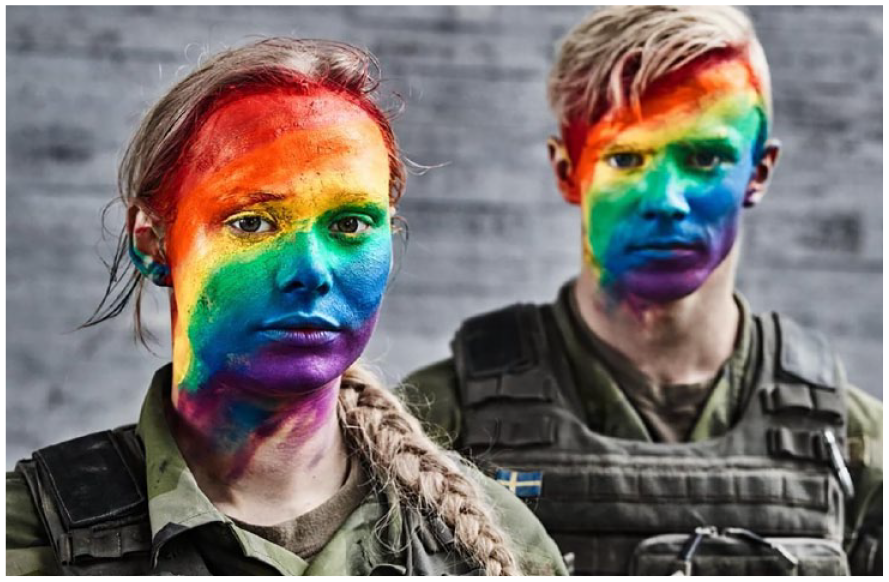
‘We Don’t Always March Straight’ (2018). Screenshot from the Swedish Armed Forces’ Instagram. Source: Försvarsmakten [the SAF]: https://www.instagram.com/p/Bl2F1uwFZCD/?igshid=MzRlODBiNWFlZA%3D%3D (accessed 15 November 2023).
EuroPride in 2018 focused on trans rights but the images are not revealing that this was the theme for that year’s Pride. There are no pronouns, names or titles and no focalizer to allow the subjects portrayed to be active internal narrators. The caption suggests that they identify as LGBTQIA+, but this cannot be known. Even though they seem to be ‘main characters’ – the subjects are only individuals outside the frame of the photo – in the image, they are part of a ‘we’ that belongs to SAF and Sweden (Kehl, 2023: 68). Whereas homonationalism serves to normalize and include specific queer identities while emphasizing heterosexuality as the norm, ‘transpatriotism’ serves to reject the fluidity of gender and, while specific normative trans bodies may be included in nationalist discourse through a specific form of ‘transpatriotism’ (Fischer, 2016), the Pride campaigns do not actively narrate a trans patriot story. Rather, all we see is that they are white, young and blonde (Kehl, 2023). This signals that LGBTQIA+-positive attitudes and the representation of young subjects may relate to recruitment purposes with the Swedish brand of progress through homonationalism that is intelligible to the reader.
Face paint is seldom worn in the armed forces, except for during exercises or battle. Apart from being understood as a symbolism for being in the closet or feeling the need to ‘blend’ in, face paint and/or camouflage could also be read as suggesting that queer identities can be worn as a ‘mask’. The metaphor is compelling and likely induces conflicting emotions in readers. The campaign can be interpreted as SAF recognizing, on the one hand, that the work has just begun but, on the other hand, that the organization is also marching towards progress. The reader understands that one should be able to be open with one’s identity in the military and not have to resort to camouflage to fit in. The textual layer also allows us to read the image as thematically inspired by experiences of ‘coming out’ in LGBTQIA+ communities. When reading the image, SAF ‘coming out’ allows for LGBTQIA+ soldiers to move away from experiences of victimhood within the armed forces and society as this hinders them from their full potential to emerge as queer patriot.
Militaries’ participation in Pride comes with certain conditions. For example, jewellery, makeup, or anything interfering with the uniform (such as rainbow-colored face paint) is typically prohibited. Even during Pride, self-expression becomes subordinate to the official uniform, making those marching in Pride soldiers foremost and LGBTQIA+ second (Bulmer, 2013). Staff from SAF are normally not allowed to wear uniform during political demonstrations due to policies of neutrality. However, Pride is exempted since SAF does not consider Pride to be a political event (The Swedish Armed Forces, 2014) and service members could be seen wearing rainbow face paint during the parade, at least during EuroPride. Herein lies a tension that is visible in the campaigns, where self-expression meets conformity and aesthetics meet practicality (Kouri, 2021). This is not narrated as an issue, but a necessity to recognize the diversity that SAF strives for. The ‘diversity as strength’ rationale is not unique to the SAF, nor is it unquestioned within CMS debates. Scholars have questioned the so-called ‘operational effectiveness’ argument, where ‘diversity’ is narrated to have important operational and strategic advantages, which in turn legitimizes gender integration or, in this case, the inclusion of LGBTQIA+ individuals (see Heinecken, 2017; Obradovic, 2014; Sasson-Levy and Amram-Katz, 2007).
Marriage and the military: Patriotic commitments?
In 2019, the campaign depicted a wedding cake in a grey camouflage pattern with one slice cut away to reveal a rainbow interior. The caption reads: ‘In the name of love’ (see Figure 3). In contrast to the EuroPride campaign from the year before, this campaign speaks to a national audience. The addressees of the image therefore do not need any explanation regarding the cultural context to understand the image and its broader narrative, as they are part of the community evoked (Freistein and Gadinger, 2020: 236). The image is different because it portrays a symbol, which seems unrelated to the military. However, as feminist scholars have noted, the institution of marriage and the military institution have much in common (Enloe, 2016); both are perceived as citizenship certifying. Marriage is an act of registration, a way to legally commit not just to another individual but also to the state. As such, it is not just a legal bond between two spouses but also a contract with the state, legitimizing and reproducing a particular form of kinship (Zivi, 2014). Heteronormativity in the military is upheld by the notion of the organization as ‘family’ with a ‘conjugal couple squarely at the center’ (Wool, 2015: 26). Herein, the queer patriot is invoked – acknowledging how ‘conventionally queer’ subjects undertake similar (heteronormative) rites of passage as the ‘typical’ soldier.
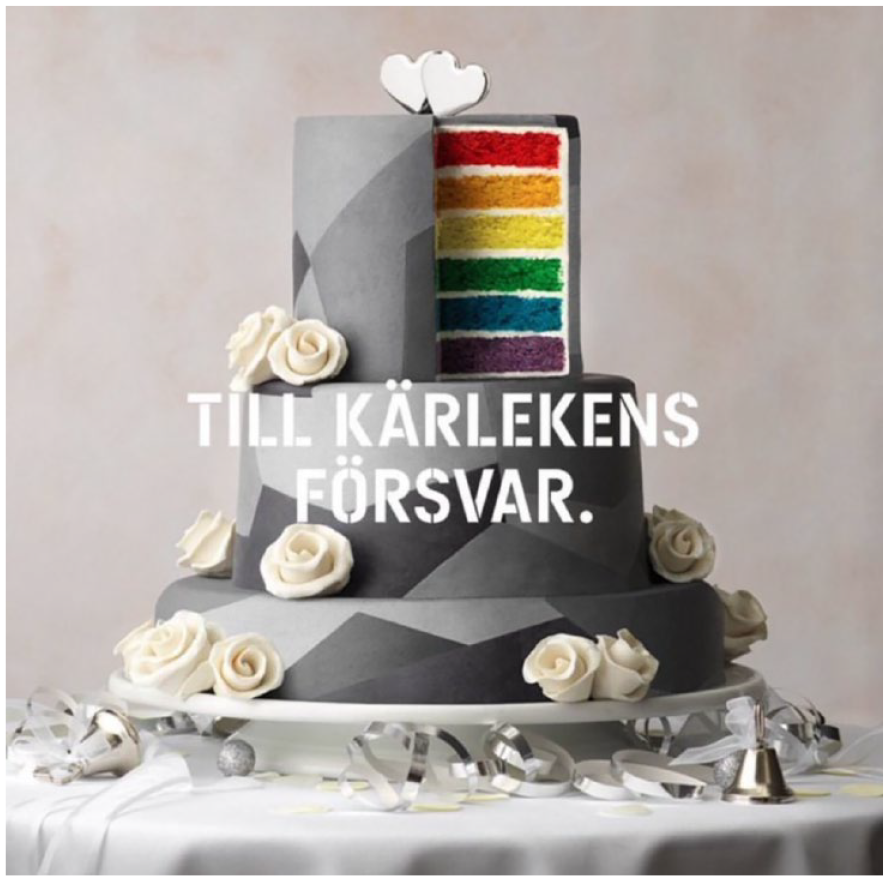
‘In the name of love’ (2019). Screenshot from the Swedish Armed Forces’ Instagram. Source: Försvarsmakten [the SAF]: https://www.instagram.com/p/B0fdKetoqLY/?igshid=MzRlODBiNWFlZA%3D%3D (accessed 15 November 2023).
The campaign also invokes the queer victim position through its recognition of the struggle to obtain equal rights to this act of registration. This again illustrates the shifting, relational and contradictory aspects of the conventionally queer ‘markers’ invoked in the campaigns. The year 2019 marked 10 years of marriage equality in Sweden, which this campaign narrates (Kehl, 2023). This campaign acknowledges the long struggle among LGBTQIA+ rights activists fighting for the legal recognition of same gender marriage. Military service, like marriage, becomes a form of kinship, although not between spouses, but between comrades protecting and caring for each other.
Symbols are harnessed in marketing to overcome a gap of representation. For instance, symbols can be harnessed to address a range of identities (Dyer, 1993). The object – the wedding cake – becomes a symbol for love and for LGBTQIA+ rights. There are no individuals in the image, the cake topper does not suggest who it belongs to – its interconnected silver hearts simply reaffirm a partnership. If this is between two individuals or between the Swedish people and the military, or both, is not discernible. It is upon the reveal of the inner layers that we can make sense of the interconnection between the military and Pride. The marzipan layer of the cake becomes a protective barrier of the inside layers, representing how SAF protects certain values such as marriage equality (Kehl, 2023: 71). If we intertextually read the image with its caption, we understand that this is more than a side task – it is the core of the organization’s mission, which relates to the narrative of Sweden as LGBTQIA+-friendly. Within this narrative, the queer protector reaffirms the commitment to the military and the state brand of ‘progression’ while not necessarily upsetting traditional and cis-heteronormative values.
How to be an ally
In the 2022 campaign (see Figure 4), the faces of the soldiers’ blur and it is difficult to distinguish the identities of the subjects within the frame. The viewer’s eye is drawn to the soldiers’ hands and the rainbow smoke above their heads. The caption is in Swedish and clearly depicts the collectivity and community to be found in the SAF. Beyond individualism and the right to self-expression, Pride is narrated to be about ‘family’. I interpret this campaign’s message as being one where all Swedes must rally to contribute to the security of Sweden and Swedish values. Accompanying the image was a seminar, which I attended, called ‘how to be an ally’, which focused on what cis- and straight staff members could do to make their LGBTQIA+ colleagues safer. Participants discussed the environment in which SAF has changed significantly in recent years, with it previously having been permissible to laugh at ‘gay jokes‘ to then being silent, to finally becoming an ally and speaking out against such comments. Becoming an ally is considered a journey in which #MeToo marked an important shift on which values are acceptable in the organization. During the seminar, the representation in relation to the Pride campaigns was mentioned as valuable as it renders visible the issues remaining in Sweden and in SAF, but this results in LGBTQIA+ individuals facing a double burden. One speaker argued that SAF ought to move away from the use of ‘poster children’ as this adds pressure on especially LGBTQIA+ individuals to ‘stand out’. They are both expected to blend in, to be ‘just like anybody else’ and emerge as queer patriot, all while coming out repeatedly by sharing their individual experiences in ways that invoke the marker closer to the queer victim.
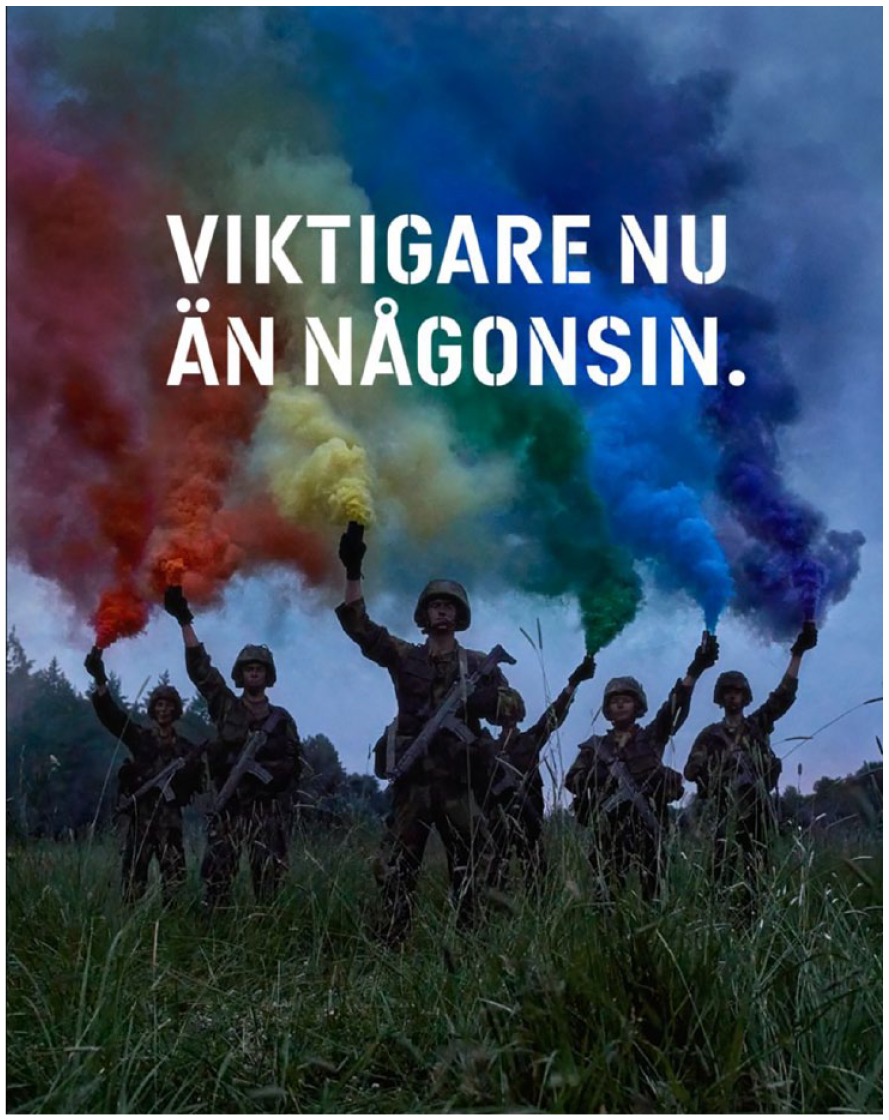
‘More important now than ever’ (2022) Screenshot from the Swedish Armed Forces’ Instagram. Source: Försvarsmakten [the SAF]: https://www.instagram.com/p/CgtL7nGoBwr/?igshid=MzRlODBiNWFlZA%3D%3D (accessed 15 November 2023).
The campaign highlighted the message that SAF’s mission now revolves around rallying against the Russian aggression in Ukraine. Thus, the story told is about uniting and becoming an ally. However, it cements an us/them dichotomy through homophobia as technology of Othering (Slootmaeckers, 2019), in which Russia becomes the explicit threat to Swedish security and values. Due to the shifting security landscape in Europe after the escalation of Russia’s war in Ukraine, Sweden moved to join the North Atlantic Treaty Organization (NATO) (Regeringskansliet, 2022). With Sweden’s accession into NATO, this campaign image must be considered a move away from the previous brand of ‘neutrality’ (Coetzee et al., 2023: 2). While the slide from non-alignment towards NATO has been largely ‘unproblematic’ in Sweden (Agius, 2023: 2) the Swedish brand is managed accordingly but still relies on similar tropes of ‘progressivity’. SAF must become an ‘ally’ and confess their true colors, i.e. their loyalty to the ‘West’ through a military alliance. In this process, the queer victim ‘over there’ is invoked as an emotional trigger, to highlight why there is a need for military protection. There is also an idea and policy goal to bring LGBTQIA+ and gender matters to the NATO table. The ‘progressive’ state brand, reliant on ‘queer’ and gendered narratives of the military, thus continues although Sweden’s security policy has undertaken drastic changes in the last years.
Conclusion
Through a feminist visual narrative analysis of the SAF’s Pride campaigns, this article made evident some contradictions innate to Western militaries’ attempts to reconcile their entrenched cis-heteronormative ideals with ‘progressive’ nation brands, specifically in relation to LGTBQIA+ rights. While previous research has argued that the campaigns have turned more militaristic (Kehl, 2023), this article demonstrates that, although explicit ‘state feminism’ was abandoned by the new government and large shifts occurred in the security sphere, such as Sweden joining NATO, the ‘reaffirmation’ of LGBTQIA+ rights through Pride reveals the stickiness of the preferred Swedish nation brand of ‘progressiveness’. In contrast to previous research analysing internally narrated stories of Swedish state feminism (Bergman Rosamond and Hedling, 2022: 317), this article intentionally focused on narratives with an external focalizer (SAF) and not on internal focalizers (service member testimonies) during Stockholm Pride. I did so because, when considering the visuality and focalization of the strategic narratives represented in the campaigns, it becomes apparent that SAF tells their story through anonymous subjects or objects, who via emotional storylines recognizable to many LGBTQIA+ individuals, relay triggers about the pain in hiding who you are and the joy of acceptance from one’s community. Consequently, the Pride series captures some individual and community-based aspects of ‘queer’.
In line with previous scholarship, however, I argued that military marketing with LGBTQIA+ messaging might only challenge military gender relations at surface level in its representation of conventional ‘queer’ subjects/objects (Kehl, 2023: 76). For instance, ‘coming out’ is represented as a singular and unidirectional event – LGBTQIA+ individuals know this to be a recurrent and not straightforward process (if one can or wants to ‘come out’ at all). Similarly, SAF – like LGBTQIA+ individuals – must affirm their identity and outwardly project their support through military marketing. By appropriating language used in (some) queer communities, SAF symbolically refers to expected rites of passages among Swedish LGBTQIA+ individuals, which echo ‘Western’ ideas of queerness and individuality: coming out, self-expression, parading in Pride, marrying one’s partner and being a proud ally. This is indicative of how the Pride campaigns perpetuate ‘conventionally’ queer subject positions through wider discourses of neoliberalism and homonationalism, which simplifies and homogenizes LGBTQIA+ identities (see also Kehl, 2023: 76). While the queer patriot and queer victim are helpful for analysing the process through which the campaigns narrate ‘progressiveness’, the relationship between these subject ‘markers’ shifts depending on the context, and their fluidity, multidirectionality and relationality serve to simultaneously restrict and empower the subjectivity of specifically the queer victim in ways that must be further theorized.
Future research should also explore LGBTQIA+ inclusion in nation branding and military marketing, especially their gendered representations over time and across branches. To conclude, an inclusive approach can be conceived as making SAF stronger, better and legitimate. Queer subjects should not experience ‘victimhood’ as concealing ‘their difference’ would hinder them from their full potential to emerge as queer patriot or perhaps rather – protector. Conversely, sexuality is narrated to be ‘irrelevant’ and does not make LGBTQIA+ individuals any ‘different’ from their peers, which renders invisible the intersectionality characterizing queer experiences. The Pride series renders visible how discourses of homonationalism and its ideals of ‘queerness’ are at play in military marketing on LGBTQIA+ inclusion, which promotes a narrative of sexual or gender difference as ‘normal’ while (re)producing conventional queer subjects of cis-heteronormative ‘sameness’.
Footnotes
Acknowledgements
I would like to extend thanks and gratitude to Jenny Hedström, Annick Wibben, Tanya Kini and Agnes Termeer for all their support and advice throughout the research process. Many thanks are also due to the members of the Military Organization respectively Gender, Peace and Security research groups at the Swedish Defence University for their valuable and constructive input on previous versions of this article. I would also like to thank the reviewers for their invaluable comments that encouraged me to strengthen this article and clarify its contribution.
Funding
The author received no financial support for the research, authorship and publication of this article.
