



Abstract
This article makes a necessary intervention in Critical Nuclear Studies which thus far lacks engagement with popular culture since the Cold War. There is a significant gap in our knowledge about contemporary representations of nuclear weapons and their significance for nuclear politics in the current moment. Using Oppenheimer (2023) as a catalyst, this article navigates a setting central to the origin story of nuclear weapons: the desert. The desert is shown to have a complex literal and symbolic history that is intertwined with nuclear politics and contributes to nuclear weapons’ continued mythological status in an age defined by an increasingly partisan trust and distrust in science. The desert setting in popular culture exemplifies the paradoxical and contradictory meanings of nuclear weapons and war. The desert is both the symbolic frontier to the land of opportunity and freedom, and a land of isolation and nothingness. In a retelling of the story of the Manhattan Project – the ‘origin story’ of nuclear weapons – Oppenheimer (2023) offers an opportunity to navigate these tropes in the current moment. Navigating competing representations of nuclear weapons and war reveals some of the hidden logics and relations of power that remain at the foundations of nuclear knowledge – from high politics to popular culture.
Introduction
In 1944, artist and painter Georgia O’Keeffe was interested in the blue of the sky. Amid the ongoing World War, it was a colour she reflected on as ‘the Blue that will always be there as it is now after all man’s destruction is finished’ (Tate, 2023). A year later, the World War ended but the ultimate tool of man’s destruction had just begun. Georgia O’Keeffe was on one of her long stays at the Ghost Ranch house in the New Mexico desert when a bright and savage light filled the sky. At the nearby Los Alamos test site, the world’s first nuclear weapon had been detonated. O’Keeffe returned to her art. She again painted the sky, though now it was alive with reds and yellows. Figure 1 depicts the sky as seen through an animal’s pelvis bone that O’Keeffe found on the desert floor. I include this image as, to me, it exemplifies the nuclear sublime: the at once beautiful and frightening, the astonishing and terrifying. It reminds me of the peculiar anecdote that in an event of nuclear war the sky will be filled with the most spectacular sunsets visible all through the day and night. Dust and aerosol would scatter the sun’s rays and produce vivid sunset effects, like the intense yellow red in O’Keeffe’s work. Truly a sight to behold, but one too costly to witness.

O’Keeffe. Pelvis Series, Red and Yellow (1945).
The images analysed in this article feature no blue skies. At times, the sky is filled with the hues of the horizon suggestive of hope for the future. Other times, it is a torched expanse, mourning the lost natural world. These concurrent and yet contradictory representations reveal a paradox at the heart of nuclear weapons and war: they are at once a story of hope and salvation and of ruin and destruction. Either way, the sky never appears as it was before.
Contribution
Academic enquiry into the relationship between popular culture and nuclear politics has declined alongside the decreasing nuclear fear since the end of the Cold War, with scholars interested in popular culture turning their attention to the War on Terror (see Holland, 2011; Parry, 2022; Pears, 2016, 2022; Robinson, 2015). The declining scholarly attention given to nuclear weapons risks presenting nuclear issues as issues of the past, confined to the Cold War. This is ignorant of the fact that every nuclear weapons state is modernizing or expanding its nuclear arsenal and, as former US Secretary of Defense William Perry puts it, ‘we are at greater danger of a nuclear catastrophe today than ever before’ (The William J. Perry Project, 2020). There is a significant gap in our knowledge about contemporary representations of nuclear weapons and their significance for nuclear politics in the current moment. It is important to continue to ask critical questions about representations of nuclear weapons and war to better understand their present, as well as their possible futures.
There is fruitful work analysing popular film in light of nuclear politics; however, this work is either a product of the Cold War or looks back to films produced during the Cold War (Broderick, 1993; Broderick and Jacobs, 2012; Carroll, 2003; Evans, 1998; Haut, 1995; Nadel, 1995; Piette, 2009; Schaub, 1991). They are often interested in Hollywood–military collaborations (Evans, 1998; Reingold, 1984; Robinson, 2019; Yavenditti, 1978), the classic 1950s radiation-produced monster films like Godzilla (1954) and Them! (1954) (Brougher, 2013; Evans, 1998; Jacobs, 2010), or the nuclear critical horrors of the 1980s like The Day After (1983) and Threads (1984) (Aistrope and Fishel, 2020; Hogg, 2016). There is a lack of engagement with contemporary popular culture created for a post-Cold War audience. This article contributes to the valuable efforts of scholars dedicated to demonstrating how popular culture and world politics are co-constituted and cannot be understood in isolation (Bleiker, 2001; Crilley, 2021; Dittmer and Bos, 2019; Fiske, 2010; Grayson et al., 2009; Griffin, 2019; Hamilton, 2019; Moore and Shepherd, 2010; Weldes, 2003). Its specific contribution makes a connection between nuclear politics and film, making a necessary intervention in Critical Nuclear Studies which thus far lacks engagement with popular culture since the Cold War.
Using Oppenheimer (2023) as a catalyst, this article navigates a setting central to the origin story of nuclear weapons: the desert. The desert is shown to have a complex literal and symbolic history that is intertwined with nuclear politics and contributes to nuclear weapons’ continued mythological status in an age defined by an increasingly partisan trust and distrust in science. Seemingly contradictory genres coexist without confusion, revealing tensions and paradoxes at the heart of the nuclear origin story and representations of nuclear weapons today. In a retelling of the story of the Manhattan Project, Oppenheimer (2023) offers an opportunity to navigate these tropes in the current cultural moment. Navigating competing representations of nuclear weapons and war reveals some of the hidden logics and relations of power that remain at the foundations of nuclear knowledge – from high politics to popular culture. As the Russia–Ukraine war continues, audiences will watch closely, ever aware of the echoes and dangers in current world affairs. The film’s representation of the first nuclear weapons shape popular assumptions about the world’s (now 12,700) nuclear warheads with vastly superior yields (ICAN, 2023). As such, both this article and the film itself have contemporary relevance, even urgency, in contributing to understanding contemporary representations of nuclear weapons and war. This popular imagining can shape the boundaries of how nuclear weapons can, and likely will, exist in the future.
Conceptual background
This article is guided by poststructuralist thought (Bleiker, 2001; Der Derian and Shapiro, 1989; Edkins, 2007), particularly the Foucauldian notion that popular and dominant discourses construct regimes of ‘truth’ which privilege certain realities and silence others. More than simply a ‘mirror’, popular culture can ‘co-constitute’ dominant discourses in world-producing processes (Grayson et al., 2009; Saunders, 2022; Weldes, 2003). A poststructuralist reading of Oppenheimer (2023) can reveal, reproduce and challenge taken-for-granted nuclear discourses. Doing so can highlight global contestations over meaning, as well as the ways in which identity, legitimacy and power are constructed. As such, I encourage International Relations (IR) scholars to consider popular cultural artefacts as legitimate tools for political enquiry. In many ways, this follows the sociological maxim, ‘make the familiar strange’, seeking to politicize what may otherwise be seen as ordinary and mundane.
Venturing from IR to Cultural Studies invites questions that bridge the political and the aesthetic. This phenomenon has been termed the ‘aesthetic turn’ in IR, commonly attributed to the seminal cannon of work by Bleiker (2001, 2018, 2021). The aesthetic turn is interested in political readings of popular cultural texts that are attentive to the ways in which aesthetics intertwine with global power relations ‘that come into being through the images we see, the movies we watch and the stories we tell’ (Bleiker, 2021: 581). Film has been one of the foremost visual genres taken up by IR scholars (Crilley, 2021). This is largely due to the contemporary diagnosis that we live in a ‘visual culture’ where cultural forms dominated by the visual are most influential (Beller, 1994; Mirzoeff, 1999). In the following sections, this article takes a particular interest in visual conventions, tropes and icons, and the ways that they are produced by and productive of nuclear culture. In the aesthetic approach, the poststructuralist feminist (see Sylvester, 2001; Weldes, 1999, 2003), and the post-colonial scholar (see Appadurai, 1996; Said, 1979) are united by a shared attention to the everyday. Socially constructed hierarchies are productive of gendered and racialized discourses which are continually produced in and through practices of everyday life. In taking popular culture seriously, everyday acts such as going to the cinema become critical incidents of world politics. As feminist scholar Enloe (2014: 351) reminds us, ‘the personal is international.’
This article is interested in how nuclear popular culture constructs ideologies which structure widespread beliefs about nuclear weapons, their potential use and their continued existence. Foundational Cultural Studies scholar, Hall (1982[1981]), defined culture as a ‘system of representation’ in which ‘the power to signify is not a neutral force’ (p. 70). Hall highlights how representation cannot be seen as reflecting some ‘truth’ about the world but rather is both a product of and productive of hierarchies of power. To this end, he understood culture as a space of ‘interpretative struggle’ where dominant meanings are continually contested and renegotiated. Following Hall, Evans (1998) outlines ideology as ‘a system of representations (images, myths, ideas, or concepts)’ which operate to ‘set the boundaries of reality’ (p. 2). Therefore, in order to better understand nuclear ideologies, both nuclear representations and ‘common sense’ understandings of nuclear realities must be called into question.
Nuclear culture
In understanding culture as a site of struggle, I propose that nuclear culture is a site of struggle par excellence. Nuclear culture is a system of representations built upon paradox and contradiction. We can simultaneously understand nuclear weapons as safe in our hands and dangerous in theirs; we can believe in credible first-use policies whilst declaring that nuclear war can never be won and must never be fought, we can pursue an arms race whilst engaging in arms control. Whilst all culture is a site of struggle, nuclear culture brings this struggle to the forefront and paradoxical notions of utopia and dystopia come to co-exist in ways so repeated that they cease to feel unusual or strange and instead are accepted as common sense. Boyer (2005) described nuclear culture as a ‘fallout’ of the atomic age. Like the radioactive particles that fall from the sky and spread themselves far and wide after a nuclear explosion, leaving traces for many years to come, nuclear culture also has far-reaching consequences and both short- and long-term impacts. Nuclear culture operates in social, political and economic realms, shaping lived experiences and everyday lives across the world. It permeates the tourism industry (nuclear bunkers, test sites and accidents), shapes marketing campaigns (the bikini, Kix cereal, Miss Atomic Bomb) and floods our screens (news, creative and gaming industries).
As the Cold War ended and nuclear fear subsided, the nuclear issue was consigned to history in public consciousness. Gorbachev signed START 1 with Bush in 1991 and START II was signed by Clinton and Yeltsin in 1993. For the first time, the nuclear age began to feel negotiable. This post-Cold War era came to be characterized by an ‘illusion’ of the disappearance of the nuclear state (Masco, 2006). Although nuclear weapons continued to dictate foreign policy and international relations, domestically there was an ‘erasure of the nuclear economy from public view, and the banalization of US nuclear weapons in everyday life’ (Masco, 2006: 4). Noting a similar effect in a British context, Hogg (2016) concluded that the nuclear state had been ‘rendered invisible’ from 1990 onwards. The same trend is observable in popular culture. According to Pelopidas (2021), there are particular ‘aesthetic gestures’ that allow us to imagine nuclear war as actually possible. These gestures ‘disappeared’ in popular culture after the 1990s, resulting in ‘an invisibilization of nuclear war that reproduces the illusion of its impossibility’ (Pelopidas, 2021: 180). Though Russia’s invasion of Ukraine has seen a resurgence in attention to the nuclear issue, the production of the Oppenheimer movie had finished before the war began. This situated director Christopher Nolan as working within a period of low nuclear fear, characterized by a lack of interest and media attention given to nuclear issues, making it ever more important to understand the aesthetic strategies used to (re)construct a sense of nuclear fear and magnitude.
Oppenheimer (2023)
(Cillian Murphy): Our work here will ensure peace mankind has never seen.
(Benny Safdie): Until somebody builds a bigger bomb. 1
The story of how the bomb came to be centres J Robert Oppenheimer and his team of scientists in Los Alamos Laboratory, working within a top-secret military–industrial complex that would change the world forever. Fiction and popular culture cannot be seen as separate from the production of truth and meaning-making processes about nuclear weapons. Rather, Oppenheimer (2023) contributes to normalizing particular regimes of truth about nuclear weapons and war, with profound political consequences. Director Christopher Nolan’s highly anticipated biopic follows the ‘father of the bomb’ during his directorship of the Los Alamos Laboratory. The film is one half of the ‘most anticipated box office battle of the year’, opening the same day as Greta Gerwig’s Barbie (2023) (Williams, 2022). Oppenheimer (2023) has surpassed $850 million at worldwide box office, making it the top-grossing film about WWII of all time. Oppenheimer’s story is often told as a Faustian bargain: a trade-off between personal morality and worldly power. This origin story has become the common-sense history of nuclear weapons. However, feminist scholars have called this origin story a myth: a myth produced by and about elites, a myth that suggests the inevitability of the bomb’s development, and a myth of men and masculinity (Considine, 2022). This story is rehearsed time and again, with Nolan’s Oppenheimer the latest reimagining of the dominant and largely masculine imagining of nuclear weapons and war.
Nolan’s film is based on the Pulitzer Prize winning biography American Prometheus: The Triumph and Tragedy of J. Robert Oppenheimer (Bird and Sherwin, 2005). The story of Prometheus is summed up in the opening quote of the Oppenheimer (2023) film: ‘Prometheus stole fire from the gods and gave it to man. For this, he was chained to a rock and tortured for eternity’ the screen reads amid fiery special effects. The story of Prometheus is used deliberately and explicitly to frame the narrative of Oppenheimer, suggesting a particular reading of his character and actions, and shaping what is highlighted and what is ignored. Like Prometheus, Oppenheimer’s actions are driven by good intentions for humans (USA) – defeating the Nazis, ending the war. However, just as fire meant only for the gods, the power he unleashes is too great for this world – and able to destroy it. Just as Mary Shelley’s Dr Frankenstein’s (‘Modern Prometheus’) tragedy began at the moment of his experimental success, when the creature comes to life, so too does Oppenheimer’s (‘American Prometheus’) tragedy begin with the success of the Trinity Test. This mythological narrative provides a narrative frame for the reading of Oppenheimer: from the outset, a film that explores scientific discovery and the laws of physics is shrouded in symbolism and mythology. Science is a venture into the unknown. The scientist, then, whose job it is to embark on this venture, has long been entangled within a web of socio-cultural anxieties surrounding the unknown. This societal fear reflects the instinctual knowledge that unknown things can be dangerous, as well as a long history of tales about forbidden knowledge: Prometheus, Adam and Eve, the Sorcerer’s Apprentice, Icarus, Pandora’s box. These stories find their roots in mythologies of sorcerers, wizards and, later, alchemists. They centre remote figures shrouded in ideas of discovery, danger and mystery who come to embody society’s fears of arcane knowledge (Haynes, 2016; Weart, 2012).
Oppenheimer sits within a canon of popular biopics about scientists, following the success of films following Alan Turing (The Imitation Game, 2014), Stephen Hawking (The Theory of Everything, 2014), Thomas Edison (The Current War, 2017), Marie Curie (Radioactive, 2019) and Nikola Tesla (Tesla, 2020). This significant volume of mainstream fiction (rather than science fiction) about scientists is a recent phenomenon. According to Haynes (2016), only in the 21st century has the centuries old stereotype of the Dr Frankenstein-esc ‘mad, bad scientist’ been challenged. The proliferation of film and television technologies has made scientists far more familiar and less subject to anxious mythologies. We are now familiar with science: we see bright laboratories, young female scientists, life-saving research, Brian Cox, David Attenborough and The Big Bang Theory (Haynes, 2016; Kirby, 2017; Weitekamp, 2015). Even their secret work and laboratories, as in Oppenheimer, are shown to us in iMax. The 21st century marked a radical revision of the stories which for so long had been filled with fear or mockery of scientists (Haynes, 2016). The climate crisis has played a pivotal role in changing the stereotype of the scientist. Rather than being associated with contamination by pesticides, toxic chemicals and radioactive waste, scientists are now perceived as the essential ally in saving the planet.
Oppenheimer (the man) and Oppenheimer (the movie) mark an interesting tension in the representation of the scientist. We must believe the scientist can keep us safe and that the scientist has unleashed a power too great for this world. We must be thankful to him for bringing peace and ending war, and we must fear that he has opened the Pandora’s box that will inevitably destroy the world. He is both the saviour of the world and the end of it. The audience is not given a simple narrative. Oppenheimer is constructed as a paradox, representing contradictions and dualism. Indeed, in an interview with the Bulletin of Atomic Scientists, Christopher Nolan used the same metaphor to describe both Oppenheimer (the man) and Oppenheimer (the movie): of the man, ‘He is the ultimate Rorschach test’, and of the movie, ‘it is a Rorschach test that prompts a variety of responses’ (Mecklin, 2023). The Rorschach test is a psychological practice involving descriptions of perceptions within a series of abstract inkblots, thought to give insight into emotional states. By design, these inkblots can be read in a multitude of ways and there is no correct answer since the blot does not actually represent anything. This notion that Oppenheimer is beyond representation necessitates ambiguous framing open to multiple conclusions which inevitably blur the line between the decades-old mad scientist and the scientist of the 21st century. The audience is not told to trust in science, nor are they told to distrust it. They are not directed to turn to God, nor are they directed to turn away. Nuclear weapons are not unambiguously safe, nor are they necessarily dangerous. Oppenheimer (2023) brings these struggles to the forefront, exposing and making strange how paradoxical notions of peace and destruction as well as dualisms of science and myth come to co-exist in the story of nuclear weapons.
The desert and nuclear weapons
In Nolan’s Oppenheimer, Oppenheimer (Cillian Murphy) speaks of his longing and affection for the New Mexico desert. ‘When I was a kid’, he says, ‘I thought if I could find a way to mix physics and New Mexico, my life would be perfect.’ He misses it terribly whilst studying in Europe. Upon his return, he escapes there with family and friends – frequenting horse-packing trips with his brother, Frank, and inviting Kitty to spend the summer at his ranch in Albuquerque before they married. Indeed, it was out of Oppenheimer’s knowledge of the land that Los Alamos was suggested as the location for the top-secret Manhattan Project. Twenty years earlier, a young ‘Oppie’ had ridden the Valle Grande and come across the Los Alamos Ranch School: later the Los Alamos secret laboratory. Out of his familiarity came the location of something entirely new. The location of the Manhattan Project and the Trinity Test shines a light on the tensions, contradictions and paradoxes that get to the heart of nuclear weaponry: a bomb that would be shrouded in a discourse of peace, a weapon that would be described as ending wars, an instrument of radiation and destruction cloaked by language of creation. Oppenheimer’s place of recreation became his place of labour. The land of Pueblo and native New Mexicans became the land of military–industrial America. A place of outstanding beauty became a place of outstanding destruction.
Today, Los Alamos remains a shrine to the Manhattan Project. The Los Alamos National Laboratory (LANL), along with its sister lab, the Lawrence Livermore National Laboratory (LLNL) remain America’s scientific epicentre of nuclear research and innovation. If you were to visit Los Alamos today, you would quickly get a sense of local pride in its nuclear heritage. The town’s slogan is ‘Where discoveries are made’ and street names such as ‘Oppenheimer Drive’ point to the past. Museums and exhibitions in Los Alamos present a carefully curated perspective of nuclear warfare that serves to depoliticize, normalize and essentialize the nuclear industry (Masco, 2006). Subtly, these sites suggest that nuclear weapons are objects of history, discouraging reflection on ongoing weapons expansion and modernization (Alexis-Martin et al., 2020; Faux, 2023; Masco, 2006; Woodward, 2014). Cultural anthropologist, Joseph Masco, asks us to consider how it is that the US’s nuclear weapons industry is now so invisible despite being a vast industrial complex that spans the entire nation and costs trillions of US dollars to maintain. The nuclear weapons complex that was literally hidden in the New Mexican desert remains figuratively hidden from popular consciousness, despite its impacts leaving little untouched (Arkin et al., 1998; Philippe et al., 2023). Christopher Nolan’s Oppenheimer (2023) has led to a welcome increase in public interest in nuclear weapons. However, without overt nods to the ongoing injustices of nuclear weapons, Oppenheimer risks resigning the bomb to history alongside vintage pipes, wide brimmed hats, and black and white film.
The frontier
Although Oppenheimer (2023) is not a Western, the genre has become so entangled with the framing of the desert that it cannot be disentangled from the representations of the Manhattan Project, nuclear weapons, or wider nuclear culture. The desert is framed by frontier discourses and narratives that continue to suggest particular readings of the space and place. Exposing these discourses can help us to encounter them differently.
Art historian Solnit (2014), wrote that our treatment of a place is shaped by the way we are taught to view it. For her, we are taught to view the Nevada Test Site with ‘the aesthetic of vastness, magnificence, power, and fear’ (p. 47). Situated in the New Mexico desert, the iconographic setting of the Los Alamos Manhattan Project laboratory is reminiscent of the American ‘Wild West’. Figure 2 exemplifies how the setting of the story plays an important part in assigning the Manhattan Project an aura of hope. The hues of the soft and pink sky make the desert seem warm and inviting. Visual metaphors of ‘dawn’ and ‘horizon’ symbolize new beginnings and opportunities. One can imagine a cowboy hero riding off into the sunset. The desert setting of the Manhattan Project established strong associations between the cowboy settlers of the mid-19th century and the atomic pioneers of the 20th (Laucht, 2009). This hue of adventurism was soon picked up in popular media and cowboy imagery came to play an important role in establishing Oppenheimer’s public image: ‘with a Stetson on his head . . . Oppenheimer liked to ride his horse Chico 40 rugged miles in a day’ (TIME Magazine, 1948: 81). The familiar iconography humanized the bomb-maker, associating him with storybook characters long cherished in American mythology (Hecht, 2008). Indeed, Oppenheimer played on this, featuring many scenes of horseback riding and prolonged attention to his Western hat. The reappropriation of these tropes and narratives shape what is seen as possible. The well-known cliché of the Western happy ending – the cinematic closing scene of a hero riding off into the sunset – can lead to unsolicited faith in the ‘heroes’ of the Manhattan project.
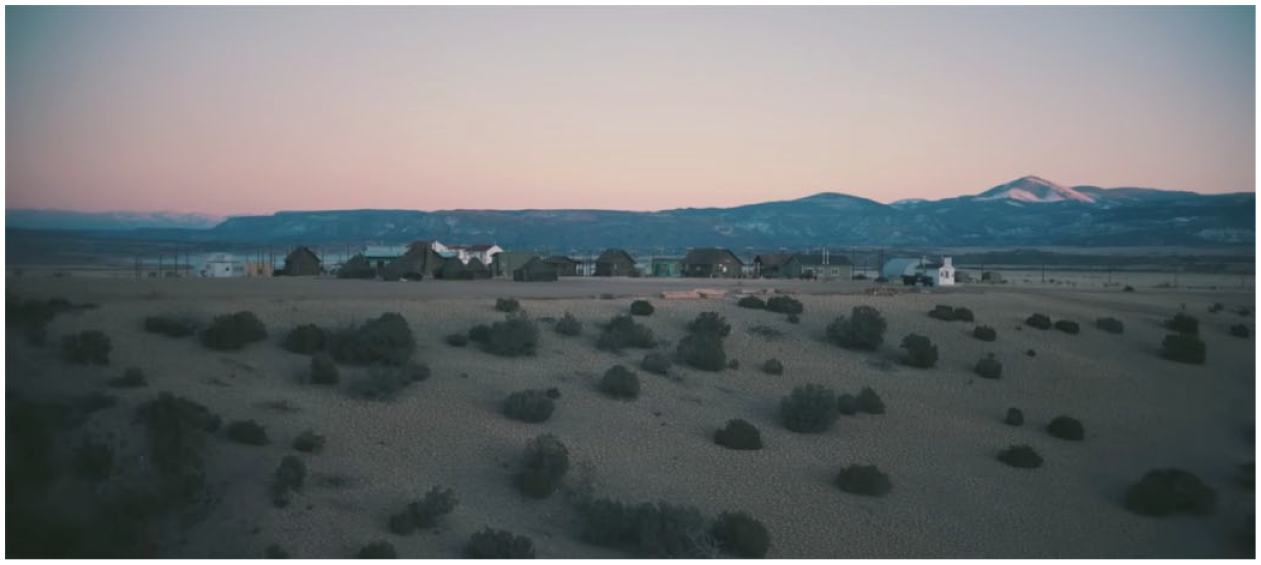
Taken from the Official Oppenheimer trailer as published on https://www.oppenheimermovie.co.uk/ reproduced in accordance with fair use for critical analysis ©2023 UNIVERSAL PICTURES.
The ways in which we remember the American West make it possible to imagine certain futures, and difficult to imagine others. The origin story of nuclear weapons shares many parallels with the origin story of America. White European settlers had no heritage story on American land; instead, their shared identity – their ‘imagined community’ (Anderson, 1991) – came from stories of frontiers and the New World. As Campbell (1992: 91) puts it, ‘if all states are “Imagined Communities” . . . America is the imagined community par excellence.’ Without ethnic heritage, Americans have constructed powerful stories to explain how their nation expanded westward (Abbott, 2005). Frontier epics at the heart of American nationalism tell the tale of European settlers’ discovery of wealth in undiscovered lands.
Post-colonial nuclear scholars have traced American cultural history, particularly the cultural frameworks that shaped the advent and use of atomic weapons. Sharp (2007) demonstrates how racial imaginings at the heart of the frontier myth of American nationalism became the framework for what he calls ‘nuclear frontier narratives’. These narratives reproduce colonial assumptions about white ‘civilization’ and non-white ‘savagery’ that come to shape notions of rational and irrational possessors of nuclear technologies (Sharp, 2007; Williams, 2011). The raw desert landscape littered with industry became a symbol of America as a land able to match, or even advance, European industry whilst leaving behind the crowded and polluted city life in Europe (Marx, 2000). The desert came to represent the New World, imagined as an uninhabited desert space transformed by the coming of man (Nye, 2003). However, these spaces were not ‘uninhabited’ (Urwin, 2022; Williams, 2011). Oppenheimer (2023) leaves out the Indigenous communities, downwinders and Nuevo Mexicana farmers who faced dispossession of their homes and homelands during the Manhattan Project. There is a subtle nod in script, easily missed, that acknowledges those who were not represented. In this scene, Truman (Gary Oldman) asks Oppenheimer (Cillian Murphy), ‘What should we do with it [Los Alamos]?’ to which Oppenheimer responds, ‘Give it back to the Indians.’
Metaphors and meanings tend to find their root in our embodied experience of the world (see Lakoff and Johnson, 1980). The physical sense of space and nothingness of the desert led to stories, myths and metaphors that associate the desert with isolation, loneliness and hopelessness. Characters who find themselves in deserts are therefore often depicted as alone – cowboys, lone rangers, even Jesus. When Jesus is tested by the devil, he is alone in the desert for 40 days and 40 nights (Matthew 4: 1–11). In the Old Testament, Moses spent 40 years in the desert and, with the Israelites, he wanders it for 40 more. In exchange for faith and endurance, God promised ‘streams in the desert’ (Isaiah 43:19). The biblical desert is a place of testing, where faith must be put in God. It is promised that if one can endure the challenges, they will receive a fruitful reward. The nuclear desert is also a place of testing – of literal nuclear weapons testing – where faith must be put in science, or God, or both. Allusions to biblical prophecy and faith were rife in accounts of the Manhattan Project; at the first nuclear weapons test (‘Trinity’), ‘one felt as though he [sic] had been privileged to witness the Birth of the World – to be present at the moment of Creation when the Lord said: Let There be Light.’ (Laurence, 1945). The significance here is that allusions to biblical prophecy ‘lend an inevitability to nuclear development and its consequences’ (Evans, 1998: 97). Religious narratives can give the weapons a form of agency beyond that of their inventors. Ongoing reference to the ‘otherworldliness’ of the desert can ultimately lead us into accepting the bomb as something beyond human responsibility: whatever happens, it was an act of God (Considine, 2020).
The Apocalypse
Reflecting on Oppenheimer (2023), one can see a form of cyclical logic at play. Science fiction cinematic tropes and genre were given new meanings by the advent of nuclear weapons. They helped to address societal fears and anxieties. Now, in a period of ‘lost’ or ‘invisible’ nuclear culture (Boyer, 2005; Hogg and Laucht, 2012), these same tropes are drawn upon in the retelling of the story of the advent of nuclear weapons. Although not science fiction, the following section demonstrates how the science fiction genre has framed the desert, suggesting particular readings of the desert landscape through the characteristics they attribute to the space and place. Those frames are influential in the reading of Oppenheimer, shedding light on often taken-for-granted assumptions and functions of power.
Like the first image, Figure 3 is a shot of the desert taken from the Oppenheimer trailer. However, in this image, the rough and empty landscape is dull and yellow, the sky is bleak and the ground is scorched. The image is far more reminiscent of apocalyptic wastelands than horseback heroes. Scholars have dubbed such aesthetics the nuclear ‘sublime’, images that inspire a combination of astonishment and terror (Burke, 2012; Hirsch, 2005; Kane, 2018). For Urwin (2023), the aesthetics of the nuclear sublime landscape obscure the mundane and everyday realities of nuclear landscapes and their inhabitants. She advocates a move away from the sublime relationship between the nuclear and the land, and calls for restraint in discussing the apocalyptic realities of nuclear weapons. The reproduction of the nuclear sublime reinforces notions of nuclear ‘exceptionalism’: that nuclear weapons are ‘fundamentally different from any other human creation’ (Hecht, 2006: 321). Narratives of nuclear exceptionalism, like the nuclear sublime, operate along a duality whereby nuclear technology either represents the ultimate utopia or dystopia. Such apocalyptic scenes obscure the relative banality of the world’s forgotten nuclear landscapes. Nuclear landscapes often look less like the end-of-the-world and more like inhabited Indigenous lands, multi-layered ecosystems and tourist hotspots (Urwin, 2023).
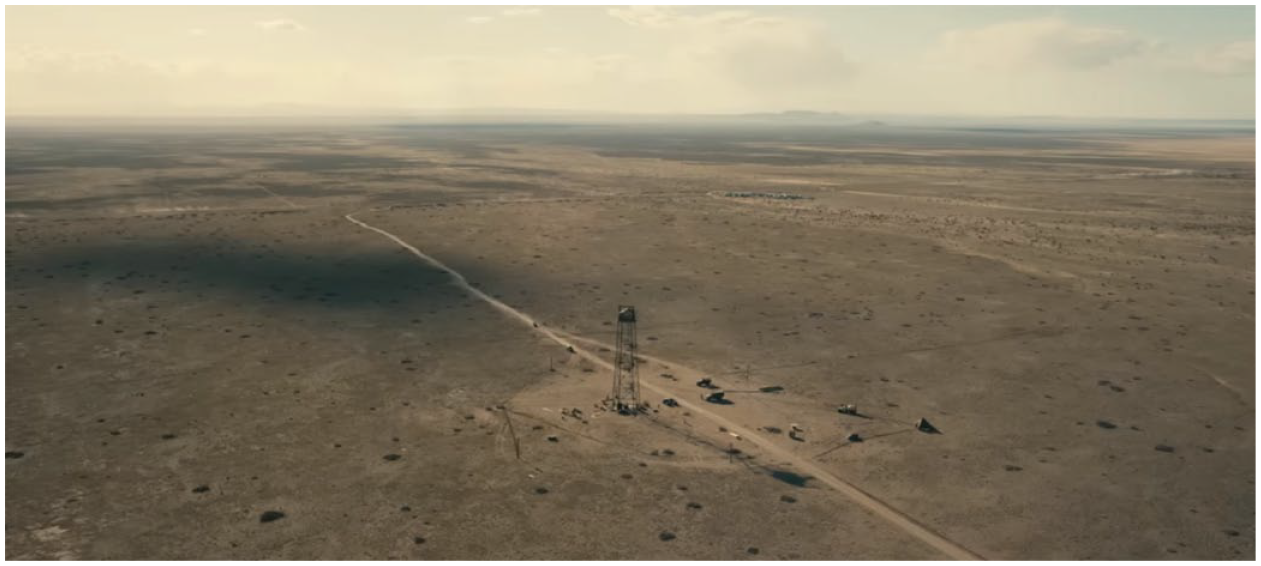
Taken from the Official Oppenheimer trailer as published on https://www.oppenheimermovie.co.uk/ reproduced in accordance with fair use for critical analysis ©2023 UNIVERSAL PICTURES.
Figure 3 is an example of what filmmakers call a ‘bird’s-eye-view’ and what, in highlighting its political effect, I will term ‘drone gaze’ (see Auchter, 2023). In film, this camera angle is a common technique used in film to provide overviews of setting. It is used to highlight magnitude or vastness by demonstrating how much, or how little, can fit into the frame - here centring the 100-foot steel ‘shot tower’ from atop of which ‘Gadget’ was detonated in Trinity, the world’s first nuclear test. The power and distance afforded by the height of the camera is a point-of-view that is not naturally available to humans. We are, however, well accustomed to this unusual gaze through modern warfare, surveillance, and even video gaming. The drone gaze aesthetic exemplifies what Stahl (2009) calls ‘militainment’; the phenomenon of increasingly visual presented as a form of spectacle through 24-hour news coverage and war-related popular culture. Weapons technology changes our ‘ways of seeing’ (Berger, 1972). The effects of this in relation to war and violence are often best demonstrated through Game Studies. First-person shooter games grant players the perspective of a (Western) soldier looking through the sight of a gun (Robinson, 2019) and the drone eye view offers surveillance over the land (Berents and Keogh, 2018). Largely due to its similarities with video gaming, critics claim that drone gaze causes remoteness and detachment, making killing more casual. Predating modern nuclear and drone warfare, Charles Lindbergh diagnosed participation in modern warfare as like ‘viewing it on a motion-picture screen in a theatre on the other side of the world’ (cited by Gregory, 2014).
Any claims of distancing effects afforded to drone gaze are radically exaggerated in the nuclear realm. Where drones’ aerial gaze reveals in close detail the bodies of their victims, aerial photographs of nuclear attacks would display no human bodies, the field of destruction too vast and the bodily destruction too great. These drone shots anonymize and dehumanize bodies on the ground, leaving only an impression of the scale of the problem. The drone gaze commonly affords a distanced, safe and powerful controller with surveillance over the land of an Other, casting an Orientalist frame over all it captures (Khatib, 2006; Maurer, 2017; Smith, 2016). This human distancing is at its most extreme when one imagines unmanned drones perpetrating nuclear warfare. Although neither Hiroshima nor Nagasaki are shown in Oppenheimer, the drone gaze forces us to encounter the Trinity Test through this same vertical visuality. The audience is empowered through their God-like vision, confronting at once an aesthetic of vastness and fear as well as an aura of power and control. Such wide-angle shots of the desert contribute to the nuclear sublime, positioning the desert as a place of astonishment and terror, and the bomb as an object of terror and of magnificence.
The recurrence of the desert in apocalyptic stories is a product of colonial seeing that shares foundations with the colonial representation of ‘uninhabited’ and ‘empty’ spaces – unmapped and thus unclaimed in European eyes (Williams, 2011). Although apparently chosen for its large uninhabited space, the Manhattan Project saw native people displaced, or worse, uninformed about the impact of living downwind. The radiation-produced monsters of the 1950s emerged from unknown or unexplored spaces – the desert, the sea, or outer space (It Came From Outer Space, 1953; Creature from the Black Lagoon, 1954; Tarantula, 1955; Forbidden Planet, 1956). To this effect, Abbott (2005) described the ‘extra-terrestrial frontier’: an extension of the foundational frontier myths of America. Rather than exploring (colonizing) the New World, science fiction explores (colonizes) new worlds. Williams (2011) notes the parallels between assumptions about the Third World and the icons and rhetoric of nuclear representations: tropes of repopulation, genocide, advanced weaponry and lost civilizations are not only buzzwords in Science Fiction but colonial realities. Recent roundtable discussions at the Theorising the Nuclear Age workshop in Copenhagen (2023) revealed an entanglement between colonialism and contamination, whereby contaminated peoples are often colonized peoples and indigenous lands are seen as suitable reservoirs for nuclear waste. Post-colonial nuclear scholar, Biswas (forthcoming), described ‘colonialism as contamination’ and ‘waste as a racial signifier’.
Figure 3 epitomizes what Sontag (1965: 219) described as the aesthetic of destruction in Science Fiction films – ‘contaminated, burnt out, exhausted, obsolete’. Sontag’s seminal The Imagination of Disaster outlined the narrative structure of Science Fiction films. Stories of this genre would usually end with the successful use of the ‘ultimate weapon’ which was as yet untested. For Sontag, science fiction films invite a ‘technological view’ where machines, not humans, have the ultimate source of power: ‘they are potent, they are what get destroyed, and they are the indispensable tools for the repulse of the alien invaders or the repair of the damaged environment’ (p. 216). There is a stark irony whereby the science fiction genre exists as a way to address societal fears of new and unknown technologies yet ultimately celebrates them. This technological view became the paradigm for science fiction: narratives tended to follow a formulaic structure whereby scientists create a monster and the military (either alone or with scientists) destroys the monster and restores civil order (Evans, 1998). Ultimately, the narrative expressed a celebration of militarism, where innovative weaponry succeeds and the population is in full support. Fiction is able to address societal fears of technology and the unknown in a manner that contains them and ensures us that, in reality, everything will also be alright in the end.
For Hollywood, the proximity of the desert to California meant it was a convenient and economically sensible set for science fiction films looking for that sense of ‘otherworldliness’. The real-world ties to the Nevada test site and Los Alamos meant that the desert became an important linking between fact and fiction. As nuclear fear rose, so too did the appeal of science fiction, a genre which had failed to reach widespread appeal until the popular proliferation of radioactive monsters and giant bugs in 1950s sci-fi blockbusters Perrine, 2019). Indeed, the commercial success of science fiction as a genre correlates with its appropriation of nuclear warfare imagery (Womack, 2013). Societal fear and science fiction were mutually productive; ‘the hordes of rampaging aliens in Science Fiction films of the period seem to provide ample evidence of America’s fear of invasion generally and Communist conspiracies specifically’ (Allen, 1992: 550). Faced with the sudden introduction of nuclear fear, science fiction was best equipped to straddle the space between fantasy and reality: ‘never in the history of motion pictures has any other genre developed and multiplied so rapidly in so brief a period’ (Evans, 1998: 75). Science fiction offered a way to address new and unknown fears in ways that acknowledged their reality whilst recasting them into a form that heroes can defeat (Pelopidas, 2021).
The connection of the desert to the US nuclear test sites cemented the desert as ‘the ultimate dystopian environment’ (Womack, 2013: 82). The deserted wasteland becomes a site of escapism, where audiences can enjoy the apocalypse safe in the knowledge that the worst has already happened. Before the atomic age, dystopian futures were commonly imagined as strictly structured societies under hyper-control by authorities (think Brave New World by Aldous Huxley, 1932). As societal nuclear fear rose throughout the Cold War, dystopian futures became characterized by a total absence of society and control (think The Planet of the Apes, 2 1963). The nuclear wasteland became a spatial signifier of a future world, destroyed by mankind. The setting of the nuclear origin story has been appropriated time and again in new versions of post-apocalyptic dystopian worlds, films from Rocketship XM (1950) to The Book of Eli (2010) feature ‘desertified’ worlds destroyed by a past nuclear war. The nuclear desert wasteland has been so often appropriated in film that the nuclear referent can be lost without losing the sense of the apocalypse, as in films such as Star Wars, The Matrix and Wall-E. As the Cold War ended and nuclear fear declined, nuclear weapons were less frequently invoked in popular culture (Boyer, 2005; Hogg and Laucht, 2012). This nuclear amnesia may have represented a loss of consciousness surrounding the weapons themselves; however, the cinematic tropes, stories and ideas that they inspired remained persistent.
Conclusion
Using Oppenheimer (2023) as a catalyst, this article first showed how science and mythology continue to be entangled in nuclear culture. Oppenheimer (the man) and Oppenheimer (the movie) represent a dualism of rescue and destruction that is entangled with stories of sorcery and secrecy as well as hope and salvation. Oppenheimer embodies a paradox of the mad scientist and the great scientist; he is credited with ending all wars and accused of ending the world. This entanglement of mythology and science operates as a (deliberate) retelling of the story of Prometheus. Oppenheimer is presented as beyond simple representation, necessitating ambiguous framing open to multiple conclusions which inevitably blur the line between the decades-old mad scientist and the scientist of the 21st century. Questions of good and evil, peace and destruction, and salvation and doom, are entangled in a seemingly contradictory web of myth and science. Oppenheimer (2023) brings this web to the forefront, exposing the ambiguous and contradictory nature of nuclear weapons.
Second, this article closely navigated the desert: a setting central to the origin story of nuclear weapons. The desert was shown to have a complex literal and symbolic history that is intertwined with nuclear politics and contributes to nuclear weapon’s continued mythological status. The desert setting in popular culture exemplifies the paradoxical and contradictory meanings of nuclear weapons and war. Although Oppenheimer (2023) is not a Western, the genre has become so intertwined with discourses of the desert that it cannot be disentangled from the representations of the Manhattan Project, nuclear weapons, or wider nuclear culture. The desert is framed by frontier discourses and narratives that continue to suggest particular readings of the space and place. In spite of not being science fiction, the science fiction genre also frames the nuclear desert. Those frames are influential in the reading of Oppenheimer, shedding light on often taken for granted assumptions and functions of power. Exposing and challenging paradoxes and contradictions render the familiar strange, unmaking common sense assumptions and showing how nuclear culture often makes little sense.
Oppenheimer (2023) offered an opportunity to navigate these tropes in the current moment whilst looking back to the origin story of the Manhattan Project. Navigating competing representations of nuclear weapons and war revealed some of the hidden logics and relations of power that remain at the foundations of nuclear discourse. Popular culture is a key terrain upon which ongoing struggles for hegemony take place, where the dominant ideas that shape our lives are contested or reinforced, sometimes both at the same time (Hall, 2018[1981]). Popular culture contributes to our sense of what is ‘true’ or ‘common sense’, as well as how, if, or when we challenge this. Popular films can act as a cultural framework, common to most people in a given society, which shapes how they see, interpret and ultimately find meaning in the world (Dittmer and Bos, 2019).
This article makes a necessary intervention in Critical Nuclear Studies – a discipline which thus far has lacked engagement with popular culture since the Cold War. This is important but insufficient. There is a significant gap in our knowledge about contemporary representations of nuclear weapons and their significance for nuclear politics in the current moment, and future studies should continue this work by reflecting critically on the ways in which nuclear weapons and war are presented in everyday spaces. Representations of nuclear weapons continue to blur the boundaries between the terrifying and the terrific, constructing a modern nuclear sublime. At a time where nuclear armed states frequently threaten nuclear use, the nuclear origin story continues to be shrouded in stories, symbols and myths.
Footnotes
Funding
The author received no financial support for the research, authorship and publication of this article.
