



Abstract
The detaining, arresting and holding of journalists for more than half a year without formal charges in addition to the war and conflict in Ethiopia between different ethnicities and regional states motivated these authors to explore rising issues of perceptions of media credibility in Ethiopia. The main focus of this study was to assess the audiences’ perceived credibility of the Ethiopian federal, regional and private television channels. The participants of this study were people living in two regional states and one capital city of Ethiopia (i.e. Amhara, Oromia and Addis Ababa). A total of 600 participants were chosen from the three places included in the survey, using snowball and convenience sampling techniques. The data were collected through the survey and analysed using non parametric statistics (Mann Whitney U Test, Wilcoxon Signed Rank Test, Kruskal Wallis Test and Wilcoxon Rank Sum Test) using SPSS version 26. Results indicated that the federal and private television channels enjoy more news and medium credibility than the regional television channels. However, the audiences’ perception of the credibility of journalists from the television channels of the federal, private and regional states showed no statistically significant difference. The results of the study suggest that the television organizations, journalists and policy designers need to work harder to bring credibility to the regional states television channels in addition to ensuring credibility to the federal and private television channels.
Keywords
Introduction
Credibility is one of the key predictors for certain interpersonal and mediated interaction outcomes such as attitude change and trust (Jin and Yongjun, 2010). Persuasion of an audience is more difficult if journalists fail to establish credibility (Hovland et al., 1959). If a journalist is perceived to be an expert or to be trustworthy, the message conveyed by the communicator is credible (Jin and Yongjun, 2010). From an industry perspective, understanding what makes a newscaster credible would help to provide an advantage over the competition. For newscasters, a perception of diminished credibility results in losing audiences, societal influence and legitimacy (Jakob, 2010). The role of media in democracy is to give citizens information they need to make decisions on matters ranging from policy issues to consumer goods and the effects of audiences’ perceptions of news media credibility are extremely important in today’s climate of increasing political and ideological polarization (Oyedeji, 2010). However, the audience perception of media credibility has been dropping since the 1970s (Pew Research Centre, 2007). In fact, the news media are suffering a credibility crisis, with academics and industry consistently showing a growing scepticism about the fairness, accuracy and trustworthiness of media reports (Flanagin and Metzger, 2000; Oyedeji, 2008; Pew Research Centre, 2007).
Polls suggested that public trust in the media has dramatically declined in the past two decades (Kohut et al., 2012). Research shows that the strength and favourability of audiences’ perceptions of a news media outlet affect their perceptions of the credibility of news messages from that outlet (Meyer, 2004; Oyedeji, 2007). Additionally, people seek out the media and content that reinforces their preexisting beliefs rather than media that challenge their beliefs (Klapper, 1960). Most previous studies, however, have mainly focused their attention on the effects of trust in mainstream news media (Bennett et al., 1999; Jakob, 2010; Tsfati, 2010; Tsfati and Cappella, 2003).
Thus, during the 2000 and 2004 US presidential election campaigns, Republican and Democratic partisans tended to avoid mainstream media they perceived as against their political views and explored alternative sources (Pfau et al., 2007). As such, media credibility scholars have moved beyond a US-centric perspective of examining media credibility factors, such as objectivity in Western nations, and have found an increase in the perception of media credibility in countries such as Bangladesh (Andaleeb et al., 2012) based on factors such as religiosity. Also, media outlets associated with the US or outlets considered Western are often not seen as credible in non-Western societies (Nisbet et al., 2004; Zaharna, 2001), and the viewing of Western news media may result in decreased opinions about one’s own country (El-Nawawy, 2006). Notably, to Arab audiences, outlets such as Al Jazeera are perceived as more credible than Western sources (Johnson and Fahmy, 2008).
Although the numbers of media companies are increasing, studies on the credibility of mainstream news media in several African countries show that the fairness, accuracy and trustworthiness of media reports is questionable (Adeyanju, 2015; Ezeah and Jonah, 2017). Ethiopia is one of the African countries where there is a rise in the numbers of private, state and federal owned broadcast news media. Yet, even though the number of Ethiopian private and government broadcast media is increasing, different studies indicate that the audiences’ satisfaction with the broadcast media is decreasing (Adamu, 2005; Mengiste, 2017; Mulugeta, 2009; Sebsbie, 2018; Tadesse, 2017). The current Ethiopian media situation is commonly described as a polarized state of affairs between the state media, private and federal media outlets (Aadland and Fackler, 2001; Price et al., 2009). Currently, with the rise in regional mass media agencies, the state media entity has seen different regional outlets nurture their own respective distinct identities in line with the most prominent ethnic group in the region where they are based (Oluka, 2021).
In this regard, it is impossible not to draw parallels between Ethiopia and Rwanda, a country where news media sharply divided along ethnic lines helped transform a political crisis into a genocide that led to the massacre of nearly a million people in the early 1990s. Until the present, the broadcast media in Ethiopia have always been impacted and manipulated by the ruling governments and oriental culture, shifting from authoritarian, communist and developmental to being leader-oriented (Ambelu et al., 2021). Even though there were media developments in the country which emerged with the coming of Prime Minister, Abiy Ahmed, who began by releasing journalists from prison in early 2018, the media still appears to have fallen victim to the changes in freedom (Wahlberg, 2018). During the the Ethiopian People’s Revolutionary Democratic Front (EPRDF) the journalists were primarily charged with crimes of ‘treason’ or as ‘conspirators’ of the opposition who were accused of ‘attempted genocide’, ‘armed rebellion’ and ‘outrage against the constitution’. A few journalists were charged with violations of the press law and terrorism (Abbink and Hagmann, 2013). Despite initial optimism for better media freedom, the current ruling party Prosperity continues to detain, arrest and hold journalists for more than half a year without formal charges (Associated Press, 2020; Fick, 2021; VOA, 2022). Additionally, even though journalists are trying to cover a news report, they tend to favour their ethnic groups by blaming others when covering conflict across regions and local population groups, which leads to the intensification and development of polarization among the people of different ethnic groups (Bonde, 2018). For instance, the Ethiopian News Network (ENN) was shut down in July 2018 for allegedly not covering the prime minister’s events and actions (Wahlberg, 2018). Some of the television stations were established by diasporas such as the OMN and KMN (Kush Media Network), both of which were formed with a focus on the socio-political issues of the Oromo people following the reform. Also, the LTV television channel has been shut down since July 2020 for political reasons (Fojo Media Institute, 2017). The government television channels, on the other hand, largely praise and promote the government (Zewge, 2010). But it would be interesting to know whether they enjoy credibility or if the regional media perform better in matters of perceptions of trust.
Since Ethiopia experienced political transition or reform in 2018, no study has assessed the credibility of regional and federal television channels, although the subject warrants scholarly investigation considering the media’s controversial roles that depart from the canons of journalism (Dessie et al., 2023; Skjerdal and Moges, 2020). Based on the complicated issues regarding the Ethiopian media and journalists, this study aimed to find out the perceived credibility of Ethiopian private, regional and federal television channels.
Research questions
Based on the existing literature on the subject and the empirical gaps identified regarding the credibility of Ethiopian media, the following research questions were formulated:
RQ1: What are the audiences’ credibility ratings of the regional television channels?
RQ2: What are the audiences’ credibility ratings of the private television channels?
RQ3:What are the audiences’ credibility ratings of the federal television channel?
Significance of the study
Media trust mirrors public trust in institutions, inter-communal trust and the health of a democracy in a given country (Lee, 2010). Unless they earn public trust, the media and political institutions cannot do much in terms of effecting change and societal betterment. This study might be primarily important to the Ethiopian and media owners of other countries, social psychology and political science scholars, politicians, policy makers, journalists and researchers. For social science scholars, media credibility and Hostile Media Phenomenon study is interesting because its understanding adds to the knowledge of how members of society react to their immediate social surroundings in the information age. Specifically, this effect has the potential to change people’s attitudes towards the media and the media’s persuasive power over individual media consumers and public opinion. The perception of media bias affects two fundamental features that characterize the relationship between the public and the media: the public’s trust and the media’s influence. This perception undermines trust in the media, which, in turn, correlates with a decrease in the media’s influence. Tsfati (2003) found that when people did not trust the media, they tended to reject the notion of public opinion created by the media. By contrast, when people regarded the media as credible, it exerted considerable power over the former’s perception of public opinion. People who trusted the media were inclined to ‘consistently converge with the media’s election predictions’. In addition to this, the result of this study might be important for current politicians in making them understand the impact of politics in media consumption.
The findings of this study might also be used as an input for policy designers. The study may inform the way in which policymakers, journalists and issue advocates try to inform and influence media audiences (Golan et al., 2010). The results of the study might also have an impact on the practice of different Ethiopian regional and federal governments, as well as private broadcast media outlets. Thus, if the differently owned broadcast outlets underwent some changes and improvements, they would achieve better influence on their audiences.
Literature review
Media credibility
The concept of credibility in the context of mass media has various definitions based on different presuppositions. It has been defined as ‘believability, trust, perceived reliability’, and many combinations of other concepts (Self, 1996: 421). It has been explained based on the characteristics of the presenter, the group presenting, the medium and the content presented. Credibility has also been defined from the point of view of the recipient of communication and the situation within which the communication took place. Studies of credibility were primarily focused on the believability of the source, the medium, or the message itself. Source credibility studies examined how characteristics of the journalists ‘influence the processing of the content’ (Kiousis, 2001: 382). Under this stream of research, the attributes of a source were examined in terms of its impact on the message or content. The message may be processed based on reliability and expertise of the sender/source (Pornpitakpan, 2004). Medium credibility studies, on the other hand, focused more on the channel used to deliver the information rather than on the individual or group sending the message.
Historically, the study of media credibility research began in the 1930s with the development of radio as an alternative news source to newspapers and it intensified in the 1950s with the coming and development of television (Metzger et al., 2003). As a result of scholarly and public interest in the relative media credibility of these media types, scholarly groups began to conduct regular surveys to measure their relative credibility (Self, 1996). Newspapers initially led other media types in media credibility ratings until about 1961, when television took the lead. Television remains the most credible media source in Roper Institute’s polls despite academicians’ arguments about the medium’s inaccuracies and penchant for pandering to the lowest common denominator (Kiousis, 2001; Metzger et al., 2003). In most cases, audiences seek out a credible information and will pursue the medium as trustworthy if it provides them with the right information which is up-to-date, balanced, objective and in-depth (Ganahl, 1994). Credibility is a very important area of study because it explains and shows the responsible bodies such as government officials, policy designers and politicians to consider how the public’s mistrust of the news media severely hinders a state’s ability to inform the public (Gaziano, 1988). Additionally, diminishing perception of media credibility will also lead to weakened freedom of the press and underestimate the economic reliability of the media.
Television and credibility
The coming of television seemed to encourage audiences to migrate to and have more trust in the new media technology (Roper, 1985) which led to a new wave of studies of trust in television credibility (Abel and Wirth, 1977; Rimmer and Weaver, 1987). In subsequent years in developing countries where television was new, there was a parallel interest in public trust in television (Andaleeb et al., 2012).
There has been continuing interest in the comparative credibility of the media types with a referential focus on television (Self, 1996). Until television took the lead in being the most credible media type, newspapers took the lead in media credibility ratings. The superiority of television does not stop with its reach but is also owed to the fact that it is accumulating extraordinary credibility (Hofileña, 2004). This is reflected in a study conducted by Hofileña’s (2004) study of the pre-election Pulse Asia poll when he found that 67 percent of the respondents considered television to be the most credible source of information and news, as well as the candidates and the campaign. Also, according to the Roper Institute’s polls, television remains the most credible media source despite scholars’ arguments regarding the inaccuracies of the medium and its penchant for pandering to the lowest common denominator (Kiousis, 2001; Metzger et al., 2003).
Credibility is sometimes used interchangeably with trust. Some scholars and researchers use both terms in their studies almost interchangeably. For instance, Tsfati and Cappella (2003) measure trust, but depending on media credibility researches. Kohring and Matthes (2007) prefer to apply trust over credibility. The audiences who attend and follow the mainstream media also trust the media more than other types of media (Tsfati and Ariely, 2014). Also, those with low levels of trust tend to choose the non-mainstream news sources, such as websites and social media (Fletcher and Park, 2017). News and media trust are very much connected with political bias and mischief (Lee, 2010). Thus, a declining trust in the media organizations is partly connected to the expansion of partisan news media organizations in some countries, where a greater number of people have come to believe that news is politically biased. Despite the growing number of media research outputs, no previous studies have addressed the credibility status of the Ethiopian media, despite the growing polarization of the media and the credibility consequences of the country’s conflict-ridden media ecology, particularly after the post-EPRDF period.
Methodology
Research design
This study employed a quantitative research approach, which aims to enumerate the data numerically and frequently applies some form of statistical analysis to reach a conclusion from the study (Malhotra and Birks, 2007). Thus, a survey was the appropriate research design used in this research to enhance and enable collection of data in a very short period of time. It is also the quickest form – effective, efficient, less costly and an accurate method and process (Zikmund and Babin, 2010).
Sampling size and technique
The data were purposively collected from the 600 Amhara and Oromia regional states and Addis Ababa city audiences of Ethiopian regional, private and federal television channels. The number of study participants was limited to 600 people owing to budget and time limits. Snowball and convenience sampling techniques were applied to collect the data. The selection of these two regional states and the capital city emanates from their influence in Ethiopian politics in the past and present, their substantial population and some evidence of ongoing attempts at political mobilization (Yusuf, 2019). Tigray was the fourth study area but, because of the war with the Ethiopian government, it was ruled out for fieldwork. This study purposively included federal and all regional government media in addition to the private television channels found in the regional and federal cities. These were: Ethiopian television (ETV), regional television channels, i.e. Addis TV from Addis Ababa, Oromia Broadcast Network (OBN) from Oromia, and Amhara Television (ATV) from Amhara. In addition, private television channels Fana television (FBC) and Walta television (WT) were included.
Method of data collection and analysis
The survey questionnaire is one of the most commonly used tools of data collection in the mass communications field. Surveys have been widely used in media credibility studies (Gaziano and McGrath, 1986; Kim and Johnson, 2009). In the present study, the credibility questionnaire was prepared to measure demographics, medium, source and message credibility of the Ethiopian regional, private and federal television channels on a Likert scale. The questions were adopted from previous studies of credibility. The study of credibility was operationalized by an 11-item semantic differential scale based on the scale used by Gaziano and McGrath (1986). Respondents were required to indicate their perceptions of the television channels’ credibility according to a five-point Likert scale ranging from (5) strongly agree, (4) agree, (3) neutral, (2) disagree and (1) strongly disagree.
Results
Research shows that audiences with different demographic and psychographic characteristics assign different levels of credibility to the media in general and to specific media outlets (Gunther, 1992; Lee, 2004; Peng, 2005). Scholars of media credibility have pointed out the important influence of audience-based variables in their assessments of source, message and medium credibility. These include, but are not limited to, variables such as age (Bucy, 2003), income (Ibelema and Powell, 2001), education (Mulder, 1981), gender (Robinson and Kohut, 1988) and race (Beaudoin and Thorson, 2005).
Demographic profile of respondents
With reference to gender (i.e. female = 64.8 and male 35.2%), age (i.e. 18–27 = 21.7%; 28–37 = 25%; 38–47 = 24.5%; 48–57 = 13.7%) and finally 58 and above are 15.2 percent, educational level (i.e. those who accomplished high school are = 26.2%; college diploma = 12.7%; Bachelor Degree = 40%; and Masters = 21.2%), and employment status (i.e. those who are students are = 26.3%; those who are employed working in government and private sectors are = 49.5% and unemployed who do not have job are = 24.2%). Regarding their marital status, 36.7 percent of them are married and the rest 63.3 percent are unmarried. Finally, purposively 600 participants from the three places (Addis Ababa, the federal capital city, Oromia regional state (Adama City) and Amhara regional state (Bahir Dar City) were included.
Audiences’ perceived credibility of the Ethiopian regional, private and federal television channels
From the Wilcoxon signed rank test in Table 1, there is a statistically significant difference in perceived credibility of journalists between all the regional, private and federal television channels because the p value is below 0.05. The result indicates that the respondents have a different perception of the credibility of journalists of the federal, regional states and private television channels.
Audiences perception of journalists’ credibility.

Table 2 shows that there is a statistically significant difference in audiences’ perception of news credibility of the regional, private and federal television channels at a 5 percent level of significance except for private broadcaster Fana TV. The result further indicates that the audiences have differences in their perception of credibility of the federal, regional states and private television channels. But the result also showed that audiences do not significantly differ in their perception of the news credibility of Fana TV, and the other regional states television channels, OBN and Addis TV.
Audiences’ perception of news credibility.

As shown in Table 3, there is a statistically significant difference in perceptions of medium credibility between regional, private and federal television channels at a 5 percent level of significance.
Audiences’ perception of medium credibility.

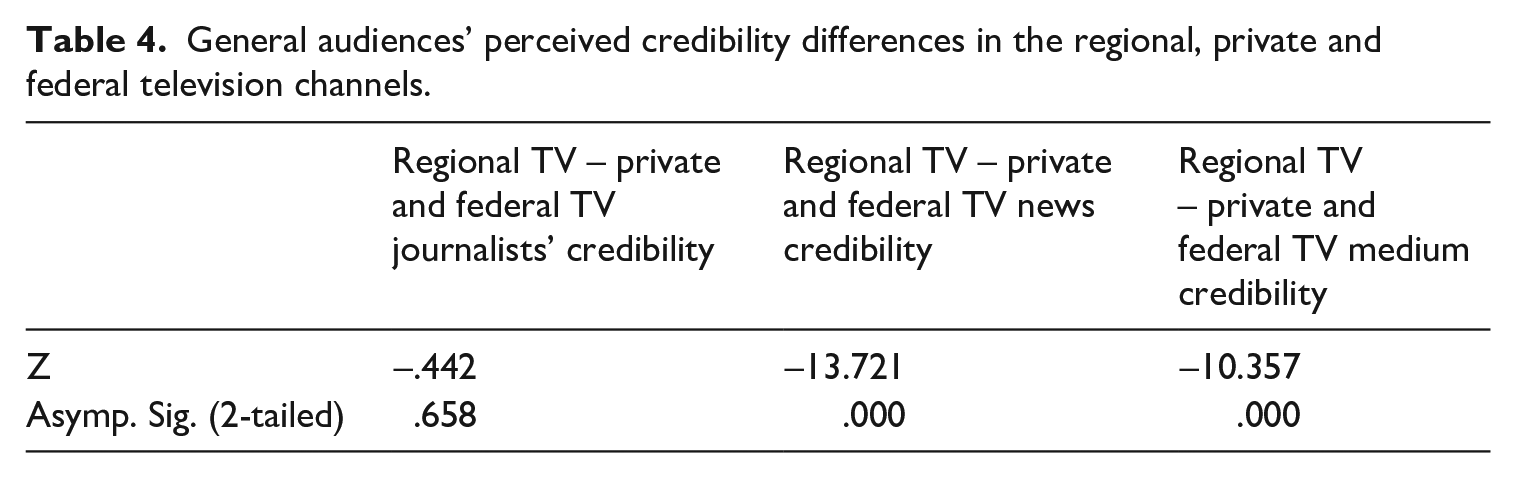
In general, Table 4 regarding audiences’ perception of the credibility of journalists working for the federal, private and regional states television channels indicates that there is no statistically significant difference in perceived credibility among the journalists belonging to the different channels (p value > .05). This implies that the audiences’ perception of the Ethiopian federal, regional state and private television channel journalists’ credibility is not significantly different. But there is significant difference between the regional, private and federal television channels in audiences’ perception of news and medium credibility at a 5 percent level of significance.
General audiences’ perceived credibility differences in the regional, private and federal television channels.
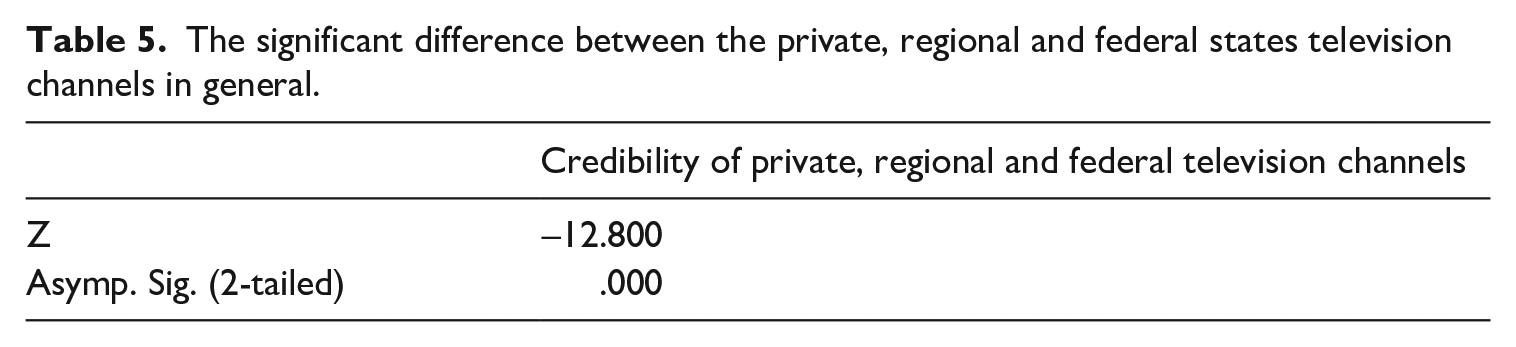
Generally, the above Wilcoxon signed ranks result in Table 5 shows that there is significant difference in audiences’ perception of credibility between the regional, private and federal television channels at a 5 percent level of significance. This indicates that audiences have differences in their credibility assessments of the Ethiopian federal, regional states and private television channels.
The significant difference between the private, regional and federal states television channels in general.
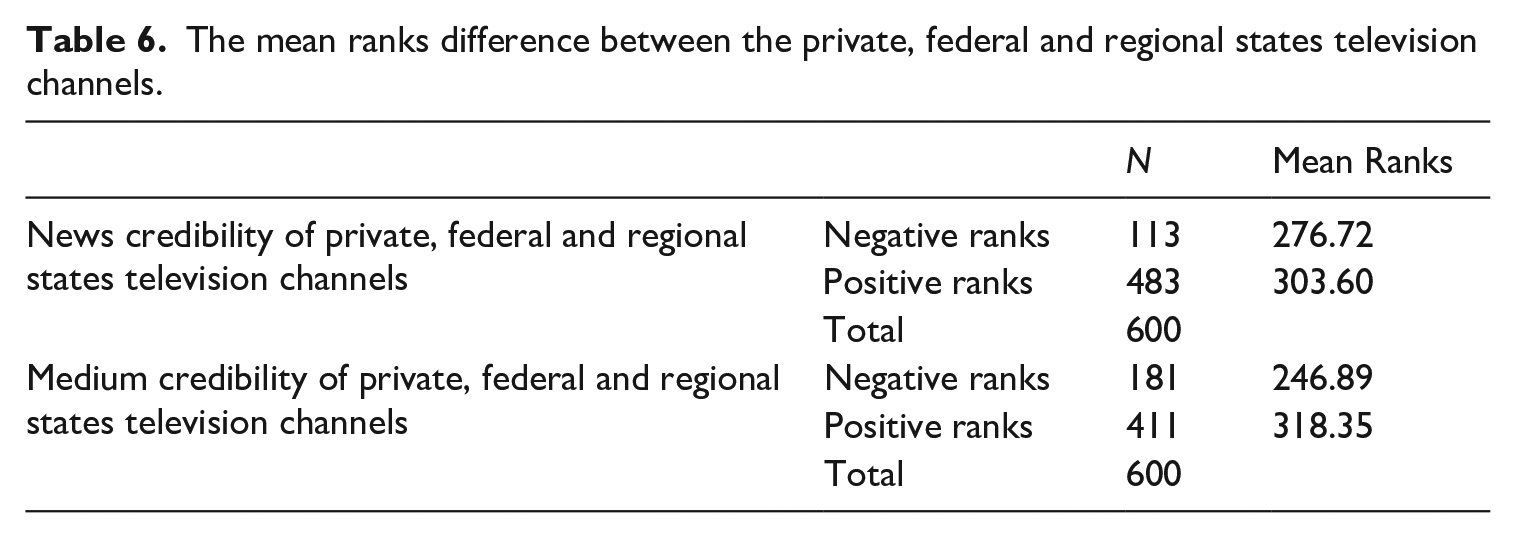
To further explore the audiences’ perception of which television channel is exactly more credible than the others among the regional, federal state and private television channels, the mean ranks of the federal, regional states and private television channels were compared.
As Table 6 shows, based on the audiences’ perception regarding which television channel is more credible, the mean rank indicates that the federal state and private television channels mean rank of 303.60 and 318.35 is found to be greater than the regional television channels mean rank in their news and medium credibility which is 276.60 and 246.89, respectively. Based on the audiences’ perception, the mean rank test indicates that the federal state and private television channels are more credible than the regional state television channels in their news content and medium credibility.
The mean ranks difference between the private, federal and regional states television channels.
Discussion
The non-parametric tests revealed that there is a statistically significant difference among the regional, private and federal states television channels in their journalists, news and medium credibility. The comparison of the mean ranks also indicates that the federal state and private television channels (ETV, Fana and Walta) are perceived to be more credible than the regional state television channels (OBN, Amhara and Addis TV). At a more general level, the results agree with those of Seid (2018) and Kebede (2013) who found that Ethiopian audiences thought local media were inadequately credible and that foreign media were more credible. The observed credibility gaps may have consequences. For instance, for the media organizations, a perception of diminished credibility results in losing audiences, societal influence and legitimacy (Jakob, 2010) whereas, from a scholarly perspective, it will potentially lead to a more polarized, less politically tolerant community (Stroud and Lee, 2008), which is why the media landscape in Ethiopia is more polarized than ever before. Widening media credibility gaps can mean media have become problems as institutions rather than being important structures with a positive sociopolitical orientation. The broadcast media are already suspect as being complicit in Ethiopia’s mayhem, turbulence and massacres that have erupted in various parts of the country since 2019.
The fragmented state media structure with a growing significance of regional mass media agencies – especially Oromia, Amhara and Tigray – are also highly conscious that they are competing with the federal state media, both with regard to audiences and political narratives (Skjerdal and Moges, 2020). These regional media have also been instrumental in the inter-regional state and inter-communal tensions as well as in challenging the federal government at times. The present findings indicate that audiences in the two regional states and one capital city (Oromia, Amhara and Addis Ababa) perceived that their own and other regional state television channels, including that of the capital city, were less credible than the federal TV and private television channels. Interestingly, a study conducted by a European Union Delegation, as well as other studies, criticized EBC for being over-dependent on the government and not fairly voicing the views of the public or citizens’ concerns and issues as a self-governing media outlet (Kemal, 2013; Kiflu et al., 2023).
In downrating their regional media’s trustworthiness, audiences may have noted the absence of balance, fairness and completeness in their regional state media. It is also likely that these basic qualities of good journalism (American Press Institute [API], 2016) may be lacking in the regional media because local politicians follow the propaganda model of journalism as they engage in battles for political survival or in their effort to appear patriotic as they face regional rivals or engage in ethnic rivalry or conflict with neighbouring regional states over resources, including border disputes. Ultimately, audiences may have grown suspicious of local politicians’ motives as well as those of the local media that they now consider to be more trustworthy federal media than regional outlets of their constituencies, which may also be blamed on rising authoritarian political populism in the regions (Norris and Inglehart, 2019). Studies show that media credibility is related to credibility of governments (McIntyre and Sobel Cohen, 2021).
There are often public opinion and credibility swings depending on critical events. The situational changes, such as the ethnic conflicts across the country, inflation, the corona virus and the Tigray War would also bring about changes in the credibility perception of the regional television channels. In other words, conditions such as military gains or losses by a region/party may be able to sway credibility across the board. The credibility effects may be exemplified by the image gains made by the US news media following the terrorist attack on the World Trade Center (WTC) and Pentagon (Nacos et al., 2007). However, such positive ratings were short-lived and dropped in the following months (Pew Research Centre for the People & the Press, 2002). As Doherty (2005) explains, one of the major reasons could be the uncertainty of several Americans in the news media’s fairness in their reporting. In short, when fair practices are sidelined, media credibility declines.
The same is true for the Ethiopian case. Before 2023, during the ethnic and religious conflict and the civil war in the country, for instance, between the Ethiopian government and TPLF, the media outlets, specially the regional state television channels, were taken to be more credible than the federal television channels. At the time of the armed conflicts, the regional states had declared that the wars were ‘popular wars of resistance’ and the media were instrumentalized in these ‘popular wars’ (Blasko, 2010). However, the present study findings show that the regional state television channels are less credible than the federal state television channels. The federal media are considered more credible perhaps because they are not run or managed by a rival region but by the federal government which may be considered to be a more neutral entity. They are also accountable to the Ethiopian Parliament which may mean that they are monitored closely by media boards with a federal multiethnic composition and would be more cautious in their programming and image as the biggest media entity. Audiences may have been impressed with ETV’s superior selectivity of topics, facts, accuracy of depictions and its journalistic assessment, which is what constitutes media trust (Kohring and Matthes, 2007). In contrast, peddling disinformation and editorial polarization may have cost the regional broadcasters trust, loss and reputational damage to their journalists and their media structures.
The low level of credibility of regional media suggests that there may be a tension in the political environment due to rival ethnic groups’ mistrust of each other or even open conflict, as has been shown in the recent developments in cross-border ethnic attacks and bloody massacres. The narratives of victimhood and the general current of competitive victimhood can imply that ethnic entrepreneurs use more radical media strategies that out-of-state audiences may find threatening to their ethnic group (Marcks and Pawelz, 2022). In the polarized media environment, moderate voices may be suspect and threatened, as a result of which they perceive that holding polarized positions is the answer to political survival, leading to a cycle of inter-ethnic mistrust. The spiral of inter-communal strife and mistrust would mean a further difficulty in any nation building and national consensus on important issues to the Ethiopian federation.
Some scholars and experts ascribe audiences’ perceptions of media credibility to changes in management, such as amplified conglomeration of the media industry and the associated merging of media conglomerates in a few hands (Bagdikian, 1997; Hickey, 2003). Others oppose and contend that the loss of public confidence is connected to the news media’s haughtiness and detachment from community life (Charity, 1995; Merritt, 1998; Rosen, 1998). Still others claim that the decline in media credibility is a result of the media’s political bias (Altschull, 1995; Bagdikian, 1997; Goldberg, 2001). Generally, even though there is a development in the media sector in Ethiopia, variety of content is neglected and ignored as most TV channels lack the capacity and experience, and continue to fear the current preventive legal regime (Fojo Media Institute, 2017).
In addition, even though the news media is regarded as a watchdog that monitors the actions of public officials on behalf of society and serves as a mediator between citizens and politicians (Dyck and Zingales, 2002; Serrin and Serrin, 2002), the monitoring and patrol role of the media cannot succeed if the media themselves have credibility deficits (Hovland et al., 1959). The present findings indicate that the private TV channel Fana enjoys fairly high credibility, which suggests that it has a moderate stance and entertains at least modest criticism of the ruling class by addressing governance problems. The station’s credibility ratings agree with those of an earlier study that found the channel a trustworthy broadcaster (Zerai and Alemu, 2018).
The ethnification of media in Ethiopia has led to growing ethnic strife and diminishing intercommunal harmony which is often exacerbated by political media. Media pluralism has meant more challenges to a shared sense of credibility as the media seem to promote sectarian agendas.
Conclusion
This study has shed light on the credibility and current status of the Ethiopians’ regional, private and federal television channels among its citizens. In Ethiopia, the mainstream media news organizations have experienced a significant decline in their credibility. For this study, Amhara TV, OBN TV and Addis TV were selected from the regional states, and ETV, Fana and Wlata were selected from the federal state and private channels. The results of the audiences’ perceived credibility for the two regional and one capital city channels indicate that the federal state and private television channels are more credible than the regional television channels. This area might need more detailed research to find out the current status of the Ethopian federal and regional states media with their audiences. The results are very important for media organizations, journalists, policy designers and researchers. Since Ethiopia is currently in a civil war and conflict between different ethnicities and regional states, ensuring and bringing more credibility to the regional and federal states television channels will contribute to the building of peace and democracy in the country. Also, as the Ethiopian government is currently detaining and arresting journalists and holding them without any charges, the results of this study might be a good lesson for the responsible government officials in looking at the status of the media sector and the public’s view in order to persuade them to take some fruitful actions in the development of the media in the country. A key issue here is diversity: the public needs to feel that the media can represent them and voice their many issues fairly and honestly. If the responsible body is not aware and conscious in restoring the credibility of the regional television channels, the making of peace and democracy will remain fragile and become very weak. Even though there is a war and conflict among different ethnicities and regional states, policy designers and responsible bodies of the government may use this and similar studies to make sure the media sector remains professional and impartial. In the future, through additional data collection and analysis methods such as a wider survey, in-depth interviews with the different opinion leaders of the public and document analysis may allow researchers to discover the exact reason behind the current credibility status of the media in Ethiopia.
Footnotes
Funding
The authors received no financial support for the research, authorship and publication of this article.
