




Abstract
In World War I, the British Army implemented daily record keeping throughout its organization. Despite being crucial to the army’s operational effectiveness and essential for historiography, the history of Unit War Diaries as mediated artefacts has been largely overlooked. This article investigates the interplay of culture, institutional practices and hitherto unnoticed technologies of writing involved in the mediation of operational record keeping. It reveals Unit War Diaries as not just containers or conduits in the army’s practices of Information Management but as the nexus of tensions between bureaucracy, technologies and individuals that have shaped the understanding of warfare.
Keywords
Introduction: The work of war
‘Our work is killing’, wrote Ernst Jünger of the soldier’s role in World War I, ‘and it is our duty to do this work well and completely . . . for every age expresses itself not only in practical life, in love, in science and in art, but also in the frightful’ (cited in Leed, 1979: 11). All the expressions of the age in which World War I (1914–1918) occurred – from the everyday to science and the arts – were profoundly impacted by the effects of industrialization. War was no exception. In addition to impacting how war was waged, industrialization transformed how war was organized. Warfare was subject to the same principles of bureaucratic organization as everything else in the industrial world and, as in the commercial sphere, keeping on top of an increasing welter of paperwork became part of daily life in the army. World War I (WWI) was the first conflict in which the British Expeditionary Forces (BEF) implemented daily record keeping. The purpose of these reports, known as War Diaries, was firstly to provide a record of operations for the official history of conflict and, secondly, to provide information to allow the army to wage war more effectively. They were to be kept by every branch of staff from general headquarters to all subordinate units.
Today, the WWI War Diaries are held by The National Archives (TNA) in Kew (UK), where they constitute a prodigious source of material for historians and family researchers. They were the foundations of the official histories of the conflict and have become essential primary sources for much subsequent historiography on WWI. However, despite their significance for the army’s operational effectiveness and for historiography, the history of these documents as material, mediated artefacts has been largely overlooked, even in research that provides much-needed insight into the significance of Information Management (IM) for communication, command and control (C 3 ) for the BEF. Brian Hall (2018), for example, examines the production of operation orders; messages; and reports in WWI via new information techniques and tools such as documents and typewriters, but he does not address how information might be shaped by the technologies and practices that mediate it. TNA indicate in their online Research Guide that many of the diaries are ‘scribbled hastily in pencil’ or are carbon copies, which may make them hard to read, but what impact did media technologies like this have on the way in which these records were written? Just as processes of mediation have been largely overlooked in studies of IM and military communications, technologies of writing and documentation have also been neglected in broader studies of media, war and conflict. This article shifts attention away from the mediation of conflict in mass media and onto the ways in which war has been mediated within official records. It aims to answer the following questions:
What role did technologies of operational reporting and writing play in determining what was considered as information in the first place by the BEF in WWI, and in what ways might they have shaped its composition?
More broadly, what happens to the record of conflict when war is considered not just as ‘work’, but as a specific kind of commercial and industrial labour subject to similar bureaucratic principles of organization and control?
To answer these questions, this article investigates WWI War Diaries as mediated artefacts that are both embedded in, and expressions of, the historically situated interplay between broader culture, the army’s institutional needs, technologies of writing and the individuals caught in the intersection of these forces. In the first section, a brief investigation of the broader cultural relationship between information, paperwork, bureaucracy and war provides a vital context for the British Army’s procedures for conceptualizing and controlling information, as expressed within the Field Service Regulations (FSR) Parts 1 and II (General Staff, War Office, 1909). The rules governing the implementation of War Diaries were established in the FSR, and a close analysis of these documents reveals the evolution of the institutional discourse and ideological framework in which the War Diaries were situated.
The next section moves on to an investigation of two of the key writing technologies used in the mediation of War Diaries – the pre-printed blank Army Form C.2118 and the indelible pencil. C.2118 has been generally treated as transparent in discussions of IM and C3, but this article will argue that this form plays a critical role not only in mediating information about events in conflict, but also in mediating the relationship between individuals and the army as an institution. Similarly, although technologies such as the telegraph and typewriter have been investigated in studies of IM and WWI, 1 the indelible pencil has been ignored, even though it is as much an industrial technology as any other from the period. This article remedies this oversight by focusing on handwritten diaries to investigate the broader cultural cache afforded to the indelible pencil and the importance of handwriting in leveraging space for individuality within bureaucratic processes. The unique writing spaces of the Western Front form the focus of this article, not least because of the unprecedented nature of trench warfare and its significance in this conflict. To better understand the pressures of producing records in the field, as opposed to the more routine and familiar production of records in the offices of Headquarters away from the action, this article focuses on the diaries produced at battalion level, as these were units involved directly in fighting. 2 The WWI War Diaries are not the reflections of poets, nor the memoirs of prominent military or political leaders, but the responses and thoughts of ordinary men (generally the regimental adjutant or nominated junior officer, but sometimes also intelligence officers) attempting to parse the experiences of an unprecedented war through the medium of official military documents. While moments of subjectivity, emotional responses or breaks in reporting protocols in War Diaries have often been marginalized in favour of those accounts that are ‘meticulous and concise’ (Hall, 2017: 19), I want to argue instead that such moments offer a unique insight into the individual embodied experience of conflict. This article therefore concludes with a brief investigation of examples of how collisions between individual affective responses and bureaucratic systems of control play out within the official structures of the War Diaries.
Ultimately, this article’s investigation of the processes and technologies of mediation in War Diaries aims to develop a more nuanced understanding of the tensions between institutional cultures, media technologies and individuals in the representation of war in official records.
Context: Industrialization, bureaucracy and the Field Service Regulations Parts 1 and 2
The 19th century is well documented as an age of revolutions in industry, culture and politics, but it is also a period in which bureaucracy emerged as the principal organizing structure within political, martial and economic spheres of society. As Max Weber (2006[c. 1930–]: 77–78) makes clear, although bureaucracy predates the industrial era, it was particularly suited to the mechanical age because it offered systems of organization that facilitated ‘precision, speed, clarity, accessibility of files, continuity, discretion, unity, strict subordination, avoidance of friction’. The production, circulation and accessibility of files or documents was particularly significant in allowing bureaucratic organizations to operate with optimal speed and efficiency. The importance and authority of the written word, which had become associated with work and knowledge over the course of early modernity (De Certeau, 1984: 134), were amplified in broader culture, largely because of the spread of the printed text. The introduction of the steam-driven printing press in the early decades of the 1800s revolutionized printing and contributed to a rapid expansion of print media such as newspapers, periodicals, books and how-to guides, all produced on an unprecedented scale. Included in the burgeoning of print media were a range of journals covering military topics, which provided a platform for discussion and the dissemination of ideas both within and outside the army’s official structures. 3 Dennis Showalter (2014: 228) therefore argues that the printing press played a key role in the professionalization of war by ‘facilitating communication within and among its full-time practitioners, and by providing an increasingly specialized view of its conduct’. Military professionals started to identify war as ‘a science most carefully studied, both by statesmen and soldiers’ (Henderson, 1912: 399), rather than an endeavour shaped by tradition and the martial prowess of individual leaders.
If war had once been regarded as an art, it was now an industrial enterprise conducted on a scale that exceeded the grasp of any single individual, best understood via the application of scientific principles and technologies. Even before WWI, Britain’s almost continuous involvement in skirmishes and ‘small wars’ throughout its Empire during the 19th century, especially the South African wars in the late 1800s, had already made clear that the great increase in the range of firearms, in the extension of troops, and in the size of armies renders it more and more impossible for any one man, be he commander-in-chief or war correspondent, or even for a large staff to follow at the time with any accuracy the detailed movements of units in action. (A British Officer 1907: 300)
The British Army responded to these challenges by reorganizing its existing hierarchical structure into distinct levels of professional specialization. Those with expertise in waging war were separated from a growing administrative staff responsible for logistics, procurement, supplies and communications. The industrialization of war thus involves not just the application of industrial weapons and technologies, but a concomitant transformation of the military along bureaucratic lines. By the turn of the century, the British Army, like most European armies, was functioning as a bureaucratic organization.
If the scale and scope of modern warfare exceeded individual knowledge, procedures were needed to circulate and store information within military organizations. Most military organizations of the time developed systems for reporting on operations. In the German Army, for example, this began with the practice of developing after-action reports in training, but it was only during the Battle of the Somme that processes of information-sharing were systematically and extensively implemented. Lessons-learned reports (Erfahrungsberichte), which incorporated not just facts and figures but analysis of tactics and events, were distributed rapidly across all levels in the hierarchy to give high command the opportunity to develop new approaches and to allow units to learn from the experiences of their peers (Foley, 2011). Similarly, the system of reporting in the American Expeditionary Forces (AEF) only really gained traction towards the end of hostilities, with four pages in the General Orders of November 1918 devoted to detailing instructions for a range of different reports, including War Diaries (American Expeditionary Forces, General Headquarters [AEF GHQ], 1922: 516–519). In contrast, the British had developed detailed guidelines for the identification and collection of information in general, as well as specific instructions for the completion of the War Diaries prior to the war, as part of the Field Service Regulations (FSR), published in two parts in 1909. Produced by the General Staff at the War Office, under the leadership of Douglas Haig (appointed as Director of Military Training in 1906), FSRI deals with operations, outlining the ‘General Principles which govern the leading in war of the Army’ (General Staff, War Office, 1909: 2). FSRII focuses on the ‘organisation and administration of the Army’ (General Staff, War Office, 1909: 2).
The FSR do not constitute ‘a uniform doctrine’ (Fox, 2017: 32). The tenets governing operations are never clearly defined and the emphasis throughout is on individual initiative in ‘the application of principles to circumstances’ (General Staff, War Office, FSRI, 1909: 14). The significance attributed to individual knowledge of local conditions is a clear indication of the influence of the army’s experience in fighting colonial wars, but the FSR were also created with the possibility of a major continental war in mind and indeed were ‘often required reading or, at least, a key text for training schools in each expeditionary force’ during the conflict (Fox, 2017: 48). It was not framed or understood this way at the time, but the struggle evident in the FSR between attempts to foster flexibility alongside ways of establishing order and maintaining control reveals a military reluctant to surrender the autonomy of the individual to the bureaucratic emphasis on process, and foreshadows the struggle between containment and individual expression in the War Diaries.
The tension between process and individuality is evident in FSRI’s guidelines for communications in the field, defined as ‘orders, reports, and messages’ (General Staff, War Office, 1909: 22). While FSRI acknowledges that circumstances might dictate whether these forms of communication are verbal or written, the general rules for the preparation and despatch of orders, reports and messages indicate that an attempt should be made to confirm them in writing ‘whenever it is practicable to do so’ (General Staff, War Office, 1909: 22). Reflecting the increasing emphasis on paper records in all spheres of life by the turn of the 19th century, the FSR accord written communication a stability lacking in verbal communication, which is considered as prone to being ‘incorrectly delivered or misunderstood, especially in the excitement of engagement’ (General Staff, War Office, FSRI, 1909: 22). FSRI thus identifies writing as the medium of choice for communications because of its perceived ability to minimize the emotional impact of warfare, and it clearly delineates how written records should be composed. FSRI insists that all forms of communication and orders should be ‘as concise as possible, consistent with clearness’ (General Staff, War Office, 1909: 22). Clarity and simplicity are valued above ‘literary form’, and any indeterminate language is to be avoided (General Staff, War Office, FSRI, 1909: 22). The controls imposed on written communications by the FSRI are typical of the need in bureaucratic organizations to compress and standardize information – a process in which ‘narrative, descriptive, or decorative information is turned into data’ (Headrick, 2000: 6, emphasis in original). The elimination of narrative and emotion from written communications is thus not a neutral process, but a ‘crucial control mechanism [through which] organisations engage in the construction and privileging of views of the world that become the world’ (Dery, 1998: 678). The FSR construct and privilege a perspective of war that is primarily based on scientific principles of rationalism, designed to eliminate emotion and uncertainty, and to maximize efficiencies.
FSRII identifies the War Diaries as specifically significant within the army’s systems for generating information. Probably with the memory of the numerous and conflicting histories of the South African wars in mind (some of which led to fierce critiques of the military’s performance), 4 the architects of FSRII make it clear that the daily records of activities, the War Diaries, are specifically intended as the foundation for the future official histories of warfare by identifying this as the first reason for their maintenance: ‘To furnish an accurate record of the operations from which the history of the war can subsequently be prepared’ (General Staff, War Office, FSRII, 1909: 174).
Unit War Diaries are thus imprinted with authenticity and pre-loaded with the weight of history from the outset. The FSR specifically identify War Diaries as primary source material providing evidence of a usable, knowable past. They are inscribed with what Tredinnick (2011: 188), referencing Roland Barthes, refers to as ‘history’s “reality effect’” in which written records attain an apparent stability and objectivity via agreed discursive conventions. By establishing controls over the collection and composition of ‘accurate’ information, the principles governing the writing of the Diaries ultimately attempt a measure of control over the future official history of warfare.
The second reason behind the implementation of the War Diaries as outlined within FSR Part II is: ‘To collect information for future reference with a view to effecting improvements in the organization, education, training, equipment and administration of the army for war’ (General Staff, War Office, FSRII, 1909: 175). The FSR’s identification of the significance of War Diaries to the army’s operational capacity is indicative of how decision making and operations within the army, as in other bureaucratic organizations, increasingly shifted from direct, individual knowledge of events to documented interpretations of those events, generating what Lisa Gitelman (2014) calls ‘paper knowledge’ and David Dery (1998: 678) goes as far as to call ‘papereality’. The capacity of the army to learn in the field would be tested to its limits in WWI, but the decision to introduce the Diaries reveals the significance of documentation for the army’s ability as a bureaucratic organization to evaluate its own performance, while the emphasis on historical weight implies a faith that these documents represent what has actually happened in the field.
FSRII follows on from FSRI in outlining principles that attempt to eliminate, or at least minimize, the subjective and personal in collecting information through implementing routinization and standardization, thereby lending the War Diaries a kind of scientific rigour and detachment that augments their authority as a primary source for historiography and for the army’s organizational knowledge. From the first day of mobilization, diaries are to be kept daily, in duplicate (using carbon paper), with the original forwarded to the Adjutant General’s office on the last day of each month. The composition of the Diaries is standardized – they are to be written on one side of the page only, following certain conventions in naming and spelling – with guidance for the kinds of information required (General Staff, War Office, FSRII, 1909: 177). In addition to information on weather, field works, casualties, terrain and other elements involved in a campaign, the Diaries should include ‘all important’ orders and decisions, matters concerning duties and administration, summaries of ‘information received and of all matters of importance, military or political, which may occur from day to day’ and reports on how organizational systems are standing up to the ‘test of war’ (General Staff, War Office, FSRII, 1909: 177). A ‘detailed account of all operations’ is also required (p. 176). A footnote to this point indicates that, in the event of ‘important actions, of which a detailed account may cover much space’, a short note in the Diary will suffice until a more complete report on the action can be included in the appendices (General Staff, War Office, FSRII, 1909: 176, note to point v). Like much in the regulations overall, the rules governing the War Diaries are simultaneously extremely specific and very general, and ultimately the decisions about what might be identified as important are left to the individual. Yet, despite the continued tension between individuality and control, the FSR establish a rational, routinized and standardized filter for sifting through events in war and identifying what might be significant and what should be excluded, and therefore potentially shape how events are rendered down to usable chunks of information.
From one perspective, it might seem perfectly logical that military communications, especially in a time of war, should be clear and standardized. However, couched in the guidelines of both sets of regulations is the assumption that it is possible to transform the chaos of combat into manageable forms of communication that are precise and accurate, creating data that rationalize warfare and mute its affective power. There is therefore more than a struggle between ‘standardisation versus flexibility’ (Fox, 2017: 64) evident in the FSR. There is also a battle between the control mechanisms of bureaucracy and the emotional impact of modern warfare. FSRI and II not only provide the guidelines for how information should be communicated, but they also create a procedural framework that determines what information about war actually is – dates, times, weather conditions, casualty numbers, etc. The principles outlined in the FSR thus attempt to remove from modern combat, one of the most extreme and complex phenomena in the world, any sense of violence or suffering, any sense of wrongness, and ultimately any sense of humanity. The memoirs of a General Staff Officer in the BEF bear testament to the specific kind of reality crafted through these kinds of processes: We ate, drank, slept, played a little and talked, very much as if we were workers in some commercial house directing coffee from a plantation to a warehouse and then to a breakfast table, instead of dealing in blood and tears . . . It is well that Imagination went to sleep, or was lacking. For so the work could be done . . . (General Staff Officer, 1920: Foreward)
The tendency of bureaucratic processes to erase emotion and imagination takes on a new resonance when applied to war. By rationalizing warfare, it becomes possible to think about it as no more than another iteration of industrialized labour, subject to the same principles of organization and, perhaps even more importantly, to similar processes of normalization in the modern world.
Tensions between bureaucratic imperatives of control and individual responses to the attempted erasure of emotion manifest most clearly in the pre-printed blank form provided for the daily accounts of operations in the War Diaries – C.2118. 5 The pre-printed blank form has acquired a kind of invisibility in historiography, as if it functions as a neutral, stable containment space for its content, but a closer examination of this form, along with the indelible pencil, offers a richer perspective on how these technologies mediate relationships between culture, institution and individuals.
The writing spaces of the Western Front: C.2118 and the pencil
C.2118 (see Figure 1) is one of a plethora of over 1,000 pre-printed blank forms designed to mediate the army’s bureaucratic processes, from court martials and casualty notices to receipts and requisitions. Preprinted blank forms are a symptom of bureaucratic organizations and they were endemic in broader society by the end of the 19th century. The preprinted blank form, with its standardized structure and/or set questions designed to gather specific information, is a crucial tool within the ‘repertoire of techniques through which bureaucracies come to know’ (Gitelman, 2014: 32). Implicit in the purpose of these forms is that their primary function is to serve the needs of the bureaucratic organization, and their design organizes information accordingly. The pre-printed blank form is identified through its material properties – paradoxically, as Gitelman points out, it is the print that makes ‘most blanks blank’ (p. 23). The print provides parameters for where the text should be located and how it should be structured, while the cultural and institutional practices associated with the form attempt to shape and delimit the production of content.
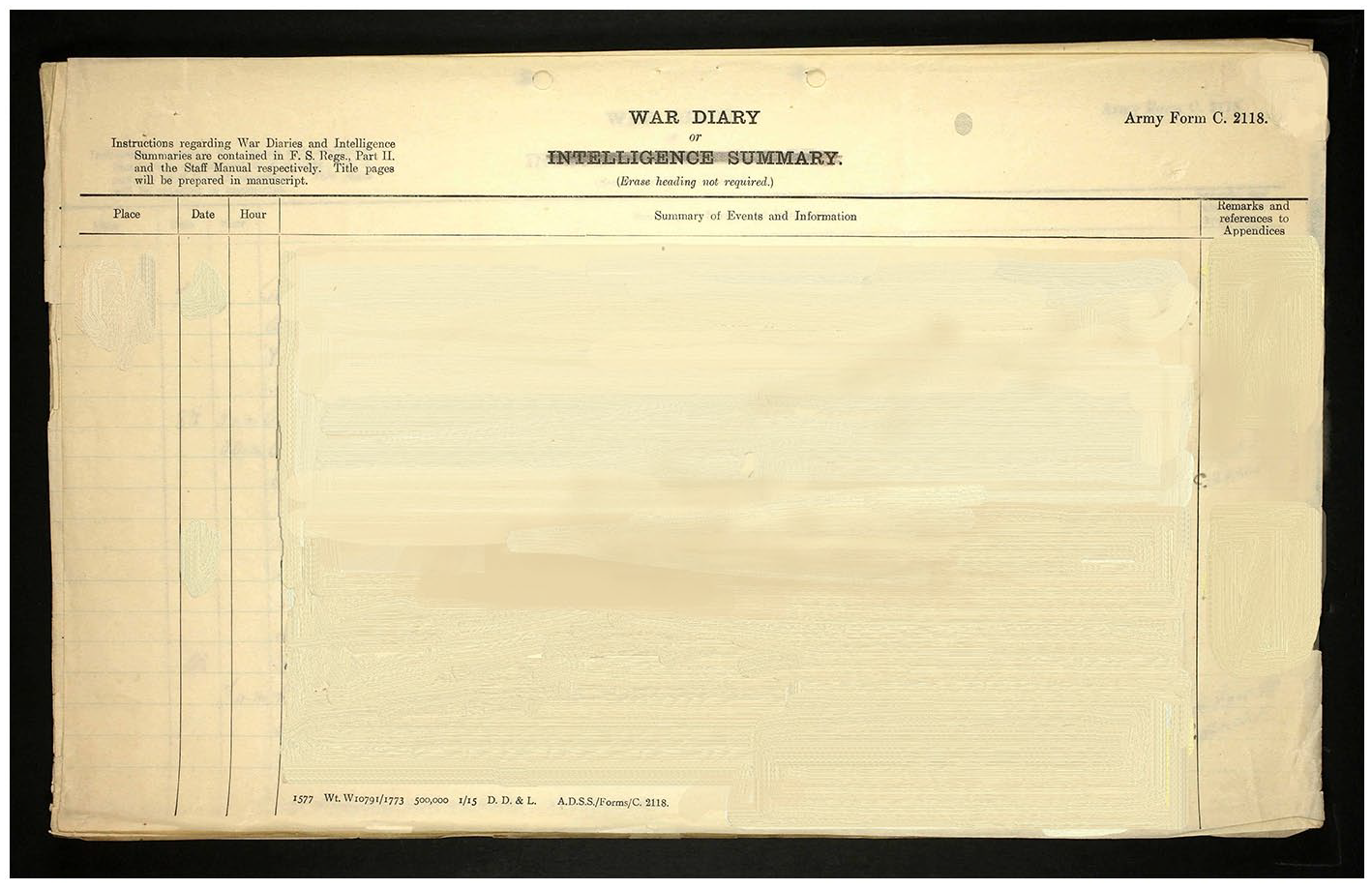
Army Form C.2118.
C.2118 is in landscape orientation, with the length of the form being longer than its height. The document is titled ‘WAR DIARY or INTELLIGENCE SUMMARY’, with instructions to erase the heading not required beneath it. On the top left-hand side are references to the FSRII and the Staff Manual for directives on how to complete the form. The title of the form itself is in the top right-hand corner. The form is divided into three columns, the first for ‘Place, Date, Hour’, the second and largest column is for the ‘Summary of Events and Information’ and the third column is headed ‘Remarks and references to Appendices’. Far from being a neutral space for writing, C.2118 is a physical framework that reinforces the directives of the FSR. The form attempts to order events by time and space (Column 1), to ensure they are expressed succinctly through summaries (Column 2) and that they are connected via annotations to a discursive network of appendices, other official forms, notes and letters (Column 3).
C.2118 thus constitutes a ‘writing space’ (Bolter, 2000) defined not only by its material properties, but also by the culture and practices of the army as an institution. Writing spaces, according to Bolter, operate in an historically contingent ‘dynamic relationship among materials, techniques, genres, and cultural attitudes and uses’ (p. 21). C.2118 is situated within the broader culture of information in which the document has an authoritative status, but it is also located more specifically within the culture of the British Army, where it mediates not only the record of operations, but additionally the relationship between individuals and the institution. C.2118 is preloaded with the authority of the army’s hierarchical structures and bureaucratic systems and it positions those who are required to complete the form in relation to those structures and systems. C.2118, like other pre-printed blank forms, thus ‘triangulate[s] the modern self in relation to authority: the authority of printedness, on the one hand, and the authority of specific social subsystems and bureaucracies on the other hand’ (Gitelman, 2014: 49). It requires its bureaucratic subjects to comply with its directives and it attempts to subordinate individuality to the army’s organizational needs and requirements.
Inherent in the instructions for the completion of the War Diaries and the structure of C.2118 is the notion that all that is required of those completing them is to filter events from an external and objective reality, and convert them into data. Slack et al.’s (1993) analysis of technical writing can be usefully applied to War Diaries. As with technical writing, the authority of C.2118 is located in the form itself and not in the authority of the individual who has completed it. War Diaries thus fall into the category of documents that Foucault (1977: 124; see also Slack et al., 1993: 13) excludes from those we conceive of as being ‘authored’ and, instead, information is understood as simply re-presented. The instructions and the structure of the form attempt to render the writer invisible by shifting emphasis away from the person responsible for constructing the report and onto the information that the organization needs to know. From one perspective, C.2118 is a writing space that dehumanizes war through its very structure. From another, however, it is a contested space in which individual expression collides with bureaucratic systems of containment and control.
The basic material properties of the completed forms provide evidence of that struggle, especially those that are handwritten. Technologies of writing play a critical role in the constitution of writing spaces. By the start of WWI, the typewriter was indispensable in commercial spheres where it met demands for speed and standardization. However, the prevalence of handwritten War Diaries indicates the relative scarcity of typewriters during the conflict, especially for frontline troops (Griffith, 1994: 181). The handwritten War Diaries are, as Bolter argues of manuscripts in the Middle Ages, the product of ‘the relatively leisured pace of the writing hand, not the insistent rhythm of the machine’ (p. 34), yet they were produced during a war that was transformed by the pace and power of industrial machinery. The writing spaces of the War Diaries are thus a confluence of technologies, both old and new, and they illustrate that, even in the age of print and the mechanization of writing and warfare, handwriting was still an important aspect of daily life.
The act of writing has not been undertaken or understood in the same way through time. 6 In an era characterized by the emergence of monumental, impersonal forces, handwriting was a personal medium, ‘a medium of the self’ (Plakins Thornton, 1996: xiii), which enabled personal expression not only through meaning-making in the text, but also through the very act of constructing words on the page and the choice of the technologies used in that process. Today, the pencil is often used for insignificant scribbles that can be easily erased. But the pencils used in the early 1900s had a quite different functionality. Innovations in production during the 18th century led to the increasing manufacture of pencils, particularly the copying or indelible pencil: a technology of writing designed to meet the demands of efficiency and productivity in the industrial age. The copying pencil was a neater and cheaper alternative to ink pens as it dispensed with the need for inkwells or ink tablets, both of which were messy and fiddly to use in the trenches. Not only was it indelible but, when dampened, these pencils created a mirror-image transfer that could be easily used as document copy and, later, because it could be used with firm pressure (unlike fountain pens), it was used in conjunction with carbon paper – bearing in mind that the FSR called for duplicates of the War Diaries. An early forerunner of the ballpoint pen, its cheapness and convenience led to its widespread distribution within the BEF (Petroski, 1990: 188). The copying pencil, when dampened, resembles the fountain pen, making its traces difficult to identify with certainty, but its widespread distribution within the BEF and common use with carbon paper strongly suggest that, alongside the typewriter, this was one of the primary writing technologies used to compose the War Diaries.
The completion of War Diaries was the responsibility of unit commanders, but they were often written by the regimental adjutant or other junior officers, whose names never appear. They are ghostwriters standing in for the commander and conveying the experiences of the unit through the scientific approach outlined by the FSRs and framed by the printed form. Yet, despite attempts to erase the individual via the authority given to rational, de-narrativized information, the uniqueness of each writer is evident in the singular nature of their scripts. Ranging across the repeated structure of the pre-printed blank form is a huge variety of handwriting, almost all of it in cursive. From the neat and elegant penmanship evident in many of the Diaries of the Cheshire Regiment (TNA, WO 95-1571-1_1: Aug 1914-Feb 1917) through the small but slightly messy hand in the reports of the Notts and Derby Regiment (TNA, WO 95-2695-1: Mar 1915–May 1919) to the absolutely appalling script of the reports signed by Lt Colonel Murray Thriepland in the War Diaries of the Welsh Guards (TNA, WO-95-1224-1_1: Aug 1915-Feb 1916), the completed C.2118 forms bear evidence of individuality and unpredictability within a system attempting to minimize exactly those things. The very illegibility of some of the handwriting (Lt. Col. Thriepland’s reports are a good example) confounds bureaucratic impulses of order and standardization long before content is evaluated. Thriepland’s indecipherable handwriting fragments information but it also inscribes humanity into the material structure of the C.2118 form and provides insight into the challenges of reading and writing in the spaces of war.
The messiness evident in some of the reports is an indication that the structure of C.2118 and the principles governing its completion, while significant in understanding the construction of the reports, are nevertheless only two facets of an intricate concatenation of elements that constitute the writing spaces of war. Much writing about war – memoirs, histories, novels – is produced in its aftermath. In contrast, War Diaries were produced in or near the spaces of conflict, sometimes as events unfolded. The writing and reading spaces of the reports of war are spaces of the battlefield, which creates a unique set of pressures. General Jack’s diary describes some of the difficulties of attempting to conduct administrative tasks in the spaces of conflict: ‘Out here much of our reading and writing has to be performed in ill-lit rooms, cellars or windowless shelters – in the two last-named by the rays from a candle-stump . . .’ (2001[1916]: 116) often in the midst of ‘the drum of our cannonade’ and ‘counter-bombardment’ from the Germans (p. 142). It is no wonder that so many of Lt Col Thriepland’s reports are illegible, considering the conditions under which they may have been written.
The effects of writing reports while units are involved in active combat are also evident in the notes taken while events unfolded. The almost hour-by-hour account of the Notts and Derby Regiment’s experiences from mid- to late September 1916, for example, bear evidence of haste in errors that are crossed out and occasionally messy scrawls in the otherwise neat handwriting (TNA, WO 95-1624-2: Aug-Dec 1916). Perhaps revealing even more about the pressures of writing about war whilst waging it are the gaps in some reports. In some instances, fighting was so intense it made reporting impossible, and the Diaries contain a line – or two at most – with after-action reports filling in for real-time observations. For instance, a successful raid carried out on 20 March 1916 by the North Staffs warrants only a few lines in the actual Diary entry, but an expanded, five-page appendix gives much more detail on the operation (TNA, WO 95-2213-1_1: Nov 1915- Dec 1917). In their introduction to a collection of essays examining emotions and war in literature, Downes et al. (2015) argue that war literature is ‘not simply about the historical and bodily emotional experience of war, but of it’ (p. 4, emphases in original). If this is true of the retrospective writing of fiction and history about war, then it is even more true of the War Diaries, which are not only reports about conflict, but products of it. Hurried, messy notes as well as absences in the reports are direct consequences of the physical effect of combat on the writers, and bear testament to the embodied experience of war.
Acknowledging that War Diaries are products of the embodied experience of conflict opens them up as more than data and reveals the vital but often obscured role played by emotion in both the waging and reporting of war. The principles governing the completion of C.2118 acknowledge the importance of individual assessment, but implicit in concessions to individual judgement is the assumption that decisions will be made according to rational principles, which by the end of the 19th century were considered ‘objective and universal’ (Jaggar, 1989: 152). But, as Jaggar explains, the act of recording observations is not passive but an active process involving ‘selection and interpretation’ (p. 160). This process, as three decades of research into cognition and emotion have demonstrated, is powerfully shaped by the emotions of the observer. 7 Despite bureaucratic attempts to de-emotionalize the information in the Diaries, the very act of selecting what to include is emotional by nature. Far from being a collection of neutral facts and figures, the information in the War Diaries is as much a product of emotion as it is of rational observation, and it often bears traces of the tensions between bureaucratic controls and individual expression. The scope of this article limits the range of possible examples, and the ones selected here are by no means intended to be definitive, but they are suggestive of how close reading of the completed C.2118 forms shifts attention away from the quality of the factual information they contain and onto the ways intersections between emotion, conflict and bureaucracy inflect the written representation of war in official records.
Detailing the loss of the village of Gheluvelt, critical in the Ypres Salient, the records of the 2nd Bn Worcestershires from 22–26 October, while generally concise, nonetheless manage to convey the desperation caused by the brutal conditions, largely through repetition of the phrase ‘very trying’. Repetition in poetry and prose is a stylistic device with a range of different purposes, but it should not be overlooked in writing like this because it goes beyond the basic requirements of reporting to introduce a level of subjectivity – a distinctly human response to the extremes of mechanized warfare. Although Column 2 of C.2118 is for a ‘Summary of Events and Information’, and the guidelines of the FSR encourage the bare minimum of facts, the entries for the events on 22 October 1914 become increasingly emotive, describing how the ‘furious bombardment’ and ‘continuous’ rifle fire created ‘a very trying ordeal’ (TNA 2nd Bn Worcestershire, WO 95-1351-1: Aug-Dec 1914). To further emphasize the challenges of this situation, the writer at this point underlines ‘very trying’ twice, before repeating the phrase twice more in the entry for the following day. The act of underlining counteracts the understatement of the phrase and nudges against the controls imposed by the formal structures of reporting. These uneven pencil marks etched into the page are an intimate indication of the hand at work in composing them. They imply that words are simply not enough to convey the severity of situation and are vivid traces of the human being behind the official form.
The majority of reports conform to the limits of official language, condensing difficult moments into terse, dispassionate accounts, as in this example taken from the 5th Bn Notts and Derby’s Diary for 28 April 1917: ‘Artillery duel from 4.30am-5.30am. Trench mortars & snipers gave considerable trouble. Work on Defence Line continued’ (TNA, WO 95-2695-1: March 1915–May 1919). But entries that go beyond facts and figures to construct detailed narratives are reminders of how individuals might push against the constraints of the official form. For instance, the Diaries of the 1st Bn South Staffs from 1915 and 1916 (TNA WO 95-1664-2_1-2; WO 95-1670-2_1) can only be described as far more literary (and occasionally flowery) than concise. Despite claiming that ‘of the gallantry and undying devotion to duty displayed by officers, N.C.O.s and men it is impossible to write fully in these pages’ (TNA, 1st Bn South Staffs, WO 95-1664-2_2: 25 September 1915), the writer does his utmost to do just that in recounting the experiences of the battalion in the Battle of Loos. The actions of individuals and of the regiment as a whole are described as ‘gallant’ four more times in these entries, and the final notes summarize the events as ‘a most glorious & ever memorable page to the History of their grand old regiment’ (TNA, 1st Bn South Staffs, WO 95-1664-2_2: Sep 1915–Dec 1916). 8 These kinds of entries disrupt the objective tone of scientific rationalism required by the reports and cannot be described as necessary for the effective operation of the army, or as accurate information for future histories. However, by calling up concepts of gallantry and glory, the writer gives meaning to a battle that even in the wider scope of WWI was particularly brutal and attritional. The charges of the men and the deaths of individual officers during the Battle of Loos are reframed through the overall narrative as noble endeavours and sacrifices in the service of Crown, country and regiment. They suggest a writer who is attempting to come to terms with appalling and unprecedented losses by transforming them through familiar and more comforting historical and narrative conventions.
Isherwood (2017: 17) draws a distinction between historians of WWI, who ‘could describe the great events of a campaign’, and soldiers writing their memoirs, who ‘recorded the emotional history of eyewitnesses’ but these kinds of examples illustrate how War Diaries fall somewhere between official document, historical account and eyewitness testimony. By structuring and limiting the nature of individual accounts, the War Diaries offer a different kind of history of war, one that guides the emotional responses of the writers into specific channels. Rather than dismissing those accounts that deviate from the norm, close reading of breaks in protocol reveal C.2118 not as a neutral space for data, but as a site of contestation between individuality, bureaucratic systems of containment and control, and the chaos of war – scribbled in official documents.
Conclusion
This article countered the general tendency to simply fold War Diaries into discussions of C3, organizational learning and Information Management, and the historiography of WWI in general. It is a starting point for addressing the widespread neglect of the history of War Diaries as material, mediated artefacts in research concerned with systems of IM and organization in the British Army, and the neglect of the document in broader work on media and conflict. Although this article focused specifically on previously overlooked technologies of writing, it is intended to open up the possibility of investigations into other documents and technologies involved in the mediation of information in the War Diaries, such as the letters and after-action reports in the appendices that complement the information presented in the C.2118 forms. Similarly, comparisons could be drawn between War Diaries within and beyond the Western Front, and between different units in the army’s hierarchy, or indeed between the practices and technologies of operational reporting in other armies. The American Expeditionary Forces’ practice of including in their War Diaries more than ‘the mere giving of such facts’ that were in their situation reports, and constructing a ‘narrative of the operations’ (AEF GHQ, 1918: 516), might be investigated. The French system of checking the morale of their troops via the scrutiny of their letters home through the postal control service might be usefully contrasted with the information in their daily war diaries. At the very least, much more investigation into the history of the mediation of operational reporting of the British Army in different conflicts is required and is the topic of future research (Ramsay and Hoskins, forthcoming 2022). Such analysis will help to reconcile the realities of the chaos of modern warfare with the ‘deeply ingrained predispositions to frame problems and issues in clear and simple terms, and deal with them in a bold and unambiguous manner, or at least appear to be able to do so’ (Beaumont, 1994: 10) in both the military and in military historiography.
According to John Law (2004: 93), there is a politics at work in the crafting of coherence from chaotic events. Bureaucratic processes that transform war into work mobilize rationalist ideologies that attempt to repress or render invisible any measure or real acknowledgement of conflict’s affective power, of the devasting impact of modern warfare on human and animal bodies, and on the environment. If we do not at least acknowledge the processes that attempt to reduce war to a rational phenomenon in the documents that form the basis of the army’s operational procedures and that are central to the historiography of Britain’s conflicts, we run the risk of reinforcing them.
Unpublished primary material
Papers of the War Office: WO 95, British Army War Diaries 1914–1922, The National Archives, Kew, UK:
1st Bn Cheshires: WO 95-1571-1_1 (Aug 1914-Feb 1917); WO 95-1571-1_3 (Sep 1916-Feb 1917); WO 95-1571-1_6 (Nov 1917-Dec 1917)
11th Bn Cheshires: WO 95-2250-1_1 (Sep 1915-July 1918)
1st Bn North Staffs: WO 95-2213-1_1 (Nov 1915-Dec 1917); WO 95-1613-3_1 (Aug 1914-Oct 1914); WO 95-1613-3_2 (Nov 1914-Oct 1915)
8th Bn North Staffs: WO 95-2085-2 (July 1915-Jan 1918)
2nd Bn Notts and Derby: WO 95-1616-3-1 (Aug 1914-Nov 1914); WO 95-1616-3-2 (Nov 1914-Oct 1915); WO 95-1624-2 (Aug-Dec 1916)
5th Bn Notts and Derby: WO 95-2695-1 (Mar 1915-May 1919)
10th Bn Notts and Derby: WO 95-2008-2-1 (July 1915-November 1916); WO 95-2008-2-2 (May 1917-Aug 1918)
1st Bn South Staffordshire Regiment: WO 95-1644-2_1 (Aug 1914-Sept 1915); WO 95-1664-2_2 (Sept 1915-Dec 1916); WO 95-1670-2_1 (Jan 1916-May 1917); WO 95-1670-2_2 (May 1917-Sept 1917); WO 95-1670-2_2 (Oct 1917-Nov 1917)
1st Bn Welsh Guards: WO 95-1224-1_1 (Aug 1915-Feb 1916); WO 95-1224-1_2 (Feb 1916-Sept 1916); WO 95-1224-1_3 (Sept 1916-Aug 1917); WO-95-1224-1_4 (Aug 1917-Aug 1918)
1st Bn Worcestershire: WO 95-1723-1_1 (Oct 1914–Nov 1915); WO 95-1723-1_2 (Jan 1915- June 1915); WO 95-1723-1_4 (May–Dec 1916)
2nd Bn Worcestershire: WO 95-1351-1 (Aug-Dec 1914); WO 95-2430-2_2 (Aug 1916-Feb 1917); WO 95-2430-2_3 (March 1917-Sept 1917); WO 95-2430-2_4 (Sept 1917-April 1918)
10th Bn Worcestershire: WO 95-2086-2_1 (July 1915-Aug 1916)
Footnotes
Funding
The author received no financial support for the research, authorship and publication of this article, and there is no conflict of interest.
