




Abstract
This article explains why Iran was unsuccessful in its efforts to persuade Shiʿi Iraqis to support Iran during the critical early years of the Iran–Iraq war. Analysis of Iranian and Iraqi framing communicated to that target population shows Iran failed due to both structural and cultural factors. Its media strategy lacked reach and variety and it misunderstood the cultural identity of Shiʿi Iraqis. The author makes use of original archive material of radio transcripts from 1981–1983 as well as other primary sources and historical accounts. The research makes an original theoretical contribution by applying media contest theory to a military confrontation between two sovereign states, rather than between a state ‘authority’ facing a non-state ‘challenger’. The findings have implications for considering how Iran today may communicate more effectively beyond its borders through regional media strategies and thus the viability of a mediatized Shiʿism.
The Iran–Iraq war was the longest inter-state war in modern history. Two states, with majority Shiʿi Muslim populations, were engulfed in an eight-year war that resulted in millions of casualties on both sides. The war soon evolved into a regional struggle between two revolutionary regimes within the broader region: the Baʿth party in Iraq advocating a pan-Arab ideology and the Islamic Republic of Iran propagating a Shiʿi theocracy.
The idea that the Iran–Iraq war showcased the failure of Baʿth’s pan-Arabism and Iran’s Shiʿi-Islamism in the Middle East is a long-lasting one in the literature (Massarrat, 1993). Yet few, if any, have tried to thoroughly examine the corresponding propaganda war and the role of the media in this failure.
Baʿthists gained power in Iraq in 1968 through a bloodless coup – titled by them as the ‘17 July Revolution’. Their general ideology was formed around an interpretation of secular Arabism, advancing Arab unity, freedom and socialism throughout the region. In Iran, the Shiʿi clerics had succeeded in assuming power in the aftermath of the 1979 revolution, and wrote the new constitution which clearly sets the main facet of the new regime’s foreign policy as to ‘export the revolution’, to support the righteous struggles of the oppressed against the oppressors (Sick, 1995).
The revolution in Iran became the most threatening for the Baʿthist regime in Iraq, the country with the longest border with Iran and hosting the second largest Shiʿi community in the region after Iran. Only months after the 1979 revolution, inspired Iraqi Shiʿis made several attempts against Saddam Hussein. Time and again, their attempts failed. Thousands were arrested and tortured, and many activists went into exile and found safe haven in a neighbouring country.
In response to the execution of a high-ranking Shiʿi clerical figure in Iraq – Mohammad Baqir al-Sadr – Iran’s leader, Ayatollah Khomeini, called upon Iraqis to follow the example of Iran’s revolution and to topple the Baʿthist regime (Aziz, 1993). Consequently, Saddam Hussein gave a speech condemning the activities of the newly established Islamic Republic of Iran for repressing Iranians and threatening neighbouring Arab countries. He continued by saying that Iranian leaders should acknowledge Arab citizens’ right of autonomy and should know that ‘those who are in Arabistan [Khuzestan] are Arab, and the blood in their veins is Arab’ (Ahmadi, 2008: 124).
Five months after this war of words, Iraq invaded Iran. Observers present different reasons for the war (Donovan, 2010; Karsh, 1989; Razoux, 2015). But the mounting incitement of Iraqi Shiʿis by Iranian propaganda was certainly one of the key motives behind the decision of the ‘secular’ Baʿthist leadership to start the war (Bakhash, 2004: 21). In starting the war, Saddam had believed that the fall of the Islamic Republic would not only end or reduce the threat that Iran would be able to ‘export’ its ‘revolution’ to the Shiʿis of Iraq, but also that this would consolidate his authority as the new Arab strongman of the region (Karsh, 1989). He believed that he could therefore kill two birds with one stone: suppress the Shiʿi identity, which was seemingly at odds with the Baʿthist ideology, and subsume the Arab identity of Iraqis as one nation.
The war placed Iraqi Shiʿis at the forefront of the belligerents’ propaganda machines. And, it soon became clear that, in order to win the war, the antagonists would need to win the hearts and minds of Shiʿi Iraqis. For Iraq, whose population includes Arabs, Kurds and Turkoman ethnic groups, the very ‘Arab’ identity of the country is owed to the existence of its Shiʿi population (Al-Alawi, 2011); and, for Iran, at least, since its attempt to invade Iraqi territories (in May 1982), the support of the majority-Shiʿi areas of southern Iraq and that of the city of Basra was vital.
Two years into the war, Iran, having gained the upper hand on the battleground by recapturing the city of Khorramshahr, advanced into Iraqi territories (see Figure 1) . This exacerbated the media war of the two hostile countries. When, in 1988, Iran was pushed to accept a cease fire, it became clear that the Achilles’ heel of the Iranian political elite was its misperception of the Iraqi Shiʿi community: above all else, they were defeated by their Iraqi co-religionists in the swamps of Basra.
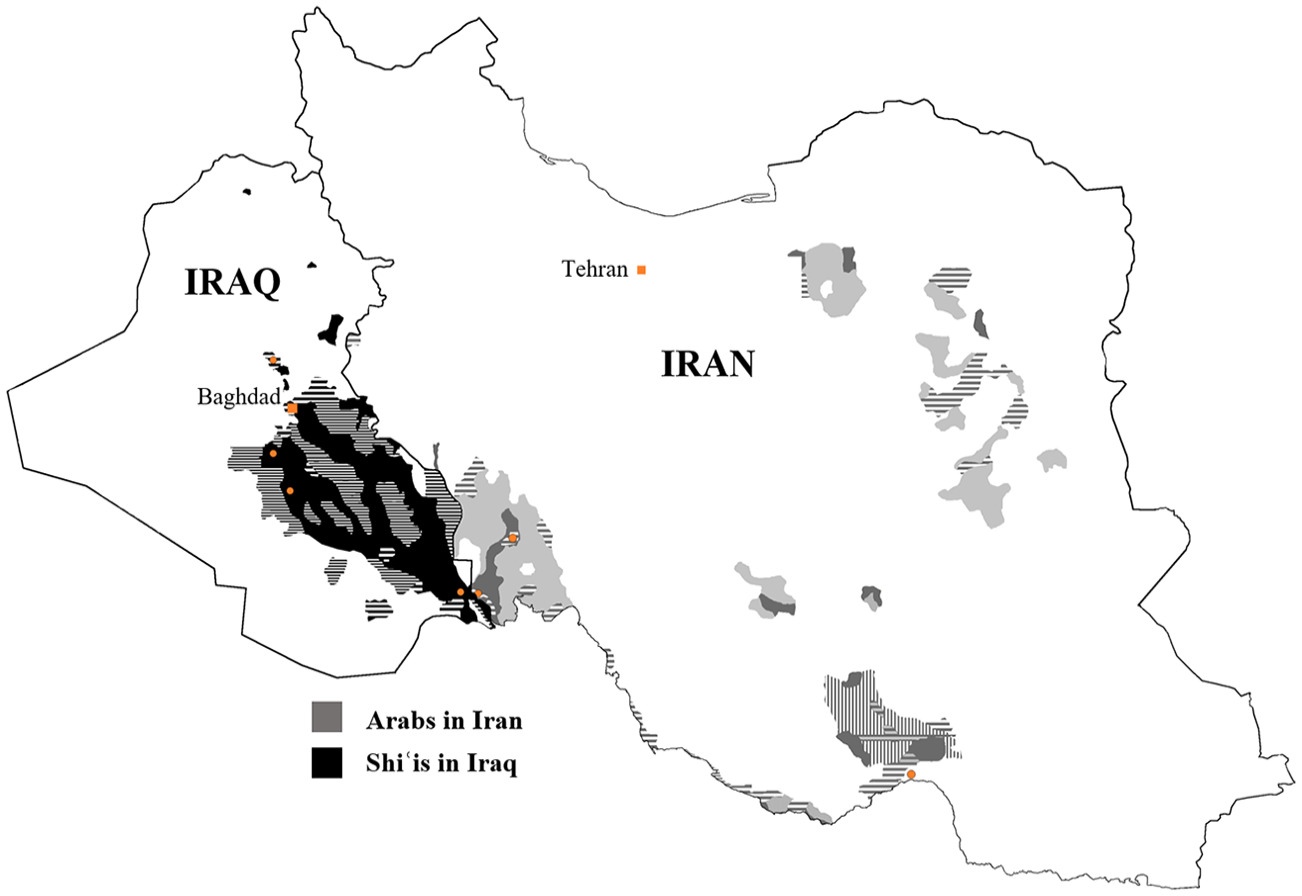
The Arabs in Iran and Shiʿis in Iraq.
Later statistics confirm that the Shiʿis in Iraq were more likely than other Iraqis to have died during the war (Blaydes, 2018: 81). In an interview with his CIA interrogator in 2005, Saddam clearly confirms the role of Iraqi Shiʿis in the war, saying: ‘[Iraq’s] Shiʿis are the ones who fought against Iran . . . They were part of the victory’ (Nixon, 2016: 131).
The aim of this article is to explore the shortcomings of the mediatized Shiʿism employed by Iranians when they began offensive operations after 1982, by examining the media contest between Iran and Iraq during the war to attract the Iraqi Shiʿi community. The article will explain why the attempts of the Iranian media failed, and why the Iraqi Shiʿi soldiery did not defect but rather drove the Iraqi military machine until the war ended. The article starts by proposing a theoretical framework based on Wolfsfeld’s Media Contest Theory (Wolfsfeld, 1997, 2003). It then scrutinizes Iran’s media authority, and the framing of Shiʿi ideology in radio broadcasting during the period between September 1981 and February 1983. This was the period in which Iran pushed Iraq’s army back to its pre-war position, and when the stalemate that ensued led to a five-year war of attrition that ended when the belligerents signed a cease fire in August 1988. The third part presents an analysis of the media contest between the two countries. The fourth part of the article examines what went wrong for the Iranian regime, focusing mainly on the cultural weaknesses of their media strategy. The article concludes by elucidating the theoretical findings and their contribution to one of the most influential conflicts in the recent history of the Middle East.
Theoretical framework: Media contest model
Media as a public sphere provides a communicative space in which ideas and ideals find public representation. There has been an ongoing debate in political communication over the extent to which the media plays a role in shaping political outcomes. At one end of this debate one finds studies that attribute such power to news media which, it is argued, can ‘manufacture consent’ for elite policies (Robinson, 2001). At the other end of this debate, and of this radical categorization, stand studies which argue that the socio-political landscape is more complicated and which point to continuous contention and contestation within media representations (Cottle, 2006). Gadi Wolfsfeld’s ‘media contest theory’ is one such study (Wolfsfeld, 1997, 2003). It aims to reconcile contrasting claims concerning the power of media in shaping political outcomes by acknowledging the role of news media but, at the same time, emphasizing that ‘politics comes first’. The theory offers a promising foundation for studying the role of media in the Iran–Iraq war, and in probing the failure of mediatized Shiʿism.
Mediatized Shiʿism refers to a form of Shiʿi Islam as a social and cultural institution that has been influenced by media (Hjarvard, 2011). There is no doubt that, in the contemporary Middle East, the changing authority of political Shiʿism is being influenced by, among other factors, general processes of mediatization. With the rise of the Ayatollahs in Iran in 1979, the local media began to propagate and enforce changes in culture and institutions, and promote so-called ‘revolutionary cultures’. Soon, Iran’s new leaders decided to promote this call throughout the region and the Muslim world. A sense of mediatized (Shiʿi) Islam, which was revolutionary, anti-imperialist and anti-autocratic began to gain traction among communities in the Middle East as early as the 1980s. At the heart of this process were the media outlets of Iran and its affiliates. When the war started, the mediatization of a so-called active ‘transnational Shiʿism’ in the region was at a very early stage. Nonetheless, as it directly engaged over 60 per cent of the world’s Shiʿi population, the Iran–Iraq war played a unique role in the formation of what today could be called the mediatized Shiʿism in the Middle East (Miller, 2009).
Recently, scholars of media and political communications have tried to address, through the lens of mediatization, fundamental questions about how the media influences culture and society, politics and foreign policy (Brommesson and Ekengren, 2017; Couldry and Hepp, 2017; Esser and Strömbäck, 2014; Hjarvard, 2013; Lundby, 2014). This growing stream in the literature is concerned with the role that the media plays in long-term changes. As Hjarvard (2013: 2) argues, mediatization departs from the focus of traditional approaches which are predominantly concened with the influence of media on society, and on the media as an instrument that serves sociopolitical goals. It inquires into how media interweaves itself with societies, how it changes patterns of social interactions, and of politics and political practices. In this sense, mediatization theory works in tandem with what Wolfsfeld (2013) calls ‘politics–media–politics’ (PMP). It acknowledges a cycle within which variation in the political environments leads to variation in media conduct and, in turn, to further variation in the political environment.
During the Iran–Iraq war, political elites in both countries, with relatively high control over media outlets, employed different media, not only to broadcast their military successes and boost the morale of their soldiers on the battleground, but also to propagate their ideological policies on the ground. An exploration of how each belligerent elite used the media, how each challenged the other to obtain more media representation and how they framed their ideological message, will shed more light on this most tempestuous of periods in the modern history of the Middle East.
Wolfsfeld’s underlying argument is that one cannot understand competition over news media without seeing it within the larger context of contests for political power. He proposes, therefore, that in order to understand a political contest between two parties – as between an established authority and a challenger – one must start by examining their competition for supportive media coverage. His empirical studies show the centrality of the political process in driving this contest (Wolfsfeld, 2003): it is policy/politics that influence the media and rarely the other way around. The initiation and protraction of the war by both Iraq and Iran was driven by the expansionist policies of these two revolutionary states. To that end, both tried to exploit the available media to justify their set policies. The belligerents had firm ideological and revolutionary standpoints and tried to use media, at least in part, as a tool in the service of propagating their ideologies. Wolfsfeld’s media contest theory also assumes that the antagonists’ contention within media representations has two dimensions: structural and cultural. While the former dimension implies contestation over access to the media, the latter dimension refers to the contestants’ battle over the meaning, by framing their ideological message, social values and norms (p. 89). Framing here is understood as those central organizing ideas, still largely unspoken and unacknowledged, for making sense of relevant events and suggesting what is at stake for those reporting the events as well as people who rely on their reports. Media contest theory tries to shed light on how the antagonists strive to utilize their ‘production assets’ to facilitate the creation of newsworthy information, first to attract more airtime and second to promote their media frames (Wolfsfeld, 2004: 49).
One of the more visible and audible characteristics of the eight-year conflict was the war of words – as happened in the spring of 1980 – between the two leaders and policymakers, conducted through Iranian and Iraqi official broadcast services. Over the course of eight years of war, and in line with strategies and realities on the ground, both countries continuously challenged each other, using different media, not only to mobilize their soldiers and boost their morale on the battlefield, but also to address the other’s public sphere by broadcasting their revolutionary ideologies beyond their own borders. This contest between authority and challenger is depicted in Figure 2. In this study and during the period under investigation, the authority is Iran because it is on the offensive, and the challenger is Iraq, which seeks to disrupt Iranian attempts to use media to influence Shiʿis inhabiting the Iraqi public sphere.
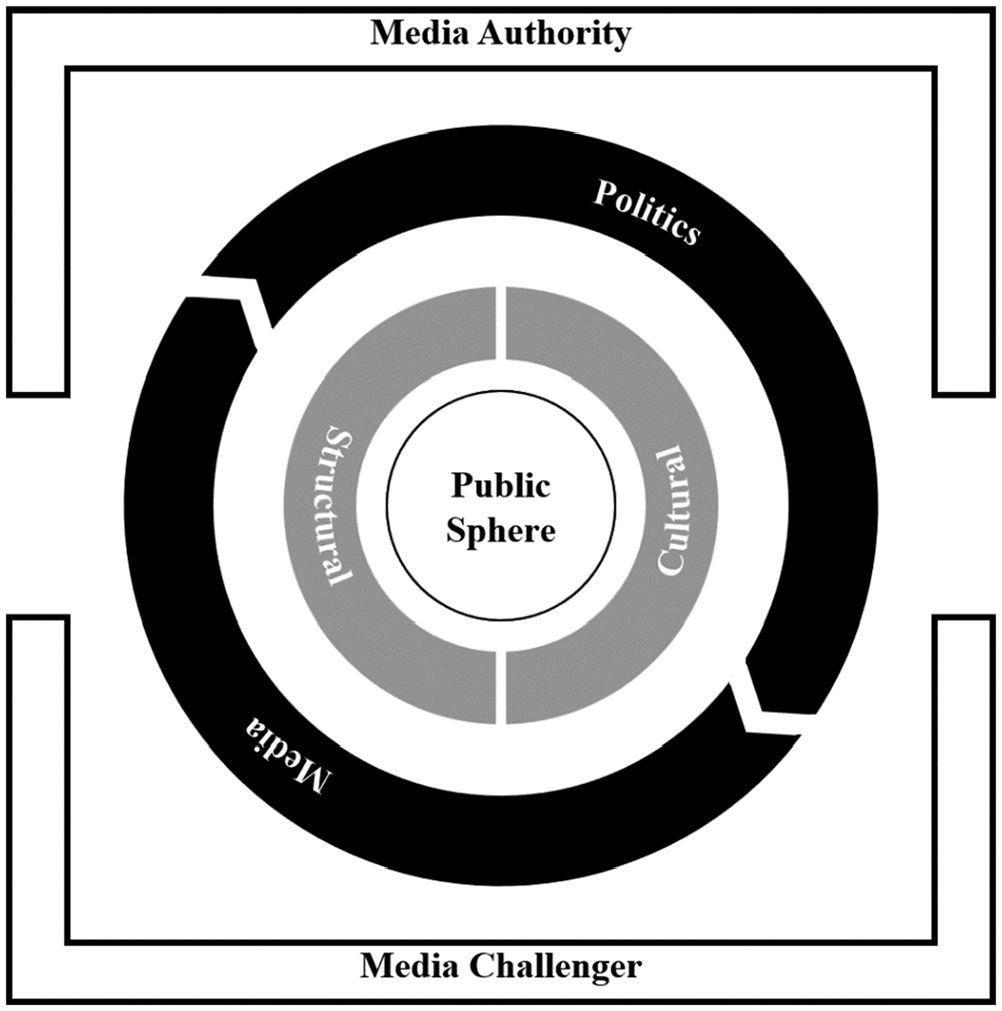
The theoretical framework.
To this end, what served the ideology of Iranian political elites was to target the Shiʿis of Iraq who conformed to their reading of Islamism. In this, Iranians were well aware of the power of news media and their weakness at least at the outset of the conflict. Khomeini admitted the superiority of Iraq’s media warfare in early 1981, in an address to personnel and managers of the Islamic Republic of Iranian Broadcasting Service: You should be vigilant, as the media and propaganda [of the enemy] is more trenchant than its weapons in the battlefield. We should be afraid of their media campaign far more, and unfortunately, we have been weak here . . . I hope that with a more well-organized strategy, and harmony, you could neutralize the enemy’s stratagem. (Khomeini, 2008, Vol. XVI: 336).
Eventually, the contest over the media became one of the main facets of the war. The focus of this article, however, is on one side of this competition: how Iran employed its production assets to mediatize its politics during the war in order to target the Shiʿis of Iraq. Media contest theory provides a useful theoretical framework for this analysis. This study develops the PMP model in a case where Media is not independent of Politics, as it is state-sponsored. However, Politics still runs into problems when Media becomes involved. It explores why, for reasons of poor framing and lack of professional practices, analysis of the Media part of the cycle illuminates problems in communication, and then reinforces the problems at the political level when we move through time to the second Politics. By examining a case where PMP are not entirely discrete units of analysis in a political sense would expand the empirical boundaries of the media contest model.
Case selection, data and methods
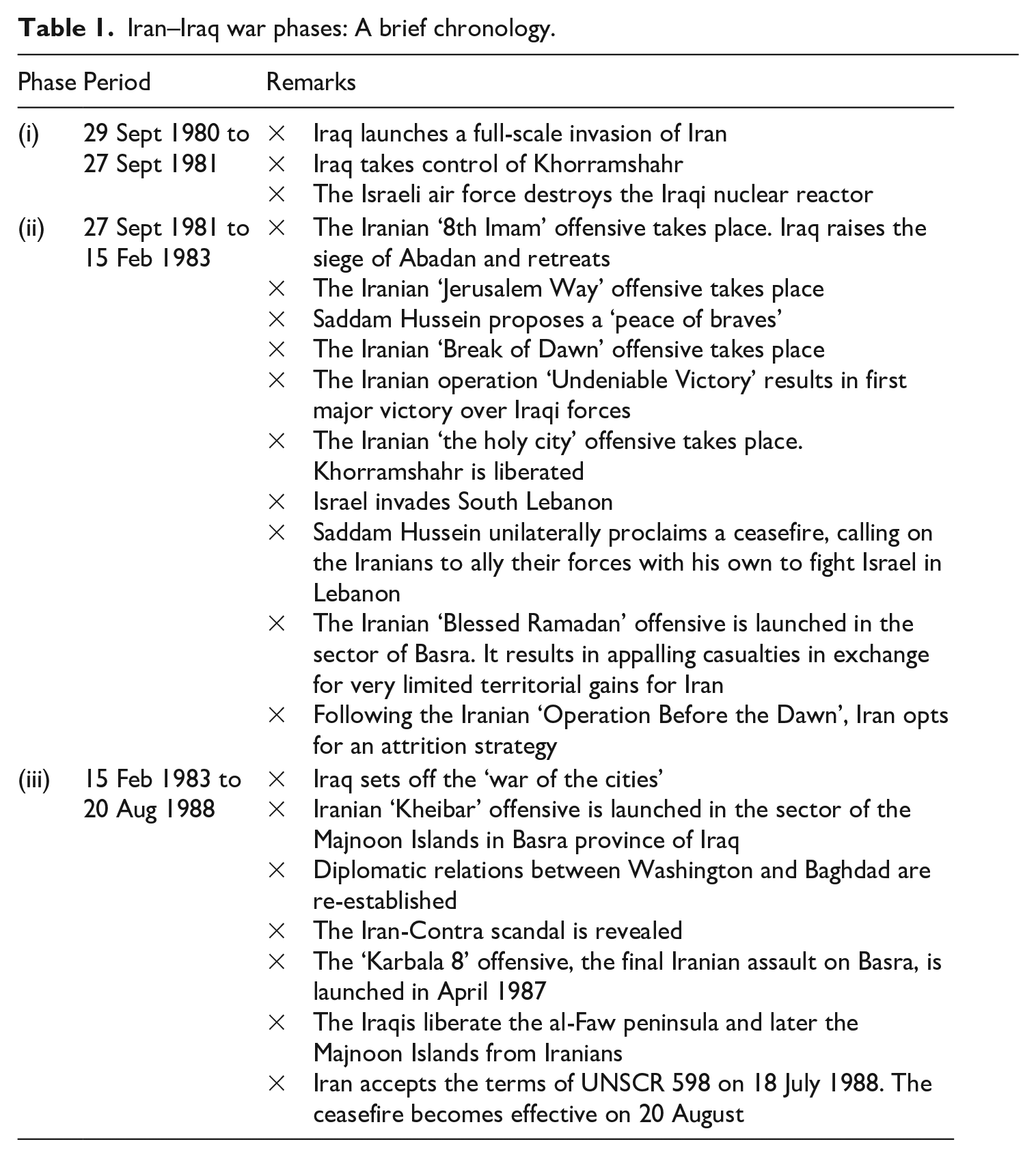
The timeframe which this study covers is the 18 months from September 1981 to February 1983. During this period – as Table 1 indicates – Iranian forces were able to begin a series of offensives against Iraq, first in order to recapture the territory that had been occupied since the start of the war, and then to invade Iraqi territories. For nearly 18 months, and up until the time when the war reached a deadlock, Tehran became an authority in its media contest against the challenger Baghdad. In the course of the dramatic changes that occurred during the war, the Iranian elites sought to use their propaganda machine in order to enable their military machine to advance into majority Shiʿi territories in southern Iraq.
Iran–Iraq war phases: A brief chronology.
In general, from the outset, the war was fought not only on the battlefield, but also on television screens and most notably on the radio (Khoury, 2013: 87). In this media contest, in order to broadcast their message beyond their own borders, Iran and Iraq relied mainly on the medium with the farthest reach: the radio.
During the second phase of the war, Iran not only used radio broadcasts to justify their stance in the war and to encourage soldiers on the battlefield, but also to propagate its ideological views among Iraqis (Khoury, 2013: 62). For its part, Baʿthist Iraq sought to challenge the media attack orchestrated by its enemy.
Radio broadcasting has played a major part in wars since the early 20th century (Pinkerton and Dodds, 2009). For decades, radio has played a critical role in political communication across the globe. And the Iran–Iraq war occurred during the period known as the ‘radio-age’ in the region (Horten, 2002: 1). Cheap and easily accessible, both in Iran and in the Arab world, radio became the primary medium for those interested in following news of coups, wars and revolutions in the region. Before the start of the war, Iran and Iraq had each had Arabic and Farsi services, and both countries used these to broadcast state policy both internally and externally.
The data for this article is gathered from the broadcasting of ‘Voice of Tehran in Arabic’ (VoTA), which had been established before the revolution to promote good relations between Iran and the neighbouring Arab countries (Boyd, 1997), and Iraqi radio broadcasts of ‘Voice of the Masses’ (VoM), which was the most politically-oriented radio station in Iraq. VoM was broadcast exclusively in Arabic, and was intended for the broader Arab world, as well as for domestic consumption (Boyd, 1982). The methodology that this article employs to study Iran’s radio framing involves a thorough reading of available radio transcripts of VoTA and VoM between September 1981 and February 1983, documented by the Foreign Broadcast Information Service (FBIS). 1 Active from 1941 to 1996, FBIS is the largest provider of the open-source intelligence (OSINT) in the US government (Mercado, 2009). It acted as the government’s primary instrument for collecting, translating, analysing and disseminating open-source media including radio, television, press agencies and newspapers. 2
In addition to the FBIS database – since the public sphere targeted by both Iran and Iraq during this period was mainly the Arab Shiʿis in southern Iraq – other mediums used by Iraq to challenge the media authority of Iran (including TV news and daily newspapers) have also been examined. This mainly includes analysis of the transcripts and other media focuses on news framing of the opponent’s leader(s), of soldiers, societies and of the conflict itself. 3 This article connects framing to the media strategies being deployed by each side during the period of analysis. In this way, as with Wolfsfeld’s studies, the analysis allows for an explanation of how political actors deployed media strategies and how structural and cultural factors constrained their efforts in ways that contribute directly to outcomes.
Iran’s media authority and the challenger, Iraq
During the 18 months between September 1981 and February 1983, Iranian troops began a series of military campaigns which led, first, to the recapture of the port city of Khorramshahr from Iraq on 24 May 1982, and pushed Iraqi forces back to their pre-war positions; and, then, to the entrance of Iranian troops into Iraqi territories with the launch of an offensive operation, ‘the blessed Ramadan’, in July 1982 (Razoux, 2015: 223). The Iraqi leadership was soon forced to admit that it was on the defensive for the first time since the start of the war (Marashi and Salama, 2008: 140). Iranians were consistently attacking all along the border opposite the city of Basra, hoping for the collapse of the Iraqi army, and that this would spark a coup against Saddam Hussein and trigger a Shiʿi uprising against the Baʿthists. This was the overarching political strategy that defined the media contest between Iran, the media authority, and Iraq, the media challenger, and was initiated through Iranian Arabic radio broadcasts during this period.
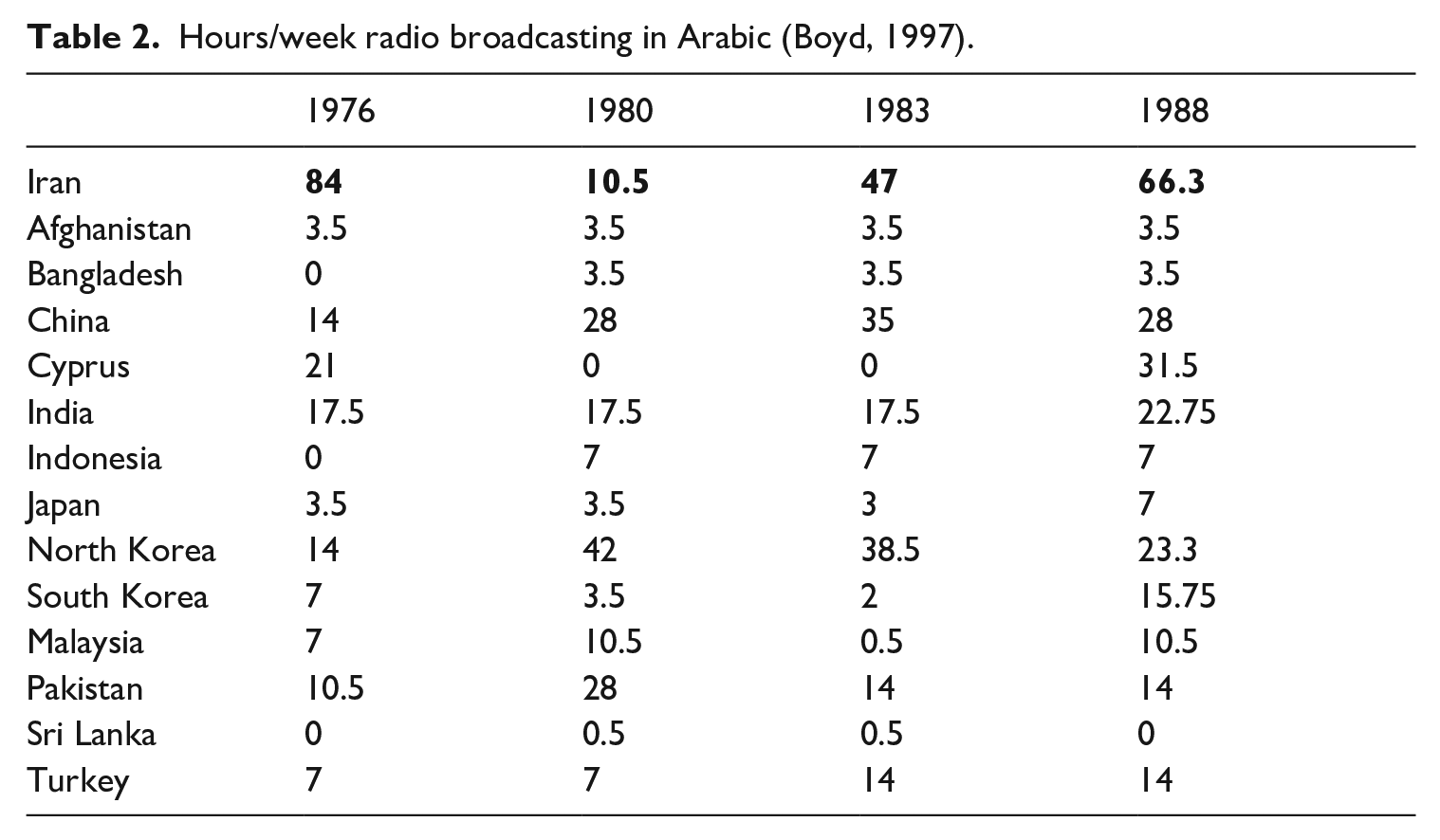
There had been an Arabic service in Iran for years before the Revolution. The Shah, who saw himself as the ‘gendarme of the Persian Gulf’, used the Arabic service to promote good relations with neighbouring Arab states. Proximity to the Arab world permitted medium-wave signals to reach the Arab public. By 1976, Iran had transmitted the largest number of Arabic-language radio programmes among non-Arab states in the region (Boyd, 1997). Nevertheless, the broadcasts of Iran’s Arabic radio station changed dramatically in the aftermath of the Revolution. The revolutionary regime had been entangled in internal factionalism and lacked a coherent state media policy (Maddy-Weitzman, 1982). This, among other issues, resulted in a sharp drop in Iran’s Arabic programming right after the Revolution so that a total of only 10.5 hours of programming was broadcast each week (Boyd, 1983). It took Iran almost 10 years, a far longer period than its war with Iraq, to regain its pre-Revolution Arabic radio airtime (see Table 2). On the other hand, Iraq, an Arab country, had numerous official radio stations – including its VoM station with 22 hours of broadcasting per day on both medium- and short-wave transmitters. It also had one official TV station and dozens of daily newspapers intended for both domestic and Arab-world consumption (Boyd, 1982). This shaped the structural dimension of the media contest between the two adversaries during the war.
Hours/week radio broadcasting in Arabic (Boyd, 1997).
Iran’s media authority during phase II of the war was easily challenged from a structural point of view, considering the amount of airtime used by Iraq’s Ministry of Information and its central media policies. Therefore, in order to win the media contest, Iran had to attain the upper hand in the cultural dimension of the media contest and hope that its bet that it could gain the support of the Shiʿi of Iraq would pay off. The cultural dimension of the media contest, as Wolfsfeld (2003) reiterates, involved persistent interpretation and reinforcement of shared norms, beliefs and outlooks on the situation. Therefore, Iran had to gain the support of Iraqi Shiʿis not only when it drove the Iraqi armed forces out of its territories, but also, and most importantly, when it decided to enter Iraq with the aim of toppling the regime of Saddam.
In September 1981, Iranian forces succeeded in ending the Iraqi siege of Abadan and were advancing to recapture the city of Khorramshahr. This was the first major victory for Iran since the start of the war, and it officially put an end to Iraqi offensives (Razoux, 2015: 181). As Iraqi forces were retreating, Iran mounted a propaganda campaign designed to demoralize the enemy. In the midst of the Iranian offensive to push Iraq out of Khorramshahr, the VoTA made the following announcement: The coming weeks will be decisive on the front. Iran will have no alternative except to continue fighting so long as the enemy persists in his illusion and persists in his usurpation of Iran’s sovereignity. The fate of every Iraqi soldier was defined by the battles fought by the soldiers of Islam. He faces three possibilities: he will fall in the hands of Islam’s forces; he will be killed in fighting, his body burned and he will be prey for the beasts of the wasteland; or he will flee from the battlefield and thus will be entangled in the web of the Saddamist regime and then will be killed and his body sent to his family with the word ‘traitor’ written on it.
4
Iranian media was very careful to make a distinction in its framing of the enemy’s forces. In order to prevent fully alienating the Iraqi soldiers – the majority of whom were Shiʿis – VoTA constantly used labels such as ‘Saddamists’ or ‘Baʿthists’ to describe their enemy. By late 1981 and early 1982, as Iraq was retreating from Iranian territories it had previously occupied, Saddam occasionally used radio broadcasting to justify that the conflict had been started by Iraq, not out of ‘desire for aggression’, but in reply to ‘Iranian aggression’. 5
From the start, the main concern of Iraqi rulers was the so-called expansionist aspirations of Iran’s Ayatollahs to extend Iran’s influence over the Shiʿi community in Iraq. As Iranian forces advanced on the ground and the Iranian propaganda machine was roaring, Saddam addressed Iraqis in a live broadcast from the Shiʿis holiest city of Najaf, stating: [The enemy] believe that many Iraqi cities might incline their heads so the Tehran rulers could put on the noose of subservience. They believe that Najaf could be part of Iran . . . Najaf is Iraq, the territory and people of Najaf are Arab.
6
In this way, he was invoking the Arab identity of Iraqi Shiʿis and warning them of the threat of subjugation at the hand of Iranians, should Iraq lose the war. This was something that Iranian media framing did not shy away from. For example, VoTA, in this call to Iraqis to rise against Saddam, stated that: We call on you to actively participate in liberating your country and establish the government of God’s justice under the Imam al-Ummah, Khomeini. This government will ensure happiness for all the world’s oppressed.
7
Iranian forces finally managed to recapture Khorramshahr on 24 May 1982. As they were clearing the city of Iraqis, this was what a jubilant VoTA announced: Oh, nation of Mohammad; a decisive round in the conflict between Islam and infidelity has ended with the victory of great Islam and the defeat of infidelity, and Satan and his surrogates. The city of Khorramshahr has been liberated . . . Oh Muslims everywhere; always follow reports of the victories forged by the soldiers of Islam . . . spread the news of these victories . . . Oh Muslim people of the region; the stooges will try to make you believe that Islam is a threat to you . . . the Islamic Republic is the state of the Quran, and the state of God’s messenger, therefore it protects every Muslim and does not inflict any harm on any Muslim . . . Oh Muslim people of Iraq; it is time for you to arise [against] the devil, Saddam. [He] must receive his just punishment. We only want the Quran’s rule and the banner of Islam. It is a struggle until the devil, all devils, are overthrown.
8
The announcement – which aimed to mark the start of a new phase for the triumphant Iranians and the demoralized and vanquished Iraqi soldiers – clearly manifests Iran’s media framing in its contest with the media framing of Iraq. First and foremost, it portrays Muslim Iranian forces as the ultimate ‘good’ people fighting against all the devils of the world, starting with Saddam’s regime. It also targeted three audiences, namely Arab Muslims, Muslims in the Middle East and Iraqi Muslims. It respectively transmitted three messages as well: first, that Muslims should rely on news coming from Iran and not rely on any other sources; second, that Iran does not aim to export its revolution to other countries in the region, therefore the Middle Eastern Muslims should not see Iran as a threat; and third, that Muslims of Iraq should rebel against Saddam and topple him, albeit with the support of Iran.
In the coming months, as data shows, this overarching media framing was persistent in VoTA reporting on the war and Iranian leaders’ commentaries. From this point on, in the emerging media contest, Iran focused on the policy of ousting Saddam from power with the help of the Iraqi masses. To establish this policy and to appeal to the Iraqis and the broader Muslim world, Iran’s media authority used radio to communicate the idea that the Ba’thists’ Saddam is an infidel, an American and Zionist puppet, and a tyrannical ruler. VoTA commentators, echoing Iranian leaders’ sermons and speeches, constantly broadcast that the only option for Saddam was either to escape from Iraq or to ‘commit suicide’ before devout Muslim Iraqis got their hands on him. 9
For their part, the Iraqi Baʿth, then on the defensive, pursued a policy of tarhib, of instilling terror, to challenge Iran’s authority and to protect the rule of Saddam (Marashi and Salama, 2008: 149). The most prominent goal was to persuade Iraqis that they were not merely fighting to protect Saddam’s regime, but to prevent Arab-Muslim Iraq from succumbing to ‘non-believer’ Iranian forces. For Saddam himself, the most pressing concern was to impress on the Iraqi Shiʿis that their faith was by no means mirrored by the Iranian interpretation of Shiʿism (Dawisha, 1999).
Iraq employed a coherent and consistent media framing in the aftermath of its retreat from Khorramshahr to its pre-war positions. It did so to challenge Iran’s intensified media campaign and in order to maintain the morale of its soldiers and prevent the potential development of a popular rebellion against Saddam. In contrast to Iran, at the time, Iraq’s media strategy was centrally designed and implemented, by the Directorate of Political Guidance. 10 This unit had the sole authority to produce media content targeting domestic and foreign audiences, using all available means at the time, including various radio stations, state TV stations and daily newspapers (Khoury, 2013: 87).
Iraq’s media framing, which was designed to challenge what the enemy was broadcasting, was built mainly around four principles. The first was presenting Saddam as the great Arab leader and the warden of Arab’s ‘eastern gate’, and to represent the war as an Arab–Persian affair that had nothing to do with Islam (Long, 2009: 25). The second was portraying a negative image of Iran and claiming that it was Iran’s expansionist ideology that had started the war (Bengio, 1998: 105). The third was to protest against those Arab states such as Libya and Syria that were supporting Iran (Maddy-Weitzman, 1982); and the fourth was to expose Iran’s relations with the US and Israel (Woods et al., 2011b: 23).
One day after the recapture of Khorramshahr, a VoM commentary announced that: It is now definite that Iraq did not enter Iran out of greed for its territory . . . It was Iranians who whetted their appetite on Iraqi resources; who considered Iraq’s development and progress a threat to their dark dreams and hindrance to Zionist plans to keep all countries of the Arab homeland weak, backward and unable to exercise real sovereignty . . . Thus when they seized power, the Iranian rulers devoted themselves to the objective of humbling Iraq, dividing its people and territory, and turning it wholly, or partially, into a province in their planned empire . . . Iran could have spared the blood of hundreds of thousands of its sons. But the Iranian rulers refused [to end the war]. They were driven by two motives: their intention not to give up their ambitions on Iraq and the Gulf countries and intervention by Zionist and pro-Zionist regimes, especially the Hafez al-Asad and al-Qaddhafi regimes, which encouraged Iranian rulers to not only continue the war, but also to hold onto their ambitions.
11
The media contest intensified after Iran began its ‘Operation Blessed Ramadan’ offensive, advancing towards Basra. VoTA constantly broadcast messages and announcements to reassure Iraqis that Iranian forces had benevolent intentions. On the other hand, the Directorate of Political Guidance office, aiming to counter rumours that Iraqi forces suffered from low morale and weak leadership, did not miss an opportunity to challenge Iran’s position (Marashi and Salama, 2008: 141). In this, Iraq as the media challenger began to frame the news about the war in ways that highlighted the hostility of Iranian forces and Iran’s insincerity in the way that its broadcasting sought to portray, and thus to forge realities on the ground. When Iran began shelling civilian areas around Basra, this became the main theme of Iraq’s challenging media strategy. Recent scholarship shows that the news of Iranian shelling and Iraqi broadcasts concerning how Iraqi captives were treated in Iranian camps triggered many Iraqis – mostly Shiʿis who feared that an Iranian invasion ‘would result in a violent disruption of their lives’ – to join the army and fight against Iran (Blaydes, 2018: 85). This was consistent with the Baʿthists’ policy; while deserters faced dire consequences, Iraqi army officers, and the families of Iraqi martyrs, were subject to substantial material improvement (p. 102). 12
The Iranian leadership opted to enter Iraqi territories in order to end the threat of Saddam and expand their Islamic call. In this, they had assumed that they could gain Iraqi popular support (Dawisha, 1999). They also had counted on the support of those Shiʿi Iraqis who had been expelled from Iraq, some of whom had joined the dissident Ayatollah Mohammad Baqir al-Hakim (1939–2003) in forming, in Iran, the Supreme Assembly of the Islamic Revolution in Iraq (Tripp, 1989: 67). In the aftermath of the recapture of Khorramshahr, VoTA reported on Hakim’s visit to an Iraqi prison camp in Tehran, and an address to Iraqis in which he sought to justify Iran’s having entered Iraq: [It] is the natural right of the Iranians to enter Iraqi territory to defend itself and to liberate the Muslim Iraqi people who have asked for assistance from the Imam of the nation and the Islamic Republic of Iran . . .
Commenting on Hakim’s remarks, the radio announcer adds: [Hakim] appealed to all Muslims in the world to mobilize their efforts under the leadership of Imam Khomeini to fight against world infidelity. Our correspondent reports that, following his address, an Iraqi prisoner expressed the Iraqi prisoners’ desire to take part in the war imposed by Saddam’s regime on the Islamic Republic.
13
While Iranian forces on the ground were facing great resistance from their co-religionist Iraqi Shiʿis, the VoTA had nothing to say other than encouraging Iraqis to fight against Saddam and to expect that, after him, ‘Imam Khomeini’ would become their leader. On the other hand, the challenging Iraqi media broadcast constantly that the Iraqi government would materially punish its defectors and reward its supporters. While Iran’s media framing was to make empty promises to the Shiʿis of Iraq in the distant future, Baʿthists were distributing material rewards among those who showed loyalty. And indeed, the Iraqi media framing and their policies resonated more with the culture of the targeted audiences.
Soon, the deadlock on the ground became apparent to the Iranians. Therefore, this time, Khomeini directly wrote a letter that was read out by VoTA for days. Although Khomeini addressed his letter to the ‘beloved Muslim people of Iraq’, its Shiʿi dimension was more evident than ever. Here is how he singles out and addresses the Shiʿi inhabitants of Basra, and of the two holy cities of Najaf and Karbala: Dear people of Iraq! Now that your brothers have come towards you and selflessly struggle to protect their country and save their dear brothers who are in bondage, rise up and, inspired by the great Islam, attack the enemies of Islam. Oh, devoted residents of Basra! Come to receive your believing brothers and sever the hands of infidel Aflaqi tyrants from your country. Oh, esteemed residents of the holy shrines! Take the opportunity God has provided for you and rise up courageously and determine your own destiny.
14
Even this exceptional attempt by the spiritual Shiʿi leader failed to bear fruit, and Iraqis continued to strive to push back the Iranian aggression. By early 1983 it had become obvious to the Iranian leadership that their media strategy was futile in attracting the Shiʿi community in Iraq. 15
As the fighting on the battleground was reaching a stalemate, the media contest lost its drive to achieve decisive influence and, instead, became entangled in repetitions of out-dated and tattered frames. While Iran had lost the opportunity to seize the upper hand on the battleground through media appeals to Iraqis which, it had hoped, would consolidate its foothold in Iraq and win the war, Iraq had pursued a well-calculated and centrally orchestrated media strategy and thus won the contest.
Mediatized Shiʿism: Structural and cultural barriers
Three years after the war with Iran, and while the defeated Iraqi army was retreating from the Kuwait war, Shiʿis of the south erupted in one of the most menacing popular uprisings in the modern history of Iraq, later to be known as the 1991 uprising (Abdul-Jabar, 1992). In less than 10 days, and with the Kurds joining the protest from the north, rebels had managed to gain control of 14 out of Iraq’s 18 provinces and were heading towards Baghdad (Tabarayian, 2012: 230). Although the central government eventually crushed the uprising and suppressed the threat, the 1991 uprising was the most threatening popular attempt to overthrow the rule of Saddam (Marr, 2012: 232). Some observers point out that President George HW Bush’s address to the Iraqis was crucial in prompting the uprising (Katzman, 2000). In a speech which was partly broadcasted to Iraqis after the Kuwait war, Bush stated: [There’s] another way for the bloodshed to stop, and that is for the Iraqi military and the Iraqi people to take matters into their own hands and force Saddam Hussein, the dictator, to step aside, and then comply with the United Nations resolutions and rejoin the family of peace-loving nations. We have no argument with the people of Iraq. Our differences are with that brutal dictator in Baghdad.
16
One may ask what President Bush said in his one address that achieved the widespread uprising that Iranian Shiʿi leaders had tried but failed to inspire during eight years of war with Iraq? How was it that Iran, which was the media authority between September 1981 and February 1983, lost the media contest to its Iraqi challengers?
The Iranian leadership had attempted to promote two distinct messages, especially among the Shiʿis of Iraq, during the second phase of the war. The first was that Saddam and his Baʿthist supporters were brutal non-Muslims who, as agents of the world powers and Israel, were working against the interest of Islam. This was a most defiant message and thus very worrisome for the Iraqi political apparatus. The second message was that the struggle against Saddam was a sacred and religious duty for all Muslims, no matter what the consequences. If they succeeded, they would join their Iranian brethren who, under the leadership of Imam Khomeini, had prevailed against the regime of the Shah; if they were murdered, they would be martyrs and rewarded by God. In their media strategy, Iranians also strove to frame the war as an effort to fight against Saddam, to help Iraqis to get rid of him and not to make them subservient to the Islamic Republic’s expansionist aspirations in the region.
The difficulties the Iranians faced in transmitting these messages were both structural and cultural. The structural barriers for Iranians, as the media authority, were more noticeable. As Table 2 indicates, after the 1979 Revolution, Iranian Arabic broadcasting situations changed dramatically, and their weekly hours dropped almost eightfold by the start of the war with Iraq in 1980. It took some time – almost the entire period of the second phase of the war when Iran had the upper hand on the battleground – for Iranians to increase their Arabic airtime. By the end of the war, the total Arabic-language hours per week were still less than in pre-Revolution Iran. On the other hand, Iranians lacked media skills when it came to regional and international broadcasting. Almost two-thirds of all VoTA records, documentd by FBIS between September 1981 and February 1983, consisted of Arabic translations of Iranian official comments, the Friday sermons and speeches by Ayatollah Khomeini delivered to domestic audiences. The Iranian Arabic media was poor and there was no central authority in place at the time. It took years for the multipolar power centres in post-Revolutionary Iran to form a coherent and pragmatic media strategy. In contrast, the Iraqi media was tightly controlled by the regime.
Nonetheless, the most important lesson to take from this case study for the contemporary Middle East politics is Iran’s media cultural impediments to the mediatized Shiʿism during the war. Iranian leaders’ lack of understanding of the Iraqi Shiʿis, of their identity and loyalties, and their underestimating of the agency of Iraqi Shiʿis were fairly high on their list of media strategy difficulties. These shortcomings offered the Iraqi regime a unique opportunity to effectively use media to frame the war and to challenge the enemy’s propaganda.
To challenge the Iranian diatribes against Saddam and the Baʿth regime, the Iraqi media initiated an orchestrated campaign to present him as the ‘Arab strongman’, a ‘pious Muslim’ and ‘the father of the nation’. Millions of copies of his photo, praying at Shiʿi holy shrines, pervaded the country. State TV stations were constantly showing him visiting shrines, meeting with families of soldiers and distributing toys among Iraqi children (Abdul-Rahman, 2007). In one of their attempts, Iraqi regime produced a pedigree chart that linked Saddam to the first Shiʿi Imam. The copies of the chart were hung in every mosque and mausoleum across the country (see Figure 3).
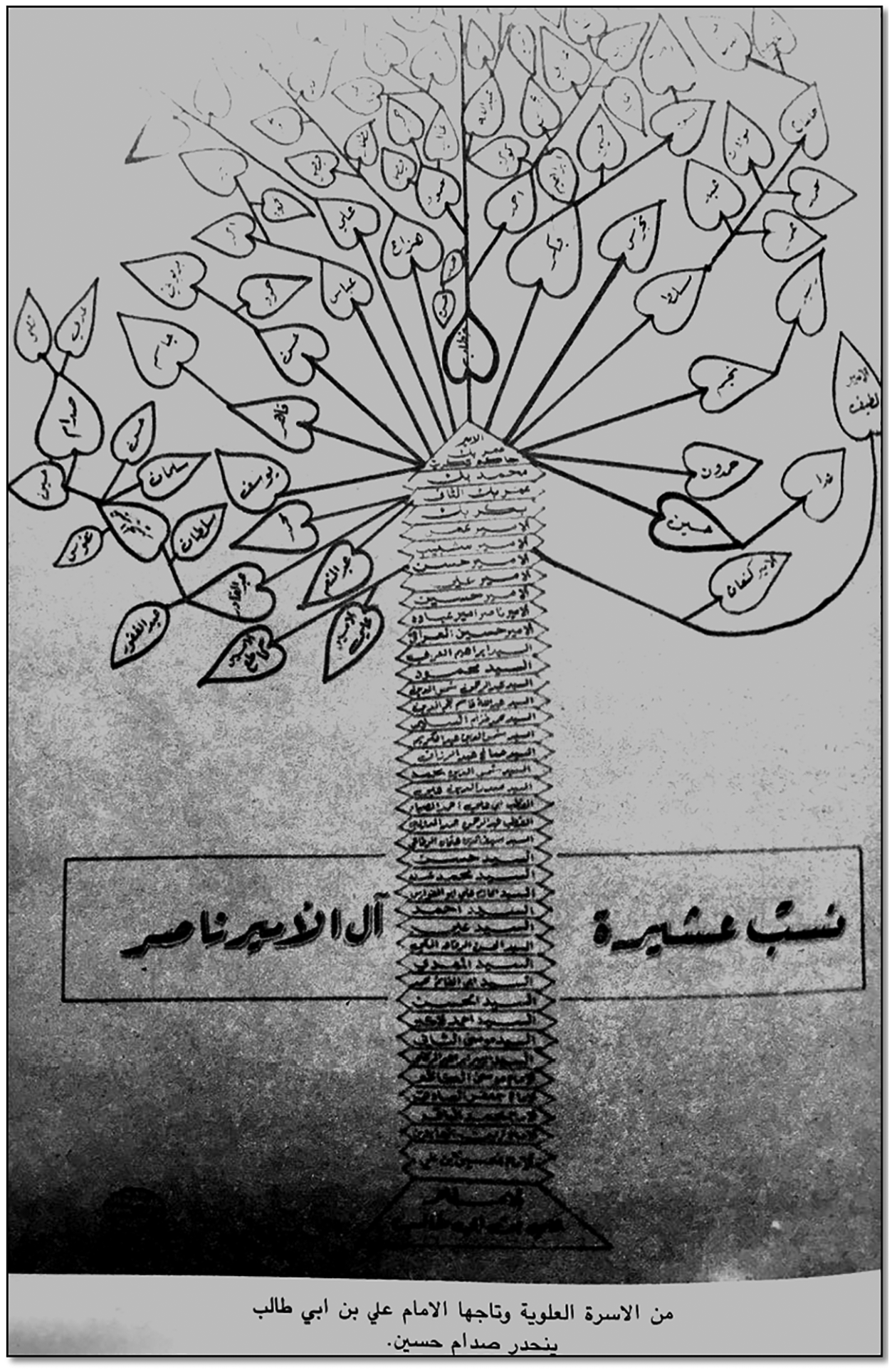
A copy of Saddam’s genealogical tree with the caption reading: ‘From Ali’s family, whose crown is Imam Ali, descended Saddam Hussein.’
One of the Iraqi media’s countermoves against that of Iran was to construct newsworthy frames which linked the leaders of the revolution to Israel. In this, they not only managed to embolden pan-Arab sentiments among the public and the broader Arab world, but also to ridicule Khomeini’s spiritual authority among Shiʿis by portraying him as a ‘Zionist stooge’ (Karsh and Rautsi, 2002: 163) (see Figure 4).
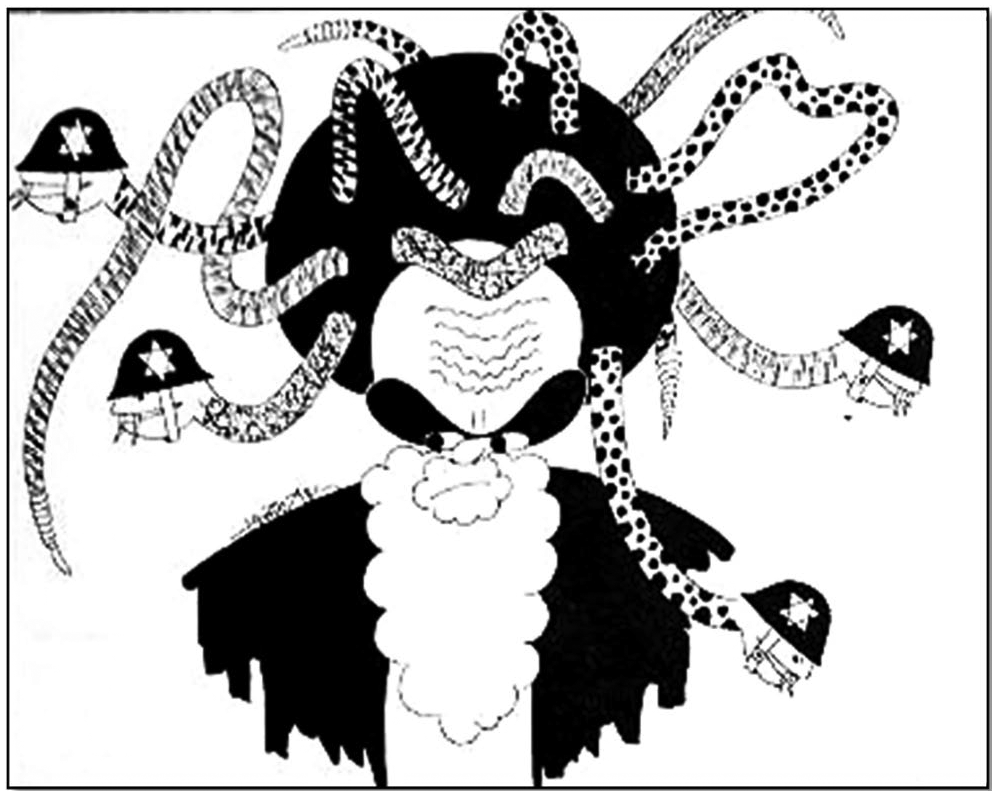
A copy of Khomeini’s cartoon published in Iraqi Alef-Ba Weekly during the war.
The most daunting cultural barrier for Iranian media strategy, nonetheless, was to communicate to the Shiʿi inhabitants of southern Iraq and Basra that Iranian forces were their liberators. In this, also, they miscalculated the very fundamental identity of Iraqi Shiʿis. It is noticeable that, in their media framing, Iranians failed to recognize ‘the exceptional collective Iraqi social character’, a concept coined by the pre-eminent Iraqi social scientist, Ali al-Wardi (Khoury, 2018: 26).
Al-Wardi opines that Iraqis, especially those Shiʿis residing in the lower Euphrates, portray a ‘double personality’: a law-abiding urban citizen and a Bedouin tribesman with a set of nomadic values (Al Hashimi, 2013: 254). Writing in the late 1960s, he argued that the idea of a modernized community was ‘superficial’ in cities and even the modern accessories (for example, modern clothing) used by Iraqis camouflaged the deeply tribal values among a society which was still Bedouin at heart (Al-Wardi, 1974, Vol. IV: 402–403). The bedrock of this culture was to desire predominance and to repudiate submission. Values such as honour, loyalty, courage and gallantry stood at the heart of Iraqi society (Khoury, 2013: 212). Material rewards and punishments had the utmost resonance for such a society (Al-Wardi, 2010: 251). This Bedouin culture was the key point that distinguished the Shiʿis of Iraq from their co-religionists in Iran and elsewhere. Not recognizing these cultural values in their framing not only caused predicaments for Iran during this period, but also offered a great opportunity for the Baʿth regime to challenge the enemy.
The Iranian leadership hoped to mobilize Iraqis against Saddam by assuring them that, if they succeeded in this ‘sacred struggle’, they would join the transnational movement of their Iranian brethren and, if they failed to do so, they would be martyrs and receive ‘God’s mercy’. 17 Iran’s structural and cultural barriers, however, undermined its media strategy. The Iraqi media on the other hand promoted government ‘reward and punishment’ policies for loyal soldiers and for the ‘coward and betraying’ defectors. TV news was filled with footage of Saddam Hussein distributing medals to soldiers who fought valiantly against Iranian aggression. 18 High-performing officers in the military could receive Mercedes Benzes for their loyalty and the families of fallen soldiers were compensated with money and a car (Blaydes, 2018: 101; Razoux, 2015: 313). On the other hand, as Saddam noted in one of his public addresses, ‘when soldiers no longer fight for the love of their leader, then they must fight by fear’ (Woods et al., 2011a: 51). The Revolutionary Command Council decrees announcing that soldiers who desert their positions would be ‘executed immediately’ pervaded Iraqi radio broadcastings. The fear of the repercussions from the government – and promoted constantly by Iraqi media – mounted to the degree that later an army general suggested that the military campaign and public mobilization revolved more around the ‘the fear of what Saddam might do than what Iranians might do’ (p. 13). Contrasting Iran’s radio broadcasts during this period of the war to that of Iraq’s media strategy demonstrates that the latter, as the challenger, had more success in promoting its political influence among the Shiʿis of Iraq.
Conclusion
Media contest theory suggests that, in order to understand political conflict, one should consider competition by political actors to use media to frame unfolding events to legitimize their rule and their policies (Cottle, 2006: 13). Studying the case of the Iran–Iraq war during the period of 1982 to 1983 through the lens of media contest theory, this article aimed to explain how the failure of Iran in mobilizing the Shiʿis of Iraq stemmed, at least partly, from its defective media activities.
The research presented here has two theoretical and empirical contributions. Most of the research that has applied media contest theory to case studies presents cases in which the media authority is a state facing weaker non-state challengers. This case study applies the theory to an explanation of the media contest between two sovereign states. Following Wolfsfeld’s original definition, it treated the more powerful antagonist as the media authority and the weaker antagonist as the challenger (Wolfsfeld, 1997: 3). It showed that, during the course of the Iran–Iraq war and as the politics on the battleground were changing, both Iran and Iraq became authority and challenger in different phases of the war. A second theoretical contribution has been to use qualitative methods to explain the cultural dimension of the contest rather than, as is more common, a quantitative analysis of frames.
The application of media contest theory to the case of the Iran–Iraq war also provides important empirical insight into the contemporary politics of the Middle East and the early stages of transnational mediatized Shiʿis that we witness today in the region. This insight concerns, first, the role of political communication in regional politics and, second, the socio-political role of the Islamic Republic within the broader Shiʿi world. Although political communication as a field has changed dramatically in the last four decades, studying the role of radio broadcasts during the Iran–Iraq war resonates with the current media-saturated era. The role that Arabic radio broadcasting played for Iranians during the war is significantly similar to their regional media strategies today. The conflict also marked the turning point for the shift to what could be called mediatized Shiʿism and this article has portrayed how Iran, for its part, failed to conduct it. Acknowledging the role of media in its regional policies and soft power today, Iran has one official Arabic news TV channel (al-Alam), one Arabic religious and cultural TV channel (al-Kawthar) and one Arabic film and entertainment channel (iFilm in Arabic), along with numerous Arabic radio stations and social media. 19 A potential area for future study is to explore how Iran’s media strategy targeting the Arab public in the Middle East, and mediatization of Shiʿi Islam, has evolved in the aftermath of the war, and especially in the period following the 2003 Iraq war. This would shed further light on the broader regional policy of Iran which has been built up on the experiences of the war with Iraq.
Footnotes
Funding
The author received no financial support for the research, authorship and publication of this article and there is no conflict of interest.
