




Abstract
Research on media discourses about migration in the United Kingdom primarily focus on immigration, and particularly the ways in which refugees and asylum seekers are constructed as invaders, criminals or drains on the UK. By contrast, research about British citizens who emigrate from the UK has been less widely conducted, particularly in relation to the media. This article addresses this lacuna through a critical discursive analysis of the UK daytime television programme Wanted Down Under, in which British participants are given a trial week living in Australia or New Zealand to help them decide if migrating is the right decision for them. Fifty episodes were analysed using the principles of Critical Discursive Psychology and three interpretative repertoires were identified: Few restrictions make migration possible and easy; Migration as a better lifestyle; and the urgency of realising long-held dreams. In addition, two ideological dilemmas were identified: Separation from family ties as a reason to not migrate; and Lifestyle at home a reason to not migrate. These discourses are discussed in relation to privileged notions of migration and we suggest that these mediated discourses draw on colonial narratives that imply that migration for British citizens is unproblematic and easy.
Introduction
In the United Kingdom (UK), discussions around migration predominantly focus on immigration and those who move into the UK (Połońska-Kimunguyi, 2022). Successive UK governments have sought to problematise migration, and migrants themselves, often talking about the need to reduce immigration to the UK and devising policies in order to attempt to achieve this. Refugees and those seeking asylum have been particularly subjected to a “hostile environment”, but this could now be said to apply to the majority of immigrants coming to the UK (Goodfellow, 2020; Walsh and Ferazzoli, 2023). This hostile environment has recently culminated in the anti-immigration and Islamophobic right-wing riots in the UK in July and August 2024. Increasingly, governmental focus has become about reducing immigration to the UK as far as possible. In 2023, the Conservative government, for example, increased visa costs and the amount of money that must be earned in order to qualify for a work visa and attempted to reduce the number of asylum seekers crossing the English Channel by boat though a scheme that would see arrivals relocated to Rwanda to have their asylum claims processed (e.g. Parker & Cornell, 2024). By contrast, far less attention has been placed on British Citizens who migrate and live in other counties across the world (Połońska-Kimunguyi, 2022). This is despite the UK having one of the highest rates of emigration in the world and with over five million British Citizens living outside the UK (Benson, 2023; Połońska-Kimunguyi, 2022). Połońska-Kimunguyi’s (2022) analysis of British media coverage of migration found almost no references to British citizens migrating overseas. Indeed, as Leonard and Walsh (2019), remark: “there is intensive interest and debate surrounding people coming to Britain, yet the numbers of Britons who migrate each year, and the reasons for this, remain largely invisible – and unquestioned as a ‘right’ – in popular discourse”. In this article, we therefore seek to address this lacuna through a critical discursive analysis of talk about emigration in a UK daytime TV show. We begin by situating the research in the current context of migration to and from Australia and the United Kingdom and introducing our theoretical framework before outlining the methods we used in our analysis and presenting a discursive psychological analysis of the ways in which emigration is constructed as unproblematic in the TV programme “Wanted Down Under”.
Migration to and from Australia and the UK
White European settler migration was a pivotal aspect of the colonial project. Between 1800 and 1925, approximately 48 million European emigrants moved to Australia, New Zealand and the Americas (Gutiérrez Rodríguez, 2018). In Australia specifically, until the mid-twentieth century, white British migrants were directly recruited through government policies, such as the Assisted Passages to Australia scheme launched in 1945. A similar push for certain types of intra-Commonwealth migration was evident in the UK. The 1948 British Nationality Act sought to ease the post-war labour crisis, by allowing migration from throughout the Commonwealth (Walsh and Ferazzoli, 2023). However, the subsequent 1962 and 1968 Commonwealth Immigration Act, differentiated between migrants from Old (e.g. India and Pakistan) and New Commonwealth countries (e.g. Australia) to prioritise the migration of predominantly white citizens (Walsh and Ferazzoli, 2023).
These immigration policies were a continuation of settler colonialism and in service of the construction and preservation of white Christian Australian and British nation-states (Gutiérrez Rodríguez, 2018; Osbaldiston et al., 2020; Walsh and Ferazzoli, 2023). As Osbaldiston et al. (2020: 2) suggest, this is a pattern of migration “developed initially in the act of colonisation that had an ongoing imprint through successive generations”. In the 21st century, Australia has consistently been the top destination for emigration from the UK (Murray et al., 2012). According to the Australian Bureau of Statistics (2024), at the end of 2023, 96,157 people in the Australian population were born in England, the highest number from any country besides Australia (Australian Bureau of Statistics, 2024).
In 2022, net migration to the UK was estimated to be 606,000 with approximately 1.2 million people arriving in the UK and 557,000 migrating out of it (House of Commons Library, 2023). Much of the political focus when these figures were announced was on reducing the number of people arriving in the UK and in particular on stopping small boats of asylum seekers crossing the English Channel (e.g. Maggs, 2020). Indeed, the most recent Conservative government has sought to further distinguish between what they refer to as “legal” and “illegal migration” and although much of their focus has been on reducing so-called “illegal” migration, they have also introduced measures to reduce “legal” migration such as increasing the earning requirements of migrants who wish to bring a spouse or family members with them to the UK. As such, there is considerably less focus paid to who those leaving the UK are and where they are moving to or the reasons for this. Whilst the figure of 557,000 includes migrants returning to their home countries, particularly to the EU following the UK’s departure from the European Union in 2020, it also includes a large proportion of British Citizens leaving the UK to live abroad. These “emigrants”, or “expats” as they are frequently referred to, are often “privileged by citizenship, class or ‘race’” (Kunz, 2016: 89), and feature less frequently in academic literature on media constructions of migration than refugees and asylum seekers (e.g. Esses et al., 2013; Goodman and Kirkwood, 2019; Goodman et al., 2017; Parker et al., 2022) who do not have such a privileged status. Therefore the aim of this paper is to analyse how the media construct accounts of this particular group of migrants and in the next section we begin by considering debates that have focussed on the terms used to describe this specific group of migrants.
Emigrant, expat or lifestyle migrant?
In much the same way as academic debates have focussed on terms such as “refugee” and “migrant” to describe those forced to leave their home countries (Crawley and Skleparis, 2018), the terminology used to refer to those who choose to migrate for lifestyle or economic reasons has similarly been contested (Kunz, 2020). As such, terms such as “expatriate”, “emigrant” or “lifestyle migrant” are frequently used and often are used interchangeably. However, as Kunz (2016) notes, this group of “migrants”, who typically move from the Global North, have been less of a focus for academic research than those who migrate from the Global South or from less affluent regions of the world. Kunz (2016: 89) therefore argues that this has resulted in a risk of “(re)producing a skewed image of migrants and immigrants as predominantly non-Western, non-White, non-elite subjects, while at the same time failing to take seriously the experiences of migrants that do not fit this image”.
Often the term “expatriate” is used to describe all those working abroad for a particular period of time and has come to be associated with “skilled migrants” and “transnational professionals” (Beaverstock, 2002) with the implication that the migration is temporary and for work purposes only (Kunz, 2016). However, others such as Sriskandarajah and Drew (2006) use the term “British expatriates” to refer to all British citizens living abroad, suggesting that the term may be used in certain places more broadly than just in relation to employment. This suggests that in both uses of the term here, whether focussed solely on employment or more generally, that use of the term “expatriate” is predominantly for (white) “Western” nationals who move abroad and that those who are from less economically developed countries are more likely to be referred to as “immigrants” or “migrant workers” (Fechter and Walsh, 2010; Leonard, 2016). Kunz (2016: 91) also reviews the historical use of the term and suggests that it stems from colonial legacies and discourses which they suggest further point to “‘racial’ and class biases haunting the contemporary ‘expatriate”. Cranston (2017), in their study of how British migrants in Singapore utilise the term “expatriate”, suggests that their participants drew upon racialised understandings of immigration debates to construct expatriates as “good” migrants and that this understanding of themselves as migrants came about through understandings of both place and comparisons to other migrants. As part of these comparisons, Cranston (2017) suggests that it allows insight into the ways in which whiteness is produced and how this confers a privileged status to white migrants. However, they also point out that place and context are important here, and that how their participants in Singapore understood themselves could be different in other contexts where whiteness is a racial majority.
In contrast to research that has focussed on “expatriates”, Benson and O’Reilly (2009) use the term “lifestyle migrants” to refer to those who migrate based on a belief that there will be a more fulfilling way of life available to them in another country. In doing so they draw a distinction between “lifestyle migrants” and what they refer to as “professional expatriates” who migrate purely for professional and work reasons, suggesting that lifestyle migrants are “relatively affluent individuals of all ages, moving [. . .] to places, that for various reasons, signify, for the migrant, a better quality of life” (Benson and O’Reilly, 2009: 609). Thus, for Benson and O’Reilly (2009), who do acknowledge that lifestyle migrants may also need to engage in employment, it is specifically the perception of the migrant in relation to their quality of life, work-life balance or freedom from prior constraints that dominates the decision to migrate. O’Reilly and Benson (2016) use lifestyle migration as a conceptual framework for understanding these migrant experiences and in this paper we similarly draw on this as our conceptual framework for understanding media representations of British migrants from the UK to Australia or New Zealand.
The present study
As we have discussed thus far, there has been less focus in contemporary scholarship on migrants who move from the Global North to either the Global South or to other countries within the Global North, and in particular, how these migrants are presented in contemporary media discourse. We seek to address this in the present study by considering the following research questions: How is migration constructed in the British daytime TV programme “Wanted Down Under”? and what colonial narratives are drawn on in these constructions of migration?
Methods
Data collection
The data analysed for this study come from the British lifestyle television programme “Wanted Down Under”, which has been broadcast by the BBC, typically on Weekday mornings, since 2007. Lorenzo-Dus (2009) has highlighted how lifestyle programmes have become increasingly popular in the UK in recent years and have often replaced more traditional television formats such as comedies and current affairs programmes. Lorenzo-Dus (2009: 164) therefore suggests that these lifestyle programmes tend to showcase particular products or ideas “as both reflecting and constituting desirable lifestyles and identities”. In the case of Wanted Down Under, we therefore see a particular lifestyle (moving to Australia or New Zealand) and identity (lifestyle migrant, emigrant or “expat”) that is constructed within this programme and we chose to focus on this particular programme for that reason. Whilst viewing figures for this specific programme are not publicly available, BBC (2023) data suggests that other popular daytime TV programmes on the BBC can average between 0.5 million and 1.5 million viewers per episode. Historically, viewing information also highlights that daytime TV programmes are most likely to be watched by older retirees, students and those with caring responsibilities (Bryan, 2023). This is in many ways reflective of overall use of BBC services, which whilst reaching 94% of UK adults each month, shows higher engagement with traditional TV programming amongst the over-55s (BBC, 2025), than younger audiences who may be more likely to use on-demand services. The programme would also have been available on the BBC’s on-demand iPlayer service at the time of broadcast so it may have been watched by a wider audience than solely those watching the live broadcast.
Usually a 45-minute programme, Wanted Down Under has a format in which a couple or family from the UK spend a trial week in Australia or New Zealand to “try out” what it would be like to live there. As part of the programme the couple or family look at properties, discuss employment opportunities and leisure activities and consider how being away from family would affect them, in order to make a final decision about whether to emigrate. Typically, in each episode there is one member of the family, or in the relationship, who wants to migrate and other members of the family who “need convincing” that it would be the right choice for them. As such, from a discursive perspective, there is a focus on persuasive discourse and making the case for migrating that was a key focus for our analysis.
We accessed recordings of the programme using the Box of Broadcasts (BoB) repository. BoB also includes transcripts of the programmes which made it ideal for our purposes. We chose the first 50 episodes of the programme that came up in the search function and saved the transcripts of each of these. As a team we began by watching and discussing a number of the episodes and agreed that much of the discursive work relating to migration was achieved during the initial introductory sections of the programme which involved voiceover from the host, highlights of what was coming up in the episode and commentary from the family taking part in the show. This introductory section lasted approximately 5 minutes in most episodes, therefore our overall dataset was approximately 250 minutes of recording. Ethical approval for this study was granted by the Birmingham City University Faculty Research Ethics Committee. Names of participants in the show have all been pseudonymised in the analysis presented in this article in keeping with ethical guidelines.
Data analysis
The data in this study was analysed using the principles of critical discursive psychology (Wetherell, 1998) and discursive psychology (Potter, 1998) which focuses on the action orientation of discourse and followed the analytic procedure suggested by Goodman (2017). We began by reading and identifying the overall narrative structure of the opening sections of each of the programmes selected for analysis. Figure 1, below, shows a map of the typical narrative structure of the introduction to each programme, which we suggest has six features: a broad introduction from the presenter, overview of the family, information from the presenter about why Australia or New Zealand is popular with British emigrants, a full introduction to those planning to move, an overview of the struggles they would face if emigrating and a final summary from the presenter. As we discussed above, we concluded that this particular section of the programme, was the section that did much of the discursive work in terms of framing the approach towards migration and that this was in part achieved through the use of this narrative structure. We then proceeded, in line with Goodman (2017), to identify the action orientation in the discourse and coded the data by identifying sections of the transcript in which migration from the UK to Australia or New Zealand was presented as being unproblematic. We focus on the presentation of migration as unproblematic in this context in line with other critical discursive work that seeks to identify how a particular version of the world is made to seem solid and unproblematic (Potter, 1996). In the context of research on migration more broadly, work in Critical Discursive Psychology has tended to focus on the ways in which opposition to immigration is constructed as being unproblematic (e.g. Augoustinos and Every, 2007; Goodman and Burke, 2010). As we were taking a Critical Discursive Psychology approach, in line with Wetherell and Edley (1999), we then sought to identify “interpretative repertoires” within the data. Wetherell and Potter (1992: 90) suggest that interpretative repertoires are “broadly discernible clusters of terms, descriptions and figures of speech often assembled around metaphors or vivid images”.
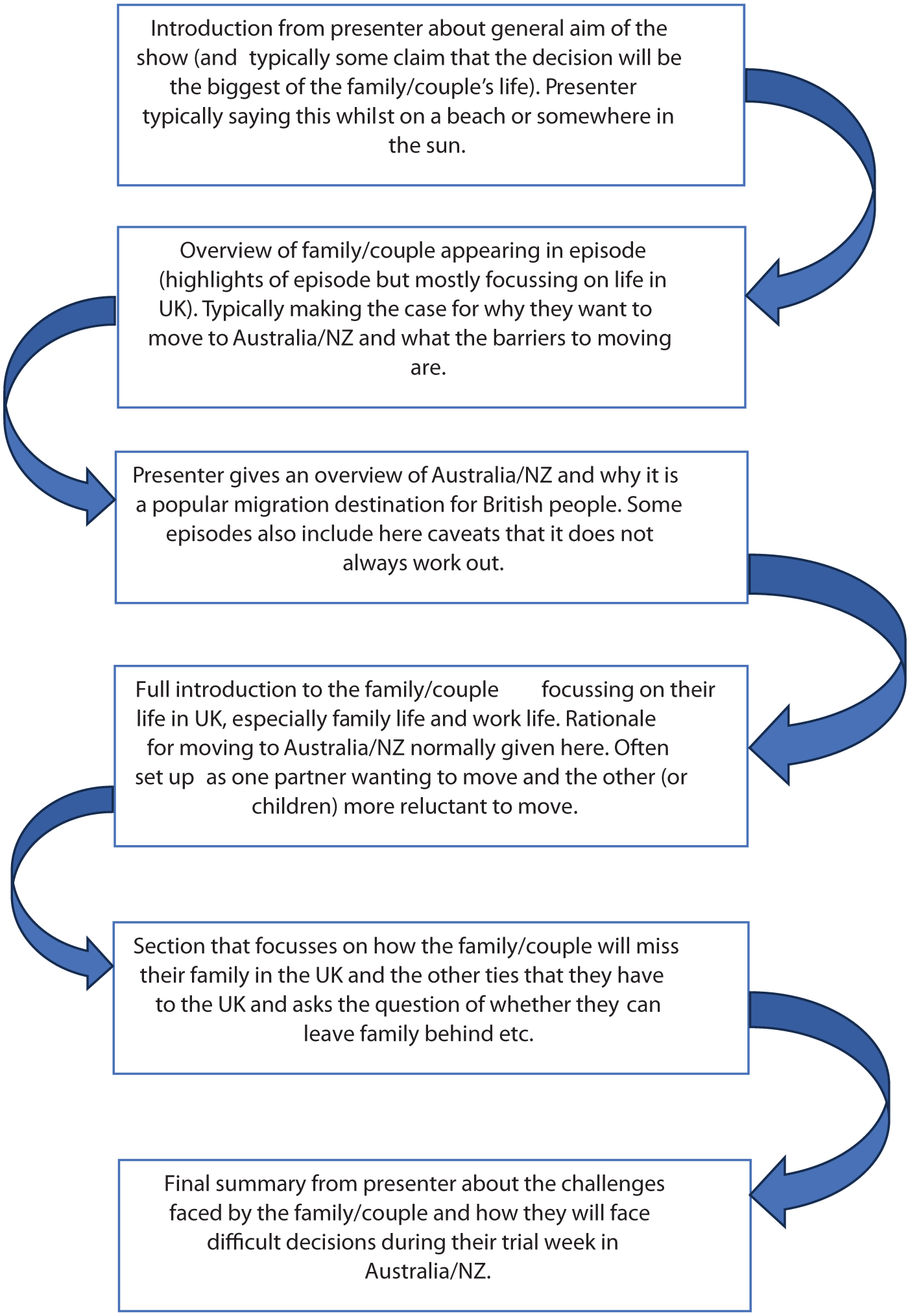
Structure of introductory section of episodes.
As such, our analysis of the transcripts involved identifying both the broad interpretative repertoires used in the programme and also the more specific discursive devices (Wiggins, 2016) which were used in the programmes when drawing on these repertoires and the functions that these had in presenting this type of migration as straight forward and unproblematic. Finally, we also sought to identify any “ideological dilemmas” (Billig et al., 1988) in the data. Goodman (2017: 149) suggests that “ideological dilemmas occur when people attempt to negotiate competing ideologies, often in the form of competing interpretative repertoires” and given the narrative structure we identified and our research questions we felt it important to identify these too.
Findings
Our analysis of the data identified three interpretative repertoires which we present below: Few restrictions make migration possible and easy; Migration as a better lifestyle; and the urgency of realising long-held dreams. In addition, we also present our analysis of two ideological dilemmas that were identified in the data: Separation from family ties as a reason to not migrate; and Lifestyle at home a reason to not migrate.
“Others are doing it, so can we”: Few restrictions make migration possible and easy
The first interpretative repertoire that we identified in the data focusses on the ways in which the language used in the TV show Wanted Down Under, by both the individuals appearing on the programme and the presenter in their pieces to camera and voiceover commentary, positioned migration to Australia or New Zealand as something that is easy to do with few restrictions.
Extract 1.1, below, is an example from the voiceover given by the presenter and comes from a section of the introduction that is a feature of all the shows (see point 3 in Figure 1 above) where they describe the features of the country that the individuals or family are considering migrating to.
Ever since the first British settlers arrived in Botany Bay in the late 1700s, Australia has been deemed a land of opportunity. Today, the promise of greater work opportunities, a chilled out lifestyle and gorgeous weather continues to attract, and British people currently account for the largest portion of the country’s 6 million residents originally born overseas. (Episode broadcast 1st July 2017
1
).
What is initially interesting to note about this example is the way in which colonialism is explicitly referenced as part of the rationale for why someone (in this case from the same group as the “British settlers”) would want to migrate to Australia. Indeed, this reference to “British settlers” is used to directly justify why Australia can be seen as a “land of opportunity”. However, this is a sanitised framing of colonisation, a form of “historical amnesia” (Połońska-Kimunguyi, 2022), in which violence and the exploitation of indigenous people and land is muted. Higgins (2018) suggests that this disavowal of indigenous people is a common aspect of the “imaginative geographies” of lifestyle migrants in settler societies like Australia and New Zealand. Additionally, in this construction of migration, the image of British “exploration” and “adventure” is foregrounded, which echoes the British imperialist trope of settlers as “buccaneers, explorers, and entrepreneurs”, a framing never given to those migrants coming into the UK (Połońska-Kimunguyi, 2022: 9). The image of Australia that is constructed here and the focus on such colonial links and longstanding movement between the two countries, positions migration to Australia as something that is taken-for-granted for those who have colonial links to Australia. This invokes a sense of unquestioned entitlement to movement between the UK and Australia due to historic precedent. The use of quantification rhetoric (Potter et al., 1991), “6 million” and the way that British people are described as making up the largest proportion of the population born overseas, further implies a sense of “everyone else is doing it, so can we”, suggesting that there is a lack of barriers to migrating in this context. However, as discussed in Section “Migration to and from Australia and the UK” above, the historical precedent of this ease of movement within the British Commonwealth was predominantly restricted to white populations (Walsh and Ferazzoli, 2023). In Extract 1.2, below, we see a similar section of the introduction to the programme, where again we see a number of discursive devices (Wiggins, 2016) used that construct migration in this context as easy and undisputed.
Australia’s the number one choice when Brits fantasise about a life on foreign shores. The 140-year-old country’s average of 300 days of sunshine a year - and the laid-back lifestyle that affords -are a huge draw for UK residents seeking a new beginning. But it isn’t always the promised land, and almost a third of those making the move return home each year with their dreams in shreds (Episode broadcast 10th August 2016).
This extract begins with a statement of Australia being the “number one” most desired country of migration for British people, which again normalises migration to Australia as something that is an assumed privilege for “Brits”. Whilst colonialism is less explicitly referenced in this extract, it is once again alluded to by saying that it is a “140-year-old country”. This is then followed by a form of listing (Selting, 2007) that focus on the weather and lifestyle to draw explicit comparisons between the UK and Australia that make migration from the former to the latter more desirable, and is a common trope of discourses of British migration (Higgins, 2018). However, where this extract differs from Extract 1.1, and the majority of the other episodes we analysed, is that during this segment of the voiceover the presenter ends with a focus on more negative experiences (“return home with their dreams in shreds”). Even so, it once again emphasises the ease of movement of British citizens and still works to position migration in this context as something straightforward, in the spirit of adventure and that if a wrong decision is made that it can easily be corrected by returning to the UK, which further highlights the distinction between voluntary and forced migration.
“I want the kids to see the koalas”: Justifying migration as a better lifestyle
A second way in which those on the show, constructed their reasons for wanting to migrate to Australia or New Zealand was on the basis of it providing a better lifestyle for themselves and their families, supporting Benson and O’Reilly’s (2009) concept of “lifestyle migration”. Whilst research on other types of migration, and forced migration in particular, has highlighted how refugees and asylum seekers may be constructed negatively and frequently demonised when seeking a better life for themselves (e.g. Goodman and Narang, 2019; Lynn and Lea, 2003; Parker, 2015), throughout the programme the suggestions of having a better lifestyle by migrating were constructed in a way that implied this type of migration is justified and worthy.
In Extract 2.1, below, the participants of the episode are discussing their reasons for wanting to move to New Zealand.
It was through watching your programme that we decided this country offers us nothing and if we could move maybe we should think about moving now. The way of life is not the same. They’re a lot more relaxed about things. We hope we can have a better lifestyle out there. Maybe we should just start looking at the process and having to go out to New Zealand. (Episode broadcast 4th November 2011)
In this extract, the use of “this country offers us nothing” is an extreme case formulation (Pomerantz, 1986) that legitimises the view that participants in this programme are unquestioningly entitled to use migration in search of opportunity. The UK as a country that offers “nothing” is then discussed in a contrastive structure with New Zealand which is described as “not the same” and “more relaxed” implying that life would be better there. However, this is hedged (Wiggins, 2016) in the following sentence as a “hope” to have “a better lifestyle”. At the end of the utterance, we again see the use of the previous interpretative repertoire we discussed where the use of the softening word “just” again implies an uncomplicated and easy route to migration for these participants.
An idealised and romanticised version of what life would be like by migrating is also seen in Extract 2.2 below.
They love nature. They love being outside. And the hope is Australia will provide more of that. They read books about the kangaroos, the koalas, the snakes and the spiders. Just very excited about the nature side, and the dolphins. Sophie’s always said she wants to. . . Be a dolphin trainer. work with dolphins. Yes (Episode broadcast 9th January 2022)
This extract is indicative of many of the episodes we analysed, where migrating to Australia or New Zealand was constructed as offering the participants, and particularly their children, a better lifestyle. In this example, this imagined better lifestyle for their children is related to their love of “nature” and through the listing of different animals native to Australia and the use of emotional discourse (Edwards, 1999) it constructs a more compelling account that means that only through migrating can these dreams be realised. Osbaldiston et al (2020, p. 9) suggest that British lifestyle migrants’ romanticisation of Australia is framed through a “colonial imagination” in which Australia – in comparison to the UK – “remains a new country, fresh, full of outdoors activities, bathed in sunshine, a happy-go-lucky social scene, and a relaxed atmosphere”. However, these idealised imaginings of Australia as a place of escape ignore the history of indigenous Australians and are once again an embodiment of ongoing legacies of colonialism (Higgins, 2018; Osbaldiston et al., 2020). As Higgins’ (2018) asserts, these romanticised tropes of a simpler life must be problematised and considered within the context of colonial history.
Furthermore, dominant discourses about migration into the UK whether that be forced or legal migration, typically construct migrants’ desire for a better life or search for opportunities as unavoidably coming at a cost to UK citizens. Britain is consistently represented as “footing the bill” for migration (Połońska-Kimunguyi, 2022: 8). In other words, the opportunities in the UK are positioned as finite and there is careful discursive policing around who is deserving of accessing the country’s limited resources (e.g. see Sales, 2002). In contrast, Australia and New Zealand are constructed here as lands of limitless opportunity. Absent from this discourse is the cost of British emigration to Australia which is a stark contrast to other dominant discourses of immigration (Połońska-Kimunguyi, 2022). This is a common feature of the construction of British lifestyle migrants, who are – as Połońska-Kimunguyi (2022: 9) suggests, never “discursively linked to any of these migration-associated anxieties”. The focus of this framing of migration is only on the possible benefit to these families for its own sake, a framing which is rarely afforded to migrants coming into the UK.
“It’s now or never”: Urgency in realising long-term dreams
The third interpretative repertoire that we identified within the data focuses on the ways in which migration was framed as an imperative in the programme and that there was a sense of urgency for the participants in the programme to migrate. Often this was due to the ways in which this was also positioned as a dream that one or more of the family members had held from a young age. Migration here is positioned as a means of achieving a long-imagined ideal rather than a last resort for survival and the fulfilment of basic needs. Whilst this was frequently observed in the talk of the show’s participants, it was also evident in the voiceover from the presenter, as in Extract 3.1 below.
If your marriage was at breaking point because of your partner’s job, how far would you go to save it? One woman feels her only option is to uproot her family and start a new life nearly 9,000 miles away. But will life in Australia really be any different? With dad Mark hardly home, the Smiths’ relationship is in serious trouble. (Episode broadcast 4th November 2020).
A series of extreme case formulations (Pomerantz, 1986), for example, “breaking point”, “only option” and “serious trouble”, and rhetorical questions (Billig, 1987), for example, “how far would you go to save it?” and “will life in Australia really be any different?” are apparent in this extract. The use of these discursive devices together works to build the urgency of the decision facing the participants in this programme and which inevitably therefore position moving to Australia as the only solution. The type of rhetorical and discursive devices used in this extract are also reminiscent of how forced migrants frequently describe their own need to flee their home country (e.g. Liebling et al., 2014) but for which they are also criticised as “lifestyle migrants” by politicians and the media in the UK (e.g. Lynn and Lea, 2003, Parker, 2015).
In Extract 3.2 below, the participant in the episode (Carole) begins by making a series of identity claims that position themselves and their family as “traditionally Welsh” and “typical Valley people” thus constructing a strong sense of national belonging and attachment to where they live in Wales. The use of “so” and “just” add further emphasis to these identity constructions. What is particularly interesting here is that the audio then cuts to the presenter who constructs an alternative version which implies that the sense of national belonging they have is insufficient to keep them in Wales.
Carole: We are typical Valley people. OK? We are so traditionally Welsh and we just love Wales. Presenter: They want more than life in Aberdare can offer. Carole: It’s work, work, work. In the evenings, we don’t do nothing. Through the winter, there’s nothing much to do. Nah. It would be just nice to go for a walk and chill out after work. That’s right. And do other things, basically. Presenter: Time is running out to realise their dream. Carole: We’ve gotta go soon because of our ages. So it’s now or never, basically. If we don’t do it now, then we’re never going to. (Episode broadcast 29th June 2016)
It needs to be remembered that this is in someways a function of how the programme has been edited together, but in the second turn from the presenter here the choice of moving to Australia is then constructed as time-limited and as a “dream”. In the final turn, Carole uses a series of imperatives and extreme case formulations to construct the urgency of their decision to migrate to Australia. This is a key contrastive structure to the sense of belonging constructed earlier in the extract and serves to emphasise the urgency of the decision to migrate. Time and temporality are central aspects of discourses of migration (Walsh and Ferazzoli, 2023). Forced migrants such as refugees and asylum seekers often have to leave their homes quickly and with a sense of urgency (Erdal and Oeppen, 2018), similar to the sense of urgency constructed here in the context of lifestyle migration. As such the constructions of voluntary migration we have demonstrated here serve to blur the line between forced and voluntary migration. However, for Carole in this extract, the realisation of their dream would be the arrival in Australia. For many forced migrants, the sense of wasted time and lost dreams persists once they have arrived at their destination. Walsh and Ferazzoli (2023: 22) outline, for example, how “the waiting inherent in UK asylum claim practices” are an intentional means of controlling migrants’ time, limiting their agency and instilling a sense of inferiority. This hierarchisation of dreams which becomes evident when comparing discourses of lifestyle and precarious migration, arguably originates within colonial discourses of the inferiority of the colonial subject (Walsh and Ferazzoli, 2023).
“I can’t leave them”: Separation from family ties as a reason to not migrate
In addition to the three interpretative repertoires we have just discussed, we also identified two ideological dilemmas (Billig et al., 1988) within the data corpus we analysed. As noted previously, ideological dilemmas can be thought of as the conflict that arises from holding contradictory beliefs, often in the form of competing interpretative repertoires, that demonstrate where people are attempting to negotiate multiple ideologies (Goodman, 2017). The first of such dilemmatic thinking was a feature in all of the episodes we analysed, usually coming towards the end of the introduction, where family ties would be positioned as a reason not to migrate, thus creating this ideological dilemma between starting a new life in Australia or New Zealand and staying in the UK where family or friendship ties were strong.
Presenter: But when the reality of leaving loved ones brings her back to earth, Jane’s faced with an unbearable choice. Anne: I’m going to break my mum’s heart if I come here. If I don’t come here. . . . . .I’m potentially stopping him living his dream. (Episode broadcast 11th January 2017)
In Extract 4.1, above, this dilemma is initially constructed in the voiceover from the show’s presenter, where it is described as a “choice”, drawing on the repertoire we discussed earlier about the ease of being able to migrate. However, the use of emotive language (“unbearable”) (Edwards, 1999) to describe this “choice”, works to create the dilemma between the ease of migrating and the reality of being separated from family members. This acts to obfuscate and complicate the agency and ease implicit in the choice to migrate. In the participant’s turn we also see similarly emotive, and also metaphorical, language used (“break my mum’s heart”). She ends her turn by implying that this dilemma is one that risks her partner not “living his dream”, highlighting that in this case migration is not an individual decision. It also draws into question whether the use of the term “lifestyle migration” (Benson and O’Reilly, 2009) is always appropriate in such contexts, if the separation from family members is constructed as being detrimental to the perceived lifestyle available when migrating. Indeed, this echoes Leonard and Walsh’s (2019) and Osbaldiston et al.’s (2020) assertions that the privilege inherent within British lifestyle migration can be theorised and considered alongside vulnerabilities, uncertainties and precarities that may accompany migration.
In Extract 4.1 it was the main participant’s partner (who would be moving to Australia too) that expresses this ideological dilemma most clearly. However, in the majority of the episodes we analysed, this dilemma was more clearly focussed on the episode’s main participant leaving behind family members in the UK, as seen in Extract 4.2, below.
I’ll be leaving my family behind, and our friends, which are a big part of our lives. It’s nice to have that support around you. My sister, she likes us close and I think she’s the one that’s more upset than anybody else, I think. (Episode broadcast 15th January 2020).
This extract supports our previous point that this ideological dilemma brings into question whether “lifestyle migration” is an appropriate term in this context as the participant here constructs an account of her lifestyle being very much about her extended family and the “support” that they provide. Interestingly, this participant also constructs her account by drawing on her perception that that her sister “likes us close”, adding further weight to this dilemma between migrating or staying in the UK to be close to family.
“We have a good life here”: Lifestyle in the UK as a reason to not migrate
The final ideological dilemma we discuss is perhaps also a specific feature of the way in which elements of drama are incorporated into this particular lifestyle television programme. In this case we see that there is often a concession that the participants already have a good life in the UK which is making them consider whether migrating is necessary, and this was found to be distinct from the previous dilemma as it focussed specifically on lifestyle rather than family connections. Often this was most strongly advocated by a partner or family members of the main participant featured in the programme, but in some cases also by the participants themselves too.
For me, it’s just not really an option at the moment. It’s taken a lot of hard work to get to where I am and now for Natasha to want me to get rid of all that and start again, is it a gamble? Yeah, it’s a massive gamble. (Episode broadcast 29th September 2019)
In this extract the partner of the main participant in the episode constructs an account of having a good life in the UK and that to migrate to Australia would be to “start again” and “a massive gamble”. However, at the same time this also implies that migrating is easy and unproblematic and that they could easily return to the UK if the “gamble” did not pay off. In Extract 5.2 below, we see a similar construction of migrating being a “risk” and an ideological dilemma created between the life they have in the UK and the need to move quickly if they do want to migrate.
Sarah: I’ve got a nice community at church, got a nice community at the school with all the school mums. I do quite a lot of volunteering as well, so I’ve got a nice life, really, and recently I’ve just been considering that and am I willing to risk that. . . . . .you know, to go to the other side of the world? Presenter: But if they’re going to make the move then the time is now. Sarah: To get a visa, I’ve only got a few more years left before I’m too old for the skilled visa and we’d either have to look at other visa other options or the dream would be over. Life’s too short. I don’t want to be in my 70s and look back and think, “I should have done that. The boys would have loved it”. (Episode broadcast 16th August 2019)
The “risk” of migrating is emphasised through the use of listing that positions their life in the UK as comfortable and happy. At the end of this first turn Sarah uses a rhetorical question that makes clear this ideological dilemma, and which is reinforced in her second turn by drawing on the interpretative repertoire of urgency that we described earlier.
Discussion
Our analysis here makes two important contributions; firstly, we have shown how daytime lifestyle TV programmes about migration in the UK are discursively and rhetorically organised to frame migration as something that is unproblematic and taken-for-granted for UK citizens wanting to move to another country with which the UK has colonial ties. This reference to an interconnected colonial history works to emphasise the historic ties between the two countries while simultaneously minimising the violence and exploitation inherent within this colonial connection (Higgins, 2018). This incomplete and muted framing of colonialism – is a form of “historical amnesia” – which justifies the global ease of movement for British migrants while never discursively connecting these migrants to the fears and anxieties that dominate discussions of migrants from the Global South (Połońska-Kimunguyi, 2022). Privilege is embedded within these interpretive repertoires, evident in “a sense of entitlement to mobility and settlement which transcends national boundaries” (Leonard and Walsh, 2019). This sense of ease is not extended in the other direction – that is, migrants from former UK colonies wanting to move to the UK.
Secondly, we have also shown that vulnerabilities are evident alongside privilege (Kunz, 2016; Leonard and Walsh, 2019; Osbaldiston et al., 2020). Interestingly, the vulnerabilities within these repertoires are broadly similar to the ways in which “forced” migrants may describe their own need to migrate to countries such as the UK or other global north countries (e.g. Goodman et al., 2014). However, agency, opportunity and choice is central to the discursive devices and ideological dilemmas in these TV programmes. Whereas migration for refugees and asylum seekers is problematised, here it is constructed as something that is easy and unproblematic, which we suggest draws on notions of colonialism and the UK’s position within the Commonwealth. When these discourses are considered alongside dominant political and media discourse around immigration to Europe, we see the “coloniality of migration” and the hierarchical ordering of types of migration, through which people are placed in “zones of recognition or rejection of the human right to liveability” (Gutiérrez Rodríguez, 2018: 24).
Our approach to exploring migration in a UK lifestyle television programme also offers an original contribution to the study of this form of mediated discourse. Whilst we are aware of other studies that have analysed lifestyle television programmes (e.g. Lorenzo-Dus, 2009; Moseley, 2000; Ringrose and Walkerdine, 2008), we have not come across other studies that have looked at this in the context of migration in general, and privileged migration in particular. Whilst there has been much research looking at the construction of migrants (particularly refugees and asylum seekers) in other forms of mediated discourse (e.g. Goodman and Kirkwood, 2019; Goodman et al., 2017, Parker et al., 2018) we would argue that these types of programmes offer important sources for understanding how discourses relating to specific forms of migration are constructed and transmitted and how they rely on particular understandings of colonial relations.
Limitations
One potential limitation of the research presented here is that our analysis concentrated only on the introductory segment of each programme. Whilst we made this decision in order to make the overall sample manageable in terms of the detailed type of analysis we employed, and our initial viewings of the programme suggested that this was where much of the discursive work about migration was done, further discursive analysis of full episodes could offer additional insights. It is also important to remember that the programmes we analysed here were a lifestyle programme and will have been structured in a particular way to engage viewers (see Lorenzo-Dus, 2009) and therefore emigration may be constructed in specific ways in this programme in order to construct particular desirable identities for viewers of the programme. The programme that we chose to analyse also focusses on migration to Australia or New Zealand, countries that the UK has colonial ties with and are part of the Commonwealth group of nations. As such, future research could extend this analysis to other lifestyle programmes about emigration, such as “A Place in the Sun”, another UK daytime TV show that predominantly focuses on British citizens emigrating to Europe, to ascertain whether these discourses are also present in different migration contexts. Identifying whether similar programmes are broadcast internationally and analysing these, may also offer important insights into how privileged forms of migration are constructed in mediated discourse.
Conclusions
In this paper we have shown how privileged forms of migration are constructed in mediated discourse on the UK lifestyle programme Wanted Down Under. These constructions are developed building on colonial sensibilities that position migration to Australia or New Zealand as something that is unproblematic and taken-for-granted as a right for British citizens. In addition the rhetorical construction of these discourses also was found to be something that needed to happen as an imperative, perhaps echoing the ways in which forced migrants might also talk about their need to migrate. Whilst we have described the constructions of migration here as unproblematic, we have also shown how ideological dilemmas were apparent within the programme, particularly where it was recognised by participants in the show that they already had a good life in the UK and would find it difficult to leave behind family and friends if they chose to emigrate. Such ideological dilemmas further reinforce the idea that those participants in the show who are considering migrating are privileged with their citizenship (Kunz, 2016) and tend to support Benson and O’Reilly’s (2009) framing of this type of migration as “lifestyle migration”.
Footnotes

Ethical considerations
Ethical approval for this study was granted by Birmingham City University’s Faculty Research Ethics Committee.
Funding
The authors received no financial support for the research, authorship, and/or publication of this article.
Declaration of conflicting interests
The authors declared no potential conflicts of interest with respect to the research, authorship, and/or publication of this article.