




Abstract
This study explores resistance used by Ukrainian companies on Kickstarter during the Russo-Ukrainian war, examining how it intertwines with commercial promotion. The analysis focuses on 22 English-language campaign calls. Methodologically, the study combines concepts from discourse analytical and rhetorical traditions. Eight discursive strategies are identified in the analysis. These strategies are connected to three kinds of rhetorical acts: evoking identification/disidentification, manifesting national pride and independence, and establishing belonging to the West. The study argues that Ukrainian companies’ use of resistance as part of commercial promotion has a double purpose: it is a way of making themselves and their products seem topical and societally meaningful to their Western customers while also serving as a form of Ukrainian self-expression, aimed at globally shaping war-related meanings.
Introduction
Crowdfunding is a type of fundraising on digital platforms addressed to individual supporters (backers), who are typically provided with product-based rewards or shares (e.g., Palmieri et al., 2022; Tirdatov, 2014). Crowdfunding campaigns often mix several types of generic content, for instance, philanthropic discourse and advertising (Liu and Deng, 2016: 189, 197), and involve societal or environmental rhetoric in addition to typical financial discourse (Kedves, 2016; Koçer, 2015; Von Selasinsky and Lutz, 2021). After the Russian invasion of Ukraine on 24 February 2022, some Ukrainian companies started to use crowdfunding discourse not only for commercial reasons but also to defense Ukrainian uniqueness through resistance. Resistance can be seen as discursive action opposing the possibility of losing rights, including the right to exist, in the context of power (e.g., Chiluwa, 2012; Eamonn, 2004; Pezzullo and Striphas, 2018). Given the societal role of business-oriented crowdfunding (see Koçer, 2015; Liu and Deng, 2016; Von Selasinsky and Lutz, 2021), this study focuses on the intertwined nature of resistance and commercial promotion by analyzing war-related resistance in Ukrainian companies’ crowdfunding. The aim is to examine what the role of resistance is in Ukrainian companies’ crowdfunding discourse. The study is guided by two research questions: (1) How is resistance used by the companies in relation to their business rhetoric? and (2) What kinds of rhetorical acts and functions are involved in their uses of resistance?
Ukrainians’ wartime resistance is a growing research topic among media and communication scholars. Lokot (2023) performs an ethnographic analysis, examining affective media practices on Twitter and Instagram, and argues that experience-based narratives of grassroots are significant forms of resistance since they are voices of those directly impacted by violence and destruction. In addition, Fomenko (2023) focuses on cultural icons as expressions of Ukrainian national identity in wartime. According to Fomenko, cultural icons are constituents of national identity and can take the form of characters, physical objects, places, ideas, or even slogans that symbolize a culture and are identified and used by the members of the culture as meaningful markers of their identity (pp. 223–224, 225). It is also noteworthy that context affects the ways resistance is used. For instance, president Zelensky has been represented as a hero figure in global and often commercial contexts, but for grassroots Ukrainians, the real heroes symbolizing bravery and resistance are often the Armed Forces of Ukraine (p. 226). In global contexts, Ukrainians may also face pressure to please Western audiences through war-related campaigning. Kaneva (2023) criticizes such resistance, arguing that the nation-branding campaign by the state of Ukraine in the early phases of the war over-emphasized bravery instead of symbols that stem from the Ukrainians’ own culture.
The core feature of resistance is the use of the ideological square (Van Dijk, 2000, 2011: 396–399), in which those viewed as vulnerable (the in-group) are evaluated positively and those using power (the out-group) negatively (see Aminu, 2024). The ideological square is also a relevant conceptualization of resistance in cases in which resistance is performatively expressed to elicit the audience’s sympathy (Aminu, 2024). This is the case with Ukrainian crowdfunding, as resistance is not directly addressed to Russia but performed for Western customers as part of fundraising and advertising. Although resistance has been previously analyzed, also in Ukrainians’ discourse, research on its interdiscursive nature in crowdfunding contexts is still lacking. This study aims to fill this gap by combining discourse-analytical and rhetorical approaches. The article is structured as follows: First, the concept of ‘interdiscursivity’ is discussed more deeply, particularly in the context of commercial promotion. This is followed by a description of the material and methodology used in this study, which draws on discourse-analytical and rhetorical research traditions. The findings of the research are then presented, with concrete examples based on the analysis. All discursive strategies found in the data are introduced and discussed in relation to interdiscursivity. The study concludes with a summary and suggestions for future analyses of resistance.
Interdiscursivity and its techniques
According to Bhatia (1998, 2010), interdiscursivity can be defined as the use of generic resources across discursive and professional genres, practices, and cultures, often resulting in genre hybrids. This means that discursive resources typical of advertising, for instance, can be used in philanthropic fundraising (see Bhatia, 1998, 2010). In addition to the link between advertising and philanthropic fundraising, discourse-analytical studies have discussed interdiscursivity in many other forms, such as in promotional news reports (Erjavec, 2004) and marketization of public discourse regarding universities (Fairclough, 1993; Han, 2014). Further, Kaneva’s (2023) study on ‘nation branding’ focuses on the adoption of marketing practices in Ukraine’s public communication, although the study does not explicitly discuss interdiscursivity as a theoretical concept.
In business-oriented crowdfunding, societal stance-taking is interdiscursively utilized with commercial promotion. On the one hand, societal stance-taking adds extra value to marketing, and it is a way of making companies and their products seem generally beneficial (Liu and Deng, 2016; Von Selasinsky and Lutz, 2021). On the other hand, marketing societal causes through fundraising gives them wider visibility (Koçer, 2015). Koçer’s (2015) study, focusing on Turkish film producers as Indiegogo activists, underlines that in some cases, the visibility of societal and political aspects of a campaign may be even more important to fundraisers than obtaining finances.
Previous research, in both rhetorical and linguistic traditions, identifies specific techniques through which interdiscursivity occurs in commercial and grassroots contexts. Mäntynen and Shore (2014) categorize hybridizing techniques as interdiscursive relations, particularly in the commercial promotion context, which makes their study relevant for the present one. Although their study focuses on the construction of hybrid genre, their classification of four distinct techniques related to processes of hybridization is useful when operationalizing the analysis of interdiscursivity in the present study. Based on previous research on interdiscursivity (e.g. Fairclough, 1992; Hasan, 1989), Mäntynen and Shore (2014) suggest four types of interdiscursive techniques: sequential intertextuality, genre embedding, genre appropriation, and genre blending. However, since neither resistance nor commercial promotion is a genre but better understood as a discourse with specific rhetorical functions, the names of interdiscursive techniques including the term ‘genre’ have been slightly modified for the purposes of the present study in what follows.
First, sequential intertextuality is an interdiscursive technique that involves snippets of texts stemming from several contexts, such as advice-giving and advertising discourses in typical cosmetics advertisements (see Fairclough, 1992: 118; Mäntynen and Shore, 2014: 744–745). Second, discourse embedding is a technique in which a bigger part of a text is clearly distinguishable as coming from another context, for instance, a recipe that is embedded in an advertisement (cf. Mäntynen and Shore, 2014: 745–746). Discourse embedding is also discussed by Fairclough (1992: 118) under the term ‘embedded intertextuality’ in which one text or discourse type contains another. Moreover, in discourse appropriation, a text adopts the schematic structure of another text in creative ways through recontextualization (cf., Mäntynen and Shore, 2014: 746–748). For example, a music review and recipe may be playfully intertwined with each other. Elsewhere, Hasan (1989: 98, 115–116) has used the term ‘pretend genre’ to discuss such a technique in which one text utilizes the form of another one as a stylistic choice (see also ‘genre play’ in Edwards, 2016: 50). The fourth type, discourse blending, occurs when resources stemming from various contexts are deployed in such a way that there are no longer clear boundaries between discourses (cf., Mäntynen and Shore, 2014: 748–751). For instance, advertising discourse may be blended with discursive features that are not primarily concerned with selling goods (see also Fairclough, 1993). In a similar vein, Edwards (2016: 47) states that assemblage is a technique based on gathering, repurposing, and deploying a combination of existing texts and making a new whole.
In sum, discourse appropriation and blending blur textual and contextual boundaries more strongly than the other two techniques. While discourse appropriation is a playful and even humorous technique in which Discourse A takes an atypical discursive form originating from Context B, discourse blending is a technique of interdiscursivity that effectively merges rhetorical functions, also enabling transformation from resistance to commercial promotion and from commercial promotion to resistance. Sequential intertextuality and discourse embedding do not blur textual and contextual borders as much as the other types, since they both involve clear points for the starting and ending of discursive variation. In sequential intertextuality, snippets of discourses originating from different contexts take turns, while discourse embedding utilizes a bigger part of Discourse A as embedded in Discourse B.
Research material
The core of crowdfunding is a campaign call that can be defined as a pitch, addressed to a crowd on digital platforms, through which campaign rhetors aim to receive funds (Palmieri et al., 2022: 334). This study focuses on such campaign calls. In the first phase of data gathering, 27 successful (the minimum aim achieved) business-oriented campaign calls by Ukrainian fundraisers were collected from Kickstarter. Only successful campaigns were chosen because they have the largest visibility. Kickstarter was considered a relevant platform for a study on resistance, considering previous studies on societally motivated campaigns on the site (e.g., Kedves, 2016; Von Selasinsky and Lutz, 2021). Moreover, Kickstarter is one of the most popular crowdfunding platforms using English as a lingua franca. According to its website, Kickstarter encourages creative projects that are created on the grassroots level, and it also markets itself as a forum for fundraising that is free of bureaucratic funding decisions. Like many other crowdfunding platforms, it is based on low production value and active grassroots creativity. A U.S.-based platform, Kickstarter was launched in 2009, and 15 years later, over 250,000 projects have been funded (Kickstarter, 2024). Campaign calls consist of written texts (in English), still images or graphics, often gifs, and typically also videos (with visual content, spoken text, music, and other sounds). All campaigns are addressed to a global (mainly Western) audience, and if they include Ukrainian, it is generally translated into English by fundraisers.
The material for this study was collected by using Ukrain* as the lemma (a word for search engines) in Kickstarter’s business category (Ukraine was mentioned as the location in each of these campaigns). All the campaigns represent reward-based crowdfunding, which means that backers are not traditional investors or donors but are provided with product rewards if campaigns manage to achieve their minimum funding. Thus, the campaigns also function as advertisements of pre-order products. 27 campaigns were selected in chronological order (starting from the newest one) using saturation as a selection principle: When the crowdfunding rhetoric started to repeat, the inclusion of new campaigns in the data was stopped. Data from 27 campaigns were seen as adequate for the purposes of the study. The material of the campaign calls was collected in autumn 2022, and only campaigns in which the fundraising is (or was) ongoing during wartime were considered. Spoken texts in the videos were transcribed by a professional subtitle and transcription service. All textual data were saved in ATLAS.ti (a cloud-based program for qualitative analysis) for further analyses, and all videos and pictures were separately saved in databases. The collected data did not include campaign updates (specific sections for greetings and further comments by companies), as such updates were typically focused on reporting on product manufacturing and shipping or the marketing of forthcoming projects.
In the second phase, campaign calls that did not involve any forms of resistance were excluded from close reading. In total, five campaigns were excluded, and 22 were selected for close reading (Table 1). Most of the companies in the study specialized in the game or fashion and design industries, but there were also a few companies specializing in new-age and other products. In addition, eight campaigns and their rewards (products) were strategically designed around the war theme in general, while in other campaigns, the rewards did not involve specific war-related meanings. Moreover, there were two campaigns in which it was possible to make a concrete donation to Ukrainians, but otherwise the idea of helping Ukrainians remained on the level of affective support through the act of purchasing pre-order products and thereby showing sympathy to Ukrainians.
Campaign calls analyzed in the study.

Methodology: Combining discourse-analytical and rhetorical approaches
The study methodology draws on both discourse-analytical and rhetorical traditions. Therefore, this study has an eclectic focus, as it combines concepts from distinct research backgrounds. However, such a combination is not unprecedented. For example, Hopper (2007) discusses not only differences but also fruitful ways of connecting linguistics-based discourse analysis with a rhetorical approach. According to Hopper (2007), linguistics offers tools for exploring communication at the micro level, focusing specifically on the forms and features of discourse. Meanwhile, the rhetorical approach is useful for examining the effectiveness of acts of communication in a particular rhetorical situation that connects the rhetor(s) and audience(s) (pp. 240, 247, 249). Moreover, as Fahnestock (2011: 10) argues, there are branches of linguistics that overlap with the functional approach of rhetoric. Such branches, according to her, include pragmatics, discourse analysis, and sociolinguistics, focusing on actual language use through communicative features and offering insights that can add substantially to rhetorical approach. These branches of linguistics go beyond mere micro level research. This study draws on these various considerations and presumes that discourse-analytical focus is needed to identify characteristics of resistance as a concrete discourse (lexical and syntactic forms, visuals, multi-modal forms, and their interdiscursive uses), while rhetorical analysis is needed to discuss the rhetorical acts and functions of these characteristics. The combination of discourse analysis (DA) and rhetorical analysis (RA) as research methods is illustrated by Figure 1, in which RQs refer to research questions 1 and 2.
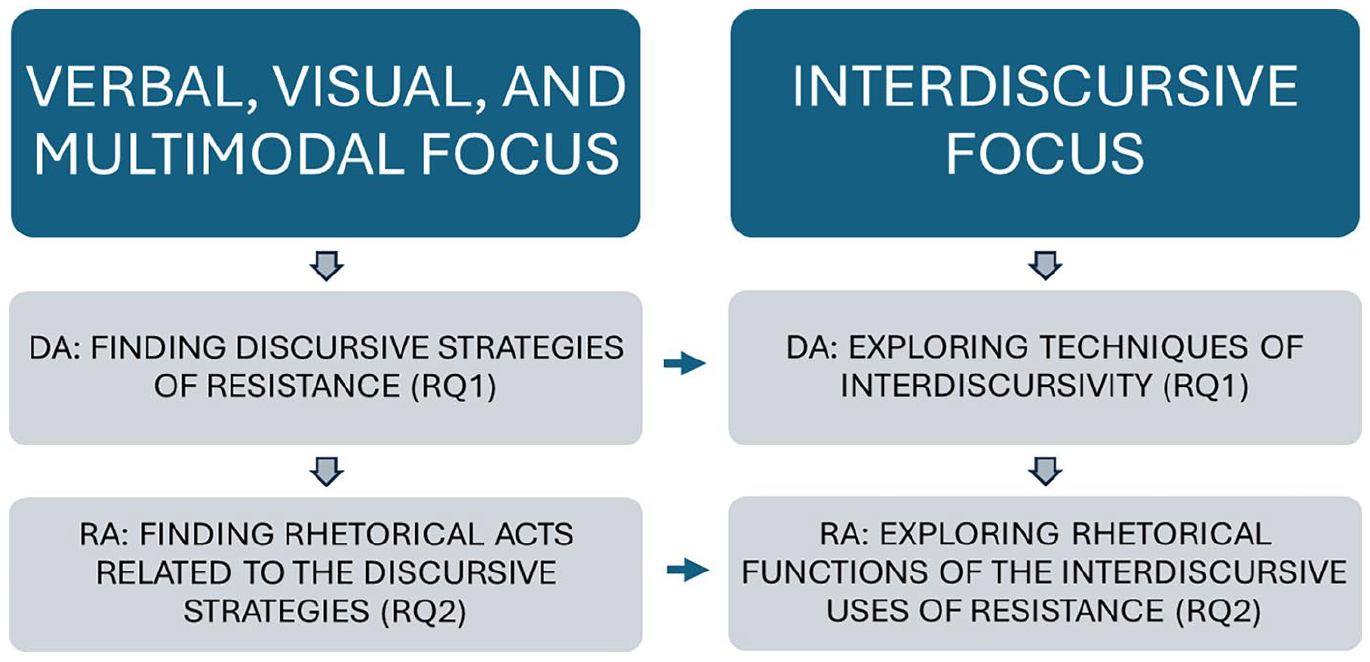
Combining discourse analysis (DA) and rhetorical analysis (RA).
As can be seen in Figure 1, the methodology of this study has a multidisciplinary design, and it is motivated by previous research on discursive uses of resistance (verbal, visual, and multimodal) and the study of interdiscursivity. While discourse analysis helps to find and categorize discursive features of resistance (strategies of resistance and techniques of interdiscursivity in which such strategies are used), it is also important to understand the rhetorical acts involved in the strategies and functions of interdiscursive uses of resistance. The arrows in the figure illustrate the movement of a researcher. First, discursive strategies of resistance are identified as uses of discourse (words, sentences, paragraphs, images, or combinations of verbal and visual texts) that oppose the possibility of Ukraine losing its independence and cultural uniqueness after the Russian invasion. Second, rhetorical acts refer to what is done in the discourse when using such strategies. Techniques of interdiscursivity (see previous section) relate to ways of combining resistance and commercial promotion as discourses, while rhetorical functions refer to the persuasive goals of such interdiscursive resistance that merges societal and commercial meanings. While DA helps to answer research question 1 (How is resistance used by the companies?), RA relates to research question 2 (What kinds of rhetorical acts and functions are involved in their uses of resistance?).
The main theoretical and methodical concepts of this study are resistance and interdiscursivity, but notions of multimodality are also utilized to approach resistance in the context of crowdfunding. In this study, multimodality is considered a tool for identifying discursive strategies of resistance that are not just verbal but sometimes also visual. In general, some resistance strategies, such as negative labels (see Aminu, 2024), are textual, while others, especially some cultural icons (see Fomenko, 2023), are characteristically visual or multimodally intertwined with verbal discourse.
In particular, the study uses the concept of multimodal gutter to explore the meanings of resistance that are multimodally created because such an approach has been associated (albeit not exclusively) with commercial promotion (see Anderson, 2017). Anderson (2017) uses the term multimodal gutter to describe the gap between texts and images as two distinct but juxtaposed elements. Although multimodal gutter is often a physical space between two modal elements, it is, even more importantly, also a conceptual space for the audience’s meaning-making work. The spatial proximity of elements in such rhetoric suggests an association, but the audience is responsible for creating closure (Anderson, 2017).
Moreover, some resistance strategies clearly involve the ‘ideological square’ in which the ‘self’ (or the in-group) is evaluated positively and the ‘other’ (the out-group) negatively (Aminu, 2024; Van Dijk, 2000, 2011). However, this study also considers Ukrainian cultural icons as a form of resistance, such as the flag of Ukraine or the falcon symbol, which are used to reinforce Ukraine’s independence and defend its cultural heritage, but which are not evaluative in the same way as, for instance, the explicit evaluation of Ukrainians as strong, persistent, or peace-loving (see Fomenko, 2023).
Findings: Resistance in Ukrainian crowdfunding
In this study, eight discursive resistance strategies are identified, reflecting three kinds of rhetorical acts: evoking identification/disidentification, manifesting national pride and independence, and establishing belonging to the West (see Figure 2).
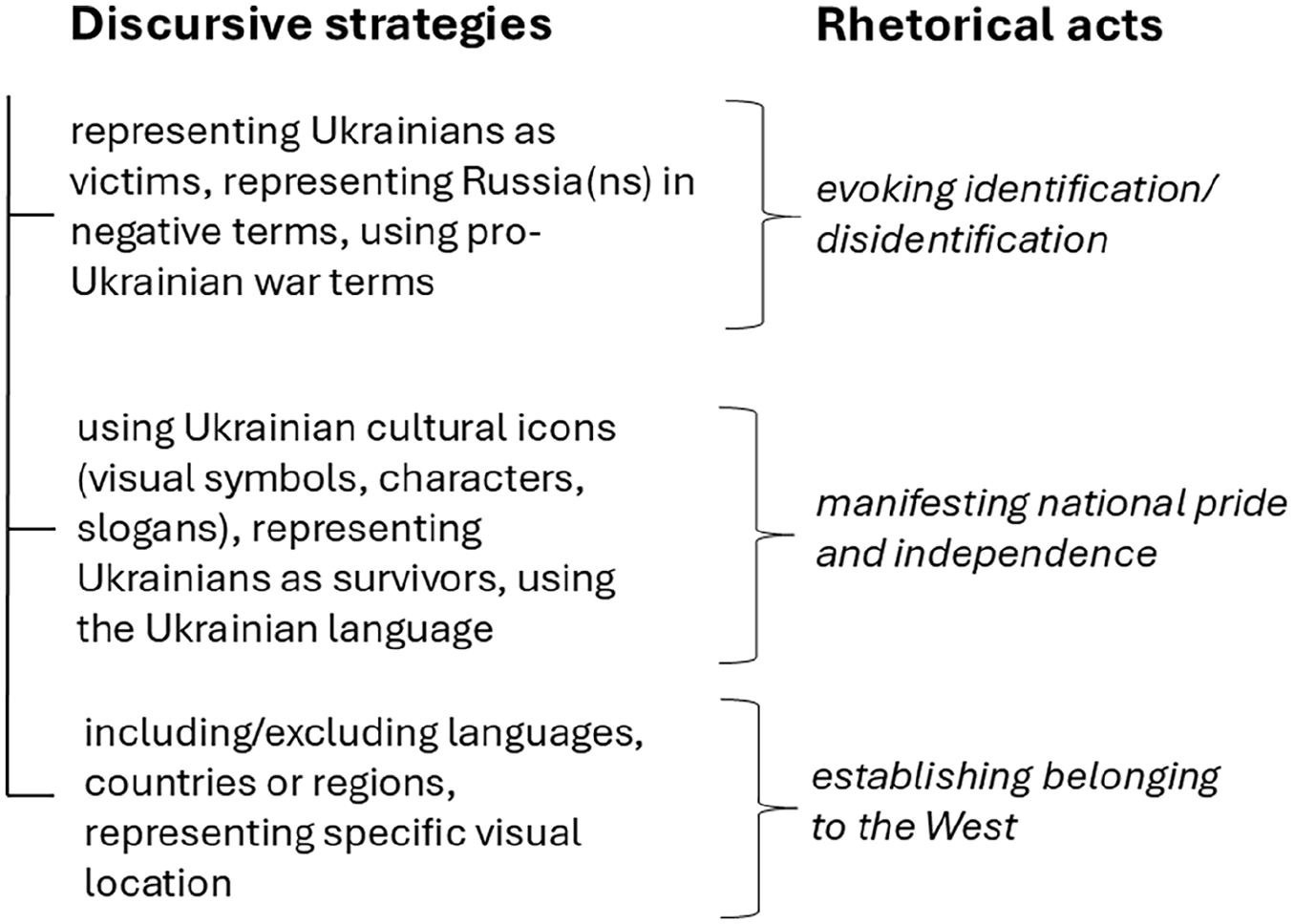
Strategies of resistance and rhetorical acts in campaign calls.
Moreover, some strategies are more prominently used than others. The most frequent ones are using cultural icons (used in 19/22 campaign calls), representing Ukrainians as survivors (18), and representing Ukrainians as victims (15). Additionally, including/excluding languages, countries, or regions (10) is often used. Representing Russia(ns) in negative terms, using pro-Ukrainian war terms, and using the Ukrainian language are each used in six campaign calls. Representing specific visual location as a resistance strategy is utilized in one campaign. In the following, these strategies are discussed more thoroughly with a focus on their interdiscursivity, starting with those utilized to evoke identification/disidentification, followed by strategies of manifesting national pride and independence and establishing belonging to the West. Relevant expressions in the examples have been bolded by the author. Companies’ names are mentioned for copyright reasons only in the case of visuals. In other examples, companies are anonymized for ethical reasons.
Evoking identification/disidentification
This section focuses on discursive strategies whose rhetorical power lies in their aim to elicit identification and disidentification in the audience. Some of these strategies clearly utilize the ideological square in which the in-group is represented in positive and compassion-triggering ways (see Van Dijk, 2011: 396–399). Negative evaluation of the out-group (in this case, Russia or the Russian army) is also present but not as prominently as positive representations of Ukrainians.
Representing Ukrainians as victims
Representing Ukrainians as victims is a typical discursive strategy (in 15/22 campaign calls). Example 1 is a transcribed text from a marketing-oriented video in which a Ukrainian company specialized in mobile gadgets and accessories describes the shock when the war began and the difficulties in their daily lives after the invasion. Example 2 is from a written text which describes difficulties in the daily lives of Ukrainians during the war. In both examples, resistance in the form of representing Ukrainians as victims is intertwined with a promotional discourse that positions the companies as moral actors that have solutions for problems the war has caused.
(1) The Ukrainian brand [brand’s name omitted] has created a unique project and helping everyone who suffered from the hostilities. Smart gadgets are presented at more than 1000 stores and shopping centers and are also delivered from Kyiv to all regions of Ukraine. Kharkiv, Lviv, Zaporižžja, Odessa, Mariupol, Cherkasy, and others. Just look how peaceful, picturesque, and promising our cities are. Or I should [sic] were. February 24, the war began. At five am, to the sound of sirens, our loud explosions, we all woke up in a terrible shock. Many families were isolated from gas, water, and electricity. And now this is a big problem. We don’t know how our loved ones feel. They do not have the opportunity to charge the phone. How do you know if they have medicine, food, water, are they alive at all?
(2) I am [name of an entrepreneur omitted], a Ukrainian 3d artist and designer, and I live in Kharkiv, Ukraine. My American friend, [name of an entrepreneur omitted], and I decided to put together a project which we did before the start of the war that would help not only my family, friends, and relatives at this difficult time, but also to my volunteer group bring food to the refugees in my home city. Our group of volunteers cook food and feed the people. Their need is great, and your support will meet this need.
Examples 1 and 2 resonate well with Lokot’s (2023) notion of grassroots experiences, which, in times of war, also naturally involve negative reactions, such as shock and distress. Such an emotional discourse has rhetorical power by creating an impression of authenticity in companies’ marketing. In Example 1, a company is introducing a power bank as a solution to the inaccessibility problem in warzones. Meanwhile, Example 2 indicates that crowdfunding will also be used to support the humanitarian work done by the company’s employees, who are now serving as voluntary workers. The way that positive representations of the companies are intertwined in these extracts can be seen as a type of discourse blending (see Mäntynen and Shore, 2014: 748–751), as there are no specific borders where resistance ends and commercial promotion starts. Indeed, the idea of companies as benevolent actors is an essential part of such crowdfunding rhetoric, which also portrays Ukrainians as vulnerable.
Representing Russia(ns) in negative terms
Explicitly negative representation of the Russian army or Russia as a state is not the most frequent strategy in the data (6/22 campaigns). The paucity of negative representations of Russia can be attributed to the unanimous support for Ukraine and the general condemnation of the invasion by Western audiences. At the same time, it is also noteworthy that negative evaluations of the out-group are accompanied by the portrayal of the in-group as victims, as noted by Aminu (2024: 35). Examples 3 and 4 involve the strategy ‘representing Russia(ns) in negative terms’, including the role of Ukrainians as victims.
(3) [The company’s name omitted] is in Ukraine. We are making this game during the Russian invasion. This video is intended to give you a glimpse into our world right now. [. . .] Others had to escape from Kharkiv, Nikolaev and other cities that had been bombarded by the
(4) Here, the documentary offers historical context and an in-depth overview of the
In Example 3, the Russian army is called ‘war criminals’, while in Example 4, Putin’s Russia is described as a country of ‘brutality and growing authoritarianism’. Example 3 is a spoken text from a video that serves as both a war narrative and narrative of the company. In the campaign call, the video involves discourse embedding (see Mäntynen and Shore, 2014: 745–746), including a war narrative and related video material of bombings. The narrated video material from the war zones lasts about 3 minutes, which is about half of the video’s duration. The rest of the video focuses on the company’s project itself and introduces the new video game the company has designed. Thereby, resistance and commercial promotion have their own parts in the video, which differs from the technique called discourse blending. In Example 4, we can see interdiscursivity between resistance and advertising in the form of discourse blending, as the example is part of an introduction concerning the marketing of a Ukrainian film. In this example, there are no clear borders between resistance and the advertisement since the whole idea of the product (the film) is to resist the invasion and its consequences.
Using pro-Ukrainian war terms
Pro-Ukrainian terms for the war are used in 6/22 campaign calls. Lokot (2023: 784) argues that Ukrainians’ grassroots opinions on ‘proper’ war names are important ways of recontextualizing the war based on embodied knowledge and assigning responsibility for the invasion. Examples 5 and 6 give the war additional meanings that resonate with representations of Ukrainians as victims and survivors as well as with negative representations of Russia(ns). Both examples are based on discourse blending: Product advertisements of a film (5) and board game (6) are essentially intertwined with resistance.
(5) Making history: a powerful story of Ukraine’s
(6) Would you like to become a governor of one of the regions of a real, young, and rapidly developing country of the world?
You can try on this role by means of our game.
Are you able to take a dare to rebuild the economy affected by
In Example 5, the polarization between ‘us’ and ‘them’ is clear. Ukraine represents freedom and democracy and also fights for these values, while the invasion is called ‘a ruthless, barbarian attack’ on these values. In Example 6, the invasion is described as ‘the hostilities on the territory of Ukraine in 2022’. Example 6 is part of a game-related crowdfunding campaign in which the question cited in the example is addressed to the potential player of the game. In the larger context, but indirectly, Example 6 also speaks to the potential helper of Ukraine who, by participating in the crowdfunding campaign, contributes to the future of Ukraine. It is interesting, however, that in many campaigns, such as the campaign involving Example 6, Russia is never explicitly mentioned but remains an invoked rhetorical meaning for the audience to make.
Manifesting national pride and independence
In the following, using Ukrainian cultural icons, representing Ukrainians as survivors, and using the Ukrainian language will be discussed as strategies of manifesting national pride and independence. Using Ukrainian cultural icons is the most prominent strategy of resistance in general, occurring in 19/22 campaign calls. Representing Ukrainians as survivors is almost as common (18/22 campaign calls), while the Ukrainian language is only utilized in 6/22 campaign calls.
Using Ukrainian cultural icons
In this study, cultural icons are divided into three sub-categories: visual symbols, characters, and slogans (see Fomenko, 2023). Overall, visual symbolism is used in most of the campaign calls as a general stylistic choice, as the colors of the sites are often yellow and blue, and the Ukrainian flag or coat of arms (the falcon symbol of Ukraine) are prominently displayed as national symbols. In general, cultural icons are important ways of manifesting independence since they provide nations with distinct attributes differentiating one nation from another (Fomenko, 2023: 224). Example 7 is from a gif presenting a stress toy as a preorder product for potential backers. In the gif, the gold and blue plates are magnetically joined. In wartime, the specific colors and the uniting hand-movement can be seen as conveying meanings of Ukraine’s independence and national unity.
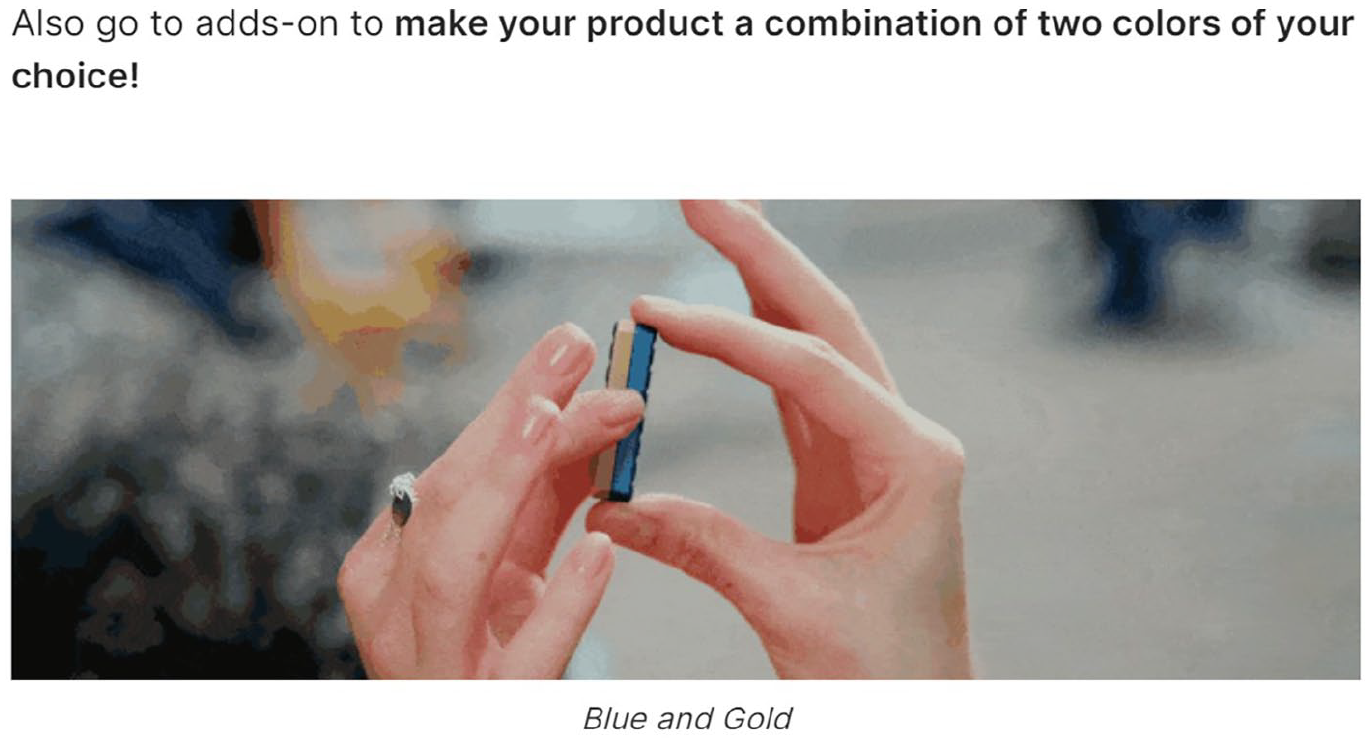
The symbolism of flag colors (3A Production). 1
In general, the campaign involving the gif (Example 7) uses the slogan ‘Stand with Ukraine’, which also affects the interpretation of the visual as a form of symbolic resistance. The words ‘two colors of your choice’ and the gif image right below represent a multimodal gutter (Anderson, 2017), suggesting that selecting these colors for the product is a way potential backers can support Ukraine. Additionally, the text below the image (‘Blue and Gold’) attracts the audience’s attention to these specific colors. This example represents discourse blending, as it involves advertisement as much as resistance without clear boundaries in between: there is not any certain point where commercial promotion ends and resistance starts since these two discourses are intrinsically combined.
In addition, Ukrainian characters are utilized as well-known figures in a few campaign calls. These characters include the legend of the Ghost of Kiev (a Ukrainian pilot who reportedly shot down several Russian airplanes) (Horbyk and Orlova, 2023: 230) and the Ukrainian president Zelensky, who is globally more well known. Example 8 is an advertisement of a company’s product showing a ‘super joker’ Zelensky. The example stems from a company specialized in playing cards, which has now launched a specific deck as a tribute to Ukraine’s wartime defense.
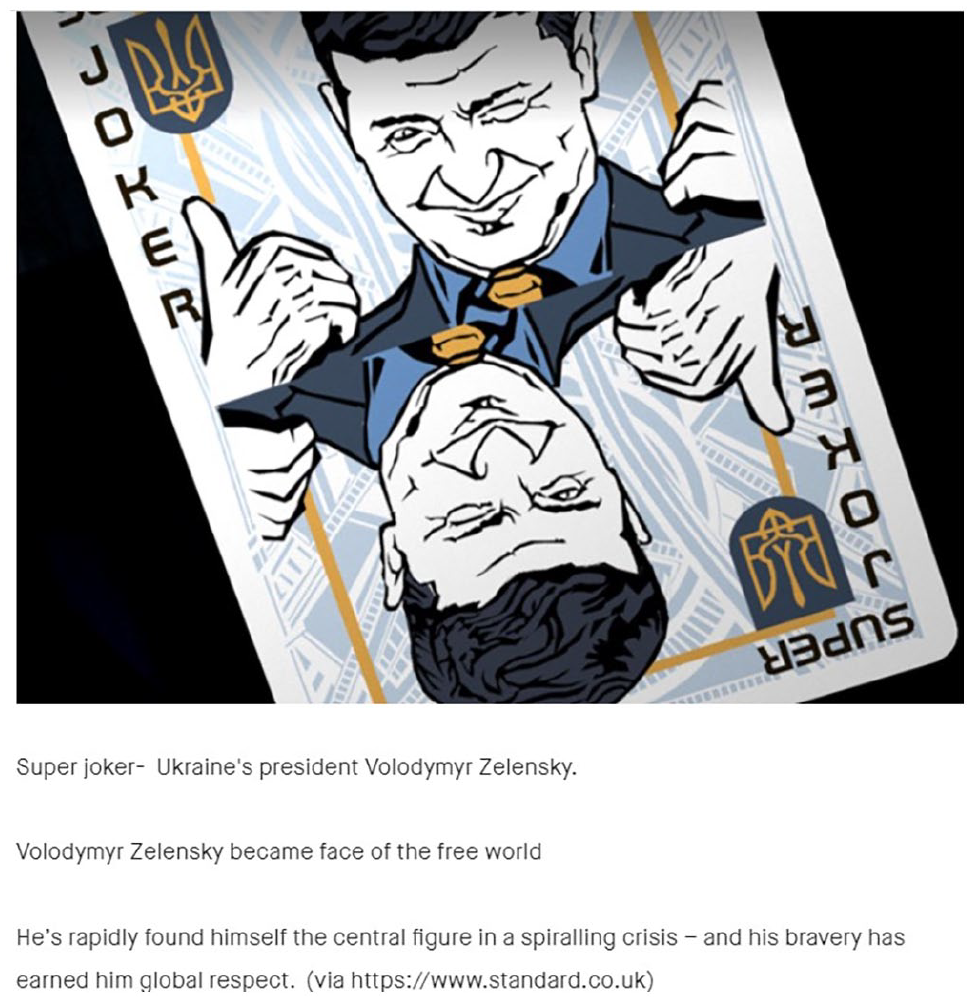
Zelensky as a super joker (3rd Dominion). 2
Although Zelensky is portrayed using highly positive word choices (‘face of the free world’, ‘the central figure in a spiraling crisis’, and ‘his bravery has earned him global respect’), there is symbolism in this example that goes beyond words. The joker card is the most valuable card in most games, with the ability to replace any of the other cards. Thus, Zelensky is represented as the key figure in Ukraine’s defense. In particular, the proximity of the words ‘super joker’ to the falcon symbol and Zelensky’s face can be seen to reflect Anderson’s (2017) multimodal gutter, as the multimodal design evokes the association of Zelensky as a (global) Ukrainian hero in the minds of the audience. According to Fomenko (2023: 226), however, the image of Zelensky is complex for many Ukrainians, but because of his prominent global status, he has become a figure typically utilized in commercial contexts. Considering these notions, the use of Zelensky as a character in the campaign may speak to Western customers even more than to Ukrainians themselves. Like Example 7, Example 8 is based on discourse blending, where resistance and advertisement are in the same package.
In Example 9, the slogan ‘Good evening, we are from Ukraine!’ is utilized to indicate resistance. The example is taken from an entrepreneurial narrative in which a Ukrainian company specialized in wooden design-products is branding itself as a family company and an expert in its field. The slogan is expressed as a distinct snippet at the end of the company’s positive evaluation, and it occurs through sequential intertextuality (see Mäntynen and Shore, 2014: 744–745). In the example, resistance is preceded by an entrepreneurial narrative branding the company in general. Without considering the specific cultural context, the slogan could be confused with an ordinary greeting. According to Fomenko (2023: 225), this greeting has become a sign of national pride that is utilized in official, popular, and grassroots contexts.
(9) We have a great experience in the production of high-quality products, more than 100 thousand happy customers all over the world, and 8 years of experience in international delivery – 100% guarantee that we won’t let you down!
Meet our family – [first names omitted], our 4 daughters [first names omitted], and parents [first names omitted]. We are so happy that we can make things that others like!
Representing Ukrainians as survivors
Representing Ukrainians as survivors is common in the campaign calls (18/22). All these survivor representations involve a forward-looking perspective, with Ukrainians seen as a victorious people, full of bravery (see also Horbyk and Orlova, 2023; Kaneva, 2023). Sometimes the whole project is branded in accordance with the bravery theme, and in other cases, the theme is involved in entrepreneurial narratives, product design, or advertising. Examples 10 and 11 are typical verbal representations of Ukrainians as survivors connected to entrepreneurial narratives. They are both based on sequential intertextuality, as resources typical of entrepreneurial narratives are followed by war-related resistance as a distinct type of discourse.
(10) Now it seems that my child dreams about a large factory are so much close to come true. I’m also very proud that they are coming true exactly in Ukraine. And exactly now, when
(11) Since 2014, our Ukrainian brand [brand’s name omitted] created inspiring and meaningful products for people’s homes, offices, and lives. Now Russia has taken our homes, made millions move away and become refugees.
Examples 10 and 11 reflect verbal choices that highlight the Ukrainians’ bravery and persistence in the war. The evaluation in Examples 10 and 11 partly resonates with nation branding in the state-based bravery campaign (Kaneva, 2023), but the difference between these examples and nation branding is the way the authors, as Ukrainian entrepreneurs, personally include themselves in the discourse. Bravery in these examples is connected to the feeling of hope as a grassroots emotion and experience.
Moreover, Example 12 shows how resistance is utilized in the product design of a campaign by a board game producer that has launched a highly symbolic war-related game in which players attempt to liberate Ukraine from its enemies. The whole campaign has been branded around the bravery theme. Like examples 7 and 8, this example also reflects discourse blending: resistance and commercial promotion are inseparable.
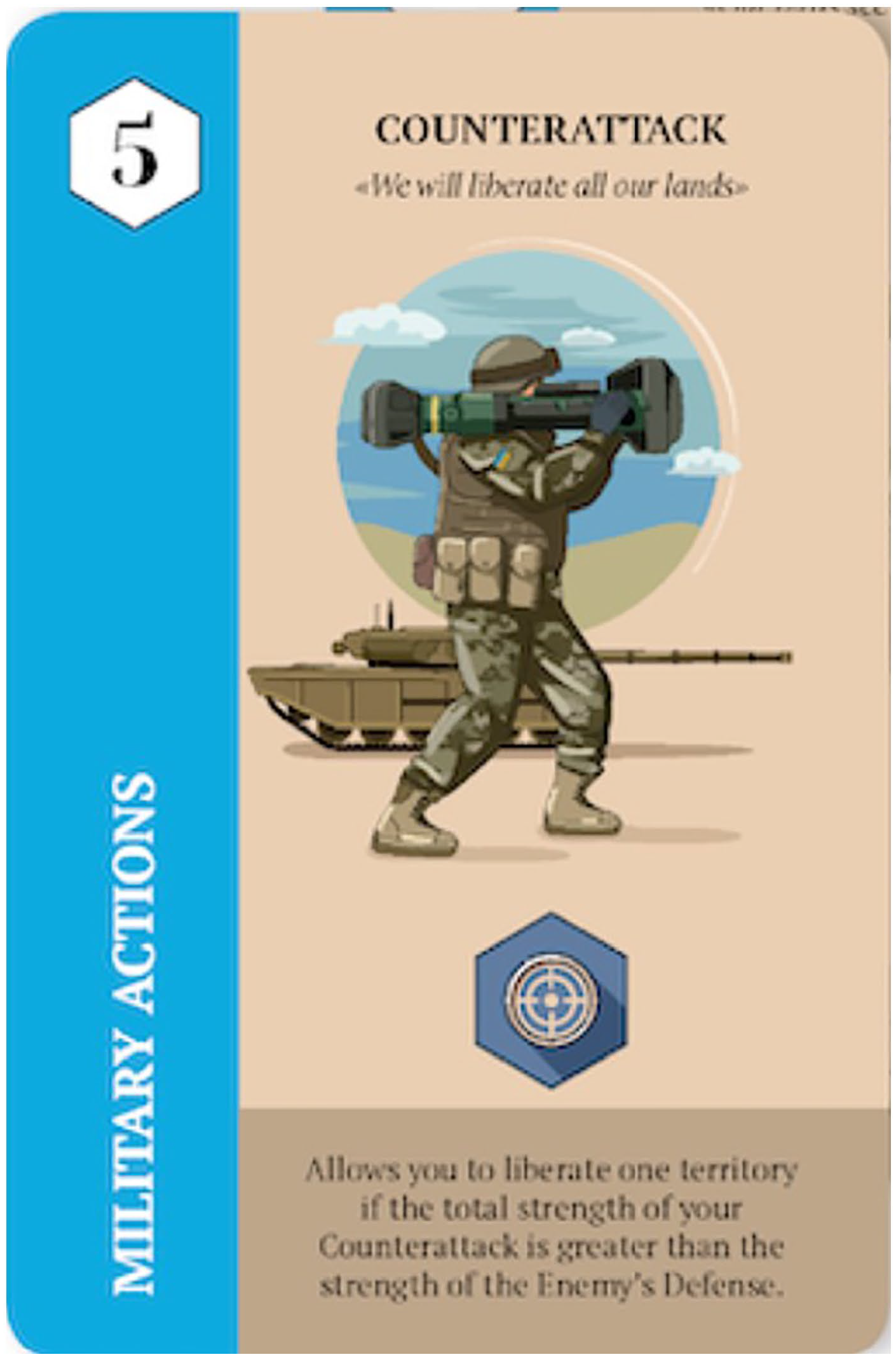
Multimodal representation of survivors (BizGames). 3
In Example 12, there is a Ukrainian soldier (with the Ukrainian flag on the right arm) carrying war equipment. At the top, there is the name of the action (counterattack), which is the title of this specific card in the board game. Below the counterattack label is a text (‘We will liberate all our lands’) which is in line with the general survivor discourse. It is interesting in Example 12 how small elements can form essential meanings. Both the first-person plural (‘We’) and the second person (‘you’) can be seen as constituting a multimodal gutter along with the Ukrainian flag on the soldier’s arm. This association is evoked in the audience, inviting players to take the side of the defenders. Example 12 is also an illustrative case of the survivor rhetoric because for many Ukrainians, the armed forces of Ukraine are the symbol of the country’s bravery and resistance (Fomenko, 2023: 226).
Using the Ukrainian language
The Ukrainian language is present in written texts and some spoken interviews included in campaign videos. As the campaigns are primarily addressed to US or West European audiences, the use of Ukrainian serves as a rhetorical device that makes the campaign calls more authentic and grassroots-based. It also indicates that there are real Ukrainian people behind the campaigns. In addition, using the Ukrainian language is a way of portraying the uniqueness of Ukrainian culture on a larger scale (see Fomenko, 2023: 224). In Example 13, the slogan Slava Ukraini (Glory to Ukraine), originally written in blue and yellow calligraphy in the campaign, is also a cultural icon, so there is overlapping of two discursive resistance strategies. This example represents sequential intertextuality, where the typical fundraising discourse of establishing credentials (see Feng et al., 2023: 329–330) is followed by an expression of resistance.
(13) Our first Kickstarter products – [names of products omitted] – had successful campaigns and helped us to expand our brand and hire a lot more people. Along with the support of an awesome community of creators, Kickstarter offers a great platform for us to showcase and fund our new Product. We do believe in the great Kickstarter community, and that with its support, our Ukrainian brand will have a second chance.
The slogan Slava Ukraini has become a globally known sign of support for Ukraine in wartime, but it has long-standing cultural meaning for Ukraine, originating in Ukrainian poetry in 1840. During the Euromaidan protests, the slogan became a target of Russian disinformation, and in 2018 the slogan was officially adopted as a greeting of the Armed Forces of Ukraine (Fomenko, 2023: 224–225). Moreover, Aminu (2024: 41) argues that the use of individual languages also acts as an index of identity in multilingual societies. In the case of crowdfunding, using the Ukrainian language is a way of resisting the aim to fade the uniqueness of Ukrainian culture and a way of showing that the Ukrainian language itself is a valuable part of the multilingual world.
Establishing belonging to the West
Rhetoric showing Ukraine’s belonging to the West can be divided into two subcategories: including/excluding languages, countries, or regions and representing specific visual location. The strategy based on inclusions/exclusions is utilized in 10/22 campaign calls, while visual locating is used in one campaign marketing a wooden world map. The key idea behind these two strategies is the inclusion of Western Europe, the US, and Ukraine in the same in-group.
Including/excluding languages, countries, or regions
This strategy occurs as a way of establishing a close connection to Western customers. This is often done by showing the flags of other Western countries (e.g., the US, Germany, France, and Great Britain or the star symbol of the EU in some campaigns). Such inclusions are typically present in the main visual (top banner) of campaigns or in sections with shipping details or product information. These inclusions serve as identifiers of the group of ‘us’ to whom the campaigns are addressed.
In addition, many campaigns are literally marketed as ‘EU friendly’. Example 14 shows the top banner of a campaign call of a war-themed boardgame with an EU-friendly label (bottom right) in addition to the Ukrainian flag in the heart shape (top middle). Although the EU-friendly label also has a practical meaning, serving as a marker that the fundraising company uses a fulfillment company to simplify product shipment to European backers, the use of the two symbols (Ukraine and EU) in the same picture is also a rhetorical way of associating them together as part of the same cultural group. The multimodal gutter is based on the connection of the Ukrainian heart-shaped flag and the words ‘EU-friendly’: both representations form the in-group and such an association also suggest that Ukraine is ‘EU-friendly’. Notably, in Example 14 Russia is never explicitly mentioned as the enemy. Like other advertising images, Example 14 is also based on discourse blending that makes resistance and commercial promotion inseparable.
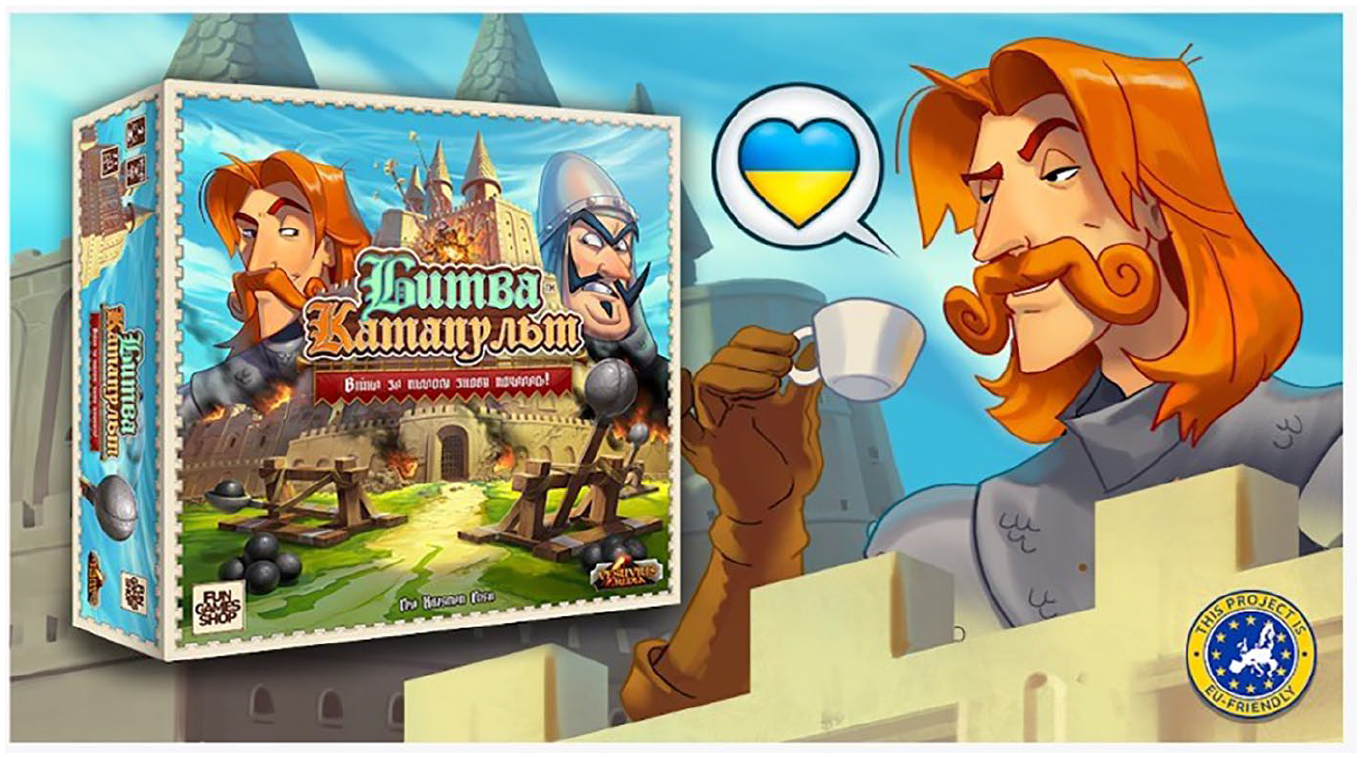
EU-friendly label in Catapult Feud’s banner. 4
Moreover, Russia is typically excluded in an implicit way by including other countries in the products’ shipping information. However, a more explicit exclusion of Russia is utilized in one campaign call in which a line is drawn through the flag of Russia with an exclusive text (‘we do not ship to Russia’) (Example 15). In that example, resistance is expressed in the form of shipping information, which gives a humorous tone to the discourse and works through discourse appropriation (see Mäntynen and Shore, 2014: 746–748). Since the campaign is not addressed to Russians, Example 15 has no actual meaning as shipping information at all.
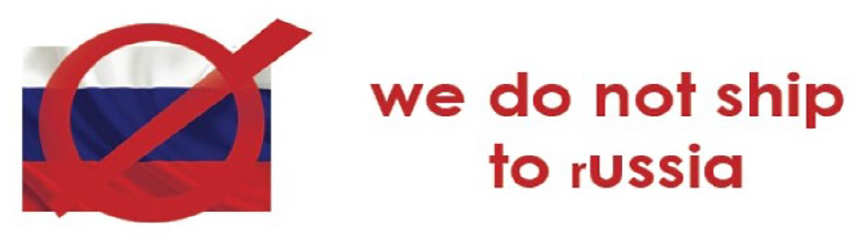
Explicit exclusion of Russia. 5
Representing specific visual location
One Ukrainian company marketing decorative maps concretely locates Ukraine as part of the West through its product advertisement. In the wooden map, Russia is shown as divided into federal districts, and only a district in the center of the Russian territory is named ‘Russia’. This strategy concretely locates Ukraine in the West: The distancing is not just visual but also conceptual. In this example, visual locating as a form of resistance is involved in the product advertisement and can be seen as discourse blending because it merges resistance with commercial promotion through an advertising image without clear discursive borders. The map is not republished in this study for copyright reasons.
Discussion
The focus of this study has not been on an analysis of resistance per se but resistance utilized interdiscursively with companies’ business-oriented rhetoric. Eight discursive strategies of resistance were identified in the study, which were further divided into three categories of rhetorical action: evoking identification/disidentification, manifesting national pride and independence, and establishing belonging to the West. In general, discursive strategies are primarily based on sequential intertextuality and discourse blending. In sequential intertextuality, resistance and commercial promotion take turns, typically through verbal means, while discourse blending characteristically involves multimodal rhetoric and unites resistance with corporate marketing, more effectively blurring discourse boundaries. All interdiscursive techniques discussed in the study play a role in constructing a double function of crowdfunding campaigns not only as commercial promotion but also as a way for Ukrainians to contribute to global war-related meanings in defense of their country. The uses of discourse blending and appropriation suggest that resistance and commercial promotion may be so closely merged with each other that they can become inseparable. In addition, interdiscursivity occurs through discourse blending especially when manifesting national pride and independence in multimodal product advertisements.
Moreover, the findings indicate that there is a tension between addressing rhetoric to Western customers and showing experiences and emotional reactions that resonate with Ukrainian grassroots expressions. On the one hand, Ukrainian crowdfunding campaigns involve the rhetoric of ‘brave Ukraine’, which has been previously utilized in more top-down nation-branding contexts (Kaneva, 2023). In addition, war-related global marketing in which president Zelensky is portrayed as a hero can be found in the campaign rhetoric (see also Fomenko, 2023: 225–226). Both strategies, along with cultural labels of the West (e.g., national flags of the US or West European countries or EU shipping labels), are ways of addressing Western customers through cultural meanings that they already recognize. On the other hand, the campaign calls by Ukrainian companies also reflect the perspective of those directly affected by the war. Explicit expressions of anger and emotional narratives of victims of the invasion are present along with expressions of hope for a better future. In addition, the Armed Forces of Ukraine are represented as Ukrainian heroes. These grassroots strategies are in line with Lokot’s (2023) findings concerning Ukrainians’ grassroots expressions on Twitter and Instagram, as they narrate the experiences of Ukrainian citizens. From a commercial angle, a grassroots perspective may increase the authenticity of campaigns in the eyes of potential backers.
Concluding remarks
This study suggests that interdiscursive resistance is a fruitful concept for analyzing marketing that also involves societal rhetoric of those whose basic human rights have been violated. The nature of crowdfunding platforms as grassroots-based forums enables multiple, creative ways of using resistance in combination with commercial promotion. Campaign calls on Kickstarter can be seen as discursively complex texts in which strategies of resistance involve internal tensions between various perspectives, some more loyal to grassroots’ experiences and others resonating more with mainstream, commercial meaning-making. The study argues that the commercial nature of companies’ crowdfunding in general, the informal means of creating campaigns, and larger national and global discourses on conflicts constitute a complex set of factors affecting the ways in which strategies of resistance are used in crowdfunding rhetoric. Interdiscursive resistance is an essential characteristic of crowdfunding by Ukrainian companies during wartime, but its use in other contexts mixing societal and commercial discourses needs further analysis. In particular, more research is needed on the multimodality of interdiscursive resistance, as the findings of this study suggest that resistance is strongly mixed with commercial rhetoric in multimodal contents.
Footnotes
Declaration of conflicting interests
The author declared no potential conflicts of interest with respect to the research, authorship, and/or publication of this article.
Funding
The author disclosed receipt of the following financial support for the research, authorship, and/or publication of this article: This research has received funding from Research Council of Finland through the project ‘Shifting Investment Cultures in Digital Spaces’ (funding decision number 339181).
