




Abstract
In this paper I intend to shed light on broadcast news interviews with a focus on the increasing role of video-mediated platforms. To do so, I first overview the rules of conduct journalists are required to follow, pondering on whether the shift to video-platforms has made substantial changes to what recommended in manuals and posited in scholarly studies. Then, I illustrate a corpus-based case study of news interviews carried out by professional journalists with Chinese and Russian diplomats. Similarities and differences between face-to-face and video-mediated interviews as well as between Chinese and Russian interviewees have been identified, with special reference to (a) the format of the questions posed by the journalists, (b) their degree of compliance to the traditional ground rules of conduct in the Q&A interface, (c) the role of the interviewees’ lingua-cultural background and (d) reference to the audience.
Keywords
Introduction
Through the centuries, technology has always played a key role as the main facilitator of changes in news discourse. Over the last decades, in particular, transformations have involved the shift from news pieces – relying exclusively on the verbal text – to story packages, exhibiting interactivity, non-linearity, and multimodality (Bednarek and Caple, 2012: 148). In turn, the Internet has removed the conclusive, unchangeable format of printed texts in favour of open-ended ones, which can be amended, updated and even cancelled both by professional and by non-professional journalists; hence, particularly over the last few decades, journalism has gradually and steadily moved away from the traditional role of gatekeeper of information to an activity more and more shared with the audiences(s) (Facchinetti, 2021). Finally, the recent spread of Artificial Intelligence has added yet another variable to ‘who’ does ‘what’ in journalism, somehow even swapping their traditional places, with algorithms rather than humans producing news texts (Lermann Henestrosa et al., 2023) as well as humanoids and virtual avatars parroting and surrogating human journalists in broadcast news.
More recently, video-communication tools – which went into full effect in early 2020 at the onset of the Covid19 pandemic – temporarily forced the whole world into social distancing and transferred all communications online. Hence, in 2020 and 2021 e-mail and instant messaging as well as video chats were heralded as the only ways to allow people to build and maintain relationships. These communication technologies have by now permeated the news broadcasting activities, also on account of the positive sides of time- and money-saving that platforms allow, enabling interlocutors to carry out their activities not only in the office but also at home (Ask and Søraa, 2023; Janghorban et al., 2014).
These profound technological changes that journalism has been experiencing require a reflection on how and to what extent they impact on journalistic discourse in its current multi-faceted actualizations, including digitally-mediated interaction. In particular, little has been studied so far on how the world of broadcast media interviews has been affected by the recent shift to the video-platform format. According to Graham (2019: 311), video-mediated (VM) interaction is not so different from Face-to-Face (FtF) interactions, while in their edited book on digital multimodality Georgakopoulou and Spilioti (2016) point to interactive digital environments as virtually and effectively (re-)shaping communication. Similarly, recent research on online/offline oppositional discourse suggests that the VM environment does play a role in the way dialogue is conducted (Facchinetti, 2023).
Hence, in the present paper I will attempt to shed more light on this still under-researched topic, focussing on the following research questions: (a) how far does the screen affect dialogical interaction in VM contexts of broadcast interviews? (b) Does the screen hinder or favour the verbal and non-verbal expressions of stance? To answer these questions, in the following sections I will first overview the rules of conduct journalists are required to follow, pondering on how far video platforms may affect dialogical communication (Section 2). Then, I will illustrate a corpus-based case study comparing FtF and VM broadcast interviews to identify any diverging aspect between the two settings (Section 3); to do so, I will draw from a section of the InterDiplo Corpus (Cavalieri et al., 2021) and will focus on a set of interviews with Chinese and Russian diplomats, also to check how far the lingua-cultural background may intervene as a possible variable. Concluding remarks will be delivered in Section 4.
Expressive caution and authenticity in today’s broadcast news interviews
According to Clayman (1992), ‘there is one setting in which expressive caution is practiced with extraordinary consistency: the television news interview’ (Clayman, 1992: 163), where long-standing rules of conduct require professional journalists to withhold from expressing their opinions in the interviewing process and to remain neutral when asking questions. Indeed, ‘their task is to elicit the stance, opinion or account of the one being questioned, but to do so at least technically without bias or prejudice’ (Hutchby, 2003: 443). Hence, journalists should express their personal opinion with caution, avoid intimidating their interviewees (IEs) and rather let them express their own views freely (Lee-Potter, 2017).
This golden rule holds true with reference both to linguistic and to paralinguistic features, as well as to body language. Specifically, trainers agree that throughout the interview both IR and IE should avoid high voice pitch and favour the regular tone of smooth dialogue, while frowning and laughing ironically at the interlocutor’s utterance should be particularly avoided. With reference to body language, direct address with eye contact is deemed essential to create trust between interlocutors, since employing eye gaze makes interlocutors more credible and promotes trust even in truth-ambiguous statements (Kreysa et al., 2016). Moreover, sitting directly opposite their interlocutors is probably a mistake whereas sitting at right angles (90 degrees) works well because it’s neither confrontational nor cosy. Sitting too far away is inadvisable, mainly because it’s more difficult to build up a rapport. (Lee-Potter, 2017: 75)
When it comes to the structure of the interview, rules of conduct posit that conversation should start with an uncontroversial question (Lee-Potter, 2017: 64–65), to put IEs at ease. Hence, journalists should resort to open questions rather than to closed ones particularly at the beginning, but also throughout the whole interview. Open questions usually begin with why, how, and what and, as such, they encourage IEs to express their thoughts freely, to expand on the topic and/or voice their perspective (Morán García, 2023: 37). In contrast, closed questions, which point to a yes/no answer, should be used with caution (Sedorkin and Forbes, 2023), as well as their subtype of choice/polar questions, which impose the IE a binary answer. To safeguard neutrality, journalists should also avoid evaluative and judgemental language, since the role of the interviewer is to elicit information rather than express one’s perspective or opinion.
While this recommendation for neutrality is largely acknowledged in training manuals for professional interviews, recent studies have brought to the fore a gradual, steady shift towards a more adversarial attitude of professional journalists, who increasingly take a stand particularly when sensitive issues (like war, health and international politics) are at stake (Piirainen-Marsh, 2005; Sun, 2010). In such contexts, they appear to lose impartiality in favour of subjectivity, shifting away from the matter-of-fact approach (Facchinetti, forthcoming). While not going as far as legitimizing oppositional discourse in broadcast interviews, Clayman and Heritage do acknowledge that challenging IEs may be a practice enacted by professional journalists to elicit truthful answers and to safeguard factual accuracy (Clayman and Heritage, 2002: 29).
Furthermore, one needs to remember that the rules of practice recalled here have been devised and shared giving for granted FtF settings, mostly with IRs and IEs sitting in studio. However, this type of setting can no longer be taken for granted on account of the wide-ranging spread of video-communication platforms. Social media in particular are acknowledged to be a setting that breeds oppositional talk, which seems to have increased, particularly after the unprecedented conditions caused by the Covid19 pandemic (Hsu and Tsai, 2022; Pascual-Ferrá et al., 2021).
Overall, VM platforms may undermine authentic communication. In the first place, some virtual platforms encourage the proliferation of products of digital alteration and this may mean touching up on one’s image before the screen. Secondly, even without digital alteration, the very possibility of staging the background behind us as well as blurring it totally may change the perception of the recipient when visualizing the interlocutors on screen. Thirdly, gestures and linguistic output may be affected by the awareness of talking to a screen rather than to a physical person in front of us. Indeed, with VM platforms there is necessarily lack of nonverbal cues such as eye gaze and body gestures; moreover, the camera angle and the screen make it hard to know the exact focus of attention as well as the background environment of the interlocutors. Finally, VM communication favours the visualization of the upper part of the body (face and shoulders) and does not necessarily convey information on the whole posture or bodily movement of the interlocutors (Croes et al., 2019).
To test the impact of video platforms on the interlocutors and on the discursive flow of dialogical interactions, as well as the degree of compliance to the rules of conduct mentioned above, a study has been carried out on both VM and FtF broadcast interviews, as illustrated in Section 3.
Comparing video-mediated and face-to-face broadcast interviews: A case study
The study addresses the following research questions: (a) how far does the mediation of the screen affect dialogical interaction in VM contexts in broadcast interviews? (b) To what extent are the gestures of interlocutors hindered or boosted in VM broadcast interactions? (c) Is the verbal expression of stance of interlocutors affected by the medium? (d) how far does the cultural background interfere in VM and in FtF broadcast interviews?
To answer these questions, I have relied on a section of the InterDiplo Corpus, 1 developed at the University of Verona, Italy, which comprises one-to-one broadcast interviews carried out in English by (non-)professional journalists, as well as by celebrity entertainers and broadcasters addressing diplomats, politicians, newsworthy public figures and certified experts from different lingua-cultural backgrounds.
For the present study, 16 interviews have been selected, 8 FtF and 8 VM, broadcast between 2020 and 2023, in order to cover both the outbreak of the Covid19 pandemic, when FtF contact and dialogue were hindered, and the present post-pandemic time. Contentwise, all 16 interviews address topics that conform to the news values of ‘negativity’ and ‘impact’ (Bednarek and Caple, 2012: 52–55; Bell, 1991), referring respectively to ‘bad’ happenings and to the (global) effects or consequences of an event; indeed, they focus on the Coronavirus, the war in Ukraine, the Afghan crisis, the disputed autonomy of Taiwan, and the conditions of the Uyghur population in China. Structurally, all interviews are adversarial (Frost, 2010), in so far as IRs ask IEs to explain and/or justify the actions and policies of their own governments.
To safeguard homogeneity of data and to avoid possible variations in the way IRs may handle IEs from different professional backgrounds, all IRs are professional journalists and all IEs are Chinese and Russian diplomats (ambassadors or their deputies). Diplomats have been chosen because they are considered ‘experts at weighing words and gestures’ (Jönsson and Hall, 2005: 72), as well as at favouring mediation and negotiation rather than assertiveness and aggressivity (Friedrich, 2016; Kurbalija, 2013); consequently, they use carefully calibrated language and safeguard courtesy even in cases of strong disagreement (Scott, 2016), as in the chosen adversarial questions of the present corpus. Chinese and Russian diplomats, in particular, belong to two different lingua-cultural backgrounds which may evidence possible diversifications in the answering attitudes depending on the setting (FtF vs VM). Indeed, studies in linguistic ethnography suggest that the formal attitude of the Chinese and the more visible presence of gestures and emotional reactions of Russians are typical traits of their respective cultures. Specifically, Russians appear to express their emotions markedly, since in the Russian culture a non-expressive face is considered a bad sign (Wierzbicka, 1998), while the Chinese culture places great emphasis on emotion moderation and control (Li-Jun et al., 2010) and disprefers gestures (Hou et al., 2014).
Table 1 shows the structure of the corpus under scrutiny, with indication of the setting and media outlet of IRs, as well as the theme of interviews and the gender and nationality of all interactants.
InterDiplo subcorpus of VM and FtF interviews with Chinese and Russian diplomats.
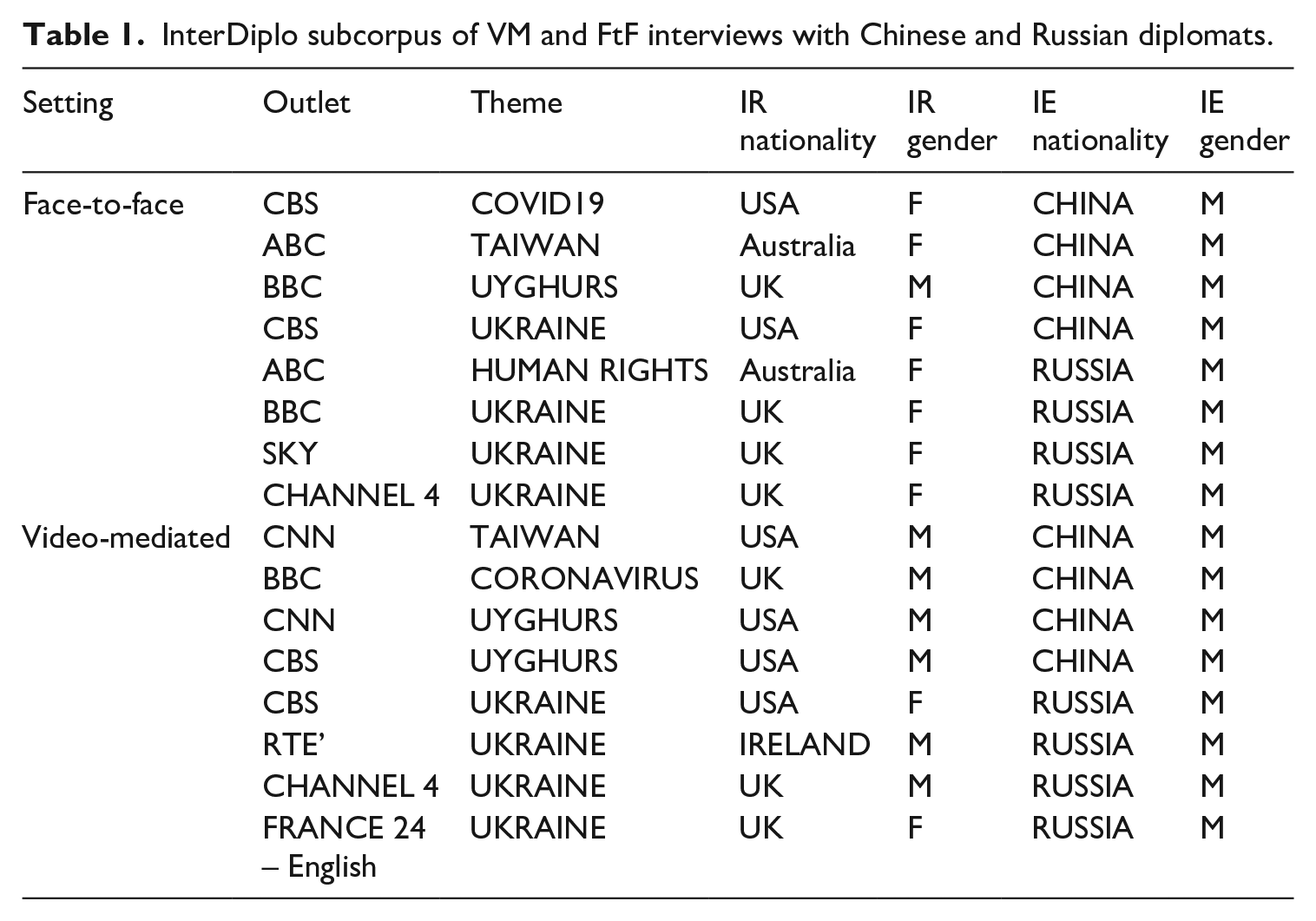
IRs and IEs do not share the same lingua-cultural background, since all journalists are from anglophone countries, while their IEs are equally subdivided between Russian and Chinese diplomats both in FtF and in VM interviews. Attention has been paid not to feature the same interactant in different interviews, which would lead to skewed data due to possible idiosyncrasies of interlocutors. With reference to the gender of IRs and IEs, while it has been possible to diversify in a relatively equal number male and female journalists (9 females, 7 males), the same has not been possible for IEs, who are all men. This points to a gender gap – and possibly glass ceiling – in the diplomatic profession which certainly deserves attention, though it is beyond the scope of this study.
Each one of the four subsets of interviews – FtF with Chinese IEs, FtF with Russian IEs, VM with Chinese IEs and VM with Russian IEs – amounts to an average of ~45 minutes, for a total length of the corpus of ~180 minutes. Indeed, the priority for comparability was given to the number and length of the interviews rather than to the number of tokens, since such paralinguistic aspects like hesitations, pauses, restarts and repairs would make the four subsets not fully comparable. Like all interviews from the InterDiplo Corpus, these as well have been converted into XML and tagged for metadata, parts of speech, paralinguistic features, and for discursive aspects such as question and answer types.
To identify similarities and differences between the FtF and the VM interviews and also between the Russian and the Chinese IEs, the videos have been checked for body language and paralinguistic features for a first level of analysis (Bednarek, 2019; Caple et al., 2020; Müller et al., 2014). Then, focussing on the conversation analytic approach of news interviews (Clayman and Heritage, 2002; Ekström, 2007; Heritage, 1985; Hutchby, 2005), the corpus has been screened quantitatively with the software SketchEngine (Kilgarriff et al., 2004, 2014) and qualitatively to analyse the question types posed by the journalists, with special attention to the initial question of each IR.
Results
Gestures and paralinguistic features
In FtF interviews, interactants can be seen in full, often with wide-angle shots providing a lot of background, and are portrayed either in the studio of the news network or in the diplomat’s office, positioned either at right angles or facing each other. When in VM settings, in the majority of cases journalists can be seen sitting at their desks; wide angles alternate with close-ups with still images in the background, while in one interview the journalist speaks from a war zone, standing against the background of a city in the distance. In turn, IEs are portrayed in their embassy offices, with a limited view of the context, the IE at the centre of the frame or even filling the frame; in three out of eight cases, the backgrounds of IR and IE somehow mirror each other with a fixed frame semiotically pointing to the respective country of origin (Great Wall, logo and name of the Chinese/Russian embassy, American flag, Senate).
When FtF, both IRs and IEs complement their verbal output (questions and answers) with gestures as an integral part of their dialogical turns, like direct eye contact, smiling, frowning, nodding, shaking one’s head and leaning forward. In line with the ethnographic studies mentioned above, Russian diplomats appear to exhibit more expressivity than the Chinese, for example by gesturing with their hands to highlight key points, exhibiting ironic smile and laughter at pressing questions, and at times increasing their tone of voice.
In contrast, in VM settings, both Chinese and Russian IEs largely avoid face display of emotions and safeguard apparent calm and a low tone of voice despite pressing, adversarial questions. Indeed, all diplomats appear to adhere more strictly to the rules of conduct they have been trained to, by restraining their gestures and facial expressions. Hence, data suggest that ‘the screen’ somehow contributes to reducing the emotional expressivity and hinders natural dialogue, possibly also on account of the fact that in online settings interlocutors can actually see themselves in screen and consequently they may check and restrain their own reactions (Chen and He, 2023).
While gestures and paralinguistic features are somehow restrained online, the verbal dialogue of both IRs and IEs exhibits relevant traits, as shown in Sections 3.1.2 and 3.1.3, dealing respectively with the journalists’ questions and the diplomats’ answers. A separate Section (3.1.4) will be dedicated to the audience a well, who is called into question in the interviews as a third participant.
Verbal discourse: Focus on interviewers
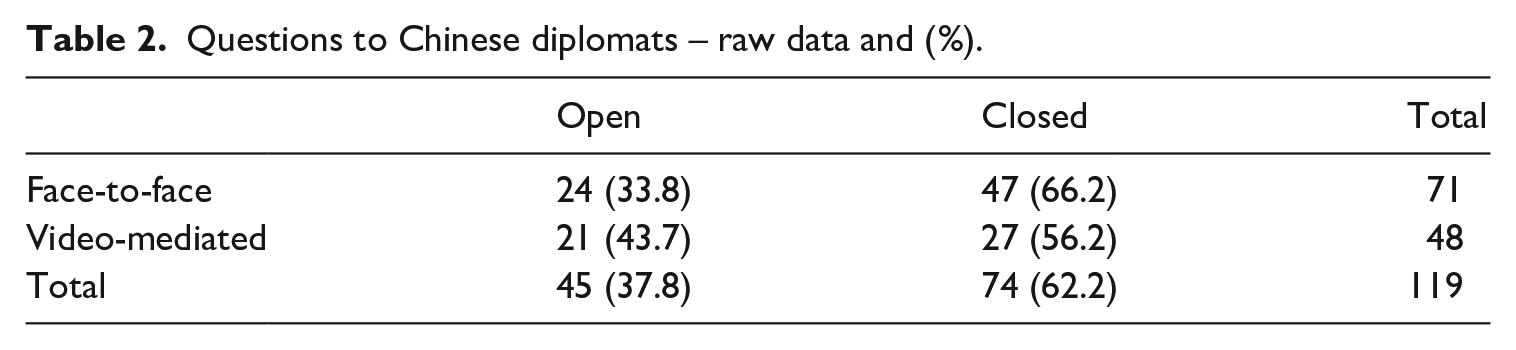
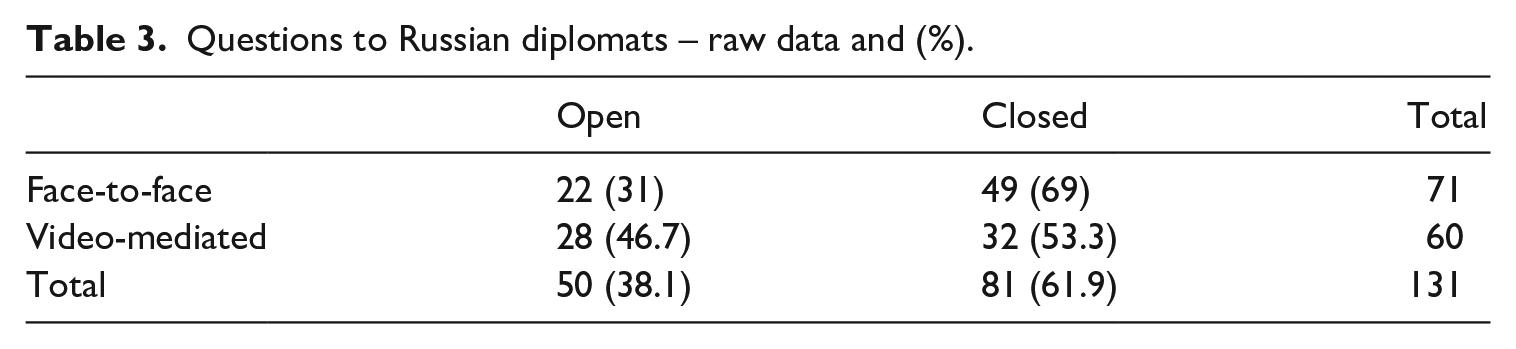
Tables 2–4 show the occurrences of closed and open questions respectively in the interviews involving Chinese diplomats (Table 2), Russian diplomats (Table 3) and in the whole corpus (Table 4).
Questions to Chinese diplomats – raw data and (%).
Questions to Russian diplomats – raw data and (%).
Questions in VM and FtF settings – raw data and (%).
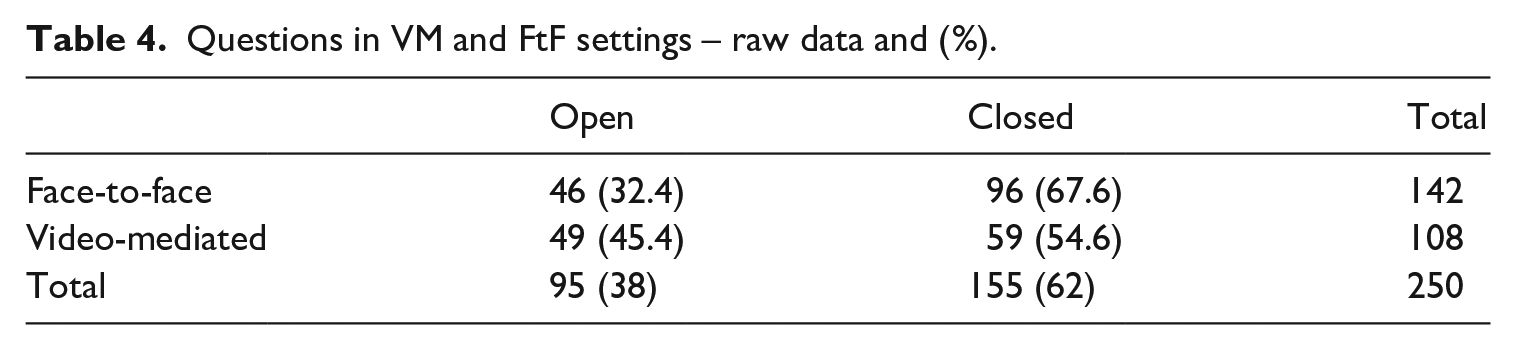
Data show that both in FtF and in VM settings journalists largely waive the rules of conduct described in section 2 with reference to the type of questions that should be favoured throughout the interview. Indeed, the figures point to a higher preference of journalists for closed questions independently of the interlocutors they are addressing (61.5% with Chinese IEs and 61.9% with Russian IEs). The percentage is even higher in FtF contexts (67.6% in FtF settings vs 54.6% in VM ones), thus indicating a more pressing and adversarial attitude when there is direct contact. This is supported by the fact that the overall number of questions in FtF settings is much higher (raw numbers 142 vs 108 in VM ones as in Table 4), thus confirming the practice of asking more questions in the same turn particularly when FtF. In contrast, when online, journalists seem to adhere more strictly to the rules of conduct with a lower number of closed questions and an increased respect for the typical turn-taking of ‘question-answer-next question’ without stuffing many questions in the same turn.
The following subsections will offer a qualitative discussion of the questions recorded in the corpus, with special reference to (a) open, closed and leading questions, and (b) evaluative language.
Open, closed and leading questions
As recalled in Section 2, according to the rules, the introductory question should be accommodating, avoid addressing the main topic from the start and favour smooth dialogue. In contrast, all the 16 opening questions of the corpus are blatantly adversarial, to the point that in one case the IE even voices his disconcert 2 :
(1) IR: Ambassador you’re here in Australia enjoying the benefits of a free and open society. How do you live with yourself representing the
IE: <laugh>
IR: you find that funny
IE: <laugh> I find – what I find funny is your way to start an interview and so
<overlap>
IR: it is a pretty straight question
IE: yes, too straight. (adv45-FtF-ABC-Russia)
In (1), the IR asks an open question, which should leave the IE free to provide an answer without being channelled in one specific direction, as is the case with closed questions; yet the apparent freedom offered by the format is counterbalanced and challenged by the embedded presupposition referring to Putin’s government as ‘repressive dictatorial’, thus following a discursive strategy whereby IRs typically include words or phrases that presuppose and give for granted the speaker’s assumptions, evaluations and perspective (Clayman and Heritage, 2002; Piirainen-Marsh, 2005). This produces a ‘leading question’, in so far as it leads the interlocutor in one specific direction rather than letting him free to voice his opinion (Facchinetti forthcoming.).
This practice has been equally recorded both when IR are women, as in (1) above, and when they are men, as in (2):
(2) IR: Shortly before we came on air, I spoke to the Russian ambassador (. . .). I first asked him when his country would stop its
IE: Well, I understand that that is an emotional question and it’s a highly emotional issue for many people here in Ireland. For us it is emotional as well. What are talking here is is really a humanitarian tragedy in Donbas.
IR:
IE: well, if you want to make a statement you are free to do that.
IR:
IE: Sir well, it doesn’t matter. I mean, will you let me explain some basic facts?
IR:
This opening exchange exhibits the IR’s slant right from the start by means of the word ‘aggression’; this is reinforced by (a) shifting the scope of ‘humanitarian tragedy’ from Donbas – as stated by the IE – to the whole Ukraine, (b) calling into question Amnesty International as a source to support the IR’s statement, and (c) pressing the IE with what sounds like a sarcastic remark: ‘Please, try, try your best’.
Leading questions are common both in open-ended contexts – as for the initial questions in (1) and (2) above – and in closed ones, as in (3) and (4):
(3)
(4) Last time we sat here you said, and I quote, you are 100% sure an invasion wouldn’t happen and then 6 days later it did.
In (3) and (4) the IE is channelled onto the binary pattern of a yes/no answer; moreover, the diplomat is overtly required to acknowledge (‘do you accept’) what is given as a state of fact and to account for previous statements made to the IR, as if it were the follow-up of an ongoing personal dialogue, with an overt accusation of lack of truthfulness (‘were you lying to me?’). In particular, the accusation of lying is used in the corpus by two different IRs, a man and a woman, respectively VM and FtF. Overall, strong, evaluative language is common throughout the interviews, as illustrated in the following section.
Evaluative language
The data yielded by the analysis via SketchEngine of the corpus subsection comprising the IRs’ questions have shown that IRs make ample use of evaluative terms (Bednarek, 2010). In particular, the following have been recorded to be among the first 300 most exploited across the 16 interviews:
attack, ban, condemn, crime, fail, force (v.), genocide, invade, invasion, kill, lie, problem.
Other terms have been recorded in the questions – though with a frequency below 5 – pointing to impact (e.g. rape, torture, slaughter), intensification (e.g. dramatic, absurd, extraordinary, extremely) and negative vocabulary (e.g. cruel, repressive, dictatorial, ignorant, disinformation).
In particular, evaluative language has been recorded largely in closed questions, thus making them even more forceful and adversarial, as exemplified in (5) and (6):
(5)
(6) as you know the UN has published a report very recently that says what happened in the camps there was
The qualitative analysis of the data also shows that evaluation is widespread in all questions both in FtF and in VM contexts; in the latter, evaluation is largely linked to the IR’s personal disbelief and disapproval of the IE’s statements:
(7)
(8) I’m a little
(9) you are acting as an apologist for
(10) that’s just
Overall, these data point to a diversified focus of IRs when exploiting evaluative language, which seems to be linked more to accusation of mismanagement in FtF contexts, while in VM ones evaluation is more related to disagreement and disbelief. However, to substantiate these data, a wider corpus with a larger amount of interviews would be needed.
Verbal discourse: Focus on interviewees
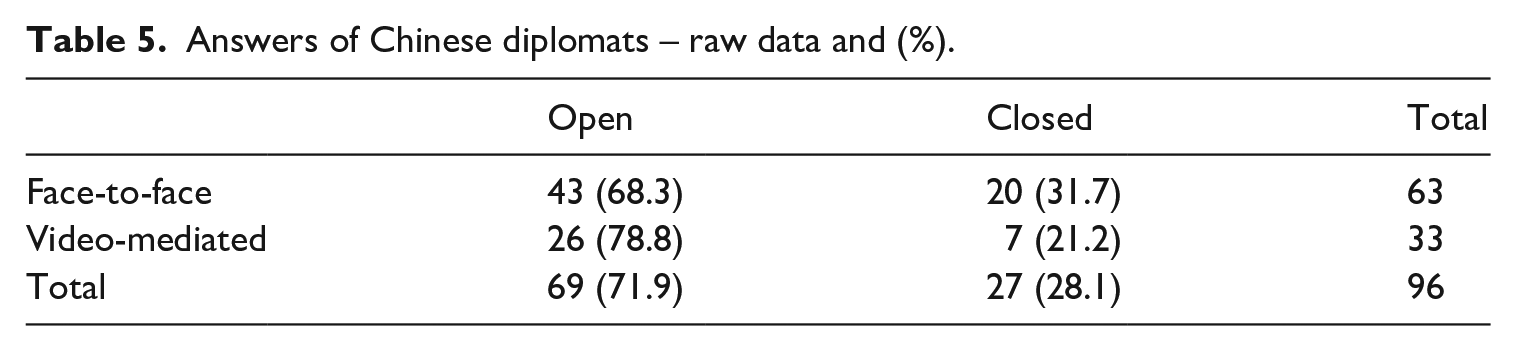
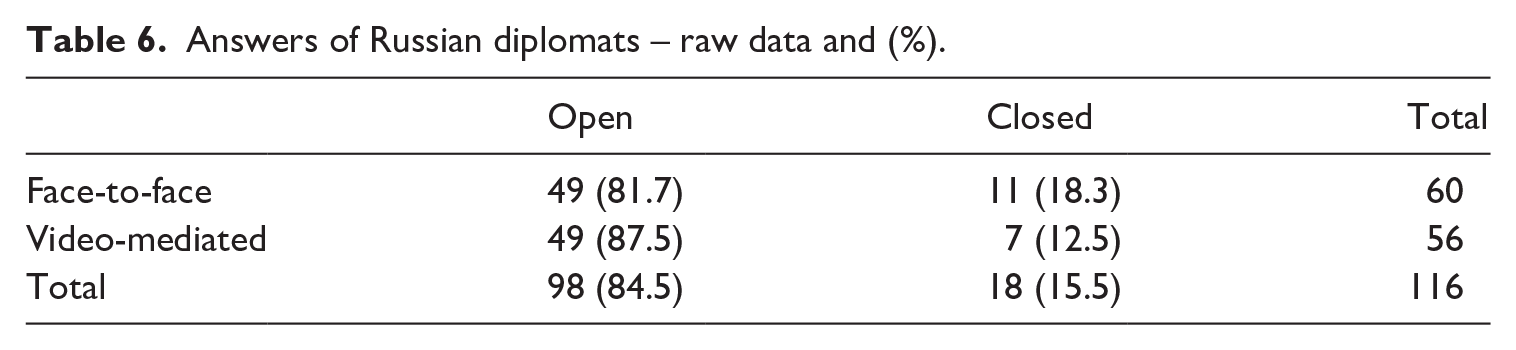
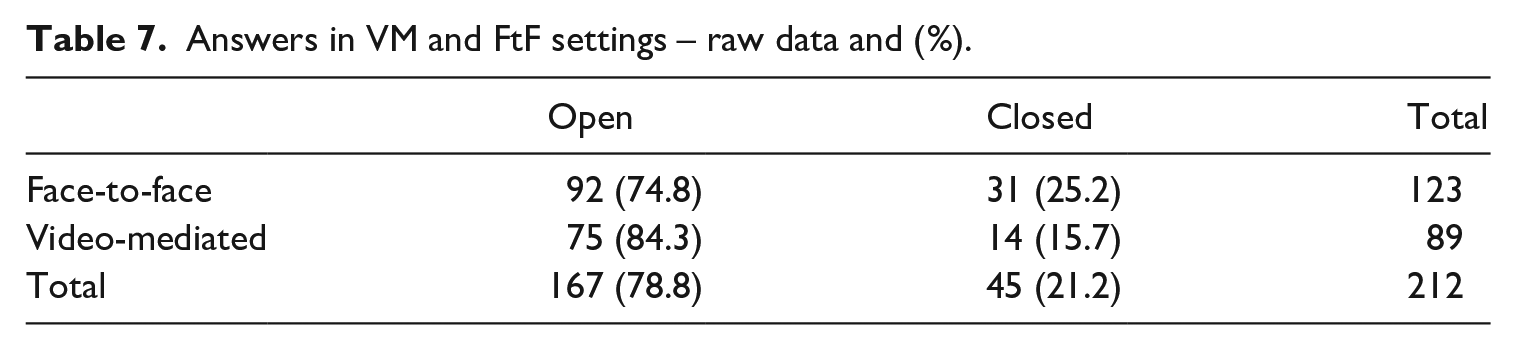
With reference to the answers given by diplomats, Tables 5–7 show that all IEs behave in a similar way by avoiding closed answers, with a total 21.2% of occurrences for the closed format as opposed to the 78.8% of the open one, 3 and particularly so in VM settings (84.3%), as shown in Table 7. Table 6 testifies to the fact that this practice is particularly exploited by Russian diplomats with 81.7% of open answers in FtF settings and even 87.5% in VM ones versus the 68.3% FtF and 78.9 VM for the Chinese. Hence, the lingua-cultural background may affect, though only partially, the answers of the IEs, since, especially when FtF, Chinese diplomats answer respecting the format of the question with the same corresponding answer type more frequently than the Russian diplomats.
Answers of Chinese diplomats – raw data and (%).
Answers of Russian diplomats – raw data and (%).
Answers in VM and FtF settings – raw data and (%).
The linguistic and discursive traits of the answers recorded in the corpus further testify to differences that may depend both on cultural traits and on the medium (FtT or VM), as illustrated in the following sections.
Answers in FtF contexts
In line with what has been highlighted for the FtF and VM output for journalists, a more dialectical and dialogical attitude emerges in FtF contexts on the part of diplomats as well. Indeed, when FtF, Russian and Chinese IEs exhibit similarities in the way they involve and address their interlocutors directly, at times calling them by their proper names. However, differences can be seen in the attitude of involvement between Russian and Chinese diplomats. Let us consider the following answers from Russian diplomats:
(11)
(12)
(13) You better study laws. . . (war008-FtF-BBC-Russia)
(14) No, come on (war017-FtFChannel4-Russia)
(15) Don’t interrupt me, OK? (war008-FtF-BBC-Russia)
(16) How do you know they are Russian missiles? (war010-FtF-SKY-Russia)
In the instances above, the IEs appear overtly adversarial in their attitude to their IRs, as if they were taking the issue personally; indeed in (11) the IE hints at the IR’s lack of knowledge; in (12) and (13) it is the lack of competence that is called into question. Similarly, informal register and even the use of imperatives in (14) and (15) make the answers less than accommodating, possibly even more so when the reply is framed as a question (16).
In contrast, the Chinese IEs address IRs with their proper names with an apparently more friendly attitude (17) and, when counter-reacting to difficult questions, they often mitigate their statements with downtoners like ‘well’, ‘actually’, ‘I mean’ (18):
(17) Thank you Sarah, thank you for having me, thank you for your invitation. (China01-FtF-ABC-China)
(18) Well, you see, this is a new virus (covid01-FtF-CBS-China)
Moreover, when disclaiming the IR’s statement, they don’t challenge the interlocutor’s competence but rather the truthfulness of the statement, thus avoiding accusing the IR and rather focussing on the data:
(19) That’s not right. I gave you official figure. (China03-FtF-BBC-China)
(20) That’s simply not true. (China03-FtF-BBC-China)
Hence, while both engage in direct and participated dialogue when FtF, the dialogical turns are apparently more friendly and less adversarial from Chinese than from Russian diplomats.
Answers in VM contexts
In VM contexts as well, Russian diplomats exhibit a high degree of adversarialness; indeed, they ask questions in return embedding presuppositions in their own questions and ascribe the difficulty of the conversational flow to the lack of willingness by the IR:
(21) Why
In contrast, Chinese diplomats tend to use ‘you’ more with an impersonal value (22), while inclusive ‘we’ has been recorded as well (23):
(22) In any country, when
(23) I think it is still debatable. I I I think
As in FtF contexts, when online as well, the language of Chinese diplomats is less forceful; specifically, they rely on positive lexemes pointing to negotiation, collaboration and good relations between countries rather than on confrontation:
(24) what
Moreover, they focus more tactfully on the evaluation of facts as well as on their scientific interpretation rather than on the criticism of their IRs and try to be somehow accommodating while pointing at good feelings and constructive dialogue:
(25)
On the one hand this result further confirms the diversified role of the intercultural background in broadcast interviews and on the other it leads to the need for further studies in the ethnography of speaking, which has at its core ‘the assumption that language is an integral part of cultural behaviour, with different cultures using different conventions for linguistic practices’ (Rings and Rasinger, 2023: 108–109).
Verbal discourse: Focus on the audience
While interviewing, at times IRs refer to their audience, thus showing that they are posing questions on their behalf. Though not widespread as a practice – five interviews out of 16 – this occurs both in VM and in FtF settings, with IRs mentioning ‘our audience’, ‘our listeners’, ‘our viewers’. The practice is of two kinds, as exemplified in (26) and (27):
(26)
(27) Ambassador, you are giving us the Russian version of events.
In (26) the modal verb ‘will’ is used apparently with the semantically epistemic value of ‘I think the audience notices’, but in actual fact the speaker is pragmatically prompting the audience to endorse what is suggested by the IR, that is, that the IE is ‘deflecting on many answers’. Hence, while accusing the IE, he is also guiding the listeners to follow his perspective in relation to the facts. In (27) the negative-interrogative question is actually rhetorically doubting the very truth of ‘the Russian version,’ further supported by the evaluative statement ‘Russia has been misleading us.’ The very use of ‘us’ somehow joins IR and audience into one entity confronting ‘the other’, namely the IE. Indeed, journalists are well aware that their talk ‘is produced for the benefit of an overhearing audience (as somehow addressed to them)’ (Hutchby, 2003: 440); this may prompt them to become more adversarial – and to some extent more theatrical – for the benefit of the camera, as criticized by Bell (2010), who remarks that current journalists ‘don’t report but they perform’ (Bell, 2010: 73).
Conclusions
Through the centuries, the world of news has shifted and twisted to adapt to the many challenges and opportunities disseminated along its path. Winding from one era to the other, crossing technological bridges and wading through the geopolitical waters of all countries, news has aptly changed its skin to exhibit its current multivocality, where the boundaries of ‘who’ does ‘what’ and ‘how’, once so distinctively identifiable, now fade and blur, while the news actors themselves at times tightly intertwine and may even exchange their roles.
The data from the present case study on VM and FtF broadcast interviews add a further aspect to the polyhedric picture of the news world: the undisputable role of VM platforms shaping communication. Indeed, the mediation of the video, the lack of eye contact, and the possibility of viewing oneself – and maybe not the IR – during the interview somehow isolate interlocutors, as if they were just speaking to themselves or to the screen. Hence, the screen contributes to reducing the emotional expressivity and hinders natural dialogue. Indeed, while when FtF both IRs and IE complement their verbal output with gestures as an integral part of their dialogical turns – smiling, frowning, nodding, shaking one’s head, leaning forward –, when online, particularly the IEs, both Chinese and Russian, appear to restrain their gestures and facial expressions. Moreover, their cultural background seems to emerge more forcefully, with the Russian diplomats somehow addressing their IRs more forcefully and the Chines diplomats avoiding face-threatening moves thanks to less forceful language, pointing to collaboration rather than to confrontation and challenging their IRs’ statement rather than accusing IRs’ themselves.
With reference to journalists, in the same way as their IEs, when online they adhere more strictly to the rules of conduct with a lower number of closed questions and an increased respect for the typical turn-taking of ‘question-answer-next question’ without stuffing many questions in the same turn. Overall, both online and FtF, journalists exhibit a clear shift from the impartiality and expressive caution required by their rules of conduct to direct involvement and an opinionated language, thus further confirming the previous findings mentioned in Section 1. Adversarial questions in their opening move, along with favoured closed questions, evaluative lexicon and embedded presuppositions appear to be so frequent in the corpus that somehow IRs run the risk of shifting from journalism to entertainment, well aware that their target group is not only their IEs but also – and possibly mostly – their audience, as the third contributor to the interviewing process. Undoubtedly, bearing in mind the intrinsic role of ideology in news discourse, journalist in their work may also reflect the standpoint of their institutions as well as the opinions and attitudes prevailing in their socio-cultural background (Van Dijk, 2006, 2011). In my corpus, for example, British and American journalists endorse the views dominant in their countries, whereby Russia is the aggressor of Ukraine, while China targets the Uyghuris and the Taiwanese as rebels.
Undoubtedly there is the need for better and broader empirical context to substantiate and explain the phenomena highlighted in my case study, both in terms of the waiving of rules of conduct and for cross-cultural aspects. A lot more calls for our attention, like possible differences between male and female interactants, which in the present corpus could not be checked since no interview with female diplomats was available for Russian or Chinese IEs. More research also needs to be carried out on how far journalists may reflect the news values of their institutions and/or of their countries, particularly when it comes to such international issues like the ones raised in this case study. Finally, more needs to be learnt on how far the screen influences conversation when both IR and IE rely on a VM platform or only one of them does, while the other sits in studio.
Overall, a triangulation between the setting and the interactants needs to be taken into consideration by Media linguistics more than has been done so far for the compilation of professional manuals, as well as for the development of training programmes, to facilitate the emergence of new action practices that focus on VM platforms as well, and to safeguard adequate and correct negotiation of meaning. This is particularly true for broadcast interviews, considering the social function that professional journalism has of sharing correct information with the general public. Indeed, this is true at all levels, in all encounters that may take place in a VM context, be it among employers/employees, doctors/patients, teachers/students, as well as friends and peers. In all such encounters both negotiation and the cultural frames shaping interpretation of behaviour are at stake. Hence, digital media literacy on the one side and linguistic ethnography on the other may soon become the pillars of linguistic studies.
One thing is clear: today’s world of news is still on the move, not only due to the increased participation of general consumers or to the coming on stage of AI; it is on the move from within the professional field, both with reference to the more personalized attitude of journalists and in terms of the new channels of news dissemination and consumption. Indeed, the video screen is itself an in-between interlocutor that we need to be aware of. Interrogating ourselves on the ways in which the current formats of news impacts communication, identifying similarities and differences of who does what and how, as well as contrasting and comparing their potentialities will enable us to adapt and update professionals’ competence and skills along with the practitioners’ need, so as to safeguard the participants’ mutual understanding and smooth constructive dialogue.
Footnotes
Declaration of conflicting interests
The author declared no potential conflicts of interest with respect to the research, authorship, and/or publication of this article.
Funding
The author(s) disclosed receipt of the following financial support for the research, authorship, and/or publication of this article: The University of Verona, Italy, is acknowledged for the financial support provided to cover Open Access publication costs.