



Abstract
Drawing on social semiotics and geosemiotics, this paper analyses multimodal texts written on different surfaces at a construction site. The analysis is based on longitudinal ethnographic work and a large collection of photos of handwritten texts that involve verbal language and other semiotic elements such as drawings or symbols. The analysis focuses on the multimodal design of the texts, their spatio-temporal contexts, and their temporal trajectories connected to the progression of the construction work. The analysis contributes to the existing research on language practices in manual work by providing new understanding of multimodal texts that are integral parts of construction workers’ day-to-day language use. The analysis also speaks to the importance of longitudinal and visually-based research designs in analyzing the language practices of manual and physical work contexts.
Introduction
Construction work is guided by blueprints, typed manuals, and other printed instructions that are frequently consulted by workers. Sometimes, construction workers write and draw to plan the next phases of their work or write reports of the work progress (e.g., Karlsson, 2006, 2009). While such practices are observable at any construction site, research on texts and textual practices of construction work or other types of physical or manual work is scarce (e.g., Lønsmann and Kraft, 2017). This paper aims to bring new understanding of the language practices in manual work contexts by analyzing multimodal texts that are handwritten on different surfaces at construction sites. 1 These texts are produced in situ, directly where they are needed for the given work task and include, for instance, instructions written on concrete walls, warnings scribbled on barrier tape, and humorous drawings on tools and materials. They consist of verbal language as well as other semiotic elements such as drawings or symbols and are tightly connected to their material surroundings. We refer to such texts as textual objects to highlight their material quality.
Our analysis draws on a data set from a larger research project that seeks to map the language practices of construction work (GLO-LO, 2023). The data for the project was collected at several multilingual construction sites in Finland with team ethnographic methods. We observed the work, took photographs, wrote fieldnotes, and videorecorded interactions between construction workers. For this paper, we draw on data from a relatively large construction site, which we visited 35 times in ten months. The analysis is based on a large collection of photos of handwritten texts that appeared on different surfaces in the building-in-the-making. In addition, we present some excerpts from our fieldnotes.
We apply the theoretical frameworks of social semiotics (Kress, 2010; Kress and Van Leeuwen, 2005) and geosemiotics (Scollon and Scollon, 2003) in the analysis and focus on (a) the multimodal design of the texts, that is, the arrangement of the semiotic elements involved in them, (b) their spatio-temporal contexts, that is, when and where during the construction process they are written and used, and (c) their temporal trajectories, that is, the life cycles of the texts that are written at some point during the construction project, sometimes modified, and which then eventually disappear as the construction work progresses. Our analysis speaks to the importance of longitudinal and visually-based research designs in analyzing the language practices of workplaces since without regular and longitudinal fieldwork and thick description (Geertz, 1973) of the visual aspects of the ever-changing construction site, the textual objects that are the focus of this paper would have escaped our attention.
The structure of this paper is as follows: In section ‘Texts and language use in manual and physical work’, we review existing research on language use at work. Data, methods, and the theoretical framework are presented in Section ‘Data and Methods’. Section ‘Analysis’ presents the analysis of the multimodal texts that have been categorized primarily based on their placement in the building-in-the-making. In the final section, we discuss our findings and their relevance for workplace studies.
Texts and language use in manual and physical work
Our motivation for studying manually produced multimodal texts at a construction site is connected to the state-of-the-art in research on language use at work (e.g., Vine, 2018) and, in particular, to the scarcity of research on textual practices of nonacademic, manual types of work. Much of the recent research on language at work is motivated by ongoing changes in working life such as textualization, that is, the increasing importance of texts mediating knowledge production and influencing communication and social relations at workplaces (Iedema and Scheeres, 2003; Scheeres, 2007) and digitalization (e.g., Nissi and Lehtinen, 2022). However, the existing research mainly focuses on professions in which knowledge is produced through language and interaction (Nissi et al., 2023), and analyses of textual practices typical to manual and physical work are scarce (see, however, Karlsson, 2006, 2009).
Karlsson (2006, 2009) is one of the few researchers who has investigated the textual practices of nonacademic occupations. She has analyzed the literacy practices of truck drivers, construction workers, carpenters, shop assistants, preschool teachers, and elderly care workers (see also Karlsson and Nikolaidou, 2016; Nikolaidou, 2014). Her ethnographic description of, for instance, a truck driver’s workday illustrates how literacy practices organize and structure their day, starting with written instructions for which goods need to be transported on a given day up until filling out the log for how much gasoline was used. The instructions that the truck driver receives in the morning as well as the reports which they write during the day are handled by a warehouse office employee; these people in different professions are thereby linked through the shared texts. Karlsson’s observations from a construction site reveal that a carpenter received most of their work tasks orally from their superior whereas two concrete finishers were more independent in their working day organization and, apart from reading and interpreting blueprints, planned their work with the help of writing and drawing.
We refer to construction work as manual and physical work rather than using the term blue-collar. The term ‘blue-collar’ is still used to refer to low status work that is physically demanding and temporary (e.g., Gonçalves, 2020a), and is thus in many ways oversimplifying and problematic. In research, blue-collar work is sometimes characterized as language-marginal (McAll, 2003). In some contexts, this characterization seems to be validated by observations made in research; for example, the work done in factories may take place under such noisy circumstances that it is impossible to communicate verbally (Piller and Lising, 2014), and sometimes work can be solitary, like in the case of cleaning (Strömmer, 2017). However, it may also be that the scarcity of research on the language practices of manual and physical types of work indicates an elitist bias among language researchers who are more drawn to analyze the language practices of ‘expert professions’ (see also Gonçalves, 2020a).
In recent years, especially the processes of globalization and increased mobility of people have motivated researchers to analyze multilingualism, language learning, and language ideologies – also in manual work (e.g., Gonçalves and Kelly-Holmes, 2021). This research has mainly concentrated on spoken interaction and the role of language in the processes of inclusion and exclusion in workplaces. For example, Gonçalves and Schluter (2017) show how overt and covert language policies guide the work practices in a multilingual cleaning company in the United States, and how the owner contributes to maintaining dominance over the (often vulnerable) employees by acting as a language broker (see also Gonçalves and Schluter, 2024). Kraft (2017) reveals the mechanisms by which language-related policies and practices are used to maintain the hierarchy between permanent (local) Norwegian workers and the temporary workers from Poland in Norwegian construction sites. The temporary workers are neither formally required nor encouraged to learn Norwegian. However, if they do, they may gain more social capital in the work (see also Kraft, 2020). Theodoropoulou (2019) has conducted an ethnographic study in Qatar where the building sites are very multilingual and host temporary workers, especially from India. Her analysis shows that while English and Arabic are positioned as the default languages of communication in the language policy documents, the lived reality is much more complex.
Research on multilingual language practices in manual and physical work contexts has also illustrated the creative methods of communicating that workers have developed. For example, Dijkstra et al. (2021) analyze the multilingual language practices of Polish truck drivers in the Netherlands, and Gonçalves (2020b) the language practices in a hotel kitchen in a tourist resort in Austria. Both studies show how the workers use drawing and gesturing in communication and how these methods are afforded by the physical surroundings that the work happens within (on similar kinds of observations, see also Lønsmann and Kraft, 2018; Pennycook and Otsuji, 2014).
Notably, much of the research on language in manual and physical work is based on interview data of workers talking about their work practices and the role of language in them and on ethnographic fieldnotes (see, e.g., the chapters in Gonçalves and Kelly-Holmes, 2021). Research drawing on visual materials, such as photos or video recordings of language use in work situations is in the minority (Hovens, 2021; Svennevig, 2018; Urbanik and Svennevig, 2021). The analysis presented in this paper contributes to the research on workplace literacies (e.g., Jonsson and Blåsjö, 2020; Karlsson, 2006, 2009) and language practices in manual work (Lønsmann and Kraft, 2017) by providing new understandings of texts that are integral parts of construction workers’ day-to-day language use and part of the ‘semiotic landscape’ (Jaworski and Thurlow, 2010) of a construction site but not managed ‘from above’ as many other texts characterizing the contemporary work life, such as various types of reports (e.g., Karlsson and Nikolaidou, 2016). Rather, the focal texts are an example of a textual practice developed and used by the workers on the floor: The texts are manually produced in situ by the workers to their colleagues (see also Hull, 1993). They are tightly connected to the progress of the manual work as well as to the material qualities of the building in the making.
Data and methods
The data for our paper has been collected as part of the project Globalizing construction work and local language practices (GLO-LO, 2023). The project’s overall aim is to find out how language is used in interactions between construction workers ‘on the floor’. The project is theoretically supported by an ethnomethodological framework (e.g., Heritage, 1984) and the analytic focus is on the everyday, especially construction workers’ methods for building intersubjectivity through language and other semiotic resources. In line with this interest, we spent extended periods of time at six different construction sites observing work practices and collecting different kinds of data: fieldnotes, video recordings, and photographs. We gained access to the construction sites through our professional contacts. To enter the sites, all team members took part in occupational safety training before the beginning of the field work.
In the fieldnotes, we wrote down the observations we made at the sites, summaries of conversations we had with workers and superiors, and cross-references to other types of data, especially photographs. As our research group is multilingual, we used both English and Finnish in our notetaking, and we regularly added photos to the shared document as part of our notes. Through videorecording the workers during their regular working day and through analyzing their language use practices with the method of ethnomethodological conversation analysis, we got a better understanding of how the work is organized in practice and how language is used to coordinate the manual work practices. By taking documentary photographs, we were also able to capture the changing physical environments and systematically track changes in it. All in all, this variety of data allows us to understand how construction work is organized and how the workers use language and other semiotic resources to coordinate their actions. In this paper, we focus on one part of our extensive data set, that is, the handwritten textual objects, with the aim of understanding what kind of texts workers on the floor write and read during their everyday work practices.
The data for this paper consists of photos from one of the bigger construction sites we visited. At this site, the overall goal was the construction of two conjoined apartment buildings. A large project like this requires collaboration among the several subcontractors so that everyone can conduct their assigned tasks. As part of our team ethnographic work, we visited the site 35 times between November 2021 and August 2022. We thus followed the construction process at the site from its early phases until its completion. Early on, we noticed the emergence of handwritten texts at the site and began to systematically collect them by photographing them in close-ups as well as in their physical context. We collected altogether almost 1300 photographs of handwritten texts, such as warnings, installation instructions, and more ‘artistic’ pieces and humorous drawings.
We draw on the perspectives of geosemiotics (Scollon and Scollon, 2003) and social semiotics (Kress, 2010; Kress and Van Leeuwen, 2001) to analyze the multimodal texts. This means that we pay attention to the semiotic systems of inscription to analyze, first, how the manually produced texts are multimodally designed to communicate their meanings in their locations. In this, we pay special attention to the ‘physical materiality of language’ (Scollon and Scollon, 2003: 129) such as the materials on which the texts are written, the style of the handwriting (i.e., its size, color, and the medium used for writing) as well as the changes that take place as the texts are revised, modified, or changed by adding elements onto them. Second, we show how the location of a text – its emplacement – is connected to its meaning. Third, in line with the ideas of geosemiotics, we show how the materiality of signs is connected to their meaning potential in terms of temporality. For example, texts that are written on temporary materials such as tarps covering windows, have the meaning of momentariness built into them, whereas texts written on concrete appear as more permanent and their message also potentially more lasting. In addition, we show how the meaning of the texts change as the physical environment changes together with the progression of the construction work. We find the theoretical concepts of geosemiotics (Scollon and Scollon, 2003) to be compatible with our overall ethnomethodological orientation of trying to understand the everyday meaning making practices.
As background information for the analysis, it is useful to know that construction sites usually do not consist of one unified body of workers – rather, different groups of subcontractors enter the site at different points to complete different kinds of specialized work, such as installing concrete walls, cutting chases for ductwork for cables into these concrete walls, filling holes and leveling walls, and tiling bathrooms, to name only a few. While these different groups do not formally work together, they are nonetheless dependent on one another in completing their respective work step before another task can be started. This also means that some (groups of) workers spend extended periods at the same site whereas other groups only come in for a few hours. While face-to-face briefings and negotiations about work practices happen daily, communication between workers happens also asynchronously through writing. In this paper, we focus on texts that are hand-written on different surfaces on the building-in-the-making. Our analysis will show how these texts are used both to instruct next phases of the work and to contribute to the construction of social solidarity among workers.
During the 9 months we regularly visited the site doing our ethnographic work, we quickly noticed that the handwritten texts we saw and documented by photographing were tied to spatio-temporal parameters: While texts referring to tiling work in the bathrooms of the building-in-the-making only occurred in one place (bathroom doorframes) and at one specific point in time (after waterproofing was done and before appliances could be installed), seemingly randomly placed building materials labeled ‘No trash’ appeared all over the site and at all stages of the building process. Such observations were already the beginning of our analysis, and after we had collected most photos, we started our analytic process by categorizing the photos of handwritten texts. The first aspect that we took into consideration in this was placement, that is, where in the construction site the text in question was placed and how it was related to specific physical objects and materials. This was essential because as the analysis to follow will show, the meaning of these textual objects is very closely dependent on their placement in the physical environment of the construction site. The texts are tied to specific tasks taking place in specific places. Second, we consider timing, that is, at which stage of the construction process specific texts occurred. In addition, we also follow the temporal changes of the texts through time. As the construction process progresses, the texts as well as their meanings change: When they are produced, the instructed work is yet to be done; once it is completed, the text may become a temporary remnant of the instruction or disappear immediately as part of the construction process.
Analysis
In the analysis to follow, we describe and analyze five different categories of multimodal texts that are written on different surfaces at a construction site as mapped out in Figure 1. Figure 1 takes Place(ment) and Time(-ing) as the two axes on a 2 × 2 matrix into which we have plotted the categories we distilled out of the images in our collection. We begin the analysis with the categories that we consider to be most closely tied to specific physical placements (‘roilo’: walls, ‘tiling information’: doorframes, ‘vaihto’: cabinet doors) and then move on to less spatially restricted categories (‘(No) trash’). Finally, we deal with humorous texts. The texts in this category are less place-bound than the texts in the other categories and therefore, located outside of the matrix.
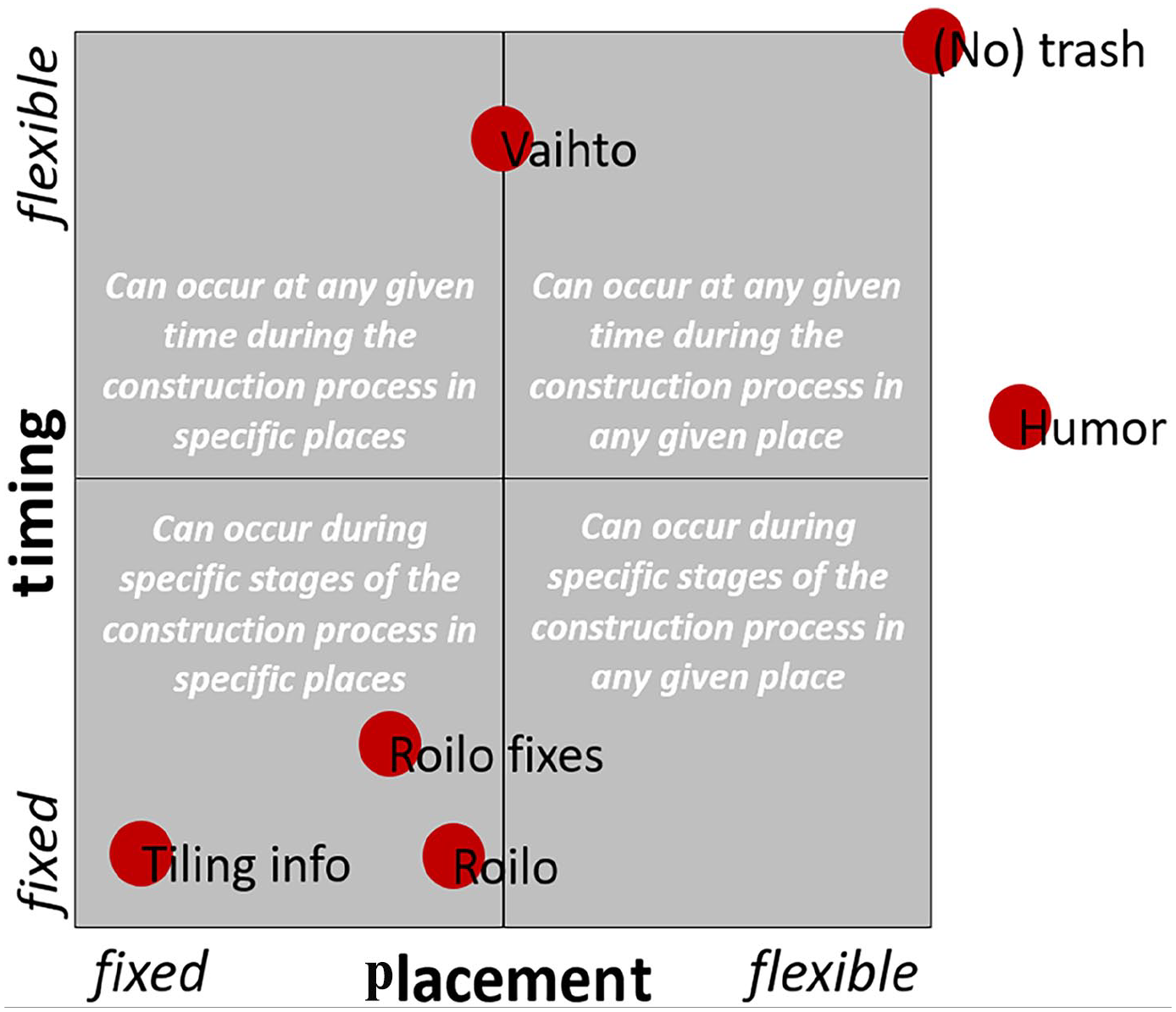
Types of handwritten texts at the construction site in a 2 × 2 matrix: x-axis: placement; y-axis: timing.
In the analysis of each category, we investigate how the manually produced texts are multimodally designed to communicate their meanings in their locations. In addition, we trace the temporal trajectories of some of the texts and show how the meaning of the texts change as the physical environment changes together with the progression of the construction work.
We start from a category of texts about chasing (‘roilo’), both because these texts were among the first ones that were prominent at the construction site and because they are clearly tied to a specific location and task. In addition, the temporal trajectory of the roilo-texts illustrates how the meaning of these multimodal textual objects changes along with the changes in their physical environment and how the texts finally lose their meaning.
We illustrate our findings with a series of images 2 and supply extracts from our fieldnotes where relevant.
‘Roilo’ – chase
The noun roilo/chase is a technical term that refers to ‘a groove or channel cut into an existing layer or substrate to accommodate services such as pipes or cables’ (ConstructionWiki, 2022). The texts in this category were, in early stages of construction, the most pervasive text found at the worksite. They are about a specific type of work, the cutting of chases (‘chasing’). We initially noticed these texts during our first visits at the site when the outer structure of the apartment building was still under construction and all walls inside and out were raw concrete.
The textual objects in this sub-collection always include the Finnish word ROILO, manually written directly on the spot on the wall where the relevant next action, that is, chasing, is supposed to be performed. The ‘roilo’ signs achieve their meaning as a combination of the tall, capitalized letters drawn with bright red (in rare cases black) crayon and their placement directly on the wall where the action of chasing is required. These methods of inscription (Scollon and Scollon, 2003) work toward making the text easily noticeable in their location. They also communicate the urgency of the task. We found that the multimodal text can be designed in two different ways. First, the word ROILO in capital letters can be accompanied by a graphic and lexical specification indexing the trajectory and/or destination of the chase. This is observable in Figure 2 in which the verbal formulation (ROILO KATTORASIALLE/CHASE FOR THE CEILING HOLE; glossing: chase ceiling-hole-ALL) specifies what needs to be done at this specific location. The trajectory of the chase is graphically indexed with an arrow pointing upwards.
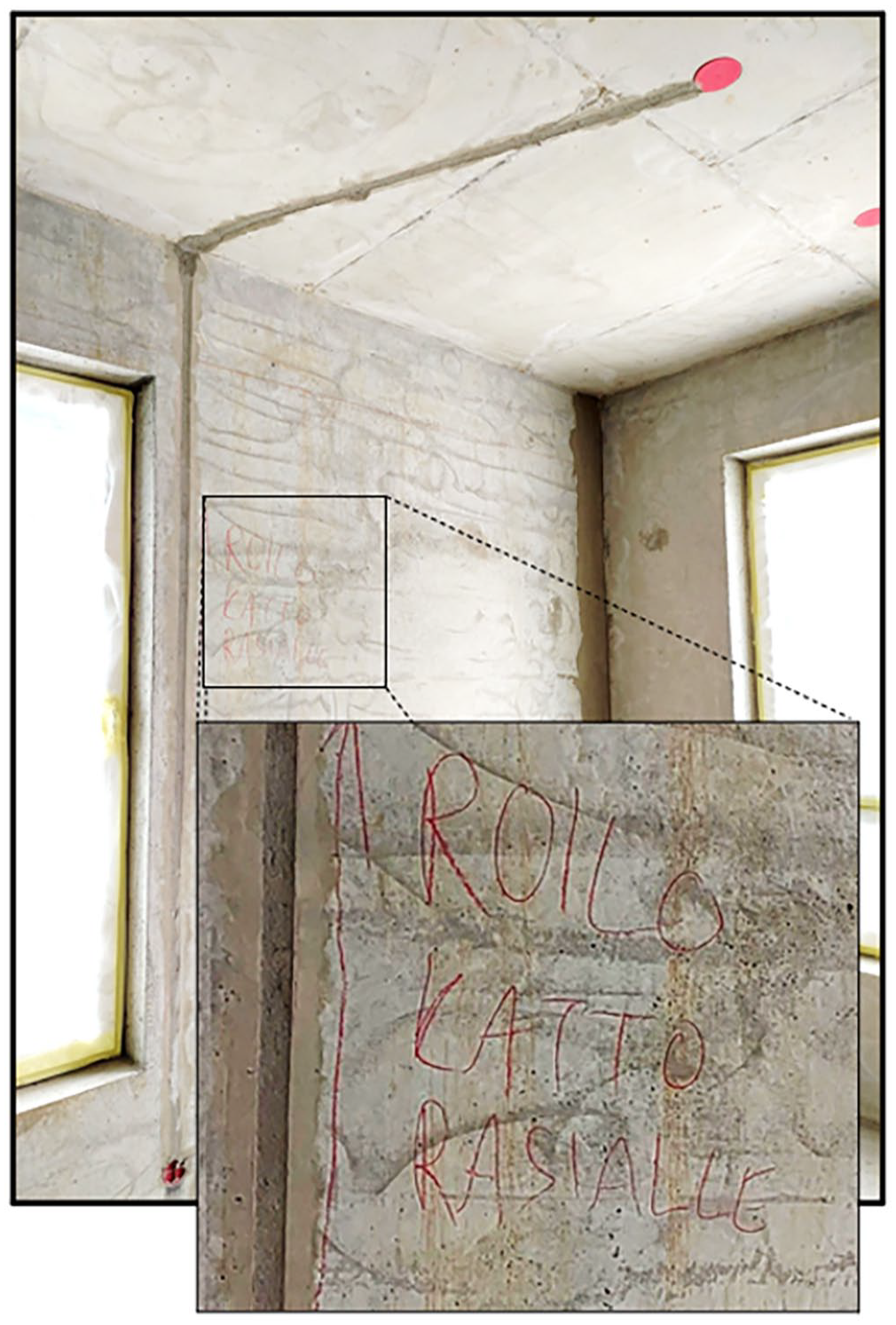
‘Roilo katto rasialle’/’chase for the ceiling hole’ written in red accompanied with an arrow indexing the intended direction of the chase.
Figure 3 exemplifies another instantiation of the same text. In it, the text consists of the noun ROILO written on the ceiling and combined with two arrows that point toward each other from opposite ends of the future chase, thereby indexing a straight line between the two end points. The verbal part of the text thus communicates that a chase is required, and the arrows add specific information about where exactly the chase needs to be cut.
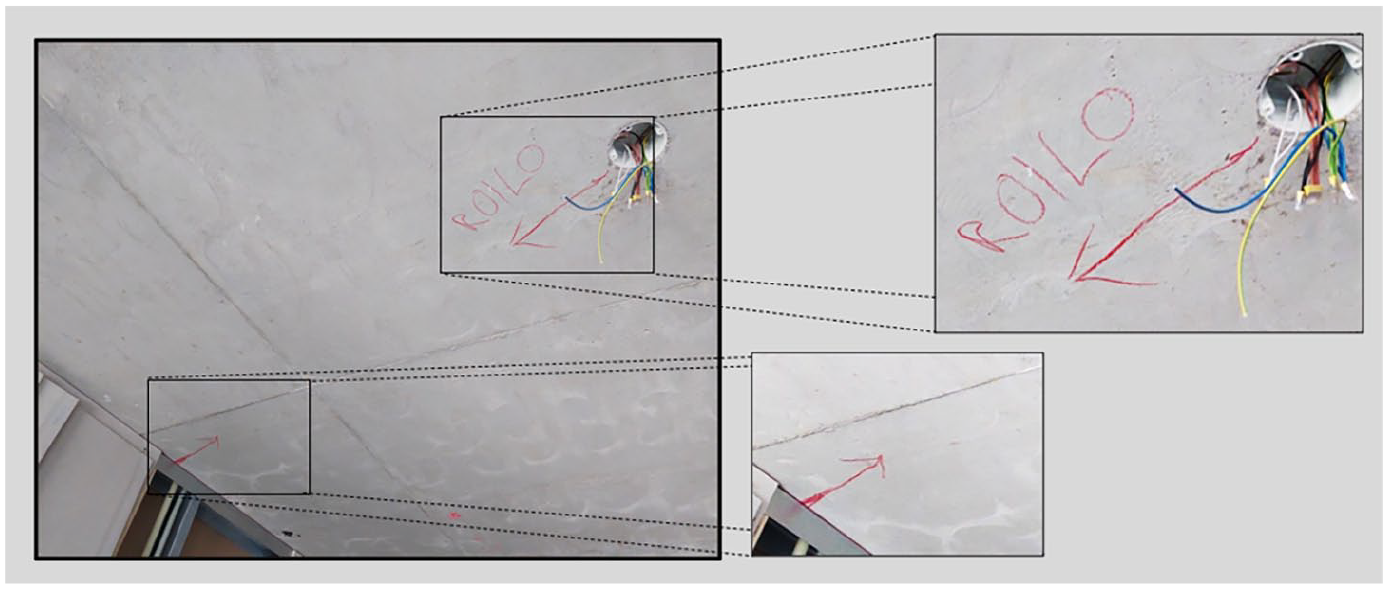
The word ‘ROILO’ and two arrows indexing the intended trajectory of the chase, specifying the way the chasing should be done.
Yet another instantiation is shown in Figure 4 where the iconic drawing, which leads from the top of the wall to two holes in the walls, resembles the shape of the end result of the chase. Also in this case, the noun roilo is added next to the iconic drawing which indicates that the drawing in itself is not necessarily self-explanatory.
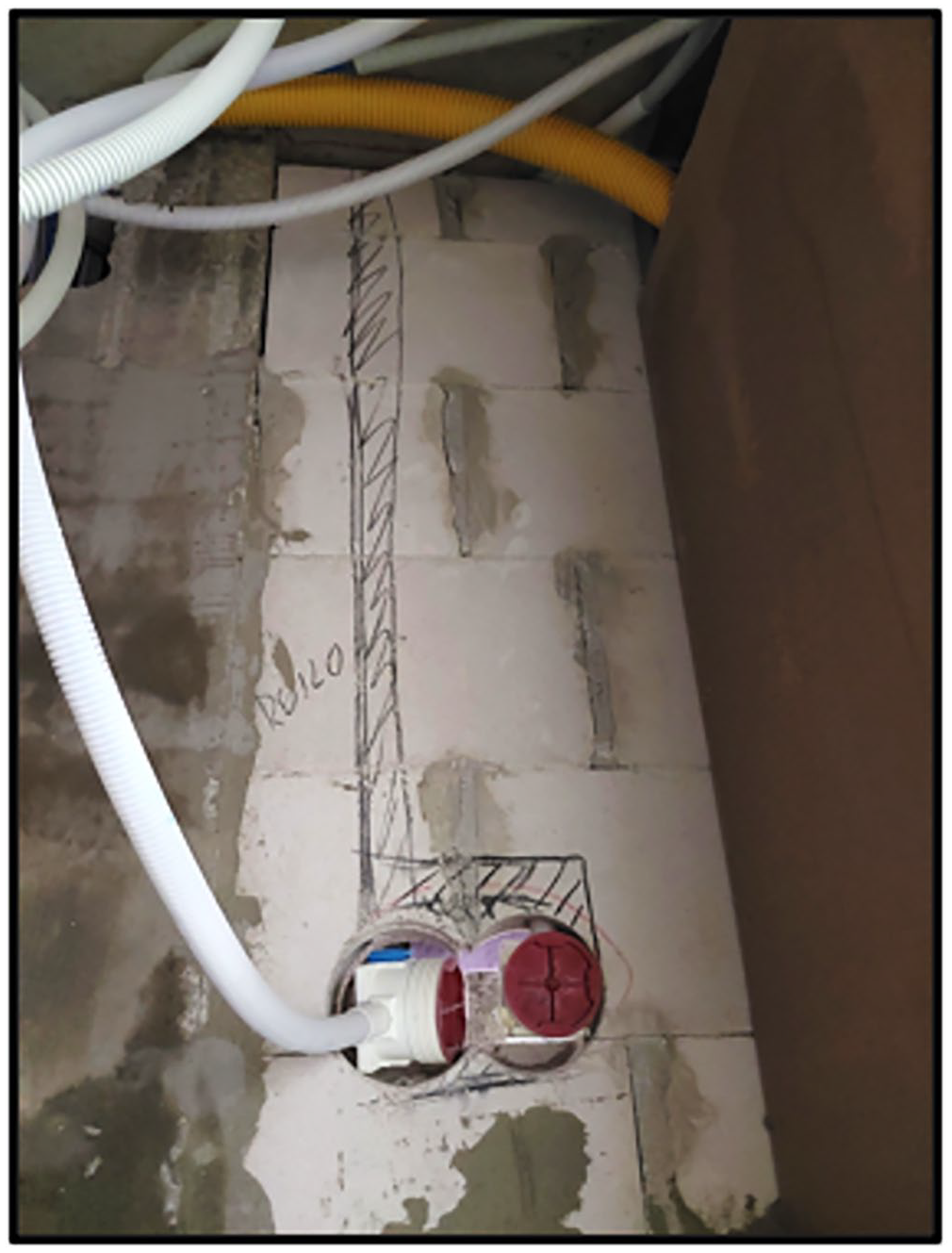
An iconic drawing of a chase accompanies the text.
The textual objects in the ‘roilo’ category are characterized by their emplacement (Scollon and Scollon, 2003) and materiality. The raw concrete walls are semioticized through the prominent writing on them. The medium of inscription (thick red crayon) ensures good visibility through creating a visual contrast to the gray color of the wall. The signs themselves have a ‘scribbled on’ character which indicates only temporary validity of the signs’ meaning. The text is linguistically simple and predominantly consists of the word ‘roilo’ alone. Semiotic complexity is added through indexical and iconic means such as arrows and schematic drawings of the desired chase.
In terms of temporality, the ‘roilo’ collection illustrates how changes in the physical environment caused by the progression of the construction work impact the meaning and validity of the texts. Initially, the multimodal roilo-texts are written on the precast concrete walls on the inside of the building to indicate where chases are supposed to be cut as illustrated in Figure 2 through 4. Next, the chases are usually cut, as can be seen in Figure 5.
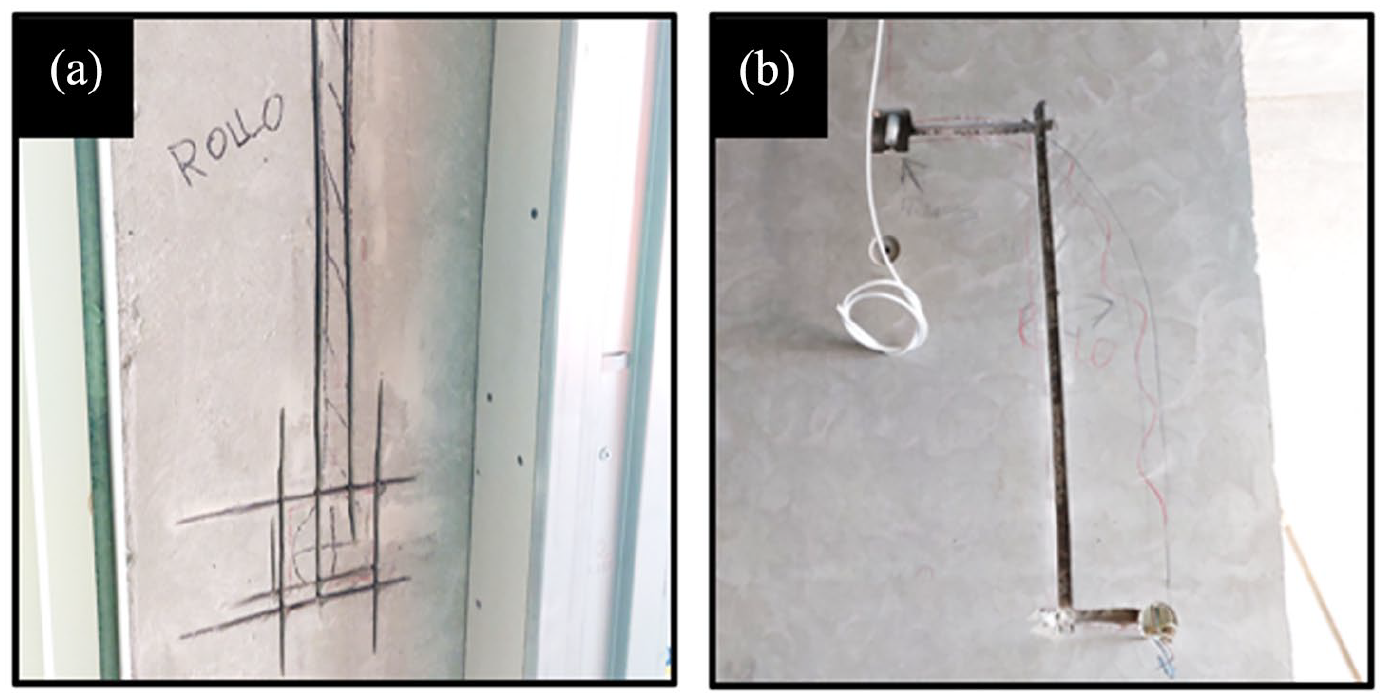
Two stages in the cutting of a chase. (a) Cutting outlines. (b) Chase is hollowed out.
The cutting of the chases shows that someone, that is, another construction worker responsible for chasing, has read the initial multimodal roilo-texts and interpreted them as instructions to do the cutting in the specific location indicated by the multimodal text.
In some cases, the chases are not deep enough for the pipe or electrical conduit to fit and, consequently, the inscription is modified to convey additional meanings. 3 Figure 6 exemplifies a case in which the text syvennä (a second person imperative – ‘make deeper’) is added next to a cut chase and combined with an arrow pointing at the exact spot where reparative measures need to be taken. Temporally, this kind of texts occur only after the chases have been cut (cf. Figure 5). Their meaning is thus connected not only to the location but also to their temporal occurrence in relation to the work phases following each other. Again, the text is written in capital letters predominantly with a red crayon. Red color is visible and easily noticeable on the gray surface, and in this context, it can be analyzed as also having the associate value of communicating the need for a correction in a similar way as the red pencil that teachers use to mark corrections (see Kress and Van Leeuwen, 2002).
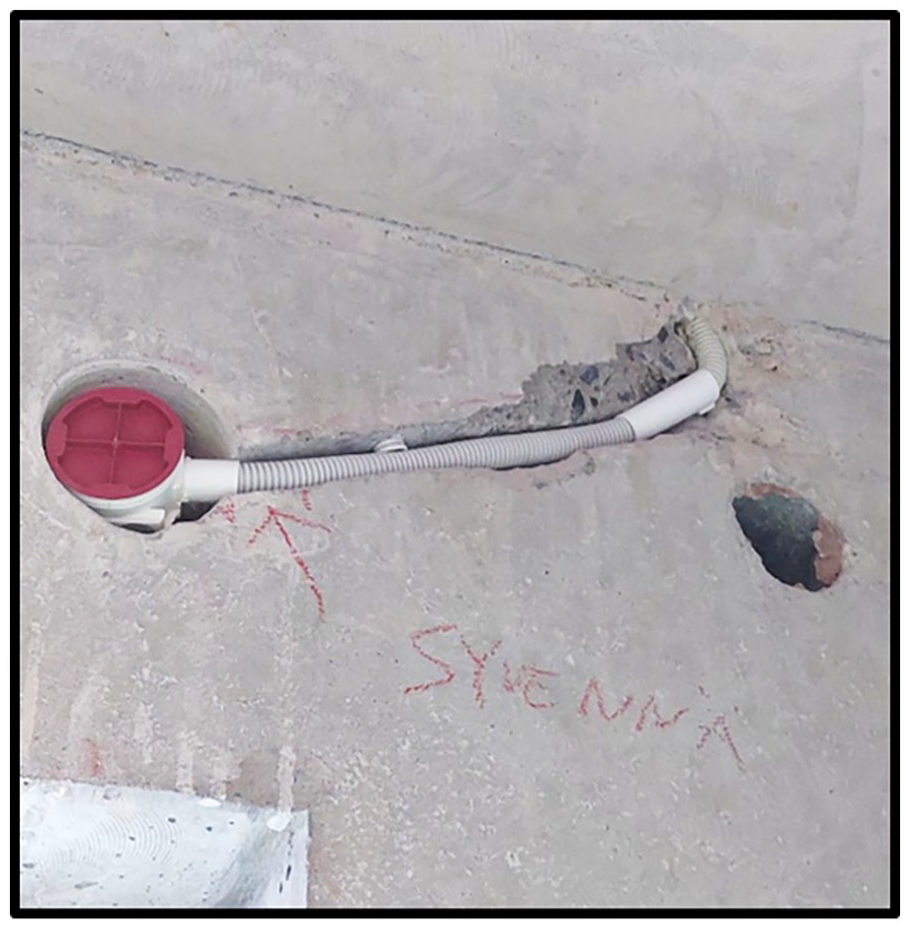
SYVENNÄ/DEEPEN – correction of cut chase. The chase was not deep enough to fit the conduit. The chiseled corrections are clearly visible.
In the next work phase, a pipe or conduit is embedded into the chase (Figure 7a) which is then filled with cement plaster (Figure 7b). At this point, the text begins to lose its meaning as the wall is now once again treated as one solid slab of cement that workers will apply putty and paint to (Figure 7c).
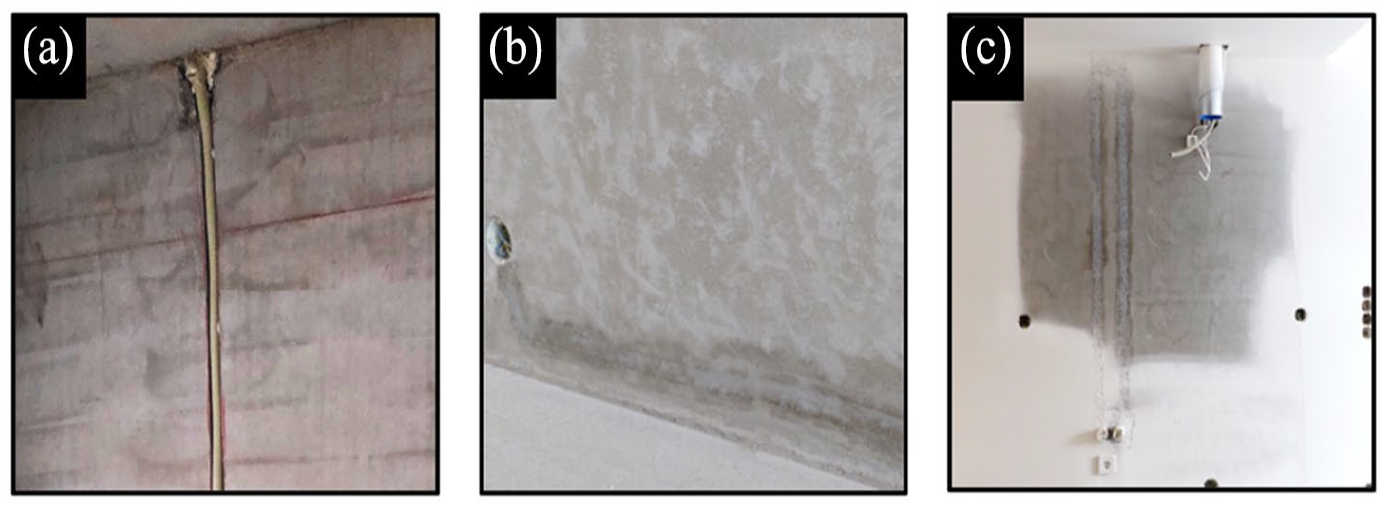
(a) Embedded conduit. (b) Chase filled with cement plaster. (c) Ready chase partly covered with paint.
Once the work task of cutting the chase and inserting a conduit in it is executed, the text loses its meaning even though it might remain visible until the raw concrete walls are treated with a new surface layer.
In sum, the texts in the ROILO category are an example of multimodal textual objects that are connected to a specific type of task (cutting the chase), typical for earlier phases of the construction work. The texts are made visible by combining different methods of inscription, most important of which are the size of the writing and the red color that draws attention. In addition, the texts are located exactly in the spots into which the chases need to be cut. Their instructive force is thus created in combination of their emplacement and the methods of inscription (see Scollon and Scollon, 2003). As the construction progresses and the space changes, the texts also lose their instructive power.
Tiling information
While the inscriptions in the previous category were placed on the surface where the instructed action was intended to take place, the signs in the second category are centralized into one spot at the doorframes of the bathrooms. They are always written in black marker at roughly eye level.
As Figure 8 illustrates, the narrow surface of the inside of the doorframe constitutes a multi-layered and multi-authored record of the work that is done in the bathroom.
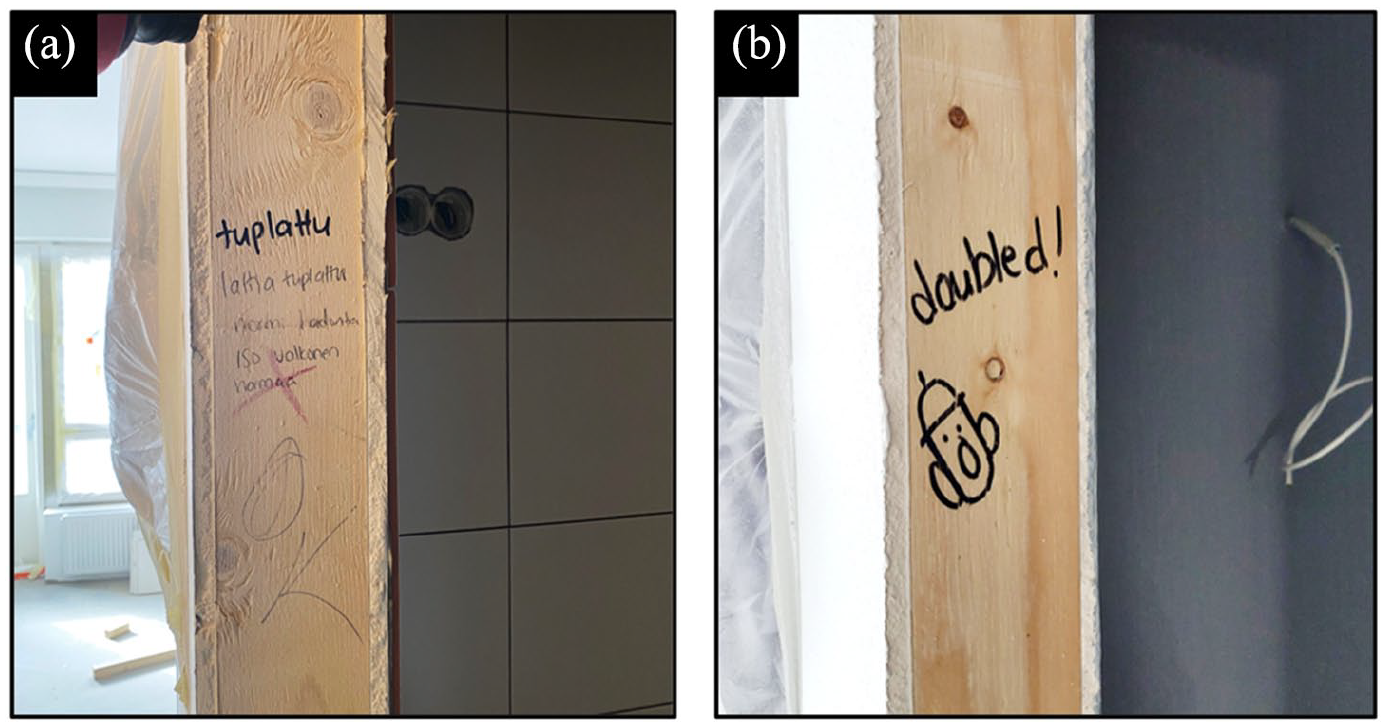
Inscriptions on the inside of bathroom doorframes. (a) Top to bottom: ‘tuplattu’/doubled (referring to waterproofing); ‘lattia tuplattu’/floor doubled (waterproofing); ‘Iso valkoinen harmaa’/large white gray (tiles); OK (walls and floors are evened and ready for further treatment).
The first texts that appeared were the ‘OK’ signs written by the workers who prepared the raw concrete walls for further treatment (cf. Figure 8). In our fieldnotes, 4 we noted:
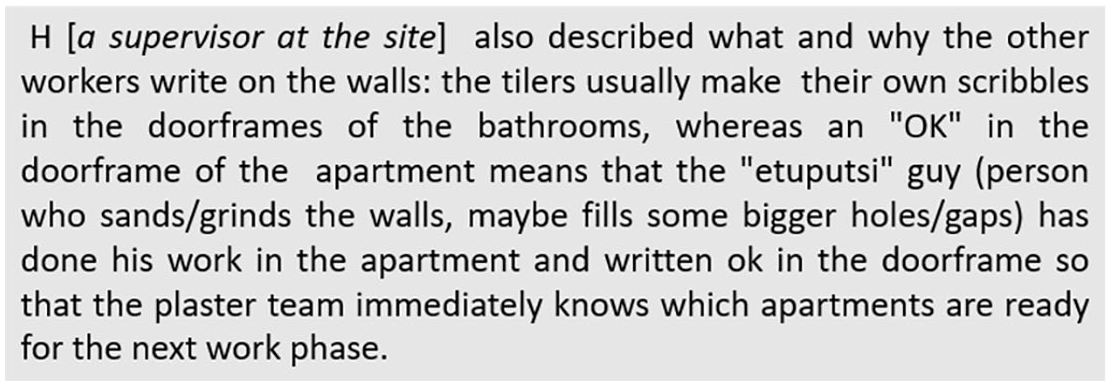
Fieldnotes extract 1: March 17, 2022
The next texts that appeared on the doorframes referred to waterproofing. The linguistic elements in these texts are either nouns or written in passive voice using the verb tuplata/to double (Figure 8a) in past participle tuplattu/doubled indicating that the waterproofing has been done. Linguistically, they are thus not as clearly designed for a recipient as the texts in the ‘roilo’ category that were formulated in second person imperative and addressed to an implied reader, thus building a relationship between the producer and user of the text (Halliday, 2007; see also Kress and Van Leeuwen, 2006). However, for the readers, the texts in this location bring about important information about the completion of a work phase that is not necessarily in the same way observable as the cutting of chases.
After this, the next work phase in the bathrooms consists of tiling the room and preparing it for the installation of plumbing and other bathroom fixtures. The texts that occur in this phase include information about the tile laying pattern that has been decided for each bathroom (e.g., normi ladonta/stack bond, see Figure 9 below) and about the color of the tiles on the wall and floor. The color descriptions contain names of the colors (often harmaa/gray) as well as attributes that often appear in comparative forms (e.g., vaaleampi harmaa/lighter gray) (Figure 9a). The colors are sometimes indicated not with words but with codes referring to certain colors (e.g., 139/112), which implies that the texts are addressed to a reader also familiar with such codes.
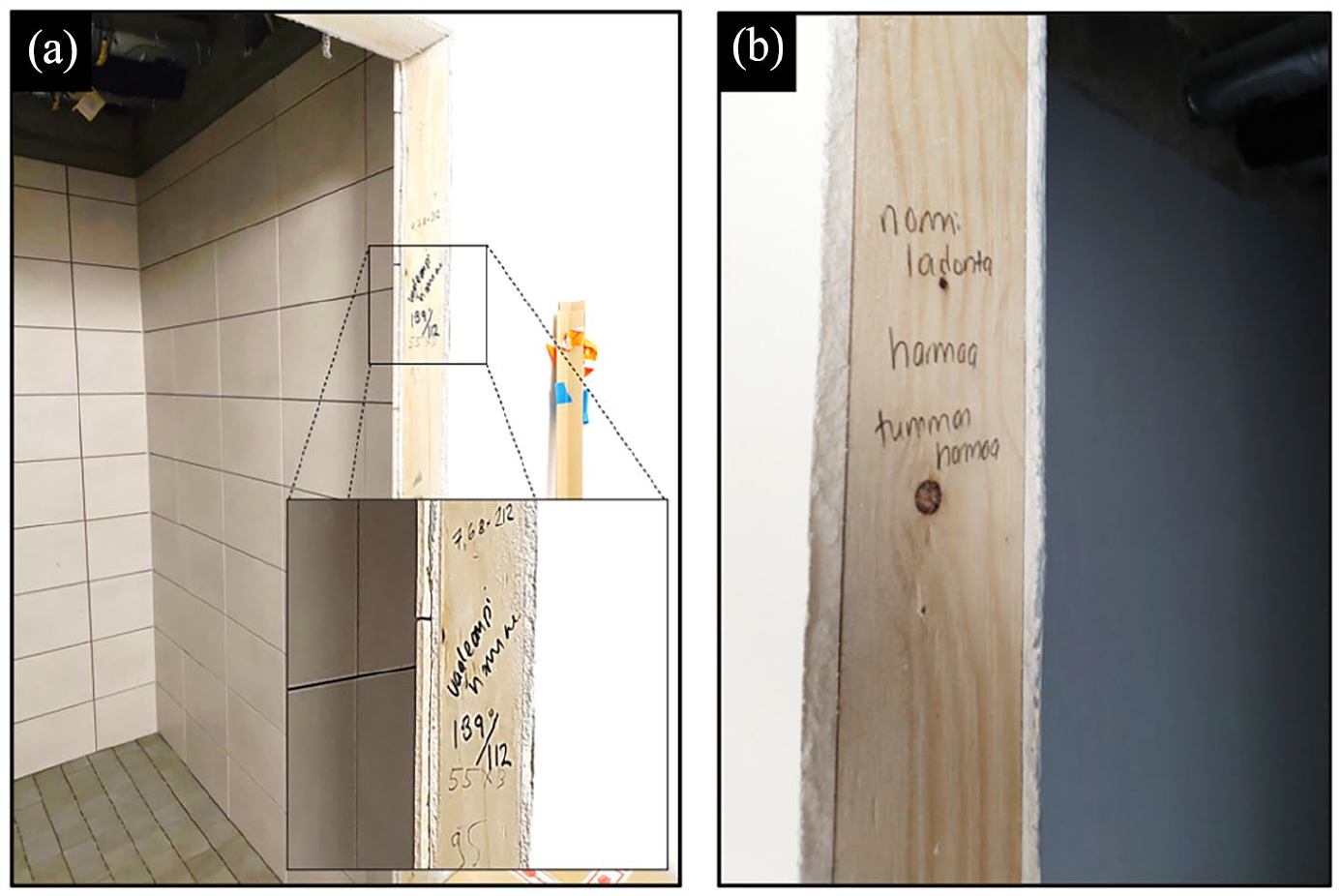
Inscriptions specify the tiles and tile laying pattern for each bathroom. (a) ‘vaaleampi harmaa 139/112’/lighter gray 139/112. (b) ‘normi ladonta; harmaa; tummaa harmaa’/stack bond, gray, dark gray.
Our fieldnotes document a conversation about the texts with the supervisor of the site who informed us that texts are routinely produced as instructions for (groups of) workers who take over after the current work is done (translation after the original):
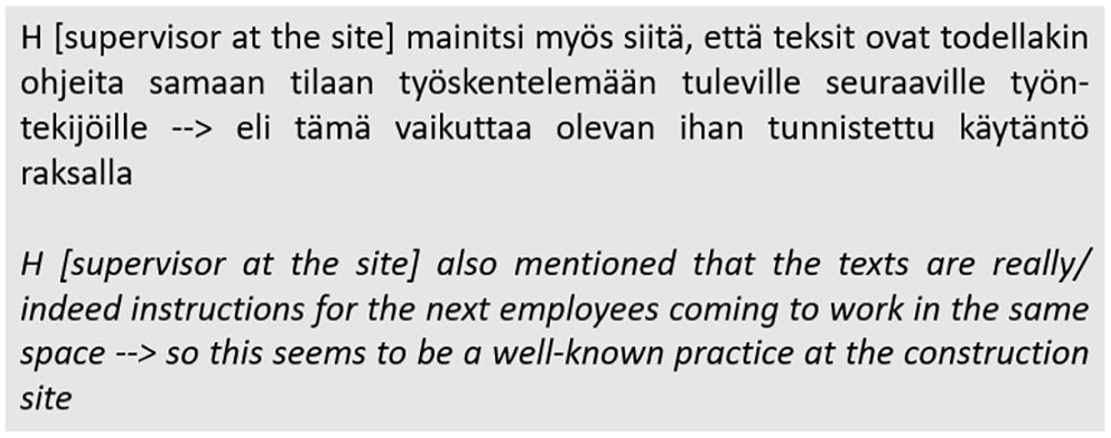
Fieldnotes extract 2: March 17, 2022
All in all, the different texts written on the doorframes thus constitute a practice that communicates information about work phases that have been finished and about materials and practices that should be used for tiling. The texts are a recognized practice for those working with waterproofing and tiling and get their meaning in relation to the placement which is also recognizable for the expert readers. An OK text in some other location could have an entirely different meaning but placed in this location its meaning is clear for those who know about the work practices: the wall and floors are ready for further treatment.
‘Vaihto’ – replacement
With the installation of the first pieces of furniture and technical appliances later in the construction process, the ‘vaihto’ category of texts emerged. There were several subcategories with different linguistic formats; the prevalent linguistic format was the noun VAIHTO/REPLACEMENT written directly on the surface that needs to be replaced.
The materiality of the surfaces on which the texts are produced matters for their meaning potentials (see also Kress and Van Leeuwen, 2006). These texts are written on cracked mirrors and on the damaged doors of kitchen cupboards or drawers. Through their emplacement (Scollon and Scollon, 2003), the texts indicate that there is something noteworthy about these materials – especially because one would not expect to find texts written with permanent markers on such materials. The placement of the text as well as its linguistic design, that is, the noun vaihto/replacement, both communicate that the whole material needs to be replaced. The handwriting gives a hastily produced impression as well, which contributes to the sign’s meaning: This surface needs replacing which includes the textual object along with the indexed damage.
In all cases, the inscriptions are produced with a marker in a color that contrasts with the underlying surface. They may include only the text ‘vaihto’ (Figure 10a) or the text combined with a circle around the damage in the object (Figure 12), thereby indexing the relevant point. In some cases, the texts take the form of a circle only (Figure 10b). Small dents and scratches tend to be circled, which indicates that the circle seeks to highlight the damage on the material.
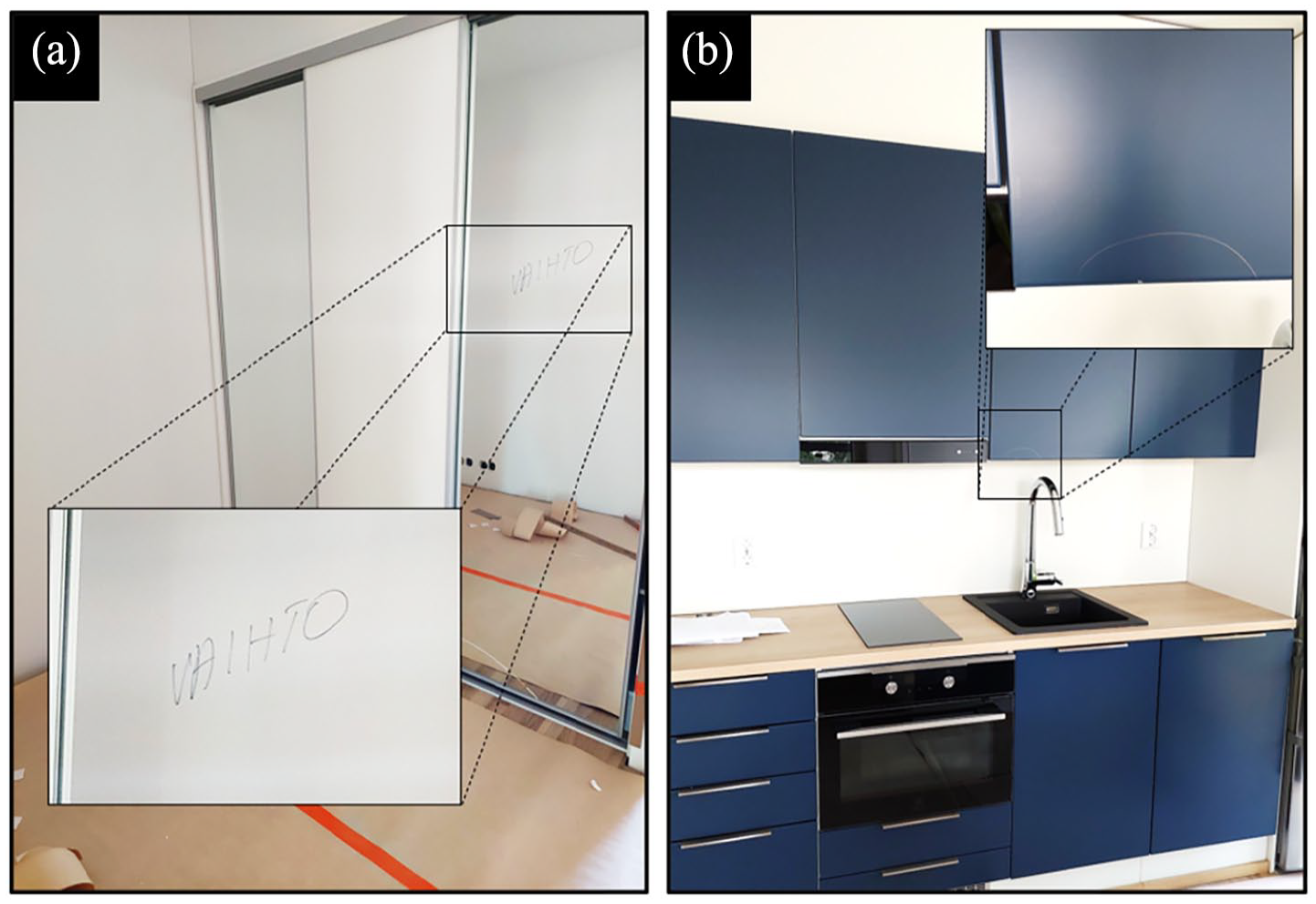
Two variations of marking parts in need of replacement. (a) VAIHTO/REPLACE written on a mirror with black permanent marker. (b) A circle around the damage in a contrasting color (white marker on dark blue background).
Vaihto is the only category in our collection in which handwritten signs co-exist with premade signs (Figure 11). While the handwritten variety is produced in situ and written directly on the respective surface, another, albeit rarely observed, option is to index damage using prefabricated stickers. Interestingly, the sticker is linguistically more elaborate consisting of a full clause (tämä osa vaihdetaan/this part will be replaced). However, both materials of inscription speak to the temporariness of the damaged object. A marker and a sticker are arguably similarly permanent on a finished surface such as a kitchen cabinet and can thus only be removed by replacing the entire cabinet door. The existence of a prefabricated sign indicates that the relevance of and need for this text type has also been recognized at the institutional level or the construction organization (cf. Karlsson, 2006, 2009).
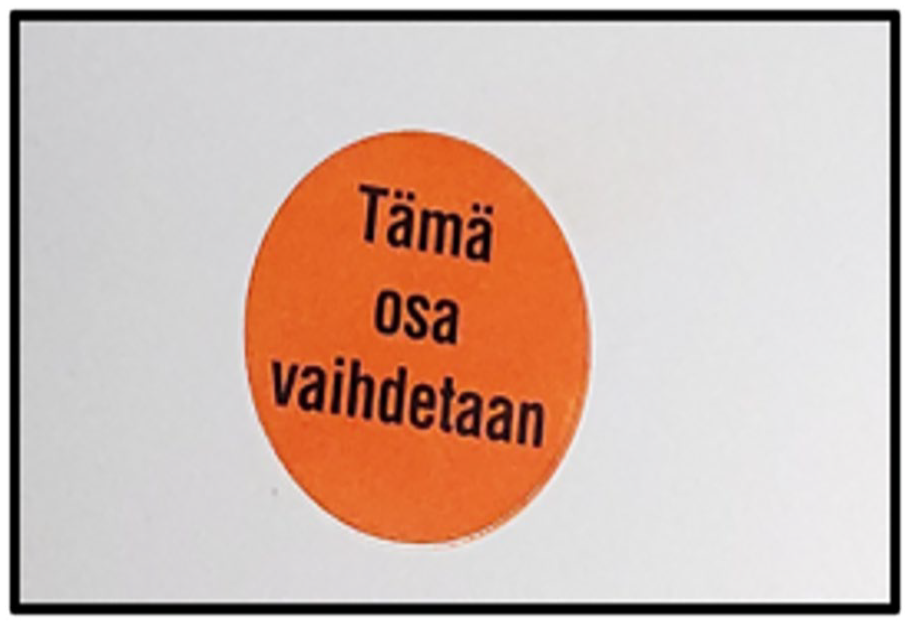
Also premade stickers are used to mark faulty surfaces ‘Tämä osa vaihdetaan’/This part is being replaced.
On April 4, 2022, we noted:
Fieldnotes extract 3: April 4, 2022
The texts in this category were among the texts with the longest longevity. As the extract from the fieldnotes implies, we witnessed the first vaihto texts already before April. The first time we documented the text on the cabinet door depicted in Figure 12 below was on February 17 and the last time on June 30. One reason for this relative long life of vaihto lies in the character of the connected work: At the time the texts are produced, they merely alert the furniture fitters, who are responsible for the installation of the furniture of the faultiness of the marked object. From this point on, the only task that is left to do here is to replace the object in question. As opposed to, for instance, the work we described in relation to the bathrooms, no other work needs to be done here before the final cleaning of the apartment. Therefore, the texts are temporarily less sensitive to next actions but can safely remain in the same spot just until before the final inspection.
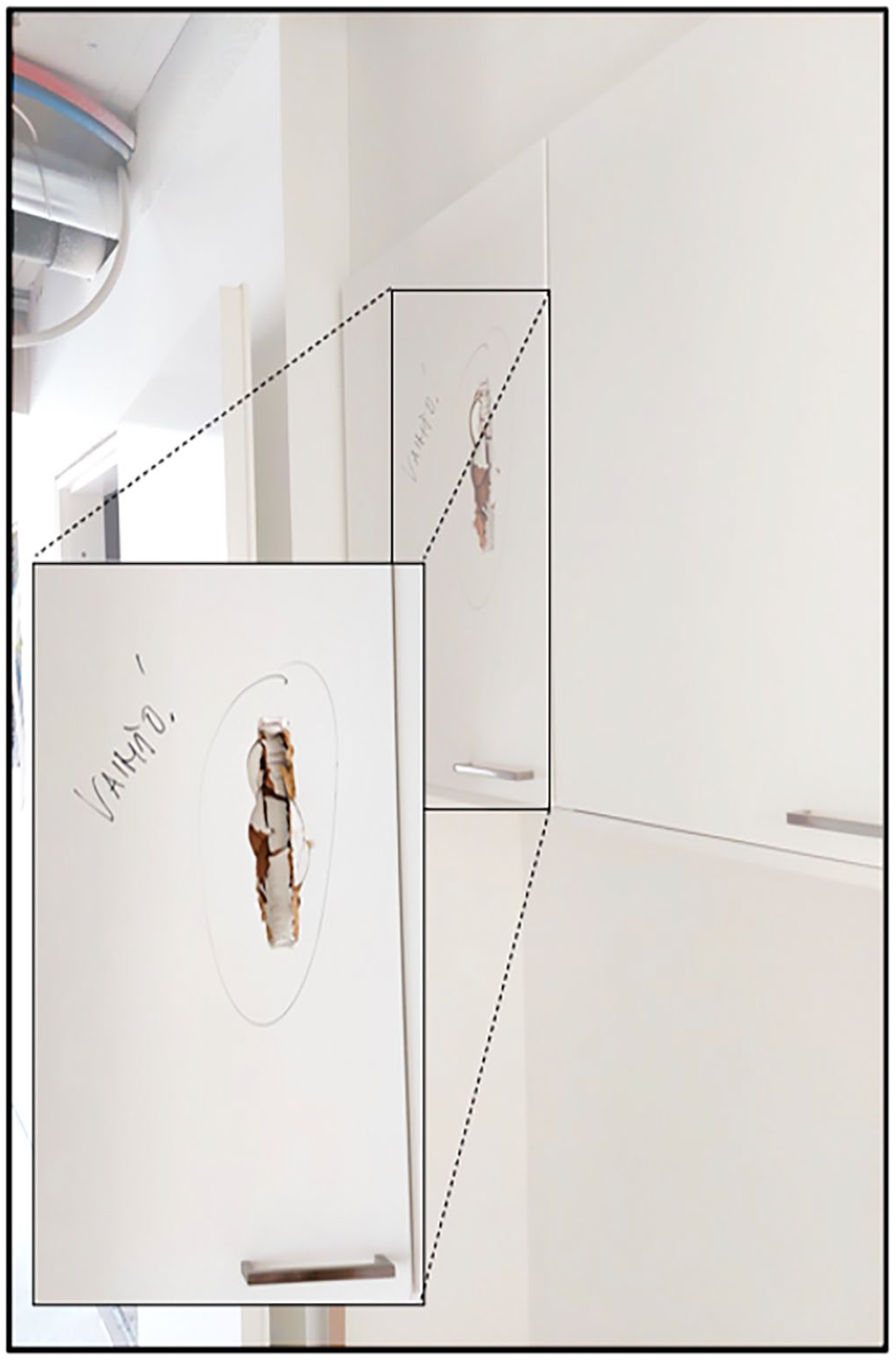
The damaged cabinet door is marked with an exclamation (VAIHTO!/REPLACEMENT!) as well as a circle around the damage. Both signs are produced with the same black permanent marker.
‘(Ei) roska’ – (no) trash
The texts in the previous categories took a major part of their meaning from their placement in the building-in-the-making. In this fourth category, the texts are less place-bound in the strict sense and occur more freely across the space of the construction site. Their meaning potentials are more bound to the inherent properties of the materials the texts are written onto. The texts label the materials either as trash (roska) or as not trash (ei roska). The label often appears on sheets of plasterboards such as templates that may be mistaken for scraps of cardboard. Such materials are often found leaning against a wall or placed in a corner. The placement of the materials as well as their qualities both make it relevant to linguistically label them as being or not being trash. In these cases, the text is always written in sizable letters that are clearly visible on the materials. Sometimes the label is also circled to enhance its visibility (Figure 13a). The texts function as labels as well as instruction. We noted in our fieldnotes that we overheard a site supervisor giving instructions to a group of workers (some of them in training) about removing redundant materials from apartments:
Fieldnotes extract 4: May 19, 2022
The fieldnotes give insights into why such labels on materials are needed: For cleaners who visit the worksite only occasionally, it is not always self-evident which materials are trash and which are still needed for the construction work. The verbal instructions are not always enough to clarify this.
Linguistically, the label ei roska is a combination of the negation word ei and the noun roska/trash. Other labeling variations include other grammatical elements and sometimes also several languages (Figure 13). For example, instead of naming just the category trash, the label sometimes informs explicitly that the object should not be thrown in the trash. In such a case, it is formulated with the noun ‘roska’ in illative case in plural (ei roskiin/not to trash, glossing: no trash-PL-ILL). The same linguistic formulations are used in cases in which the labeled object is meant to be thrown away (roska/roskiin).
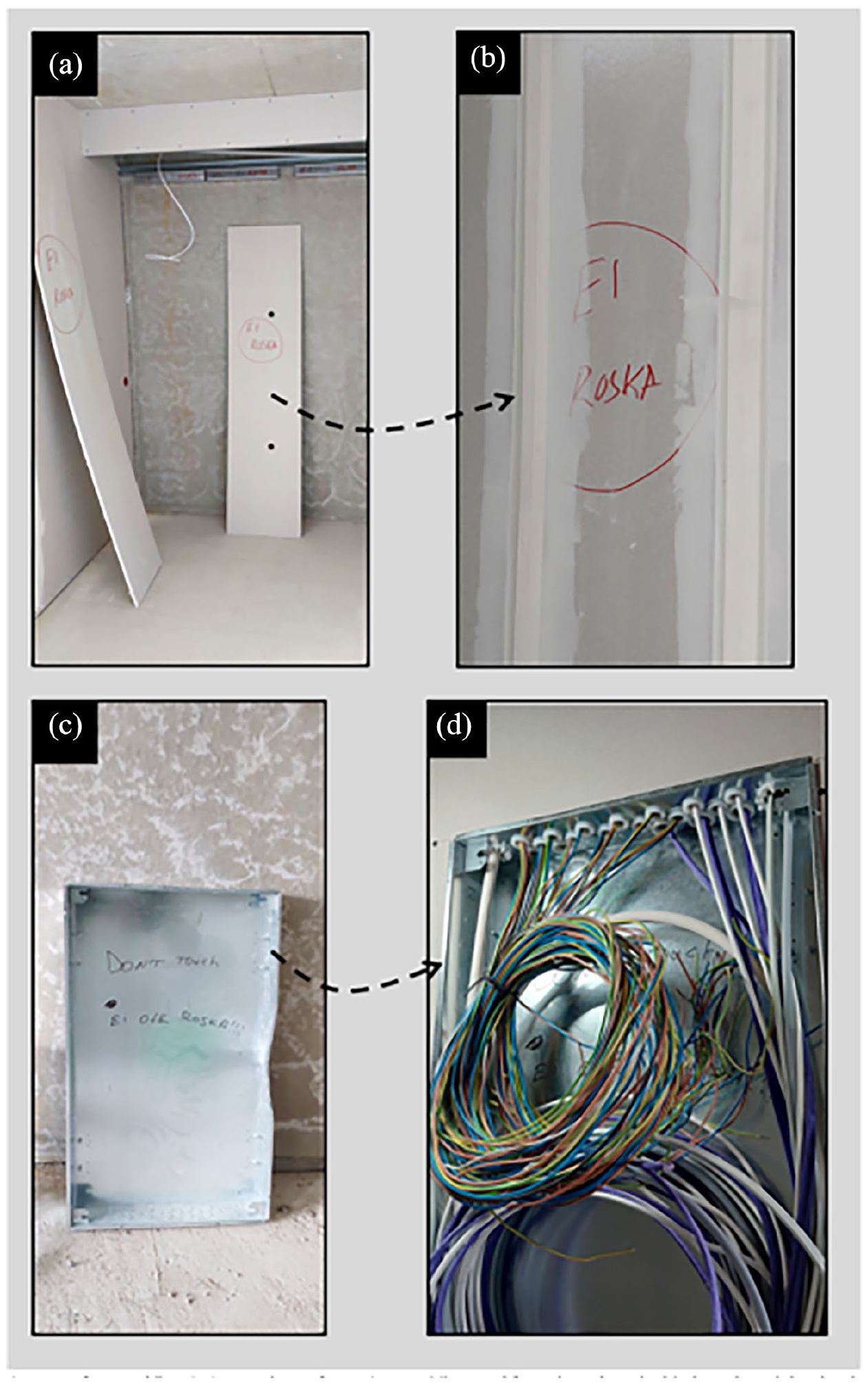
‘No trash’ variations and transformations. (a) ‘No trash’ on plasterboard. (b) Plasterboard that has been integrated into a drywall. (c) Multilingual appeal in English and Finnish. (d) Piece of metal that is now part of a switchboard.
Roska texts occurred especially in the earlier phases of construction when the space was still filled with building materials and the building did not yet resemble an apartment building. The more finished each apartment became, the rarer these texts became. Similar to the categories ‘roilo’ and ‘tiling information’, the ‘(no) trash’ texts lose their meaning over time. Figure 13a to d illustrate how the objects transform from ‘objects that may be mistaken for trash’ to essential elements of an emerging structure. The meaning of these texts thus changes through the progression of the work. Once the material labeled as ‘no trash’ has been installed, it cannot be understood as trash anymore which renders the text meaningless. In this sense, the meaning of the text is very tightly connected to the quality and placement of the material on which it is inscribed (Scollon and Scollon, 2003) and changes its meaning as the function of the material in the construction process changes from a loose object to a part of the construction.
Humor and social banter
During our ethnographic fieldwork, we also observed very creative ways of using the resources of the material environment to produce humorous texts. The humorous texts illustrate the social and interpersonal functions the inscriptions have in the work community (Halliday, 2007). In Figure 14, a worker at the site has added a drawing of a cat to (i) their labeling of a bucket of paint (Figure 14a) as their own and (ii) to a work light that they are reserving for their use (Figure 14c).
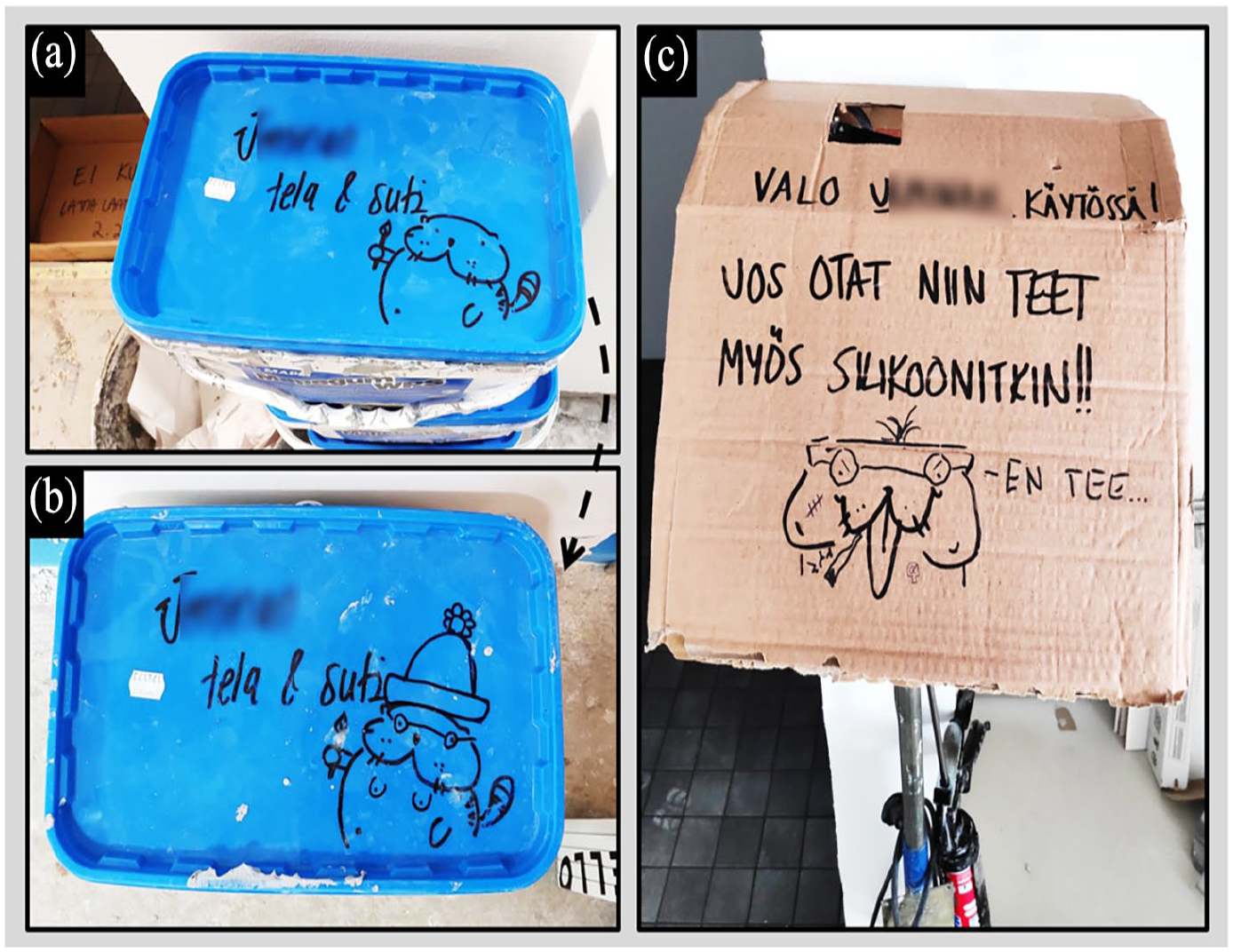
Cat drawings added to a person’s objects: (a) a paint bucket; (c) a work light. Both texts and drawings were expanded on by other people at the site (cf. b).
Figure 14a shows a bucket of paint with the inscription [name-GEN] tela & suti/[name]’s roller and brush accompanied by a drawing of a chubby cat holding a brush. Upon our next visit, the text had remained unchanged while the cat had been elaborated upon, now donning a hat, a pair of glasses, and a pair of teats. Again, the function of the text remains the same while the drawing arguably mitigates the force of the claim of possession. In Figure 14c, the same worker has attached a piece of cardboard to a work light stating that the light is in their use (VALO [NAME-GEN] KÄYTÖSSÄ!/LIGHT IN [NAME]’S USE!). In addition, the person included a conditional stating that the person who (unrightfully) takes the light would also have to do the work that the light was intended for (JOS OTAT NIIN TEET MYÖS SILIKOONITKIN!!/IF YOU TAKE IT THEN YOU ALSO DO THE SILICONE WORK!!). This text is accompanied by the face of a chubby cat as well. At the point when we saw it at the site, it had already been ‘worked on’ by a co-worker, who added glasses, hair, scars, and a cigarette to the cat’s head. On top of that, the words EN TEE. . ./I WON’T DO. . . were added, which appear as a reply to the conditional as spoken by the cat.
The final example (Figure 15) is a humorous text that garnered high degrees of participation from people at the site, partly due to its polarizing content, partly because of its prominent placement in the physical environment. Over several weeks of our ethnographic fieldwork, we tracked the development of a textual object in a central staircase which many workers used many times per day and thus many people were exposed to every day. This exposure led to a high degree of interaction around the textual object. As visible in Figure 15, the plastic tarp in front of a window in the staircase was augmented with the logo of a local ice hockey club. The first documentation of the textual object happened on February 24, 2022. The size of the ‘canvas’ as well as the drawing tool afford a larger scale drawing. As a logo of a local club, the sign’s semiotics are rather decontextualized. Considering the (local) rivalry between ice hockey loyalists that we witnessed in form of numerous overheard conversations about past matches as well as signs of allegiance (prominently in the form of stickers, keychains, hats, and other paraphernalia), a debate was to be expected following such prominent and blatant statement of one individual’s adherence. At the point where we saw the logo for the first time, someone else had already added a comment on the right expressing amusement (Figure 15a). The interactional character of this type of a textual object is observable in that it kept changing as workers added things to it and kept modifying it. Upon our next visit on March 10, a number of people had added in black marker:
The word NOLOA/EMBARRASSING (15b – A)
Preference for the local rival club (15b – B)
A mention of another club across the original logo (15b – C)
Parentheses around the logo (15b – D)
In addition, someone had, in red marker, crossed out everything related to other clubs (Figure 15b – D). Within the following week, another, this time written, mention of the original club appeared (March 17, Figure 15c). The following week, we were surprised to find the discussion had come to an end: We heard from a few workers that a supervisor had taken it into their hands to end the discussion and had literally cut out the controversy leaving only fragments of the dialogue intact (Figure 15d). After that, the site of the banter about ice hockey allegiances had gone out of existence.
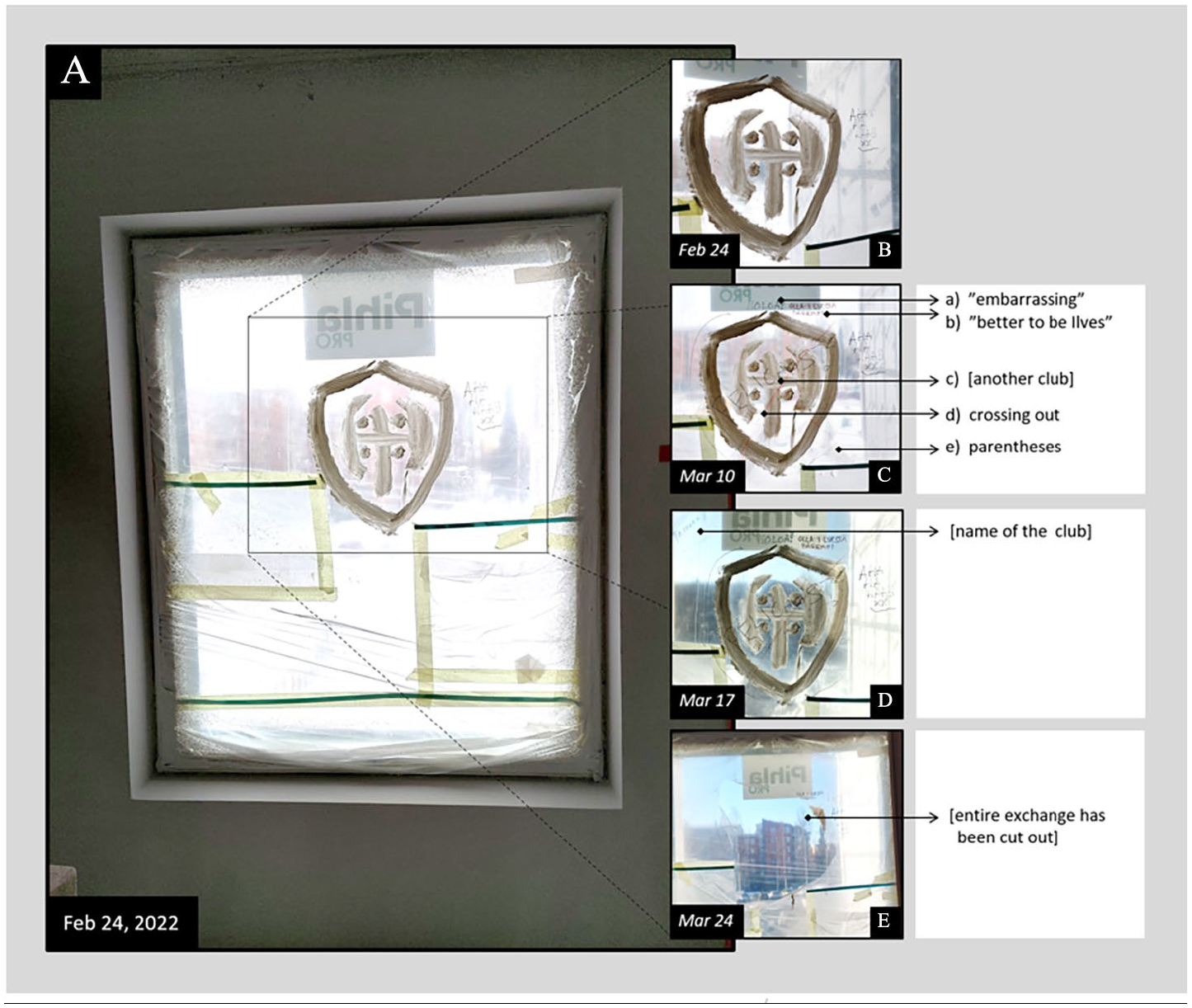
Ice hockey related banter on publicly placed tarp and its temporal development.
We talked about the drawing of the ice hockey logo with the workers several times. The next field note comes from the end of March. That time, the logo had already been cut out (translation after original).
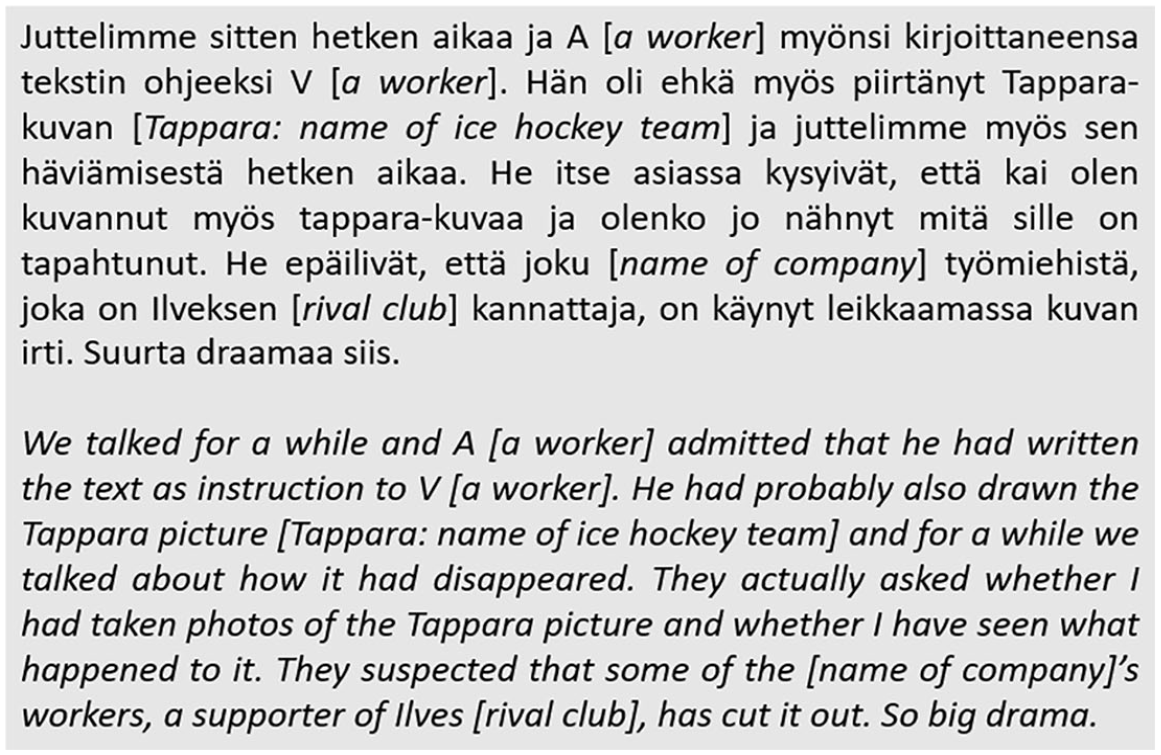
Fieldnotes extract 5: March 24, 2022
The fieldnote also illustrates the workers’ social investment in the text and their eagerness to talk to us and discuss the surrounding debate. In this particular case, however, no one could provide any concrete evidence as to where the text had originated and what had happened to it in the meantime.
These examples illustrate the significance of the physical environment and material resources, and with it the impact of public availability of the object. These publicly posted signs are treated as an invitation to engage in friendly banter across occupations which is carried on asynchronously and at least partly anonymously. With that, it is an example of the role of the texts in creating workplace culture. Previous research on humorous language use in workplace settings has shown how humor can contribute to maintaining harmony and solidarity between the workers (Holmes and Marra, 2006) and to constructing positive workplace relationships. The texts do not keep their significance forever but instead, they are rendered irrelevant as the time goes by, as was observable quite brutally in the ice hockey example.
Summary and discussion
In this paper, we have analyzed handwritten textual objects found at a construction site. We divided the texts into five categories based on where they appeared in the building-in-the-making and when during the construction project. As Scollon and Scollon (2003) observe, a sign ‘only has meaning because of where it is placed in the world’ (p. 29). We hope to have shown that both the placement and the timing of the multimodal texts in the building in the making is crucial for how they achieve their meaning. The texts we have analyzed are inextricably bound to the places in which they occur and the materials they are written on. We have shown for example how the texts that instruct the cutting of chases get their meaning in relation to their location. In addition, the meaning is constructed multimodally, in the interplay of lexical and graphic elements such as arrows indicating where exactly a chase should be cut.
We have shown how the handwritten textual objects instruct the next phases of the work by leaving a permanent mark on the respective surface that designates the work that needs to be done (or has already been done as in the waterproofing example). In close interplay with the placement, we also analyzed the temporal trajectories of the texts in their locations. Looking at the scale of the textual objects and their development over time, we observed that, in time with the progression of the construction, the texts generally went from large fonts written in crayon and broad marker on coarse materials such as concrete elements to typically smaller-scale writing in fine marker or pencil. This observation goes hand in hand with the observation that the textual objects are usually relevant to one specific step in the work or another concrete step in the construction process. For instance, whereas roilo referred to large chases across large sections of the concrete walls, vaihto quietly drew attention to small faults in cabinet doors that needed to be pointed out and be replaced toward the end of the construction work.
We analyzed the multimodal design of the texts and showed that the handwritten texts are short and rarely contain full clauses. Some texts are more explicitly designed for a recipient, such as the texts in the roilo/chase category that were formulated as directives using second person imperatives. In other cases, like in the tiling information category, the texts were formulated as a description of the current state of the work process or consisted of very specific information about the colors to be used indicated with professional codes.
The intertwinement of text and location was also observable in the texts written directly on specific items labelling some items as trash or not trash. These in-situ produced texts are more permanent than the spoken word and carry meaning across time. At the same time, they are evanescent in the sense that they lose their communicative meaning as soon as a specific step in the construction has been initiated or accomplished. This was clearly observable in the case of the roilo (chase) text where the current work phase is clearly observable. When the chase has been cut, the initial instruction about where it should be cut is not relevant anymore. In some instances, like in the case of preparing the walls and floors for tiling it is not as clear when the work has been finished. In these cases, verbal information is needed to inform colleagues that they may continue with the next phases of the work, as in the texts placed on the doorframes of the bathrooms.
Tracing the texts and their environments’ development over time has also shown us how changes in the physical environment impact the texts and their validity as an instruction (see also Scollon and Scollon, 2003). Essentially, the timing of the texts’ production, their placement as well as existence in a specific time and space in the construction process are much more tightly intertwined than, for instance, a supervisor’s note on their door is.
All in all, our analysis has contributed to the knowledge about the use of language in manual and physical types of work at construction sites. Even if language and texts may not have as noticeable roles in manual work as they have in language-based professions, they hold an important role in guiding the next stages of the work and in communicating things to co-workers they should be aware of or (not) do (see also Hovens, 2023; Karlsson, 2006). Getting to know the unique linguistic and semiotic landscape of the construction context helps to understand how texts are used to organize work practices that have traditionally been characterized as ‘language-marginal’ (McAll, 2003; on linguistic and semiotic landscapes, see Jaworski and Thurlow, 2010). Along with more institutionalized texts with rule-based conventions that are recognized by everyone at the site (cf. Karlsson, 2006), we hope to have shown that manually, in situ produced textual objects play a crucial role in organizing the professional as well as social aspects of construction work.
The textual objects we have analyzed are a literacy practice that may not be observable for researchers without longitudinal ethnographic work. We would not have become aware of the texts had we not spent a lot of time observing and documenting the work practices at the specific site. The texts are such an integral part of the work that they may easily go unnoticed. In addition, they are written by the workers ‘on the floor’ and lack institutional recognition. The fact that no one mentioned handwritten texts to us when we asked about practices at the workplace without prompting suggests that the workers are not explicitly aware of this practice as it is so mundane to them. We noticed the texts because of our longitudinal team ethnographic work that was inspired by the ethnomethodological interest in understanding how the construction workers go about their everyday work. In collecting the data, we repeatedly made observations and took photos of the everyday practices that were not necessarily in any way special or striking. This focus on the mundane allowed us to make observations of the textual practices described and analyzed in this paper. Methodologically, our analysis thus emphasizes the importance of longitudinal and visually-based research designs in analyzing the language practices of manual and physical work. In addition, our analysis highlights how important it is to get to know the logic of the work and its organization to be able to understand what functions language practices in general, and different types of texts, in particular, have for the work practices. The language and literacy practice are tightly connected to the organization of the work and can only be understood in relation to them.
Footnotes
Author contributions
Nathalie Schümchen: Conceptualization, methodology, analysis, investigation, data curation, writing (original draft and review/editing), visualization. Niina Lilja: Conceptualization, methodology, analysis, investigation, resources, data curation, writing (original draft and review/editing), supervision, project administration, funding acquisition.
Declaration of conflicting interests
This project has been funded by the Research Council of Finland (previously Academy of Finland). Decision number: 332470.
Funding
The author(s) received no financial support for the research, authorship, and/or publication of this article.