




Abstract
Multicommunication is a form of multitasking that involves engaging in two or more interactional activities simultaneously. Technological features of mediated communication make multicommunication more practical, yet it is questioned whether the quality of our interactions is upheld when interpersonal engagement is split. This paper addresses this concern by asking whether interactional techniques are employed by multicommunicators in the context of Facebook and what this means for the quality of our online interactions. Building on previous multicommunication research, this paper examines how multicommunication is managed behind the screen: that is, how interlocutors move between overlapping conversations rather than the organisation within conversations themselves. In doing this, this paper extends the Goffmanian concept of ‘participatory roles’, arguing that multicommunicators adopt the role of a ‘manager’ to move between numerous conversation threads. Through presenting screen capture data of Facebook Messenger interactions, and drawing on micro analytic methods, it is revealed how Facebook users work to simplify their interactions when multicommunicating whilst simultaneously preserving interactional complexity.
Keywords
Introduction
There has long been debate surrounding whether the proliferation of online technologies supports or impedes our everyday interactions. Although opportunities for interaction are identified, such as the editability of messages, scholars and popular media have argued how our online technologies are contributing to the declining quality of our conversations (see The Guardian, 2012; Turkle, 2011). One concern is that interactions on online platforms are ‘reduced’. Turkle (2011), for example, highlighted how we ‘flatten out what we say to each other’ in new ‘reductive’ ways on digital platforms indicating that the very content of our talk is declining in quality (p. 280). Defining quality in interaction can be approached in various ways. It can be measured in time, length or form, for example a Facebook ‘like’ is more reductive than a typed-out message (Ditchfield, 2020). This article, however, approaches quality through the Goffmanian notion of the interactional order: the idea that ‘interaction is entwined with rules and rituals that set expectations around the most appropriate ways to behave’ (Ditchfield, 2020: 928). Quality, understood in this way, is synonymous with maintaining interactional order and adhering to the rules and rituals that encapsulate what it means to be appropriate in social encounters. This article explores what the interactive behaviour of multicommunication, that is engaging in more than one online conversation at the same time, can tell us about the interactional order of our online interactions.
Multicommunication is a form of multitasking which involves engaging in two or more interactional activities simultaneously. Multitasking is closely linked to declining quality with suggestions that it ‘causes cognitive overload, impedes concentration, or distracts and creates stress’ (Haddington et al., 2014: 4). Multicommunication is argued to be an especially complex form of multitasking as it requires ‘people to switch roles and adjust to various audiences’ something non interactional multitasking does not require (Stephens et al., 2012: 25). In face to face interactions, splitting attention across numerous conversations would challenge interactional expectations. When discussing Goffman’s ritual requirements for interaction, for example, Kendon speaks of interlocutors ‘jointly agreeing’ to operate as ‘sole communication nodes’ who ‘make themselves fully available for that purpose’ (p. 15). Online, however, the technological features of textually mediated interaction change the context in which interlocutors work. Online, typed, interactions (e.g. Facebook Messenger chats) allow for: (1) textual persistence meaning messages remain visible and can be re-read, (2) separated message construction and sending allowing for an extended time lag between utterances and (3) compartmentalisation allowing for multiple interactions to remain separated. Such features make the practical side of multicommunicating easier to navigate through lessening overlaps, aiding memory and buying time (Ditchfield and Lunt, 2021; Reinsch et al., 2008). Despite this, the challenge of ‘switching roles’ and ‘adjusting to various audiences’ still exists and scholars have still questioned whether the quality of our interactions can be upheld when interlocutors split their interpersonal engagement, even within these online mediated contexts (Baron, 2008).
Multicommunication has been studied from various angles including tolerance to multicommunication in the workplace (Reinsch et al., 2008) and accounts of multicommunication on instant messenger technologies (Baron, 2008). Scholars have also explored multicommunication from an interactionist perspective asking what interactional techniques are employed when individuals engage in simultaneous face to face and mediated interactions (Didomenico et al., 2018; Licoppe and Tuncer, 2014). These studies have looked at multicommunication in non, or semi, compartmentalised settings. This refers to contexts where all (or some) of the interlocutors involved are potentially privy to the fact that more than one interaction is occurring, for example responding to a text message whilst engaged in a face to face conversation. Multicommunication that occurs within online spaces, like Facebook Messenger, is different as textual interactions here are all compartmentalised. This means that interactions are contained to separate threads with interactants being unaware of what is occurring outside of their specific thread boundaries. This changes the nature of what organising multiple interactions looks like. In the context of Licoppe and Tuncer (2014) and Didomenico et al. (2018), multicommunication was something that needed to be managed and attended to within the course of the interaction itself. On Facebook, however, an individual’s interactional partners do not necessarily know that multicommunication is taking place. In this way, multicommunication on Facebook is not necessarily a performative act and is instead something that is managed behind the screen, rather than within the content, of their social media conversations. It is this element of multicommunication that has received considerably less scholarly attention: the organisation of multicommunication between overlapping conversations instead of within.
Interactional work that occurs behind the screen of social media interactions has been referred to as the pre post space: a space where social media users prepare interactions away from the gaze of their audiences (Ditchfield, 2020). This work has focused on the performative element of the pre post space of interaction, for example how users construct their identities before sending messages to intended recipients. This article extends the study of pre-post interactional work to include the organisation of multiple conversations focusing on how Facebook users organise numerous, overlapping interactions within platform boundaries. Textually mediated (e.g. messages, comments, status updates) interactions on Facebook are not the only form of interaction where multicommunication can arise in a completely compartmentalised manner. Other textually mediated spaces, be that email or alternative social media platforms, would also afford this (for further discussion see Ditchfield and Lunt, 2021). This article therefore uses Facebook as an example of compartmentalised multicommunication to investigate the underexplored ‘behind the screen’ or ‘pre-post’ dimension to multicommunication.
This paper draws on and extends the Goffmanian concept of ‘participatory roles’ to understand how multicommunciation is organised in a compartmentalised mediated context. Its asks whether interactional techniques are employed by multicommunicators to manage overlapping, simultaneous conversations despite features such as persistent text and compartmentalisation making multicommunication more practical. Through the use of screen capture software to record real time interactions, this paper presents a micro analysis of instances of multicommunication on Facebook showing how users engage in strategies of simplification whilst simultaneously preserving interactional complexity. In doing this, it reveals an additional layer to sequential ordering present when multicommunicating online and draws attention to the important interactional work that occurs ‘behind the screen’ and away from the gaze of social media users audiences.
Multicommunicating on Facebook: Temporal organisation and involvements
The compartmentalised nature of interactions on Facebook not only means that multicommunication becomes something to manage behind the screen but also that the temporal organisation of the multiple conversations takes on a different form to other multitasking. When understanding the temporal structure of engaging in multitasking scholars have noted how tasks are organised in a simultaneous order meaning that activities are attended to in an overlapping time frame. This is in contrast to a successive order where activities are queued and organised one after another (see Mondada, 2014). What order is ultimately adopted depends on the availability of resources. Mondada, for example, focuses on multitasking in a face to face context exploring how surgeons operate on patients whilst recordings demonstrations for teaching. Here, simultaneous multiactivity can occur as surgeons engage in both oral (speaking about the operation) and physical (conducting the operation) activities at the same time meaning resources can be used in a combined fashion.
Engaging in multiple conversations on Facebook, however, requires the same resources, for example the one screen or keyboard that is available. Mondada (2014) highlights how ‘as soon as the same modality is used in the two different courses of action, the participants have to switch from a simultaneous mode to a successive mode’ (p. 38). In this way, ‘multicommunication on Facebook is technically organised successively as users cannot physically respond to more than one message at the same time’ (Ditchfield and Lunt, 2021: 128). However, what is observed is something more hybrid.
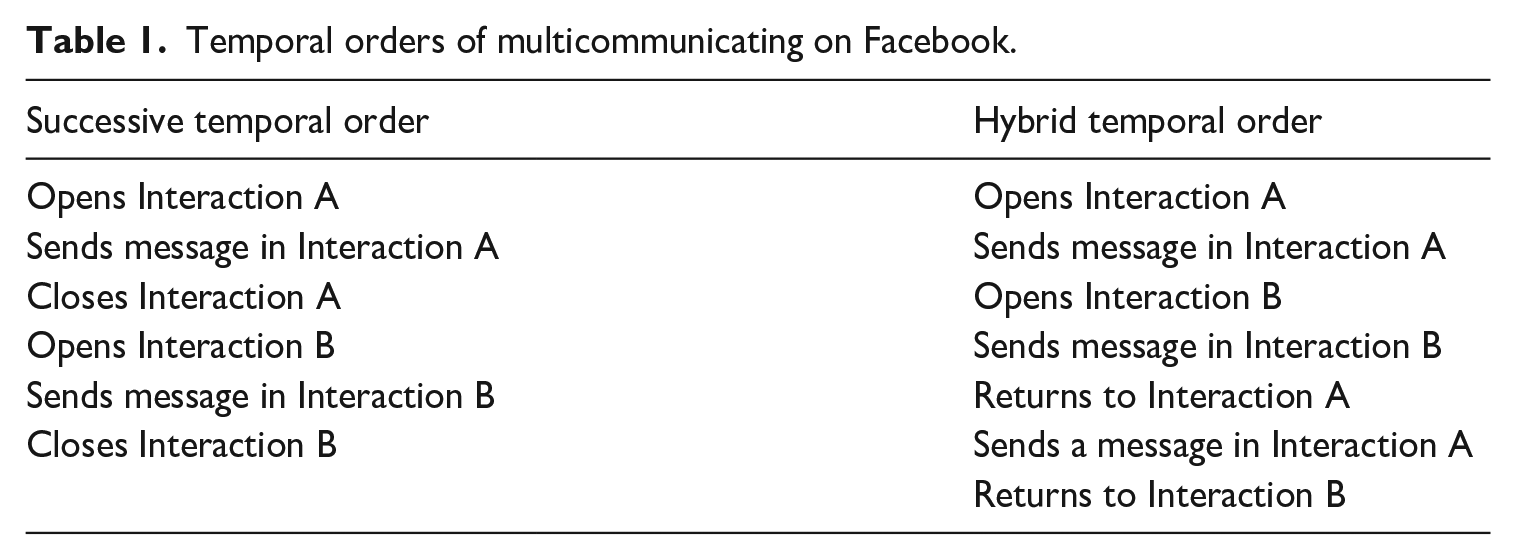
Rather than queuing interactions (as seen in a successive order of the left) users of Facebook work in a more hybrid way that involves much more communicative overlap (seen on the right of Table 1). Although they may not physically be responding to two messages at the same time, interactants have more than one conversational thread open and ongoing in the same time frame with users moving continuously between the two meaning that ‘the temporal frames of sequentiality and simultaneity are overlapped and embedded within each other’ (Ditchfield and Lunt, 2021:128).
Temporal orders of multicommunicating on Facebook.
Despite multicommunication in textually mediated contexts taking a hybrid temporal form the potential challenges that multicommunication brings for interaction, and interactional order, remain. Interactants are still switching interactive roles and adjusting to various audiences in a rapid fashion (Stephens et al., 2012); they are still splitting their interpersonal engagement in more than one direction (Baron, 2008) and, due to not ‘making themselves fully available’ to one interaction (Kendon, 1988), they also need to make decisions about where to place their attention and when. This issue of the division of attention can be understood through the use of Goffman’s concept of ‘involvement’. Involvement ‘refers to the capacity of an individual to give, or withhold from giving, his concentrated attention to some activity at hand’ (Goffman, 1963: 43). Goffman identified that we work to divide our attention into ‘main’ and ‘side’ involvements. Main involvements refer to activities that ‘absorb the major part of an individual’s attention and interest’ whereas a side involvement is an activity that ‘an individual can carry on in an abstracted fashion without threatening or confusing maintenance of a main involvement’ (Goffman, 1963: 43). As noted by Goffman (1963), and more recently Mondada (2014), the positioning, or temporal organisation, of individuals’ multiple activities is important as it often ‘displays whether participants consider one activity as prevailing over the other’ (p. 46). In the context of multicommunication, scholars have found interactants orient to their involvements in different ways. Didomenico et al. (2018), for example, found that mobile phone notifications were attended to as side involvements when interacting face to face. With Licoppe and Tuncer’s (2014) research, interactants instead put their main involvements ‘on hold’, to attend to an incoming interactional summons (such as a door knock whilst on a Skype call).
Unlike the multicommunication that occurs in these studies, multicommunication on Facebook can be completely compartmentalised. This means that the act of dividing attention and organising multiple threads of interactions into main and side involvements is not something that needs to be attended to within the run of the interaction itself unless the interactant decides to do so. Despite this, the task of deciding where to place attention and where to position multiple, ongoing interactions in relation to one another remains. This article therefore asks how interactants organise their multiple, overlapping interactions in this compartmentalised context?
Participatory roles: Authoring and managing in the pre-post space of online interaction
Goffmanian concepts applied in the new media context tend to focus on the presentation of self, impression management and face-work (see Ditchfield, 2020; Lillqvist and Louhiala-Salminen, 2014; West and Trester, 2012). This article, however, is concerned with the organisation of interactive environments and with how Facebook users position and organise the multiple strands of interaction that they are engaged in. This focus moves towards other areas of Goffman’s work that centre on the concept of ‘the participation framework’. As Hutchby explains, ‘the participation framework refers to the range of ways that persons within perceptual range of an utterance are able to position themselves in relation to it; for example as addressed or not addressed, ratified or not ratified’ (Hutchby, 2014: 85). It is a concept that ‘differentiates how people involved in an interactional setting participate in that setting’ as well as categorising a participant’s ‘orientation, alignment and involvement with a task’ (Rae, 2001: 253).
Before the notion of the ‘participant framework’ was introduced, a simple dyadic model of communication where roles such as ‘speaker’ and ‘hearer’ were commonly used to explain the organisational structure of interactions. However, Goffman’s participant framework replaced this understanding by splitting hearer and speaker roles down into more specific classifications. Hearers, for example, can be ‘ratified’, meaning they have an official place in the encounter, or ‘unratified’ meaning they have access to the conversation but not an official place. Speakers may adopt roles such as author or animator; with the author forming the content of the utterance and the animator delivering (1981). Participatory roles have been considered in computer mediated interaction for example Dynel (2014). Here, Dynel advocates that the simple hearer/speak dyad is insufficient for many online interactional settings and proposes a new participatory framework which holds for multi-party interaction on You Tube. The interactional settings and affordances of You Tube and that of Facebook Messenger though are different. On You Tube, there are an ‘infinite number of potential participants at the reception end’ of an interaction (Dynel, 2014: 37). The interaction is also multimodal in nature with interactional turns being verbal/nonverbal as well and spoken/written. For these reasons this article considers what a participatory framework looks like within the setting of Facebook Messenger and particularly within the context of users multicommunicating.
To begin, it can be seen how Goffman’s participatory roles can, and do, translate to the setting of Facebook Messenger. In the production of a Facebook message, for example, there is an animator (the role of delivering, performing, or pressing ‘send’ on the utterance) and there is an author (the role of creating/designing the performance or message). The animators work occurs in the run of interaction, it is visible as the published artefact of interaction. The work of the author’s role is ‘behind the screen’; it is where the message is crafted away from the sight of the audience. When multicommunicating, however, interactants are also engaged in a third speaker role: that of a manager. In this role, interactants work to organise and move between the multiple ongoing encounters that they are involved in. Here, decisions are not made about the content of the interaction (like when authoring) but are instead made about where and when to place attention.
The role of the author and the manager occur in the pre-post space of interaction; the space of online interaction that lies behind the screen and is usually only visible to the interactant themselves (Ditchfield, 2020). To date, the study of pre-post activity has focused on the role of the author in that it has examined the ways that content, interactions, or artefacts are constructed. Such an interest has mapped across both online and offline contexts. In the study of fine art, for example, X-ray technology has been used to ‘peel back’ the layers of paint on works to unveil the edits that were made by artists thus revealing the pre-publication moves made as they crafted their work (see Gooch and Tumblin, 2007). Online, there is a body of work that has focused on the construction and editing of online interactions. Meredith and Stokoe (2014) and Ditchfield (2020) both used screen capture software to explore the pre-post editing of Facebook Messenger interactions. That is, they examined how users crafted and tweaked their messages before sending them to their intended audience.
To date, considerably less attention has been paid to the interactive role of the ‘manager’ in online communications. This role is less about performance preparation and more about the organisational task of coordinating multiple, overlapping performances that occur on different, and separated, stages. With the pre-post space being identified as consequential for interactive work and quality (see Ditchfield, 2020) this article works to extend inquiry to the role of the ‘manager’ exploring how users approach the role of managing multiple interactions and what, if any, techniques they employ when moving across and between their Facebook conversations. Of course, the interactional role of the ‘manager’ is not unique to Facebook communication specifically. The organisational task of coordinating overlapping performances occurs within other textually mediated platforms and settings for example moving between chats on WhatsApp, between comments and direct messages on Instagram or even coordinating interactions across different platforms and spaces. This article is therefore using Facebook as an example to explore how interactants enact this role of the manager in a textually mediated, and compartmentalised, setting.
Capturing behind the screen: Using screen capture technology
To capture how multicommunication is organised and managed in the pre-post space this research collected screen capture recordings of real time Facebook interactions. Screen capture software can be downloaded onto a device and ran in the background of any activity to record whatever is happening on the screen. In other words, what the computer user sees on their screen, the software captures and saves as video files. Such an approach allows researchers to go ‘behind the screen’ by revealing interactional details such as what is typed, deleted as well as cursor movements that would not be captured by transcripts of the published interactions alone. Such technology offers a unique lens to explore multicommunication as the exact ways interactants move between their simultaneous conversations are captured revealing precise timings, movements and orders of activity.
Participants of this research downloaded screen capture software (either litecam or Movavi) onto their own laptops and recorded their Facebook interactions at times to suit them. Recording participant interactions on mobile devices was also considered, however at the time of data collection (2015/16), mobile operators blocked the use of screen capture applications. In terms of sample, four participants were recruited to record their Facebook interactions with a total of six and a half hours of data collected. This is inevitably a small sample. However, the aim of my analysis is to examine the micro details of how multicommunication is managed and negotiated within the Facebook platform. Interactive details such as the specific design of conversational threads, the exact sequences of participants actions and even the slight cursor movements made by participants as they negotiate their simultaneous tasks take a central focus. When analytic attention is reserved for such micro moments, it is common to work from smaller samples with attention placed on the richness of interactive moves rather than the quantity of participants or hours of recording (Wood and Kroger, 2000). Due to the small sample of this analysis, it is important to note that this article is not claiming to provide a generalisable representation of how Facebook users manage and organise multicommunication. Instead, it provides an empirical insight into a previously unexplored aspect of online communication thus making an important contribution to existing understandings of online interaction.
Capturing live recordings of participant’s Facebook interactions inevitably presents ethical issues, specifically in reference to privacy and consent. All recording participants for this research gave informed consent and were in control of when they recorded to ensure privacy was maintained. Secondary participants, those whose screens were not recorded but who were participating in the interactions (Meredith and Potter, 2013), also gave consent or were given opportunities to opt out of the research before data collection began. In rare cases, secondary participants gave partial consent to their participation in the research. Secondary participants Daniel and Oliver, who are referred to in example two of the analysis, gave consent for their interactions to be recorded but did not want their interactions published in conference presentations or published works. In these cases, I was able to use these recordings as part of the data sample and analysis but was unable to present the exact detail of what their interactions included. The presentation of data with missing turns may seem problematic in research drawing on a conversation analysis. However, due to consent restrictions being around publishing, rather than access and analysing, I was able to consider all turns in my original analysis of the data. The focus of the analysis in this paper is also specifically on the way participants move between and negotiate their multiple interactions. In this sense, despite not being able to present all utterances in the case of example two, the data still reveals important information about the way multicommunication is managed in the Facebook context.
Due to recording such private interactions, participants were recruited through my own social network to ensure existing trust and rapport was intact (for a detailed exploration of approaches to consent and recruitment in screen capture research see Ditchfield and Meredith, 2018). Of the participants two were male and two were female. They ranged from 24 to 40 years old and were all British. Participant demographics were not determining factors as to who I recruited. As this research is concerned with the interactional work that individuals do online, my priority was on the interactional moves that the participants made rather than the user’s personal background. This is a common approach in conversation analytic work where ‘any text or person who speaks to the issue at hand will do as well as any other’ (Wood and Kroger, 2000: 79). I therefore focused on the recorded interactions and no further contextual information on participants and their relationships to one another was collected.
Micro analysis of online data
To explore the organisation of multicommunication within Facebook interactions I draw on micro analytic approaches to study the interactive detail of online communication (Meredith et al., 2021). In this article, I draw on two different approaches: the first inspired by the Goffmanian perspective of interaction and the second inspired by Conversation Analysis (CA). The Goffmanian approach to analysis focuses on the ritual elements of interaction with the moral and social expectations of what interaction should look like taking centre stage (Ditchfield, 2021). I draw on this approach through engaging with concepts such as interactional order and whether the increased interactional load of engaging in numerous simultaneous conversations impacts the eventual ‘quality’ of the interactions produced.
CA, on the other hand, is a more systematic approach to analysis instead ‘focusing on the practical organisation of social encounters’ (Ditchfield, 2021: 318). Here, draw on two ‘fundamental structures’ of CA: (1) recipient design and (2) sequencing (for more on the fundamental structure of CA see Sidnell and Stivers, 2012). Recipient design refers to the ways in which a turn in interaction is designed for its recipients (Meredith et al., 2021). It is based on the notion that there are multiple ways performing the same action thus speakers engage in a process of ‘selecting the details’ in which their desired action will be accomplished (Drew, 2005: 83). The interest in this paper is whether, how and to what extent Facebook users alter their recipient design as they move across different threads of simultaneous conversation and what consequences for interaction this has. The second structure, sequencing, refers to the positioning of an utterance in a conversation (Stivers, 2012: 191). Scholars have examined sequencing in mediated interaction but have tended to focus on how this is done within specific threads of discussion (Farina, 2018; Hutchby and Tanna, 2008). Hutchby and Tanna (2008), for example, focused on the sequential organisation within complex SMS messages (messages that involved more than one action). Here, authors highlighted how such complex formats left texters with a decision around ‘which of these actions should be responded to in a reply and in what order’ (p. 153). This is a similar dilemma to the one facing multicommunicators on Facebook. Instead of choosing which ‘action’ to respond to, however, interactants need to decide which ‘person’ or ‘thread of conversation’ to respond to and in what order. Due to this, I draw on the concept of sequencing to examine not how interactional turns within conversations are positioned but instead how entire threads of interaction are positioned when engaging in numerous, simultaneous encounters.
Despite Goffmanian and CA approaches to analysis differing in their routes to understanding social interaction (see Schegloff, 1988) I argue that the approaches can be used in a complimentary manner to reveal both the ritual and systematic structures of interaction at play (Ditchfield, 2021). All six and a half hours of screen capture data were analysed in this research. Selections regarding what multicommunication features and examples to include in this article were made on the basis of the extent they revealed details of movements between separated, compartmentalised threads of talk. Due to the microanalytic approach adopted, only a small selection of cases from the data set can be shown and analysed to illustrate the general patterns from the analysis.
Analysis
This analysis reveals two strategies Facebook users engage in that work to simplify multicommunication: (1) overlapping topics of conversation and (2) ‘first come, first served’ response orders. I will begin by exploring the former.
Overlapping topics of conversation
Multicommunication is argued to be an especially complex form of multitasking (Stephens et al., 2012). Reinsch et al. (2008), who researched multicommunication in the context of the workplace, argued that one aspect leading to the complexity of multicommunication was the variety of conversational topics that can occur across multiple, simultaneous conversations. Authors noted how the more topics there are, the more intense a multicommunicating experience would be. However, examples of multicommunication within this data revealed how participants can limit the multiple topics they engage with across their simultaneous Facebook interactions. See below:
Example 1.
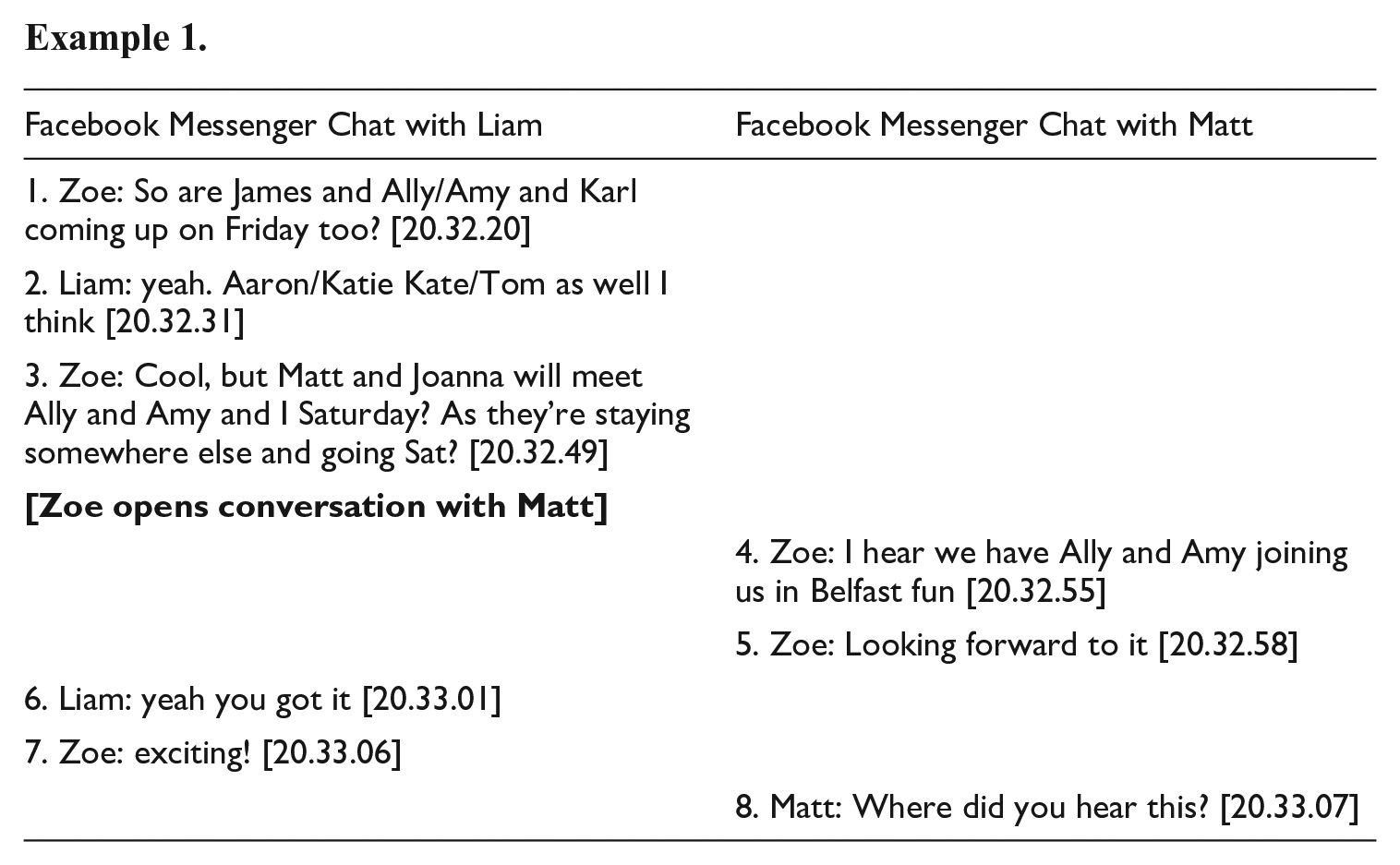
In example 1 the recording participant, Zoe, is talking to Liam about an up and coming weekend trip in Belfast. During this interaction, she begins a conversion with Matt about the same trip (in between turns 3–4). Here, rather than introducing a new and secondary topic with Matt, which according to Reisch et al., would intensify the experience of multicommunication, Zoe eliminates one aspect of multiplicity from these two separate exchanges working to simplify the interactional task at hand. A similar example can be seen in example 2:
Example 2.
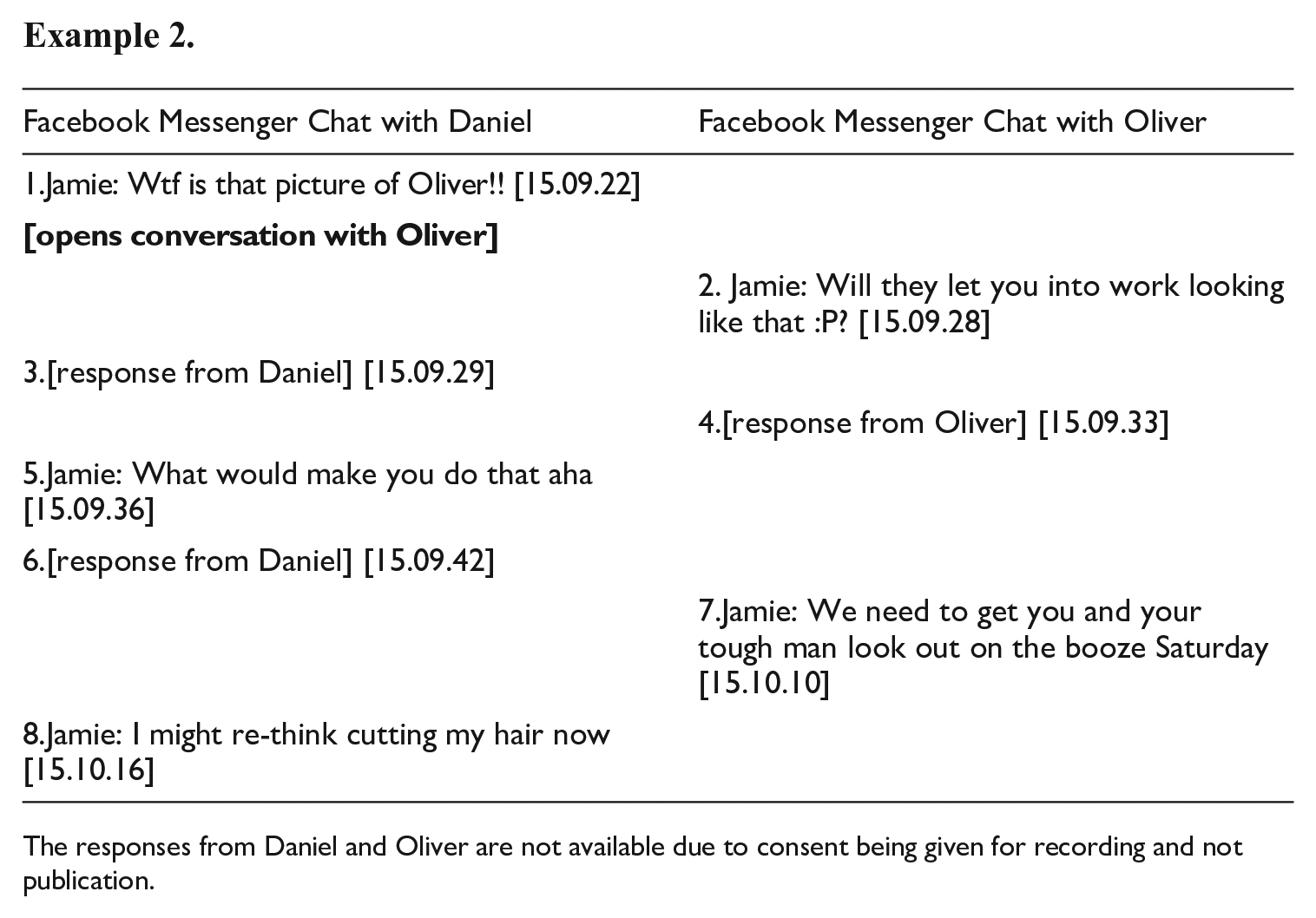
The responses from Daniel and Oliver are not available due to consent being given for recording and not publication.
Here, the recording participant Jamie is talking to Daniel about an image of Oliver that has just appeared on their news feed (the image shows that Oliver has shaved all of his hair off). Jamie then begins an interaction with Oliver himself about that same image (in between turns 1–2). In a similar way to example one, Jamie overlaps interactional topics across his Facebook Messenger chats thus simplifying the task of multicommunication.
Despite the topics of conversation overlapping, the way in which the topics are presented, or designed, for their specific recipients varies. In the chat with Daniel (left), Jamie expresses a lack of understanding of Oliver’s newly shaved head through phrases such as ‘wtf’ and ‘what would make you do that’. Jamie also works to further distance himself from Oliver’s actions suggesting he will ‘re-think’ cutting his own hair creating a more critical tone within the interaction. In the chat with Oliver himself (right), Jamie asks Oliver whether he will be able to go to work looking the way he does. Although this could potentially be read with a similarly critical tone, the use of the ‘:p’ emoji works as a pragmatic marker to modify the tone of the utterance indicating to Oliver that such a comment was being made in jest (Herring and Dainas, 2017). Jamie also refers to Oliver’s new image as a ‘tough man look’, drawing on the connotations of a strong and masculine image rather than an image that Jamie himself cannot understand (wtf) or aspire to (I’m going to re-think cutting my hair now). In this way, the design of Jamie’s interaction with Oliver approaches Oliver’s new look in a more favourable way than the conversation with Daniel.
Examples 1 and 2 reveal that when multicommunicating on Facebook, individuals adopt the technique of overlapping interactional topics to lessen the intensity and simplify the task of engaging in multiple conversations. Despite multicommunication being simplified in this way, though, complexity is not lost. The distinct recipient design that is captured in Jamie’s messages to both Liam and Oliver displays a sensitivity to the different audiences of the overlapping threads and reveals how the challenge of ‘switching roles’ and ‘adjusting to various audiences’ (Stephens et al., 2012) is attended to in action.
‘First come, first served’: Ordering multiple interactions
One complexity when multicommunicating is attending to, or perhaps even dismissing, certain expectations that form the foundation of interactional structures. One such expectation is that of timings. As Sacks et al. (1974) noted, there is the expectation in face to face interaction that turns of conversation are meant to occur with no (or minimal) gaps between. Jefferson (1989) argued that the maximum tolerance of silence between turns in these contexts is around one second before there is the potential for interactional trouble to occur. Online, these expectations vary depending on the medium used to communicate. Email, for example, is referred to as asynchronous, meaning time gaps are expected to be of a longer fashion. Facebook messenger, along with other instant messaging technologies, is defined as a quasi-synchronous medium (Garcia and Baker Jacobs, 1999). This refers to interactions that are fast moving in the way that interactional turns are produced but where, unlike in face to face settings, the message construction process of the interaction is not available to the interactional partner (Garcia and Baker Jacobs, 1999). Time gaps between turns in this context are expected to be slightly longer than face to face, but not as long as mediums such as email. The challenge when multicommunicating is how, or indeed whether, interactants attend to such expectations regarding time gaps between turns when engaged in more than one active conversation. In addition to timings, a further complexity of multicommunication is deciding when and where to place attention in the first place. Scholars such as Goffman (1963) have noted how interactants can adopt systems to help navigate these decisions such as identifying main and side involvements. However, participants who multicommunicate on Facebook do not always seem to adhere to such arrangements. See below:
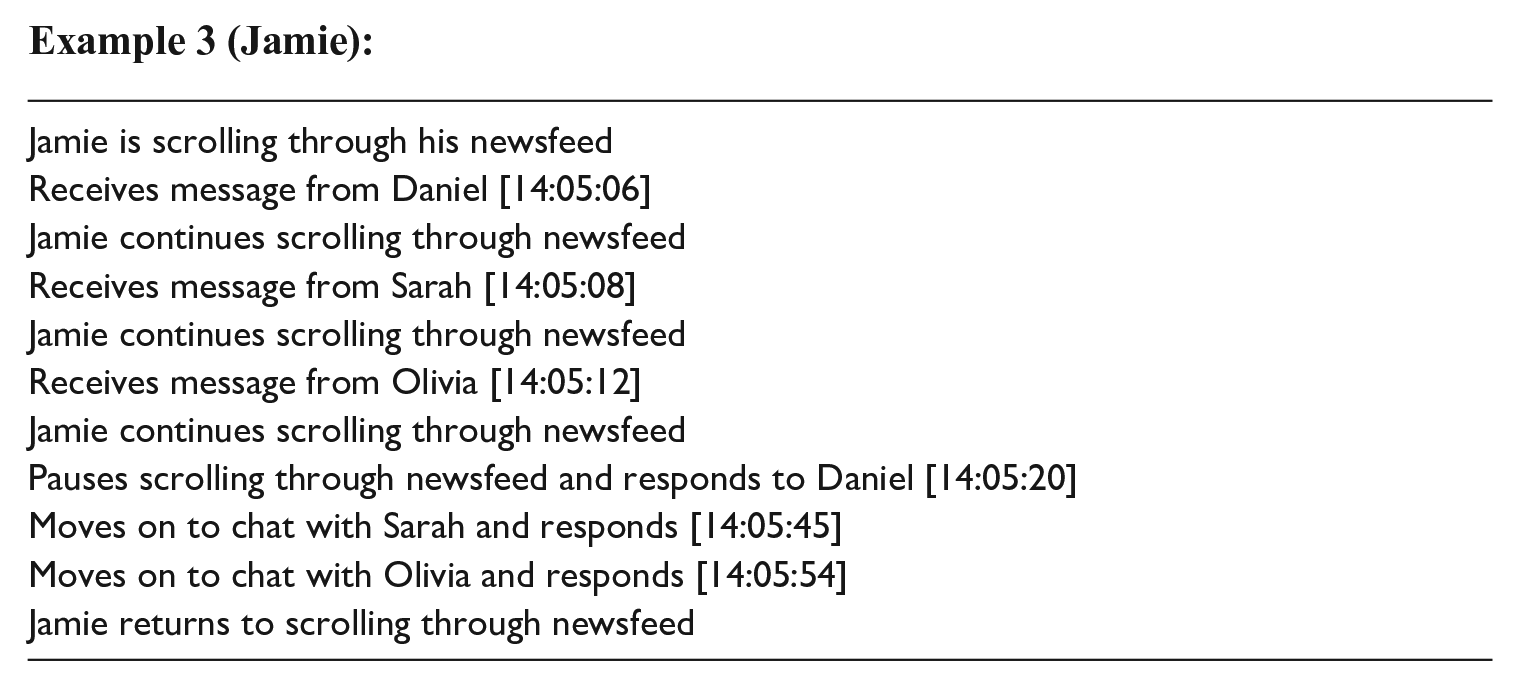
Example 3 (Jamie):
Example 4 (Zoe).
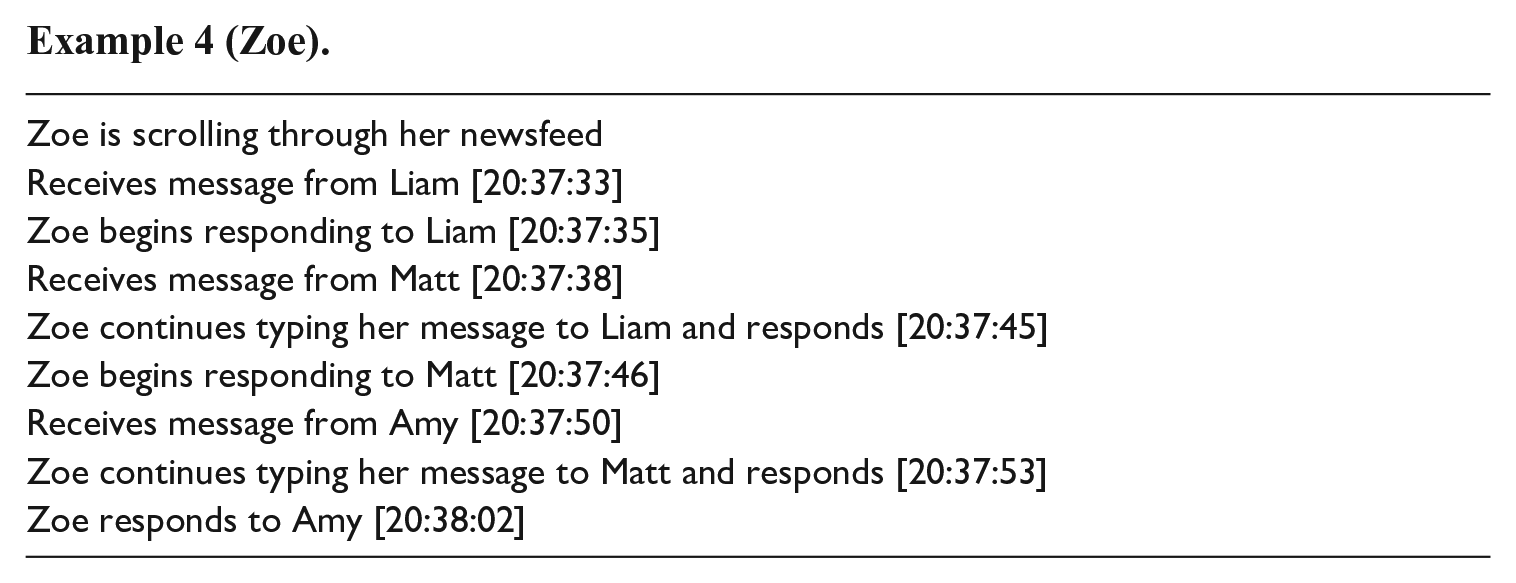
In the first example (3), Jamie receives three messages in separate threads of conversation from three interactional partners: Daniel, followed by Sarah, followed by Olivia. During the time frame that he receives these messages (a total of 6 seconds) Jamie spends his time scrolling his newsfeed on Facebook (the homepage of his Facebook account where various stories and interactions from his friends appear). In this scenario, Jamie has three messages to respond to and is faced with a decision around who to respond to first. Quite simply, Jamie responds in the order in which he received the messages.
In example 4, Zoe is faced with a similar decision and again responds to the messages in the order in which they were received. In Zoe’s case, she received a message from her friend Matt when in the middle of typing her response to Liam. Receiving this message from Matt does not appear (on the screen) to distract Zoe from her task of responding to Liam as she completes this interaction before moving on to attend to Matt. These two examples reveal what Mondada (2014) terms an ‘embedded order’ of multiactivity: an order that is ‘organised in an intertwined and alternating way’ (p. 35). The interactions above overlap in time (and are thus intertwined in terms of temporal frame) and are also orientated to in an alternating fashion. Specifically, these examples are alternated on the basis of a ‘first come-first served’ pattern of response: whoever sends the message first is the first person that the Facebook user responds to and whoever sends a message second is responded to second. In this way, there is no clear orientation to one of these interactions as ‘main’ and the others as ‘side’.
The ‘first come-first served’ pattern of sequential organisation is not new to mediated interaction and was also identified in Hutchby and Tanna’s (2008) work on SMS messages where texters replied to complex messages (e.g. texts that contained more than one action) by responding in the order the actions were sent. However, what this analysis reveals is that the first come-first served pattern is utilised not just to organise responses within interactions but also to organise how users order and move between their separate, yet overlapping, conversations. In following this temporal pattern, participants are again working to simplify multicommunication. Here, they are doing this by ‘opting out’ of the decision making process of where to place attention, they are handing over the choice to the fate of message notifications. This minimises the interactional load on participants as rather than deciding who to respond to and prioritise every time an interaction is received they follow the order in which the notifications of messages appear.
As well as working to decrease interactional load, responding to incoming messages in this embedded, or first come, first served manner also reveals a way that Facebook users work to adhere to the temporal expectations of the medium they are communicating on. By attending to interactions in the order that they are received, multicommunicators on Facebook are working to minimise the interactional gap that occurs between the turns of interaction in each thread. This is important as the interactions that appear in both examples are fast moving, as in, they are demonstrating the more synchronous nature that online chat mediums afford. With Jamie, for instance, he receives and responds to 3 messages all within the space of 1 minute. This makes the timing between turns even more relevant as if a gap in conversation extends more than a few seconds such a gap may become noticeable or potentially problematic in the run of the interaction (Jefferson, 1989). This demonstrates how quality, as understood from the perspective of the interactional order, is maintained even when multicommunicating and attending to numerous, simultaneous conversations.
This first come, first served pattern was the most commonly adopted form of sequential organisation in this data. However, there were exceptions:
Example 5 (Mark):
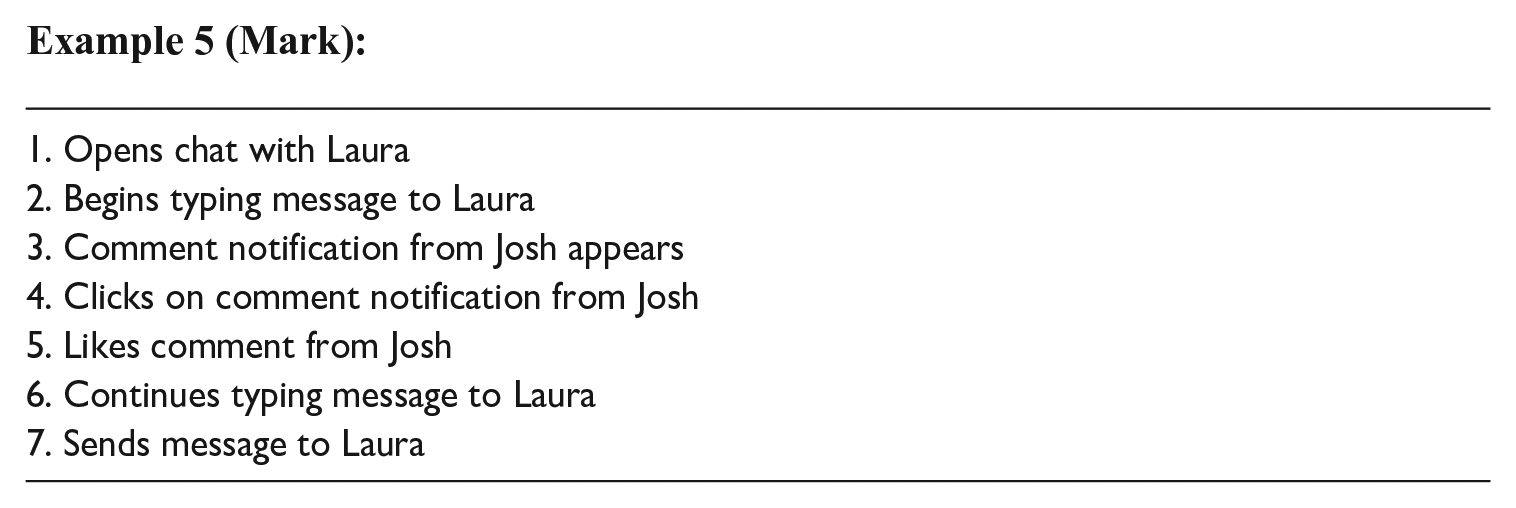
In example 5, Mark opens a chat and begins typing a message to Laura (lines 1–2). Mark then receives a comment notification, which appears as a box in the top left-hand corner of the screen informing him that Josh has commented on a recent interaction between them. Mark clicks on this notification box, sending him through to the comment interaction thread and leaving the page in which he was writing the message to Laura (line 4). Mark then engages with Josh’s comment through ‘liking’ it before returning to typing his message to Laura and pressing send (lines 6–7).
Rather than the ‘embedded order’ that was seen within examples 3 and 4 what is observed here is an ‘exclusive order’; one where ‘one activity is momentarily abandoned in order to carry out another’ (Mondada, 2014: 35). This is apparent through Mark momentarily abandoning typing out his message to Laura in order to attend to, and engage with, the comment notification from Josh. Not only is Mark adopting an exclusive order here, but he is also attending to a summons. A summons, in the context of multiple interaction, has been referred to as events initiated by a remote party such as when a phone or doorbell rings (Licoppe and Tuncer, 2014). When summoned by such events, Licoppe and Tuncer argue that often interactants put their other interactions on hold and temporarily become subordinate to the summons. Here, rather than phone calls or doorbells, it is the comment notification that acts as such an event. Through attending to the summons of the comment notification, and putting the interaction with Laura on hold, Mark is establishing a hierarchy between the interactions revealing how one activity (in this case the comment notification) is prioritised over the other (Mondada, 2014). In this way we can see a return to the Goffmanian model of organising multiple activities in which one activity is oriented to as the ‘main’ and one is orientated to as the ‘side’.
There is, however, one difference between the interactions with Laura and Josh: the sense of co-presence. Josh, for example, shows signs of being virtually present on Facebook as he has, in real time, responded to one of Mark’s photos. In the chat with Laura, Mark is opening the conversation meaning that Laura is not yet (virtually) present or engaged with the interaction. In fact, Laura is unaware that this interaction is about to take place. Any potential time pressures to respond to Laura are therefore non-existent as the dyadic part of the interaction has not yet begun. It should also be noted that the engagement with Josh is not textual and instead takes the form of a Facebook ‘like’. In terms of interactional load, this is minimal and requires much less resource to produce (e.g. less resource in terms of recipient design as well as time to type out). This shows how the interactional context, such as level of co-presence or the interactional demand of a task, plays a role in how multiple interactions on Facebook are ordered and attended to.
Examples 3, 4 and 5 have revealed various sequential orders present when multicommunicating on Facebook. However, there is evidence to suggest that deciding which interactions to place first, and more specifically whether certain summoning events should be prioritised, might be a challenging process for Facebook users. To illustrate, I present example 5 again, this time focusing on events between lines 3–4.
Example 5 (Mark):
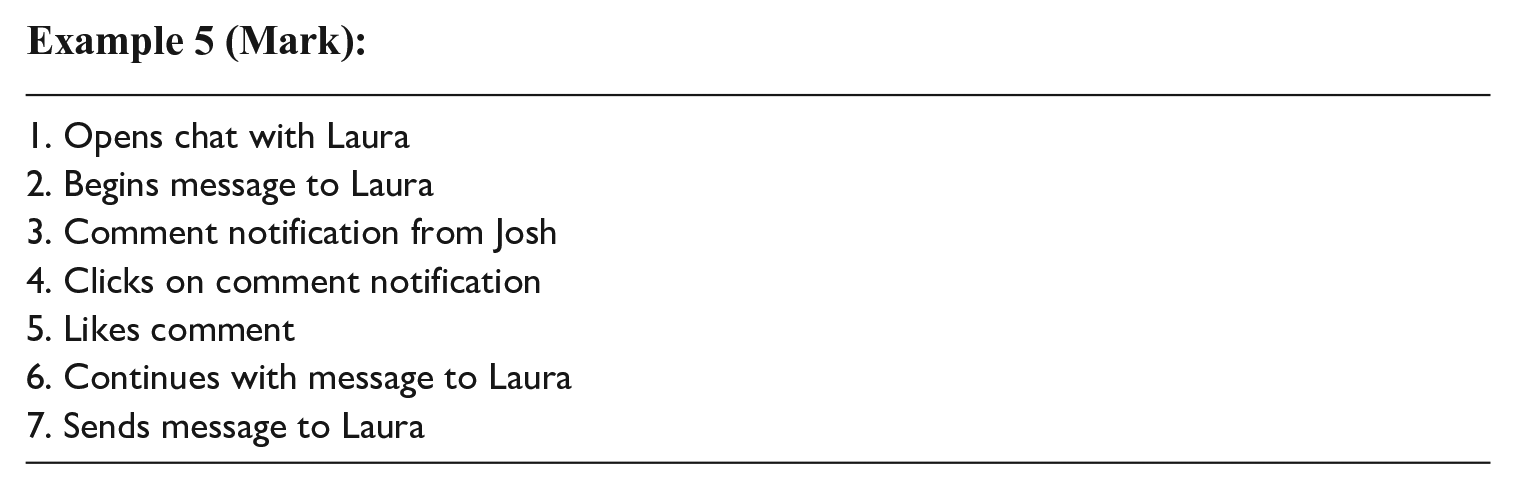
As line 3 shows, Mark received a comment notification from Josh with the notification appearing as a red icon in the top right hand corner of Mark’s Facebook page. After receiving the comment notification, Mark’s cursor is seen moving from the message construction box (bottom left of the screen) to hovering over the notification. The cursor then returned back to hover over the message construction box before again moving back to hover over the notification. Mark then clicks through to view, and engage with, the comment notification (line 4).
Through a recording of screen capture data it is only possible for me to comment on what I see Facebook users do. I cannot make claims around their cognitive or emotional experiences of the interactions that are being recorded. Yet, the empirical imagination is invited to consider whether such cursor movements represent a form of hesitation; hesitation regarding whether to succumb to the summons, hesitation regarding which interaction to prioritise. This poses questions around how multicommunication is experienced by Facebook users and what challenges around decision making may be involved in the organisation of multicommunication online.
Conclusion
This article has explored how multicommunication in the context of Facebook Messenger is organised and managed behind the screen. Despite technological affordances making multicommunication more feasible in online spaces, Facebook users adopt techniques that simplify the process of engaging in multiple, simultaneous conversations. They do this through: (1) overlapping topics in conversation and (2) adopting a ‘first come, first served’ order when responding to multiple active threads of interaction. Although users engage in these techniques of simplification, the interactions themselves are not simplified as interactants display sensitivity to interactional context for example through tailored receipt design, maintaining temporal expectations and the prioritisation of co-presence. In this way, interactional complexity is not reduced or impoverished in the ways that the work of Goffman (see Kendon, 1988) or Turkle (2011) would assume. It is instead preserved with interactants working to attend to the individual needs and requirements of conversations despite not ‘making themselves fully available’ to one interaction at one time (Kendon, 1988).
Multicommunication is also not only organised in a performative space visible to fellow interactants (as seen in the work Didomenico et al., 2018; Licoppe and Tuncer, 2014) but is managed within the pre-post space of interaction, an interactive space away from the gaze of interlocutors. It is here that social media users adopt the participatory role of the manager. In this role, interactants work to organise their movements between overlapping conversations, making decisions not on content, but on where to place attention and when. This extends what has previously been included in theories on the pre-post work of social media conversations (see Ditchfield, 2020) with the pre-post space of interaction presenting itself as more than a space of rehearsal and drafting but also a space where users are seen to negotiate multiplicity.
Through opening up the pre-post space of multicommunication, this article has shown that sequential order also exists behind the screen of online interactions. This is made visible by the ways that Facebook Messenger users respond to incoming Facebook messages in a first come, first served pattern only deviating from this under particular contextual conditions. This suggests that a double layer of sequential ordering is oriented to when multicommunicating in mediated contexts. The first, as found by Hutchby and Tanna (2008) and Farina (2018), is the ordering of turns published in the interaction themselves, for example the identifiable structure that is apparent in Facebook comment thread (Farina, 2018). The second, and the one highlighted in this paper, is the ordering of what conversation, and which interactant, to respond to. In this way, this paper has shown that the way that multicommunicaiton is temporally organised is coherent not only in the way turns of conversation are published but also in the way they are attended to and organised from the perspective of the ‘manager’. This is important as maintaining such a structure works to manage the potential complexity that multicommuication brings and ultimately avoid reducing or impoverishing the quality of the interactions online.
This article has taken a case study approach to the study of multicommunication examining in detail how this is managed in the context of Facebook. Knowing that the features of platforms change the interactive context (see Meredith, 2017) future work examining the organisation of multicommunication needs to consider how this is negotiated in alternative online spaces. However, moving forward, this paper also calls for more analytical focus to attend to the pre-post space of interaction. Not only is this a key site for identity work (see Ditchfield, 2020) but it also the site where an alternative layer of sequential ordering is made visible to researchers. With mediated technologies affording the gap between message construction and sending, and thus an extended time gap between turns of conversation, the pre-post space of interaction is where interactants are spending an increasing amount of their interactive time and needs to be matched with an elevated amount of empirical and analytical attention.
Footnotes
Declaration of conflicting interests
The author(s) declared no potential conflicts of interest with respect to the research, authorship, and/or publication of this article.
Funding
The author(s) received no financial support for the research, authorship, and/or publication of this article.