




Abstract
Computer-mediated webchat is fast replacing voice support in customer service. Whilst previous studies have explored how communication breaks down in customer service voice exchange in off-shored/outsourced multinational companies; studies into webchat exchange in the same industries are scarce. Given the high stakes of customer service interactions – for example customer satisfaction, return intention and loyalty to the company – there is an urgent need to understand how conversations unfold, in a linguistic sense, in successful and unsuccessful service. This study, using interactional linguistics, has used a close interpretative process to analyse instances of problematic exchange showing two key causes of communicative disruption. This first relates to disrupted turn adjacency where the sequence and flow of the exchange becomes confusing. The second relates to conceptual misunderstandings of terms in the exchange that may have multiple meanings. As workplaces invest millions of dollar in recruiting, training and appraising global webchat agents to serve their customers, the findings of this study can fruitfully inform webchat training and coaching that impact performance at work and provide high satisfaction to customers.
Keywords
Introduction
Computer-mediated communication technologies have fundamentally changed how business is conducted day-to-day, including the service support companies offer to their customers. There is now an increased need for 24/7 web-based customer service both from customers and businesses: this is evidenced by the growing need for outsourced providers of such support, such as contact centres in the Philippines, India and China (CAIE, 2018).
When it comes to online customer support, there is a lot at stake. High quality customer service is essential to a positive customer experience, which directly affects satisfaction, trust, re-visit intention and loyalty (Verhoef et al., 2009). Web-based customer service chats provide increased opportunities for quicker and more instantaneous, two-way communicative encounters, and are thought to help relationship building between organisations and customers (Turel et al., 2013). It is not surprising, therefore, that these interactions have a crucial role in the formation of customer experiences, and the building of a good relationship. However, in spite of the growing attention to employees’ communication skills and the generous training and coaching in call centres, interactions are often sources of frustration for both businesses and customers (Forey and Lockwood, 2007). The slow speed and the fragmented nature of online conversations seem to cause not only distress but the loss of trust, as further attested, for example, in public accounts (see Edwards, 2013).
The emerging problems are often the result of pressure on agents to attend to multiple conversations concurrently; and relatedly that they have to rely heavily on ready-made templates and scripts. Consequently, even a human online agent may sound ‘robotic’ and impersonal. An added challenge, where online support has been off-shored, is that English is not the agents’ first language and therefore they may not have the same level of pragmatic understanding and sensitivity as a native speaker (Friginal, 2007).
In spite of the evident importance and ever-growing prevalence of online customer support, and in spite of evidence from contact centres and popular accounts of customers relating the often problematic nature of these encounters (CAIE, 2018; Lockwood, 2017; Xu and Lockwood, 2021), we only have a limited understanding of the nature of communication breakdowns in corporate webchat. Apart from a few recent exceptions (Hui, 2018; Lockwood, 2017; Xu and Lockwood, 2021) scholarly examination of what exactly happens in web-based customer service interactions in business contexts is very scarce (see also Turel and Connelly, 2013). While digitally mediated customer service has been explored, previous studies focused on specific sites of talk, such as librarian-patron interactions (Fagan and Desai, 2003; Koshik and Okazawa, 2012), health counselling (Stommel, 2012; Stommel and Te Molder, 2015) or telephone sales (Clark et al., 2003; Mazeland, 2004). There is also a growing scholarship exploring customer service interactions with chatbots (Dippold et al., 2020). However, webchat exchanges in a commercial contact centre where both interactants are human, remain curiously under-researched (cf. Kazmer et al., 2007). This paper sets out to address this gap.
The main aim of the paper is to expose potential causes of communication problems between customer service agents and customers. In order to isolate these causes in this text-based, digitally mediated communicative environment, we adopt a data-driven, empirical approach to naturally occurring webchat interactions. In what follows, we provide, on the one hand, a brief overview of what scholarship in business and organisation studies have found related to communication in digital customer service; and on the other hand, we review applied linguistic and discourse analytic research on customer service interactions in general and digital interactions specifically.
Literature review
In order to get a better understanding of what business or management disciplines have established about communication in online customer service with human participants we targeted our search to literature on interactions in web-based support. Due to the multitude of synchronous or partially overlapping technical terminology (e-service encounter, webchat, web-based customer support, live chat customer service) and the variety of disciplinary backgrounds where such literature could be found, the scholarly work we identified in the first round of our literature search was further vetted based on its focus on communication, interaction or empirical interactional data, with the effectiveness of customer service being at the heart of the work. One dominant trend among the papers we found was that they make observations about the issues related to digitally mediated communication and how this may affect customer satisfaction. Favouring the conceptual background informed by media richness theory (e.g. Daft and Lengel, 1986) several studies were concerned with the lack of visual and auditory cues in live chat customer service interactions. McLean and Osei-Frimpong (2017) for instance found that digitally mediated text-based channels deprive communicators of crucial audio-visual signs that would enable to conveyance of friendliness and empathy, directly affecting customer satisfaction. Turel and Connelly (2013) identified chronemic cues – the timing of messages and response time – as key factors to affect perceptions of fairness. Turel et al. (2013) attest that the communication media being ‘lean’ ‘may lead users to view web-based support service alternatives as inferior, and therefore as less attractive than more conventional service options’ (p. 99). These studies are characterised by their reliance on perceptions surveys, and provide insights into the importance of communication to be empathic, reliable and authentic. However, the quantitative nature of the work makes it hard for the authors to explore the specific linguistic and discursive strategies that realise these communicative behaviours that would, for instance, make an agent seem reliable, sound ‘authentic’ or that would enable him/her to enact empathy.
The problem arising from the lack of such understanding is particularly evident when authors set out to identify which linguistic and discourse strategies may achieve certain desired communicative effects. Both McLean and Osei-Frimpong (2017) and Turel et al. (2013) for instance, advocate the use of emoticons as a way of conveying feelings or making the interaction more personalised. However, research on emoticons has previously shown that the interactional function of emoticons is complex, and far exceeds simply signalling an emotion (Dresner and Herring, 2010; Skovholt et al., 2014). Similarly, Turel and Connelly (2013) advocate the use of specific ‘filler’ verbal phrases or even automated responses to manage long gaps and consequently the impressions of busy-ness (p. 681), without deeper consideration for the complexities of conversational flow or the varied role of chronemic cues in instant messaging (e.g. Darics, 2014). We agree with Skovholt et al. (2014) who argue that in order to be able to make recommendations about digitally mediate business communication, a much deeper understanding of the complexities of language use and the mechanics of conversation is needed.
Many studies in the area of web-chat customer service interaction that break with the self-reporting, survey based tradition and examine real-life interactions come from the area of librarian reference chat (Fagan and Desai, 2003; Kazmer et al., 2007; Koshik and Okazawa, 2012) make a strong case for examining what actually happens in interactions between customer (patron) and a business representative (librarian). Applying a conversation analytic approach to naturally occurring data, these studies examine scripts of actual conversations to explore questions related to identity (Kazmer et al., 2007), causes of communication breakdowns (Koshik and Okazawa, 2012) or the role of conversational openings and closings in the success of the interaction (Dempsey, 2016). The attempt to understand what makes a webchat interaction effective through the examination of naturally occurring interactional data allows researchers to report on the complexities of interaction taking into consideration its unfolding, context-dependent nature. The importance of, and need for, such an approach in corporate contexts has repeatedly been pointed out by scholars in discourse-centred disciplines (e.g. Hui, 2018) and occasionally by scholars in other areas (Salomonson et al., 2012); yet actual web-based customer service interactions remain unexplored.
The other stream of research that informs this study is scholarship that investigates the nature of telephone-based call-centre exchanges. Considering the specialised nature of the interaction type in question, and the resulting specific language use, it is unsurprising that much scholarship comes from the field of applied linguistics (Forey and Lockwood, 2007, 2010; Friginal, 2013; Hood, 2010; Lockwood, 2017). Often prompted by the practical needs of communication training, many of the studies are concerned with isolating issues that either facilitate communication or lead to breakdown. In their pioneering study, Forey and Lockwood (2007) examined 300 authentic phone calls and found that contrary to the popular beliefs about the problematic pronunciation and poor grammar of the L2 agents, it was the lack of relationship building skills and problems in clearly explaining products and processes to the customer that caused most of the communication problems. Other discourse or interactional issues that have been previously identified as causing communication breakdown is the lack of clear logical patterning of information (Cruz and Lockwood, forthcoming); the complexities related to naming practices (Hood, 2010); timing and extended silence (Lam and Yu, 2013) and the use of scripted responses (Hultgren and Cameron, 2010). Interestingly, other studies have found that scripted responses and templates have a beneficial ‘scaffolding effect’ especially in the situation where the agent is an L2 speaker of that language (Woydack and Rampton, 2016). Further strategies that have been found to contribute to the smooth flow and success of call centre interactions are politeness and respect markers (Friginal, 2007), the appropriate use of spatial conceptualisation (Kraan, 2005), naming devices (Hood and Forey, 2008) active listening, attention and cognitive empathy (Clark et al., 2013).
These studies expose a wide range of phenomena that may have a direct effect on the outcome and success of the interactions. However, while many of these findings may be relevant to interactions that are conducted in text-based, digitally mediated environments (like instant messaging or SMS text) we have to exercise caution in generalising findings from research on spoken interactions to digital communication. For example, the patterning of information is radically different in speech and text-based chat: while speech is, for most, linear, chat interactions can be fragmented as they are reliant on technical aspects like typing speed and server speed (Herring, 1999). This naturally changes the dynamics of interactional coherence and conversation progression as well as expectations regarding gaps, delays or silences (e.g. Darics, 2014). Expressing empathy, conveying politeness and respect or the signalling of active listening also differ considerably due to the lack of visual and auditory cues: interactional partners cannot rely on backchannel signals, facial expressions or intonation, for example, to convey such relational meaning (Paulus et al., 2016). To understand the effect of these differences, to expose the practices that may hinder of aid the progression of the conversation, and ultimately the success of the interaction, it is essential that we gain a better understanding of the dynamics of text-based chat customer service interactions. In this paper we set out to do just this: we closely examine naturally occurring interactions with an aim to explore how computer-mediated technology affects the unfolding meaning-making in customer-agent interaction, and what a micro-analysis of an unfolding interaction can reveal about the communication issues that affect the outcome of the service encounter. By doing so this work expands the current line of literature on webchat-based customer service (Kazmer et al., 2007; Lockwood, 2017; Xu and Lockwood, 2021), and also informs both the broader literature on customer service interactions (for a review see Hui, 2018) as well as scholarship that promotes the use of naturally occurring interactional data for theorisations about customer service encounters in business and organisational disciplines (Turel and Connelly, 2013). Our exposure of communication issues caused by computer-mediation has an articulated practical aim too: to inform communication training in call centres, as we will explain below.
Web-chat in call centres
Over the last two decades the call-centre industry has grown exponentially and now boasts of over a million contact centre seats in the Philippines alone, with a similar number of seats in India (BPAP, 2016; CAIE, 2016). Where the core skill for the success of these centres is high levels of English proficiency and communicative competence, the fact that the local employees are not first language speakers has resulted in careful recruitment, exhaustive training and constant communications coaching on the floor. The introduction of webchat to the traditional call centre work (renaming them as contact centres), however, has led to questions about to the required communication skills of the agents working with this new media. Confusions about the communicative skills required for webchat are reflected in poor language recruitment, training and coaching processes (Lockwood, 2017). Typically, webchat agents undergo about 2 weeks of communications training before they go onto the floor, and for webchat agents report they are trained in email writing skills with an emphasis on grammar accuracy. A recent white paper (CAIE, 2012: 8–9) based on an analysis of successful webchat providers, outlines five ‘best practice’ points for webchat which include the necessity to keep the messages brief and to the point; to ensure grammar, spelling and sentence structure are accurate; to make the tone of the exchange sound professional; to minimise the use of technical jargon and finally, to personalise the exchange. Adding to the above prescribed guidelines to ensure personalisation and professional credibility, agents are also instructed to interact in writing in the way they would interact with voice. Previous studies have shown, however, that although webchat agents are able follow the same communicative patterns in writing as they would in speech, handling webchats is actually much more time-consuming: 10–15 minutes for webchat exchanges and 2–3 minutes for phone calls (Lockwood, 2017; Xu and Lockwood, 2021) . From our consultancy experience we know that business managers also typically discourage the use of strategies that would inscribe non-verbal cues in writing such as emoticons, emojis, punctuation devices and capitalisations of words (CMC cues, see Vandergriff, 2013), citing that such strategies send the wrong message about professional communication. With such heavy regulation of the kind of language to be used, businesses may unwittingly undermine the very things they want to achieve in terms of personalising the conversation, being thrifty in terms of time, and making customer exchanges smooth. Clearly, a deeper understanding of what exactly happens, how interactions unfold and the causes of communicative breakdowns is necessary, so that language training in businesses can aid, and not restrict the ability of the agents to perform their work effectively.
Methodology
Our study is based on a set of real-life customer service interactions which were provided to one of us as part of a needs assessment and training development at an outsourced contact centre of a multinational online marketplace provider, located in the Philippines. The provider is a popular and busy online retail platform and the volume of calls and therefore the queues are enormous, consequently the outsourced business management imposes ever increasing targets for enquiries answered, and for excellent customer satisfaction levels. Whilst the agents get training on the system and also on communication skills, it is the view of the client that the agents can be given templated responses to deal with most customer enquiries. There is a tension therefore between the business requirement to serve several customers concurrently and the quality of these interactions so that responses to customer concerns need to be listened to, cared for and expertly serviced. The quality assurance specialists report that the agents often select, adapt and store the templates they find useful and keep them on their desktops; they even share ones they feel work particularly well with customers. The opening and closings are scripted completely; the openings to ensure a pleasant sociable exchange takes place with the insertion of the first name of the customer; and the closing wraps up all the business requirements in closing the call.
The 18 transcripts of conversations we received cover a wide range of issues, some concern sellers, some buyers, with differences in case complexity and gravity. To explore how computer-mediated technology affects the unfolding meaning-making in customer-agent interaction, and get a deeper understanding of the communication issues that affect the outcome of the service encounter we adopted a two-step analytical approach. Inspired by the radically inductive methodology of Interactional Linguistics (Couper-Kuhlen and Selting, 2018), in the first step we conducted a single-case study and employed a close, interpretative analysis of one specific conversation which stood out as particularly problematic. This is a 24-minute long exchange in which the customer (seller) sought the agent out to solve a problem related to a non-paying buyer. This exchange stood out not only due to its length, but the evident detrimental effect of the communication failure the customer experienced, to the point that she said:
Extract 1 94 Customer 11:37:29 ok im actually shocked of how rude you are 97 Customer 11:38:41 ur a joke
Interactional Linguistics is an analytical approach that promotes empirically based understanding of language and how linguistic forms relate to social actions, and specifically asks ‘how actions or courses of action are implemented with linguistic resources and made interpretable as such for co-participants’ (Couper-Kuhlen and Selting, 2018: 15). Our operationalisation of this approach started with ‘unmotivated looking’ and the close examination of the scripts with an aim to expose how the participants display their interpretation and understanding of the ongoing activity, through the analysis of their linguistic, non-verbal and discursive strategies. Our main aim was to identify features that the participants in interaction orient to as being relevant in the unfolding social interaction, ‘find patterns and explicate their logic’ (Ten Have, 2007: 120). An important point has been the validation procedure during which we drew on the reactions of the participants as a way of providing evidence of the validity of our interpretations.
In the second stage of research we extended our examination to the rest of the scripts: we focused our attention on the practices that emerged during the single-case analysis to check if the same patterns emerge and whether these cause similar communication breakdowns. We have to note that while both stages of our research were inspired by the conversation analytic method of turn-by-turn micro-analysis, traditional approaches to spoken conversation could not be used in a straightforward manner in text-based web-chat (Paulus et al., 2016). As we have noted before, the interactional coherence and the lack of auditory and visual information in particular, call for an adjustment of the traditional conversation analytical conventions. In this study we complement these with findings of computer-mediated discourse analysis (CMDA, e.g. Herring, 2019).
Analysis
Case study analysis
Due to space considerations we only include excerpts of the case study conversation, with references to parts which are not included here. Due to confidentiality reasons and for the ease of reading, we use a generic ‘he’ for the customer and ‘she’ for the agent, regardless the actual gender of these to people. We present the analysis with a focus on the patterns we identified during the first rounds of manual reading of the script, specifically two issues that emerged as sources of miscommunication: sequentiality problems, or disrupted turn adjacency and its effect on responsive action; and conceptual misunderstanding.
The exchange concerns a customer who did not receive a payment for the goods he sold online using the ESHOP (pseudonym) website. Extract 2 (Figure 1) starts with the formulaic sign-on typical of online customer service interactions, which includes an open question (1). In line 2–4 we see evidence right away of what is called ‘disrupted turn adjacency’ (Berglund, 2009; Herring, 1999) in CMDA, namely when the display of a second relevant turn following a first is not sequentially ordered, in line 3, for instance, the Agent’s greeting is wedged between two parts of the customer’s turn. (Extract 2)
Extract 2
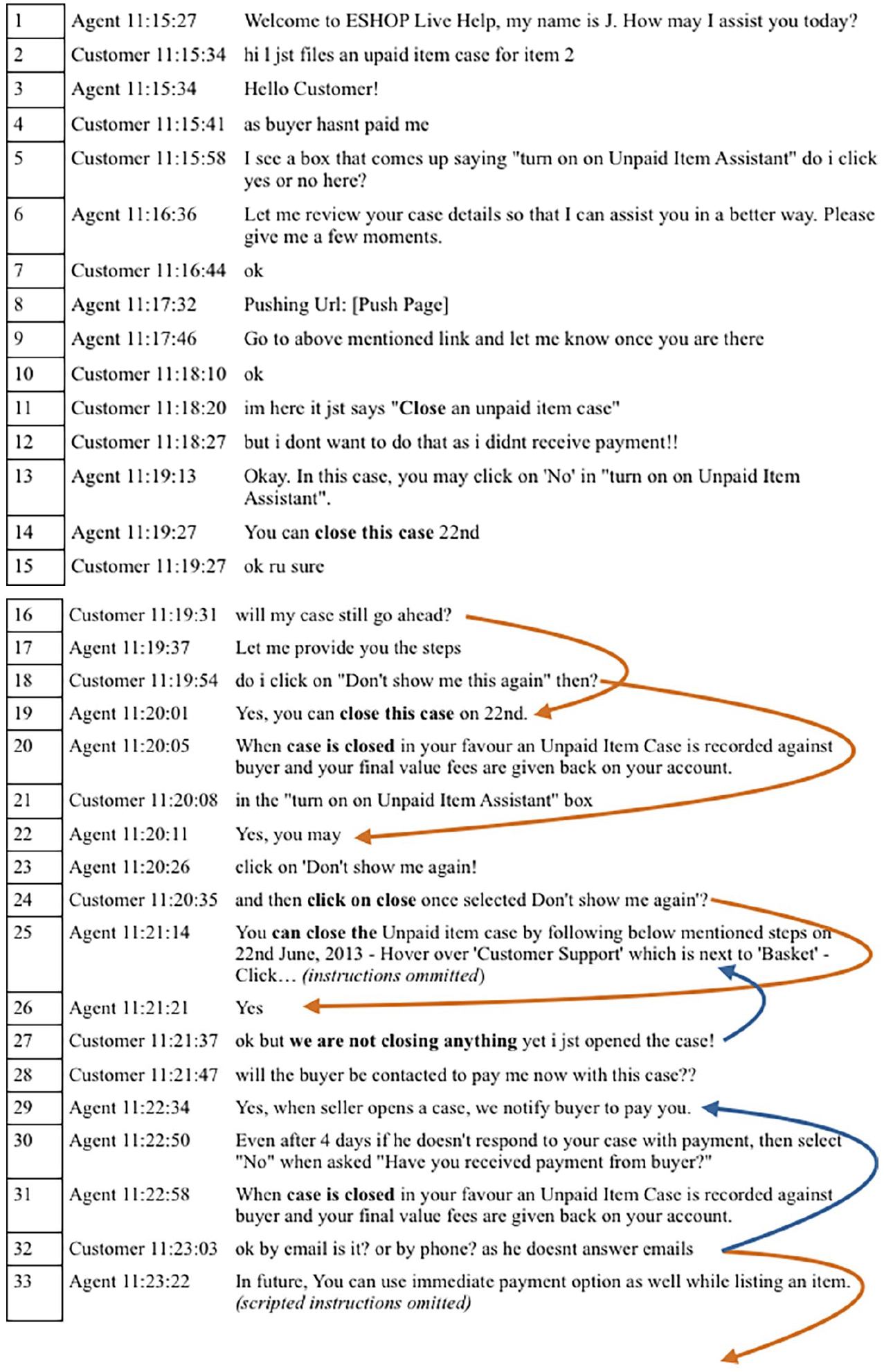
Extract from a customer service webchat.
Disrupted turn adjacency and its effect on responsive action
During the course of the conversation the caller poses 23 questions. Most questions during the first half of the interaction (lines 5, 18, 24 also 38, 41) are requests for affirmation: the caller requires information and/or guidance for specific actions to be completed as part of the procedure to report a non-paying buyer. In general, when speakers use specifying questions (such as in line 5) and the yes/no interrogatives or polar questions (such as in 18, 24, 15, 16) the design of their questions, in conversation analytic terms, is called an ‘initiating action’ (Schegloff and Sacks, 1973). This means that the question initiates a responsive action that has to reflect what the question was understood to be doing, for example, if the ‘main job’ of the question is eliciting specific information, like (5) ‘Do I click yes or no?’, the social action that is made relevant in the responsive action is the providing of information requested along the lines of ‘Click yes’ or ‘Click no’. In polar interrogatives, this evoked action and the resulting preferred 1 response is even more constrained. Previous research shows that if a question is a positively formed yes/no question (for instance the question ‘will my case still go ahead?’ in line 16), the response type it makes relevant consists of – or at least starts with – a positive response token such as ‘yes’ (Raymond, 2003).
As mentioned, the question in line 5 ‘do I click yes or no here?’ implements the action of information seeking. The response (line 6) however, does not conform to the expectations of information giving: ‘Let me review your case. . .’ is the agent’s time buying strategy. The preferred response to this question is not at a later stage, instead the agent instructs the caller to complete a set of actions by ‘pushing’ a URL (line 8) and instructing them what to do next (line 9). The acknowledging ‘OK’ in line 10 completes the instruction sequence and indicates the caller’s compliance. Following a set of additional exchanges about the instructions (11–14) the customer continues to acknowledge the instructions (line 15), but in the same turn she checks the understanding or knowledge of the agent, followed up by a polar interrogative probing the state of the case overall: (line 16) ‘will my case still go ahead?’. As a positively framed yes/no question, in particular emphasised through the use of the adverb ‘still’ is a request for confirmation, and as such the relevant responsive action is either confirmation or – in a dispreferred case – denial. As we can see in Extract 1, however, due the turn adjacency being disrupted as the conversation unfolds, the answers that were made relevant by the initiating action of the questions became positioned between other turns, to the extent that the relevance of the turns became very hard to decipher. Our attempt is illustrated by the arrows in Figure 1. The agent’s answer in line 19 may function as an assurance response to the question in line 15 or as a positive response to the question in line 16. The customer’s request for information in line 18 is only provided in lines 22–23. Here we can see the agent’s attempt to signal the relevance by repeating a part of the phrase of the customer in their response. The next question requesting information (line 24) is also not immediately followed by the response (line 26). In line 28, even though the responsive action to the polar question is conforming and is adjacent to the question, the agent uses two terms in a divergent way, responding to the question referring to ‘me’ (line 28) with an answer about ‘the seller’ (and not ‘you’ line 29) and instead of the word ‘contact’ (line 28) the agent uses ‘notify’ (line 29). Such replacement of terms of the original question in the response have previously been found to function as a way of resisting the constraints of the prior question, and transforming it by replacing specific terms in the response. This strategy in spoken interaction has been found to be accompanied by a distinctive intonation pattern with the replaced word being emphasised (Stivers and Hayashi, 2010). While it is unlikely that the agent here has used divergent language as a way of challenging or transforming the caller’s question (and more likely reverted back to the language of a scripted response), the overall effect of such divergence is that the agent’s behaviour can seen as being less than fully cooperative. The caller’s follow-up question in line 32 confirms that she understood the references made of line 29, yet the divergent language, as Stivers and Hayashi (2010) note, may reflect on the perception of cooperativeness, because ‘question recipients resist the presuppositions the questioners made (. . .) they resist the terms in which the question is being asked (disaligning)’ (p. 20).
Computer-mediated discourse research concerned with coherence in text-based chats agrees that disruptions in adjacency for most do not seem to affect meaning-making and that chat users have developed strategies to communicate coherence, for example through topic development, grammatical and lexical cohesion and the inscription of non-verbal turn-coordination features, like backchannel signals or quoting (Berglund, 2009; Herring, 1999; Nilsen and Mäkitalo, 2010). However, as we can see in the case study conversation, in this one-to-one, high stakes chat there are three concurrent issues related to strategies previous identified as means of creating coherence which seemed to have led to communication problems, and consequently high level of frustration. We will discuss these below.
First, the discussion developed several concurrent topics, some concerning the matter at hand in a more holistic manner (e.g. lines 4, 15–16, 19–20); some topics focusing on more local issues, such as the instruction to immediate action on screen (e.g. lines 17–18, 21–26), the additional instruction about how to avoid similar situations in the future (lines 33–53) and the topic about whose responsibility it is to contact the non-paying buyer (lines 32, 54–78). The problems that arose from the jumps in the various levels of conceptualisation of the problem and will be discussed below.
Second, we have seen instances of lack of grammatical and lexical coherence (e.g. line 29 or Extract 3) where the divergence – although not necessarily intentional – may have come across as intentionally resisting the constraints imposed by the caller’s questions, and as such, viewed as uncooperative behaviour. A similar interactional episode occurs in lines 68–74. Note that the agent uses ‘contact them’ and ‘let them know’ in lines 68 as a way of describing the actions the company took towards the non-paying buyer. She then uses the verb ‘reply’ to describe the predicted/hoped for action of the buyer. The caller then uses a synonymous term ‘answer’, which has an almost overlapping meaning to ‘reply’. The repetition of the question three times may be a signal of his growing impatience. In line 73 the agent’s responsive action is not only a disconfirmation of the information sought by the caller, but is done in a way that the response functions as a correction by replacing the term (previously used by both the caller (70–72 ) and the agent herself (line 68)), with a further corrective explanation added in the same turn (line 73).
Extract 3 68 Agent 11:28:25: We have contacted them via email to let them know about this 69 Agent 11:28:43 If they don’t reply, then you can close the case on 22nd. 70 Customer 11:28:49 71 Customer 11:29:05 72 Customer 11:29:09 73 Agent 11:29:37: WE just inform them to pay you. So, they don’t need to answer us 74 Agent 11:29:42 ARead that
The third aspect is the power of sequentiality: we know from research on spoken interactions that people orient towards nextness as a ‘a basic locus for the production and management of relevancy’ (Raymond, 2013: 170). Of the 23 questions the caller posed only nine were responded to in the sequentially relevant second turn, and out of this number five responses were not type-confirming or dispreferred responses.
These three issues in their own right perhaps would not have led to a communication breakdown, but combined they clearly had a detrimental effect: the evidence in the script from both parties show extreme frustration, and the agent’s behaviour being perceived as ‘rude’ and ‘a joke’. This finding seems to confirm observations from previous research regarding disruptions to conversation in customer service, namely that they can lead to lower levels of trust and greater scepticism about the conversational partner’s competence (Ruhleder and Jordan, 2001). These communication problems also exemplify Salomonson et al.’s (2012) point about the importance of an agent’s ability to be able to use the available communication channels to convey perceptiveness, attentiveness and responsiveness. If an agent’s responsive action does not correspond with the caller’s initiating action she will be perceived or judged as none of these.
Conceptual misunderstanding of space and process
During the first manual reading of the data we have noticed the high number of references to ‘closing’ (marked bold in Extract 2), 19 occurrences all together. Our analysis revealed that the differing conceptualisations of ‘closing’ have repeatedly lead to communication problems. In Extract 2, for example, the customer is instructed to go to a link (line 9). As a way of reporting his progress, the caller uses ‘here’ in a the proximal deixis sense to indicate his position in the metaphorical ‘space’ of the online environment (see Holmes, 1995) and then quotes what he sees on the screen, which contains the instructional verb ‘close’. This clearly causes a conflict for the customer, as evidenced in line (12) where he objects against the ‘closing of the case’. In line 13 the agent acknowledges the caller’s objection and continues to instruct him, and then in line 13 she uses the word ‘close’, which previously seemed to refer to the immediate closure of the case by clicking on a button (line 11), whereas here, it does not denote a specific action but the termination of a procedure at a later date (22nd). In line 24 the caller uses the word ‘close’ in a third sense, where ‘clicking on close’ refers to completing a series of actions on the screen, namely closing a specific window. The grammatical structure seems to further complicate the meaning of this term: the agent’s communication suggests that the act of closing is done by the customer in lines 14, 19, 25, 43, 77, 87, whereas in lines 20, 31, 57, 80 the agent uses passive grammatical structure ‘when the case is closed’ implying that the closing is done by someone else, presumably the company. The uncertainty regarding the three meanings and the agency is evident in the customer’s repeated efforts to clarify what closing means and who does it. In line 27 he writes ‘ but we are not closing anything yet i jst opened the case!’ using a collective pronoun that allows him not to specify the agent and asserting her objection against closing ‘anything’.
The problems in the conceptualisation of the process of closing are closely linked to the multiple conceptualisations of the online space. The conceptualisation of computer-mediated communication environments as ‘space’ has long interested researchers (e.g. Holmes, 1995). The complexity that arises from the multiple spatial aspects the users can orient to is highlighted by Jones (2005), who identifies five such aspects: (a) physical space of the speaker, (b) perceptual online space (the webchat ‘room’), (c) relational space created by the ‘state of talk’ between the participants, (d) screen space and (e) third, external spaces which are not inhabited by the participant, but referred to (p. 144). The analysis revealed that if the agent does not make clear the type of space they orient towards, it makes it problematic for the customer to make sense of the actions referred to. In line (11) for example the caller operates in a perceptual space of an online room, and the ‘closing’ can be done through the completion of specific actions, like clicking buttons. In line 14, however ‘close’ is used in a metaphorical sense and possibly means filing or submitting for further consideration by the organisation, beyond the close spatial context of the screen. The different conceptualisations of space lead to differing metaphorical conceptualisation of the problem: is it system related and solvable as a result of a few clicks on the screen, or is the problem outside of the system and needs more complex problem solving? The properties of ‘closing a case’, therefore, are different depending on the space in which they are positioned, and this positioning consequently, leads to how either of the interactants can conceptualise the process of problem-solving (cf. Kraan, 2005).
Mapping of remaining scripts
During the reading of the remaining scripts we looked for explicit signs of communication problems or breakdown, such as evidence of heightened emotional involvement or misunderstanding. Interestingly, while all scripts were marked for low quality by the quality assurance specialist as a way of identifying agents in need for further training, we only found evidence of problems related to communication breakdown in further 6 scripts, and none quite as severe as our case study. The reason for this, as the quality assurance team member revealed, is that although all conversations were identified as low quality, in most cases it meant problems related to product knowledge or information quality, and only a few cases were referred to as having explicit communication issues, and none quite as serious as the case study example. Below, due to space considerations we limit our discussion to three scripts.
Conversation #7
In this conversation the seller is contacting customer service to find out if the buyer is still required to pay for an item which was labelled as ‘collection only’, but the buyer wants it to be delivered. We have chosen to include this as an example because the script contained several instances where the initiating action in the first part of a question-answer sequence was not followed by a response that would conform the type and structure of the preferred response.
In the script, the anxiety of the seller is evident, through his use of cues that contextualise the message as being of heightened emotional state, as we can see in Extract 4.
Extract 4 10 Customer 08:49:10 how will i receive my outstanding money from this buyer..??? will eshop be able to sort this out for me? 11 <agent> 08:49:13 Here’s how to close the case on 10 february and claim your Final Value Fee (. . .) 12–18 (instructions) 19 Customer 08:53:08 ok but surely if i stated collection only and they have won the bid they must still pay for the item when i could have had another buyer interested in buying the item and was out bid buy this person? 20 <agent name> 08:53:11 We have a User Agreement and a set of policies that outline what we expect from our Customers. 21 <agent name> 08:54:23 I respect your sentiment on this and I understand how unsettling this experience can be.
In Extract 4 the caller seeks affirmation about the company’s ability to sort the issue out (line 10), the agent responds to the caller’s first question in the next turn by providing a set of instructions (11–18) about how to report the buyer. In line 19 we can see that although the caller acknowledges the instructions (‘ok’) he continues with an interrogative, using the word ‘surely’. This can interpreted as an assertion, rather than a question. Assertions in general make acknowledgement, agreement/affiliation and/or confirmation relevant next (Couper-Kuhlen and Selting, 2018: 506). This preference is, yet again, not fulfilled by the agent’s response. The agent’s offer of sympathy in line 21, however, is evidence that the caller’s emotional state was apparent, and perhaps even the act of the non-compliance with the response preference acknowledged. The conversation, although the actual issue has seem to be resolved, seems to have left the customer dissatisfied as revealed by the comments in line 25 ‘i just think it s wrong that. . .’ and line 27 ‘I still think it’s wrong when’. . .
Conversation #12
The seller is contacting ESHOP to provide evidence of the posting of an item, which the buyer claims was undelivered. At the beginning of the call, the seller is transferred several times: in fact, it takes 27 minutes and 10 seconds before the case is reviewed in detail. In spite of the length of the entire call being nearly 45 minutes, the case is not solved satisfactorily, and the customer concludes (line 65): ‘i will ring an agent I am not getting anywhere with you am I? bloody useless’. The communication issues occur when the caller explains that he is pressed for time and asks for clear instructions/explanation as to how the case will be handled (Extract 5/Figure 2). His turn in line 47 is understood by the agent as leave-taking and greets the customer, who, however asks for clarification (line 49) and requests a status update (line 52). The disruption in turn adjacency (as illustrated by the arrows) and the grammatical errors made by the agent as illustrated by the arrows in Figure 2 (line 56, 58) lead to a misunderstanding, in particular related to a space-related term ‘location’. This customer service interaction – as exemplified in Extract 5 ‒ adds to the evidence that although for most, disruption in turn adjacency does not pose problems during text-based interactions, when the speakers are emotionally involved or under pressure (see also Extract 2) the disruption increases the cognitive load and affects meaning making, in particular in contexts when conceptualisation of space or process can differ (e.g. line 54).
Extract 5
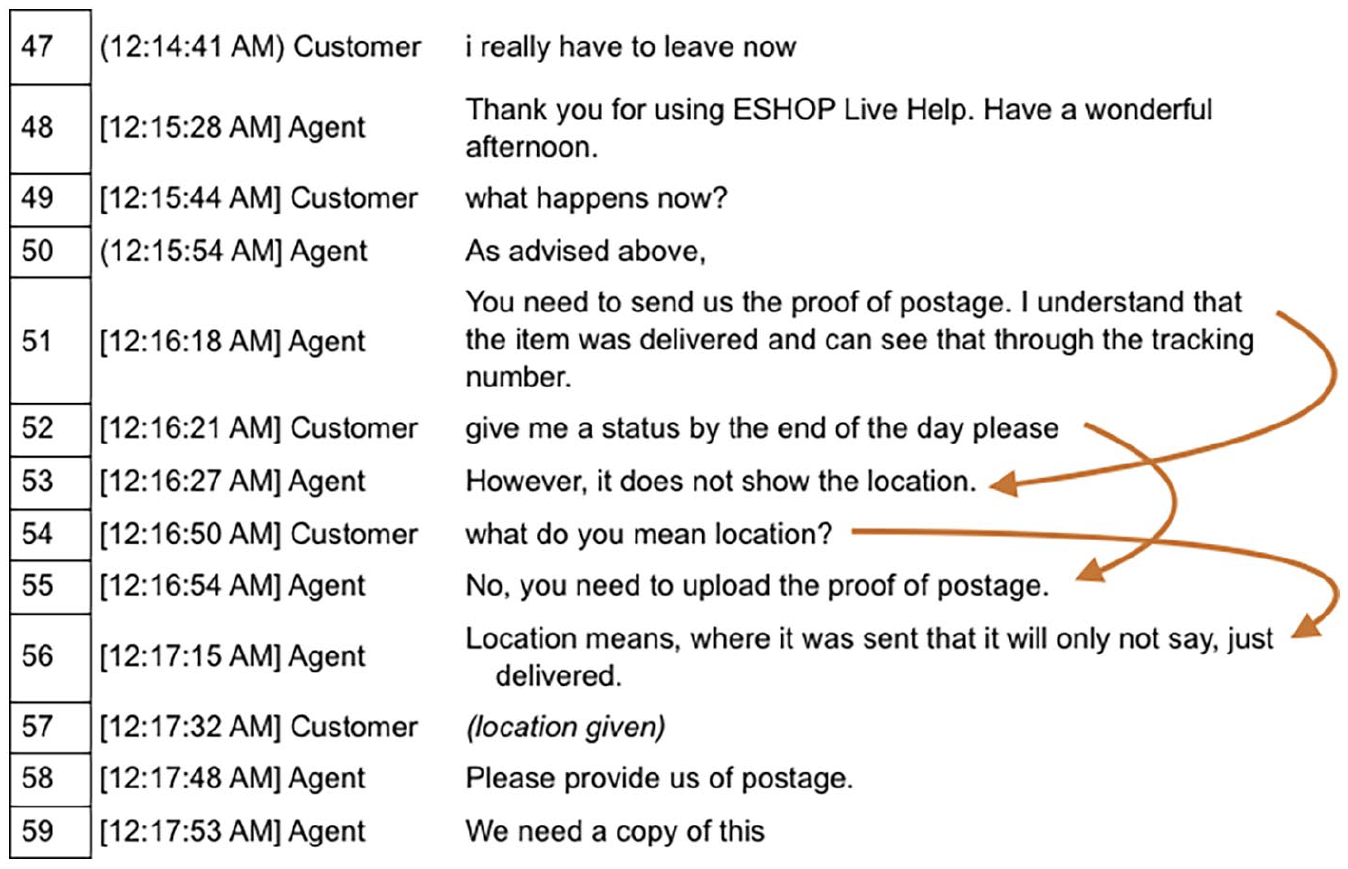
Extract with disrupted adjacency.
Conversation #13
Location as a problematic concept has also occurred in #13 where a caller contacts the centre to discuss re-opening a UK account. In this conversation the different conceptualisations of the current, physical location of the caller, the on-screen space and the relational space of the interaction are being negotiated.
Extract 6 55 Agent 12:18:23 The best thing we should do right now is to change your registration site. But before we can do that, you must change your registered address. You need to provide a UK address. 56 Customer 12:18:25 can you charge it to ESHOP UK, when I will give you my currently address? 57 Customer 12:18:47 can you do this ? from here? 58 Agent 12:21:43 Customer, I won’t be able to change your address on your behalf for we have no access on your account. I can walk you through the process on how you can update your address, though.
In Extract 6 the agent advises the customer of the process of changing registration sites, using ‘we’ in an inclusive sense, referring to herself and the caller. This inclusive interpretation is confirmed by the caller in lines 56–57 when he directly addresses the agent, and asks if this action could be completed ‘from here’, referring to the relational space of the interaction, the here-and-now. The rejection in the agent’s turn (line 58) is evidence of the understanding of the relational spatial conceptualisation: in the rejection the pronoun ‘we’ becomes an exclusive ‘we’, referring to the company, rather than the customer and the agent, so the shared, here-and-now interactional space of solving the problem/updating information has moved to a different online space (your account). The problems related to space are further complicated by the agent’s reference to ‘current location’ (83–84), which prompts the customer to clarify if the agent is talking about ‘my account?’ (line 90) ‘or me?’ (line 91). This instance highlights the importance of the possible differences in experience, against which a linguistic reference is profiled. As Kraan (2005) notes, ‘constructions and referents that are familiar to callers may actually be used from a perspective that may only be familiar to the helpdesk agent’ (p. 95).
Discussion and implications
In this paper we set out to expose issues that may lead to communication problems in text-based chat. Our aim was to identify practices that may be the result of or affected by computer-mediation, and which affect the unfolding meaning-making in customer-agent interaction. We did this in two steps: first by examining the most problematic interaction in great detail and isolating issues that stood out as possible causes of communication breakdown. These were: sequentiality problems, or in other words disrupted turn adjacency and how it affected responsive action; and conceptual misunderstanding. We then analysed the rest of the scripts, paying specific attention to the practices that emerged during the single-case analysis to check if the same patterns emerge and whether these cause similar communication breakdowns. While the second stage of analyses did not provide conclusive evidence to whether the disrupted turn adjacency and the way it affects responsive action, or the conceptualisation problems lead to communication breakdown, it allowed us to expose the various ways these affect the interaction and the overall outcome of the conversation. The chat scripts we identified as problematic from an interactional point of view have shown that the co-occurrence of these issues, in particular under stress or heightened emotional state are likely to lead to communication problems, and consequently frustration and customer dissatisfaction.
The analyses provided evidence that close, interpretative analyses of naturally occurring interactions are an important means to expose of how the participant displayed their interpretation and understanding of the ongoing service interaction. While in computer-mediated communication research in organisational and business contexts theorisations often happen based on reflective accounts and experimental research (Purvanova, 2014), the close analysis of naturally occurring data can expose details unavailable to those scholars who are not engaged with the minutiae of talk-in-interaction. Our findings therefore can inform research on computer-mediated business (and specifically customer service) communication, and provide evidence for or juxtaposed against previous claims (e.g. McLean and Osei-Frimpong, 2017).
The findings have important implications for training. The complex nature of an unfolding conversation, especially where a lot is as stake, makes it hard (if not impossible) to simplify and generalise communication rules for training purposes (see also Xu and Lockwood, 2021). Our findings provide strong evidence that in order to provide actionable communication advice to the agents, it is not sufficient to have insights into psychological, technological and marketing aspects of electronically mediated service encounters (cf. Turel et al., 2013: 103). Greater acknowledgement should be given to the importance of the linguistic and discourse strategies that lead to desired communicative behaviour, like attentiveness, responsiveness or empathy. One way to achieve this is to introduce naturally occurring data as a source for learning through analysis and observation.
The idea of exposing trainees to authentic discourse material has been increasingly promoted by business communication scholars (Bremner, 2018; Clifton, 2012; Darics, 2019). As Chan (2017) found, using naturally occurring interactional data as teaching resource are particularly useful for teaching interpersonal and pragmatic functions. However, to provide trainees with such materials in itself is not enough: they have to be guided to notice the minutiae of language use, other sources of meaning as well as the interactional functions these sources may accomplish. Analytical work, such as the one presented in this paper can successfully inform such training efforts, because trainees, as Koshik and Okazawa (2012) observe, can learn to analyse transcripts with an aim to isolate typical causes of miscommunication, and importantly, ‘to monitor and analyze their own performance to see how it can be improved’ (p. 2019). Based on this study, contact centre agents can be trained to examine the strong interactional rules governing conversations, and
acknowledge the impositions of an initiating action, for example a polar interrogative, and consider the effects of resisting it by providing non-conforming or dispreferred response;
observe the means of creating coherence if adjacency is disrupted, for instance through topical coherence and the use of specific lexical devices. This includes careful consideration of the various conceptualisations related to company-specific terminology or spatial concepts.
The training of communication specialists, like customer service agents, need to become mindful and aware of the complexities of human interaction, in particular in novel interactional situations like webchat; in so doing this will ultimately lead to more competent communicators. By using such analytical observation, we believe, agents will be able to better monitor their own performance, understand and address the causes of miscommunication (cf. Hultgren and Cameron, 2010). As well, given that this industry is so heavily monitored for quality communication in the webchat exchanges, meaningful criteria for measuring such exchange will result not only in fairer scores but also in better diagnosis of what is going wrong. This ultimately will feed into enhanced communication recruitment processes, in training and in coaching.
Footnotes
Declaration of conflicting interests
The author(s) declared no potential conflicts of interest with respect to the research, authorship, and/or publication of this article.
Funding
The author(s) received no financial support for the research, authorship, and/or publication of this article.