




Abstract
When governments introduce controversial policies that many citizens disapprove of, officeholders increasingly use discursive legitimation strategies in their public communication to ward off blame. In this paper, we contribute to the study of blame avoidance in government social media communication by exploring how corpus-assisted discourse analysis helps to identify three types of common legitimations: self-defensive appeals to (1) personal authority of policymakers, (2) impersonal authority of rules or documents and (3) goals or effects of policies. We use a specialised corpus of tweets by the Brexit department of the British government (42,618 words) which we analyse both qualitatively and quantitatively. We demonstrate how the analysis of lexical bundles that characterise each type of legitimation might provide a new avenue for identifying the presence, characteristics and uses of these legitimations in larger datasets.
Keywords
Blame avoidance and legitimation in government communication
Since the 1980s, political scientists have increasingly interpreted the policy choices and (communicative) behaviour of government officeholders from the perspective of blame avoidance: the idea that officeholders tend to act in self-preserving ways to hold on to power when facing blame risks (Hinterleitner, 2020; Hood, 2011; Weaver, 1986). Whenever officeholders sense that they are (or may become) susceptible to blame attacks due to scandals, crises or policy controversies, they may seek to exploit discursive strategies of blame avoidance, such as various ways of legitimising or denying, as part of their facework in service of positive self-presentation (Hansson, 2015, 2018a). Blame avoidance behaviour may be either reactive, when officeholders respond to public accusations, or anticipative, when officeholders try to communicate in a way that would lower the risk of becoming a target of accusations (Hansson, 2017). Blame avoidance as a social and linguistic phenomenon is of particular interest to critical scholars of language and politics because the defensive discursive strategies may be exploited by ill-behaving policymakers to get away with harmful policies and hold on to power.
Among the most important discursive strategies of blame avoidance are legitimations: answers to the spoken or unspoken ‘why’ question to justify some social action (Hansson, 2015; Hansson and Page, 2022; van Leeuwen, 2007). Discourse analysts have noted that people who wish to defend their behaviour or (political) standpoint tend to use, among other things, appeals to personal authority, rules, role models, experts, tradition, fear, goals and effects, a hypothetical future, or altruism (Reyes, 2011; van Leeuwen, 2007; van Leeuwen and Wodak, 1999). In this study, we focus on three types of legitimising appeals that may be seen as common in government discourse about policies: (1) legitimising via references to the impersonal authority of rules or documents, (2) legitimising via references to the personal authority of individual policymakers and (3) legitimising via rationalising references to goals or effects of policies.
So far, the language of blame avoidance has been analysed manually, focussing on small datasets surrounding particular conflictual events (e.g. Hansson, 2015, 2018b, 2019). The same is true for the growing body of critical discourse studies that explore the uses of legitimation strategies in various contexts, including political campaigning (e.g. Mackay, 2015; Zappettini, 2019), public administration and public diplomacy (e.g. Björkvall and Höög, 2019; Simonsen, 2019), business organisations (e.g. Holmgreen, 2021) and news and social media texts (e.g. Lee, 2020; Pérez-Arredondo and Cárdenas-Neira, 2019; Vaara, 2014). These studies have brought to light how powerful groups or institutions have sought approval for their problematic behaviour or harmful policies by using persuasive and sometimes manipulative discourse where their ‘institutional actions and policies are typically described as beneficial for the group or society as a whole, whereas morally reprehensive or otherwise controversial actions are ignored, obfuscated or reinterpreted as being acceptable’ (Rojo and van Dijk, 1997: 528).
Within the discourse-analytic traditions, blame avoidance and legitimation are seen as complex social phenomena that can be only understood fully by analysing particular historical, institutional and interactional contexts in which certain actors experience specific blame risks, and therefore it seems difficult to establish and quantify the discursive features of self-defensive and justificatory text and talk. However, for large datasets of public text and talk, corpus-assisted discourse analysis has been used to gain insights into how particular social actors or actions are represented, and certain values or topics are constructed in blame-sensitive contexts (e.g. Baker et al., 2008, who studied the attitudes towards refugees, asylum seekers, immigrants and migrants in the press; Bednarek and Caple, 2014, who studied how negativity and other news values are construed in the press). In studies of political rhetoric, corpus methods have helped to chart the uses of metaphors as persuasive devices (Charteris-Black, 2004, 2018) that may be part of legitimating discourse. Given that the kinds of legitimation typical of governmental discourse are context-specific and are realised linguistically at a level above the word, tackling the analysis of larger datasets poses major methodological challenges, including in the case of the types of appeals addressed in this paper. Developing these methods is important as governmental departments and politicians are increasingly using social media platforms such as Twitter to legitimise their actions when facing major controversies, scandals or crises. The large scale and scope of the social media datasets that contain legitimations require us to move beyond the solely manual analysis of these strategies.
In our paper, we explore how to increase the transparency and replicability of analysing legitimation using a combination of discourse analytic and corpus linguistic techniques to identify the lexical patterns that characterise three particular defensive communicative strategies. The methods we use help us understand better the characteristic building blocks of these types of legitimation as they appear in a specific dataset and test how far these phraseological units can be used to identify similar strategies in other datasets. This will enable analysts of political discourse to move beyond small case studies of blame games and carry out comparative research across time, issues and contexts (e.g. how government’s defensive language use changes throughout a lengthy political scandal; how government’s defensive language use in the context of scandal X is similar to/different from that during scandal Y). Importantly, this also involves refining the criteria for operationalising different types of defensive/legitimating discursive moves found in the data, thereby making the analytical categories and coding decisions more transparent.
We use the Twitter communication of the Department for Exiting the European Union of the British government as case study to explore the uses of legitimation strategies, because the Department dealt with Brexit – a complex and controversial policy that engendered numerous public blame firestorms and triggered several ministerial resignations. We contextualise this case study in relation to government communication in other online contexts via comparisons with a specialised corpus of tweets from a wider selection of UK governmental departments and political figures, and a general reference corpus of English-language texts collected from the Internet (English Web 2018).
Data: Tweets of the Brexit department and comparable corpora
Our study focuses on the tweets posted by the Department for Exiting the EU. This department, informally known as the Brexit department, was established by Prime Minister Theresa May on 14 July 2016 to oversee the UK’s exit from the EU, following the UK-wide referendum on 23 June 2016, in which 51.9% of voters voted to leave. Throughout its existence, the Department was vulnerable to blame attacks mainly from two perspectives: (1) many UK citizens opposed Brexit, seeing it as a harmful policy that would negatively affect their freedoms and wealth and (2) the government faced constant criticism for poor planning and execution of the Brexit process (Smith, 2018; whatukthinks.org, 2020; YouGov, 2021).
In August 2016, as a part of its public communication efforts, the Department created a profile on Twitter (https://twitter.com/DExEUgov) where it posted content over the course of three and a half years until the Department was dissolved on 31 January 2020 when Brexit took effect. By the end of its term in 2020, the Brexit department’s Twitter profile had attracted 55,600 followers. Throughout its existence, the Brexit department posted 968 original messages and retweeted 901 messages that originated from a total of 145 accounts. The Brexit department mainly retweeted tweets posted by the UK Prime Minister’s office (@10DowningStreet), 14 senior and junior ministers who oversaw the Brexit department during different periods, and other UK government departments and agencies. This indicates that a significant part of the Brexit department’s Twitter communication was geared towards amplifying and spreading Brexit-related messages from the most senior political leaders (particularly the Prime Minister) and relevant government departments. We used the rtweet R package (Kearney, 2019) to scrape all the 1869 tweets and retweets from the Twitter profile of the Department and compiled a specialised corpus of 42,618 words.
For the purpose of comparison, we used two larger corpora where justifications of Brexit and other government policies were likely to occur:
A specialised corpus of tweets (622,625 words) posted by 19 UK politicians and governmental departments associated with Brexit and the COVID-19 pandemic, compiled using R between January 2020 and January 2021, the period in which the UK’s transition from the EU was completed.
The English Web 2018 corpus, a general corpus of texts collected from the Internet (over 25 billion words) and available within Sketch Engine (Kilgarriff et al., 2014).
The two larger corpora offer interesting points of comparison with the Brexit department’s tweets. The corpus of tweets by UK politicians and government departments might be expected to contain similar strategies to those used by the Brexit department’s Twitter account, given that some of the accounts and departments associated with Brexit are also included in the former corpus. However, the timeline of the UK politicians and government departments Twitter data collection means that Brexit is by no means the only topic about which these departments were tweeting as the Covid-19 pandemic, itself a blame-triggering event, became a major theme in government communication since March 2020. The English Web 2018 corpus is not limited to political discourse, but does include online websites and blogs that contain political discussion, news and blogs that include discussion of Brexit and of many other political matters.
Methods
There are no universally applicable linguistic methods for identifying and quantifying legitimation strategies in their lexico-grammatical contexts. Therefore, our exploratory research design differs from much of the existing corpus-assisted discourse studies. While it is common to use quantitative measures, such as word frequency rankings, keywords or collocations as entry points into large datasets and then focus on a detailed qualitative analysis of a smaller subset of text (e.g. Kopf, 2020; Ross and Rivers, 2020), in our study of legitimation strategies the order of these stages was reversed. First, we carried out a qualitative, manual analysis of the entire corpus to identify the uses of three types of legitimising appeals. In the second, quantitative stage, we used Sketch Engine software to explore lexical bundles, multi-word units which occur recurrently in large corpora (Biber et al., 2004).
We chose to focus on lexical bundles (rather than single-word units) because of the potentially formulaic nature of the governmental discourse: we expected to find some recognisable phraseological units that occur rather frequently. A phraseological approach seemed a more productive means of identifying the functions of the different types of appeals also because the lexical realisations of these appeals (at the level of single word units) tend to be topic-specific. Lexical bundle analysis provides us with descriptive precision for characterising the building blocks of each type of legitimation and enables us to validate the qualitative analysis by comparing the uses of the bundles in larger, comparative datasets. The two strands of analysis are complementary: the manual analysis allows us to pay attention to low-frequency features in the discourse, while the lexical bundle analysis points to the more formulaic characteristics of the legitimations.
Qualitative stage: Manual discourse analysis of legitimation strategies
As noted at the outset, legitimising means providing answers to the spoken or unspoken ‘why’ question to justify some social action (van Leeuwen, 2007). In the context of the blame risks affecting the Brexit department, legitimising primarily revolves around the following two ‘why’ questions: (1) Why should Brexit be implemented – and why should it be done in the way the UK government and its Brexit department do it? (2) Why might the UK government and its Brexit department deserve praise (and not deserve blame) for what they do?
These over-arching goals of legitimation can be met through various strategies. Following van Leeuwen (2007), a fundamental distinction can be made between legitimation via authorisation and rationalisation. The former means imposing some kind of authority without further justification: the answer to the ‘why’ question is either ‘because [authority figure] says so’ (personal authority legitimation) or ‘because [rule, policy, law, etc.] says so’ (impersonal authority legitimation). Rationalisation, however, involves referring to the utility of the practice that is being justified: the answer to the ‘why’ question is ‘in order to do/be/have [something desirable]’. These legitimations may be regarded as typical appeals used in political argumentation (Hart, 2013; van Leeuwen, 2018), so for the sake of clarity in the context of official tweets, we have labelled our main analytic categories as follows:
appeals to personal authority of policymakers,
appeals to the authority of rules or documents,
appeals to goals or effects of the government policy.
Legitimations may be accomplished by various speech acts, such as assertions or questions, but semantically, all legitimising appeals presuppose or refer to actions that the speaker wants to defend, and emphasise the speaker’s opinion that these actions as appropriate (Rojo and van Dijk, 1997). Appeals to authority explicitly mention either a powerful actor whose words are cited directly or paraphrased to support the chosen path of action, or a rule/document that is used as a basis for justification. Appeals to goals or effects typically mention some presumably desirable state of affairs that the action in question has brought about or is supposed to bring about in the future.
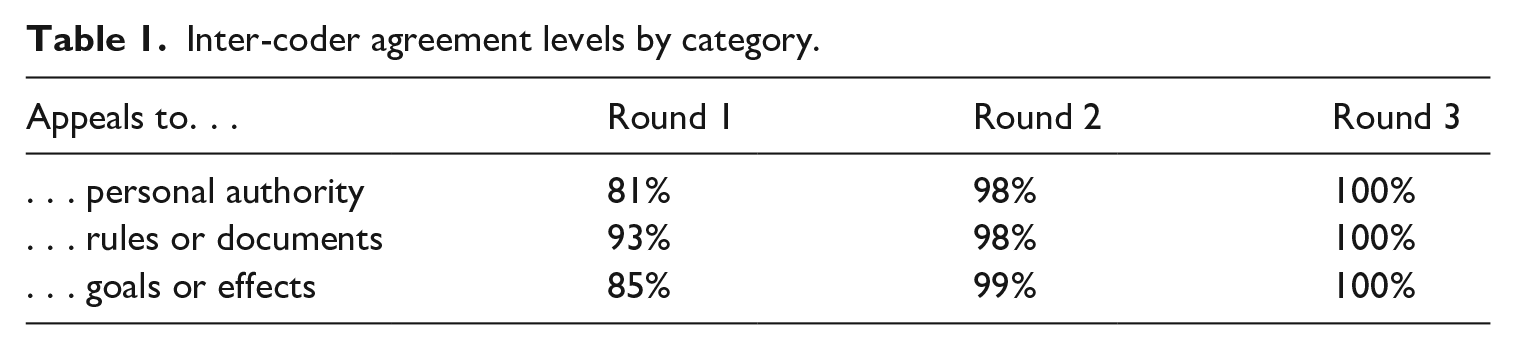
Based on these preliminary insights, we developed an annotation manual to guide the analysis of the data. The two authors of this paper read each tweet in the Brexit department dataset independently, identifying every occurrence of the three appeals listed above at the level of the tweet. A single tweet could be annotated as containing more than one type of appeal. The annotation was reviewed in three consecutive rounds to identify the level of inter-coder agreement, followed by the discussion of ambiguous cases and refining of the criteria used for annotation. In the first round of coding, we reached above 80% agreement, and in the second round, 98% agreement for each of the categories. All coding disagreements were resolved at the third round of coding. The details of the levels of agreement by category are summarised in Table 1. The inter-coder review process was used particularly to refine the criteria for identifying appeals to personal authority, so that these were categorised on the basis that the tweet indicated the source of the personal authority and reported that person’s speech that legitimised the Brexit process (i.e. merely mentioning a person in a tweet would not count as legitimation).
Inter-coder agreement levels by category.
Quantitative stage: Corpus-assisted analysis of lexical bundles
The corpus-assisted analysis focussed on the multi-word units – lexical bundles – that characterised the three legitimising appeals. We began by identifying the subsections of the dataset in which only one appeal occurred in each tweet and checking these for 3, 4, and 5-word n-grams in Sketch Engine. The 3-word n-grams were too short to be satisfactory for our analysis, so 4-word n-grams form the main body of our analysis, with occasionally 5-word n-grams included where two 4-word n-grams were joined together. Following Cortes (2013), we regard these n-grams as frequently occurring patterns that are long enough to contain a recognisable, albeit incomplete structural unit and recognisable discourse function. Additional thresholds were applied to select only the n-grams that occurred with a raw frequency of five or more and that occurred in at least 10% of the tweets for each appeal. These thresholds mean that the lexical bundles were less likely to be skewed by idiosyncratic uses in an already small corpus.
Our analysis of the lexical bundles focuses on their discourse function (Gray and Biber, 2015) using the categories developed by Cortes (2013) and Jablonkai (2010), that is, whether the bundle was used as a stance marker to organise the discourse, or to express a local referential meaning. This analysis might then help bring to light the commonly occurring communicative functions of each strategy and the most frequent phraseological patterns used to realise each of them.
Lastly, as Gray and Biber (2015: 137) point out, the specific phrases identified through lexical bundle analysis can be influenced by the corpus design. To test how replicable the form of the lexical bundles and their function as indicators of legitimation might be, in the final stage of the corpus-assisted analysis we searched for each of the n-grams in the two larger corpora described in the Data section.
Results
Results of manual discourse analysis
In the Twitter communication of the Brexit department, we found 646 instances of appeals to personal authority, 266 instances of appeals to goals or effects and 206 instances of appeals to the authority of rules or documents. We start by looking more closely at the two kinds of appeals to authority.
Appealing to the personal authority of policymakers
The most common strategy of discursive legitimation of the Brexit process in our dataset rests on the assumption that the audiences would be persuaded by the claims that the government’s version of Brexit should be implemented if these claims are made by powerful policymakers. These claims may be presented in the form of direct quotations or paraphrases of what the policymaker has said in a speech or some other statement.
(1) As Brexit Secretary @SteveBarclay told the House today, it’s time to #GetBrexitDone
In (1), the necessity of implementing the government’s Brexit policy is justified by what a top policymaker has said in the Parliament. The high status of the source of legitimation is made explicit by stating his job title: Brexit Secretary. In addition, the personal aspect of the legitimation is further underlined by presenting the name of the authority figure as his Twitter username (i.e. a ‘handle’ beginning with @, a hyperlink to the personal Twitter profile of the Brexit Secretary). That could be seen as an additional resource for legitimation within Twitter, for including the person’s Twitter handle may link to further forms of ratifying their status, such as the ‘verified’ account status, descriptions of their status in the Twitter profile, and links to their official websites.
Appeals to personal authority may be combined with appeals to positive effects of the policy that is being legitimised.
(2) “We are going to unite and level up the whole of this incredible United Kingdom - England, Scotland, Wales, Northern Ireland - together.” – PM @BorisJohnson
In (2), the tweet contains a sentence in quotation marks that suggests that Brexit would have a politically unifying effect that could be seen (at least by certain audiences) as desirable. The quotation is explicitly attributed to the Prime Minister, who, again, is presented with a Twitter handle that foregrounds the personalised source of this claim.
From a critical discourse-analytic perspective, the overwhelming reliance on appeals to authority may be seen as problematic, because discourse structures that ‘emphasise the position, power, authority or moral superiority of the speaker(s) or their sources’ (van Dijk, 2006: 376) could make the recipients potentially more vulnerable and less resistant to manipulation. Appeals to authority are also known as appeals to ‘awe’ (argumentum ad vercundiam), and may be regarded as argumentative fallacies if these are used to avoid rational debate (Reisigl and Wodak, 2016).
Appealing to the impersonal authority of rules or documents
Not all appeals to authority are personal. As van Leeuwen (2007: 96) explains, [i]mpersonal authorities can be the subject of ‘verbal process clauses’ just as readily as personal authorities (‘The rules state that. . .’; ‘The law says that. . .’). But the indispensable element in legitimations of this kind is the presence of nouns such as ‘policy’, ‘regulation’, ‘rule’, ‘law’, etc. or their cognate adjectives and adverbs (e.g. ‘compulsory’, ‘mandatory’, ‘obligatory’).
In the Brexit department’s tweets, there are mentions of a large variety of rules and other official documents, including words like agreement, act, bill, paper, deal, scheme, treaty, plan, report and so on. This is unsurprising, considering that Brexit is a complex process that involves the introduction of a lot of new legislation and the production of various political and legal documents over many years. As previous critical discourse studies have suggested, in their legitimations, officeholders often try to emphasise the legality of official practices (Rojo and van Dijk, 1997). Here is a typical example: (3) Our new deal delivers #Brexit. The EU (Withdrawal Agreement) Bill introduced to Parliament yesterday will put it into UK law. https://t.co/hSzhGE1OtY https://t.co/UJyJEcDVZJ
In (3), ‘deal’ and ‘bill’ are presented as powerful social actors that ‘deliver Brexit’ and ‘put it into law’. The reference to the bill being introduced to Parliament suggests that the government’s version of Brexit should be seen as desirable because it is supported by the legislators. The tweet also contains a hyperlink to an online full version of the bill in question, so the audience is implicitly invited to read the full document.
In many cases, the appeal to the authority of a rule or an official document is combined with an appeal to its (presumably positive) goals or effects as exemplified in (4) below: (4) Today’s #BrexitDeal will provide clarity and certainty for UK business and for all our citizens.
From a critical discourse-analytic perspective, the use of appeals to rules or documents in officeholders’ communication may be seen as serving at least two blame avoidance functions. First, similarly to the appeals to personal authority, frequent references to (presumably) important official documents emphasise the high social status of the source(s), thereby possibly inducing awe in law-abiding or less-informed citizens and reducing their willingness to dispute the content of the proposed policies or blame the government for introducing harmful policies. Second, in contrast to the appeals to personal authority, by casting rules or documents as social actors who ‘deliver’ policies, officeholders effectively delete or background human agency in their accounts, so it becomes difficult or even impossible to single out any policymakers who could be held accountable for the problematic policy in question.
Appealing to goals or effects of the government’s policy
A course of action may be defended by appealing to its purposefulness. Van Leeuwen (2007) calls this type of legitimising ‘rationalisation’ and notes that it may take many forms, such as: ‘I do x in order to do (or be, or have) y’, ‘I achieve doing (or being, or having) y by x-ing’, ‘X-ing serves to achieve being (or doing, or having) y’, ‘X [allows, helps, facilitates] doing y’. The Brexit department’s tweets frequently appeal to future positive outcomes (supposedly) arising from the activities of the government, so the answers to the ‘why’ questions could be restated as ‘because [Brexit, policy] leads to [a desired effect]’ or ‘because [Brexit, policy] helps to achieve [a desired goal]’. For instance: (5) Outside the EU we’ll be able to give farmers the support they need - helping them farm more productively and sustainably.
In some instances, the desired effect that the tweets appeal to is ‘no unwanted change’, typically taking the form of claims that no harm will happen as a result of Brexit. For example: (6) Brexit won’t affect your UK State Pension: payments will automatically continue.
Some appeals are notably vague, referring to positive future outcomes for the country such as ‘brighter future’, ‘new role’ or ‘opportunities’. For instance: (7) Passing this deal through Parliament means we can focus on building our bright, post-Brexit future (8) “Brexit means we can forge a new role for the UK globally”
In the same vein, some appeals are hyperbolic: (9) The #Brexit deal paves the way for us to negotiate the broadest and most ambitious Free Trade Agreement with the EU the world has seen.
What these examples demonstrate is that when officeholders use appeals to the goals and effects of policies while seeking to present themselves in a positive light, they are not necessarily putting forward logically sound arguments supported by relevant evidence. As van Leeuwen (2018) has observed, legitimation strategies always include an element of moral evaluation, and rationalisations may rely on value-laden adjectives (such as ‘ambitious’ and ‘bright’ in our dataset) that hint at some presumably ‘commonsensical’ understandings of what is morally desirable.
Results of corpus-assisted analysis
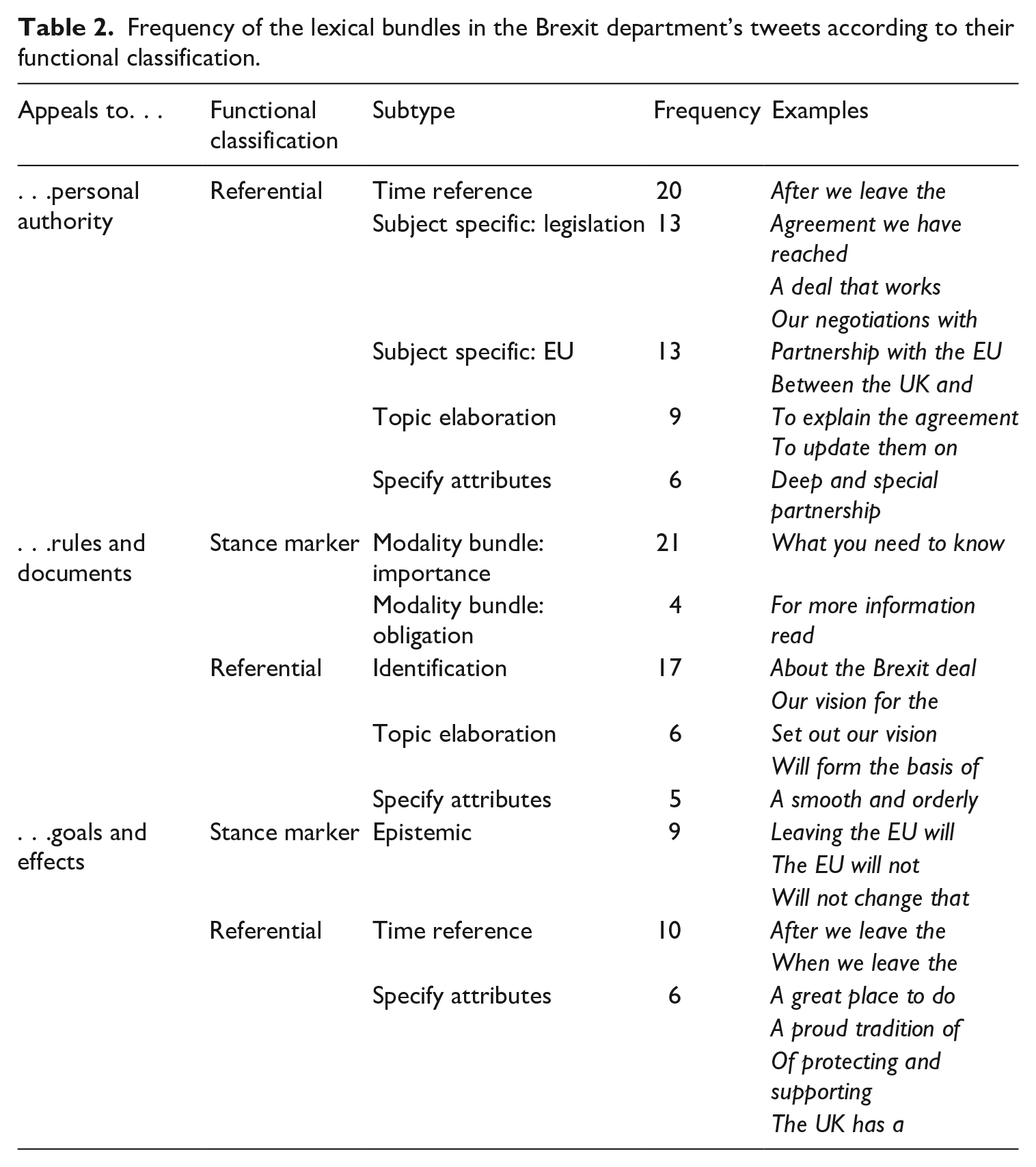
The results of the quantitative analysis of lexical bundles and their discourse functions are summarised in Table 2. In the following sections, we describe the three types of appeals and the lexical bundles identified in each of these in turn.
Frequency of the lexical bundles in the Brexit department’s tweets according to their functional classification.
Appealing to the personal authority of policymakers
The quantitative analysis indicated that the appeals to personal authority were characterised by lexical bundles that served the purpose of topic elaboration (e.g. to explain the agreement, to update them on). These bundles appeared in subordinate clauses which conveyed the purpose of a politician’s activities, typically meeting with other politicians, stakeholders and citizens. The topic elaboration could co-occur with subject-specific bundles that related to particular political outcomes, (e.g. securing their rights).
(10) @LordCallanan met members of the Maltese community in the UK last night at their London High Commission (11) The Brexit Secretary @SteveBarclay was in the Czech Republic earlier this week meeting business leaders & senior ministers
Appeals to personal authority also included bundles that repeatedly specified the attributes of a particular entity or outcome in a positive light, such as the references to the deep and special partnership with the EU.
(12) Over the weekend PM @theresa_may set out why the #UK wants a
Lastly, there were tweets with lexical bundles that provided contextualising information in time adverbials (after we leave the, when we leave the) which projected an optimistic vision of future events.
(13) Secretary of State @DominicRaab after his phone conversation today with @MichelBarnier, on our progress negotiating a deal that works in all of our interests (14) Today I met with @vonderleyen.
Together, these bundles point at some of the communicative building blocks that characterise the appeals to personal authority in our Twitter data. This includes phrases that incorporate verbal processes (e.g. to update them on, to explain the agreement) or reports of communication (e.g. our negotiations with the, agreement we have reached) which are typically coupled with the presentation of the government’s work in positive evaluations that depict future outcomes. What is perhaps most notable is that from a phraseological perspective none of these bundles reflect the individual who is the source of the personal authority, but rather their acts of communication on behalf of the government.
Appealing to the impersonal authority of rules or documents
The quantitative analysis indicated that the functions served by the lexical bundles in the appeals to rules include localised references which were characterised by topic elaboration, identification and specifying the attributes of particular entities. These bundles co-occurred in 83% of those appeals. For example, there is a complementary function of topic elaboration (e.g. sets out our. . .) in the framing clause and the identification giving further details of the content contained in that report or regulation (e.g. vision for UK-EU co-operation).
(15) Today’s future partnership paper
Likewise, topic elaboration bundles (e.g. will form the basis) combined with a bundle specifying the attributes of an entity (e.g. a smooth and orderly).
(16) The Repeal Bill
Lastly, the appeal to rules was characterised by stance-marking bundles which emphasised the importance of the documents (e.g. what you need to know) or legislation and directed the audience to engage further with the documents in full (e.g. for more information read).
(17) @DailyMailUK Here’s (18) The Repeal Bill will form the basis for a smooth and orderly EU exit -
Although in van Leeuwen’s (2007) account of impersonal authority legitimation, the source of legitimation lies with the status of the rules or documents, these bundles suggest that from a phraseological perspective, what characterises this strategy is the communicative functions realised through verbal processes and summarising the key content of those rules and documents and their envisioned effects. They also point to the communicative context in which these appeals occurred: the official announcements that push information about official documents to the audience via social media, ostensibly in the service of transparency.
Appealing to goals or effects of the government’s policy
The quantitative analysis indicated that the appeals to goals and effects (rationalisation) were characterised by bundles that contained referential attributes which presented the UK in a positive light (e.g. a great place to do, protecting and supporting, the UK has a).
(19) After we leave the EU, the UK will remain
Goals and effects are appeals to future outcomes, and as such include time references which in this data relates to the positive outcomes possible ‘when we leave the EU’.
(20)
Eighty per cent of the bundles of referential attributes co-occurred with these time references or with stance-marking bundles of epistemic modality that expressed certainty with which a positive outcome would occur or remain available (will not change that).
(21) The UK has a proud tradition of protecting and supporting human rights. Leaving the EU
The appeals to goals and effects are thus characterised by claims that in the future, positive attributes will either be achieved or remain undisrupted. This is in line with van Leeuwen’s (2008: 115–116) typology where rationalisation may focus on the potential of particular actions for serving specific purposes, or on theoretical predictions.
Comparison with larger corpora
As explained in the methods section, to test how replicable the form of the lexical bundles and their function as indicators of legitimation might be, we searched for each of the n-grams in two larger corpora where justifications of Brexit and other government policies might occur. All of the lexical bundles except for one (our vision for UK-EU) occurred in the English Web 2018 corpus. Half the lexical bundles occurred in the UK government tweets corpus. The raw and normalised frequencies for each bundle are presented in Table 3.
Frequency of lexical bundles from the Brexit department’s tweets in two larger corpora: UK government tweets 2020 and English Web 2018.
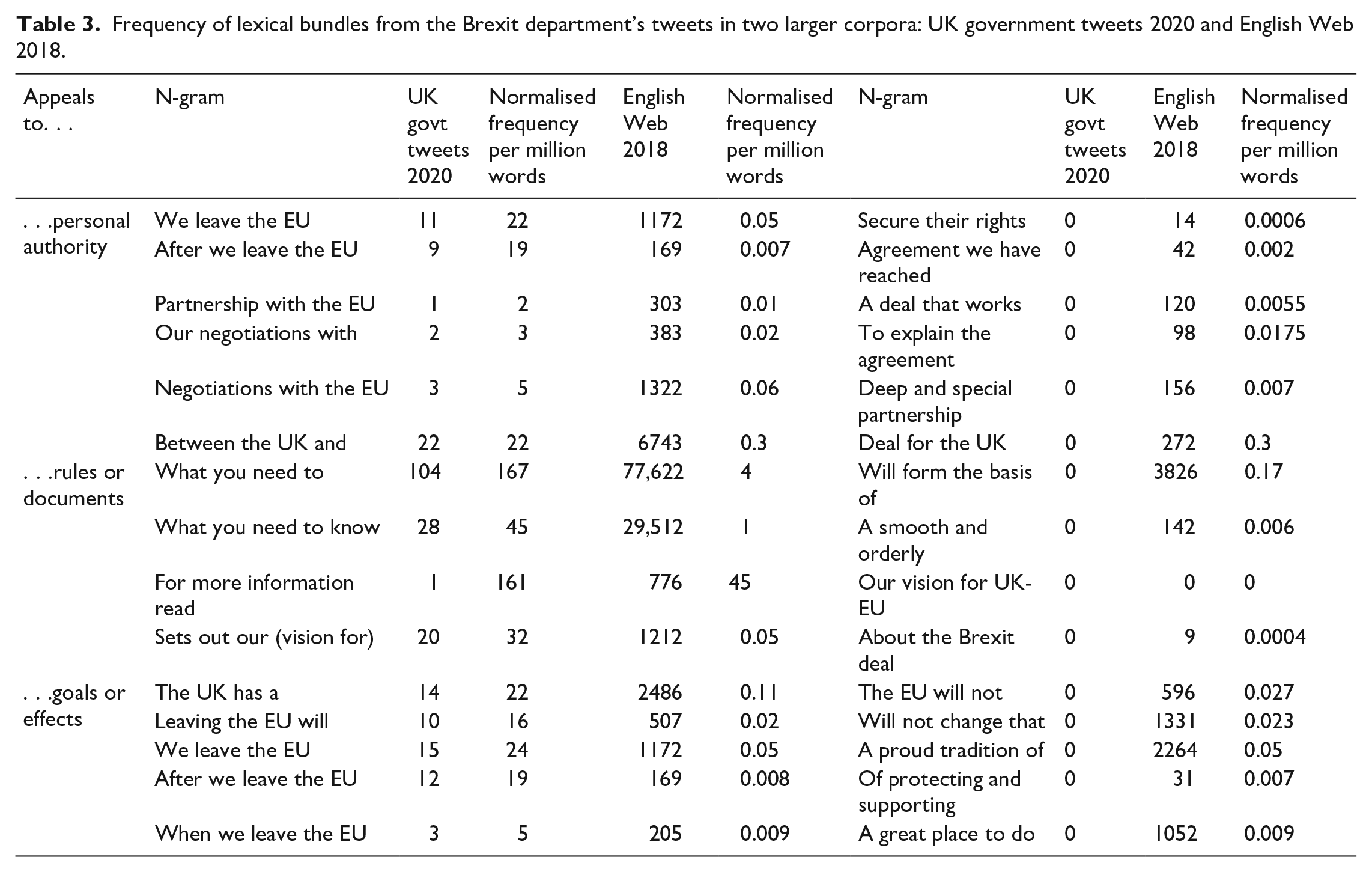
The concordance lines in the UK government tweets corpus and a random sample of up to 100 concordance lines from the English Web 2018 were then checked in order to identify how far the bundle could be used to identify instances of legitimation in other datasets beyond the original corpus.
The frequencies of these bundles suggest that some are more context-spanning in their occurrence than others. For example, the most frequently occurring bundles, ‘for more information read’, might occur in many different contexts, and even in the tweets from the Brexit department it occurred not because it was typical of the legitimation per se, but rather because of the broader communicative context in which the legitimation occurred (i.e. appeals to the authority of rules or documents were supported by directing the reader to links where they might find the documents). The question remains of how far the less frequently occurring, but more context-specific lexical bundles might allow us to identify further examples of legitimation. In some cases, the n-grams which mentioned specific phrases relating to Brexit-specific legitimation (e.g. partnership with the EU, when we leave the EU) were found to occur in similar contexts in datasets beyond the Brexit department’s tweets (Examples 22–25).
(22) WATCH LIVE: Prime Minister @BorisJohnson outlines details of the future (23) We want a positive new strategic partnership with the EU and we are confident of achieving this [English Web 2018] (24) (25) We remain fully committed to controlling the export of live farm animals for slaughter
A second set of n-grams used formulations that characterised governmental or business discourse more generally. These included the lexical bundles that in the Brexit department’s tweets functioned to specify attributes of the government’s activities, such as ‘smooth and orderly’ and also occurred in other institutional contexts where positive evaluation was used to legitimise responses to change or crisis (Examples 26, 27).
(26) Lily will remain with the Company until 14 November 2018, ensuring (27) To help ensure
Other n-grams that appeared in positive depictions of the UK in the Brexit department’s tweets were used to describe the attributes of the UK in other governmental or institutional contexts. Similarly, ‘The UK has a’ prefaced a range of positive attributes for the country both in government and business contexts (Examples 28–31).
(28) @BorisJohnson held talks with President @AlsisiOfficial of Egypt this morning in Downing Street. They spoke about the importance of trade and education links (29) International business student Henry Lancaster said: "To be sitting with the manager of Barclay's operations in China is pretty special. He wanted to hear our thoughts about the alliance (30) (31)
Within the referential n-grams are a group of clause fragments (such as ‘set out our’, ‘will form the basis of’, ‘agreement we have reached’ and ‘to update them on’) that were used to report the government’s communicative activities within the Brexit department’s tweets and are also used to describe the communication of other political figures in contexts beyond that of Brexit. In the UK government tweets corpus, this included messages about the Covid-19 pandemic response, and in the English Web 2018 corpus, reports about government budget decisions (Examples 32–35).
(32) Yesterday @MattHancock (33) Yesterday we (34) The purpose of these meetings is to keep our dealers informed of any new regulations and (35) In confirming the agreement reached between the two organisations CSCS Chief Executive, Graham Wren, commented "
What each of these examples shows is that when these lexical bundles occur in contexts beyond that of the Brexit department’s tweets, their wider contexts of use imply positive activities or outcomes. The bundles have a wider, positive, discourse prosody that supports their use within the legitimising appeals. In some cases, this might seem obvious, for example, when smooth and orderly is used to cast the government’s Brexit process in a positive light. However, in other cases, the discourse prosody emerges from the context of use. For example, to set out or to update are typically used in other institutional discourse contexts that imply a solution or transparency.
However, not every use of the lexical bundles that characterise the legitimising appeals in the Brexit department’s tweets will identify similar kinds of legitimation in other datasets. There is no isomorphic relationship between the lexical bundle and its potential to be used in legitimising an action. The identification of the n-grams in other datasets could only be seen a first step in finding potential instances of legitimation. Careful scrutiny of the concordance lines in which the bundles occur is necessary to determine whether or not these form part of any defensive appeals in a particular communicative context. The bundles that occur in the appeals used by the Brexit department do not always serve a legitimatising function and can be used in contexts to imply blame. The following examples show how selected bundles occurred in contexts of complaining or criticising the government, for example, where communication has failed (‘to update them on’), where negative attributes are reported (‘The UK has a’) or negative outcomes described (‘when we leave the UK’).
(36) They complain that the government is refusing (37) (38) “London is one of the areas that really benefits from the skills of overseas specialists, so it could be one of the most severely impacted
Conclusions
Our analysis shows that the qualitative and corpus-assisted analyses of the legitimation strategies provide complementary perspectives on blame avoidance in governmental tweets.
Some features of the legitimation strategies were only identifiable through the qualitative analysis, such as the forms of naming and usernames that emphasised the personal authority of political figures, the presence of hyperlinks that gave readers access to the documentation referred to in appeals to rules and documents, and the varied ways in which appeals to goals/effects could be expressed with greater or lesser detail. In general, qualitative analysis primarily draws researchers’ attention to the argumentative structure of the legitimising appeals, that is, the ways in which the (unexpressed) ‘why’ question in relation to some problematic policy is answered by formulations that imply ‘because [authority figure/rule/document] says so’ or ‘in order to do/be/have [something desirable]’. This means that from a critical discourse analytic perspective, further information about the cultural, and political aspects of the specific communicative act must also be used to interpret the particular blame risks that the speaker may be experiencing. The qualitative analysis helps to bring out several problematic aspects of legitimation, such as the overwhelming reliance on appeals to authority that could make people more vulnerable to manipulation, the backgrounding of human agency (and thereby blameworthiness) by casting rules or documents as social actors who ‘deliver’ controversial policies, and the lack of logically sound arguments supported by relevant evidence when talking about the goals or effects of policies.
In contrast, the analysis of the lexical bundles brought to light the positive discourse prosody associated with the most frequently used phrases that elaborated topics in the appeals to personal authority and to goals and effects. The lexical bundles in the appeals to rules and documents also highlighted the typical communicative contexts in which the legitimation occurred: that is, with additional recommendations that the reader ‘find out’ or ‘read’ more about the rule or document.
Both the qualitative and lexical bundle analysis showed how legitimising appeals rely on reported speech in what people or documents ‘say’, and the positive evaluation of potentially problematic social practices in all types of appeal, as suggested previously in van Leeuwen’s (2008) work. However, it brought to light additional aspects of legitimising as they were realised in this data set, that is: the persuasive potential of the particular phraseological choices used to frame reported speech and the positive evaluation that emerges from the discourse prosody of these choices. While the qualitative analysis relies on extra-textual interpretation of ‘commonsensical’ understanding of what may enable the moral evaluation to be judged as desirable, the corpus-assisted analysis provides textual evidence of the ways in which this positive evaluation is more widely used.
Crucially, the analysis of the lexical bundles across different corpora showed that these phraseological choices were not limited to their legitimising functions in the tweets from the specialised corpus but also occurred in other contexts of governmental communication and institutional discourse, where they also sometimes served legitimising functions. As with all corpus-assisted discourse analysis, close scrutiny of the concordance lines and wider textual context is necessary to identify whether the bundles were being used for legitimising purposes or not.
Nonetheless, there is promising value in exploring legitimation strategies from a phraseological perspective. Corpus methods may help further refine this analysis, for example, by using regular expressions to identify multi-word sequences in which words form a ‘frame’ around a variable slot (p-frames). Given that the governmental use of social media is widespread and of growing interest to scholars from multiple disciplinary backgrounds (e.g. DePaula et al., 2018; Krzyżanowski, 2018; Medaglia and Zheng, 2017), understanding how far particular appeals occur in other conflictual contexts beyond Brexit is an important step in being able to scale up and compare the use of legitimation strategies in other, larger government social media datasets. Self-defensive communication is not limited to the political sphere but occurs in corporate and elite discourses of many kinds, and in national contexts outside the United Kingdom. There are other multimodal aspects of social media data, such as emoji, images and audio-visual content, which were not considered in our analysis but which are now becoming amenable to computer-assisted analysis, and which may well contribute to the semiotic construction of blamelessness (see, e.g. Hansson, 2018c; Mackay, 2015). There is thus considerable further work to be done to test and explore how far the phraseological patterns in legitimation operate across contexts of use.
Our paper has focussed on the identification of defensive strategies used in government communication, but not their reception. Further work could explore the relationship between these patterns of legitimation and their possible blame avoidance effects, for example, by tracing the patterns in the replies to tweets or other kinds of social media interactions, by using the meta-data available with tweets to examine the patterns of distribution of blame avoidance within social media networks, or by using quasi-experimental design to test the perception of blame on different groups of people. This kind of work opens up avenues of interdisciplinary inquiry, for example, with scholars in social psychology, media studies as well as political science. The real world political and social implications of blame avoidance are significant – it may affect reputations, voting outcomes and the lived experience of many citizens – and therefore a better understanding is needed of how legitimising discourse is shaped in social media.
Footnotes
Acknowledgements
We are grateful to Susan Hunston, Paul Thompson, and Nicholas Groom for their helpful comments on earlier drafts.
Declaration of conflicting interests
The author(s) declared no potential conflicts of interest with respect to the research, authorship, and/or publication of this article.
Funding
The author(s) disclosed receipt of the following financial support for the research, authorship, and/or publication of this article: This project has received funding from the European Union’s Horizon 2020 research and innovation programme under the Marie Skłodowska-Curie grant agreement No 891933.