



Abstract
Social media is an endless source of texts and images about almost everything. Accordingly, the number of analyses based on this source increases daily. Among the numerous methods social media can be analysed by, our attention focusses on discourse analysis (DA). DA is a complex approach which makes it possible to capture not only the linguistic characteristics of given texts, but also their socially constructive and socially constructed features. Therefore, we carried out a systematic examination of the articles at one of the largest academic databases, EBSCO available in 2019 which used DA in social media research. Our investigation studies not only the geographical distribution of this corpus, but the different self-proclaimed DA approaches. Furthermore, we developed a three-level scale in order to capture the methodological complexity of the collected articles. At one end of the scale there are those research papers where discourse appears only as a label for the textual material gathered, without further indication of any DA theories or methodologies. The other end, however, refers to those research projects which applied DA both in their theoretical and methodological frameworks, providing complex discourse analytical investigations of social media texts. This way we were able to demonstrate the wide array of DA perspectives employed in social media research.
Introduction
In this paper, we attempt to give a comprehensive picture of how researchers apply discourse analysis in research projects on social media and also to address the diversity in the application and types of discourse analytic approaches. The necessity of this systematic scoping review (Peters et al., 2015) lies in the rising number of papers examining language use on social media.
Although the term ‘social media’ has still not been clearly defined in social sciences (boyd and Ellison, 2007; Kietzmann et al., 2011), its significance is hardly debatable. Researchers pay special attention to its conceptualisation, highlighting social media’s impact on our everyday lives (Bouvier, 2015, 2019; Bouvier and Machin, 2018). Social media content inherently differs from traditional media: the actors, readers, length, characteristics, speed, variability and aim, and hence its possible use are all radically different (Bouvier and Machin, 2018). Moreover, its popularity and penetration results in a never-before-seen amount of data on ordinary people’s language use and online public discourse. Since their initial launch in the early-mid 2000s, social media sites such as Facebook, Twitter, Weibo, etc. have gained millions of users. 1 Besides the number of visitors, the time spent on social media also underpins its importance: between January and March 2020 the average user spent 2 hours 20 minutes daily on social media platforms and messaging applications (GlobalWebIndex, 2021). Due to these attributes, it is a favoured subject of a number of research projects. The role of social media is frequently researched both on personal (see e.g. Byron, 2017; Dyson and Gorvin, 2017; Pang and Hill, 2018) and societal levels (e.g. Chrona and Bee, 2017; Feltwell et al., 2017; Shirazi, 2013).
Discourse analysis (henceforth DA), both as a theoretical concept and methodological approach, is frequently applied in research projects that examine traditional media (KhosraviNik and Zia, 2014; Richardson, 2007). Although sometimes researchers refer to discourse analysis as a specific type of analysis for language in use (Gee, 2011), it is mostly used as an umbrella term for research approaches based on discourse theory (Jørgensen and Phillips, 2002; Potter, 2004). DA by nature is intended to understand meaning-making (Gee, 2011; Potter, 2004; Tonkiss, 2012), and in some cases even aims to unveil power relations unveil power relations appearing in public discourse in public discourse (Fairclough and Wodak, 1997; Wodak, 2001). Thus, evidently, discourse analytic approaches are frequently applied on a medium that is generally said to mirror and construct the elites’ discourse (van Dijk, 1993). Furthermore, some types of DA are specifically adjusted to analysing media texts (Richardson, 2007). This long-standing habit of DA-driven media analysis takes a new turn with the rapid rise of social media, as it enables researchers to examine elite discourses hand in hand with the online public discourse that is emerging from the average person’s accurately documented opinions.
Our goal in this review was to study research projects that combined these two fields and analysed social media with DA approaches. Thus, we gathered scholarly publications, and reviewed and evaluated them from several different angles, to give a glimpse of how researchers do analyses in this rapidly changing environment of communication.
Therefore, in the following sections first we present our research focus in light of previous reviews, then summarise our corpus-building process and provide a descriptive examination of the corpus. However, our main focus is the methodological complexity of the articles chosen that relate to discourse analysis. Accordingly, we identified three levels of complexity of the applied DA concepts and presented their characteristics with some illustrations.
Short framework and research questions
Although there are a number of scholarly reviews of academic papers engaging in discourse analytic theory and/or methods, these reviews most frequently focus on DA research projects of a specific field. These fields include for example political discourse (Jungherr, 2016; Randour et al., 2020) (literacy) educational research (Mullet, 2018; Rogers and Schaenen, 2014; Rogers et al., 2005) and health communication (Labrie and Schulz, 2014; Traynor, 2006). Since such papers aim their attention at their own field, their results on the analysed topics, applied theoretical and methodological approaches are inevitably limited. Thematic categorisation of the reviewed papers and descriptive bibliometric analysis seem to be common, but not mandatory features of these reviews. Moreover, as they are rather interested in the findings of a specific field, some papers do not exclusively focus on DA (Hughes and Kesting, 2014; Jungherr, 2016; Randour et al., 2020). While those scholarly reviews that especially emphasise the importance of DA in their own field, are mostly curious in the application of critical discourse analysis (or Critical Discourse Studies) (Mullet, 2018; Qian et al., 2018; Rogers and Schaenen, 2014; Rogers et al., 2005). Albeit these reviews provide a very useful overview of one’s own field, only some concentrates on the application of DA theory and methods, while they are not concerned with the specific features of social media content and its analysis.
Gwen Bouvier have studied the relationship of social media and (critical) discourse analysis in several of her publications. For example, in one of her articles, Bouvier (2015) addressed the DA approach to multicultural discourses, providing a critical social media theory overview as well as summarising the findings of several critical discourse analysis (henceforth CDA) research projects that concern multicultural discourses in social media. The significance of social media in (online) identity construction is stressed both in the aforementioned publication and in Bouvier and Machin (2018) – a notion that our analysis underpins as well. In their article, Bouvier and Machin (2018) highlight the changes in news media in connection with social media, while drawing up new directions for the application of CDA in social media and also recommendations for further research in the field.
Based on our aim to give a cross-sectional image on the application of DA on social media, and on the previously presented research papers, our research questions were the following:
What is the nature of DA research in social media so far?
What voices appear in research projects that analyse social media with DA?
What complexity do the found research articles show in DA approaches concerning their theoretical and methodological concepts?
The data gathering and corpus-building process
The analysed publications were gathered in October 2019 with the help of EBSCO 2 online academic database. In order to find all possibly relevant articles, we carried out two searches. The first focussed on the keywords 3 of the articles published in English. In this phase, two keywords: social media and discourse analysis were used to find the appropriate scientific articles. The keywords were not between quotation marks, therefore, pieces with the keywords social and media and discourse and analysis were found by the search engine. This search gave 84 results.
For achieving a more thorough collection, we carried out a second search on EBSCO as well. This time, the focus was on the abstracts of the scientific papers. The chosen phrases of the search were the same, but were put between quotation marks; thus, only the publications were found where the abstract contained ‘social media’ and ‘discourse analysis’. This process resulted in 99 articles. Advanced search settings were used in both cases to avoid non-English language publications and collected only peer-reviewed scientific articles. Since social media as research subject by nature does not have a long history, the search was not narrowed down by date of publication.
Out of the total of 183 articles we created the project’s original study corpus and a database, which contains basic publication data (title, authors, DOI number, year of publication, etc.) and information about the research projects (abstracts, chosen type of analysis, research question and so forth).
It became obvious very early in the gathering process that despite the search settings, a few articles that are not pertinent to this scoping review made it to our database. Hence, the group of relevant articles were narrowed down in several steps, based on technical details and applied research methodologies.
As Figure 1 illustrates, the technical decision points were as follows: first, we preferred English language articles due to language barriers. Secondly, duplications had to be eliminated from the database. Non-peer-reviewed scientific articles (e.g. book reviews) and articles that did not present empirical research were also excluded, since the scoping review was supposed to examine the use of DA in empirical academic research projects.
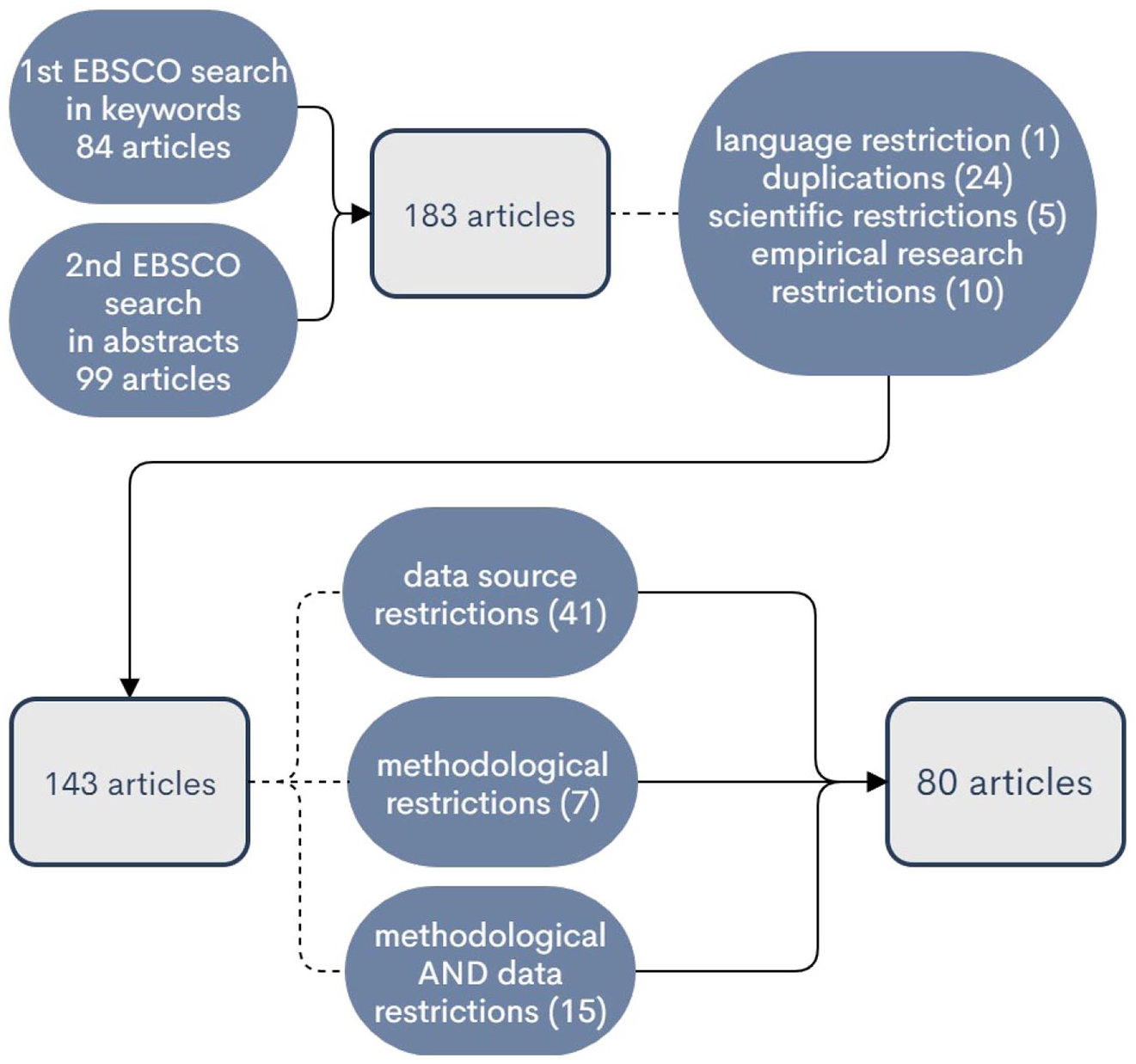
Steps and decision-points of the data-gathering process.
Moving on to methodology focussed decisions, we selected articles from the remaining group for further analysis based on their self-description. That is to say, those publications whose abstracts or keywords explicitly called their approach DA or implied the use of some kind of discourse based qualitative analysis, and also defined at least one of their sources 4 as ‘social media’. For these reasons 63 articles were excluded from the analysis: they either did not refer to their source as social media 5 (41), did not define their research approach as a discourse focussed analysis (7) or neither (15). This decision left us with the final 80 articles.
The nature of discourse analysis research: Basic bibliometric findings
At first, we present some characteristics of the final database in order to provide a general picture of the 80 articles selected.
All research projects were published after 2010 – not so shocking information if one considers that the most frequently used social media sites were launched in the mid-late 2000’s. The number of articles showed a steady growing year by year, which underpins the increasing attention to social media research applying DA methods.
Regarding the regional distribution of the publications, we identified which continent or country the research projects focussed on.
As presented in Figure 2, there are the so called ‘Intercontinental’ research projects (7%), which dealt with topics that overarch continents – that is, analysing social events in connection with several regions in different parts of the world (e.g. Bacallao-Pino, 2014; Pérez-Sabater and Maguelouk Moffo, 2019). Interestingly, while South America is quite underrepresented in our database (1%), Asia (19%) and Africa (10%) received more attention. Regarding the share of Europe (20%) and North America (15%), we can see a quite balanced geographical distribution in the research-areas. 6
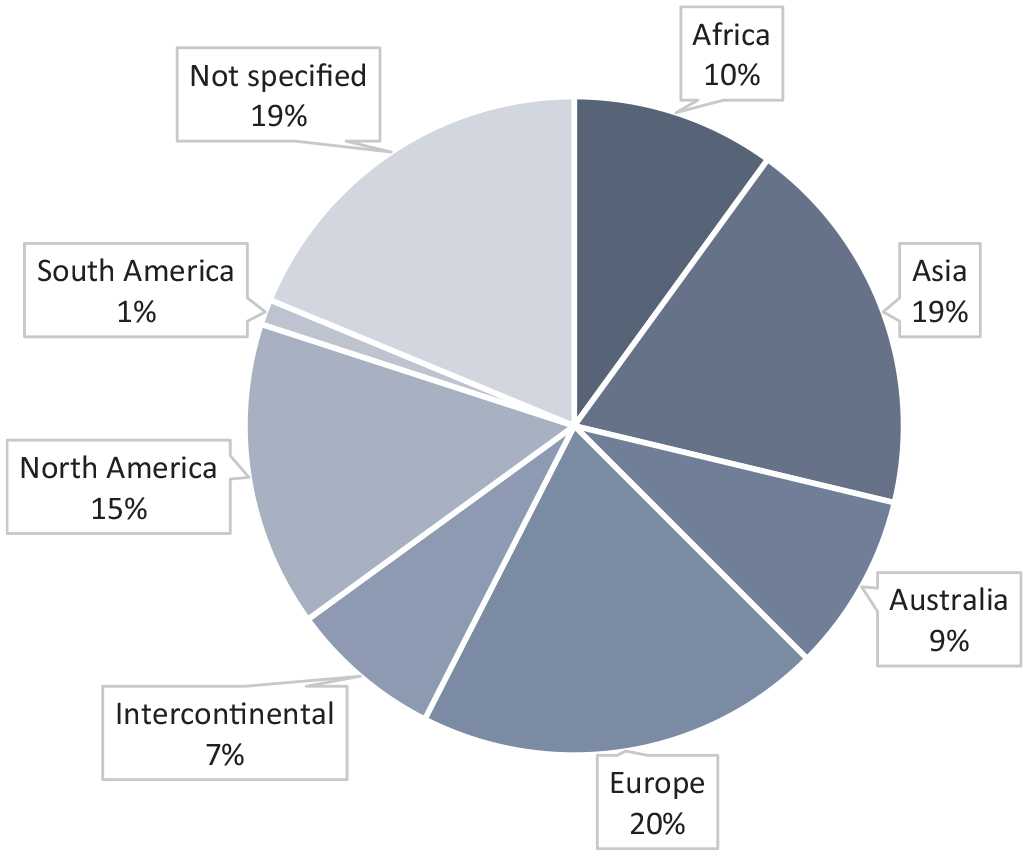
Continental distribution of publications (%).
Furthermore, 19% of the research projects did not explicitly specify their regional relation, for which we found two reasons. Firstly, even though some of the research projects did not clearly articulate their connections to a region or country, they examined phenomena that were linked to a specific place. In these cases, the lack of explicit geographical information (e.g. country or continent) could stem from the conviction or belief that the town, event, phenomenon, etc. mentioned is known by everybody, and thus needs no further introduction. This practice was more prevalent among those research projects that focussed on North American or Western-European phenomena.
Secondly, while traditional media is inherently connected to a region at least by its place of production, social media content, as it is produced on the internet, does not have to be related to such a place. Moreover, considering the influence of the English language on social media, its content does not even have to be related to a cultural region. Therefore, a number of the analysed publications could not be categorised this way. Still, even in these cases, researchers had to make decisions that narrowed down their collected data in a geographical or cultural sense. Namely, several of them collected social media content by searching for English keywords on the sites. This leads to research projects that implicitly focus only on the English-speaking world and those social classes throughout the world, whose members post content on social media in English.
The voices in social media DA research
Regarding our chosen corpus, that is, social media research with DA approach, it has become obvious how the used data sources and research objectives affect each other through the applied methodology. As it is mentioned in some of the articles, social media as a source of data enables researchers to analyse the ordinary web users’ opinions and discursive strategies, without interfering with the subjects in any way. Törnberg and Törnberg (2016), Way (2015) and Al-Tahmazi (2015) are just a few examples that pointed out that the rise of social media allows researchers to move away from analysing mostly elite discourses (mass media, politicians, etc.), and concentrate on the average people. And that is exactly what we observed: most analysed articles concentrate on social media content of ordinary people, with a few exceptions, where organisations’ social media communication is in the centre of analysis (e.g. Chaufan and Saliba, 2019; DeCook, 2018; Hayhurst and Szto, 2016), or other one-way media content that is distributed on social media (e.g. Ephraim et al., 2017). In the former case, the ‘ordinary people’s’ communication that mostly consists of posts, reactions, and comments are analysed. It was a great opportunity for the researchers to reflect on the discursive strategies and themes of average people’s online communication, and to analyse the dynamics of social media communication. In other instances, researchers aimed to show ordinary people’s discursive strategies on specific social phenomena, almost creating a social map of employed discourses on these topics. Interestingly, not too much academic attention was paid to politicians’ or other prominent decision makers’ social media presence in our corpus. That is, only two research papers dealt with such issues in our database. 7
The researchers’ tendency to concentrate on civilians’ social media content as source set their research objective as well. Underscoring the already existing literature on the important role of social media in identity construction (Bouvier, 2015; Livingstone, 2008), in these projects, different aspects of individual or collective identity construction are in the limelight. Moreover, researchers were determined to unveil the discursive construction of political resistance and the means with which social media can help with building it. Therefore, the possibilities and forms of online activism (or ‘slacktivism’/‘clicktivism’) also appeared as a recurrent research focus of these projects.
After outlining these general attributes, we would like to turn our attention to the discourse analytical side of our inquiry.
The types and complexity of discourse approaches
In order to capture the different types of discourse approaches we used two techniques. At first, we relied on the publications’ self-described type of discourse analytic approach and divided the articles into five main groups. However, reading the corpus, we found that the articles provide a much more diverse landscape in their DA approaches. Therefore, by applying a closer scrutiny of the use of ‘discourse’ and ‘discourse analysis’, we elaborated a three-level indicator to show whether DA appears in the theoretical background, in the methodology section or both.
The self-declared types of discourse analysis
As for the different types of DA approaches used, we identified five categories: discourse analysis (in general, without further marker), critical discourse analysis (CDA), computer assisted discourse analysis, multimodal discourse analysis and other methods. As already mentioned, in this categorisation we relied on the researchers’ self-description of their used methodology. In cases where the researchers used a mixture of these, like ‘multimodal critical discourse analysis’ (Ma and Stahl, 2017), they fell into a category that fitted their first mentioned (and therefore, highlighted) type.
We did not try to decide whether the publications actually used the DA method they claim to use, or they use the name as a token or label, while doing something entirely different, since it is hard to define a clear-cut difference between these approaches (Jørgensen and Phillips, 2002).
The distribution of self-reported DA concepts points to a few interesting features of the corpus (Figure 3).
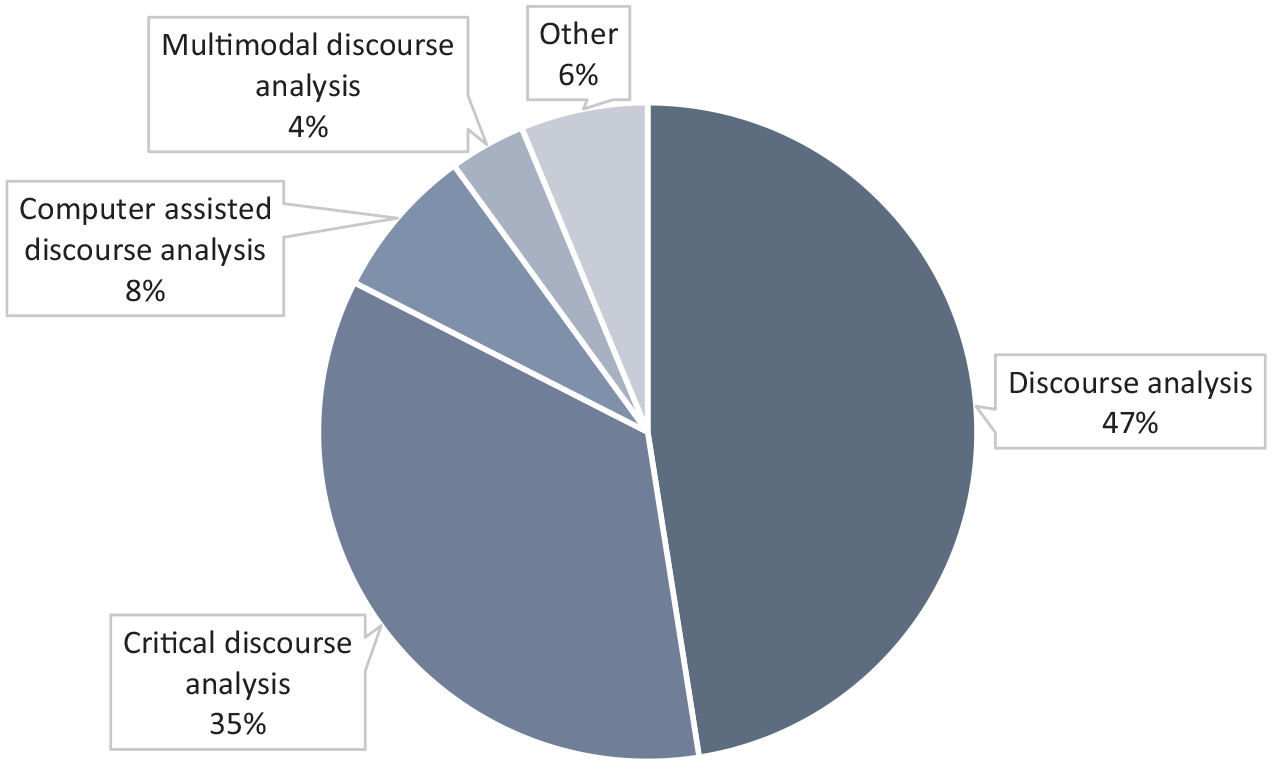
Distribution of self-reported DA types (%).
First of all, the high proportion (47%) of ‘DA’ as referred type suggests different approaches. Either that most research projects analysing social media actually use a general DA approach, or even if they use a specific approach, they do not name it in their keywords and abstracts. Secondly, that the most popular specific approach with 35% is CDA. This implies a rather strong critical attitude among social media researchers, although it is a question, whether their critical attitude led them to the analysis of social media, or social media just happened to be the source of their inquiry.
The complexity level of the applied DA concepts
Through a detailed examination of the publications, we elaborated a complexity marker of the publications. This three-level indicator mirrors a distinction between discourse and DA as a theoretical approach or as a methodological approach. That is, we tried to capture, whether the researchers used discourse or DA as a methodological tool, or as a theoretical concept to their social media analysis, or both.
However, there are articles which used the concept of discourse but without any theoretical or methodological DA-related concept. These articles are in a separate category, namely complexity level (henceforth CL) 1. These articles used the word ‘discourse’ basically as a synonym for text or corpus but did not apply discourse analysis-based theory nor methodology. At the next category, CL 2, two subcategories were created; namely, those publications that used discourse analysis as a theoretical frame but did not claim to use it as a methodology (2a); and those that referred to discourse analysis merely as a methodology for analysing content but without using it as a theoretical approach (2b). The last are the most complex use of discourse analysis, marked as CL 3. These publications applied discourse analysis both in their theoretical and their methodological approaches.
Figure 4 presents the distribution of articles according to this complexity-categorisation.
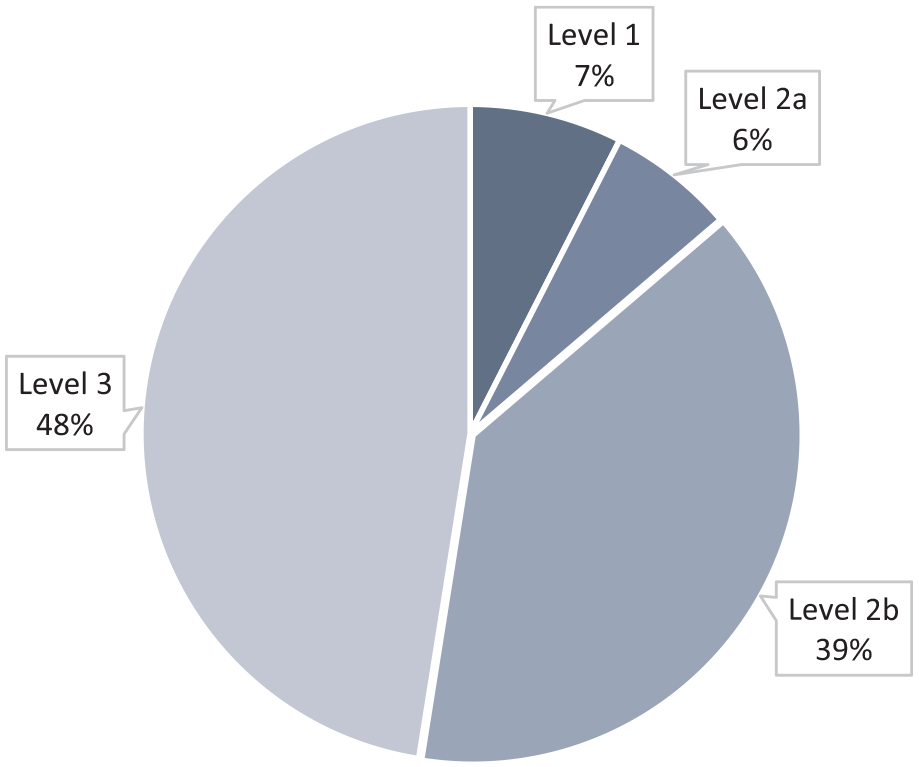
Distribution of articles’ DA complexity level (%).
As Figure 4 shows, CL 1 articles are the least frequent (7%), meaning that in our database most researchers refer to discourse as a distinct phenomenon at the intersection of social sciences and linguistics, and not just another phrase for ‘text’. The high number of publications with CL 3 (48%) is outstanding. As for category CL 2, it is clear, that in those cases where DA appeared either as methodological or as theoretical frame, the methodological application is much more frequent. More details about the features and articles of each group are explained in the next section.
From ‘discourse’ only as datatype to complex theoretical and methodological DA concepts: Detailed description of the complexity levels
As mentioned earlier, we categorised the collected articles by their DA-related complexity levels.
The first level (CL 1) contains those articles that used ‘discourse’ only as a textual data type. That is, they refer to their collected textual social media corpus as discourse but did not mention either any DA schools or approaches, or any DA methods. Accordingly, in these articles discourse seems to be a synonym of text or textual data. As we saw it in Figure 4, only a small part (7%) of the publications belongs to this category. Nonetheless, they represent one end of the scale of discourse-related research, where the label is used only as a form of data without deep theoretical or methodological commitment to any DA approaches. However, these could help disseminate the importance of the concept of discourse, as unit of analysis in text-based research. In our opinion, if there is not any DA framework in the theoretical and/or methodological parts, the complexity and deepness of the DA approach could not really be conveyed.
The second category (CL 2) refers to those articles which applied DA either as a theoretical or as a methodological frame, but not both together. Accordingly, this category has two subcategories: 2a, where DA is explained only theoretically and 2b, where it appears only as methodology.
Complexity level 2a indicates those publications which refer to DA as a theoretical framework, but do not elaborate it in their methods. They represent only a small share of the corpus (6%), so this combination does not seem to be very common. As for the theoretical frames they refer to, critical discourse analysis and interactionism are the prominent approaches. In these articles, while the theoretical considerations related to DA are explained in detail, the process of the analysis seems to be treated as self-explanatory. As if by naming the chosen framework (e.g. ‘thematic and discourse analysis approaches’ (Ab Rashid, 2018: 2)), no more detail would be necessary regarding the analytical process. In the articles of this category DA as a methodological tool seems to be so self-evident that there is no need to go into details about the steps and choices of the examination-process.
From a critical point of view, this could be a sign of using DA as a ‘fashionable’ token-expression for textual-analysis, without real commitment to any actual DA methodology. However, if we assume that the shortage of analytical details does not mean the lack of methodological considerations, then a possible explanation could be that the researchers indeed treat DA as self-evident methodological tool, therefore they do not enumerate their steps and decisions (except for sample-information). Nonetheless, a higher level of transparency regarding the decisions and steps of the analysis could enhance not only the understanding of the given research but the application of its DA procedures to other research topics. This way also their reliability and validity could be enhanced.
Complexity level 2b indicates those publications which present DA as a methodological concept, but without framing it theoretically with discourse theories. This category contains more than one third (39%) of the collected articles, therefore this application of discourse concepts can be considered quite prevalent. In these articles typically the textual material gathered was called discourse, and discourse analysis appeared only as a methodological approach, a tool to analyse the collected social media corpus. But there was neither detailed theoretical discursive frame, nor discussion about different discourse approaches, their main ideologies and so on.
Regarding the methodological details in these articles, they generally give a very nuanced account of the sampling procedure, then a somewhat schematic description of the main steps of their DA process. This schematic procedure typically starts with a coding phase (either with predefined categories, or with open coding), then is followed by classifying emergent patterns (see e.g. Darwin, 2017), which are identified as themes or discourses or narratives (sometimes stereotypes or myths).
However, we should emphasise that besides this schematic general process, quite complex analytical procedures could be found. Not only computer-mediated DA methodologies appear, but also different methodological combinations. These are not restricted only to the textual methods repertoire (like CDA and appraisal analysis in the case of Harju, 2015; or thematic analysis and CDA in Petersen et al., 2016); but combine non-textual methods with DA, like social network analysis (e.g. Klein and Muis, 2019; Mercea and Yilmaz, 2018; Sharma and Tietjen, 2016).
Moreover, the combination of quantitative and qualitative approaches in analysing discourses is definitely discernible, although none of the examined articles used the label of mixed methods (but ‘corpus-assisted multimodal discourse analysis’ appeared at Caple, 2019). Also, most of the times DA is named as ‘the qualitative’ part of the mix. However, in our opinion some of them could be labelled as a mixed methodological DA (Géring, 2021).
The last group of articles we were able to define based on the complexity of their DA approach is marked with CL 3. These research projects interpreted DA both as a theoretical concept and a method of analysis.
Firstly, we should emphasise that articles belonging to this group are rather diverse in terms of how elaborately they examine discourse theories. The publications also show a great variety in other theories they engage to complete the used DA approaches.
To evaluate the complexity of the employed discourse theoretical background we analysed the detailedness and the conceptual foundations presented in the articles. In terms of detailedness the publications range from articles that present the basics of DA theory in 1–5 sentences to ones that devote several pages to it (e.g. Chaufan and Saliba, 2019; Way, 2015). Moving on, analysing the conceptual foundations of the articles we examined the content of those parts of the papers that describe their theoretical background. By doing this, we were able to define two main approaches: one that is grounded in DA theory (21 articles), and one that uses it in a complementary manner to interpret their results or theoretically ground their methods (17 publications).
Another finding is that even though most research projects draw on the discourse concepts of van Dijk, Wodak, Fairclough, van Leeuwen and Halliday, originating in the Foucauldian approach to discourse, some engage in less explicit discourse theories. For example, Alvares (2018), Mendes et al. (2019) and Harp et al. (2018) all ground their theories in the notion that discourse (of any kind) affects social reality (Gee, 2011; Potter, 2004; Wodak, 2001) and that discourse is a social practice that shapes society, while being shaped by society (Fairclough and Wodak, 1997; Potter, 2004), whereas neither of them explicitly exhibits DA theories. Thus, although these research projects do not engage with a ‘mainstream DA approach’, they are nonetheless influenced by discourse theory and the resulting methodologies. This shows that DA can be well applied in harmony with several akin theoretical approaches of social scientific research, underpinning Fairclough’s (2001) notion on the close dialogical relationship between other social theories and critical discourse analysis. Since these research projects do not lose their discourse theoretical foundations by drawing on other theoretical views, they do not lose their social significance either. In contrast, those publications that eliminate DA theory, interpret their results as the mere imprint of communication events, alienating them from the social phenomenon they contribute to.
Many of these publications explain their data gathering at length and provide some basic description of the methods in their methodological section. However, the description of specific applied methods is partly or entirely presented among the results, if anywhere. Furthermore, even if the decisions and steps of analysis are described, mostly only in connection with the particular example through which the researchers try to illustrate their applied methods. We suggest changing this praxis and introducing the detailed analytical process at the methodology sections because this way the feeling (and critique) of lack of methodological transparency could be avoided.
Lastly, we would like to emphasise the differences in some articles’ content-ratio. There is an outstanding contrast between articles that discuss social phenomena in the ‘Western’ or Anglo-Saxon region and research projects that focus on other parts of the world. Namely, while in the Western oriented publications the socio-political context of the analysed phenomena was introduced quite briefly, articles in connection with the non-Western world paid a lot more attention to describing the context of their research from historical and socio-political aspects. Although no clear conclusions can be drawn from such a small sample (38 articles of CL 3 category), this could reflect the ambivalence of the academic world’s attitude towards ‘Western’ and ‘non-Western’ topics. That is, researchers might have to argue for the ‘non-Western’ topics’ importance through describing their social significance at a great length, while the need for a research on Proud Boys memes in social media is considered self-evident (DeCook, 2018). Nonetheless, providing a vivid description of the social environment may improve every research paper in the field, regardless of their focus, since the interpretation of a discourse cannot be complete without knowing its socio-political context (Fairclough and Wodak, 1997; Gee, 2011; Potter, 2004).
Conclusion
As highlighted in the previous sections, the reviewed publications show a rich variety in some aspects. From the complexity of their discourse analytic approach, through their applied methodologies and transparency, to the employed theoretical concepts, the research publications come in all shapes and sizes.
On the one hand, a great diversity of topics and examined social terrains is very positive. It shows that the importance of language use in every sphere of social, private and professional life might come to the limelight eventually. This diversity is even more significant considering the geographic distribution of the research topics. Furthermore, methodological diversity could add both to the academic field and the public interest. Moreover, theoretical variety can enhance the area of DA driven research as it underpins the flexibility of DA approaches, as well as the compatibility of DA theories with other social theories.
On the other hand, there may be some aspects in which a narrower gold standard could be helpful for both researchers and the academic perception of DA. First, transparency in all aspects: defining what the authors mean by discourse, and how they analyse it. The researchers’ methodological decisions are often not articulated clearly. This practice could be problematic as it undermines the validity of DA approaches, since neither can their methods be evaluated academically, nor is it clear whether they had a systematic approach. In addition, not relying on any kind of DA theory in the articles affects the evaluation of the projects as well as the academic field. That is to say, when not acknowledging the role of discourse in constructing social reality (Fairclough and Wodak, 1997; Gee, 2011; Potter, 2004), the publications merely suggest that representations may affect some people’s opinions on specific matters, or that social media portrayal matters just for the sake of portrayal.
However, there was an aspect in which the reviewed articles differ rather less, that is, the type of content they gather from the chosen sources. Analysing ordinary people’s social media postings, comments and reactions is a common choice of data source in most research projects.
All in all, discourse analytic research approaches to social media content seem to be on the rise. As the reviewed articles show, socially and scholarly valuable, carefully executed research projects have already been made, which could serve as a good ground for further research as well. Luckily, social media provides continuously increasing amount of text for the analysis of discursive social reality construction. With transparency, a systematic approach in methodology and focus on DA theory, this source grants infinite research opportunities.
Footnotes
Acknowledgements
The authors would like to thank Gwen Bouvier, Innocent Chiluwa and Joel Rasmussen for their helpful and constructive comments that greatly contributed to improving the final version of this paper.
Declaration of conflicting interests
The author(s) declared no potential conflicts of interest with respect to the research, authorship, and/or publication of this article.
Funding
The author(s) disclosed receipt of the following financial support for the research, authorship, and/or publication of this article: This paper was prepared as part of the project ‘The future of business education’ funded by National Research, Development and Innovation Office, Hungary (FK127972).