



Abstract
Sensorial access to products in shop encounters constitutes a crucial aspect of the appeal to customers. This paper examines sensorial engagements with products in a specific ecology (outdoor markets) with a focus on the possible (pre)opening of a shop encounter. When passers-by stroll from one stand to another, open to local findings, unplanned discoveries, and emergent opportunities to buy, they orient to the sensory appeal of the products, becoming possible customers, stopping in front of a counter and engaging in a social interaction with sellers and other customers. The analysis focuses on multisensoriality in action, studying how customers and sellers treat the sensorial qualities of the products, the relevance of the sensory engagement of the customer with their materiality, and their involvement in the social encounter with the seller, including normative expectations related to sensing and buying. It includes a discussion of how under Covid-19 sensorial access to products was restricted and the sensorial, interactional, normative, and economic consequences of these restrictions. Based on video recordings of market encounters, and on an ethnomethodological and conversation analytic approach of multimodality and multisensoriality, the paper reflects on how appealing to the senses of sight, touch, smell, and taste is methodically orchestrated, and its consequences for the interaction with the seller, the sensorial experience, and the economic transaction.
Keywords
Introduction
The constitutive role of social interaction in activities of buying and selling has been discussed by an important literature on sales encounters in various contexts, not only in shops and markets, but in sales and service provider calls (e.g. Clark et al., 1994; Vinkhuyzen et al., 2006) and in digital exchanges (e.g. in finance, Cetina, 2007). If social interaction shapes the emergence and achievement of the purchase in co-presence, on the telephone and on the Internet, an important difference between co-present economic encounters and distant ones concerns the body involvement of the customers and, more specifically, their sensory engagements. The body is central in co-present shopping encounters in two intertwined ways. First, the mobile body is centrally involved in the pleasure of promenading in city arcades (Benjamin, 2002), malls (Crawford, 1992), supermarkets (De Stefani, 2011), and urban markets (Watson, 2006), as well as in establishing sociality in public spaces, which has been described in various forms and categories, such as the flâneur (Benjamin, 2002), the alienated customer (Goss, 1993), the regular (Laurier, 2013), or those engaging in casual encounters ‘rubbing around’ (Watson, 2006). Second, the sensing body is crucial for establishing the multisensory access to material objects that the co-presence of products and embodied customers makes possible, in the form of looking, touching, smelling, and tasting (Mondada, 2019a).
This paper examines sensorial engagements with products in a specific ecology (outdoor markets) with a focus on the possible (pre)opening of a shop encounter, when passers-by stroll from one stand to another other, open to local findings, unplanned discoveries, and emergent opportunities to buy, orienting to the sensory appeal of the products. The focus of the analysis is on passers-by who are mobile within the space of the market or street, and are possibly transformed into customers by stopping in front of a counter and engaging in a social interaction with sellers and other customers. The analysis focuses on the role of sensoriality in this transition from moving to stopping and highlights how customers and sellers orient toward the sensorial qualities of the products, the relevance of the sensory engagement of the customer with the materiality of the product, and their involvement in the social encounter with the seller, including normative expectations related to sensing and buying. Stopping reflexively responds to an opportunity to sense the product and makes sensing possible; stopping is also what makes a purchase possible. This paper reflects on how multisensory access to the products – concerning sight, touch, smell, and taste – can be organized in both mobile and static ways, and their consequences for the interaction with the seller, the sensorial experience, and the economic transaction.
The analyses explore how the shopping experience emerges without restricting it to the opening of the interaction between seller and customer but including the fleeting moments in which a passer-by might notice, look at, or glance at a stand, and the emergent movement by which the passer-by progressively slows down and stops, gradually engaging with the products – touching, smelling, and tasting them. The analyses are based on video recordings of actual activities in marketplaces, studied within the perspective of ethnomethodology and conversation analysis, with a special focus on multimodality and multisensoriality (Mondada, 2019a, 2021b).
State of the art: Social interactions at the market, mobility, and sensoriality
This paper shows how diverse issues – mobility, sensoriality, and social interaction in urban markets – generally treated in the literature in a distinct way intersect in the lively market experience. Social interactions in a plurality of shopping contexts have been studied in the literature, focusing on different settings (shops, supermarkets, markets, etc.) and a diversity of aspects. Sociolinguistic and pragmatic studies have focused on the expression of social relationships (Félix-Brasdefer, 2015; Kerbrat-Orecchioni and Traverso, 2008); conversation analytic approaches have discussed the recurrent actions characterizing the shop encounter (such as questions, Merritt, 1976, or requests and their formats, Fox and Heinemann, 2016; Mondada and Sorjonen, 2016). The consequences for service have been discussed (Aston, 1988; Bailey, 1997; Harjunpää et al., 2018), as well as how the economic dimension of these encounters permeates the interactional organization and the microstructures of economic action (Clark and Pinch, 1995; Llewellyn, 2015; Llewellyn and Burrow, 2008; Vom Lehn, 2014). The materiality of the products has received less attention, with some exceptions: De Stefani (2011, 2014) examined how customers grasp products in the supermarket, inspect them, read labels, and eventually put them in the cart; Mondada (2018a, 2019a, 2019b) analyzed how food products are approached in a multisensory fashion for their visual, haptic, olfactory, and gustatory qualities; within a socio-semiotic approach, Karrebæk (2017) discussed the material, functional, and symbolic meaning of products.
Among possible shopping contexts, city markets have attracted the attention of anthropologists and sociologists of public spaces, who see them as a locus of sociability (De La Pradelle, 2006; Lindenfeld, 1990; Watson, 2009) – which is also visible in the participation framework characterizing the stalls (Hochuli, 2019) – but also as places where culture, tradition, and economics are intertwined (see Bestor, 2004 about the fish market of Tsukiji in Tokyo), as well as language and price negotiations (e.g. through practices of pitching, Clark and Pinch, 1995).
The mobility of customers is a central aspect of markets, malls, and supermarkets (De Stefani, 2013; Rasmussen and Dalby-Kristiansen, 2021). Mobility in open, public spaces more generally involves trajectories, bodily arrangements (Lee and Watson, 1993), and an orderliness of the walkers (Mondada, 2014; Ryave and Schenkein, 1974). Markets constitute a particular social-material environment as open public spaces, in which passers-by walk on the street along the stands. Contrary to shops – in which people entering the door establish themselves as customers and initiate an opening that establishes them as customers interacting with the seller (Harjunpää et al., 2018) – the market is an open space in which the passers-by are not a priori categorized as customers, but might become so only by engaging with the sellers/products. Mobility has strong membership categorization implications (Sacks, 1972): the very recognizability of the category ‘passer-by’ is based on their mobility (Mondada, 2009), which is visible at a glance (Jayyusi, 1984; Sudnow, 1972). The arrangements and mobile practices of pedestrians in the market categorize them as ‘walker-through’, ‘browser’, or ‘potential customer’ (Lee and Watson, 1993: 83). Stands, on the other hand, are organized such that people stop at them and engage as ‘customers’ in new participation frameworks around them (Hochuli, 2019). The fluidity of the market space is related to the practices through which a passer-by becomes a customer.
Products can be seen from a diversity of perspectives – as objects mobilized within embodied actions or as objects with a value that is defined in social interaction, (Day and Wagner, 2019; Nevile et al., 2014). Objects also have a multisensory dimension, being not only manipulated but also sensed – and this aspect is fundamental for the sensory design of marketplaces (Hultén et al., 2009). Embodied sensory engagements with products are fundamental in the shop encounter (Mondada, 2018a, 2019a, 2019b) as well as in the market. In turn, the form of sensory engagement is crucially related to the position of the body within the local ecology within situated courses of action.
Data
This study relies on a rich corpus of video-recordings in marketplaces in the three-national region of Basel (Switzerland, France, Germany); my team and I gathered these data within several research projects. This paper uses a sub-set of recordings in French-speaking markets in Alsace (35 hours at 10 food market stands in three cities).
In this paper, I focus on cases in which the sensory orientation to the materiality of the products – which can be seen, touched, smelled, or tasted – constitutes the first (and sometimes the only) step toward a possible economic encounter, which might be limited to the sensorial access, but also might evolve into a sustained encounter with the seller. Thus, I focus on passing flâneurs, who look but do not stop at the stand; on fleeting incipient shopping activities in which a possible customer stops and touches products but then goes away; as well as on incipient openings of encounters grounded on a sensory approach to the products. In all of these cases, the sensorial access to the products constitutes the first engagement with the stand, initiated either by the not-yet-but-possible-customer or by the seller. Contrary to focused interactions, which are opened by greetings at the stand or in which the customer approaches the seller with a request, this focus favors fleeting, unplanned, occasioned, contingent, opportunistic engagements of mobile passers-by in the market, attracted by a product they have spotted or by a seller offering them something to taste.
The analysis builds on recent developments of multimodal conversation analysis (Goodwin, 2017; Mondada, 2016, 2018b) that have expanded the study of embodiment toward sensoriality (Mondada, 2018a, 2019b). While multimodal analyses have highlighted the plurality of linguistic and embodied resources mobilized by participants to build the accountability of their action in interaction, the analysis of multisensoriality focuses on the fact that body and language are not only in service of the intelligibility of social interaction but are also involved in experiencing the world through the senses. Sensoriality has often been considered as a private, subjective, and internal experience; a social interaction approach to sensoriality reveals how sensing in an interaction is designed in a way that makes it inter-subjectively intelligible and publicly accountable (Mondada, 2018a, 2020, 2021a, 2021b).
Considering how participants orient themselves toward the sensory qualities of products when browsing, buying, and selling at the market – and how products appeal to the senses of sight, touch, smell, and taste – enables an analysis of economic encounters that integrates a crucial material and sensory aspect, related both to the corporeal pleasure of shopping and the sensory aspects of selling design and persuasion (Mondada, 2019b). An interactional approach to the multisensory dimensions of customers’ engagements with products enriches our understanding of the role of materiality and the senses in social life in general and in economic encounters in particular. The investigation of this aspect has been understudied in interactional studies, but well exploited by sensory marketing, highlights the social, normative, and intersubjective aspects of situated sensory practices as they happen in social interaction.
The analysis is organized in three parts: the first focuses on passers-by walking and looking at stands en passant (§4); the second on how passers-by stop at a stand, eventually becoming customers, engaging in sensing the products (§5); the third on how sellers stop passers-by by offering something to taste and eventually succeed in transforming them into customers who might possibly buy something (§6). Issues concern mobility, sensoriality, embodied actions, and categorization in incipient shopping activities, which might remain fleeting sensory engagements or become shop encounters.
Looking en Passant
Looking constitutes the first point of access to the proliferation of material objects on display at the market. This distant form of sensoriality can be achieved within multiple visual practices, which vary from a fleeting, panning glance to a prolonged staring look at products (Mondada, 2021b; Stukenbrock and Dao, 2019). These visual practices are achieved within the mobility of passers-by walking in the flow of pedestrians (Lee and Watson, 1993). They might then be transformed into inspecting practices that involve object manipulations from a stationary position (see §5).
This happens in the simplest way when the passer-by glances, looks, or gazes at the exposed products en passant, while continuing to walk. I show here two instances of the phenomenon, which are not transcribed (contrary to similar, and more complex instances, for which I will discuss the precise temporality, see extract 5) but represented in a simple way by a sequence of images and a map. The first instance comes from a stand selling chocolate, in a Christmas market in Colmar – following the trajectory indicated in Map 1:
(1) (COLM_CHOC_1-39-32)
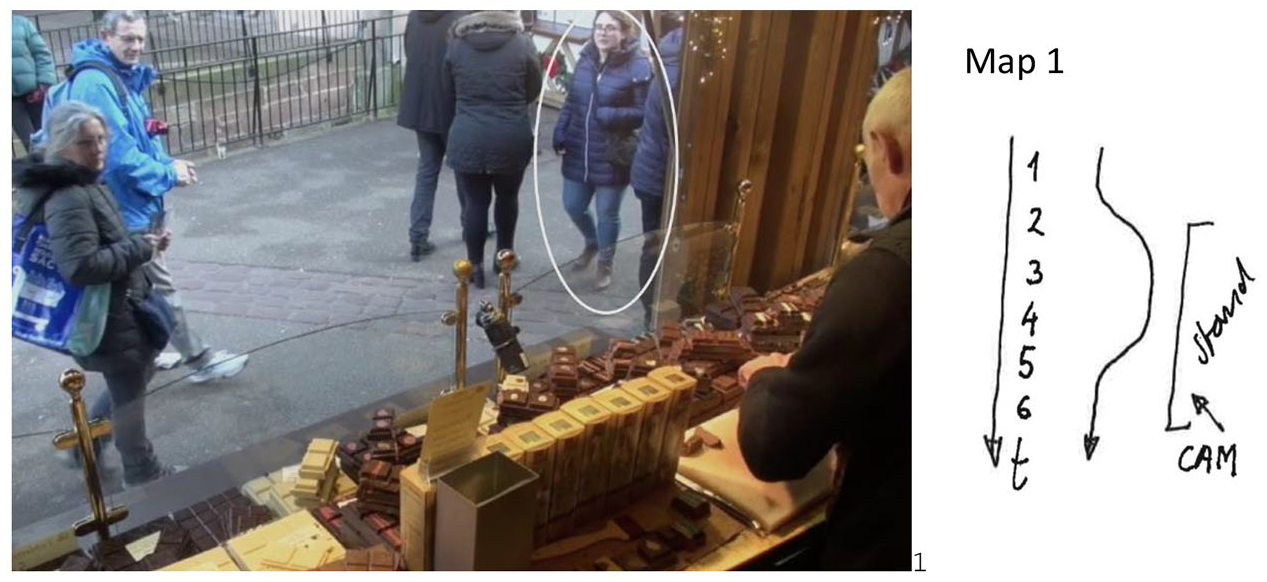
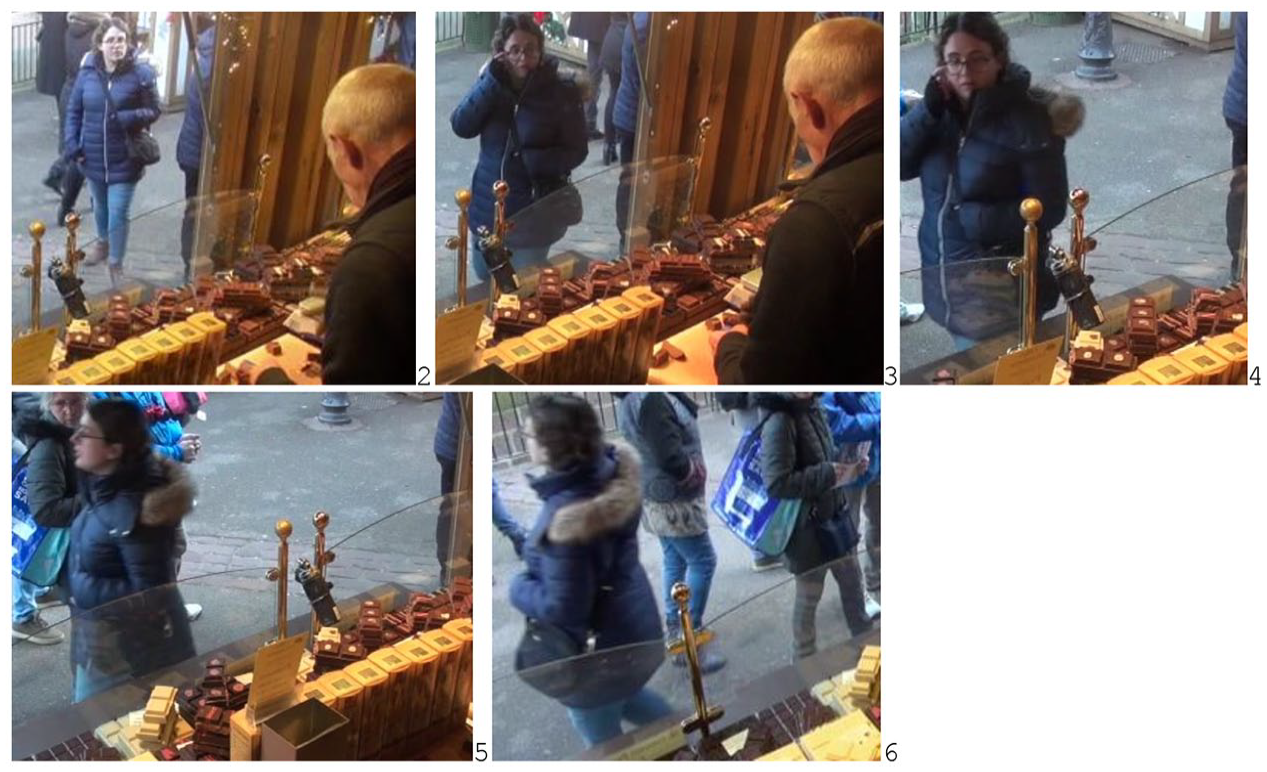
The passer-by walks along the street next to the stand (Figure 1). She turns her head toward the stand, looking at the products (Figure 2) while she continues her walk. She modifies her trajectory, coming closer to the stand (Figure 3), still looking at the products and continuing to walk (Figure 4). She then moves away from the stand (Figure 5), also looking away (Figures 5 and 6). The total event lasts less than 8 seconds and constitutes a brief visual engagement with the products, without any engagement with the seller (who is busy doing something else).
The second instance concerns a passer-by at a vegetable stand in Mulhouse, filmed by two cameras, frontally (Figures 7–10) and dorsally (Figures 11–14), along the trajectory indicated in Map 2.
(2) (MULH_1-15-20)
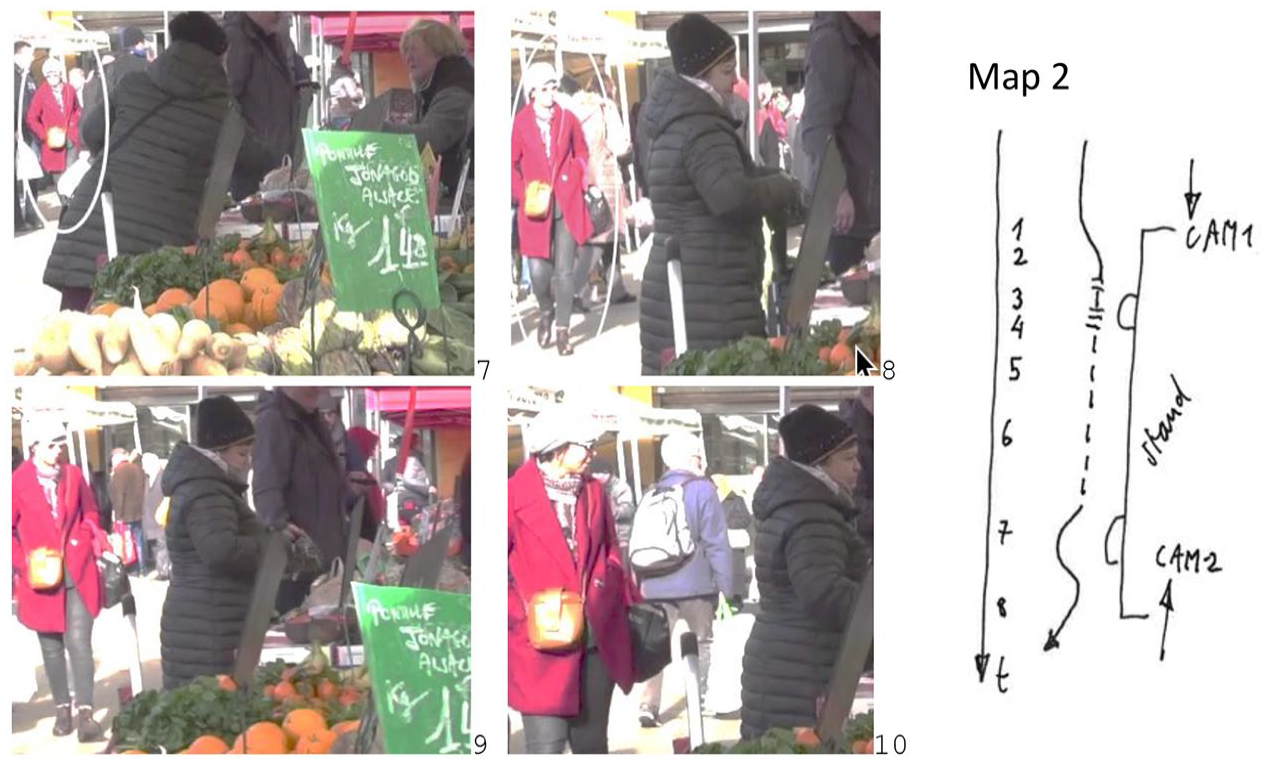
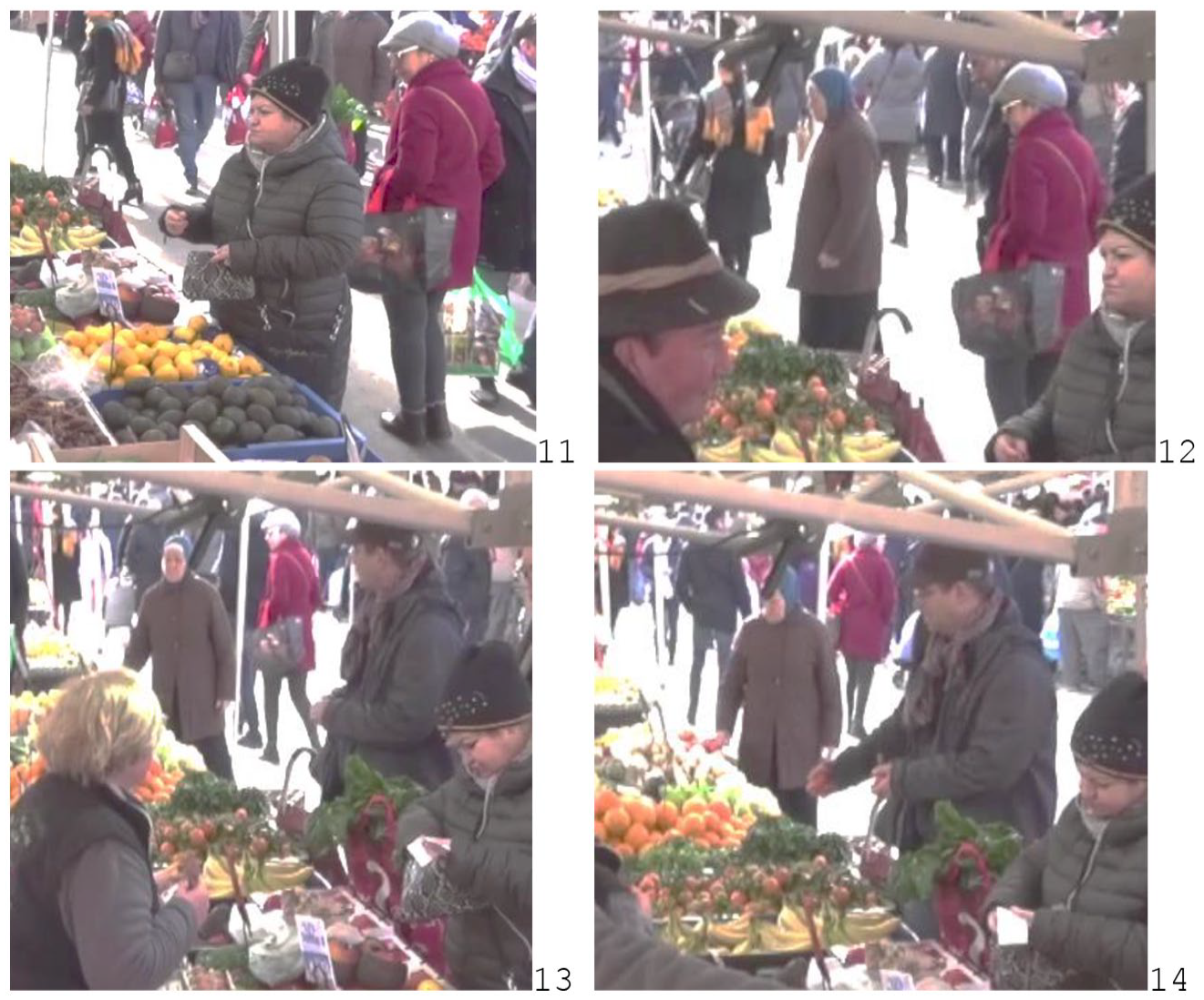
The passer-by walks along the alley (Figure 7) and when approaching the vegetable stand bends her trajectory toward it while looking at it (Figure 8). She approaches from behind a customer (Figure 9), slows down, almost stopping behind the other customer (Figures 10 and 11), then continues to walk slowly along the counter, looking at the products (Figure 12), even when she walks behind another customer (Figure 13), before walking away (Figure 14). Even if she does not engage with other customers, she oversees them inspecting specific products: they impede her access to the products and at the same time provide for hints about possible appealing ones. The total event lasts less than 30 seconds.
In these fleeting minimal sensory engagements with the products, the passer-by glances at the objects exposed and continues to look at them during a prolonged portion of her walking trajectory. This walking trajectory is discontinuous spatially – coming closer and then away from the stand – and temporally – slowing down or accelerating. The mobility of the passer-by transforms the continuous look into a panning gaze. In both excerpts, the passer-by does not stop at the stall, and the seller does not interact with them (being busy with other activities and not looking at all at them). Looking while passing-by is thus a first way of accessing and minimally engaging with material objects without yet engaging as a customer. This categorization of looking as not engaging in selling activity is formulated by the passers-by when addressed by the seller seeing their look, as in the next two extracts:
(3) (CHOC 1-39-32)
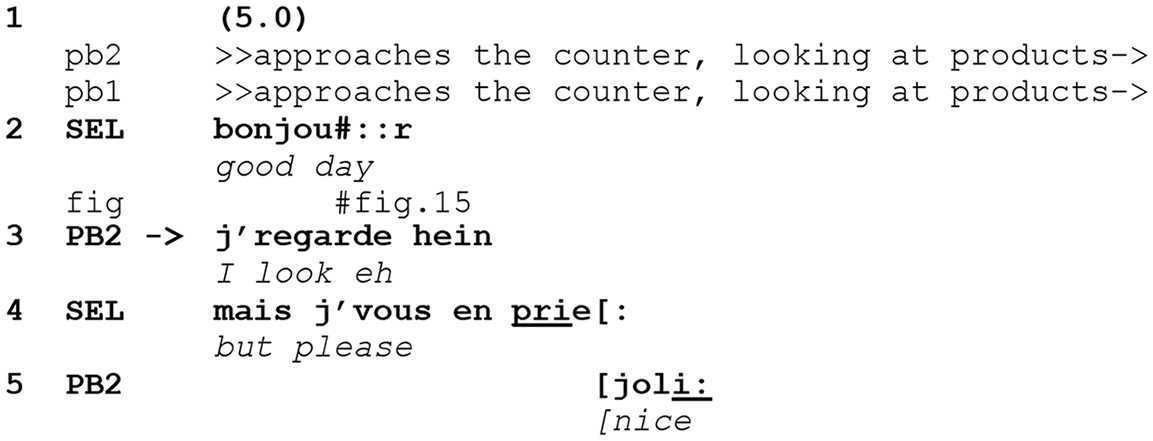
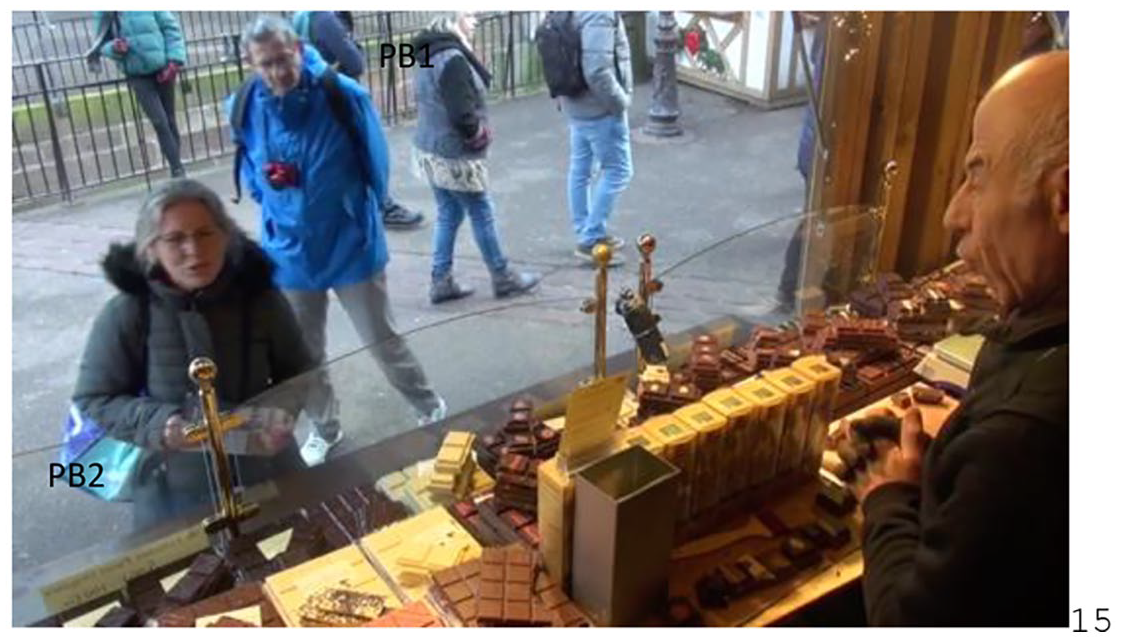
As the seller, seeing a couple looking at the products, greets them, one of them responds by saying je regarde hein/‘I look eh’ (3), instead of returning the greeting. The seller produces a third turn prefaced with ‘but’ – aligning with and at the same time addressing the possible normative implications transpiring from the formulation. The customer’s turn, sequentially positioned just after the greeting, as well as its final particle (‘hein’), preempts other possible actions from the seller, like offering a product. The next extract shows the same sequential ordering of turns:
(4) (STL2_0919_1-35-45/0.00 chbl)
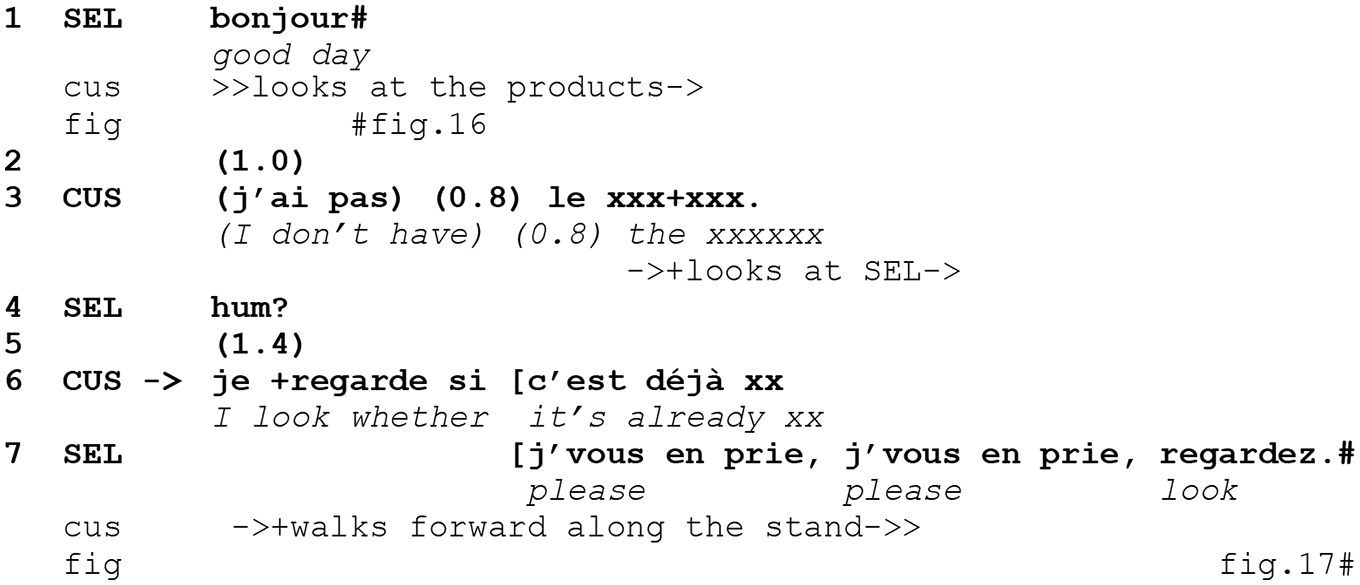
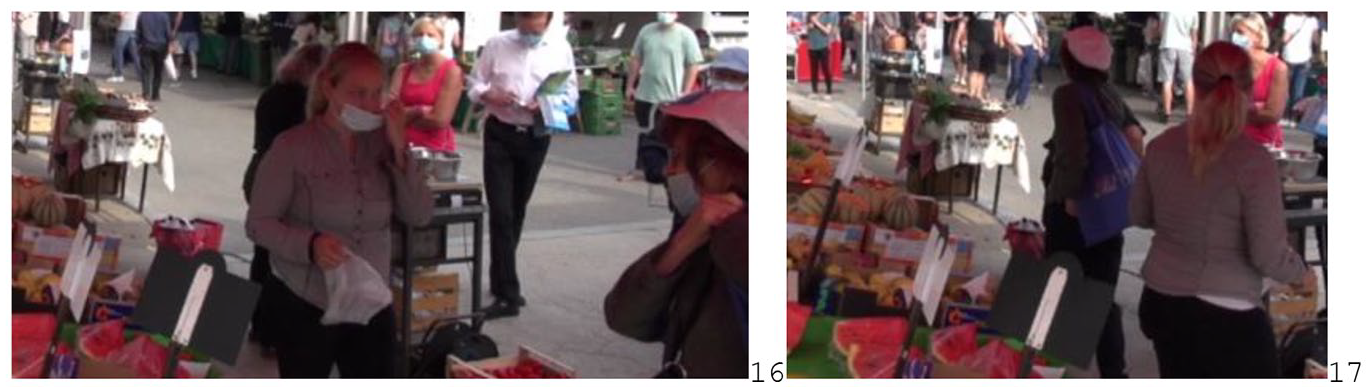
The seller walks toward a customer standing in front of and looking at some vegetables and greets her (1, Figure 16). After a gap, the customer says something that is not a greeting (although it is difficult to understand because she is wearing a mask, 3). This occasions the initiation of a repair (4), responded to by a turn beginning with je regarde (6), which continues specifying what the customer is looking at, overlapped by the seller aligning with the repeated je vous en prie and the repetition of the verb regardez (7). By doing so, the seller aligns, a bit sarcastically, with the customer’s formulation. The customer walks away (Figure 17) while continuing to look at the produce along the stand.
In these two cases, a person is looking at the products and the value of her looking is explicitly formulated for the seller. This is enough to manifest that, at this point, the person is not engaging in more than looking – that is, the passer-by is not engaging further in buying. The responses of the sellers show that they understand it that way. Looking constitutes a first sensory access to the displayed objects. However, it is not the perceptual practice that is foregrounded in the interaction when it is formulated in so many words; rather, looking is addressed for its normative implications, both as a right of the passer-by and as an unconditional offer of the seller – a prolog to a possible engagement in a more-than-looking activity.
Engaging in close sensing: Stopping and touching
Looking, as revealed in the previous section, constitutes a first minimal sensory access to a product. It is treated as a right, but also as possibly implying some obligation relative to the displayed offer by the salespersons. Moreover, looking is often not sufficient to select a product: the participants orient themselves toward looking-and-touching as providing more substantial access and grounds for decision-making. This section focuses on how customers progressively and emergently shift from a mobile looking en passant to a stopping and standing while looking or inspecting and touching the products (§5.1). The importance of touching is also shown in contrast to normative injunctions not to touch, which I discuss in the context of the norms and regulations imposed by the Covid-19 pandemic (§5.2).
Stopping for touching and visually inspecting the products
When passers-by engage in more than distantly sensing (looking at) products and, approaching the stall to gain a closer multisensory access to the products, they stop. A recurrent pattern consists in a person or a party walking along the street, approaching the market stand, stopping, and touching the products. In this case, looking at the products is not considered sufficient: products are manipulated, grasped, and more importantly touched, palpated, pressed – and in some cases, smelled and tasted.
In the next extract, three subsequent instances of the phenomenon are observable. They are all embodied without a word. Customer 1 and Customer 2 approach and touch some cress, then walk away. Customer 3 picks up bananas and clementines, which she will buy. Contrary to extracts 1 and 2, these actions are transcribed in a detailed way, using the conventions established by Mondada (2018b). This enables an analytic glance at how various customers, although not directly interacting together, coordinate and oversee their actions.
(5) (MULH_1-44-06)
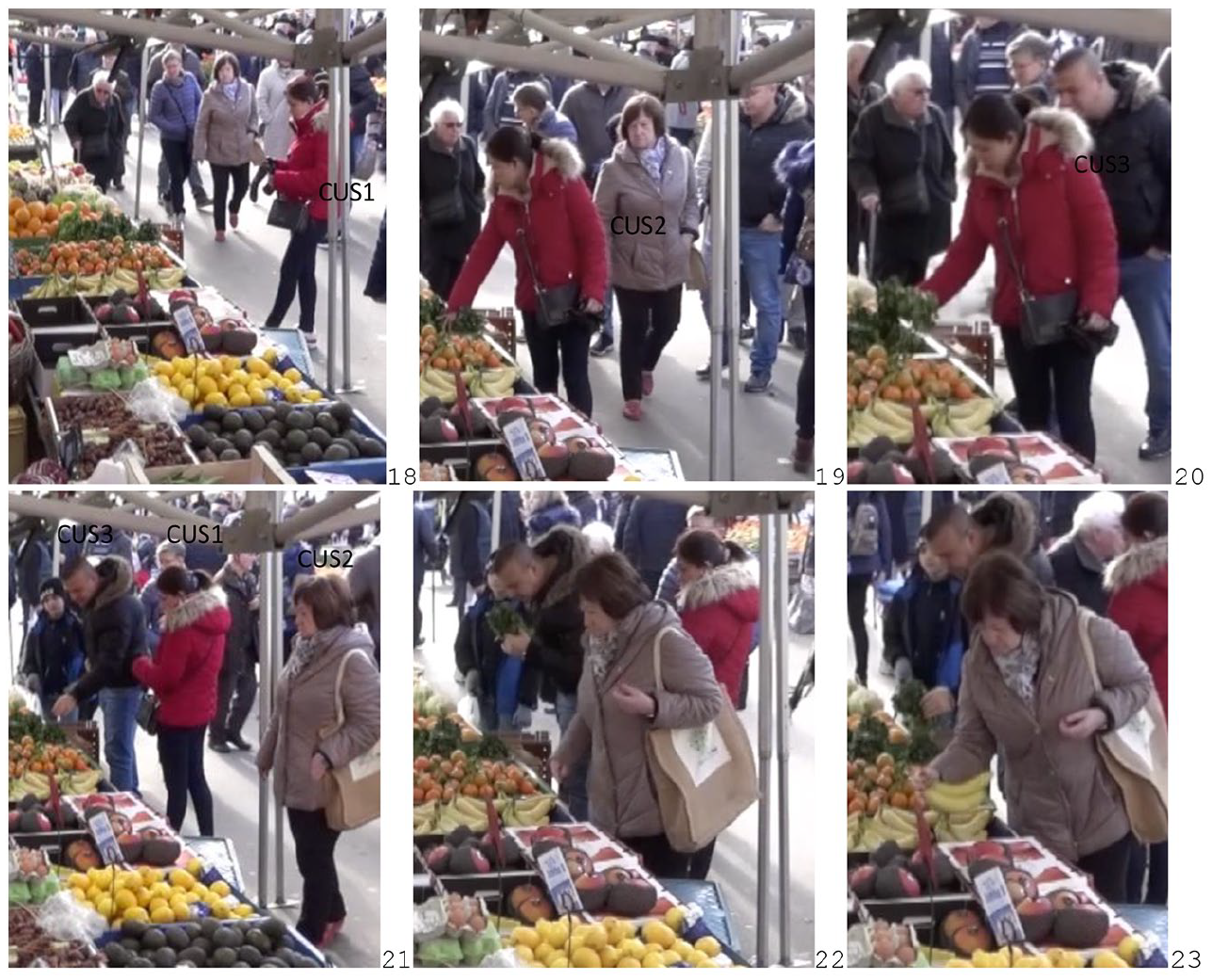
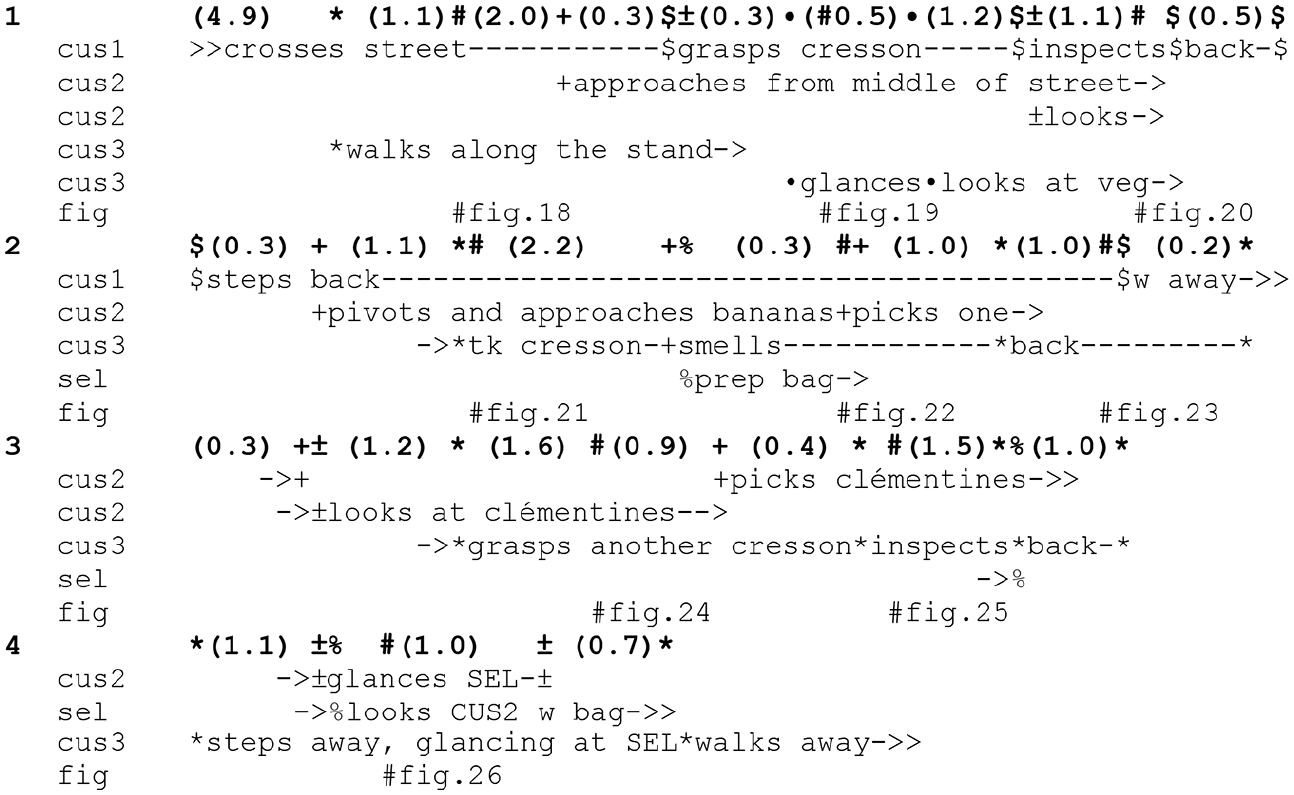
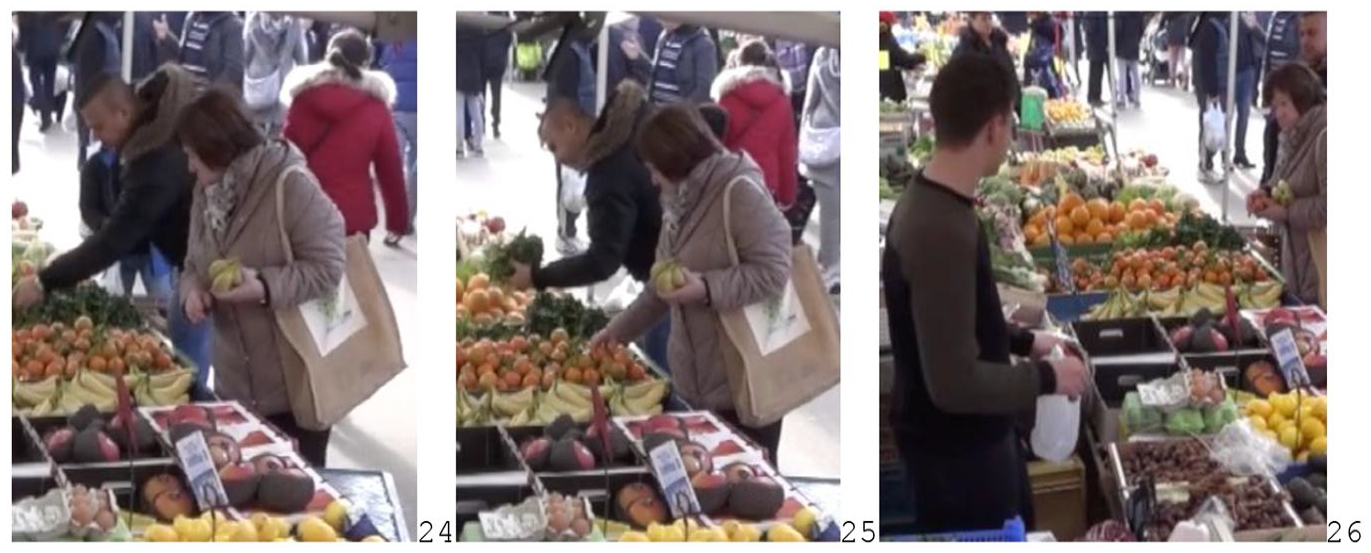
Customer 1 crosses the street and approaches the stand where the cress is (1, Figure 18). At the same time, Customer 2 is walking along the stand, without looking (Figure 18). When she passes behind Customer 1 (Figure 19), she looks at the vegetables and may notice Customer 1 picking up a bunch of watercress (Figures 19 and 20). Another customer (Customer 3) is also crossing the street (Figure 19) and comes behind Customer 1, also looking at the cress and watching Customer 1 inspect it (Figure 20). As Customer 1 puts the cress back and takes a step back (1–2), Customer 3 comes closer and picks a bunch (Figure 21). In the meantime, Customer 2 changes trajectory: she pivots toward the stand in front of the bananas (Figure 21) and approaches them (Figure 22). Customer 3 not only picks up a bunch of cress but also smells it (Figure 22), while Customer 1 takes a further step back behind him (Figure 22). While Customer 3 puts back the cress, after having smelled it (Figure 23), Customer 2 picks up a bunch of bananas (Figures 23 and 24). Customer 1 leaves the stand, walking away. Customer 3 takes another bunch of cress (Figure 24) and inspects it (Figure 25), while Customer 2 picks up some clementines (Figure 25). Next, Customer 3 puts back the cress and steps back, with a short glance at the Seller (Figure 26), while Customer 2 gazes at him (Figure 26). The Seller then turns toward them, holding a plastic bag (Figure 26), projecting buying. Customer 3 walks away, while Customer 2 continues her purchase.
This analysis, based on the temporality of the various actions (first transcribed on ELAN, then reported in the transcript above) and on a series of stills (in which the participants are observable in their parallel engagements with the products), highlights the tacit coordination between these three customers’ sensory engagements with the produce. Each participant could be described individually, following their approach, touch, smell, and manipulation of the products. However, this description would miss a relevant feature of their co-presence: although they do not engage in any focused interaction (Goffman, 1963), they oversee and monitor each other, and finely coordinate their movements. They co-position their bodies, creating queues – such as when Customer 3 comes up behind Customer 1 and occupies her position when she steps back. They also monitor each other and look at what they are looking at – such as when Customer 3 sees Customer 1 inspecting the cress; when Customer 2 passes behind Customer 1 and begins to look at the vegetables (she was not looking at the stand before, when walking along it); or when Customer 2 sees Customer 3 smelling the cress and comes closer to him, inspecting the clementines that lie beside the cress. The customers monitor each other: this enables them to organize their spatial co-presence and also enables them to monitor their engagements with the products, seeing how others grasp products to inspect, touch, and even smell them.
Thus, these individual customer actions, including their sensorial examination of the products and their embodied decision to pick up or put back what they have grasped, are witnessable and witnessed in the public arena of the stand by other co-present participants. The Seller neither immediately nor continuously monitors them (he is talking with another seller – not shown in the figures/transcripts), but at some point, he approaches them while holding a plastic bag, which he opens. The Seller’s visual and embodied orientation toward the customers is noticed by them: by Customer 3 leaving the stand, and by Customer 2 picking up a series of clementines. The bag becomes a relevant tool for the latter (who also looks at him), given the accumulation of objects in her hands, and her embodied (thus visible) decision to buy. Thus, the seller makes himself available at a precise and relevant point within this continuous silent and autonomous engagement with the products: handing over the bag occurs when the objects picked up become buyable, possessable, and even almost possessions of the customer, thereby silently opening a possible shop encounter.
Touching might be the basis for making the decision either not to buy – and leave – or to further engage in the purchase by entering into an interaction with the seller, who monitors the time and actions of the customers manipulating the products. The latter option is observable in the next excerpt. A couple of customers (CUS1 and CUS2) comes closer to a box of clementines: they stop and Customer 1 immediately begins to touch them. The interaction with the seller is initiated only later on, so the beginning of the action is similar to the fragments analyzed above. Later they will interact with another customer (CUS3) who is completing her purchase.
(6.1) (MULH_1-15-20)

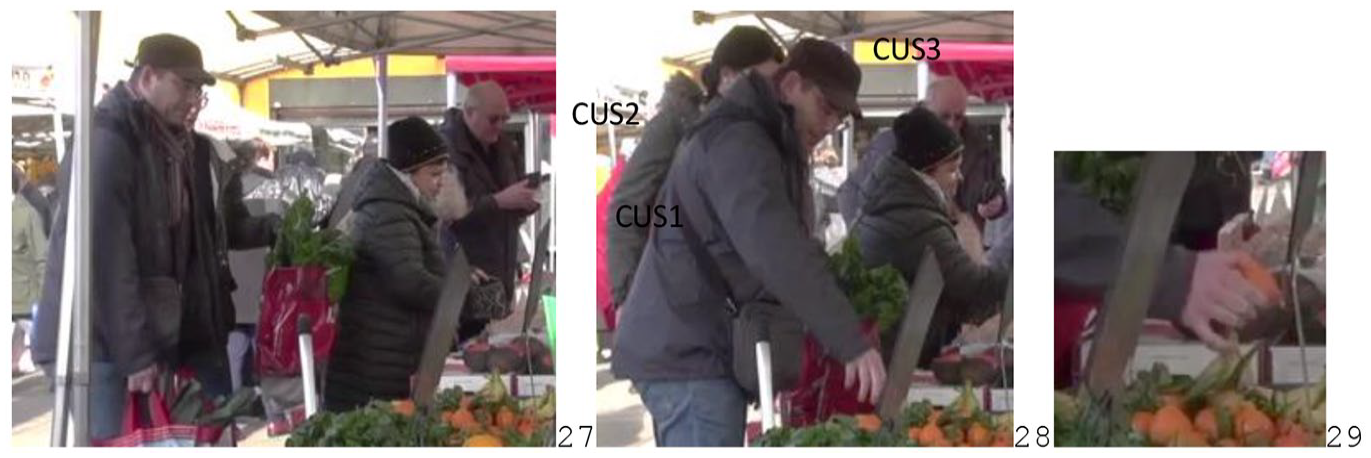
Customer1 approaches the stand (Figure 27), where the clementines are. He puts two bags full of other purchases on the ground and immediately begins to touch the clementines (Figure 28). The customer successively palpates and presses two of them, checking their consistency, and finally picks a third one (Figure 29). At this point, he gazes at the seller, positioned in the middle of the stand. This gaze projects an engagement in interaction with her. She sees it and greets him:
(6.2) (MULH_1-15-20)
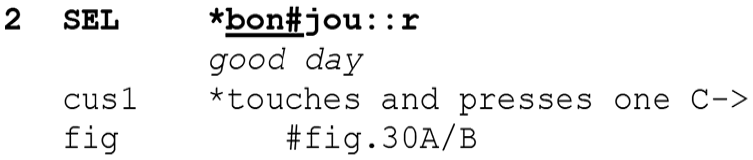
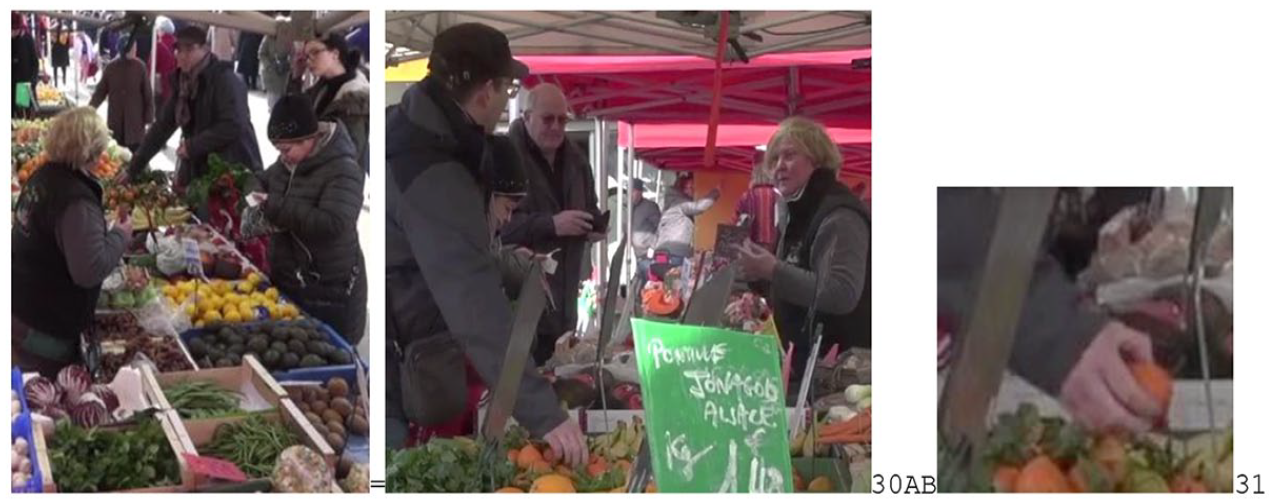
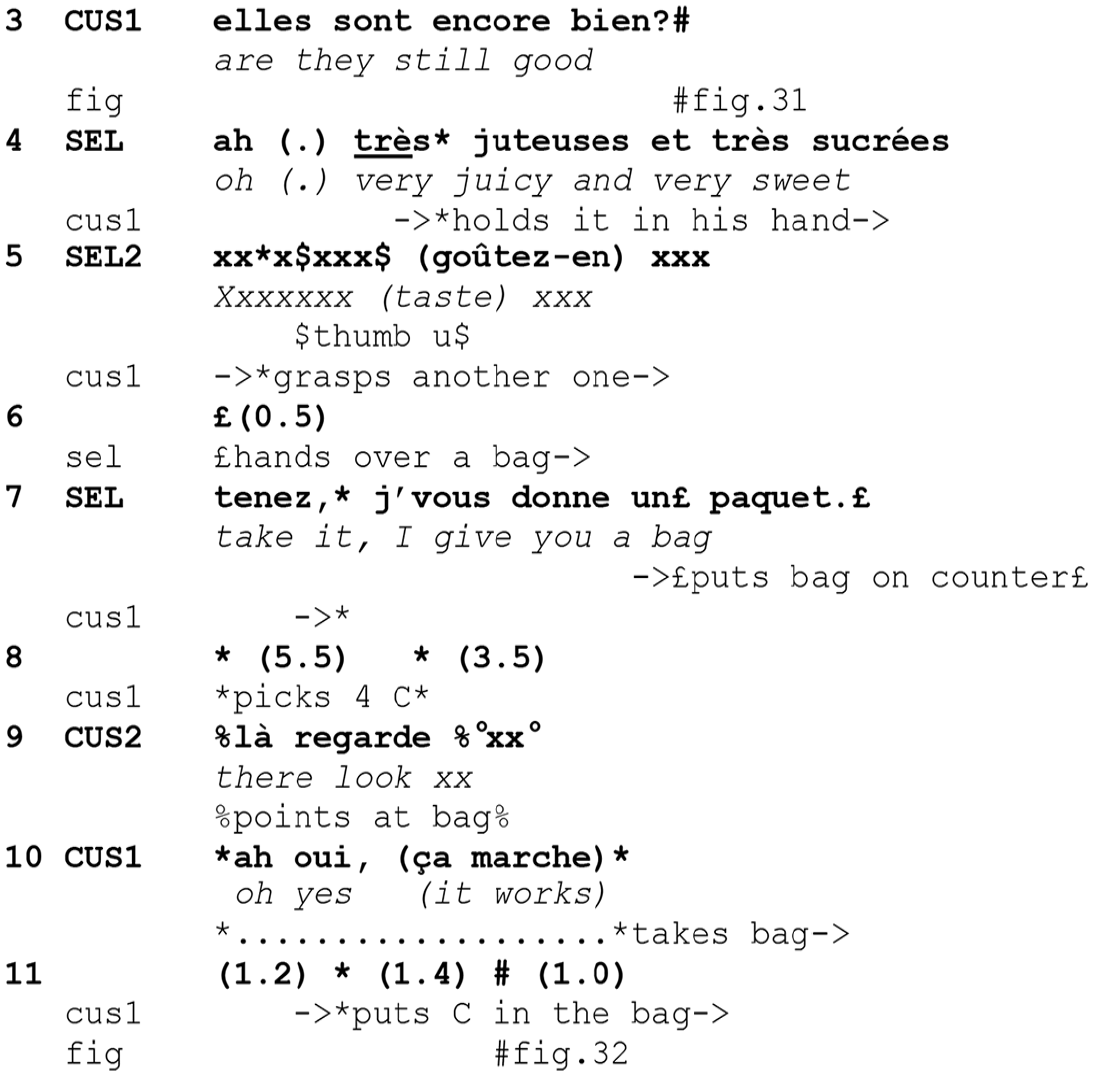
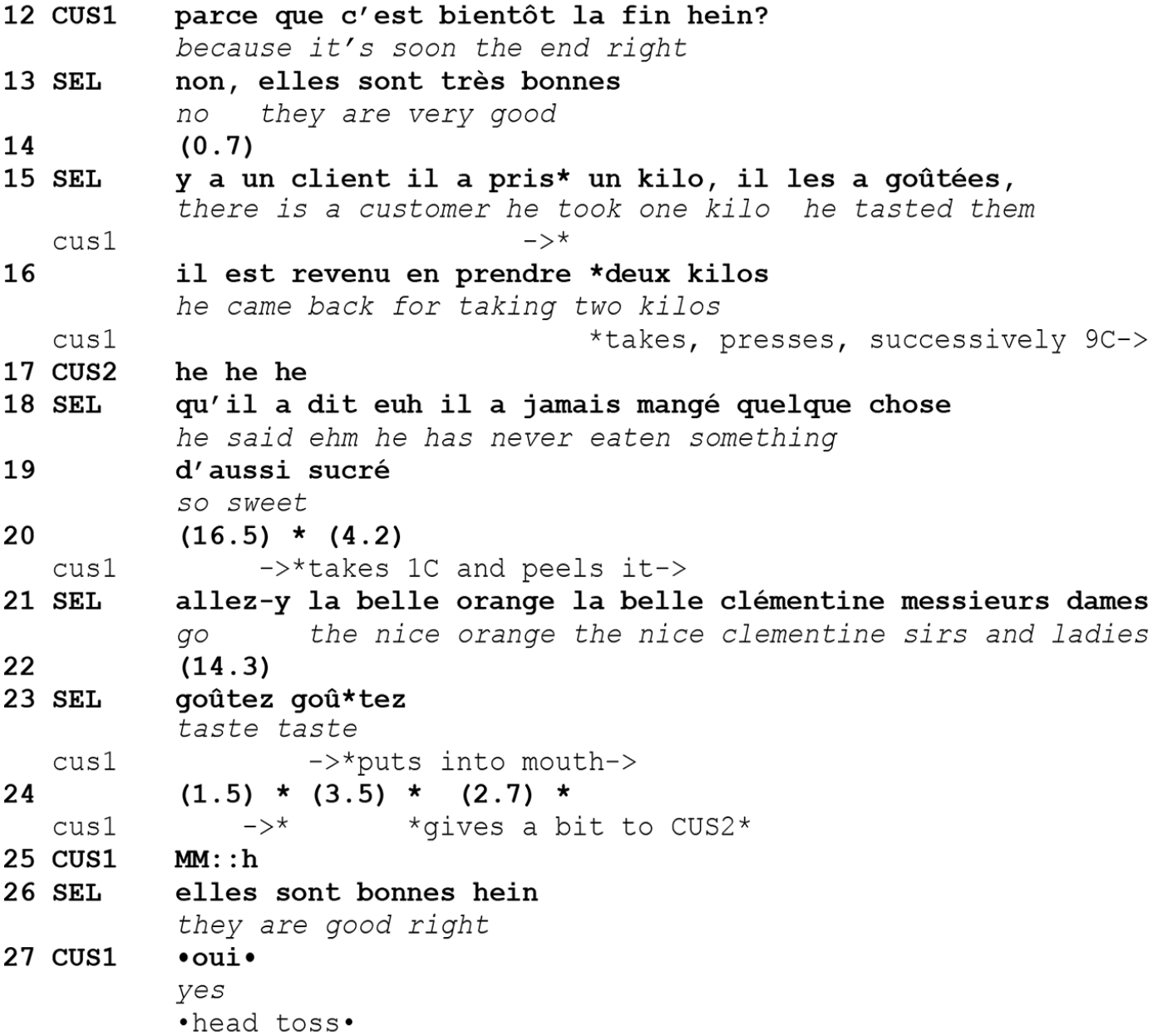
The seller’s greeting is countered by a question (3), rather than another greeting: the greeting is understood as a way the seller shows her availability for Customer 1 in the midst of various other customers (Figures 30A/B – which refer to the same instant from two camera angles). The question uses the feminine pronoun elles/‘they’, treating the reference to the clementines as made evident by the customer’s hand touching one of them. Customer 1 continues to touch and even press the fruit as he asks the question, which displays that this haptic access is relevant but not sufficient to fully appreciate the quality of the fruit (Figure 31). Two sellers respond to his query: the seller he is looking at (SEL), who states two positive qualities for that fruit, juiciness and sweetness (4), and another seller (SEL2), busy with other products a bit further away, who produces a positive assessment (partially audible on the recording, 5, but visibly positive thanks to the thumb up).
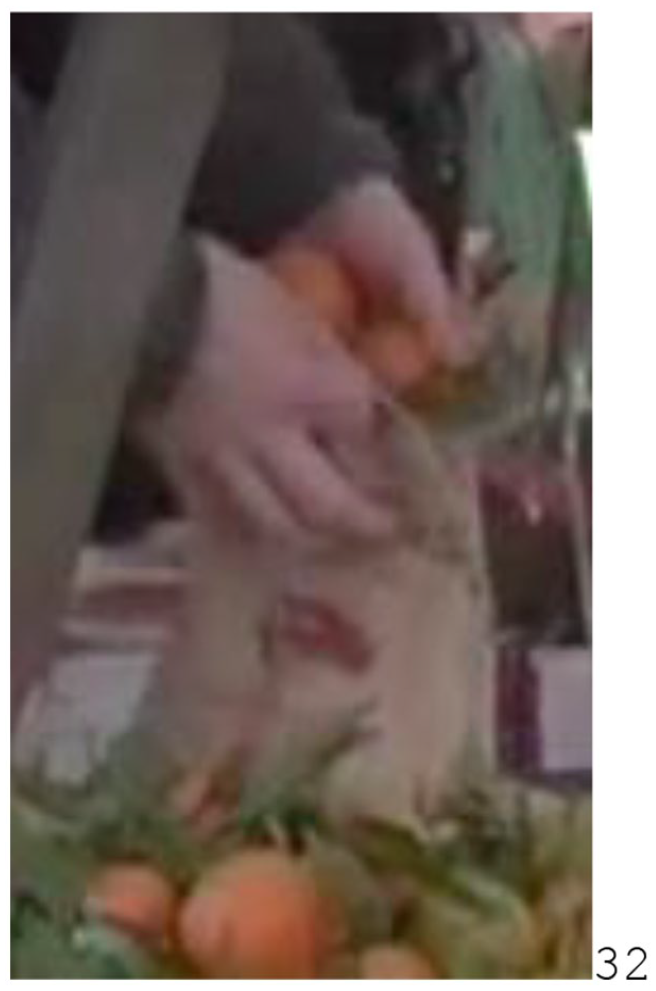
Customer 1 aligns with these responses by continuing to pick up fruit and holding them in his hand: holding the fruit (vs grasping, palpating, and replacing) projects their purchase (and their transformation from buyable to possessable). The seller understands it this way, because she hands over a paper bag, which she places not far away from the fruit. The customer continues to pick up clementines, and notices the bag only when his girlfriend points at it. Putting the fruits in the bag (Figure 32) constitutes a further progression toward the purchase.
While putting the fruit in the bag, Customer 1 asks another question, using a yes/no format, projecting a confirmation of the hint that the season for clementines is almost over (12). This is understood by the seller as projecting a possible negative assessment, which she rebuts, with a non ‘no’ produced straight away, followed by a positive assessment. She also adds a concise story about a customer (15–19), which works as proof or grounds for her description of the clementines as ‘very good’ (13) and ‘very sweet’ (4, see 19), while also using an extreme case (18) formulation (Pomerantz, 1986). During this story, the customer continues to touch, palpate, press, and pick up a number of clementines, which he puts in the bag. The story, like the previous assessments and the selection of the fruit, mutually inform each other, the story providing not only reasons to buy the fruit but also fortifying the feeling and sensations related to the haptic contact with them.
The story also seems consequential for the next action of the customer, who begins to peel one of the clementines: peeling projects its tasting, a sensory engagement that responds to the reference to the sweetness of the fruit. This makes a further sensory access to the product relevant. At this point, the seller utters a general advertising announcement (21) that is not (only) addressed to this couple, but is also audible to other customers and passers-by. She monitors the action of Customer 1, inviting him to taste the fruit (23). Next Customer 1 puts the fruit in his mouth and tastes it, sharing it with Customer 2 (23–24). The outcome of this tasting (an audible gustatory MMh; Wiggins, 2002) is addressed by the seller asking for confirmation (26). The tasting completes the story: the present tasting experience converges with the experience narrated about another customer and proves the quality of the product. This grounds the new decision made by the customer to take a second bag of clementines:
(6.3)
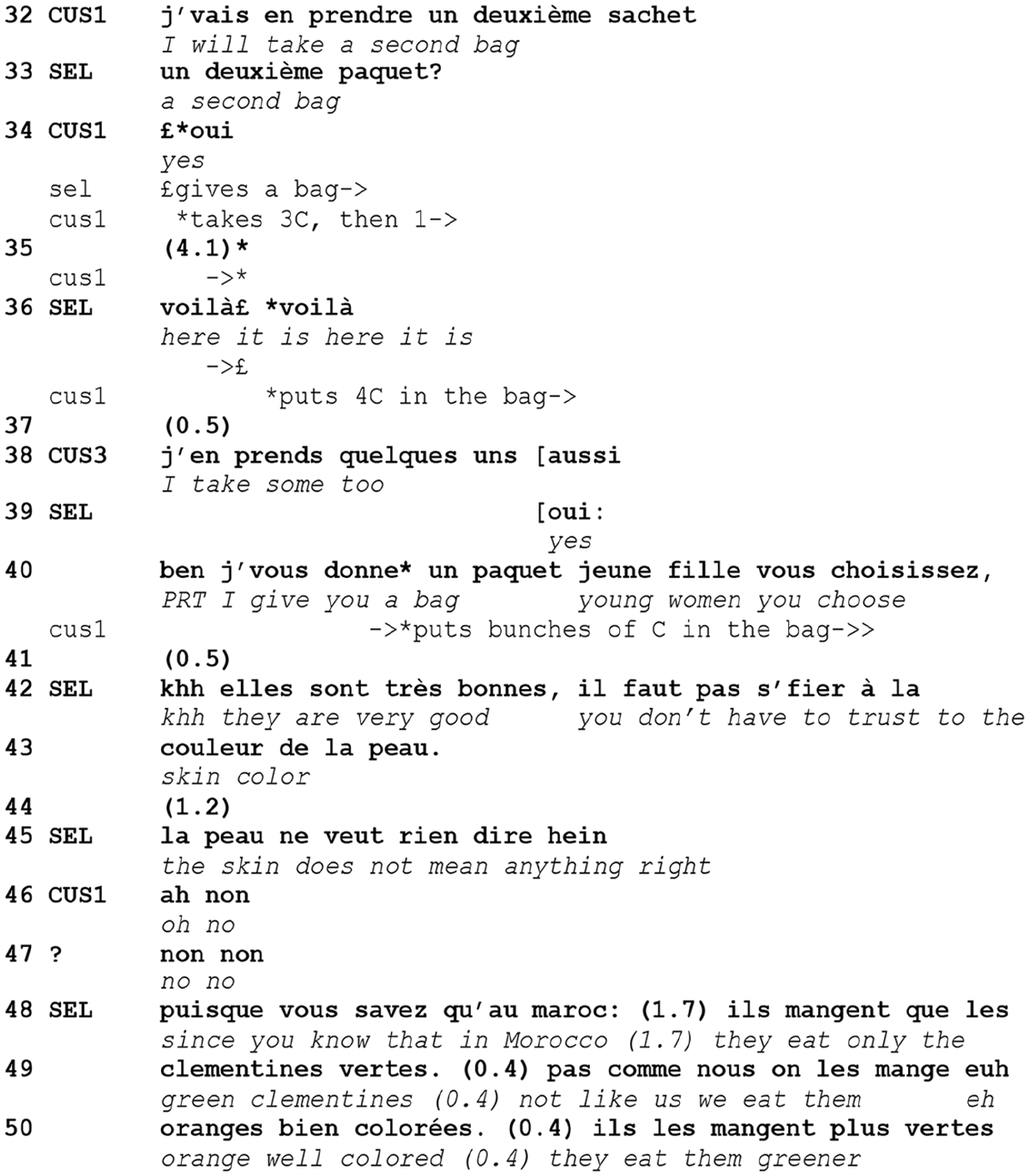
As the customer puts more and more clementines in the bag (just taking them without touching and inspecting them, as he was doing at the beginning), another customer (CUS3, 38) announces she wants some, too. The sequential position of this decision is noticeable: because she has just paid for her purchase, her action is a post-paying request clearly built on the overheard and overseen episode of the other customer tasting the clementines.
The seller describes the product again (42–50) in a way that explicitly addresses its sensorial qualities: she contrasts their visual appearance (skin color) and the internal qualities (sweetness), referring to a cultural authority (how Moroccans use to eat them). This description comes after the customer has touched and tasted them and summarizes the contrast between what can be seen and tasted in a way that makes sense for both customers.
The previous cases demonstrate the importance of not only looking, but also touching and smelling – as well as tasting (initiated by the customer) – as a first access to the products (possibly overseen by others and inducing others to buy the products, too). The way products are arranged in the stall maximizes their sensory appeal and accessibility. The customer exploits this accessibility by actually engaging in sensory explorations of the products, which can be further encouraged by the seller, especially when insisting on the possible discrepancy between the visual appearance and the tastiness of the food.
When it is forbidden to touch: The Covid-19 pandemic as a breaching experiment
The relevance and importance of these sensory opportunities for the buyer, and in particular of haptic inspections, are made observable ex negativo in contexts in which touching products at the market is prohibited. While some sellers forbid touching for reasons of hygiene and product preservation, during the Covid-19 pandemic, some markets forbade customers from touching products as a matter of public health safety. This prohibition was official at the French market of Saint-Louis in September 2020, when the next recordings were collected. During the pandemic, this market adopted different procedures to enforce the prohibition against touching products: one was through safety instructions and signs visibly posted in the market. Moreover, at some point, the prohibition was enforced by tape around the stands to keep customers in the alley (Figures B.1–3). At other times, however, it was enforced within the local organization interactions at each stand (Figures A.1–3). Video recordings were made at the same vegetable stand in these two latter conditions, and the next excerpts focus on how the prohibition against touch was implemented in social interaction in the latter context.
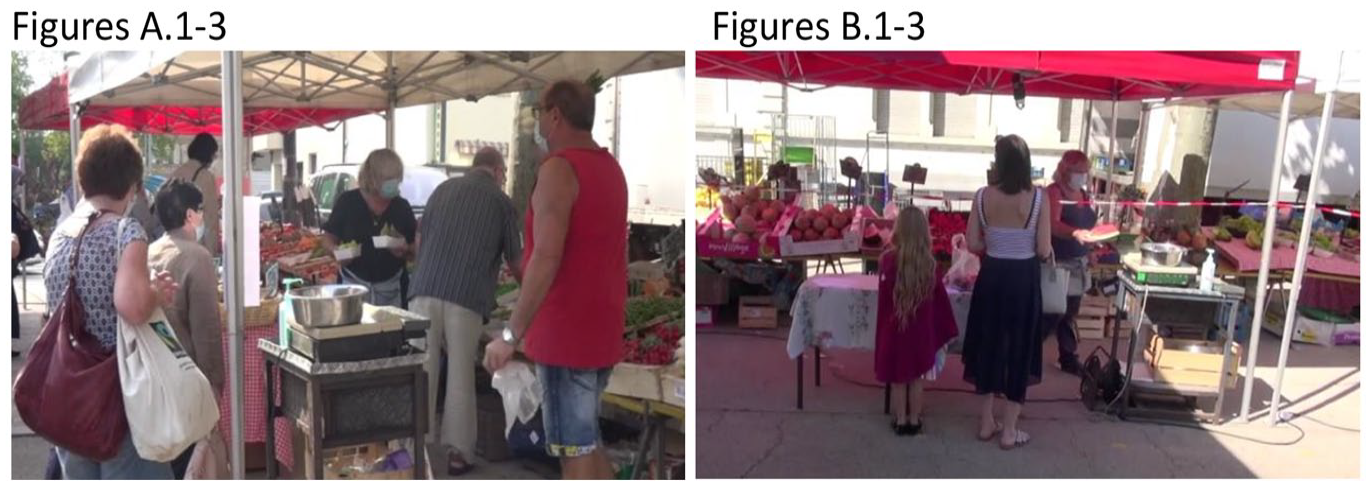
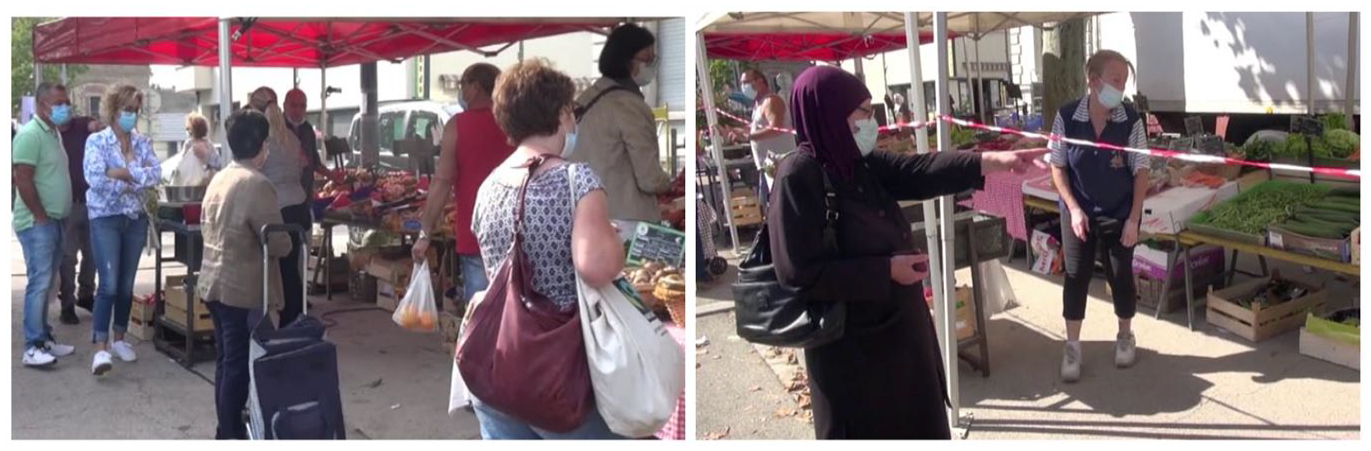
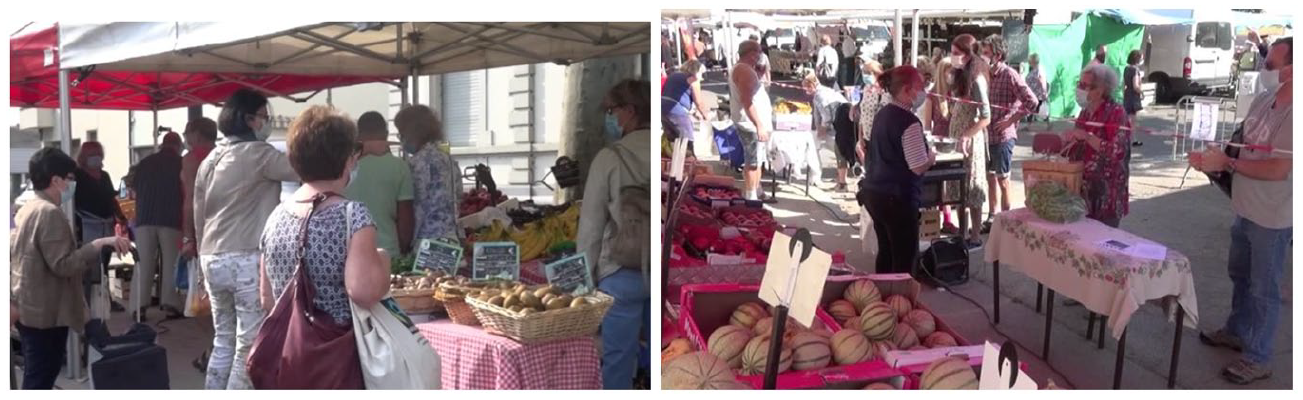
While the tape organizes the spatial distribution of customers and sellers – with a consequent organization of shopping around visual access and requests (Figures A.1–3) – in its absence (during the same prohibition period), some customers queue outside, whereas other enter the stand (Figures B.1–3). The latter engage not only in looking from a distance, but in touching the products, approaching the counter as if they would have the right to touch (cf. §5.1). In this latter case, they might be addressed by the seller, verbally enforcing the prohibition against touching.
This happens in the following extract, in which the seller (SEL1), who is engaged with a couple of customers (CUS1 and CUS2), sees another customer (CUS3) picking up bananas – touching, looking at them, and putting them back – as she walks by on her way back to the couple, she asks CUS3 to wait to be served, not having noticed that she is served by another seller (SEL2, Figure 33):
(7.1) (STL2_0919_1-47-40)
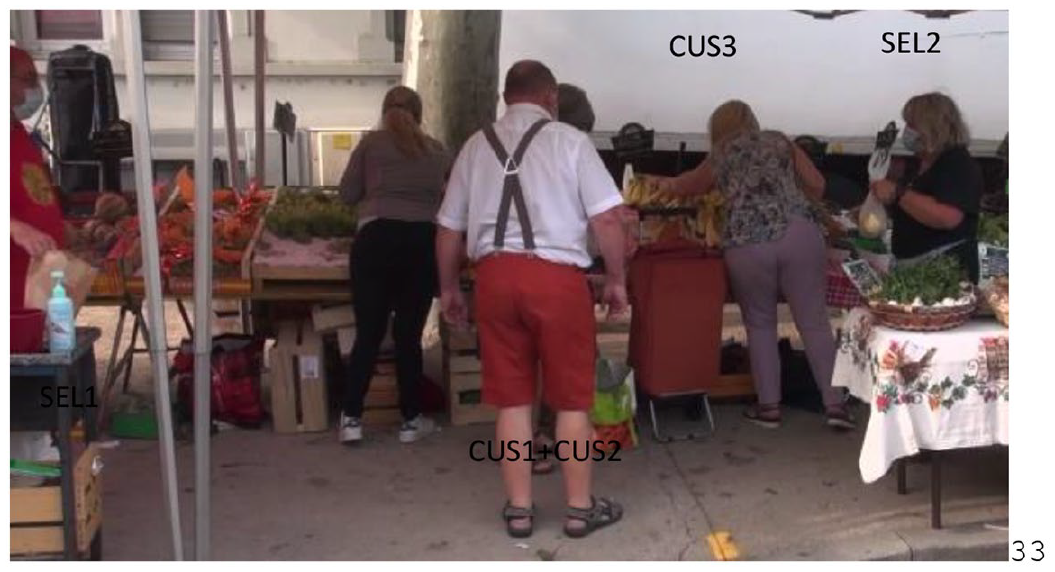
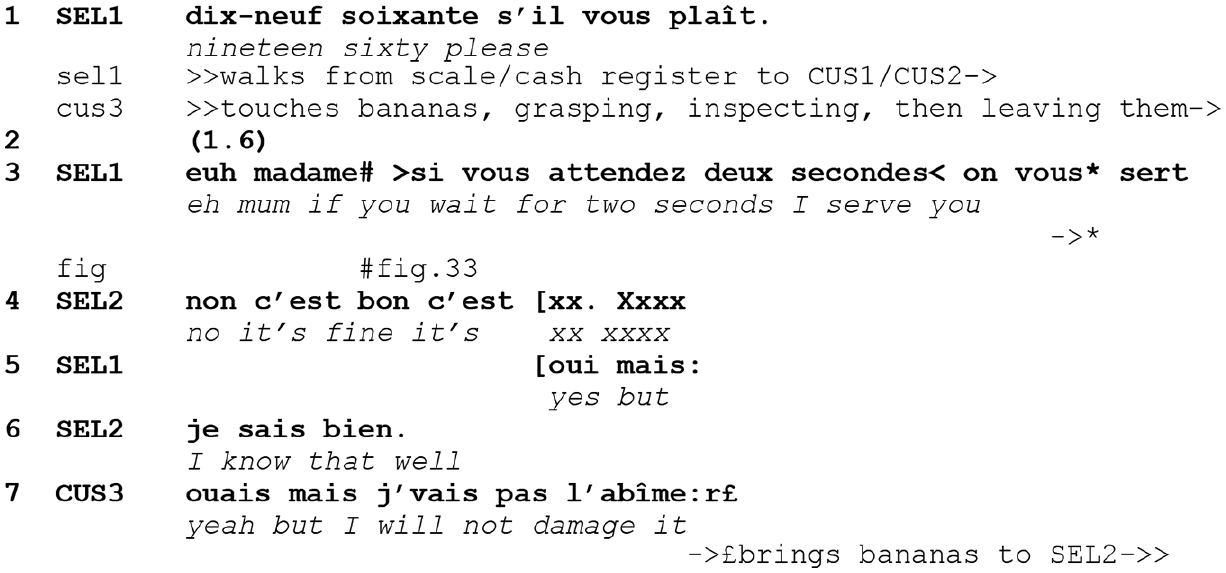
While serving two customers (CUS1, CUS2, 1), the seller notices a woman touching the bananas in a box (CUS3, 1). She addresses this as raising a problem of service, presents self-service as not permitted and insists on Customer 3 being served by the seller. She also hints at a problem of time (‘if you wait for two seconds’, 3) and at the notion of self-service as ‘faster’ and thus possibly motivated by being in a hurry. Customer 3 responds with a verbal aligned ouais/‘yeah’ (7), followed by an account prefaced with ‘but’, referring to the fact that the product will not be damaged. Seller 2 also responds, indicating that the customer is actually being served by him (4) – to which Seller 1 objects (5) in a turn that is incomplete but perfectly understood by her colleague (6). At this point, several possible forms of accountability for what is happening and the normativity of touch are superimposed: self- versus other-service, faster time versus waiting time, preservation of the products or not. None of these forms refers directly to the pandemic or to public health. Nonetheless, when Seller 1 turns back to her initial customers (19) – resuming the interaction with them – after having announced the price (19, see supra, 1), she refers to what happened (23):
(7.2) (STL2_0919_1-47-40)
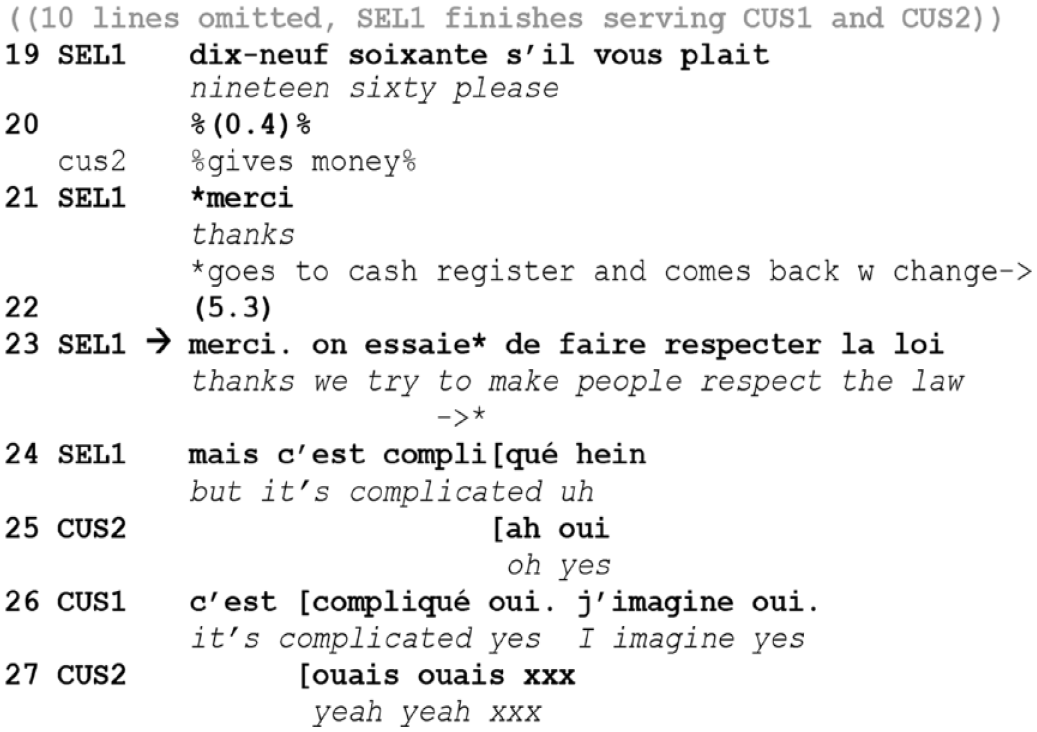
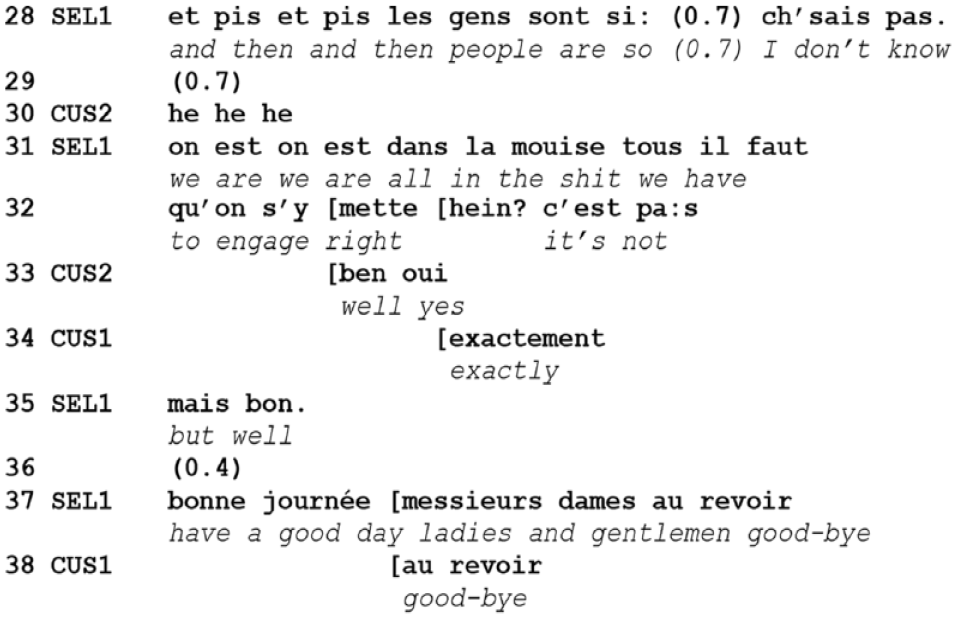
The seller now formulates explicitly what she was doing with the previous customer. This formulation is very different from what was proffered before: it refers to respect for the law (23). The fact that she uses a modal verb (on essaie/‘we try’, 23) and that she adds an assessment (24) shows an orientation to the partial local failure and the difficulties in enforcement of the law – with which the customers align (26–27). This occasions another formulation, related to the agency of the gens/‘people’ (28) and a more inclusive vision (on/‘we’, tous/‘all’, 31–32).
This episode shows how the normative legal prohibition against touching is implemented, enforced, and transgressed at the market during the pandemic. This context occasions various situations in which customers are confronted with the prohibition and resist it. The next extract shows how grasping and touching the products is treated by the seller, who declines to impose her service in lieu of self-service. As in the previous fragments, the seller is busy with a customer when she sees another one approaching and taking some potatoes:
(8) (STL 1.35.45/1.30 potatoes)
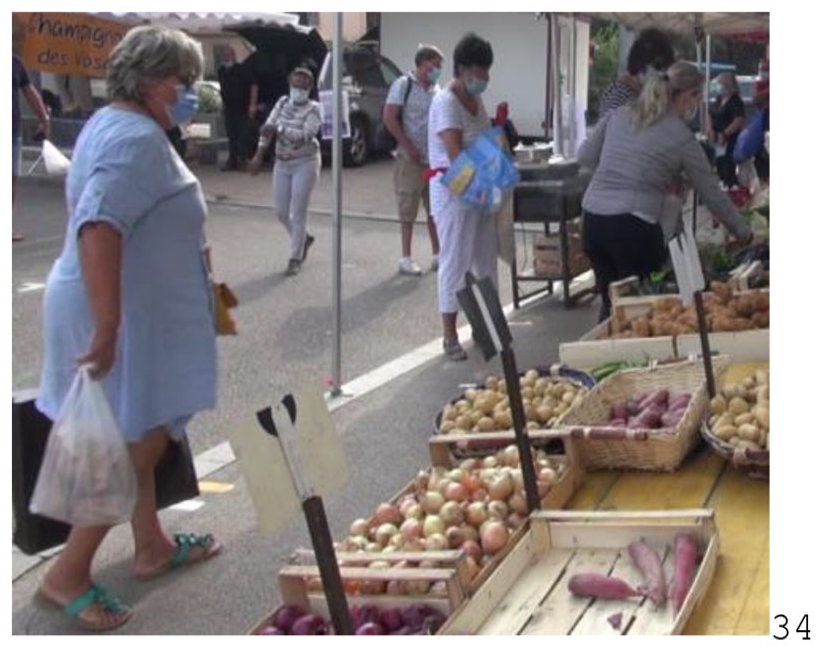

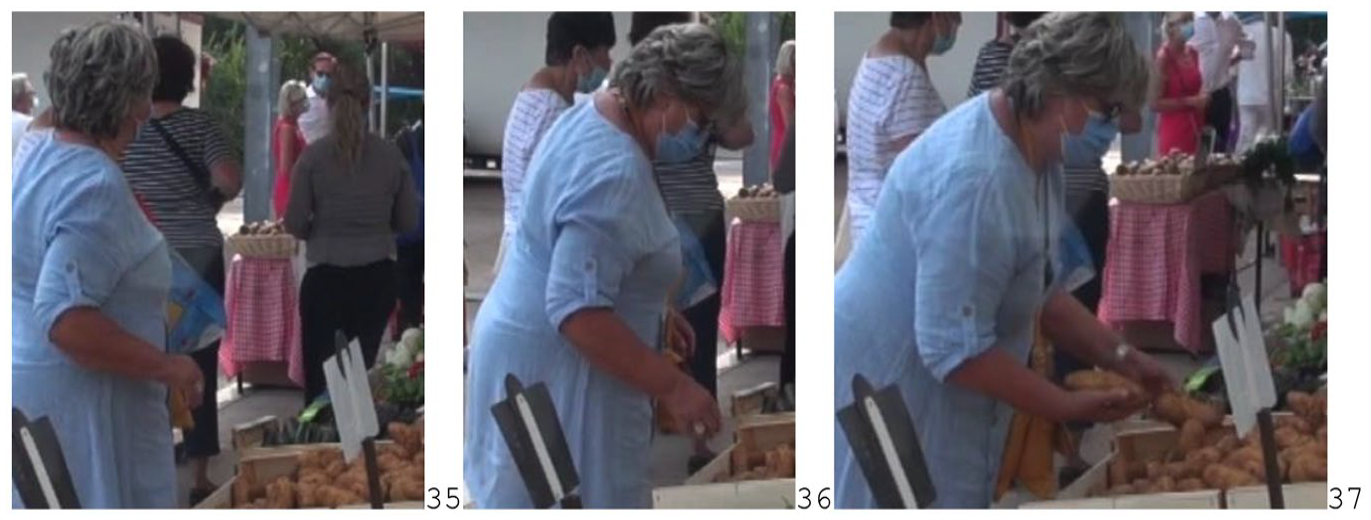
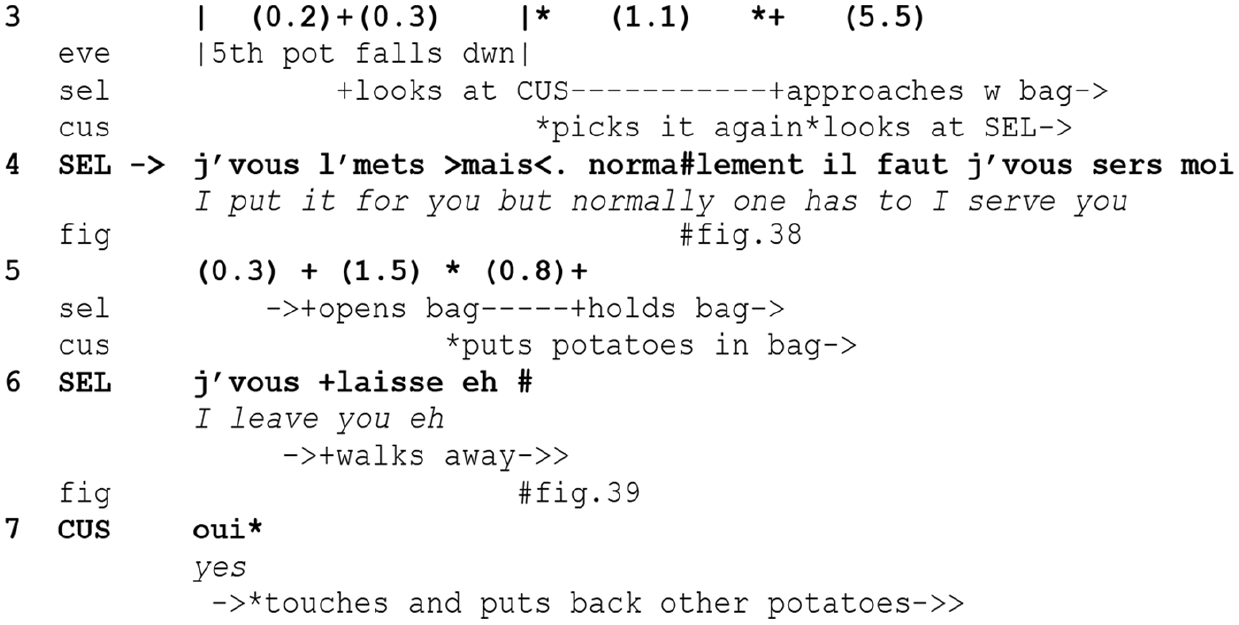
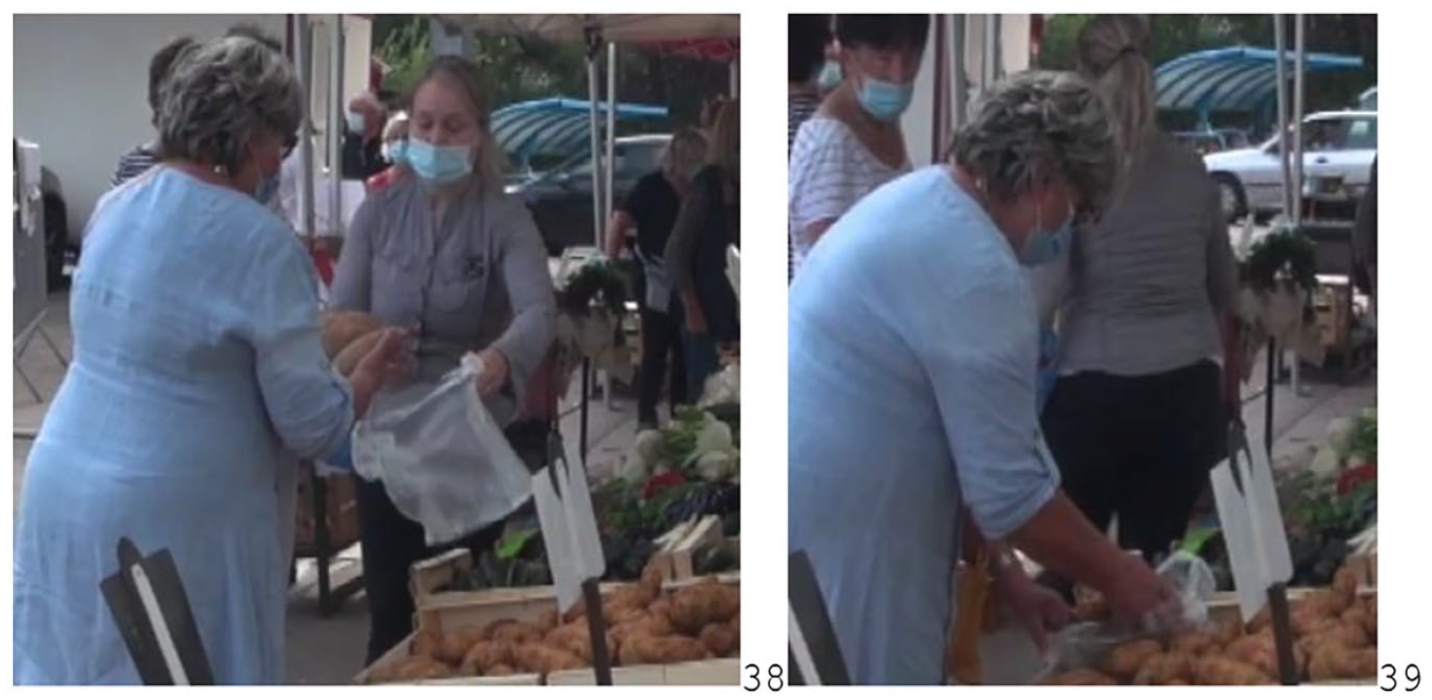
A customer approaches the counter (Figure 34) and, after having deposited her bags to free her hands, she briefly glances at the seller (Figure 35), orienting toward the possible service she could obtain. Seeing the seller, who has her back to the customer, serving other customers (Figure 35), she engages in self-service, picking up potatoes from the box (2, Figure 36). Some potatoes remain held in the hand, while others are put back (Figure 37). The seller notices her doing this (3) and walks toward her with a bag: holding it, she enables the customer to put her potatoes in it (Figure 38), offering a form of service. She also formulates what she does, giving the customer the bag rather than serving the customer directly (4), opposing the two (with mais/’but’) and using the adverb normalement/’normally’, which might refer to what she ordinarily does, but also to what is required by the new norm. As the seller leaves, going back to her initial customer, the customer continues her self-service (Figure 39). In this case, the violation of the rules is indirectly hinted at by the seller, but does not change the actions of the customer. In other cases, the customer orients to the prohibition, but ends up touching and inspecting the food herself.
(9.1) (STL 1.35.45/0.35 rayé)
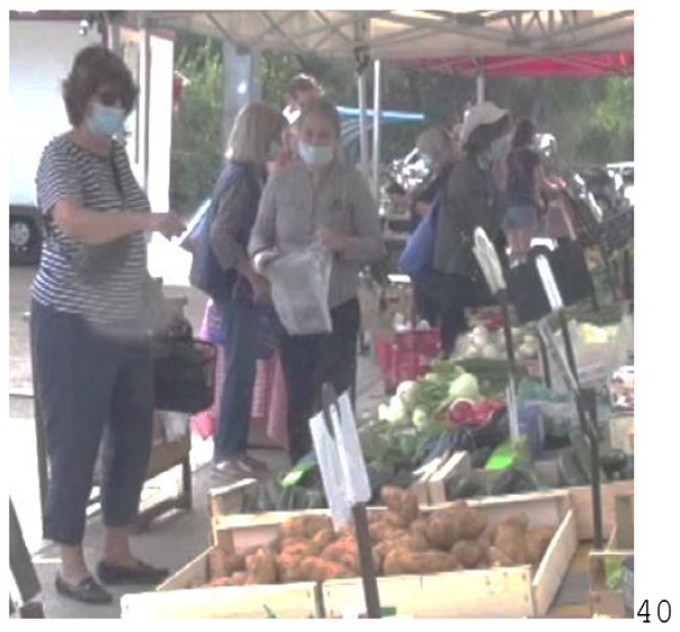
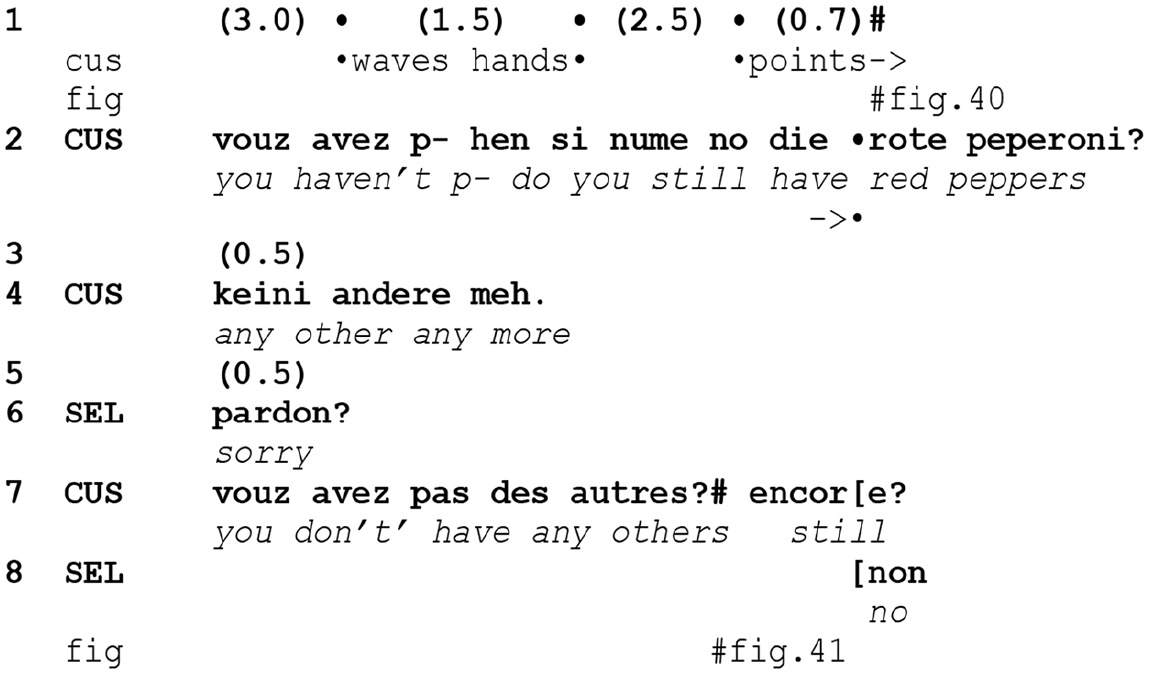
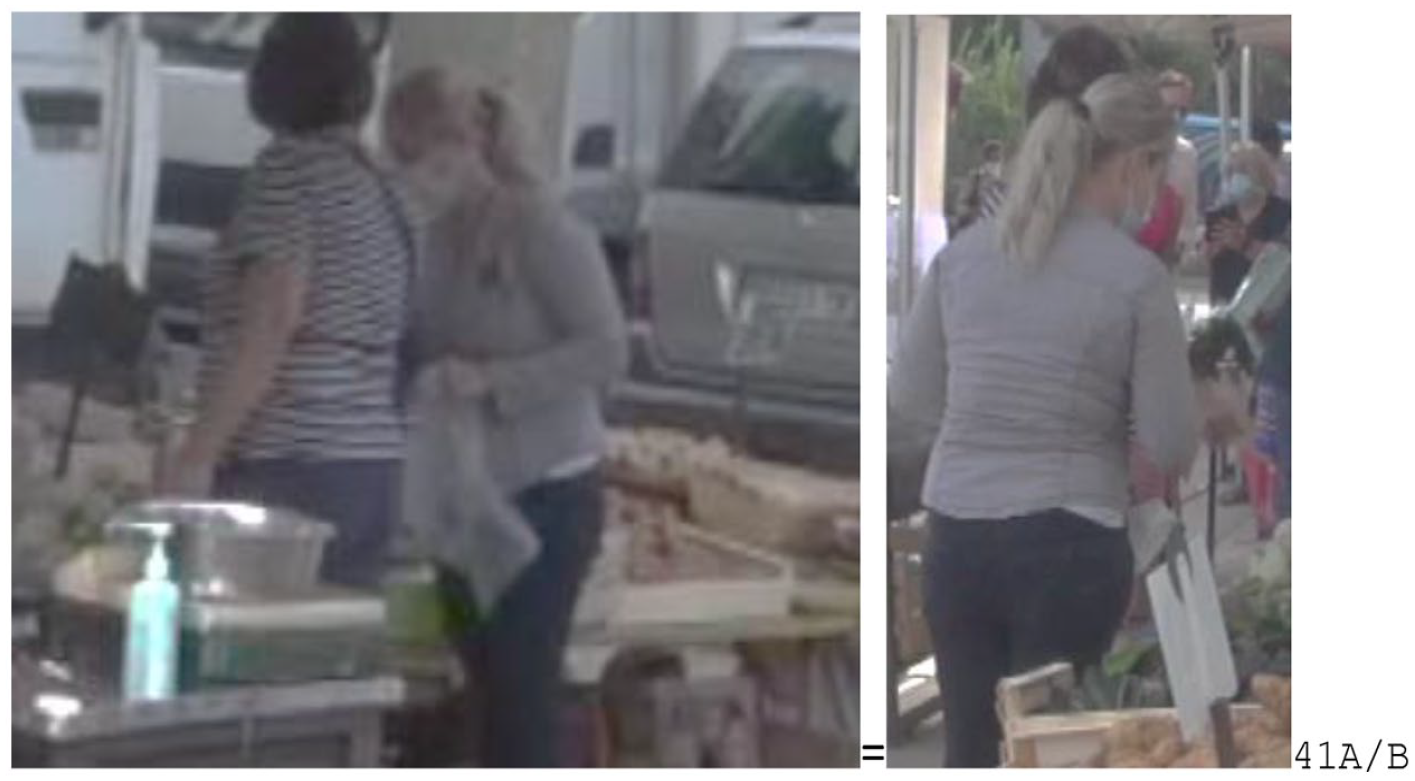

The customer has been waving at the seller and waiting for her at some distance from the vegetables (Figure 40). The transaction begins with her pointing at some peppers and asking a question, first in French, then in Swiss German (2), hinting at their non-availability (4). The seller initiates a repair in French (6) and the customer repairs the question in French (7), which is responded to by a quick negative answer (8). The issue is further expanded (9) and confirmed (10). Up to this point, the two participants are positioned in front of the peppers, looking at them (Figure 41), pointing at them, and talking about them. The customer pursues her investigation concerning the available peppers.
(9.2) (STL 1.35.45/0.35)
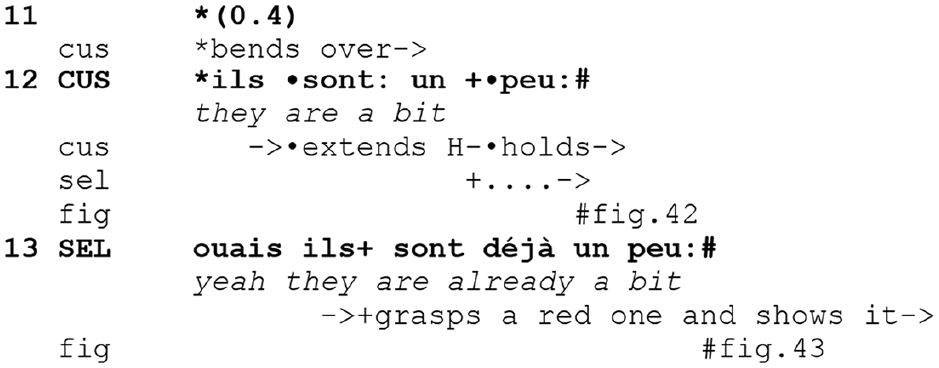

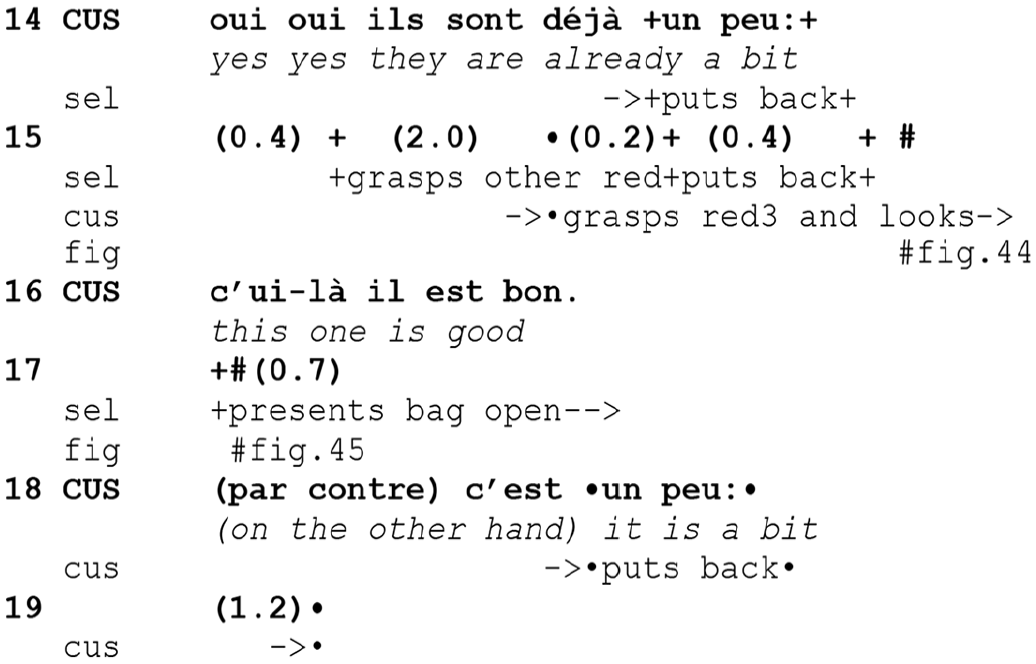
The customer bends over, taking a closer look at the peppers, and extends her hand toward them (Figure 42), projecting a possible and relevant touch, although actually not touching them, holding her hand on top of them. This posture shows two opposite orientations, toward touching and not touching.
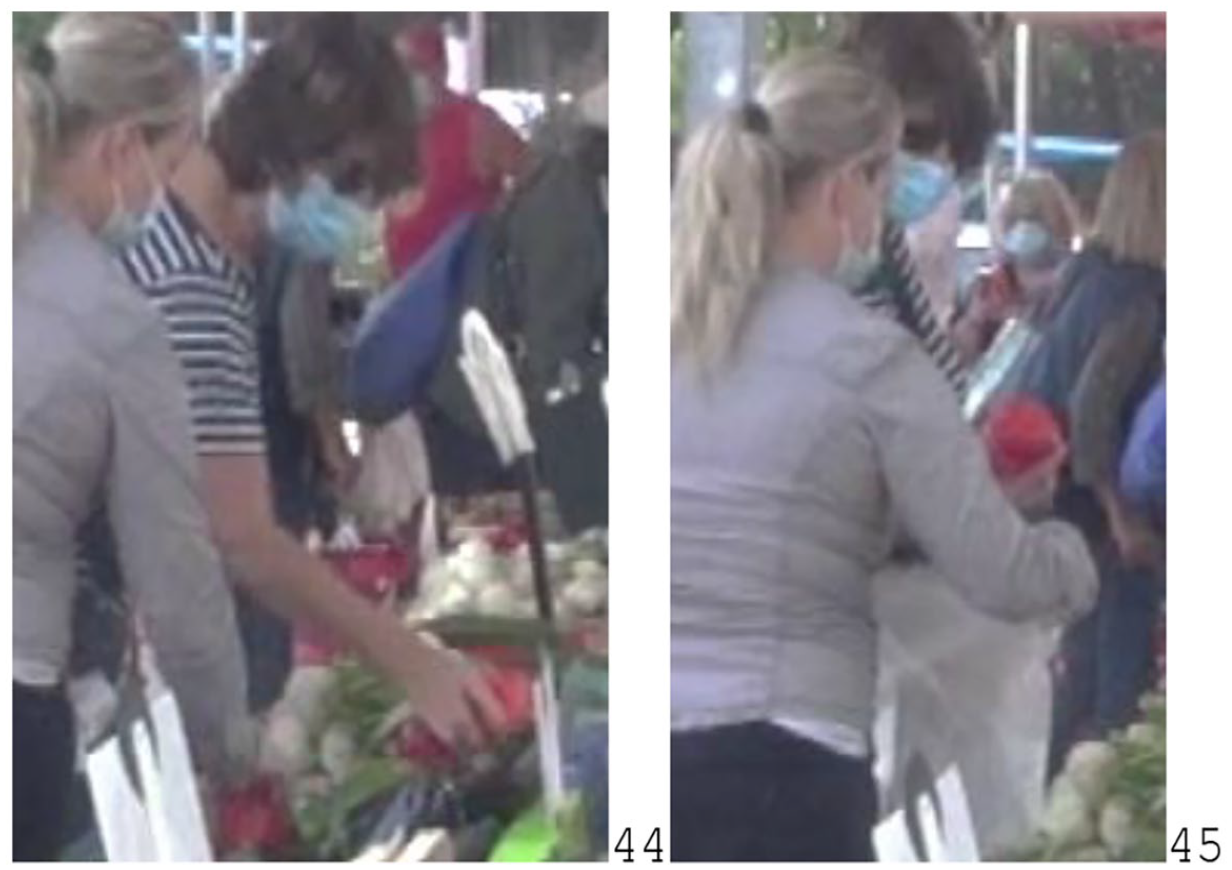
The relevance of touching is provided by the customer’s turn: she projects an assessment (ils sont: un peu:/‘they are a bit’, 12) about the quality of the peppers as she extends her arm. The seller responds to that with a confirmation (ouais/‘yeah’), using the same syntactic structure with the insertion of a temporal adverb (déjà/‘already’), hinting at the ripeness of the vegetables, which is not completed (13) like the previous one (12). While making this confirmation, the seller grasps a pepper and shows it to the customer (Figure 43). In this way, whereas the customer was projecting but refraining from touching, the seller exhibits her (professional) right to touch. The customer confirms that the quality of the pepper does not correspond to what she wants to buy (14), and the seller treats it in this way, by putting the pepper back in the box. She also grasps another one (15), searching for an acceptable alternative. However, at this point, the suspended hand of the customer engages in grasping the next pepper (Figure 44), picking it up and looking at it, while uttering a positive assessment (16). The seller aligns with this action, which projects buying, and opens the plastic bag, ready to collect the product (Figure 45). However, the customer adds a possible critical assessment (18) and puts the pepper back on the box, displaying her decision not to buy it. At this point the seller addresses the normativity of touch:
(9.3) (STL 1.35.45/0.35)
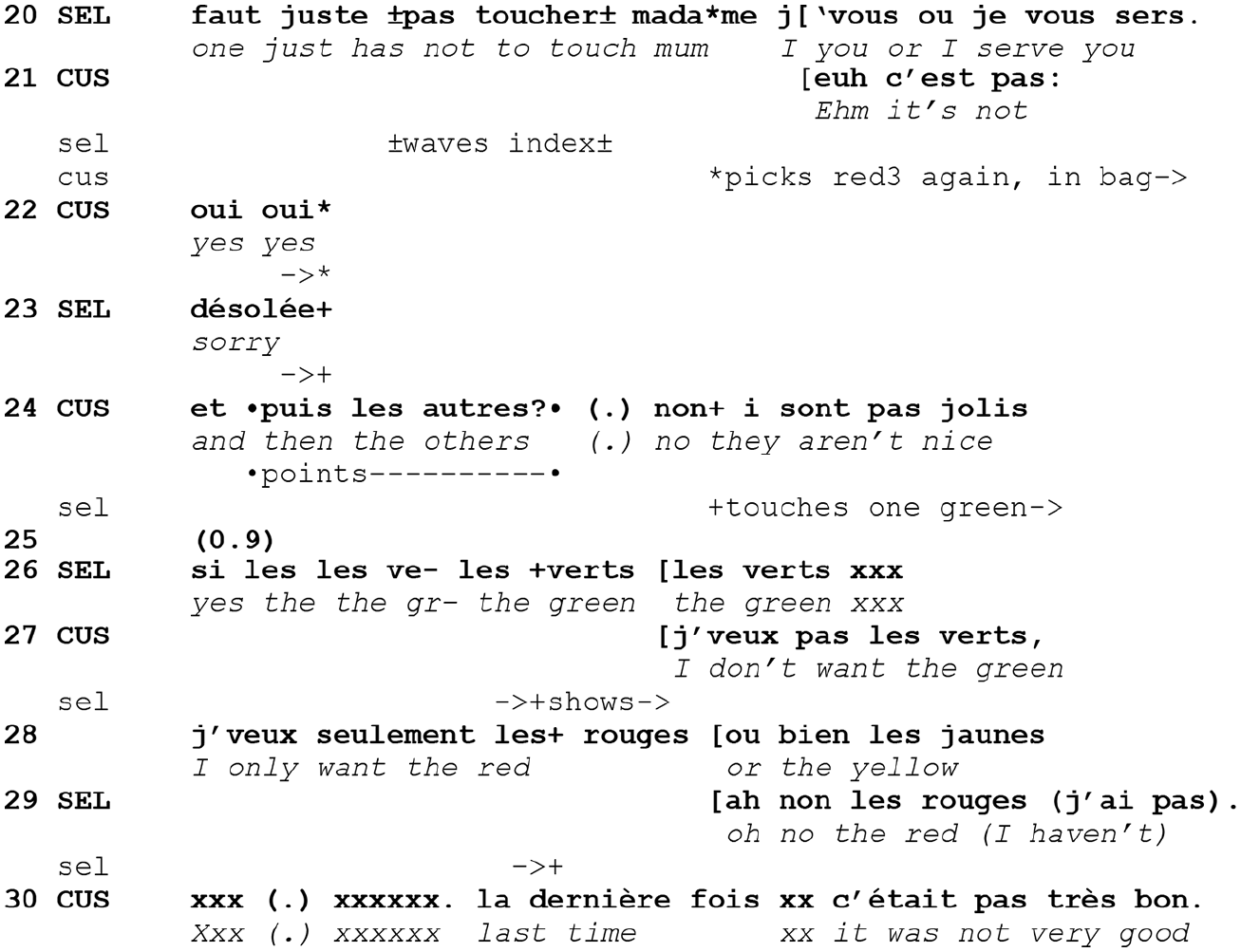
The normative action of the seller is twofold (20): on the one hand, she forbids the customer from touching, using the modal verb falloir/‘to have to’ and a waving index finger; on the other, she offers her service as an alternative. In this way, the prohibition is integrated in the commercial service. This prohibition against touching is positioned at a precise moment: not when the customer touches the product, but when she puts it back. The customer aligns immediately with the formulation and with its normative implications: she picks up the pepper she was touching and puts it in the bag held by the seller. The seller apologizes (23) after this complying alignment.
The search for an adequate product continues, in a way that incorporates the previous normative instruction: the customer asks a further question about the peppers and points at them and the seller touches and shows a possible candidate. The continuation of the transaction is achieved within this division of sensorial labor, the seller touching the products, and the customer pointing and looking at them from a distance, as well as using language to search, check the quality, and make decisions. This case shows the tension between normative injunctions and ordinary actions. Even if touching is prohibited, the relevance of touching is maintained and worked out by the participants.
The normativity of touch is ignored in extract 8, is respected but finally violated in extract 9, and resisted in the next extract, in which touch is claimed to be justified and necessary for checking the ripeness of the fruits (vs their hardness), which is not detectable by sight alone. We join the action as Seller 1 is asking a customer not to touch (2):
(10) (STL 1.35.45/1.15-1.44 Fgilet bleu)
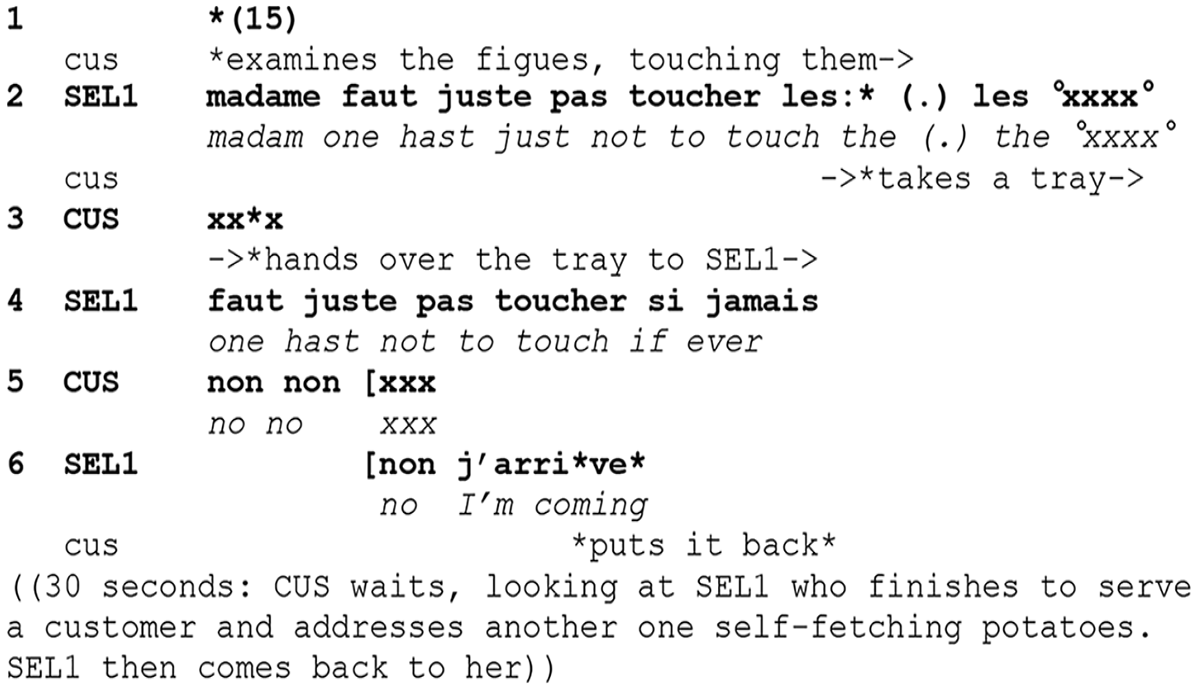
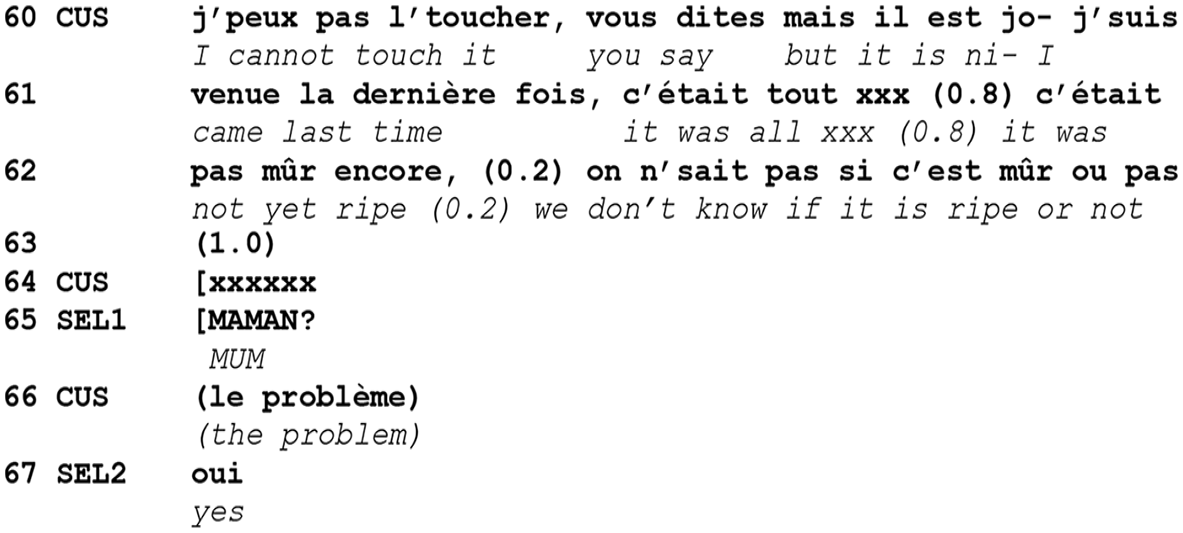
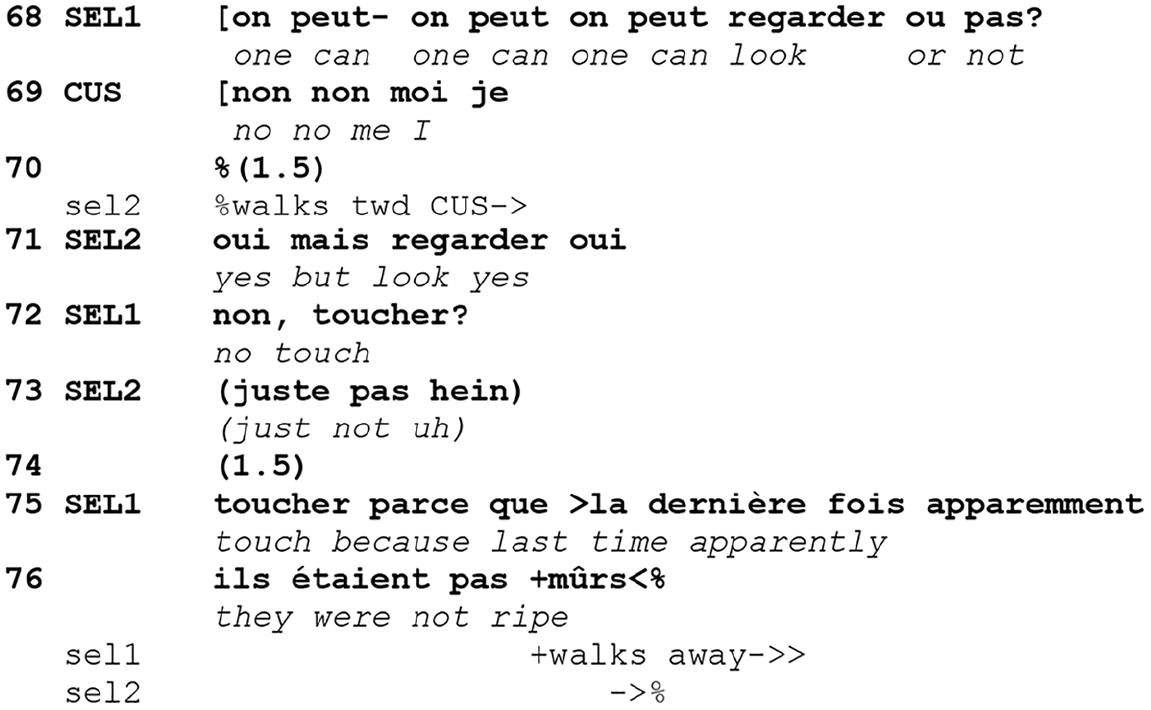
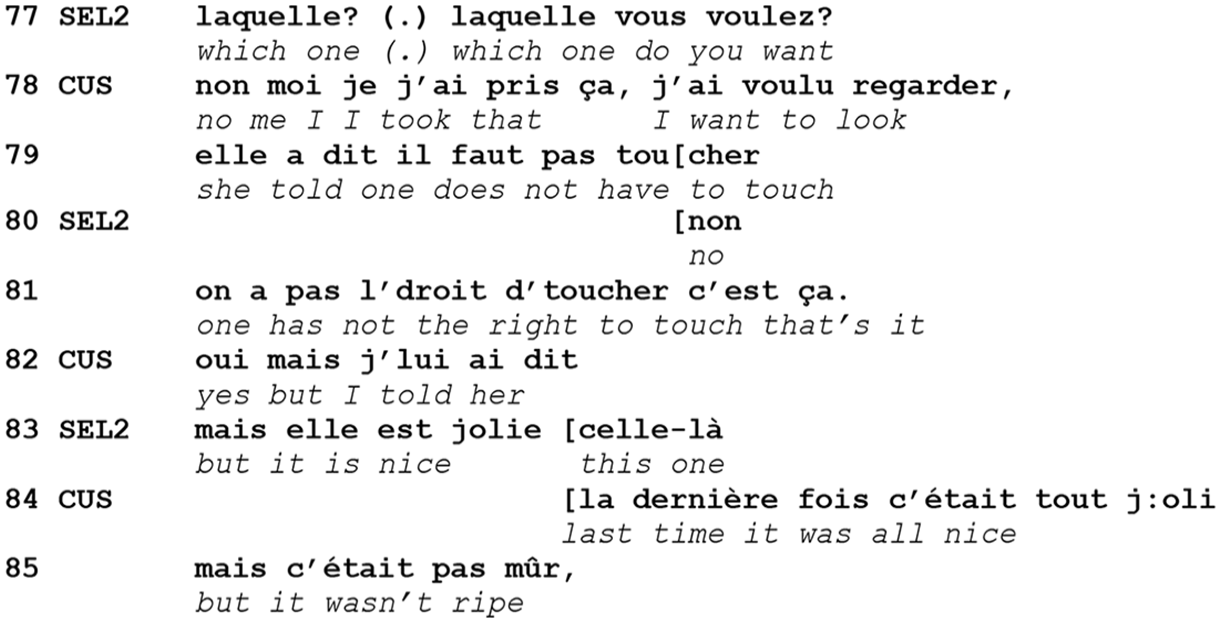
As the customer is examining some figs and also touching them, the seller – who is serving another customer – asks her not to touch them. She addresses the customer without any greetings, using the verbal expression faut juste pas toucher/‘just don’t touch’ in the impersonal negative form twice (2, 4) and mentions touching as the only relevant aspect at that point. With j’arrive/‘I’m coming’ (6) she projects imminent service.
She comes back 30 seconds later, after having finished with her other customers. As soon as she approaches, the customer refers back to the prohibition, quoting her (60) and objecting to it: she critically refers to a previous purchase and justifies her touching, claiming the right to haptic access as relevant for choosing the product (62). At this point, the seller calls her mother (SEL2) (65). She uses the verb regarder (on peut regarder ou pas?/‘one can look or not?’ 68), which she then repairs in toucher/‘touch’ (72). Touching is here addressed by citing the complaint previously uttered by the customer (75, cf. 61–62). Seller 2 continues the exchange, as the daughter walks away: the customer refers back again to the prohibition, claiming to have aimed at looking (j’ai voulu regarder/‘I wanted to look’, 78) and to have been reprimanded for touching (79). Seller 2 confirms the prohibition in terms of a negated right (on a pas l’droit d’toucher/‘one hasn’t the right to touch’, 81) using an impersonal expression (the pronoun on/‘one’). As the customer continues to cite the previous interaction, Seller 2 progresses in the transaction, producing a positive assessment (83), which is rebutted by reference to the past experience (84–85). Here joli/‘nice’ is critically treated by the customer as appealing to the eyes (‘good-looking’), by contrast to other qualities (ripeness), in a way similar to that used previously with Seller 1 (60–62), when the same adjective was used, albeit in a truncated way (jo- 60).
In this case, the prohibition against touching is resisted with various arguments, some addressing the invisible material and sensory qualities of the product, others addressing issues of trust concerning the seller’s offers and descriptions. In other words, touch is presented as the only way to have direct access to the quality of the produce without depending on the mediation of the seller. Critically referring to the seller’s description of the produce, the customer introduces some distrust in talk in general and in the seller’s mediation in particular, enhancing the relevance of the right to a direct sensory access for the customer. Thus, the context of the pandemic and its normative injunctions reveal ordinary routine expectations (Mondada et al., 2020a for greetings), while suspending and changing ordinary courses of action and their legitimacy (Mondada et al., 2020b for paying), pinpointing the normative dimensions of sensoriality.
Being invited to sense: offers to taste
In the cases examined in the previous section, the customer looks at, touches, and smells the products. By contrast, this section addresses cases in which it is the seller who invites the customer to look at the products and to engage in sensing them. By contrast with vegetable stands open to the street, this type of behavior typically happens in stands where the products are not directly accessible, but have to be either requested by or offered to the counter. When people do not themselves approach the counter to request a product, the seller has the practical task of inviting passers-by walking on the street to stop at the stand. One technique consists in offering a sample to taste – relying on the appeal to the senses to transform the passer-by into a customer and possibly a buyer. This context, characterized by the seller’s initiation of a sequence of actions (vs the customer, §4–5), constitutes a perspicuous setting to reflect on the transition from visual access to a closer sensory access, represented by tasting (vs touching, §4–5).
The following extracts, recorded at two stands – one selling chocolate and another cheese – document how the offer to taste is variously responded to by its recipients: they might continue their walk, slow down, or stop; they might refuse to taste, accept tasting without abandoning their initial trajectory, or fully accept the offer to taste and engage in a discussion with the seller. The degree to which tasting appeals to the passer-by crucially depends on how it is sequentially and temporally positioned with respect to their ongoing embodied trajectory. The next extract shows how the passers-by might slow down in front of the stand, but move away while refusing the offer from the seller:
(11) (CHOC 3-20-00)
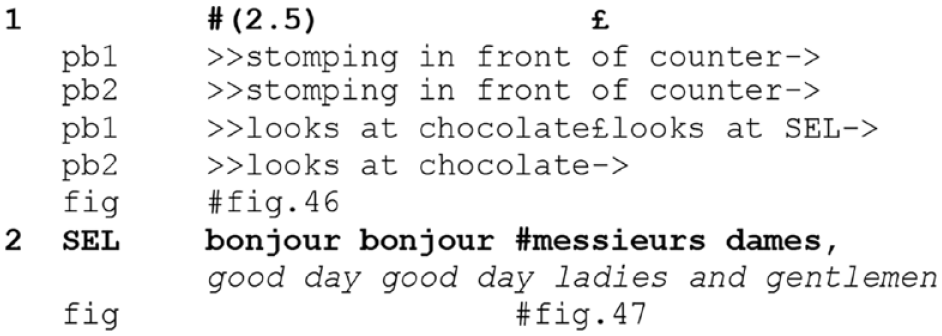
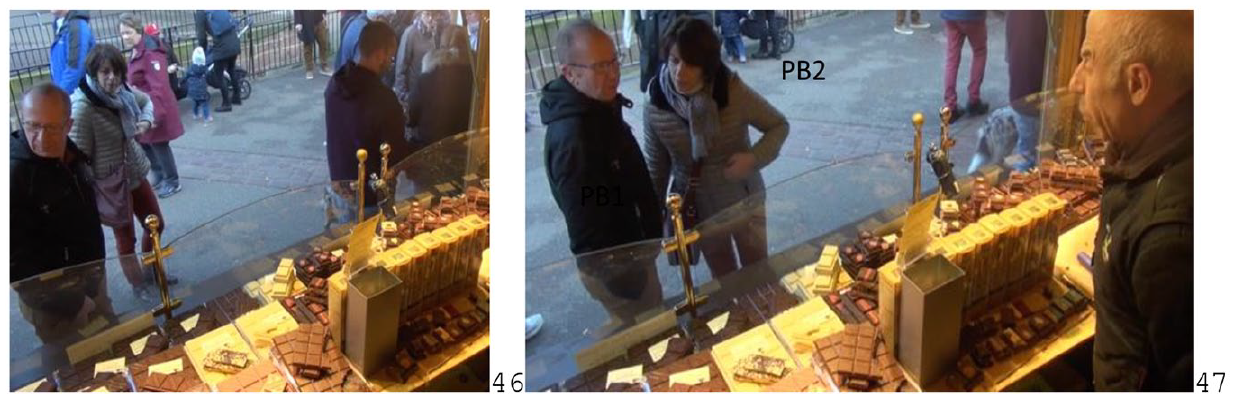
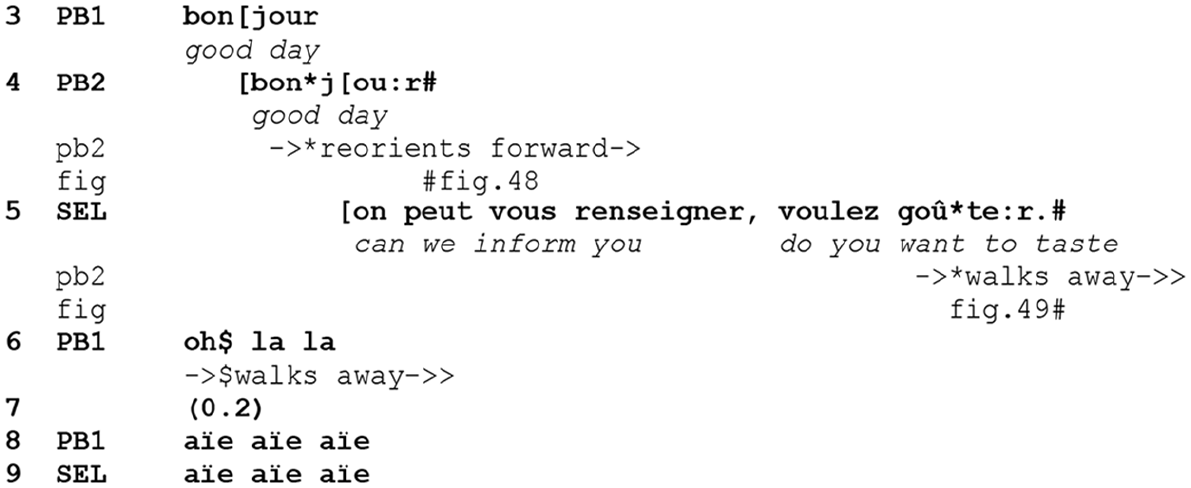
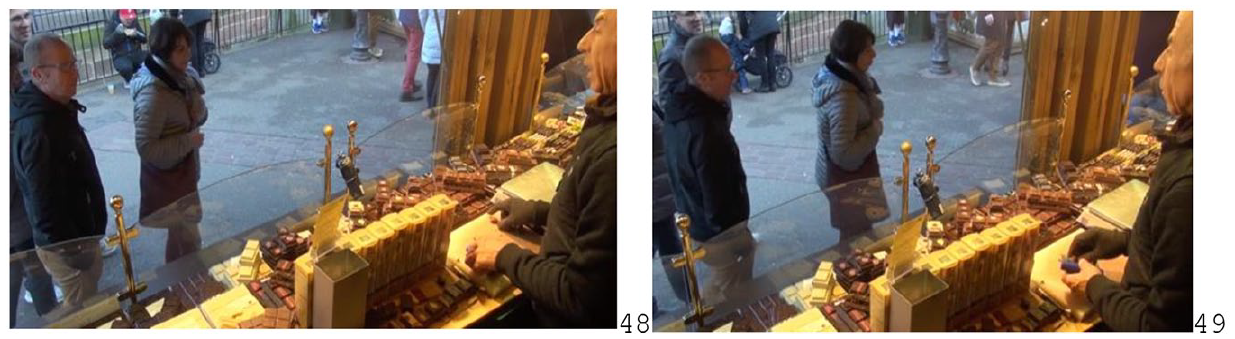
A couple of passers-by slow down their walk and look at the products, stomping in front of the seller (Figure 46), who addresses them as soon as one of them looks at him (2, Figure 47). They respond to the greeting (3–4), but one of them immediately bodily reorients by looking and walking forward (Figure 48), projecting a refusal. Her companion, too, walks forward as he refuses the offer (6–8, Figure 49). Walking away not only closes the sequence (Broth and Mondada, 2013) but also embodies refusing. The appeal to taste can either be rejected or accepted, albeit in different ways. The next fragment shows another couple: she refuses a tasting and continues her walk (Figure 51), while he accepts, albeit maintaining his body posture aligned with the directionality of the walk (Figure 52).
(12.1) (MUNST 0-12-41)
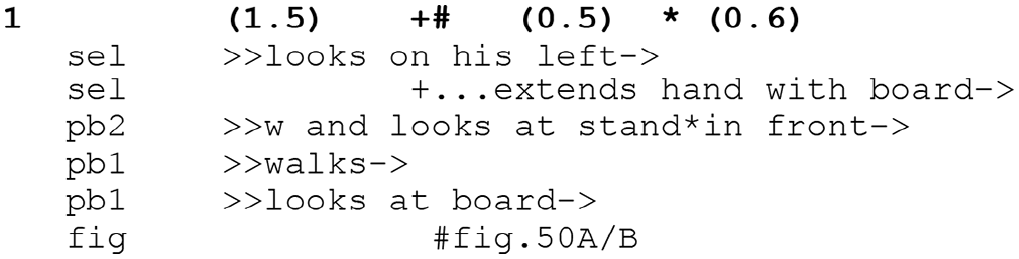
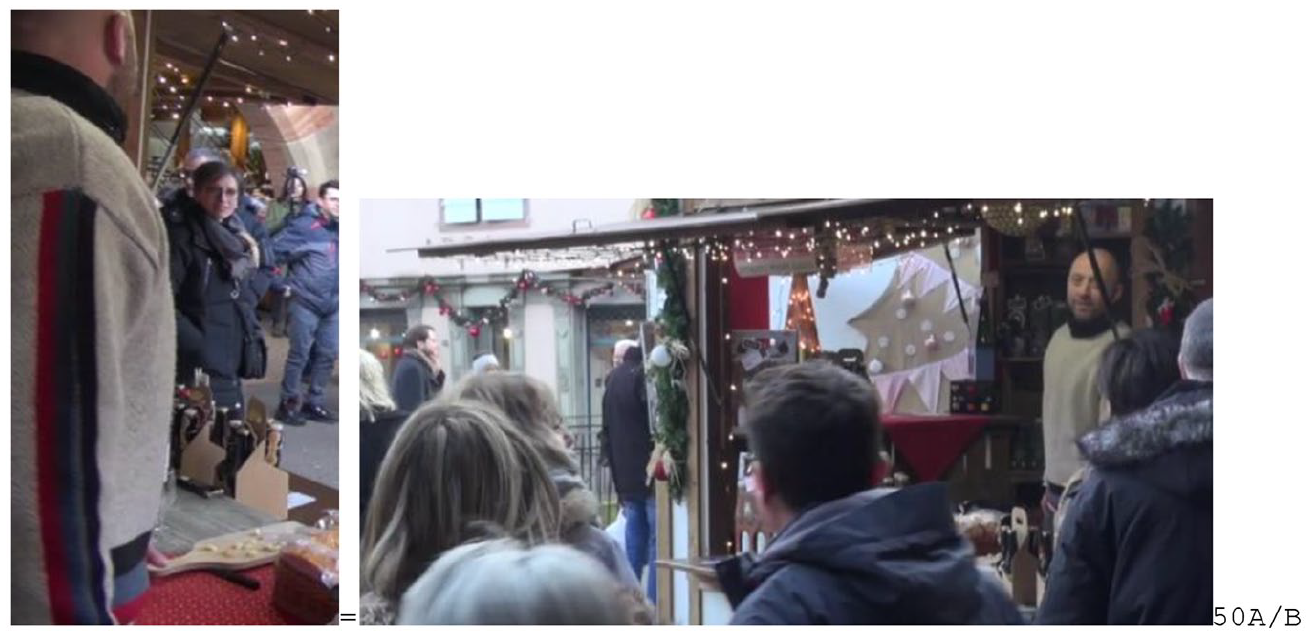

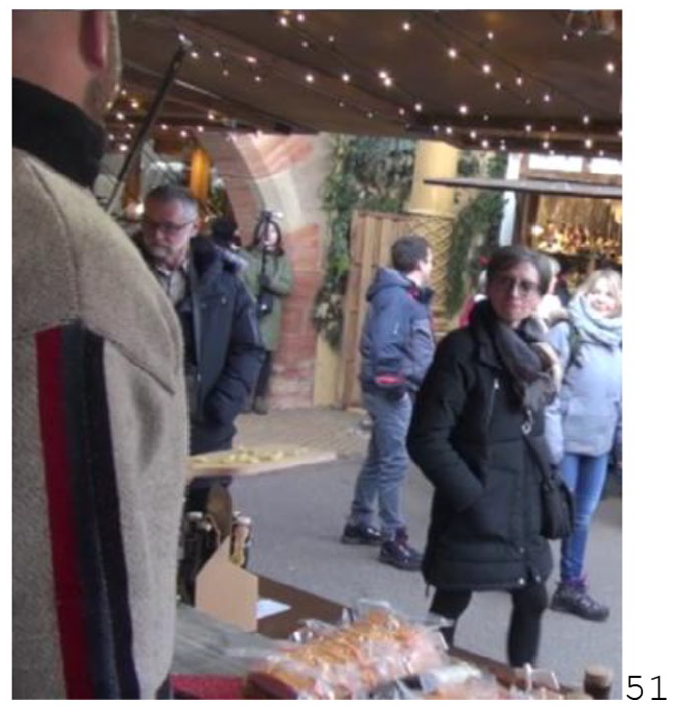
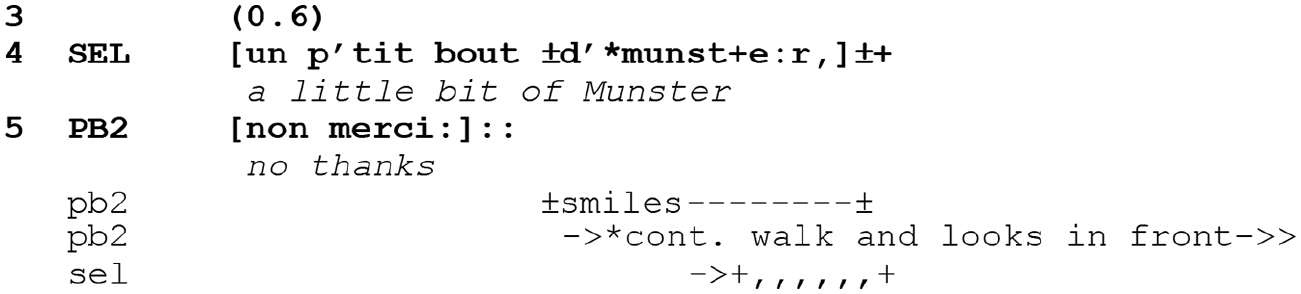
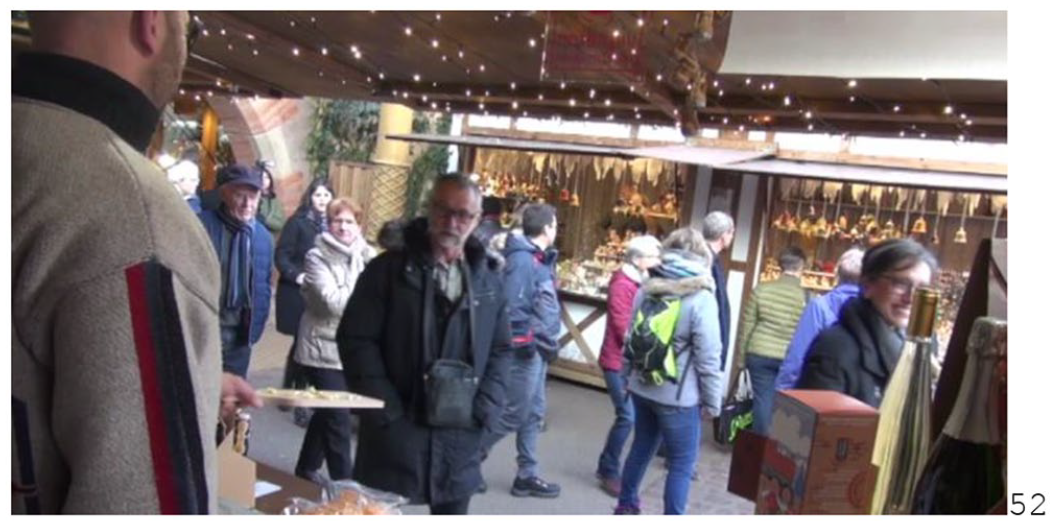
The seller looks to his left, where a series of passers-by are approaching. When one of them looks at him (PB2, Figure 50), the seller begins to hands over a board with some samples of Munster (see his hand holding the board, Figure 50). The passer-by possibly diverts her gaze at this point (1). The seller then utters a greeting (2) and the hand with the board follows her, while he offers a taste (4). In overlap, she responds with a negative thank you (5), smiling, and looking in front of her as she continues to walk. The seller reorients his hand holding the board to the next passer-by (PB1, 5), who is walking and scanning the products in the stand (Figure 52).
(12.2) (MUNST 0-12-41)

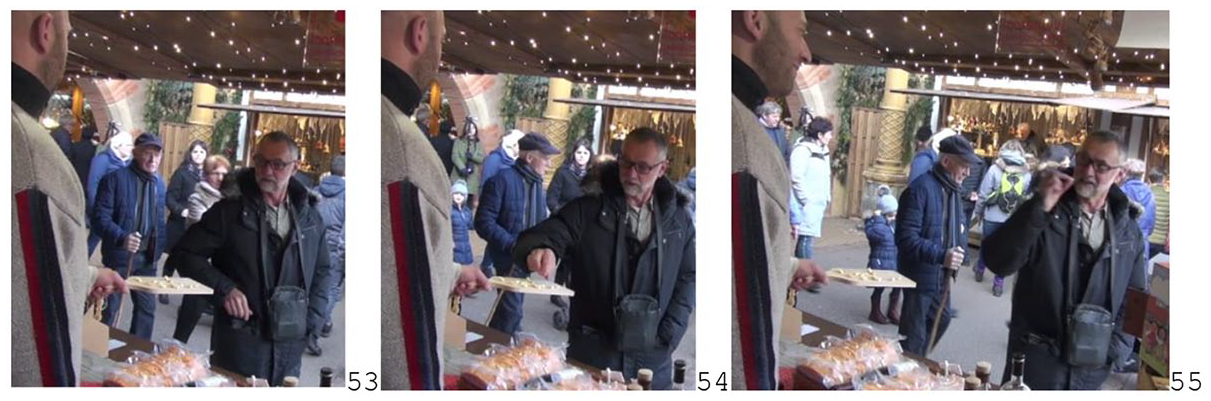
The second passer-by takes his hands out of the pocket and slows his walk (Figure 53). The seller seems to orient to this change in posture: he offers the Munster at this point (7), holding the board. The passer-by extends his hand and, by the end of the offering turn, he is almost touching the sample (Figure 54). He also responds verbally, while he takes the sample and puts it into his mouth. He also shifts his gaze from the board to the seller (8–10). He accelerates again as soon as he has grasped the sample (Figures 8 and 55) and before offering thanks (10).
This extract shows how vision and taste are mobilized in a multimodal exchange in which the panning/passing look at the stand/seller/products is exploited for proposing enhanced access to the product – tasting. This offer can either be refused, verbally and by walking away, or accepted, by taking the given sample. Whereas in the former case the passer-by continues to walk, in the latter, the passer-by can stop or, as in the present case, slow down and reaccelerate immediately, thereby minimizing the possibility of an expansion of the encounter and resisting to become a customer. Accepting the sample is not just achieved by stopping: the passer-by who maintains a body posture turned toward the progression of his walk, as in extract 10, might accept the offered taste, although minimizing his engagement with continuing the encounter, within a body-torqued position (Schegloff, 1998). By contrast, the passer-by who stops and redirects their body frontally toward the counter not only accepts the sample but also displays being available for a continuation of the transaction.
In the following extract, the passer-by is progressively transformed into a potential customer through a shift from looking en passant at the stand to establishing a focus of attention on the seller/product, in response to tasting offer:
(13) (MUNST 0-32-23)
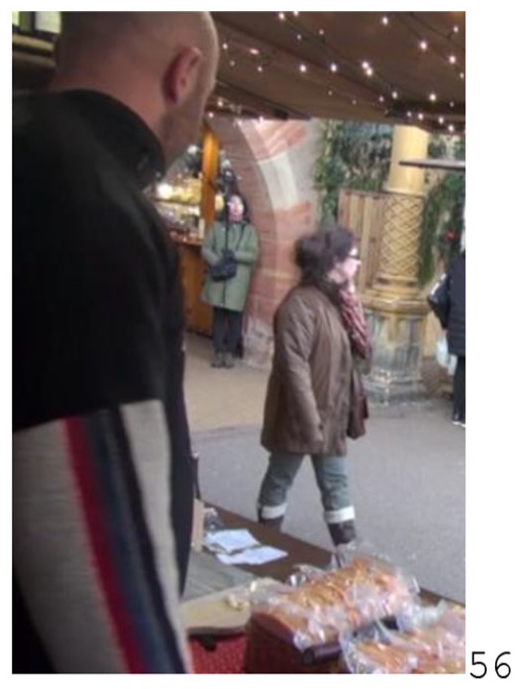

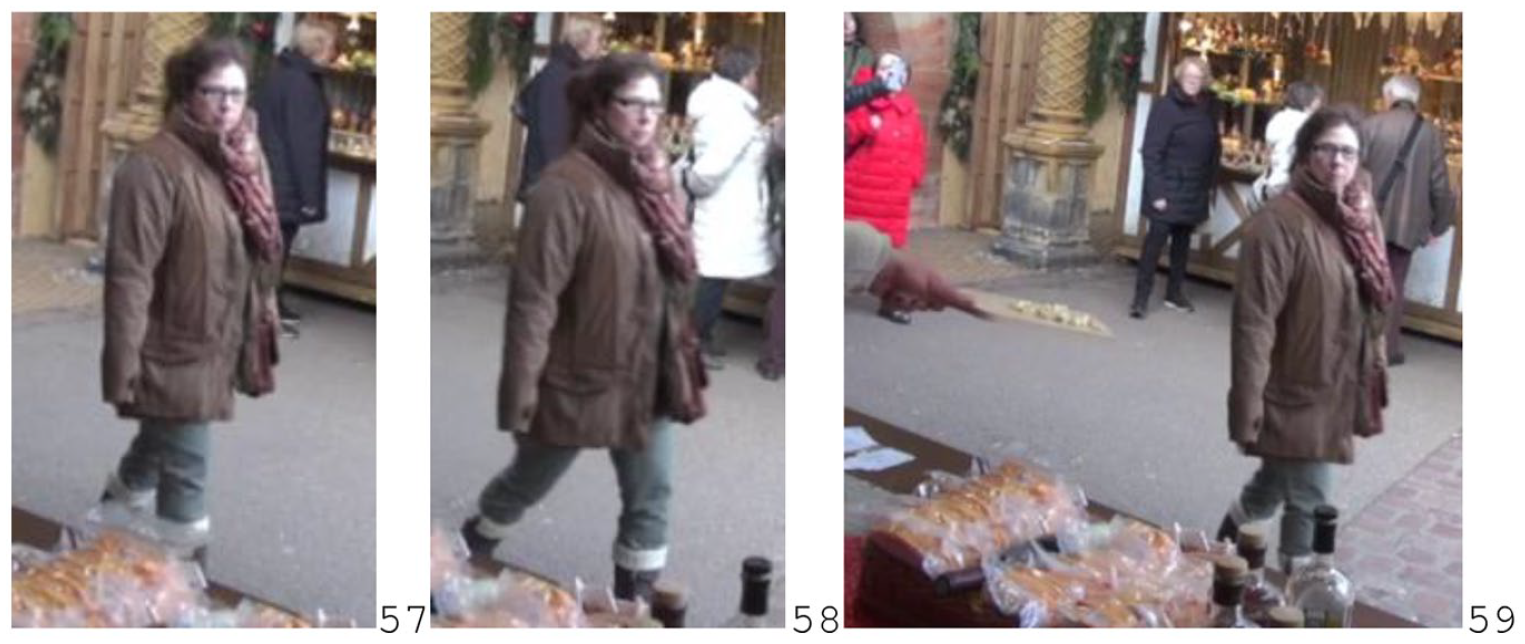
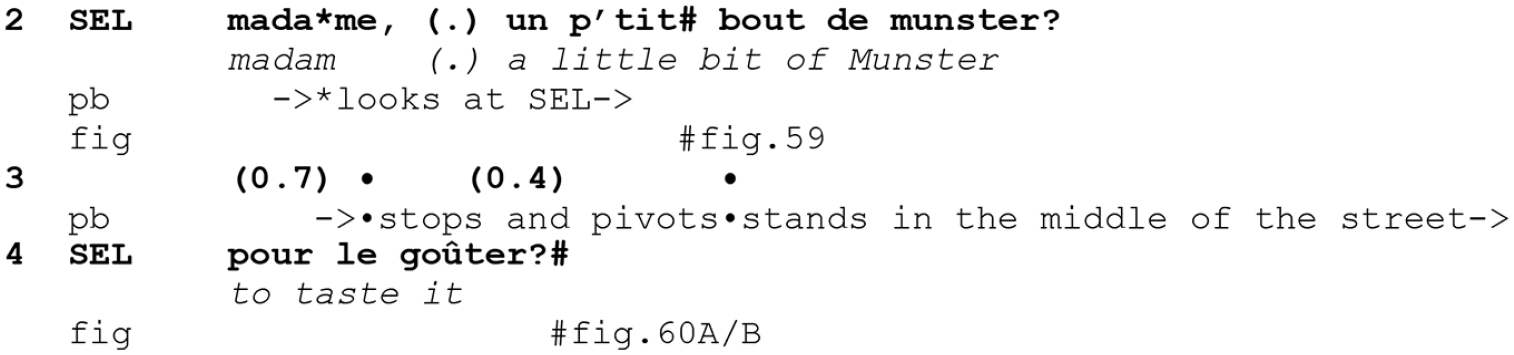
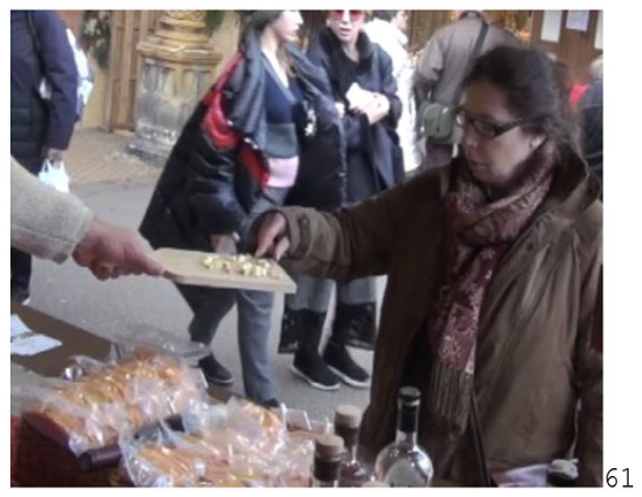
The passer-by walks by the stand, looking at the opposite shop (Figure 56), then briefly at the cheese stand (Figure 57) and continuing her walk while looking straight in front of her (Figure 58). The seller sees her (Figure 56) and when he utters the address term (2) he seems to orient to her brief glance at the stand; in turn, the address is responded to by her turning her head toward him (Figure 59). Reflexively, the establishment of mutual gaze is followed by the seller offering a cheese sample, holding out the board (2, Figure 59). The summons by the seller is thus sensitive to a possible noticing of his stand by the passer-by, which, in turn, is responded to by a more focused gaze, which makes the production of the offer relevant.
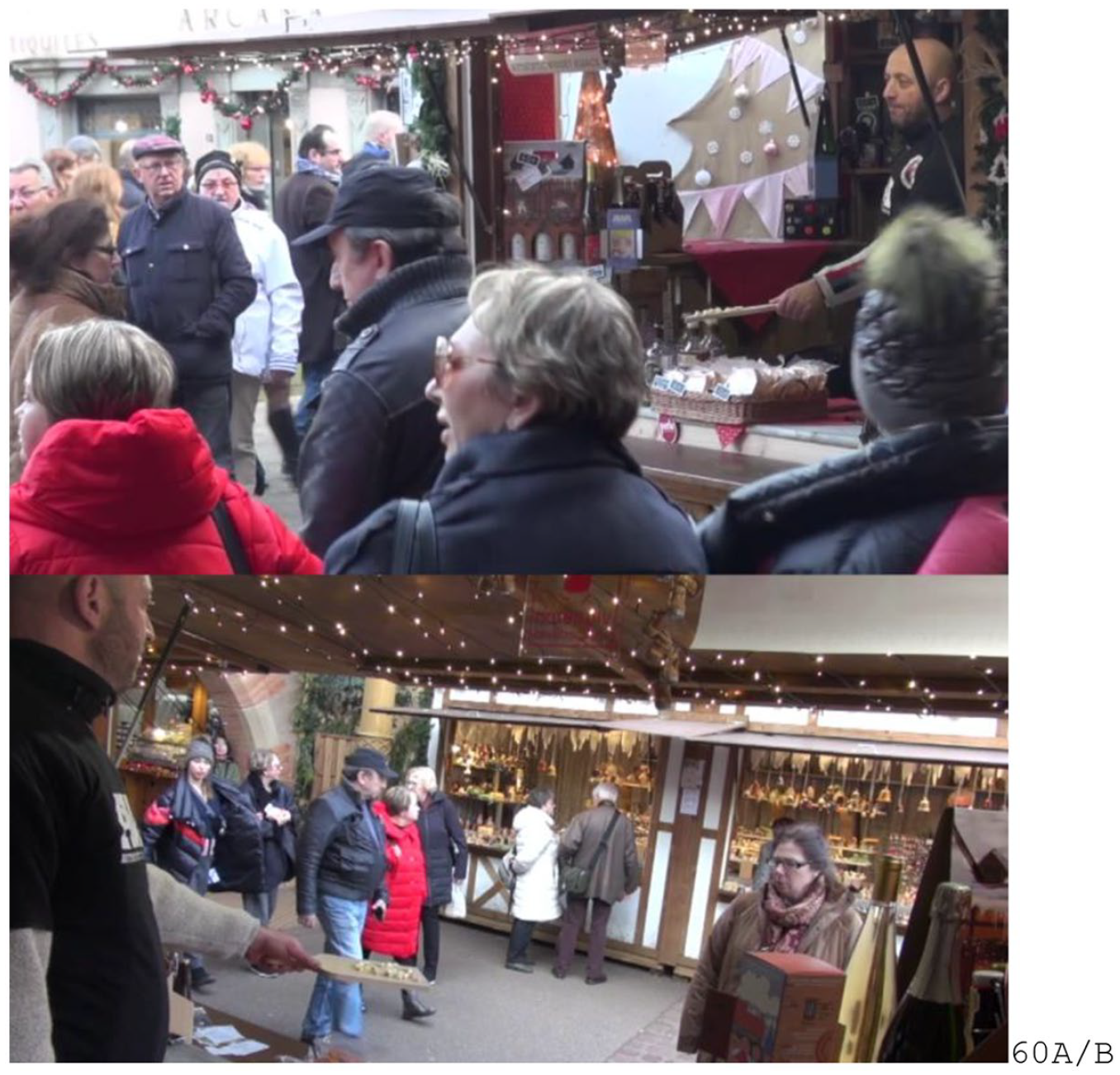
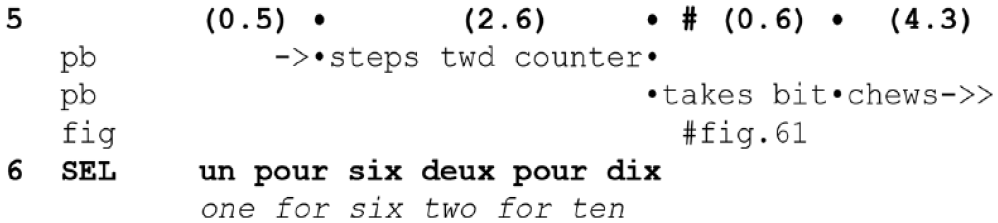
The passer-by responds to the offer by stopping and pivoting in front of the stand, staying in the middle of the road while staring at it (Figure 60A/B). The seller responds to this by producing an increment of his turn (4), which makes tasting a next relevant action. The alignment with the offer is embodied by the passer-by moving closer to the counter and taking a sample (Figure 62). She also engages in tasting, which is visible and accountable to the seller by the display of a prolonged chewing of the sample and a vacant gaze, which are a methodical approach to tasting (Mondada, 2018a). This substantial sensory engagement with the product is also understood by the seller as making buying possibly relevant – which is publicly made audible in the price offer (6). In this case, the offer to taste transforms the fleeting glance of the customer into a prolonged look and her body posture from one of mobility to a standing position, which makes possible a focused tasting (vs the tasting of the previous customer which was done in passing), itself a prolog to buying. A similar progressive approach to the counter for tasting is observable in the next and final extract. A couple, PB1 and PB2, are walking by the stand, looking at its products (Figure 62), and are offered a taste of chocolate:
(14) (CHOC 0-37-30)
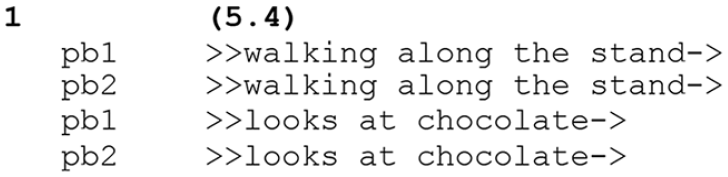
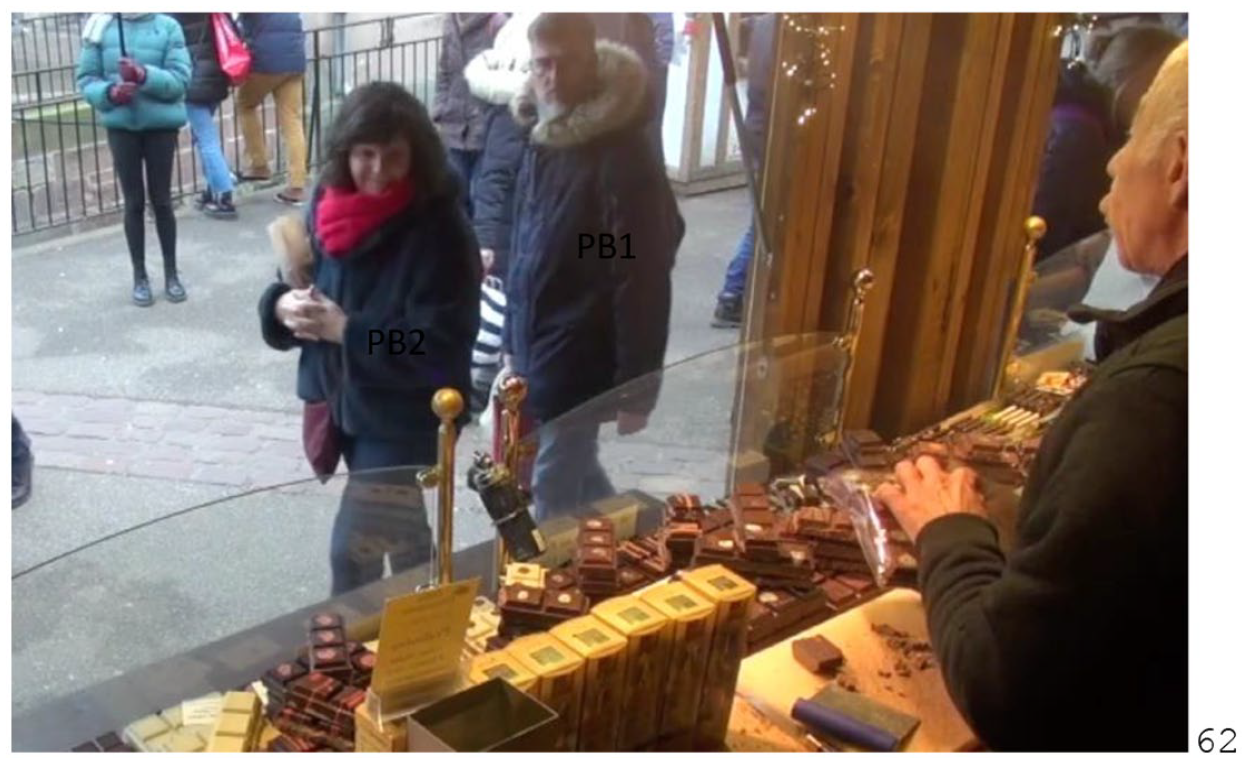
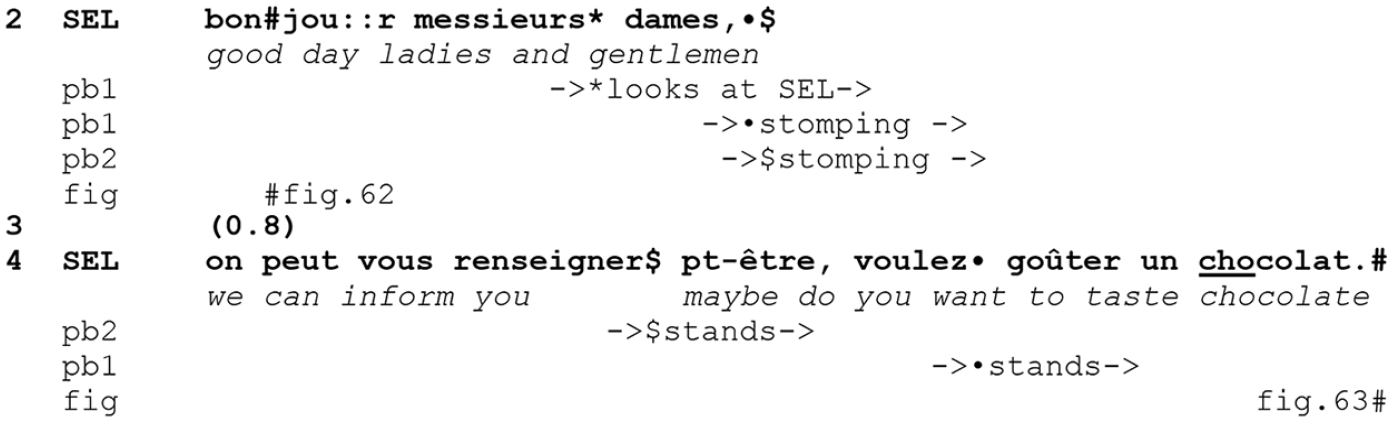
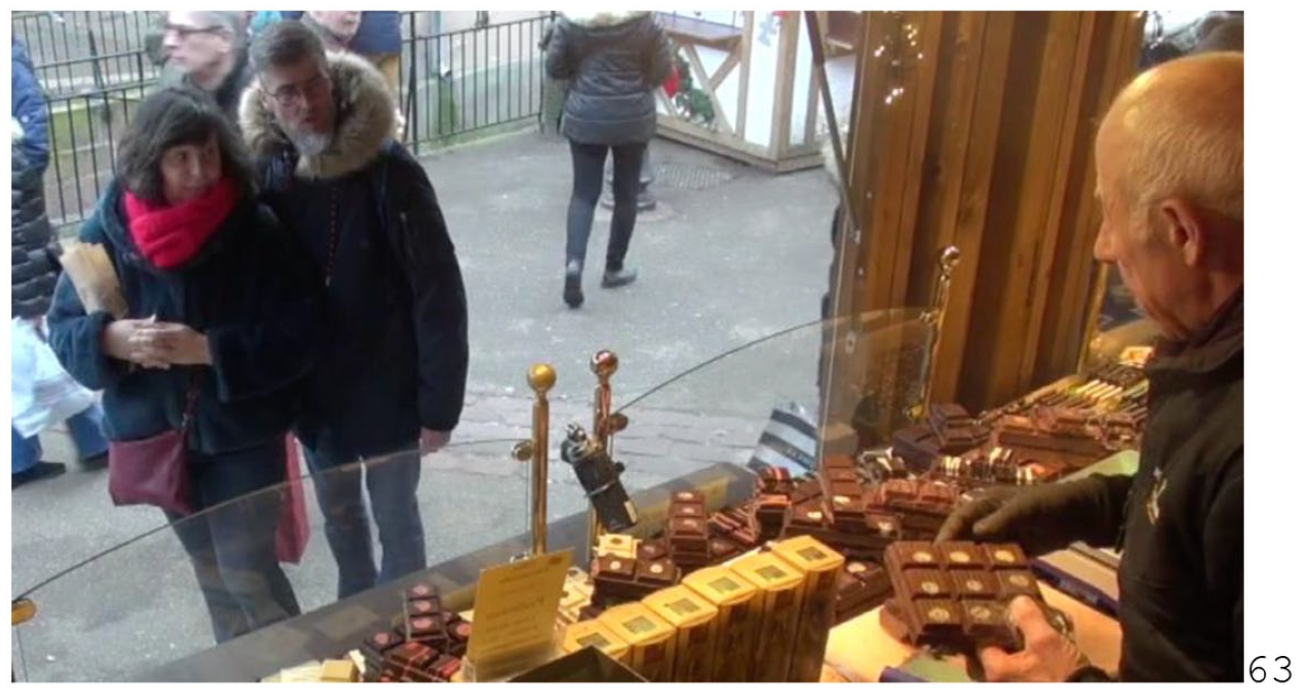
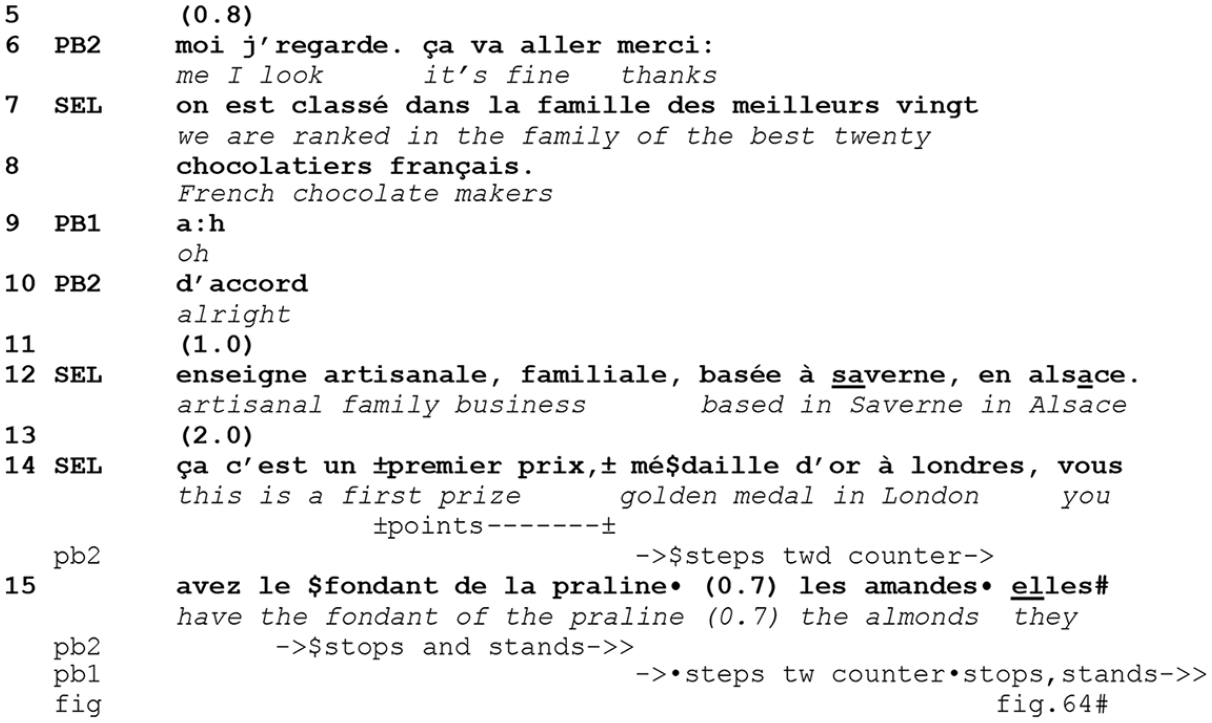
The seller sees the couple passing by and greets them (2). In response, they slow down, prompting the seller to produce an offer to taste (4). At this point they stop in front of the counter (Figure 63), although maintaining an orientation of their bodies in direction of the progression of their walk, in the form of body torque, and staying at some distance from the counter. In this posture, the woman claims to be just looking (cf. supra) and declines to taste.
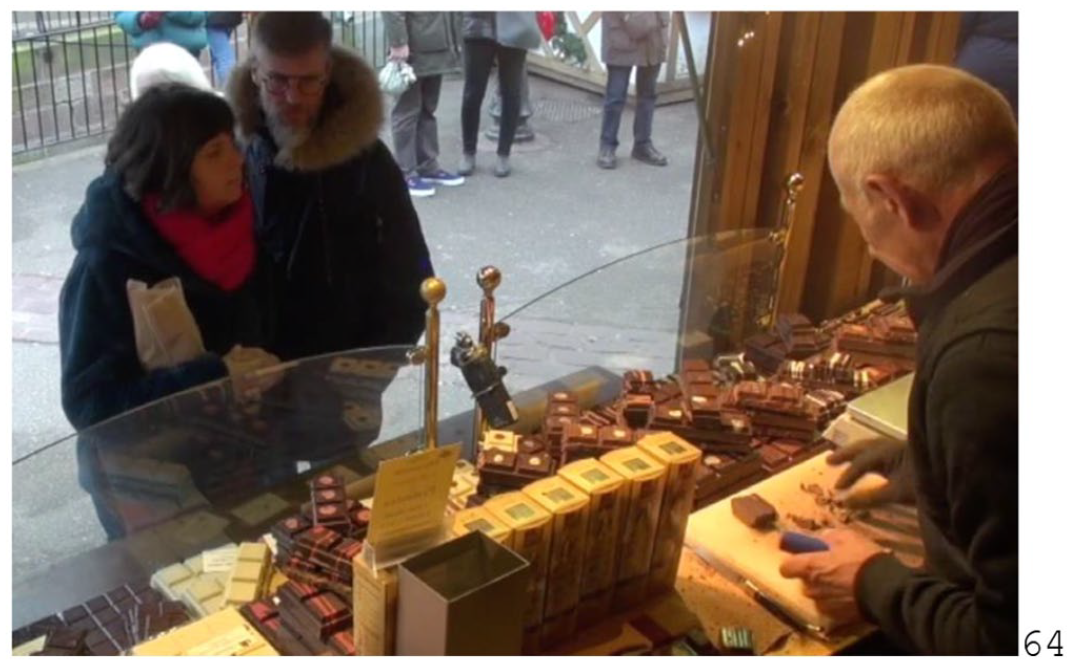
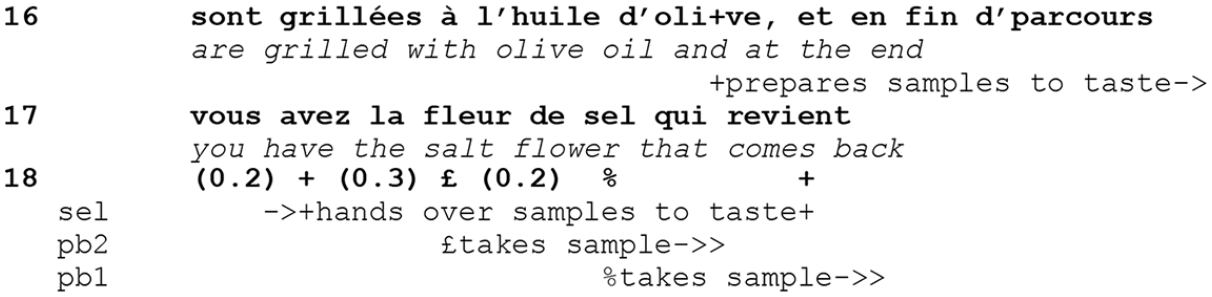
Despite this refusal and a distant engagement, the seller continues (7–8, 12, 14–17), presenting information about the company and the excellence of a product he is manipulating on the counter. The two recipients take a step toward the counter, coming closer to the stand (Figure 64). The body posture and trajectory have changed: they are no longer oriented toward the progression of their walk, but reoriented facing toward the counter (Figure 64). In this new posture, they accept the offer to taste by taking the bits of chocolate handed over by the seller, and next, they engage in tasting. In this way, the offer to taste stops the customers at the stand and builds the opportunity to further develop the exchange. With the offer to taste, the seller is appealing to the senses of the passers-by to transform them into customers – whereas in the vegetable market it is the way in which the products are displayed that appeals to the senses, and leaves up to the passers-by whether or not to stop, oftentimes without even interacting with the seller.
Conclusion
This paper has investigated how the potential sensory orientation of passers-by to the materiality of products and engagement with them, even before/without opening a focused interaction with the seller. While the study of openings of shop interactions has favored the establishment of the availability, identification, and relation between co-participants (Aston, 1995; Harjunpää et al., 2018), the focus on how people achieve sensory access to objects points to an important moment preparing the opening of the transaction or even making the opening irrelevant. The systematic investigation of the step-by-step approach to the stall and the emergent sensory engagement with the products offers an interactional account of how the appeal to the senses works in situ, in a methodic and publicly accountable way.
The appeal to the senses is orchestrated by making products accessible, either in a direct or a mediated way: the sensory orientation toward products can be initiated either by the passer-by looking at, approaching, touching, and smelling/tasting the products or by the seller inviting the passer-by to taste. The methodic way the possible customer uses their senses to access the products reveals the public social-interactional organization of sensing practices, as well as its indexical dimension, locally adjusted to the context of the market. It also reveals the rights to look, touch, smell, and sense, and with them the normativity of sensory practices, which can be taken for granted, negotiated, or enforced, which is further highlighted by the normative constraints of specific contexts, like the Covid-19 pandemic.
An apparently mundane practice such as looking at clementines while passing by a stand, or stopping to touch bananas at another stall, reveals how mobility, categorization, sensoriality, materiality, normativity, and the formatting of accountable actions are assembled in situ. It also demonstrates how relevant these intertwined aspects are for how the selling and buying activities are traditionally organized in the marketplace, and their radical difference with more abstract, sensorially limited practices, such as internet shopping.
Transcription conventions
The transcripts use Jefferson’s conventions for talk (2004) and Mondada’s conventions for embodiment (2018) (see https://www.lorenzamondada.net/multimodal-transcription)
Footnotes
Acknowledgements
The article has been written within the following projects I am the PI of: From multimodality to multisensoriality (SNF 100012_175969), The five first words (SNF 100012L_182296/1), Human Sociality in the Age of Covid-19 (Univ. Basel).
Declaration of conflicting interests
The author declared no potential conflicts of interest with respect to the research, authorship, and/or publication of this article.
Funding
The author(s) disclosed receipt of the following financial support for the research, authorship, and/or publication of this article: From multimodality to multisensoriality (SNF 100012_175969), The five first words (SNF 100012L_182296/1), Human Sociality in the Age of Covid-19 (Univ. Basel).