



Abstract
A large number of Swedish public authorities produce ‘platform of values’ texts that present core values. This article presents a study of how such texts and practices, including the core values they revolve around, are legitimized. Using Van Leeuwen’s legitimation framework, three different data sets are analysed: 47 ‘platform of values’ texts, a focus group discussion with seven senior HR officers, and a quantitative questionnaire study answered by civil servants at three public authorities. The analysis shows how the existence of ‘platform of values’ texts and practices is legitimized through rationalizations, above all by describing the texts as concrete means for reaching specific ends and, with regard to the choice of core values, through a custom-conformity type of authority. Thus, this article addresses discursive transformations of contemporary organizations with a particular focus on available discursive space for critical thinking in the wake of New Public Management and related developments.
Keywords
Introduction
Public administration in the Western world is flooded with texts. Alongside traditional texts such as rules, regulations, and administrative directives, policy texts in different shapes and forms have gained grounds since the early 21st century. Within public administration in Sweden, a frequently occurring policy text is the ‘platform of values’ (‘värdegrund’) – a type of ‘value text’ centred around a number of core values. In organizational research, the existence of such texts and practices has been related to developments such as New Public Management/Governance (NPM/NPG) (Hood, 1991; Pollitt and Bouckaert, 2011) and post-NPM paradigms (Wällstedt and Almqvist, 2015), as well as to the need for public organizations to promote themselves externally (Lerøy Sataøen, 2015; Wæraas, 2010). In the field of Critical Discourse Studies (CDS), they have, for instance, been analysed as fully logical realizations of the increasing impact of neo-liberal ideologies in the public sector (Ledin and Machin, 2016). This article contributes to these bodies of research in a very concrete way: it analyses a large number of ‘platform of values’ texts and core values with the aim of showing how the texts themselves and the people that create and use them legitimize their existence in public administration.
‘Platform of values’ (henceforth PV) texts and practices were a scarce novelty to Sweden in the early years of this century. However, in late 2016, when the data for this article was collected, a majority of public authorities had produced their own PV texts, and they were quite commonly published on their official website, thereby assigning them a certain symbolic value (Nyström Höög, 2017). In fact, PV texts have rapidly become compulsory in public administration in Sweden; as of 2017, every public authority is obliged to have a PV text and to continuously revise it (Regeringskansliet, 2016). The texts are often elaborately – and professionally – designed, with pictures and colours, and lists of core values (see Figure 2).
In a quantitative survey study (Nyström Höög and Björkvall, 2018), the ‘platform of values’ texts and practices were approached from the perspective of civil servants at three large public authorities in Sweden. The principal research question was what main functions of PV texts and practices that the employees perceived. The results showed that contribution to goal achievement was recognized as the main function. In a focus group discussion, seven senior HR managers discussed functions of and expectations on PV texts and practices. Here, participants repeatedly stated that PV texts are expected to promote recurring conversations among employees ‘at the coffee machine’ 1 (Björkvall, 2018: 64).
This article presents a text- and discourse-oriented analysis of how PV texts and practices along with specific value words are legitimized (Van Leeuwen, 2008) in PV texts, in the aforementioned focus group discussion, and, to some extent, in answers to the quantitative survey. The results will be discussed in the light of ongoing discussions of discursive transformations of organizations in the field of CDS. This article also connects to a lively discussion on critical thinking in organizations (Alvesson, 2013, 2015; Alvesson and Spicer, 2016): in the wake of NPM and related transformations of public administration, is critical thinking being obstructed in favour of empty discussions and extensive use of clichés?
Research on value texts and practices in public administration
Previous research provides a number of tentative answers to the question of why value practices and connected PV texts have become so prevalent in public administration. Much of that research comes from organization studies and business and public administration research. Some of it makes use of data from a number of countries in order to make comparisons regarding, for instance, implementation of NPM/NPG (e.g. Pollitt and Bouckaert, 2011); in other cases, organizational and management theories are drawn on in order to explain, for instance, value-centred practices in relation to changing patterns of steering in post-bureaucratic organizations (e.g. Clegg, 2011). In text-oriented discourse and communication studies, neo-liberalism and marketization (often of higher education) has been used as explanatory frameworks (cf. Ledin and Machin, 2016; Lerøy Sataøen, 2015; Wæraas, 2010). This article relates to all of these research strands, but it adds a significant focus on the discursive practices of professional value work (cf. Bhatia, 2017; Fairclough, 2003; Van Leeuwen, 2008), in particular on the way the producers, users, and the texts themselves legitimize the existence of PV texts, practices, and value words.
Research in the fields of organization studies and public and business administration tends to point to changing organizational structures and practices, such as NPM and the transformation from a rule-based bureaucracy to post- or neo-bureaucratic ones when discussing value-based practices in the public sector. The deconstruction of the hierarchical top-down structures of Weberian bureaucracy (Clegg, 2011; Reed, 2011) has led to a strive for consensus as a managing principle, which makes value-centred practices a useful resource. Value-centred practices presumably meet the challenges of contemporary society, where public service leadership is expected to ‘create authority that operates successfully in horizontally dispersed power settings and is responsive to the expectations of the citizens’ (Bao et al., 2013: 453). Whether these practices present themselves under the label of soft power (Mulderrig, 2011) or as integral parts of NPM/NPG, this type of research highlights processes of management that require value-driven cooperation form all individuals in an organization (Hall, 2015).
Alvesson and Willmott (2002) point to discursive identity construction and demonstrated participation as distinctive features of the self-monitoring expected from employees in neo-bureaucratic organizations. Such organizations are characterized by a top-level strategic leadership combined with front-line employees facing ever-increasing instability, diversity, and complexity (cf. Reed, 2011). Arguably, PV texts and practices can function as tools in self-monitoring practices (Alvesson and Willmott, 2002). In addition, an increased interest in (re-)constructing a public service ethos since the late 1980s onward is often put forward as an explanation to why value practices have become so salient (Brereton and Temple, 1999; Lawton and Doig, 2006; Maesschalk, 2004; Salminen and Mäntysalo, 2013). Svensson (2013) even suggests that PV practices and texts in Swedish public administration are its public service ethos.
Ledin and Machin (2016) analysed key strategy and value texts from universities (formally public authorities in Sweden) as direct realizations of neo-liberal ideologies and NPM. Their main argument is that these texts are used for steering employees – civil servants, as it were – and that the rationality of this steering comes from a belief that everything, be it different types of research in a university or social work in a municipality, must be predictable and profitable, and the steering system makes what is being done by different professionals explicit in a new language, one that is very difficult to challenge. (Ledin and Machin, 2016: 465)
Whereas Ledin and Machin focus on the internal control functions of value texts, Wæraas and Lerøy Sataøen analyse value texts as external communication (Lerøy Sataøen, 2015; Wæraas, 2010; Wæraas and Lerøy Sataøen, 2018). By quantitatively analysing above all core values, they draw a picture of universities and authorities that promote themselves, for instance, as morally high-standing.
Summing up, the connection between value-centred practices, professional identities, and organizational change (often in the direction of NPM) is highlighted in previous organizational research: a disaggregated public sector needs new forms of governance and new tools for constructing a sense of ethically grounded community as well as loyalty among civil servants (Hood, 1991; Karlsson, 2017). As stands clear from the discussions above, the transformations of public administration are still ongoing. What is still emerging is often accompanied by legitimations, while what is regarded as ‘common sense’, although deeply ideological, is not (Van Leeuwen, 2008: 20). As of yet, PV practices within the public sector cannot be expected to be affected by ‘genesis amnesia’ (Bourdieu, 1977: 23), which makes the study of how they are legitimized timely as well as relevant.
Legitimation
Legitimation, according to Van Dijk (1998), is more or less related to institutional contexts and can be understood as an interaction between legitimation and legitimacy. In everyday conversations, people are rarely involved in legitimation, but it is something that you typically would engage in as an organization or institution. Legitimation ‘justifies “official” action in terms of the rights and duties, politically, socially or legally associated with that role or position’ (Van Dijk, 1998: 256). Furthermore, legitimation is prototypically political, a claim that appears to be corroborated by the fact that a large amount of studies on legitimation deals with political issues: campaigns or political parties (Chaidas, 2018; Mackay, 2015) including media involvement in such issues (Hart, 2017; Pasitselska, 2017), discourses of migration (Martín-Rojo and Van Dijk, 1997; Van Leeuwen and Wodak, 1999), or ‘the legitimacy of war’ (Chouliaraki, 2005: 2; cf. Machin and Van Leeuwen, 2005; Van Dijk, 2005).
Different lines of development in the field of legitimation studies can be observed, making the field increasingly diversified in terms of methodologies. Martín-Rojo and Van Dijk (1997) present a broad perception of legitimation when claiming that the socio-political and discursive act of legitimation may be analysed at least at the pragmatic, semantic, and socio-political level (p. 524). They apply categories from Van Leeuwen’s (1995) Grammar of Legitimation when analysing the semantic level which, in turn, links to strategies of legitimation at the pragmatic level. Their socio-political analysis includes the self-legitimation of official discourse, and the simultaneously ongoing delegitimation of alternative discourses. Van Leeuwen (2007, 2008) presents a comprehensive methodological framework for the analysis of the sociological, discursive, and linguistic practice of legitimation, including a rather detailed analysis of lexico-grammatical realizations of legitimations (see the more specific description below). A related line of development is multimodal: Van Leeuwen’s framework is applied and, accordingly, developed to handle multimodal legitimation (Chaidas, 2018; Mackay, 2015). Finally, a number of studies of legitimation operate on a rhetorical level, using different sets of analytical tools, such as metaphors and frames (Hart, 2017; Näsänen, 2017), narratives (Chaidas, 2018; Näsänen, 2017), or lexico-grammatical analysis of polarization as a means for legitimation (Oddo, 2011).
This study aligns with Van Dijk’s (1998) understanding that legitimation may not be necessary in normal courses of events, but that it becomes imperative when legitimacy is at stake, for instance, in certain stages of organizational change (cf. Näsänen, 2017) in public administration. As will be further explained below, we apply the framework presented by Van Leeuwen (2008), but we do not foreground the lexico-grammatical realizations of different types of legitimation unless necessary to address the aims of this article.
Data and methods
Three types of data are analysed in this article. First, a collection of 47 texts labelled ‘platform of values’ or ‘value words’ (Swedish ‘värdeord’) from the same number of public authorities were analysed. These texts are part of a larger text corpus which is constituted by the total production of ‘core values’, ‘vision and values’, ‘platform of values’, and comparable texts published by Swedish public authorities. These 230 texts were collected in 2016 via the websites of the authorities; in some cases, they were submitted to us via email from the authorities.
Second, a focus group discussion was performed in 2016. The seven participants (four women and three men) were senior HR managers from different public authorities in Sweden, all having had the main responsibility for the development of PV practices and texts at their respective authority. The choice of focus group discussion as a method for data collection was primarily motivated by the fact that we were interested in PV as broader professional and discursive practice rather than in the opinions of individual employees. In other words, we wanted to promote and observe discussions among professionals rather than identifying individual opinions (cf. Litosseliti, 2003). The 2-hour long discussion, held in Swedish, was video-recorded using two cameras placed on opposite sides of the room, thus catching the faces of all participants, and it was also audio-recorded as a precautionary measure. As researchers, we took on the role of facilitators, asked a few questions, and presented three different PV texts as prompts for the discussion. However, the discussion among the participants was vivid and needed very little guidance from us.
Third, a questionnaire survey was conducted in February and March 2017. The survey was distributed via email to all employees – including the top-level management – at three different public authorities. The rationale for a questionnaire survey was to reach larger groups of civil servants regardless of their involvement in the process of creating PV texts and to understand how they perceive PV practices, texts, and their functions. As with the focus group, the aim was to reach an understanding of PV as practice and text in general, not of specific PV texts of the participating authorities. However, a prerequisite for participation was that each authority had a PV text in use so that the respondents would be able to relate to the concept.
The questionnaire was distributed with a covering letter ensuring anonymity and stating that the questionnaire concerned PV practices. The overall response rate was 58% (N = 492). A majority of the respondents had more than 2 years of working experience at their present appointment (84%) and the most well-represented occupation (62%) was case handlers, often in the role of front-line workers discussed by Reed (2011: 242–243) as the public face of public authorities. The questionnaire consisted of 10 multiple choice questions, which took approximately 5–10 minutes for a respondent to fill in. Six of the questions allowed for further comments, and some of them contained legitimations and delegitimations of PV texts and practices.
All types of data were analysed using Van Leeuwen’s (2008) aforementioned framework. According to Van Leeuwen (2008), legitimation of social practices answers ‘the unspoken questions “Why should we do this?” or “Why should we do this in this way?”’ (p. 105). Four main types of legitimation strategies are described by Van Leeuwen:
Authorization: legitimation by reference to personal or impersonal authority, to law, tradition, custom, or recommendation.
Moral evaluation: legitimation by explicit or implicit reference to value systems, using comparison, evaluation, or abstraction.
Rationalization: legitimation by reference to goals, means and effects of institutionalized social action, or to ‘the knowledges that society has constructed to endow them with cognitive validity’ (Van Leeuwen, 2008: 106).
Mythopoesis: legitimation realized through the use of narratives, such as moral or cautionary tales.
Each of these types of legitimation can occur separately or in combination and may imbue longer of shorter stretches of discourse. In our analysis, every instance of legitimation across data types has been identified and categorized. However, due to the highly heterogeneous character of the data (e.g. very different lengths of the texts, the fact that individual legitimations can vary immensely in length, and so on), the number of legitimations were not described as, for example, percentages of whole texts or stretches of speech. Instead, trends in the data as a whole were identified, allowing for comparisons between the overall distribution of different categories of legitimation in the data.
The analysis was performed in two steps, based on the following questions, which also form the structure of the presentation of results below:
How is the existence of a PV as text and/or professional practice legitimized?
How is the use of individual value words legitimized? In other words, why were these particular core values chosen?
Legitimation of ‘platform of values’ as text and professional practice
The most general result of the analysis is that PV texts and practices actually are explicitly legitimized in the PV texts and in the focus group data, and that they are to some extent being delegitimized in the answers civil servants submitted to the survey. With regard to the analysis of PV texts, this result is probably an indication of the still evolving status of PV practices and texts at public authorities, which requires them to be explicitly legitimized. Out of the total of 47 PV texts, 35 contained some type of explicit legitimation of PV texts and/or practices. All but one of Van Leeuwen’s (2008) four major legitimation strategies were identified in the data: rationalization (p. 117) is the preferred category of legitimation, both in the text and focus group data analysed, whereas no instances of mythopoesis were found. Out of the 47 texts in the data set, 27 display instances of legitimation of the rationalization type, and that type also dominates in the focus group discussion. In order to illustrate the subtypes of rationalization, a somewhat less detailed version of Van Leeuwen’s description of this type of legitimation is presented in Figure 1.
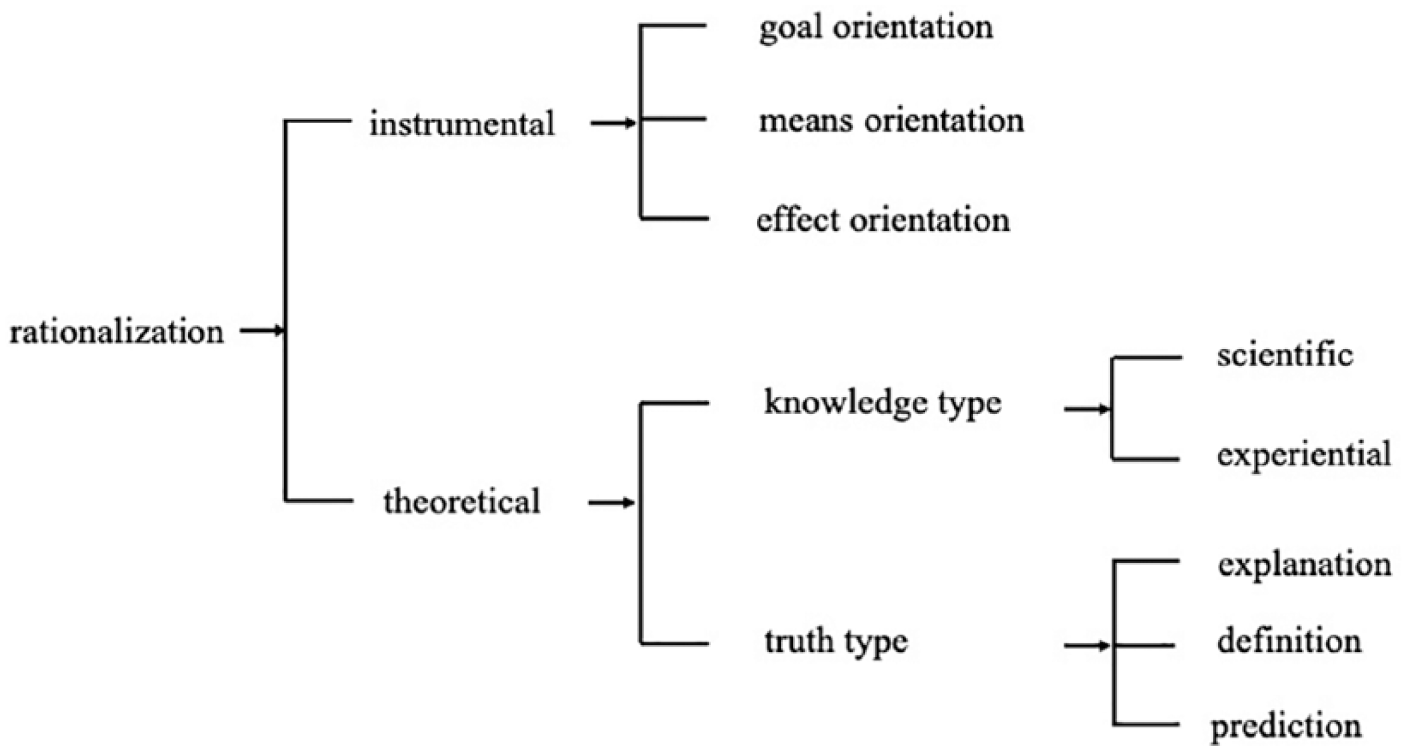
Subtypes of rationalization (inspired by Van Leeuwen, 2008: 117).
Out of the two subtypes of instrumental and theoretical rationalization, the instrumental type – especially with means orientation – dominates in the text as well as in the focus group data. PV texts and practices are described as quite concrete means to achieve something and are, accordingly, legitimized with regard to their capacity as tools to be used in the everyday activities at the authorities.
An extract from the PV text of the Swedish Coast Guard (Kustbevakningen) is found in Figure 2. The text is designed as a pamphlet with a cover as shown to the left in Figure 2. To the right in Figure 2 is the page preceding the core values and it contains the very common means type of rationalization.

Platform of values from the Swedish Coast Guard.
The text reads (boldface by authors, here and below): The platform of values of the Coast Guard
There are three instances of instrumental rationalization of the means type in the example: the PV text (and, by extension, the overall practice) is presented as legitimate since it is a means for telling employees ‘how to interact’ and helping them ‘to perform’. It also steers the way they ‘act and interact’.
The focus group participants also legitimized PV texts and practices by describing them as means to an end, for instance, it [the PV text] is an [the PV shall]
Again, the idea that it is rational and therefore legitimate to have PV texts and practices is put forward. Under the condition that public authorities should hold together and be characterized as holistic entities (which could be challenged from the perspective of diversity and democracy in public institutions), these texts and practices are presented as useful and rational tools (cf. Nyström Höög and Björkvall, 2018). The use of a tool metaphor for describing PV texts and practices is actually found both in the focus group material and in the answers to the larger survey (see below).
Two other subtypes of instrumental rationalizations have not yet been mentioned (cf. Figure 1): those that legitimize PV texts and practices as rational for reaching goals and those that point to how they have effects. Goal orientation stresses ‘the outcome of action’ (Van Leeuwen, 2008: 115), as when the Swedish Armed Forces (Försvarsmakten) in their PV text state that ‘our
It should be noted that instrumental rationalizations are semantically and pragmatically not very different from what Van Leeuwen (2008) calls ‘purpose constructions’ (p. 113). However, Van Leeuwen claims that ‘in order to serve as legitimations, purpose constructions must contain an element of moralization’ – it is in this capacity that they can function as what Habermas (1976) calls a ‘strategic-utilitarian morality’ (p. 22). In other words, the instrumental legitimations above are rational at the surface, but they also relate to a type of morality: value-based text and practices are presented as apt means or tools for reaching very concrete goals with specific effects. All the examples above have this element of moralization in common, even though it is overshadowed by their concrete instrumentality (which is why they are not simply analysed as moral evaluations). Table 1 summarizes and exemplifies the main types of legitimation-through-rationalization (cf. Figure 1) found in the data.
Legitimation of PV texts and practices through rationalization.
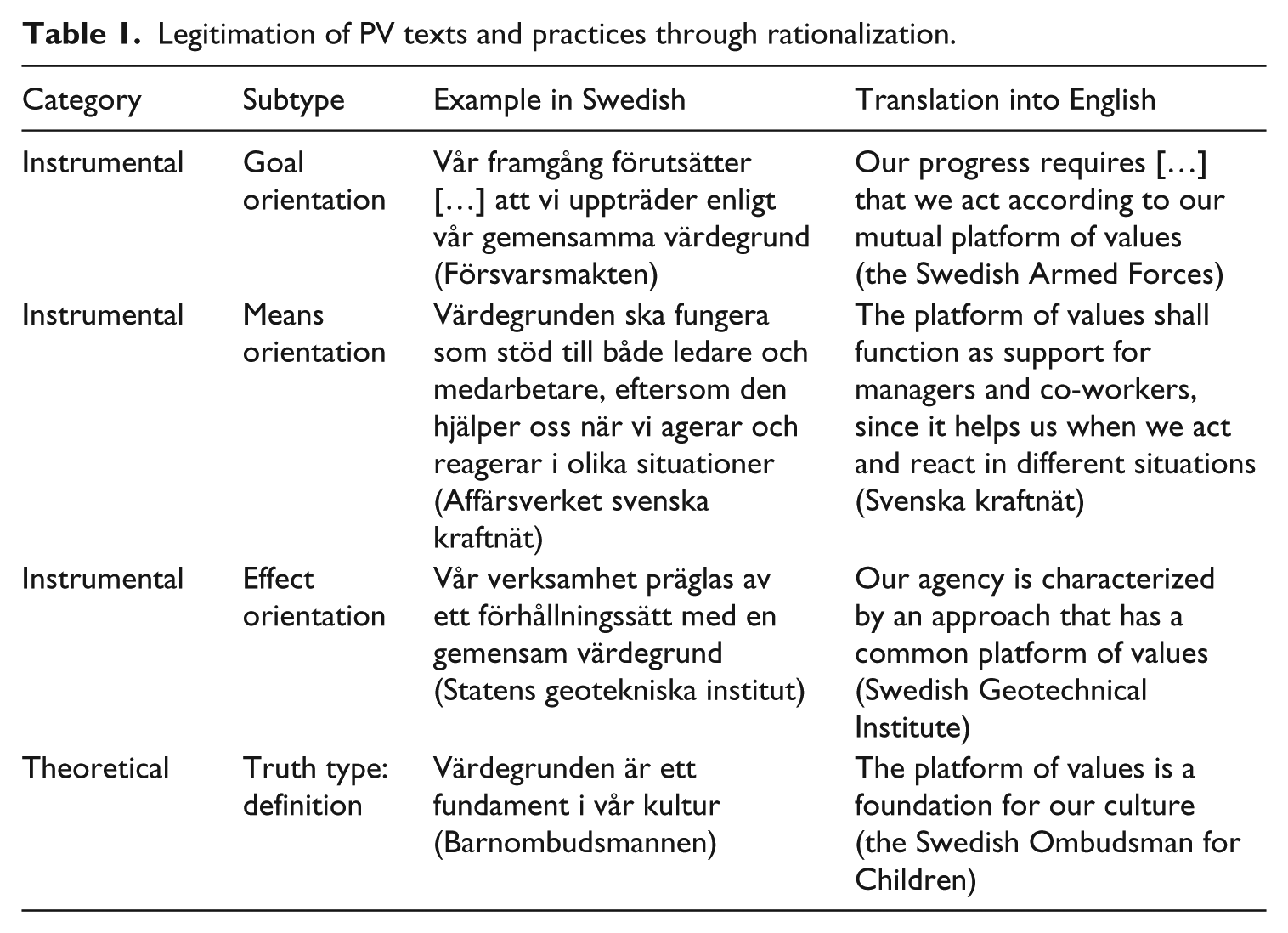
As shown in Figure 1, theoretical rationalization is the second main type of rationalization, which appears as a subtler and less common form of rationalization in our data, where it is usually realized as a type of definition (bottom of Table 1). Van Leeuwen (2008: 116) writes that theoretical rationalizations are ‘founded on some kind of truth, on “the way things are”’. In a PV text from the Swedish Ombudsman for Children (Barnombudsmannen), for example, one instance of theoretical rationalization through definition reads, ‘The platform of values is a foundation for our culture’ (‘Värdegrunden är ett fundament i vår kultur’). The PV is here defined as a phenomenon without which the entire organization would be put at risk (cf. Svensson, 2013). In one respect, it is therefore rational (and thus legitimate) for the Swedish Ombudsman for Children to have a PV text: without it the public authority would apparently collapse – that is just the way ‘things are’. But this rationality depends on the much more profound theoretical assumption that organizations can have only one set of common values and only one culture, ‘our culture’. At this point in the legitimation chain, we have moved away from rationality and peek into the realm of norms and morality (see below).
Two other categories of legitimation are present in the data, but in small numbers (and not listed in Table 1): authorization and moral evaluation. Authorization in the context of PV often refers to impersonal authorities such as the law, the government, or The Common Basic Values for the Public Sector (Den gemensamma värdegrunden för de statsanställda – grundläggande rättsliga principer) – a policy document with national coverage containing basic values for all civil servants and public authorities, such as freedom of opinion, objectivity, and democracy. An example of (impersonal) authorization comes from the PV text of the Medical Products Agency (Läkemedelsverket). Its first sentence states that the reason for having a PV is that ‘we shall meet the demands placed on a public authority’ (‘vi ska uppfylla kraven på en myndighet’). This is a more traditional way of legitimating a specific practice (and text) in public administration: we do it because someone tells us to.
Moral evaluations connect the PV practice to a positive moral value by comparison or evaluation. Such evaluations are present both in the PV texts and in the focus group discussion. Through the use of moral evaluations, legitimations are connected to discourses of moral value, which makes it difficult to find linguistically motivated boundaries for this category. As Van Leeuwen (2008) puts it, ‘we can only “recognize” them, on the basis of our commonsense cultural knowledge’ (p. 110). An example of moral evaluation by comparison is ‘it [the PV] is something you feel,
Among the larger group of civil servants that responded to the questionnaire, there are a few comments which seriously question the necessity of PV practices and texts since they are pointless and expensive (in terms of man-hours). The informants in the questionnaire survey were in practice limited to responses in free form text for making statements about legitimation, but the type of questioning described above can be interpreted as a type of moral delegitimization: PV texts and practices are no good and unnecessary. However, and importantly, one of the main results of the survey was that the majority of the respondents perceived PV practices and texts as something that they put to use in their everyday work–life, as a concrete tool. Just as in the other data sets, PV texts and practices are legitimized with respect to their function as rational means.
Legitimation of particular core values
When value words rather than entire PV texts and practices are legitimized (and they often are – 30 texts out of the 47 display legitimation of value words), rationalization is again one of two preferred types of legitimation, the other being authorization. Instrumental rationalization is the most salient subtype, just as when PV texts and practices are legitimized. This can be illustrated by an example from the Swedish Competition Agency (Konkurrensverket), which presents ‘engaged’ (‘engagerade’) as one of their value words and legitimizes this particular word through an instrumental means oriented rationalization: ‘The engagement
Theoretical rationalizations in the shape of definitions (cf. previous section and Figure 1) are more foregrounded when value words rather than PV texts and practices are being legitimized. An excerpt from the PV text of the Swedish Public Employment Service (Arbetsförmedlingen) illustrates how theoretical rationalizations of the definition type are used to legitimate specific value words:
The three value words are directly combined with definitions. ‘Professional’ is legitimized with a rational definition of what it means: ‘to be of service’ – that is why it is chosen as a core value word. Furthermore, it is rational for the authority to choose ‘inspiring’ because it means that the civil servants at the authority inspire each other; ‘trustworthy’ is rationally chosen because everything that goes on in and around the authority revolves around ‘trust’.
Definitions of this type draw attention to the process of filling value words with collective meanings through ongoing discussions among employees: ‘what does professional, inspiring, and trustworthy mean to you?’ In other words, definitions have the potential to invite to collective discussions on the meaning of value words. Definitions as rational legitimation devices also tend to produce circular arguments (cf. ‘trustworthy – it is about trust’), which brings us to the second main type of legitimation of value words: authorization.
As mentioned, authorization is not so salient in relation to PV practices and texts, but all the more preferred in relation to specific core values. The type of authority particularly referred to is not an impersonal authority like the law or the government, but customs (Van Leeuwen, 2008: 109) within the authority itself. This type of legitimation of value words is often carried out using the collective pronoun we in combination with a finite verb, most commonly are. The core values of the Swedish Police (Polisen) read as follows:
The repetition of the pattern we take/are puts emphasis on the collective identity of the employees at the authority, and evokes a sense of conformity at the same time as the value words are legitimized according to the formula ‘we all are/do what we are/do and therefore our core value is X’. Thus, the authority on which the legitimation of the core values rests is the (supposedly) uniform actions and ways of being of everybody at the Swedish Police.
A few instances of moral evaluation were also found as legitimations of value words. This category borders on definition (cf. Figure 1) but comes with explicit references to moral assumptions and evaluations, such as ‘
In sum, legitimation of specific value words is phrased in terms of instrumental rationalizations (mostly means oriented), theoretical rationalizations, often in the shape of definitions based on experience from the authority at hand, as implicit requests to remain in the same behavioural pattern as is already established at the authority (i.e. authorization through conformity), or by evaluations that describe the core values as morally desirable.
Finally, a number of the civil servants made reference to the PV text of their own authority when commenting upon core values in the larger questionnaire. These comments include instances of legitimation as well as delegitimation of particular core values. The overall picture is that core values are delegitimized through moral evaluations. One questionnaire question in particular evoked such delegitimations. Respondents were asked to comment upon the following phrase from a PV text: ‘We take responsibility and propel important issues’ (cf. Nyström Höög and Björkvall, 2018: 91). A total of 49 (10%) out of the 492 respondents chose to comment and provide us with their views on these values. A majority of the comments contained explicit evaluative delegitimations of the core values in the quote, for example, (they are) ‘empty’, ‘meaningless’, ‘unnecessary’, ‘platitudes’ or ‘clichés’.
Discussion
The results presented above indicate that legitimation is an integral part of the genre ‘platform of values’. More precisely, a majority of the analysed PV texts use explicit legitimation as a response to the implicit question of why the practice and text exist, which is in line with Van Dijk’s (1998) claim that legitimation most commonly is an institutional practice. Van Dijk (1998) argues that ‘People justify or account for their actions mostly if they know or expect that others […] disagree, condemn, challenge or attack them because of their actions. Legitimation, then, is the institutional counterpart of such justifications’ (p. 256). In the PV case, there is probably both external and internal disagreement to be feared. For instance, influential commentators and researchers in Sweden have characterized PV practices and vision documents as void of relevant content or as being pointless (Alvesson, 2015). The practice can also be criticized for being expensive in terms of working hours, as indicated in a questionnaire response. Legitimation is a type of institutional behaviour that responds to such challenges.
The triangulation of different data sets in this study yielded a number of results regarding preferred types of legitimations that were used across the PV texts (from a number of different public authorities) and in the focus group discussion. The questionnaire data primarily contained delegitimations. The analysis showed how above all means oriented instrumental rationalizations were used for legitimizing the existence of PV texts, practices and specific core value words. Put differently, the use of what can be described as vague rather than precise and operationally oriented texts, practices, and words are legitimized as concrete tools or methods for reaching specific goals; for creating unity within an authority; or for setting a standard for dialogues and interactional patterns at an authority.
Theoretical rationalization is the second most preferred legitimation of PV practices and texts, and just as common as the instrumental rationalizations when core value words are legitimized. The experiential knowledge upon which the theoretical rationalizations are based is that PV practices and texts are very important for the construction and survival of the authority, and when core value words are rationally legitimized through definitions, their (always positive) meanings are specified as based on knowledge of positive values already in place at the authority. This legitimation of core values was analysed as a custom-conformity type authorization based on ‘how things are’ in the organization. The core values are confirmed as legitimate due to their status of already embraced values at the public authority.
The analysis of legitimation in value texts calls for some methodological reflection. Above all, the framework applied in this article is quite detailed and allows for fine-tuned categorizations that, for instance, distinguish between goal orientation, means orientation, and effect orientation as subtypes of instrumental rationalization (cf. Figure 1). This type of fine-tuning is essential as a foundation for the further development of the framework. For instance, it would be theoretically and methodologically fruitful to dig deeper into the prototypical linguistic realizations of specific subtypes of legitimation. However, an analysis of organizational discourse such as the one presented in this article has a slightly different focus, with the ambition to be relevant also to researchers and practitioners outside of the field of linguistics and linguistically oriented discourse analysis. For instance, the difference between instrumental goal orientation (focussing on outcomes of an action) and effect orientation (with a focus on how something turned out in hindsight) is demanding to identify and not always relevant to the overall conclusions of the analysis. In other words, the balance between methodical development and the presentation of empirical insights relevant also to the broader field of, say, organizational studies requires reflection regarding the analytical depth of the discourse analysis as well as how the empirical results are presented to different audiences.
In the light of changing value-driven discursive practices at Swedish public authorities, a slightly paradoxical situation can be discerned. PV texts and core values present what is already ‘there’ at the authority and are at the same time tools for reaching the goals of the authority. Possibly, PV texts have the implicit function of assuring and confirming that PV practices are going on (which becomes even more important in a situation where they are required by the legislation). However, if the core values are already known, acknowledged, and practised at the authority, the habit of presenting them as a written document seems a bit superfluous. This ritual character of the PV texts, or their character of rhetorical smoke screens, deserves critical attention. And that attention is not limited to the public sector in Sweden; PV texts resemble, and draw inspiration from, mission statements, vision and values, and several other types of strategic documents, which are produced and used in large parts of the Western world to date. Are these texts all predominantly stating the obvious, repeating in print what is already present in everyday discourse at the workplaces?
There is organizational research that supports such interpretations. Drawing on theories from the field of neo-institutionalism (Meyer and Rowan, 1977), Alvesson (2013: 15–21) claims that organizations tend to use a set of ‘illusion tricks’ with the sole purpose of creating a positive image. One example is the organizational pseudo-structures, including ‘quality-assurance projects’ and other ‘reforms’, which serve as means to build symbolic self-confidence in an organization (Alvesson, 2013: 17–18) rather than supporting its core activities. It may be the case that PV texts and practices are part of such pseudo-structures more than anything else, which can shed further light on their rapid spread within Swedish public administration.
However, there are also aspects of PV practices that are more directly related to power. By (re)presenting supposedly already existing values and practices the texts construe identities for the civil servants in the shape and form of invitations to be and behave in a certain way, namely in accordance with the core values. In this respect, (re)stating existing values is a matter of management and control though the construction of mandatory value-based discursive identities (Alvesson and Willmott, 2002) for every civil servant at the neo-bureaucratic public authority. Alvesson and Spicer (2016) describe working life as requiring a certain amount of functional stupidity which, for instance, includes the practice of ‘saying one thing and mean another’ (p. 80). Such a strategy is required when it is crucial to align with a certain behaviour, whether that behaviour is motivated or not. Alvesson and Spicer’s description connects to the use of PV texts and practices as an alibi for disciplining civil servants who do not behave according to the goal-oriented practices of a public authority. That is, in a rule-based bureaucracy, people would be punished if they did not comply with rules and regulations; in value-based bureaucratic organizations, people can be left without support from the management if they do not live up to the core values of the public authority. The analysis of legitimation is one way of making visible such processes and the tools that enable them, thus also making it possible to challenge them.
Footnotes
Declaration of conflicting interests
The author(s) declared no potential conflicts of interest with respect to the research, authorship, and/or publication of this article.
Funding
The author(s) disclosed receipt of the following financial support for the research, authorship, and/or publication of this article: This work is part of the research project The archaeology of a new genre: Vision and values texts of public authorities in Sweden supported by the Riksbankens Jubileumsfond (The Swedish foundation for humanities and social sciences) (Grant No. P15-0119).