



Abstract
Performance art is a genre in which artists use their bodies as a medium of expression to create physical presence. Performances revolve around the ambition to create something that transcends existing frames of what is seen as art; its raison d’être is novelty and change. But how is new art established? This article empirically addresses this question by studying performance artists who take part in performance art festivals organized around the world. Drawing on fieldwork and employing Goffman’s frame analysis combined with the notion of transnational tribe, which refers to a mobile community of artists and audiences who travel across countries for performance events, it is shown under what conditions performances are accepted as new art. Artists create performances at organized art festivals, which positions their activities within the broader frames of art. The study details how artists may be appreciated for ‘doing things well,’ but new art emerges under the condition of ambiguity of frames creating a singular experience. This performance can be collectively legitimized within the tribe as new art, reshaping the broader frame of art within the tribe, entering their shared knowledge, and influencing future perceptions of what can be considered original or new.
Introduction
Performance art is a genre in which artists use their bodies as a medium of expression to create a physical presence through audience engagement. Performances revolve around the ambition to create something that transcends what is seen as art; its raison d’être is novelty and change. Creating new art is challenging, and while such events are rare, they occasionally occur, and some performances are recognized as new art within the performance art community.
In this article, we ask how new art emerges in performance art by focusing on a small transnational tribe of performance artists and the performance art festivals they participate in. We study the processes behind both successful and unsuccessful performances by analyzing field notes from the performances of this transnational tribe of ‘avant-garde of the avant-garde’ artists, thus toning down the nation as the unit of analysis (Buchholz, 2022). We introduce a conceptualization of frame analysis, with an emphasis on the concepts of framing, ambiguity, and shared knowledge, as a tool to understand the process of recognition and legitimation of new art as a successful performance in this context.
This study demonstrates that ambiguity is not only a necessary condition for the artist’s creativity but also, when it immerses and engages the audience in the work as a singular experience, it enables further legitimation through the collective narration of that experience as a shared phenomenon. The study specifically contributes to the scholarly work on study of cultural product legitimization as a group process (Baumann, 2007; Cnossen and Bencherki, 2023; DiMaggio, 1987). By the use of the frame analysis approach (Goffman, 1981; Heinich, 2019), the article builds on research linking legitimation and framing (Baumann, 2007), with a particular focus on the concept of conventions in art worlds (Becker, 1982). While previous studies have highlighted the significance of ambiguity in art appreciation (Jakesch and Leder, 2009; Kaplan and Kris, 1948) and its strategic use for artistic innovation (Sgourev, 2013), as well as studying change in general (Feront and Bertels, 2021), we complement this literature by using frame analysis and connecting ambiguity – arising from the overlap between different frames – to a direct interaction between artist and audience and a subsequent legitimation process.
We begin by introducing the field and the performance art tribe under study, followed by a review of research on the creation of new art and changes in the art world, with a focus on innovation, legitimation, and small group dynamics, using our theoretical approach. The remainder of the article analyzes performances to illustrate the elements of framing and the processes behind both successful and unsuccessful outcomes. We conclude by discussing framing, ambiguity, and shared knowledge both within and beyond the realm of art.
The Transnational Tribe of Performance Art
Performance art is often considered avant-garde art that challenges existing artistic conventions by exploring new techniques, ideas, and expressions. It is a form of art with roots in the early 20th-century energetic activities of the Futurists, who wanted to break away from traditional artistic forms and pave the way for the future through path-breaking poems, music, and manifestos (Goldberg, 2011; Pontbriand, 1979; Stiles and Selz, 1996). Over time, it came to integrate elements from Dadaism and, later, the so-called happenings of the 1960s. Used as a method to investigate the boundaries between art and life, performance has, due to its ambition, been referred to as ‘the avant avant-garde’ of art (Goldberg, 2011: 7) and is there seen as a catalyst in contemporary artistic production (Berghaus, 2005), where the art/non-art binary remains central. The position of performance art in the field of art is typically found at its autonomous pole, with its seeming lack of interest in money and preoccupation with symbolic recognition and status among peers and making art for the sake of art itself (Bourdieu, 1993, 1996). Performance art festivals are central to this part of the field, as performances often have been performed outside traditional art institutions to break with existing framings of art to challenge conventional art spaces and artists (Pagani, 2001).
To study the making of new performance art, we have zoomed in on a transnational avant-garde performance ‘tribe,’ that is, a subgroup ‘within’ the avant-garde of performance artists that perform at various performance festivals. We choose to use the term transnational tribe (cf. Bell, 1971: 517) instead of alternative terms like collaborative circles (Farrell, 2001) or creative groups (Corte, 2022; Farrell, 2001; Parker and Corte, 2017), as these latter terms refer to smaller, more selective groups analyzed through a social psychological lens focused on friendship and role-taking dynamics. In contrast, when we refer to ‘tribe,’ we retain the anthropological meaning of common culture, language, internal relations, and positioning against other tribes while deliberately avoiding the notion of territory, as these tribes are transnational.
The members of this tribe maintain borders to outsiders using a combination of selection via network and membership. The tribe members define themselves negatively – primarily to ‘mainstream’ performance art and, more obviously, art production institutions in general – building an oral narrative in which actors, events, and performances are interwoven.
Several of the leaders of this small transnational tribe are artists, frequently with a background in visual arts, and curators who hold formal positions in the art world. They all had in common a strong belief that performance art was and still is considered avant-garde, mixing art and life. However, a majority of those performing at these festivals were younger artists who used performance art as one of many aesthetic expressions in their repertoire.
Performance art festivals are typically non-profit and primarily funded by national arts councils and local community sponsors. These funds are used to cover travel and accommodation expenses for a curated mix of national and international artists. Festivals usually open with a ceremony in which the curator(s) present their aims and vision for the event and conclude with a celebratory party. Many festivals also organize artist talks, panel discussions, and sometimes lectures by invited artists, all of which focus on pressing issues in the performance art field. However, the majority of performances do not qualify as original or new art, and some artists are considered unable to perform within the context of a performance art festival. It is precisely this tension between ordinary performance art and what is recognized as truly new art that forms the focus of our attention.
Literature Review: Making New and Legitimate Art
This article seeks to answer how new art is created, recognized, and legitimated within performance art as a transnational tribe through a specific process involving framing, ambiguity, and shared knowledge. While existing research often focuses on the role of ambiguity in creative acts, we highlight how ambiguity interacts with audience engagement and the processes of legitimation in the context of performance art. To ground our analysis, we turn to classical approaches in the sociology of art while also drawing on research that directly pertains to our case of performance art, small group dynamics, and the specific processes of artistic innovation and legitimation.
The Emergence of New Art
Two highly influential sociological approaches to the study of art creation and its legitimization are represented by Pierre Bourdieu (1996) and Pierre-Michel Menger (2014). Bourdieu (1996) studies the positions, position-taking, and social background of artists in relation to the dynamic structure of fields composed of relations between artists, artistic expressions, and institutions. Bourdieu shows that the emergence of new art is shaped by power dynamics, positions of dominance, and the competition for symbolic capital. Dominant groups influence what is considered legitimate and consecrated art, while artists strive to distinguish themselves and compete for valuable resources within the field. Newcomers seeking to challenge the established legitimacy of dominant cultural forms endeavor to redefine what is considered legitimate within the field.
Menger (2014), in turn, focuses on institutional structures in place for making art and the structure of labor markets for artists in making careers, their precarious nature, and the often slim chances of getting a breakthrough. Menger highlights the selection processes of artists and their works over time within the field of art as key mechanisms to explain how artists gain influence and new art comes about.
These two structural-sociological perspectives explain art primarily as the outcome of the artist, their work, and the field of art. In contrast, we focus on the temporal and interactional dynamics involved in creating, interpreting, and framing art, drawing especially on Becker’s (1982) theory of conventions and Goffman’s (1974) frame analysis. This perspective examines events ‘on the ground.’ We argue that the emergence of new art is shaped not only by competitive and institutional dynamics but also by the moment-to-moment interactions, interpretations, and artist–audience engagements that occur during the framing and reception of art.
Innovation and Legitimation
To further understand how new art emerges within performance art, it is crucial to consider the art world’s (and the field’s) inherent focus on constant change, supporting the creation and praise of novelty, innovation, and creativity.
A general definition of innovations is that they arise from creative acts of intentionally combining elements to create a ‘surprise value’ for audiences (Godart et al., 2020; Hutter, 2011; Wohl, 2022). Similarly, for Becker (1982: 63–64), innovation in art worlds occurs through the combination of familiar conventions with unfamiliar ones. For example, the outsiders, mavericks, ‘make art, but they do not attract audience or disciples and find no art schools or traditions’; they break with familiar conventions but have a hard time being recognized as artists (1982: 300–301). For these innovations, novelties, and creative accomplishments to have an impact, they must be recognized and legitimated in the art world.
Of particular relevance to understanding this recognition is the work of Baumann (2007), who uses social movement theory and argues that the creation of legitimate art by cultural entrepreneurs is achieved through the mobilization of resources, such as networks supporting the innovation. The legitimation of new art also requires framing through discourse that connects with prevailing ideologies. The legitimation of something as art depends on the symbolic and structural opportunities available, as well as the cultural, institutional, and political context in which the process unfolds.
To legitimize artistic value, it is essential to reduce uncertainty by employing various strategies, techniques, and organizational structures that allow for valuation of art to occur (Aspers, 2024). Research about the reduction of uncertainty about value has previously specifically studied judgment devices (Karpik, 2010), galleries as signals (Velthuis, 2005), and prizes (English, 2005) to establish the value of art. Notions like gut feeling are also used to identify art (Fürst, 2018). Genre classifications are another area where art is organized and innovations are found (DiMaggio, 1987; Wohl, 2022). Originality emerges from within a genre and it is one convention used to evaluate and justify the selection of new cultural goods regardless of whether it is an audience (Askin and Mauskapf, 2017) or a gatekeeper (Childress, 2017; Franssen and Kuipers, 2013; Fürst, 2018). Artists that are successful within a genre or role, and in a sense original, risk typecasting (Faulkner and Anderson, 1987; Wohl, 2022; Zuckerman et al., 2003), potentially falling into the trap of repeating past performances associated with their established identities.
Our contribution is not only empirical but also conceptualizes the interplay between ambiguity and frames, artist and audience, and the movement of a performance from a live event to legitimated new art within a small group. We argue that ambiguity is not only relevant to artistic creation but also important to art appreciation and legitimation.
Theoretical Framework: Framing and Ambiguity
The question, ‘What is it that’s going on here?’ (Goffman, 1974: 8), not only drives frame analysis but also lies at the heart of how new art emerges. New art arises through creativity that combines frames and the audience’s collective interpretation of an ambiguous combination of frames, creating an experience that is necessary to recognize something as new art.
Research claims that even ambiguity plays a significant role in enabling new art, as it opens up multiple interpretations of a situation. Ambiguity is essential not only for the appreciation of art, such as striking a balance between clarity and mystery (Jakesch and Leder, 2009; Kaplan and Kris, 1948) but also as a strategy for artistic innovation (Sgourev, 2013). Ambiguity (cf. White, 1992) refers to the ‘question as to what could possibly be going on’ and ‘which one of two or more clearly possible things is going on’ (Goffman, 1974: 302–303). Gadamer sees ambiguity as relevant to art when he explains it in relation to ‘artistic play.’ He says about plays: ‘The productive ambiguity that constitutes the essence of a work is only another way of expressing the play’s essential characteristics of continually becoming a new event’ (Gadamer, 1975: 499, cf. 141; cf. Heidegger, 1927: §37).
To create new works of art, artists must relate to what understanding already exists, but they must also ‘unlearn a little of the conventionally right way of doing things they have learned’ and learn to which reactions the audience will respond (Becker, 1982: 204).
New art is not limited to breaking old conventions with new ones. Rather, creating new art often requires moving through a state of interpretative ambiguity between frames before being reframed and stabilized as art.
Framing as an activity requires, at its core, three components: the performer(s), the event, and the audience. Not much happens if someone performs something as X, and this is framed as Y using the existing frame Z. In such situations, no ambiguity is involved, and interaction and coordination go smoothly; there is simply an alignment between the event and the frame, and the frame is ‘properly sustained’ (Goffman, 1974: 345).
New performance art emerges when the performer does something that does not fit within the existing frames (Goffman, 1974: 345–377) but which eventually is recognized by the audience in an interpretative process as new art that, hence, transcends and reformulates the existing frame of performance art through keying.
To study these unfolding events of new art, it is necessary to account for the frame elements of keying, breaking, and fabrication. A key is ‘the set of conventions by which a given activity, one already meaningful in terms of some primary framework, is transformed into something patterned on this activity but seen by the participants to be something quite else.’ (Goffman, 1974: 43–44). Keying is the process of changing the original or primary framing through conventions (creating a copy of the original). Frames may break, meaning that the experience of what is going on is vulnerable (Goffman, 1974: 439), and power may be exerted to enforce a course of conduct (Goffman, 1974: 446). Fabrication is a vulnerability to the situation that introduces a transformation of frames that leads others into a false belief of what is actually going on (Goffman, 1974: 83). When a performance is established as new art, the frame of art is altered and accepted and integrated into the collective memory of the art tribe’s members. In performance art, this reframing involves legitimation through the tribe’s valued artistic dimensions of time, space, body, material, and concepts. Engaging with these dimensions can lead to altered symbolic boundaries (cf. DiMaggio, 1987; Lamont and Molnár, 2002).
The interpretative process of framing an ambiguous event begins before the performance, continues during it, and persists until a consensus on the framing is reached. This process extends over time and across several festivals, creating a collective evolution in which past interpretations influence future understandings, shaping the ongoing development of what is recognized as art.
Method and Empirical Material
We conducted ethnographies at 14 performance art festivals between 2012 and 2015, attending six different festivals in Sweden (four of which we visited twice) and one festival in each of France, Italy, the USA, and China (see Sandström, 2018 for additional details). 1 We met with 11 curators and around 250 artists from over 40 countries aged 25 to 70. Over the course of more than 50 days in festival settings, we observed over 500 performances and conducted more than 40 interviews with organizers and artists. In 2022, we conducted a follow-up study at two multi-day performance art festivals in Sweden, where we tested some ideas from our previous findings. The festivals we visited were among the first to reopen after the Covid-19 lockdowns.
The empirical material comprises field notes, photos, and interview transcripts, as well as secondary materials such as festival and artist websites, organizers’ application forms, YouTube videos (mainly artist talks), and festival catalogs, which provide information on festivals, artists’ visions, and statements.
The epistemological foundation of this text is grounded in the ideas first articulated by Alfred Schütz (Aspers, 2009), particularly his distinction between first-order and second-order constructs. According to this perspective, scientific concepts (second-order constructs) are developed in relation to the meanings attributed by actors in the field (first-order constructs). In this approach, theory is employed to establish a meaningful alignment with the empirical material, thereby enabling it to offer a coherent interpretation of the observed phenomena. This is line with the ideas employed already by Howard Becker (1982) and Erving Goffman (1974). Our analysis was conducted in several stages. The data were compiled, coded, and compared with a focus on the actors, situations, and objects involved. In the initial round of analysis, we largely bracketed (Aspers, 2009) the theoretical framework to allow the material to speak on its own terms. Building on this preliminary analysis, we then applied the theoretical framework presented in this text, guided by the question: ‘What is going on here?’ – with particular attention to issues of framing. Our team of three authors engaged in an iterative process of analyzing cases of varying outcomes – successful, unsuccessful, and partially successful – through sustained dialogue. Patrik Aspers and Henrik Fürst developed initial conceptualizations, while Edvin Sandström contributed additional insight and contextualization of the empirical material.
Our analysis is structured around three core components: the event, the phenomenology of the performer(s), and the role of the audience. We study how, when it occurs at all, a performance leads to ambiguity and the employment of frames, as well as the techniques of keying and fabrication. By employing this strategy, we can account for what makes the empirical cases either succeed or fail as new performance art at the theoretical level of frames. The result of this work is field-specific framings of the art that occur in a process, revealing the limits of the relationships, situations, and processes that make boundary-pushing and changes in framing possible.
As it is not possible to present all cases, we have chosen three main exemplary ones, along with auxiliary examples. These cases represent the major variations in the data, featuring two unsuccessful performances – one lacking the necessary ambiguity and framing, and one possessing the necessary ambiguity but failing in its framing – and one successful performance that includes both the necessary ambiguity and framing. The detailed analysis of framing presented, along with the form of legitimation through the tribe-valued vocabularies of time, space, body, material, and concept, is embedded in the larger frame of the performance art world.
Analysis: Legitimating Art
In our analysis, we begin with the organization of the festival and the role of the tribe within it before turning to what commonly occurs in the field – namely, those performances that, for various reasons, were not deemed to be new performance art. Ultimately, we arrive at an exemplary case in which new performance art was created.
The Organized Framing of the Festival and the Tribe
The festival is an organized setting in which artists will attempt to make new art. Because organizers of performance festivals typically seek permission to use public physical space, artists are essentially forced to follow the same frames that apply to all citizens. At the same time, by using public urban spaces as the physical place for the artistic event, the organizers require participants to handle the uncertainty of the situation but also enable them to create ambiguity for onlookers as their art must occur in a space not devoted to art. This publicness means that they have to juggle not only with different art frames but also with societal non-art frames.
The fact that performances take place in public underscores the value that festivals should be free of charge and that the general audience is part of the space in which artists perform. Several rules and principles are rooted in the field, including, for example, the prohibition of weaponry and fire during performances in public spaces due to legal restrictions. An important framing is provided by the organizers, who voice their ideas and expectations about the festival during the opening, and the ‘success’ of an event at the festival is evaluated partly in relation to how well it aligns with this baseline framing.
There are tribe-valued elements derived from their shared knowledge related to what is esteemed in performance art, which is used in discourse to evaluate performances and legitimize their relevance as new art. The strong notion of ‘being’ rather than ‘acting’ is a central element by which the performance art world distinguishes itself from others. This concept remains important for artists engaged in performance art and is the most common factor used in discourse to legitimize new art among tribe members, making it the hardest to escape. The ability to become ‘present’ and ensure onlookers acknowledge the performer’s presence is challenging.
Another closely related element is being present with one’s body, which serves as the primary medium of performance art. Two additional important aspects involve effectively utilizing the place and context of the festival. The performance integrates into the local space and time, relating to the physical location as well as its heritage and culture.
The task of the artist who wants to push the boundaries of art is complicated: it requires a combination of novelty and the prescribed frame, but in a way that does more than merely combine the given frame of the organizers with a pre-existing and set frame of art. Artists must hope for a stroke of luck or be well-informed about the collective memory to have an idea of what could potentially be perceived as new art by onlookers, organizers, and their peers. In this context, the transnational tribe generates a predominantly orally constituted collective memory and belief system, or ‘framework of frameworks’ (Goffman, 1974: 27), about performances at festivals. This collective memory is crucial, as it is in relation to this memory that the tribe establishes that performance is a ‘new art.’ This collective memory is not fixed but is reinterpreted over time in the ongoing discussions among its members. The notion of tribe and belonging to it is key here because, over time, members frequently switch roles between festivals; for example, the organizers of one festival often serve as artists or onlookers at another festival. Moreover, there is a strong selection effect, as artists at a festival are selected and invited based on their past work, or as one of the organizers put it: ‘You invite the artists, not the work.’
Although tribe members belonging to the same culture may have slightly different ideas about what constitutes ‘new art’ and various strategies for achieving it, they do not attempt to repeat what was done at the last festival. Such a ‘theatrical’ approach is not valued. Even if an artist occasionally manages to create a state of ambiguity for the audience and perhaps experiences ambiguity themselves, the outcome is anything but certain. Therefore, we begin with an analysis of a failed performance art that we label as a ‘spectacle.’
Spectacles: No Ambiguity and no Art
While most of the performances we observed were evaluated as ‘okay,’ and did not leave any lasting impression on the community, some stood out as ‘spectacles,’ a frame describing actions that are considered overplayed or amplified, which can sometimes be perceived as jokes, embarrassments, or simply failures.
In the following case not only was the engagement with the valued frame of art in the collective memory of the tribe unsuccessful, but the necessary state of ambiguity for the creation of new art was also not achieved.
The observed performance took place during a daytime session at a marketplace in the small fishing village of Sète in the south of France. Two artists, performing for the first time at this festival, wandered around the space wearing white star boy dresses with tall white cones on their heads, singing songs for the Feast of Saint Lucy for about 90 minutes (see Figure 1). While the artists were clearly present, the cultural reference to this framing was notably lacking among the general audience and, indeed, among most of the other artists, as this Christian feast day on 13 December is observed only in some Nordic countries. This action occurred at the marketplace, where several other artists also constructed their performances.
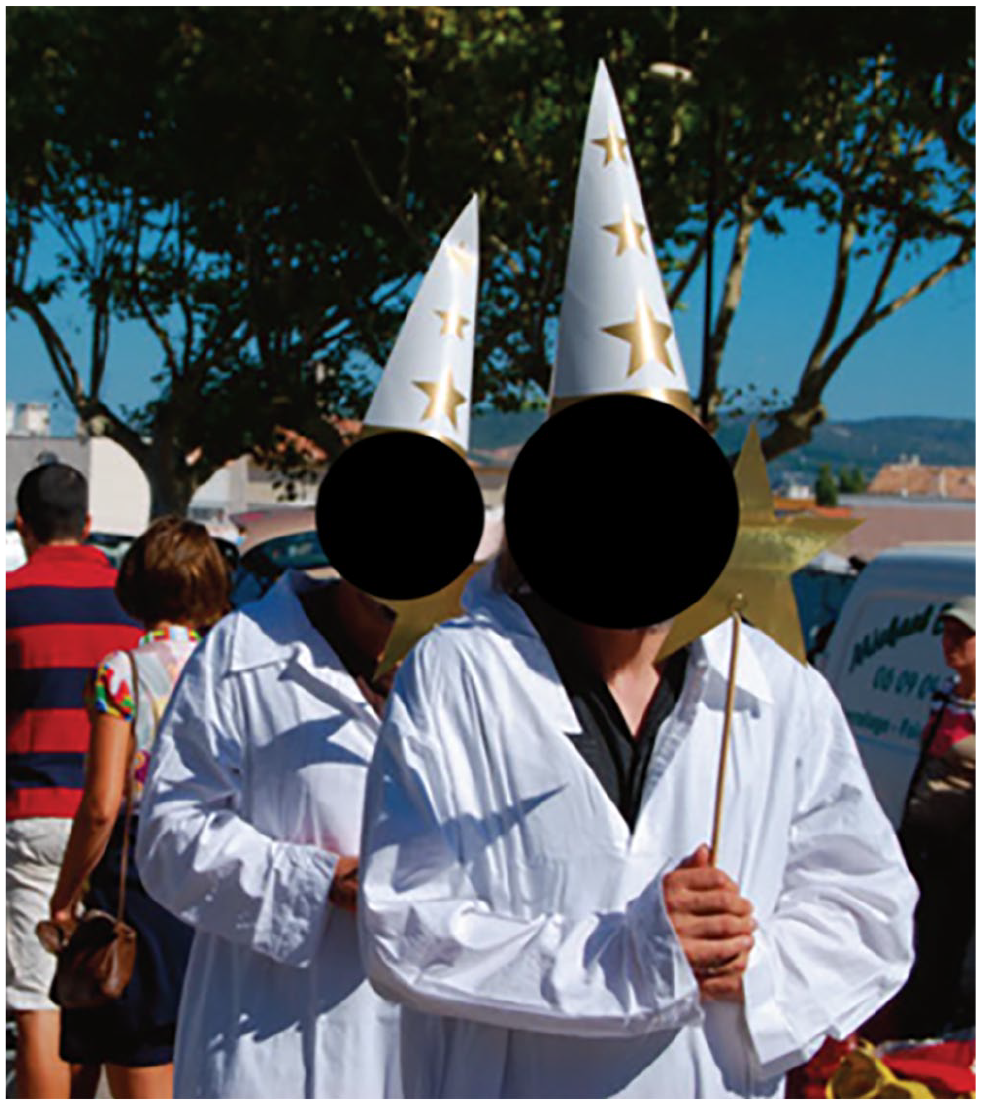
The two artists walking around an outdoor market dressed as star boys.
In the afternoon of the same day, we had coffee with two artists who also performed at this marketplace. One of them was quite upset, accusing the artists who had performed as star boys earlier of reframing the space into something other than art, a ‘playground,’ which made the other artists look like ‘fools’ as the overall framing of the event affecting all performances was threatened.
He explained that during his own performance, he felt so ‘uncomfortable’ and ‘disturbed’ by their actions that he simply quit and went back to his hotel room for a nap. When we asked why the action was so upsetting, the artist described it as a ridiculous way to promote whatever idea they wanted to communicate, mainly due to how they set it up. It was not so much the concept he considered terrible but rather how they had turned themselves into ‘spectacles’ with their unserious appearance, laughter, and ‘terrible singing,’ which made the action feel more like a sketch or a prank. This critical peer, who, as an insider and part of the tribe, evaluated the performance based on its inclusion in the festival and the valued frames of art from the collective memory of the tribe, articulated its impact by inverting the frames of art, asserting that it was not art, and relying solely on vocabulary and conventions from non-art frames, which were culturally specific and largely unknown to the public, to describe the event.
The framing of the action as a spectacle was also echoed by the festival organizer, who, as a member of the tribe sharing the same set of frames, expressed disappointment and felt that the artists did not try hard enough to create ‘good work.’ The performance was described as ‘clumsy’ and ‘not well planned or executed.’ While it generated entertainment value for the artists, in the eyes of the audience and evaluating peers, they failed to reach the tribe-valued state of being ‘present,’ as they were perceived to disengage from the place and concept and were unable to communicate with the audience in any meaningful way. Because their performance was ‘just’ entertaining for the general public, there was no ambiguity. Instead, the performers broke the ‘illusio’ of the field (Bourdieu, 1996), undermining the connection to beliefs about good art and the investment needed to create quality work within the tribe and its framework of frameworks.
The artists’ lack of knowledge regarding frames led to their being perceived as unsuccessful or as naïve, out-of-place individuals within the established performance art world. Their attempt to intertwine and combine the frames of the Feast of Saint Lucy with those of the art festival was not accepted by the tribe. Although the performance had potential by merging various framing possibilities and creating necessary ambiguity for new art, their inability to connect with the valued frames of art and the powerful framing of the situation as a spectacle – along with the embarrassment it caused among peers – ultimately disrupted the frame of art and threatened both the festival and the legitimacy of its participants. Consequently, the organizers emphasized that these artists were unlikely to receive future invitations to the festival. The two artists were entirely unsuccessful in engaging with the ‘framework of frameworks’ that constitutes the tribe’s broader belief system. They were disqualified and faced the harshest penalty a tribe can impose: expulsion. In this context, expulsion is tantamount to the ‘death’ of an artist, as they are cast out from the social group essential for framing their act as future performance art. While other performances classified as ‘spectacles’ – such as one involving a woman lying on a stretcher, smoking and coughing while being carried around by two individuals dressed as doctors – were similarly described as unsuccessful in their use of ambiguity, a threat to the festival, and difficult to follow, they did not result in expulsion, as they were not deemed embarrassing.
Death Traps: Ambiguity but no New Art
The fact that new performances require transcending the established art frame through the introduction of something new means that there are many ways one can ‘fail’ to produce art, even if the ambiguity of multiple possible interpretations of the event is achieved. Tribe members often describe their performance art production as ‘risk-taking’ (cf. Corte, 2022: 192–195), thereby referring to the necessary uncertainty of art production discussed earlier. In their view, risk can range from making a fool of oneself in front of others, as seen in the previous case, to putting oneself in a life-and-death situation, although bodily presence is often essential to risk-taking. Thus, not only is the body present, but the activity implies that the actor is sticking their neck out, placing both themselves and the audience in a situation of uncertainty that may produce multiple frames for interpretation and provide a necessary condition for new art. However, as mentioned, new art requires not just uncertainty but ambiguity, too.
There is an ambition within the tribe that one can do almost anything without being interrupted or disrupted. Pushing this ethos is found in situations in which tribe members accuse one another of tricking others into actions that are immoral or, for other reasons, fall outside the frame of art. 2
Actions in performances may also trigger moral framings beyond art by inviting or deceiving audience members into participating in self-harming actions. In the following paragraphs, we present an example where the performance produced the desired ambiguity but was not successfully framed as art.
The performance took place in the evening at a gallery in Gothenburg, Sweden. An audience of about 40 people stood at the gallery entrance and was invited into the room by the artist. The larger framing in this case clearly indicated that what was about to happen should be evaluated as ‘art.’
Once everyone had entered the room, the artist began to pick up stones she had collected from outside, took aim, and started throwing them at glass bottles she had lined up on a long roll of white paper, resembling a bowling alley. Then, she instructed us to pick up stones and throw them at the glass bottles (see Figure 2). Most of us joined her and threw stones, aiming to break the bottles. If you were able to break some bottles, you were applauded, contributing to a vibrant atmosphere in the room. When most of the bottles had been smashed, the artist took a jump rope and started to jump on the glass on the paper carpet. The mood in the room quickly changed from cheerful to serious. The artist kept jumping and stepping on more glass, making her feet bleed heavily. She finally reached the end of the paper carpet, which was now stained red with her blood. Members of the audience had begun to concernedly talk to each other, and the organizers became increasingly troubled by the situation. At this point, the artist had lost a lot of blood, and you could even smell it in the room. The atmosphere in the room was transformed, and some members of the audience left at this point.
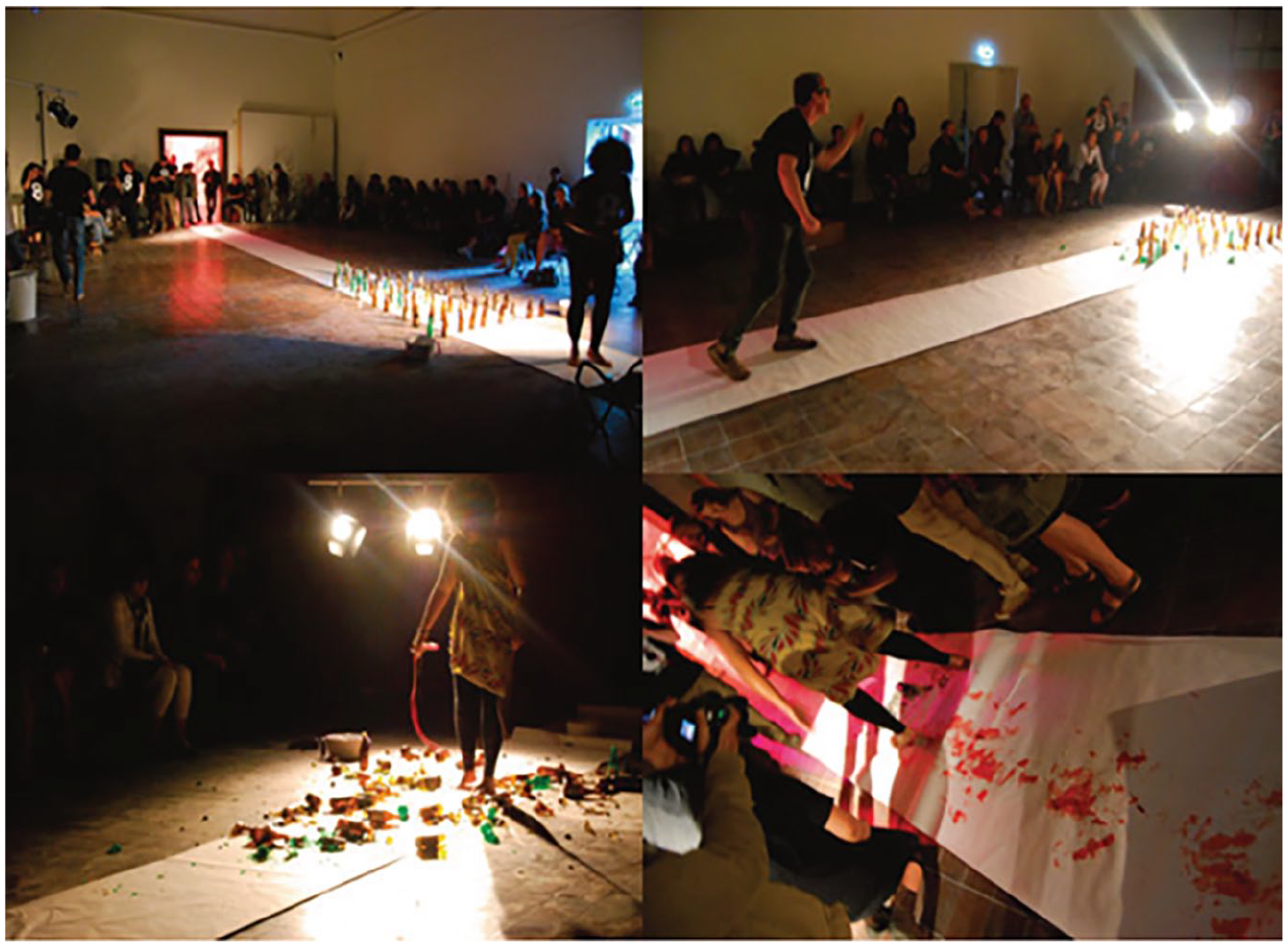
The figures show how the performance unfolded.
When the artist had reached the end of the paper carpet, the organizers and some audience members approached her and asked if she was okay. They began to examine her feet and decided to take her to hospital. An audience member who knew her followed her in a taxi to the hospital. He stayed there with her overnight. At this point, it became clear that this had not been planned and that the frames of art played only a minor part in the interpretation of the event.
No doubt, this event created ambiguity in that she managed to produce a surprise effect through the combination of elements, the sequence of events, and the introduction of something new to the collectively held art frame of the tribe. The gallery clearly framed the event as potential new art; however, the spell of the event and this framing broke as her presence and the combination of tribe-valued elements were nullified, shifting the framing to one of life and death, focusing on the need to save the life of the performer.
There was little discussion of the action immediately after it took place, as the performer left for the hospital, and the audience shifted its attention to the next performance. However, later conversations with other artists and festival organizers revealed that tribe members were critical of how the action unfolded. Some argued that if she had not cut herself so much – an act that overshadowed the framing of the entire event – it might have evolved into something ‘really good.’ Instead, the focus was on the blood and the risk to her life. They believed the action would have been improved had she removed the glass when using the jump rope, as they understood that the movement of the rope was intended to sweep away most of the broken glass. Additionally, they suggested that the performance could have been stronger with fewer bottles while still conveying her message. The organizer also said, ‘We could have had a medic and we could have scheduled her work as the last one in the program, because the following performances suffered from the atmosphere of that performance.’ This once again highlights the implications of an unsuccessful performance for the entire festival, and how the performances bleed merge into one another influencing the framing of coming performances.
Organizers noted that many participating artists were upset by the performance, feeling she had ‘used’ them to injure herself. They pointed out some ‘basic errors,’ particularly in dragging everyone into the space before starting the performance. One of the organizers elaborated on the moral implications of the performance.
She didn’t let the audience make their own choice but dragged us into this swindle, [fooling us into] having fun throwing the stones to break the glass bottles. If she had only let us do it voluntarily [it might have been different], but [as it was], she pulled us in, and it became morally wrong. It’s one thing if you go into the situation without thinking, even if that is problematic and to some extent wrong, but when she drags you into a trap, it is very wrong, I think. You feel manipulated. (Organizer, 2 June, 2014)
This case exemplifies how the ambiguity of framing is crucial for creating a surprise effect. While this potential surprise could have been transformed into new art, it was ultimately framed as morally dubious, resulting in an incomplete creation of new art. The artist engaged in a morally questionable fabrication (Goffman, 1974: 83), leading the audience to believe that the performance was merely fun and games. Throughout this performance, the audience oscillated between various interpretations of what was happening and what was being done to them. The confusion and surprise that arose when the scene shifted from bowling and smashing glass bottles to the performer jumping rope over the broken glass created an ambiguous situation. This reframing not only broke the frames set by the organizers but also altered the audience’s initial willingness to participate, making them accessories to an experience they had not consented to. In this instance, it would have been possible to legitimize the event, as the artist’s body, the concept, and the temporal structure of the performance converged to heighten the experience, making every second matter and creating the much-valued ‘presence.’ The ambiguity lay in its potential to represent several things at once – a work of art, self-harm, or even a crime – transforming what began as fun and games into a matter of life and death. Still, the event had to be interpreted largely as a failure because it could not predominantly be framed as an art event. Although this event is unlikely to be forgotten by those present, it was not legitimized or framed as new art within the tribe.
In contrast to the example of the spectacle described earlier in this article, the artist was not expelled from the community. She later emailed the organizers to apologize for the performance, and they remain interested in her work due to her strong reputation and history of successful pieces. As one organizer stated: ‘I think she makes strong work. I have seen two strong and two weak ones. But I think she is an interesting artist, and she brings with her a color – because she is from another culture. Even if she is now based in Berlin, she brings something new and interesting.’ Hence, the evaluation is not limited to a single performance, but also considers the artist’s potential to produce successful works in the future, especially in this case, in which the artist was on the verge of creating something new.
Poetic Events: Ambiguity and New Art
The two kinds of performance we have just discussed represent cases that do not turn into new art according to the tribe’s members. However, performance artists occasionally create situations that become recognized as great performances or what some tribe members call ‘poetic events.’
While these poetic events rely on ambiguity, they do not need to be disturbing, as demonstrated in the previous section, to be considered art. One artist in Gothenburg exemplifies this. He created a striking piece using charred logs – placing one in his mouth and the other in his left hand – walking in a clockwise direction for four hours, while hurting and bleeding (see Figure 3). Audience members whispered, ‘Look at the image,’ ‘It’s very graphic,’ ‘So raw and simple,’ ‘What a great space,’ ‘He is really present,’ ‘Very poetic,’ and ‘Strong image.’ The piece was later uploaded to Facebook, where it received similar praise. It invited multiple layered interpretations – bridging the local, physical intensity of the action with broader concepts such as the pain of passing time, the toll of labor, or the duration of a workday – readings influenced in part by the artist’s earlier performance in China. The ambiguity between these frames – including his suffering, poetic presence, and societal critique – did not cancel each other out, but rather formed the condition for a successful performance in which no single reading prevails.
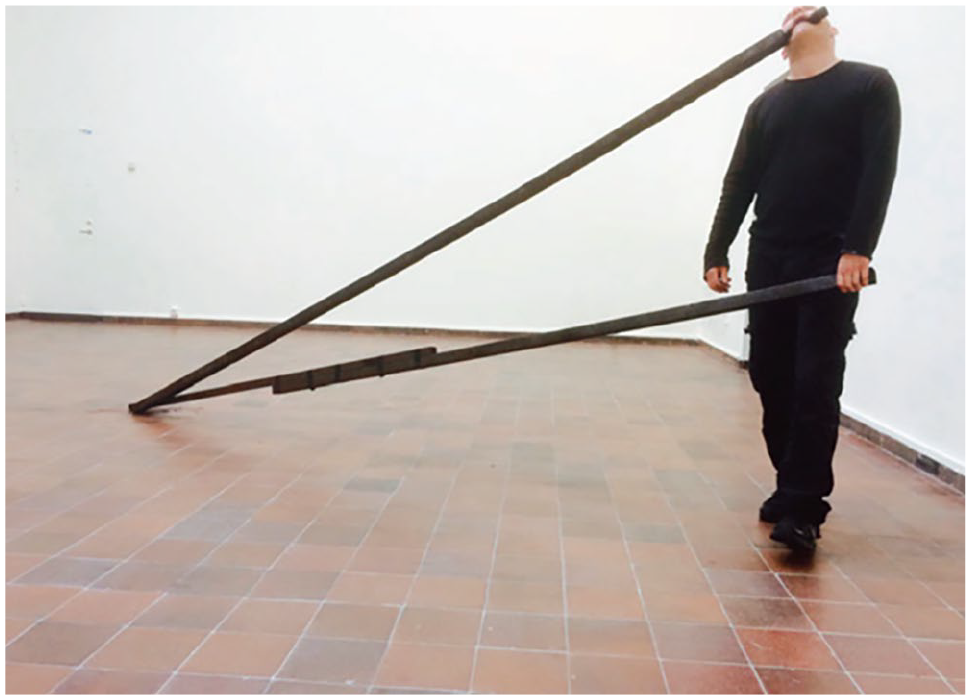
The artist walking around in circles with logs.
Thus, to create new art, a performance must establish a sense of ‘presence’ in the eyes of the audience, similar to the earlier example. Although artists acknowledge the difficulty of defining ‘presentness,’ they often legitimize this presence by the combined use of tribe-valued elements – body, space, time, concept, and physical material under the condition of ambiguity – to frame an event. Discussions regarding the negotiation of this frame, along with its limits and boundaries, are ongoing at festivals, particularly during organized artist talks that are integral to these events.
Another action that became recognized as great performance art occurred in the streets during an open space session of one of the festivals. The artist was searching for an opportunity to do a performance and was, therefore, particularly attentive to his environment. According to the artist, ‘there are actions all around you and you pay attention. Action art can erase the line between non-awareness and awareness. Because if you start to think what it means it turns into images. I don’t know when or whether I’ll be ready to do an action. An action has to come to me.’ This exploratory mode of discovering, emphasizing means before ends, led the artist to realize the possibility of creating an event with a flagpole. This opportunity involved a physical and symbolic manifestation and using his body and clothes: black jeans and a black hoodie.
He approached a flagpole on which the national flag of Sweden was raised, opened his hoodie, and swiped it around the pole (see Figure 4). During the performance, another artist – and member of the tribe – was asked to comment on the unfolding events. He said, I like his style. He has this ability to see and act. He studies the space and often finds ways to use it wisely. Researcher: How do you mean ‘wisely’? Onlooking artist: He often takes his time to explore his environment. If there’s no clear image, he waits and does not rush into anything. You know, performance art is about timing, and you need to be alert in the space to use it. Use its possibilities to experiment with it and its surroundings.
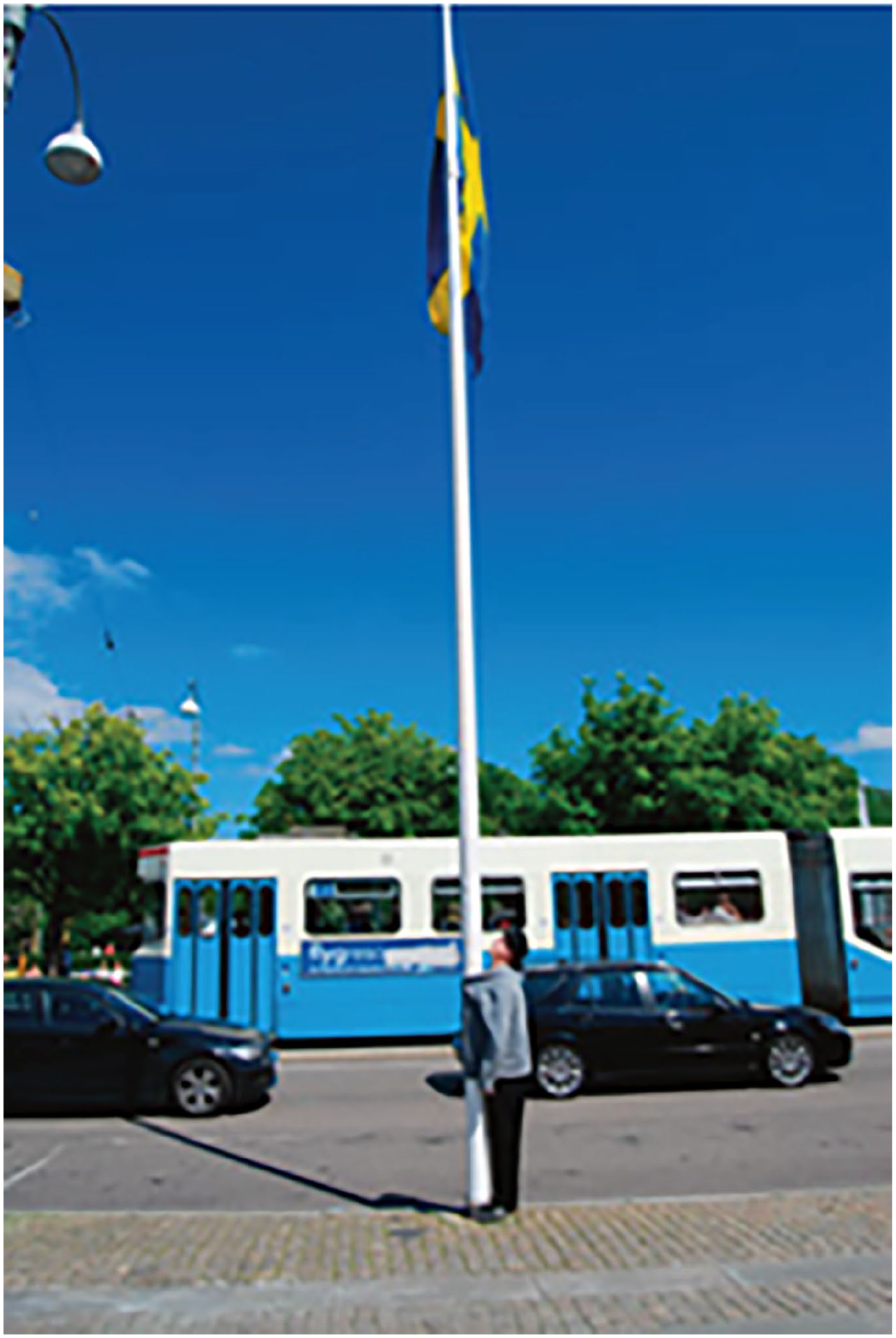
The artist stands against a flagpole around which he has wrapped his hooded jacket.
The surprise effect and excitement of potential new art was aroused by the tension of unconventional reverence for the national symbol: an unfamiliar yet mundane salute to a familiar nationalistic practice, prompting the audience to question the meaning of patriotism and national identity. This combination of conventions from different frames was effectively used. The action lasted about three hours and ended when the artist removed his hoodie and walked away from the space. In the aftermath, the action was praised for its ‘simple yet powerful imagery.’ It was also recognized for how it was set up. With modest means and his own bodily presence at the center, he used existing materials – a flagpole displaying the most distinct national symbol – in the given space of the festival and created a performance. Each of the frames, national symbol, body, person, hoodie, public space, flagpole, and more are, as such, not even remotely ‘artistic.’ It is the combination of these frames by this person that is interpreted by others, the onlookers in general, but most decisively other tribe members, that matters for it to become new art. As one of the other artists explained, ‘The setup of this action was anything but amplified. He wore his normal clothing, saw an image in the space, and embraced it with simplicity. A great action, if you ask me.’
During an artist talk, this work was differentiated from the theater frame, allowing those present to refer to the performance as distinctly successful. The performance was seen as a good example of the performance artist’s gaze, demonstrating that the artist was adept at identifying images in his surroundings and creating a sense of presence for the audience: It doesn’t follow a script. And neither is it improvisation and for me, it shouldn’t follow habits and the manner of theatrical things, such as walking in certain ways or controlling the audience in a certain way; it should be risky, it should be unknown, it should be challenging ‘your limits,’ and it should be different from conventional theater.
Besides the oral praise and legitimating discourse given through tribe-valued elements during the festival, we could follow the framing on social media in the aftermath of the action, posted on the festival’s Facebook page by one of the organizers. Here, other artists posted comments such as ‘beautiful image,’ ‘love you man, love your work,’ ‘strong action,’ ‘you’re poetry,’ and the like, which formed part of the event’s interpretative process. The written admiration of the action continued for about three months after it took place.
One year later, an additional sign of the work’s consecration in the shared frame of successful art within the tribe emerged. At an artist talk in Guangzhou, China, one of the artists referenced the flagpole performance as an example when categorizing what she considered good performance art, emphasizing the strong imagery and spontaneity of the action. She said: Take, for example, his action last year in Gothenburg. He did not do many actions, but the one in which he used the flagpole was a great example of his ability to spot and make use of the space in a memorable way.
The performing artist, who had been part of the tribe for some time, had thus been recognized for his previous actions centered around finding materials or objects in the festival space and interacting with them. He was admired for his creativity in new contexts, and his artistic concept focused on ‘raising awareness of objects in the world through bodily presence.’ However, being a role model within the tribe, endowed with that status, does not necessarily guarantee the ability to create new art. While expectations provide ample opportunities for artists, they also come with pressure.
The interpretation of the initial ambiguity as transcending the frame of art within the tribe, along with positive sanctions and legitimizing discourse that relied on the tribe-valued elements in its aftermath, is key to the gradual acceptance and legitimation of this event as part of the tribe’s narrative of ‘new art.’ This unique and valued performance created a lasting memory for the tribe members, which was articulated, discussed, and reinforced in their conversations with one another. As a result, it was eventually institutionalized as a new piece of art within the transnational tribe’s shared frame of art.
What makes this specific performance successful in contrast to the other two categories is not the context of art, though it frames the setting, the interpretations, and the interpreters. Neither the public, the artist’s peers, nor the artists themselves could predict the outcome of the performance where uncertainty prevails. The combination of different frames in performances that make them open to interpretation was also present in other instances.
This site-specific performance, similar to the example mentioned earlier, was legitimized as art because it expressed and combined the tribe-valued elements of concept, body, and place, which could be used in discourse to legitimize the performance within both the festival’s frame and the tribe’s conception of art. It was carried out by an established artist who effectively employed ambiguity to revise the definition of what is considered art within this tribe. Although the individual elements, when viewed outside the art frame, would not suffice to constitute new art, their combination and connection to the art frames resulted in a successful performance piece.
The combination of different frames and their associated conventions was also used effectively in the eyes of tribe members. This combination fostered a heightened experience of excitement and a sense of ‘presence’ as the event unfolded in the ‘here and now.’ Thus, it is not merely repetition but keying – applying a new interpretive framework that transforms the original activity into something different (Goffman, 1974: 439) by introducing an adjacent frame. The reframing of seemingly mundane elements into something new, unique, spectacular, and singular expanded the original art frame of the tribe, presenting the piece as new art in the eyes of the audience.
Experiencing the performance, whether at the time of the event or in retrospect, was associated with heightened feelings of engagement, surprise, and excitement about what was unfolding. This effect was achieved by creating an ambiguous situation open to multiple interpretations, which was combined with the valued art frames of the tribe. As this artwork enters the collective frame of reference for the tribe, it cannot be repeated but instead serves as a reference point for future works, guiding the creation of new art in relation to it.
Conclusion
We show that ambiguity is not only a necessary condition for the artist’s creativity but also that when it immerses and engages the audience in the work as a singular experience, it enables further legitimation through the collective narration of that experience. Evaluations and legitimations of potential newness are conducted through discourse, drawing on tribe-valued vocabularies of time, space, body, material, and concept. When this combination of frames and vocabularies is collectively recognized as both novel and legitimate by the peer community through a process of mutual adjustment in oral exchanges, the work becomes re-framed and acknowledged as new art in the group’s collective memory and shared knowledge. Through this process, we illustrate how this art world functions, in contrast to previous avant-garde movements, relies on audience response and validation to allow artists to become legitimate participants and have their work consecrated as new art. However, while our study focuses on a specific context within performance art, it is important to acknowledge that the processes we describe may not generalize to all art worlds, particularly those that are not as clearly governed by a binary logic of ‘art’ and ‘not art.’
At performance festivals, members of the performance art community gather for an intensive period to create performances that aim to produce unique events. Most of these attempts are simply forgotten, while others receive negative sanctions and are thus not recognized as new art. However, in rare cases, an attempt is positively sanctioned and becomes part of the tribe’s collective memory as a unique, singular event valued as new art (Karpik, 2010).
Our analysis employs Goffman’s concept of framing to explore the dynamics of interpretation and evaluation in performance art. The framing is fundamentally a collective interpretation that narrows down the multitude of possible interpretations characterizing the state of ambiguity (White, 1992: 106). Consequently, if a narrative about the event prevails, new performance art may be solidified and consecrated in the collective memory of the tribe and serve as a reference point for framing future performances. When something is recognized as new performance art, it has the potential to alter the very definition of what constitutes ‘art’ within the tribe.
Our findings on how new performance art is established – that is, the account of how changes in art occur through the notion of framing – cannot capture the full complexity of creating new art. Like all forms of creative output, performance art needs to be experienced to determine its value, as it is multidimensional, incommensurable, and of uncertain quality (Karpik, 2010). Consequently, we cannot provide a guide for making new performance art, as it is situationally bound and contingent upon the specific circumstances and unfolding events in its aftermath.
Moreover, for insiders who are physically present and draw on their contextual knowledge (Aspers, 2006) and interpretative horizon (Gadamer, 1975), meaning cannot be perfectly conveyed to outsiders; it is a finite province of meaning (Schütz, 1962). Strictly speaking, only insiders can fully understand and participate in this reframing (Becker, 1982: 63). Whether the art will be recognized outside the subfield of performance art and may affect the field of art at large depends on the status and autonomy (cf. Weber, 1946: 342) of the tribe in reaction to the art field at large (Bourdieu, 1996). The autonomy of the tribe we studied, largely shunning external actors, is a precondition of making new art; new art is not a ‘democratic’ decision reaching out to people beyond the tribe members.
The fact that this tribe is a small group within a larger art world, over which no single individual can exert control, complicates the possibility of creating a formula for automatically producing new art; even the artists themselves are unable to do so. To carry out new performances, one must be recognized as an insider by the tribe members, aligning with existing frames while also possessing the ability to challenge them. This knowledge cannot be explicitly articulated before any act takes place. New art must be performed live, observed, interpreted, and ultimately deemed ‘new art’ in a process that remains outside anyone’s control. In other words, our study indicates that it is a contradiction in terms to attempt a detailed account – beyond a formal description – of when and how new art comes into being.
Performance art thus points to a process of mutual adjustment for social ordering (Berger and Luckmann, 1967). We claim that new art is coordinated and established in a similar way to scientific ‘truths,’ namely as ‘the result of human action, but not the execution of any human design’ (Ferguson, 1767: 205). That is, neither art nor scientific findings are embraced because of centralized authoritative decisions but emerge in a context and process of free actors who are listening and paying attention to others interacting with one another. This results in an unknown, non-authoritative, and essentially uncontrollable outcome (Nowotny, 2016) established by the ‘field’ (Bourdieu, 2004: 71–84). Still, the narrative that is established, for example, in science, represents only one of ‘countless alternative hypotheses’ that conform to the existing ‘assemblage of evidence’ (Goodman, 1976: 263).
In conclusion, performance art, through its inherent unpredictability, seeks to create singular events that not only transform the art world but also impact those who experience it. This reflects a broader trend in late modern society, characterized by the singularization and culturalization of life, where unique experiences are highly valued (Reckwitz, 2020). Our findings and conceptualizations can contribute to a deeper understanding of these contemporary societal processes that strive toward singular experiences.
Footnotes
Funding
The authors received no financial support for the research, authorship, and/or publication of this article.
