




Abstract
Cosplay is a fan culture that involves dressing up as and performing fictional characters from popular media texts. Since the late 2000s, commercial enterprises in Japan have been creating and exploring new places for cosplay, such as rental studios and real-life locations, and marketing them to cosplayers for profit-seeking purposes. Based on fieldwork at cosplay events and rental studios, as well as interviews with staff, cosplayers, and chiefs of companies, I explore and discuss various ways in which spaces for cosplay are commodified in Japan. I argue that part of cosplayers’ creative spatial experience within rental studios and locations is predicted and staged by place providers. Still, cultural meanings are co-created by both cosplayers’ creative agency and place providers’ attempts to control cosplayers’ consumer behaviours. This co-creation is the result of the power dynamics between cosplayer users and place providers, along with the employment of cosplayers’ subcultural and online social capital by place providers. This study contributes to the understanding of how cultural meanings are co-created between cultural organisations and their users. It also broadens critical discussions on the collaboration between corporations and prosumers.
Since the late 2000s, the creation and utilisation of spaces for cosplay have been going through commodification. Commercial enterprises have been fabricating fantastical places and rebranding real-life places to lease them out to cosplayers for cosplay photography and ‘offline gatherings’ (ofukai) of the online cosplay community. Cosplayers used to either borrow fan conventions or explore places unintended for cosplay and transform places into their own meaningful spaces through cultural practices (Winge, 2006). The involvement of cultural institutions in Japanese cosplay culture indicates that the exploration, creation and use of cosplay spaces are now driven by market forces. Drawing on de Certeau’s (1984) cultural political theory of place and space, I explore the commodification of indoor and outdoor cosplay spaces in Japan and examine the power dynamics between place providers and cosplayers. The results are conceptualised as three processes during the production and consumption of places for cosplay. The first and second processes involve place providers predicting cosplay genres and behaviours, while cosplayers occasionally exceed such predictions, making cosplay behaviours not entirely predictable. The third process concerns place providers’ employment of cosplayers’ subcultural capital and online social capital in their marketing and construction/exploration of places for cosplay. In the end, I contend that cultural meanings are co-created by cosplayers and place providers, both explicitly and implicitly. This co-creation leads to ambiguities both in the positionality of cosplayers and in the distinction between place and space.
Cosplayers, Meanings and Spatial Practices
Chao and Kesebir (2011: 318) define cultural meanings as ‘norms, values, beliefs, scripts, and schemas of a community, and serves as symbolic resources’. In this study, I examine the production of cultural meanings from a spatial perspective. In other words, I analyse how cosplayers produce meanings by practising ‘spaces’ commodified by commercial providers of ‘places’. De Certeau (1984) uses the concepts of ‘place’ and ‘space’ in a city to denote the power relations between the cultural institutions and consumers of culture. A place is created by the dominant city designers to impose a predesigned ideological order on the inhabitants and has its lawful, expected uses (Conley, 2012). A space, on the other hand, is created by the ‘users’ of places (Kawamata et al., 2022). Users transform the planned urban places into their own meaningful spaces through unique ways to navigate, discern and utilise places, regardless of their predesigned uses and meanings (de Certeau, 1984), in order to assert users’ right to their ‘everyday existence’ (Conley, 2012). De Certeau’s theory is further applied to interpret fans’ cultural production by Fiske (1992) and Jenkins (2012), who argue that fans are essentially creative, self-directed users of the original texts as they ‘poach’ different elements from their favourite fictional worlds to practise their own meaning-making processes. These processes include producing derivative fan works, establishing fandom and communicating with fellow fans in ‘rituals’ like club gatherings and fan conventions (Jenkins, 2012). These processes also include fan pilgrimages, where fans visit real-life places that resemble fictional worlds to enhance fan community bonds and emotional connections to fandom objects (Okamoto, 2018; Waysdorf and Rejinders, 2018). Fans’ productive and explorative efforts are not focused on industrial efficiency and profitability. Instead, fans discover and redefine their self-identities by expressing connections to fictional texts and online/offline fandoms (Lamerichs, 2018; Rahman et al., 2012).
Both fan studies and tourism studies have suggested that cosplayers’ spatial creativity helps them transform places into meaningful spaces. Fan studies generally focus on how cosplayers use anime conventions for community building. Through cosplay fashion shows, competitions and random encounters, cosplayers evaluate and appreciate each other’s costumes, strengthen bonds, and gain social capital within cosplay fandom (Crawford and Hancock, 2019; Lamerichs, 2018; Rahman et al., 2012). Tourism studies, on the other hand, examine how cosplayers transform tourist attractions into photographic backgrounds to re-enact scenarios from anime/manga or create new scenes based on the traits of the characters they cosplay (Kainuma, 2016; Kikuchi and Masanori, 2017; Koarai, 2019; Rastati, 2020). Such creative practice differentiates cosplayers from ordinary tourists. Tourist destinations, initially designed to be passively consumed by guided tourists (Urry, 2001), become sites of self-directed cultural production in the eyes of cosplayers.
Nevertheless, existing studies on cosplay have not investigated a new consumer behaviour in Japanese cosplay culture since around 2005, that of the increasing consumption of prefabricated or pre-explored places like cosplay photography studios (also known as rental studios) and indoor/outdoor ‘locations’ (rokechi) rebranded as preferable for cosplay photography. In particular, the power dynamics between cosplayers and place providers, who impose preconceived meanings on cosplayers for their own purposes, remain an under-discussed topic in studies on cosplay. Additionally, while existing literature in fan studies has conflicting views on the topic of power and resistance in fan culture (Hills, 2002; Jenkins, 2012; Tresca, 2013), through this research, I bring new insights into the topic by analysing a recent case of new power dynamics between fans and the cultural industry as a result of the commodification of fan culture.
Since 2000, the ‘level’ (reberu) of cosplay, measured by how accurately cosplayers can re-enact fictional characters (Koarai, 2019), has become a new value pursued by the cosplay community (Tanaka, 2009). While much of this pursuit focuses on costume-making and photography skills, the choice of spaces for cosplay photography is also crucial, as media texts often have spatial settings tied to specific themes like schools or tennis courts. It is because of the demand for photography backgrounds that cosplay photography studios and location services have emerged. Photography studios, which used only to exist for family photos and commercial photography production (covers of albums, TV programmes, etc.), have recognised the potential of cosplayers as their consumer demographic. This new group of consumers has a specific taste for the kinds of places suitable for specific genres and settings inspired by anime, manga, films, and video games. To meet these new demands, studio owners have begun to design rooms that replicate common anime genres. Another emerging business model is location services, which collaborate with owners of real-life locations, such as cafés and ancient buildings, and lend these places to cosplayers for a negotiated period of time. 1 From a Foucauldian perspective, these commodified spaces for cosplay are ‘heterotopias’ of deviation and illusion (Foucault, 1984) – they are marketed both as idealised spaces for cosplay and as designated areas to quarantine eccentric cosplayers, separating them from a society that often despises their presence in public space. (Winge, 2006). However, interpretations based on de Certeau’s theory of place and space reveal a more complex understanding of how cosplayers use commodified spaces. I explore this complexity in the following sections.
Data and Methods
I drew on ethnographic and interview data extracted from a 15-month fieldwork study on the commercialisation of cosplay in Japan, conducted from 11 April 2023 to 10 June 2024. Data featured in this article included six in-depth semi-structured interviews with cosplayers, staff and chief members of businesses related to cosplay; and fieldwork at ten cosplay events and three photography studios. I generated fieldnotes and short interviews with cosplayer participants based on fieldwork. I also collected textual, mostly advertising and descriptive materials, from fieldsites and websites. All informants and their affiliated organisations/corporations involved in this research were anonymised. I used pseudonyms to address informants and their affiliated corporations/organisations in this article. Interviewees were either recruited from networks established during fieldwork or contacted through publicly available details on websites or flyers. I conducted all in-depth, semi-structured interviews physically. Interviews lasted between 30 and 120 minutes and were recorded by a voice recorder. Interviews were all conducted in Japanese, so I translated the quotations presented in this article from Japanese into English. Short interviews with cosplayers during fieldwork lasted between 2 and 20 minutes and were not voice recorded, but I recorded keywords, ideas and important quotations and included them in the fieldnotes.
I employed a multi-sited ethnography that integrated concepts from hybrid ethnographies, which emphasised the interplay between online and offline cultural practices, (Jordan, 2009: 81). Since the commodification of physical spaces was my central focus, physical fieldwork remained the primary data source. Supplemental online data were gathered from corporate place providers’ advertising materials on their websites, alongside social media posts on X that showed how cosplayers share and obtain information about spaces available for their activities. During offline fieldwork in photography studios and cosplay events, along with semi-structured interviews with cosplayers and place providers, I enquired into the construction, marketing and utilisation of commodified spaces across both digital and physical realms. This dual focus on cyberspace and physical space arose from their roles as crucial information sources for cosplayers (Lamerichs, 2018; Tanaka, 2009), and as significant arenas of power dynamics between users and the cultural industry (Castells, 2007; Przybylski, 2020). Additionally, the commercialisation of information about cosplay also involved online marketing strategies for cosplay-related products (Tanaka, 2009), including commodified spaces.
My analytical method drew inspiration from grounded theory (GT) (Glaser and Strauss, 1967). Although the small dataset of interviews and fieldwork meant that I could not achieve the kind of theoretical saturation in traditional GT, this choice of method rested on three justifications. First, the necessary sample size for theoretical saturation depends on the research question’s scope (Thomson, 2011). Compared to large qualitative research that usually requires approximately a hundred interviews to answer a broad research question (Thomson, 2011), this study was only part of a large project that investigated the commercialisation of the cosplay subculture in Japan and focused on the specific aspect of commodified spaces. Second, small-sample GT studies can provide deep insights if iterative refinement is intensively applied to capture nuances (Barnes, 1996). In this study, I used the ‘constant comparison approach’ in grounded theory for iterative refinement during the analysis of coded data. Through the constant comparison approach, conceptual categories generated from new data were immediately compared to existing categories for verification, contrasts or elaboration (Glaser and Strauss, 1967). Third, despite the small sample size of each data type, I utilised various data sources (in-depth interviews, fieldnotes, short interviews during fieldwork and online/offline textual materials). This data triangulation enhanced validity through mutual confirmation (Berg and Lune, 2011).
Accordingly, the initial coding method featured open coding (line-by-line and/or paragraph-by-paragraph coding), as well as in vivo coding (naming codes based on words said by the interviewees) (Charmaz, 2021; Glaser and Strauss, 1967). After the initial coding process, I applied axial coding by establishing connections among categories and codes (Charmaz, 2014). In the light of the inductive–deductive reasoning in GT (Charmaz, 2021), I then borrowed de Certeau’s (1984) theory of ‘place’ and ‘space’ to construct a framework of coded data. In the final selective coding process, I chose ‘the co-creation of cultural meanings by cosplayers and cultural producers’ as the overarching category. Finally, I established connections between the overarching category and three relevant categories: ‘staged creativity in cosplay photography’, ‘predicted/unexpected uses of spaces’ and the ‘ambiguity of place and space’. The findings discussed in this article were based on these three conceptual categories.
Predictable Creativity
Cosplay remains a productive consumer culture today (Lamerichs, 2018), meaning that cosplayers do not instantly consume commodities after purchases, but instead ‘focus on the process, craft, and slowness of making something anew’ (Crawford and Hancock, 2019: 181). Cosplayers show their creativity by converting everyday consumer goods into anime costumes and transforming urban spaces into photography locations. Renting photography studios and locations essentially follows the same basic logic, whereby rented space is not used for passive, instant consumption. Instead, rented space is used for three cosplay practices: the active, slow creation of cultural artefacts (cosplay photos), the production of fun and creative spatial experiences, as well as the participation in fandom by sharing cosplay photos online afterwards. A hidden problem, however, is that in the eyes of the providers of indoor/outdoor places for cosplay, cosplayers’ creation is partially predictable. In particular, place providers are able to roughly predict what anime/manga/games cosplayers would choose for their next cosplay based on popular genres or media franchises. They then construct/explore and advertise specific places accordingly to attract particular types of cosplayers.
Rental studios, for instance, are rooms renovated from empty spaces to delicate places in an attempt to fabricate specific themes that draw inspiration from popular media texts. Studios are often categorised into genres such as ‘Industrial sites’ (kōgyōfū), ‘Japanese-style’ (wafū), and others. The genres can be further ramified into subgenres like ‘ruins’ (haikyo), ‘traditional Japanese red-light districts’ (yūkaku), and so on. This process of categorisation is performed by both the companies behind studios on their websites, as well as online commercial media 2 that produce catalogues, articles and social media posts to advertise studios.
Producing a rental studio requires the staff’s creative labour. This labour typically involves accurately recreating popular stereotypes by designing layouts and selecting wallpapers, flooring and assets that align with the designs. Occasionally, the staff’s creativity is based on making effective use of the original empty space during the design phase. For example, SPS, a rental space company I visited in Tokyo, had a studio that used to be a clinic. While inspecting the emptied clinic, Sadami, the manager who designed the studio, noticed two things: first, there was a separate room that used to be a doctor’s office; and second, the clinic featured vintage, western-style wooden floorboards. These factors inspired Sadami to create a ‘British-style study’ theme for the studio. Eventually, the doctor’s office became a fake study with a desk and second-hand English books on the bookshelf (see Figure 1), while the space outside was renovated into a living room with European furniture and tea sets.
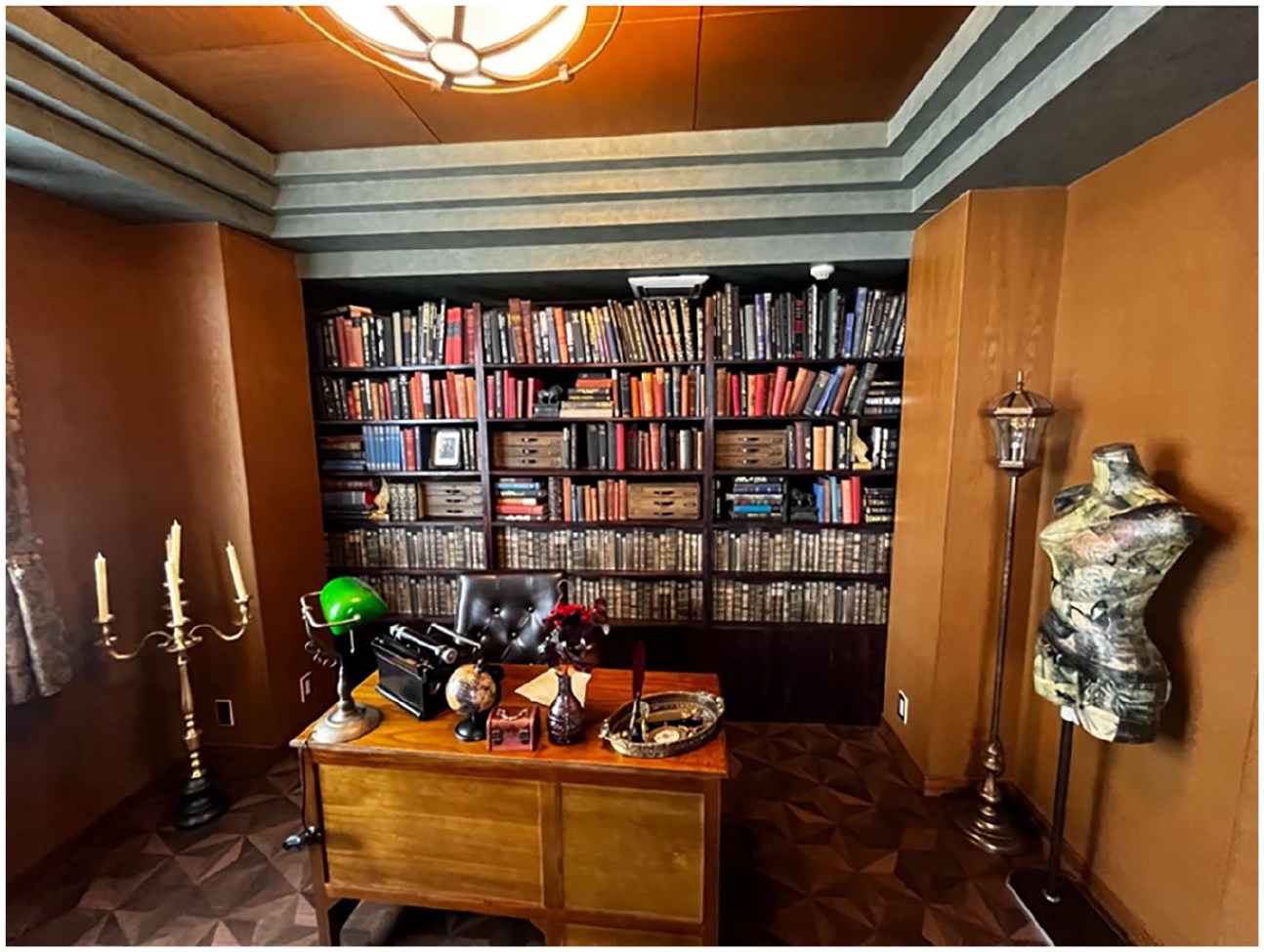
A former doctor’s office turned into a fabricated study, with the original wooden flooring unchanged. Photo by author.
However, the staff’s spatial creativity is also based on their prediction of cosplay genres. An example of this prediction concerns the recurring concept of ‘the come-and-go of trends’ (hayarisudari) mentioned by rental studio staff. Mitsuru, a manager of the rental studio company COSTUDIO in Osaka, revealed how COSTUDIO designed its business strategy around cosplayers’ recent consumer behaviours: I think that changing decorations is important for us. Like, we are quite able to catch the current trends in cosplay, and change the decorations based on these trends. . . especially these days, when there can be an infinite number of characters when those mobile phone games are constantly generating new characters. This makes (cosplayers keep saying) ‘I wanna do this character oh I wanna do that character as well!’ as more and more characters come out.
A notable detail here is that, when promoting their studios, Mitsuru’s staff never directly mentioned the trendy mobile games that inspire their designs. This was because such an advertising strategy could potentially constitute copyright infringement. Additionally, they find direct references unnecessary. Cosplayers can instantly recognise the anime or games that the studio decorations refer to just by viewing the settings of the studios on the websites.
Location services, on the other hand, require far less effort and capital than rental studios, since businesses are mostly operated online. ‘Shooting at locations’ (rokesatsuei), a term borrowed from TV production terminology and used in tourism nowadays (Iwahana, 2012), used to be practised by cosplayers independently. Since different locations have their own rules, cosplayers have to negotiate with owners of resorts, factories, and shopping districts in order to legally access indoor and outdoor locations. Additionally, cosplayers need to explore different locations, either on their own or by utilising their social capital (Bourdieu, 1984), which consists of the online cosplay community and real-life cosplayer friends (Kainuma, 2017; Lamerichs, 2018). This suggests that exploring and accessing locations for cosplay used to be a self-directed practice requiring time, effort, and social networks. However, online location services now provide a convenient alternative, allowing cosplayers to bypass these processes. Naruki, the owner of multiple cosplay-related businesses, including a location service, described how he started the service: So, we were trying to create a service that could make cosplayers happy and does not cost much money. We thought if we used places that already exist, we would not spend too much money on them. However, the venues, how should I say, we do not know if we can use the venues for cosplay photography. So we negotiated with the owners and found these places (suitable for cosplay). Since there are always ‘wasted’ (mottainai) periods, meaning the time periods when the places are empty venues, we would then offer twenty to thirty thousand yen (for our business during wasted periods), which the owners themselves were happy to accept.
In this way, location services manufacture the processes of exploration and negotiations that cosplayers used to practise slowly and individually. But the purposes are different. Cosplayers seek access to locations occasionally during their leisure time for their own production of photos and fun. Location services multiply the explorative processes to the extent that they can produce an entire list of themed places, which can be temporarily rented to cosplayers for profit. Moreover, location services rebrand places, which used to serve different purposes, as ‘cosplay-friendly’ places. In particular, location services use textual narratives and well-shot sample photos to make cosplayers imagine a fantasised version of ‘authentic’ spatial experiences. One example is an extracted description of one ‘Showa-era school’ location on the official website of Naruki’s service: Take cosplay photos privately in a Showa-era retro wooden school building! Enjoy taking cosplay photos in the old-fashioned gymnasium, playground, classrooms, Japanese-style rooms, and farmyard in a relaxed atmosphere. The gymnasium and classrooms can be used at the same time, allowing you to shoot in the entire school building. This is a great place to create cosplay portfolios and other works of art. Of course, you can shoot videos here as well.
By using words like ‘retro’ and ‘old-fashioned’, the description attempts to evoke a delusional sense of nostalgia for the ambience of the Showa era (1926–1989), something that the vast majority of young cosplayers, who were born in the Heisei era (1989–2019), never experienced in the first place. Nevertheless, despite location services manipulating subjective feelings of authenticity through online advertising, objective authenticity still exists because the actual locations remain ‘unstaged’. No additional decorations are added by location services specifically for cosplayers to feel authentic. This is, according to Naruki, simply because location services do not have full control over the locations they sell. This lack of control over actual places leads to location services’ inability to manipulate cosplayers’ physical spatial experiences, even though cosplayers’ expectations can be influenced by online marketing discourses and imagery prior to their arrival. The strategy used by location services shares some resemblance to Harry Potter and Lord of the Rings theme parks (Tzanelli, 2004; Waysdorf and Rejinders, 2018), in which connections between fictional texts and tourist objects are marketed as ‘authentic’ tourist experiences to fans. The only difference is that, while theme park owners construct authenticity as a consumer experience, location services market authenticity as a ‘prosumer’ experience (Toffler, 1980), since they predict cosplayers’ behaviours of both consuming spaces and producing cosplay photos for their thematic connections to anime/game genres. Spatial authenticity for cosplayers thus derives from two things: cosplayers’ feelings of being situated within settings relevant to the characters they play, along with cosplayers’ capability to re-enact scenes from popular media texts within those suitable settings (Koarai, 2019). Location services anticipate both aspects of cosplayers’ desire for authenticity and incorporate them into their marketing strategies, as exemplified by Naruki’s web advertisement quoted earlier.
Additionally, while place providers would often base their prediction on the come and go of trends, occasionally they also directly appeal to anime/game franchises with long-term popularity. Naruki, for instance, found a stable source of customers from cosplayer fans of an old sports anime The Prince of Tennis (Tenisu No Ōjisama). These persistent fans would choose to book tennis courts ever since Naruki started his location service. SPS also used to advertise their traditional Japanese room by associating its thematic features (flooring, decorations, etc. in photos posted online) with an old mobile game Touken Ranbu that features a fantasised version of ancient Japan. While this marketing strategy is similar to advertising ‘authentic’ connections between theme parks and media franchises (Waysdorf and Rejinders, 2018), place providers often abandon this strategy in the long run, as profiting from specific fandoms limits their consumer demographics.
Unpredictable Creativity
While the marketing and spatial designs of place providers are based on their prediction of cosplay genres and authentic cosplay experiences, the actual creative behaviours of cosplayers are not entirely predictable. Mitsuru, in this case, noticed that the actual impressions created by cosplayers through photography can contrast the designed ambience of the studio rooms they use: Surprisingly, cosplayers are more imaginative than we are. For example, in Studio 2, which is a dark, gothic-like room, I would expect a cool character (to be played by cosplayers). And when there is a white piano or maybe a lot of cute decorations, I may think of a cute girl character (to be played by cosplayers). However, even in a ‘cute white’ area, depending on the way cosplay photos are taken, cosplayers can make it look really cool as well.
Studio designers manipulate ‘atmospherics’, or sensory elements like bright lights, milky wallpapers and greenery decors (Kotler, 1973) to generate what Mitsuru calls a ‘cute white’ ambience. Nevertheless, cosplayers, despite being the intended audience, do not always correspond with the prefabricated atmospherics when using studios. Instead, cosplayers can generate alternative ambience in their photos based on poses, photography skills and additional lighting. In another case, this alternative ambience can be a ‘mismatch’ between the studio room’s theme and cosplayed characters. When visiting one of SPS’s traditional Japanese studio rooms, Sadami told me that both cosplayers and the TV production team would use that room. The TV production team, in particular, always book the room for shooting their special programmes for the New Year’s holiday (nenmatsunenshi) and Japanese New Year (oshōgatsu), During these periods, TV programmes often feature celebrities dressed in kimonos. This suggests that when the media industry uses studios, they would focus on the thematic consistency between dress code and spatial settings. This thematic consistency is used to prevent dissonance that would undermine the traditional ambience and celebratory mood the industry attempts to impose on the viewers. But cosplayers have the freedom to choose between creating or destroying such consistency. For instance, initially, many cosplayers would use the traditional Japanese room in SPS to do a cosplay of the anime Demon Slayer: Kimetsu no Yaiba, making a perfect match between the room and the anime’s historical setting. But over time, SPS noticed that some cosplayers would ignore suitability, with an example being Tanako’s recollection of a cosplayer dressed as a French maid in the traditional Japanese room. This notion of alternative uses of space reconverts commodified space back to cosplayers’ own emotional space for self-directed cultural production, independent of studio owners’ influence. Nevertheless, while subcultures like goth, punk and skateboarding have profoundly influenced the meanings of urban landscape through their defiant uses of spaces (Borden, 2001; Darchen et al., 2023), the influence of cosplayers’ alternative spatial practices on the meanings of rental studio spaces is more like Cinderella’s dress – it vanishes after a designated time, as the studio room returns to its original state once the cosplayers leave. The only ‘glass slipper’, or enduring cultural influence, consists of the innovative and distinctive cosplay photos. These photos can be posted online to be used as references and inspirations for other cosplayers when they use studio rooms with similar predesigned themes.
On the other hand, cosplayers’ creative uses of studios can also be exhibited in a collective way. Rental studios have always been a pricy service for cosplayers since their emergence. Since the majority of cosplayers still include students and working youth, they need an economical way to afford studio use. Therefore, many cosplayers choose to share the cost with others. While this sharing is usually limited to peer groups, one cosplayer I interviewed described how offline gatherings of the online cosplay community can help cosplayers economically use rental studios: a ‘host’ (hosuto) first recruits cosplayers he/she knows from social media platforms like X and Line. The host then provides information about the available periods, theme and address of a the chosen studio room. Recruited cosplayers will then recruit their own friends and/or camera operators. When the number of participants is confirmed, the host negotiates a date and time with the participants and books that studio room. Upon using the studio, cosplayers scatter around to take photos with close friends. Strangers can also make acquaintance with one another, especially when they dress as characters from the same franchises. As their fun time comes to an end, the participants gather to take collective cosplay photos (awaseshashin) before tidying up the room and leaving.
The sizes of some existing rental studios are, in fact, designed to hold more than 10 or even 20 people. This suggests that studio owners have already predicted the collective use of studio rooms beforehand. However, as long as the rules are followed and profits are made, studio owners like Mitsuru are not interested in the details of how cosplayers use the studios in large groups. Essentially, what cosplayers do to actualise collective use of studios is to adapt offline gatherings, a hybrid (online+offline) activity usually practised at anime conventions and cosplay events, into a tactic that makes rental studios an affordable choice for the majority of cosplayers. This adaptation allows cosplayers to turn a photography studio into a space that combines its original function of photography with socialising, bonding and community building, much like traditional cosplay events. Since cyberspace is beyond the control of place providers, everyday online interactions within subcultural communities enable cosplayers to develop new ‘tactics’ (de Certeau, 1984) to create alternative, ritualised spatial experiences as a collective. This hybrid ritual, however, is not necessarily the cosplayers’ symbolic resistance that Hall and Jefferson (1990) might have suggested. Rather, cosplayers’ innovative spatial practices still sit on the foundation of place providers’ prediction of genres and usages. In other words, while de Certeau (1984) emphasises users’ agency to convert pre-made places into emotional spaces, the eventual spatial meanings are not created independently by users. Instead, cosplayers mix their creativity with part of place providers’ initial prefilled meanings. For instance, the studio owners’ prediction of collective use and provision of larger spaces enable cosplayers’ innovative collective use to be realised. Hence, cosplayers are essentially adding some unexpected, creative bits on top of studios’ predictions, rather than completely subverting the intended use of studios.
In the case of location services, where real-life landscapes may not perfectly match desirable backgrounds, cosplayers have the freedom to choose whether to rely on the scenery for photographic backgrounds. Instead, they can edit the backgrounds using Photoshop. An instance mentioned by a cosplayer during my fieldwork was her experience of cosplaying as Kiki the witch from Kiki’s Delivery Service. When she did a pose of Kiki riding a broom, she noticed that the location she chose, a park with mostly greenery around, did not have any backgrounds remotely similar to what she had envisioned. Consequently, she ended up using Adobe Photoshop to change the background into a European seaside town viewed from above, so that she appeared to be flying on a broom in the photo. Locations can thus only serve as a source of natural light (shizenkō) depending on cosplayers’ photography plans, while the actual theme of cosplay photos can be actualised through digital editing that transcends locations’ own themes. It is, however, a rare case for cosplayers to completely abandon spatial themes predicted by place providers, as photoshopped backgrounds might make cosplayers seem to be ‘floating in the background’ (uiteru). This technical difficulty is why photo editing has not replaced themed studios and locations.
In the last analysis, since cosplayers’ main purpose in producing cosplay photos is for self-satisfaction, cosplayers’ imaginations and whims allow them to show more diversity in their usage of space than place providers expect. Still, the relationships between place providers and cosplayers cannot be fully explained by the dichotomy between producers of places and users who transform places into spaces. In fact, contrary to directly and effortlessly consumed places like casinos and hotels (Gottdiener, 2000), the designed use of rental studios and locations is for cosplayers to turn them into their own spaces through cultural practices like cosplay photography and gatherings. This suggests that first, the desire for cosplayers to exert their spatial creativity has been noticed and utilised by corporate place providers for profit-seeking purposes, through which users’ creativity itself becomes staged by the many predictions and expectations of place providers. Second, and more importantly, the commodification of space for cosplay eventually results in an ambiguity between space and place. Since rental studios are prefabricated and locations are pre-explored and rebranded, part of the meanings cosplayers create through their spatial practices is influenced by the decorations prepared by studio staff. In addition, cosplayers’ preconceptions of spatial themes can be shaped by the branding of location services. As a result, it is difficult to confidently call these studio rooms ‘spaces’ when users’ spatial practices are partially staged by the place providers. But neither do they stay as ‘places’ forever, since cosplayers would practise alternative meaning-making at studios and locations. These alternative meanings occasionally exceed place providers’ predictions.
In these ambiguous ‘place-spaces’, spatial meanings are neither created by users independently nor completely dominated by those powerful designers and architects, contrary to what Lefebvre (1992) suggests. Instead, meanings derive from the implicit power dynamics between cosplayers and place providers. To attract their target consumers, studio owners prefill empty spaces with settings, colours, and decorations that they presume cosplayers would like, based on popular themes in popular media. They then sell these places, with a preconception that cosplayers would always match their cosplay genres with the themes of places. However, cosplayers would not always choose the ‘best match’ but instead create alternative meanings through ‘mismatches’, through which cosplayers render the prediction imperfect. Still, often cosplayers do not fully negate the prefilled meanings in their cultural production. On the one hand, rental studios are filled with decorations, colours, and lighting, so that cosplay photos would always include some atmospherics predesigned by studio staff. On the other hand, location services have already rebranded various real-life places as suitable for cosplay before cosplayers’ discovery of these places. Consequently, cosplayers’ pioneering practice of turning places unintended for cosplay into sites of cosplay production (Koarai, 2019) is replaced by location services’ manufactured explorations of cosplay-friendly places.
Subcultural Capital and Online Social Capital Used for Commercial Activities
Beyond the dynamics of predictable and unpredictable creativity, studio owners would also utilise cosplayers’ subcultural capital and online social capital, both in designing studio rooms and in developing marketing strategies. Bourdieu (1984, 1986) theorises that the objectified (e.g. trophies), embodied (e.g. the taste of the arts) and institutionalised (e.g. qualifications) cultural capital are the assets that one needs to acquire in order to climb up the ladder of social hierarchy. Borrowing from Bourdieu, Thornton (1995) coined the term subcultural capital to theorise sets of objectified and embodied cultural capital only gained and manifested within subcultural groups. While subcultural capital is differentiated among individuals belonging to a subculture, it creates a hierarchy within a subcultural group but has little impact on class distinctions in broader society, since subculture is created as an escape from the stratified mainstream culture (Thornton, 1995). In cosplay culture, subcultural capital mainly revolves around crafting and makeup skills, otaku knowledge, and the specific information and terminology shared within the cosplay community ( Kainuma, 2017; Tanaka, 2023). The concept of ‘good taste’, which reflects an individual’s abundance of subcultural capital (Bourdieu, 1984; Thornton, 1995), is associated with the level of cosplay and costumes (Tanaka, 2009). The cosplay community, whether online or at conventions, often assesses the level of cosplay based on the quality and accuracy of the portrayal of fictional characters (Lamerichs, 2018; Tanaka, 2009).
However, while Tanaka (2009) contends that cosplay-related skills, knowledge, and taste are only appreciated within the cosplay and otaku communities, I argue that cosplayers’ subcultural capital, especially their creative agency and knowledge about cosplay, has been used by place providers both for decorating studio rooms and marketing. COSTADIO, for instance, hired two experienced cosplayers to construct and manage all the studios as staff members. One of Mitsuru’s staff, Seiko, had 10 years of cosplay experience and used to be a user of studios herself. When asked about how she designed the studio rooms and what Mitsuru’s instructions were, Seiko answered the following:
I’m a cosplayer myself and working with another staff member who is also a cosplayer. So we were like ‘I reckon we can get more of this stuff (for the studio)’ and ‘I just want this (for the studio)’, like we would just include everything that we wanted (but didn’t have) when we used other studios before. And, like, cosplayers’ senses of beauty differ from one another. In our case, we love things that are plenty, in large quantities, so we always add an extra number of things [. . .] We were often told (by the managers) to be ‘free to do anything’. I always wanted to do some crafting, thinking if I could create my own studio room, I would really want to do it, so they let me do it.
Seiko and her co-worker’s aesthetics were reflected in the actual designs of the studio rooms. For example, when I visited one of their studios, I encountered a gothic-style room filled with countless chandeliers hanging from the ceiling (see Figure 2). Another room was filled with dried herbs and artificial flowers scattered throughout the space. When asked why she preferred things in large quantities, Seiko explained that these spectacles are ‘extraordinary’ (hinichijōteki), something rarely seen in everyday life, and achievable only in the fabricated settings of photography studios. Moreover, since Seiko’s innovations turned out to be well-received by cosplayers, she revealed that she might add even more chandeliers and herbs sometime in the future, out of whim.
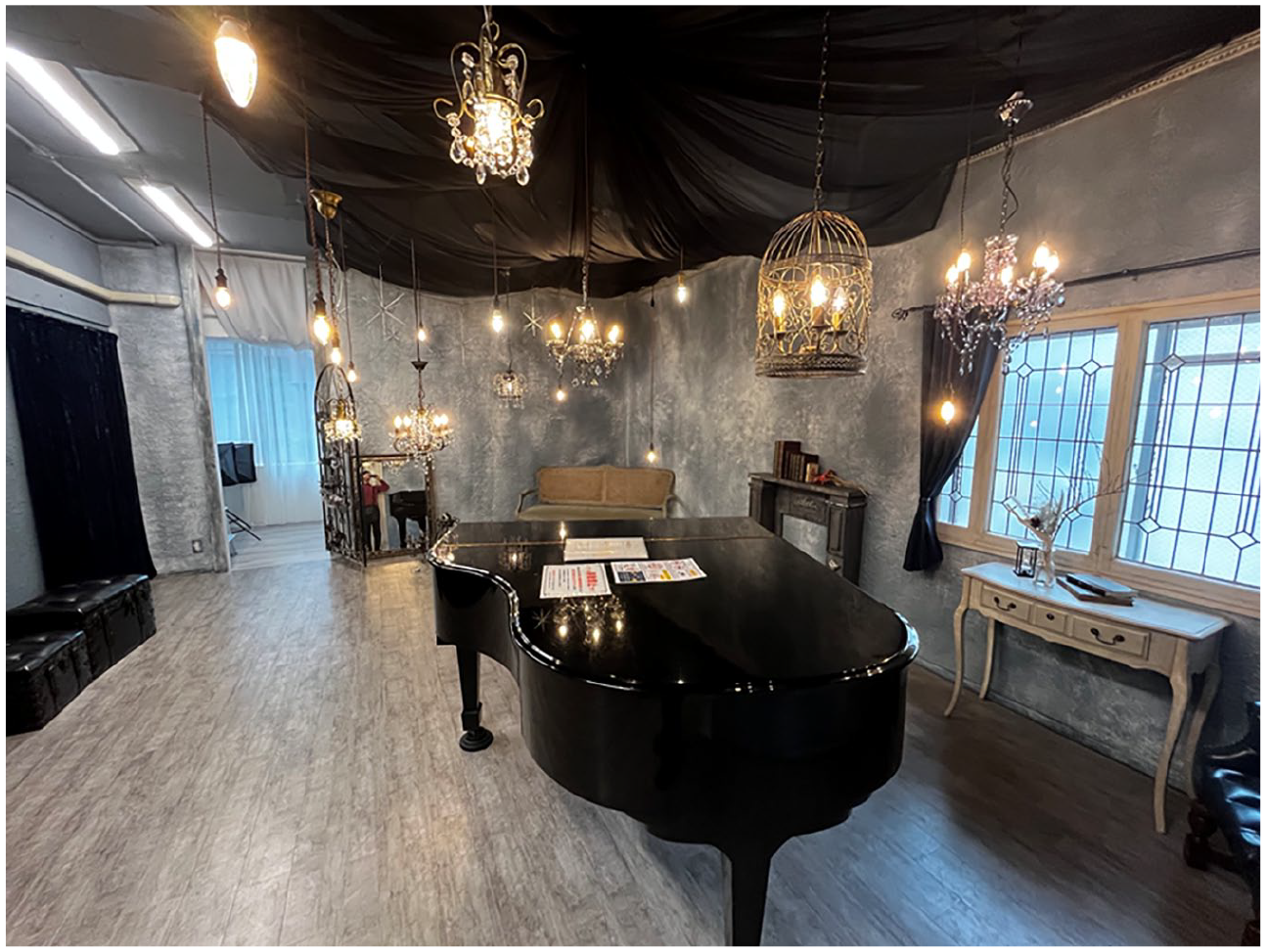
A studio room at COSTUDIO, with multiple chandeliers hanging from above. Photo by author.
The use of cosplayers’ wits is what differentiates COSTUDIO from other studios I visited. On the positive side, Mitsuru and other managers provided Seiko with both the freedom and sufficient material resources to exercise their creative agency. Such freedom results in unique, heterogenous studio rooms that do not fall into specific tropes or categories, other than the vague atmospheric concepts of ‘dark, gothic-like’ and ‘cute white’ mentioned by Mitsuru. On the flip side, however, Mitsuru was also essentially making use of Seiko’s prior experience as a cosplayer and studio user, as well as her unique taste developed through cosplay experience. Additionally, according to Seiko, she was also hired because she can easily understand the terminology her cosplayer/otaku customers use, along with technical, photographic terms like ‘strobe lights’ (sutorobo) and ‘stands’ (sutando). These reasons for Seiko’s employment indicate that the ‘insider knowledge’ and cosplayers’ unique aesthetics were used by COSTUDIO for effective communications with the target users of studio rooms.
In addition, high-quality cosplay photos are also occasionally used for marketing purposes. Cosplay photos serve as both objectified cultural capital to evaluate cosplay quality and crystallised forms of cosplayers’ skills in costume-making, make-up, role-playing, photography and editing. As one of the ‘end products’ of cosplay culture, cosplay photos may also carry emotional meanings for individual cosplayers, such as remembrance of fun with friends (Koarai, 2019). However, rental studios are able to inject advertising messages into cosplay photos in multiple ways. COSTUDIO, for one, would ask users to send their cosplay photos using COSTUDIO rooms as backgrounds. The studio would then use these photos as sample portraits on their official websites and reward cooperative users with coupons for COSTUDIO. SPS, which primarily focused its marketing efforts on social media, would often collaborate with ‘famous cosplayers’ with thousands to tens of thousands of followers on platforms like X and TikTok. SPS would allow famous cosplayers to use one of their studios for free once, in exchange for these cosplayers posting the names of studio rooms and SPS’s URL alongside their cosplay photos or short videos posted on social media.
However, SPS was not only using objectified cultural capital (manifested by high-level cosplay photos) for advertising. It was also utilising famous cosplayers’ online social capital. Different from Bourdieu’s (1986) concept of social capital consisting of resources and benefits generated from social networks, online social capital refers to both benefits generated by connections in cyberspace and digitised online fame and influences measured by likes and followers (Rouse and Salter, 2021). Compared to offline social capital, which takes longer to establish but fosters deeper interactions, online social capital is quickly accumulated on a larger scale but consists mostly of weak ties and shallow interactions (Jabeen et al., 2020). These features enable cosplayers to monetise online social capital by turning weak ties into fans, selling merchandise, and attracting sponsors, including place providers (Rouse and Salter, 2021). By having their studio rooms endorsed by cosplayer influencers, SPS incorporates marketing activities into cosplayers’ everyday social practices of accumulating online fame and interacting with online cosplayer friends. Still, despite the advertising intent, Mitsuru from COSTUDIO articulated that cosplay photos on webpages and social media can also be helpful for cosplayer users as they provide references for cosplayers to decide whether to book a studio.
As for location services, while Naruki’s service only gathered locations from interested owners, another location service called Akoroke also collects information about potential locations from cosplayer users via an online form. 3 According to the online form, Akoroke asks cosplayers to report places they want to cosplay in but are unsure if they are permitted to use. Akoroke will then negotiate with the owners to see if these places can be used by cosplayers. Here, cosplayers’ original practice of independently exploring places is partially restored by the company’s business strategy, but the negotiation process is still taken over by Akoroke. Unlike individual cosplayers, who share locational information with peers and the cosplay community, Akoroke rebrands the locations into commodities able to be ‘browsed’ and ‘booked’ through their mobile app and website. In addition, unlike Naruki’s service, which only predicted what places cosplayers would like based on franchises and themes, Akoroke attempts to make use of cosplayers’ aesthetics to discern and confirm places that would potentially be well-received products. In this way, cosplayers’ creative agency remains unexploited, but their tastes and imaginations are utilised for the location service to get a better aim at its target consumer demographics.
Still, this final process of using cosplayers’ social and subcultural capital for business strategies does not imply that subcultural and online social capitals in subcultures are woven into the broader narrative of class society. This is because no cosplayers have achieved social mobility or distinction through being employed by or cooperating with rental studios or location services. The process does, however, indicate that subcultural and social capital is no longer manifested and used solely within the cosplay community. Instead, the integration of cosplay culture into the market mechanism also involves cosplayers’ direct participation in or indirect contributions to the relevant industry. This also means that the exploration of locations, and the construction and marketing of studios, involve the participation of cosplayers at various stages, rather than being dictated by managers and owners. To some extent, the industry of spaces for cosplay is jointly created and developed by both place providers and cosplayers. Nevertheless, this joint production of cultural meanings also suggests that studios and location services are essentially using veteran or famous cosplayers’ tastes, knowledge and fame to predict and control the consumer behaviours of other cosplayer users.
Implicit/Explicit Co-Creation and the Resultant Ambiguity
In the end, spatial meanings are co-created by both place providers and users. This co-creation is actualised by three aforementioned processes: place providers predicting cosplay genres and behaviours, cosplayers’ creative agency surpassing these predictions, and place providers using cosplayers’ knowledge, taste and online fame to enhance and promote commodified spaces for cosplay. In this section, I argue that these processes are made possible by two underlying rationales that eventually result in the co-creation of cultural meanings in both implicit and explicit ways.
The first rationale concerns place providers’ relative lack of knowledge about cosplay culture and a lack of interest in controlling every detail of cosplayers’ practices. The prediction of cosplay genres is still largely based on the ‘source texts’ of cosplay as a fan culture, rather than on data-driven market research that big companies would commonly employ to determine what cosplayers like. This flawed strategy results in cosplayers’ creativity being able to penetrate the net of predictions through practices like mismatches between predesigned themes and actual cosplay genres. Place providers’ lack of knowledge is also reflected by the fact that certain studios resort to cosplayers’ insider knowledge for designs. COSTUDIO, for instance, was actually a subsidiary of a cosmetic company trying to tap into the cosplayer demographics. Venturing into this entirely new industry, the four managers assigned by the parent company chose to employ cosplayers as operating staff, since existing users of spaces for cosplay knew what they needed better than the inexperienced managers.
On the other hand, studios and location services are profit-driven and, as long as periodic KPIs (Key Performance Indicators) are met, have little interest in controlling every detail of cosplayers’ activities within the places they rent out. Instead, decorations and props are often set up in studios based on the providers’ assumptions about cosplayers’ needs. However, the actual usage is generally not a concern for studio owners, provided that no disorders (like damaged assets and loud noises) are created. Hence, due to their limited knowledge and interest, place providers, as profit-seeking entities, only partially control spatial meanings by designing and branding spaces. Cosplayers complete the rest of the spatial meanings by either resonating or contrasting with the providers’ predictions. These power dynamics between place providers and cosplayer users eventually constitute an implicit form of co-creation of cultural meanings. This implicit co-creation blurs the line between place and space, as both the cosplayers’ creative agency and the place providers’ prediction of cosplay behaviours give shape to the cosplayers’ actual spatial practices and the cosplay photos they produce.
The second rationale is associated with cosplayers’ willingness to collaborate with place providers. Both SPS and COSTUDIO have reported that cosplayers are a very cooperative consumer group, who almost always follow the rules, help tidy up the studio rooms, and return assets to their original positions after using the spaces. After all, deviance is not a core value of cosplay as a fan culture. Even back in the 1990s, cosplayers’ creative spatial practices did not deliberately seek to resist mainstream culture, but merely clashed with the dominant conservative values as a result (Winge, 2006). Nowadays, when cultural institutions treat cosplayers as a profitable consumer demographic and provide them with spatial means to meet their niche needs, the cosplayers I interviewed during fieldwork were willing to embrace the trend of spatial commodification for their convenience and their achievement of higher quality in cosplay. Some even showed off the photos they took at studios/locations to me, giving me details about what scenes they re-enacted and how they chose suitable studio rooms and backgrounds based on thematic connections to anime. Therefore, the intervention of commercial place providers in the cosplay community is welcomed and taken for granted in the first place. This explains why cosplayers are willing to report information about potential locations, provide photos for marketing, and even work in the industry of rental studios. Cosplayers’ direct cooperation with place providers’ projects thus constitutes a second, more explicit form of co-creation.
Different from implicit co-creation, not only does explicit co-creation generate an ambiguity of place and space, but it also suggests an ambiguity of cosplayers’ positionality. In Seiko’s case, she formed a complicit relationship with COSTUDIO. Her purpose, however, did not fully coincide with the corporation’s goal. While Seiko and her colleague had their own aesthetics and dreams about ideal spaces for cosplay photography, they could not actualise their thoughts before joining COSTUDIO, as they were mere consumers of studios back then. Their current roles as studio designers and operators has provided them with a rare opportunity to monetise their subcultural capital. They have also gained the freedom and resources to exercise the spatial creativity they used to long for as consumers. Then again, when Tanaka (2023: 142) interprets the utilisation of cosplay/popular culture knowledge for career enhancement as cosplayers’ ‘secret exploitation of the capitalist economic system to maintain [emotional] free space’, rather than the ‘subordination of individual abilities to capitalist economy’, Tanaka misses one point here. As exemplified by COSTUDIO’s case, Seiko’s freedom was not earned by any secret struggle but granted by the powerful corporation due to the managers’ lack of knowledge about cosplay/popular culture. This process of endowment rather than struggle suggests two problems related to ambiguity. First, the positionality of cosplayers cooperating with place providers becomes ambiguous. These cooperative cosplayers gain more advantages and freedom than other cosplayers when practising cosplay, but they also become part of an industrial process that seeks to predict and control the spatial meanings and experiences of other cosplayer consumers. As a result, these ‘double agents’ belong to both the cosplay community and the industry that profits from the community. Second, similar to the place/space ambiguity generated by implicit co-creation, if a cosplayer participates in the production and/or branding of a place using their prior cosplayer experience and online social capital, the resultant place itself has features similar to a practised space. In particular, although the resultant place is based on place providers’ intention to enhance the commercial values of spaces for cosplay, it is also produced/discovered/promoted by ‘fellow’ cosplayers active in the cosplay fan community. These insiders of both sides help other cosplayers to discover, evaluate and utilise a larger variety of spaces for cosplay photography and gatherings than ever before. Their efforts thus render studios and locations both spaces practised by fellow fans, and places produced and marketed by the industry.
Fourteen years after the theory of place and space (de Certeau, 1984), de Certeau (1998) warned about the ‘industrialisation’ of tools. He explained that while users employ their own ‘tactics’ to use tools and goods in ways that evade the system’s ‘strategies’ for ideological control, the system can develop more complex tools and goods to offer greater convenience (de Certeau, 1998). With a lack of resources to understand and manipulate the intricacy in their own ways, users lose their ability to exercise the same kind of creativity they used to show when using older, less complex tools (de Certeau, 1998). Nevertheless, in the case of commodified space for cosplay, users develop new tactics that co-exist with (rather than evade) newer, industrialised strategies used to partially control their creative behaviours. Cultural institutions also consult users’ insider knowledge to design convenient tools and market their products, resulting in the situation of users working for/with the institutions. In the end, I argue that cultural meanings are co-created by cosplayers and corporate place providers in two ways. First, the power dynamics between place providers trying to predict cosplay genres and cosplayers occasionally exceeding prediction constitute an implicit form of co-creation. Second, place providers’ utilisation of cosplayers’ knowledge, creativity and online social capital for the production, exploration and branding of places constitutes an explicit form of co-creation. Both forms of co-creation blur the boundary between the concepts of place and space in de Certeau’s (1984) theory. Explicit co-creation also complicates the positionality of cosplayers collaborating with the industry.
Contributions and Future Research
Despite the small scale of this study, my findings contribute to two areas of study in cultural sociology. First, the co-creation of cultural meanings has been extensively discussed in research about cultural organisations and their audience across both physical and hybrid realms (Ciasullo et al., 2018; Hudson et al., 2017; Simon, 2010; Walmsley, 2013). Previous studies have tended to emphasise co-creation based on cultural organisations’ inclusive practices that empower users to participate in the production of cultural meanings (Hudson et al., 2017; Walmsley, 2016). In this study, I discovered similar cases of such explicit co-creation, exemplified by place providers utilising cosplayers’ cultural and social capital for the production and marketing of commodified spaces. However, I also suggested a more latent form of co-creation based on the power dynamics between place providers and cosplayers, manifested by predictable and unpredictable creativity. This notion of implicit co-creation has been implied in studies on museum visitors producing various individualised meanings by creatively interacting with exhibits (Simon, 2010; Stylianou-Lambert, 2017). Nevertheless, to achieve a thorough understanding of implicit co-creation, further research is needed to examine cultural organisations’ prediction and expectations of user behaviours, and the extent to which users’ practices surpass or align with cultural organisations’ expectations.
The second area of contribution concerns the issues caused by collaboration between corporations and prosumers (Toffler, 1980). Despite the promise of ‘consumer empowerment’ (Chatterjee et al., 2023), the cultural institutions’ use of prosumers’ knowledge and creative labour has been criticised as exploitation, alienation and the illusion of empowerment (Comor, 2011; Gill and Dorsen, 2024). Additionally, prosumers’ online interactive activities are also used by corporations for branding and advertising purposes, allowing corporations to benefit from cultural authenticity and align themselves with meanings created by cultural prosumers (Banks, 2022; Berthon et al., 2008). In this study, I discussed both issues by examining the use of cosplayers’ cultural and social capital in place providers’ production and advertising of commodified spaces. My findings generally reaffirmed Banks’ (2022) discovery of corporate branding based on alignment with values in Black culture by directing Black prosumers’ social media activities. Similarly, as rental studios use cosplayers’ photos for advertising on their website and social media, they also brand their spatial products as ideal for cosplay photography and inseparable from cosplay culture. On the flip side, some of my findings may stand in contrast to previous discussions on alienation. In particular, cooperative cosplayers are not entirely alienated from their creation. Instead, they form a more reciprocal relationship with place providers. Despite not owning the rooms they design and decorate, Seiko and her colleague could use the rooms they decorated for cosplay photography for free when they have little work to do. Providers of information about outdoor locations for cosplay also obtain an opportunity to cosplay in locations they dream of without worrying about back-and-forth negotiations with landowners. Therefore, future research may focus on specific conditions in which alienation and/or reciprocity are involved in corporations’ employment of prosumers’ knowledge and creative labour.
Footnotes
Funding
The author received no financial support for the research, authorship, and/or publication of this article.
