



Abstract
In times of major change, people reassess what is a valuable and, therefore, prideful achievement in the context of a new societal structure and culture. Our article challenges the traditional view of achievements and pride as purely individual experiences, arguing that pride has social and cultural sources and modes of articulation, which may shift dramatically during radical change. We find that people express pride in their achievements when they align with social structures of worth and when societal feeling rules confirm that pride is appropriate and justified. We demonstrate this by analysing four biographical interviews from two research projects with a similar methodology on the post-socialist transformation in Lithuania and in East Germany. By examining how people construe accounts of pride, we find that they express this emotion in recurrent narratives of hard work, notions of resourcefulness and agility, images of restructuring corporate structures, and constructions of ethnic belonging. Our findings reveal that while achievements often lead to pride, not all achievements are narrated with a sense of pride. Our contribution offers a novel, context-sensitive approach to this emotion by bringing together frameworks from cultural sociology and the sociology of emotions.
Introduction
In times of profound change, people reassess what constitutes a worthwhile achievement. Although achievements are often associated with personal effort and often give rise to individual pride, we argue that pride is a thoroughly sociocultural phenomenon. Pride is commonly studied as an individual feeling or psychological state (Brady, 2017; Fischer, 2017), while cultural sociologists examine it at a macro level, for example, when studying national pride (Bonikowski 2017; Spillman, 1997). In this article, we argue that pride is articulated through social and cultural sources and propose a middle ground between individual and macro-level analyses by tracing the social facets of pride in biographical narratives.
As part of the special issue ‘Deep Transformations’, this article explores the emotional dimension of profound social, political, economic and cultural change. In order to scrutinize the idea that social context is inscribed in the articulation of pride, we embed our inquiry in a comparison of two different contexts in which people underwent similarly drastic changes: The Lithuanian and the (East) German transformation experience, the transition from Communist-party rule to market democracy after 1989/1991. In each case, we juxtapose biographical interviews of two individuals and explore how they recall these changes, how they describe the achievements decades after the events of 1989/1991, and how these relate to pride. More specifically, we seek to understand what and why people consider their achievements to be worthy of pride.
The analysis reveals that pride is not solely derived from a triumphant, success-based, individual-centred life story. Instead, it is expressed through embedding individual biographical experiences within larger systemic changes. We uncover recurring narratives of hard work, notions of ingenuity and agility, images of the restructuring of corporate structures and constructions of ethnicity as elements of pride. People derive accounts of pride in different ways and talk of continuity and resilience, even when many of the changes they have experienced have been disruptive. Based on these findings, we propose that the emotion of pride is a genuinely relational narrative that only acquires meaning in a sociocultural context and cannot be analysed without understanding it.
Our study shows that there is a dynamic interplay between ‘feeling rules’, as defined by sociologists of emotions and ‘structures of worth’, a concept from cultural sociology. This interplay illuminates the processes of re-evaluation, comparison and redefinition of societal pride following large-scale social change. The analysis thus extends beyond the dominant psychological focus on pride and beyond the preoccupation with it (only) as a counterpart of shame in the emotion sociology (e.g. Scheff, 1988), rendering it more accessible to cultural and sociological analysis.
Theory: Narrating Experience of Pride
The largest body of research on pride comes from psychology. Richard Lazarus has defined pride as the ‘enhancement of one’s ego-identity by taking credit of a valued object or achievement, either of our own or that of someone or group with whom we identify’ (Lazarus, 1991: 122). Thus, pride occurs only when there is a relationship of belonging (possession or identification) between a person and something valued (Taylor, 1985) that fosters their identity (Tracy et al., 2010) or allows for the satisfaction of personal ideals (Fischer, 2017).
In conceptualizing pride, one of the major debates relates to the role of active pursuit of achievement in it. The agential view of pride (Brady, 2017; Kauppinen, 2017) argues that pride only occurs when an individual feels responsible for a specific accomplishment (Fischer, 2017) and expressed when this agency is manifested (Smith and Ellsworth, 1985). Brady (2017) questions the notion of pride as a feeling that arises only when a person acts and takes responsibility for the achievement(s). According to the reduced-agency approach to pride (Fischer, 2017), people may experience ego amplification due to factors beyond moral responsibility, such as background, ethnicity, or family history.
Although psychologists tend to think of pride as an individual-level phenomenon, they also concede that this emotion is deeply entangled with social and relational dynamics. Pride is often driven by ‘personal subjective evaluation of status’, where subjective aspects like self-assessment and positive evaluation by group members hold more importance than objective status indicators such as earnings (Bolló et al., 2018). Therefore, individuals with fewer achievements might engage in comparing themselves with others (Salice, 2020). They could also try to expand their scope of possible associations with valued objects, people, or events to maintain their status level (Brady, 2017) or to improve their reputation and pursue a higher status (Anderson and Willer, 2014).
Emotion and cultural sociology offer limited if valuable insights into this topic. First, scholars consider pride, along with shame, as one of the primary emotions involved in societal regulation or conformity (Scheff, 1988). Since social status is a reward for prosocial behaviour (Kemper, 1987) and pride evaluates one’s success in fulfilling social standards, it may also be seen as a genuinely social and moral emotion (Lewis, 2008). Together with other moral self-conscious emotions, pride provides immediate feedback on our behaviour (Tangney et al., 2007). The pleasurable experience of pride may reinforce our values (Ben-Zeʼev, 2000) and indicate as well as confirm our perceptions of self as good, virtuous (Haidt, 2003) and honourable (Frevert, 2020).
Second, pride is only experienced when others recognize the achievement as worthy (Kemper, 1987). Thus, it is closely tied to social structures of worth, which reflect the dominant values perceived to exist in society. Cultural sociologists do not aim to define values in society as fixed and immutable, but instead ask how people relate and aspire to them in shared ways. Such collective modes of realizing values, imbued with their own meanings, give rise to structures of worth in specific historical and cultural contexts. These are variously theorized as structures of meaning (Alexander, 2003), competing orders of worth (Boltanski and Thévenot, 2006) or repertoires of dignity (Lamont, 2000).
Third, pride is also governed by societal feeling rules, or norms and conventions related to emotions’ expression, intensity, and duration (Hochschild, 1979). Feeling rules reflect society’s values and the emotional climate prevailing in society (de Rivera, 1992). They show which emotions are desirable and how they should be legitimately expressed. Although emotions might be officially prescribed by politics, and more so in totalitarian and authoritarian than democratic regimes (Verbalyte and Ulinskaitė, forthcoming), feeling rules are often not so rigid, forming part of collective memories and sociocultural repertoires (Frevert, 2020). Under Communist-party rule, feeling rules were explicitly articulated and strictly enforced – exemplified by principles such as ‘love of the socialist motherland’, ‘Brotherly solidarity to all workers’ (‘Moral Code of the Builder of Communism’, 1962). After the breakdown of state-socialism, feeling rules have become significantly more diversified.
Fourth, both cultural sociology and emotion sociology have engaged with the concept of national pride. Nationalism, in a broader sense, is ‘a heterogeneous set of “nation”- oriented idioms, practices and possibilities that are continuously available [. . .] in modern cultural and political life’ (Brubaker, 2004: 10). National pride, as long as it is domain-specific, is perceived as ‘the positive affect that the public feels towards their country’ (Smith and Kim, 2006: 127). However, a more general undifferentiated pride in one’s nation, which disregards whether it is right or wrong, and asserts superiority over others, is distinguished from pride and called hubris (Bonikowski and DiMaggio, 2016).
In times of radical change, the interplay between personal agency, values, and accomplishments, as well as social structures of worth and feeling rules related to pride, becomes increasingly complex. Several aspects of this complex relationship may change: the sense of personal agency may be limited due to withdrawn chances, status lost during the transition, and the worth of previous achievements diminished. Moreover, in such unstable and insecure situations, an individual’s capacity to orient themselves is significantly restricted. In post-socialist societies, the idea of ‘productive labour’ constitutes one important structure of worth that blends elements from the old and new systems (Hann, 2018; Hilmar, 2023; Wierling, 1996). Demonstrating hard work, incorruptibility, and dedication to (selective elements of) egalitarian principles effectively aligns one with this moral ideal. After 1989/1991, the spread of neoliberal ideas promoting meritocracy created the impression that hard work would be duly rewarded. However, many people found their expectations of social upward mobility unmet (Ghodsee and Orenstein, 2021). Although the value of ‘productive labour’ appeared to be transferable, it was often not rewarded by the new system, complicating the feeling rules associated with expressing pride. This complexity makes pride a particularly valuable concept in the analysis of societal change. While touching upon all these aspects, it helps us to understand structures of worth as realized in individual actions and personal achievements/agency in the social context.
In what follows, taking up a cultural sociological angle, we recognize the significance of individual agency in relation to pride but propose tracing how people engage in meaning-making around it (Polletta et al., 2011; Somers, 1994): examining the accomplishments or sources they cite for this emotion, and how they narrate their success or lack of it in the transformed society. In the following, we analyse two national cases, drawing on two biographical interviews in each, to offer a contextually rich approach to this issue.
Research Context
To examine pride during periods of radical change, we focus on the post-1989/1991 transformation following the collapse of the Soviet Union and analyse interviews from two countries with both similar and distinct trajectories of change: the former GDR (German Democratic Republic) and former Sovietized country Lithuania. While Lithuania regained its national independence after decades of Soviet domination and repression in 1991, the GDR was officially dissolved when reunited with the Federal Republic of Germany in 1990.
In the post-socialist world, deindustrialization and manufacturing decline led to the dismantling of old economic structures (Berend, 2009; Ther, 2016). While privatization improved enterprise competitiveness globally, it also caused significant labour market upheavals, unemployment and socio-economic disparities (Ghodsee and Orenstein, 2021). Before the collapse of Communist-party rule, employment was guaranteed, and working at state-owned companies provided citizens with basic social and economic rights and benefits. Despite economic challenges in the 1980s, pride in work was a value of social integration (Lampland, 1995; Wierling, 1996). This emotional bond with work shaped people’s transition after 1989/1991, with work morals evolving into deservingness criteria in market society (Hann, 2018; Hilmar, 2023). Until today, work has retained a higher significance in post-socialist societies compared to other European countries (Sawicka and Karlińska, 2021).
Infused with competition and the ideal of meritocracy, the new social and economic order in post-socialist countries increased the pressure on individuals to take responsibility for their success (and failure) – a fertile ground for agential pride. In Lithuania, the shortage economy under communist rule created an environment where the constant search for opportunities in economic relations was necessary (Rehn and Taalas, 2004). With the transition to a market economy, such skills allowed people not only to survive but also to realize their desire to own a business (Aidis et al., 2007). However, even with the strong cultural allure of entrepreneurship at the time (Pehe, 2022), the decision to start one’s own business was often fraught with challenges. Founding one’s own business during this time proved to be a successful long-term economic strategy only for a small number of people (Róna-Tas, 2002; Saar and Unt, 2006).
However, there are substantial differences between the national contexts. For Lithuania, the collapse of the USSR meant first and foremost the restoration of an independent state, which explains why Lithuanians are less nostalgic about the communist regime and have the lowest appreciation of the socialist economy of any post-socialist country (Ekman and Linde, 2005). The ‘return to the West’, that is, EU and NATO membership, was a unifying factor for the political elite and a mobilizing factor for society (Ther, 2016). The West was seen as clearly superior (cf. Ramonaitė et al., 2007), as something to envy, and the capitalist system was accepted as the only alternative (cf. Kaźmierska and Waniek, 2022).
Nevertheless, the economic downturn has been severe and the route to prosperity (and security) long. The decline in living standards and unemployment were perceived as the most important problems, while the government was expected to regulate prices and provide employment for all (Jankauskas, 2002). Support for state regulation is paradoxical in a society where 73% of respondents preferred freedom to equality (Adomėnas, 2007), and where public solidarity with the unemployed was the lowest in Europe (van Oorschot, 2006). The disillusionment with the liberal economic policies was high on both sides of the political spectrum, while economic inequality was rising, especially in rural areas (Jankauskas, 2002; Norkus, 2008).
In Germany, the relationship between East and West Germans is convoluted. German reunification, officially enacted on 3 October 1990, is often regarded as a political success story: East Germans were granted full legal and political equality with their western counterparts. However, the process also gave rise to profound dissatisfaction. In the early 1990s, the East German economy was radically restructured, and its industrial structure largely dissolved. Many of the East German major factories either went bankrupt or were allowed to fail. They were then sold to West German or international companies for a fraction of their worth, regardless of whether they were truly beyond salvage. The workforce, left jobless, was subsequently employed as inexpensive labour (Ther, 2016). Many East Germans define this economic loss in political terms, believing that the social and economic achievements of their former homeland were overlooked to promote a specific political narrative: the superiority of the capitalist democratic system over socialism. Many East Germans, who viewed themselves as hard-working and productive (despite the macro-economic challenges of the late-socialist period), felt anger and resentment due to the lack of opportunities for social upward mobility (Hilmar, 2023; Mau, 2019).
Moreover, the fact that West Germans assumed positions of power – holding elite roles in politics, the economy and culture – while Easterners remained significantly underrepresented in these spheres, and still do to this day, has engendered feelings of disappointment, resentment, and nostalgia. Many East Germans express feelings of humiliation and disappointment about the unification and a sense of being ‘second-class citizens’ vis-a-vis their West German peers (Wike et al., 2019). East Germans have also been confronted with a prevailing feeling rule in German society which has often labelled them as perpetual ‘complainers’ (Rippl et al., 2018), hence their ambiguous feelings about the post-1989 transformation were, for a long time, dismissed as illegitimate.
Against this background, exploring experiences of pride sheds light on how individuals craft their narratives in the context of uncertain trajectories of social mobility, the pluralization and recombination of feeling rules, and evolving structures of worth.
Interview Selection and Methodology
While cross-country interview research is still developing, we argue that the paired analysis of biographical accounts of the post-1989/1991 transformation can reveal how the individual narrative of pride is embedded in specific social, cultural, and historical contexts. We selected two interviews from each context: one set represents ruptures in professional biographies, and the other set reflects career continuity. We chose two interviews that entailed stories about the creation of new businesses to capture experiences of career change aligned with ideas about the emerging market economy. We juxtaposed them with accounts by individuals who maintained a close connection to their company, either by staying with the same firm or by working in a spin-off of their previous employer. We anticipated that different career paths (rupture vs. continuity) would give rise to different narratives of accomplishment and pride. However, the analysis revealed that it is not so much the presence of career continuity or rupture in the narratives, but rather how people make sense of their achievements within the broader context of structures of worth and feeling rules, that allows us to understand and interpret expressions of pride.
We compare interviews with the same focus conducted in two projects in Lithuania and East Germany. Although different interviewers conducted interviews at different times, they followed a similar methodology (biographical interviews that also included semi-structured questionnaires). The interviews on the Lithuanian post-socialist transformation were conducted in the summer of 2021 with interviewees who were at least 18 years old when the Soviet Union collapsed. The East German interviews are taken from a research project with 41 East German interviewees who were mostly in their early 20s in 1989. They were conducted in 2016 and 2017. For initial analysis, we translated all interviews into English with DeepL, with subsequent proofreading and corrections by native speakers of the interview languages. Next, passages involving pride were identified and all three authors closely examined them together to clarify any nuances potentially lost in the automated translation. The automated translations conveyed sufficient meaning to identify expressions of pride, and we think that these tools could therefore advance comparative interview research.
All the examined interviews are, objectively speaking, stories of relative success: none of our interviewees was unemployed for a longer period, experienced significant material losses during the transformation or had to drastically redirect their career. Although they underwent some serious changes, they stayed in their professional field. The four interviewees differ in terms of age and gender but share a higher education background (see details in Table 1). They belong to the same age group, which experienced the onset of the 1990s already as part of their professional lives. The gender dimension is made explicit in some narratives, but it does not seem to determine the articulation of pride in times of change.
Overview of selected interviews.
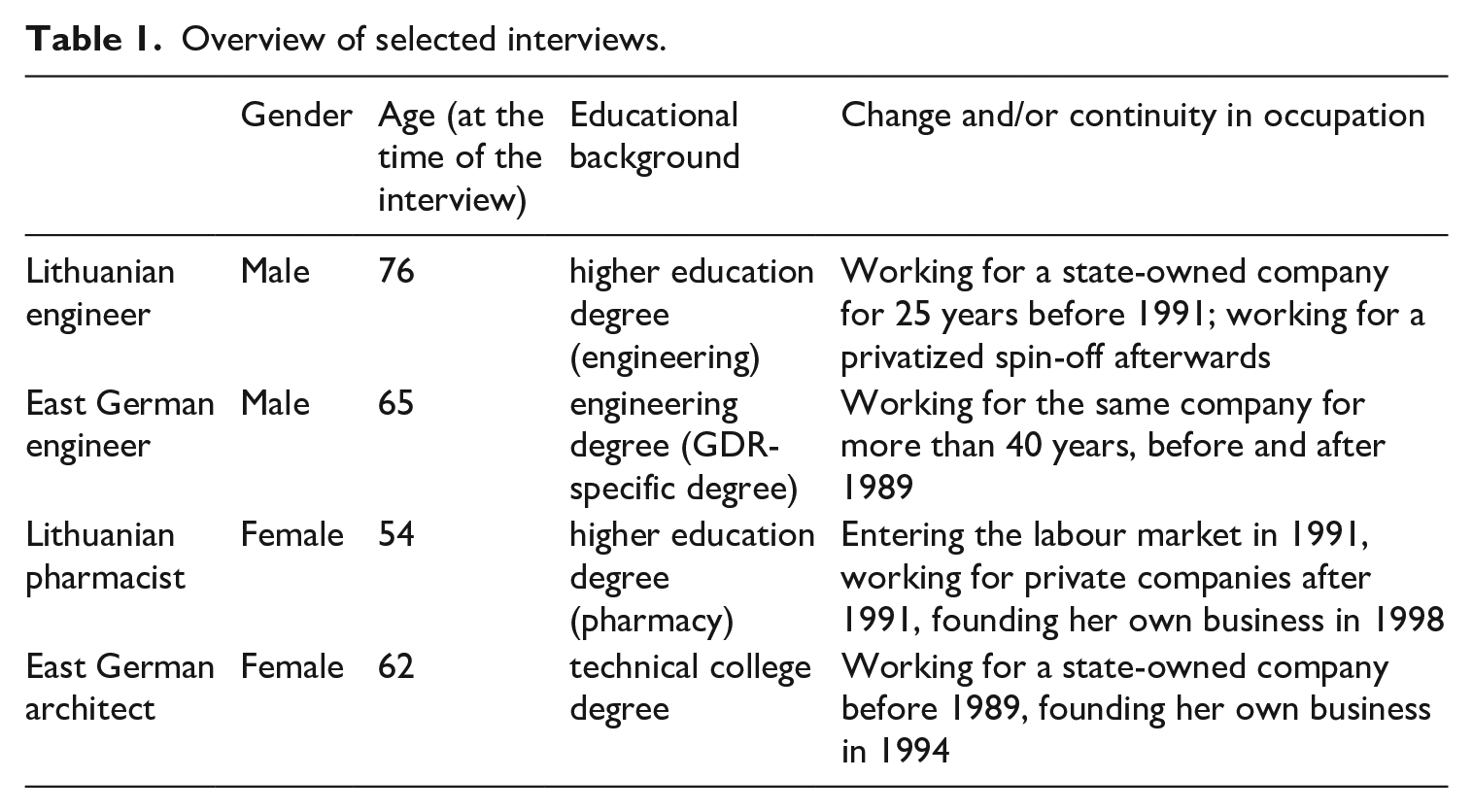
The interviews differ in how they make sense of life-course experiences through pride. Two female entrepreneurs tell stories about founding and successfully managing their businesses. Both stories suggest robust agency, effort and initiative. The East German architect and two colleagues ‘broke away’ from the old enterprise, which they saw as facing bankruptcy, to found a small independent firm. The interviewee stayed in the same field, and although she had to get acquainted with the new West German regulations and to prove herself to new clients, she succeeded. Similarly, the Lithuanian pharmacist and her colleague also decided to establish their own business following the closure of their previous workplace.
The two male interviewees offer different pride narratives, although their career paths are very similar. After the collapse of the USSR, the Lithuanian engineer started working in one of the private firms spun off from a large state-owned company. He used his former skills in managing large-scale projects to organize construction businesses in the oil-rich parts of Russia. Similarly, the East German engineer not only retained his position but even received a promotion during his firm’s radical downsizing after 1990.
We scrutinized the interview material keeping in mind the fact that, while people express pride to communicate social worth and achievements (Salice, 2020), they might not always do so in a straightforward, unequivocal way (pride may be alluded to, masked with humour, or intertwined with different emotions or narratives). Hence, all authors coded for expressions of pride across the interview material and then compared the coded parts. By doing so, we discovered that interviewees explain their achievements by referring to individual characteristics such as hard work, resourcefulness and agility and collective experiences such as solidarity in the workplace or national identification. We structure our results in the following sections according to these themes.
Results
The Importance of Hard Work: The Achievement Itself and the Means to Success
Professional activities formed a significant part of the narratives, with interviewees mentioning hard work as a particularly important explanation of their achievements. It served as a relevant structure of worth, allowing comparisons between more and less successful people, as well as between the previous and the current regime. The accounts of women entrepreneurs are particularly structured around the hard work of building a business. When describing the founding of her architectural office, the East German entrepreneur recalls that she had to make many sacrifices to keep up with the market requirements and her commitment to the firm. In later years, as she gained experience, the work became easier, but it was never a breeze for her: You have to deal with yourself when you embark on a new path, there is a tension, and over the years, you start to loosen up and really understand what you are talking about. But yes, the first years were [challenging], we have never had an eight-hour day, allowed ourselves very little vacation, and the family did take a bit of a backseat (laughs), yes, it is always how you challenge yourself: do I have these demands on myself, what do I want to achieve?
Although starting a business in a new economic environment required taking personal responsibility for success, she describes these conditions as opportunities rather than challenges of the unknown. The interviewee argues that constant self-demands and a focus on the goal have driven her success, ultimately leading to the most valuable achievements: personal freedom and independence.
We’ve managed to make it and are also happy about it, and also enjoy this independent work, we can close the door when there is unrest outside with the bureaucracy or with clients, and that does not affect us; we receive our tasks, get paid, are our own masters, that is simply a very, very nice feeling!
The phrase ‘our own masters’ is pronounced with pride, satisfaction, and agency. Yet, the pursuit of independence has not precluded cooperation with colleagues to achieve set goals. On the contrary, close partnership is described as a prerequisite for business success: ‘And when you go as a trio, you rise or fall together, right? That, and we’ve always pulled each other along’ (more on collaboration later in the article). Hard work is thus a shared experience, and mutual support is a necessary success factor. Sharing experiences also allows for sharing pride and confirms that achievements are worthy of pride.
The Lithuanian entrepreneur also builds her story on her dedication to work. The work, both in the pharmacy and back home, took up all her time and energy so that she hardly ever had a chance to catch her breath: The job was what we lived by. A shift at home, a shift at work. No, own business has consumed very much time, energy, and everything. I mean, I have never had such a holiday, to take a month off; I’ve never even had that in all these twenty-three years. And even now it’s not a holiday. We work every other day, and that’s all [. . .] We raised our children in that pharmacy [. . .] If my colleague will go somewhere now, of course, I will work that time. If I go somewhere, she will work that time.
As in the previous example, the pharmacy business was based on an equal partnership between two colleagues, allowing flexibility in scheduling working hours. Like the East German architect, the Lithuanian pharmacist emphasized that independence was an important goal, achieved by earning well enough. Yet memories of work rather than freedom dominate this narrative.
Ultimately, the most important achievement, apart from independence, was not the establishment of the business itself but its continuity for more than 20 years. This achievement is significant not only for economic reasons but also from a moral point of view. In the 1990s, questionable business practices were rife, and competition with large corporations and retail chains was fierce. The proudest accomplishment in the story is therefore not the profit but the ability to avoid opaque business practices.
We were working quite legit. No, we really did not want those things, to hide something, to cover things up. What would you hide if you had receipts? You know, maybe others used to work without receipts, where they used to buy goods for cash, they would go, load the car, not write receipts there, sell here. This is how the black business was [back then], and then much money came out of it for many.
The interview of the Lithuanian entrepreneur makes it clear that hard work is an alternative and legal path to success. This enabled her to reconcile her achievements with moral integrity and to make her pride justified both in regard to the societal structures of worth and personal values.
Two male interviewees also mentioned hard work as a source of pride. The Lithuanian engineer describes hard work as a sign of a certain ethical or moral attitude, contrasting it with the period under Communist-party rule when work was slow and morale low. During the transition to a market economy, high wage differentials and unregulated working hours motivated workers to work hard – the narrator did not have to recruit workers because ‘people came to us’. Although this motivation can be seen as a consequence of the collapse of the old (i.e. low unemployment) and the creation of a new capitalist economic structure, the narrator is proud of this achievement as his own. For him, as for the Lithuanian pharmacist, hard work is an alternative route to success, as opposed to shadow business, unfair competition, or racketeering. In a time of no fair competition, it is of utmost importance for both Lithuanian interlocutors to show that they have kept their moral values through hard work.
To summarize, narratives of hard work express agential pride when a person takes responsibility, puts in the effort, and achieves the desired result. With the change of regime, hard work became the generally accepted path to success, and personal values of the interviewees finally aligned with the societal structures of worth, allowing them to express pride in their achievements and to draw social boundaries to illegal or illegitimate ways to success (particularly for Lithuanian interviewees). Nevertheless, the actual experience was also complex, accompanied by reflections on the sacrifices of achieving independence and material gains (family life and free time).
Maintained or Acquired Resourcefulness and Agility
Defining the transformation as a major rupture requiring the sudden acquisition of new skills underestimates the fact that some people have developed the qualities necessary for a market economy under the Communist-party rule. The hard work discussed earlier was valued by our interviewees even before the transformation and has been given additional meaning in the new context. Resourcefulness and agility are other qualities also mentioned as essential in the new system but reflected on differently.
The record of the Lithuanian engineer’s achievements is underpinned by a narrative of agility and resourcefulness developed in the economy of scarcity. The post-socialist transformation gave him great opportunities to start a construction business in Russia. This logistical task of assembling a large group of workers (7–8 buses) to work in Russia is presented with pride, as an adventurous story about overcoming obstacles. This narrative of transformation echoes the emotional story of the struggle to obtain scarce products under communism: Although materials and products had to be calculated and allocated in a planned economy, as manager of a construction trust, he was responsible for obtaining the materials needed to build the plant: I used to take, listen, a banana and a tangerine to Lithuania from Moscow because they [retailers] were standing [selling] there in the Belaruskij vakzale [Belarussian market, in Russian]. [. . .] It was even more interesting to live in those times, really. [. . .] Paint, for example, you need paint [. . .] you have four hundred tonnes per million roubles of construction volume and you need one thousand two hundred tonnes. And you only get four hundred. So how can you build it?
Through connections, resourcefulness, and travel opportunities, he has obtained valuable products coveted but unavailable to others, thereby securing a higher status in society and a sense of pride. These skills, so useful in business, were acquired before the transformation and then applied under new circumstances to achieve success. Moreover, in a capitalist society where consumption became a means to demonstrate status, these earlier engagements began to align with structures of worth in society.
The pride in this agility is even more striking when comparing the stories from the GDR and Lithuania. The German engineer was content with a stable and relatively well-off life under communism: when he started work, the company sent him to an engineering school and secured him a job; later, guaranteed a good salary, with annual increases, low rent, long holidays and priority to an apartment. The transformation, with privatization and restructuring, created competition for him (3–4 people applied for one vacancy) and, therefore, meant an abrupt transition from stability to uncertainty rather than to an open field of possibilities, as in the previous interview.
Despite the downsizing, the interviewee maintained his job and was proud of his long service with the same company. He attributes his continued employment to luck and agility, a necessary quality to develop during that period, particularly evident when he lists the steps he took during the transition: It was definitely a question of qualifications, but it was also about being flexible and quickly adapting to the new situation [. . .] I pursued many qualifications; there was no other way. I was very lucky, but I must also say I also was very focused on this, but you had to, you could not hold yourself back in the transition – no one would have come, you had to be active and agile, and that actually went well.
In contrast to the previous interview, he argues that since these new skills can be developed by anyone, it is not only these qualities that make for success but also luck. The strong emphasis on luck throughout the interview signals that his achievements are interpreted as being outside his control. On the other hand, it can also be interpreted as a clash between a new structure of worth, where individual initiative and responsibility are seen as valuable and encouraged, and the old structure of worth with an emphasis on egalitarianism and solidarity.
In this part of the article, the focus on skills and specific individual characteristics has allowed us to compare different approaches to the transformation process. In the narrative of the German engineer, although some work-relevant skills and qualifications were brought from the previous regime, the new circumstances required to develop a new type of behaviour. In his account, a combination of agility, resourcefulness, and luck drove his achievements. In contrast, resourcefulness was a skill of the Lithuanian engineer developed and refined solely under the communist regime. These qualities became indispensable in the new economy when following his own interests aligned with the structures of worth, suggesting that even the most agential examples of pride are conditioned by the approval of society.
Solidarity in Accounts of the Restructuring of Corporate Frameworks
Narratives regarding the sources of pride are also linked to ideas about solidarity. This becomes evident once we examine how interviewees refer to the firms or corporate entities and structures within which they were active, as part of their economic biography. These references reveal ideas about solidarity, because stories about the fate of one’s company during the 1990s are enriched with ideas about how individuals position themselves, and their economic agency, in a wider social space. This kind of solidarity may be a source of pride.
The East German engineer’s story is instructive in this regard. As mentioned earlier, the large optical firm where he has worked throughout his professional life remains a primary source of pride in his account. In the way he articulates feelings of pride, they always appear to be nourished by social sources and frameworks more than by his personal agency. The company, as well as the employees working there, are the critical point of reference for him. Throughout his story, he narrates the fate of the company after 1989 by highlighting changes in the numbers of employees. He finds himself in the middle of a process of dissolution, but as an individual who is lucky enough to endure it – hence he commits himself to the task of chronicling the process of disintegration in a way that acknowledges the fate of those who were less fortunate. As he begins to recount the moment of the fall of the Wall, he immediately frames it in terms of the consequences for his company and his co-workers at the time: So, and then came the cut, the turn. Where everything changed after all. Of course, the combine disintegrated, the site [. . .] was reduced from 18,000 to 9,000, the rest were laid off or went into early retirement, then the total number of 9,000 was further reduced [. . .] There were now always 3 or 4 employees for a position, and I was actually always a bit lucky.
As observed earlier, throughout his narrative, he keeps on emphasizing that he was always ‘lucky’ to have been able to remain. It is possible to identify two dimensions of what we might call a company-centred pride in this account. First, he expresses a sense of achievement in relation to the products of the firm, praising their excellence before and after the system change. During GDR times, he maintains, the firm was already a leader in optical technology, exporting its products to various parts of the world. Despite the West German takeover and restructuring, and despite it having been transformed by financialization, he still feels proud of how the company operates, in terms of its superior products, its refined technologies, its advanced skill levels.
Second, and this is where feelings of pride and solidarity become truly interrelated, the interviewee expresses pride in the company as a social space. In the interview, he shares his very fond memories of his 40th anniversary at the company. This reflects not only social attachment, but also a more general understanding of what the firm, as a node of crisscrossing relationships, can do for its employees: As he argues, if employees can gather for drinks at work from time to time, this contributes to the ‘social cohesion’ among them. He considers this an achievement, also because it requires repeated commitment and care. Social rituals at work foster a sense of mutual respect and solidarity – while they were ubiquitous before 1989, they all but disappeared during the 1990s. This is a recurring theme in post-socialist nostalgia, which is often linked to the image of the firm as a ‘family’ (cf. Wawrzyniak, 2021). Importantly, the interviewee also has a personal and family connection to the firm: His grandfather was already employed there, as he proudly reports, and he has hopes that his grandchildren would do so one day, too. He also keeps a private archive of company documents at home, including photos and announcements about new technologies introduced during the 1970s. His personal historical archive is also a record of social events at the company like firm-sponsored anniversaries for senior employees. The kind of pride is grounded in the collective experience among co-workers as well as in his personal, family-based attachment to the firm.
The interviewee seems to be struggling with how to recount the disintegration of social and economic structures, with all the injustices that it entails, in a way that is appropriate and ethical. Importantly, this does not imply that his own agency was passive, that he was merely reacting to what others were doing or saw his fate as predetermined. His story is a story of active agency, but of a kind that is informed, motivated and made possible by other sources than his own ambition. He introduces the company, and the social ensemble that it used to represent, as another, deeper, collective space of agency. The value and the mode of solidarity, to him, emerges as the appropriate way to remember these unsettling changes.
The Lithuanian engineer, in contrast, does not recount the fate of his company as linked to the problem of solidarity. In his story, he invokes an overarching sense of dissolution, too, but the company itself does not play a major role, it appears as part of a broader narrative about the decline of old, Soviet-type economic structures. Yet he does not seem to associate the Soviet structures with any specific economic rationality or with a specific set of social functions. Similarly, the East German architect does not frame the disintegration of old corporate structures as a story of loss. In contrast, she credits herself with successfully creating a new structure amidst the declining old order. The fate of her former colleagues at the old disintegrated firm is not something that concerns her: She maintains that everyone was simply trying to ‘desert the sinking ship’.
Instead, this interviewee finds a sense of unity and solidarity in the act of founding a business together with her colleagues. Hence, her entrepreneurial story encompasses a moment of solidarity and egalitarianism, though it is applied only to a small group of people around her. A theme that she introduces in this critical moment is that of taking over responsibility – it is the very foundation of the ‘we’ in her narrative. According to her, the GDR economy was characterized by a division of labour in which no one ever took individual responsibility for the outcomes. Market society after 1989 was built on the opposite principle: ‘we were sent into responsibility, which we simply didn’t know in that form, and that was really difficult for us, I have to say’. But she and her like-minded business partners managed the transformation so well precisely because they understood what was at stake: That involves decisiveness, the readiness to take over responsibility. And we cover all phases such as construction, preparation of measures, planning, up to the supervision of the construction. We take on the full range of services and then hand over complete objects to the client, therefore we have grown quite fast in our responsibility!
The pride in her economic achievements is also linked to her identity as a woman, and more specifically, as an East German woman. Her entrepreneurial narrative post-1989 is a story of challenging a Western German business world dominated by men and proving herself in it. To achieve this, she leverages knowledge and resources gained during GDR times (‘we have received a very good education back then’), but she also fully arrived in a market society. In fact, in her story, this is not a contradiction: the values that were required to thrive after 1989 were the same ones that she had already held growing up as a woman in state-socialist East Germany. The reference to her gender identity in fact allows her to narrate this consistency over time: I have to say that this typical image of women was still a hindrance at the beginning [of reunified Germany], and you felt it many times, especially on the construction site, but with professional arguments you can convince everyone – reliability, professional competence, and adherence to deadlines were always our trademarks and we were able to assert ourselves quite well with them.
The ‘we’, in her story, refers to her and her female business partner. Together, they were confronting larger forces in society, and they succeeded thanks to their shared economic principles and their work ethic. She explicitly connects her gender identity to her professional identity, establishing a more authentic foundation of meritocratic, resilience-oriented, achievement-based ideals (cf. Cech and Blair-Loy, 2014 for similar findings on female engineers in the USA). This allows her to focus even more on economic performance and professional values, which inspire her biographical agency.
National and Ethnic Pride: Being Lithuanian and East German as an Achievement?
The boundaries of solidarity can also go beyond a specific group of people, or beyond enterprise, industry, or gender. Some interviewees connect their agency to an even larger ‘we’ – an ethnic belonging as well as civilizational identity. Before starting her own pharmacy, the Lithuanian woman was working in the company founded by the Germans: At the beginning, we thought that we sell very good things, later it appeared that other shops also [. . .] bring the same [products] and sell three times cheaper (laughs). [. . .] We started to have difficulties selling this stuff because the person [client] used to say: ‘Why does this toothpaste there cost this much and at your place it is twice as expensive?’ [. . .] It was simply quickly earning money and that’s all. Business.
This is an example of how anything that is coded as ‘western’ was – for some time, at least – considered to be of superior quality, something to be proud of and strive for. The interviewee’s personal perception of Germany was later challenged when she realized that it represented profit and capitalist business practices more than high standards of production. In contrast, in the Lithuanian imagination, Russia (‘the East’) has always been perceived as a political adversary, a view that often justifies treating Russian people as inferior. The Lithuanian engineer perceives Russians as ‘lazy’ and backward – he finds that they lack technological literacy, as well as culturedness. A few times during the interview, he mentions that ‘we’ – referring to Lithuanian builders – had constructed everything in Siberia because ‘they’ – the locals – were incapable of doing it themselves: God, what kind of workers (laughs). [. . .] They come before the start of work [. . .] and then they start to hold a meeting on [allocating tasks] [. . .] two and a half hours go by, so imagine – hours are wasted, and nobody is working (laughs). We were bringing everything from Lithuania [. . .] we transported bricks from Lithuania, we transported foundation blocks, we transported floor slabs from Lithuania five thousand kilometres.
He expresses a lot of sarcasm and disdain towards the newly rich in Siberia, who, despite their oil wealth, lacked basic civilizational amenities like theatres, sidewalks and new houses. Metaphorically speaking, the Lithuanians brought civilization to those distant regions of Russia through their buildings. In his narrative, Lithuanians are portrayed as superior also to other ethnicities, such as Uzbek builders (‘They plaster by hand’) and the Chechen mafia (‘One of them comes in, gives a wet hand, sniffing, scared, and sits down’): We lived much better here, so to speak, even though we had less money. They had money, but they lived very badly there. Well, there was nothing there, there was nothing there.
Here the argument becomes even stronger: ‘They’ lack not only civilization and building materials, but everything. ‘We’ have these amenities and are good builders, yet comparison with ‘backward’ Uzbeks and ‘lazy’ Russians puts a low bar for the achievement to be proud of. It appears to be a mere prototype of national hubris, but the interviewee also emphasizes hard work and cleverness over material achievements. Thus, through these kinds of ethnic comparisons, he differentiates mere possession of money from wealth earned through personal effort. This makes this comparison not only socially but also morally acceptable.
The situation in the former GDR is very different. As the German engineer puts it, West Germans think that ‘[East Germans] were lazy all the time!’ They seem to justify persisting wage disparities between East and West – a key element of East Germans’ feelings of disappointment – in this way. According to the interviewee, in the early 1990s, the new West German business owners often exploited the situation and paid people less than in the West, since there were so many unemployed people and always someone willing to work for less. He adds that in West Germany, East Germans were sometimes compared to migrants or refugees, in terms of being even cheaper than them. This comparison reflects the lowest status of East Germans in the social hierarchy.
The impression of being second-class citizens was reinforced after most of the managing positions in the companies were occupied by West Germans soon after 1989: ‘they were obviously considered more capable, more experienced or more cosmopolitan or so’. While the East German engineer is critical of how the privatization process after 1989 has affected his own company, he also avoids framing his experience of economic rupture primarily in terms of West Germany undermining the worth of East Germans, a narrative often found in East German public discourse. For example, he acknowledges the superiority of some western technologies introduced after 1989.
The East German architect, in contrast, offers a much more straightforward rejection of West German dominance. She finds that the relationship of West Germans to the East is still primarily characterized by ignorance: ‘They do not know it and do not want to get to know it’. And although her ability to convince West Germans that business ethics, not her gender, is what it comes down to, her narrative can also be interpreted as teaching West Germans a defiant lesson about what truly matters in market society. Additionally, because of this focus on success, she steers clear of being labelled as a ‘complaining’ East German.
Unlike the Lithuanian engineer, who firmly rejects Russia’s past or perceived superiority, the German interviewees tend to see certain advantages of the state-socialist system over capitalism. They not only show appreciation for the East German production, more solidary working environment (engineer), attained education and position of women (architect). However, the German engineer’s story, compared to the Lithuanian engineer and the German architect, more significantly revolves around the theme of broken solidarity. Like the other two, he was able to navigate the rules of the new system, but, because they clash with his own personal values, he feels restricted to fully embrace them.
in this form of society, those who elbow their way through and find someone to do tasks for peanuts also quickly work their ways up to become a boss or director.
Both German interviewees ascribe many of the problems in current society to the capitalist mentality. They remember people as less materialistic, more friendly, and community-oriented in the socialist society. Since unification failed to provide substantial grounds for a shared sense of German national pride, interviewees appear to derive sources of pride from aspects of the socialist system instead. Given that they were not the ones who lost the most during the transformation, the ambivalence displayed by German interviewees in assessing the system is surprising.
Conclusion
Although the breakdown of the Soviet Union deeply transformed an existing order of values (Ghodsee and Orenstein, 2021), the established sources of pride and paths to achievements did not disappear overnight. Together with the newly emerged structures of worth of market society, which emphasize personal success and individual achievements, they shape the stories that people tell about the post-socialist transformation. In this article, we argued that we need to look behind accounts of individual agency and reveal the complex interaction among different values of the past and the present. A way to do so is to move beyond the distinction between agential and reduced-agency pride and to foreground cultural constructions of achievements and pride in life stories. Analysing four interviews from two different national cases of post-socialist transformation, we delineate pride narratives when the emotion expressed entails a particular account of an achievement. Achievement is a prerequisite for the identification of pride, but not every account of achievement is necessarily accompanied by the expression of pride.
By exploring pride narratives, we find that, in both the Lithuanian and the German cases, people narrate their pride in achievements against the backdrop of the broader social context. More precisely, the renegotiation of the structures of worth and achievements after 1989/1991 takes place in a discursive dialogue with society, both past and present.
We identify pride in a number of different themes, sometimes in paradoxical ways. Hard work was mentioned by both new entrepreneurs and stable employees. In the Lithuanian interviews, it defined the boundaries between good business practices and illegal or shady ones. Resourcefulness and agility, associated with the market economy, were mentioned as having been acquired in the socialist system. Dissecting accounts about the fate of corporate structures after the system change, it becomes possible to recognize the collective dimension of the economic transformation as an important source of solidarity, and also pride in terms of company structures and workplace collective. Although influenced by different factors in the Lithuanian and German cases, ethnicity emerges as another source of collective pride (or lack thereof), with interviewees from both contexts invoking symbolic boundaries in similar ways.
Against this background, we suggest that when achievements align with structures of worth, and feeling rules confirm that the structures of worth can be legitimately invoked, pride seems to be not only more appropriate, but also a more intense emotion. Conversely, when structures of worth are perceived to differ from an individual’s values, the expression of pride becomes more complex. As we saw, in such cases, people may engage in the cultural work of construing pride ‘against all odds’: They refer to resourcefulness and agility as a source of pride, negotiating their sense of disconnection from a society that fails to acclaim their values, achievements and success. We saw this, for example, in entrepreneurial narratives about the transformation period where interviewees perceive a disappointment with market society and view their own achievements as more authentically aligned with market principles.
Our list of sources of pride and their interaction with structures of worth is neither exhaustive nor conclusive. Some works suggest that people might also redirect their values and pride into another domain (household and family instead of work achievements, see e.g. Pine, 2004). Some embrace new neoliberal values, lose the support of old structures of worth, fail and suffer (Waniek, 2022). However, the relationship between these strategies and the expressions of pride remains unknown and warrants further exploration.
Our analysis reveals why it is important to recognize, from the perspective of the sociology of culture and the sociology of emotions, how people narrate not only material deprivations, but also perceived mismatch between individual achievements and structures of worth. The articulation of emotions such as pride shapes the way they perceive and interpret social and political changes such as rising social inequalities after 1989/1991. Towards scholarship on culture and inequality, which has only recently become more attentive to the dynamics of history and memory (Savage, 2021), our findings demonstrate that people connect their agency in coping with macro-level changes to emotions such as pride. Therefore, our analysis is in line with current work in the field of wealth inequality (Waitkus and Wallaschek, 2022), which finds that the way people portray and narrate the sources of wealth crucially shapes what they regard as legitimate wealth inequalities in the present.
Finally, our contribution to the sociology of emotions lies in moving beyond the psychological understanding of pride and showing that the categories of agential or reduced-agency pride cannot encompass the variety of pride experiences in people’s narratives. Instead, pride is articulated in a language of values, social belonging, and ethnic hierarchies. This language is far from straightforward; it entails many contradictions and ambivalences. It demands greater attention from the sociology of emotions, which has so far predominantly examined pride as ‘the neglected sibling’ (Tangney et al., 2007: 360) of shame. This focus on negative emotions is a result of the negative bias in emotion research, as noted by Scheff (2014). Additionally, we have demonstrated that pride is an interesting emotion for analysis not only within social and cultural contexts, but also in the context of social change, as it reveals how people interact with new environments.
Footnotes
Funding
This research in Lithuania was funded by a grant from the Research Council of Lithuania (No. S-MOD-21-6).
