




Abstract
Musical activity in contemporary societies clusters in distinct ‘music worlds’, centred on such factors as style and/or locality. A number of studies have analysed these music worlds as networks of participants, linked in a variety of ways. This is useful but only captures some aspects of music worlds, neglecting others. In this article I introduce the concept of ‘event networks’ as a complement which allows us to capture much that ‘participant networks’ exclude. An event network is a sequence of events, such as gigs, certain pairs of which are linked by a flow of both participants (e.g. artists, audience members and support personnel) and the various resources and (evolving) conventions those participants carry with them. It forms an important part of the social structure of a music world and we can analyse it, empirically, using social network analysis (SNA). In the first part of the article I elaborate theoretically upon the concept of event networks and its significance in relation to music worlds. In the second part I develop this via an illustrative analysis of an empirical event network. The purpose of this analysis is to stimulate further discussion of event networks, of the interpretation of their properties and of possibilities for future analyses.
In this article I introduce the concept of ‘event networks’ and argue for its importance for understanding and analysing ‘music worlds’. An event network is a sequence of events, such as gigs, certain pairs of which are linked by a flow of participants (e.g. artists, audience members and support personnel, such as managers, promoters, producers etc.) and the various resources and subcultural dispositions those participants carry with them. It forms an important part of the social structure of a music world and as I demonstrate in the later sections of the article, we can analyse it, empirically, using social network analysis (SNA), thereby illuminating that structure (on SNA see Scott, 2000; Wasserman and Faust, 1994).
‘Music world’ is a concept I have developed from Howard Becker’s (1982) more generic ‘art worlds’ (see also Crossley, 2015, 2020; Finnegan, 1989; Gilmore, 1987, 1988; Lopes, 2002; Martin, 2005, 2006). It denotes a relatively cohesive cluster of musical interaction within the broader universe of such interaction in a society. Music worlds are generated and sustained through the interactions of their participants; interactions which, as Becker notes, serve as conduits for the exchange and pooling of resources, and which are coordinated by the orientation of their participants to (always-evolving) conventions.
A music world is, in some respects, akin to a ‘scene’ (Bennett and Peterson, 2004; Straw, 1991) or ‘subculture’ (e.g. Hodkinson, 2002). However, ‘subculture’ is less often used in music sociology today, having been subject to extensive critique (e.g. Bennett and Kahn-Harris, 2004; Huq, 2006) and I prefer ‘world’ over ‘scene’ because Becker’s (1974, 1982, 1995, 2004, 2006a, 2006b) strong and elaborate theoretical account compares favourably with accounts of scenes, which are conflicting and in many cases underdeveloped (Hesmondhalgh, 2005). There is much of value in the literature on scenes and subcultures, and in what follows I borrow from it to further develop the ‘worlds’ concept, but I will refer exclusively to ‘worlds’ hereafter.
Worlds often cohere around musical styles and/or geographical locations (e.g. the Manchester jazz world). However, they can cohere around other factors, including politics, organisational forms, commercial success and/or the demographics of their participants (e.g. feminist or DIY music worlds (Crossley, 2023; Deane, 2023; O’Shea, 2015). Moreover, they are not necessarily local. Some are translocal (with or without local hubs), most have a virtual aspect and some are entirely virtual (Bennett and Peterson, 2004; Emms and Crossley, 2018; Kruse, 2003).
Worlds can be conceptualised, following Becker (1982), as networks of participants playing various roles: e.g. artist, audience and assorted support roles. Several studies have used SNA to analyse them in this way (e.g. Allington et al., 2015; Crossley, 2015; McAndrew and Everett, 2015a, 2015b; McAndrew et al., 2015; Millward et al., 2017; O’Shea, 2015; Watson, 2020). This is important but such ‘participant networks’ are just one dimension of a music world’s social structure. ‘Event networks’ are another and they afford a different vantage point. They allow us to capture the processual, episodic and spatially dispersed nature of music worlds, shedding light upon their evolution and that of their participant networks. These points require elaboration.
Music worlds are social systems, constituted through the interaction of multiple social actors playing a variety of roles (namely, artist, audience and support roles). They unfold and evolve with that interaction. However, like many social systems they are episodic and spatially dispersed. Their constitutive interactions are not permanently on-going because their participants have other, unrelated needs, interests and roles to fulfil. Participants only come together for music-related activities some of the time. Consequently, music worlds are largely latent much of the time; a mere potential, dependent upon periodic collective action on behalf of their participants for actualisation. Regular participants revivify aspects of a world, simultaneously activating their own world-specific dispositions and identities, when a subset of them switch into their musical roles, coming together at particular times to rehearse, record, perform, watch others perform, listen to and discuss recordings, plan activities and so on (on ‘switching’ see Mische and White, 1998; White, 1995). Moreover, this often happens in varied locations, rendering worlds spatially dispersed. Sometimes the interaction constitutive of a world occurs ‘here’, other times ‘there’. These bouts of collective musical action are what I mean by ‘events’.
Developing this idea further, ontologically, a music world is a two-levelled structure, relationally constituted and always in-process. At one level it comprises the aforementioned events, instigated when participants switch into their musical roles and converge to do music together. At the other it comprises the structure formed by the flow of participants between such events, connecting them; a network of events or ‘event network’. This second level is my primary focus in this article but a brief prefatory discussion of the first would be instructive. For concision and clarity I will focus this discussion on the two event types I return to in my analysis later in the article: gigs and festivals.
Gigs and festivals are forms of collective action, driven by the agency of their participants. However, this does not preclude structure. Interactions often give rise to more enduring relations. Participants take on different roles. And as Becker (1982, 1995) notes, participants coordinate their contributions by orienting to (evolving) conventions, which lend their practices a regular and recognisable form. In addition, musical interaction requires resources of various kinds, which are unevenly distributed between participants, bestowing different opportunities and constraints upon them. And exchanges of resources and the interdependency they engender generate (im)balances of power which further structure the unfolding of events. Indeed, resources such as venues and equipment have their own structuring effects. For example, venue size limits the number of participants who can become involved in an event; venue layout affects possibilities for interaction (Fonarow, 2006; Small, 1998); and in conjunction with the raw materials from which a venue is built, both size and layout affect acoustics and sound quality, influencing both audience perceptions and artists’ musical choices (Byrne, 2012).
Structure is generated in interaction and any opportunities and constraints it effects exist for actors pursuing their aims. Moreover, resources take on meaning through the uses to which they are put in collective action. Liverpool’s Cavern, for example, famous for hosting the fledgling Beatles, was originally a fruit warehouse, whilst Manchester’s Haçienda, the epicentre of the UK’s late 1980s acid house explosion, was a yacht showroom. Both were unlikely sites for musical revolution, sacralisation and pilgrimage before they were appropriated and put to such uses, taking on new meanings, in collective musical action.
The structure of events is relational. It is constituted in the interaction between participants; in their joint orientation to (and modification of) conventions; and in their collaborative use and exchange of resources. Furthermore, because constituted in interaction this structure is always in-process. It extends and takes shape through time.
The events belonging to and constitutive of any given world are discrete. They have identifiable beginnings and endings, often occur in different places and may be separated by considerable periods of time. However, turning to the second level of structure referred to earlier, they are linked by flows of (subsets of) participants and the resources and subcultural dispositions those participants carry with them, forming what I have called an event network. An event network is a relational structure too. It comprises events and relations (i.e. flows of participants, resources and subcultural dispositions) between those events. And like the events which comprise its nodes it is always in-process. Few if any of the events comprising the network are simultaneous. Most are consecutive, forming a sequence across time.
The relational-processual ontology outlined here makes musicological as well as sociological sense. Music is social interaction (Becker, 1974, 1982; Crossley, 2020; Small, 1998). Indeed, musicologist, Christopher Small (1998), suggests that the word ‘music’ is best considered a verb (‘to music’), taking the present participle, ‘musicking’. And he insists that, even in its apparently most solitary forms, musicking mobilises social relations (Small, 1998, 201–206, see also Crossley, 2022). This conception complements the more general definition of music as ‘humanly organised sound’ (e.g. Blacking, 1973) and the related claim that organisation bestows meaning upon sound. ‘Sound’ is integral to this definition but unlike the vibrations which become sound within our experience, sound itself does not exist in the absence of listening and hearing. It is perception and thus activity dependent. Scores, recordings and other music-related objects make no sound in and of themselves. They are not music. They have to be played and, no less importantly, listened to, to give rise to sound and therefore music. There is no music in the absence of the activity of listening. Moreover, the work of organising sound and meaning-making begun by the composer (where it is) and performer is continued by audiences at every recitation. Along with composing and performing, listening is an activity which bestows organisation and meaning upon sound, and the work of organising sound and rendering it meaningful, even for scores and recordings long since ‘finished’, resumes on every occasion that they are played (Crossley, 2020). However, musicking is punctuated. Songs begin and end, as do LPs, playlists, live sets, gigs, festivals and so on. These beginnings and endings package musicking into distinct but connected events: an event network.
In what follows I elaborate upon the concept of event networks. In the next section I return to gigs and festivals, discussing what might be gained by analysing connections between them and the networks thus formed. This is followed by a brief reflection upon recent methodological developments which dovetail with what I am proposing. I then offer an illustrative analysis of an empirical event network, considering how such analysis might be conducted and what might be learned from it.
Gigs, Festivals and Event Networks
There is a growing literature on festivals and gigs which has illuminated many of their important facets (Bennett et al., 2014; Driver and Bennet, 2015; Fonorow, 2006; McKay, 2000, 2015; Shank, 1994; Sinclair and Dolan, 2015; Small, 1998). However, most of what has been written focuses upon what happens within the boundaries of a single event. To date, researchers have overlooked connections between events. Gigs and festivals are discrete events, bounded in time by beginnings and endings which are often ritually demarcated by dramatic entrances, openings, encores and finales. In addition, they are often concentrated within particular spaces, with barriers to exclude outsiders. However, these discrete events are connected by a flow of participants and resources. Artists, audience members and support personnel attend multiple gigs and festivals over time, connecting them and thereby forging a temporally extended network which impacts upon future events. These networks are important for a sociological understanding of music worlds.
Stylistically distinct worlds might be linked in this way. For example, folk musicians sometimes play at rock festivals and jazz enthusiasts might attend a classical concert. However, we would expect a greater volume and concentration of traffic between events belonging to the same stylistic world, such that worlds form identifiable network clusters. For example, we would expect two jazz festivals to share a higher proportion of artists and audience members than either would share with a rock festival. Likewise local worlds: we would expect a greater density of traffic between, for example, two jazz gigs in the same locality than between gigs in different localities. Preliminary work suggests that this is the case. The flow of participants is greatest between events centring upon the same musical style and/or locality such that different stylistic and local worlds form distinct clusters within the wider network of the ‘musical universe’ (Crossley and Emms, 2016; Emms and Crossley, 2018).
The flow of participants between events is important because it facilitates the reproduction of emerging interpersonal networks, encouraging collective identity formation, and because it creates channels for the flow of both resources and cultural conventions which distinguish and help to define a world. Ties forged at earlier gigs are renewed at later gigs and even where personal acquaintance isn’t established faces become familiar and reputations are established. Furthermore, conventions are established and reproduced as newbies learn from old hands, often going on to become old hands and role models themselves. Experienced audience members mobilise their know-how to generate a mosh pit or facilitate crowd surfing, for example, passing this know-how on to newcomers who learn through co-participation. Sound engineer, Dave Goodman, gives a flavour of this when recounting his time behind the mixing desk during a run of Sex Pistols gigs in London during 1976:
Fans would bring friends along. You could spot the newcomers by their initial apprehension and reluctance to join the pulsating mass in the front of the stage but, once they did, they experienced something that was really a new form of self-expression. The next week they would be back with a marked change in appearance and attitude, often bringing more friends with them. (Goodman, 2006: 19)
What is also apparent in this observation is the role of gigs in generating an enthusiasm for further participation that allows a world to survive and flourish. Collins’ (2004) concept of ‘interaction ritual chains’ is a useful point of reference for elaborating this point. Drawing upon both Durkheim (1915) and Goffman (1967), Collins argues that events such as gigs (though he doesn’t discuss gigs or music in any detail) generate high levels of ‘emotional energy’. There are many reasons why this might be so in relation to gigs, including the widely observed capacity for music to evoke emotion more generally (Clarke et al., 2012; Huron, 2007; Meyer, 1961; Sloboda, 2005). However, any such effects are amplified, according to Collins’ theory, by the interaction rituals of the gig. Gigs typically involve many types of ritual, from the formation of mosh pits and crowd surfing, through call and response sequences, to applause between songs and the drama of bands leaving and returning to the stage for encores. And at a more general level gigs exemplify the conditions which Collins (2004) specifies for successful interaction rituals, falling, in virtue of their intensity and large number of participants, at the ‘high’ end of his emotional arousal continuum. They involve (i) co-presence, (ii) separation from the wider world, (iii) a shared focus of attention, and (iv) a shared, rhythmically coordinated or ‘entrained’ response. Artists interact with audiences, who respond collectively, moving together, in time both with one another and the artists. Although he acknowledges that the same event may be experienced differently by different people, with different consequences, including deflation, Collins’ work, if applied to music, suggests that, for many, gigs generate a much valued and sought-after emotional high.
Collins’ focus upon rituals, collective effervescence and the esprit de corps they generate parallels that of Maffesoli (1996) and my appropriation of his work parallels those who have used Maffesoli to make sense of musical ‘tribes’ (Bennett, 1999; Riley et al., 2010). However, Collins pushes the idea further than Maffesoli, arguing that the emotionally rewarding nature of interaction rituals incentivises further, future participation, generating a potentially self-perpetuating feedback loop. Going to gigs of a certain type, for as long as it affords an emotional high, reinvigorates a participant’s desire for going to gigs of that type.
It follows from this that individual gigs are transformed by belonging to a network of gigs. Participants approach each new gig energised by the experience of its predecessors, anticipating and seeking a similar high and equipped with the know-how necessary (if not always sufficient) to make that happen. Individual gigs generate an energy which helps to perpetuate the network whilst simultaneously benefiting from the anticipation, enthusiasm and cultural innovations generated by those which precede them. Moreover, it is not only ‘emotional energy’ and its associated rituals that participants transfer between the events in which they participate. Other resources are transferred too. For example, the money generated by events contributes to the financial survival of artists and support personnel, enabling and incentivising them to continue their roles into subsequent events. Likewise, both artists and support personnel are perpetually learning on the job, acquiring skills and experience which they employ in subsequent engagements. Again, events are shaped by the network they collectively form.
Following Collins, we should add that energy transfer between gigs is enhanced by the emotionally charged symbolic significance which certain objects, practices and people take on as a consequence of their use or involvement in interaction rituals. The ‘high’ of the gig invests performers, band names, logos and so on with an emotional charge which sustains participants’ enthusiasm between gigs and contributes to the anticipatory excitement many participants bring to a gig. This charge wanes over time if the association between object and emotion is not regularly reinforced but in the context of interaction ritual chains it typically is, not least as old hands habitually draw upon such symbols in the course of events, simultaneously reinforcing their significance for themselves and creating it for newcomers. In addition, these symbols, along with familiar faces and rituals, bestow an identity upon the gigs at which they are observed, marking those gigs out as belonging to a distinct music world. No two gigs are identical but some feel as though they belong together in virtue of common symbols, rituals, participants and the collective emotional atmosphere they cultivate.
Collins’ concept of ‘interaction ritual chains’ focuses upon the individual, tracking their movement between ritual events which ‘recharge’ their emotional energy. My ‘event networks’ concept draws upon this idea but switches the gestalt, making events and in this case gigs and festivals in particular the focus and deeming their potential for emotional highs as one amongst the key incentives that draw actors, repeatedly, to them.
Erikson (2018) argues that the simultaneous interaction of multiple parties at some events is irreducible to the dyadic ties captured in SNA. We see this at gigs. For example, the formation and dynamics of the mosh pit cannot be reduced to dyadic interaction. This is important and gives us reason to treat events as irreducible units of analysis. However, the flows of participants, culture and resources which connect and transform events can be captured by way of SNA, as I show later in this article. Furthermore, whilst Erikson is right, her account is not the whole story. Dyadic ties remain important in relation to events in at least three respects.
First, gigs are what Feld (1981) calls network foci. They draw like-minded individuals into a shared space at a shared time to participate in activities centred upon their shared tastes and interests, thereby encouraging the forging of (one-to-one) ties between them. The history of popular music is replete with stories of artists meeting their future collaborators at gigs and music ethnographies frequently make reference to the importance (for participants) of friendships forged and reproduced at gigs, suggesting that the prospect of meeting up with friends only seen at gigs and festivals is often a key incentive for attending them (Dowd et al., 2004; Emms, 2017; Shank, 1994).
Second, as the literature on networks and collective action suggests, pre-existing ties, which may derive from interaction in unrelated contexts or from previous events, are often an essential precondition of mobilisation (Crossley, 2007). For example, events are usually organised, which involves prior communication and thus pre-existing relations between organisers. In addition, the probability of all forms of participation is higher amongst those who have ties to other participants (Crossley, 2007). Audience members are more likely to turn up to a gig, for example, if they know someone else who is going. And as the earlier quotation from Goodman suggests, they recruit further audience members from their wider friendship networks.
Third, participant networks constitute an always-evolving local social structure, formed in some part by meetings at focal events whilst also impacting upon the unfolding of events and how they are experienced. Participants may polarise in competing factions, for example, with some dominating performance spaces. And they may feel more comfortable and enjoy themselves more the better integrated in a local network they are. Julian Cope (1994) conveys some of this in his recollections of Eric’s, a celebrated Liverpool punk club of the late 1970s (see also Crossley, 2015). A subset of Eric’s regulars formed a self-appointed in-crowd which was ‘snobby, snotty’ in relation to its out-group, according to Cope (1994: 74). Moreover, they marked out their status and claim upon the club with interaction rituals:
At the bottom of the stairs, Peter Burns and Paul Rutherford were ensconced on their thrones, the territory of floor just before the main doors. They would sit there, sometimes with Lyn [Burns] and their young acolytes, and slag people off as they entered the club. (Cope, 1994: 32)
The existence of this in-crowd affected interaction dynamics and thereby experiences of gigs at Eric’s but it did not pre-exist its members’ visits to Eric’s. Most of the in-crowd met and forged ties at punk gigs at Eric’s. These gigs were foci which facilitated the formation and evolution of a network which, in turn, impacted upon interaction dynamics at subsequent gigs.
The salience of such local social structures is largely restricted to music world events and foci, including, in the Liverpool case, Probe, a record shop where the in-crowd hung out and, in some cases, worked (Crossley, 2015). An in-crowd is often only an in-crowd within a particular music world; that is, within very specific spaces and at particular times. It has no identity, status or authority beyond the boundary of a world. But it is important all the same.
Participant networks remain important for a full analysis and understanding of music worlds, therefore. The concept of event networks is not intended to displace them but rather to complement them. Each captures aspects of the structure of a music world not captured by the other. My focus here, however, is on event networks.
Analysing Event Networks
What I am attempting to capture with ‘event networks’ has some parallels in the SNA literature. ‘Two-mode’ network analyses which, building upon Breiger (1974), often capture patterns of relations between events and those who participate in them, and which Breiger aligns with Simmel’s (1955) conception of social structure, often bring ‘events’ into focus. Line graph studies, which track participation trajectories and flows of resources across time speak in some part to my concern with flows of participants and resources (Broccatelli et al., 2016). Mische’s (2008) use of Galois lattices to capture multiple affiliations and successive cohorts represents an innovative means of exploring participation across time. Finally, relational event models (REMs) explore sequences of interaction, and in the case of the very recent work of Lerner and Lomi (2022) on relational hyperevent models (RHEMs) this extends to modelling patterns of participation in different events across time (on REMs more generally see Butts, 2008).
However, none of these innovations are entirely suitable for my purposes. The focus on events in two-mode studies is often a means of deriving networks of actors (linked by the events they have co-attended), with little significance accorded to events themselves. And even where networks of events are analysed their temporal sequence and geographical dispersal, which are crucial to my conception, are not. Similarly, though line graph studies take important steps in the direction pursued in this article, they ultimately focus upon networks of actors. In contrast, I want to bring events and their connections to the fore. Mische’s work is important and has several parallels with what I am proposing but ultimately her focus is upon multiple affiliations rather than events. It is my contention that the event is sociologically important and should be a central focus of analysis.
The focus upon turn-by-turn sequences in interaction, characteristic of standard REMs, does not allow for the situation frequently observed in the data discussed later in this article, where one event is directly tied to multiple others. However, Lerner and Lomi’s (2022) RHEMs come very close to what I am discussing. They suggest a way of modelling the pattern of connection between successive events, constituted by the flow of participants between these events, taking temporal sequence into account. In particular, their model focuses upon such matters as the impact of early co-participation in events upon later participation. Though they do not offer the sociological elaboration or rationale provided here, focusing rather upon matters relevant to statistical modelling, Lerner and Lomi’s position closely parallels my own, and RHEMs could and in the future may be used to analyse event networks in the sense I have given to that concept. However, like many such models, and in particular models at an early stage of development, RHEMs are quite restrictive in what they can tell us. They address a limited range of questions and these are not always questions we are inclined to ask or questions with an obvious sociological relevance. Whilst I remain open to their use in the future, particularly as the range of questions they can answer expands, I suggest that any form of modelling is always best preceded by exploratory analysis. And for present purposes, exploratory analysis, which adapts existing SNA and statistical techniques, is the best way to approach event networks and is sufficient in itself.
Exploring Event Networks
To concretise my reflections and show both how an event network analysis might proceed and what it might yield I will offer an illustrative analysis of data which tracks the participation of 481 audience members and 201 bands in 148 underground heavy metal gigs/festivals, spread across six English cities, during three months in 2015. Data regarding events and the bands playing them were gleaned from a comprehensive search of websites, social media channels and email lists dedicated to underground metal. Data regarding audience participation were gleaned from an on-line survey distributed through these same channels. The cities and time window selected were identified as having a high number of gigs by several underground metal promoters consulted for the project (for further details see Emms and Crossley, 2018).
I begin by discussing the significance of a number of SNA measures, drawing out both the different network effects of festivals and ordinary gigs and the different patterns of connection forged by artists and audience members respectively. I then introduce time and space more fully into the analysis, reflecting upon their significance. Analyses and visualisations were performed using UCInet (Borgatti et al., 2002). All measures of statistical significance are based upon permutation tests and, where appropriate, UCInet’s quadratic assignment algorithm. 1
As a first step we can visualise our event network, with events represented by small shaded squares (‘nodes’ or ‘vertices’), linked by a connecting line (‘edge’) where they share participants. We could value edges, capturing the number of participants shared by pairs of events but precise values are unlikely to be reliable and would unnecessarily complicate what is intended as an illustrative analysis. To keep things straightforward, I will treat edges as binary; events either share participants or they do not.
With the exception of two isolates (i.e. nodes which have no connections), the events form a single network component; that is, each is at least indirectly connected by a path, comprising other nodes and edges, to all of the others. Path lengths can be measured by reference to the number of edges (referred to in this context as ‘degrees’) they involve. For example, if event i is linked to event j and event j is linked to event k then event i is connected to event k by a path of two degrees (i→j + j→k). Any two nodes are typically linked by multiple paths of different lengths but SNA is usually interested in the shortest of these, whose length is referred to as the ‘geodesic distance’ between the two nodes. The mean geodesic distance in the main component of Figure 1 is two degrees (like the foregoing example).
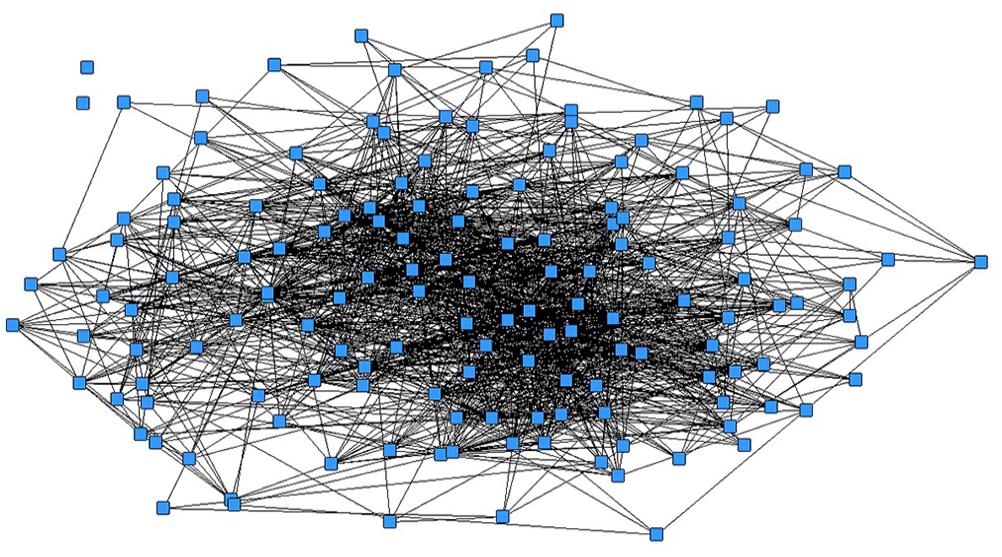
A network of events.
That our network forms a single component is important. 2 It suggests that the observed events attract many of the same participants and therefore belong together. Moreover, to return to a point discussed earlier, the involvement of the same participants in these events enables a transfer of resources and emergent cultural forms between them. The events are not independent because the movement of people between them generates channels of influence. This is one reason we would regard them as constituting a (single) music world. The mean geodesic distance of the network further supports this argument because it indicates that resources and new cultural innovations do not have far to travel to reach all other nodes, which in turn suggests that individual events in the network will be shaped by the inflow of such resources/innovations and thus by the network as a whole.
Another visually striking feature of Figure 1 is the increased density of connection towards its centre, which is suggestive of a core-periphery structure. Again, these properties can be systematically measured and analysed using SNA. ‘Density’ is defined as the proportion of all possible ties between a set of nodes that are actually observed. If each of our 148 events was tied to all of the others, for example, that would involve 10,878 (undirected
3
) ties. In fact we observe 1655 ties, giving a density of
The existence of a core-periphery structure is significant. The higher density of traffic between core events suggests their greater importance to participants. In addition, it indicates a greater possibility for transfer of resources (including embodied know-how and emotional energy) and cultural forms, while affording a greater opportunity for repetition and reinforcement of innovations which, in turn, might lead to the establishment of new cultural forms and conventions. Core events enjoy an elevated importance in a music world. This, in turn, indicates that music worlds and their constitutive event networks are characterised by inequalities. Some events are more important than others.
Flow Types: Artists and Audiences
The foregoing analysis captures the flow of participants, in general, between events but participants play different roles; chiefly, artist, audience and ‘support’ roles (e.g. promoters, sound engineers, managers etc.). Do these roles have a differential impact upon network structure? The data we are examining here includes both artists and audiences, allowing us to distinguish and compare the network each would generate on their own. For present purposes I will compare components/isolates, density and two further measures centred on path lengths: fragmentation and compactness. Fragmentation measures the proportion of pairs of nodes in a network not linked by a path. As such it is an important indicator of the potential for culture and resources to flow through a network. Compactness addresses a limitation of the otherwise useful notion of geodesic distance; namely, that some geodesic distances cannot be computed in networks with more than one component because members of different components are not connected by a path and are therefore technically at an infinite distance. Compactness circumvents this by using the harmonic mean of geodesic distance, calculated with reciprocals of original values (the reciprocal of n is
Table 1 compares these measures across the networks formed by audience and artist flows, respectively, and also the combined network. The results are revealing. Consider, first, components. When linked by the flow of audience members, the event network has two isolates, with all other (146) nodes forming a single component. When linked by the flow of artists the network has 26 isolates and the remaining nodes form 24 separate components, the biggest of which has only 42 members. This is a striking difference which suggests that audiences play a much greater role than artists in generating cohesion within this music world. What connects events, primarily, is the flow of audience members between them.
Artist and audience flows compared.
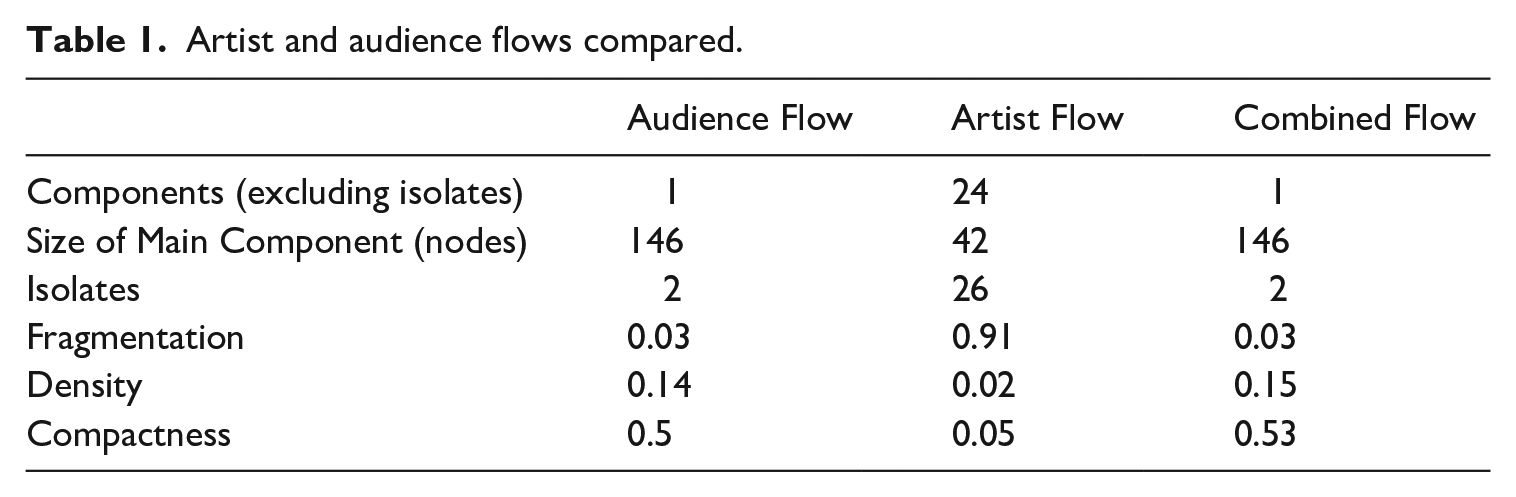
This is confirmed by the fragmentation measure. Only 3% of pairs of nodes are not connected by a path for audience flow, whilst the figure for artist flow is 91%. Again, this suggests that artists play a minimal role in linking events and facilitating a flow of culture and resources between them. It is primarily audiences who play this role. Likewise compactness which, to reiterate, captures distances between nodes, and thus the directness and efficiency with which culture and resources flow through the network. The difference is again dramatic. Where artist flows generate a compactness of only 0.05, the figure for audience flow is ten times higher at 0.5.
Finally, the picture is similar for density. The figure is much lower for the artist network. Artists connect far fewer events than audience members do. This may be partly due to the fact that there are more audience members than bands in the network, 481 to 201, and that many of the events in the network were one-off gigs, with many of the bands not touring and 150 of them only playing one gig. However, this does not detract from the significance of the finding.
Most SNA studies of music worlds focus upon artists, as do journalistic accounts, but the analysis just given suggests that it is disproportionately audiences who link the events constitutive of a music world, thereby both allowing resources and culture to flow between them and constituting them as a world. Artists are important, of course, as shared objects of attention and experience for audiences, but their involvement (qua artists) is occasional and it is audiences, rather, who lend cohesion and continuity to a world. It would be interesting to determine whether this is true of other music worlds. Moreover, further analysis might focus upon the contribution of other types of participants (e.g. promoters and sound engineers) to continuity and cohesion in worlds.
Event Types: Festival Hubs
It has been suggested in a number of studies that festivals and all-dayers (‘festivals’ hereafter) are key events in many music worlds and have an elevated status amongst audiences (Dowd et al., 2004; Emms, 2017; Hodkinson, 2002, 2004, 2012). Festivals afford an opportunity to listen to a large number of bands, including both old favourites and new talent, at a relatively low cost, and they concentrate this opportunity within a short time period. This makes them accessible and attractive to busy individuals on tight budgets, so much so that it encourages participants to travel further than they ordinarily would, beyond their immediate locality. In addition, they are valued because they afford an opportunity for making and renewing friendships, especially with others from more distant localities whom participants do not encounter at standard gigs (Dowd et al., 2004; Emms, 2017; Hodkinson, 2002, 2004, 2012). Festivals are key mechanisms for generating translocal interpersonal connections and thereby translocal worlds.
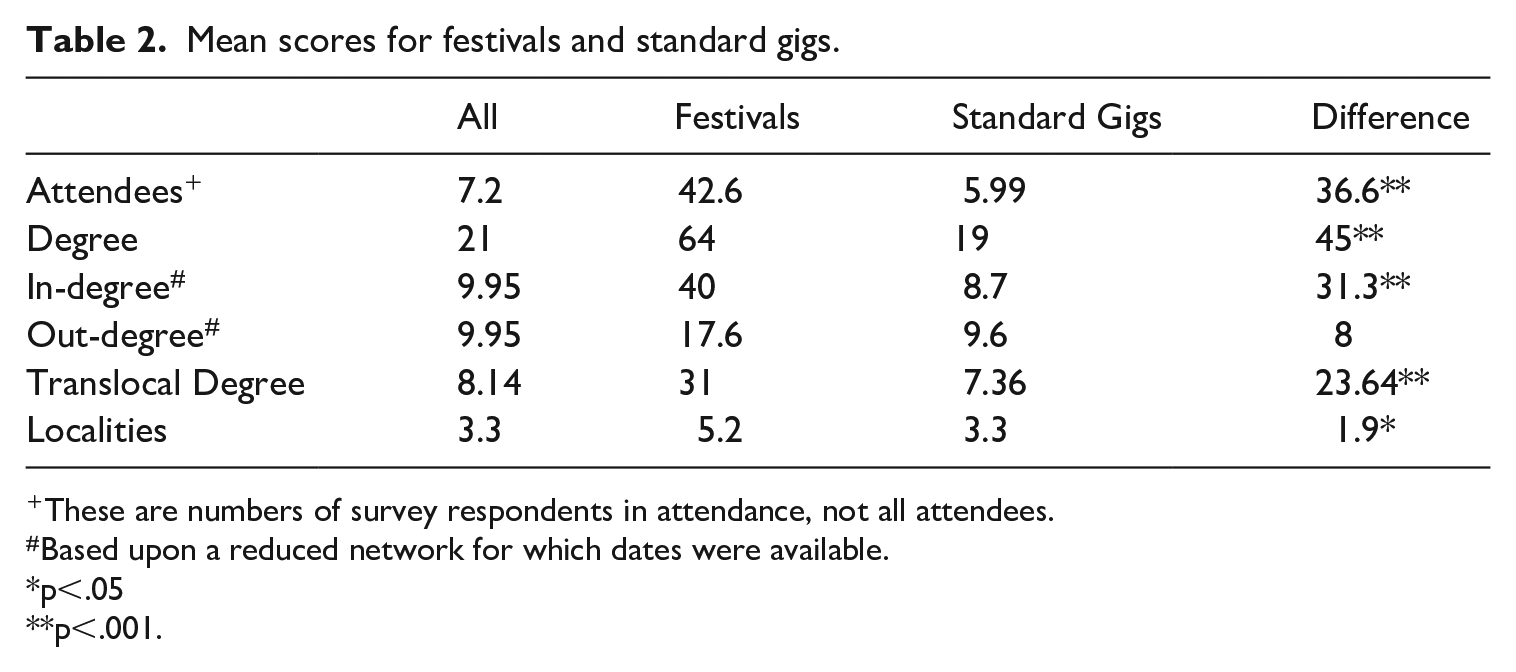
When they contain festivals, as ours does, event networks afford an opportunity to test these claims. If festivals enjoy the elevated status attributed to them in the previously mentioned studies we would expect that they would both attract a larger audience than standard gigs and enjoy a higher degree in the event network. ‘Degree’ is one of a number of measures used in SNA to identify more and less central nodes within a network. It comprises a count of the number of other nodes to which any given node is connected. In Table 2, we see that festivals do indeed score (statistically) significantly higher for both attendees and degree, confirming these hypotheses. We should also note that all five of the festivals in the network belong to the core of the network’s core-periphery structure.
Mean scores for festivals and standard gigs.
These are numbers of survey respondents in attendance, not all attendees.
Based upon a reduced network for which dates were available.
p<.05
p<.001.
To test the ‘translocal’ claim I computed the number of events hosted in ‘other’ localities to which each event was connected (‘Translocal Degree’) and the number of localities to which each event in the event network had connections (‘Localities’). In each case the figure for festivals was (statistically) significantly higher. The hypothesis is therefore supported. Festivals generate translocality.
Time and Space
I return to Table 2. Before I do, however, it is necessary to open up the spatial issues this discussion touches upon, and also time. The analyses given earlier are useful and interesting but they are limited because they analyse network structure in abstraction from time and space, which, I suggest, are key structuring features of event networks. Events are sequenced in time and this affects the possibility of flows between them. Likewise, they happen in particular places, whether on or offline. Event networks ought to capture these dimensions.
As a first step, consider the graph in Figure 2. This is a visualisation of the same network visualised in Figure 1. In contrast to Figure 1, however, it has defined x and y axes. The y axis measures time, in days, from the first day of the observation period. The x axis is an ordinal scale of ‘northernness’ which captures the city in which events occurred. In what follows I want to reflect briefly upon these dimensions.
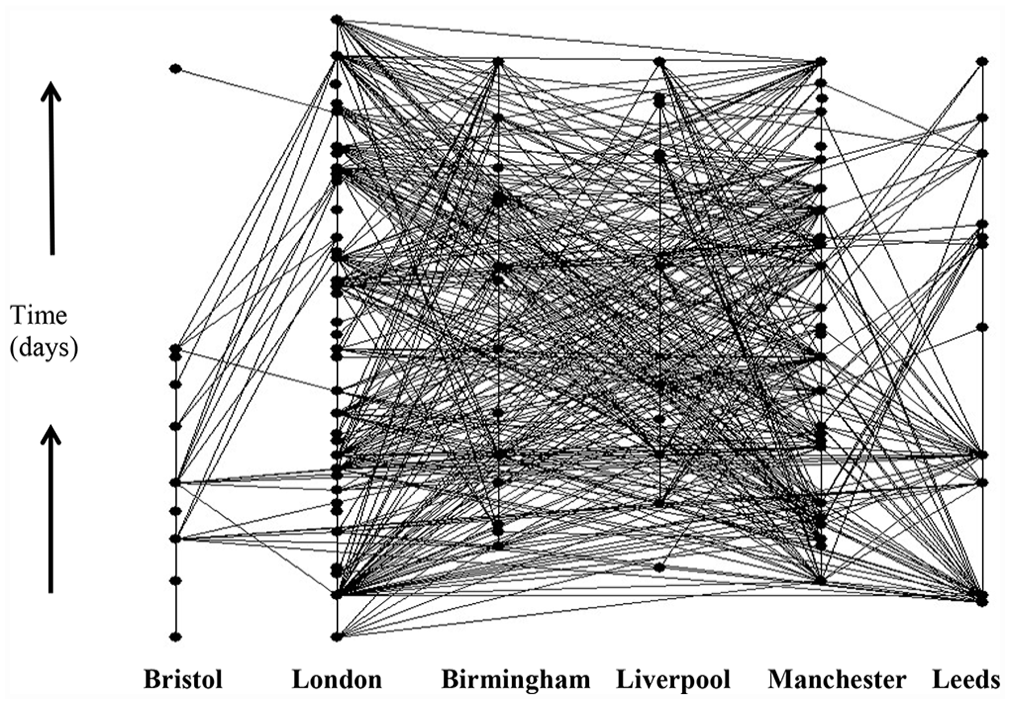
A flow of participants, their culture and resources between underground heavy metal gigs.
Time
The significance of time in event networks requires more unpacking than I can give it here. Nevertheless, we can make a start. Figure 3 tracks the cumulative frequency of the events over time. Two observations are noteworthy. First, events are relatively evenly distributed across time. However, second, there are noticeable steps along the distribution. These steps, in many cases, mark weekend days, when more gigs happen. These observations are not surprising, but the steps serve to remind us of the episodic nature of music worlds and of participants switching in and out of their musical roles. Furthermore, both characteristics can be explained by time constraints which all parties must work around: audiences have more time for their role at weekends and, notwithstanding festivals, which concentrate a great deal into a small time, find it easier to distribute their involvement over time.
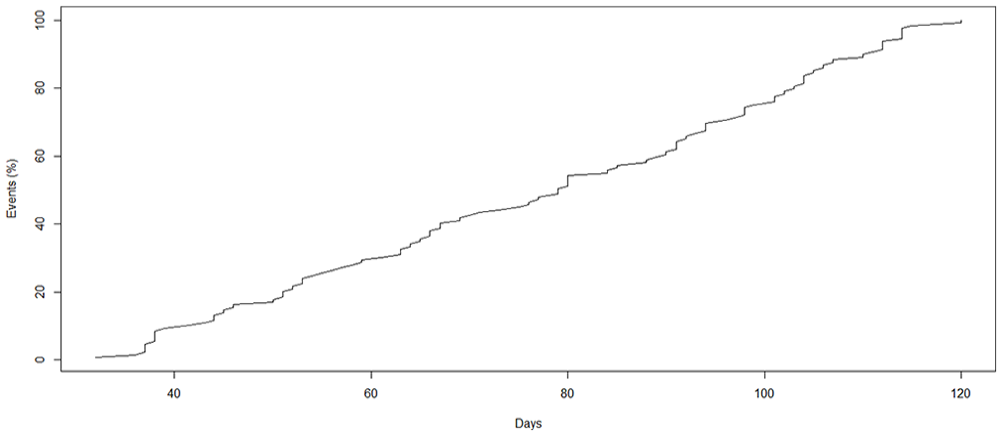
The temporal distribution of events.
The distribution of events across time affects what happens in an event network. For example, edges are necessarily both directed and unreciprocated; participants can flow and transfer resources from earlier to later events but not backwards. This does not undermine any of the foregoing analyses but it does suggest a need for caution in interpretation of findings; it may affect some SNA measures and routines; and it suggests a need for more refined concepts in some cases. In directed networks, for example, ‘degree’ is commonly divided between ties received (in-degree) and ties sent (out-degree), and when they are distributed across time earlier events have less chance of accumulating an in-degree, because fewer events precede them, and more chance of accumulating an out-degree, because more events come after them, with the opposite being true for later events. Indeed, we may observe ‘seed events’, which have no in-degree and are more likely earlier in the sequence, and ‘terminal events’, which have no out-degree and are more likely later in the sequence.
We can illustrate some of this by returning to the earlier analysis of festivals. As Table 2 shows, festivals score more highly for both in- and out-degree, though the difference is much bigger for in-degree and falls just short of statistical significance for out-degree (p=0.06). I suggest that this discrepancy can be explained by festivals occurring relatively late in the survey window, such that they have less opportunity to amass out-degree. However, it is important that both in- and out-degrees are elevated. This suggests that festivals are nexus which gather innovations and resources generated before them and then distribute those innovations and resources widely across later events. Much of what flows in a music world flows through its festivals and that makes festivals important.
Space
In contrast to time, the spatial distribution of events was not even. Manchester and a fortiori London hosted significantly more events (see Figure 4). This is significant because it points to the impact of geography on music worlds and to geographical inequalities. In the case of London, I suggest that its dominance is largely due to its bigger population size, which delivers the critical mass of potential participants to support more gigs. If the proportion of inhabitants disposed to participate in underground metal gigs is roughly the same across all cities then bigger cities will have bigger pools of potential participants and should, in turn, host more gigs. Manchester is a big city too but not sufficiently so to explain the differences in numbers of gigs reported in Figure 4. However, it has an exceptionally large student population (one of the largest in Europe) making the proportion of its inhabitants likely to attend gigs, and particularly underground gigs, higher.
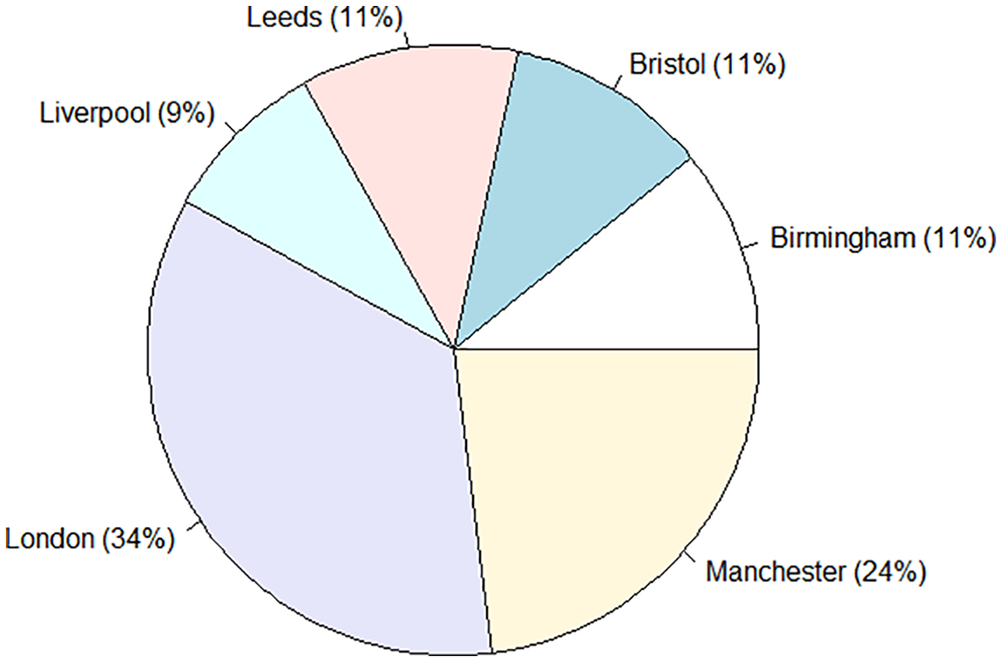
Distribution of events by city.
As noted, these differences are also indicative of geographical inequalities. Audiences in London or Manchester have more opportunities to attend underground metal gigs, without having to travel, than those in other cities. Moreover, 36% and 52% of events identified as ‘core’ in the foregoing analysis were hosted in Manchester and London respectively, suggesting that more attractive gigs are hosted there. For artists and support personnel, particularly those wishing to make a living from musicking, this may create an incentive to move to cities such as London and Manchester, a dynamic which exacerbates inequalities by shifting resources from (musically) poorer to richer localities. Research in Liverpool by Cohen (2007), for example, identifies a tendency for rising musicians to migrate to London in search of opportunities, depriving Liverpool of the resources they have amassed.
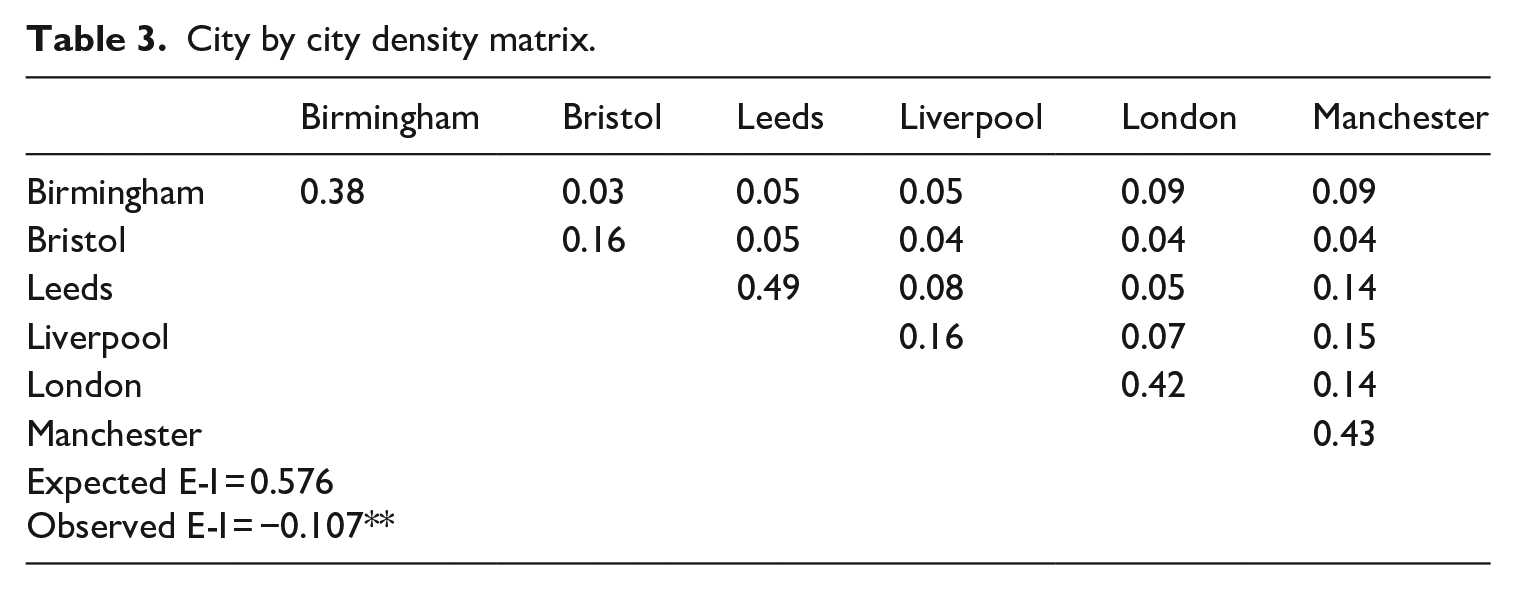
If we compare network density within and between our localities we see that, for each locality, internal density is higher than density of connection to any other locality and the E-I index for this matrix (explained later in this section) indicates that this pattern is statistically significant (see Table 3). These observations are important. Higher internal density affirms the existence of local worlds (most traffic is local). However, each locality enjoys some connection to other localities and we therefore also have evidence of a trans-local world.
City by city density matrix.
We can develop this analysis by returning to the earlier distinction between audience and artist flows. Given the costs of travel, in terms of time, effort and money, one would expect audience members to limit their participation within a restricted radius, which would in most cases mean limiting gig attendance to one of the cities surveyed. One might therefore hypothesise that audience flows will disproportionately link gigs within the same city, generating local clustering and local worlds. Artists face the same costs, amplified by their need to transport equipment. However, playing too often in the same place, for them, risks exhausting audience demand. Relatedly, they have an interest, both economic and symbolic, in acquiring and maintaining a large and therefore trans-local audience. It would be reasonable to hypothesise that those bands who played more than one gig did so across different cities, contributing primarily to the forging of a trans-local world.
We can test these hypotheses by measuring geographical homophily/heterophily in our networks. ‘Homophily’ refers to the tendency for nodes which are similar in a specified manner to enjoy a probability of connection greater than chance. Heterophily, by contrast, entails an increased probability of connection when nodes differ in a specified manner. By extension, geographical homophily entails that events in the same city enjoy an increased likelihood of connection and geographical heterophily entails that events enjoy a greater likelihood of connection when occurring in different cities. My hypothesis is that we will find geographical-homophily in audience flow and geographical-heterophily in artist flow.
There are several ways of measuring homophily/heterophily. The most straightforward and informative, for current purposes, is the E-I index, which is based upon the ratio of external to internal ties within a network, with positive scores indicating heterophily and negative scores homophily. It is also possible to compute an expected E-I value and to calculate the probability of any deviation between the observed and expected values arising by chance.
Because the number of events and their respective locations are the same for each network their expected value is the same (0.576). However, in each case the observed values deviate from this to a statistically significant extent (p<.001) in the expected direction. Audience-flow is homophilous (−0.207), artist-flow is heterophilous (+0.883).
This analysis reveals two contrasting but complementary processes. Audience flow tends to link local events, generating a local world. Artist flow typically traverses cities, generating a trans-local world. However, one might hypothesise that some audience members will want to see their preferred artists on more than one occasion and will therefore follow them across localities. If this happens to any significant extent, we would expect to observe a correlation between artist and audience networks. We do, albeit only a slight one (Pearson’s = 0.1, p<.01). Audience flows, it would seem, are influenced by both geographical homophily and artist flows.
To test this further I ran a QAP 4 logistic regression model whose dependent variable was audience flow and whose independent variables were artist flow and geographical-homophily. The results, which are presented in Table 4, suggest that both variables have a significant effect. Audiences tend to flow locally but also follow bands across localities.
The effect of geographical homophily and artist flows upon audience flows: a QAP logistic regression model.
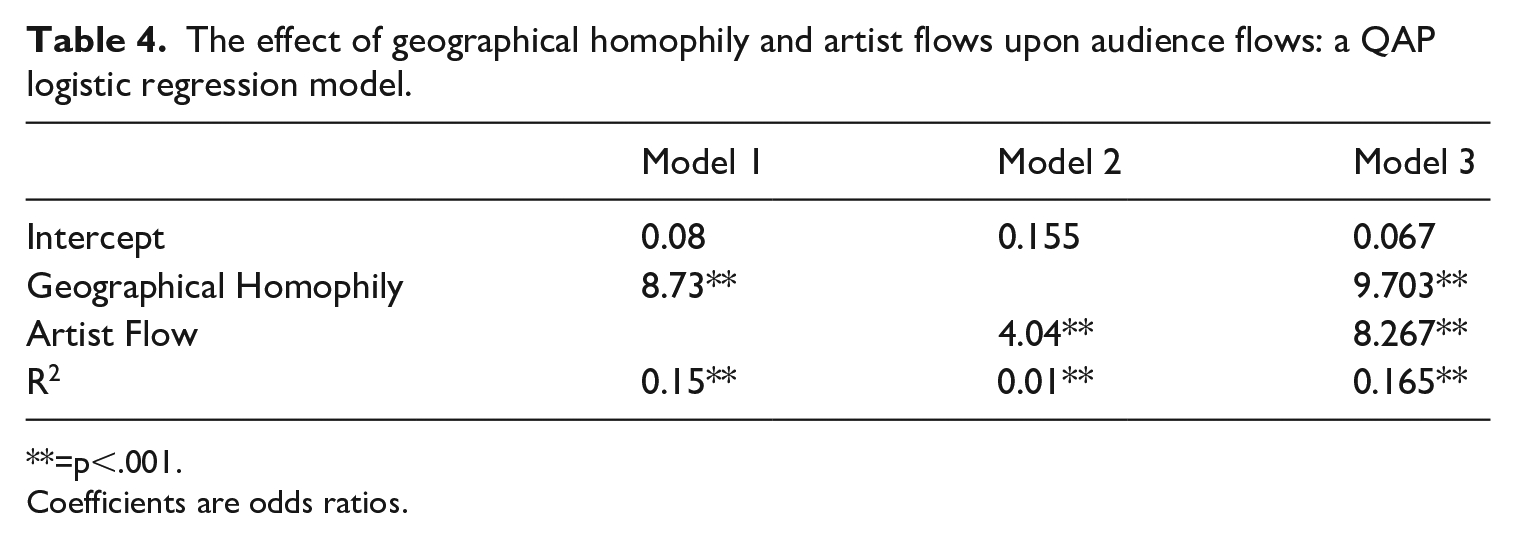
=p<.001.
Coefficients are odds ratios.
I have used the concepts of homo/heterophily and associated measures to explore the impact of space on event networks and music worlds. Future work might consider the impact of other forms of homo/heterophily; for example, the finer stylistic distinctions which participants in a music world often draw (Emms, 2017; Hield, 2010; Thornton, 1995; Watson, 2020). One would expect that the importance that participants attach to such distinctions would inform their patterns of participation and thereby the flows we observe. In addition, it would be interesting to consider the extent to which incumbents of different support roles, including promoters, work across localities, and indeed whether artist and audience patterns of participation are associated with particular promoters, venues and so forth.
Conclusion
A music world is an episodic structure-in-process. It comprises interaction between multiple participants playing an assortment of roles but its participants have other, unrelated interests and only switch into their musical roles some of the time, for specific events, thereby awakening their world, or some aspect of it, from a state of latency. These events take many forms, including practice and recording sessions, and the many situations in which audiences, alone or with others, listen, appreciate, interpret and respond to the recordings and performances of artists. However, gigs and festivals enjoy a special significance for participants in many music worlds – including underground metal (Emms, 2017). As Durkheim (1915) argued for the ritual festivities of totemic clans, they are occasions for participants to live out their belonging to a world and engage with its music in what many take to be its most authentic form.
We can analyse music worlds as networks of participants. There is much to learn from doing so. However, in this article I have argued that we can better capture the episodic nature and spatio-temporal dispersion of music worlds by analysing the network of their constitutive events, which are connected by a flow of both participants and the various resources and cultural forms they carry with them. I have demonstrated something of what this might achieve with an illustrative analysis. Specifically I explored differences in the flow of different participant types (artists and audiences) and their significance. I tested claims regarding the significance of different types of event (namely, gigs and festivals). I identified a core-periphery structure amongst events. And I explored the simultaneous generation of local and trans-local worlds. This is only a start. Far more is possible. It is sufficient, however, to establish the potential utility of social network analysis of ‘event networks’ for exploring and understanding music worlds.
Footnotes
Acknowledgements
The data analysed in this article are drawn from an earlier project on which I collaborated with Rachel Emms. Thank you to Rachel for letting me reuse the data for this solo venture. An earlier version of the article was presented at the NYU Sociology of Culture Workshop. Thank you to Paul DiMaggio, Carly Knight, Iddo Tavory and their colleagues and students for inviting me and offering such helpful and stimulating feedback.
Funding
The author received no financial support for the research, authorship, and/or publication of this article.