



Abstract
This article examines the strategies used by individuals within cultural fields to make a transition from previously low-status categories to high-status categories, in order to rise in the status hierarchy. Using the case of gastronomy in the global cities of London and New York, we investigate how the once strict boundary between high-end and ethnic restaurants is being breached, leading to field transformations. An analysis of the process of recategorization undertaken by chefs and restaurateurs reveals how strategies of category detachment and emulation are employed simultaneously: on the one side, to achieve a distancing from those held to be lower in the culinary hierarchy (ethnic restaurants/chefs) and, on the other side, to emulate those perceived to be above them in status (high-end restaurants). A third strategy identified is horizontal differentiation within the category – initiated by newcomers to ensure distinction and further secure their membership to the higher status category. Our analysis reveals the agency of producers in enacting status change by a focus on mainly material practices, while showing that recategorization is made possible by external societal and cultural transformations.
Introduction
During the last decade or so, significant changes have occurred in the global gastronomic scene. ‘Core cuisines’ – most notably French, but also Italian, Japanese, Modern British and New American – have traditionally been central in defining the cultural canons of the fine-dining sector. In contrast, restaurants with cuisines hitherto either not well known or stereotyped have been subsumed in the ethnic domain. Yet, since the 2010s or so, a growing number of restaurants in the latter category have established themselves as offering high-end cuisine. Hence, we are dealing with change in a cultural hierarchy and with the reconstruction of meaning this involves for chefs.
The arrival of chefs/cuisines from mainly non-European countries previously considered marginal to culinary culture, together with the rise in culinary reputation of longer-established ethnic cuisines achieved by second-generation immigrants, have raised questions about accomplishing change of category membership and about how the breach of the previously strict boundary between high-end and ethnic cuisine has been achieved and legitimated. We thus examine how these restaurants and their chefs ‘have broken the categorical glass ceiling’ (Delmestri and Greenwood, 2016: 537) but still see the need to legitimate this radical change of category membership.
In contrast to much other work on categorization (e.g. Boghossian and David, 2021; Delmestri and Greenwood, 2016; Glynn and Navis, 2013; Navis and Glynn, 2010; Pedeliento et al., 2020), we focus on the recategorization accomplished by an increasing number of category members, rather than on the upward movement of a whole category. 1 As we are dealing with relatively small, mostly owner- and chef-managed organizations there is a strong overlap between the two, and we do not rigidly distinguish between restaurants, chefs and their cuisines. We focus particularly on the various strategies individual chefs have adopted to achieve the goal of recategorization. Most of the chefs studied have started their businesses as high-end and thus have accomplished the recategorization of a previously ethnic cuisine, rather than having moved their restaurant from a low- to a high-end category.
Our study investigates the chefs’ strategies for achieving upward movement in the context of two global cities, London and New York, both considered major culinary hubs. These cities are comparable given that, despite their pre-eminence in many cultural fields, they have never generated new culinary movements with transnational appeal. Historically, neither city has been a centre of indigenous culinary excellence, and both the USA and the UK have a relatively undistinguished national culinary tradition (Lane, 2016 and Mennell, 1985 on the UK; Freedman, 2019 on the USA). These features together have made the two cities extremely receptive to new culinary trends. 2 Both cities play host to large numbers of cosmopolitan diners (Cappeliez and Johnston, 2013; Leschziner, 2015; Sassen, 2001) and/or to an expanded professional middle class of omnivores, who embrace cuisines with hierarchically disparate reputations to exhibit distinction (Warde et al., 2020: 181 f. on London). Such omnivores have dropped the sole preference for elitist French and Japanese cuisine and have embraced also cuisines from countries, previously regarded as peripheral in terms of culinary culture. They embrace variety and adventure (Warde et al., 2020).
It is notable that introducing a vertical distinction, that is, erecting strict boundaries to distinguish category members from producers thought to be inferior, is more rigidly adhered to than is horizontal distinction within categories (DiMaggio, 1987: 447). Status orders are particularly difficult to subvert (Chen et al., 2012). Moreover, ‘status change involving a mature category’, according to Delmestri and Greenwood (2016: 513), ‘remains largely neglected’. Given this strong impediment to status change, this achievement of upward movement of what were previously viewed as ethnic cuisines/chefs presents a particularly intriguing research puzzle.
We suggest that these previously distinct categories of high-end and ethnic cuisines, their hierarchical arrangement and an apparently immutable boundary between them, have been put into question. Based on the accounts of chefs and restaurant owners, our article investigates the process of upward movement in the culinary status hierarchy by member organizations and conceptualizes it in terms of the legitimation of recategorization. We examine how individuals and their organizations seek to consolidate their membership of a higher-status category by activities of detachment and emulation and view this vertical mobility as related to status striving. Following Podolny (1993), we see status as a signal of the underlying quality of the cuisine the producers wish to convey.
We additionally analyse restaurants’/chefs’ horizontal differentiation within the high-end category, initiated to further secure their membership by emphasizing the distinctiveness of their cuisine. The article thus points to the chefs’ efforts to expand an existing category, by extolling not only the novelty of their ‘foreign’ cuisine, but also its authenticity, variously defined. High-end cuisine currently is an evolving category, the previously strict boundaries of which have become more porous in recent decades.
Our study addresses the following research questions: How have cultural producers offering products traditionally pertaining to lower-field categories managed to get their work recognized as high-end by external audiences, such as restaurant guides, rankings and the relevant media? What strategies have producers pursued to articulate their affiliation to this higher category and to maintain the newly acquired status, and what resources have enabled them to pursue these strategies? Such a focus on producers’ agency is combined with the recognition that changes in the socio-cultural context have facilitated their pursuit of recategorization. The purpose of our article is thus to apply existing conceptualizations of processes of recategorization to an intriguing new case – the member organizations of a broad and complex socio-economic category – and, by doing so, refine existing theory in several ways. Our article covers new ground also in empirical terms. Although a few authors have noted the occurrence of the change in the gastronomy field for restaurants from ethnic origin (Freedman, 2019 and Ray, 2016 for New York; and Buettner, 2008 for London restaurants), no general and sustained empirical study of this phenomenon has been undertaken.
Categorization, Strategy and Resources
Scholars in sociology and organization studies, particularly studies of cultural industries, have shown that socio-cognitive categories are essential to the functioning of complex markets/fields (Khaire and Wadhwani, 2010: 1281). Categories serve ‘as touchstones for organizational identity claims and for audience attention, legitimation and valuation’ (Glynn and Navis, 2013: 1124). 3 A category is established when producers and/or their products, on the basis of certain shared characteristics, are linked together in a way which establishes clear boundaries between their attributes and those of other categories. This relational feature of categorization based on shared norms and meanings, invites comparison, and such comparisons consider the value or worth of the categories that are being compared (Khaire and Wadhwani, 2010; Vergne and Wry, 2014). However, deviation from norms and practice by category members is common in cultural production where the pursuit of novelty is often valued.
Categories may be arranged horizontally, with an emphasis on similarity–difference, or vertically when a hierarchical ordering expresses superiority–inferiority (Piazza and Perretti, 2015). Much literature on classification has been concerned with horizontally arranged categories and their stability, due to a preoccupation with the potentially adverse consequences of increasingly fuzzy category boundaries for consumers, intermediaries and producers. During the last decade or so, however, more attention has been paid to the vertical dimension of category arrangement and attendant changes in the status hierarchy (Boghossian and David, 2021; Delmestri and Greenwood, 2016; Khaire and Wadhwani, 2010; Pedeliento et al., 2020; Piazza and Perretti, 2015; Siltaoja et al., 2020). To our knowledge, there exists only one attempt to apply categorization theory to culinary culture, namely Leschziner’s (2015) insightful analysis of culinary styles adopted by New York and San Francisco chefs. Leschziner’s study deals primarily with the constraining effects of category boundaries, whereas our article focuses on how such boundaries can be crossed.
Our consideration of the recategorization of individual members of a mature category builds on the category reconceptualization by Delmestri and Greenwood (2016), Khaire and Wadhwani (2010); Navis and Glynn (2010), and Pedeliento et al. (2020). In contrast to these authors, we do not offer a historical analysis of a process of recategorization but focus on the legitimation of upward movement in a hierarchy recently achieved by member organizations. Much of the extant literature ascribes such legitimation activities to external audiences (e.g. Khaire and Wadhwani, 2010; Navis and Glynn, 2010), while our article draws attention to the efforts of producers themselves whose perspectives and actions have been relatively neglected by the literature (Kodeih et al., 2019).
Delmestri and Greenwood (2016) have examined status change of a market category of relatively low complexity – the Italian drink of grappa – and focus on only one highly unusual member organization, including the personal lifestyle practices of the owner (rather than production activities). These combined practices are rather idiosyncratic, and generalization across cases might be hazardous. Our article, in contrast, does not merely focus on a single producer but considers 30 of them in two different geographical locations, allowing us to trace similarity and differences in practices across organizations and locations.
Considering the dynamics of recategorization, some of the literature attributes great importance to the social context in which product categories are nested (e.g. Glynn and Navis, 2013), and change is often connected with external influences (e.g. Khaire and Wadhwani, 2010; Pedeliento et al., 2020). Our article, too, considers such external social and cultural influences as important but combines this focus with an emphasis on the agentic nature of category members. We consider structure and agency as being mutually influential. We further argue that actions to achieve recategorization are part of a strategy and take account of the resources producers can marshal to implement their strategy. In this context, we draw insights from the cultural sociology of Bourdieu (1984, 1993 and 1995). His work is pertinent to the understanding of vertical movement and is related to the conceptualization of recategorization processes. For Bourdieu, too, engaging in practices that signal status enables actors to improve their position within a field’s social space, if that association is considered legitimate (Bourdieu, 1984).
Finally, to deepen our understanding of the practices that enable agents not only to achieve recategorization but also to sustain status enhancement, we build on studies of authenticity. The concept of authenticity has received significant critical attention in the analysis of cultural fields (e.g. Cappeliez and Johnston, 2013; Heldke, 2005; Mintz, 1996; Pilcher, 2012). An organization is held to be authentic ‘when the experience that audiences have with it aligns with the organization’s identity claims’ (Demetry, 2019: 938). Given that business organizations are likely to benefit financially from consumers’ perception of authenticity, it is ‘manufactured’ by various means, with more or less sincerity and credibility (Demetry, 2019: 238; Peterson, 1997). Hence, our study draws on conceptualizations of authenticity to critically interrogate the agents’ claims of high-status and the role of these claims in consolidating recategorization processes.
Our study enables us to make the following contributions. Our consideration of a relatively large number of category members in two locations enables us to identify and substantiate an important breach between the previously mature categories of ethnic and high-end restaurants. By recognizing producers as agents for status enhancement, rather than focusing on external audiences prevalent in much of the literature, we are able to show their central role in achieving a change in category membership. A systematic analysis of the practices adopted to implement category emulation and detachment enables us to highlight their predominantly material nature, rather than insisting on the overriding importance of discourse or narrative, as found in much of the literature (e.g. Glynn and Navis, 2013; Khaire and Wadhwani, 2010; Navis and Glynn, 2011; Siltaoja et al., 2020). Our focus on both vertical repositioning and horizontal differentiation makes clear that change of category membership is a complex and extended process, characterized by a constant and sustained search for the consolidation of legitimacy. Last, our emphasis on the social, cultural and economic capital enabling producers to become agentic establishes a link between the literature on recategorization mainly in the field of organization studies and Bourdieu’s sociological work on cultural capital, repositioning in a field and achievement of legitimacy.
Empirical Context: Ethnic and High-End Cuisine
Traditionally, an ethnic chef and his or her cuisine have been defined in socio-cultural terms of race where the ethnic ‘other’ is contrasted with the white indigenous population and framed as exotic (e.g. Heldke, 2005; Ray, 2007, 2016; for the USA and Buettner, 2008 for the UK). Definitions have also been closely linked to immigration patterns (Ray, 2016: 104), and migrants have been viewed as economically and culturally reliant on ethnic diasporas. More recent definitions, recognizing a decline of overt racialism and the loss of exoticism of long-established and pervasive cuisines in the 21st century (e.g. Johnston and Bauman 2014: 41), have aimed for a more neutral, but still socio-cultural definition. Thus, according to Warde et al. (2020: 169), ‘ethnic cuisine is . . . a marker of a socio-cultural relationship between a local majority and distantiated minorities’. Another set of studies have focused on the substantive characteristics of ethnic and high-end cuisine and have presented the difference between the two in socio-economic terms, namely in terms of restaurateurs’ entrepreneurship that works to raise the reputation of the cuisine (Freedman, 2019).
We combine the definition by Warde et al. (2020) with that adopted by Freedman (2019). The improved educational credentials and socio-economic status of some ethnic groups has lessened their social marginality. A reduced dependence on their diaspora has led to chefs’ greater reliance on their individually accumulated economic and cultural resources. As the factors already mentioned have acquired equal explanatory force as a mere reference to racial difference (Johnston and Bauman 2014: 41; Ray 2016: 108), a distinction between ethnic and high-end has to refer to a list of precise material and aesthetic characteristics, without ignoring that the term ‘ethnic’ retains social and political overtones.
Definitions of ‘high-end cuisine’ have been less common and controversial. Not being the cuisine of the indigenous white population no longer disqualifies a foreign cuisine from claiming the status of ‘high-end’. The previously highly hierarchical ordering of cuisines, with French cuisine dominating the hierarchy, in recent decades has given way to the evolution of a more fluid and ambiguous hierarchy where cuisines from other national origins, including previously culturally marginal countries, have become eligible for high-end status (Freedman, 2019; Leschziner, 2015; Warde et al., 2020). To distinguish these newcomers from largely non-western societies from the longer-established cuisines from Europe and Japan, we refer to the former as (culturally) peripheral or non-core and the latter as core cuisines.
What then may be regarded as the most salient divergences between high-end and ethnic cuisines? High-end cuisines are widely regarded as more complex and/or original, and they show a higher level of quality in both ingredients and techniques used. These characteristics, in turn, allude to the higher degree of competence and creativity of high-end chefs, contrasting the usually professionally qualified chef with the self-trained ethnic chefs.
Distinctions made between high-end and ethnic cuisine go well beyond food. More stereotypical and less refined decorative devices, less accomplished service and highly standardized and long menus are commonly associated with ethnic restaurants (however, the presence or absence of white tablecloths is no longer a reliable distinguishing feature). All these differences have constrained ethnic chefs to charge significantly lower prices than is common for the cuisine from the same national origin in high-end restaurants (Ray, 2016: 81; Warde, 2018: 2). These various attributes of ethnic cuisine have been associated with an image of both culinary and social inferiority, among producers, consumers and intermediaries alike. Consumers, however, are still likely to regard the cuisine of ethnic establishments as authentic (compared to that of chain-affiliated organizations) (Kovács et al., 2013; Ray, 2013), despite the ‘ethnic’ establishments’ tendency to adjust their food to the palatal preferences of their host society (Dunlop, 2019; Freedman, 2019; Panayi, 2008; Ray, 2013). This reveals ‘authenticity’ as a highly elusive and contradictory term (Cappeliez and Johnston, 2013).
Methods: Data Collection and Analysis
Our investigation builds on data collected from 2017 to 2023, from 2017 to 2020. The data analysis consisted of multiple steps and iterations, which allowed us to identify patterns and distinctions across the cities of London and New York.
We created two comparable datasets for each city. Our primary data source consists of 30 in-depth interviews with chefs and restaurant owners (15 in London and 15 in New York; corresponding to 250 pages of transcripts, single-spaced). Interviewees offered a foreign cuisine that, in many cases, is still widely regarded as ethnic but who had successfully made the transition to having their cuisine/restaurant regarded as high-end. Selection of interviewees was guided by their recognition by industry taste-makers as offering high-end cuisine, which included high ratings or rankings from international culinary guides (Michelin and the World’s 50 Best Restaurants list) and national/city guides (e.g. ZAGAT New York or London’s Time Out guide) and, in a few cases, came from their corporate owners, such as a luxury hotel and the owner of a small high-end restaurant group. Several interviewees had earned other honours, such as publishing cookbooks focused on their non-core cuisines (For details, see Table 1, in the Appendix). All of our interviewees’ restaurants had been opened for a relatively short period of time (from 2010 onwards), confirming our claim that recategorization is a new phenomenon. For a full list of our interviewees, including their socio-cultural backgrounds, educational/professional attainment and public awards see Table 2, in the Appendix. We visited most of the restaurants of our interviewees, and took pictures of the restaurants external appearance, ambiance and décor.
Our interviews started with questions regarding the chefs’ cultural and social backgrounds. We then discussed the challenges they had experienced and the decisions they had made while running their restaurants (e.g. developing their menus or culinary styles). We ate in their restaurants whenever possible. These dining experiences gave us an additional perspective on the chef’s work and allowed us to gain information on the restaurant’s ambiance, service and food offered. We also analysed the restaurants’ menus (37) according to the format and type of items offered, the names assigned to dishes and the prices of dishes. Information gathered from the restaurants’ websites (27) and cookbooks published by the chefs (4) complemented these insights.
In analysing the data collected, we draw on several qualitative approaches, including inductive analysis, interviewing and coding techniques (Pratt et al., 2022).
Step 1. Consolidation and analysis of data sources: We started our analysis by inductively examining the diverse data sources collected for each city. This allowed us to develop a deep understanding of the empirical context (Glaser and Strauss, 1967). It became clear early on that London and New York were highly comparable in terms of their strategic positions in the global culinary field, their cosmopolitan populations and the challenges experienced by agents in establishing their restaurants. In a second step, we combined the datasets developed and searched for broad themes that could help us organize the insights obtained. In examining our primary data, we paid special attention to keeping the meanings and words used by our interviewees to avoid imposing our own preconceptions (Gioa et al., 2012). For instance, we did not use terms like ‘core’ or ‘non-core/peripheral’ cuisines in our gathering of their accounts, but instead considered the terms our interviewees’ used to describe their work (e.g. ‘inventive’, ‘modern’). When coding our data, we identified the chefs’ attempts to develop and showcase their work as high-end which, as we learned, expanded beyond the cuisine served at their restaurants and included the chefs’ active shaping of menus, the restaurant’s design and the organization of service. Based on this analysis, we developed multiple data reduction tables that helped us to combine and compare the findings obtained for each city and for each chef interviewed (e.g. timetables synthesizing the professional trajectory of each chef and tables comparing the strategies used to distinguish their work).
Step 2. Searching for broader theoretical constructs: Our next step consisted of identifying second order concepts that could help us explain the patterns observed in the data. For example, we noticed that the devices and practices used by chefs to present their cuisine as high-end were not only discursive but also material in character (i.e. including the use of objects and artefacts). This insight pushed us to look back into our data and search for further nuances that could help us clarify the strategies identified. We systematically contrasted the chefs’ accounts of their work (accessible through interviews, menus and their restaurants’ websites) with our own observations of their work (accessible through field notes and pictures of the restaurants’ decor, service and our own experiences eating the chefs’ cuisine). At this stage we started connecting our empirical findings with existing streams of literature, and to initiate a process of theory building from our case studies (Eisenhardt, 1989).
Step 3. Systematic iterations and refinement of our findings: Later steps consisted of recurrent iterations, in which we systematically moved from theory to data (and back to theory). This allowed us to identify three emerging theoretical constructs and to examine the relationships between them: (i) distancing from low-status categories (ethnic cuisine), (ii) striving for the status of high-level categories (high-end cuisine) and, (iii) achieving distinction within the high-status category (high-end cuisine). Iterative processes to expand and hone our findings were conducted separately and jointly by the authors at multiple stages of the project. When our interpretations of the emergent themes or codes differed, we engaged in new discussions until a new consensus was reached (Gioa et al., 2012). The first and second order analyses, their resulting theoretical constructs, and the multiple iterations conduced, are summarized in Figure 1.
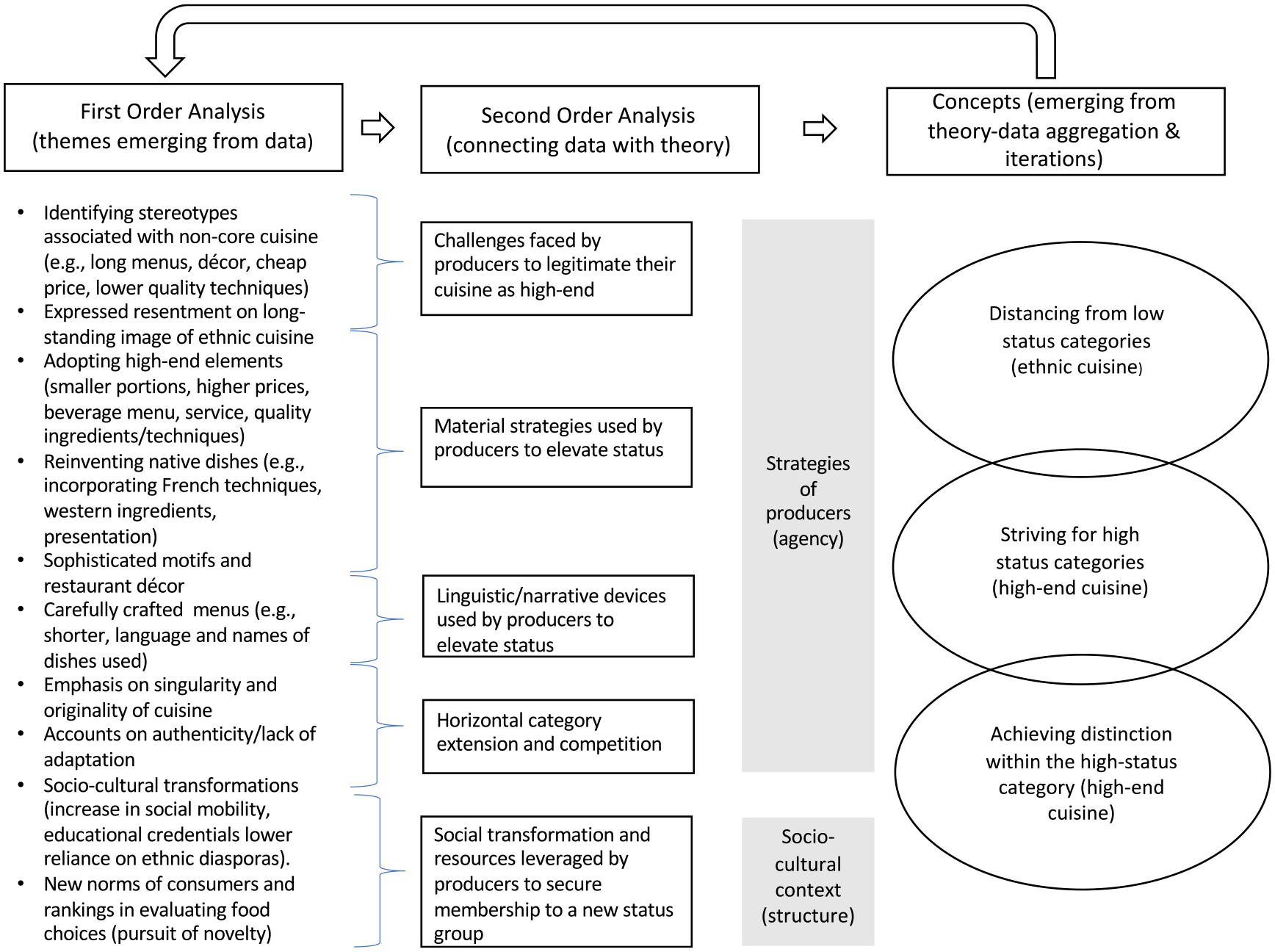
Analytical process and iterations.
Findings: From Ethnic to High-End Cuisine
The goal of non-core high-end chefs was to open restaurants that could showcase the uniqueness and refinement of foreign culinary traditions and to be recognized as high-end. However, this strategy held the risk of appearing insufficiently distinct from ethnic chefs from the same country. Hence, they strove to distinguish their cuisine and restaurant from what they regarded as the low quality, standardization and lack of authenticity of the food and dining experience offered by their ethnic co-nationals. Such denigration of, and distancing from, what they regarded as low-status cuisine/restaurants usually went hand-in-hand with the copying of many aspects of core high-end cuisines/restaurants and thus with efforts to raise their culinary and social status. At the same time, these chefs strove for distinction within the category of high-end restaurants by promoting the ‘foreign’ origin and therefore the novelty of their cuisines. They highlighted their singularity as an asset which, in many cases, was further amplified by proclaiming their cuisine’s authenticity and, in some cases, the varying degrees of adaptation/innovation of their national cuisines. Such an ambitious three-pronged strategy required chefs to utilize a significant amount of cultural and economic capital. Table 3 in the Appendix offers details on the prevalence of the strategies identified, as deployed by the chefs interviewed.
Strategies Employed by Producers
Distancing Themselves from Ethnic Cuisine
Efforts to distinguish themselves from what was denigrated as low-status ethnic cuisine/gastronomy were particularly notable where an ethnic cuisine had been long-established. In these circumstances, second-generation immigrants felt bound to distinguish their cuisine/restaurant along all dimensions from what they regarded as inferior practices and styles. Chefs were well aware that the value of their upgraded cuisine, concretized in what they can charge customers, was at stake. A chef with Indian restaurants in New York and London clearly expressed this:
The mindset of people in New York about Indian food, and to a certain extent with other cuisines like Chinese or Thai food or Mexican food, is that they think these cuisines are usually not fit for being a fine dining restaurant and they’re sometimes not ready to spend the kind of money they spend on a Japanese restaurant or a French restaurant or Italian restaurant [. . .] Or they don’t feel that an Indian restaurant can be that expensive.
Chefs were anxious about the stereotypes and lack of knowledge about their national cuisines. A New York Mexican chef points out, ‘Unfortunately when you talk about Mexican food, people think of burritos or tacos with lettuce, which don’t exist in Mexico!’ A London Chinese chef tells us: ‘[I want to] change people’s preconceptions of what a Chinese restaurant is and give it equality with other national cuisines.’
Interviewees tried to distance themselves from ethnic chefs through a variety of practices, beyond food preparation. Regarding food, efforts went beyond raising its quality and freshness, and chefs also astutely assessed the inferior techniques used by most ethnic restaurants, due to the low degree of training possessed:
When we opened [names restaurant in New York] there was a common practice in most Chinese restaurants to have a menu that has too many items on it. And part of the reason of that is because they take one kind of technique and apply it to different proteins, different vegetables [. . .]. But we said, ‘We don’t want to do that, we want to have one kind of technique on one kind of material, as a representative of that particular technique – and not to have it repeated over and over again.
Chefs additionally tried to escape the denigration of their restaurants and cuisines by repudiating the decorative traditions of ethnic restaurants: ‘You can recognize an Indian restaurant a mile away; they would all have a similar kind of décor’, one chef said. ‘Dragons, lanterns and the colour red are a typical symbol of ‘Chinese-ness’, another chef mentioned. Such contempt for ‘ethnic’ decor was, at the same time, matched by adopting less standardized and more sophisticated décor, as shown in the next section.
Striving for the Status of High-End Cuisine/Gastronomy
Chefs did not merely express resentment about how ethnic restaurants had shaped the public image of non-core restaurants. They also proudly explained how and why their cuisines were superior to their ethnic counterparts. An Indian-born restaurateur in New York illustrated this:
We wanted to be comparable to top cuisines. . . like Japanese, French, pan-Asian, American . . . We wanted to be mentioned in the same breath. [. . .] So that’s when we added a mission statement: ‘We want to open a restaurant that serves [great] Indian food. That means we add a great design, a great spark, good architecture, good balance to menu [. . .]’.
Chef patrons strove to elevate their cuisine and restaurant in the culinary and social hierarchy in a number of ways: This involved: (i) refining or reinventing indigenous culinary creations, as well as their presentation; (ii) extending and upgrading the beverage menu; (iii) improving the service; (iv) shaping the design of menus, and (v) introducing a restaurant design that reinforced the message that the chefs wanted to convey. Each of these strategies involved the deployment of specific skills and resources, as well as their management.
(i) Adjusting, refining and reinventing native dishes: In their search for high status, chefs seek to create goods that build on the foreignness of their cuisines, yet usually represent upgraded versions of those cuisines. A few chefs did this by applying French or more recently discovered western techniques and by inserting new ingredients to traditional indigenous preparations. The first route was easily adopted as several chefs, particularly in New York, had learnt French techniques as part of their training either at college or in a core high-end restaurant. A New York chef, for instance, describes how she reinvented one of the most well-known Filipino dishes ‘pork belly adobo’ by cooking ingredients separately and using European techniques:
From me working in Italy and in the fine dining restaurants in New York City, a lot of the restaurant techniques that I learnt were European cooking, and then I applied those to what I learnt in South East Asia.
Another New York chef explains how he builds on his knowledge of French cooking to prepare a novel version of Mexican lamb, ‘I was cooking French cuisine for a long time [in New York] and there I find many ingredients that can make dishes tastier. For instance, the ‘chamorro de borrego’ [a tender lamb shank cooked with beer, Mexican herbs and spices]. If you go to Mexico people will not use wine, but I add wine to give it more flavour’.
Additionally, more neutral techniques, introduced as part of modernist cuisine, had been adopted selectively. They were regarded as high-status in that they are considered as being avant-garde. A Chinese chef in London illustrates this endeavour: ‘I embrace technology. I do, for example, temperature-controlled cooking [. . .] for consistency’. A New York chef similarly explains how he uses the sous-vide technique for refining Indian recipes, ‘So whenever we cook, say, our lamb or duck, for those dishes we want to make it consistent and the best way to do that is by utilizing that [modern technique]’. Turning to the occasional borrowing of ingredients from western cuisines, a particularly egregious attempt to signal high status was undertaken by an Indian chef who stuffed his naans with high-class and expensive foods, such as caviar, foie gras or stilton. However, this constituted an exceptional case among London chefs who were less likely to hybridize their dishes.
Upgrading of their food offerings was often based on the realization that western diners are very health-conscious and that many dishes in high-end restaurants are now served in small portions. ‘Tapas’-size dishes were offered by Scandinavian, Greek, Indian, Korean, West African and Chinese chefs. A London Indian chef explains: ‘[We serve] very small portions – the current fine-dining thing.’
Chefs also upgrade the presentation of their native dishes as a way to signal the ‘high-end-ness’of their work. The owner of a restaurant in New York explains how the presentation of dishes helped her raise the status of Malaysian cuisine:
Another Westernized [aspect of our dishes] is our plating. So, [the way we serve dishes] it’s not how you would get these plated in Malaysia, where it’s a little more just: ‘Here is your dish’. Most Nasi Lemak’s [traditional dish] I’ve had in Malaysia, it was just on a banana leaf with some rice, all the condiments on the side. We’ve taken that and plated it a little nicer.
A New York Indian chef used the technique of smoking to improve the presentation of curries. ‘Curries are not the most visually appealing cuisine. [. . . So] we’ll do a lot of smoking, which in Indian cooking they do that, but we try to use it into the way we do our plating. On the plate you’ll actually see smoke, we utilize it like that because we want to implement the aesthetic version of that [dish]’. Finally, a Korean chef borrowed the Japanese concept of ‘yakitori’ (grilled recipes served on skewers) to present an ‘exquisite’ interpretation of his native cuisine, ‘Generally, everyone that knows about skewered foods refers to the Japanese version of it. We wanted to build up an identity for Korean food to show people that this is something that Korean food can offer as well’.
(ii) Upgrading their beverage menu: Whereas ethnic restaurants offer a very limited and unimaginative variety of drinks – mainly water, beer and tea – our chefs signalled high-status by upgrading and diversifying the range of drinks offered. Some of the Indian interviewees in New York and London had developed a customized beverage menu to match their food – a strategy very common among high-end core restaurants, but more difficult for restaurants with Asian cuisine. They hired sommeliers and beverage directors to create wine and cocktail programs that could accompany the food served at their restaurants. ‘I believe wines can go with Indian food a lot, [but] it’s complex because we have very different regions, and then different spices are being used, and obviously Indian food is a very shared cuisine, you might be eating one or two dishes at a time’. One restaurateur stressed, that many of the awards received by his restaurant had been connected with these beverage programs.
Chefs at high-end Indian restaurants followed a similar approach when they adopted traditional Indian teas, as well as innovative cocktails created at the restaurants, such as ‘East India gin and tonic’ and ‘Mumbai margarita’. The owner explains the rationale behind these novel creations: ‘We have a drink called East India gin and tonic, so the tonic is created for us, so you won’t find it somewhere else [. . .] [It’s about] being progressive and keep elevating the cuisine’.
Another restaurant prides itself on offering the ‘largest and most diverse Greek wine list in London’ and on its ‘exclusive cocktails and unique Greek spirits’ (Opso restaurant’s website).
(iii) Improving service: Chefs also put some effort into improving the quality of service. A Chinese chef asserts, ‘in America, most Chinese restaurants employ people who might not necessarily know how to properly serve guests’. This restaurateur trained his staff on western modes of service based on his experience of dining at French and European-style restaurants. He hoped that this effort will help ‘people [in America] ditch the negative impression of Chinese culture, to say ‘these people are savages, people who have no manners’.
(iv) Designing menus: Menus are prime devices for signalling high status. Restaurateurs create more focused menus by streamlining their culinary offerings. To change the general expectations about their traditional cuisine, Indian and Chinese chefs got rid of the ‘20 pages menu’, in which ‘half of the dishes are not even made [in their countries’ cuisine]’. Some chefs offered tasting menus alongside an à la carte menu, a common practice among fine-dining European restaurants – thus asserting a very explicit claim to high social status.
Menus also function as a device to distinguish the chefs’ upscale cuisine from that of their ethnic counterparts in the way they address customers. The menu of a Peruvian restaurant noted: ‘Our menu is packed with superfood ingredients native to the Peruvian Andes paired with the best of British produce’. A chef claims in his website that his nine-course menu is inspired by the ‘Korean royal court’; and another menu tries to evoke mystery and create enchantment: ‘Folktales and customs are for sharing and holding dear. Each season, Chef Martha Ortiz uses food to retell one of Mexico’s enchanting stories’. These statements constitute narrative devices used by chefs to orient diners’ interpretation and valuation of their work.
(v) Restaurant decor as a signal of status: Our interviewees worked hard to design spaces that conveyed the image of a high-status restaurant. Chefs proudly explain that they deliberately chose objects and motifs that can help them convey the complexity and richness of their cuisines. As explained by a Mexican chef, ‘so much thought has been put into the design of the restaurant – there are stories for everything’. The chefs claim that the artefacts displayed and the music played at their restaurants allow them to go beyond simply providing high-quality food, to instead, invite diners on a ‘cultural journey’. Chinese restaurateurs opted to paint the restaurant’s walls blue (unlike the typical red) and Indian chefs in London and New York created uncluttered spaces, manifested in the design of ample corridors, open kitchens and large dining rooms, decorated with sophisticated carved wooden adornments. Altogether, the elegant design reinforced the upmarket character of the food by incorporating valuable materials, mixing modern European minimal styles with selected indigenous accents. A Peruvian chef went even further and made his restaurant double as an art gallery, to showcase Peruvian contemporary art. Overall, emulation of aspects of western restaurant design culture, usually mixed with design elements or artistic artefacts from their country of origin, was a key way to achieve an elevation in status.
Achieving Distinction Within the Genre of High-End Cuisine
Chefs’ strategy to raise the reputation of their restaurants to ‘high-end’ level was usually supplemented by efforts to achieve distinctiveness within the category, in order to secure competitiveness and stabilize legitimacy. To claim singularity for their national cuisine, an important strategy employed by chefs was to invoke framings of authenticity. Chefs offered the following ‘authenticity claims’ when describing their work: ‘I don’t cook for Americans. I cook for Mexicans who miss Mexican food and for Americans that appreciate Mexican food’. Or ‘I want people to recognize that there is more to Turkish cuisine than kebabs and mezze’. A Korean chef summarized this by saying, ‘That’s how I eat at home, and that’s how I want to serve my food’. These chefs stated that they wished ‘to cook dishes so that people get to know them as they are’. London Mexican and Indian chefs went beyond staying true to indigenous traditions in their cooking and also trained their serving staff in the history and culture of their country’s cuisine.
In several cases, authenticity was effectively signalled by offering regional cuisines, noting their regional focus at the top of the menu. An example of such a practice is a Mexican restaurant in London: ‘We serve regional specialties from the Yucatan peninsula, Oaxaca, Mexico City and the Pacific coast. Our dishes are all prepared using traditional Mexican cooking technique and specially chilies, herbs and spices’.
Chefs therefore sought to achieve both legitimacy and differentiation by stressing their faithfulness to the codes and expectations associated with their non-core cuisines, drawing attention to the specialized knowledge and practices that comprise their craft (Carroll and Wheaton, 2009). Stressing authenticity and, at the same time, making small adaptations/innovations to their national dishes, often occurred side by side. However, as Leschziner (2015: 50) points out, the choice of a particular culinary model prescribes what ingredients and techniques can be used and simultaneously puts limits on the how much borrowing from other cuisines can be practised. Hence for many chefs, authenticity is about remaining loyal to their national/regional cuisines while improving traditions. This approach was articulated by a New York Senegalese chef: ‘The challenge is to stay true to the essence of the dish [. . .] [while] keep your creative juices going’. A London Peruvian chef holds a similar view: ‘We mix locally sourced ingredients with Peruvian ones. We look for the essence of tradition’. While chefs in both cities made some claims for authenticity, in terms of staying close to the culinary traditions of their country of origin, London chefs were more strongly committed to it and were less likely to make major adaptations to their dishes.
The Socio-Cultural Context of Strategy Formation
Our study combines an emphasis on the agency of producers with a consideration of the socio-cultural context in which restaurants are embedded. Such changes in context reveal new possibilities to enact strategies and guide actors towards realizing them. Such socio-cultural contextual transformations were of three kinds, and they have transformed both actors themselves and their business environment. The first change was a generational increase in social mobility of restaurateurs/chefs (Buettner, 2008; Freedman, 2019: 180; Ray, 2016. Also the journal Restaurant, July 2010 and November 2017), evident in their greater accumulation of economic and cultural resources. Upward social mobility, evident in chefs’ educational qualifications, job experience and command of the English language, was found both among second-generation and recent immigrants (for details see Table 2). Consequently, the development of ingenuity and entrepreneurialism became more decisive than race in shaping the status of restaurateurs and chefs. (On the increased importance of class, rather than just race among chefs, see also Johnston and Bauman, 2014: 41 and Ray, 2016: 108.) It predisposed them to move from ethnic to high-end status, as well as to consolidating their position among high-end restaurants, by placing the national origin of their cuisine at the centre of their market strategy.
Second, is the prevalence of a new taste regime (Arsel and Bean, 2013), in other words, the acceptance of new norms of evaluation by consumers and culinary intermediaries for what constitutes desirable food, including the constant pursuit of novelty, regarding culinary styles and the accompanying expanded global focus. Such a cosmopolitan attitude and omnivorous openness towards dining out among the two cities’ professional middle classes (Katz-Gerro, 2017; Regev, 2019; Sassen, 2019; Warde et al., 2020), in turn, had transformed the socio-cultural and business environment of chefs. According to Warde et al. (2020: 160), ‘restaurants [in the UK and particularly in London], branding themselves as purveyors of specific national, and latterly also regional cuisines, have had increasing influence on the mind and on the plate’. A London chef confirms: ‘There is now so much interest in new restaurants, it has taken off in the last ten years.’ A New York colleague concurs: ‘People in New York like to be adventurers, and they really like to try something new and are excited.’
Third, is the recent emergence of culinary intermediaries that have adopted or shifted to a global focus in selecting and ranking and rating restaurants, thereby encouraging chefs to introduce their native cuisine in western societies. Examples are the World’s 50 Best Restaurants list (since 2002) and the Michelin Guide (since 2006) (Lane, 2019), both of which now rank and rate restaurants in Asia, South America, Eastern Europe, and the Middle East and thereby put their diverse cuisines on the global radar.
Chefs’ Social Origins and Possession of Economic and Cultural Resources
The positions that agents occupy in a cultural field and, hence, their ability to introduce changes in their field’s hierarchy, are largely conditioned by agents’ embodied dispositions (or ‘habitus’), as well as being contingent on their possession of economic, cultural and social capital (Bourdieu, 1993 and 1995).
We find that high-end ‘non-core’ chefs are endowed with significant economic and cultural resources, acquired during family socialization, education and considerable work experience in the culinary profession or, in several cases, prior professional affiliation in non-gastronomic fields. Acquired aesthetic dispositions and cultural competence have been critical in allowing chefs to develop culinary experiences that attract recognition by diners and culinary intermediaries. The resourcefulness of these non-core chefs was highly relevant for achieving the upgrading of their various cuisines as high-end.
Chefs who seek to elevate culturally peripheral cuisines in global cities are mainly first- and second-generation immigrants and, uncommon among our sample, career-changing UK and US nationals. Many have a middle-class background and tend to have a high level of education. All our interviewees are anglophone, and all (but one) of them have degrees in either gastronomy-related fields and/or in other academic fields. Several of our New York interviewees had received their training in well-known culinary institutions (including three chefs who had studied in the prestigious Culinary Institute of America, see Table 2).
Most chefs have worked or studied in their respective global city or country of origin prior to opening their ‘non-core’ restaurants. Unlike lower-level ethnic cooks, they do not rely on the immigrant diaspora for sustaining their businesses. Several of them had accumulated their own financial resources, found wealthy partners and/or had gained financial sponsors in their prior professional careers. Most of the chefs were also owners of the restaurants (for details, see Table 2). This reveals high levels of cultural and economic capital among high-end non-core chefs, as compared to their ethnic counterparts, who tend to come from lower socio-economic backgrounds and remain conditioned by their country’s distinct cultural features and language (Ray, 2016). Such an educational profile is not common across the profession as a whole where the level of general and higher education is low (Lane, 2016, for the UK).
In sum, our findings suggest that achieving distinction for previously low-status cuisines is encouraged by broader socio-cultural and economic changes. These changes shaped the producers’ resourcefulness and the adoption of the strategies for business transformation detailed earlier. They generated the conditions for their novel tastes to be recognized in global cities.
Discussion
As suggested by DiMaggio (1987: 447), ‘vertical classification conveys a moral content that reflects credit on the members of highly ranked genres’ and therefore has made it extremely difficult for members of low-status categories to move upwards in the status hierarchy. In this article, we have therefore addressed a challenging research problem, namely how an increasing number of previously peripheral cuisines and chefs nevertheless breached the boundary between the two categories and improved their position in the restaurant hierarchy. Although the categories of ethnic restaurants and cuisines have not been eliminated, the breaching of the boundary between them by a growing number of member organizations nevertheless has put this boundary into question. It cannot any longer be argued that cuisines from (culinary) culturally peripheral countries must always be relegated to the category of ethnic cuisine.
Our analysis of the vertical recategorization experience of gastronomic establishments and their chefs has traced the process of categorical meaning construction and has identified three different, but interrelated constituent processes. Like Delmestri and Greenwood (2016), we have focused on the strategies of category detachment and emulation, which have facilitated a vertical move from a low- to a high-status category. Category detachment and category emulation were articulated at the same time, and, indeed, restaurants’ recategorization as high-end depended on the chefs’ enactment of both these strategies. It is notable that category detachment and the disdain of aspiring chefs towards their compatriot chefs leads to severe loss among the latter, who are usually among the poorer ones of this sub-section of cuisine (Ray, 2016: 183). ‘The [professionalized] chef reproduces the abjection of the ethnic cook’ (Ray, 2016: 190).
Chefs showed a canny assessment of the desire of global cities’ cosmopolitan diners for authentic and/or novel food by striving to uphold the culinary traditions of their country of origin. They achieved cultural resonance by offering a type of cuisine not available in core high-end restaurants, while matching the all-round quality standards of the latter. We show that chefs accomplished this feat by drawing on the considerable cultural and economic capital they possessed.
As the move from a mature low-end category to a high-end category constituted a very radical move, chefs were still intent on the legitimation of their membership of a high-end category. In the words of Ray (2016: 164), ‘[outsider approval] is the dream of every upwardly mobile ethnic expatriate chef forced to play in a field where he does not belong’. To further secure their status enhancement and membership of the new category, they engaged in a third move, namely horizontal differentiation within the category to achieve optimal distinctiveness (Glynn and Navis, 2013; Navis and Glynn 2011; Voronov et al., 2012). To introduce differentiation within the high-end category, chefs fall back on the expertise they have in the codes and practices of their particular ‘foreign’ cuisine. Presenting such a national and, in some cases, regional cuisine made it plausible for them to emphasize their faithfulness to ‘the essence’ of their home country’s cuisine, often perceived as authenticity by diners. According to Ray (2016: 179), ‘they trade more in the domain of authenticity than in the realm of innovation in haute cuisine’. As this is widely deemed to be an excellent competitive strategy, given the avid embrace of authenticity by many contemporary diners (e.g. Kovacz et al., 2013; Lehman et al., 2014; Warde et al., 2020: 160–161), proclaiming authenticity further cemented their high-end status.
As pointed out by Peterson (1997: 185), conceptions of authenticity shape day-to-day actions in many cultural fields. Our study shows that its promotion cannot be avoided when chefs define a high-end cuisine by its national origin, that is, geographic origin is referenced as the basis of authenticity. In such cases, we are dealing with ‘type authenticity’ where an entity is true to its associated type (genre) classification (Carroll and Wheaton, 2009). In other words, in such a case, authenticity claims are aligned with restaurants’ identity claims.
All these strategies help chefs to redraw common understandings of ‘core’ and ethnic or ‘peripheral’ cuisines, as well as of ‘high-end chefs’ and ‘ethnic cooks.’ Our coverage of such a repertoire of interrelated strategies towards recategorization, entailing both vertical and horizontal movement, we suggest, constitutes a significant contribution to the field of recategorization.
Our research has broken new ground also in another way. In contrast to many recent studies of vertical recategorization, we selected for analysis multiple member organizations of a category. This enabled us to study both a large range of practices, oriented towards achieving status change, as well as to show the convergence in strategy pursuit among our cases. This avoids the hazard, faced by single-organization studies, of covering an idiosyncratic case, with low chances of generalizability.
In contrast to many other studies in this field, we identified producers as the main agents of change, that is, we focused on internal agents of change, rather than external audiences. This enabled us to study a large set of practices adopted for strategy implementation. We showed the importance of material practices adopted by producers to enhance all-round quality, whereas the literature in this field is overly focused on discursive practices. These material practices included raising the quality of their dishes, drinks menu and décor of their restaurants. However, we do not ignore the use of rhetorical practices, such as the chefs’ claims of authenticity and the narratives they insert in their menus to exalt the distinctiveness of their work.
We thus emphasized the agentic nature of producers but, as sociologists, we were well aware of the mutual shaping of actors and structure. We therefore indicated how the socio-cultural context provided by the two global cities had an enabling effect, that motivated producers to aspire to upward movement in the gastronomic cultural hierarchy and, at the same time, provided some of the conditions supporting the success of their strategies. One of these enabling contextual factors lay in the changed taste regime (Arsel and Bean, 2013), that is the new culinary culture that came to be adopted in the first decades of the 21st century, which dovetailed perfectly with chefs’ culinary offerings. The second factor, a change in chefs’ class position, changed chefs/restaurateurs themselves. The importance of middle-class membership of migrants from culturally ‘peripheral’ countries as an enabling factor is also highlighted by a study of African film-makers (Steedman (2019) of novelists and poets (Gappah, 2023) when they connect middle-class competency with the ability to speak the right language and to market themselves. The improvement in the educational and social profile of chefs partly has been due to the social mobility of second-generation migrants, but it equally reflects the fact that the media-promoted social prestige and even glamour of high-end gastronomy and celebrity chefs now attracts more well-educated people to the hospitality industry. The enhanced status position of chefs became an important signal that facilitated the widening of the high-status category, beyond their ethnic origin. Last, the increasingly global reach of culinary intermediaries made cuisines from countries, deemed previously to be marginal to culinary culture, more visible and worthy of introduction also into large and cosmopolitan western cities (Lane, 2019).
Our study of chefs in two global cities invites some cautious comparative reflection, but conclusions drawn can be no more than suggestive. Similarities in chefs’ strategies to achieve recategorization were far more striking than differences between them. This may be attributed to the fact that they worked in a very similar environment, namely that of two global cities in anglophone countries with similar culinary traditions. These cities constitute a similar environment, first, in the way they attract professionals working in producer services for large globally oriented corporations who have developed cosmopolitan orientations in their cultural consumption, including dining out. Second, similarity extends to the history and status of the two national cuisines. Neither country developed an internationally influential culinary model, and both have drawn heavily on the French model (Mennell, 1985 and Warde, 2018 on British cuisine; Leschziner, 2015 and Freedman, 2019 on American cuisine), and both therefore were exceptionally open to the introduction of foreign cuisines. In both cities, restaurant establishments are mainly small and medium-sized and are helmed by their owners who are either chefs or restaurateurs.
However, one important difference between the two indigenous high-end cuisines is that, in the USA, it has been shaped by centuries of constant immigration (Gabbaccia, 1998) whereas in the UK, significant immigration started only after the Second World War (Panayi, 2008; Warde et al., 2020). It has manifested itself in much less borrowing from ethnic cuisines by high-end chefs in the UK than in the USA. In the USA, in contrast, culinary fusion has a long history, and eclecticism and ‘mixing of categories’ is pronounced (Freedman, 2019: 259; Gualtieri, 2021; Ray, 2016: 169). Borrowing from other cuisines therefore has not been frowned upon (Leschziner, 2015: 51), and fusion (or flexible cuisine) has even been celebrated as innovatory and creative (Gualtieri, 2021: 17). In the UK, in contrast, such a trend has been less developed and accepted. This differing attitude to culinary hybridity in high-end cuisine by both American chefs and consumers may account for the fact that our New York chefs were practising more adaptation of their national cuisines than the London chefs and were therefore more hesitant in their claims of following tradition (see Table 3). A London chef, comparing attitudes to adaptation in London and New York, summed it up like this: ‘New York is more trendy [than London], while London is both classic and trendy’. Whereas London chefs most often tied their ‘authenticity’ claims to traditionalism (use of indigenous ingredients, techniques and recipes), New York chefs were more likely to elaborate claims based on what ‘felt authentic to them’. Hence, for the latter group of chefs, ‘authenticity’ was tied not only to the culinary tradition of a country or region, but to their ‘own tradition’, that is to their professional development and trajectories as chefs.
This difference between the two sets of chefs was further reinforced by the fact that more of the New York chefs had previous work experience in high-end core restaurants and were able to draw on their prior experience in these kitchens in developing a more personalized approach to their ‘peripheral’ cuisines. Among London chefs, such prior experience in kitchens, producing high-end core cuisine, was far less pronounced. Several of the London chefs (7 out of 15 chefs as against only 2 out of 12 in New York) had hardly any prior experience of this type and, having made drastic career changes, only started their culinary career in their current restaurant (see Table 2). This made London chefs more inclined and perhaps even obliged to emphasize the singularity and authenticity of their ‘foreign’ cuisine.
The chefs’ immigration status also appears to influence the strategies they use to elevate their ‘peripheral’ cuisines. Chefs who were second-generation, in both London and New York, were more likely to insert higher degrees of novelty/adaptation to their ‘peripheral’ cuisines, as compared to first-generation chefs (exceptions to this are two first-generation chefs in New York who had a long experience working in the USA) (Table 3). This pattern confirms the role played by the chefs’ cultural and social origins in shaping the development of their work.
Chefs’ considerable cultural and often also economic capital led us to turn towards Bourdieu’s conceptualizations of cultural production and consumption (Bourdieu, 1984, 1993, 1995) and establish some as yet rarely acknowledged overlap between his conceptualizations of position-taking in socio-cultural space and those of categorization theory. Bourdieu’s concepts of strategy for advancement in the field’s cultural hierarchy and capital to develop and put into effect such advancement, usefully blends with and expands approaches to recategorization into a higher status category. While Bourdieu detects severe limits to hierarchical advancement in artistic fields, other sociologists analysing cultural fields are more open to exploring the breaking down of category boundaries and to the introduction of the new meanings and norms this entails (DiMaggio, 1987; Innis, 2022; Khaire and Wadhwani, 2010). Altogether, we introduced not only a new and intriguing empirical case of recategorization, but also pointed to several ways in which the analysis of this case contributes to the expansion and refinement of existing theory in this field.
Recategorization from ethnic to high-end culinary status is an emerging, rather than a completed transformation in the restaurant sector. ‘Peripheral’ cuisines have not achieved parity with established high-end core cuisines. However, data we collected from major culinary intermediaries (international culinary rankings and local food guides) reveal an increasing consecration of cuisines formerly labelled as ‘ethnic’ (Lane and Opazo, forthcoming).
Furthermore, stigmatization of and discrimination against ethnic restaurateurs and/or their cuisines remains pervasive (Gualtieri, 2021). However, a growing number of them have gained recognition by influential external audiences. Their increasing appreciation by culinary cultural intermediaries (see Table 1) and their ensuing ability to charge higher prices confirms their acceptance as high-end also by consumers. This emergent transformation of the gastronomic scene has been well summed up by Ray (2016: 114): ‘[Ethnic cuisine is] a field in upward motion [. . .] yet this tide is not lifting all boats.’
Our research has answered only some vital questions about the process of recategorization. This process is an interactive one where consumers and cultural intermediaries also make important contributions to bringing about an ascendancy of producers/organizations in the hierarchy of classificatory categories. Hence research on their facilitating role in bringing about recategorization merits future research. The same applies to the role of culinary intermediaries who make previously overlooked restaurants visible, and, by confirming their aspiration to high-end status, legitimates them. We fully endorse such an interactive process to initiate and confirm high-end culinary status, and we have examined this aspect of recategorization in another publication (Lane and Opazo, forthcoming). However, we advise that a strong focus on producers should not be jettisoned.
Footnotes
Appendix
Strategies deployed by chefs and restaurateurs
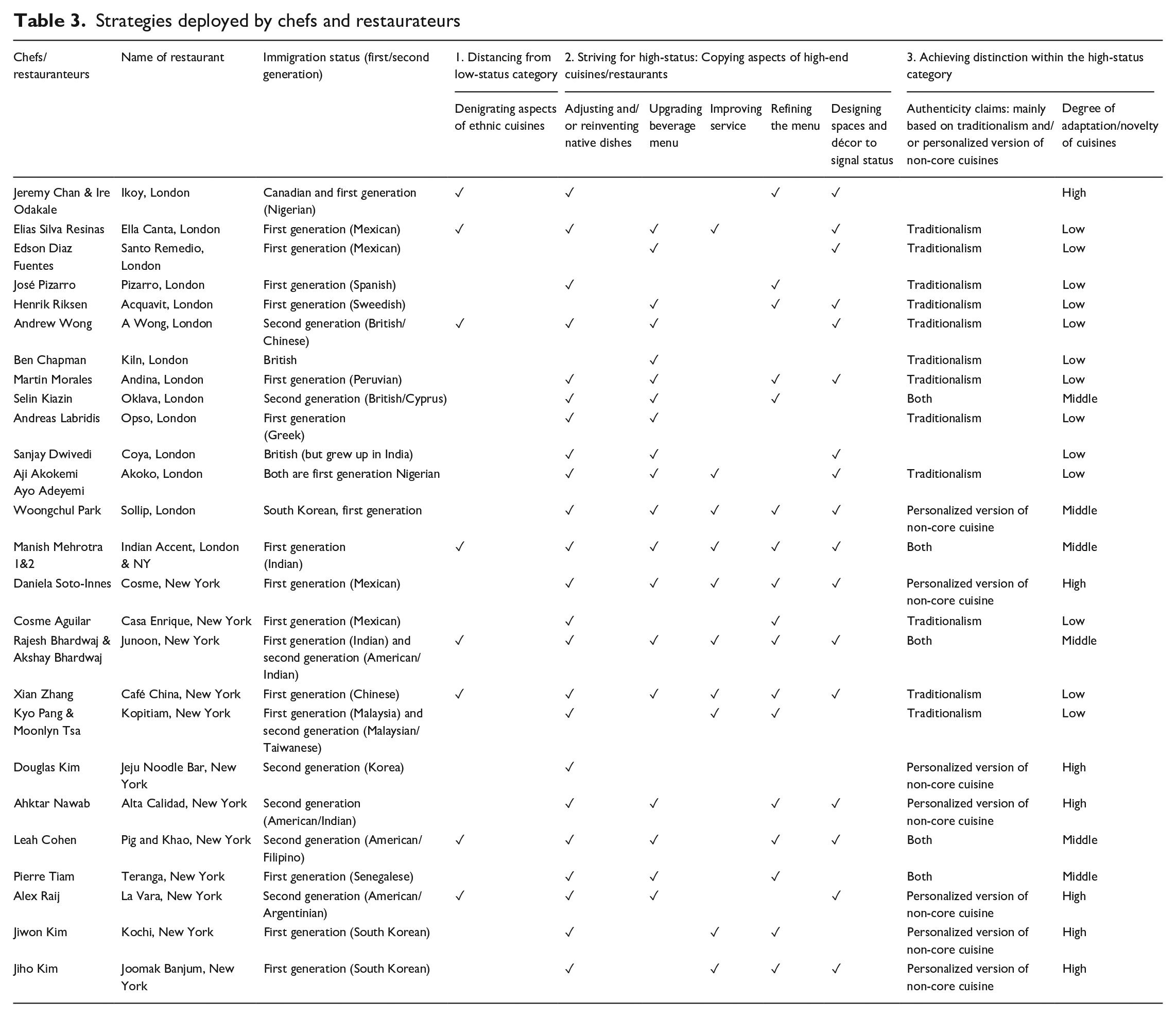
| Chefs/restauranteurs | Name of restaurant | Immigration status (first/second generation) | 1. Distancing from low-status category | 2. Striving for high-status: Copying aspects of high-end cuisines/restaurants | 3. Achieving distinction within the high-status category | |||||
|---|---|---|---|---|---|---|---|---|---|---|
| Denigrating aspects of ethnic cuisines | Adjusting and/or reinventing native dishes | Upgrading beverage menu | Improving service | Refining the menu | Designing spaces and décor to signal status | Authenticity claims: mainly based on traditionalism and/or personalized version of non-core cuisines | Degree of adaptation/novelty of cuisines | |||
| Jeremy Chan & Ire Odakale | Ikoy, London | Canadian and first generation (Nigerian) | ✓ | ✓ | ✓ | ✓ | High | |||
| Elias Silva Resinas | Ella Canta, London | First generation (Mexican) | ✓ | ✓ | ✓ | ✓ | ✓ | Traditionalism | Low | |
| Edson Diaz Fuentes | Santo Remedio, |
First generation (Mexican) | ✓ | ✓ | Traditionalism | Low | ||||
| José Pizarro | Pizarro, London | First generation (Spanish) | ✓ | ✓ | Traditionalism | Low | ||||
| Henrik Riksen | Acquavit, London | First generation (Sweedish) | ✓ | ✓ | ✓ | Traditionalism | Low | |||
| Andrew Wong | A Wong, London | Second generation (British/Chinese) | ✓ | ✓ | ✓ | ✓ | Traditionalism | Low | ||
| Ben Chapman | Kiln, London | British | ✓ | Traditionalism | Low | |||||
| Martin Morales | Andina, London | First generation (Peruvian) | ✓ | ✓ | ✓ | ✓ | Traditionalism | Low | ||
| Selin Kiazin | Oklava, London | Second generation (British/Cyprus) | ✓ | ✓ | ✓ | Both | Middle | |||
| Andreas Labridis | Opso, London | First generation |
✓ | ✓ | Traditionalism | Low | ||||
| Sanjay Dwivedi | Coya, London | British (but grew up in India) | ✓ | ✓ | ✓ | Low | ||||
| Aji Akokemi |
Akoko, London | Both are first generation Nigerian | ✓ | ✓ | ✓ | ✓ | Traditionalism | Low | ||
| Woongchul Park | Sollip, London | South Korean, first generation | ✓ | ✓ | ✓ | ✓ | ✓ | Personalized version of non-core cuisine | Middle | |
| Manish Mehrotra 1&2 | Indian Accent, London & NY | First generation |
✓ | ✓ | ✓ | ✓ | ✓ | ✓ | Both | Middle |
| Daniela Soto-Innes | Cosme, New York | First generation (Mexican) | ✓ | ✓ | ✓ | ✓ | ✓ | Personalized version of non-core cuisine | High | |
| Cosme Aguilar | Casa Enrique, New York | First generation (Mexican) | ✓ | ✓ | Traditionalism | Low | ||||
| Rajesh Bhardwaj & Akshay Bhardwaj | Junoon, New York | First generation (Indian) and second generation (American/Indian) | ✓ | ✓ | ✓ | ✓ | ✓ | ✓ | Both | Middle |
| Xian Zhang | Café China, New York | First generation (Chinese) | ✓ | ✓ | ✓ | ✓ | ✓ | ✓ | Traditionalism | Low |
| Kyo Pang & Moonlyn Tsa | Kopitiam, New York | First generation (Malaysia) and second generation (Malaysian/Taiwanese) | ✓ | ✓ | ✓ | Traditionalism | Low | |||
| Douglas Kim | Jeju Noodle Bar, New York | Second generation (Korea) | ✓ | Personalized version of non-core cuisine | High | |||||
| Ahktar Nawab | Alta Calidad, New York | Second generation |
✓ | ✓ | ✓ | ✓ | Personalized version of non-core cuisine | High | ||
| Leah Cohen | Pig and Khao, New York | Second generation (American/Filipino) | ✓ | ✓ | ✓ | ✓ | ✓ | Both | Middle | |
| Pierre Tiam | Teranga, New York | First generation (Senegalese) | ✓ | ✓ | ✓ | Both | Middle | |||
| Alex Raij | La Vara, New York | Second generation (American/Argentinian) | ✓ | ✓ | ✓ | ✓ | Personalized version of non-core cuisine | High | ||
| Jiwon Kim | Kochi, New York | First generation (South Korean) | ✓ | ✓ | ✓ | Personalized version of non-core cuisine | High | |||
| Jiho Kim | Joomak Banjum, New York | First generation (South Korean) | ✓ | ✓ | ✓ | ✓ | Personalized version of non-core cuisine | High | ||
Acknowledgements
We are grateful to Emma Mock for her help in collecting data from our interviewees’ menus and restaurants’ websites.
Declaration of conflicting interests
The author(s) declared no potential conflicts of interest with respect to the research, authorship, and/or publication of this article.
Funding
The authors received no financial support for the research, authorship, and/or publication of this article.