




Abstract
In this article we explore the revival of rave music in the UK, reporting original research findings and focusing, in particular, upon two emergent themes: (1) the lived experience of the ageing raver, and its embodied and collective nature; and (2) the changing role of the DJ. The article draws upon 15 in-depth interviews with both music professionals and ordinary participants who were part of the rave scene in the 1990s and who are now either returning to rave, after a period away from it, or who, having decreased their involvement, are now stepping it up again in the context of the revival. We explore how rave’s revival constitutes a form of heritage which is crucial to the UK’s creative economy and we illustrate how heritage rave events provide a collective space for ageing ravers to relive times, music and dances of old. However, we find that heritage rave is also a space of contention between advocates of ‘authentic’ and ‘commercialised’ forms of rave respectively. A further finding centres upon the ways in which reviving rave and reframing it in terms of heritage has transformed the position and role of the DJ. Having been a background figure in rave’s first wave, the DJ has become a centralised and revered figure within the heritage rave sector. There is a greater demand for professionalism and therefore sobriety, a demand which often agrees with those of their ageing body, but there are also performance demands which must be reconciled with the limitations of the latter. All DJ’ing involves non-contact bodywork – using music and mixing as a means of eliciting a specific and importantly, collective, bodily response – we argue, but this is heightened in the heritage rave scene.
Introduction
Subcultures or scenes centred upon music, dance and often drug-taking, and the moral panics which often surround them, are a prominent feature of the history of youth in most western societies during the latter half of the 20th century (Bennett and Kahn-Harris, 2004; Hall and Jefferson, 1993; Hebdige, 1988; Huq, 2006). From teds to mods, skins, hippies and punks, significant numbers of young people have converged around their preferred forms of music, inventing: new ways of dancing; their own argot; new codes of dress and appearance; and often adopting particular recreational drugs and ways of using those drugs which (to them at least but also often outside observers) reflect their collective ethos (Hall and Jefferson, 1993; Hebdige, 1998). In the process of doing this, moreover, they have often found themselves becoming an object of fear and anxiety for their parents and wider authorities, a response which has in many cases amplified the ‘deviance’ it identifies and vilifies (Hall and Jefferson, 1993; Hebdige, 1998).
One of the most recent examples of this is the ‘rave’ scene and subculture which began to gain traction in the UK during the late 1980s, enjoying its peak popularity and indeed notoriety during the early 1990s. The term ‘rave’ derives from the parties (‘raves’), famously organised in a DIY manner during the early years of rave, by young people themselves, often illegally, in warehouses, squats and remote open-air locations (Hill, 2002); and later, organised on a more professional, commercial and legal basis in dedicated club spaces. Early raves centred, musically, upon Chicago ‘house’ music and the ‘acid house’ music that evolved from it. Over time, however, playlists broadened to incorporate a variety of forms of electronic dance music (EDM) and there was a notable influence of what became known as ‘Balearic Beat’, a form of house music which took shape in Ibiza, whose clubs acquired a reputation for their raves, turning the island into a place of pilgrimage for youthful ravers across the developed world. Clothing and appearance changed too, as ravers rediscovered the hippy fashions of the 1960s and 1970s; their bright colours, loose, baggy fits and projected happy appearance (exemplified by the ubiquitous happy face symbol) standing in marked contrast to the more austere, serious and ‘tight’ look of the post-punk fashions of the early 1980s. No less central, however, was the psychoactive drug, Ecstasy, widely taken at raves, which was reputed to boost energy levels (for dancing), increase empathy and induce a state of happiness. Much of the ethos and many of the further practices associated with rave overlapped with and enhanced these effects. For example: many ravers made of use of olfactory decongestants, because they were reputed to increase the strength of an Ecstasy high, to the point where some wore dust masks lined with Vic’s Vaporub at raves; drinking plenty of water was a widespread and much remarked upon practice (unheard of in other music worlds), intended to combat the dehydration Ecstasy was known to cause; and levels of alcohol consumption, typically high amongst young people, were relatively low amongst ravers (with serious economic consequences for some clubs) because the drug was known to interact badly with alcohol and also because, for some ravers, it was symbolic of a mainstream and male dominated club culture which they rejected (Gilbert and Pearson, 1999; Pini, 1997).
Like its predecessors, the trajectory of rave can be envisaged as a wave, rising into prominence from relative obscurity, peaking and then inevitably declining as the members of its chief participant cohort enter a new life-stage and reduce their involvement in order to accommodate the demands and responsibilities of that new life-stage (e.g. careers and children) (Bennett, 2012; Bennett and Hodkinson, 2012; Gregory, 2012; Smith, 2009). And as fashion cycles turn, the younger generation find their own alternative ways of enjoying their youth. Again like its predecessors, however, rave appears to be enjoying something of a revival. Whilst rave may have continued in some capacity during this hiatus – the Ibiza holiday party scene being a notable example – its predominance in the lives of those who were committed 1990s ravers undoubtedly declined (Anderson, 2009; Gregory 2012). This is corroborated by economic and societal shifts which have transformed the night-time economy not just in the UK but across Europe. The financial recession of the late 2000s saw numerous clubs close. In 1994, estimates suggest that there were at least 4200 nightclubs in the UK (Mintel, 1994), by 2015 this had reduced to just 1733 (ALMR, 2015). This does not mean rave disappeared altogether, but it certainly was not a prominent feature of the night-time economy or the ‘hugely significant social phenomena’ it had previously been (Malbon, 1999: 6). Indeed, many of the music professionals we interviewed discussed having to take on other forms of employment during this period because of a lack of work. It is difficult to pinpoint when rave’s resurgence began, but our research suggests that events started happening across the UK from approximately 2015 onwards. First-wave ravers, now in their 40s and 50s, are entering a life stage in which certain of the demands and responsibilities which caused them to cease raving are beginning to lift and they are experiencing both increased free-time and sufficient disposable income to be able to afford what are often expensive nights out, whilst perhaps feeling the need to rediscover both some of the pleasures of their youth and the sense of self and identity which went with it. This shift has created a demand that club owners, DJs and promoters and others have sought to both cultivate and service, resulting in the abovementioned revival. As we illustrate, this revival operates in quite a different spatial and temporal landscape, with daytime events and one-off festivals catering to older clientele. It also draws significantly on the heritage of 1990s’ rave brands.
There is a growing literature on the revival of a variety of subcultures and scenes, and the return to or at least reinvigoration of participation on behalf of those originally involved in them (Bennett, 2012; Bennett and Hodkinson, 2012; Bithell and Hill, 2014; Smith, 2009). This includes a small amount of work on rave (Gregory, 2012; Peter and Williams, 2019). However, this work is very much in its infancy, particularly in relation to rave, which has received only scant attention. The academic literature on the rave revival is thin. Furthermore, the literature on the first wave is quite narrowly focused. Apart from Thornton’s (1995) classic account of club cultures, which, drawing upon Bourdieu (1984), explores the ways in which clubbers accumulate and deploy ‘sub-cultural capital’ in an effort to achieve distinction, and Anderson’s (2009) important discussion of the waning of rave culture, most accounts centre either upon: the emergence and rise of rave as a scene and/or subculture (Bainbridge, 2013; McKay, 1998); the subversive nature which social scientific commentators, echoing the claims of the early theorists of subculture in Birmingham’s Centre for Contemporary Cultural Studies (CCCS), perceive in rave (Gilbert and Pearson, 1999; Pini, 1997; Redhead, 1997, 1998); and, again echoing a key CCCS theme, the moral panic which the media and other agencies of social control created around rave, and the effect of that moral panic (Hier, 2002; Thornton, 1994). What is missing in much of this work, as Malbon (1999: 17) observes, is any sustained focus upon the experience of clubbing.
In this article we expand this focus by presenting and discussing the findings of a qualitative study focused upon the contemporary rave revival. As discussed, whilst we acknowledge that rave did not completely disappear over the last 30 years, socio-economic changes, coupled with increasing lifecourse responsibilities of first-wave ravers, meant rave’s popularity significantly diminished. Its resurgence now presents a revival. In particular, our article centres the body as the primary vehicle for exploring the lived experiences of heritage rave. Our approach to this is twofold exploring the embodied experiences of both rave fans and DJs. Work on musical fandom is well established (Duffett, 2015), as is a focus on fandom and age (Bennett, 2013; Holland, 2012). Yet it is only recently that scholars have begun to pay attention to music and embodiment (Crossley, 2015; Driver and Bennett, 2014). Importantly such studies address embodiment beyond just fans, and focus on the collectivity of ‘music worlds’ (Crossley, 2015) or ‘scenes’ (Driver and Bennett, 2014): including producers, managers, artists and anyone involved in ‘musicking’ (Small, 1998). Through in-depth qualitative interviews with both rave fans and music professionals we draw together age and embodiment of music to understand the heritage rave ‘music world’. This leads us to argue that the revival of rave is driven by older ravers wishing to relive past embodied experiences of rave, albeit in quite different and more ‘age appropriate’ circumstances. Likewise, we illuminate the embodied changes for the DJ, including the pressures of perceived professionalisation of their role, but also the ageing body. Borrowing from studies of labour (Holmes, 2015; Lee Treweek, 1997; Twigg, 2000), we contend that part of the embodiment of rave involves the DJ performing a non-contact form of bodywork, using their craft to elicit a specific and collective bodily response. This we illustrate is heightened in the heritage rave scene because of its increased commercialisation and position within the creative economy. As we demonstrate, whilst heritage rave is a collective space for ageing ravers to relive rave it is also a space of tension between ‘authentic’ and ‘commercialised’ forms of rave.
We begin with a review of the key sociological debates that the article unites, including: rave’s position in studies of music and musical cultures; literature on music, age and the body; and heritage studies and the creative economy. A methodology follows detailing the core aspects of our research design. Our empirical findings and discussion are then broken down into four key sections: the first considers the changing landscape of rave, the production of its heritage form and the ageing clubber; the second considers the changing role of the DJ; the third the DJ as bodyworker; and the final empirical section draws the article together to consider ‘authentic’ versus ‘commercialised’ forms of heritage rave.
Literature Review
Positioning Rave
The UK rave ‘scene’ emerged during the late 1980s and early 1990s. With its roots in Chicago ‘house’ music which with the help of technology, such as synthesizers, developed into a further genre of ‘acid house’ – rave music has transatlantic heritage (Brewster and Broughton, 2006). The term rave is now associated with a range of music styles including dance, techno, and Balearic, alongside acid and house, all united by a distinctive ‘four-on-the-floor’ 1 rhythm. Nonetheless rave is more than just its music. As Brewster and Broughton (2006: 87) discuss, Northern Soul provided a ‘blueprint’ for UK rave culture to take hold. Rave in its first iteration involved working-class youth congregating in large numbers to take drugs and dance, just as the Northern Soul scene had done in the 1970s and 1980s (Hollows and Milestone, 1998). Importantly Northern Soul also elevated the significance of the DJ, ‘introducing an unprecedented sophistication to the craft’ (Brewster and Broughton, 2006: 87).
As noted, academic studies on rave are limited. Of those which focus on its 1990s origins, rave’s political and subcultural roots is a primary topic. Work exploring rave across the globe, from Newcastle, UK to Sydney, Australia, have reached similar conclusions: that rave was a youth culture focused on resisting the social and political order (Bennett, 1999; Brookman, 2001; Gilbert and Pearson, 1999; Malbon, 1999; Pini, 1997; Thornton, 1995). The UK 1990s rave scene is often depicted as an inclusive community away from the mass unemployment and deindustrialisation of Thatcherite Britain (Rietveld, 1998). Building on the New Age and hippy movement of the 1960s and 1970s, and having the same serendipitous undertones, the Free Party Movement was responsible for numerous ‘illegal raves’ in warehouses, fields and motorway service station car parks across the country (Hemment, 1998; McKay, 1998). Coupled with the introduction of Ecstasy into the UK party scene in the late 1980s (urban legend has it that Ecstasy was brought into the UK by a number of now renowned DJs who first sampled it in Ibiza) and moral panic supposedly ensued (Wright, 1998). Indeed, it was such DIY dance parties – and similar concern about more legal, formal ones (Hemment, 1998) – which led to the introduction of the 1994 Criminal Justice and Public Order Act to prevent such gatherings, further politicising ravers and the rave scene (Halfacree and Kitchin, 1996). Yet as Luckman (2001) notes, there has been an overt focus on rave as subcultural resistance at the expense of other avenues of enquiry. Malbon’s (1999: 17) work on clubbing concurs, citing the need for more focus on the ‘experiences of clubbing’. Our work illustrates that whilst rave’s subcultural undertones are played down by participants, there are tensions around what are deemed more commercial versus more authentic forms of rave within the revival. The former presented as a profit-driven opportunity to make money from iconic club brands, and the latter drawing on rave’s original ethos of collectivity and serendipity.
The very limited recent work on rave does, in the main, make such a departure to focus more on experiences of rave. Recent studies include a focus on the racial politics of rave, exploring how London’s acid house scene emerged from rare groove and the live black music scene (Melville, 2019). Whilst revealing a much-needed alternative history to acid house and rave, it must be noted that Melville’s work is historical rather than contemporary. Peter and William’s (2019) work on the ageing clubber goes some way to address the lack of academic attention given to rave’s revival. Whilst initially focused on ‘lapsed clubbers’ and memories of the 1990s rave scene, their 2016 study was extended to include a survey on clubbers’ present experiences. Exploring how often participants still went clubbing, the prevalence of drug taking and how contemporary clubbing relates to employment and relationship status, they conclude that ravers continue to partake in raving once they are older. Although somewhat limited by its quantitative approach, this study goes someway to reveal the contemporary experiences of ageing ravers. Importantly, it also concurs with other work on music, ageing and youth cultures.
Age, Rave and the Body
Work on music and ageing covers a broad spectrum of musical genres including rock (Gibson, 2012), punk (Bennett, 2012; Sharp and Threadgold, 2020), goth (Hodkinson, 2011) and Northern Soul (Smith, 2012) (see also Bennett and Hodkinson, 2012). A very small sliver of this is devoted to rave (Bennett, 2012; Peter and Williams, 2019). Several studies conclude that rave is a preserve of youth (Gregory, 2012; Thornton, 1995). As Thornton notes (1995: 32) ‘the age boundaries of clubbing are tight, framed on the younger end of the scale’. However, other work aligns with Peter and Williams (2019) to argue that rave now incorporates people of all ages. Bennett (2012: 135) discusses how the ‘dance club and party scene’ is increasingly ‘catering to an older clientele’ and that this includes DJs from the 1980s and 1990s who continue to play such music. Such work supports this article’s argument that rave is experiencing a renaissance and importantly that this not just due to fans remaining interested, but also music professionals continuing to work in the rave scene. Drawing on Harrison’s (2010: 4) notion of heritage as active, ‘creative engagement with the past in the present’, we illustrate how rave can be a form of heritage because it is attached to both collective and individual memories, values, experiences, ‘places, objects and practices’ which are held up ‘as a mirror to the present’. As we illustrate through the voices of our participants, it is as much about enjoying the present as it is about remembering the past for both fans and professionals.
A further facet of work on music and ageing attends to the body. Once again where rave is concerned this is particularly limited. As several key musicologists have noted, there has been little work on music and embodiment (but see Crossley, 2015; Driver and Bennett, 2014). In rave’s case, Gregory’s study (2012: 39) on older female ravers, explores rave, ageing and gender. Similarly, Bennett (2013: 118) explores how older ravers have ‘to adapt to the demands of the dance and party scene with an aging body and the added responsibilities that age has brought with it’. Yet, to date, nothing has addressed the specifics of rave’s embodiment and importantly how rave evokes particular bodily reactions. Drawing on labour studies, we contend that rave involves a collective bodily response and that this response is crafted by the DJ. We use the term bodywork, to describe this process. Bodywork is understood as paid work performed on the bodies of others. As a concept it originates from social science research in the 1990s and early 2000s on feminised forms of work and labour. Emerging from studies on nursing and care work (Lee-Treweek, 1997; Twigg, 2000), the term has been expanded to include sex-work (O’Connell Davidson, 1995; Sanders, 2005), alternative therapy (Oerton, 2004) and beauty treatments (Sharma and Black, 2001). Alongside other feminist scholarly work on emotional (Hochschild, 1983) and aesthetic labour (Witz et al., 2003), body work is regarded as part of the essentialised skill set women are constructed to possess. It embodies both feminised notions of caring for others, alongside sexualised elements of women using their bodies to work upon the bodies of others (Wolkowitz, 2002). Nonetheless, as other scholars have illuminated, bodywork can be both a source of ‘domination, but also ‘empowerment’ for workers, demonstrating the complexities and ambiguities of bodywork and that it can have both negative and positive connotations (Gimlin, 2007: 360). Research exploring male forms of bodywork is limited, focused predominantly in studies of gender (Fisher, 2009) and sexuality (Chen, 2017). However, there have been some studies focused more predominantly on masculine bodywork roles, including McDowell’s (1997) study of London stockbrokers and Twigg’s (2000) discussion of undertaking. Our use of the term here is something of a deviation – applying it both to a predominantly male form of work and also a form of labour which is very much non-contact.
The DJ, Heritage and the Changing Cultural and Creative Economy
The notion of the DJ as having the power to direct and transform the audience is not new but understanding this as a form of bodywork is, and it is tied to the DJ’s now revered position. Historically a DJ was someone who played records on the radio. It was only in the 1940s that the idea of someone playing records to a live, physical audience emerged (Brewster and Broughton, 2006). Yet the prominence of the DJ as a spectacle in their own right is a much more recent phenomenon. Earlier rave studies suggest that the DJ was a somewhat anonymous figure hidden away and rarely visible. As Langlois (1992: 223) notes ‘in purpose-built clubs, the mixing booth is often out of sight, and even at large scale events the DJ is ill-lit compared to the garish visual projections and other lighting effects’ (see also Thornton, 1995). This is in sharp contrast to more recent studies who note the role of the DJ as being ‘as much about visual performance as it is about sound creation’ (Montano, 2010: 406; see also Farrugia and Swiss, 2005). Brewster and Broughton (2006) pin this sea change on rave’s heyday in the 1990s, when high ranking DJs were commanding fees of five and six figures for single performances. This, they argue, was due to the DJ’s skills at mixing, rather than just playing records, and primarily the communal and collective atmosphere of raving, with DJs essentially steering the audience’s mood and, as we develop here, their actions. It must also be noted that the DJ has historically been a male figure (Gadir, 2016). Whilst we do not discuss the gendering of DJ’ing at any length here – the assumption that most DJs are male was certainly made by some of the participants. As we illuminate the DJ’s revered position is even more prominent in the contemporary heritage rave scene.
Heritage is a well-established and crucial component of the Cultural and Creative Economy (CCE) (Harrison, 2010; Harrison et al., 2020). Cultural heritage is described as the preservation of ‘objects of art and of daily use, architecture, landscape form – and intangible culture – performances of dance, music, theatre, and ritual [. . .] language and human rights’ (Silverman and Ruggles, 2007: 3). Work on musical cultural heritage is well researched, exploring topics such as the role music plays in urban heritage and place making (Gilmore, 2013), music heritage and tourism (Lashua, 2018), the politics of music heritage (Johnson, 2018) and the need to preserve it (Baker, 2015). Nonetheless, work which positions rave as a specific form of musical heritage is lacking, as is work which explores the role of the DJ in this process of heritage making. Similar research on musicians and their work as part of the CCE is a popular field of study, exploring issues such as precarity (Morgan and Wood, 2014); competition (Umney, 2017) and the production of inequalities (Bull and Scharff, 2021). Some of this literature deals specifically with the labour of the DJ and their role within the creative economy (Fraser, 2012); a proportion is also devoted to the impact of digitalisation on the rave DJ (Montano, 2010). However, nothing to date connects the rave DJ, the CCE and heritage-making. In what follows we make this connection, highlighting the increasing focus on the performance of DJs, and in turn their required professionalisation, and the impact this has on producing rave as a form of heritage within the CCE. We go on to consider how the heritage rave scene involves tensions around what constitutes ‘appropriate’ or ‘authentic’ rave heritage – drawing on rave’s DIY and collective roots – and how the role of the DJ is wrapped up within this.
Methodology
This article stems from a pilot project conducted in 2018/19 focused on rave’s revival and the changing nature of rave events. Primary data collection involved 15 in-depth interviews with individuals, living in the north-west of England, who are both currently active in the north-west rave ‘world’ and were active in that world during the 1990s. This involved a focus on Manchester as a major clubbing location during the 1990s and with a vibrant night-time economy at the time of the research (pre-Covid). It must be acknowledged that whilst the research is focused on Manchester, we believe the findings are more broadly representative of cities across the UK, where similar heritage rave events are taking place. As we go on to elaborate, some of these are attached to iconic club brands, whilst others are smaller, localised events.
Participants were recruited using a snowball sample, whereby the lead author promoted the project on various rave social media sites. Participants were a mix of music professionals involved in rave and also rave fans who attended regular events. It must be noted that often the delineation between fan and professional was not clear. Several of the well-known DJs and music professionals interviewed professed to be devoted fans of rave music and just as willing to be on the other side of the decks/music equipment as they were operating them. Likewise, several of the fans interviewed were also amateur/semi-professional rave music professionals, working at rave gigs as well as attending them. Table 1 provides basic socio-demographic information about each of the participants and illustrates the complexity of separating rave professional from fan. Participants were a mixture of genders, class, race and ethnicity, but notably all were over the age of 40 – reflecting the project’s focus on returning and reviving ravers from the 1990s. As noted earlier, the majority of the music professionals interviewed also identified as male. This reflects the gendering of music professional roles and in particular DJ’ing (Farrugia, 2012; Gadir, 2016). Whilst we do not address this as one of our findings, it is an area of further study and potentially impacts upon the DJ’s revered position in much the same way other crafts, and particular ‘master’ crafts people, are often seen as traditionally male-oriented roles (see: Holmes, 2015; Sennett, 2008). Finally, we should add that one participant (Graeme Park), a renowned DJ, who was interviewed for the project, is also a co-author of this article. For this reason and with Graeme’s consent his quotations are identifiable. All other participants are pseudonymised to protect their anonymity.
List of participants.
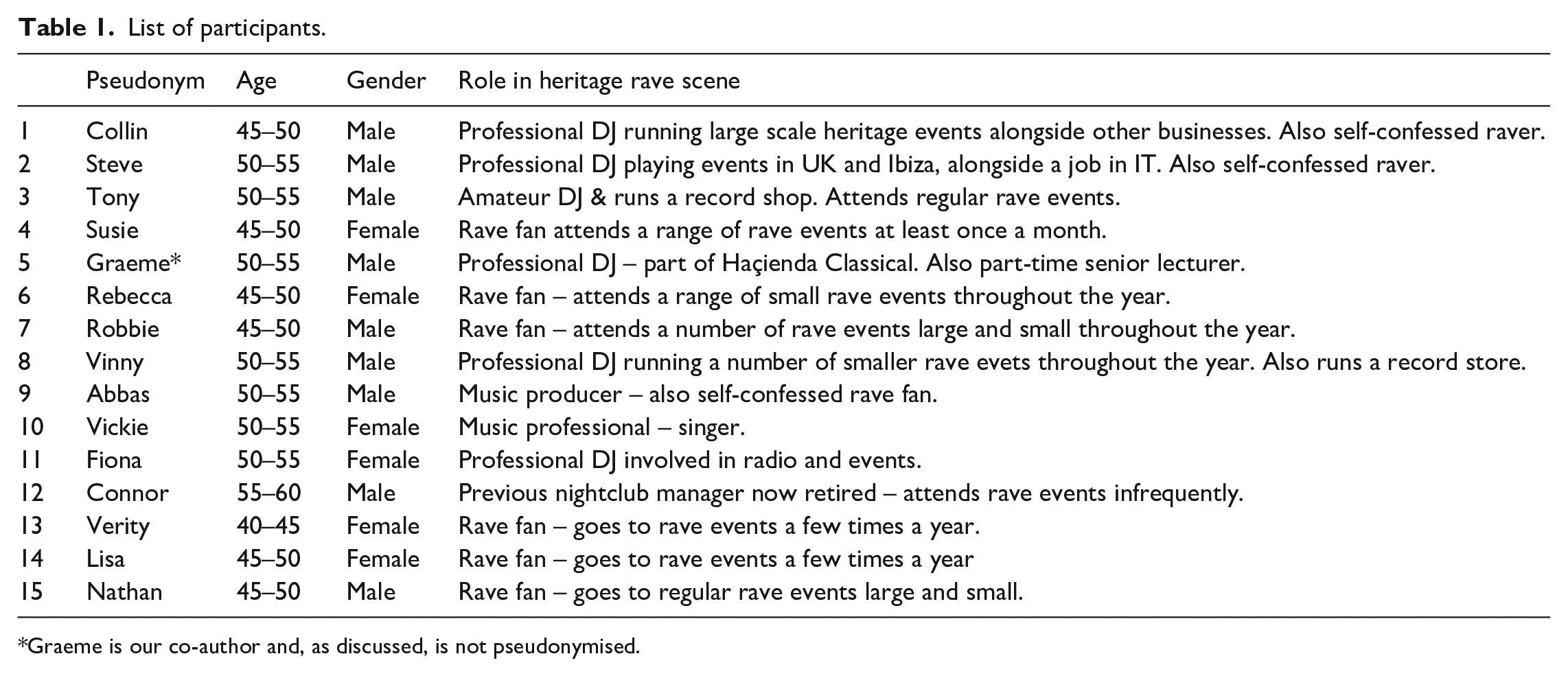
Graeme is our co-author and, as discussed, is not pseudonymised.
The aim of the interviews was to access participants’ lived experiences, memories and accounts of rave in the 1990s and compare these to those of the contemporary era. As Smart (2007: 40) notes, memories are not static and can ‘change to suit an audience’. Thus, we recognise that the narrative process of storytelling through the interviews may well have led to the reconstruction and embellishment of memories. All interviews took place in a space chosen by the participants – often in cafes or places of work. Most interviews lasted between 1–2 hours and all of them were audio-recorded. Following professional transcription, each interview was analysed by the lead author using thematic coding. Coding involved both etic and emic approaches, with themes identified from both the top down and the bottom up. Analysed data and themes were then discussed with co-authors to produce the main arguments of the article.
In terms of reflexivity and positionality, it must be noted that whilst Graeme Park, the DJ co-author is an ‘insider’ to the rave world, neither of the other authors are. The lead author, who conducted all the interviews, is an infrequent attendee of rave events, but was not part of the earlier rave scene being too young. Co-author Nick Crossley is a music sociologist, active in other music worlds, but is not and never has been part of the rave world. Thus we acknowledge that our positionality in approaching the topic is one of academic expertise, with the insider knowledge of our DJ author to draw on during the analytical discussions, we must also stress that the interviews were undertaken without drawing on Graeme Park’s networks or participants having any knowledge of his involvement.
‘Better Days’: The Changing Landscape of Rave and the Ageing Clubber
Our first point corroborates emerging and recent academic literature on the contemporary experiences of ageing ravers: rave is having a revival and this is being driven by older clubbers (Bennett, 2012; Gregory, 2012; Peter and Williams, 2019). However, we argue that rave’s revival constitutes a form of heritage which is part of the Creative and Cultural Economy (CCE). In keeping with notions of cultural heritage (Silverman and Ruggles, 2007: 3), this involves the preservation of rave as a form of music, dance and (sub)culture through events such as those described later in the article (see also Bennett and Janssen, 2016; Cohen et al., 2015; Reynolds, 2012). This is closely connected to urban heritage and place-making (Bennett, 2020; Gilmore, 2013), whereby iconic club brands known for being physically located in particular cities draw upon their geographical and urban heritage to promote their branded rave events. As we will illustrate in the article, this contemporary reproduction of rave is a form of musical and cultural heritage. We start by highlighting how rave has undergone a number of spatial and temporal changes since its heyday in the 1990s, which form the foundations for heritage rave and the audiences it attracts.
Concurring with Bennett’s (2012) work on the dance party scene, our study found that the very fabric of the night-time economy has been moulded to cater for older ravers. Many of the iconic clubs of UK rave’s heyday have long since gone – Manchester’s Haçienda, Liverpool’s Cream. In their place have emerged a plethora of rave events in a variety of spaces and venues across the UK, including daytime festivals and early evening concerts many of which are finished by 11 p.m. Some such events are huge, drawing in crowds of 5000 upwards for those attached to iconic club brands such as Manchester’s Haçienda Classical or London’s Clockwork Orange. Others are much smaller affairs, advertised on social media and occurring in local bars and restaurants with 100 or so attendees. Participants described going to rave events, big or small, as ‘occasions’; activities they booked and planned quite far in advance. Many described how this was vastly different to their raving practices in the 1990s where they might be out two to three times a week at different clubs.
Importantly such events were seen to fit better with their responsibilities as older adults: So I started going clubbing when I was 15 [. . .] it was every week, two or three nights a week [. . .] I embraced it fully. Loved it, absolutely loved it. But yeah it all changed [. . .] And the people who had been about had either grown up or stopped going out or were having babies [. . .] now I go to festivals and local events. (Susie, rave fan) The Haçienda closed in ‘97, Sankeys Soap a few months after. They all seemed to go one after the other. And then I had friends, they started getting married and having kids [. . .] real life starts to creep in on people [. . .] And going out every weekend [. . .] now it’s a shift to a more festival vibe [. . .] you might do a monthly thing. (Tony, amateur DJ & rave fan) I think I probably stopped clubbing around 1998. I ended up having my son in 2001. And then I’d go to a real, real occasional thing and then it really dropped off until 2012 when I got an unexpected invite from a friend and it kind of reawakened [. . .] now I go to a lot of boat parties and small events. (Rebecca, rave fan)
The above participants illuminate the spatial and temporal changes to raving which have occurred over the last 30 years. From going out every week as a teenager to attending occasional one-off rave events when middle-aged, these quotations illustrate how wider socio-economic changes, such as club closures, alongside changing personal circumstances attached to getting older, such as having children, have changed the landscape of rave. No longer is rave the preserve of the young, occurring weekly in nightclubs and continuing into the early hours. Contemporary rave involves older clientele, at one-off events, in a range of spaces and venues, which finish at, what was often referred to by participants as, ‘respectable’ times. Thus, heritage rave draws on the music and dances of old, and indeed involves many of the same participants and professionals, but it is spatially and temporally different from its early form.
Furthermore, this reworking of rave is also described as being much better suited to the older body, as professional DJ, Collin, explains: The daytime things now are just where it’s at. It’s just so much nicer. You can go home at a reasonable hour. You might be a bit jaded but it’s a lot better than getting in at seven o’clock in the morning. (Collin, professional DJ)
Daytime events and those aimed at older ravers were often compared to more typical nightclub experiences and places which were now seen as ‘off limits’ to older bodies and tastes: We actually went to the Warehouse Project. We turned up and I was like ‘I’m about 30 years too old.’ These middle-aged couples stood there going ‘hello, have you got a wine list?’ (Susie, rave fan) That is a proper decider for me. If I go anywhere, like is there somewhere to sit down. I was way too old at the Warehouse Project as well. Where there’s people going ‘oh it’s great you’re still out clubbing’ like some sort of museum exhibit. (Rebecca, rave fan)
These latter extracts not only illuminate the perceived bodily limitations of the older raver but also reveal some of the tensions within around the ‘right sort of raving’. As the participants discuss, at events such as the Warehouse Project (a series of large-scale night-time clubbing events held at the Mayfield Depot in Manchester which attract upwards of 10,000 clubbers) they felt out of place and too old. Such a venue did not cater to their needs or tastes – wanting a range of drinks and somewhere to be able to sit. This points towards there being an ‘acceptable’ sort of raving for the older raver. In addition, as we go on to explain, there are tensions within rave’s revival, whereby large-scale heritage rave events are deemed too commercial, and too far removed from rave’s original ethos to be authentic versions of rave.
‘I Wanna Give You Devotion’: Centralising the Sober DJ
Alongside the abovementioned spatio-temporal changes in ordinary ravers’ participation we observed corresponding changes in the role and responsibilities of the DJ, similarly motivated, at least in some part, by the demands of the ageing body. The heritage rave DJ is deemed a more sensible and professional act than their earlier counterparts. A recurrent theme within the interviews with both rave fans and professionals was how, in the 1990s, the DJ would often be as intoxicated – either through alcohol or drugs – as many of the ravers, but that contemporary rave has seen the rise of the sober DJ: And the DJs you know, everybody was drunk, everybody was on stuff in the nineties. Now it just don’t happen anymore. Back then everyone was off their biscuit and carrying vinyl. Now, no-one’s off their biscuit and they’ve all got USB. (Collin, professional DJ) It’s quite different now to how they used to be where they’d [DJs] sort of fall on the decks. And Paul, our friend, sometimes he’d forget to put a record on he’d be so pissed (laughs). (Rebecca, rave fan)
These quotations highlight that whilst being drunk or high was considered an acceptable practice for DJs in the 1990s, it is not something that happens as often in the contemporary rave scene. DJ participant Collin’s statement illustrates the impact of DJ’ing on the body and how, in contemporary rave, putting the body under strain from either carrying heavy vinyl or doing drugs – as he notes ‘being off your biscuit’ – is not what ageing DJs want. As Collin goes on to say: ‘record boxes at our age would put everyone’s backs out’. A further DJ participant, Steve, corroborates this, noting the stamina DJ’ing requires: In the 90s in Ibiza, if I was working six or seven days or nights a week I could be doing, you know, a six-hour stint in a bar. Which I could not do now. It’s exhausting.
Thus, not unlike the rave fans – the ageing DJ also has different bodily requirements of the contemporary rave scene. However, the drive to be sober and have less impact on the body is not only linked to age but also to an increased professionalisation of the rave DJs role, which, as we illustrate later, is in turn part of the production of the heritage rave scene and the tensions within it. Falling on the decks or forgetting to put on a record noted in Rebecca’s quotation would not be acceptable in the heritage rave scene. Indeed, as several rave DJ participants discussed, being a rave DJ is much more ‘serious’ now than it ever was. As DJ Collin notes: ‘it’s one thousand times more professional now than is used to be’. We argue that this is because the DJ is now a much more centralised figure than she/he ever was.
Whilst many participants discussed the rise of the ‘superstar DJ’ – famous DJs who can command huge salaries – many spoke of the DJ as being a central figure at most rave events, large or small, in a way they never were in the 1990s: And now when I go to clubs, everybody looks at the DJ, nobody looks at each other. (Fiona, professional DJ) Back then I certainly wouldn’t be bowing to the DJ as if he was some Godlike creature. I wasn’t bothered about watching him perfect his craft. I was there to snog boys and stuff! (Rebecca, rave fan) I always went to places where the DJ was tucked away. You could see him but he wasn’t the focal point [. . .] But now if you’re a promoter paying like ten grand you’re not going to shove them in a corner where no one could see them because anyone could be doing it. So at some point, they’ve made this thing where it’s like ‘here they are’ and it’s just morphed from that. (Vinnie, professional DJ) In the 80s and 90s nobody played a blind bit of attention to the DJ. (Graeme, professional DJ)
As these participant quotations illustrate, alongside the changes to the temporal and spatial nature of contemporary rave and its ageing participants and professionals, the role of the DJ has also drastically changed. Langlois’ (1992: 233) early work on rave discussed the DJ as being ‘barely visible’, with the mixing booth being ‘out of sight’. This is in contrast to more recent work by Montano (2010: 406) on the increasing digitisation of the DJ’s role which recognises that DJ’ing is ‘as much about visual performance as it is about sound creation’. In this respect, moreover, the (ageing) body of the DJ, their appearance and physical performance, are on display and form a part of the ‘show’.
Thus, we propose that a change has occurred within rave since the 1990s which has positioned the DJ in a much more central role than ever before, and this does not just apply to the ‘Superstar DJ’. Rather than hidden away and employed to ‘play the music’, the DJ is now the entertainer; a central, physical spectacle to watch and observe, alongside listening to. We argue that this centralisation of the DJ is part of the creation and reproduction of the heritage rave scene, and as we highlight shortly is part of the tensions within it.
‘Just Dance and Move Your Body’: The Bodywork of the DJ
With an increased focus on the DJ comes more pressure on them to provide a successful rave performance. In other words, to entice people to the dance floor. With this in mind, we argue that DJ’ing has always been a non-contact form of bodywork – using their skills of playing and mixing music to elicit a specific and collective, bodily response: DJs they are storytellers. They take you on a journey [. . .] they can take it up and they take it down [. . .] it’s like rounding up the sheep. (Abbas, music professional) It’s [DJ] the orchestrator of an audience [. . .] people they get the energy from the DJs, from the music. (Collin, professional DJ)
As discussed, whilst bodywork is traditionally a concept applied to feminised forms of work which involves paid work performed upon the bodies of others, it is also relevant when thinking about the craft of DJ’ing. As these participant statements illustrate, the DJ is essentially paid to get the audience to move their bodies and dance. As Abbas notes this might be to induce a mood of euphoria leading to specific dancing styles and body techniques (Crossley, 2015), or they may create a more chilled, subdued atmosphere. Unlike traditional forms of bodywork, this is done without contact, through the music they choose. The only other forms of body work which may involve this non-contact element are fitness instructors. As Langlois (1992: 236) corroborates, the DJ ‘actively performs’ the records, ensuring that ‘fans ‘are not there to ‘listen’ to the music but to become so emotionally involved that they can physically feel it’. Thus, rave is very much an embodied experience led by the DJ. As Abbas describes ‘certain tracks [. . .] when you hear it [. . .] it’s almost as strong as smells’ – illustrating the power of the DJ to induce a specific bodily reaction through their bodywork skills. Thus, the DJ as bodyworker is particularly unique, using their DJ skills and the medium of music to work on the bodies of rave goers. Furthermore, we contend that the need for the DJ to be seen to be a successful bodyworker is heightened because of the increased professionalisation of their role and growth of the heritage rave sector. Whilst we would imagine all rave DJs want to be able to make the audience dance, being able to draw audiences in and create the ‘right atmosphere’ is part of the commercialisation of rave and the tensions within the heritage rave scene, as we now move on to discuss.
‘Everybody in the Place’: Finding ‘Authentic’ Rave
As we have illustrated, the heritage rave scene has a number of distinctive features from its 1990s counterpart: it is spatially and temporally different making it more suitable for the bodies and lifestyles of the ageing clubber and DJ; it centralises the sober and professional DJ; and, in turn, emphasises the DJ’s skills as bodyworker – drawing in audiences and creating the ‘right’ rave atmosphere. Nonetheless, there are tensions within heritage rave, with particular rave events being criticised by participants for not having the same ethos or vibe of the 1990s rave scene. Whilst this may involve nuances and complexities from an academic perspective it was presented by participants as a polarised situation, with commercial and manufactured heritage rave events on one side and authentic rave events, embodying rave’s original ethos of DIY, collectivity, and serendipity, on the other.
A recurrent theme within participant discussions of what constitutes the right sort of rave was the notion of collectivity. The notion of raving as a collective act is linked to rave’s subcultural roots and its resistance against the social and political order (Bennett, 1999; Brookman, 2001; Malbon, 1999; Thornton, 1995). However, this interpretation of 1990s rave was challenged by several participants who argued that, whilst rave may have been political, it ‘didn’t feel political at the time’ (Susie, rave fan) and that this was a ‘narrative applied later’ (Vinnie, professional DJ). Rather, the collectivity discussed, and what seems at threat by aspects of commercialised heritage rave, was one based on notions of ‘family’: It’s almost like a family reunion [. . .] there’s like everyone, it’s like one big family, and everyone knows each other. (Vinnie, professional DJ) So I’ve got my clubbing family. And I enjoy going to the same gigs as these people. We all get along together. (Steve, professional DJ) [. . .] back then it was like one big happy family [. . .] quite like a family of ravers. (Robbie, rave fan)
These quotations illustrate that notions of raving as involving a collective like ‘family’ were present back in the 1990s and still are now, perhaps even more so when rave occasions are less frequent. Steve’s statement about his clubbing family going to the same gigs is important when thinking about the tensions within heritage rave, and is something which resonates within other participants’ accounts. Only certain heritage rave events were seen to have this collective, family-like element: When it’s small nights, they capture the ethos of what it’s about originally [. . .] it’s just more personal and you feel more part of it. But then you’ve got the cash cows [. . .] where you’re just a commodity [. . .] people get really annoyed about it. (Vinnie, professional DJ)
In the quotation above, Vinnie claims that the collectivity of rave and the family-like personal feel is more prevalent at smaller rave events. For him, small events capture the ‘ethos’ of original rave. This links back to earlier descriptions about large events such as the Warehouse Project which are deemed much more commercialised and, therefore, considered to be less authentic not just because of their size but also their impersonal nature. Other participants criticised ‘the nostalgia circuit’ (Tony, amateur DJ/rave fan) within heritage rave as less authentic. Such events are attached and promoted via iconic club brands (e.g. Haçienda, Cream, Clockwork) and are deemed to play a particular and obvious genre of well-known rave tracks. These are juxtaposed with smaller events which participants described as playing more obscure and forgotten tracks, mixed with new music. Thus, commercialised rave – identified as large events, heavily branded and/or playing ‘obvious’ music – is pitted against more authentic rave – small, intimate events where people know each other, playing forgotten tracks. This illuminates the tensions within the heritage rave sector about what constitutes the right sort of rave and events which provide what participants feel are authentic rave experiences.
Importantly a lot of this is tied to the DJ. As we have illustrated, the role of the DJ has become more centralised with the rave scene: requiring a much more professional persona. This professionalism is linked to the DJ’s abilities to perform and to bring in the crowds through their bodywork skills. Therefore, it follows that the more well-known the DJ, the more likely they are to be involved in large commercial events, and thus, in the eyes of some rave fans, the less likely they are to provide an ‘authentic’ rave experience. As DJ participant Vinnie noted, ‘a lot of the bigger DJs sell their souls to the devil and start following the money’. This also works the other way though, as professional DJ Fiona discussed; the scene is now so commercialised that DJs ‘will only get a gig at some events if you have X amount of social media followers’. Thus, some heritage rave events require that DJs actively work on their social media following – further adding to the professionalism of the role, distancing it from its 1990s counterpart, and thereby adding to the tensions.
Finally, and building on the last point, digitalisation as a whole adds to the tensions within the heritage rave scene. The perceived increase in digitalisation is seen to be linked to the professionalisation of DJ’ing and part of the erosion of authentic rave, particularly around rave’s original DIY, serendipitous ethos and notions of being in the moment. Nowhere is this clearer than in the ‘vinyl versus digital’ debate. Whilst there is not scope to go into this here (it could be an article in its own right, see Hesmondhalgh and Meier, 2018; Montano, 2010), the move from DJs physically choosing and playing records to plugging a USB (often containing a pre-determined set list) into a laptop was regularly cited by participants as part of the demise of authentic rave. Vinyl is often deemed ‘better’ with ‘a heavier, richer sound’ (Steve, professional DJ) and having the magic of ‘the crackle’ when played (Collin, professional DJ). But this is contested by others, our co-author, Graeme, included, who notes that vinyl is often the preference of the ‘older male clubber’, not the DJ having to carry it around – once again linking to the body. As Montano (2010: 409) concurs the ‘use of vinyl by some is seen as authenticating the practice’; a display as much of the DJ’s skills, as their ability to read the audience and choose the next track. Likewise, as Farrugia and Swiss (2005) illuminate, there is a certain irony to this distaste for digitisation, given rave’s electronic roots. This in part also links to repeated mentions by participants about the use of mobile phones at events, similarly somehow eroding rave’s authenticity of being in the moment. Often this was directed at younger ravers, and more commercialised events, but was also discussed more generally in relation to those who stare at the DJ and film them. Such practices were seen to ruin the collectivity of rave. As Fiona (professional DJ) notes ‘put your phone away and be totally enveloped in the music’. Thus, the contemporary digital world is also deemed often at odds with rave’s original ethos of DIY, serendipity and collectivity. In sum, as we have illustrated in this section, whilst the heritage rave scene provides opportunities for ageing clubbers and DJs to enjoy rave again it is full of tensions, particularly around acceptable and authentic sorts of raving.
Conclusion
In this article we have explored the revival of rave music in the UK, arguing that this resurgence in interest in rave and attending rave events constitutes a form of cultural and creative heritage. In our unpicking of heritage rave we have illustrated how the landscape of rave has changed significantly. This has involved major spatial and temporal changes, but also changes to how rave is experienced by rave fans and music professionals. Our focus on the lived experience of rave has shown how heritage rave is better suited to the ageing body and lifestyles of both rave fans and DJs. From someone who was often hidden away in a corner of a club and employed to play the music, we have noted that the DJ is now a central and revered spectacle within the rave scene, responsible for putting on a successful and professional performance. No longer is it okay to ‘fall onto the decks’, rather the DJ must use their bodyworking skills to ensure a professional and sober performance which keeps the audience interested and most importantly dancing.
Whilst many ageing ravers are enjoying the revival of rave, the heritage rave scene is not without tensions. As we have illuminated, tensions exist around the ‘right’ sort of rave and these are often connected to the DJ. Large scale events, heavily branded or those focused on playing ‘obvious’ old rave music are often perceived to be at odds with rave’s original ethos of collectivity and serendipity. Rather, many rave fans spoke of authentic rave being found at events which are smaller, attended with their ‘rave family’ and playing forgotten or more obscure tracks. DJs who play at large scale events or have swapped vinyl for digital, were also deemed to be part of the commercialisation of rave – even though many DJs would contest this.
Footnotes
Funding
The authors disclosed receipt of the following financial support for the research, authorship, and/or publication of this article: This research was supported by a grant from the School of Social Sciences Small Grants Committee, University of Manchester.
