




Abstract
Theorisations of cultural preferences frequently posit a nexus between familiarity and pleasure. The pursuit and enjoyment of our tastes has been linked to the socialised acquisition of embodied cultural competencies and to psychological mechanisms of expectation. A genre such as contemporary art music disrupts this link to familiarity due to its emphasis on the explicitly unfamiliar. Drawing on interviews with concert attendees, this article examines how taste is put into practice and performed in a context marked by ambiguity. The data are significant for the disruption they represent to any idealised notion of how audiences engage with legitimate culture. Not only is the anticipation of pleasure largely absent, but the expression of taste is also far removed from an austere mode of contemplation and appreciation. Affective modes of appreciation are frequently employed, while audiences also often show a reluctance to engage in processes of evaluation. The article argues for the importance of understanding taste as comprising fluid, emergent and contingent strategies for forming an attachment to cultural objects in a field marked by ambiguity.
Introduction
The notion that we would derive pleasure from our musical interests is unremarkable. While the modalities of that pleasure might vary as people interact with different objects of their musical tastes – be it the transcendental enjoyment of opera, the nostalgia of rock, the euphoria of trance, or the intellectual appreciation of the avant-garde – in all these examples, some easily identifiable form of satisfaction is being obtained by listeners. Indeed, for Bourdieu (1984: 86), the pursuit of pleasure is regarded as a precondition for successful acts of cultural investment.
The pursuit and reward of pleasure in our musical tastes carries with it a close connection to the role played by familiarity. For Bourdieu (1984), this familiarity corresponds to embodied cultural competencies which facilitate appreciation. For a listener who encounters a work, but who lacks a familiarity capable of recognising and appreciating the codes embedded in it, the beholder would be ‘lost in a chaos of sounds and rhythms’ (Bourdieu, 1984: 2). A similar association can be traced to Meyer’s (1956) pioneering work in musical aesthetics. Working from the psychological notion of intellectual uncertainty, he postulated that embodied musical meanings are a product of expectation, which, in turn, develops as a result of stylistic experience. In linking familiarity to an expectation born of experience, Meyer (1956: 35) argued that ‘music in a style with which we are totally unfamiliar is meaningless’.
How, then, are we to make sense of the ‘pleasure’ experienced by devotees of a genre such as contemporary art music, which places an explicit emphasis on the unfamiliar? Bourdieu (1984: 272) associates a taste for the avant-garde with an austere and purified mode of consumption – the pure ‘purified’ of pleasure. By contrast, Menger’s (2017) study of the audiences of Ensemble intercontemporain (EIC) – one of Europe’s leading contemporary art music ensembles – found that 72% of audience members lacked the ability to discriminate among the various styles of contemporary works presented. The disorientation and discomfort which Menger found among many of the EIC attendees draws into question any association with a quasi-scholastic disposition which obtains its joy from processes of recognition and deciphering.
This disjuncture – between theorised understandings of cultural taste and the experience of art music audiences – forms the departure point for the current article. Taking the Australian contemporary art music scene as its case study, it interrogates how audiences enact, realise and perform their musical taste in a context marked by ambiguity. This focus on how the encounter between a listener and the work is experienced identifies two dominant frames employed by audiences in discursively expressing their appreciation of music: the intellectual and affective. The ability to move between these two frames, together with avoiding evaluation altogether, is argued as essential for audiences to negotiate the ambiguous and unfamiliar and form what Hennion (2005) describes as an ‘attachment’ to their musical interests. Not only does this reshape our understanding of the relationship between tastes and familiarity, but it also disputes idealised notions of how audiences engage with legitimate culture.
From Tastes to Attachments
In researching the operation of tastes, the very question: ‘What are your musical tastes?’ is itself both unremarkable and yet perversely awkward. Unremarkable, in that the enumeration and analysis of individuals’ cultural tastes has long been a central concern to sociologists investigating how tastes – viewed as relatively stable and long-term preferences – are imbricated in various aspects of social life. In particular, Bourdieu’s (1984) seminal analysis in Distinction pioneered multiple correspondence analysis (MCA) as a method for identifying the homologies between the social space of actors and their corresponding cultural interests as observed in France in the 1960s. A diverse range of studies has subsequently drawn on Bourdieu’s conceptual framework for the nexus between taste and the social in other national and temporal settings (e.g. Bennett et al., 2020a) or with respect to specific topics such as omnivorousness (e.g. Savage and Gayo, 2011), social reproduction (e.g. Kraaykamp and van Eijck, 2010) and social stratification (e.g. Tampubolon, 2010).
To question someone about their musical tastes is awkward, however, in that it is an artifice of the researcher. In the first instance, people rarely use the term ‘taste’ to enquire about people’s musical preferences. They might ask about what kinds of music someone is ‘into’, enquire as to favourite music artists, or discuss what they ‘listen to’. Framing such questions in terms of ‘taste’, however, is at once both overly formal and also suggests that the interrogator is less concerned with musical interests and more with what might be interpreted as lying behind those interests. Secondly, the unity and stability of preferences implied by the term ‘taste’ crumbles under the slightest scrutiny. The analytical assignment of tastes risks overlooking the varying intensities of musical preferences. The nuanced configurations in which someone might mainly enjoy folk rock, but also occasionally goes to jazz clubs or listens to light classics, can go unnoticed in assigning people to broad genre categories. Committing to having a ‘taste’ for a particular style of music also suggests a homogeneity of appreciation which typically breaks down and fragments as individuals articulate their interests in any degree of detail. I like classical music (but mainly baroque and hate contemporary music). I like baroque (but only when played on period instruments). I like baroque music played on period instruments (but mainly French composers, except Boismortier is over-rated). This fragmentation of taste into increasing specificity does not even begin to account for all manner of contexts of listening and uses of music which further multiply the contingencies (I like listening to recordings of French baroque music played on period instruments when I’m at home by myself and I want to escape from the world).
This perspective, in which people’s ‘tastes’ are increasingly fluid and contingent, reflects the ‘pragmatic turn’ to analysing cultural preferences pioneered by Antoine Hennion which aimed at ‘restoring the performative nature of the activity of taste, instead of making it an observance’ (Hennion, 2005: 135). In addition to shifting from a concern with ‘tastes’ to ‘attachments and practices’, this programme of research inserts a new form of agency into the analysis of preferences as the analytical focus moves away from Bourdieu’s interest in cultural hierarchies. Rather than treating individuals as ‘cultural dopes’ who are wrong about what they do and need to be explained by the researcher’s access to social theories, Hennion instead argues for treating the expression of tastes as a reflexive activity which demands giving far greater attention to the multiple contexts and ways in which people enact their tastes. This approach echoes that of Latour (2005) in his critique of critical sociology and advocacy for a sociology of associations which places its focus on how ‘the social’ needs to be continually produced through the performance of mediating actors. His analogy of dance, ‘If a dancer stops dancing, the dance is finished’ (2005: 37), emphasises the role given to the performance and practice of taste as the preferred locus of analysis.
This article draws on performative understandings of taste, and the multiple ways in which it is performed, to examine the observed disjuncture between musical tastes and pleasure. Focusing on the genre of contemporary art music as experienced in Australia, it analyses interview data from participants to consider how they discursively construct their engagement with the object of their taste. The research interrogates the ways taste is exercised at the level of responses to individual works and how participants negotiated their varied appreciation of specific objects of their taste. Importantly, this approach restores a level of agency to the music itself. Rather than reducing music to a ‘mere arbitrary cloak’ (Hennion, 2015: 10) in the analysis of social forces, it allows a consideration of how audiences variously engage with (or ignore) the specific qualities of the music which is the purported object of their interests.
The analysis firstly considers the ways in which participants discuss choosing to practise their musical taste through acts of listening. Whereas other cultural pursuits offer more objectified forms of realising one’s taste – with Bourdieu (1984: 282) considering the purchase of works of art as the example par excellence – the temporal and often ephemeral nature of music points to different modes of pursuing these interests. The data not only emphasise the importance of attending live events, but also point to the significant positioning work which is at play as participants choose to exercise their taste. This serves to affirm participants’ own positions in the niche field of contemporary art music and can be seen as a microcosm of the broader types of social positioning which Bourdieu (1984) observes in Distinction. In doing so, however, the traditional modalities of ‘pure aesthetic’ or ‘sensual’ pleasure are largely absent from interviewee accounts as they discuss their concert attendance. Instead, their decisions to do so were largely framed in terms of demonstrating solidarity with and supporting their own specific ‘interest’ in the specific cultural field of Australian art music.
The article concludes by examining the discursive strategies employed by participants in experiencing, making sense of, and evaluating specific musical works. The notion of taste as involving processes of evaluation, and the ‘aesthetic principles’ on which these judgements are made, have been argued by Hanquinet (2018) as underacknowledged in sociological accounts of taste. The dominant intellectual and affective frames employed by participants – and the role they serve to position them in relation to the music they encounter – again draw parallels with Bourdieu’s notion of ‘pure’ and ‘impure’ taste as expressions of the interested relational positioning of individuals in society. Instead of the austere mode of consumption which Bourdieu commonly identifies in discussing avant-garde styles, however, the performance of taste in fields marked by ambiguity and tension demands a subtlety and nuance as participants switch between different frames of reference to enact their appreciation of contemporary art music. Furthermore, this shifting of discursive repertoires is also necessary to enact the ideal of cultural ‘openness’ (Ollivier, 2008) to which many participants aspire, while simultaneously allowing for the sorts of discrimination which are fundamental to musical taste.
The Contemporary Art Music Scene
The scene of contemporary art music provides a critical case study to examine these issues of taste precisely because of its emphasis on the presentation of the unfamiliar – as part of avant-garde culture – together with its increasingly ambiguous position in hierarchies of culture. In reflecting the music of present-day composers and sound artists, the contemporary art music scene would appear to sit neatly in the ‘high’ and ‘new’ quadrant of Bellavance’s (2008) theoretical space of cultural items. As Bellavance notes in his analysis of Canadian cultural tastes, however, the discriminating role once played by the high/low axis of cultural distinction is increasingly blurred. In the particular Australian context examined here, Bennett et al. (2020b) argue that classical music’s apex position with respect to cultural legitimacy has been diminishing since the 1970s.
This shift can be observed alongside increasing calls for the democratisation of cultural policy more broadly (Holden, 2006) and, specifically, in initiatives to increase the diversity of musical genres which have access to state funding in Australia (Homan, 2016). As a result, the legitimacy of contemporary art music leans increasingly on the contemporary and less on the art by demonstrating its connection to time and place. These layers of ambiguity combine to provide a rich case study in which to investigate how these tensions emerge in the expression of musical taste.
Method
The study’s data were generated through a series of semi-structured interviews with contemporary art music attendees in Sydney, Australia, conducted between May and November 2017. The interview format required that participants had co-attended a concert with the interviewer as their responses to specific works would form one of the topics covered in the subsequent interview. A cohort of 13 participants was identified by attending a range of music concerts and festivals and inviting attendees to participate in an interview.
Despite the sample (see Table 1) being purposively selected to reflect a range of ages, genders and occupations, it nevertheless demonstrates a consistently high degree of formal music training, with only four participants (31%) not having completed a music degree. Rather than representing an anomaly of the sampling approach, this largely reflects the practitioner-dominated nature of the field which was often emphasised in the interviews and also alludes to the levels of particular forms of cultural capital which are necessary in order to have an interest in contemporary art music. The high level of tertiary music training among interviewees is therefore considered to be reflective of the broader population of art music attendees and is in line with other research. A 2017 survey of members of various Australian music organisations (Chambers, 2020) found that a remarkably high percentage – 85% – of people who identified as having an interest in contemporary art music had a tertiary degree and 70% of those degrees were in fields of either creative arts or education.
Interview participants.
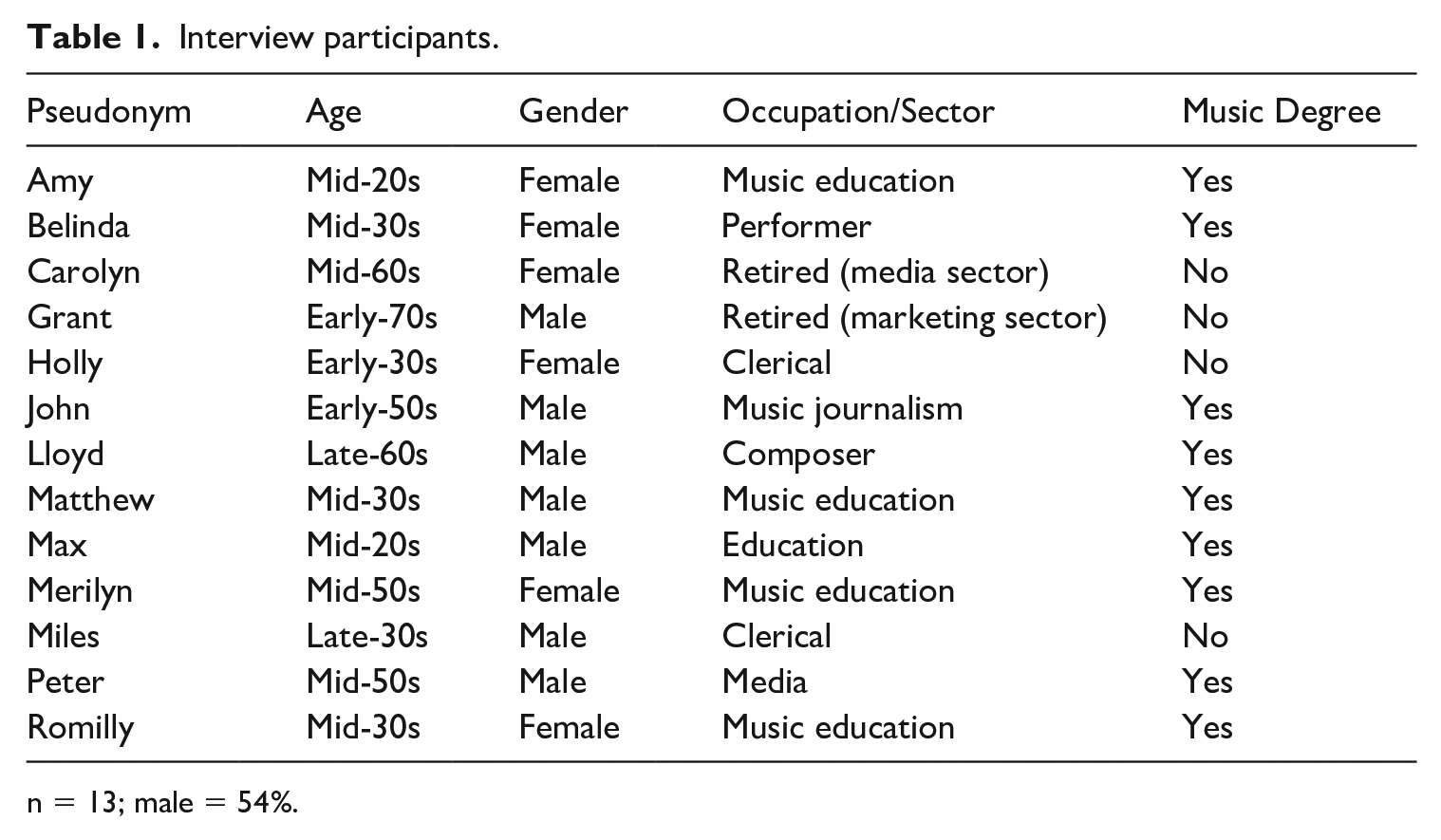
n = 13; male = 54%.
Interviews were conducted in-person, in a setting of the participant’s choosing and lasted between 45 minutes and 2 hours in duration. They followed a semi-structured format in which participants were asked to reflect on (i) their musical tastes generally; (ii) the origins of their interest in contemporary art music in particular; (iii) how and why they valued contemporary art music; and (iv) their experience of the particular concert they had co-attended with the researcher. In discussing the co-attended concerts, participants were first asked about their experience of the event overall, before then being probed in greater detail as to their impression and evaluation of particular works. This was followed by questions which invited participants to reflect on the criteria they use more generally in their responses to and evaluation of music.
The choice of in-person interviews for the generation of data was not based on any supposed correspondence with an underlying objective truth. Instead, interview data were regarded as giving the researcher room for ‘active intervention’ (Potter and Wetherell, 1987: 163), in which the contextual variability of participants’ discourse can be probed in dialogic interaction. The data generated in the interviews, therefore, sought to explore the varying ways in which participants framed their attachments to the objects of their musical taste. Rather than attempting to ascribe particular techniques or interpretive repertoires to individuals, the approach treated participants as capable of expressing multiple and contradictory discourses as they sought to variously position themselves and achieve particular outcomes through a discursive performance of taste. While the interviews have the limitation of being conducted in an artificial environment – in which participants constructed a particular version of themselves and their tastes in dialogue with a researcher – this reflexivity did itself become a theme which was examined in the subsequent analysis.
The data were coded using an inductive approach to identify the different frames or rationales which participants drew on as they engaged with evaluative judgements – of works, concerts, artists or genres – relating to their taste in contemporary art music. This focus on the interviews’ evaluative discourse reflects Bourdieu’s (1984) theorisation of taste as constituting acts of discrimination and distinction. Three broad frames were identified through this process: affective, intellectual and avoidance. The affective frame involves evaluations which draw on music’s perceived capacity to elicit emotions or embodied experiences and employed terminology such as ‘love’ and ‘feelings’. The intellectual frame, by contrast, draws on rationales which emphasise the aesthetic principles and stylistic qualities of the music in question. These two frames have parallels with the kinds of oppositions found in Bourdieu’s notion of impure and pure tastes discussed earlier, which provides a reference for how they can be understood as divergent and distinct. In addition to the affective and intellectual, a third frame was also identified which sought to variously avoid, reject or deflect away from the very notion of evaluation.
Practising Taste: Acts of Listening
Beyond an act of identification with a particular style, genre or community, the concept of musical taste also involves acts of practising that taste – as a performative undertaking – through acts of listening. Listening is by no means the only way in which musical taste can be practised, with one participant, Miles, for example, discussing the importance of fashion in a way reminiscent of Hebdige’s (1979) work on subcultures. Nevertheless, much research does operationalise and measure taste by counting acts of attendance or participation in various cultural fields (Robette and Roueff, 2014) and it can be assumed that choosing to listen is central to most people’s attachment to their musical styles of choice.
For many participants, there was a ‘taken for granted’ aspect to their acts of appreciation, which they found difficult or perplexing to have to put into words. While this lends itself to the sort of ‘Platonic illusion’ which Bourdieu identifies where ‘the pleasure of the love of art has its source in unawareness of producing the source of what produces it’ (Bourdieu, 1983: 354), the interviewees frequently exhibit a cynicism which, if not quite venerating the ‘trickery which places their fetish beyond critique’ (Bourdieu, 1983), nevertheless provides a very different perspective on what it means to be a fan of this style of music.
When participants reflected on their decisions for attending the concert co-attended by the interviewer, it is significant to observe that discourses of anticipated pleasure and affective enjoyment were largely absent from their rationales. The response of Romilly, a private music teacher in her 30s, as to why she and her partner decided to come to a particular concert provides a clear example:
For us, it’s a social thing. Sometimes we have to go because you need to see people and it’s almost like work, you know? Like it’s like turning up to a job on the weekend. I mean, I go, you know, to understand what other people are interested in musically, but you don’t go to these kinds of concerts for fun. I mean, they’re not really entertaining. (Romilly)
In addition to consciously eschewing any notion of entertainment, Romilly’s rationale also highlights the blurred lines between producer and consumer which are often found in contemporary art music. This situates its status as a restricted field of production, in which producers predominantly produce for other producers (Bourdieu, 1992: 217). From this perspective, it is unsurprising to see the expression of taste in relation to professional considerations of the benefits which are derived from participation. Max, who has aspirations to be a composer, is initially confounded as to questions of ‘why’ he is attending, but goes on to draw similar parallels to it being ‘work’, while attempting to retain a more positive perspective on his reasons for practising his taste:
I guess I’ve never really thought about it in terms of, like, why was I there? (laughs) . . . It, it’s almost like a, an expectation, in a way. I don’t mean that in terms of like, a burden (laughs) . . . I enjoy listening to it most of the time, but I don’t think that’s the only reason why I go. I think it’s also that sort of community and support. And also, somewhat an obligation, as well. (Max)
A rationale of ‘support’ is frequently found among participants and includes both the notion of wanting to attend to lend their support to particular artists – such as in the cases of Belinda, Amy, Merilyn and Grant – together with others whose attendance was couched in a desire to show their support for the art music community more broadly. In both formulations, there is an idea that the particular artist, or the field generally, represents something of value which deserves to be validated by having an audience and which therefore leads them to attend. The notion of ‘duty’ is seen in the way Carolyn, a retired radio producer in her 60s, defends and excuses her not practising her taste by not listening to a particular national radio program which is influential in the Australian art music community:
No, I don’t listen to The Music Show. I’m at yoga on Saturday mornings and so I’m spared the, um, the duty of hav- [sic] . . . I don’t have to listen to absolutely everything that moves. (Carolyn)
The anomalous nature of how musical taste is exercised in contemporary art music is also highlighted in the perspectives of Holly and Miles, who represent the participants with the lowest level of interest in the field. In describing why they will choose to listen to music in non-classical styles, they have no trouble in drawing on narratives of affective pleasure. Miles, for example, when talking of his interest in rock, says: ‘I would say it’s pure enjoyment, fundamentally . . . you know, it rouses up the real experience. Even if you’re just at home and bored, it’s entertainment.’
The rationales provided by Holly and Miles for attending their respective art music concerts, however, were far removed from these traditional modes of engaging with music. In identifying her attendance as a social way of connecting with the interests of a particular group of friends, Holly joked that her occasional attendance at such concerts was about ‘making myself feel smarter’. For Miles, attending was part of his long-standing interest in experimenting with exposing himself to different musical sounds. Choosing to listen is therefore closely tied to being able to practise his omnivorousness, as opposed to practising his interest in contemporary art music in particular.
A similar mindset, in the form of a desire to be challenged and confronted by the music they hear, can also be found among more seasoned art music fans. Rather than emphasising an extension of omnivorous listening habits, however, there is a more forthright desire to engage in specific forms of culture as enabling a kind of discipline of self-care. John, a music journalist in his 50s, for example, in identifying how he chooses what he listens to, says:
I don’t want the things I already know – I want the things I don’t know . . . You have people only in their echo chambers and, naïve starry-eyed person that I still am, I think that music can cut through that. (John)
In addition to serving to position himself in relation to where he feels musical value lies in the broader field, contemporary art music also offers John a way to expose himself to the unexpected in a calculated way to provoke a response.
Taken together, the various ways in which participants describe their decisions to practise their interest in contemporary art music are notable for their omission of anticipated enjoyment and pleasure of the music itself. While it was acknowledged that enjoyment could be derived by stimulating specifically intellectual faculties, the majority of participant discourse instead emphasised aspects such as support and loyalty to their chosen music scene (or artists within that scene), together with the social and professional opportunities afforded by exercising their musical tastes. This disrupts the traditional links between the practice of cultural tastes and the anticipatory reward of pleasure, and instead points to the elevated importance of symbolic membership of particular music scenes. Furthermore, it draws into question the assumption underlying much quantitative research that attendance at a cultural event should itself be considered as an expression of taste. Particularly in smaller fields of restricted production, attending a concert may be less about providing audiences with the opportunity to experience and engage with the objects of their taste and more concerned with the maintenance and accumulation of valuable social capital.
Articulating Taste: Discourses of Evaluation
Beyond taste as an engagement with a particular style of music, acts of listening inevitably also involve fans negotiating their responses to individual works within that style. Rather than treating a taste for contemporary art music as corresponding to a universal appreciation for all music fitting that label, the subsequent analysis focuses on the ways in which value is variably attributed to different pieces of music. Taste not only becomes performative and positions participants in particular relationships, but also acts as a framework for interpretation. For all interviewees the music being discussed is, to some degree, unfamiliar to them in that the concerts selected all featured at least one world premiere. Even if they had some previous familiarity with the composers, participants were nevertheless being asked to articulate their responses to novel sounds. The interview data firstly demonstrate how an avoidance of processes of evaluation can form an important part of how audiences relate to the objects of their taste. Where evaluations were ventured, audiences required a capacity to fluidly draw on both intellectual and affective frames of appreciation to enact their attachment to individual musical works.
Avoiding Evaluation
While a style with the moniker of ‘art’ music might be expected to embrace criticism and aesthetic debate, a substantial amount of time was spent by participants either placing the object of their taste beyond evaluation or taking extreme care in identifying the position of the interviewer before venturing their own perspectives. In doing so, the concept of ‘taste’ was often used to qualify their reactions as personal opinions which didn’t constitute a meaningful evaluation. Belinda, for example, initially refers to her ‘personal taste as being a bit like a chameleon’ to excuse making any judgements which go beyond a personal opinion of what she happens to like at any particular moment. While a reluctance to evaluate might commonly reflect a lack of confidence stemming from a paucity of cultural capital, it is difficult to ascribe this to Belinda given her professional role as a performer. Instead, Belinda’s discursive position provides her with maximum fluidity in the expression of taste, while also implicitly denying that any such evaluative judgement outside of the personal could or should be made. Grant goes further in his antipathy towards ‘the people who judge music’ and affirms that the only valid judgements are those which he makes to serve his own interests. Both Belinda and Grant subsequently do, however, engage in a range of evaluations which are not based on an exclusively personal interpretation of taste and their doing so serves to position them in relation to both the interviewer and the object of their taste. For Belinda, it largely allows her to avoid disagreement or confrontation; for Grant, it positions him as almost magnanimous and ‘open’ in his reluctance to criticise.
A similar reluctance to evaluate was also observed to arise from an opposite standpoint which largely rejected the importance of personal taste, which it instead sought to overcome. This approach draws more on a discourse which has parallels with Ollivier’s (2008) ‘humanist’ mode of openness to cultural diversity and which seeks to invert the object of critique from the music to the listener. The idea of trying to understand the music from the perspective of the composer was a strategy adopted by several participants. It is apparent, for example, in Peter’s self-reflexive mode of evaluation, which he identifies as a response to questioning his prejudice towards country and disco music while a music student at university: ‘I think one of the things of my young adulthood was a gradual process of a dialogue with myself saying everything that I hate is a challenge to understand why it’s interesting.’
John gives a more impassioned and value-laden version of this viewpoint, in which he clearly positions his own omnivorous mindset in relation to others whom he effectively dismisses:
We’ve demonised this idea of submission. And you know listening is an act of submission. Reading a book is an act of submission. And when people say ‘Oh, no, I listened to a little of that’, you know, people hear a file on the internet – they listen to five seconds, get bored, they turn it down – ‘It’s not entertaining me’; or ‘I started reading that book, it didn’t do anything for me, it’s boring.’ I’m sorry, it’s not about you, it’s about it. I don’t listen to music to gain pleasure from it, although ultimately I do, because I gain pleasure from learning about something I didn’t know about – getting into someone else’s head. That’s exciting. (John)
Most participants engaged in some level of avoidance, skirting, or resistance to the idea of evaluation at some stage throughout the course of their interview. By doing so they managed to position themselves variously as respectful, benevolent or empathetic in their engagement with contemporary art music. In reflecting on her negative assessment of a work, Romilly, however, drew attention to what was a crucial issue underlying people’s avoidance of judgement:
It’s such a funny thing with new music, because I feel like you’re almost not allowed to say, ‘I didn’t like that work, or I found it ugly.’ There’s this feeling that this music is almost like an endangered species. It’s vulnerable, you have to protect it and so we can’t be critical, and if you are critical, it’s because you didn’t understand it. Or you’re stupid. So . . . I think that people are cautious. They reserve judgement. (Romilly)
Romilly’s observations on the vulnerability of contemporary art music contextualises the earlier desire by Belinda to skirt confrontation and reinforces the previously identified influence of solidarity with a community of practice on the ways in which taste is expressed. Whereas Menger’s (2017) Ensemble intercontemporain (EIC) audiences had the appearance of being ignorant in their lack of critical faculties, the present study points to a variety of strategies which are being employed. These range from those which enable participants to enact particular modes of cultural openness to engage with their musical interests, to the social considerations of self-censorship and protecting potential professional opportunities by avoiding upsetting a smaller and more closely tied music community than is the case with EIC. While avoidance was a common strategy, the analysis also identified a range of other contexts in which participants moved to draw on more explicit evaluative frames of reference to practise their appreciation of contemporary art music.
Intellectual Frame
The shift to evaluative frames of engaging with works reflects the need for participants’ attachment to their chosen music to take a form which can be justified to themselves and others. A disavowal of evaluation can only go so far given the basis of tastes in practices which are, by their discerning nature, distinguishing at the level of preferred cultural works. Where participants did move to formulate evaluative responses to works, the dominant criteria for expressing such judgements drew on intellectual considerations. This is most clearly articulated by Lloyd, who, when reflecting on a concert remarked:
That was the most inane, mediocre shit I have ever been to in 45 years . . . If that guy [the performer] can present me with an argument as to why that inane shit should exist, then I’ll accept it. But he has no argument . . . You know, what’s the relevance other than it’s just part of a cut and paste sort of arbitrary lifestyle choice? You know, it could also be some lightweight, you know, I mean almost jazz; it could have been anything lightweight . . . It was irrelevant. (Lloyd)
Lloyd explicitly rejects any idea that ‘taste’ (as personal opinion) is a relevant consideration and instead demands a coherent aesthetic rationale as the basis for discerning music which he deems valuable. By decrying the music as ‘lightweight’, he makes a contrast with the efforts and intentions of ‘serious’ music, with which he associates his own practice. Part of this concern with emphasising intellectual criteria, therefore, is that it facilitates an affirmation of his own conception of and position in the field. Lloyd’s own work is highly experimental and informed by aesthetic arguments; by deploying intellectual propositions in responding to unfamiliar music encountered in a concert, he serves to reinforce the value of the brand of contemporary art music in which he is invested – his position in the illusio of the game – and against a broader set of communities with similar competing aspirations. Whereas Bourdieu (1984: 56) emphasises the violence of aesthetic intolerance stemming from differences located in broadly differentiated class habitus, the negation in Lloyd’s dismissal points to the ways in which taste works to act as a process of distinction within even the smallest fields of practice.
The opportunities provided by intellectual frames to position fans is further demonstrated in the way Matthew takes issue with how intellectual arguments can be abused and serve as a form of window dressing which actually masks a lack of substance and rigour. Contrary to Lloyd’s disgust at the lack of aesthetic principles, Matthew laments at how intellectual aesthetic arguments can be used to justify music of which he was highly critical:
What you’re ending up with is an undisciplined, sloppy, second-rate product that is being justified through political manifestos or through ideology . . . You used to be able to identify the charlatans from the real. But now they have legitimised their lack of discipline intellectually to the point where it’s impossible to differentiate what is right and wrong. (Matthew)
As with Lloyd, Matthew places value on intellectual rigour as necessary for guiding his tastes, however, he is more despairing at the capacity for processes of artistic consecration to be suitably discriminatory. Matthew did evidently have a clear idea of what he felt was right and wrong but despaired at the idea that there was effectively nothing beyond personal taste. Matthew was far from reactionary in his musical views, yet his perspective points to the relevance of the broader disruption to questions of legitimacy in the overall field of Australian music. While intellectual frames enabled him to affirm his convictions about his position in the field, he also admitted that it led to a withdrawal in terms of choosing to practise his taste.
It is significant to note that the auditory experience of the music is absent in these modes of evaluation. The music itself becomes abstracted to an intellectual endeavour which the listeners discern as being successful or not against a largely unspoken set of aesthetic principles. Carolyn, for example, expresses her negative reception of a particular work by stating that ‘it wasn’t conceptually a good idea’. Indeed, Carolyn demonstrates a common strategy of cordoning off ‘taste’, which she constructs as something personal and out of which she derives a form of affective enjoyment, as something which is quite separate to her ability to appreciate and find value in works based on an intellectual appraisal: ‘Their work is not to my taste, which doesn’t matter. I still respect enormously the work that they do . . . it’s always of the highest intellectual standards.’
In this perspective, there are no reservations expressed about the listener’s capacity to make judgements about the value of the music in question, which is notable given Carolyn’s previous assertion that she is ‘completely uneducated in music’. This anomaly can be understood by placing such evaluations in discourses of respect and authenticity for artists which they hold in high (or low) regard, irrespective of the music itself. References to intellectual rigour are therefore commonly used to position the respondent in relationship to the broader field of contemporary art music. Belinda, for example, talks of the difficulty of hearing a particular work for the first time as she felt confounded by it, but because of her strong regard for the composer, she is willing to invest in the time necessary to ‘discover what I love about the piece’. While the use of the term ‘love’ suggests an affective engagement, the subsequent language she uses clearly positions her response as being concerned with developing an understanding of what the composer is attempting to conceptually achieve in the construction of the piece.
This emphasis on ‘understanding’, whereby listening to contemporary art music is almost an interpretation game of perceiving the intentions of the composer, is often found in participant responses to specific pieces of music. When deployed, there is a tension in whether any lack of understanding should be attributed to the listener for failing to comprehend the piece, or to the composer as reflecting a failure of the piece itself. The way in which this tension was balanced was not simply reducible to the level of music education and field-specific cultural capital possessed by the interviewees. Romilly and Peter, for example, both have postgraduate qualifications in music and yet oscillate between acknowledging their negative responses to particular works in terms of their own failures and judgements about the music itself. This can be attributed, in part, to the positioning game of finding a safe space for critique with the interviewer, with Romilly initially adopting a charitable stance towards a work:
I don’t know what to say about this piece . . . I couldn’t piece it together. I was struggling to comprehend it. I was really trying to figure out what was going on and I wasn’t the wiser. Like, by work’s end . . . I was really confused. (Romilly)
Once it became clear that her interviewer wasn’t going to take issue with anything she was saying, she subsequently shifted the emphasis of critique to the music itself and the limited skill of the composer as being to blame for her inability to comprehend the music as a coherent work. Peter similarly moves from an initial personal focus of evaluation, whereby he emphasises his own failure to respond to the music, to one which subsequently affirms his critique as being attributable to failings of the work’s composer.
The use of intellectual frames of evaluation, therefore, offers a range of discursive possibilities for participants to articulate and affirm their own position within the field. By deploying this repertoire, the field of contemporary art music is constructed as a series of fragmented communities in which the expression of taste becomes a way of making often subtle yet clear statements about where objective value is said to lie. In this regard it is unsurprising that those who were most heavily invested in the field were more likely to utilise intellectual rationales, given they have most to gain by asserting their position in relation to others.
Affective Frame
The primary contrast to intellectual frames of reference in evaluating music was found in the use of affective frames which emphasised music’s capacity to deliver enjoyment in the form of sensual or emotional pleasure. The fact that enjoyment can be derived from purely intellectual pursuits has been discussed earlier in this article and the emphasis in this frame of reference is instead on instances where participants identify a more emotional basis for how they are evaluating the music in question. Whereas intellectual arguments lend themselves to discursive expression, putting affective responses into words was far more challenging for most participants. While they were able to identify positive and negative reactions, they frequently lacked the means to translate these into coherent statements. Merilyn, for instance, describes a ‘warm and fuzzy feeling’ she experienced from a work she enjoyed while Amy, who was typically comfortable engaging in detailed discussion of her musical interests, provides an example of how this struggle to express an affective response was manifested when asked for her appraisal of the concert attended with the interviewer:
I really appreciated it as a concert. And um . . . yeah, it was like one of those evenings that for whatever reason afterwards, you just like, ‘Huh’. You just feel good, whatever that means. I just thought it was really, um . . . just everything about it. (Amy)
The use of affective discourse was observed to be more common as participants were asked to formulate responses to music which had a higher degree of unfamiliarity for them. For contemporary art music, familiarity warrants a more intellectual mode of articulating taste along aesthetic lines, whereas more novice listeners will always have recourse to their emotional reactions to formulate their responses. Miles, for example, typically values his musical interests in terms of their capacity to engage his intellectual curiosity; when reflecting on music he is less familiar with, however, he turns to more affective frames of reference: ‘It was enjoyable. I feel like there’s something . . . I don’t want to say magical, but there’s something nice about hearing a grand piano play live acoustically. My mind was drifting.’
What affective responses do permit audiences to do is engage with the specific acoustic material of the music in a way which was rarely encountered in intellectual responses. In contrast to intellectual evaluations of the musical work as an abstract whole and in the context of a composer’s oeuvre, respondents were able to reflect on specific musical material which engendered emotional or embodied responses. When discussing the work he enjoyed most from a concert, Max becomes animated in discussing a particular snare drum and the way it enabled the audience to ‘feel and bop along to it’, and Amy similarly talks in detail about the positive emotions elicited by particular percussive sounds. In this regard, while the discrete affective response may still be difficult to articulate, it is easier for participants to point to the specific musical material which elicits these responses compared to discussions of value based on music’s intellectual merits.
The accessibility of emotional responses to all audiences, no matter their familiarity with particular works or the genre more broadly, is also used in evaluations which seek to emphasise the universality of music’s appeal. While Lloyd disparages the ‘no brain’ antics of a performer who, in presenting his concert used phrases such as ‘super cool’, he later refers positively to (experimental) music which lay audiences can regard as ‘cool’ and accessible without the pretentions of high art. He develops an argument whereby he extols music which facilitates audience engagement by appealing to a veneer of familiarity as a hook to encourage a deeper curiosity. Importantly, however, the way in which Lloyd deploys affective frames is removed from his own personal evaluations and responses to music, and instead is projected onto others to strengthen his own position in the field.
Discussion
For all participants, the decision to practise their taste in contemporary art music was remarkable for the absence or limited role played by the anticipation of common understandings of pleasure. This is in contrast to Bourdieu’s ‘illusio’ of affective investment in legitimate culture, whereby the pursuit of taste is associated with the ‘unconscious’ and ‘sincere enthusiasm’ devoid of cynical calculation (Bourdieu, 1984: 86). Nor does the decision to exercise taste approach the sort of benevolent asceticism as suggested by Menger (2017), whose surveyed audience was engaged in a less experimental form of contemporary art music than those in the present study. Instead, the participants are often forthright in associating their decisions to attend concerts as acts of solidarity or affinity with a community of practice. Any musical distance arising from the listener’s lack of familiarity is of less concern compared to the opportunity to reinforce proximities among actors in the field itself. As Romilly observes in relation to people’s reluctance to evaluate, there is a sense of vulnerability to art music practice which engenders a responsibility to attend. As a field in which the overlap between producers and consumers is often blurred, and in which much is made of the importance given to live public events (as opposed to the anonymity of recorded music consumption), attendance provides an important and socially recognisable way of affirming their position in the field. While contemporary art music might be considered a specialised niche without room for much heterogeneity (one participant considered a concert with 20 attendees as constituting a good crowd), it nevertheless contains myriad sub-divisions and tensions, with participants vying over scarce funding resources and claims to legitimacy. For some participants the act of practising one’s taste was therefore less concerned with forming an attachment to preferred cultural works and instead provides an opportunity to form and reaffirm social attachments – and the maintenance of social capital – demanded by their professional engagement with the field.
In contrast to solidarity, other participants did discuss exercising their taste as a source of a particular form of pleasure, largely in relation to the satisfaction from a mode of cultural openness. For John and Peter – both of whose long-term attendance at concerts is intertwined with their professional roles – they framed their practise of taste in terms of what led to their pursuing careers in the music industry in the first place. They share much in common with Ollivier’s (2008) ‘humanist’ mode of openness to cultural diversity and with Peterson and Simkus’s (1992) notion of omnivorousness as an ability and inclination to appreciate the aesthetic of diverse cultural forms. While both John and Peter present themselves with an omnivore sensibility, it is evident that they regard contemporary art music as offering the richest source for meeting this challenge. The pleasure may ostensibly lie less in the appreciation of the objects themselves and more in the process of challenging themselves, yet neither discussed spending much time listening to other styles of music. The inverse can be observed in Miles – who is predominantly a ‘genre omnivore’ within the specific domain of guitar rock and on occasion lets his pursuit of the unfamiliar expand to genres such as contemporary art music. Miles, Peter and John all ostensibly share a similar form of pleasure in pursuing their musical tastes – what Schwarz (2013) would consider ‘tasting techniques’ – yet the genres within which they enjoy them are markedly different. This is not simply in terms of different musical styles, but also each style’s level of cultural legitimacy. Rather than Schwarz’s idea of a common modus agendi manifested in different material outputs but being traceable to common sociodemographic origins, Miles is from a lower middle-class background and has a clerical job, whereas Peter and John occupy a decidedly higher social status. This discrepancy points to the need for further investigation into how the same mode of consumption across different cultural forms can be understood.
Once participants were engaging with specific works, they were shown to employ a range of discursive strategies to enable them to appropriate the music in a manner which supported them in practising the appreciation of their musical taste. The aesthetic complexity which Menger (2017) identified as responsible for confounding audiences is, for example, reflected in the discursive strategy of adopting affective frames to overcome a lack of familiarity with the stylistic codes deployed in the music. This is at odds with Bourdieu’s conception of artistic contemplation and demonstrates the fluidity which is necessary for audiences to practise their taste. While responses to individual works can be variable, when participants had decided to exercise their taste by attending a concert, they did typically seek to find ways of forming an attachment to at least some of the music in question. The affective frame’s basis in emotions and perception provides a recourse for participants through which they can appreciate and value contemporary art music. Alternatively, participants also sought to avoid the premise of evaluation altogether. While this was often a precursor to subsequent evaluative practices, this discourse of avoidance frequently sought to partition ‘taste’ as limited to the ‘chameleon’ of personal taste – again stressing a fluidity which supports a personal connection to the music which only has to be justified to themselves.
The role played by intellectual frames in this analysis also offers a counterpoint to understandings of connoisseurship. For McClary (1989), the notion of the ‘connoisseur of elite [avant-garde] music’ is associated with the accumulation of specific and exclusionary forms of formal cultural capital. In this conception of autonomous art – which maintains an illusion of insulation from the social world – the encounter with the distant and intentionally difficult demands ‘a special advanced seminar in advanced analytical methods’. The ways in which both experts and novices were observed to engage with contemporary art music, however, provide a contrast to traditional ideas of a connoisseurship capable of appreciating the ‘terminal prestige’ which McClary observes in the losing battle fought by the avant-garde. Intellectual considerations remain important, but their focus is less on an application of carefully developed scholarly learning and instead forms part of what Hennion (2001) considers orientations towards objects which permit their appreciation. Rather than a close familiarity with and mastery of aesthetic codes, the intellectual frame was manifested more as an understanding of positions within the field and a capacity to reaffirm one’s own. This reaffirmation also echoes the moral dimension implicit in aesthetic values (Hanquinet, 2018). For Lloyd, the strength with which he argues the merits of particular musical works is less about ‘beauty’ and more to do with the principles he believes are important for life.
The ambiguous position occupied by contemporary art music in Australia’s cultural hierarchies also contributes to a need for audiences to be able to adopt a diversity of approaches to form attachments to the music. Whereas classical music in Australia once held a monopoly on legitimacy, any boundaries between high and low are increasingly blurred, and fail to act as the markers of social distinction they once did (Bennett et al., 2020b). Whereas Lloyd enacts a version of taste which appeals to and affirms his own aesthetic position in the field, he simultaneously acknowledges the need to provide a mode of engaging with contemporary art music which has universal appeal. Rather than shifting rationales for his own engagement with music, Lloyd instead projects an affective and emotional basis onto how others can appreciate the same music. This points to an inversion of the previously discussed modus agendi; instead of a common technique applied to different cultural outputs, we instead have different modes of appreciating the same music. Whereas social distinction was previously located in the object of musical tastes, here distinction does operate through techniques in a manner reminiscent of Bourdieu: ‘pure’ modes for those with high levels of cultural capital and ‘impure’ for less sophisticated audiences. Nevertheless, rather than an attempted ‘universalisation of the particular case’ (Bourdieu, 1992: 286) participants showed an awareness of the peculiar specificity of their chosen interests. When considering the accessibility of this music to others they shifted their conceptualisation of the field by emphasising the ‘contemporary’ and downplaying the ‘art’. In doing so, the contemporary art music of their own tastes was conflated with a variant which acquired a new form of authenticity through its capacity to have a broad relevance and appeal. This became something to incorporate into their own discursive strategies rather than simply negating the vulgarity implied by the ‘natural’.
While the analysis presented here has focused on the how different discursive framings permit audiences to position themselves in relation to the objects of their taste, the current study has been limited in its exploration of how the different backgrounds of interviewees intersect to produce different practices of taste. In particular, the trajectories through which people come to their cultural interests – reflecting influences such as the family (Reeves, 2015) and social mobility (Friedman, 2016) – offer an important complement through which to further analyse the ways in which taste is performed.
The ‘pragmatic turn’ in the sociology of music has opened up new methods of understanding the ways in which audiences form attachments to the objects of their musical taste. Rather than taste being something which is ‘possessed’ by a listener and which lends itself to be categorised by the analyst, the present study has emphasised how, even in a niche field of contemporary art music, taste is nevertheless practised in fluid and heterogeneous ways. Instead of common notions of anticipated and derived pleasure, audiences are instead driven by both solidarity with their preferred positions within the field and the opportunity to fulfil a disposition of cultural openness. The intellectual and affective frames used to engage with individual works, together with the avoidance of evaluation, all serve to facilitate attachment to the objects of taste in contexts marked by tension and ambiguity. Importantly, this engagement is with an object that audiences are seeking to appropriate and enjoy as part of their musical tastes. While Hennion (2001) emphasises the performative practices through which passions are realised, the emphasis here on evaluative techniques retains a greater concern for tastes as culturally distinguishing practices. In this respect, the fluid performance of taste – realised through multiple frames of appreciation – is essential for its capacity to bridge distances and achieve an attachment to the unfamiliar.
Footnotes
Acknowledgements
I wish to thank colleagues at Western Sydney University’s Institute for Culture and Society for their feedback on earlier drafts of this article – in particular Professor Tony Bennett, Professor Greg Noble, Associate Professor Liam Magee and the members of the Bourdieu Reading Group. I also thank the anonymous peer reviewers for their constructive comments.
Funding
The author received no financial support for the research, authorship, and/or publication of this article.
