




Abstract
There is a vivid interest in so-called epimilitary narratives of war that depart from heroic themes and zoom out from the armed forces. This article joins this direction by analyzing two variants of cultural narratives of the war in Bosnia-Hercegovina during the 1990s and the siege of Sarajevo: the videogame This War of Mine and Bosnian citizens’ personal stories told in qualitative interviews. Both variants portray war as an uncontrollable condition devoid of grand meanings, as an arena for survival skills and moral work rather than heroic deeds or moral tests, and as an object for detailed analysis rather than categorical positioning. To highlight this type of narrative across diverse manifestations may sensitize researchers to capture how the mundane and emotional content of war is articulated outside political scripts.
Introduction
Whereas some scholars see heroic propaganda as a driving force behind war (Chomsky, 2002), others argue that it rather serves as society-wide self-justification (Maleševic, 2010: 202–232). In today’s sociological research, the latter position seems to have more empirical support. As Collins (2008) shows, people tend to flee violence and get depressed and physically sick by enacting it; they may retrospectively exaggerate their engagement whereas in reality they fled or deserted. A passionate speech, enthusiastic media reports or a suggestive film – cultural narratives rendering war in heroic terms – can hardly overcome socially grounded aversion (Collins, 2008; Maleševic, 2010: 228–229).
Though it can be tempting to ascribe far-reaching control to aggressive rhetoric in a society engaged in violent conflict, empirical studies tend to locate effective control in the interactions between soldiers. Members of a unit tend to embrace a kinship-like solidarity that has little to do with war propaganda: ‘. . . despite official, and even personal, pronouncements that a particular soldier has given his life for his country, an ethnic collective or an ideological doctrine,’ Maleševic (2010: 231) writes, ‘most willing battlefield sacrifices are in fact made for a much smaller group.’ If we were to fix our gaze at legitimizing frames of war it would not be difficult to find a heroic tale, in which war is portrayed as controllable and possible to win according to a higher cause, as an arena for epic deeds and identities, as a reason for moral tests, favoring those who have what it takes, and as an object for categorical positioning. But things become more nuanced if we examine other cultural representations, for instance stories about civilians and their everyday concerns in a warzone, stories about shock and distress on learning about war crimes, or accounts of sufferings and absurdities during a war.
Such narratives have their place in today’s culture, albeit sometimes in the margins. For instance, the videogames Papers, Please and This War of Mine (Scott, 2015: 34), Joe Sacco’s (2000, 2004) graphic novels Safe Area Goražde and The Fixer, Zlata Filipović’s Zlata’s Diary (1994) and Svetlana Aleksijevitj’s (2012 [2006]) stories, all share artistic ambitions far beyond representing military activity (cf. Madigan, 2021). Similar ambitions are also present in ethnographic research, where researchers spend time with war-experienced people (Basic, 2018; Eastmond and Mannergren Selimovic, 2012; Hromadzic, 2012; Mannergren Selimovic, 2015).
The purpose of this article is to explore the performance of two formally different but thematically similar narratives of the siege of Sarajevo and the war in Bosnia-Hercegovina during the 1990s: the videogame This War of Mine and personal accounts by Bosnians collected through qualitative interviews. I draw on a dialogical and performative theory of storytelling (Riessman, 2008: 105–140) to support an understanding of cultural narratives that implicitly respond to heroic tales by inverting or sidestepping them. Whereas war propaganda tends to be unitary and centralizing, in Bakhtin’s (2000 [1981]: 270–271) terms, alternative stories seem more like novels, with a decentralized and heteroglot character.
These stories are epimilitary, to use Madigan’s (2021) term for de-emphasizing the military, so that war is portrayed as an uncontrollable condition devoid of grand meanings, as an arena for survival skills, as a reason for unfinalized moral work and as an object for detailed analysis. The aim of this article is to exemplify and strengthen our analytic sensitivity to this type of narrative.
Theory and Previous Research
Laments over the lack of studies in the sociology of war are, as Wimmer (2014: 175) points out, increasingly unjustified. Wimmer (2014: 175–176) identifies four themes that today’s sociologists are preoccupied with: (1) long-term historical developments behind war, (2) organizational causes of war, (3) political legitimacy, nationalist ideologies or cultural framings of war, and (4) the role of political power and configurations of power behind wars. Close to sociology, political science also studies war within international relations (interstate wars) and comparative politics (civil wars). In research on legitimacy, nationalism and cultural framing, (3), the stream closest to this article, Wimmer discerns an interest in honor, shame, victory and defeat, that is, frames that appear to facilitate or cause a war. Even though nationalism also can be studied as a consequence of war, it is often taken as its source, since the idea of nation states easily makes any ethnopolitical inequality appear illegitimate (Wimmer, 2014: 181; also see Maleševic, 2010: 179–201). Wimmer et al. (2009) argue that ethnopolitical exclusion fosters civil war, and Feinstein (2012) claims that nationalist framings similarly permit leaders to ‘restore’ national glory in battle. Smith (2005) analyzes discourses around the American war in Iraq in 2003–2011, the Gulf War in 1990–1991, and the Suez Crisis in 1956, and finds narratives that make war acceptable and plausible. An apocalyptic vision is required, Smith argues, to make people see large-scale sacrifices as necessary.
Without dismissing the value of such intersections of war sociology and cultural sociology, one can observe that they treat the war as a political object rather than a lived condition. Other accounts of war, including those that blur boundaries between good and evil, friend and foe in personal stories ‘on the ground’ seem harder to make analytically relevant. Yet these are the ones that come closer to people’s actual experiences of war: emotional distress, critical assessments of order and control, group solidarity. The lattermost, in particular, is relevant also from a military point of view. Killing other people demands organizational support but also micro-level solidarity (Maleševic, 2010: 232). Dollard’s (1977) research on American veterans of the Spanish Civil War found that most soldiers were afraid not of getting killed, but of being deemed cowards. Shalit’s (1988) study on Israeli soldiers and Swedish peacekeepers show that the more experienced feared most how their comrades would view their actions rather than the possibility of losing their lives.
The author Svetlana Aleksijevitj (2012 [2006]) has become famous for her interview-based narratives on the Second World War, not least from the point of view of Soviet women: narratives that often diverge into the unexpected. One story recounts the shivering hesitancy when a narrator sees, for the first time, a human being who is to be killed through her sniperscope – resembling Collins’ (2008) and Maleševic’s (2010: 228–229) accounts of messy and guilt-ridden killing by soldiers. Another story is about a son finding comfort in a cat during the bombing of a train outside Kiev, and yet another is about German children evoking empathy from their Soviet conquerors (including food and care), despite being identified with the enemy (Aleksijevitj, 2012 [2006]). From Aleksijevitj’s artistic project we can learn how to listen openly, neither lumping all war narratives together, nor solely identifying a war with a politico-strategic event, nor looking only for war legitimacy or binaries between victims and perpetrators. A war is also an arena for a broader variety of meanings and emotions. It is a cultural setting in itself.
An academic equivalent to Aleksijevitj’s work is Mannergren Selimovic’s (2015) identification of narratives ‘in the margins’ in the town of Foča in Bosnia-Hercegovina, narratives that refuse collective categorization and coexist with more expected types (the latter including the institutional narrative articulated by the International Criminal Tribunal for the former Yugoslavia, and the narratives of ethnonationalism in politics and media). Narratives in the margins, Mannergren Selimovic argues, represent something else. One can narrate, for instance, how a friend belonging to the ‘wrong’ ethnic collective once called to warn against upcoming mass killings, thereby assisting the narrator to flee. ‘I had a call from that person at the last minute and that is why I could escape’ (Mannergren Selimovic 2015: 239; see also Eastmond and Mannergren Selimovic, 2012: 520). Such stories deviate from established dichotomies, and though they seem spun around typifications (‘good’ vs. ‘bad’ people), they display cross-ethnic solidarity rather than war-legitimizing ideologies. Similarly, Eastmond and Mannergren Selimovic (2015) show how personal stories in today’s Bosnia-Hercegovina can deviate from the public testimonies and the transitional justice ideal of ‘telling the truth,’ and instead cultivate silence. To not speak out but to protect post-war relationships through silence does not have to mean denial or subordination. It may subtly maintain moral claims and identities.
Memories of the horror of war may also deviate from the expected when articulated in narratives, as Basic (2018: 11) shows in personal stories from survivors in Bosnia-Hercegovina. Fourteen years after the war, one narrator, Vlado, still remembers how the Serbian soldiers sang as they beat and jumped on their Muslim captives in the middle of Ljubija village – ‘who is saying, who is lying that Serbia is small’ – and how the victims screamed. ‘It still echoes in my head,’ Vlado says. Through such details a war emerges as a more complex experience than Wimmer (2014) suggests. From Vlado’s story, Basic (2018: 12) teases out several meanings: the decay of social control and yet the maintenance of a war-defined social order, and the shockingly secure positions of the perpetrators. Beating and jumping on people in the village square was unthinkable before the war. For Vlado, the incident in Ljubija makes war into a repulsive absurdity.
This means that when war sociology meets cultural sociology, we can benefit from working with narrative-in-the-margins as a sensitizing concept. As Madigan (2021: 170) points out, today there is a cultural form for representing war in which the warrior is almost entirely absent and the war is ‘more expansive’. Civilians and refugees are highlighted, along with emotional and quotidian aspects, whereas combat often is pushed to the side. Madigan calls this form epimilitary (where epi- means ‘in addition to’) and argues that the armed forces need no longer be put at the center in, for instance, literary works on the Vietnam war. Similarly, the typical resolution need not be defeating the enemy, but rather the protagonists coming to terms with their struggles and emotions (Madigan, 2021: 187).
The cultural representation of war is thus not reserved for politicians, academics or makers of monuments or action movies, but it is a multifaceted activity we can find in many forms and at many sites. Returning to the themes Wimmer (2014) identified, there seems to be a more spacious approach within (3), the study of political legitimacy, nationalist ideologies and cultural framings, where we need to acknowledge the sad and absurd frames of war.
To do so, I draw on performative and dialogical theory of narratives, that is to say, the conceptualization of stories as enacted and cultural phenomena, co-produced in the choreography of narrator and audience (Riessman, 2008). Instead of treating a narrative as mirroring an inner self or an indisputable truth, it can be treated as dramaturgic accomplishment, responding to culture (Riessman 2008: 109). Though its specificity might get lost with popularization, as Riessman (2008) puts it, narrative has energized an array of topics (Riessman, 2008: 17), including in war studies. 1 A narrator is doing something with his or her story, in this case portraying war in a certain way, simultaneously acting and enacting ‘war’ – and the audience contributes. This is the performative aspect and, as Riessman (2008: 107) points out, it stands close to the dialogical, since when narrators dramatize an event or experience, they draw on wider dialogues in culture. Similar to a novelist, they cannot just present one perspective (in a unitary, centralized way) but need many perspectives, interrelated in their telling (cf. Bakhtin, 2000 [1981]). Narrators switch between direct speech and reported speech; they quote and juxtapose a range of utterances, and they lean on conflicts and pluralism in their surroundings (cf. Riessman, 2008: 108–111).
It is through this conceptualization that I study sad and absurd representations of war. By inverting or sidestepping heroic tales, war is rendered as uncontrollable and devoid of grand meanings, as an arena for survival skills rather than epic deeds, and as a reason to engage in messy and never-ending moral work rather than clear-cut moral tests. In the game This War of Mine, and in personal stories from the Sarajevo interviews, war is an object for detailed analysis and not merely an object for categorical positioning. A performative and dialogical approach is particularly helpful for discovering how not-so-heroic narratives lean on and ‘quote’ heroic narratives as they incorporate many voices from various positions and as they are accomplished in relation to others.
My topic is not the war in Bosnia as such, but a short background of this war might still be necessary to understand what follows, here based on Hromadzic’s summary (2012: 102). After two of its constituent units, Slovenia and Croatia, declared independence and left Yugoslavia in 1991, most Croats and Bosniaks (Muslims) in Bosnia supported independence, whereas most Serbs did not. In April 1992, Serbian paramilitary units and the Yugoslav People’s Army attacked the Bosnian capital, Sarajevo, following the recognition of Bosnia-Hercegovina’s independence by the European Community. With the help of troops and weapons from Serbia, the self-proclaimed Serb Republic conquered close to 70% of the country’s territory by the end of 1993. Mass killings, ethnic cleansing, rape and torture took place, and Sarajevo was besieged for three years and ten months. In July 1995, Serbian forces invaded the town of Srebrenica, and more than 8000 Muslim boys and men were taken to places of detention, abused, tortured and then executed. After over 100,000 deaths and the displacement of some 2 million refugees, the war was brought to an end with the Dayton Peace Agreement in 1995, brokered by the USA. As Helms (2008: 96) points out, the war left Bosnia-Hercegovina split into territories under ethnonationalist parties, but support for a multiethnic state was much greater among residents of Bosniak-majority areas than in others. Since in the former Yugoslavia socialism had been brought to an end by a war, unlike other countries in Eastern Europe, the communist past was bracketed away from the post-war present, and little space was left to come to terms with its legacies (Gilbert, 2006: 15).
The Bosniaks were the main victims of the war, and they also represented most of those displaced by wartime combat and ethnic cleansing (Bougarel, 2018). The Omarska and Keraterm camps as well as the Srebrenica massacre in 1995 – later declared a genocide by the International Criminal Tribunal for the former Yugoslavia – became symbols of martyrdom of the Bosniak nation (Bougarel, 2018).
Materials and Methods
The materials for this study belong to an ongoing project on war experiences, with a focus on how people perform emotions and morals regarding captivity, escape and migration, led by the sociologist Goran Basic. I use a mixed methods approach to find and analyze cultural narratives that depart from heroic themes and zoom out from the armed forces: qualitative interviews in 2017 with cultural workers, academics and students in Sarajevo, and digital ethnography of videogames on war with alternative plots, especially This War of Mine.
The interview sample comprises one museum guide, one university lecturer, one master’s student and seven undergraduates. The interviews – ranging from 45 to 90 minutes in length – were coupled with go-alongs in Sarajevo and Srebrenica (cf. Kusenbach, 2003), in which signs, images, statues and other commemoration artefacts (as well as ruins and bullet holes) were pointed out and commented on by interviewees and their acquaintances. I also interviewed a veteran and his wife, with the help of a student interpreter. Some of the characteristics of personal war stories identified by Basic (2018) – revolving around absurd and horrifying war experiences – have helped my analysis, since we share an interest in going beyond expected war themes. Though some interview accounts do belong to expected narratives on collective victimization, ethnonationalism, and transitional justice (Mannergren Selimovics, 2015), often centered on the right to defend one’s ethnic group when attacked, I also found themes that were initially harder to categorize.
The respondents were chosen using theoretical sampling, which seeks out actors who seem likely to epitomize a project’s analytical interests (Warren, 2002: 87), in my case engagement in cultural representations of a war. Within this strategy I used a snowball process, so that contacted persons helped locate others (Warren, 2002: 87). The sample is not intended to be representative; rather the aim is to generate detailed data from settings where narratives of war are likely to be created, especially of epimilitary types (Madigan, 2021). Researchers analyzing cultural narratives often emphasize the benefit of collecting in situ oral storytelling, which provides an opportunity to document local narrative work during the interviews, as narrators actively configure their experiences in relation to listeners (Gubrium and Holstein, 2009: 42). The recordings allow analysts to revisit the data repeatedly and uncover patterns that might not have been immediately apparent (Gubrium and Holstein, 2009: 34–38). 2
During several hundred hours over the course of a year I analyzed the videogame This War of Mine – in its ‘The Little Ones’ version, which includes children (11 bit studios, 2016). I also collected internet reviews and online discussion threads related to the game, and took ethnographic notes from my gameplay and compared them to previous research on games, as well as my notes and transcripts from Sarajevo. This War of Mine was developed by 11 bit studios, a Warsaw-based game development company, in 2014, and is a simulation of civilian life in a besieged city. Created by designers from Eastern Europe and based on their research (de Smale et al., 2019), it does not explicitly state that Sarajevo is the model but this emerges clearly from its visual details, time markers and reception (Scott, 2015). The game strives to portray a war’s ‘emotional realism,’ including famine, sickness, death, suffering and boredom (de Smale et al., 2019: 397). I compared This War of Mine with other violent games that I tried out, such as The Division and Assassin’s Creed, which helped me distinguish its peculiarities. The control that gamers have over violence and narrative in the other games was particularly striking. I also compared the more strategic and chess-like Twilight Struggle (also a boardgame) in which one strives to win the Cold War. Its map, cards, the bird’s eye view of the world, and the reduction of individual wars to minor incidents, are striking contrasts to the stumbling efforts to survive in the darkness of This War of Mine. By making the gamer adopt the characters of civilians trying to live through another day in a warzone, This War of Mine introduces empathy and doubt and ‘transforms the player’s perception of combat’ (Scott, 2015: 34; also see Kansteiner, 2017: 334, note 90). 3
The purpose of the videogame analysis is to explore the richness of narrative reality (Gubrium and Holsten, 2009: 228) in and around war representations. War can be narrated not only in interviews but in novels and reports, reportages and comic books, games and art, and so on. In general, ‘many texts have characteristics of a narrative’ (Alasuutari, 1996), and to look for narrative patterns in a broad selection of cultural accomplishments and artifacts can be a fruitful avenue to reach wider meaning structures (Alasuutari, 1996). Following Caracciolo’s (2015) example, I intend to tease out the narratives that emerge from gameplay – the unfolding interaction when a player follows the rules of a game and experiences its system through play – as a ludic interest meets a narrative one. Playing This War of Mine means wondering about the uncertain outcome of the civilians’ situation and hoping for a happy resolution (a ludic interest) but it also means an interest in a series of storyworld-internal facts and events. A narrative structure is designed by the game developers, but individual narratives emerge because of the player’s decisions during play. As Caracciolo (2015: 247) argues, I find no reason to drive a wedge between film and literature on the one hand, and videogames on the other. Both are cultural arenas and can encourage narrative analysis.
Combining the collection and analysis of data from interviews with the experience of playing This War of Mine helped me to tease out the epimilitary theme in relation to data from Sarajevo, and the interviews similarly helped me clarify this element of the game. As de Smale et al. (2019: 398) show in their article on the origins of the game, the designers interviewed survivors of war to get as close as possible to actual memories, ‘to not misrepresent history’. ‘When asked about some particular aspect of the game,’ one game developer said, ‘I can point to a time and place [in war history] when something like that actually happened’ (de Smale et al., 2019: 398). Thus, the type of connections I made when playing the game were also made and embedded by the designers, and the empathy I felt for the fictional characters and people was, of course, intentionally manufactured (Kors et al., 2021: 97). Game designers resemble narrative analysts themselves and gameplay ‘their’ narratives (even though they also belong to the gamers), making the plot and themes that emerge during a given game an example of the ‘accounts of all kinds’ that exist in today’s world (Gubrium and Holstein, 2009: 228). The stories in the interviews and in the gameplay share the performance of sad and absurd war experiences, although they differ in style and origin. 4
This article is, in other words, based on a variety of materials, together treated with what Alasuutari (1996) calls a specimen perspective. Rather than treating the data as mirroring certain features or events ‘out there’ – a factist perspective (Alasuutari, 1996: 47) – they are considered as actual bits and pieces of the searched-for phenomenon: war narratives with an alternative and critical slant. This means that what I quote and describe should not be read as accounts to be externally verified or not, but as samples of meaning constructions. 5
In what follows, I will first present a condensed picture of my participant observations in This War of Mine, with particular emphasis on how the generated narratives depart from heroic war tales. I will then exemplify the performance of similar and related themes in excerpts from my Sarajevo interviews.
Sad and Absurd Gaming
The videogame This War of Mine is about surviving a modern war in ‘Pogoren,’ a besieged city in the fictional country of Graznavia, which is in many ways similar to Sarajevo in Bosnia. The game is not about fighting in the war or steering it towards victory; the goal is just to survive. Playing it, you get few clues about when the war will end, and zero opportunities to determine its course. You are not playing a first-person shooter or a strategist with political power and troops at your disposal but a group of civilians without military training or political cause. They stumble upon an abandoned house, sectioned on the screen, and you have to activate them (in a Sims-like manner) to start finding resources to survive: food, medicine, bandages, materials for producing homemade tools, machines, weapons, herbs, vegetables and so on. Without food your people will starve, without pills and bandages they will get sick or stop healing, and without cultural stimulation (for instance a book) or social interaction they will become sad, depressed and finally broken. Without a radio they will struggle to predict when the temperature will fall or understand why the price of coffee beans is on the rise, and without beds (and time to sleep in them) they will get exhausted. Fights occur but are brief and often deadly. I found it hard to really knock somebody out when raiding other areas of the city during the night, and easy to get seriously wounded.
The first couple of times I played it, This War of Mine was overwhelming. I did not understand how to manage the demands and the clock kept ticking. I tried to survive by prioritizing short-term needs (stealing food and solving each character’s most acute problem) but the group soon started to starve and get sad. The house was raided at night, its inhabitants wounded, their belongings stolen. The characters started to collapse before my eyes, unable to contribute and just getting worse. I played the ‘The Little Ones’ version of the game, in which kids turn up and ask if they can stay, but they sometimes fled the house, and adults sat on the floor in apathy or committed suicide. If one character died, the others became even more disheartened and blamed themselves. In winter the house was cold since the heating was inadequate. The screen turned black, with the text: You didn’t make it. Then the characters’ life trajectories after the war were summarized. Some did better than others, with their destiny dependent on the trauma experienced during gameplay (de Smale et al., 2019: 400).
Slowly, I began to learn. I started to keep track of the materials needed, and to discipline my gaming to take a long-term perspective. I managed to upgrade the heater and keep the house warm using less fuel, I set up cages for small animals and arranged for a vegetable garden. I learned that the holes in the walls could be boarded up and the door reinforced, giving some protection from looters. Even though my characters often wandered around sad and hungry, I slowly figured out the crucial steps towards self-sufficiency when it comes to food and shelter. A homemade knife helped to defend against looters, and a conflict-avoidant style helped to prevent serious injury or death during raids in the city. I started to read the characters’ bios more carefully and tried to fulfil their personal needs. Cigarettes and coffee helped some deal with suffering, while intellectuals were less sad if they had a book. A child would benefit from play and talking to an adult. Some characters turned out to be especially good at sneaking silently, bargaining or cooking, so a division of labor proved efficient. My initial feeling of disorientation was – I later learned – carefully designed. ‘We wanted the player to feel helpless and lost initially,’ one designer said (de Smale et al., 2019: 402), because ‘people who find themselves in this situation [in a real war] they get no tutorial, no cliff notes on war.’
Thus, what characterizes This War of Mine is a detour around the warrior, in-control, war narrative. This manifests in several ways: (1) the gamer tries to survive the war, not win it, (2) the game characters scavenge or create tiny pieces of resources, not conquer large amounts, (3) small-scale solidarity rather than aggression is favored, and (4) death is not glorious or sense-making, but pointless, sad and often gradual (typically one gets broken down, step by step, though one may also get suddenly killed in a fight). The emotions on display are not about triumph and domination, but about enduring on a day-by-day basis, and finding a niche in the margins (Figure 1). Small treats like cigarettes or a book mean a lot; progress in the battlefield means little. What brings relief to the gamer is information like ‘the night was calm’ and ‘fine, we have a deal’ (said by the local merchant), what is more common, though, are lines like ‘we’ve been raided’ or ‘Ivano got lethally wounded.’ The designers have said they wanted to ‘humanize the experience of war’ (de Smale et al., 2019: 400). All characters have names and backgrounds, and the materials are called ‘our things,’ not ‘resources’. These aspects – along with the presence of kids
6
– promote emotional bonds between the gamer and the characters, and ‘feelings of discomfort’ as their situation is so hard (de Smale et al., 2019: 401). The designers report similar experiences to mine:
And the guy [playing This War of Mine] said that he played for nine days in game and one guy has starved to death, the second one was sick, and the third hanged himself. And he couldn’t handle the game anymore because it was his fault they died. He wanted to play the game. He will return to the game. But he can’t for now. It’s too much. He will come back in a couple of days. (de Smale et al., 2019: 401).
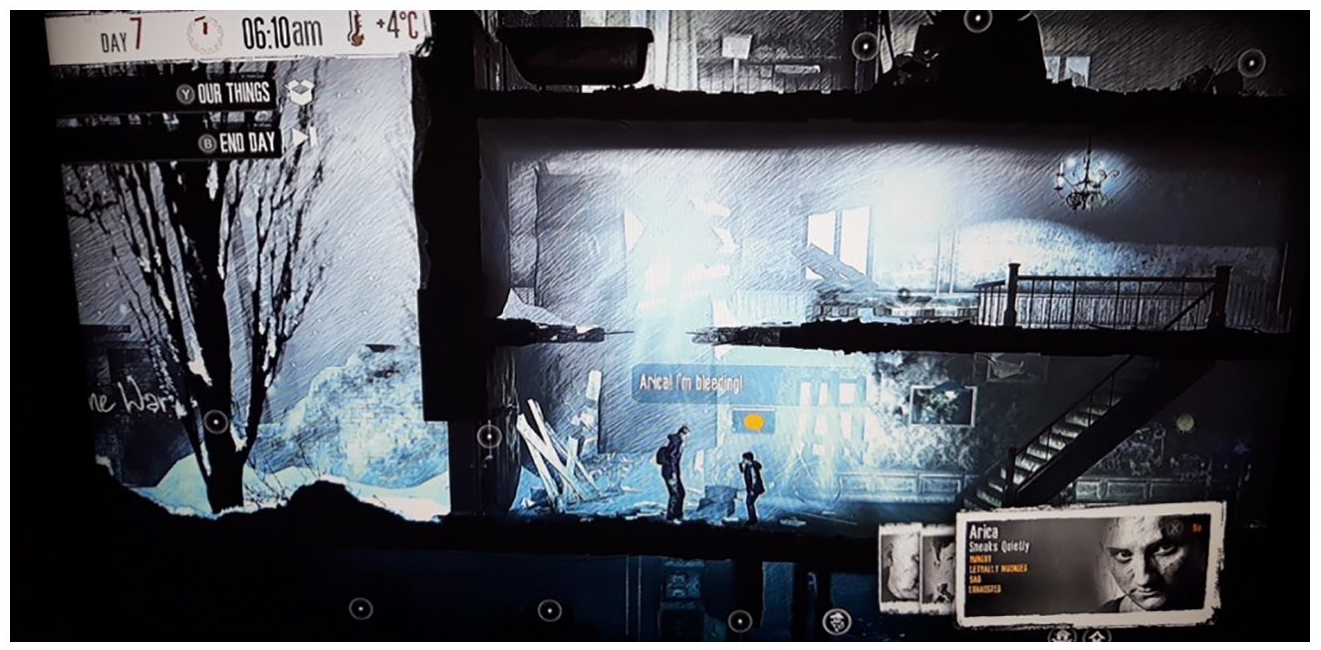
Arica, one of characters controlled by the gamer, is confronted by a child saying ‘I’m bleeding!’ This entails work to find bandages, and time to comfort the child. Arica herself is hungry, badly wounded, sad and exhausted. She needs bandages, a good night’s sleep and a pep talk or some cultural stimulation. It is winter, cold, and outside the house the shelling continues. (Photo by the author).
The house may eventually turn into a relatively cozy place, with vegetables, a radio and home-cooked food, and so on, but threats and risks are always there. The war is rendered as something to endure rather than control, and nostalgia for pre-war times are scattered here and there, even during quite successful gameplay. As one character stands at Sniper Junction, she says to herself: ‘It used to be such a lively place, I miss those times.’ And on one occasion, when the house’s grandpa takes his medicine, he is interrupted by a child asking him:
Grandpa, why do people kill other people?
Because . . . they forgot how to talk.
But we didn’t forget, grandpa, did we?
No kiddo, we didn’t. We can still talk.
Through such moral vignettes, the game balances depressing features with more hopeful ones, although still under an all-encompassing dark and troubling umbrella. The kid’s perspective is heartwarming but naïve, and the game asks us to take the adults’ point of view more seriously: they are the ones constantly occupied with such things as searching for food, boarding up the house, upgrading the heating, while sighing over the pointlessness of the war. In This War of Mine, keeping the house a (relatively) safe haven and securing randomly assembled Gemeinschaft, is on the other hand, not the sole purpose. Now and then neighbors knock on the door, asking for help, and if one says no to strangers all the time, they will eventually not include you in their sphere of solidarity (as when humanitarian airdrops occur). If one behaves immorally in other respects, for instance robbing elderly people in their downtown houses, one’s reputation deteriorates and one is haunted by an action-delaying bad conscience, adding to one’s own melancholy and depression (de Smale et al., 2019).
A similar dilemma, carefully planted by the designers, involves a young woman being sexually assaulted by a soldier in an abandoned supermarket. Help her (and risk your life), or stand by and return home? (de Smale et al., 2019: 399–400). As Clark points out in an online review, ‘remorse is a tangible, ugly thing’ in This War of Mine:
Remorse causes characters to move slower, hang their heads, decide not to perform simple tasks due to the pointlessness of it all. Your friends at home may feel overwhelming guilt about using stolen goods. And left unchecked, such guilt can fester into crippling depression and, worse, lead to suicide. (Clark, 2017)
While gaming, Clark (2017) reports having ‘a constant vision in my head that the events of a random Call of Duty [a much more conventional and heroic war game] were taking place just beyond the northern reaches of the map’.
This War of Mine is, in other words, situated in the margins of war and in the shadow of more conventional narratives. It ascribes a set of sad meanings, in which the glimpses of light are few (but precious), and in which absurdities abound. It cannot be put into the same category as heroic tales; rather, it inverts this form, deconstructs the war’s ‘grand’ meanings and makes the player critique war. As a cultural narrative, it demonstratively shuns chants or cheers for generals or soldiers (cf. Scott, 2015).
Sad and Absurd Interview Accounts
Comparable themes can be found in my encounters in Sarajevo with people engaged in representing war. In a city distinctly victimized during the war in the 1990s, one might expect an antagonistic or vengeful rhetoric, aimed at honoring national pride and denigrating the Serbs (cf. the propaganda warfare described in Maleševic, 2010). Such tones were to be found during my fieldwork, but the stories told also departed from the expected.
I will start with two instances from my interview with an exhibition guide, revolving around the Srebrenica genocide and the horror and absurdity of war. I will then analyze two instances from an interview with a veteran soldier and his wife, regarding ethnic fatalism, small-scale solidarity and absurd war events. My final instance, from an interview with a student, illustrates how war, rather than being presented as a moral test or an object for categorical positioning, is portrayed as a reason for moral work and an object for detailed analysis.
Detailed Analysis, Moral Work and Silence
The guide had seen quite a few visitors getting upset by the Srebrenica exhibition in Sarajevo over the years, sometimes crying openly or leaving in distress before viewing all the photos. But in most cases, he said, visitors simply fall silent. Aged around 12 at the time of the genocide, the guide himself remembered a ‘dramatic call for help’ from the victims on the radio, and spoke of the tragic feeling of not being able to do anything, a feeling of devastating resignation. When I met him, he engaged with Srebrenica every day, both privately and through his work. Sometimes visitors stay for a while after the guided tours, and they might then air memories from the time (if they had any), but mostly they just turned sad and quiet afterwards (‘often they are silent’). In any case they all held certain impressions when leaving, of the events of the war as devoid of grand meaning, bravery or heroism. The guide had watched a recurring emotional transformation over the years, from when visitors entered the exhibition to when they left it:
7 And most people, I don’t know how to say it, you can- you can tell- you can see the difference between how they look when enter the gallery (. . .) what to expect and how they- when they exit. Like, that- that transformation of their faces when they –
– Aha. Right –
– And so like, even if they came cheerful, even if they like came by accident or- or sometimes maybe even with some kind of attitude, like a little bit of arrogance, usually they’re exiting like calm. You can see (. . .) like totally affected by all that they have seen.
So they all (. . .) or –
– Yeah, more calm. Yes.
In this narrative, the war’s events and historical lessons are not portrayed as mobilizing categorical positionings, nor even as educational, but as an exercise of wordless shock and horror. As the guide put it, any feeling among the visitors – even those entering ‘with some kind of attitude’ – ends in silence. Srebrenica lays a heavy hand on the visitors’ mood, and drives out competing emotions. The guide illustrated this experience in our talk but he also put it to use. The more he emphasized how ‘totally affected’ the visitors were, the more he could narratively perform the exhibition as striking and successful. Like This War of Mine, the exhibition was designed to perform trauma and ‘stimulate discomfort’ (de Smale et al., 2019: 404). Similarly, the guide talked about a visiting United Nations soldier who had been deeply affected ‘because he recognized . . . the names of the boys he knew’ from his time in Srebrenica with the failed UN mission. The soldier left a long entry in the guestbook saying ‘forgive us for leaving you behind,’ ‘for going’. The guide used these examples to emphasize a remarkable impact of the exhibition, and by doing so he articulated the consequences of becoming sad, almost depressed, when learning about Srebrenica. Though he and his colleagues clearly argued against the Serbian denial of the genocide, and the appurtenant justifications, what he narrated was not vengeance but an overwhelming sense of meaninglessness of the atrocities. Still, he was engaged in creating meaning out of them, but in a more heteroglot and less unitary way (cf. Bakhtin, 2000 [1981]), as if engaged in a dialogue with an opposing picture of war, characterized by the clear-cut lines of propaganda.
A related moral can be found when the guide talked about his preparations for work. Although he (and the other interviewees) emphasized that the rhetorical war with the Serbian nationalists is far from over in Sarajevo today, and that ‘the war is constantly present’ on the news and in Bosnian political discourse, his preparations to deal with objections are seldom or never put to use. The guide elaborated in detail how he searched the internet for genocide-denial arguments that skeptical visitors might confront him with, but this preparedness has turned out to be quite unnecessary.
– Mm. So I- I get it that you- you, by reading and looking (. . .) after these things, you are more or less prepared if like visitors would –
– Yes. Yes –
– Start arguing against you and say ‘Oh, I read this book about blah-blah-blah’ –
– Yeah exactly. (. . .) and you would think like ‘Now it’s great. Someone will maybe challenge me.’ And just to see like clash of the opinions, but it’s not happening. I never had like a real kind of- for four years working in the gallery I never had like no one like clearly that acted like that ‘Oh. No, that’s not true.’
The guide described one occasion when a group from Serbia did question him, but he managed to sort out the facts and it was only ‘that one question’. Otherwise, he said, there is ‘no such drama’ at his workplace. The guide’s account was one of unemployed preparations – he portrayed himself as ready to be challenged with the expected war rhetoric (‘is that really so?’ ‘what about this or that?’ ‘both sides generated atrocities,’ ‘but the victims were all soldiers’ etc.), but basically no one did this. Instead: silence and a kind of implicit shock. The guide talked at length about Serbian nationalism, and the fact that ‘nothing changed’ even when the fugitive war criminal Radovan Karadžić was found and arrested, but eventually he conveyed disbelief when it came to straight answers to war questions. ‘I don’t think there is any answer [to why the war happened], where it started, what was the cause’. While indicating an expectation of more conventional attitudes as contrasts, the guide’s stories portrayed a struggle to deal with a war’s meaninglessness and brutality.
Fatalism, Small-Scale Solidarity and Chuck Norris
The veteran and his wife, along with the student who translated their talk, conveyed a hopeless picture of Sarajevo 26 years after the war: ‘nothing has changed’. Bosnia is full of nationalism, the politicians are the same as ever, and violence may very well burst out again. Bosnia has three presidents, representing the country’s divisions. ‘How would you feel if there were three presidents in [your country] Sweden?’ the student asked me during our conversation. The veteran and his wife nodded.
Now he is saying [the veteran soldier], yesterday, he was listening to the [Bosnian Serb] president, and he said that, ‘I am living for the day when we could be Serbia again,’ and same thing that they [the Bosnian Serbs] wanted to do [join with Serbia] during the war.
The difference, the veteran explained, is that if the war were to start again, the Muslims ‘would be better organized’. He would be prepared to ‘kill the nationalists’ again, to defend his people, and the same is true of the Serbs. The veteran soldier has had Serbian friends (both now and before the war), and although they never talk openly about the war, he assumes they think they also defended themselves. The student-translator asked rhetorically: ‘And what can you say about that?’ The veteran, his wife and the translator joined in the common phrases ‘never forgive, never forget’ several times during our conversation. In this sense, the situation in Bosnia today was portrayed as merely a ceasefire, and the war as an uncontrollable state of condition rather than a political object on a map. The physical version of war could be restarted at any time; the lines separating the enemies might not be clear to outsiders, but they are surely there.
These things were said laconically, without fervor or enthusiasm. All three communicated a sense of an objective analysis, free from passion or intense rhetoric. Still, among the ‘people’ to defend in Sarajevo they included ‘a guy from Montenegro,’ as well as ‘eight Serbs’ who belonged to the veteran’s unit in the former army. When I go through my notes and transcripts, I can see that a nationalist definition of ‘people’ did not count as that important in practice, departing from the sharp (war-related) distinction ‘between those who are members of the same nation and those who are not’ (Maleševic, 2010: 195). What seems to matter more for the interviewees’ stories is small-scale (at times cross-ethnic) solidarity, such as: the city and its sorely tried inhabitants, the neighborhoods, those one could trust. ‘Every person . . . [during the war] in the army was guided by heart,’ the veteran said. During the war, the Serbs he could trust inside Sarajevo ‘were better [as soldiers] than some Bosnian people’. The war narrative here is about the actors’ fine and empirically based distinctions, not blunt categories. Nationalism is present, but the details are organized along lines determined by personal, residential and face-to-face experiences.
The interviewees thus combine a fatalistic political image of the war and its aftermath with glimpses of a fighting spirit and sense of solidarity that is not wholly dependent on that image. They also insert glimpses of a more absurd kind, minor stories of strange things that happened during the war, in fact indicating that certain things could only have happened in a war. The veteran, for instance, talked about criminal gang leaders who turned into altruistic and patriot defenders of neighborhoods, and he described when he once hid for his life in a ditch full of human faeces, and that nobody wanted to come near him afterwards since he was stinking so much. Both the veteran and his wife joined in a story about how he drove with food ‘for everybody’ (all in his family and neighborhood, who were waiting for him) and the wife could watch him and his car from a balcony, pursued by bombardment, like in an action movie. The student said to me that he had heard this story several times.
And grenades were falling behind him, like he drives his car with grenades behind him, it was [like] a film for her [watching from the balcony].
Chuck Norris.
What does the action hero Chuck Norris have in common with the bitter siege of Sarajevo in the 1990s? It sounds like a joke, bizarre, and was accompanied by bitter laughter. By inserting this name (and, similarly, by retelling the story about hiding in a hole full of shit), a particular image of a war was performed. One might expect war to be about battlefield strategies, conquering enemies, defending territory and the like, but it is also about unbelievable situations and absurdities. In this way, the veteran and his wife engaged in an implicit dialogue with the heroic account of the war while performing war events, with me as audience, likening the narrator to a Hollywood action hero, but in a quirky and distorted way. The laughter was directed both at the episode and at the metaphor.
Frozen History, Living History
A student I met told a story about small-scale solidarity: as a child, he was saved by his Serbian neighbors (despite being Muslim himself) when Serbian soldiers came knocking on the doors in their apartment building, searching for enemies to kill. Mostly, though, this student was occupied with political analyses of today’s Bosnia and how politicians treat the war history. On the one hand he argued that ‘history is frozen in this region’ since the peace treaty of 1995, and all interests are in stasis, but on the other hand he exemplified a debate with a Serbian acquaintance in which they openly challenged each other’s version of the Srebrenica genocide, and in which history very much seemed to come alive. Similar to Gilbert’s (2006) view, the student bracketed a time period – not, as in Gilbert’s (2006: 16) analysis, the socialist Yugoslav era, to keep it from becoming an object of public discourse – but the post-war era, to emphasize that the ‘post’ is actually a chimera. The excerpt follows my question about war memorials in Sarajevo, and whether he thought they represent history for people or whether they ensure the war is ‘still alive.’
No. History –
– How would you –
– History is freezed –
– How would you, when your friends relate to these places [memorial sites], maybe you take them for granted or?
No, no, no. History is freezed in this- in this region, in this territory. [yeah] It’s freezed. The day when it got- when it got frozen it’s 1995 when they- the [Dayton treaty] (. . .) was signed. You don’t have a winner in the war. Everybody loses the war in that period. Everybody lost the war. And from that, you don’t have one national state like Croatia, Serbia. You have the state without the state [today’s Bosnia-Hercegovina], without – so it’s like Yugoslavia little, that doesn’t function, but it doesn’t function because you don’t have like some kind of leader. Like Tito was, you know.
Far from a heroic narrative, the student talked about ‘everybody’ as losers. Bosnia today was ‘a state without a state,’ formally similar to the multiethnic former Yugoslavia (‘Yugoslavia little’), and thereby a restoration of socialist socio-political order (Gilbert, 2006: 17), but in practice – without a Tito – a nonfunctional absurdity (see Hromadzic, 2012: 43, on the consociational model of the Dayton agreement, and its legitimization of segregation). Listening to the student’s account of the political aftermath of the war, it was hard to believe it would make sense to start it anew, and yet he argued that his own people – the Muslims – would probably be the ones doing so in the future, because of political bitterness. The war memorials of Sarajevo were reminders of ‘frozen history,’ not of the victims – the latter, he said, were still framed in a too-political way. Later in our conversation, though, he started to talk about a Serbian friend of a friend, with whom he had once debated Srebrenica. ‘We drank some alcohol and started discussing’. ‘How can you explain that it was a genocide?’ the Serbian guy said (in the student’s narrative):
‘How? How?’ And I tried to explain to him (. . .) that by the definition by the court practice of the ICTY and ICTR [The International Criminal Tribunal for the former Yugoslavia and The International Criminal Tribunal for Rwanda] how to define ethnicity-genocide, excuse me. And he was saying ‘Okay. But it wasn’t- they were all- all males [the victims] were ready for- they were all military. They’re from military.’ I’m thinking ‘No. they were not military.’ How can you (. . .) How can you be- be the military when you ran from other cities, from (. . .) from- you ran from those cities with- with children, with everything to the safe zone, how could they enter? First, how could they run from other cities with weapons? (. . .) And everything you know- everything you need to go through all military (. . .). You’re stopped every moment and then to get to the safe zone with weapons? For me, it’s not- you cannot explain it.
The student recalled precisely the kind of situation that the exhibition guide had expected but never faced: to be confronted by a stream of political criticism and forced to reply with all knowledge available. The student refuted revisionism by invoking the UN definition, and by pointing out inconsistencies in what the Serbian guy implied. (If all the victims of Srebrenica had been soldiers, how come they fled from other places to begin with? How could they pass military posts if they were armed? etc.) In these instances, history seemed far from frozen but was rather an object for detailed analysis and a reason for moral work. The historical interests of both the dramatized Serbian counterpart and the narrator himself were clearly performed in the narrative.
What was consistent throughout the student’s account was the politicization (and ethnicization) that permeated every aspect of social life in Bosnia. The war was narrated as hopeless, miserable, almost a perpetual motion machine, essentially uncontrollable and absurd. Nothing good had come out of it, and what’s worse, it was not even over. ‘It’s still . . . the war is going on,’ the student said, ‘I’m telling you’. The cultural dialogue being performed involved an implicit image of war as controllable, as possible to end and win, and this image was contested and rebutted. Instead, war was performed as endless and uncontainable, and the narrator as an analyst rather than a hero. It was not a fighting spirit that was on show, but a series of sighs and laments.
Conclusion
By analyzing cultural representations of war that implicate sad or absurd meanings, I have tried to sharpen our analytical sensitivity in relation to stories that depart from the heroic scripts. The sociology of war should maintain space for the hard-to-categorize versions, too, and not treat cultural narratives as relevant only from the point of view of explaining war in conventional ways, as when assessing whether they cause or legitimate a given violent conflict (Maleševic, 2010: 202–232). If we equip ourselves with an eye for epimilitary stories-in-the-margins (Madigan, 2021; Mannergren Selimovic, 2015), the repulsive character of war can be given color and shape, including its depressing, horrifying and absurd aspects (Basic, 2018). That is why I include the veteran cited in the analysis – not to conflate soldiers/civilians, but to point out how war can be narrated alternatively, also by an ex-soldier.
Taken as dialogized and performed narratives (Riessman, 2008), epimilitary artistic works are similar to many stories told in research interviews, and through careful theorizing we may distinguish how they are implicitly related to heroic versions. ‘An utterance carries the traces of other utterances, past and present,’ as Riessman (2008: 107) writes, so that stories ‘carry’ their counterpart on their back. They are performed in an implicit and wider cultural dialogue with an opposite. If we were not so accustomed to the heroic versions, we might not even distinguish what is peculiar when war is given another shape in the first place, and would not, for instance, get so appalled or impressed by Aleksijevitj’s stories, or by alternative plots in gameplay.
Sad and absurd narratives seem to provide webs of pathways for actors and groups to make sense of war, ascribe meanings to it, assess and deconstruct war propaganda, sigh and lament it, and foster or indulge in paradoxical or ‘non-linear’ war images (cf. Scott, 2015: 33) as well as images of the consequences of war (Madigan, 2021). A war constitutes a setting and situation, one characterized by multifaceted experiences, emotions and deliberations not necessarily authorized by great thinkers or political agendas, and alternative narratives remind us about this. Whether explored through a moral game such as This War of Mine or through personal stories told in research interviews, war can be approached as something broader than a political object on a map, and people as more complicated than recipients of narratives authored by others. As Maleševic (2010: 204) points out, the one-sided image of war propaganda as swiftly turning whole populations into loyal servants of the ‘master manipulators’ at the top ‘is based on a simplified view of social action’.
If we take this critique seriously, we need to be open to all these seemingly out-of-place stories of war, exemplified in artistic projects such as those of Svetlana Aleksijevitj and 11 bit studios, as well as in ethnographic projects such as those of Hromadzic (2012, 2018), Mannergren Selimovic (2015) and Eastmond and Mannergren Selimovic (2012). Much of the content touched on here is also close to findings in war sociology, for instance narrators’ perspectives on small-group solidarity, the experience of absurdities and everyday ways of understanding or dealing with brutality. When, in this article, the veteran soldier talked about ‘every person . . . guided by heart,’ he came close to Maleševic’s (2010: 222) remarks about combativeness as primarily a group phenomenon. What matters ‘is the action itself,’ not a shared descent or nationality. Similarly, when the game designers of This War of Mine arranged the gameplay so as to induce empathy and a bad conscience, they situated the game close to Collins’ (2008) work on human reluctance, repulsion and aversion to violent conflict. These interconnections are among the reasons why this type of cultural sociology defends its place within war sociology.
Footnotes
Acknowledgements
I am very grateful for the help and critique I have got from Goran Basic and Fatima Raja, as well as from anonymous reviewers.
Funding
The author received no financial support for the research, authorship, and/or publication of this article.
Ethical Approval /Patient consent
The article belongs to Goran Basic’s project ‘War Anomie.’ Fakultet Politickih Nauka, The University of Sarajevo, has approved and confirmed the ethical correctness, protocol number 01-3-1052-1/21.