




Abstract
Carrying out proper food practices in family life is seen as the inherent and taken-for-granted responsibility of parents. However, the theoretically solid and comprehensive picture of coordination relating to parental food practices is missing. This study aims to map the coordination of cooking-related practices in today’s hurried family life. By applying practice theory, we employ the concept of foodwork as referring to a bundle of cooking-related practices. The coordination of foodwork is explored through material arrangements, temporal activities and interpersonal relationships in the theoretical part of the study. The empirical analysis utilises multiform qualitative data consisting of cooking videos shot by five Finnish families for one week and interviews with the families. The concept of adjustments is developed through the data analysis to provide a nuanced understanding of how parents reflectively and unreflectively integrate their foodwork into inevitable ongoing changes of everyday life. The study elaborates on the coordination of parental foodwork defining six adjustment themes: appropriateness, sequences, synchronisation, duties, significance and acceptance. Themes illustrate continuous, temporal, material and interpersonal adjustments of foodwork. As a result, the study constructs the comprehensive understanding of parental foodwork by providing novel, theoretically and empirically elaborated and interrelated concepts for future studies. The concept of foodwork and themes of adjustment enable a topical and multidimensional approach to identify and interpret the complex coordination of practices, what, for example, the change towards healthier and more sustainable cooking and eating can provoke in households and a family life.
Introduction
Current social norms invite families to carry out healthier and more sustainable food practices. This is considered in public discussions and in many studies a significant responsibility of parents and the cultural convention of family life, into which the next generations should be socialised at home (Cappellini et al., 2019). The emerged discursive dynamics reveal social and cultural meanings of family food practices, which nourish the reflections and negotiations of appropriate practices (e.g. Halkier, 2020). Nutrition-oriented contributions often call for proper cooking skills amongst parents as well as cooking from scratch and regular family meals (e.g. Lavelle et al., 2016; Radtke et al., 2019; Van der Horst et al., 2014) but several qualitative studies have expressed that carrying out food practices in current family life is dependent on more complex issues than individual skills, knowledges or motivations (e.g. Cuevas et al., 2021; Halkier, 2010). Further, sociological studies have upheld discussions about the inequality between genders (e.g. Cairns et al., 2019; Holm et al., 2019; Szabo, 2014) and the effects of financial, temporal, social and cultural resources in the (re-)production of ideal family food practices (e.g. Jabs et al., 2006; Kwon and Adams, 2021; O’Connell and Brannen, 2021). Simultaneously, studies have showed diversity and changes in food-providing practices and ambiguity about the role of cooking as the normative core practice of meals (Plessz and Étilé, 2019). For example, the outsourcing of cooking tasks by purchasing ready-made meals or convenience-based foods has become an accepted way to feed oneself and others (e.g. Halkier, 2017; Meah and Jackson, 2017). To understand better how parents enact the current family food practices and navigate between social and cultural issues discussed in previous studies, this study aims to compose a clarifying conceptualisation of phenomena through practice theory and empirical examples.
We apply the concept of foodwork referring to ‘a work including all the work involved in feeding the family’, also including the invisible work of thinking about and coordinating various practices (O’Connell and Brannen, 2016: 31). However, foodwork is often condensed as a simple list of food-related practices, such as shopping, planning, cooking and cleaning (e.g. Meah, 2014), and it is typically used as a lens for exploring how people’s actions are gendered while feeding their families (e.g. Cairns et al., 2019; Szabo, 2014). The theoretically oriented exploration of foodwork as such seems to be missing. Application of practice theory (see e.g. Halkier, 2010; Warde, 2016) offers a reasonable theoretical approach to foodwork and potential concepts to analyse family food practices and elucidate the taken-for-granted coordination related to the inherent responsibility of ‘feeding’ the family (DeVault, 1994).
By coordination, we refer to ‘actions that combine to achieve a result that someone intends to be achieved’ (Schatzki, 2010: 69) such as carrying out the normative organisation of interconnected practices related to the parental feeding responsibility. Participants enacting practices do not necessarily pursue a collectively decided result or they are not even conscious about the coordination. Coordination can be thought both as organised by social practices and performed by people (e.g. Welch et al., 2020). Ongoing adjustments illustrate more precisely the continual coordination and the way that people reflectively or unreflectively integrate their performances into inevitable changes of everyday life, in order to move on in situations (Schatzki, 2016a). Adjustments ‘help compose practices and uphold the normative organization of practices’ in continually changing everyday circumstances (Schatzki, 2016a: 17). However, adjustments are ‘underdeveloped in literature’ (Schatzki, 2016a: 26); therefore, as stepping stones, at the beginning we apply the ‘coordination forms’ presented in the study of laundry practices (Mylan and Southerton, 2018). The main aim of our study is to conceptualise comprehensively and in a more nuanced manner the coordination related to feeding the family by elaborating on parents' adjustments of foodwork to ongoing everyday life situations.
The next section introduces our practice theoretical conceptualisation of foodwork and an overview of recent studies regarding parental foodwork. The empirical analysis of foodwork is based on practice theoretical concepts and on exceptionally multiform qualitative data from five Finnish families with at least two children and two wage-earning parents. The data consist of everyday cooking videos shot by these families for one week as well as interviews with them aiming to capture foodwork within ongoing everyday occurrences. In the data analysis, we expose adjustments embedded in foodwork, because they ‘can be fully understood only if analysed as such’ (Schatzki, 2016a: 26). As results, six adjustment themes of parental foodwork are expressed with a help of empirical exemplifications. By constructing such an aggregate picture of parental foodwork, the study is intended to offer novel insights into discussions about home cooking, food-mediated socialisation and steering of family food practices. A broader understanding of cooking at home and feeding the family is needed to avoid overlooking their complexity in studies aiming to promote changes towards, for example, more healthy or sustainable family food practices.
A practice theoretical view on foodwork
In recent decades, many sociological studies focusing on everyday food consumption have used practice theory to strengthen their theoretical bases (e.g. Halkier, 2010, 2021; O’Connell and Brannen, 2016; Torkkeli et al., 2020, 2021; Warde, 2016) instead of previously dominant cultural analyses (see e.g. Warde, 2014). One aim of the practice theoretical approach has been to turn the research focus from cognitive abilities, aspirations, skills or knowledge of individuals to social practices forming the dynamic structure of everyday life. The emphasis of analysis has been placed upon embodied routines over reflective choices and material doings over cultural representations (Warde, 2014, 2016). Instead of presenting their own lifestyles, individuals are seen as active carriers of socially shared practices (Reckwitz, 2002). This limits acceptable performances of practitioners, but at the same time, situational performances are adapted to a surrounding environment producing continual changes to social practices. Thus, for example, changes in cooking culture can be seen more as the result of adaptation to prevailing social and material environments than the consequence of people’s de-skilling (Halkier, 2021).
By applying practice theory, cooking can be approached ‘as a socially shared practice, immersed in materiality, intersected with other practices and embedded in normative expectations in everyday life’ (Halkier, 2021: 2) and as a part of foodwork practices. Foodwork, in turn, can be outlined as a bundle of practices and material arrangements (e.g. Schatzki, 2012). In other words, foodwork consists of food-related practices (e.g. shopping, planning, cooking, cleaning) (Meah, 2014) and material arrangements referring to a broad variety of both background arrangements (e.g. electricity, income, digital networks) and immediate arrangements (e.g. ingredients, kitchens, grocery stores) (e.g. Shove et al., 2015). The practices of the bundle interconnect owing to the different causal, envisioned, essential and intentional relations between them (Schatzki, 2012). For example, foodwork practices are linked while forthcoming situations are envisioned: meals need to be planned, food bought, the kitchen cleaned before and after cooking.
Moreover, each of the foodwork practices consists of sayings and doings that can be organised by constituting elements (Schatzki, 1996). In other words, elements link together while cooking and organise doings and sayings of the practice. In this study, we apply elements’ understandings, procedures and engagements, which Warde (2005) developed to facilitate elements’ applicability in empirical analyses of practices. These three are just one version of different conceptualisations of elements (see e.g. Reckwitz, 2002; Schatzki, 1996; Shove et al., 2012) but they have been applied previously in many other sociological food studies (e.g. Halkier, 2010; Jauho, et al., 2016; Närvänen et al., 2013). The constituting elements of practice can be defined as follows. Understandings comprise shared knowledge, opinions and texts about the practices as well as the comprehension of what doings and sayings are appropriate to particular practice. Procedures refer to principles and rules as well as the routinized, tacit and unreflective knowing of how to enact practices, which can be evolved through previous performances. Engagements consists of social and cultural ends, hopes and emotions that direct the performance of practices (Warde, 2016).
However, the elements of practice alone do not clarify how the bundle of foodwork practices are coordinated in families. Achieving coordination in everyday life is a dynamic process involving a social interaction between participants, but the focusing on such discourses has not been emphasised in recent practice theoretical studies aiming to analyse material doings and distance from cultural analyses (Halkier, 2020). Nonetheless, parental foodwork is carried out for family members, with them and in front of them. The analysis of coordination requires following the interaction between participants and sets of different experiences as well as the sequences of material and temporal chains (Hui, 2017). Thus, we apply a recent practice theoretical study exploring flows of another bundle of household practices – laundry. The ordering of mundane practices is analysed by using three coordination forms: material arrangements, temporal activities and interpersonal relationships (Mylan and Southerton, 2018). Next, we show how these three coordination forms appear in recent studies concerning family feeding practices and reflecting societal mechanisms ordering the parental foodwork.
Material Arrangements
The nutrition-driven approach to feeding families is criticised for treating foodwork as simply a matter of providing healthy food (Harman et al., 2019). However, parents acknowledge family members’ individual preferences and opinions in material arrangements. Such democratising of family food decisions may demand a challenging reorganising of foodwork aiming at ‘happy meals’ (Wilk, 2010: 428). In a study on British families, O’Connell and Brannen (2016: 52) observe that ‘food preferences were subordinated to cost considerations and food selection depended on what foods were affordable rather than what the family preferred to eat’. Thus, disposable financial and other resources may regulate both the realisation of family members’ preferences and nutritionists’ advice.
Parents also fit material arrangements into available time by utilising different convenience foods. This has raised public concern about deteriorating cooking skills and unhealthy eating, although the boundary between different convenience foods and raw, ‘unprocessed’ ingredients is ambiguous (e.g. Jackson and Viehoff, 2016). Thus, convenience foods and homemade foods form a continuum and belong to the same category (Halkier, 2017). Convenience foods facilitate material arrangements by decreasing cooking tasks and dirty dishes, providing flexibility and making it possible to care for and feed family members within the intersecting schedules of everyday practices (Meah and Jackson, 2017).
However, negotiations of proper food and material arrangements relating to suitable foodwork practices recur in families and in society (e.g. Cappellini et al., 2019). Such negotiations expose differing notions of acceptability, which can be examined as common and various justifications of ‘good’ reflecting, for example, health, nature, fame, creativity, domesticity, citizenship, competitiveness or efficiency (Boltanski and Thévenot, 2006). Yet the justification of proper materials such as healthy foods, does not mean that ‘good’ foodwork is enacted and everyday routines are transformed (e.g. Murcott, 2019).
Temporal Activities
The daily accomplishment of foodwork can cause feelings of time scarcity, defined as a lack of timing and synchronicity of different schedules (O’Connell and Brannen, 2016). An attempt to synchronise foodwork practices with parents’ and children’s schedules of paid work, school and leisure activities can create ‘irreconcilable temporal experiences’ (O’Connell and Brannen, 2016: 59). However, parents prioritise children’s feeding in the nexus of everyday practices, and mostly mothers take charge, as they feel ‘it’s just easier for me to do it’ (Beagan et al., 2008: 653). Ease can refer to an unchallenged adoption of gendered norms but also to experiences of foodwork and evolved competences (e.g. Torkkeli et al., 2021). Thus, fathers engaged in caring and taking responsibility for foodwork can have facilitating routines and competences as much as mothers do (Szabo, 2014).
In many Scandinavian countries, participation of fathers has slowly increased, although mothers still perform most of the foodwork in heteronormative families (Holm et al., 2019) and carry out invisible and continuous mental work revolving around coordinating daily practices (e.g. Miller, 2017; O’Connell and Brannen, 2016). Better planning is common advice for successful coordinating. However, planning can demand impossible monitoring of family members’ activities, taking more energy and time rather than facilitating foodwork (Jabs et al., 2007). Thus, situational and flexible adjusting of foodwork may be experienced as easier than the time-consuming practice of planning (Torkkeli et al., 2021).
Nevertheless, socially recognised temporalities of particular practices provide tools for ordering everyday life (Goodwin and Cekaite, 2018), such as rhythms of meals and paid working – in other words, public organisation of the day (cf. Douglas, 1991). Therefore, concerns over the loss of family meals or home cooking relate to worries about the social order. However, time surveys still show the simultaneity of daily meals, for example, in Nordic countries (Lund and Gronow, 2019). Moreover, the decrease of family meals is difficult to prove, as they seem to be an ideal more than a reality (Murcott, 2019; Wilk, 2010). Family members’ schedules and practices can criss-cross and compete in family life, but parents calibrate performances of practices across time and space, utilising the temporal organisation of society (Goodwin and Cekaite, 2018).
Interpersonal Relationships
Repeated dichotomies are often highlighted in studies of foodwork: for women, foodwork is caring, struggling and (re-)producing family life, while men are less involved in responsibilities of everyday foodwork and its accomplishing (e.g. DeVault, 1994; Szabo, 2014). However, the most important and simultaneously increasingly complex interpersonal relationship of parental foodwork is between parents and children (cf. Miller, 2017). Through food, parents aim to deliver practical and emotional caring of children, which means struggling to balance the advice of health authorities and (re-)production of family life (Boni, 2019). Thus, parents can prioritise rearing ‘healthy’ children by means of food but emphasise ‘family relations and harmony, more than strictly attending a nutritious diet’ (Grønhøj and Gram, 2020: 77).
Through foodwork, parents may also aim at socialising children into a food culture and a broad sense of taste (Anving and Sellerberg, 2010). However, food-mediated socialisation occurs everywhere – between meals, in grocery stores or with friends (Grønhøj and Gram, 2020) – and parents’ awareness of this can vary. Moreover, they may be unconscious of their own impact, for example, on socialisation into gender roles (Oleschuk, 2019).
Socialisation is not a one-way process to be like one’s parents; it is also to be like others. This may create power struggles between parents and children (e.g. Boni, 2019; Marshall, 2019). Many socialising agents such as schools, friends and media, can reinforce or challenge food practices at home (Oncini, 2019). Essentially, societies and parents should share the responsibility of children’s welfare, although the advice of ‘good’ parenting practices stands out in public discussions, questioning occasionally parents’ abilities to care for their children by means of proper food (e.g. Hinton et al., 2013).
The norms of ‘good’ parenting are cultural, historical and ideological perceptions and are, therefore, subject to continuous change (Cappellini et al., 2019). This study provides an opportunity to explore how some Finnish parents enact and reconstruct current food- and feeding-related norms while coordinating different material arrangements, temporal activities and interpersonal relationships involved in foodwork. However, the essential aim of this study is to elucidate the complexity of parental foodwork coordination by analysing more precisely continuous adjustments in everyday family life occurrences.
Methods and Data: Cooking Videos and Interviews on Foodwork
Many qualitative foodwork studies are based on data collected by interviewing (e.g. Beagan et al., 2008; Cairns et al., 2019; DeVault, 1994) or observing participants (Oleschuk, 2019; Szabo, 2014). Data based on verbalisation and interaction with researchers can highlight culturally normative meanings related to everyday practices (Martens, 2012) but hide the subtleties of foodwork that may be difficult to remember or verbalise. Thus, we add two new perspectives: participants’ ‘first-person perspective’ videos (Lahlou et al., 2015; Pink, 2015) to capture their situational foodwork at home and subsequent stimulated interviews focusing on recorded situations. Pre-interviews preceding video shoots aimed to trace repeated structures of foodwork. Consequently, this enabled the observation of both sayings and doings of foodwork, which supports the practice theoretical analysis (Warde, 2016).
The data were collected from five middle-class families with two full-time wage-working parents and two to four children, aged 5–16 years, capable of participating in foodwork. All the parents have a tertiary education and the families live in a metropolitan area in Finland. By recruiting multimember families, we tried to ensure that the data would involve the coordination of various daily practices (compared, for example, to families of a parent and a child) and parents’ adjustments of foodwork for respect to the research aim. Families volunteered by answering a web-based questionnaire concerning attitudes, frequencies and labour divisions of shopping, cooking and planning. This approach facilitated checking for adequate variations between families’ foodwork and possibilities for multi-dimensional analysis (cf. Timmermans and Tavory, 2012). The first author sent the questionnaire to her leisure-time and previous work contacts. They spread the announcement to people with a non-professional relation to food and who were unknown to the author and encouraged them to participate. Thus, researchers did not previously know the participants.
The first author arranged the data collection and analysis. The initial meetings occurred at the families’ homes and one or both parents, and sometimes the children, participated in the pre-interviews. During the pre-interviews, families talked about their weekly schedules and the meanings, challenges and repetition of foodwork practices. This created a pre-comprehension of the coordination in each family. Additionally, the usage of video cameras was guided and informed consent forms on the ethical principles of data collection and reporting were signed. The study does not include any conduct that needs an ethical review in Finland, nor does the study include sensitive themes. No participants are in a vulnerable position and identifiable personal data (e.g. race, religion, or ethnicity) is not collected (Finnish National Board on Research Integrity TENK, 2019). 1
The families were invited to video record themselves cooking dinner for approximately one week. The dinner is the most common meal prepared at homes in Finland (Kahma et al., 2019) and, therefore, it was the focus of recordings. This also simplified the data collecting invitation and participants’ commitment to a recording assignment entangling in their everyday life. Moreover, it was easier and more ethical to invite participants to video record foodwork in their homes than, for instance, in grocery stores around strange people. The families recorded the videos independently, without external observers, using wearable cameras that recorded cooking performances, the surrounding environment and the other participants from the main practitioner’s perspective (Torkkeli et al., 2021). The videos were shot between February and April 2018.
Immediately after each data collection week, the first author watched all the footage and organised the data into tables to gain an overall picture of the videos’ contents (for example, who recorded when, what, with whom and for how long). Unclear episodes (e.g. exceptional procedures or interruptions) were registered for follow-up questions. Within a week of recording, the researcher returned to the families to conduct stimulated recall (SR) interviews (Mackenzie and Kerr, 2012). The follow-up questions directed the focus of the SR interviews. The participants accounted for the occurrences of the week in more detail by recalling situations and watching video clips that the researcher had chosen or that they particularly wanted to see (Lahlou et al., 2015). All the interviews were audio-recorded and transcribed verbatim by a professional transcriber.
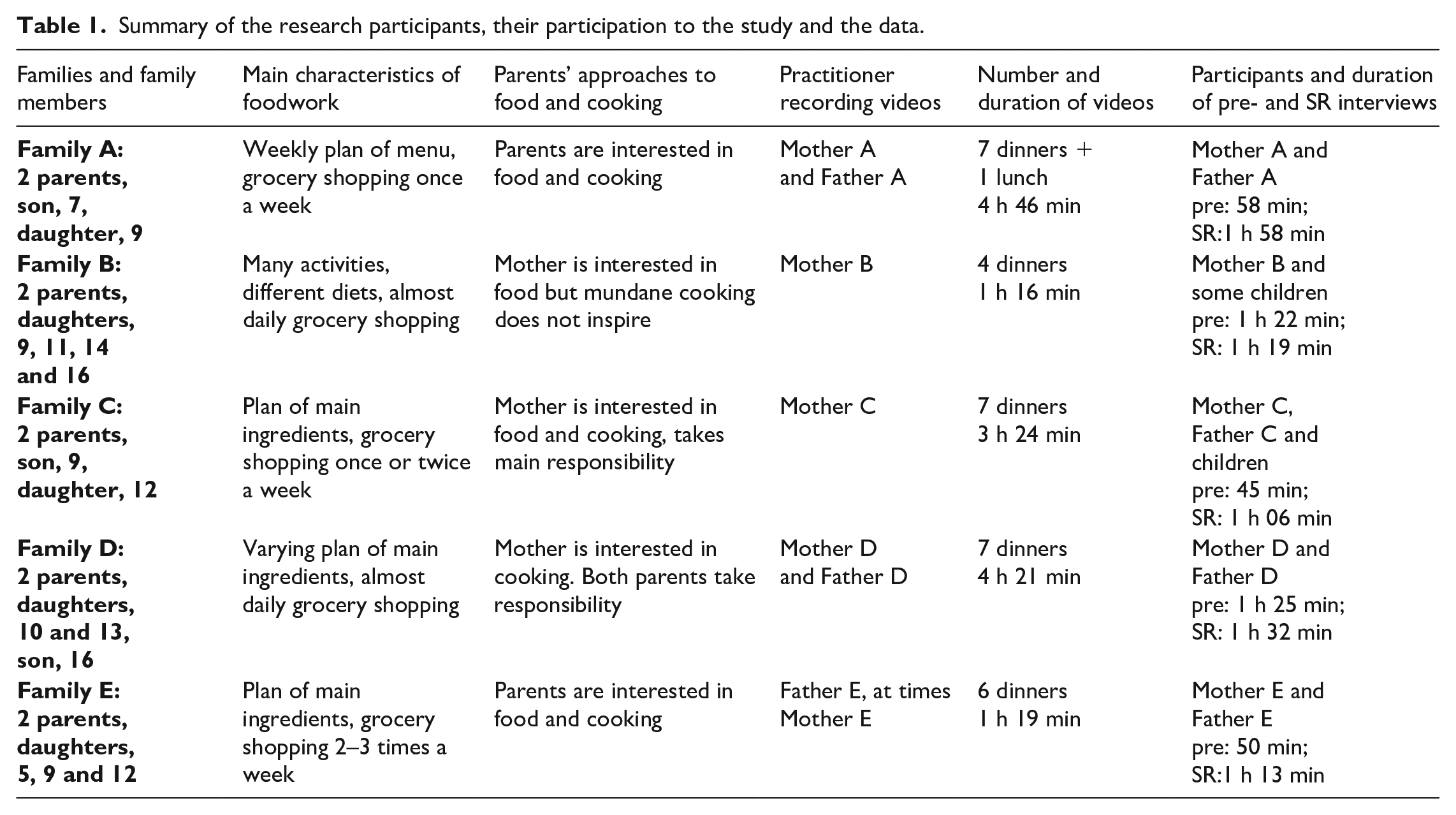
Afterwards, the researcher transcribed all the comments by practitioners and the conversations recorded on the videos. She also scripted nuanced summaries of each video: who was at home, what they did and when, and what cooking episodes and other foodwork performances were conducted. Altogether, the transcripts of pre-interviews covered 108 pages, SR interviews covered 172 pages and videos covered 137 single-spaced pages written in 12-point font. The textual data was anonymised for analysis. The textual data in Finnish were full of situational nuances conveying various manifestations of foodwork, thus enabling a many-sided analysis. The data containing identifiable information about participants cannot be opened and this was made in agreement with participants when informed consent forms was signed (cf. Finnish National Board on Research Integrity TENK, 2019). Families, their characteristics of foodwork and the participation of family members to different data formats are presented briefly in Table 1.
Summary of the research participants, their participation to the study and the data.
Abductive Data Analysis
We conducted an abductive analysis proceeding simultaneously through a theory-based and data-driven analysis (Timmerman and Tavory, 2012). The analysis process employed two theoretical concept systems: coordination forms (material arrangements, temporal activities and interpersonal relationships (Mylan and Southerton, 2018)) and elements of practice (understandings, procedures and engagements (Halkier, 2010; Warde, 2005)).
The data were coded in the qualitative analysis program Atlas.ti, initially utilising the three coordination forms. However, this alone turned out to be impossible as participants adjusted material arrangements to temporal activities (e.g. varying foods for weekdays and weekends), carried out temporal activities in interpersonal relationships (e.g. situational division of foodwork) or argued for material arrangements according to interpersonal relationships (e.g. acknowledging others’ food preferences). Overlaps of coordination forms in the data directed us towards a more nuanced analysis. Thus, the coordination forms act as ‘overarching categories’ in a way that each coordination form includes two adjustment themes of foodwork practices. The units of data analysis varied from sentences to entire paragraphs. As representations and performances of foodwork were rich in content, even consecutive words might refer to different themes. In total, six adjustment themes of foodwork were recognised, two for each overarching category.
The coordination forms expressed a generic difference between the adjustment themes. An elaborate coding of data by theme forced the discernment of clearer differences between them. Thus, the elements of practice were brought into the analysis process. The elements acted as ‘reflection concepts’ to the data-driven themes. With the help of these concepts, the researcher revised the names and definitions of the themes while ensuring that they captured all variations of the data. Finally, the adjustment themes indicated in a more nuanced way how parents repeatedly adjust foodwork practices to feed family members within the steering of social practices. To clarify the relationships between coordination forms, elements of practice and data-driven themes, the analytical components are illustrated as overlapping circles in Figure 1.
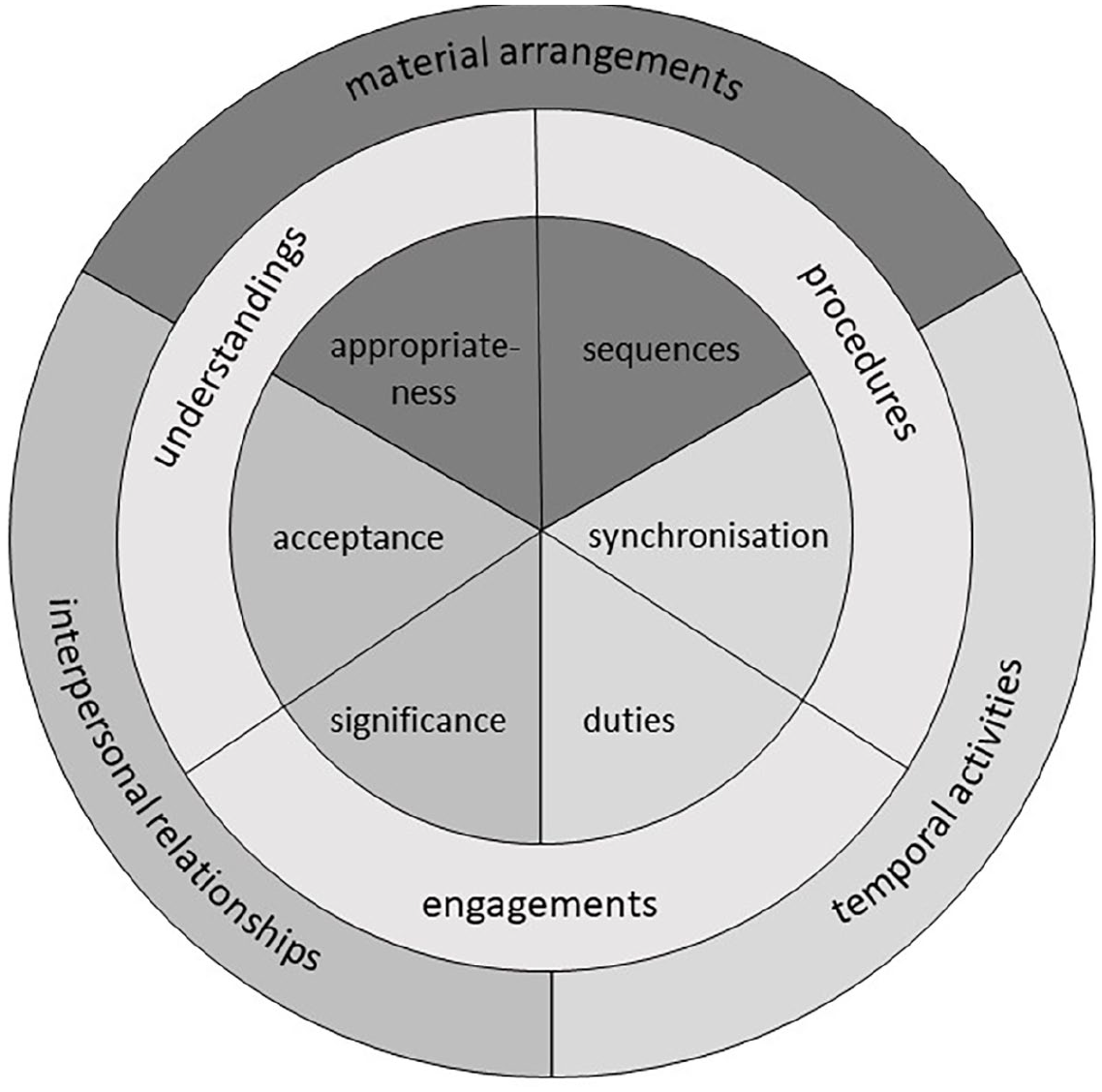
The relations between analytical components shown as overlapping circles. From outside in: coordination forms as ‘overarching categories’, elements of practice as ‘reflection concepts’ and adjustment themes of foodwork.
Material arrangements were divided into the themes ‘appropriateness’ and ‘sequences’. Appropriateness included varying thoughts and opinions about the temporal, spatial or financial suitability of foods and tools to a particular practice. This theme reflects understandings from the concepts of elements of practice. Sequences contained the order of arrangements – that is, the chains of material inputs and outputs involved in performances. Thus, the theoretical concept of procedures is reflected in the theme, emphasising shared principles as well as embedded and unreflective routines of material sequences. The themes ‘synchronisation’ and ‘duties’ elaborated the coordination of temporal activities. Synchronisation addressed the adjustment of activities to the different schedules and rhythms of everyday life. This theme again reflects procedures highlighting in this connection their temporality, such as durations of different performances, which steers their synchronisation. Duties contained all foodwork performances with the varying involvement of practitioners. The theme reflects the concept of engagements emphasising different ends and emotions that are accumulated through the experiences of foodwork practices, whereupon they also direct performances of present duties. The last themes, ‘significance’ and ‘acceptance’, specified the coordination form of interpersonal relationships. Significance considered various aims and thoughts about what is important in the performances of parental foodwork. The theme again refers to engagements but emphasises the social and cultural targets and meanings of foodwork varying interpersonally. Acceptance appeared in participants’ preferences and opinions of ‘good’ food and ‘proper’ practices. The theme again reflects the concept of understandings but refers to interpersonal rather than material differences.
The results section illustrates the six adjustment themes with the help of video descriptions and transcripts translated into English. The themes appeared in the data in various combinations, but for clarity, we introduce them in the results through the coordination forms.
Results: Adjustment Themes of Foodwork
Coordination of Material Arrangements
Parents adjusted their material arrangements to be in line with understandings and procedures around foodwork. The descriptions and performances of arrangements revealed the adjustment of appropriateness and sequences of materials.
The appropriateness of material arrangements reflected understandings related to different characteristics of and information about materials. Parents echoed various social justifications when describing suitable foodstuffs, good grocery stores or proper equipment. For example, Mother D explained that they confine themselves to ‘kind of good food that is made from basic ingredients’ in contrast to ‘kind of new food’. Mother A wanted her children to eat ‘not necessarily healthy or unhealthy but like something in between’; therefore, her son would ‘get pepperoni every other week but every other week . . . normal ham or something’. Thus, the different characteristics (e.g. conventionality, economy, healthiness, environmental, temporality) influenced the suitability of materials in different situations of foodwork. For example, in relation to appropriate meal arrangements, different materials were more appropriate on weekends than on weekdays. Mother A explained the repeated scheme of their weekly menus: ‘There’s this logic, right: soup and chicken and pasta each once a week and something special for Friday and Saturday and something long-lasting for Sunday’. Between the ingredients and dishes on weekdays, and between weekdays and weekends, there had to be variation. Father D crystallised this as follows: ‘If it’s the weekend, then we might make more of an effort, but if it’s just a weekday, it’s really, like, expediency first’. On weekdays, the appropriateness of foods referred to feeding eaters by using time-saving and familiar ingredients and equipment, whereas on weekends, the meals prepared and materials used differed from those on weekdays. As illustrated in the videos, parents made, from scratch, time-consuming Wiener schnitzels (Father D), pizzas (Father A) and grilled souvlaki (Mother C) on weekends.
Sequences of material arrangements appeared as verbalised principles or fluent series of routinised procedures in videos. Basically, sequencing ensures that material inputs and outputs of practices enable foodwork. For example, a lack of functional recycling spaces led to creative storing in Family C, material accumulation on kitchen worktops in Family E and the ending of recycling in Family D, even though the organisation of recycling bins near houses was meant to support the procedure. In times of cooking, lack of ingredients meant visiting the nearest grocery or using alternative ingredients from the cupboards. Mother B talked about vanishing food storage: ‘And sometimes, right, I’ve planned it out like, okay, I’ve got some pasta and I’ll make this sauce, but no, there’s naught in the fridge when I get cooking’. Her four daughters ate and cooked by themselves, hindering long-term planning and forcing the mother to supplement storage several days in the week. In Families C and D, the availability of ingredients was organised by purchasing basic ingredients (e.g. minced meat, fish, chicken, vegetables, potatoes and pasta) together, without exact meal plans. This enabled creative flexibility. As Mother D put it, ‘Then there’s tons of stuff I can make with ’em’. However, Father D criticised the procedure because unplanned purchasing causes food waste as a refrigerator might consist of ‘eight kilos of potatoes, and half of ’em have sprouts already’. In contrast, Family A wanted to control the quantity of materials by sticking to plans and avoiding ‘buy 2, get 1 free’ campaigns, which was a procedure of Family E for saving in food costs.
In videos, material sequences were enacted by routinised procedures and in-action planning that meant fluent reacting to changes of situations (Torkkeli et al., 2021). Father D reported in the video his situational planning: ‘Cooking actually started with going round the shops ’cause the fridge was empty, and I popped in to get groceries, and sausage soup is really quick and easy’. While he was cooking, his elder daughter came home. Father D asked her to stack the dishwasher and asked the younger daughter to set the table. Thus, the foodwork was adjusted situationally in an interaction with the changing environment. The organisation of grocery stores near the living area supported and enabled the short-term, in-action planning. However, Fathers D and E were dissatisfied with the procedure. They would have liked more systematic planning, such as weekly menus and planned shopping lists, to facilitate the mental work and avoid dull, recurring foods. Their wives resisted such planning by arguing, ‘I can’t know what one likes to eat on the next day’ (Mother E), or by preferring ‘go[ing] with the flow’ (Mother D). Mother E also described completing all the planned tasks of paid work as being so stressful that ‘you kind of don’t have the energy to think about it [food]’. Mothers preferred flexible material procedures because the organisation of temporal practices and differing schedules of everyday family life was complex.
Coordination of Temporal Activities
Parents adjust the temporal activities of foodwork according to the procedures of and engagements in foodwork. The descriptions and performances displayed the synchronisation and duties of temporal activities.
The synchronisation of temporal activities was enacted by adjusting foodwork procedures to the schedules of family members and the rhythms of society. On weekdays, all the parents were at work and the children were at school. Synchronising parents’ schedules was crucial because ‘either one of us should always be making it home from work to feed the kids’ (Father A). Subsequently, both the children and parents had leisure activities, and daily foodwork was organised between different schedules and transportation. Despite varying schedules, weekday meals were prepared in Families A, D and E regularly between 5 and 6 pm, and anyone who could not join the family ate alone according to their own schedule. In Families B and C, mothers assumed the main responsibility for foodwork, and therefore, the timing of meals and foodwork varied according to the activities of the children and mothers. They often synchronised the transportation of children to activities with the parents’ activities and purchased food en route. Fitting the purchase of food into available periods or preparing food for several days were alternative solutions to synchronisation challenges. For example, Mother C reported in a video while cooking a macaroni casserole that ‘Macaroni casserole is great ’cause Son has practice tomorrow at 2 pm; I think, when there’s casserole left over, then Son can eat it tomorrow before practice as well’.
Duties of temporal activities were performed mostly by routinised engagements in foodwork. This was based on long-term experience with different foodwork situations. This manifested as fluent manoeuvres in videos rather than the utilisation of specific skills. Father A stated aptly, ‘I can’t make salad. Or I can’t be bothered’. By this, he revealed that his lack of skill was actually a lack of engagement in the activity. However, parents were able to compare their own strengths and interests to their spouses’. For example, Mother A was good at planning and preparing dishes and Father A at baking pizzas and making meat dishes. Mother E highlighted Father E’s talent for seasoning and her own deftness at peeling and chopping. Mother D was good at preparing multi-part meals, while Father D preferred a more compact repertoire. Thus, engagements in foodwork differed on a personal level and cumulated at the household level, affecting the division of duties but also indicating cooperation and flexibility according to the spouses’ schedules. In Families B and C, mothers had the most duties. Father C might help if asked, but inequality was the most obvious in Family B. Mother B explained the division of duties as follows: “Um, he [her husband] doesn’t want any part of this: planning or buying or preparing’. However, the daughters participated in the foodwork, which emerged from the videos.
In every family, children were involved in foodwork depending on their age and competences. The usual duties of children were setting the table, making salads and helping with cooking. For example, the parents of Family E were preparing Friday dinner in a video in which the two younger daughters were happy to join in the foodwork. Mother E tried to assign equal duties to both lively children. Father E commented on the fuss in the video clip: ‘It’s actually quite fun ’cause they like to help out and ’cause they’re not scared of using sharp knives, so they chop away and learn that as well . . . Sometimes, we laugh about how this would’ve been sorted in a half hour, but it took an hour with all the help’. Although children’s participation in foodwork might break easy routines and demand a more nuanced division of duties, most parents engaged in the socialisation of children with foodwork.
Coordination of Interpersonal Relationships
The displays of interpersonal relationships highlighted engagements in differing aims of parental foodwork and understandings of participants’ preferences. In other words, parents described the significance and varying acceptance of their foodwork.
The significance of foodwork was revealed when parents talked about their engagements in various aims of parental foodwork and the importance of doing so. For example, Mother A described how engaging in the systematic planning of weekly meals was a socialisation into the essential practice of socially ‘sensible’ parenting: ‘When [our] daughter was born, we thought, right, let’s be sensible adults and get groceries once a week’. She displayed notebooks also containing weeks planned by the nine-year-old daughter. Instead of engaging in such systematic planning, Mother D planned in-action an alternative meal for a picky child while the others had avocado pasta. She commented afterwards that eating together and foodwork chiefly mediates care: ‘It’s a comfortable, nice situation. But then, of course, you can teach good manners around the table and listen, but also, everyone gets attention’. In pre-interviews, families A, B and E displayed another kind of significance of parental foodwork, highlighting an aim to socialise children towards a diverse and experimental relationship to food. Mother A argued for the significance of this: ‘It’s just common sense, and part of travel, and open-mindedness, and eating out, and eating at other people’s houses; it’s like a basic skill. And then you don’t have to think about it’. Thus, it was important to rear open-minded and flexible omnivores who could behave well in social situations and simultaneously facilitate the parents’ foodwork. However, the videos of Families A and B showed that the rearing of ‘good eaters’ and open-minded omnivores was an ideal. A daughter cried and refused to taste vegetable balls prepared by Mother A, and Mother B made alternative food when the younger daughters asked for it. Socialisation to diversity and experimentation forced compromises because the primary significance of parental foodwork was to ensure adequate energy supply – ‘expediency first’, as Father D stated.
Acceptance of foodwork appeared as understandings of varied preferences and opinions about ‘proper’ practices. Parents were conscious of the foods that family members accepted and preferred. For example, Mother B reported that Father B did not accept convenience food. However, on a busy Friday, they purchased many different convenience products (sweet potato fries, ready-made tzatziki, ready-to-fry patties and lamb fillets, frozen wok vegetables and hot smoked salmon) to fulfil different wishes for protein-rich, pescatarian and vegetarian food. Mostly, parents streamlined the weekdays’ foodwork and prepared one dish, hoping that it would be accepted. For example, Mothers A and C enacted an ecologically justified practice and offered bean-based foods without other options. Simultaneously, they took a conscious ‘risk’ that the children would refuse to eat the food. Vegetarian Mother A said in the pre-interview, ‘We don’t make them try anything unusual on Sundays; they have to eat vegetarian all week anyway’. Mother C described: ‘He (the son) doesn’t like cooked veggies . . . So, he usually pops them on my plate ’cause I keep telling him not to throw food in the bin; I hope he’ll start eating them someday, but I won’t force him’. Thus, mothers offered just one option that children did not always accept; Mother A called this ‘silent persuasion’, whereas Mother C said it is more like forcing.
Overall, vegetarian diets and bean-based vegan products recurred as indicators of power conflicts between parents and children. Mother B talked about how her elder daughters ‘imitated’ vegetarian schoolmates and media influencers. She gave up power and let her daughters try the vegetarian diet but asked them to list foods they wanted to eat. However, the diet experiment ruptured her fixed routines and hampered foodwork, so she displayed relief in the SR interview when she said that the experiment ‘is going to pass’. The variations in acceptance also caused conflicts and negotiations between parents enacting foodwork in cooperation (in Families A, D and E), for instance, about whether it is important to recycle bio waste, whether a meal needs to include a salad or what proper procedures are in general. Negotiations and descriptions of disagreements revealed different justifications about accepted practices. However, the transformation of foodwork demands that societal justifications of more ecological, wholesome or economical foodwork are adjusted continuously through aforementioned adjustment themes to fit in different everyday situations.
Discussion: Parental Foodwork and Ongoing Adjustments
The aim of the study was to elaborate parents’ coordination of everyday foodwork by analysing the ongoing adjustments they made to feed family members repeatedly within the steering of social practices. The results demonstrate a continual coordination through six adjustment themes of parental foodwork: appropriateness, sequences, synchronisation, duties, significance and acceptance. Appropriateness and sequences specified material arrangements; synchronisation and duties explained the temporal activities; and significance and acceptance nuanced interpersonal relationships. The themes both diversified and facilitated the comprehension of foodwork’s complex coordination, although it was not possible to analyse any repeated schemas or causal relations between the adjustment themes.
The practice theoretical perspective of the study enabled us to deal with the complexity of parental foodwork, as all the social practices interconnected within foodwork have commonalities: they consist of sayings and doings organised by the elements of practice (i.e. understandings, procedures and engagements). Coordination forms (Mylan and Southerton, 2018) offered concepts to interconnect and consider material, temporal and interpersonal dimensions of foodwork practices. However, the analysis of multiform data comprising situational and tacit performances (doings of foodwork) as well as reflexive accounts of family food practices (sayings of foodwork) exposed continual adjusting that was more nuanced than coordination forms imply. With the help of elements of practices, adjustments were possible to conceptualise as different themes. Thus, the analysis conducted from the perspective of participants’ everyday life showed that adjustment themes embedded in bundle of foodwork practices helped parents to perform practices and maintain the normative configuration of them in changing everyday situations (see Schatzki, 2016a).
However, foodwork practices are socially and culturally diverse and connections between different everyday practices can emerge, develop and break constantly (e.g. Shove et al., 2012). Thus, as the results indicated, parental foodwork does not depend merely on adjustments of parents. Parents and children are in a continuous interplay with a surrounding society that socialises family members into foodwork practices as well as organises and justifies performances of practitioners. Such interplay is obvious because it is impossible to separate practices of parents from the practices of society as the practices are characteristically social and shared (Schatzki, 2016b). Thus, adjustments of parental foodwork can be perceived also from the perspective of understandings, procedures and engagements mediating and steering family food practices.
Understandings of proper and socially justified family food practices affected how parents adjusted acceptance and appropriateness of their foodwork. Parents monitored the different preferences of family members and characteristics of materials in an interplay with normative understandings of ‘good’ foodwork. Thus, understandings of convenience, vegetarian or healthy foods expressed by friends, media or authorities might evolve into negotiations and power struggles in families. Power is always involved in interpersonal relationships (Watson, 2017), which was revealed especially in situational performances of cooperation, division of duties and accounts of conflicts and compromises. On one hand, the democratisation of family life (Wilk, 2010) has normalised children’s participation in decisions about foodwork, such as meal plans and timetables. On the other hand, parents try to reassess their foodwork according to societal justifications involving, for example, targets towards healthier, more sustainable or traditional family food practices (Torkkeli et al., 2021). Thus, the democratisation of family life and different worlds of justification (Boltanski and Thévenot, 2006) entail power struggles between parents but also between parents and children, producing a ‘negotiation culture’ in families (Goodwin and Cekaite, 2018: 25).
Societal material and temporal procedures interrelating with family food practices affected sequences and synchronisation of parents’ foodwork. Sequences as repetitive and conventional ways of doing something partly depended on the temporal procedures of social practices, such as, societal eating rhythms (e.g. Southerton 2012; Kahma et al. 2019). Parents’ synchronisation of foodwork meant adjusting to these rhythms and the schedules of school, work and exercise. Moreover, waste recycling, school meals or teleworking are societal procedures that may help or challenge the adjustments of sequences and synchronisation related to foodwork. Cooperation between parents facilitates the sequences and synchronisation of foodwork, but the results also expose challenges regarding the invisible mental work that is still considered to be highly gendered (Miller, 2017). Thus, unplanned meals and empty refrigerators raise the question of who has the responsibility for the mental work of sequencing, such as anticipatory planning, how it should be undertaken in cooperation and whether it is even a negotiable issue. Although the division of mental work was challenging, parents adjusted foodwork through situationally performed interpretations of what were temporally possible, materially feasible and interpersonally appropriate. However, the transformation from gendered and invisible mental work to the equal and shared coordination of foodwork demands flexible power relations between parents and continual verbalisation of thoughts and aspirations.
Simultaneously, the normative (and gendered) engagements in family food practices recur in the society affecting how parents adjusted duties and significance related to foodwork in this study. In essence, parents followed practices into which they themselves had been engaged and simultaneously socialised their children into foodwork, which they regarded as significant and fitted in their circumstances. Parents’ reflections of their goals for food-related socialisation have been explored (e.g. Anving and Sellerberg, 2010; Grønhøj and Gram, 2020), but more attention should be paid to how the goals are implemented in everyday family life and what is socialised unconsciously (e.g. Oleschuk, 2019). Concurrently, children are socialised into food practices in different societal arenas (e.g. in media, schools, leisure activities), which diversifies the experiences of practices familiarised at home. This can challenge parents’ conventional foodwork but also facilitate the accomplishment of their socialisation goals depending on how parents see the significance of foodwork. However, the synergy of different socialisation actors (e.g. kin, media, schools, public health) can advance heathier and more sustainable food practices of households or children’s well-being, but it demands a concerted understanding of the complexity and dynamics of parental foodwork. Moreover, the role of children in accomplishing everyday foodwork duties merits attention. It has fallen outside the scope of studies related to home cooking as the focus has been on parents’ accounts and performances, but the analysis of cooking videos indicated the active involvement of children.
Overall, the video method enabled us to analyse foodwork as situational performances carried out at home and, thus, avoid overemphasising recurring cultural and social meanings (cf. Martens, 2012) or public worries regarding families’ food practices (see Murcott, 2019). The study exemplified how the combination of video and SR-interview methods can seize both sayings and doings of practices and consider their situational, interpersonal and non-verbal manifestations. Thus, the method produced rich, diverse and deep data rather than data that were widely generalizable. At the same time, it is important to acknowledge that the method may particularly attract families who are ready to exhibit their foodwork enacted perhaps by following socially normative and culturally ‘good’ practices representing middle-class values (e.g. Dermott and Pomati, 2016). Therefore, in future, it is important to expand this kind of study also to families with different cultural and socio-economic backgrounds, conditions and resources (e.g. working-class or single parents with limited finances or people not living in the metropolitan area), which would enable research to test and revise adjustment themes.
However, the study succeeded in deepening the understanding of parental foodwork with a synthesis of practice theoretical concepts and rich data from five families. The data were affluent in the diversity of embodied performances, cooperation between family members and situational expressions about varying social norms of parental foodwork embedded in the everyday life of middle-class families. Foremost, the main contribution of this study is the theoretical elaboration of the coordination of foodwork by applying practice theoretical concepts in the analysis of data collected in novel ways. The results showed situationally adjusted and enacted everyday foodwork saturated with negotiable nuances. Nevertheless, the foodwork was not chaotic. Rather, it displayed parents’ skilfully manoeuvred adjustments and flexibility of foodwork. This indicates competences that are beyond the normative idea of cooking skills as technical-material or knowledge-based (see also Halkier, 2021; Trubek, 2017). The studying of what those skills are and how they could be supported, would be important to succeed in promotions of culturally, socially and ecologically preferable family food practices.
Conclusion
The study compiles a theoretically solid and comprehensive picture of parental foodwork, highlighting a continuous adjustment through six themes (appropriateness, sequences, synchronisation, duties, significance and acceptance). This clarifies the complexity of parental foodwork and elucidates the coordination of practices hidden behind daily performances as the inherent responsibility of parents. Simultaneously, societally recurring understandings, procedures and engagements interrelated with family food practices steer, facilitate and challenge everyday foodwork and adjustments of parents. Thus, the analysis of parental foodwork through adjustment themes and elements of practices can offer a multidimensional perspective, for example, to explore current sustainability transition without overestimating the possibilities of changes within family life. In addition, the practice theoretically reinforced concept of foodwork can be an empirically topical and applicable approach for future studies considering changes of home cooking and diversifying food-related practices in everyday life: If home cooking is diminishing, foodwork remains. Overall, this study shows that families are continually adjusting to navigate in their everyday circumstances and within the bundle of socially shared and recurring food-related practices. The studying of adjustments in different empirical contexts and within various bundles of practices could elucidate the role and meaning of households in societal changes.
Footnotes
Funding
The authors disclosed receipt of the following financial support for the research, authorship, and/or publication of this article: The first author’s work on this article was partly supported by Elli Suninen and Rachel Troberg Foundation.
Ethical Statements and Informed Consent Information
The study does not include any conduct that needs an ethical review in Finland. The study does not include sensitive themes, participants are not in a vulnerable position and identifiable personal data (e.g. race, religion, or ethnicity) is not collected (Finnish National Board on Research Integrity TENK, 2019).