




Abstract
By introducing a wider understanding of the discourse of modernism at the time that record covers were introduced, this article investigates record covers as a means through which various actors in the Swedish jazz scene connected jazz with modernist art forms. In the 1950s, specific designs for record sleeves became integrated into the ways in which jazz was mediated in Sweden, which coincided with wider debates about whether jazz could be seen as an art form.
The main question of this article is: How did the artwork on record covers influence the acceptance of jazz as an art form in Sweden? In responding to this question, the article aims to demonstrate that, in addition to written discourse, visual objects – in this case record covers – were of great importance to the rising status of jazz in Sweden in the 1950s and 1960s. More broadly, I argue that the visual elements in music cultures can be just as important, if not more so, than written forms of discourse, for negotiating the social status of music.
Introduction
Much research on jazz and its history has focused on written discourses surrounding jazz culture, jazz musicians and jazz as music, concentrating on articles and reviews in specialized jazz magazines. Prominent jazz scholars have pointed out how important jazz criticism has been for various jazz scenes (see Gabbard, 1995; Gennari, 2006; Kjellberg, 2009; Nylöf, 2006). Researchers have even analysed discourse as a central site for debates on the status of jazz, a topic that has enjoyed wide discussion by use of Pierre Bourdieu’s field theory. Ethnologist Alf Arvidsson (2002, 2011), for example, has, in this way, analysed the journeys of jazz from its early beginnings as a form of popular music to an established artistic expression in various Swedish contexts in the 1960s. However, as Nick Prior (2008) has argued, there are limits to the usefulness of Bourdieu. In discussing contemporary music, Prior finds that Bourdieu does not pay attention to the different forms that media and technologies take in this theoretical framework. This finding is relevant, even from a historical perspective. As Prior (2008) continues, Bourdieu-inspired analyses tend to miss how materials not generally regarded as central to discourse join the relationalities that Bourdieu conceptualizes through the concept of the field. By analysing record covers, I want to show how other materials, such as record covers, have been of great importance in such relationalities as those I have described. The article is not a rejection of the sophisticated understanding of Bourdieu in the present literature on jazz in Sweden (Arvidsson, 2002, 2011); rather, it aims to exemplify how a greater width of empirical material can complement existing scholarship on the changing status of jazz and jazz historiography. The analyses show how visual elements in music cultures have been used to express ambitions, or claims, for the social positions of specific styles of music. Herein I want to extend the use of Bourdieu’s concept of the field to understand how and in what ways these claims work to establish and/or strengthen relationalities between visual cultures and music cultures.
It is not only written texts that have influenced the way jazz fans and the wider, more general audiences have regarded jazz. Because the discipline of jazz studies understands jazz as being more than just a type of music and therefore includes it in the cultural domain, several scholars have pointed out the importance of various artefacts in jazz, such as records and record covers (Dougherty, 2007; Pond, 2021). Robert O’Meally (1997) even connects the particular visual characteristics of jazz sleeves to the music: But the album cover was not entirely a graphic design domain. More than any other type of recorded music, jazz record covers were a showcase for modern fine art (particularly painting). All people who followed the arts understood that abstraction and other forms of modern art perfectly expressed the values and spirit of jazz. (O’Meally, 1997: 42)
O’Meally does not, however, specify how modern art expressed values within jazz, and he underlines this connection as self-evident; everybody with any notion of the arts apparently thought so. I, however, want to investigate more critically why it was obvious that modern art expressed the values and spirit of jazz. Furthermore, I want to provide a more sophisticated understanding of how modern art and jazz were connected on record covers and thereby investigate how visual elements were relevant for the position of jazz in cultural fields in Sweden. I also argue that considering the design of record covers helps to give a better understanding of the discourse of modernism in the context of jazz, which connects to the way visual aesthetics influenced the status of jazz in Sweden.
Discourse and Iconicity
The theorization of jazz as a discourse or a site where various discourses meet has proven to be a fruitful method for jazz studies scholars (Arvidsson, 2011; Gabbard, 1995) to understand the ways in which musicians, critics and fans have made jazz meaningful. Rather than rejecting the importance of discourses, I will argue that in addition to written discourses, visual elements have also been meaningful for the way in which jazz has been understood. It is important, however, to recognize that other materials – such as record covers – come into play as well (following Prior, 2008).
There is the very visual side to record covers; however, on top of that, record covers are connected to activities of handling and playing the vinyl record. Julia Sonnevend (2012: 220) has pointed out that people encounter images in connection with other experiences: ‘The image encounter is never exclusively visual, but rather a diffuse sensory experience that also includes our perception of and interaction with the spatial and social environment.’ As other materials come into play, it is not only the visual appearance of the record cover that is connected to the music; the discourse is also connected to other sensory experiences. Dominik Bartmanski and Ian Woodward (2015, 2018) have considered these issues, focusing on the vinyl record as an icon. As the record cover is intimately linked to the vinyl record, Bartmanski and Woodward’s discussion (2018: 173) is valuable here as well. With the vinyl record, a variety of experiences and activities becomes highly relevant: It is a complex sensory signifier and multifaceted material object and therefore needs to be accounted for in terms of its affordances, qualities, sensualities and a whole range of specific phenomenological references and performative traits. Vinyl as a signifier is not merely arbitrarily connected to its cultural meanings and the social myths surrounding its biography.
In a contemporary setting, vinyl is associated with a move away from mass production, as in its materiality and the treatment of its materiality packaged in an LP cover, vinyl records are different from digital music and even CD releases (Bartmanski and Woodward, 2015). In the 1950s, however, the production of vinyl records signalled the beginning of a new period of mass production of mediated and packaged music. Vinyl was a new material, and packaging these discs in sleeves with individual designs was not yet an established practice. Vinyl releases of jazz took advantage of the packaging possibilities at an early stage. In a European context, Swedish record companies had a high output and were particularly quick to adopt the new format. 1 The elaborate covers of Swedish issues of jazz from the post-war era set jazz records apart from other styles of music – most notably, popular song. As such, jazz in Sweden was no longer viewed as the popular dance music that was frowned upon before the Second World War. With their picture sleeves printed in multiple colours, the jazz EPs issued in Sweden were exclusive commodities that not only contained music but also included visual characteristics, in addition to being associated with activities such as listening. The sensory experiences of listening also connected to the modern techniques associated with vinyl record players that were new and technologically advanced in the Sweden of the early 1950s.
Visual Culture in Sweden of the 1950s
The 1950s in Sweden have primarily been characterized as a time of increased welfare, as ethnologist Kerstin Gunnemark (2006) has argued in her research on Swedes’ memories and experiences of the 1950s. For many who were young at that time, the period represented a ‘new’ era that aspired towards a future in which life was going to be different. The economic development of the post-war era enabled this well-being, as did developments in Swedish city planning. With the construction of new suburban areas that included apartments, the government marked the beginning of real efforts to solve the housing shortage that existed in the larger cities. As Gunnemark (2006) notes, these new spaces for living were expected to live up to the modernist ideal of a ‘more beautiful everyday life’ 2 (‘vackrare vardagsvara’ in Swedish, as coined by architect Gregor Paulsson (1919)).
These changes in public and private living spaces make it important to situate record covers in the Swedish living rooms of the 1950s. Tom Perchard (2017) points out that jazz was connected to media that were consumed in the living room, such as the record player. The connection between furniture design and record covers also relates to the equipment that played the music. Various hi-fi sets, such as the Star Sinfonia, were advertised in the Swedish jazz magazine Orkesterjournalen (OJ, The Orchestra Journal). The set combined a record player with amplifier, speakers and radio, and even included a cabinet to store up to a hundred LPs. The advertisement claimed that the set was ‘Easy to furnish with’ (Orkesterjournalen, December, 1955: 21), and buyers could choose between teak and mahogany. Discussions of the ways in which hi-fi equipment could be integrated into the home interior were not new in the 1950s (see Björnberg, 2020), but from the late 1950s onwards, hi-fi equipment had become associated with modern design in Sweden (Björnberg, 2019). Although elaborate hi-fi sets were commonly advertised, this equipment, along with modern furniture in general, was expensive. Even if the welfare in Sweden did grow remarkably in the 1950s, modern living was definitely not for all Swedes. Those who listened to jazz, however, were mostly young, and many of them made the ‘class journey’ associated with the new suburban way of life in the 1950s in Sweden (Nylöf, 2006).
The rise of record collecting also strengthened the position of music, records and jazz as a part of the living room. Next to the devices that played the music, there was furniture that stored the records. An advertisement for a record stand explained that it was not only a way of ordering a record collection, but that it was also a ‘fun interior detail’ and a ‘beautiful small piece of furniture’ (Orkesterjournalen, October, 1958: 29). With its construction in wrought and painted iron and plastic feet, the record stand would fit in very well with the style of contemporary fashion, which had a dominance of iron shelving systems. The company that made the stand was called Nordisk Form, which operated from Vällingby, a model suburb of Stockholm that arose in the 1950s and was seen as being typical of the era (Gunnemark, 2006).
The furnishings of the new apartments were closely connected to ideas of modern living. In particular, this included teak furniture, as well as shelving systems that combined wood with new materials, steel coated in plastic. Kajsa and Nisse Strining’s ‘String’ shelving system, which featured wooden planks and steel string panels, was especially recurrent in the new homes styled with the latest furniture (Gunnemark, 2006). The latter system shows striking similarities to the record stand described earlier. From an international perspective, it is important to note that in Sweden there was no explicit understanding of this kind of furniture as being connected to the ‘Scandinavian design’ that arose abroad (Perchard, 2017). For many Swedes, this furniture was primarily ‘modern’, and generally, ideas of modern ways of living tended to be inspired by the USA if they were at all connected to a nation-state.
The use of new materials – exactly like records that now were made of vinyl, using plastic instead of shellac – was one of the typical elements of the 1950s. Another typical trade of the era was the styles of patterns used in design in Sweden. Curtains, rugs and ceramics were decorated with abstract patterns and bright colours, clearly distancing themselves from the more traditional and figurative style of the 1940s. These changes in patterns became extra significant, as at the same time, illustrations became more prominent in everyday life, such as in magazines. Typical for the decades after the Second World War was that magazines used less photography, and vignettes and the like were drawn instead. The form of many illustrations, such as in magazines, became less geometric and more playful and organic (Johannesson, 2007). The leading jazz journals in Sweden increased the number of illustrations notably. Returning sections, such as record reviews, got their own vignettes, and an ambitious series that discussed the importance of specific musical instruments for jazz received individual illustrations. The makers of these illustrations were closely connected to the local jazz scene. An illustration used for OJ’s article on the trumpet was made by Gunnar Cyrén, who was active as a jazz musician and later became central to the leading Swedish glassworks of Orrefors (Eriksson and Mankell, 2007). This indicates that a significant number of people who were interested in modern design and jazz were part of the same circles.
Jazz had, since its introduction in Sweden, been established as a ‘new’ form of music and was regarded as ‘modern’ dance music (Fornäs, 2004: 20). In connection to the Stockholm exhibition in the 1930s, Swedes became familiar with modernism and functionalism. From this period onwards, jazz became connected to modernism and functionalism, as well as to a more general belief in new societies with a greater standard of living. This new acquaintance was not always positive; some sounds in the public debate were less embracing and considered modernism as un-Swedish and saw it as an alienation from vernacular culture. As Johan Fornäs (2004: 55) has pointed out, one of the central figures of the ‘Hembygdsrörelsen’ (the local heritage movement), Karl-Erik Forsslund, called functionalistic architecture ‘frozen negro music’. Fornäs further explains that this local heritage movement can be seen as ‘part of a conservative and nationalistically oriented flow of critique that considered functionalism a non-Swedish threat – a foreign body that had forced itself into the home’ (Fornäs, 2004: 55). When modernism returned to the limelight in the period after the Second World War, the connections between jazz and modernism were strengthened. A notable event was the H55 exhibition for design in Helsingborg in 1955. This event was considered the leading exhibition for Swedish design in the 1950s, comprising a ‘manifestation of the architecture, furnishing and design of the 1950s’ (Eriksson and Mankell, 2007: 242). As jazz magazine OJ (August, 1955) reports, the exhibition was not limited to showing objects of furniture; even jazz could be heard at the event, played by Swedish jazz musicians, such as pianist Reinhold Svensson (as part of clarinettist Putte Wickman’s group), who played at H55 and is discussed later in this article. Jazz had thus been linked together with design in Swedish living rooms, as well as at exhibitions and by individuals moving between jazz and design as practitioners. In discussions of the two, it was primarily modernity that linked them together.
To summarize, various forms of visual elements were increasingly important in Swedish jazz culture. Jazz magazines contained more and more illustrations at the same time as tending to pay more attention to the locale that was the living room interior. As the medium in which ‘jazz’ was contained, record covers were particularly significant for connecting the music to specific types of imagery. Specifically, in a way that consolidated association between the record cover and the living room, where music listeners took the record out of its sleeve and listened to the music on a record player, establishing the room as a site for engaging in particular forms of sensory experience (Sonnevend, 2012).
The Symbolism of Record Packaging
With the introduction of the LP on the Swedish market in 1951 and the EP – the format that would become the new standard for jazz in Sweden from 1953 onwards – new record formats were adopted by Swedish jazz fans. Swedish issues of albums on shellac discs in the late 1940s heralded what would become standard practice for jazz records in Sweden in the 1950s: the use of a record cover unique to the particular record it enveloped. As Robert O’Meally (1997) has argued, the introduction of self-selection in American record stores in 1945 can be connected to the appearance of record covers. Russell Sanjek (1988: 338) even connects the use of picture sleeves to the upcoming market of records for children connected to the increased birth rate after the Second World War – new listeners for whom American parents who had embraced high-fidelity audio sets bought records. Record covers thus became a means to target specific audiences.
The American record label Columbia was not only a driving force behind the commercial introduction of LPs, but it was also at the forefront of the development of record covers in the era of 78s. It had a design department that pushed record covers, which was headed by one of the first prominent cover designers, Alex Steinweiss, who played a key role in establishing the use of picture covers. This innovation increased sales numbers considerably, and as a result, competitors followed Columbia’s new practice (De Ville, 2003).
This emphasis on the marketing reasons behind record sleeves is of course in place; it is a reminder of the fact that at this time, jazz was sold by privately owned record companies. The first record covers made by the Swedish record label Metronome were made by commercial illustrators from a Swedish advertising agency called ‘PM reklam’. In the years to follow, however, those who designed the covers were more closely linked to the jazz scene. This might indicate that the record company demanded more than just a marketing perspective in its design of record sleeves. Together with Lars Burman, Börje Ekberg was one of the founders of Metronome in 1949 in the 78-era, and he explained that they wanted to set a new visual standard for record labels: Lars Burman had a friend in the Klarakvarter in central Stockholm, who was a commercial illustrator and he made the logo with the guitar and saxophone. Back then all labels were very conventional . . . and not fancy in any way, we were revolutionizing in that sense. (Ekberg, 2013)
Ekberg’s account thus emphasizes that the record company wanted to have an innovative label that could be regarded as ‘fancy’. The fact that the company prioritized the design of the label indicated the emergence of new ideals in the Swedish record business.
The visual design of packaging material became more prominent when vinyl records started to outsell 78s. However, as shown in the case of the Swedish record companies issuing jazz in the 1950s, record covers did not solely function as a marketing innovation intended to maximize profit. Even for small issues, which would mean the majority of jazz records produced in Sweden, it became important to have a well-designed record cover. Record executive Dag Häggqvist, who started the Swedish record label Gazell in 1957 that recorded a lot of local jazz musicians, explains: I believe that when we had decided to issue a record, we felt a responsibility for it to look nice. And then, if you had a record that you would sell 5000 copies of instead of 500, it was more important. But even for those we only counted on selling 500 of, it was a matter of prestige, you can say. (Häggqvist, 2019)
This indicates that for record companies that issued jazz, it was not only economic reasons that motivated the design of record covers; the idea of prestige also evoked notions of status.
Case Studies
To analyse how record covers related jazz to modern art in the 1950s, I have selected covers with references to visual arts from the extensive number of Swedish issues of jazz. I included both Swedish and American jazz musicians who were issued on various record companies in Sweden, some with a cover corresponding to an earlier American issue and others with a new Swedish cover. Rather than giving an entirely representative overview of record covers in jazz in Sweden, the aim here is to investigate how record covers can influence the status of jazz and consider the symbolic function of the aesthetics of the record covers as a contribution to the discourse of jazz’s position in Swedish society.
Swedish jazz scholars agree that the 1960s comprised the period in which jazz found a new position in Swedish society as it – in retrospect – began to be accepted as a form of art (see Arvidsson, 2011; Bruér, 2007). As I will show, this process goes back to the preceding decade. The 1950s marked a period in which the way jazz was mediated on records underwent drastic changes, and as part of this, record covers took on a role of great importance for establishing jazz as being ‘modern’ and as being a form of ‘art’.
The two central ideas of ‘art’ and ‘modern’ are a point of focus in the analyses. Instead of taking for granted that ‘modern’ and ‘modern art’ had clear definitions in Swedish jazz circles, I trace these terms and the actors involved through Swedish jazz record covers. I investigate the ways in which music and visual art relate to the term ‘modern’. Based on the findings from the case studies, the consecutive discussion will then further develop how the changing discourses of jazz and art intersect in their understanding of ‘modern’ and ‘modernism’ related to a period in time as well as an aesthetics.
Reinhold Svensson trio, Metronome MEP 32
Metronome was the first record company in Sweden to issue jazz on vinyl and adorn records with a specially designed cover. One of these issues starred Swedish pianist Reinhold Svensson and his trio. The cover (see Figure 1) shows abstractions of the three instruments on the recording: very blocky renditions of a drum kit, a double bass and a grand piano. The simplification of the shapes and the crooked perspective connect the cover to cubism. The handmade quality of the lines gives the cover a playful impression. In the bottom right corner, a small signature ‘Kal.’ appears, referring to Sture Kallin. The fact that he designed the cover – and that this information is significant – is further emphasized on the back of the sleeve, where it states: ‘Cover by Sture Kallin’. The jazz listener is thus given information about the cover, but the text also directs the reader to the front cover and thereby stresses the importance of the design.
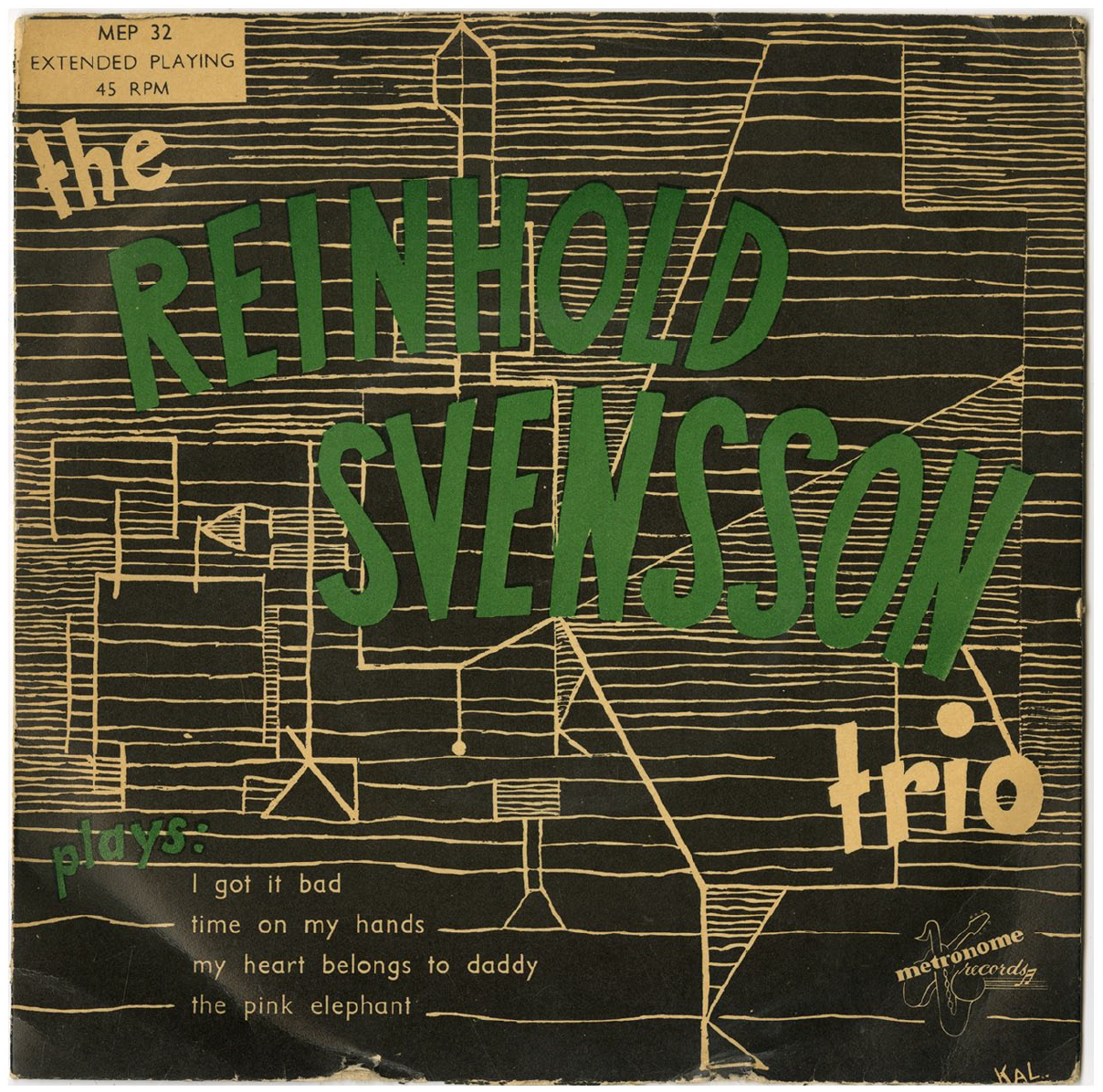
Metronome MEP 32, 1954, ‘Stubben’ Kallin.
The record was reviewed in the April 1954 issue of Swedish jazz magazine OJ, where the reviewers paid attention to the designer of the cover: ‘On the remaining sides the gentlemen work diligently and “Stubben” Kallin is not just satisfied with playing good drums; he has even made the amusing record cover’ (Ole Dole Doff, 1954: 30). Here, the novelty – and modernity – of the vinyl EP medium becomes apparent as the reviewers refer to the four tunes on the EP as ‘sides’, referring to the 78 record that traditionally had one tune on each side. The reviewers thus appreciated the record cover and perceived it as playful, but they also noted that its designer was the same individual as the musician. Though Kallin might not have been recognized as a visual artist by contemporary art critics, jazz critics, on the other hand, saw him as a good jazz musician who also had other artistic qualities. The record cover thus creates a link between modern art and jazz since one of the musicians who made the music also designed the cover.
The liner notes also define the music on the record: ‘This is modern jazz piano at its best but you do not have to be an avid jazz fan to enjoy the pianistics of Reinhold Svensson’ (Metronome MEP 32, 1954). Here, then, the notes on the back of the sleeve connect the design of the cover to the music. At the same time, they signal that the music is not overly complicated, either rhythmically or harmonically. The music on the record confirms this; the melodies of the jazz standards by Duke Ellington, Vincent Youmans and Cole Porter are recognizable as such, and the general impression of the music is a form of modernized swing rather than having been influenced by the more recent jazz style of bebop. Svensson’s original is a nice tune that swings, but is not a tune that would scare off more conservative jazz listeners. The music thus confirms the idea of the record as modern, but without positioning Svensson within the realm of bebop, a style that many Swedish jazz fans and critics regarded as having departed (too) radically from the jazz tradition. ‘Modern’, here, is not primarily a time-marker as it does not refer to the latest developments or avant-garde in jazz.
Reinhold Svensson, Moods, Metronome MEP 132, 133, 134
A series of three EPs with Reinhold Svensson was issued on Metronome in 1955, and the records were packaged using two cover designs made by the – now famous – Carl-Fredrik Reuterswärd (see Figures 2 and 3). The third record cover (Metronome MEP 132, 1955) – volume 1 in this series – had a similar design to volume 2 shown in Figure 2, but it was printed with red as a background colour instead. The covers showcase an experimental use of photography, incorporating a play on the negative and the positive light components of the picture. It should be noted that at this point, photography was not widely accepted as an artistic medium (Tellgren, 1997), and would only start to dominate Swedish jazz record covers towards the end of the 1950s. The playful use of both drawings and writings on the negative also evokes associations with psychology. There is a bird drawn on top of Svensson’s head in volume 2 and the figure on volume 3 that extends into the microphone stand and cord can be interpreted as a bird looking in different directions connecting the design to the title ‘Moods’ of the series. Reuterswärd used a collage technique here, a style that had been established in the visual arts and as a ‘modern’ art form. As with the previous record, the characterization of ‘modern’ represented a type of aesthetics rather than designating a point in time.
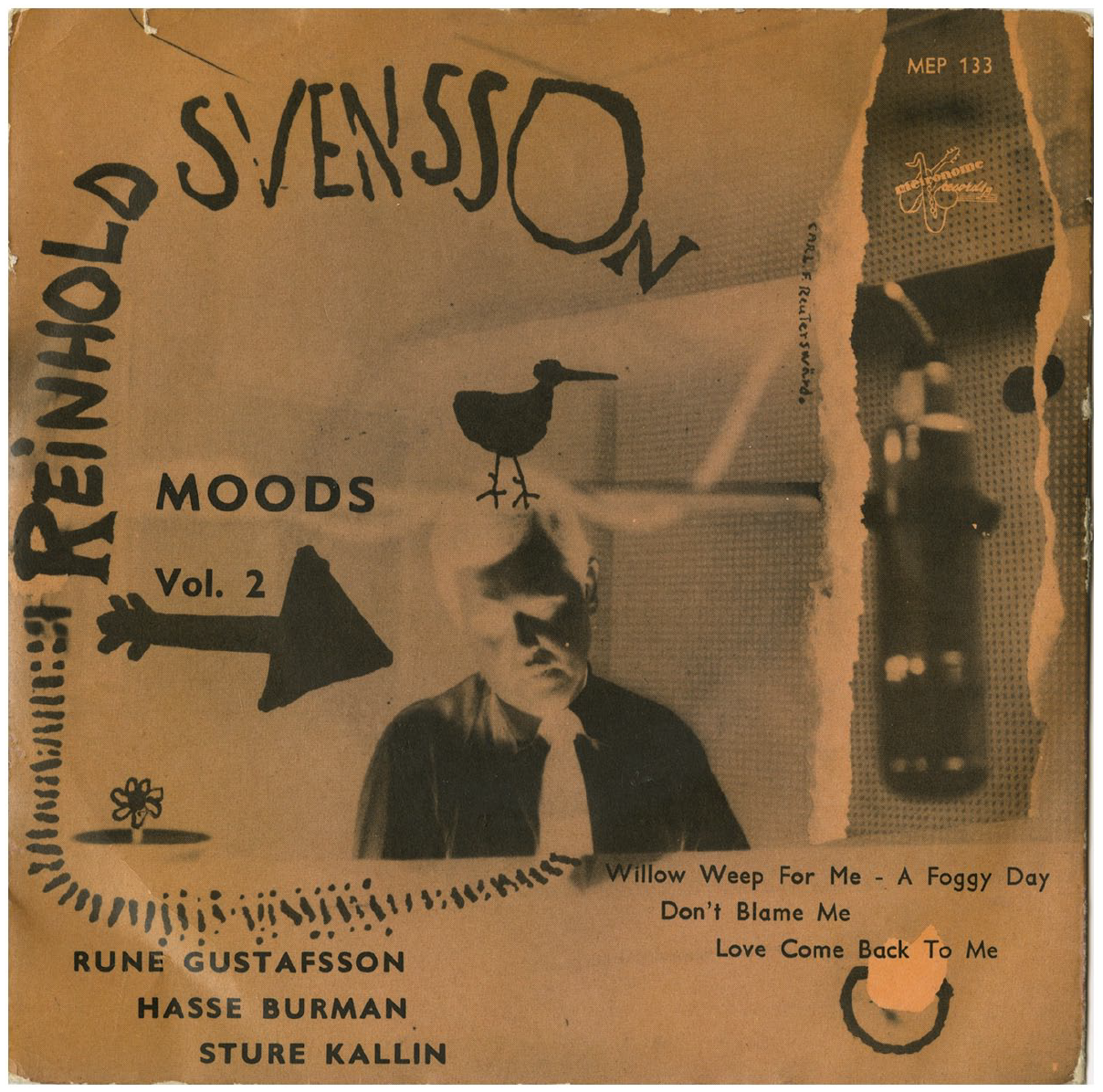
Metronome MEP 133, 1955, Carl-Fredrik Reuterswärd.
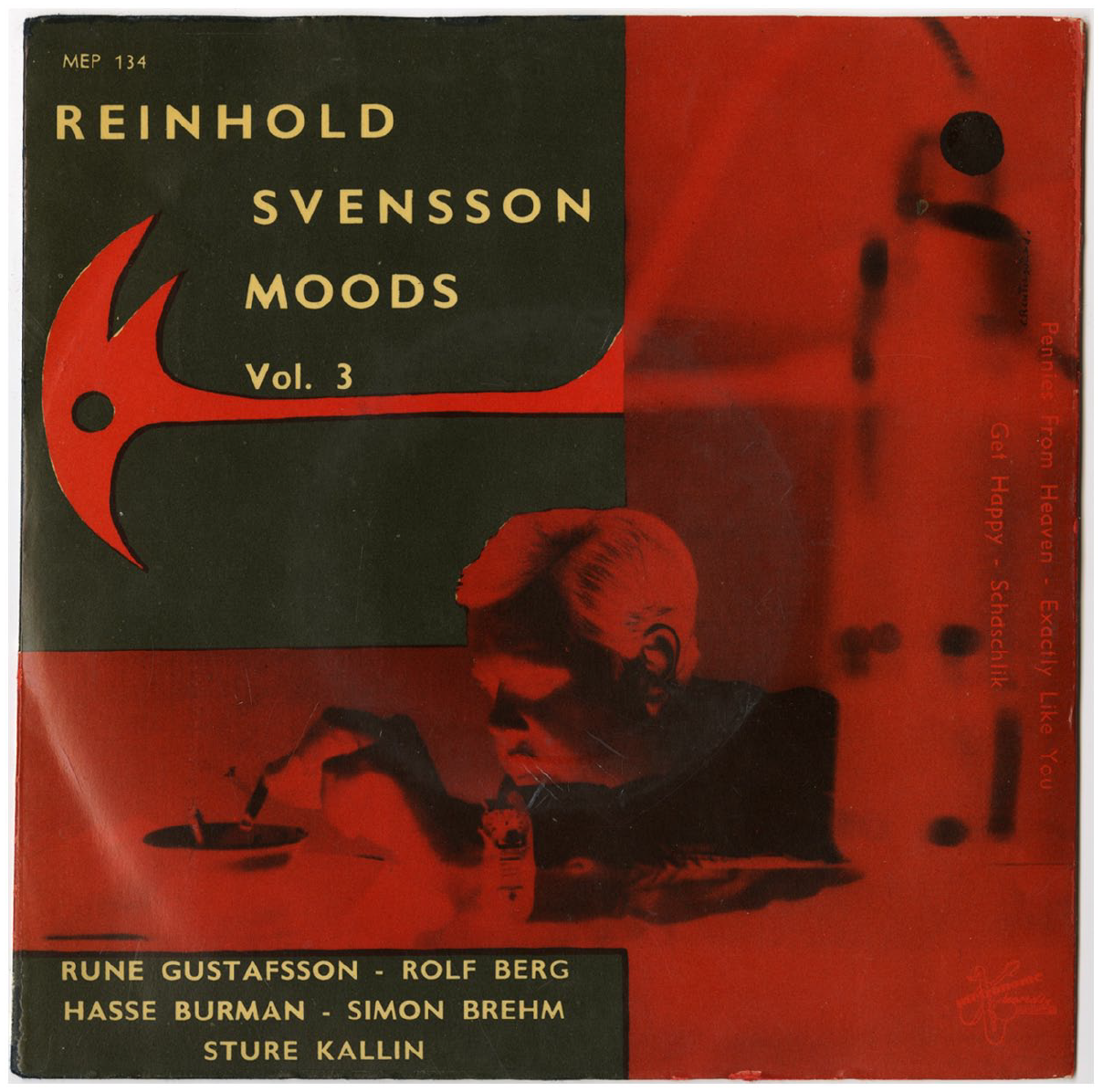
Metronome MEP 134, 1955, Carl-Fredrik Reuterswärd.
Dag Häggqvist was familiar with Reuterswärd, and he reflected on connections between jazz and visual arts by taking Reuterswärd as an example: Because jazz music in Sweden has a sophisticated understanding of culture, so to speak, it has attracted very good art. There are plenty of examples of Swedish artists such as Carl-Fredrik Reuterswärd and others who have really been engaged because of art. Some of them even played themselves, he did . . . I think he played bass together with decent musicians, almost on a Nalen-level, I think. But then he got quite famous as an artist. (Häggqvist, 2019)
Here, Häggqvist reflects on the jazz scene as a place where jazz musicians and fans have a shared interest not only in jazz as music but also in art. He describes Reuterswärd as an active member of the jazz scene. In addition to his activities in art, he played double bass on a level close to the musicians who performed at Nalen, Stockholm’s central jazz stage at the time.
Häggqvist himself was interested in getting a record cover made by Reuterswärd for one of the record companies he was involved in: ‘I tried to engage him to do some kind of sleeve, but he did not make portraits by order, so to say [laughs], but we did an exchange of art for records, so I have some stuff of his at home’ (Häggqvist, 2019). Even though Reuterswärd declined the request, the exchange of records for art strengthens the notion of jazz and art as being part of the same community.
Besides its visual style, the cover raises associations to art, as it is signed like a proper artwork. The back of the cover provides further information and lists Bengt H. Malmqvist as the photographer and Carl Reuterswärd as responsible for the cover design. The provision of this extensive information about the artists emphasizes the fact that the cover was specifically commissioned and made by an artist.
The music on the three EPs, however, would not have been regarded as the best example of jazz as art by contemporary jazz fans and jazz critics. The musicians play a kind of jazz that cannot be considered at the forefront of new developments in the style; the music was not something avid jazz fans had not heard before. A review in OJ commented that the choice of music was unusually uninspiring and that pianist Svensson ‘had not to any great extent changed his style in the last year and a half’ (Dole, 1955: 37). The slow tempo on most of the tunes made the band rather accessible to an audience wider than one merely consisting of devoted jazz fans.
Art Pepper Quartet, Abstract Art, Sonet SXP 2812
The next cover I will discuss is a 1958 record of the American alto saxophonist named Art Pepper. The cover (see Figure 4) shows a colourful and non-figurative abstraction with mostly square shapes. The felt tip pen-like technique makes the process of creation visible. This can be connected to improvisation and the idea that the creation could go anywhere, which raises parallels between jazz and visual arts. The non-figurative character of the cover also emphasizes the art scene of the USA more than the figurative abstractions more typical of European abstract art.
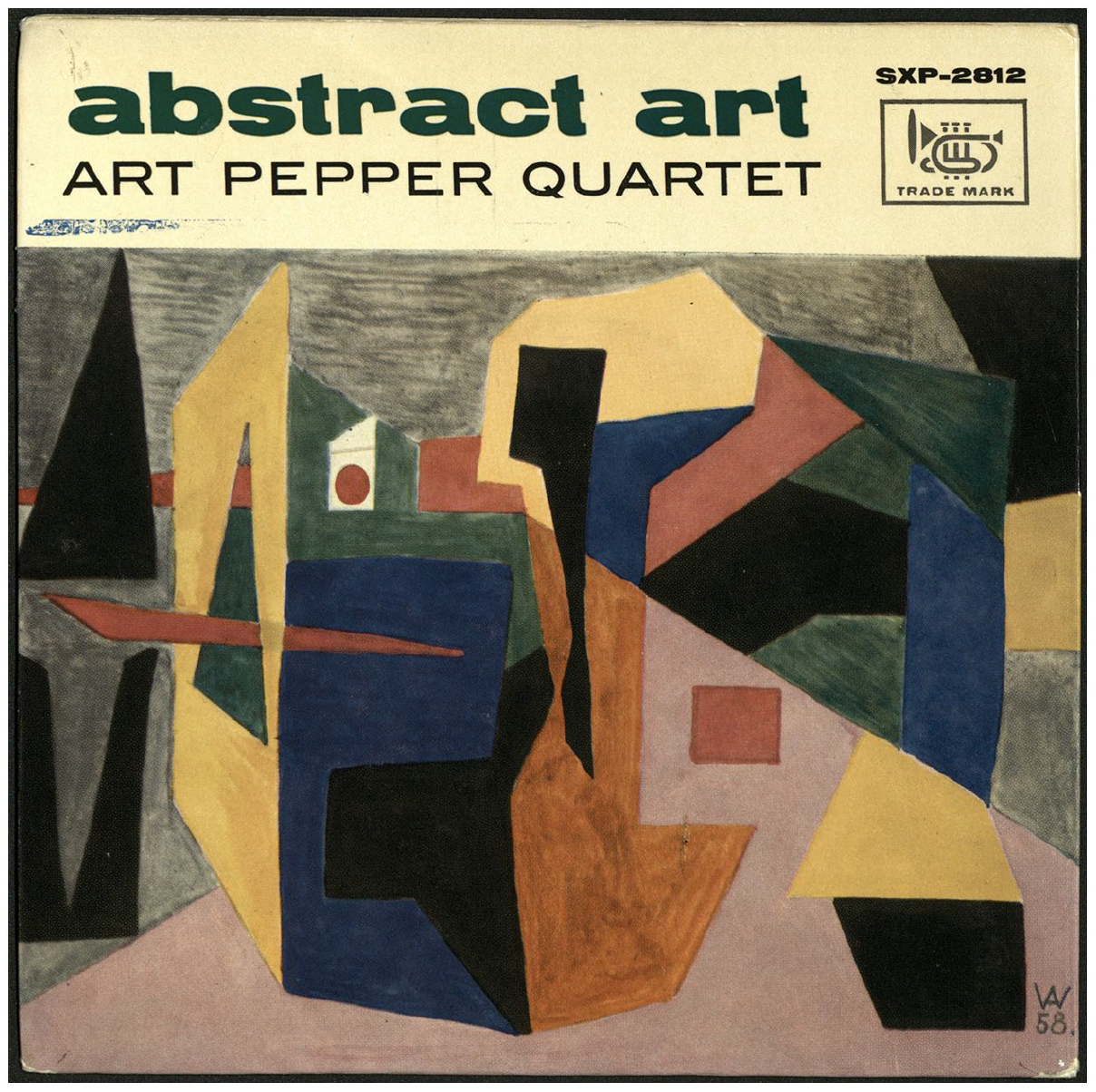
Sonet SXP 2812, 1958, W. Atterblad.
I asked Dag Häggqvist, who was involved with the Swedish Sonet label and who was close friends with the owners at this time, what he knows about this artwork: ‘This is one of my childhood friends, his father was a less successful artist. I think it was the wife who earned the money for their survival. They used to live right next to us at Djurgårdsplan’ (Häggqvist, 2019). The actual artist who designed the art on the cover was thus not necessarily expected to be an established artist; even a ‘less successful artist’ could design a record cover that would suffice to connect saxophonist Art Pepper – also through a creative play with the musician’s name and the notion of art – to an idea of jazz as an abstract form of art. In answering the question of how the father of his childhood friend, who, after Häggqvist’s recommendation started working for Sonet, ended up designing the cover, he replied: ‘They wanted an artwork then, probably because they didn’t have any other material and then this was a good way to arrange it’ (Häggqvist, 2019). Even though it did not seem essential that the author of the visuals was recognized as an artist, the presentation of the cover positioned it as a work of art. The back of the sleeve not only identifies ‘W. Atterblad’ as the creator of the picture on the cover, it also identifies it as the ‘cover painting’, which, together with the fact that it is signed and dated in the bottom right corner, emphasizes the artistic credentials of the design.
As the recordings on the Swedish EP were recorded and first issued in the USA, it is interesting to note that the Swedish issue has a different cover from the American one. The recordings were issued in the USA on LP on West Coast label Tampa Records (TP 28, 1956). Here, the tune ‘Abstract Art’ is included, a tune absent from the Swedish version, but the name remains. This clever use of the title connected ‘abstract art’ to the name of the American musician, implying that Art was an ‘abstract’ musician. Thereby the Swedish issue strengthens the connection between jazz and modern art and, more specifically, abstract art.
The music sounds typical of West Coast jazz, with a cool and relaxed style of playing. Both harmonically and rhythmically, the rendition of the tunes is less radical than in bebop, although they are informed by the style. The resulting music fits well into the understanding of modern jazz that had become established by this time. As a post-bebop development, cool jazz departed less from the musical language established earlier in the swing era. This is noticeable in Pepper’s rendition of the jazz standard ‘All the things you are’. If this song is compared to a version by Charlie Parker, one of the leading figures of bebop and like Pepper an alto saxophonist, it becomes clear that Parker played the jazz standard in a harmonically and rhythmically more complicated manner and abstracted from the original to a greater extent (Debut DLP-2, 1953).
Zoot Sims, The Modern Art of Jazz by Zoot Sims, Jazz Selection JEP 4567
The last record to be discussed is also an American recording by a saxophonist, this time Zoot Sims. The Swedish cover of the EP corresponds to the original issue of the recordings in the USA (see Figure 5), where the two tracks were issued on an LP on the Dawn label a year earlier (Dawn DLP 1102, 1956). The cover shows a photograph of Sims in front of a piece of art, a cubist bronze statue by Jacques Lipchitz (MoMa, 1937). The abstract figure on the cover connects the music and the band leader – who is also shown – to abstract art, as does the location.
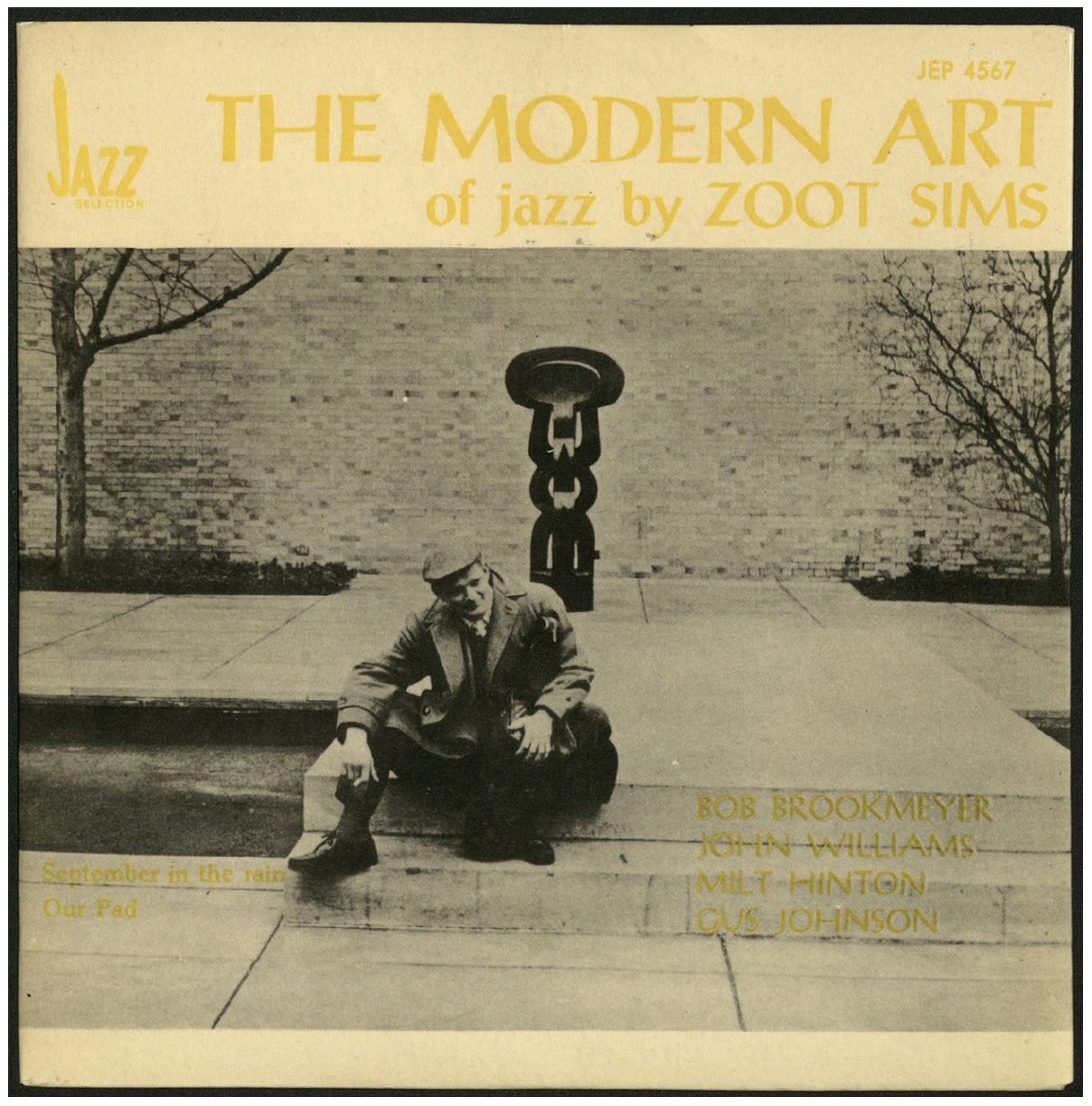
Jazz Selection JEP 4567, 1957.
The liner notes on the Swedish issue start off by explaining what the cover actually shows: If you turn the sleeve, you see Zoot Sims sitting on the stairs to the Museum of Modern Art in New York. The image is kind of symbolic. It wants to express Zoot Sims’ importance in jazz. He is without a doubt one of the world’s leading interpreters of ‘The Modern Art of Jazz’ and worthy to be seen with such a pretentious background as this. (Jazz Selection JEP 4567, 1957)
Here, the liner notes point out the symbolism of the place depicted; as it emerges, the listener and/or observer make the connection between Zoot Sims and MoMa as an institution of modern art, which is further emphasized by the title of the EP.
By showing Zoot Sims sitting in front of a statue at the Museum for Modern Art in New York, the picture on the cover not only connects jazz musician Zoot Sims to a piece of art, it also connects him to an institution of art, specifically one of modern art. Sims’ attitude and body language are also important (following Ake, 2002). Sims sits on the ground with his legs spread, relaxed with a cigarette in his hand. In this way, he expresses a sense of relaxedness and informality despite the institutional cachet of MoMa.
Zoot Sims was one of the so-called four brothers, the saxophonists of Woody Herman’s band who – inspired by Lester Young – used little vibrato and were formative in the aesthetic ideology of cool jazz. The music on this record fits this aesthetic, although at this time, knowledge about bebop was widespread and the style had become more central in the historiography of jazz (DeVeaux, 1991), and therefore the jazz on this record also started to sound less new. The rest of the liner notes argue that the music is not unnecessarily complex, but state that this music will be of historical value: ‘swinging modern jazz that will survive the passage of time’ (Jazz Selection JEP 4567, 1957). That formulation corresponds to the statue by Lipchitz on the cover, which is dated 1926–1930 and said to be cast in 1937 (MoMa, 1937). The idea of modern jazz here is thus not only the music of now, but also the music that has been and will be important in and for other times. By its connection to the Museum of Modern Art, it relates the idea of modern jazz to an understanding of modern as becoming established in the institutional context of a museum as an expression for a cultural establishment.
To summarize the case studies, these various covers show a great variety of styles that have become understood as modern, since various forms of figurative and non-figurative abstractionism, collage techniques and cubism were used on the record covers discussed in this article. The liner notes connect the understanding of the music to this idea of ‘modern’ and direct the jazz listeners to see connections between jazz and modernism through the materiality of the cover. The covers also stress an understanding of jazz as being part of a cultural environment where jazz musicians and visual artists share the same values and have an interest in each other.
What is striking in these case studies is that the idea of ‘modern’ connected to time, as the latest or newest, is less apparent in the music. Instead, associations with art are more important and central to the use of the term. Musically, the records are very different from what would have been considered the newest vogue in jazz at that time – hardbop as a new current that reinterpreted bebop and cherished its harmonic and rhythmic innovations. Representatives of this music can be found in Swedish trumpeter Rolf Ericson, who recorded a variety of material in 1956 with American musicians like Duke Jordan, Cecil Payne, John Simmons and Art Taylor.
Finally, the record covers also refer to modern art as an established institution rather than an avant-garde subculture. This then raises questions about the institutionalization of modernism in the visual arts and its connections to jazz.
Jazz and Visual Artists
As Mona Hadler (1995) has pointed out, jazz represented modern life for some painters because of its new sounds and dynamism. Visual artists had been intrigued by jazz at least since the early 1940s (Hadler, 1995), thus well before vinyl records were introduced and record covers became obligatory for jazz records. Simultaneously, with its roots in African American culture, it fitted the search for a ‘primitive’ expression that was championed because of its ‘pureness’. Thereby, jazz paradoxically represented both the most modern and most primitive expression in music, mimicking the extremes of abstract expressionism. The idea of jazz being primitive reveals the racialized conception of jazz as a ‘black’ form of music, and bears parallels to the early interest in jazz and related styles of music that art music composers displayed from the late 1800s to the 1930s (Salamone, 2005). Mona Hadler (1995: 247) characterizes the New York School artists’ interest in jazz as hierarchically ordered, and at the same time sees it as a sign that what she calls ‘high-art forms’ were interested in cultural expressions that were generally not regarded as high art: ‘Abstract Expressionism can be opened up to noncanonical figures and “low art” influences such as jazz.’ That these painters thus saw jazz as a source of primitivism that could inspire forms of art indicates how there was an understanding of jazz as a form of low art. The hierarchy was based on the conception of visual arts as a form of proper art, or high art, and jazz as merely a source for inspiration, almost a kind of raw material that could evoke or inspire artful expressions, but that by itself would not be regarded as a part of a high-art sphere.
Jazz - as an expression of primitivism - was thus something very different from art music, but associations with jazz were not as stable as they might seem at first glance. Though the appreciation and reception of jazz had always differed within various groups of artists, in the 1940s, many visual artists started to understand jazz more as a combination of improvisation and structure, moving away from racialized ideas of jazz as primitive expressions: The notion of jazz as architecture rather than automatic process grew on [Jimmy, MK] Ernst and informed the bulk of his paintings on jazz from the mid-forties such as Riff of 1946 . . . His ideas countered the ‘primitivist myth’ of jazz as pure inspiration, produced in a trance, and devoid of intellectual content. (Hadler, 1995: 254)
This is indicative of a change after the Second World War in the relationship between jazz and the visual arts.
Though Hadler’s observations are valuable and explanatory of the different ways in which jazz was perceived by those interested parties who existed outside of jazz circles, it is also typical of the way in which connections between jazz and the visual arts have been described: as one-way traffic of non-concretized inspiration. Most discussions operate on a very general level regarding inspiration without paying attention to the more precise forms of jazz or styles of visual art (Kohler, 1999; Paulo and Wiedemann, 2008). The case of Carl-Fredrik Reuterswärd discussed earlier, however, shows that the relations between jazz and the visual arts could be a lot more complex and interwoven, even to the point where the two spheres could be hard to distinguish. In Sweden, like elsewhere, it was difficult to draw boundaries between different forms of art, in particular because these circles were very small.
As the case studies have shown, the question of what modern art and modernism meant during the 1950s also becomes relevant, as this was the period when the term ‘modern jazz’ was launched. This notion was used by jazz critics to refer to various forms of jazz that originated between 1940 and 1960. Paul Lopes has argued that field dynamics caused jazz musicians to adopt a high-art aesthetics (Lopes, 2000). He, however, does not connect this argument to the question of what ‘modern’ meant and restricts his investigation to musical orientations.
Another complexity is what specific music jazz fans, painters and scholars have meant by ‘jazz’, a concept, whose understanding – like modernism – not only developed over time but in which various styles were defined and included in a canon (see DeVeaux, 1991). Hadler rightly points out that these artists ‘did not always listen to the same artists as canonized by jazz writers’ (Hadler, 1995: 247). As Hilary Moore (2010) pointed out, Jackson Pollock listened to jazz that was older than the free jazz for which his artwork was used as record cover. The specific styles of jazz music that jazz critics described as ‘modern’ were thus not necessarily the styles of jazz that inspired the modernist visual art of the artists in the New York School.
Debates in jazz were very much soaked in war metaphors after the Second World War, as jazz critics fought the ‘battle of styles’ between traditionalists and modernists (see Gendron, 1994; Nylöf, 2006). Though the rhetoric and oppositions in these debates were fierce, this did not hinder jazz fans from changing sides. Furthermore, as Bernard Gendron and John Gennari have argued, although retrospectively it seemed that this discussion was about old-fashioned, original jazz and modern jazz, both sides of the battle connected their preferred styles of jazz to modernism (Gennari, 2006: 109). As the idea of what modernism was changed, a specific understanding of modernity and modernism in jazz became dominant. Swedish traditionalists were interested in Sartre and held existentialist discussions in the Dixieland clubs that started to form in Stockholm from 1950 onwards that used jazz clubs in Paris as an example (Nylöf, 2006). The Gazell club in central Stockholm, for example, had walls painted in a non-figurative abstract fashion not too different from the cover in Figure 4. Jazz critics and fans would subordinate connections to modernism associated with traditional jazz. Here, the modernist interest in primitivism discussed earlier is an association that has lost attention among jazz critics, indicating the need for a more precise discussion of the connections between modernism and jazz.
Modern and Modernist Art
The omnipresence of references to or associations with abstract art and modern art in the cases studied in this article and the complexities of modernism and jazz raise the question of what modern art meant in a context contemporary to the issuing of these records in Sweden. Swedish art historian Hans Hayden (2006) analyses the way in which modernism has been defined by exploring the questions of when, where and how modernism became synonymous with modern art.
The key term in this discussion, the word ‘modern’, bears a connection to both modernity as a temporal characterization as well as ‘modernism’ as a specific style of art. The definition of and associations with modernism in the arts were not always as self-evident as they seem now. As Hayden (2006) argues, modernism has become a term that connected a specific attitude within the arts that was even connected to a specific period in time; it became a style that was typical for ‘its’ period. Furthermore, Hayden argues that the word ‘modernism’ merged various currents within the avant-garde that had existed from the late 1800s onwards and which became reorganized into a more unified and interconnected order as they now were seen as having something in common that made them into ‘modernist’ art.
As Hayden points out, the period in which this process took place was right before and right after the Second World War: the decades immediately prior to and following the Second World War can be considered to be a first breakpoint. It was then that modernist art was incorporated and institutionalized within the established system of cultural norms in Western Europe and the United States—as an aspect of the unified rational and progressive modernity, which at that time became a cornerstone of the ideological structure of the modern welfare state. There is a chronological agreement at this point between the establishment of a particular unified image of modernity and a similarly unified image of modernism as the essential artistic form of modernity. (Hayden, 2018: 46)
This process of institutionalizing modernism as a clearly defined and agreed upon unity of artistic visual forms was thus congruous with the period in which the status of jazz rose beyond earlier notions of it as a ‘low art’. The idea of modernity as a time that was connected to jazz had already been established before the Second World War (see Fornäs, 2004); what happened after the relative cultural isolation that the War inflicted on places like Sweden was that jazz became more closely connected to the idea of modernist art.
With the founding of Moderna Museet in 1958, a specialized museum for modern art was established in Stockholm and so was a narrative structure: ‘The historical selection was defined with such a degree of specificity that the word modern combined a period of time (the twentieth century) with a particular aesthetic trend (modernism)’ (Hayden, 2018: 195). The Swedish situation corresponded to international patterns, and the establishment of a museum of modern art in Sweden helped to establish the idea of modernism as a unified whole. The use of the Museum of Modern Art in New York on the cover of a record issued in Sweden is an example of how the institutionalization of modernist art as the essential artistic form of modernity was used to establish associations with jazz. Here, parallels can be drawn to Moderna Museet in Stockholm, which was led by Pontus Hultén. Hayden mentions Hultén’s idea that ‘the modern visual arts appear in close interplay with music, dance, film and theatre’ (Hultén cited in Hayden, 2006: 193); however, he does not discuss these interplays in greater detail. In addition, when Hayden does discuss music, he refers primarily to art music (Hayden, 2006). In the late 1950s, jazz started to show up in places like Moderna Museet. In May 1959, a year after its opening, the museum organized the exhibition ‘Film, Jazz, Poetry’ in collaboration with Swedish Radio, and in 1962, director Lasse Sarri made a TV production called Modern Jazz: Jazz at Moderna Museet. In these ways, jazz not only became associated with this newly formed institution, it also entered the modern Swedish living rooms. The idea of jazz as a modern art that made it suitable for the programme of a museum dedicated to modern art had already been introduced on record covers prior to the museum’s opening. This connection was further justified by the newly formed institution of Moderna Museet and its presentation in national media on radio and television.
From Avant-Garde to Establishment
Another important reason why the association with modernism was a successful strategy for jazz was because the aesthetics of modernism had begun to be spread widely, reaching beyond artistic spheres: ‘It became established at a time of heightened visual modernity, when the codes and forms of the visual cultures had been subject to an expansion, without historical parallel, in advertising, television, film, logos, the daily and weekly press, comics, record covers, product design and posters’ (Hayden, 2018: 250). Here, I argue that the relations conjoining record covers and modernism in the visual arts can be regarded as reciprocal. Record sleeves comprised one specific way in which ideas of modernism and its canonization spread more broadly. As such, they informed and formed part of the wider defining of modernist aesthetics. This is so irrespective of whether the record covers were considered as ‘art’, or not at the time. Alf Arvidsson (2011: 268) has questioned the assumption that clear borders can be drawn between the arts and mass media and suggests that scholars should regard the ‘mass-media product as an artwork’. As O’Meally (1997) has argued, liner notes on record covers made jazz available and accessible as art. Furthermore, the design of the cover embedded jazz in the context of modernist art, and the covers made popularized forms of modernist art available too, even before Moderna Museet in Stockholm opened to the public. There was thus a mutual relationship, as jazz also promoted modernism and its aesthetics and, in that process, also contributed to characterizing the museum and art as modern (Rynell Åhlén, 2016).
Arvidsson (2011: 268) highlights the wider changes of the 20th century, including the mediation of culture that started to challenge status divisions between different arts: ‘when the layering of modernism in cultural forms of high and low became definitely established, jazz appeared as a mass-media product and was among the first to challenge this order. The role of jazz music to produce models for cultural life in a mass medial society has been underestimated’. Though Arvidsson primarily refers to jazz as music, even visual elements of jazz culture are of importance. Here, it is not only the symbolic associations of the art shown on record covers that can be seen as a reference to an artwork, but also the ways in which jazz fans engaged with art and started to collect records.
The layering of what was regarded as high and low culture actualizes a question that so far has been unanswered: what happens when a counterculture is united with a dominant culture? Within jazz, most critics and record companies initially regarded bebop – after they finally noticed it in the second half of the 1940s – as a subculture in jazz. At this time, the unorthodox music was so radically different and new in comparison to other styles of jazz that it easily fitted the idea of ‘modern’ as a definition of its time, even if its initial reception focused on the question of whether it was jazz in the first place (see DeVeaux, 1991). As the term ‘modern’ in jazz turned from meaning ‘new’ to defining a specific style, it enabled a different understanding of jazz where the ‘modern’ designation could serve the aim that many jazz fans and critics had at the time: to raise the status of jazz.
The definition of a modern form of jazz had also become possible as the understanding of modernism in the visual arts started to be clearly defined. As ‘modern jazz’ arose as a specific style of jazz, critics assigned bebop the position of avant-gardist subculture, and thereby the style acquired a more central position within jazz historiography (see DeVeaux, 1991). With bebop in this avant-garde position, jazz critics and record companies could argue that other styles could be inspired and influenced, and as a result, they could profit from the newly acclaimed artistic aspirations associated with the avant-garde of jazz. This process was closely linked to the normalization of the avant-garde in the visual arts that Hayden describes: The gradual institutionalisation of the avant-garde served, in other words, as a link between the decades before and after the Second World War. However, the situation in the post-war period was qualitatively different in that the historical avant-garde was no longer presented as a marginal phenomenon but as the unquestioned art-form of the twentieth century. This multifaceted process involved not only a codification of the avant-garde as modernism and the widespread inculcation of the essential difference between Art and popular culture, but also a greater emphasis on the development of modernism qua the development of modern art. The course of this process, its rhetoric and gradual shifts, is crucial to understanding the institutionalisation of modernism. (Hayden, 2018: 137)
An understanding of bebop as an avant-garde form of jazz and of modern jazz as a modernist outcome that resulted from this avant-garde allowed critics, record companies and jazz musicians to argue for the strong parallels between jazz and the now more generally accepted and defined idea of modernism in the arts and modern art as the art of its time. This then made it possible for jazz to become associated with art without the connotations of art music as ‘old’ or classical, music not of modern times. Here, when it came to art, ideas of not being ‘locked’ into a specific tradition – and consequently held back by history – were important in the reasoning of actors in the jazz world, not least in the case of record covers. As record executive Dag Häggqvist (2019) explains, taking the American cover designer David Stone Martin as an example, ‘It was the graphics, it was a bit unconventional graphically. He drew names and things quite freely generally, not locked in any tradition.’ Other elements were also used to position jazz outside of an old or formal art tradition, and instead critics and record companies emphasized its modern character. Spontaneity and informality were characteristics often associated with jazz (DeVeaux, 1991), which arose, for example, in the funny drawings on Reuterswärd’s collages or the way in which Zoot Sims takes the stairs at the MoMa. In these ways, the covers downplayed possible negative connotations of old-fashioned art that potential jazz listeners might associate with institutionalized art. Instead, critics and record companies emphasized that the subculture that had become associated with an institutionalized establishment was not losing its positive characteristics, such as expressiveness, and had not become formal and boring.
Strategies for Raising the Status of Jazz
As I have shown, record covers were important in shaping this move towards jazz being seen as an art form. Hilary Moore (2010) argued that using Jackson Pollock’s art on the record cover of Ornette Coleman’s 1960 album Free Jazz contributed to positioning jazz as an art form. Notably, the situation in the USA was different from the situation in Sweden. Issues related to race impacted the understanding of the music differently in Europe. Furthermore, in Europe, jazz musicians played in concert halls to a greater extent and jazz gained critical recognition at an earlier stage.
In his research on the rising status of jazz in Sweden, Alf Arvidsson concluded that the most important strategies that were used to increase the status of jazz in Sweden connected to social identities, the forms and contexts of the music and its position within public society. Among the various strategies that Arvidsson (2011: 274) lists, notably, an important one was to create ‘contexts that highlighted “jazz in its own right”, i.e., concerts, recordings, jam sessions’. This strategy of getting jazz recognized as an art form thus focused on jazz as a purely musical form; it was not subordinated to any other functions, which, considering the history of jazz in Sweden as a form of modern dance music, was a clear discontinuity. Record covers emphasized the uniqueness of the music by their unique designs and the elaborate visual and textual information about the records they contained.
Furthermore, Arvidsson (2011: 274) includes strategies that can be connected to the visual aspects of record covers for jazz in Sweden, such as: ‘distancing itself from popular culture; collaborating with established musical styles; taking part in established artistic contexts; cultivating a written discourse, a distinct jazz criticism that stressed differences and intellectualized interest in jazz’. In addition to musical crossover forms with established musical styles, associations with (newly) established art forms on record covers have also been important. The Swedish actors involved in producing jazz and creating record covers expressed that they found the appearance important. As Dag Häggqvist explained, he felt a sense of responsibility for the quality of the design and argued that the cover was a matter of prestige, indicating that these actors saw covers as a matter of status. The case studies given in this article have shown that record covers played an important role in enabling modern jazz to become associated with modern art and thereby to enter a newly established artistic context. As a mass-media product that was distinguished from popular culture by its artistic aesthetics, record covers were important in the dissemination of these ideas. As objects adorned with references to modern art, record covers influenced the act of listening to and making sense of jazz in Swedish living rooms.
Conclusion
By analysing Swedish jazz record covers, I have investigated how record covers influenced the understanding of jazz as an art form in Sweden. This article has shown the limitations of Bourdieu’s field theory. The textual focus of existing accounts that studied the rising status of jazz in Sweden has meant that important sites where the status of jazz was negotiated have been missed. If jazz is a (mass-)media product, the different forms the media take and their roles in the field need to be accounted for in a discussion of status grounded in Bourdieu’s field theory. Furthermore, the article has shown the need for a more critical investigation of what ‘modernity’ and ‘modernism’ meant and how the changing understanding of these terms made it possible for visual elements, such as record covers, to raise the status of jazz in Sweden. More broadly, this article has demonstrated how relations between different forms of culture interact and influence one another in meaningful ways. Herein, I have focused on the way discourses from visual culture were used to legitimize musical culture, and I have demonstrated the processes by which the status of one particular art form – modernism in visual culture – was used to elevate another form of cultural expression – modern jazz.
The case studies of Swedish record covers demonstrated how the worlds of modern jazz and modern art were small: individuals knew each other and their positions as jazz players and visual art creators were often interchangeable. Jazz, like modern art, was connected to ideas of modernity that both related to time and a specific style typical of that time. This meant that contemporary design and the new ‘modern’ living that arose in newly built suburban areas in the bigger cities in Sweden were connected to the various sensory aspects of the living room. Together with furniture and hi-fi sets of teak and mahogany, record covers brought associations between jazz and modern art to the living room.
This article has explored how and in what ways visual culture was successfully used to connect jazz to the discourse of modern art. By establishing this connection, record covers positioned jazz as worthy of being associated with the newly established institutions of modern art. The resulting understanding of modern jazz depended on the institutionalization of modernism. A prerequisite of the association of jazz with modern art was that the latter became synonymous with modernist art, which was also being canonized as a unified whole. Furthermore, jazz spread these associations to the Swedish living room and thereby contributed to spreading this understanding of modernism and modern art. It did so through the radio and the TV that broadcast jazz from Moderna Museet (the museum of modern art) but primarily through the visual language of the record covers. In this way, jazz was associated with the newly established institution of modern art in Sweden, but it also spread and constructed its own aesthetics. The changes in the way in which modern art was considered made it possible for jazz to be seen in a different way too. Record covers from the 1950s played an important, if not vital part, in the wider attempts to elevate the status of jazz to be on a par with modern art. As a result, Swedish record covers of modern jazz contributed to raising the status of jazz in Sweden and positioned jazz as a form of art.
Footnotes
Funding
The research for this article was made possible by a grant from Birgit och Gad Rausings Stiftelse för Humanistisk forskning (Birgit and Gad Rausing’s foundation for research in the Humanities).

Notes
Author biography
Mischa van Kan is a senior lecturer in musicology at Linnæus University in Växjö, Sweden. He is primarily working with popular music with a particular focus on jazz and popular music from the Nordic countries. His research interests include music media and the ways in which people interact with these as well as the way in which notions of nationality, ethnicity and race are connected to music, as discussed in his forthcoming book Swedish Jazz in the United States: Swede and Cool (Routledge 2022).