




Abstract
This article explores material loss and develops a new conceptual agenda. Synthesising and developing debates on the sociology of consumption and material culture in combination with those of the sociology of nothing, it argues that material loss is crucial to understanding people’s everyday relationships to the material world and to practices of consumption. Abstract notions of absence, nothingness and loss are becoming increasingly intriguing phenomena for sociologists interested in the everyday. However, whilst their theoretical connotations are being discussed more and more, empirical investigation into these phenomena remains somewhat (ironically) absent. This article draws on a recent project exploring lost property, based on qualitative interviews with lost property offices, households and museums. Developing previous work on material affinities and material culture, the authors argue that lost property reveals the enduring relationships people have with objects which are no longer in their possession. These relationships disrupt and develop contemporary debates on the sociology of consumption regarding how objects are devalued, divested and disposed of, as well as how they are acquired, appropriated and appreciated. In turn, we contend that the transformative potential of material loss and absence offers a way of thinking about alternative, non-material practices of accumulation.
Introduction
This article explores material loss and develops a new conceptual agenda. Drawing on empirical research exploring lost property, this article argues that material loss is crucial to understanding people’s relationships to the material world and to practices of consumption. Through a focus on material culture and materiality, it innovatively connects and develops debates on the sociology of consumption and the growing area of literature on the sociology of nothing (Scott, 2018). It builds on the notion of material affinities and the relationships people have with objects, to argue that such relationships can endure long after an item is no longer in our possession (Holmes, 2019). As the authors of this paper illustrate through empirical examples, these enduring relationships with lost things disrupt and develop contemporary debates on the sociology of consumption regarding how objects are divested, devalued and disposed of (Evans, 2019), as well as how they are acquired, appropriated and appreciated (Warde, 2014).
The sociology of nothing is an emerging area of sociological work. Posited by Susie Scott, it explores ‘negatively defined social phenomena, such as non-identity, non-events, non-participation and non-presence’ (Scott, 2019: 2; see also Scott, 2018). As Scott notes ‘sociology has neglected nothing’ potentially due to the discipline’s focus on the tangibly and socially observable (2019: 2). Yet, whilst abstract notions of absence, nothing and loss are becoming increasingly intriguing phenomena for sociologists (Scott, 2018), empirical investigation into these phenomena remains largely absent. This article addresses this lacuna by exploring and translating the abstract notion of loss through an empirical and material-focused study on lost property. Whilst it could be argued that such an approach marks a return to the ‘tangibly and socially observable’ (Scott, 2019: 2) the article centres upon absent objects and the narratives and trajectories that mark and remember their existence.
This focus on absent, as opposed to present, objects marks a development in material culture approaches. To date, most material culture studies focus on materially present things, and do so through methodologies which prioritise either the object or the subject. This article utilises an innovative object interviewing technique which prioritises neither the object nor the subject (Holmes, 2019, 2020). Empirically, it focuses on absent and invisible objects and mentally conjured images of past things to explore the materiality of nothing. This connects and extends previous work on material affinities and the notion that objects can ‘reproduce, imagine and memorialise kin connections both biological and social, and in and through time’ (Holmes, 2019: 187). The key argument is that material affinities are still experienced long after objects have been in our possession. This is not to argue that all objects have this potency and potential to live on in people’s narratives, but more that, for a variety of often not very obvious or rational reasons, lost things haunt us. Whilst we might think lost sentimental items or items of high financial worth are those that people would remember, regret and memorialise losing, as the article illustrates, often it is the mundane, the everyday and the ordinary lost objects that live on in people’s memories and can be recounted vividly. The article focuses upon how lost things are brought to life through their very absence and how their agency, material qualities and sensory abilities become more pronounced through their having gone missing.
In turn, thinking about loss also forces us to think about accumulation, and why some often seemingly unremarkable items matter so much more to us than other things perhaps more obviously noteworthy of our remembrance and attention. Drawing on empirical data, we argue that object loss and its antithesis, finding, disrupt defined stages of consumption, such as Warde’s (2005, 2014 – brought together by Evans, 2019) ‘3As’ – acquisition, appropriation and appreciation and Evans’ (2019) ‘3Ds’ – devaluation, divestment and disposal. We illustrate how losing an object prompts a further stage in the 3Ds of ‘disjuncture’, whereby the consumption pattern is broken and we are unable to properly devalue, divest or dispose. We use the example of finding and keeping a lost item of someone else’s to illuminate how the 3As are transformed and altered, in particular noting that appropriation of someone else’s belongings requires a period of ‘acclimatisation’. Our inclusion of ‘finding’ in the article is essential. As we illustrate, to fully appreciate material loss we must also consider its antithesis and how this, too, disrupts accepted trajectories of consumption. We argue that having a better understanding of our relationships with objects and why certain things matter more than others, enables us to gain valuable insight into accumulation practices and in turn notions of a throwaway society and overconsumption (Cooper, 2005). In sum, through a novel focus on material loss we unite and develop key debates on material culture, the sociology of consumption and the sociology of nothing.
We begin with a review of the key debates that the article unites including absence, loss, materiality and consumption. We follow with a methodology describing our research design. Our empirical findings and discussion are then broken down into four key sections: the first considers why people care so much about mundane items; the second explores how the importance of objects is often only illuminated once they are gone; the third illustrates how lost objects disrupt the 3Ds (devaluation, divestment and disposal) of consumption; whilst the fourth highlights how finding an object similarly disrupts the 3As (acquisition, appropriation and appreciation). Significantly, as the focus of the article is primarily on loss, we consider lost objects and the 3Ds before a briefer section devoted to finding objects and the 3As. This is of course counter to the typical trajectory of consumption whereby goods are acquired before they are disposed of. We conclude by illustrating the importance of material loss for understandings of consumption and future practices of accumulation.
Nothing, Loss and Absence
The sociology of nothing is enlivening sociological debates and studies of the everyday. Scott’s (2018, 2019) study of nothing focuses on the abstract notion of the ‘unmarked’ (Brekhus, 1998) and involves ‘negatively defined nothings and nobodies’ – or ‘non-identity, non-presence and non-participation’ (Scott, 2018: 4). Nothing is defined by two distinct modes of social action: acts of commission and acts of omission. The former involves a conscious process of choosing to do nothing, whilst the latter concerns more passive acts of non-doing (Scott, 2019). So far, such work has been predominantly theoretical, though research is starting to emerge which provides empirical flesh to the sociology of nothing’s theoretical bones. For example, Banister et al. (2019) have conducted research on young people’s non-participation and non-identification in drinking cultures. Thus, the potential application of the sociology of nothing to studies of the everyday is vast. Nonetheless, to date it remains a primarily theoretical concept.
Two key elements of the sociology of nothing are loss and absence. The loss of embodied items, such as hair, teeth or significant loved ones, can leave a ghostly presence and can be considered an act of commission; we consciously mourn and memorialise them. On the other hand, the absence of symbolic objects that we have never possessed can create a void in our lives, and is an act of omission in that we can only imagine what having them would be like (Scott, 2018, 2019). As Scott (2018: 11) notes, these things can ‘nevertheless be perceived, imagined or remembered’ and affect our social action. To date, material loss has been peripheral within academic research. Exceptions to this include Lamb (2004) and his work on lost objects in historical accounts. In this he emphasises the need to explore the ‘soul of the [lost] thing’ and the qualities which make an object ‘peculiarly the owner’s own’ (2004: 953). Likewise, Burman (2019: 12) focuses on discarded/found childhood toys to reveal the ‘nostalgic affectivities’ of out of place objects. Thus, whilst material loss has received some academic attention there is great scope for further conceptual development.
Material absence has also remained peripheral within academic research. The majority of studies on material culture and materiality focus on objects which are materially present. From car boot sale wares (Gregson and Crewe, 2003), to polyester clothes (Stanes and Gibson, 2017) to mobile phones (Hall, 2020) work on materially present objects is vast and varied. Material absence raises significant challenges for scholars though. How do you conduct research on materiality with materials and objects which are not there? As we discuss in the methodology, the data drawn upon for this article was gathered through the adaptation of a specific technique – object interviews – to illuminate the materially absent (Holmes, 2020). The work of Kevin Hetherington (2004) has made significant inroads into thinking about material absence and the haunting of past objects. Drawing on the earlier work of Derrida (1994) and Munro (1995), Hetherington (2004) explores practices of disposal and how objects we have thrown away have an absent presence, ‘their “erasure never complete”’ (2004: 168). Objects and materials leave trace effects which continue to haunt us, be it unease about things we disposed of too soon or annoyance at things we held on to long after they should have been thrown out. Bille et al. (2010: 4), in their anthropological work on how absences are important to people’s social, material and emotional lives, note how ‘what may be materially absent still influences people’s experiences of the material world’. As Holmes has argued elsewhere (2019: 187), people have ‘material affinities’ to objects; deep connections which are tied to an object’s material and symbolic qualities. Focused on practices of kinship and how objects are passed on, this work has illustrated how mundane objects such as clothing, furniture and gardening equipment ‘can reproduce, imagine and memorialise kin connections both biological and social, and in and through time’. This can include objects which are in our possession and remind us of bygone times or long-passed relatives, alongside objects we no longer own but that have the power to live on within our memories and imaginations. As Meyer (2012: 107) reminds us, absence is not a ‘thing in itself but something that is made to exist through relations that give absence matter’. This article extends the concept of material affinities to explore the connections people have to objects that they have lost, and also those they have found; illuminating the relations they afford.
Returning to Hetherington, his work on the absent presence of object disposal forms part of the now rich field of ‘ordinary consumption’. ‘Ordinary consumption’ (Gronow and Warde, 2001) was part of a call in the late 1990s and early 2000s for consumption studies to move away from a focus on ‘spectacular’ forms of consumption and consumption as a means of identity, to think about ordinary, mundane and inconspicuous activities of consumption. A key component of this work was a focus on the materials and objects of consumption and their agency and power. This ‘rematerialisation’ (Jackson, 2004: 172) of social and cultural studies enabled a move from focusing on the ‘symbolism’ of objects as commodities, to a focus on the ‘substance’ of objects (Gregson and Crewe, 1998: 40) and their fibres, textures, patterns and forms (Miller, 2005). Examples include work on charity shops (Gregson and Crewe, 2003), food shopping (Miller, 2002), and DIY (Watson and Shove, 2008). Thus, ordinary consumption marked a sea change in consumption studies and has resulted in a 20-year trajectory of research devoted to the mundane, the everyday and the material aspects of consumption. An important component of this work has been to examine the practices of consumption beyond the point of purchase – so what actually happens to things once we possess them, and in turn how we eventually dispose of them.
Whilst many scholars have been influential in examining consumption beyond the point of purchase (Gregson, 2011; Gregson et al., 2007; Miller, 2002, 2005; Shove, 2003) Alan Warde’s work (2005, 2014) has been significant in identifying key moments of consumption, at what Hetherington (2004) and others refer to as the ‘front end of consumption’. Building on this, recently David Evans (2019, 2020) has not only fleshed out these ‘front end’ moments, but has also countered them with three further moments which mark out what scholars might think of as the latter stages of consumption. These are the 3As and the 3Ds. The 3As are acquisition, appropriation and appreciation. Taking each in turn – acquisition relates to how people access goods and services and relates closely to Warde’s (1992) mode of provision framework; appropriation refers to how commodities are ‘incorporated into people’s everyday lives’ (Evans, 2019: 506), whilst appreciation is about how pleasure is derived from such goods. Evans’ (2019) 3Ds are: devaluation, divestment and disposal. Devaluation refers to when goods and services no longer meet expectations, be that in terms of economic value or practical use; divestment refers to the processes of mentally and potentially physically distancing oneself from a commodity – not using it as much, not considering it as relevant to our everyday consumption; and disposal is how people remove items from their consumption practices – be that by throwing something away, giving it to charity or re-appropriating it elsewhere.
These moments of consumption are crucial for providing a framework of consumption activities, enabling scholars to think and research the social and material experiences and relations of consumption. Nonetheless, such a framework must be approached with some caveats. First and foremost, moments of consumption are not always linear, many objects do not pass neatly through the 3As and onto the 3Ds and instead will move back and forth, particularly between the categories of appropriation, appreciation and divestment. As Thompson (2017) illustrates in his work on Rubbish Theory objects can shift in value. Those items once devalued as worthless or redundant can move back into the category of valuable and useful through the influence of varying individual motivations and broader structural changes. Likewise, there are many other hidden stages within these moments of consumption. Nicky Gregson’s work (2011) on ‘ridding’ and how everyday objects move through the home illustrates this clearly. As she contends:
Ridding events then, were disclosed not as discrete events marking key moments in the social lives of things. Rather they occurred as part of a seamless flow of appropriation and divestment, storing, keeping and holding. (Gregson, 2011: 20)
Similarly, Evans’ work on food waste describes the holding stages of food and how ‘ridding is a graduated process’ (2012: 1125). Thus, whilst the 3As and the 3Ds provide a useful framework to determine moments of consumption, common sense notions of consumption as a linear process can be challenged. Indeed, identifying consumption’s circular propensities is becoming a growing area of research (Holmes 2018; Holmes et al., forthcoming). Work exploring ideas around ‘prosumption’, whereby consumption involves acts of production past the point of purchase, such as through DIY activities (Ritzer, 2015), or the ‘consumption work’ (Wheeler and Glucksmann, 2015) involved in setting up home services like Wifi, illustrate this. As does increasing interest in the sharing economy and models of reuse, renting and repair (Botsman and Rogers, 2011).
By uniting the sociology of nothing with debates on the sociology of consumption and its established connections to material culture and materiality, this article illuminates how material loss disrupts the traditional trajectories of consumption. It reveals further hidden moments of consumption and the messy multiple nature of consumption practices - moments which enable us to question our accumulation practices and why some objects matter more than others regardless of their economic worth or any typically sentimental value. We highlight how material loss is crucial to understanding people’s everyday relationships to the material world and to practices of consumption. In turn, we reveal how the transformative potential of loss and absence offers a way of thinking about alternative, non-material practices of accumulation as a response to overconsumption and the throwaway society; moving beyond progress-centred understandings of sustainability (Ehgartner et al., 2017).
Methodology
This article stems from a 12-month research project exploring lost property. The idea for the project evolved from the past work of Holmes (2019) exploring the affinities and connections people have with mundane objects, and the number of participants who talked about things they had lost. A news article detailing how in 2011 the British Museum had lost a £750,000 Cartier diamond ring (Marsh, 2017) sparked a further interest in object loss and how material loss is navigated and managed within institutional settings. The data collection focused on qualitative semi-structured interviews with three different groups: members of the public, lost property offices, and cultural institutions including museums and archives. A total of 18 interviews took place: 10 with members of the public, 4 with lost property offices and 4 with cultural institutions all in and around Manchester, UK. The latter two groups were recruited through direct communication, whilst the first group, the members of the public, were recruited using a pop-up exhibition.
This innovative approach started with an emphasis on engaging the public with the project and having impact; aspects which more traditionally occur towards the end of research. Inspired by the museum and archives we spoke with during the project, we produced a short pop-up exhibition on the subject of lost property. The exhibition was held at two of the participating cultural institutions, one a library with a significant archive collection, and the other a museum. The exhibition ran for one day only at each institution, taking place a couple of months apart. It included five exhibits of objects which were pertinent to everyday lost property. This included a child’s toy, an empty purse, an umbrella, a pair of gloves and a necklace. Each had a short explanatory narrative prompt attached, such as informing how many units of that particular item are lost in the UK per year, or a news article about the loss of such an object. This was followed by a question for the visitors, such as whether they had experienced losing such an object, what that felt like, and whether they replaced it. The exhibits were designed to get visitors thinking about their own lost property experiences. The last exhibit box merely contained a piece of paper asking: ‘What have you lost?’. Visitors to the exhibition were then encouraged to fill out a brief postcard and recount, either through words or images, their experience of object loss. The postcard had an option for participants to ‘opt in’ to a longer research interview. Through this rather unconventional approach, 10 participants were recruited. Those selected for interview were a diverse group of varying ages and backgrounds, as Table 1 illustrates, but they were predominantly women (8 female/2 male). This does reflect a particular gendering to the research, and whilst we do not feel this is crucial to the findings, we raise this as a potential limitation.
Participant information.
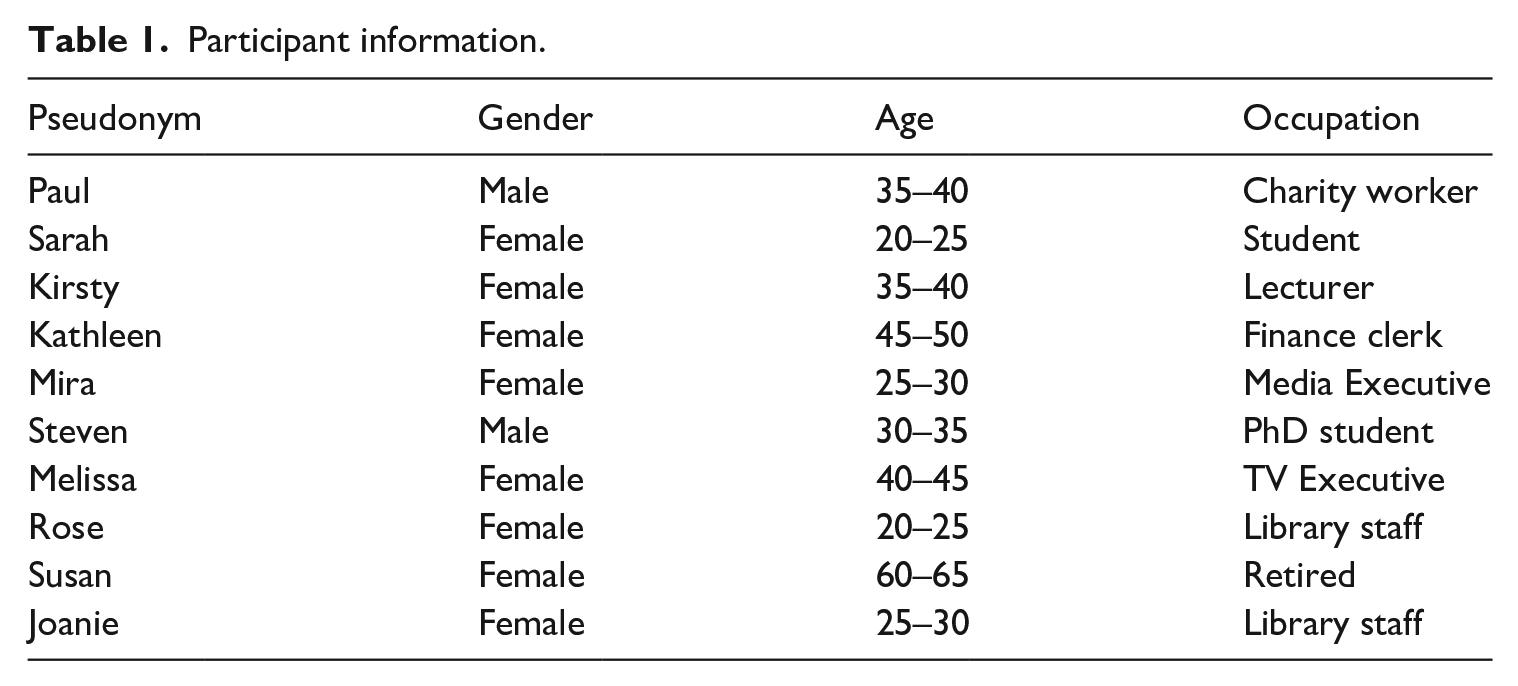
Interviews with all three groups were conducted by the authors and followed a semi-structured approach. This article is based on the findings from the interviews with members of the public. One participant, Rose (see Table 1), also worked in a library and therefore her account also includes things which were lost within the library. The interviews explored people’s experiences of losing objects and of finding those belonging to others. In particular, we used an object interview focused technique which involves centring objects rather than subjects during interview. This approach, as used and explored by Holmes in a number of research projects (see Holmes, 2019, 2020), seeks to ensure that the biography of the object is as prominent as that of its owner (Humphries and Smith, 2014). Normally such object interviews would involve participants bringing along objects to talk about with the researcher, or having them in-situ, such as in someone’s home. However, in this case both authors were somewhat challenged as the majority of objects discussed were no longer in the participants’ possession. Other than objects that the participant had found, all other objects discussed had been lost, gone forever and leaving only memories. Thus, we had to adapt our methodology to this challenge. This was done primarily by asking participants to focus on describing lost objects in detail – asking them to think about colours, textures and material qualities and getting them to think about why that object remains in their memory. Some participants chose to draw their lost objects, providing a more visual account. Overall, despite our reticence, the approach worked well and many participants were surprised at the level of detail they could provide about certain lost items. The interviews often prompted buried memories about the most mundane yet personally poignant of things. Nonetheless, we recognise the influence our questions and object interview technique may have had on participants’ memories of objects. As Smart (2007: 40) notes, memories are not static and can ‘change to suit an audience’. We are aware that the narrative process of storytelling through the interviews may well have led to the reconstruction and embellishment of memories. All interviews were audio-recorded, professionally transcribed and finally analysed by the authors using thematic coding. An etic and emic approach was taken to coding with themes identified both via ‘top down’ and ‘bottom up’/‘in viva’ analysis (Crang and Cook, 2007). Any images or drawings formed part of the analysis, providing a visual representation of the objects and a reminder of their materiality (Pink, 2013).
Why Do We Care So Much about Particular Mundane Objects?
As Holmes’ work on material affinities (2019) has illustrated, more scholarly attention needs to be paid to the influence of mundane objects on everyday lives and experiences; things such as kitchen utensils, furniture or clothing which structure our daily existence. When it comes to losing an object there is a tendency to assume that people will only worry or show concern for items which are deemed financially valuable, sentimentally significant because of who or what they represent, or of some other individual worth such as holding personal data. Certainly, all our participants talked of the fear of losing such items. Jewellery, mobile phones, laptops, and mementos of past loved ones were all things participants worried about losing and often described feelings of anxiety, and sometimes grief, if they had lost such items. However, there were similar levels of distress shown about lost items which did not fit any of these categories. These were objects which one would typically think of as mundane, ordinary and most of all easily and cheaply replaceable. As the following separate accounts of two participants who had lost umbrellas indicates, material affinities exist to ordinary, everyday objects. Furthermore, they continue to exist long after the object is in our possession manifesting themselves in vivid technicolour memories:
I was in London, it was evening, it had been raining. We had gone into a little French brasserie . . . usual thing, have your meal, pick your bag up afterwards, brolly was under the table. Went outside, went to go and get it, realised I didn’t have it . . . The thing with this umbrella was, it was a huge big golfing umbrella. It was colourful, it was pastel colours but strong pastel colours, so it’s pinks, blues, yellows . . . I’ve always remembered that brolly . . . always missed it. I could draw it for you, it’s so vividly in my mind that umbrella. (Melissa) I had a lovely umbrella. It was a leopard print umbrella . . . it’s massive. I’m very leopard print. What did I do? Fucking lost it, in a big team meeting. It’s been about two years, still not over it. (Mira)
For Melissa and Mira the loss of their umbrellas was a significant material loss, provoking prominent detailed memories of the objects themselves and the circumstances of their going missing. Whilst umbrellas are deemed cheap, replaceable items, regularly described by participants as something you could buy for a few pounds, the material qualities of these objects remain at the forefront of the participants’ minds. For Mira the umbrella was leopard print and associated closely to her identity – she is ‘very leopard print’. For Melissa the umbrella was vividly coloured and large, so clear in her memory that she could sketch it. She remembers the night she lost it in detail, as if it is etched on her mind. Whilst Mira laments her umbrella’s loss noting how she is still ‘not over it.’ These excerpts reveal the prominence of certain lost mundane objects in peoples’ minds. Other participants talked about treasured gloves, or shoes, or special trinkets such as shells, sticks and coins. Thus, whilst other lost umbrellas may never be remembered by the participants, these two leave striking material memories, their material affinities stretching through time despite their physical absence.
Juxtaposed with the example of treasured yet seemingly mundane lost items, are those which one would typically deem of high financial and sentimental value. The following is from a participant, Rose, who worked in a library, and was amazed at the sorts of objects people ‘lost’ there:
So, we get a lot of umbrellas, a lot of gloves. We do get a few odd items occasionally . . . somebody once left a wedding dress.
Okay! How did the wedding dress end up in there!?
So, the lady came in to take some pictures, wedding photographs. We don’t really encourage it, but she came in and she followed our rules, but she had two [wedding dresses] with her. Whilst she was here she changed between the two dresses and then once she’d finished she was walking out and she’d left like a dress on the side. And we were like ‘what’s happened here?’
Alongside the usual quotidian items one might expect in lost property, the wedding dress stands out. What was really happening on this occasion – whether the woman was modelling for something and not really a bride, whether the dress was abandoned or lost – we will never know. That such an object was left, raises interesting questions regarding the sorts of items which are deemed losable. Wedding dresses are normalised as sacred items (Friese, 2001), traditionally symbolic of a poignant milestone in a woman’s life. Their importance and one-time use are similarly reflected in their generally high price tag, with the average wedding dress costing £1,313 in the UK in 2019 (Pye, 2019). Hence, they are not the sort of item one would traditionally expect to lose. Understandably, Rose and the other staff at her workplace were very surprised that such an extraordinary item would simply be left behind.
Thus, on the one hand, there are mundane, ordinary items which people expect to lose but instead for some are treasured and irreplaceable, and then, on the other, there are extraordinary objects which appear to be carelessly abandoned. Normalised assumptions regarding the sorts of objects which it is acceptable to lose, versus those that people should care about and treasure, do not necessarily match up with everyday experiences of lost property. Rather, what these examples illustrate is that the material affinities people have with objects are varied and disparate depending on individual circumstances. Whilst there may be objects people expect to lose, or perhaps do not care as much about, object loss is a very personal experience. As the saying goes: one person’s trash is another person’s treasure. These relationships are determined by the connections people have with objects and how they value them, either because of their sentimental value, their financial worth, or, as demonstrated by the umbrellas of Melissa and Mira, their unique material qualities which make them perfect for us as individuals. Mourning lost everyday objects could be deemed a form of ‘disenfranchised grief’ (Doka, 1989: 4), a loss which is not culturally recognised or easily accepted. As we illuminate in the next section, often the significance of objects within people’s lives and the importance of their materiality is only truly revealed when those objects are gone.
‘You Don’t Know What You’ve got till it’s Gone’
Whilst the previous section revealed the material affinities and connections people can have to lost objects, the quotations from participants Melissa and Mira also hint at how losing an object brings their importance and material qualities to the fore. In other words, through an object’s absence its agency, material qualities and sensory abilities become pronounced. This idea mirrors the work of Graham and Thrift (2007: 2) whose study of maintenance and repair found that ‘things only come into visible focus as things when they become inoperable’. The following statement from participant Paul, who lost his bike, illuminates this idea:
And it was about £200 . . . it cost a lot more than that if you want to buy it new, so it’s a nice bike . . . it’s the old phrase ‘you don’t know what you’ve got till it’s gone’. I really missed it once it had gone. I didn’t appreciate how good it was, because when I got my next bike it wasn’t as good, it was a bit heavier. (Paul)
Whilst it should be added that Paul’s bike was stolen when it was chained up in Manchester city centre, as he clearly notes, he did not appreciate his bike until it had gone. Its replacement did not match up, it was not ‘as good’, its material qualities made it ‘heavier’, harder to carry and move around. Hence, the material affinities Paul had with the bike were only brought to the fore once it had been lost, and its material qualities were missed.
Melissa’s lost flip flops are another example of losing a mundane item which cannot be properly replaced:
So it was V festival ’99 . . . and everyone was in the mosh pit and I’d had some flip flops on. And these were really comfy flip-flops, and they had a bit of wedge kind of heel . . . if I remember rightly I brought them back from Bali . . . they were cheap as chips but they were comfortable and they were leather. I’d got lifted up and I could feel my flip flops coming off. They had gone. Could not find them anywhere. Looked all over this field. I did try and replace them but they were never the same. Gone forever. (Melissa)
This account from Melissa is about a pair of flip flops lost 20 years ago at a festival, which she can still vividly remember and still misses. As she discusses, these flip flops could never be replaced, any new ones do not live up to the comfort and material qualities of the originals. Participant Sarah concurs, noting: ‘you grow a loyalty to objects that you’re reliant on’. Certain items, no matter how mundane, are important to people’s everyday lives; their material qualities are ‘just right’. As with the lost umbrellas, the circumstances of the loss of the flip flops are crucial to remembering them, conjuring up a narrative of yesteryear and a possession long gone.
Indeed, we argue that it is the losing of an object that makes its missing more pronounced, making the item almost legendary within people’s minds and creating an obvious ‘gap’ within their material possessions. Participant Joanie alludes to this when she discusses a lost pottery cat which her Grandmother had given her:
I lost a little cat that was very dear to me, that my Nana gave me, and it was broken, and I’d glued it together but the loss of that cat made the cat more visible. (Joanie)
Here we have an item which is of sentimental worth. Despite being broken, the cat reminded Joanie of her Nana. As she notes, its loss makes the cat more visible and at the same time reminds her of who the loss symbolises. In other words, the loss of the cat amplifies its importance and sentiment within Joanie’s life. Losing the cat makes it more remarkable, more special to Joanie and, therefore, more worthy of being memorialised. Its material memories mark a gap in Joanie’s possessions, and symbolically emphasise the loss of her Nana. Both losses are forced states of dispossession, amplifying the unfairness and grief. As we move on to illustrate, the ‘gap’ that lost objects can create could be described as ‘haunting’; creating a sense of disjuncture which upsets the usual patterns of consumption.
Devaluation, Divestment and Disposal – What about Disjuncture?
As the previous section has shown, feelings of unease around lost objects were common among participants. Ranging from mild anxiety and frustration, such as that surrounding Melissa and Mira’s lost umbrellas, to more intense and prolonged feelings of wondering and worrying about what happened to something, such as in the case of Joanie’s lost pottery cat. Hetherington (2004), in his work on disposal, talks of absent objects ‘haunting’ us, being both absent and present in our lives through trace effects. We argue that these trace effects are bound up in the invisible material agency of lost objects, materiality which is made more pronounced by the ‘gap’ lost objects create. People’s material memories – the way something felt and looked, as well as how it fitted into their lives in a way a replacement object simply does not – serve as a reflective vehicle reminding them of their loss, and goading them into thinking about what has happened to it. Many participants described a feeling of unease, a jarring about the lost thing and where it is now. Participant Paul lost his car keys whilst out running a few years ago, as he notes:
I do worry about those. Not worry, I do think where they are. They’re just in a bog somewhere aren’t they? (Paul)
Similarly, participant Steven describes the loss of a watch two years ago as something he still thinks about:
It was kind of curious because time would go by and I would think ‘where is that?’, you know . . . ‘I wonder where the watch . . .’ If somebody else asked me significant things that I’ve lost, the watch would probably always be at the top of that list. (Steven)
Thus, lost objects not only leave a ‘gap’ in people’s possessions but also a sense of mystery regarding what has happened to them. They create disjuncture in people’s engagement with material things.
Crucially, we argue that the disjuncture lost objects create offers an important rupture point in everyday consumption habits. Evans (2019) argues that the latter stages of consumption are devaluation, divestment and disposal, but losing an object interrupts this sequence. As the foregoing quotations have illustrated, object loss is often instantaneous, there is not time for participants to go through the ‘usual’ moments of consumption as described by the ‘3Ds’. ‘Devaluation’, whereby goods are deemed to no longer meet expectations, does not occur. We argue that in some cases the opposite happens where the value of lost items becomes more pronounced because they are missing, creating a material ‘gap’ in people’s lives. Likewise, the option to ‘divest’ from an object – to mentally or physically distance oneself – is also taken away. People are forced to try to divest because the object has gone but are left wondering where it went and if it will turn up. In other words, disjuncture is divestment without devaluation.
We argue that many participants go through a form of divestment, by trying to rationalise their loss:
I try to sort of feel at ease with it thinking that, whoever stole it really needed the money for it. And whatever they got for that money, helped them. And I also think hopefully whoever bought it off the person didn’t know it was stolen and it’s being used quite nicely. (Paul and his stolen/lost bike) I try to minimise the annoyance from it, so if that means letting it go and thinking oh someone else can have it. (Kirsty, on multiple items she had lost)
As these statements show, divestment through rationalisation occurs through imagining the future life of an object and hoping that someone else is gaining something from having it. As participant Mira puts it, you need ‘to detach yourself’ from the object, as a means of letting it go. The process of disposing of an object is also not possible because the object’s physical removal from one’s possession has already occurred.
Interestingly, whilst losing an object disrupts the 3Ds of consumption, revealing other hidden consumption moments, such as disjuncture, it also illuminates how consumption of an object is not performed in isolation. Rather, participants discussed how the loss of one object revealed and disrupted the consumption of other related objects. Participant Steven talked of how he feared losing his cycling helmet because, despite costing only £8, it was part of his ‘assemblage’ of things which enabled him to cycle. Mira, Melissa and Susan all mentioned losing one earring and how this rendered the other useless. Others spoke of the loss of items of clothing and how this upsets a favourite outfit or particular aesthetic look. This illustrates how objects are consumed as part of a network of things (see also Woodward, 2020; Goode, 2007 on object collections). Participant Steven’s use of the Deleuzian term ‘assemblage’ is important in illuminating how objects are not consumed in isolation but rather are connected in a web of object relationships (Holmes, 2020). Removing one object from that network causes disruption to the consumption of the other objects, reinforcing the argument that consumption is not a linear process, but rather a messy endeavour, whereby objects can shift back and forth between different realms of relevance and importance in people’s lives.
Acquisition, Appropriation and Appreciation – What about Acclimatisation?
Whilst the focus so far has been on loss, it is important to also consider its antithesis – finding. We argue that just as lost objects disrupt the 3Ds of consumption, so finding an object can disrupt the 3As. As noted, Warde’s 3As (1992, 2005, 2014) – acquisition, appropriation and appreciation (as brought together by Evans, 2019) – reflect moments at the front end of consumption practices - in other words, how objects are incorporated into people’s lives. Unfortunately, we do not have space, here, to explore aspects of losing something, but for the purposes of our argument we would like to focus on people who find objects which are not theirs and essentially incorporate them into their own lives. As the following quotations illustrate, finding an object does not involve the usual processes of acquisition, appropriation or appreciation:
Oh actually so one of my favourite jumpers was a lost item. I didn’t mean to, it’s so mine now that I forgot the story, so basically there’s this skater brand in Manchester called Note . . . and they have like a bee on the back, like the Manchester bee . . . quite expensive . . . so basically I like really wanted to go on a night out with my friend . . . so I went to Charlestown, the tram stop, and I was sat there and like it was maybe 11.30 . . . so I was waiting for her to come up on the tram and I thought I’m not going to get this night out that I wanted, so I got on the tram and I lived by Forestwood tram stop . . . and as I got off on the bench there was this hoodie and then I went over to it and it was a Note hoodie and I thought even though I didn’t get my night out at least I got this sick hoodie . . . I told someone and they were like aren’t you going to try and find its owner, like put a post on Facebook or whatever and I was like no, like, finder’s keepers. (Sarah) I don’t know if I want to admit this. I did once find a hat . . . and it was quite a good make. And it was raining, it was dropped in a puddle and it was all wet and horrible, and I thought I can take that home, wash it, and I did . . . And I had looked around to see, there was literally no one around. I will just say that . . . It was like dropped in a puddle and it was manky. (Melissa)
In both these cases, the object was found in the street. Whereas Warde’s acquisition would normally focus on the processes of exchange, such as money, barter or reciprocity to acquire an object, what we see here is that there is no means of exchange with a visible other. Likewise, there is no clear specific mode of provision (Warde, 1992) - in other words, the means through which something is acquired, either through formal means, such as the market or state, or informally through community or household modes. Hence, these are objects without physical caretakers; seemingly abandoned, on their own and lacking in obvious connections to people or the usual channels of provision, such as shops.
Appropriation – how objects are ‘incorporated into people’s everyday lives’ (Evans, 2019: 506) is also very different. Indeed, we argue that finding an object reveals a further hidden moment of consumption attached to appropriation, that of ‘acclimatisation’. Acclimatisation involves both mental processes of distancing oneself from the object’s original owner, but also physical actions of removing any material traces. In terms of mentally distancing themselves from the owner, both Sarah and Melissa (in the foregoing quotations) note the morality of finding and keeping the items. Sarah’s ‘I didn’t mean to’ and Melissa’s ‘I don’t know if I want to admit this’ – indicate a certain amount of guilt attached to taking something which is someone else’s, despite its seemingly abandoned status. In much the same way that the participants who had lost an object rationalised their divestment, so participants who found an item justified their decisions to keep them. Sarah states the age-old adage ‘finders-keepers’, whilst Melissa mentions ‘how she looked around’ for the hat’s owner but there was no one there, justifying her decision to take it. She also describes the state it was in when she found it – ‘dropped in a puddle’ ‘and manky’ - to insinuate that nobody else would want it anyway, so she did nothing wrong. This mental process of participants acclimatising the object into their lives, is entwined with physical practices of removing potential material traces of previous owners:
I washed it and I wore it quite a lot around then but I still wear it loads. (Sarah) I properly like boil-washed it. Yeah whose head has it been on? I properly boil washed it. And I kept it for a long time. I wore it for a long time. (Melissa)
On the one hand, these acts of washing found objects are about removing any bodily traces of previous owners lingering in the material. As Melissa notes ‘whose head has it been on?’ expressing fear of contamination from a previous owner. On the other hand, this act is also symbolic. Washing has long been described a practice of purification, cleansing and rebirth (Douglas, 1966). By washing the found objects, participants are purifying them ready for their new lives with them. This tallies with work on charity shop purchases where consumers describe the activities of physically and symbolically removing remnants and markers of previous owners to make an item their own (Gregson and Crewe, 2003; Gregson et al., 2007). That both participants also stress the number of times they wore the found items, similarly provides further justification for taking them; illuminating how these objects are now fully acclimatised and part of their repertoire of objects. As Sarah notes in her earlier statement – ‘it’s so mine now that I forgot the story’. Hence, acclimatisation is appropriation without the typical spaces and practices of acquisition.
Finally, appreciation – the act of deriving pleasure from goods – is one moment of consumption that finding does not alter significantly. Many participants spoke of their appreciation for their found objects being closely linked to how the item was acquired, in much the same way that getting a bargain in the sales is experienced. Sarah spoke of sending ‘selfies’ in the Note hoodie to her sister, who she said was ‘jealous’ of such a find, whilst Melissa talked of feeling a sense of pride at getting a hat of such a good brand for nothing. Both described the material affinities they now felt to the objects – Sarah noting how the hoodie was now 5 years old and referring to her ‘scruffy jumper’ and Melissa how the hat was a good fit. Thus, this section has revealed how finding an item disrupts the 3As of consumption and reveals a further moment of consumption, that of acclimatisation. Similarly, as with the 3Ds, it illuminates that consumption is a messy process containing multiple moments of consumption which do not necessarily always occur in any set pattern.
Conclusion
This article illustrates the need for a new conceptual agenda devoted to material loss - an agenda which synthesises debates on the sociology of nothing, absence and loss with those of consumption and material culture. As we have argued, material loss is rarely examined but is vital to people’s experiences of the world and their relationships to objects. Through developing and extending the concept of material affinities (Holmes, 2019) we have illuminated how relationships with objects can continue even when those objects are not physically present. We have highlighted how objects we would not typically think of as demanding any strong affiliation or attachment, such as umbrellas or flip flops, have the ability to conjure potent connections long after they have gone from people’s possessions. Furthermore, such connections are not simply bound by items having sentimental associations or particular financial worth, but are often entwined with an item’s material qualities – what it did, how it felt, its material function within people’s lives. Thus, normalised assumptions regarding the sorts of objects which are acceptable to lose, versus those that people should care about and treasure, do not necessarily marry up with everyday experiences of material loss. As we have illustrated, lost objects can create a ‘material gap’ in everyday lives, a space a valued object previously occupied; a materiality of nothing. Filling this physical and, as we have argued, metaphorical space, seems impossible, Instead, people are left haunted by the object they once had, deemed never fully replaceable.
We contend that material loss disrupts accepted patterns of consumption. Losing an object upsets the devaluation-divestment-disposal sequence deemed to occur at the latter stages of consumption (Evans, 2019). Instead, what we have found is ‘disjuncture’, a process of forced ‘divestment’ but without the opportunity to first begin to ‘devalue’ the lost object. Likewise, our research on finding and keeping an object which is not one’s own disrupts the front end of consumption and the sequence of acquisition, appropriation and appreciation (Warde, 1992, 2005, 2014). Instead, we argue for an additional process of ‘acclimatisation’, a form of appropriation whereby goods are materially and symbolically cleansed of their previous owners and incorporated into people’s lives, but without the typical spaces and practices of acquisition. Significantly, this is not to argue that these are the only ‘moments’ of consumption. What our work illustrates is that consumption is messy and multiplicitous. This connects back to our original focus on the sociology of nothing, which identifies ‘reverse trajectories’ which invert the usual process of progression, and circular non-linear processes which are messy and complicated (Scott, 2019: 26). Whilst frameworks such as the 3Ds and 3As are undoubtedly useful for identifying processes and patterns of consumption, they cannot capture all moments of consumption. Likewise, consumption does not necessarily occur in the linear pattern of the 3As or the 3Ds, but can involve moving back and forth between different moments, or as illustrated by our research, missing out certain ‘moments’ altogether. Our research is also in keeping with recent debates around the discrete categories of ‘consumption’ and ‘production’. We could argue that the work which goes into acclimatising a found object is a form of ‘prosumption’ (Ritzer, 2015): activities which involve both producing and consuming the object simultaneously. Nonetheless, what our work highlights is the need for further research on the activities of ‘consumption’ and not just activities beyond the point of purchase, but also activities which involve acquiring goods through ‘other’ non-monetary, non-exchange-based means (other possibilities, along with loss, being theft or treasure hunting).
Finally, we contend that the transformative potential of material loss and absence offers a way of thinking about alternative, non-material practices of accumulation. As we have shown, often seemingly unremarkable items matter so much more to people than other objects perhaps more obviously noteworthy of our remembrance and attention. Lost objects of importance continue to ‘live on’ through people’s material affinities to them, reminding them vividly of their past place in their lives. Indeed, as we have illustrated, it is often through an object’s loss that its material power and agency is brought to the fore. How might we harness this to encourage more sustainable forms of consumption? This disruption of the usual process of ‘progression’ (make-take-dispose) might yield something new and interesting, what Scott calls a ‘progressive non-progression’ (2019: 26). One very simple way may be to encourage people to think about the everyday objects they value, items which are important to conducting their daily lives. Appreciating objects’ importance and what their material qualities afford may promote their care and attention. To borrow a phrase from material science, a ‘hierarchy of materials’ may be useful, encouraging people to audit and evaluate their everyday objects to determine the personal value of each thing. More radically, we could build upon the increasing emergence of access as opposed to ownership models of consumption, as typified by renting, sharing and swapping activities (Botsman and Rogers, 2011). Rather than accessing a physical object, consumers could have the opportunity to virtually consume using augmented reality software or through other digital means. Of course, such an approach will not feed or clothe us, but may satisfy more ‘wants’-based desires – such as driving a high-performance car or visiting a world-renowned heritage site. In the light of recent events linked to COVID-19 and the potential for future pandemic lockdowns, the possibilities and appetites for virtual forms of consumption are likely to increase. Thus, if we can have material affinities to objects we no longer possess, can we make similar connections to those we have never owned?
Footnotes
Acknowledgements
We would particularly like to thank Dr Sarah Marie Hall and Professor David Evans for their very helpful comments on earlier drafts of this article.
Funding
This research was supported by a grant from the Sustainable Consumption Institute, University of Manchester.
