




Abstract
The last few decades have seen a surge in the consumption of locally produced popular music in the West. Domestic music – music made by national artists and sung in the national language – has gained increasing popularity, specifically within the lower to middle-class segments of the native population. This article uses the Dutch music genre levenslied to explore this growing trend. From a neo-Durkheimian perspective, we can assume the presence of collective effervescence – a shared intensified mood drawn from collective assembly. However, it is less clear how this collectivity is brought about and experienced. In other words, what are the requirements for this state of effervescence to occur? Looking not only at the totems these concertgoers celebrate but also the established symbolic boundaries, can help us understand how the group defines itself, adding to our knowledge of the rise in popularity of domestic music.
We interviewed 20 concertgoers about their experience of these concerts. The analysis finds that the establishment of collectivity is influenced by three symbolic boundaries: (1) intercultural, (2) interclass, and (3) intraclass. Through the negative othering of ethnic monitories – those considered socially higher, and those considered morally lower than themselves – the audiences of these concerts glorify a very narrow image of Dutchness, obtaining a sense of self-worth through the celebration of an idealized national image rooted in nostalgia. The increasing popularity of levenslied concerts (and domestic music more generally) can, therefore, be understood in relation to broader societal changes and connected with a ‘squeezed middle’ class, clinging to tradition and their declining social position.
Keywords
Introduction
Despite the common belief that music consumption is primarily dominated by an Anglo-American market, the last decades have seen a steady increase in the consumption of locally produced music (Achterberg et al., 2011; Bekhuis et al., 2014; Frith, 2004; Van der Hoeven et al., 2016). Research into the consumers of local music has shown that a taste for the domestic and the national is not equally distributed throughout society but is structured socially, making it dependent on one’s position in social space. Studies find, for example, that those who occupy a relatively disadvantaged position in society are most likely to consume local culture while individuals higher on the social ladder are found to consume a more broad and cosmopolitan range of culture (Cheyne and Binder, 2010; Kuipers, 2012; Meuleman and Savage, 2013).
Fitting within this wider European trend of rising ‘nationally oriented’ music consumption, the Netherlands has seen the popularity of its homegrown musical talents steadily increase since the 1990s (Van der Hoeven et al., 2016). This study will focus on the case of the Dutch music genre levenslied, exploring the experience of locally produced live music among its consumers. Levenslied can be seen as a form of domestic music – widely popular music sung by national artists in the national language. While levenslied (and domestic music in general) is often considered as a folk music, it deviates from folk in the traditional sense because of its commercial nature. Where folk music is generally considered to derive from a specific community, made by and for its members (Frith, 1981), domestic music is produced by a professional culture industry, and although communities form around it through participation in live music concerts, these communities are not involved in the actual production of the music. Levenslied as a genre can thus be situated somewhere between folk music and popular music; finding a balance between community and mass appeal.
Through interviews with levenslied concert goers, this article investigates the underlying attitudes and beliefs relevant for the audience of domestic music in creating and experiencing community. In addition, a survey was conducted during a levenslied concert (n = 812) to establish the demographics of these audiences. Previous research has looked into music concerts (Benzecry and Collins; Olaveson, 2004) and festivals (Fabiani, 2005; Liebst, 2019; Niekrenz, 2014) as modern-day secular rituals, highlighting their potential in the reproduction and reification of community. Using a modern and non-anthropological application of Durkheim’s ritual theory, this article examines the symbolic boundaries used to define this community, uncovering the totemic principles at play in concert participation. The analysis reveals that the preconditions for collectivity are determined by three forms of symbolic boundaries: (1) intercultural boundaries, (2) interclass boundaries and (3) intraclass boundaries. In understanding what the audience celebrates and disdains, we get a broader understanding not only of the section of society attracted to this music, but also of the driving force behind its rise in popularity.
Theoretical Framework
Concerts as Rituals
As rituals, levenslied concerts have the potential to foster feelings of collectivity. In Elementary Forms of Religious Life (1995 [1912]) Durkheim argued that rituals generate a heightened awareness of group membership, leading to emotional energy or collective effervescence. Engaging in ritual action – defined as intense, focused and rhythmic behaviour – leads to a collective consciousness and feelings of intersubjectivity. Although music concerts differ from the ‘pre-modern’ rituals of the Australian aboriginal tribes of Durkheim’s original accounts, they have the potential to draw a collective energy of equal capacity. According to Collins (2004: 59) they can be considered ‘non-serious’ rituals, which ‘do not have the same recognized status as other formal rituals but are generally regarded as a form of play, of the non-serious part of the world. Nevertheless, they are eminently successful in providing high points of ritual experience’.
From this perspective, concerts can be considered sacred events that stand in sharp contrast to the ‘monotonous, slack, and humdrum’ (Durkheim, 1995 [1912]: 217) happenings of everyday life. During the concert, the performance of common practices and synchronized movements such as dancing, headbanging and clapping creates a mutual awareness, attuning members of the crowd to one another. These collective actions and the close proximity of the crowd lead to heightened excitement, where the performing artist plays the important role of ritual guide, encouraging and motivating the crowd to enter into a state of collective effervescence (Tutenges, 2013).
If successful, emotions of solidarity transform into feelings of group membership, where a moral community is formed for the duration of the event (Kerney, 2018). For this, however, boundaries must be drawn marking the perimeters of the community. The clear identification of the group is important for individuals to unite over a common belief or purpose. Rituals thus have a stratifying effect, as group membership requires constant deliberation over who are considered insiders and outsiders (Collins, 2004).
Despite the transient nature of collective effervescence, the power of rituals lies in their ability to construct group symbols (Collins, 2004). During a ritual, sacred emblems, or what Durkheim called totems, are charged with strong group sentiment. These come to represent the group, mark membership and remind participants of the interaction long after it has passed. Totems can come in many forms – for example, raising one’s fingers like horns at a rock concert, or wearing a band’s shirt, or sharing a particular hair or clothing style. Displaying these symbols shows solidarity and respect for the group. However, using the totem incorrectly, disrespecting it or not displaying it, immediately leads to rejection from the group (Collins, 2004: 109).
Levenslied as a Music of the People
Levenslied is a popular Dutch music genre heavily influenced by traditional folk music. Similar to Germany’s Schlager, Serbia’s Turbo-folk, or America’s country music, it fuses modern music, such as pop, rock or electronic, with elements from the nation’s traditional folk music. While levenslied finds its roots in Dutch cabaret from the early 20th century, typically played with live instruments such as the accordion and the barrel organ, today it is primarily performed by solo (male) artists singing over an electronic backing track. The music can vary from overtly sentimental ballads, dealing with themes of life and death or love and heartbreak, to more upbeat songs, focused on creating a party atmosphere. Characteristics that remain constant, however, are the simple lyrics, sung in the Dutch language and accompanied by an accessible backing track.
Concerts can range from private events such as weddings and birthday parties to large-scale events and festivals featuring numerous artists that regularly sell out. Despite – or because of – its vast popularity, levenslied is generally considered a lowbrow genre, standing at odds with ‘legitimate’ culture, and perceived as inferior to international music (Hitters and Van de Kamp, 2010; Van der Hoeven et al., 2016).
Musical influence is not the only thing that levenslied shares with traditional folk music; a parallel can also be drawn between the national component of both genres. Folk, traditionally being a music passed down from generation to generation and used as an expression of cultural identity, is a celebration of the national and the local (Roy, 2010). And while levenslied is very much a commercial music, with little emphasis on the craft or the oral tradition of storytelling associated with traditional folk music, the influence of the nation is evident. The symbolic significance of the nation is visible through the advertisement of its events, where posters and banners frequently display the Dutch flag or the monarchical colour orange, along with a variety of Dutch emblems such as clogs, windmills, cheese and tulips. The monarchical colour is also used as the name of the TV channel devoted to this music, TV Oranje (translated: TV Orange). Furthermore, the national component is emphasized in the names given to concerts and festivals where levenslied artists perform, for example, Sterren van Holland (translated: Stars of Holland) and Puur Hollands (translated: Pure Dutch).
The musical characteristics of levenslied as not only loud, simple and repetitive but also emotionally accessible, make it an ideal catalyst for the generation of collective effervescence (Benzecry and Collins, 2014; Tutenges, 2013). But how is the corresponding image of community defined in the minds of the audience and how is this sense of community created? Looking at the symbols and ritual activities both celebrated and disdained by levenslied audiences can help us understand how this group defines itself and experiences levenslied concerts, contributing to what we know about the rise of domestic music and its audiences.
Method
In the present study, we conducted interviews with visitors of levenslied concerts to understand what motivates them to participate in these events. In doing so, we aimed to find out how they described their taste in music, their expectations of levenslied concerts, and what they would dislike in a live musical experience (levenslied concert or other). To this purpose, the interviews focused on four topics: (1) experience of the concert attended, (2) cultural taste, (3) affinity with levenslied and other musical genres and (4) affinity with other cultural forms. The interviews took a semi-structured format (Flick et al., 2004), although the questions were kept broad to let the interviewees steer the conversation with the aim of limiting probing on the part of the interviewer.
As taste patterns vary considerably across generations (Van Eijck and Knulst, 2005) and we did not want age to become the single most decisive factor in our data, only respondents within the range of 18 to 35 were selected. Still, apart from age, we wanted to avoid a sample consisting of only particular kinds of fans, which would have restricted the possible diversity of motivations in our data collection. We therefore sidestepped snowball sampling or recruiting inside (online) fan communities, but selected respondents directly at three major levenslied festivals in different cities.
Initially, respondents were recruited at Sterren van Holland (which took place in Ahoy, a large Rotterdam venue, on 23 February 2018). The first author attended this event, accompanied by a group of six student volunteers who held a brief survey among the audience. They were positioned at the doors and approached every tenth person coming in with a brief paper questionnaire (n = 812), which surveyed gender, age and education level and invited respondents to participate in an interview at a later date. Those who agreed to an interview and met the age criterion, were invited for an interview in the days following the festival. In this way, 10 respondents were recruited and interviewed and their data were analysed before continuing the study.
To collect additional data, the first author attended two more levenslied festivals – the summer edition of Sterren van Holland (in Arenapark, Amsterdam, 12 August 2018) and Puur Hollands (in Goffertpark, Nijmegen, 27 August 2018). At these events, she indiscriminately approached people and, having established their age, asked them whether they would be willing to participate in an interview at a later date. In this way, an additional 10 respondents were recruited, bringing the total to 20 individual participants.
In total 17 interviews were conducted. Two interviews were held with a couple and one with two friends, the others were conducted individually. The interviews lasted an hour on average. All of the interviews were carried out face-to-face by the first author in Dutch in a setting of the respondent’s choosing. All participants signed a consent form and their names, used in this article, were changed to ensure anonymity.
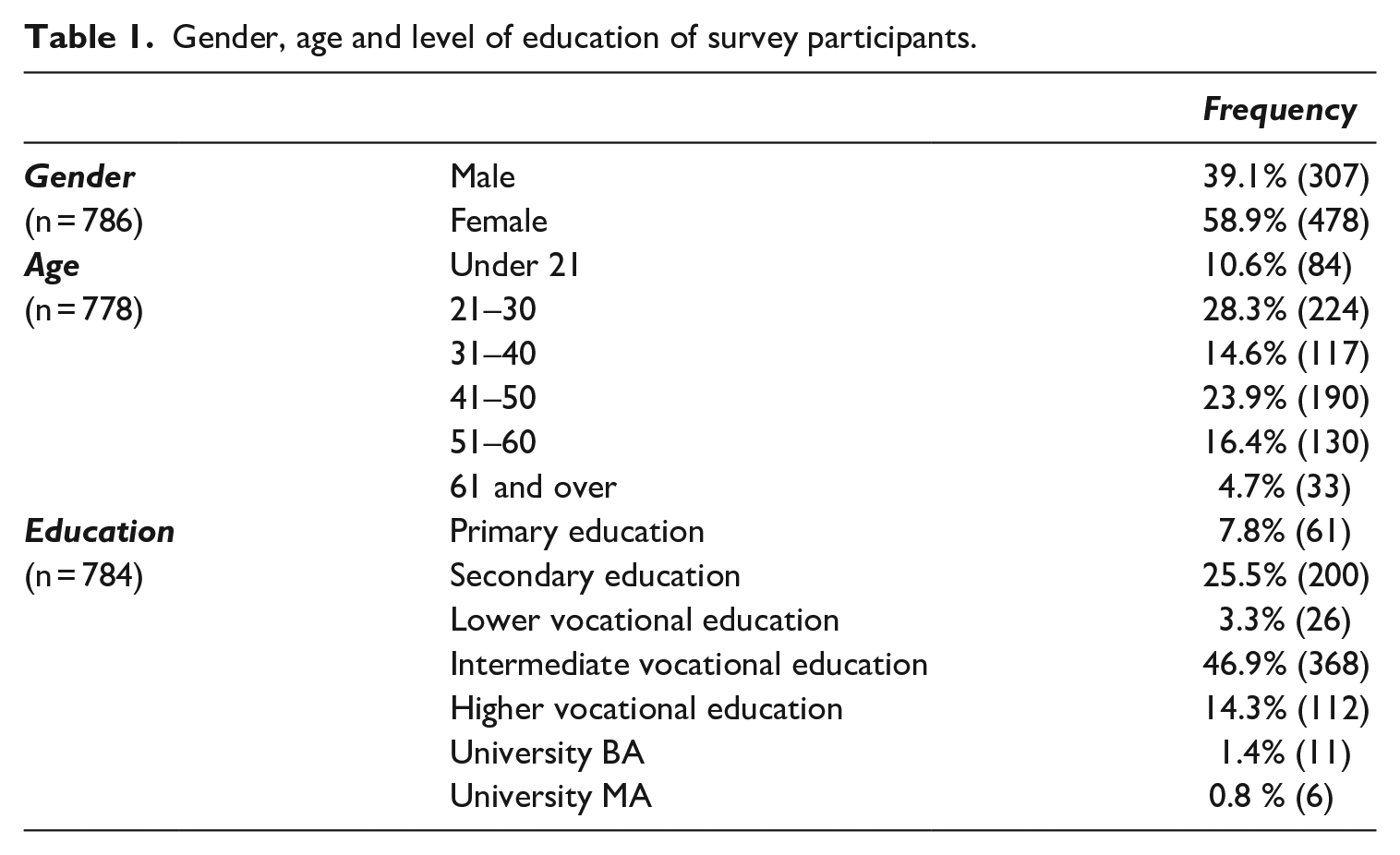
On the basis of the survey, we obtained a more reliable indication of the composition of the audience (see Table 1). Females were slightly more represented than males and the average age of the surveyed audience members was 35. In regard to educational attainment, only 2.2% had obtained a university degree. The largest section of the sample had completed intermediate vocational education (46.9%). This indicates a primarily lower class to lower-middle-class audience.
Gender, age and level of education of survey participants.
The interviewed group included 7 women and 13 men. The majority of participants had completed a type of applied or vocational secondary education. However, four had received a bachelor’s degree, which indicates an overrepresentation of higher educated interviewees compared to the survey. Although lower educated audience members were most willing to engage in conversation at the concert, it has been found repeatedly that they are more reluctant to participate in an interview (Huang et al., 2010). In terms of occupation, the majority of the women worked as social workers and the men as labourers (carpenters, builders, caretakers). Four respondents were still students (three of whom were in vocational education), and two worked in more skilled occupations – one as a consultant and the other as a graphic designer.
A thematic analysis of the interviews was conducted (Braun and Clarke, 2006), which started with thorough and repeated reading and was succeeded by an extraction of recurring and meaningful themes and patterns. In the following section, the results of the analyses are presented. After delving into the feeling of collective effervescence fostered at these events, we address the symbols that the audience celebrate. We then turn to the symbolic boundaries, identifying three important areas of boundary work invariable adopted by the respondents.
Results
The Pursuit of Effervescence
A common term used by all participants when asked why they attend levenslied concerts was the word ‘gezelligheid’. The Dutch use this term to describe a collection of sentiments that encompass feelings of cosiness, intimacy, fun, sociability, and homeliness. Inhabitants of the Netherlands proudly depict it as a ‘classically Dutch virtue’ (Hendriks, 2009: 252) used to describe social interactions, the atmosphere of an event or the quality of a person (for more on gezelligheid, see Lindemann, 2009). When asked what he likes about these events, Tino (male, 18), a relative newcomer to levenslied, states: it is ‘the gezelligheid. What I love about Dutch festivals is the atmosphere. Sometimes, out of nowhere you just get handed a beer by a stranger’. Tino is attracted to these concerts because of the general mood. He appreciates the community feeling, where strangers become friends for the duration of the concert. When asked the same question, Geertje (female, 28) reiterates this by saying ‘I just really like the gezelligheid, it is a little like-knows-like, that kind of party’. Although they come together as individuals, previously unrelated, the perceived similarity of the group unites them, fostering feelings of solidarity.
For Mike (male, 25), a seasoned festival goer, it is the particular audience of levenslied concerts that attracts him to these events. He states:
Yeah, it is just, I mostly go to these festivals, not for the music. Yeah, we stand at the back the whole time, this doesn’t matter. But the gezelligheid, the people, yeah that makes the festival.
The music seems secondary to the people present, with the concerts being primarily utilized as an opportunity to socialize. Building on this, Danny (male, 23) accepts that levenslied artists do not have to sing ‘perfectly’, placing more emphasis on the fact that ‘they can build a good party’. The artists’ appeal lies less in their vocal ability, but in their capacity to captivate an audience – carrying the attention of the crowd, encouraging interaction and a lively atmosphere. Mike (male, 25) explains why he enjoyed the performance of his favourite act:
Because he just gets a certain energy going. Which is just really great. You are just standing there . . . Full throttle he starts the show, and immediately, really in that minute, from the moment that he starts to sing, then the whole audience receives, straight away, that energy from him and that I just think is really cool. You easily go along with that energy; the energy is just there. Everyone just goes as fast as him, with his tempo. And that is just really cool.
Mike’s admiration for the artist’s ability to disseminate his energy to the audience, passing on his tempo and infecting the crowd with enthusiasm, demonstrates the role of conductor that these artists play. There is an expectation for artists to act as a ‘charismatic leader’ (Carlton-Ford, 1992), a guide who manoeuvres the crowd, generating the desired atmosphere.
It is the job of the artist to spur on collective movement and singing. Like Danny, Janne (female, 20) and Maaike (female, 20), who travelled down from the north of the Netherlands to be at Sterren van Holland in Amsterdam, agree that the vocal capacity of the artist comes second to their ability to encourage collective singing. They state:
I don’t think that the voice even matters that much in Dutch music.
No.
I think that, often, they just have to be able to get the people going.
Yeah.
That’s really all it is.
The ability to sing along with songs, you know.
Yeah, with the music. Because the moment that you cannot sing along to a Dutch song and it has no atmosphere, then it’s over.
Yeah
Or if you cannot understand half of it, even if it is in Dutch, then I switch off very quickly and go away very fast. That, hmm, no you really have to get people going with the music. Then it’s fun.
That is really the most important, I think.
These best friends indicate that an important feature of the genre is audience interaction. To establish the desired atmosphere, it is fundamental that the crowd can participate. There is a danger that if the artist is not understood – the song is too complicated, or the lyrics unclear – the attention of the audience will be lost. It becomes evident then that the audience explicitly values the simplicity of the songs as it generates a sing-along atmosphere.
An exceptional voice is not necessary and may even hinder the reputation of an artist. The barrier between artist and audience should be kept at a minimum and exhibiting advanced singing techniques, such as high notes or complicated key shifts, may keep the audience from singing along. Despite the fact that the artist is standing on a stage and the audience at ground level, artists should exhibit as little distinction from the audience as possible. They should come across as relatable and display recognizable characteristics. Most importantly, levenslied artists should never get ‘too big for their boots’ (Arijan, male, 33), remain humble and refrain from flaunting any newfound wealth or prestige.
For the respondents, the music – like the artist – should also be relatable, with lyrics that reflect personal experience and address recognizable themes. Demonstrating this, Kelsey (female, 27) explains that:
Making music is not art. Making music is putting your feelings into something. Every singer has song lyrics with something that often comes from their own life. Because it has to be sincere it must come across to the people; you have to recognize it within yourself . . . for me the lyrics are important. I have to think ‘oh that is a beautiful text’ or ‘I can see myself in that’, uh – it has to give me emotion.
Appreciated less for aesthetic qualities and more as a reflection of life, music should provoke emotion. In a similar way to how Holt (1997) writes about the taste of the low cultural capital consumer, the levenslied audience prefers to engage in culture that evokes immediate sensory pleasure. The relatable songs, filled with the universal feelings of love and sadness, aid in the establishment of solidarity among the crowd.
The vernacular nature of the music and the guidance of the artists, who act as ritual leaders, transform the audience from a collection of individuals into a collectivity, with a mutual awareness. Not only do these concerts then allow for a space that is separate from everyday life, fostering excitement in itself, but they establish feelings of intersubjectivity. The solidarity generated through collective effervescence then appears not as a consequence or side effect, but as something that the participants strive for, and an important reason to participate. While we can say that collective effervescence is a primary reason for attending any concert (or live event in general), it is the accompanying notions of community that specifically drive this audience.
The Nation as Totem
As feelings of community lie at the core of the experience of levenslied consumers, the question arises: how is this community defined? When asked who attends these concerts, Danny (male, 23) states that the audience do ‘not necessarily have to be campers, but people who love gezelligheid. It will also be uhhh . . . from the 100% of people who go, 95% will also really be Dutch’. Danny here paints the audience as fun and sociable. He separates the crowd from what he calls ‘campers’ – a derogatory term used to describe a group of lower-class Dutch who live in trailer parks. Through this distinction, he acknowledges a common image – and in his thoughts a misconception – of the social position of levenslied fans. This is a segment of society that Danny does not want to be associated with, attempting to distance himself by saying that the crowd’s main characteristic is gezelligheid. He points to the virtuous nature of gezelligheid, taking pride in the perceived sociable and cosy atmosphere among the audience and pinning it against that of the ‘camper’ community.
Furthermore, Danny associates these concerts with a predominantly Dutch crowd – an aspect spontaneously referred to as central by many interviewees. When asked why he likes levenslied concerts, Arijan, states that it is the ‘gezelligheid and, say, all the people together, all the Dutch people together’. The social element of the concert is important to Arijan. However, in his opinion, this community cannot be made up of just anybody; the desired atmosphere only exists because of the predominantly Dutch audience that it attracts. Here the adjective gezellig takes on a connotation very much, if not exclusively, associated with an idealized Dutch characteristic.
Gezelligheid was not only used to describe the people and atmosphere at these concerts, but also the music itself. For example, Bart (male, 25) states:
It is easy music. You easily sing along with the tracks. It’s gezellig. It is also quite straightforward about things. Less artistic, just straight to the point. It’s just a bit of ‘guys let’s all just be normal, make it fun!’
As seen in the foregoing quotations, music should provide an opportunity for sociability, connecting the crowd through collective singing. However, Bart adds to this by saying that music should also be straight to the point, conveying a directness. Only when the music is ‘straightforward’, and ‘normal’ is it ‘fun’.
The music, or at least the language in which Bart portrays it, is a reflection of the attitudes of the audience, a sensibility which trickles into other aspects of their lives. Janne (female, 20) reflects this when talking about her clothing style:
I do have simple clothes actually [laughs]. Pretty boring really. Well . . . at the concerts everyone has it. Just normal. With no frills, it doesn’t have to be all that much. It’s just simple, just if you wear a dark green shirt then it’s fine.
Similarly, Jan (male, 35) states:
You can always recognize the people who are going to the concert.
Yeah, how do you see this?
Yes, they are just normal. Say, people go in farmer’s clothing, let’s say a farmer taste. Not in a costume or – uh – a suit or something.
Clothes, like music, should ‘just [be] normal’, not flashy, with no frills or embellishments. The interviewees downplay the importance of apparel, clothes are worn to fit in rather than stand out, reflecting the crowd’s attitude towards homogeneity.
In striving for the ‘normal’ and the ‘simple’, they reject the eccentric and idiosyncratic. Demonstrating this drive, Maaike (female, 20), compares the visitors of a rap concert with the levenslied audience:
Now that is really weird music. Now that rapper music, if I hear that I think of those 15-year-old boys, you know? With those caps, trying to be completely cool, but of course, they are totally not . . . I always have the idea that it is those guys who think they are amazing. With their little bags. Yeah, exactly that kind of type goes to those concerts. This is, of course, a big difference from our music. See, if we go to a concert, 9 out of 10 boys that walk around are broad and twice as big. They wear clogs and just act normal.
Distinguishing the type of masculinity displayed at levenslied concerts from that at rap concerts, she shows a strong aversion to arrogance. Valuing a more traditional form of masculinity, she feels that men should be strong and avoid feminine objects like ‘little bags’. Men should stick to forms of clothing that are modest and unpretentious – something she feels is represented in the quintessentially Dutch footwear, clogs. While clogs as a traditional shoe are rarely worn today, it becomes evident that the interviewees see normalcy as something connected to Dutchness. Traditional symbols such as clogs and modest clothing make visible an imagined Dutch culture governed by ideals of the normal, simple and ordinary.
National symbols, such as clogs, become a totem for the audience; a tangible image that the group can relate to and identify with. As the emblem of the crowd, these symbols come to represent values of not only long-standing tradition, but also ideals of normalcy, simplicity and sociability. The totem of the audience speaks for a specific image of Dutchness, with the community defining itself from within these boundaries. Through the collective emotion fostered at these concerts, these symbols are charged with a certain narrative or a national mythology (Zubrzycki, 2011). While these symbols do not make them nationalistic in a political sense, it redefines and reproduces feelings of national fellowship (Fukuoka, 2017).
Intercultural Boundaries
Boundaries provide a logistical time and place setting for the manifestation of community (McMillan, 1996). Moreover, fostering solidarity requires active choices of exclusion. Concerts have both physical and symbolic boundaries, which enclose the crowd and come with implicitly governing rules; with norms and practices that all participants must adhere to. The exclusiveness of definitions of community is positively related to the inelasticity of its boundaries (Sutton, 2004).
Tino (male, 18), reflects on what he perceives will happen if the boundaries are breached:
At Dutch folk concerts, the atmosphere is great and yes it sounds very racist, but there are no Moroccans or Turks. The moment that those people come in, the atmosphere changes. Then everyone goes more into themselves. Look, now everyone can go a little crazy together and have fun . . . You do not have to be afraid. It is usually very gezellig, just like you’ve known each other for years. So, when a song comes on about a boat, you have 25 people sitting on the floor, rowing an imaginary boat. You really do not see this at other parties. You would get laughed at, or people would try and rob you of your stuff. Here you do not have that; here you have all the freedom and peace.
With the security of being surrounded by the familiar – people from a similar social background who display similar intentions – the concert has the ability to transport the crowd to new heights of enthusiasm and feelings of solidarity. During the ritual, a freedom of self-expression is generated, allowing the crowd to detach themselves from the constraints of everyday life. However, while the breakdown of individual boundaries is necessary for the generation of collective effervescence, here Tino also highlights the perceived danger of group contamination. In breaching the boundaries to the outside, the sense of security is lost. When newcomers who are seen as deviating from the conventional image, join, the ritual is broken. There is a desire to keep the audience ‘pure’ and Dutch, justifying this distinction by comparing the fun and sociable atmosphere at levenslied concerts with the dangerous and unpredictable atmosphere at other events.
One type of event where respondents expected an unsafe environment was at rap concerts. The majority of the interviewees explicitly mentioned their dislike for rap music. Mike (male, 25) describes why he would never go to a rap concert:
Yeah just the young boys so to speak. The little guys. Those wound-up types. Yes, it is hard to say without coming across as very discriminating. But it is just – yes – yes – more the Moroccan type of people. A certain type of person is going there. A type which does not suit me, because I sometimes get completely irritated by those people. Those people annoy me immensely. So yes, then you would rather avoid them than go there. Yes, it’s just a certain type of person who likes that music. Those with the caps that match their bags. There is such a strange pattern over it, I don’t know anything about that. The men carry little bags with them and all of that kind of stuff. And pants that hang up to here [points to his upper thigh].
It is the audience at these concerts that deters Mike from these events, associating the crowd with a ‘Moroccan type’, which agitates him. The disdain for this music genre stems more from a racialized image of a ‘seemingly homogenous imagined [fan] community’ (Nayak, 2005: 142) rather than the music itself. Similar to what Maaike states (in an earlier quotation), his dislike for this audience comes down to exterior displays, such as the clothes they wear and how they wear them. The interviewees’ image of this scene is encoded with racialized features very much connected with traditional notions of gender and sexuality. Male rap fans are presented as being of small physical build and are shunned for placing too much attention on their clothing style. These characteristics can be associated with traditional feminine qualities, especially when contrasted to the ‘farmer taste’ preferred by the levenslied fans. Boundaries seem to be drawn around not only a preconceived traditional Dutchness, but a Dutchness very much seen in terms of whiteness.
Boundary work towards the foreign was not only limited to music audiences, with interviewees also showing a dislike for multiculturalism in general. When describing what levenslied, as a Dutch music, means to her, Janne (female, 20) states:
Yes. My own culture is also very important to me. Yes, to stay with your own. Because you notice that a lot of people from other countries are coming here. A lot nowadays. And then you see that they started with Zwarte Piet. Their ideologies must be respected, but then ours – that suddenly becomes uh, that should just go away. Then I think, this is going too far. Because that is part of the Netherlands . . . And then you think it’s nice that you let them in, but why does that have to be changed? It is still just the Netherlands.
Here Janne points to the debate in the Netherlands surrounding the Dutch tradition of Sinterklaas (in English Saint Nicholas). Controversies have been mounting about the painted skin colour and accompanying ethnic stereotyping of the Saint’s helper, Zwarte Piet (Black Peter; see Hilhorst and Hermes, 2016), leading to changes in the old tradition. One of the reasons Janne feels so strongly about levenslied is because it is a Dutch music – sung in the Dutch language for the Dutch people. Through stating that it is her ‘own culture’, she claims ownership of the nation and its traditions, something she feels is under threat in an increasingly multicultural climate.
When misunderstanding a question about his opinion on the importance of art and culture, Marco (male, 22) mimics Janne’s reasoning:
Of course I think Dutch culture is important. It is nice for us all to maintain it. I think it is important that you do not lose it because it is really something of your own people. Your own country. It is nice to maintain it. To show what you are, what country you are from. It really is very gezellig.
The interviewees demonstrate an overall ambition to preserve Dutch culture, fearing a dilution of Dutch customs and identity. They aim to maintain a particular image of the Netherlands, manifested in nostalgia and rooted in the past. Levenslied concerts, despite being a relatively new music genre, provide a space for this. Through participating in this ritual, they celebrate an idealized Dutch culture, strengthening their ‘national’ identity and forming and reaffirming their moral and ideological stances.
Interclass Boundaries
As levenslied is a domestic music, which in many ways celebrates a national identity, it is perhaps not surprising that people who are seen to deviate from this are not accepted. However, in the interviews we find that boundaries are not just drawn along ethnic lines. Through the participants’ desire for the ‘normal’, the ‘simple’ and the ‘homogenous’, they disdain not only the unconventional, but also the elite and the highbrow. After expressing her dislike for classical music, Geertje (female, 28) is asked what kind of people she thinks visit such concerts:
Yeah, maybe well, yes, the higher, the higher educated people, say the older people, yeah, I will just call them the rich class, or so I think. They go to these concerts, the rich classes . . . No, high art, there really isn’t anything in it for me.
Geertje, while aware that classical music consumers have both higher economic and cultural capital, does not strive for a highbrow lifestyle. In this statement, she actively resists the Bourdieusian notions of symbolic power and cultural goodwill (Bourdieu, 1984). The consumers of levenslied distinguish themselves from this culture, not only explaining how it is ‘not for them’ but also criticizing it as ‘boring’ and unengaging. They do not feel shame or embarrassment about their own taste, but embrace and celebrate its fun and sociable atmosphere. When asked a similar question, Rachel (female, 19) shared a comparable opinion:
Well, I think people like my granny [laughs]. You are not allowed to dance or anything, yeah, I don’t think people who go there would like to dance. Or even sing along. So yeah, not for me.
Classical music concerts are associated with people of an older generation. The music is seen as unexciting, with no room for interaction in the form of dancing and singing along, demonstrating once again the value the participants place on audience participation.
While these levenslied concerts can be classified as part of the ‘sacred’ (Durkheim, 1995 [1912]), separated from the everyday, they are an overt celebration of the mundane. Events traditionally seen as legitimate in society, such as classical music concerts and opera, are disdained with little consideration of the elite cultural position they hold in wider society. When the position of the high arts are considered, it is normally met with downgrading terms such as ‘pretentious’ and ‘cocky’. Luxury or brand clothing, also perceived as superior in wider society, is downplayed as well. Suits, high heels and flashy garments are disliked by the participants as they are seen as ostentatious. The interviewees place emphasis on the function of clothing, praising garments for being mundane. The audience protect their ideology of simplicity and uniformity by disregarding anything eccentric as dishonest.
The celebration of the mundane is another indication of the importance of community for this group and places them firmly within what Schulze named the ‘folk scheme’ (1992). According to Schulze, there are three principal schemes – folk, highbrow and pop – where schemes are distinct cultural discourses operating in a way similar to Boltanski and Thevenot’s (2006) justification logics. Whereas intellectual aspirations drive the highbrow scheme, and the pop scheme is focused on recreation, in the folk scheme people are motivated by ideas of tradition and harmony. In line with this cultural orientation, the interviewees display a longing for predictability and find comfort in fitting in. While these concerts stand as sacred events, where the heightened energy leads to extraordinary happenings – such as sitting on the floor pretending to row an imaginary boat (see description from Tino given earlier) – these activities are very much aimed at bringing the crowd closer together and strengthening feelings of collectivity.
Intraclass Boundaries
Interestingly, it was not only types of music that would traditionally be considered non-Dutch or highbrow that were disliked by the participants. A music genre that was not only unanimously disliked by the group, but would also be spontaneously used as a contrasting musical taste was the Dutch music genre hardcore techno. This massively successful electronic music subculture emerged in the Netherlands as a successor of the 1990s rave scene. When asked why she dislikes this music, Sammi (female, 21) states:
It doesn’t grab me. It’s too fast and I, I don’t see any meaning in it. The only thing I see is people who, yes, who are on drugs and can only get through the night because of it. No, that is not for me. Well, it is not that I draw judgements, but it is mainly people who like a pill and well, yes, how should I say that, err, have a bit of aggression and bitterness towards everything. Let me put it that way. So, they don’t care what people think . . . Yes. They will not be people who love Dutch-language music.
Through the ‘negative othering’ (Stahl, 2017) of the hardcore consumers, Sammi formulates an image of who she is, distancing herself from the immoral behaviour that she anticipates during a hardcore event. She bases her dislike for this music on the substance consumption of the crowd at these events. Whearas alcohol (namely beer) is celebrated and utilized by the levenslied audience as a ritual activity, illegal substances that are seen as taboo in society, are shunned by the interviewees, demonstrating their eagerness to fall under the category of ‘good citizen’.
The drug use, in conjunction with the ‘fast’, ‘loud and intense’ (Mark, male, 27) music, made the participants conclude that the atmosphere at a hardcore concert would be sombre and unpredictable. Sophie (female, 23), who admits she has never been to a hardcore event, compares the atmosphere of a levenslied concert to a hardcore concert:
The Sterren van Holland was especially atmospheric and all fun and cosy. And with hardcore, I think that everyone stays within themselves, and then there is only headbanging, and for all I know, that kind of thing. That is the image that I have . . . Yes, mostly dark. And for example, at Sterren van Holland, there were all those decorative hearts in the air. I think the atmosphere is very different. It was all about warm atmospheric lighting. I think that at a hardcore event there is only darkness and, uh, strobe lights that flicker all the time. Where you never know if you are really safe.
Here Sophie paints a vibrant picture of how she views the events that she attends in comparison to hardcore techno concerts. Where levenslied concerts, according to her, are bright and cosy, she presumes that hardcore concerts are bleak and made up of an individualistic crowd. The moral component is also evident here, with Sophie correlating the atmosphere to an unsafe environment. In distinguishing her taste from events she associates with anti-social and unsafe behaviour, she demonstrates that she rather values a strong sense of community, once again subscribing to the importance of solidarity for this group.
While hardcore tends to be associated with a Dutch crowd, it is not a genre that the participants connected or wished to be associated with. The image given of these concerts and its audience does not fit their value system or the constructed national mythology (Zubrzycki, 2011). By distinguishing themselves from what they perceive as unlawful and individualistic behaviour, they display their moral values as a group of sociable, friendly, law-abiding citizens. They erect boundaries not only against members perceived to be above them socio-economically, but also against those on similar or lower strata, demonstrating the rigidly narrow nature of their image of Dutchness.
Conclusion and Discussion
Throughout the interviews with participants of levenslied concerts, the atmosphere at the events was a central theme – invariably epitomized as the quality of gezelligheid. The accounts provided by the interviewees display striking similarities with Durkheim’s arguments on group rituals. While any concert can result in feelings of collective effervescence, the respondents present it as something they seek out deliberately (rather than it being a side effect), for the particular outcome of solidarity that it generates. Through collective movement and singing, people get a sense of belonging to a familiar and welcoming community. These concerts are thus mobilized rather deliberately as a cultural resource, where the artist is viewed as ritual leader and the artists’ vocal capacity seen as secondary to their ability to foster this atmosphere of collective effervescence.
Still, whereas Durkheim viewed collective rituals as sacred, setting them apart from the humdrum of ordinary life, levenslied is in fact experienced as a celebration of the ordinary. And although the totems of the group seem to come in the form of national symbols, it could be argued that these emblems are based on the principle of normalcy. This is manifested in a number of ways – from the norm of dressing down, the explicit preference for simple, catchy songs and relatable lyrics to the requirement of small social distance with the performing artist. The central value underlying these events seems to be social accessibility, complemented by an outspoken disapproval of pretence.
However, this social accessibility is defined rather narrowly as it is conditional on a number of requirements, which we repeatedly encountered throughout the interviews. Hence, a set of strong symbolic boundaries are drawn around the perception of normalcy. First, although none of the respondents claim to subscribe to racist ideology, from their arguments it becomes evident that they presume a sense of cultural homogeneity to be a precondition for the convivial and friendly atmosphere they value so much. This cultural homogeneity is understood in national terms, which becomes apparent when respondents emphasize the Dutchness of both the music and the crowd at levenslied concerts. Moreover, when contrasting the clothing worn at these events to clothing styles commonly associated with minority subcultures, respondents tend to rely on a racialized portrayal – not just of the perceived outgroup, but also of the Dutchness of the in group (for instance, by referring to clogs, which are rarely worn in the Netherlands nowadays, let alone in public). This makes clear how much of this national cultural homogeneity is imaginary.
Second, the idea of normalcy is further qualified by marking its difference from highbrow music concerts, which are rejected for being pretentious and boring. From the perspective of our interviewees, the audience at such events seem ‘to miss the point’ of going to a concert, thereby emphasizing the central importance attached to audience participation in the generation of collective effervescence.
Although this disdain for pretence suggests that there is a classed dimension underlying the preference for levenslied concerts, we also see a disavowal for other forms of popular music events, as these are considered to be centred on individualistic and anti-social attitudes. The atmosphere at levenslied concerts is repeatedly contrasted to hardcore techno events, which are associated with drug consumption and aggressive behaviour. In that way, an intraclass boundary is constructed on moral grounds, placing a characteristically Dutch taste outside the bracket of what is considered ‘normal’.
The respondents build their identity by placing themselves morally above this section of society, but also by generating a strong hierarchy in terms of the music’s materiality. The perceived musical qualities of techno as ‘loud’ ‘fast’ and ‘intense’ were seen to contribute to the anti-social behaviour of the crowd. Similarly, classical music was seen as ‘boring’ and without the capacity to generate any form of participation. The social values of the audience are materialized in the perceived quality of levenslied, as simple and straightforward, indicating the importance of the aesthetic experience of music in the formation of cultural taste. It becomes evident that the quality of the music itself is not only crucial for the concert experience – for the establishment of collective effervescence and the generation of solidarity – but also for the construction of identity (Born, 2011; DeNora, 2000; Hennion, 2001).
The social values of the audience were not only represented in musical characteristics, however. Social meaning was also embedded in material forms such as the stereotypical Dutch symbols of clogs, windmills, tulips and cheese. These banal images serve as an ‘iconic nationalism’ (Rose-Greenland, 2013: 667), where contact with these icons leads to an emotional experience and the renewal of meaning (Alexander, 2010: 11). Levenslied concerts then manifest themselves as a form of everyday nationalism (Billig, 1995; Hobsbawm, 1991). Although far removed from explicit political discourse and mobilization, they are a celebration of what is perceived as the essence of a nation and its traditions. While the image upheld may not be an accurate reflection of the national community in any way, levenslied concerts take on the meaning of a site for the re-establishment of a community that is perceived to have been lost. For visitors, they present a frozen moment, a nod back to a time that was supposed to be ‘simpler and better’.
The growing popularity of levenslied concerts (and domestic music more generally) should, therefore, be understood against the backdrop of broader societal changes. Research has shown an increasing polarization within society, fuelled by perceptions of rising immigration, globalization and multiculturalism (Grande et al., 2018; Silva, 2017). While economically well-off and educated segments of society are becoming progressively more internationally oriented, as a result, the less educated feel disaffected by these processes and remain primarily locally oriented (Weenink, 2008, cited in Kuipers, 2012: 27–28). The ensuing decline in cultural exchanges between social strata on the national level has contributed to a decreasing centrality of shared ‘symbols, stories and rituals’ that bind a nation (Kuipers, 2012: 28). Although for people in socially advantaged positions national allegiance has been replaced by membership of an international (or even global) community, those positioned at the other end of the spectrum merely experience ‘eroding cultural values and traditional ways of life’ (Halikiopoulou and Vlandas, 2019: 413).
Emerging research on nationalism has taken this erosion of tradition as one of the driving forces behind new forms of nationalist populism, understood as a cultural backlash of the ‘common people’ (Bugaric and Kuhelj, 2018), or as a working-class revolt against globalization. However, this growing trend can also be seen as a consequence of a ‘squeezed middle’, an intermediate class struggling with a declining socio-economic position (Antonucci et al., 2017). For example, in spite of popular media accounts, research into the demographics of Trump and Brexit voters in 2016 (Bhambra, 2017; Dorling, 2016) has found an overrepresentation of individuals with an intermediate level of education – ‘ordinary workers coping with the increasing cost of living and inflation’ (Antonucci et al., 2017). This position is reflected in the clutch to tradition of the (lower to lower-middle-class) respondents of this research. Therefore, levenslied can be considered the Dutch manifestation of a broader trend where national identity is reinscribed in the domain of cultural consumption and leisure. Through glorifying traits like ‘being normal’ and gezelligheid, lower-middle-class members defend their position in society and reaffirm their self-worth by contrasting who they are to minorities and those considered morally lower or socially higher than themselves.
This is where they fit into the traditional Bourdieusian framework. Bourdieu and his followers paint the middle class as a ‘halfway’ position in social space (Vandebroeck, 2016: 20). Therefore, its members primarily derive their characteristics from their projected social trajectory (Bourdieu, 1984). Although both the upwardly and downwardly mobile build an identity by distinguishing themselves from sections lower than them, those expecting to climb socially show admiration for upper-class culture (cultural goodwill), aspiring to transcend their intermediary position. By contrast, the dispositions of people on a downward trajectory are shaped by the hopes to preserve their position, which manifests itself in a value system emphasizing tradition and conservativeness. Levenslied fans, then, seem not only to differentiate themselves from unattractive lower positions, but also from the unattainable upper tiers. Through performances and practices that they frame as ‘Dutch’, they signify their taste as authentic and differentiate it from the dominant symbols of a social hierarchy that is structured to their disadvantage. By setting up strong cultural boundaries, they attempt to maintain this identity, clinging to their position in society.
In uncovering the governing principles behind the consumption of levenslied, and domestic music more broadly, this article has not only added to our understanding of the audience of a specific type of music, but also of a cultural facet of growing European nationalism.
Footnotes
Funding
This project was funded by the Erasmus Initiative ‘Vital Cities and Citizens’, through which Erasmus University Rotterdam stimulates research that contributes to improving the quality of urban life. The authors are very grateful of this support.
Author biographies
 .
.