




Abstract
The article triangulates Schatzki’s practice theory (2002) and Thévenot’s (2001) ‘regimes of engagement’ with the nascent field of ‘social futures’ or future-oriented cultural sociology (e.g. Coleman and Tutton 2017; Mische 2009). We present a reading of Thévenot’s regimes of engagement that is ontologically compatible with Schatzki’s account of social practices and argue that practices are more or less enmeshed in distinct regimes of engagement. We aver that while people engage reality through distinct regimes of engagement they do so, to follow Schatzki, primarily in the context of social practices. We then articulate this account with Giuliana Mandich’s (2019) work on the different modes of engagement with the future, or forms of reflexive projectivity, that are expressed through Thévenot’s regimes: that of practical anticipation for the regime of the familiar; of probability for the regime of the plan; of possibility for the regime of justification; and of discovery for the regime of exploration. This synthesis enables a practice theoretical account of the different modes through which actors engage with the future that is, we suggest, analytically superior to both Thévenot’s and Schatzki’s tendency towards a mono-dimensional view of agents’ projectivity towards the future. We illustrate the synthesis of practices, regimes of engagement and modes of projectivity chiefly through a study of domestic laundry practice conducted by Southerton and Mylan (2018). We suggest this theoretical development may be productively applied to practice theoretical work informing understanding of issues such as sustainable consumption, mobility and energy use, as well as social change more broadly.
Introduction
Recent developments have seen a growing interest in taking the future seriously in sociological analysis. A future-oriented cultural sociology, as Ann Mische (2009) has put it, takes seriously the future’s critical role in the present. This amounts to a fundamental shift in sociological perspective. As Andrew Abbott (2005) notes, the conventional sociological viewpoint sees present social conditions as outcomes emerging from the past, rather than as oriented towards the future. Or as Jens Beckert (2016: 49) puts it: ‘The future, in the eyes of most sociologists, is a prolongation of the past’. Anticipation, aspiration, hope or expectation have little role in play in such conventional understandings.
The introduction of a future-orientation in sociological theory and research does not simply mark the opening of a new ‘field of inquiry’ but rather emerges from the need to cope with fundamental questions that the discipline has encountered in its development. The profound link between futurity and social action has always been present in social theory (from Weber to Schutz, Mead, and Bourdieu), but has remained underdeveloped (Mandich, 2017). One of the most influential accounts of agency – Emirbayer and Mische (1998) – conceptualizes it as a temporally embedded process of social engagement, and emphasizes the importance of the orientation toward the future, as a ‘projective’ capacity to imagine alternative possibilities. From this perspective, ‘futures in action’ are at the core of sociological analysis (Mische, 2009). This means shifting the perspective from a reified view of the future as something ‘given’, that must simply be reached, or as a ‘neutral temporal space into which objective expectations can be projected’ (Brown and Michael, 2003: 4), to the future as field of projectivity: the forward-looking dimension of human agency (Mandich, 2017). The future has thus been conceived as a dimension deeply embedded in social agency rather than as a field external to human agency (Adam and Groves, 2007; Emirbayer and Mische, 1998).
However, how it is possible to position future-oriented agency, and what type of assumptions regarding social practices, culture and agency are embedded in how we conceptualize temporality and the future, are still matters of debate (Cook and Cuervo, 2019; Mische, 2009, 2014; Schulz, 2015; Tavory and Eliasoph, 2013). The field of the future is a very complex one: simultaneously symbolic and material; not yet and in the making; embedded in the present and the past, as well as being forward-oriented. A challenge, therefore, is to disentangle the intertwining of temporal dimensions and the complexity of social practices through which the future is produced (Mandich, 2019).
We suggest this reorientation to the future can be useful to allow practice theory to focus on the cultural. The aim of the article is to follow this path. To be able to account at the same time for the complexity of social practices and the multifariousness of the field of futurity we stage an encounter between two quite distinct lineages of the wide family of theories of practice: namely the work of Laurent Thévenot and that of Theodore Schatzki. As this Special Issue attests, within several fields of contemporary sociology, and notably the sociology of consumption, Schatzki’s (1996, 2002) work has become the pre-eminent source of practice theoretical inspiration. Thévenot’s (2001, 2007, 2014) work has made significant contributions to cultural sociology. These two lineages of practice theory have rarely been brought into a direct encounter. 1 However, in a recent contribution, Schatzki (2017) has himself (briefly) staged such an encounter – the conclusions of which we take issue with here.
An area where sociological operationalization of practice theory has been weak lies in addressing the evaluative, reflexive and critical stance that actors are capable of taking towards practice (Alkemeyer and Buschmann 2019; Schmidt, 2017). Practice theories – in common with many strands of social and cultural theory from the late 20th century onwards – dissolve ‘the purportedly universal self-reflexive subject into historically specific practice complexes’ (Alkemeyer et al., 2016: 70). However, as Alkemeyer et al. note, practice theories ‘have avoided discussion of how reflexive competences and critical rationality, hitherto seen in connection with a classical conception of subjectivity, can be reconceptualised in a productive manner within this new paradigm’ (2016). There are two likely reasons for this lacuna. First, there is the general opposition of practice theories to ontological and methodological individualism, and thus a tendency to eschew a focus on the individual. And, second, their emphasis on the habituality of practice: the tacit, embodied, pre-reflexive basis of action over the deliberative, conscious reflection and rationally planned action (see Lizardo, 2017; Lizardo and Strand, 2010).
How can the capacities of reflection and critique traditionally associated with a classical subject be reconceptualized ‘without letting the insight into the societal and historical formation of subjectivity in relation to specific practices be pushed out of focus?’ (Alkemeyer et al., 2016). Furthermore, how are we to articulate the role of imagined futures and reflexive projectivity (Mandich, 2019), whilst maintaining focus on the specificity of practices in the plural, as in Schatzki’s work, rather than on the praxis of individuals?
We suggest this lacuna has particular significance for a practice theoretical study of social futures, given, as Ann Mische notes, ‘the constitutive role that the future imaginary plays in reflective processes of critique, problem-solving, and social intervention’ (2014: 440). As such this exercise contributes to the understanding of processes of social change. Further, we suggest it has practical significance to the kind of engaged studies that draw upon practice theory to inform issues such as sustainable consumption, mobility, energy use and health (see e.g. Vihalemm et al., 2015). Social interventions and policy around such issues necessarily justify interventions in the present based on imagined, anticipated actions in the future. Engaging overtly with futurity is therefore a very important task.
Thévenot has made an important contribution to the ‘pragmatic turn’ in French sociology away from structural theories of reproduction, exemplified by Bourdieu, towards a social theory attentive to the dynamics of action (Thévenot, 2007). Originally developed with Boltanski through the model of conflicting ‘orders of worth’, e.g. ‘civic’, ‘market’, ‘domestic’ (Boltanski and Thévenot, 2006 [1991]), Thévenot’s work expanded beyond attention to this ‘regime of justification’ – the realm of public contestation of ‘orders of worth’ – to a ‘a sociology of regimes of engagements’ (Thévenot, 2001, 2006). This sought to articulate multiple regimes, or ‘cognitive formats’, namely: the milieu of ‘close familiar attachments’ or ‘regime of familiarity’; the ‘regime of regular planning’; and, latterly (Thévenot, 2011, 2014), a ‘regime of exploration’. Each regime is characterized by different forms of relationship to, and dependency between, the human being and her or his environment: ‘a plurality of cognitive and evaluative formats’ (Thévenot, 2007: 412). Each also embodies a distinctive ‘good’ (e.g. the feeling of being ‘at ease’ of the regime of familiarity) and distinctive form of sociality (e.g. care, love and friendship in the regime of familiarity). Central to this programme of ‘regimes of engagement’ is the problematic of coordinating social action.
We suggest that putting to work Thévenot’s (2006) ‘regimes of engagement’ can both help overcome the lacuna of evaluation, reflexivity and critique in practice theories and enable an analysis of modalities of projectivity lacking in Schatzki’s (2002, 2010) account of the teleoaffectivity of practices. Conversely, we argue that Thévenot’s account lacks a grasp of the importance, à la Schatzki, of the organization of human activity into specific practices that evince and enjoin their own distinct teleological and affective normativity. Put at its simplest, we aver that while people engage reality through distinct ‘regimes of engagement’ they do so largely in the context of social practices, and, concomitantly, different practices are more or less embedded in distinct ‘regimes of engagement’.
In doing so we challenge Schatzki’s (2017) assertion that Thévenot’s ‘regimes of engagement’, due to fundamental ontological individualism, are ontologically incompatible with his own social ontology of practice. We argue, conversely, that ‘regimes of engagement’ can be productively articulated with Schatzki’s (2002) account of social practices. However, while we offer a theoretical synthesis we adhere to Schatzki’s fundamental social ontology: that the locus of the social lies in the field of human practices; and that human activity must be understood as fundamentally organized through social practices.
We suggest that through this encounter a more nuanced account of different temporalities, orientations to the future and reflexive projectivity can be articulated. In doing so, we draw upon Giuliana Mandich’s (2019) development of the projective dimension of Thévenot’s ‘regimes of engagement’ as modes of engagement with the future.
The article proceeds thus. We first briefly outline Thévenot’s (2001) regimes of engagement. We then move on to critique Thévenot’s (2001, 2007, 2014) conceptualization of social practices as regularities and how this plays out in relation to Schatzki’s (2017) criticism of Thévenot’s regimes of engagement as being founded on ontological individualism, and we reject the latter criticism. This allows for a compatibility between a Schatzkian account of practices and Thévenot’s regimes. We thus move on to elaborate an articulation of Thévenot’s regimes of engagement with social practices as conceptualized by Schatzki. Having staged our encounter between Schatzki and Thévenot we turn to the issue of future-orientation. Firstly, we rehearse Mandich’s (2019) development of Thévenot’s regimes of engagement as different fields of future making, each with its own logic of projectivity. We then consider the relationships between these logics of projectivity and Schatzki’s (2002) understanding of the ‘teleoaffective structures’ of individual practices and with ‘teleoaffective formations’ that enjoin multiple practices (Welch, 2020). We illustrate this through a discussion of domestic laundry practice (Southerton and Mylan, 2018). Lastly, we conclude by summarising the synthesis of Schatzki’s social ontology, Thévenot’s regimes of engagement and Mandich’s modes of projectivity, through which we contribute a practice theoretical account of orientations to the future.
Thévenot’s Regimes of Engagement
For Thévenot, ‘regimes of engagement’ or ‘[p]ragmatic regimes are social devices which govern our way of engaging with our environment inasmuch as they articulate two notions: (a) an orientation towards some kind of good; (b) a mode of access to reality’ (2001: 75). Each evinces: a ‘good’ to be engaged, with a specific type of evaluation; how reality is to be grasped, with a specific type of capacity; an appropriate cognitive format; and a specific kind of mastery or power that characterizes the actors and their subsequent form of coordination. Thévenot defines four regimes of engagement: the regime of familiarity, the regime of the plan, the regime of justification and the regime of exploration.
The first regime – the regime of familiar engagement – engages ‘a personalized and localized good: feeling at ease’ (Thévenot, 2007: 416), comfort and convenience. Reality here is engaged as a milieu of familiarity ‘with a kind idiosyncratic hold on the environment’ (Thévenot, 2014: 15), that arises through use. However, these engagements should nevertheless be understood as social, because ‘they are commonly acknowledged’ (2014). Thévenot’s conception draws both on an understanding of embodiment and practical understanding common to practice theory and on a more dynamic (phenomenological) idea of familiarization as a process. The cognitive format is therefore generally tacit and pre-reflexive, however, as Thévenot suggests, the good involved in familiarity ‘is more than a fixed habit because it involves a dynamic relation with an immediate milieu that is experienced’ (Thévenot, 2007: 416). The regime affords the mutual engagement of care, friendship and intimacy (Thévenot, 2014).
The second is the regime of engagement in a plan. Thèvenot underlines how this regime corresponds to what is usually called ‘normal action’, or the ‘normal format of action’, such that the specificity of its mode of engagement is easily lost to view (2007: 417). It is from a critique of this mode as a mono-dimensional conceptualization of social agency as intentional action that Thévenot (2006) develops his idea of a variety of regimes of engagement (Mandich, 2019). In the regime of the plan, reality is engaged functionally, through an instrumental capacity. The ‘good’ is the accomplishment of autonomous will; however the regime also affords the mutual engagement of the joint project or contract (Thévenot, 2014).
The third is the regime of justification, oriented to the common good and by demands of a public order, since the evaluation must be valid for a third party and characterized by generality and legitimacy. This is the regime of ‘orders of worth’ (Boltanski and Thévenot, 2006 [1991]), plural and potentially conflicting collective conventions of the common good, such as: market competition, industrial efficiency, public renown, civic solidarity, domestic trust, and inspiration. These conventions govern criticisms and justifications that claim legitimacy in the realm of public contestation. They involve codification and the qualification of authorities, and the discourse of this regime is sharply distinct from the ordinary language used to communicate planned action, or the intimacies of familiarity. Conventions may be understood as mutual expectations that emerge in the process of actions aimed at solving problems of coordination. Conventions inform or guide action, providing interpretative frameworks for, and legitimizations of, actions. Offering the basis for judging the appropriateness of action, conventions are open to testing and contestation, controversy and compromise. Their legitimacy relies on forms of valuation derived from differing cultural notions of the common good (Boltanski and Thévenot, (2006 [1991]).
The fourth, developed later, is the regime of exploration (Thévenot, 2011, 2014). This regime is characterized by creativity and innovation in the engagement with the world; its good is the discovery of novelty. Unlike the means–ends rationality of the plan, the regime of exploration is defined by a continuous redefining of the relevant characteristics of the environment at each step of the process of discovery, or what Nicolas Auray (2011), from whom Thévenot took inspiration, defined as ‘tâtonnements et affinités’ (‘trial and error’).
We suggest that ‘regimes of engagement’ can be usefully related to the definition of social practices theorized by Schatzki (2002). Schatzki (2017) himself rejects such an articulation on the grounds of ontological incompatibility with Thévenot’s account. Fundamental to Schatzki’s (2002) position is a social ontology in which practices are the locus of the social and form a basic reality. The only stricture on which theoretical resources can be combined with his account of social practices is that theories do not contravene this foundational practice-theoretical tenet (Schatzki, 2018: 168). In the next section we examine why we think Schatzki has mis-characterized Thévenot as ascribing to ontological individualism.
An Encounter of Thévenot and Schatzki
Thévenot (2001) contrasts the concept of ‘pragmatic regime’ or ‘regime of engagement’ to the concept of ‘practice’. According to Thévenot most theorizations of practice cannot provide good accounts of ‘our dynamic confrontation with the world’ or of the normative and evaluative aspect of practices that governs our ‘pragmatic engagement’ (2001: 64–65). ‘Regimes of engagement’ by contrast seek to capture: the ‘pragmatic versatility’ with which people in contemporary society navigate between the personal and local, and the general and public; the actor’s dynamic engagement with a resistant and changing environment; and the inherent normativity of that engagement – the conception of ‘the good’ specific to the regime (‘goods’ plural in the case of the regime of justification).
We suggest that there is something in this criticism, especially in respect of current sociological practice theoretical accounts, and their difficulty in admitting individual agency and the evaluative and reflexive stance that actors are capable of taking towards their own practices. At the same time, as Schatzki notes (2017), Thévenot misconstrues current conceptions of practices, as we discuss later. Schatzki (2017) briefly entertains the possibility of a reading of Thévenot’s account in which ‘individuals and social formations jointly emerge’ (Schatzki, 2017: 46), and which would therefore be ontologically compatible with his own. However, Schatzki (2017) draws back from this possibility of compatibility by claiming to identify Thévenot’s regimes as expressing a commitment to ontological individualism. We are unconvinced by this latter point, as we will discuss.
We seek to demonstrate that the two accounts are in fact more compatible than either Schatzki or Thévenot acknowledges and thus argue for a possible synthesis between the two. If regimes of engagement are not ontologically incompatible with a social ontology of practices, a model of regimes can be profitably articulated with an account of practices, such that both the ‘pragmatic engagement’ of individuals afforded by regimes and the organization of activity through specific practices can be acknowledged. Drawing on Mandich (2019) we go on to suggest that this synthesis provides a fuller account of projectivity, or future-orientation, than that of Schatzki’s (2002) conception of the ‘teleoloaffective’ orientation of practices.
Two Concepts of Practices: As Regularity and as Normativity
Thévenot’s (2001) conception of practices reflects a particular understanding of practices as relatively static and stable regularities: ‘regular conduct to which the members of the same collective conform’ (Thévenot, 2001: 68). Such a conception of practice as regularity is fundamentally opposed to a normative conception of practices (Rouse, 2001). Stephen Turner’s (1994) powerful critique of social practices is directed towards practices as regularities. As Rouse (2001: 198) puts it, according to Turner, ‘the inference from common behavior to its supposedly underlying source in shared presuppositions or practices cannot be justified, the causal powers of practices are inevitably mysterious, and the transmission or reproduction of practices over time and from one practitioner to another cannot be accounted for’. Each of these criticisms assumes that, in order to do explanatory work, practices must be objectively identifiable regularities – a position that these criticisms then assert is untenable. What Turner fails to acknowledge, argues Rouse (2001: 199), is ‘the possibility of an alternative conception of a “practice,” in which actors share a practice if their actions are appropriately regarded as answerable to norms of correct or incorrect practice’. As Rouse (2007: 529) puts it, a ‘practice is not a regularity underlying its constituent performances, but a pattern of interaction among them that expresses their mutual normative accountability’.
In L’action au pluriel Thévenot (2006) criticizes the widespread assumption in social science literature that activity within the regime of familiarity equates to routine, which implies stability. Similarly, Schatzki (2016) criticizes Reckwitz’s (2002: 249) seminal definition of a practice as ‘a routinized type of behaviour’ as an appeal to regularity. With the focus on routine and regularity lies the danger, as Alkemeyer et al. (2016: 79) note, of practice theories ‘succumbing to a new type of “structuralist” functionalism’, which reconstructs from the successful conclusion of a performance a practice-as-regularity. Consequently, ‘practice-as-performance’, Alkemeyer et al. (2016: 80) warn, ‘only appears as a successful choreography [and] the constitutive reflexivity and contingency of the performance is, thus, barely captured’. What is then overlooked are ‘the moments of conflict, interruption, objection, and transcendence of social order, with which everyday praxis is rife’ and which constitute the ground of social change (2016).
For Schatzki (2016), a practice is not defined by regularity. Rather it is:
. . . an open nexus of doings and sayings . . . Which doings and sayings belong to it is delimited by normative organisation . . . (Schatzki, 2016: 9)
In Schatzki’s account this normativity is most obviously to be found in the practice’s ‘teleoaffective structure’ – the normatively ordered array of ends, orientations, and affective engagements enjoined or allowed by a practice. Schatzki’s notion of the ‘teleoaffective structure’ of practices draws our attention to the complex entwining of emotional commitment and motivational orientation towards goals.
Regimes of Engagement, Practices and the Locus of the Social
Thévenot (2001) rejects designating the regime of familiarity as ‘social’ on the basis of an embrace of ‘collective “social practices”’ (on the model of regularity). For him, the idiosyncrasy of activity within the regime debars that. He gives a number of domestic examples of such personalized and idiosyncractic engagements with familiar surroundings, such as:
A Russian student admits . . . that he puts most of his clothes on an old armchair now entirely dedicated to the usage normally reserved to a shelf . . . [Another student] the peculiar way he found to hold the match and simultaneously press the gas button to turn on his old water-heater. (Thévenot, 2001: 69–70)
But nevertheless, despite these idiosyncrasies and personalizations, Thévenot affirms the social character of the regime of familiarity:
What is shared is not the gesture [as a component of collective practice] which might be hardly understandable, but the mode of engagement from which this gesture gets its propriety. (2001: 74)
Thévenot therefore locates the social in the common modes of engagement found in regimes. For Schatzki (2002), by contrast, the locus of the social is practices. However, unlike Schatzki, Thévenot is not fundamentally concerned with the locus of the social. Rather his concern here is with critiquing the equation of the social with regularity of conduct. We agree with Schatzki’s fundamental criticism that Thévenot ignores the context of common practices (which exhibit specific forms of organization) as underlying people’s capacity for coordination (Schatzki, 2017). 2 The ‘idiosyncrasy’ of Thévenot’s students’ regimes of familiarity are nevertheless enmeshed in social practices of, for example, laundering clothes or washing the dishes. However, we depart from Schatzki’s account of Thévenot’s regimes at the point that he asserts that the latter evinces ontological individualism (i.e. locates the social in the relation between individuals).
According to Schatzki (2017: 47), Thévenot’s account of regimes ‘prioritizes coordination with oneself and bases coordination with others on this’; the prioritization of coordination with oneself as the basis for social coordination per se equates to ontological individualism. 3 In support of this Schatzki quotes Thévenot’s statement that the account of regimes of engagement enlarges ‘the notion of coordinative powers to personal capacities or abilities that imply coordination with oneself and are a prerequisite for coordination with others’ (Thévenot, 2014: 11). It is unclear, however, why this equates to an ontological priority of the individual.
Thévenot’s statement concerning extending interest in ‘coordinative powers’ to ‘personal capacities’ does not make an ontological claim about the priority of self-coordination. It concerns instead the analysis of ‘[s]ocially acknowledged modes of coordination with oneself’ which are implicated in the power effects of coordination. The example he gives is of the ‘reconstruction of welfare policies around individual autonomy and self-management’ (Thévenot, 2014): ‘the interrelated metamorphoses of modes of government and of selves that we observe nowadays’ (2014: 9). What self-coordination denotes for Thévenot becomes clear when he evokes – as one of the only existing conceptual resources to adequately express the relation between ‘orders of worth’ (the regime of justification) and the individually oriented regimes of engagement – Foucault’s concepts of ‘governmentality’ and ‘techniques [technologies] of the self’ (see also Thévenot, 2012). The latter are techniques that ‘permit individuals a number of operations on their own bodies, conduct, thoughts so as to transform themselves in order to maintain a certain state’ (Foucault, 1988: 18). Technologies of the self are clearly, by any account, social practices. The ‘idiosyncrasy’ of the regime of familiarity is not therefore that of an individual outside of social practices – unless practices are (mis)understood through the model of regularity. Ironically therefore, Schatzki’s own anti-regularist understanding of practices absolves Thévenot’s ‘regime of familiarity’ of ontological individualism. Co-ordination with oneself is better understood through the lens of ‘technologies of the self’, as practices of self-cultivation. In at least one of Foucault’s formulations, ‘governmentality’ is understood as ‘contact between the technologies of domination of others and those of the self’ (1988: 19). For Thévenot, therefore, the claim is not that there is a relation between individuals that forms the basis of society (ontological individualism). The problematic he is engaged with is quite different to Schatzki’s concern with social ontology. It is, rather, the problematic of alignments between the individual’s engagement with the familiar, which may take the form of technologies of the self, and public practices that enjoin relations of governance (or governmentality) – such as those that mobilize classifications, codes, standards, and so forth – in the regime of justification.
We argue that the locus of the social for Thévenot is not the individual’s coordination with herself or himself as a basis of coordination with others. Rather, Thévenot’s characterization of the social lies in the ‘common regime’ (2001: 69) which emerges (for each regime) from the interdependence and ‘pragmatic articulation’ of ‘the engaged good [of the regime] and the engaged reality’. This articulation is the ‘reality test’ in which the good ‘is realized in the evaluation of some performance’ (2001: 68). As Thévenot puts it: ‘coordination with other human beings (and oneself, from one moment to the next) presupposes that the agent makes use of models of activity to take hold of what happens’ (2001: 74). This is the ‘social character of the relation between human agency and material environment’ (2001). This ‘social character’ then is founded in ‘models of activity’ offered by regimes of engagement.
4
However, Thévenot’s work is not primarily engaged with social ontology and it is debatable whether his body of work evinces a consistent ontological commitment. Latsis (2006) identifies a tension in the Convention School with which Thévenot is identified between methodological individualism on the one hand and the use of convention as a central analytical category on the other. That said, Latsis (2006) also notes Thévenot’s clearly non-individualist positioning in response to a critique of methodological individualism aimed at the Convention School:
The dynamics of the various regimes of engagement, with their combinations in personality and community, helps us go beyond any dualism between agent and structure, and all active/passive formulations like ‘structuring/structured’. (Thévenot, 2012: 12)
However, what of the individual idiosyncrasy in the regime of familiarity that Thévenot evokes? Schatzki avers that there is no reason that this should ‘vitiate theories of practice and the notions of commonality they develop since . . . these theories can acknowledge that experience occurs on the background of [practices] and can be grasped only by a conceptual apparatus that is other than, but complementary to, that of practice theory’ (2017: 48). In recent work Schatzki has been ecumenical in calling for practice theory to harness other bodies of theory – for example, phenomenology, symbolic interactionism, conversation analysis, or a Foucauldian conception of power – to better address a perhaps surprisingly broad range of phenomena, including interaction, learning and experience (Schatzki, 2018, cf. 2016). His more recent work (2010, 2017, 2019) has also firmly established the place of people as co-responsible (‘equiprimordial’) with practices for social phenomena: ‘coordination requires both people and practices’ (Schatzki, 2017: 49).
Regimes and Practices as Mutually Enmeshed
Whilst we can acknowledge phenomenological experience outside of practices, it is clear that all of the regimes, including the regime of familiarity, are enmeshed by social practices. This is clear not least by Thévenot’s (2014) assignation of different forms of ‘mutual engagement’ for each of the regimes: in the case of the regime of familiarity, ‘close friendship’ and ‘intimacy’. As Schatzki notes:
People . . . don’t need to (re)invent the ties of love and friendship they take up when relating to the world in the first regime of engagement [familiarity]. Actual and possible forms of love and friendship are already available in extant practices whenever a particular individual comes to form such ties, and the particular ties he takes up largely mirror the available forms. (Schatzki, 2017: 48)
We argue, therefore, for a non-individualist reading of regimes of engagement. We have argued for the ontological compatibility of Schatzki’s practices and Thevenot’s regimes, on the basis of: first, Thevenot’s mischaracterization of social practices as regularities; and second, Schatzki’s mischaracterization of Thevenot’s regimes as implying ontological individualism. While Thévenot’s account misses the form of commonality provided by the organization of activity into specific practices, we suggest that an account of social practices benefits from an appreciation of how these practices are rooted in everyday experience through different forms of engagements with reality, as captured by Thévenot’s regimes (see e.g. Cuzzocrea and Mandich, 2015). This synthesis enables us to appreciate the pragmatic versatility with which people navigate the complexity and multidimensionality of everyday life.
In this perspective, everyday life has to be defined not only as routine and the ordinary but more generally as the site of social practices, the locus of social experience (Sandywell, 2004). As such it is ‘characterized by ambivalences, perils, puzzles, contradictions, accommodations and transformative possibilities’ (Neal and Murji, 2015: 812; cf. Alkemeyer and Buschmann 2019).
We suggest that practices are more or less embedded in different regimes. Our model is summarized in Figure 1.
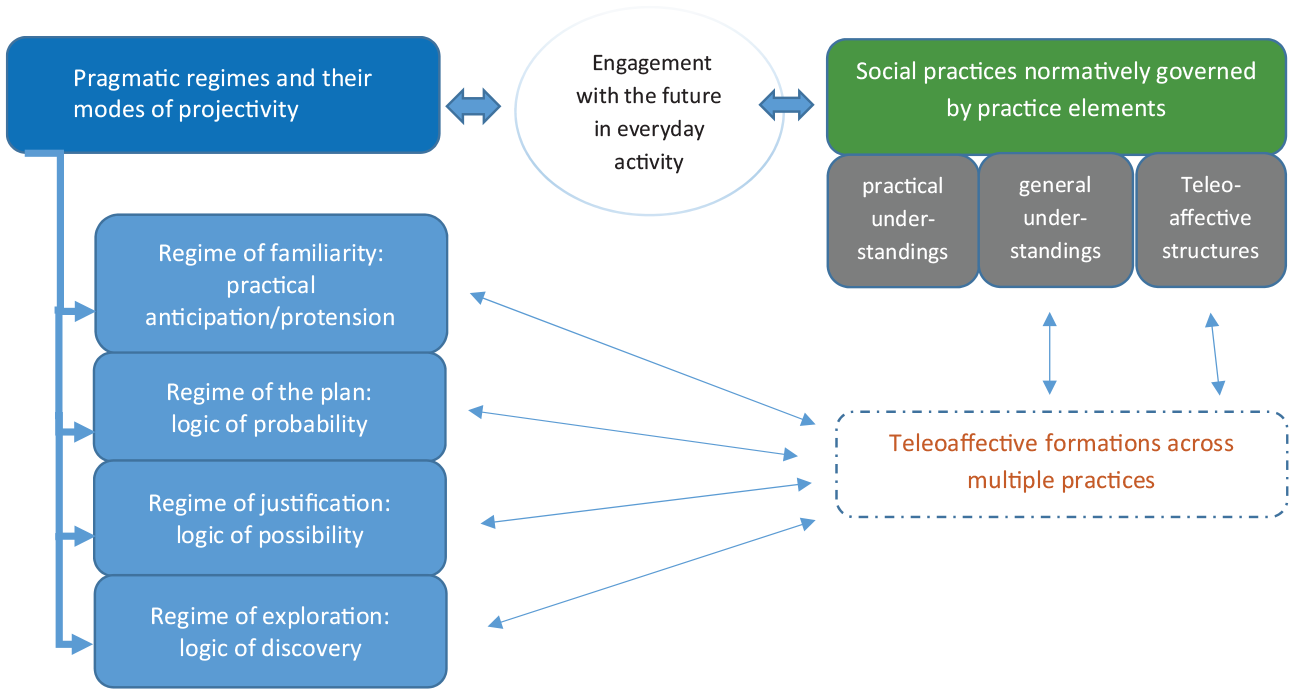
Enmeshing of regimes, modes of projectivity and social practices.
For example, many domestic practices almost exclusively take place in the regime of familiarity and of the plan, whilst the public contestation of social movements takes place in the regime of justification. However, it would be wrong to simply identify different practices with different regimes: we need an account of the variegation of the ‘more or less’ embedding of practices in different regimes. For example, Yates (2015) explores the ‘prefigurative’ political logic of social movements’ everyday activities, where activists create experimental or ‘alternative’ social arrangements (such as communal forms of provisioning) to express the political ‘ends’ of their actions through the ‘means’ of everyday life. Here, in our terms, activists deliberately transpose their political general understandings (see Welch and Warde, 2017), not least of ‘prefigurative politics’ itself, from the regime of justification (orders of worth), to the regime of exploration, with an aim to instantiate those understandings in an emancipatory regime of familiarity conditioned by ‘new and future-oriented social norms’ (Yates, 2015). Indeed Thévenot (2012: 6) notes that this ‘plurality is usually neglected by the various literatures devoted to social movements or participation, which are focussed on public frames, interest strategies and resource mobilization’. The normative goal of Thévenot’s sociology of engagements includes bringing to light the oppressions produced by ‘the pressure exerted by one engagement upon another’ and to ‘trace oppressions and humiliations which are not easily expressed in critical format’ (Thévenot, 2012). We suggest the synthesis we develop here preserves that possibility.
The embedding of practices in regimes further raises questions of how this embedding changes over time, how the familiar becomes contested – and de-familiarized – and the once contested becomes familiar. For example, if we consider the history of feminism, we can acknowledge how the uncontested gendering of different domestic practices became taken up into explicit discursive contestation (‘the personal is political’). Conversely, the outcomes of periods of contentious action by social movements playing out in the regime of justification may become embedded in domestic practices transpiring in the regime of familiarity. Kaufmann (1998) for example, chronicles negotiation over the division of domestic practices between couples in the light of the social changes wrought by feminism. Other examples can be found in the case of environmental sustainability, and the relations between the ‘ecological order of worth’ (Blok, 2013; Chiapello, 2013; Thévenot et al., 2000) and everyday practices, most obviously recycling, where an ecological sensibility becomes enfolded into habitual domestic practice in the regime of familiarity. Indeed, we have argued elsewhere that an appreciation of everyday practice through regimes of engagement affords potential insights into the realization of environmental policy directed at consumption and the domestic sphere (Welch et al., 2016).
Projectivity and Teleoaffectivity
Many conceptualizations of social agency imply a mono-dimensional view of projectivity (focusing on the regime of the plan) or tend to dichotomize between non-reflective and reflexive modes of projectivity (Tavory and Eliasoph, 2013) or non-representational and representational forms of projectivity (Cook and Cuervo, 2019). There is a common overemphasis on the specific status of the project or plan in relation to the future, which flattens the varieties of social agency and multiple forms of reflexive projectivity (Mandich, 2019). Projectivity is considerably more complex than the simple idea of a project would suggest. Creativity and imagination are pivotal elements in a more nuanced definition of projectivity. Expanding Thévenot’s regimes into modes of engagement with the future can thus help to overcome mono-dimensional views of projectivity (Mandich, 2019).
Schatkzi’s account of social practice is strongly teleological. The future-orientation of activity is expressed through the concept of the ‘teleoaffective structure’ of practices: ‘a range of normativized and hierarchically ordered ends, projects, and tasks’ (Schatzki, 2002: 80), which encompasses ‘existential futures that are enjoined of or accepted for the participants in the practice involved’ (Schatzki, 2010: 74). 5
Teleoaffective structures are specific to particular practices, and the concept therefore is unsuited to the analysis of cultural configurations that cross multiple practices and orient those practices towards common goals or ends. Welch (2020) builds on Schatzki’s account to offer a concept of ‘teleoaffective formation’ to capture cultural ‘configurations across multiple practices that enjoin those practices to common ends, ordering their affective engagements and offering general understandings through which participants make sense of the projects they pursue’ (Welch, 2020: 1; cf. Welch and Warde, 2017).
While teleoaffectivity expresses projectivity – ends are tied to hopes and expectations – we argue that the account offers little in the way of unpacking reflexive projectivity, or engagement with the future-orientation of the ‘end-project-task’ combinations that, according to Schatzki, teleoaffectivity specifies. Arguably, Schatzki’s account defaults to a mono-dimensional means–ends reflexivity. Similarly, Mandich (2019) argues that while Thévenot criticizes the reduction of agency to the regime of plan – the raison d’etre to develop his account of pragmatic regimes – he too considers the future as a dimension that is exclusively related to the idea of plan. We suggest therefore that both Schatzki and Thévenot default to a mono-dimensional view of projectivity as project or plan.
Here we turn to Mandich’s (2019) development of Thevenot’s regimes beyond such a mono-dimensional view, to embrace multiple forms of projectivity. It is through this move, we argue, that we are better able to understand the socio-material processes whereby affective engagements are made with ‘the cultural scaffoldings of future projections’ (Mische, 2014: 440). Mandich (2019) develops modalities of future-orientation specific to each of Thévenot’s regimes as a way of ‘looking at the future from the way it is entailed in everyday practices’ (Mandich, 2019: 17). Rather than specifying for each regime a main temporal dimension, as Thévenot implies – past for the regime of familiarity, future for the regime of plan and present for the regimes of justification and exploration – Mandich (2019) unpacks the complex temporal nature of each regime. As the modalities of assessing reality differ according to the regime of engagement in which the actor is involved, so the nature of projectivity varies from regime to regime. According to Mandich:
The future is ‘made and measured’ within the logic of probability in the regime of plans; of possibility in the regime of justification; of practical anticipation in the regime of familiarity; and of discovery in the regime of exploration. (2019: 1)
The analytical ‘cut’ of modes of projectivity provides a more nuanced account than one structured through the ‘end-project-task’ orientation of teleoaffective structure alone.
We now briefly illustrate our concept of engagement with the future in everyday activity through a practice theoretical analysis of doing domestic laundry conducted by Southerton and Mylan (2018). Their respondents narrated the parts of their laundry practice: ‘designation of unclean items, storage, washing, drying, and preparation of items for use (e.g. ironing)’ (2018: 1137). While Southerton and Mylan analyse their data in terms of the social practice of doing laundry we can additionally see how the respondents’ accounts depict their constant juggling of their laundry activity between different pragmatic regimes. First, laundry performances belong to the regime of familiarity, where practitioners’ activity from one moment to the next is organized by practical anticipation that seeks to maintain convenience and comfort in ‘a familiar milieu’ (Thévenot, 2001: 76). Thévenot notes that ‘[w]hen the things we appropriate [into the regime of familiarity] are customized, tamed, or domesticated they maintain our intimate being’ (2001: 77). The breaching of such practical anticipation is far from simply inconvenience. As one interviewee described her washing machine’s failure: ‘“I just felt really lost and really like ‘what am I going to do?’ . . . It was just panic”’ (Southerton and Mylan, 2018: 1146). Second, Southerton and Mylan’s empirical material clearly demonstrates how respondents also engage with the regime of plan in their navigation of the elaborate sequencing and organizing of different domestic activities (e.g. cleaning, eating) and paid work routines. This regime is oriented to the future through a ‘logic of probability’ – the agent’s ability to imagine completed action according to a certain goal and timing, as illustrated in this interview extract:
I can just put them in and out between cleaning and sorting out homework and organizing anything else, so that it’s all done and dusted for lunchtime on Saturday. (Southerton and Mylan, 2018: 1139)
However, the practice of domestic laundry is not circumscribed by the regimes of familiarity and the plan. Rather, it may also engage with the regime of justification, and its future-orientation to a logic of possibility, through the intervention of public, contentious discourses – most obviously feminism and environmentalism – into domestic practice. The regime of justification is by definition a realm of controversy and contention, in which agency is framed by possible futures. Its mode of projectivity – governed by a logic of possibility (Mandich, 2019) – offers the capacity to imagine ourselves and our world otherwise: whether in terms of gendered divisions of domestic labour or environmentally sustainable household practices. It is here that cultural conventions, or in Schatzkian terms ‘general understandings’ (see Welch and Warde, 2017), such as those elicited in Southerton and Mylan’s (2018) interviews with householders – temporal efficiency, domestic productivity, care for others or the propriety of public self-presentation – are offered in justification. Discourses such as feminism or environmentalism introduce new understandings to everyday practice, which may be assimilated to existing understandings, or may be dissonant with them.
Arguably, Southerton and Mylan’s (2018) account of laundry practice gestures towards a wider ‘teleoaffective formation’ (Welch, 2020) of ‘home’ or ‘family life’, configuring various domestic practices like cleaning and cooking under an orienting nexus of general understandings such as cleanliness, care, propriety, domestic efficiency and, potentially, also environmental sustainability. These general understandings inform the teleoaffective structure of individual practices, such as doing the laundry. This is to say, general understandings are in themselves ‘ends’ to which practices are oriented.
What Mandich’s (2019) notion of ‘modes of engagement with the future’ provides us with is a far richer account of the projectivity towards, or anticipation of, those ends – of the pragmatic versatility and multidimensionality of future-oriented agency in everyday life (Mandich, 2019) – than afforded by the concept of teleoaffective structure alone.
In sum, we can see that Southerton and Mylan’s (2018) respondents’ reflexive projectivity or future orientation varies as part of their engagement in pragmatic regimes. The futures in practice of domestic laundry are not only the next moment in the sequence of practical anticipation in the realm of familiarity. Nor simply are they solely the rational, calculated future of probabilities within busy household schedules in the regime of the plan. They may also embrace the more distant future of possibilities operating within the regime of justification, for example in the name of environmental sustainability, embodied in environmentally friendly washing powder, reduced washing temperatures, AAA-rated energy-efficient washing machines, and perhaps changed household habits. While the material in Southerton and Mylan’s (2018) study does not lend itself for interpretation in terms of the regime of exploration and its attendant logic of discovery, as we have suggested earlier in this article, domestic practices may engage with the regime of exploration in experimental or ‘alternative’ social arrangements inspired by social movements (Yates, 2015). Perhaps also the experimentation in domestic practices – especially as these are intertwined with digital technology – enforced by the ‘lockdowns’ and disruption of the coronavirus pandemic also evince the regime of exploration.
There is nothing inevitable about the happy co-existence of regimes and practices, however, and the integration of norms of environmental sustainability within domestic practices are a moot case in point. Southerton and Mylan’s (2018) study is itself framed as a contribution to thinking about sustainable practices; their criticism is directed towards the so-called ‘deficit-model’ of information provision in environmental ‘behaviour change’ interventions, which, they argue, fails to take account of the complex scheduling and coordinating of domestic practices. The theoretical synthesis we present here suggests other issues to consider when thinking about the integration of environmental norms into everyday practice. The perspective of multiple modes of projectivity we have advocated here adds the temporal dimension of modes of projectivity to the observation that the orienting conventions or general understandings of social practices – for example domestic care and environmental sustainability – may be at odds. The ‘logic of possibility’ at play in the regime of justification, of which ‘sustainability’ partakes – care for the distant, possible future – is not necessarily easily accommodated with the dominant forms of projectivity of domestic practice: practical anticipation (regime of familiarity) and probability (regime of the plan). Thus the householder who is resistant to the ‘greening’ of their domestic practices may, for example, be experiencing not simply a conflict of conventions, but the discomfort of the intrusion of a ‘logic of possibility’ into a practice comfortably and familiarly governed by practical anticipation. The societal significance of such potential dissonances – and, equally, resonances – should be understood in the context that projects of purposive social change towards sustainability, for example large-scale policy programmes such as the European Union’s commitments to Circular Economy, are oriented by imagined futures of consumption that embrace not only novel business models and consumption practices but novel consumption norms and affective engagements (Welch et al., 2016). Whether such norms and engagements become successfully inculcated into everyday practice depends, in part at least, on the alignment, or resonance, of the modes of projectivity that subtend them.
Conclusion
This article has the intention of providing practice theory with a richer and more nuanced account of the orientations to the future or projectivity enacted in social practices than can be articulated through existing understandings of teleoaffectivity (Schatzki, 2002; Welch, 2020). We seek to do this through, first, a synthesis of Schatzki’s social ontology of practices with Thévenot’s account of regimes of engagement. Second, we integrate Mandich’s (2019) development of the modes of reflexive projectivity specific to each regime: practical anticipation of the regime of familiarity; the logic of probability for the regime of plan; logic of possibility for the regime of justification; and logic of discovery for the regime of exploration. This elaboration of multiple forms of projectivity avoids resorting to a mono-dimensional means–ends projectivity and attempts to do justice to the versatility and multi-dimensionality of everyday experience, as well as unpacking the diverse temporalities of pragmatic regimes.
We produce this synthesis through arguing for the ontological compatibility of Schatzki’s account of social practices and Thévenot’s account of regimes of engagement, on the basis of: first, Thévenot’s mischaracterization of social practices as regularities; and second, a non-individualist reading of regimes of engagement. This enables an account of the variegated enmeshing of practices and regimes of engagement, and the enactment of the latter’s modes of projectivity within practices. We retain, however, Schatzki’s fundamental insight that the organization of activity should be understood through specific practices. We believe this account does justice to the complexity of social practices, individuals’ everyday experience and the multifariousness of the field of futurity. Space has allowed us only a brief illustration of this account, the analytic utility of which can only be fully demonstrated by our models’ application to future empirical research.
Footnotes
Acknowledgements
The authors would like to thank Nick Prior at Cultural Sociology and two anonymous reviewers for their constructive input. The article was considerably improved by their engagement.
Funding
Daniel Welch’s contribution to this article was funded by the UK’s Economic and Social Research Council, ref: ES/R007942/1. Giuliana Mandich’s contribution has been developed within ‘Mapping youth futures: Forms of anticipation and youth agency’ ( ), a PRIN project financed by the Italian Government. Margit Keller’s contribution has been supported by grant PRG346 from the Estonian Research Council. The authors would also like to thank the Sustainable Consumption Institute, University of Manchester, for generously funding a workshop which initiated the development of the article.