




Abstract
This article reassesses Paul Rotha’s tenure as BBC television’s Head of Documentaries (1953–55), primarily by reconsidering his signature television series, The World Is Ours (1954–56), as a more hybrid and collaborative production than has hitherto been acknowledged. It relates Rotha’s BBC work to the British documentary film movement’s embrace of a specific variant of postwar internationalism, to the changing style of his preceding film projects during the 1940s and early 1950s, and to emergent practices within postwar British factual television. This article broadens understanding of a period when new televisual forms were being developed and the question of television production for international markets gradually became more prominent.
Keywords
Although Paul Rotha (1907–1984) was the BBC’s first formal Head of Television Documentaries between 1953 and 1955, some historians have considered his contribution to British television history negligible. This article refines that judgement by interrogating Rotha’s BBC work from several angles. Tim Boon (2008, 2013) has to date undertaken the most extensive research on Rotha at the BBC but this has been from the specific perspective of the representation of science in British television. This article will track how Rotha’s work developed more generally across film and television during the 1940s and 1950s, with different institutional and sponsorship contexts imposing certain constraints and opening up particular opportunities. Rotha’s television work during this period also involved interactions with new collaborators and a significant path not taken. This article explores his major contribution to early British television documentary, the series The World Is Ours (1954-56), as a hybrid production, with some variance between different episodes, where a range of modes of address and representational strategies converged, sometimes uneasily, within an early television project designed to address global issues and promote a particular variant of internationalism.
Rotha’s career prior to his appointment at the BBC is relatively familiar to film historians. His first major achievement was the publication, in his early twenties, of The Film Till Now (Rotha, 1930), a pioneering English language survey of world cinema, as well as a rumination on film theory, which was updated in subsequent editions and served as a standard reference text until at least the 1960s. Rotha also established himself as a leading film maker within the British documentary film movement, despite only working in a state film unit with its acknowledged founder, John Grierson, for a brief period during 1931. Rotha was successful during the 1930s in securing industrial rather than state sponsorship for a range of documentary films he produced and directed. The first film he directed was Contact (1933), sponsored by Imperial Airways. During the Second World War, he ran his own independent production companies, Paul Rotha Productions and Films of Fact, but the collapse of the latter in 1947 marked the end of Rotha’s role as a major producer of British documentary films. The years between 1947 and his appointment at the BBC in 1953 were lean ones for Rotha, characterised by limited and sporadic employment on freelance projects, such as the direction of his first feature film, No Resting Place (1951). However, Rotha was still considered enough of a documentary ‘star’ during this period to be considered for the BBC role, although he also carried with him a reputation for being a demanding taskmaster.
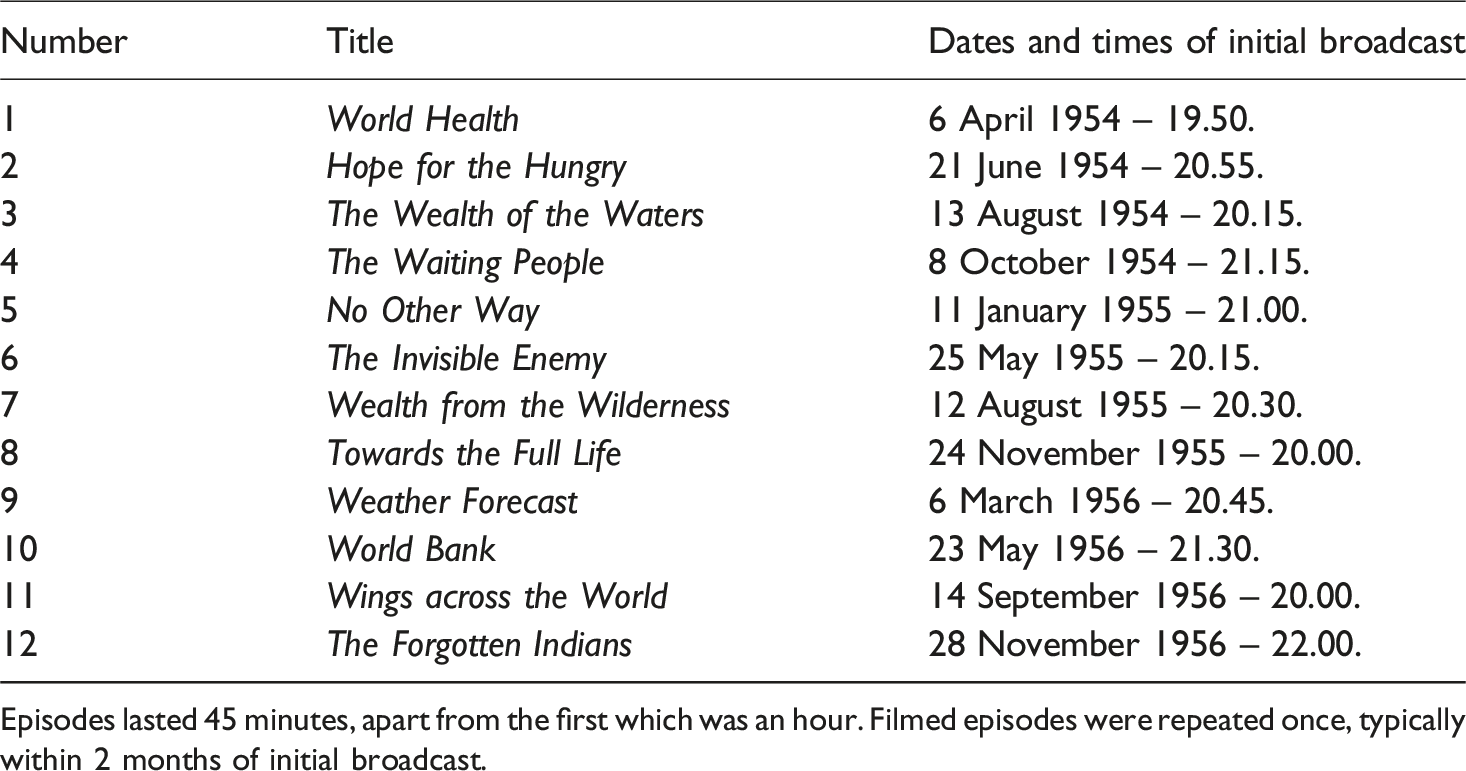
Episodes lasted 45 minutes, apart from the first which was an hour. Filmed episodes were repeated once, typically within 2 months of initial broadcast.
In her pioneering account of the origins of British television documentary (1946–1955), Elaine Bell mentions Rotha only briefly and focuses primarily on the categories of British documentary television, more electronic studio-based, which other members of the Documentary Department developed, prior to and during Rotha’s tenure. Following television scriptwriter Arthur Swinson’s 1955 definitions from his book Writing for Television, Bell lists these as the dramatised documentary (associated with Caryl Doncaster, Robert Barr and Duncan Ross), the actuality documentary, and the magazine documentary (associated with Stephen McCormack) (Bell, 1986: 74). The World Is Ours can broadly be categorised as an actuality documentary, defined by Swinson as dealing with ‘serious subjects…in a serious manner’, eschewing extended dramatisation, often utilising some form of commentary, and deploying the resources of the electronic studio as well as filmed material (Swinson, 1955: 98). However, from the outset, as Swinson notes, it was BBC television producer ‘Norman Swallow with his Special Enquiry (1952-7) series’ and ‘its deservedly high reputation’, rather than The World Is Ours, which was held to be the early exemplar of this category of British television documentary (Swinson, 1955: 98).
Swallow had a more successful and extensive career in British broadcasting than Rotha, and his view of his former boss was equivocal. On one occasion, however, he defended The World Is Ours, which he also worked on, as ‘a breakthrough of a kind…international…a series…about human beings and human problems rather than international politics’ (Swallow in De Lotbinière, 1990: n.p). These reflections help to more precisely situate The World Is Ours’ historical significance. It addressed international issues in a way that had precedents in film and radio, but which differed from British television’s previous approach to these issues, in series such as International Commentary (1950-2). Presented by Labour MP Christopher Mayhew, International Commentary focused on explicitly political topics including Titoism and, in colonialist parlance, the Malayan Emergency. In his 1966 book Factual Television, Swallow also classified The World Is Ours alongside the BBC documentary series War in the Air (1954-5), although from the perspective of the 1960s he considered both somewhat outmoded (Swallow, 1966: 193–4). Nevertheless, this association highlights that The World Is Ours should also be understood as an early example of a landmark British television documentary series, such as War in the Air and The Great War (1964), although unlike these examples, which used archive footage to address historical issues, it focused primarily on the contemporary scene.
The British documentary film movement, Rotha and television
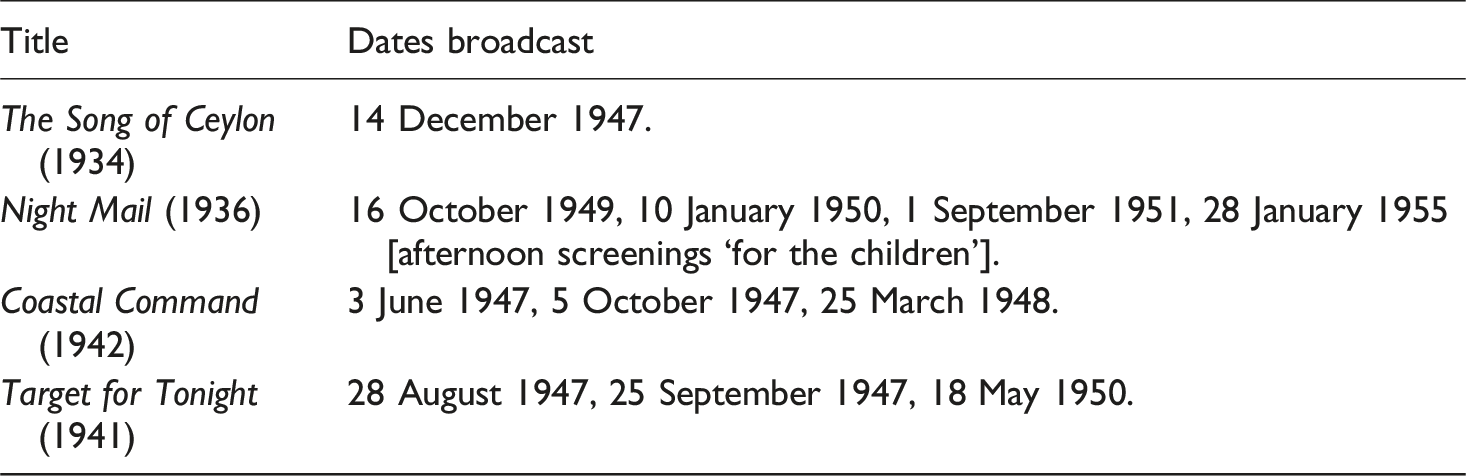
Insofar as established British documentary film makers contributed to the production of television programmes, this was initially based upon their expertise in cinema. During the immediate postwar period Grierson and Rotha occasionally appeared as guests sharing their knowledge and expertise. Grierson, for example, appeared in an April 1948 programme about UNESCO, showcasing extracts from films including The World is Rich (1947) and Here is the Gold Coast (1947; Hardy, 1979: 204). Rotha similarly appeared on a programme entitled Montage in February 1950. Cecil McGivern, Head of Television Programmes, was keen to have Rotha introduce and talk about a sequence from the documentary he had recently directed, A City Speaks (1947). McGivern regarded the sequence, representing entertainment in Manchester, ‘as a very fine example of film editing’ (BBC WAC T6/208, Memo 22 November 1949). Grierson and Rotha therefore appeared on television during this period as what James Bennett describes as ‘vocationally skilled performers’, displaying ‘knowledge or skill that is held by the television personality as a professional within a particular field’ (Bennett, 2011: 21).
Rotha’s television discussion of A City Speaks benefited from the film previously having been broadcast in December 1948, relatively soon after its initial release. Several British documentary movement films were screened on television within a similar timescale, for example: A Diary for Timothy (1945) in June 1946; The Cumberland Story (1947) in January and March 1949. The culmination of this shortening timescale between documentary film release and television screening was, eventually, the elimination of any temporal gap whatsoever. The screening of World Without End (1953), which Rotha co-directed with Basil Wright, entailed what Rotha described as UNESCO’s decision ‘to have the first showing...on British TV...in the belief that through such a single screening (plus later repeats) the picture would reach a wider and more receptive audience...than via a second-feature commercial cinema release’ (Rotha, 1955: 366). The nature of the relationship between the British film industry and the BBC at the time typically prohibited the television screening of new films. This meant that World Without End was automatically ‘blacklisted’, as one press report put it, by the Cinematograph Exhibitors Association (CEA) (quoted in Hall, 2024: 89).
During the immediate postwar period Rotha was the most prominent advocate within the British documentary film movement for fundamental changes to the British film industry, changes which he hoped would enable documentary films to connect much more effectively with cinema audiences. In 1945, for example, in a wide-ranging report for the new Labour government, Rotha lobbied for a Government Film Corporation which, among other things, would support ‘feature-length documentary films, say 12 a year’, with ‘guaranteed circulation...secured at circuit theatre prices’ (Rotha, 1958: 270). By 1952, however, he was expressing disappointment that during its time in office (1945–1951) ‘the Labour government only tinkered with the industry’s problems. Never did it tackle the basic problem of the dominance over production held by the distributors and circuits’ (Rotha, 1958: 302). Rotha abandoned the chance of any kind of commercial release for World Without End, in favour of a television premiere, at a time when he saw little prospect for changes that would boost the distribution and exhibition of British documentary films in mainstream cinemas. However, as Rotha wrote in June 1953, soon after joining the BBC, he saw television as offering to documentary films, whether initially produced for theatrical screening or specifically produced by the BBC for broadcast, a fantastic new ‘distribution outlet’ entailing ‘the biggest expansion of the non-theatrical field we ever envisaged’ (quoted in Fox, 2013: 502).
Even during his tenure as Head of Television Documentaries, Rotha publicly celebrated television’s potential as ‘a transmitter of celluloid’ (quoted in Hall, 2024: 89). However, McGivern, Rotha’s manager at the BBC, expected him to develop programming that encompassed but also moved beyond the ‘development of filmed television’ (quoted in Boon, 2008: 200). His expectation at that time was that Rotha would also further innovate the live, primarily studio-based forms of programming that other Documentary Department members were already taking forward. McGivern was not overly prescriptive as to how this should be done. As he wrote to Rotha in June 1954, ‘although I could supply some [programme ideas], I do not think I should. Ideas must come up more than down, if the programme situation is to be healthy’ (BBC WAC T4/35, Memo 8 June 1954). McGivern was intrigued, however, by Hollywood director Joseph Losey’s arrival in Britain after his blacklisting by the House Un-American Activities Committee (HUAC), and especially by his background as one of the theatre directors involved in the Living Newspaper during the 1930s. 1 McGivern saw potential here for the development of ‘new documentary “forms”’ (BBC WAC TVART1, Memo 4 March 1953) and proposed a collaboration between Rotha and Losey. Rotha responded with apparent enthusiasm, reminding McGivern that he had previously undertaken a ‘long study’ of Living Newspaper productions during his September 1937 to March 1938 visit to New York (BBC WAC TVART1, Letter 11 March 1953). Rotha proposed showing Losey ‘New Worlds for Old [1938], World of Plenty [1943] and Land of Promise [1946] so that we may plan how from theatre via film the technique can be developed into television’ (BBC WAC TVART1, Letter 11 March 1953).
Rather than making any longer-term commitment to the BBC, however, Losey opted to work for most of 1953 anonymously supervising and directing television drama for Edward Danziger’s and Harry Lee Danziger’s production company, earning ‘$100 a week under the table so I didn’t have to pay tax on it’, more than he would have earned from any taxable BBC contract (quoted in Ciment, 1985: 134). This missed opportunity for a collaboration between Rotha and Losey is one of the ‘what ifs’ of British television history. Living Newspaper theatre productions often involved what Rotha described as ‘contrapuntal dialogue’ and shifts between presentation formats (Rotha, 1938: 65). One Third of a Nation, for example, which Rotha saw in New York, alternated between character speech and a loudspeaker presenting facts and posing questions, and incorporated a film and lantern slide show into its staging. The obvious starting point for British television documentaries extending this approach in the early 1950s would have been inventive shifts between different commentators and presenters and between live studio, filmed and possibly even outside broadcast material. Rotha noted McGivern’s advice that as Head of Television Documentaries it would be ‘good to be associated especially with one project (in addition to the overall work of the department)’ (BBC WAC TVART1, Letter 11 March 1953). However, although it was a ‘prestige’ production, a concept carried over from film (Boon, 2013: 492), The World is Ours did not break new ground in the ways that McGivern anticipated. Instead, The World is Ours, to varying degrees within different episodes, constituted a hybrid between established trends within Rotha’s recent documentary film practice and some emergent television techniques. Rotha did not consciously and consistently innovate new documentary television forms to the extent that a project more directly influenced by the Living Newspaper approach might have done.
Stylistic developments and Rotha’s internationalism during the 1940s and 1950s
Even if Losey had been interested in reworking Living Newspaper techniques for television, it is a moot point as to whether Rotha would have fully embraced such a project. By 1953 Rotha had moved through and beyond this influence. New Worlds for Old (1938) was Rotha’s first production, after his exposure to Living Newspaper theatre in New York, to employ his ‘own invention [within a documentary context], the multi-voice narration, whereby the film’s themes are argued-out between several commentators’ (Boon, nd). This initial experiment was relatively restrained, however, because the ‘arguing out’ between multiple commentators in New Worlds for Old is quite limited, and ‘sceptical and questioning voices simply introduce new stretches of narrative exposition’ (Boon, 2008: 129). World of Plenty (1943), on the other hand, more adventurously pitted a range of commentary voices in ongoing dispute and debate with each other, albeit with some voices, particularly scientist John Boyd Orr’s, granted more authority than others. This is combined with instances where, as David Pearson puts it, ‘the styles of newsreel and mainstream documentary are parodied and exposed’, without ultimately relinquishing a commitment to documentary’s capacity to represent reality (Pearson, 1982: 78).
Rotha’s next project, Land of Promise (1946), extended his experiments with multiple debating commentary voices, as well as relying more heavily on actors. One of these voices, described by one reviewer as a ‘young man from the Forces whose participation in the direction of the film’s argument grows with the knowledge he gains ([played by British film star] John Mills)’, seemingly steps up from the cinema audience in a concluding sequence set in a pub, then turns to directly address the camera and the audience with an impassioned closing speech (Anon, 1946: 59). The trade press responded negatively to this explicitly agitational approach, with Kinematograph Weekly concluding: ‘It is not that Rotha does not try to give all sides to his problem [of housing]. He does. But the weight comes down so heavily for the progressive view’ that it raised questions about the film’s ‘suitability for the rank and file of the business’ (quoted in Haggith, 1998: 207–8). Land of Promise received even more limited commercial distribution than World of Plenty (Farmer, 2010; Haggith 1998: 206, 209). Rotha eventually regarded Land of Promise as a dead end as far as film experiments partly based upon Living Newspaper techniques were concerned. The 1952 edition of his book Documentary Film classified it as marked by ‘an aggressive insistence which almost defeated its purpose’ (Rotha, 1952: 262).
Rotha’s subsequent project, The World Is Rich (1947), shifted away from debating commentary voices. The initial conception of The World Is Rich was closer to this model but during production key stakeholders such as Ronald Tritton, Director of the Films Division, Central Office of Information (COI), expressed concern that ‘as in Land of Promise you overplay your hand and become slightly strident and overemphatic’ (quoted in Boon, 2008: 159). This feedback was heeded. Although The World Is Rich credits seven commentary speakers, their interplay is different from World of Plenty or Land of Promise. The voices tend to complement each other, jointly moving the exposition of the film’s overall argument forward rather than directly and extensively challenging each other. Unlike World of Plenty, The World Is Rich had a specific agency to which it attached hope for more equitable global food distribution, the United Nation’s Food and Agriculture Organization (FAO), headed by Boyd Orr. The World Is Rich was co-commissioned by the COI and the UK government’s Ministry of Food during the immediate postwar period. With more global film markets accessible than during wartime, there was more scope to plan a film which might secure distribution within non-Anglophone contexts. Rotha cited this as one of the reasons for The World is Rich’s particular use of its seven credited commentary speakers: ‘[This film] did not pursue [a commentary] dialogue technique [similar to World of Plenty] because one of the requirements laid down in its commission was that its speech could be easily translated into foreign languages’ (quoted in Kruger, 1999: 33). Unlike multiple commentary voices that challenge each other, multiple commentary voices that support each other can more easily and cheaply be translated into a single commentary voice for foreign markets. Pragmatic considerations such as this played a role in shaping The World Is Rich, allied to the fact, as Rob Aitken notes, that this film and World Without End, its successor in the ‘world’ series, subscribed to ‘developmentalism’ and ‘share a faith in the technocratic possibilities of international organisation’ (the FAO and UNESCO, respectively), rather than retaining a degree of dialogue or debate about the aims and impact of the specific international agencies being endorsed (Aitken, 2013: 674). This ‘faith’ rested upon underlying political and ideological factors surrounding Rotha’s postwar commitment to internationalism.
There was a widespread feeling among British documentary movement film makers during the immediate postwar period that the social purpose of their film making could be revitalised through internationalism, which would enable them to liberate themselves from some of the more narrow, instrumental purposes to which their work was harnessed during wartime. Of course, different conceptions of internationalism circulated during this period. As Richard MacDonald has argued, the version promoted by Rotha and some of his British peers envisaged ‘an international community of effort among film-makers communicating to a corresponding community of understanding, the audience. The true internationalism of documentary was contrasted with the boundaries, divisions and conflicts of international politics and diplomacy’ (MacDonald, 2013: 461). Although practical efforts to coordinate Western and Eastern bloc film makers within the World Union of Documentary (1948–50) fell victim to ‘an intensifying cultural cold war’, communist and anti-communist and colonial and anti-colonial oppositions were not explicitly acknowledged as dividing lines in postwar British documentary film movement discourse (MacDonald, 2013: 462). For example, there is no acknowledgement of the Soviet Union’s refusal to join the FAO in The World is Rich or of its boycott of UNESCO (prior to 1954) in World Without End (1953).
World Without End, representing UNESCO’s work in Mexico and Siam (Thailand), was the culmination of the developments outlined above and partly set a template for The World Is Ours. Initially titled The World is a Village, referencing the 1950s trope of the ‘global village’, Wright and Rotha, as Zoe Druick puts it, ‘took this small world concept and the universal humanist sensibility associated with it and welded it to the work of the UN’ (Druick, 2011: 276). Stakeholders during World Without End’s production process again encouraged the use of a commentary track that could be easily translated into different languages for screenings within a range of different international contexts (Druick, 2011: 276). World Without End features just a single commentator, the actor Michael Gough, a pattern also broadly followed in The World Is Ours, where radio actor and narrator James McKechnie typically provides the series’ sole, unseen commentary voice. Rotha also expressed the view, in his notes on the draft script for an early episode of The World Is Ours, that ‘too many voices confuse the viewer’ (BBC WAC T32/364/2, Script notes nd). This suggests a perception on his part that television audiences, envisaged as easily distractible, required a more univocal mode of address than in some of his previous experiments in film.
Unequivocally positive in its representation of its sponsor’s work, World Without End grants agency to non-Western medical and scientific UNESCO professionals only insofar as they fulfil the objective of humanitarian intervention into the developing world. Anti-colonial resistance is rigorously excluded from the film’s purview. As MacDonald suggests, part of Siam’s appeal as one of the film’s two main locations was as ‘the only country in the region not to have experienced, in the recent past, the turmoil and violence of anti-colonial nationalist struggle’ (MacDonald, 2013: 467). Similarly, Norman Swallow described The World is Ours as comprising ‘international programmes that deal with social and human issues, and steer clear of politics and armed forces’ (BBC WAC T32/364/6, Memo 16 February 1954). Swallow’s description accords with what Macdonald, Druick and Aitken describe as the elision of the Cold War and late British imperial contexts within which these television programmes and the films preceding them were produced. Nevertheless, some episodes of The World Is Ours gesture towards what is excluded from their purview. The commentary in episode nine, Weather Forecast (6 March 1956), for example, which celebrated the work of the World Meteorological Organization (WMO), asserts that there are ‘no iron curtains in the weather world’, sidestepping contemporary debates about the initial exclusion of the People’s Republic of China (PRC) and individual Soviet republics from full membership of the WMO (Edwards, 2006). Some reviewers registered these elisions at the time. The television critic Peter Black wrote for example of episode five, No Other Way (11 January 1955), which focused on the International Labour Organization (ILO): ‘I wish we had been told how the ILO membership had been made up…nobody told us two facts of the greatest importance: whether the Communist countries are in it, and how large their cooperation might be’ (Black, 1955: 8).
Rotha’s commitment to film on television in its institutional context
Several reasons have been adduced for Rotha’s dismissal from his post at the BBC in 1955. The first is his excessive focus on film and film technique at the expense of developing new documentary forms which utilised the resources of the electronic studio. This is certainly correct, but needs to be understood not only in terms of Rotha’s personal shortcomings but also in relation to wider developments within the BBC and factual television during this period. The BBC as an institution was not at this time opposed to the use of film per se. Indeed, Rotha’s film expertise was one of the reasons why he was recruited. The issue was that the larger objectives Rotha wished to achieve by deploying film, and his particular approach to film making, did not accord with the BBC’s practices and emerging priorities at that time.
The World Is Ours was designed for worldwide distribution. This ambition only became fully realisable when every episode from the fourth onwards was shot entirely on film. Henry Cassirer, inaugural head of UNESCO’s television service, argued that television documentaries shot on film with a single unseen commentator lent themselves most easily to commentary translation and international exchange (Cassirer, 1956: 158). This possibility enthused Rotha, who wrote in the mid-1950s: ‘[We] are about to enter on a most exciting and challenging era of international exchange in television terms…of films and filmed programs’ (Rotha, 1955: 373). Discussions and negotiations, some involving Cassirer, took place regarding distributing The World Is Ours to overseas television and non-theatrical markets in France, Belgium, Holland and Australia (BBC WAC T32/346/7, Letter 8 February 1955; Letter 11 February 1955; Memo 24 February 1955). The United Nations agencies’ assistance in providing footage for The World Is Ours was acknowledged by granting them non-theatrical distribution rights, which came into effect 6 months after the first British television screening of each episode (BBC WAC T32/346/7, undated contract). Rotha’s view was that ‘I got no support for this idea; [the BBC] were only at that time concerned with the UK market’ (quoted in King, 1975: 96).
Rotha was incorrect on this point. It is more accurate to say there were competing visions of international exchange within BBC television during this time, with some afforded higher priority than others. The BBC’s senior leadership unsuccessfully lobbied the British government in 1952 for financial subsidy to support the production of programmes shot on film intended for US distribution (Potter, 2012: 194). With British commercial television and therefore increased domestic and global competition on the horizon, the future Director-General of the BBC, Hugh Carleton Greene, published an article, around the time of Rotha’s appointment, in which he underlined that television programme sales to the American market, and competition with US television exports within the Commonwealth, were vital considerations. Greene argued, ‘American television want[s] films…specially designed for American television. It wants them in large numbers and it wants them now’ (Greene, 1952-3: 218). This pragmatic, market-orientated rhetoric contrasted with Rotha’s more idealistic internationalism. The issue was therefore not just Rotha’s preference for film but the uses to which he put this limited resource. The World Is Ours’ format was not seen by BBC senior managers and rising stars as part of the longer-term response to the wider challenges they faced.
More immediately, some of Rotha’s colleagues felt that the issue was not film per se but the way he expected them to use it. Director Tony de Lotbinière, for example, who had been working in television since 1948, felt that Rotha’s comment, ‘that wasn’t a very smooth track…wouldn’t it have been better if you used rails?’, when viewing some rushes of footage of a Welsh hill farmer for a Special Enquiry episode, The Nation’s Meat (29 June 1954), confirmed he ‘hadn’t quite got the measure of television’ (De Lotbinière, 1990: n.p.). de Lotbinière’s view was, ‘we couldn’t afford time or money to put rails down’ but ‘it didn’t really matter…what mattered was having the hill farmer talking to camera on site’ (De Lotbinière, 1990: n.p.). Rotha for his part situated his cinematic perfectionism, something which McGivern had warned him against before his BBC appointment (BBC WAC LI/376, Letter 15 September 1952), within a more general appeal for the ideal working conditions within which he considered creativity could flourish. He contrasted the ‘speed and immediacy’ of ‘a television show which takes a few weeks to plan’ to the longer schedule of working on film, which can ‘give time for thought, for research, for careful consideration of content and argument’ (Rotha, 1956: 20, 12, 13).
Rotha’s stance resembled the one he had previously adopted when lobbying to change the organisation of the British film industry in the late 1940s. He focused more on proposing radical changes to the current organisation of television production and broadcasting rather than negotiating a viable path within this context. In his introduction to Television in the Making, published soon after he left the BBC, Rotha contrasted film making’s ‘creative artistry’ with routine television’s ‘operational technical skill’ (Rotha, 1956: 14). He expressed the view that television had not yet produced anything comparable in artistic merit to the classics of cinema and observed: ‘Perhaps it is significant that very few, if any, top-flight film-makers have so far shown much interest in producing for this medium?’ (Rotha, 1956: 15). All of the film makers Rotha cited in this context were, of course, men. Grace Wyndham Goldie, on the other hand, at that time the dynamic Assistant Head of Television Talks, the department that absorbed Rotha’s team in 1955, had little truck with such implicitly gendered authorial notions. Goldie rejected the ‘mystique of the cinema’ associated with Rotha and the British documentary movement and negotiated a successful long-term career as an innovator and inspiring leader within the broader field of BBC factual television (Irwin, 2022: 290).
After Rotha’s first year in post, concerns were raised in the annual report on his performance about his perfectionism contributing to a ‘softening’ of documentary output, with volume of production ‘too low’ (quoted in Boon, 2008: 207). Rotha’s meticulousness is demonstrated by his approach to combining library material with newly shot footage, the latter a requirement because, unlike War in the Air, The World Is Ours focused on the contemporary scene. Rotha and his collaborators scoured archives and utilised his international network of contacts to obtain newly shot footage. Rotha leaned into his experience of producing films such as World of Plenty and The World Is Rich (the latter with the younger documentary film maker Michael Orrom), which depended heavily upon archival material. A working note on material that could be used to provide archive footage for The World Is Ours’ third episode, The Wealth of the Waters (13 August 1954), suggested recycling shots from films including Bassein: An Indian Fishing Village (1946), and The Rising Tide (1949), about fishing cooperatives in Canada (BBC WAC T32/364/3, ‘Films for Fisheries Programme’ nd). Rotha was however conscious that The World Is Ours could be criticised for being constructed ‘out of old library material’ (BBC WAC T32/364/3, Memo 29 July 1954). He and Swallow therefore also sought to obtain newly shot footage, beyond the limitations imposed by the BBC, by commissioning the Films Division of the UN to secure some of what they required. One useful contact was Alexander Shaw, another veteran British documentary film maker who had first collaborated with Rotha in the 1930s, and who in the mid-1950s was working on a UNESCO Technical Assistance Mission with ‘a team of young technicians’ drawn from Palestinian refugee camps (Anon, 1954: 38). Rotha wrote to Shaw when compiling The Waiting People, ‘there is nothing like having new material shot by such an expert hand as yours’ (BBC WAC T32/364/6, Letter 11 May 1954). 2 All of this coordination, and integration of different types of film footage, consumed precious production time. On a purely pragmatic level, contemporaneity could be achieved more cheaply and quickly through live studio-based commentary of the type Christopher Mayhew provided for International Commentary, produced by Wyndham Goldie for the Talks Department.
Disaffection, collaboration and The World Is Ours as a hybrid production
Another reason for Rotha’s dismissal from his BBC post in 1955 was, as he paraphrased in a letter to George Barnes, Director of BBC Television, the perception ‘that the morale of [his] department was in bad shape’ (BBC WAC T31/435, Letter 21 May 1955). This can partly be related to Rotha’s preference for actuality documentary over the other categories of television documentary that were being developed prior to his arrival. Duncan Ross, closely associated with the dramatised documentary, left the Documentary Department in 1954, partly due to differences of view over how television documentary should develop (Boon, 2013: 480). Robert Barr, also closely associated with dramatised documentary, similarly left in 1955, like Ross, initially to work in television advertising (Nixon, 2013: 103). Barr recalled his and others’ departure, and the dissolution of the Documentary Department, being caused not only by disaffection with Rotha but also by the new job opportunities created by the advent of commercial television in Britain (quoted in King, 1975: 89).
Rotha’s situation as Head of Television Documentaries was significantly different from the periods he spent during the 1940s as head of his own independent documentary film units, where he had more film making experience than the younger film makers he employed and more direct control over the units’ output. At the BBC, Rotha was brought in to lead a group of television programme makers, including Swallow, Barr, and Caryl Doncaster, all of whom had more experience of the medium than him. For example, Ross, who worked for Rotha as a novice film maker at Films of Fact before moving into television in late 1947, had over 5 years more experience than Rotha of working in television when the latter joined in 1953. Similarly, discussions of the career of John Read, who specialised in arts documentaries, rarely mention that Rotha was for 2 years his head of department. The relative creative autonomy exercised by members of the Documentary Department was crystallised in the correspondence between Rotha and Barnes, after his employment there ended. Rotha interpreted a statement signed by Swallow, Doncaster, Read, de Lotbinière and others as evidence of support for him personally when his contract ended. However, as Barnes emphasised in his reply, this jointly signed memorandum did not mention Rotha at all. It simply ‘expressed our regret at the dissolution of a unit [the Documentary Department of the BBC Television Service]’ (BBC WAC T31/435, Letter 13 May 1955). The loyalty the signatories expressed was not to Rotha but to ‘the Documentary Programme, and our resolution to continue it in the future, wherever we may be’ (BBC WAC T31/435, Statement 28 April 1955).
The disaffection surrounding Rotha at the BBC has partly obscured the fact that constructive collaboration between him and some of his new television colleagues also took place. Previous discussions of The World Is Ours have tended to link it primarily to Rotha. Insofar as collaborators are considered, scholarship has emphasised Rotha’s ongoing reliance at the BBC on established associates such as Orrom, Ritchie Calder, and Marie Neurath, who had previously worked on his films (Boon, 2013: 484). However, even former film colleagues brought distinctive elements to their freelance television work for Rotha. Orrom, for example, scripted several episodes of The World Is Ours, including the eighth, Towards the Full Life (24 November 1955), covering UNESCO’s fundamental education work in an Egyptian village. This opens with commentary exploring different definitions of culture, in Britain and elsewhere, very much in the manner of Orrom’s colleague, Raymond Williams. Of Rotha’s new television colleagues, Martin Chisholm received screen credit for writing The Wealth of the Waters, dealing with the FAO’s involvement in fisheries, ‘farming [fish] in the fields (as in Java) or “ranching” them at sea’, and Weather Forecast (Calder, 1954: 7). Chisholm had a background in radio and television programmes often focusing on scientific or technical subjects. His contributions to The World Is Ours tend to foreground elements of the ‘process’ genre, which can partly be defined as ‘the sequentially ordered representation of [people] making or doing something’, often with ‘tools and machines’ (Skvirsky, 2020: 2). The episodes written by Chisholm are in some respects characteristic of a general tendency of the series as a whole, which in its focus on the technical operations of the various UN agencies emphasises their ideal mode of functioning, rather than their shortcomings and institutional challenges. As de Lotbinière said of an episode he directed, Towards the Full Life: ‘One had to take the noble side and say what the purpose of [UNESCO] was, you couldn’t actually run it down’ (De Lotbinière, 1990: n.p.).
Most importantly in terms of production personnel, Swallow was credited as the producer of every episode of The World Is Ours except for the final one. He was the new television colleague with whom Rotha developed the best working relationship, with their views often coinciding. Although not uncritical of Rotha, Swallow remained loyal enough to contribute to a 1982 BFI dossier on Rotha and was seen as someone who could possibly produce a planned 1980s television documentary on Rotha’s life and work (Swallow, 1982; Stollery, 2019: 75). Quoting a memo by McGivern, Boon emphasises that Rotha exercised ‘detailed supervision over script, rushes, editing, etc.’ (quoted in Boon, 2013: 482). de Lotbinière’s recollection of Rotha’s remark about using rails for a camera track supports this. However, the memo Boon quotes is one in which McGivern notes that Swallow is confident about leading on ‘detailed supervision’ of television documentary projects that were still in production after Rotha’s departure from the BBC. Swallow’s general view was, ‘[if] any individual style can be traced in the documentary type of [television] journalism it will be that of the producer’, of whom he also noted: ‘He [sic] works too quickly to be able to submit every point to higher authority’ (Swallow, 1956: 52, 53). This invites further exploration of Swallow’s input into The World Is Ours and links between this series and Swallow’s other television work from this period. These links were highlighted at the time. Calder, in an article based upon Swallow’s notes (BBC WAC T32/364/6, Memo 16 February 1954), argued: ‘The success of…the television Special Enquiry into All the World’s Children [30 October 1953] showed that there was an eager audience for the kind of programme [the forthcoming The World Is Ours] that deals with human issues’ (Calder, 1954: 7). 3
As John Corner has argued, Special Enquiry demonstrates ‘the increasing centrality’, during the 1950s, ‘of non-professional talk to documentary’s criteria of realism and rhetorics of address’ (Corner, 1991: 43). This included live opening and closing studio sequences with resident presenter Robert Reid and frequent interview sequences with ordinary people in which ‘apparently unsolicited testimony and opinion is offered directly to the viewer’ (Corner, 1996: 45). These aspects of Special Enquiry differ from the overarching form of speech in The World Is Ours. As the unseen commentator for the majority of The World Is Ours’ episodes, McKechnie’s technically versatile delivery does not attain the same intimacy of address as Special Enquiry’s Reid, whose northern accent ‘was felt to lend the programme an extra note of “no-nonsense” integrity’ (Corner, 1991: 44–5). Neither does The World Is Ours have an equivalent to Special Enquiry’s various location reporters who act as the viewer’s representative ‘and “our” eyes and ears’ (Corner, 1991: 44). Furthermore, Reid ‘swung round to look at a screen at the start of the filmed report’ in Special Enquiry ‘and swung away from it to address the viewers at the end…the studio space itself was projected as a parallel space to the space of the domestic viewer’ (Corner, 1991: 44). The World Is Ours, by contrast, often included sometimes quite lengthy interviews with experts in more removed spaces of authority, their offices or laboratories. Examples include the leading virologist Dr Christopher Andrewes and Dr Anthony Payne, a WHO epidemiologist, in the sixth episode, The Invisible Enemy (16 June 1955). Their speech, as Boon puts it, is typically ‘scripted, formal and fully grammatical’ and on occasion ‘rather stilted’ (Boon, 2008: 207; 2013: 483). Swallow, on the other hand, conceived Special Enquiry as a series which moved away from deference to experts towards ‘looser styles of speech’ (Boon, 2008: 207). However, as Boon also briefly notes, British factual television was in a state of flux during this period and The World Is Ours did employ some ‘techniques that had been developed within television’ (Boon, 2013: 486, 483). This proposition warrants more detailed exploration.
With the benefit of hindsight Swallow wrote of The World Is Ours in 1966: ‘What was missing…was, quite simply, people’. He asserted that the ordinary people who did appear ‘were merely symbols of a general condition, wearing nearly-visible labels, ‘doctor’, ‘sick child’, ‘stateless person’, and so on’ (Swallow, 1966: 194). 4 However, Rotha acknowledged at the time: ‘In the intimacy of the home, sincerity of intention by performer and producer…belong to television - especially the projection of personality’ (Rotha, 1956: 10–11). There were intermittent attempts throughout The World Is Ours, as was more frequently the case in Special Enquiry, to platform engaging personalities and to represent ordinary people in the more individualised manner Swallow envisaged. This began with the first episode of The World Is Ours, World Health, where in Rotha’s view the WHO nurse Maria Palmira Tito de Morais ‘came here in person and gave a brilliant performance in the studio’ (BBC WAC T32/364/6, Letter 13 April 1954). Even in The Invisible Enemy, shot entirely on film, interviews with experts are broken up by a more intimate synchronised dialogue sequence involving a young girl, Pat, and her mother taking part in a research project. The seventh episode, Wealth from the Wilderness (12 August 1955), deploys non-synchronised dialogue, a technique developed during the early phase of the GPO Film Unit (Stollery, 2011: 173–4). Some kibbutzniks, who have emigrated from Britain to Israel, introduce themselves by name as they work, without their speech being synchronised with their images, affording them some individuality within a collective endeavour. Viewer feedback captured in BBC audience research reports also suggested that actors cast as social types in the series could contribute to ‘a general impression of sincerity’. The report for The Wealth of The Waters stated: ‘All the acted parts were taken very naturally…some [viewers] did not realise that “Maria,” the Chilean village girl, was played by Cecile Chevreau’ [and] were “astounded that a South American peasant could speak English so well”’ (BBC WAC T32/364/3, Audience Research Report 1 September 1954). This chimed with Swallow’s further observation that in factual television during this period, ‘people appeared “in the round”…ironically’, when they ‘were not real people at all’, but actors (Swallow, 1966: 194). This begs the question of whether The World Is Ours might have benefited from a more thoroughgoing incorporation of techniques being concurrently developed in dramatised television documentary.
The Waiting People is an example of an episode from The World Is Ours with a more hybrid mode of address. McKechnie’s commentary for this episode was described by one viewer as ‘clear, exact and expressive’, implicitly lacking the intimacy and immediacy that an engaging onscreen presenter such as Robert Reid could provide (BBC WAC T32/364/4, Audience Research Report 21 October 1954). Sections of The Waiting People are given over to expert speech, predominantly Dr Gerrit Jan van Heuven Goedhart, the first UN High Commissioner for Refugees. However, the episode also included individual European refugee testimony in sequences framed briefly by McKechnie’s commentary introducing them by name, followed by the individual refugees talking directly to camera in what Corner describes as factual television’s characteristic ‘shots in the “middle-close-up” range’ about their specific personal histories and current circumstances (Corner, 1999: 26). Whereas actual refugees are filmed in these sequences, their speech is voiced in variously accented English spoken by actors, a slightly awkward device nevertheless intended to communicate their personal stories to British viewers while signifying their European identities. 5 These individual testimonies are subsumed within an overall framework which clearly situates refugees as a global problem to be addressed by UN agencies and charitable action. Yet they also move beyond what Swallow described as the reductive representation of symbolic social types by engaging viewers with individual personalities with unique life stories. The World Is Ours can therefore be seen not only in terms of perpetuating an older documentary film tradition but also as participating, to a limited degree, in what Corner describes as the general trend towards representing ‘newer versions of the “personal” within the “social”’ in British 1950s factual television (Corner, 1996: 75).
Swallow’s and Rotha’s notes on Calder’s script for The World Is Ours’ second episode, Hope for the Hungry (21 June 1954), on world food and overpopulation, demonstrate both their close working relationship and the considerable thought they gave to the less frequently explored issue of non-Western voices in 1950s British factual television. Swallow wrote: I would like to see the narrative taken over by an Eastern voice now and then, because I think it’s a fault of this script that it postulates the Western point of view on a problem that is not obviously a Western problem. Consequently the sequences from Asia seem rather patronising – the thing the Asians most resent. Let an Asian speak for long periods of this programme. (BBC WAC T32/364/2, Script notes nd)
Rotha added: ‘Yes and perhaps also an African? They always seem to get a poor deal in our programmes’. However, as was the case with the footage shot by Palestinians under Shaw’s supervision, this egalitarian impulse towards including Asian and African contributions needs to be seen within the wider construction of the series as a whole, which was framed by white male middle-class liberal British programme makers.
Swallow arranged for Rajkumari Amrit Kaur, the Indian Minister of Health, who was visiting Britain at that time, to speak towards the end of the programme. Swallow wrote to the Indian government’s press officer in May 1954: ‘But we all feel that the last word should not come from a European expert…We should like to hear the attitude of the Indian Government towards the position of women, and possibly even towards the controversial issue of family planning’ (BBC WAC T32/364/6, Letter May 1954). Kaur’s inclusion can be related to Trinh T. Minh-ha’s argument: ‘This is often called “giving voice,” even though these “given” voices never truly form the Voice of the film, being mostly used as devices of legitimation’ (Minh-ha, 1991: 67). Swallow acknowledged this legitimating function in further notes on Calder’s script: ‘It is important, I think, that the programme should not seem to be telling the Asians what to do…criticisms of their inefficiency, should come from their side’ (BBC WAC T32/364/2, Script notes nd). Nevertheless, Kaur’s contribution touched a nerve in relation to the legacy of imperialism. The audience research report on Hope for the Hungry stated, ‘one or two [viewers] objected to [Kaur’s] statement with regard to the problems of health in India that “very little had been done for us when we came into our independence.” This, they said, implied – untruly and unfairly - that Britain was to blame for India’s present difficulties’ (BBC WAC T32/364/2, Audience Research Report 9 July 1954).
Other instances in The World Is Ours when non-European people are given a voice include Towards the Full Life. McKechnie’s commentary states what Egyptian villagers are presumed to be thinking or saying and apparently translates an imam’s announcement verbatim when he announces a literacy campaign. McKechnie’s commentary is briefly replaced by an unseen Indian commentator in The Invisible Enemy when a smallpox outbreak in India is discussed (Boon, 2008: 206). McKechnie speaks about global issues, whereas the Indian commentator is restricted to Indian ones. Insofar as ordinary people are given a voice in the series, even within the framework Minh-ha outlines, Europeans are often privileged over non-Europeans. In The Waiting People, for example, although Indian, Korean and Palestinian refugees are briefly represented, only European ones are named and get to speak. Even in a more process-orientated episode such as Weather Forecast, the synchronised dialogue involves British and American pilots and forecasters, and a brief sound montage of weather forecasts from different locations includes only English and French.
If The World Is Ours needs to be understood partly in relation to other contributors who worked on it and wider developments within BBC factual television during this period, Rotha’s contribution also needs to be tracked beyond The World Is Ours. Swallow acknowledged his influence on Special Enquiry’s choice of subject matter, such as illiteracy, old age and race relations (Swallow, 1982: 87). Rotha, who had trained at the Slade School of Fine Art in the 1920s, also supported the expansion of arts coverage beyond established and canonised artists. Swallow credited him with proposing Black on White (28 November 1954), covering two hundred years of cartoonists and caricaturists, directed by John Read (Swallow, 1982: 87). Rotha initially supported a programme, never realised, by Catherine Dove, who by June 1954 had undergone ‘five months’ training…in the making of Art Films for my Department’, on the British primitivist painter Jack Taylor (BBC WAC T4/35, Memo 16 June 1954). Rotha also instigated The Blackpool Story (3 August 1954), written and narrated by novelist and television scriptwriter Allan Prior, an impressionistic documentary portrait of the resort that can be related back to the entertainment sequence in A City Speaks that McGivern admired (Prior, 1994). The Blackpool Story’s focus on residents’ and visitors’ subjectivity and leisure time is another incremental step towards ‘newer versions of the “personal” within the “social”’ in 1950s British factual television. There are fewer archival traces, however, of constructive engagement between Rotha and colleagues working on dramatised or magazine documentaries. This tends to confirm his relative disinterest in these television production categories.
Conclusion
Television historians generally consider Swallow’s Special Enquiry more innovative than The World Is Ours. If we consider the history through a more collaborative lens, bringing into view Swallow’s and others’ work on The World Is Ours, and Rotha’s contributions to the department’s wider work, a more complex picture emerges. The World Is Ours encompassed various modes of address and representational strategies, derived from both film and television, within an early example of a globally-orientated television project. The World Is Ours introduced the British television public to internationalist perspectives that were already well established within British documentary film. However, this did not gel with the BBC’s emergent conceptions of international exchanges, which predominantly focused on breaking into the American market. The World Is Ours generally avoided political debate, and after the first three episodes largely eschewed the resources of the electronic studio, which McGivern’s suggested affiliation with Living Newspaper techniques might have facilitated. Instead, the series promoted the primacy of celluloid and extended to the international sphere Grierson’s view that in documentary ‘the spectator’s understanding [should] be directed into a recognition of the essential underlying unity of society’ rather than giving overly critical or negative accounts of social relationships (Aitken, 1998: 39). This type of representation is easier to sustain in certain moments rather than others. The World Is Ours’ last episode, The Forgotten Indians (28 November 1956), was broadcast around the time of the globally polarising Hungarian uprising and Suez crisis. After this historical juncture, it became more difficult to posit the ‘essential underlying unity’ of international relationships.
Footnotes
Declaration of conflicting interests
The author declared no potential conflicts of interest with respect to the research, authorship, and/or publication of this article.
Funding
The author received no financial support for the research, authorship, and/or publication of this article.
