




Abstract
When linear television enters the archive, its temporal context tends to become obscured. Based on Dutch TV news, we propose three easy-to-use methods for recapturing this context: visualizing repetitive imagery through screenshots; colour coding the relationship between archived broadcasts and broadcast schedules as printed in newspapers; and colour-coding segments in archival speech transcripts. Together, these methods show how archived television can be understood as the epitome of a ‘recombinatory practice’ (Uricchio, 2011), mixing flow, segmentation, and repetition with archival reordering, while also emphasizing the need for broader access to that same temporal context.
Introduction
Over the past decades, the digitization process within archives has led to a large increase in available materials for television historical research. According to the editors of the 2010 Critical Studies in Television journal’s special issue on digital archives, digitization is ‘undoubtedly the strongest [influence] in respect of the digital capacity to record and store vast volumes of information in a small space, and the increased potential for interactivity and creative reuse’ (Nelson and Cooke, 2010: xvii). Since then, this digital turn in television history has been warmly embraced by television historians around the globe. 1 Although the viewership of linear television vis-à-vis streaming services is decreasing (e.g. Yamatsu and Lee, 2023), there is still a massive amount of institutionally archived, linear television broadcasts – which we call archived television – worth studying.
Linear television is characterized by temporal heterogeneity in three interrelated ways. First, linear television has historically been shaped by techniques for ensuring continuity that create a personal connection to the viewer. These shape the brand of the television channel and implement a sense of liveness, which results in a scheduled ‘flow’, as older studies on linear television illustrate (e.g. Van Den Bulck et al., 2014). The concept of flow, originally coined and theorized by Williams (2003), describes the stream of programmes, advertisements, and interstitials that constitute ‘one cultural experience’ (Cox, 2018: 442). Furthermore, segments (small units of about 5 minutes) are lined up in sequential conglomerations, constituting another important characteristic of television (Ellis, 1992: 101). Apart from flow and sequential segmentation, repetition is also an essential temporal element, of sequences into series, but also of previously aired programmes (Gilbert, 2019; Kompare, 2004) and reused segments leading to iconization (Urrichio, 2010). In short, linear television can therefore be characterized as a ‘recombinatory practice’, in Uricchio’s (2011: 28) sense of the term, of flow, segmentation, and repetition.
In practice, however, this temporal heterogeneity of linear television tends to become obscured: when linear television is archived, it is archived as a singular item. Or, as Uricchio writes, television is approached far too often as if it were a singular film: We (and our archives) tend to focus on individual texts, [...], freed from notions of repetition or interpenetration or larger programme sequence, and exempted from any consideration of the heterochronic regime of which they are a part. As a result, television texts are analysed very much like film texts [...]. (Uricchio, 2010: 36)
Similarly, De Leeuw (2012) writes that the ‘key metaphors’ of television – television, broadcasting, flow – have become invisible and ‘appear out of their original context’ in the archive. To complicate matters, Spigel (2010: 64) rightfully states that the archive also ‘reinterprets’ and ‘reorders’ television. The archive not only documents but also provides a new context, which leaves traces in the preserved programme. In other words, television’s temporality is shuffled and reshuffled in and by the archive.
This phenomenon begs two questions: what kind of methods are apt to study archived television with respect to its temporal heterogeneity, and what role should the very ‘archived’ status of television play in these methods? From our perspective, the answer to these questions is simple: if we are to investigate archived television as a heterochronic regime, we must bring its temporal context (back) in or ‘recapture’ it. More specifically, we show how this temporal context can be reconstructed by a multitude of broadcasts that, in their turn, materialize in the archive as metadata, broadcast schedules, videos, and speech transcripts. Fortunately, with the rapid emergence of digital archives, large amounts of those archival materials have become available, creating momentum for a contemporary inquiry into the formulation and testing of methods to recapture archived television.
For this inquiry, we chose a corpus of Dutch TV news on the Chernobyl nuclear disaster as archived by the Netherlands Institute of Sound and Vision. TV news is the most requested and reused genre in archives (cf. O’Dwyer, 2008) and a central part of linear television (cf. Williams, 2003), which makes it a common genre to study. TV news is also repeated frequently during the day and night, which may shed an interesting light on the recapturing of flow, segmentation, and repetition. TV news is also quite often enriched with automatic speech transcripts (Van Gorp and Van der Deure, 2025), which enables us to experiment with this new type of archival material to showcase our methods.
For our three methods, then, we use simple, easy-to-use techniques: visualizing repetitive imagery through screenshots; colour-coding the relationship between archived broadcasts and broadcast schedules as printed in newspapers; and colour-coding segments in archival speech transcripts. By reappraising the concept of the archive within the realm of linear television, then, we aim to demonstrate the benefits of studying archived television with easy-to-use techniques. In addition, our article will substantiate Spigel’s (2010) claim that the archive ‘reorders’ television with in-depth and practical examples from the digital age. Ultimately, this study demonstrates that access to temporal context plays a pivotal role in the wider applicability of the proposed methods.
Context in digital television archives
To recapture temporal context, we should first discuss how (the importance of) context in the digital television archive can be understood. In the inaugural issue of the European television journal VIEW, De Leeuw (2012) highlights the necessity of context for doing digital television historiography: ‘Users might be able to retrieve items [in the archive], yet without context and a framework for interpretation, the cultural and material understanding of selected content remains limited’ (De Leeuw, 2012: 7). Availability of, and access to, context is, indeed, one of the main challenges in television archive studies (Smart and Wrigley, 2016). Context is often missing in the archive as archival records are separated from their original framing (Pajala, 2010). In the digital workflow, the large volumes and variety of materials pose challenges to contextualization, requiring strict protocols (Noordegraaf, 2010: 8). Moreover, once it is available, access is challenged by right issues and technological barriers (De Leeuw, 2012). Fortunately, archives make continuous efforts to broaden access, of which the EUscreen portal is an excellent example.
Context in the case of digital television archives, then, can first of all be interpreted as the historical context of archival production. It is generally agreed that archives are not neutral and are the result of their production contexts (see e.g. Ketelaar, 2001). Within the archives, archivists decide what to select and what not. As part of this process, some footage will not make the archive and hence this archival footage will, at least partly, be missing, incomplete, or lost. This archival selection is also bound by policy-led, technical, and financial restraints, which are all shaped by inherent norms and values – a process Cook (2011: 173) refers to as ‘archival appraisal’. Ketelaar (2001) states that, as a consequence, these archival contexts leave traces in the archive generating meaning that is constantly constructed and reshaped. Researchers should thus be aware that archival collections are never complete or neutral but are result from selection processes that highlight certain contents and omit others.
A more practical question, then, is where context can be found; how context is documented in the digital television archive. Context quite directly materializes in metadata, that is, the information of a record (Noordegraaf, 2010). Metadata, or data about data, are crucial to understanding and situating archival content (e.g. Pomerantz, 2015). Metadata, then, are largely considered to provide contextual information, as the historical context of the ‘how’, ‘who’, ‘what’, ‘when’, and ‘where’ of the record (Fickers, 2012). Metadata not only provide historical context, but also frame and provide perspective (Rinehart and Ippolito, 2014). Hence, they also contain traces of the production context (see e.g. Meuzelaar, 2021). Not only metadata, but also (digitized) paper collections provide context. Van Den Bulck (2009), for instance, used broadcast schedules as printed in a magazine to reconstruct the scheduling of Flemish PSB. In digital humanities scholarship, then, the connection between archival materials and the practice of archiving is often made. O’Dwyer (2012), for instance, looked at the digitized broadcast magazines of Radio Times, expressing the hope that the magazines could not only be used as contextualization for researchers but also as practical navigation tool within the BBC archives.
Apart from metadata and paper archives, archived videos can also provide context. Johnson’s (2012) study of programming through the analysis of videos is pioneering in this respect. She studied branding techniques based on the videos of ‘weekly recordings’. Weekly recordings are full-day recordings of the entire 24 h broadcast-cycle of channels, recorded by archives, that enable the study of interstitials, announcers, etc. Series of videos as mere speech are less likely to be studied in television studies compared to communication sciences. In the latter, speech of television is predominantly done based on (manual or automated) speech transcripts and a focus on speech’s framing potential (e.g. Squiers et al., 2019). At the merely visual level of videos, previous scholarship has shown that repetition of clips and photographic footage throughout a bulk of broadcasts can potentially lead to iconization, as was the case with the constant recirculation of 9/11 footage (Uricchio, 2010). Recently, several computational projects have studied televisional iconization, contextualizing individual broadcasts within a series of broadcasts. Shen et al. (2023), for instance, compiled a corpus of about 56,000 videos and developed software to trace repetition within this corpus. Recently, Veldhoen et al. (2024) have shown how a prototype of a built-in tool can look for similarities between 369 archived broadcasts. Beyond the experimental stage, the automatic recognition of repetition is still some way from being practically applicable by television scholars. In this article, we aim to contribute to this scholarship on linear television studies with the formulation of easy-to-use methods that should be (more) broadly useable by researchers and students.
Easy-to-use methods for archived television
As we are based in the Netherlands, we can work with a large amount of digitized and digital born television programmes available in the CLARIAH Media Suite (Melgar Estrada et al., 2019). 2 At the time of writing, the full metadata and videos of about 700,000 Dutch radio and television programmes as archived by the Netherlands Institute for Sound and Vision are available for researchers to watch and annotate in the CLARIAH Media Suite. To put more flesh on the bones of our research, then, we chose Dutch TV news on the 1986 Chernobyl disaster as a thematic case study. Over the years, the Chernobyl disaster, or in short ‘Chernobyl’, has repeatedly emerged in the Dutch news due to its environmental and humanitarian aftermath (Sarlos and Fekete, 2019). The archived clips of the disaster have been frequently reused since its occurrence about 40 years ago, and since then new footage has been created around the current status of the nuclear power plant for numerous news broadcasts (Van Gorp and Van der Deure, 2025).
We searched the television archive in the CLARIAH Media Suite for Chernobyl TV news in the period 1986–2022. While the nuclear incident happened on 26 April 1986, the first news item was from 28 April 1986, when radiation levels in Sweden alarmed the world about the incident. The last broadcast in our corpus is of 18 August 2022, when Russian troops were nearing the Chernobyl nuclear power plant during the war in Ukraine. In total, 602 archived news broadcasts between 1986 and 2022 were reporting on or mentioning Chernobyl. With the help of the Netherlands Institute for Sound and Vision, we gathered all metadata of these 602 broadcasts in a spreadsheet, including a direct link to the video as accessible in the Media Suite. We subsequently established methods to study broadcasts as archived television.
In the current digital and data-driven era, distant reading methods such as statistical (e.g. Butler, 2014) and computational methods (Arnold et al., 2019) are becoming more common. In contrast, we deliberately decided to work with simple manual techniques instead: the accessible documentation method of taking screenshots (Švelch, 2021), which we compiled in a grid, and the method of colour coding texts with highlight markers and standard text-processing software. 3 Those easy-to-use manual techniques are inclusive to a wider research community and especially students as they do not require any advanced statistical or computational skills, making our methods applicable in the majority of television studies curricula. In addition, manual techniques offer ample time for critical reflection on the part of the researcher thus stimulating the important skill of digital source criticism (Fickers, 2012). As the researchers conduct all the manual handlings themselves, they can simultaneously reflect on the selecting and the interpreting of their research. Third, the copyright restrictions on archival materials also (admittedly) forced us to use those simple manual techniques. For copyright reasons, it is not possible to download videos and therefore we could only capture the visual aspect of archived television by making screenshots. In addition, again due to copyright restrictions, it is not allowed to reproduce large amounts of broadcast schedules and speech transcripts in publications, so we had to hide the texts beneath the colouring in order to print the figures in this article. 4
We incorporated those manual techniques into three different approaches, loosely inspired by Williams’ (2003) hands-on analysis of the flow of TV news. Williams divided his analysis of flow into three layers: long-range (programmes as units of analysis), mid-range (news items/segments as units of analysis), and close-range (words and images as units of analysis). We mixed this division of flow into the three distinct methods that we used to recapture the temporal context of archived television. In the first approach we created an overview of manually made screenshots of Chernobyl items. This method enabled us to examine the visual content of programmed segments, rather than programmed programmes, and hence, we (loosely) mixed a long-range analysis with a mid-range analysis. Our second approach remains closest to Williams’ long-range analysis by zooming in on three specific news days and by comparing the originally planned broadcast schedules with the preserved programming in the archive by colouring broadcast schedules as derived from digital newspaper archives. Finally, we looked at the close-range level of TV news in terms of speech and analyzed the segmentation of episodes through colouring the archived closed captions and automatically generated speech transcripts. Together, these methods and phases recapture the distinct temporal characteristics of archived television on three levels and therefore bring the ‘original context’ back in.
Compiling screenshots of videos
For the first method, we took a screenshot of the first frame of the item mentioning Chernobyl, one per broadcast. This process resulted in 602 screenshots, with light grey squares replacing the frames of any faulty videos we encountered. We copy-pasted the 602 screenshots one-by-one in a photo editing programme, ordering them chronologically (top to bottom, left to right), resulting in Figure 1. We had to cover all Eurovision News Exchange (EVN) screenshots with blue squares (dark grey in printed) to comply with copyright restrictions on the materials.
5
The visible screenshots are all taken from NOS Journaals. The screenshots discussed in the article are outlined with white dotted lines. A chronological compilation of screenshots of Dutch archived television news 1986–2022.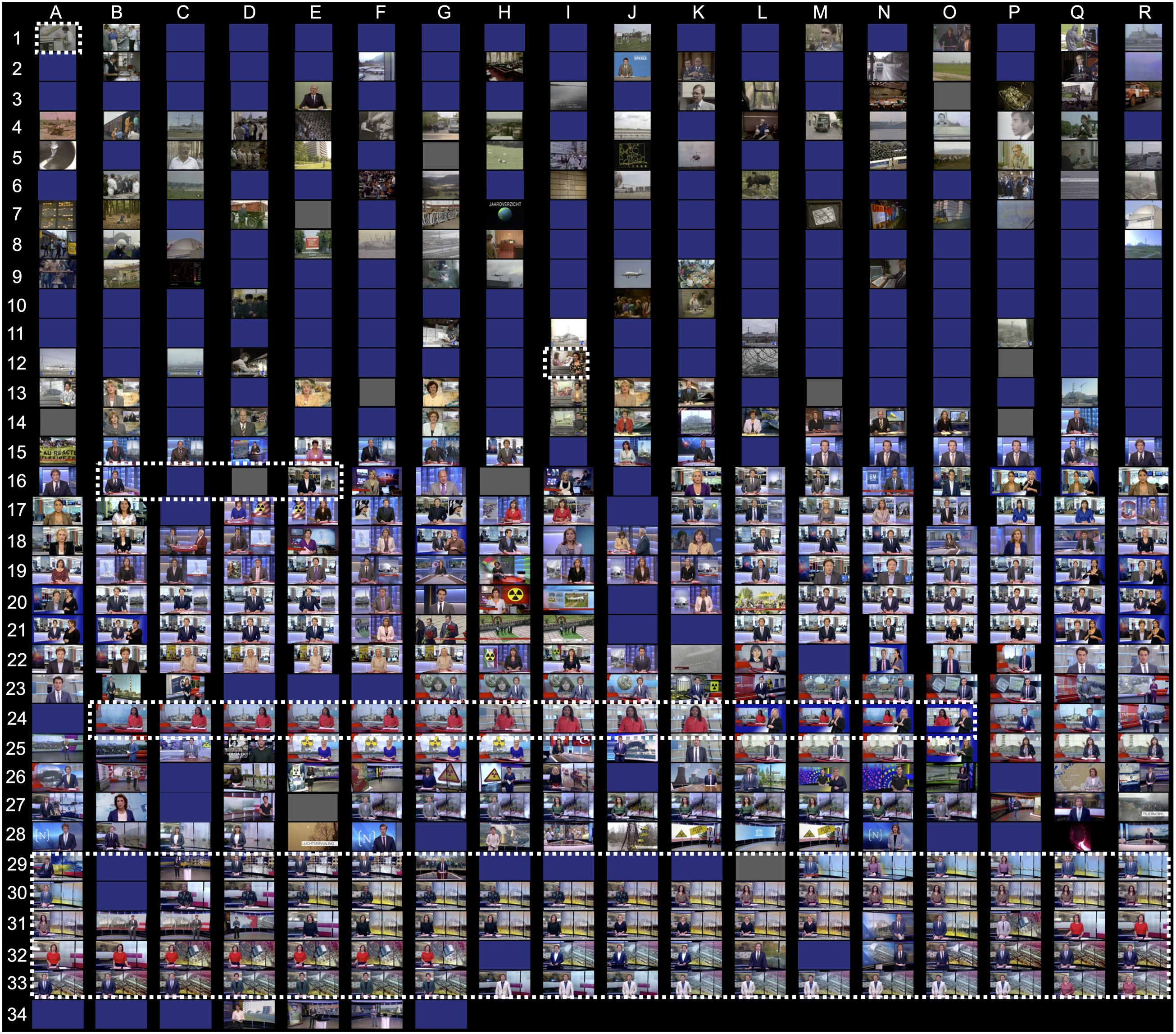
The resulting Figure 1 is a composition of Dutch Chernobyl news items deriving from a 36-year span (1986–2022), providing visual insight into the transformation of news items. This method opens up Williams’ long-range analysis of flow by looking at the repetition of imagery across days and years, adding a visual layer to it. It also fits Ellis’ idea (1992: 106) of the role of imagery in sequencing, in which the (simplified, ‘stripped-down’) imagery hooks the viewer. In our case the stripped-down imagery is the very first shot of each TV news item on Chernobyl, setting the scene for the remainder of the item.
The screenshot composition contains various noticeable changes in the series of broadcasts, the first of a technological nature. In 2007, the Dutch public news broadcaster NOS switched from a 4:3 to a 16:9 wide-screen aspect ratio in their programmes. This aspect ratio was archived accordingly and, in Figure 1, this transition is clearly visible in row 16 (see screenshots 16-C to 16-F). Secondly, we see a change in the design of the news studio, the camera standpoint and position of the news anchor, in which the early news programmes show more anchor and less background and the newer ones more background screens and more dynamically standing (instead of sitting) news anchors. In addition, we see a change in the archive’s appraisal policy. In 1986, the year of the disaster, the archive only preserved clips of news footage, so-called ‘orphaned’ footage. In this kind of footage, the programme leader, the news anchor, and some of the other items are not preserved. Our first news item (screenshot A-1), for example, contained a short 30-s clip of radiation measurements in Helsinki, 2 days after the explosion in Chernobyl. The Chernobyl news collection until 1995 consisted mostly of these individual, ‘orphaned’ news.
After 1995, full news broadcasts slowly started seeping into the collection. This can be identified through the first screenshot of a news anchor in a studio, visible in row 12 (screenshot I-12). Archiving those full broadcasts became the archival standard from 1996 onwards with the archived EVN broadcasts as the only exception. These news clips originate from the European Broadcasting Union (EBU) and contain raw news footage that news broadcasters in Europe can reuse and incorporate in their programmes. Some EVN Chernobyl items can be identified through an opening text page, but others are simply full screen news reports. This raw footage is not broadcast as such but reused in the broadcast TV news. The screenshots method, therefore, also showcases television which was not broadcast.
Apart from these (abrupt) changes, Figure 1 predominantly highlights the repetition that characterizes television as a medium. TV news specifically is known for continuous updates throughout the day, as well as the (partial) repetition of news items. In Figure 1, this repetition is best identified through the repetition of news anchors in the screenshots after 1995 (from row 13 onwards). From these screenshots, it is apparent that the item usually exists of a news anchor directly addressing the viewer, with a teleprompter speech that is supported by images projected in the background. While news anchors change throughout the day (usually around 12 p.m. and 18 p.m.), the repetition of these anchors and their daily attire clearly identify same-day news. The same news anchor is also often repeated in the screenshots. In another example in Figure 1 (row 24), the news anchor presented a story about the 30-year anniversary of the Chernobyl disaster on 26 April 2016. Through imagery of this specific news anchor, we can identify that their news story has been, at least partially, repeated at least 14 times that day, including repetitions through news episodes for the hearing impaired. Together, the news anchors in Figure 1 indicate the frequent daily repetition that is such a crucial part of televisual flow.
The repetition of the same news anchor is not the only pointer for identifying potential reuse and repetition. A (partially) repeated news item can also be identified through the full-screen or projected background images accompanying the news anchor. Figure 1 brings this visual repetition to light. Initially, the Chernobyl news was represented visually through images of the reactor, visible in the top-half of Figure 1. The recognizable ventilation stack striped white and red became the iconized visual representation of the Chernobyl disaster. In 2016, the exploded reactor in Chernobyl was covered with a sarcophagus to protect the outside world against the reactor’s still harmful radiation. This half dome, now covering the ventilation stack, became the new visual of the Chernobyl discourse, which was used and reused frequently in 2022, when the war in Ukraine endangered the safety of the nuclear reactor. Pictures of the sarcophagus in yellow lighting were used 24 times in this time period (see rows 29–33). Another, well-known, image is the yellow symbol for radiation danger, which was used 15 times. As such, this method of identifying recurring background imagery shows that what Uricchio (2010: 30) describes as ‘recycling of news footage’ also refers to photographs, video stills and symbols, leading up to potential iconization.
Colouring broadcast schedules
In the second method, we investigate the distribution of the programmes: what is broadcast and when, and how this relates to what is being archived. In this colouring broadcast schedules method, we compared the broadcasts mentioned in the broadcast schedules originating in the digital newspaper NRC Handelsblad, with the broadcasts as archived in the television archive. We repeated this approach for three relevant dates: (1) 3 days after the disaster and the first day of Dutch news on the topic (30 April 1986); (2) the day after the Fukushima nuclear disaster, in which Chernobyl was frequently used as a comparison (12 March 2011); and (3) a day in the first weeks of Russia’s invasion of Ukraine, which featured ample news coverage of the Chernobyl power plant (4 March 2022). These three dates are specific snapshots of historical reference. This method remains the closest to the long-range flow analysis of Williams (2003), in which he analyses evenings of programming; our approach extends this by adding an archival layer to it.
In terms of techniques, we manually compared which programmes from the newspaper schedule were preserved in the archive, by juxtaposing them to the recordings and their metadata in the CLARIAH Media Suite, after which we colour coded accordingly. The resulting Figure 2 represents the juxtaposition between programme distribution and programme availability in the archive. As Figure 2 shows, there is a clear discrepancy between the originally scheduled broadcasts, and the programmes actually preserved in the archive. Only 30% of the programmes scheduled in 1986 were archived, while this increases to 60% for the 2011 schedule and up to 75% for the 2022 schedule. Those gaps in archival practices can, first of all, be explained by the archive’s policy to only preserve Dutch programmes. However, there are also other interesting dynamics at play. Three broadcast schedules, colour coded to indicate availability of programmes in the television archive.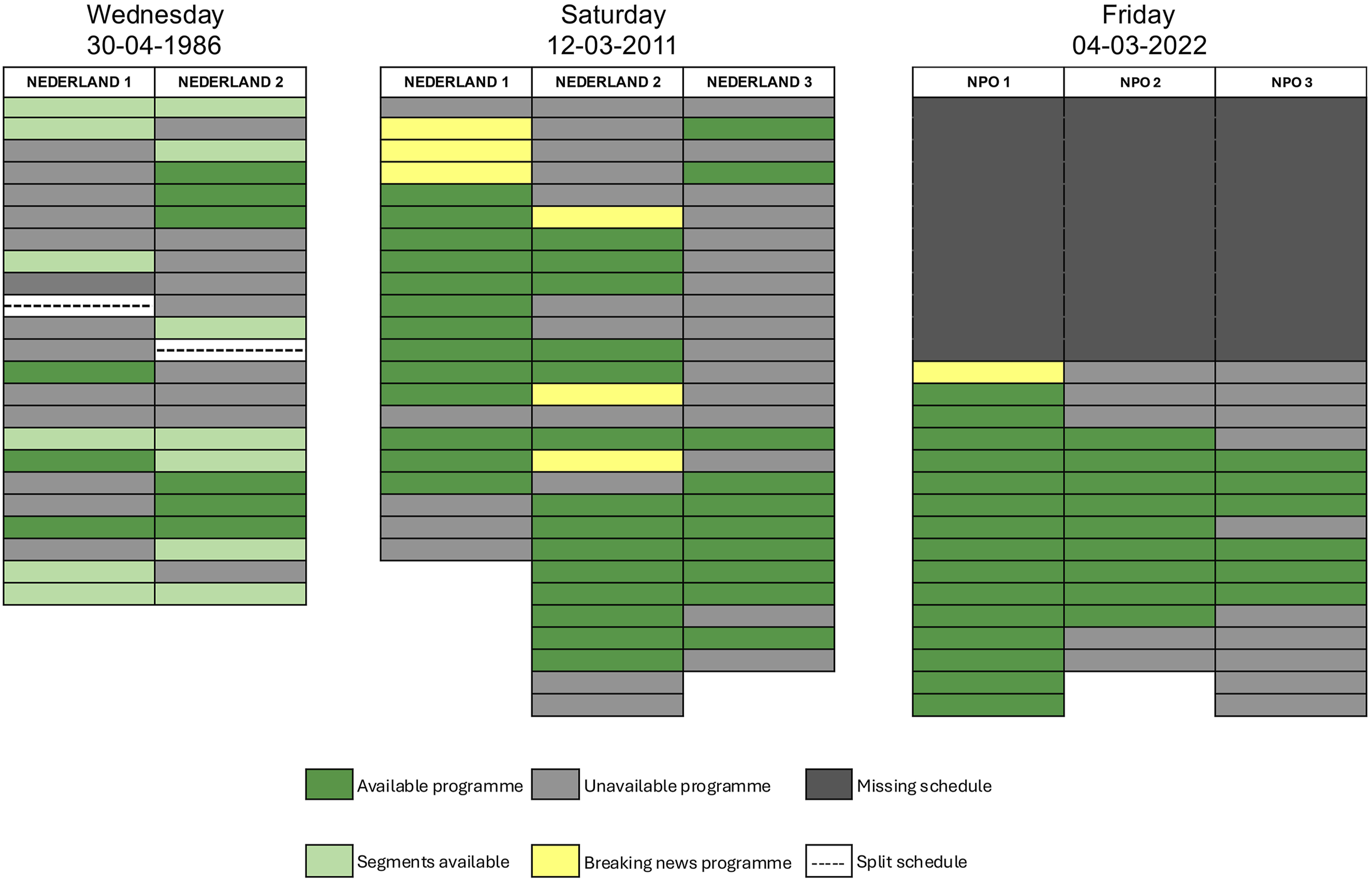
With only nine available programmes, the 1986 schedule shows the least availability and therefore the most obscuration in the archive. We found that the archive predominantly preserved Dutch children shows, next to programmes about politics, news, current affairs, culture, and history. In line with Van Den Bulck’s (2009) research on linear Flemish television, our findings indicate that the educational-cultural logic of the public broadcasters lives on in the archive through its inclusion and exclusion criteria. We found that the 1986 news episodes only consisted of orphaned news segments without broadcasting context (comparable to the patterns revealed through the screenshot method). As it is unclear to which day’s news episode these segments belong, we were unable to match them to the scheduled programme. These items were, therefore, not only decontextualized from the episode in which they were aired but also from their original programming.
The rise in availability in 2011 is exemplary of the digital and daily influx in the archive (initiated in 2007) and the arrival of a third channel, Nederland 3 (in 1988). What stands out in the 2011 schedule is breaking news. On 12 March 2011, the day after the earthquake and subsequent tsunami in Japan, there was a hydrogen explosion in the nuclear reactor in Fukushima, leading to interruptions in the Dutch scheduled news programme of that Saturday. Weekend news broadcasts usually start later in the morning as compared to weekdays, but on this particular morning four Extra NOS Journaal episodes provided continuous updates of the situation in Japan. While the morning programming on the Nederland 1 channel had to give way for breaking news updates, the broadcasts of the ice-skating World Cup did continue as planned in the afternoon, and the Extra NOS Journaal episodes were moved to the Nederland 2 channel. In this case, televisual flow is consciously crafted out of public motivations (i.e. serving as a public service broadcaster), as well as economic motivations. This shows how flow is part of the set of continuity techniques that maintains a broadcasters’ brand identity (Johnson, 2012; Van Den Bulck et al., 2014).
In contrast, the 2022 schedule shows the most available programmes compared to the other 2 days. Still, this schedule shows how the archive’s policy actually obscures temporal context. As the archive has to make selections, it does not preserve programme repetitions or re-broadcasts. 6 Thus, while reruns follow a key programming logic (Kompare, 2004), this does not translate to the archive. However, we encountered two variations of re-broadcasts that were archived. First of all, news for the hearing impaired is a re-broadcast of earlier news (in-screen) but with a sign language interpreter in front. Secondly, in 2022, the same news broadcast was aired on two different channels at the same time (at 5 p.m.) which were then both archived. This means that for the archive, a re-broadcast is only a re-broadcast when it is aired in exactly the same format but at a different point in time.
Furthermore, it is important to probe the temporal characteristics of the broadcast schedule as printed in the newspaper, as this too affects the temporality of television. Just as broadcast schedules have to segment the flow of television into distinct units, they also have to begin and end at a certain point, going against the continuous broadcast that characterizes television. This is specifically visible in the nighttime programming, which was not included in the broadcast schedules, excluding the viewers who watch television at night. The nighttime programmes were, however, preserved in the archive. Metadata descriptions show that in 2011, the nighttime television programming actually consisted of several filmed radio programmes among other programmes. The archive also had to make a cut here to determine the date of a programme, with all programmes after 12 archived not as Saturday 12 March 2011 but as Sunday 13 March 2011. What we can see here is that both the archive and the planned schedule have to segment a televisual flow that is characterized by a continuous, uninterrupted broadcast of programmes.
Television schedules always have a specific cut-off point, obscuring the continuous flow of television. They do, however, provide a valuable source of information regarding distribution context and the newspaper’s perspective on what is considered important television. Precisely these cut-off points in the newspaper schedules reflect the changing societal position of television over the years. In 1986, the daily broadcast schedule was actually spread out over two different newspapers. The daily paper would reflect the schedule of that day but only starting from 6 p.m. up until midnight. This is because our newspaper source, the NRC Handelsblad, was an evening newspaper, which used to be delivered in the afternoon. In 2011, NRC was still an evening newspaper during the week but then became a morning newspaper on the weekend. Therefore, as our 2011 schedule is of a weekend day (a Saturday), this NRC edition also contains the morning schedule. It mirrors the newspaper’s idea of the 9-to-5 workweek with free time on the weekends, implying that people do not have time to read and watch during the week but ample time on Saturday and Sunday mornings. From 2022 onwards, the schedule is no longer split in two, but there appears to be another gap. Although the newspaper had become a morning one, the schedule starts at 4 p.m. This suggests that the newspaper caters to viewers who (only) watch television during prime time in the evening. It can also be explained by the rise of SVOD, which has reduced the relevance of linear schedules for many viewers, prompting the newspaper to devote less space to broadcast schedules. In sum, similar to the schedule break at 4 p.m. in 1986 and the lack of a break in 2011, the planned television schedule in 2022 still represents the role of linear television in the flow of daily life.
Colouring speech transcripts
Our third and last easy-to-use method zooms in on the archival speech transcripts of the same 3 days as chosen for the previous method. While news consists of individual segments (Ellis, 1992: 119), a type of flow is present in the episode itself and across episodes. To investigate this interplay in temporality, we focussed on the segmentation apparent in speech transcripts, in order to understand the segment’s length and position within the broadcast compared to the preceding and succeeding broadcasts. In addition, the transcripts also shed light on the speech used in the episode, in which the news anchor’s speech is believed to contribute to the construction of flow (Williams, 2003). In this method, we colour-coded the available transcripts of all news episodes to literally highlight the news item segmentation. This method is a digital and contemporary update of Williams’s close-range flow analysis in which he analyses speech in TV news. In our case, transcripts were no longer made manually, by the researcher, but by means of AI–automated speech transcripts.
A caveat, however, is that we could not implement the method as originally intended, given that the speech transcripts were not widely available in the archive. For the first day in our corpus, 30 April 1986, no transcripts were available, and for 12 March 2011, only Automatic Speech Recognition (ASR) files were accessible. Furthermore, for 4 March 2022, we could only access Closed Captions (CC) for the hearing impaired. ASR and CC files largely differ, which complexifies comparison. The ASR transcripts are generated by AI-models and primarily deployed to facilitate retrieval in the archive, while CC transcripts are incorporated for the hearing impaired and generated by the Dutch Teletext Closed Caption service (TT888 in the Netherlands). The latter captions are the result of an editor repeating the televised speech into an ASR model, either live, semi-live (with a small delay), or in post-production, correcting the resulting transcripts where needed after which they are incorporated in the original broadcast (Meinedo et al., 2008). Each type of speech transcripts leads to similar insights, but the CC transcripts were the easiest to work with.
Figure 3 shows the ASR transcripts of TV news on 12 March 2011, the day of the Fukushima breaking news reports. These transcripts originated in two Extra NOS Journaal episodes and two regular episodes. Identifying the segments of the extra news reports turned out to be challenging, as these segments appeared to be a continuous broadcast about one and the same topic – Fukushima. In addition, ASR cuts spoken words into separate sentences based on breaths/pauses, which do not necessarily match the actual sentences. Therefore, new segments often start mid-way in a speaker’s sentence. However, we could still identify the start of a segment in the ASR by the introduction of names of experts in the studio on the one hand or the names of foreign correspondents or the place of reporting on the other hand. Conversely, we could identify the end of a segment through words such as ‘thank you’ (Extra NOS Journaal 8 a.m., 12 March 2011) or ‘good luck’ (NOS Journaal 6 p.m., 12 March 2011). Additionally, the Fukushima items are marked off with ‘so far the news on Japan, let’s now move to [different topic]’ (NOS Journaal 6 p.m., 12 March 2011). Similarly, as Williams shows (2003), these signifiers indicate differences between the various segments and create continuity between them. Segmentation colouring of four TV News episodes on 12-3-2011 based on automatically generated speech transcripts (ASR) by the archive.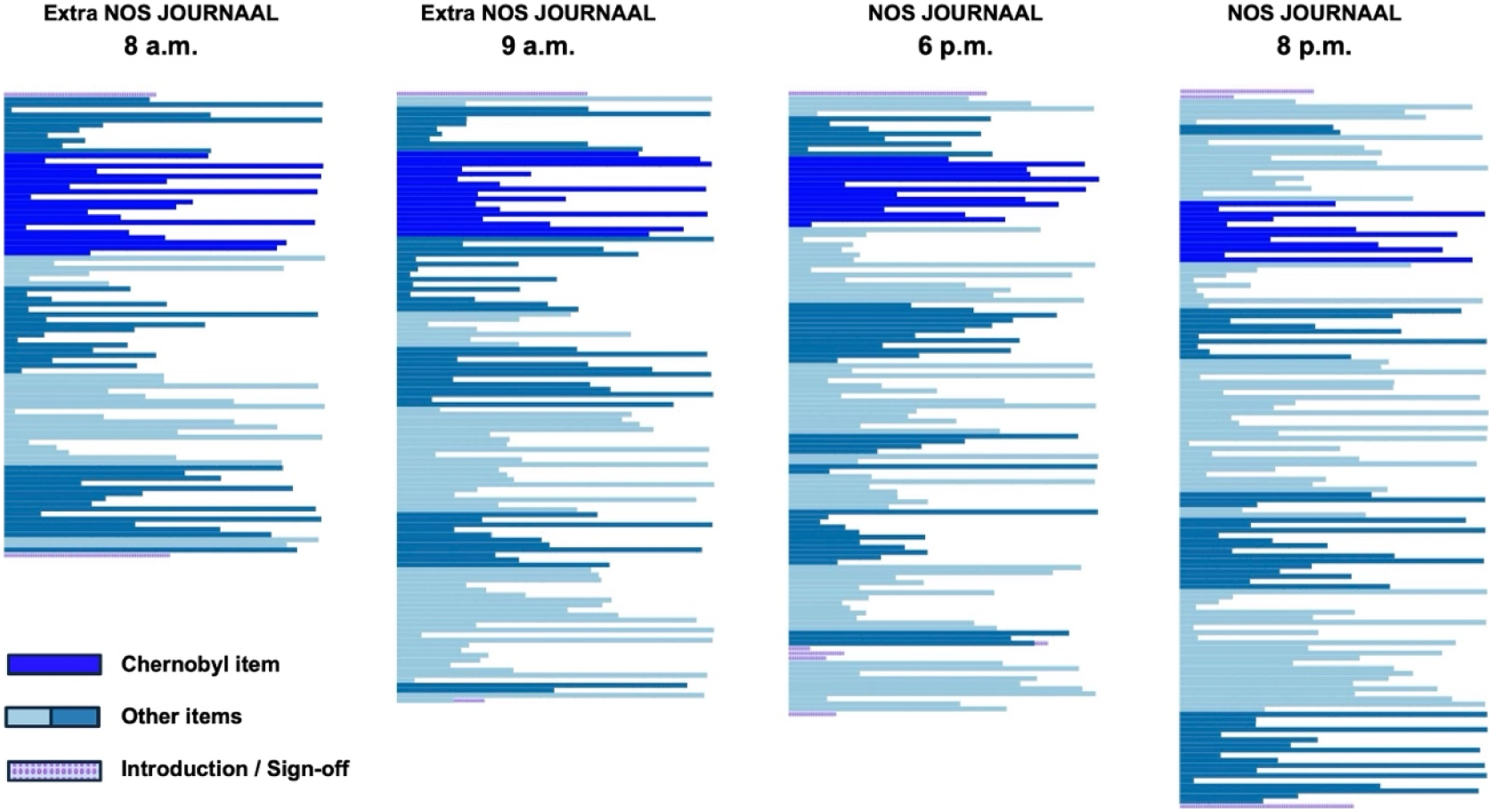
In comparison to the ASR transcripts, the segmentation is far more visible in the CC transcripts in Figure 4. Interestingly, signifiers marking the beginning of new segments (such as ‘now’ and ‘let’s move to’), are always at the start of a new sentence while they are in the midst of longer sentences in the ASR transcripts. This means that the episode flow is more obscured in the ASR transcripts but more intact in the CC transcripts. Segmentation colouring of six TV News episodes on 04-03-2022 based on archived closed captions.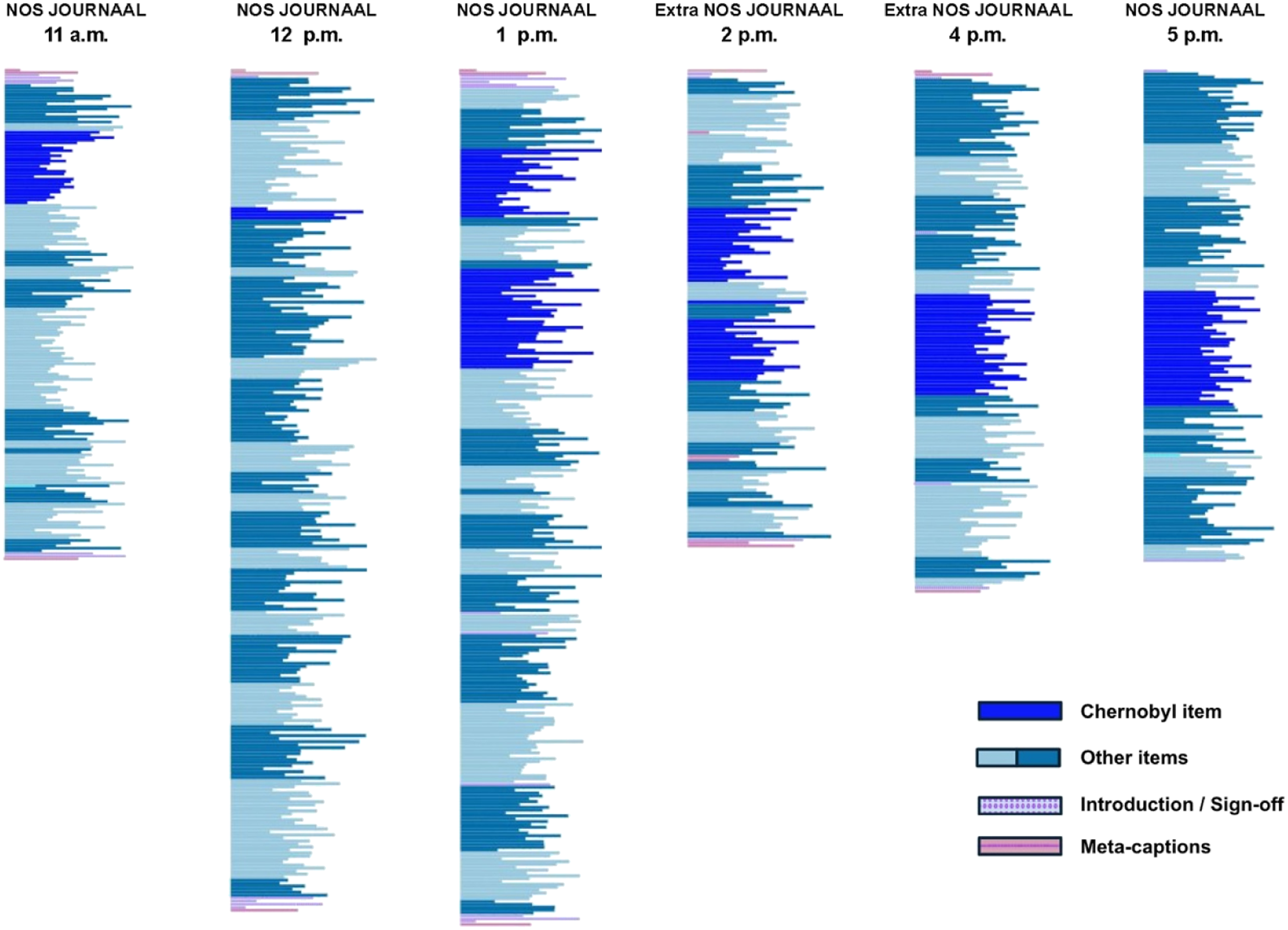
When juxtaposing the 2 days, the CC transcripts (Figure 4) show much shorter sentences compared to the ASR transcripts (Figure 3). This discrepancy is caused by the captions being cut in two or three parts to fit the size of the screen, during broadcasting. Additionally, captions are often shortened to keep up with the pacing of the televised speech. Interestingly, the CC transcripts commence with the warning: ‘this is transcribed live, captions can be behind’, which accentuates the televisual characteristic of liveness while at the same time interrupting the viewers’ experience. A similar interruption of meta-captions takes place in the transcription of sounds that is incorporated in the TT888 captions, including contextual information for the hearing-impaired viewers, for example, indicated by the terms ‘SINGING’ (Extra NOS Journaal 4 p.m., 4 March 2022) or ‘A WOMAN CRIES’ (Extra NOS Journaal 2 p.m., 4 March 2022).
Furthermore, the items in which Fukushima is compared to Chernobyl are consistently placed as the second or third item in the ASR transcripts (Figure 3). In the Extra episodes, almost all items are connected to the events in Fukushima, whereas in the regular episodes, other news items are grouped together in the second half of the episode. In the 2022 CC transcripts (Figure 4), we see a different pattern regarding the episodes that discuss the Ukrainian war situation in the Chernobyl area. These 2022 episodes discuss the Chernobyl item with priority and intensity, repeated in different segments. However, as the day evolves, the item is discussed at the end of the episodes from 5 p.m. onwards, and even completely left out in the later episodes of that day, to make room for other incoming news. These choices reflect the news value appointed to the different news items by the programme makers, as well as the changes of their estimated news value throughout the day. This shift in news value (what news items are deemed worthy or disposable or no longer relevant) evidently depends on the value of other incoming news stories.
When analyzed together, both the ASR and CC transcripts’ figures clearly show the programme’s construction of flow within the particular episode. At 8 a.m. of 12 March 2011 (at the end of the NOS Journaal episode), the news anchor kept the viewer engaged by announcing more news updates on the situation in Japan in the next hour, encouraging the viewer to keep watching. In all news episodes analyzed, the news anchor mentioned subsequent news broadcasts. On 4 March 2022 for instance, the anchor announces that at 12 p.m. and 1 p.m., the episodes will concern sports, while at 4 p.m., upcoming regional news is announced. Subsequent viewer habits are literally encouraged, and viewers are informed about how their future watching experience will differ from the experience that they just had. The latter is in line with general television’s interpenetration programme logics (Uricchio, 2010: 30), in which hooks are used to redirect and grip viewers to viewing subsequent programmes.
Our method and findings reflect the repetition inherent to televisual flow, as one of the characteristics of TV news (Uricchio, 2010: 30). This is particularly visible in one studio interview at 12 p.m. on 4 March 2022 that was identically repeated the same day in later episodes, as apparent from the CC transcripts (Figure 4). There is a noticeable contrast with the ASR transcripts (Figure 3), which do not contain that much repetition. This can be explained by the ASR technology wrongly identifying speech, or missing non-Dutch language, leading up to mistakes and gaps in the transcripts (Van Gorp and Van der Deure, 2025). The CC files, on the other hand, contain fewer and therefore more identical repetitions. Because of human intervention, the CC transcripts also reflect the reuse of repeated news scripts, indicated by transcribers consistently leaving out or changing the same words. This also reflects television’s temporal characteristic of liveness, as the (semi) live transcribers correctly abbreviate the name ‘International Atomic Energy Agency (Internationaal Atoom Agentschap)’ to IAEA, while this is never pronounced in this way during the episode (NOS Journaal 12 p.m. and 1 p.m., 4 March 2022a, 2022b). The archived CC files are therefore more suitable for investigating repetition than the ASR-files.
Conclusion
To conclude, we posit in this article that to recapture archived television’s temporality, one needs to consider the complex interplay between what is archived, what is broadcast, and how this is done. By manually analysing a variety of archival materials (metadata, videos, broadcast schedules in newspapers, and speech transcripts) derived from a multitude of broadcasts, we have demonstrated how the temporal heterogeneity of archived television can be recaptured. While the screenshots method and the speech transcripts reveal the role of the imagery and speech respectively, the schedules method emphasizes the role of programming in constituting temporality. Together, the methods show how archived television is the epitomy of a ‘recombinatory practice’, in Uricchio’s (2011) sense of the term, in which flow, segmentation, and repetition are mixed with archival reordering processes.
The screenshots method has shown the power of repetition and recycling not only in terms of repeated photographs, videos, and stills but also in terms of repeated news anchors and symbols in the background. Hence it stressed the importance of the visual in the construction of flow, segmentation, and repetition. In addition, the screenshots method is deemed to be most apt for identifying changes over time in terms of policy measures, technology, and design. The speech transcripts method, then, allowed to analyse news segmentation (including the position of items), as well as news anchor speech, which highlighted the repetition present in the episodes. At the same time, the speech transcripts have shown a clear example of how flow was established: how the script urges the viewer to keep on watching and not pause or discontinue the viewing process, while tying together the repeated news episodes of 1 day. The CC transcripts, interestingly, also held traces of the liveness of the broadcast, making them more valuable as resource than the ASR transcripts. The screenshots and speech transcripts methods have proven to be the most useful for recapturing television’s temporality. The schedules method has shown mostly how policy impacted scheduling, but the strength of the latter method is its ability to reveal the archival context.
Our analysis has also provided new, digital examples of the ways in which the archiving of broadcasts ‘reinterprets’ and ‘reorders’ television temporality, as Spigel (2010) claimed. We found that the separate clips were not only decontextualized from the episode in which they were aired, as seen in the screenshots method, but also from their original programming, making it impossible to situate them in the broadcast schedules. In addition, the schedules method has revealed that both the television archive and newspapers (for their broadcast schedules) have to decide when ‘a television day’ starts and ends, in the process revealing what they consider to be important television. Nighttime television is deemed less important, indicated by its non-presence in schedules, and the same can be said about daytime television once SVOD entered the media landscape. The schedules method has also shown how the technological advancement of digital, daily influx in the archive has led to a larger number of preserved programmes. Finally, this method has shown that re-broadcasts are not preserved by the archive, hence obscuring them, while the screenshot method has also revealed that archives preserve programmes that are not broadcast.
The wider applicability, however, differs from method to method. While the schedules method is not dependent of the chosen genre of the case study, the screenshots and speech transcripts methods seem to work the best with TV news. Our choice for TV news, then, also had the benefit that we could look closer at the role of ‘breaking news’: breaking news disrupted the broadcast schedules and was also clearly traceable in the speech transcripts, making it an interesting case study to scrutinize further. The speech transcripts method would probably also work well to analyse flow in ‘weekly recordings’ (see Johnson, 2012), as those recordings contain the scarcely archived interstitials (Van Gorp, 2023). The screenshots method would probably work well with other heavily serialized programmes, such as talk shows, drama series, or sitcoms. However, archival access to fictional genres tends to be more restricted due to high costs to clear the rights (cf. Hagedoorn, 2019: 432). Consequently, in practice the screenshots method is probably most applicable to TV news.
Copyrights and restricted access had a big impact on our methods. Since the screenshots method is a visual method, it implies that researchers have to clear the copyrights when they want to print their screenshot compilation in publications. Clearing copyrights proved to be cumbersome, especially with 602 screenshots in our case. In addition, our methods are also dependent on the degree of access to national television archives. As researchers based in the Netherlands, we had access via the CLARIAH Media Suite, while researchers outside the Netherlands have no access to the majority of the videos. In other countries such as in France (INA) and UK (BBC), there are similar options for researchers, but mostly nationally bound in terms of access and available content. Moreover, many archives generate speech transcripts, but it is challenging to provide scholarly access to them due to copyrights and sustainability issues (Ordelman and Van Hessen, 2018). The broadcast schedules method is the only one that is accessible to a great degree through institutional or individual subscriptions to digital newspapers. One of the benefits of our methods, then, is that we could tackle the copyright restrictions on the reprint of speech transcripts and broadcast schedules by covering the copyright-protected texts under the highlight marking.
At the heart of our article is the need to triangulate different methods and a variety of archival materials with profound critical reflection on the archival access to context. Revisiting Nelson and Cooke’s (2010) statement in our introduction, digitization has indeed an enormous potential, but it still faces critical barriers. While our methods require only basic computer skills, their effectiveness remains conditional on the accessibility of archival materials. Ultimately, our article presents practically employable methods and detailed insights in temporal context, while also emphasizing the need for broader access to that same temporal context.
Footnotes
Acknowledgements
We wish to thank the two anonymous reviewers for taking the time to provide detailed feedback, the Netherlands Institute for Sound and Vision for their help with their collections, and Maaike van Cruchten for her advice on the visualizations.
Author contributions
Conceptualization: JVG, MvdD - Investigation: JVG, MvdD - Methodology: JVG - Visualization: JVG, MvdD - Data Curation: MvdD - Writing (Original Draft): JVG, MvdD - Writing (Review & Editing): JVG. Both authors have read and agreed to the published version of the manuscript.
Declaration of conflicting interests
The authors declared no potential conflicts of interest with respect to the research, authorship, and/or publication of this article.
Funding
The authors disclosed receipt of the following financial support for the research, authorship, and/or publication of this article: The research has been conducted as part of the projects Re-Frame (Click-NL ppp programme and the Netherlands Institute for Sound and Vision) and NWO CLARIAH-PLUS (Grant 184.034.023).
