



Abstract
This study explores disability representation in the transnational television crime drama Midsomer Murders (1997-present). It focuses on Lana who has a partial right arm and how she is positioned as a central figure in the Christmas 2023 episode. The analysis reveals a complex and contradictory pattern of interwoven ableist and anti-ableist ideas. Even though negative stereotypes are avoided, Lana’s portrayal is simultaneously visually and emotionally conditioned to avoid alienating audiences. The study speaks to critical scholars across disciplines with a broad interest in the fictional television crime drama and its abilities to communicate social (diversity) issues.
Introduction
Television crime dramas often start off with a dead body (Turnbull, 2016), not seldom a woman’s dead body (Brunsdon, 2013). Not so in the Midsomer Murders’ (1997-present) episode ‘A Climate of Death’ (S24, E4): here, a woman who is very much alive gets to introduce the story. In the opening scene, the camera zooms in on a blonde woman in her early thirties. Standing in a green valley landscape on a blue-sky day, the woman is busy managing an electronic device. The fact that she has a partial right forearm/hand is clearly visible in the shot. The scene continues to show the woman pressing buttons on a screen, getting up from a kneeling position adjusting her handbag and gazing out over the fields with a hard-to-read look on her face. The 40-s scene introduces Lana Markham, meteorology researcher and environmental activist, as a prominent character in the episode’s upcoming narrative. Lana is played by the British actor Melissa Johns who was born without her right forearm and hand (Purcell, 2024).
The Lana character can be said to illustrate the broadcaster ITV’s ambitions to ‘shape culture for good’ by improving their work on diversity, equity and inclusion (ITV, 2023). But apart from fulfilling diversity plan ambitions and acknowledging demands from disability advocates, ITV along with other commercial media companies must work to maximise audiences by alienating as few as possible (Kellner, 1995). This is achieved by incorporating ‘a variety of discourses, ideological positions, narrative strategies, image construction (…) which rarely coalesce into a pure and coherent ideological position’ (Kellner, 1995: 93; see also McGillivray et al., 2021). ITV need therefore judge what audiences are thought to tolerate regarding disability representations so as not to lose viewers. Such a pre-judgment may be especially important when the show is ‘transnational’ (Coulthard et al., 2018) and reaches people in over 200 countries around the world (Morgan, 2016). Indeed, the pursuit of commercial success and a global distribution are factors that have been found to hinder to what extent diversity issues can be pushed in a television production (Conway, 2017).
On the positive side, at least British television audiences seem to appreciate disability representations and believe that broadcasters have become better at showing people with disabilities than before (Ofcom, 2018). Indeed, there seems to be a current heightened visibility of sorts when it comes to, especially, female actors cast as characters with disabilities. Besides playing Lana, Melissa Johns has featured in a number of high-profile drama series in the UK in recent years. A female character with a similar disability as Johns can be seen in the latest two seasons of another major ITV crime drama, Vera (2011-25), in the form of DC Steph Duncan (played by Rhiannon Clements). Other contemporary UK crime television fiction shows with leading women with disabilities include Code of Silence (2025-present) and Patience (2025-present).
At the same time, Caroline Hodges et al. (2014a) observe that even though viewers may articulate a politics of disability inclusion, they do not necessarily recognise actors with disabilities or watch such programming unless accidentally stumbling across it. So, even though an increased representation of people with disabilities on screen in a wider variety of roles may be welcomed by many, it is also conditioned (Sancho, 2003). Factors such as matching (characterising a person with disability like everyone else), likeability (possibility for emotional connection), celebrity (use of famous actor in disability role) and incidental inclusion (not focussing on the disability) have been found to increase audience acceptance of people with disabilities on television (Sancho, 2003). Notably, a study of American scripted television series between 2016 and 23 (Conroy et al., 2024) showed no positive trend when it comes to increased disability representations on television in the US, nor did it show any improvements in authentic casting (characters with disabilities played by people with disabilities). This latter fact is especially problematic since, according to disability advocates, to have people with disabilities play disabled roles is crucial to provide authenticity, employment opportunities and nuanced storytelling (Kelly, 2025). However, in the case of the Midsomer Murders episode analysed here, Lana is authentically cast.
Television crime and, specifically, media representations of crime, criminals, law enforcement, courts or prisons have been extensively studied (e.g. Jewkes, 2015; Mason, 2013; Mittell, 2004; Turnbull, 2010, 2014). However, the present study speaks to scholars across disciplines with a broad interest in the fictional television crime drama and its abilities to communicate important social issues (that is beyond crime-related ones) within a popular entertainment genre. In fact, dealing with ‘unconventional representations of people with disabilities’ in television crime fiction may not be such a straightforward thing (Klein, 2011: 913), for even though producers of entertainment television recognise the lack of visibility of people with disabilities as well as the media’s tendency to wholly focus on disability when represented, they do not want to tell audiences what to think (Klein, 2011).
This paper departs from the idea that the construction of Lana in Midsomer Murders needs to articulate ideas, discourses and ideologies that support both a progressive (pro-disability equity representation) position, as well as a more conservative position (where disability inclusion on equal terms is not self-evident), to not risk alienating audiences (Kellner, 1995). The delicate management of these two communicative tasks in the show will be examined through an in-depth analysis of the Lana character’s construction, her role in the narrative and, importantly, the camera work used to portray her in the story. The results point to the reproduction of a complex pattern of ideas, discourses and ideologies related to people with disabilities which go beyond good or bad stereotyping.
The study contributes to research at the intersections of media culture, social issues and entertainment television, and (specifically) television crime drama, women and disability representations in the media. In addition, the detailed attention to the visual representations of Lana adds to critical scholarship on crime, media and visual imagery (Greer et al., 2007). My focus on the long-running Midsomer Murders television production means that I shed light on a ‘relatively invisible’ or ‘old’ type of television series which Hills (2010) has argued deserves additional empirical and theoretical scholarship.
In relation to Television Studies specifically, this study can be positioned as one that combines a detailed inquiry into the text’s aesthetic dimensions with an ideologically driven framework for the evaluation of the programme’s stylistic choices. It thus tries to bridge an identified division between what is viewed as two different and sometimes conflicting approaches within Television Studies (Cardwell, 2013). As such, I find that it by and large subscribes to the suggested ambition of conducting ‘aesthetic criticism’ (Walters, 2024). That is, to perform both close textual analysis and (critical) evaluation, with the aim of furthering our knowledge and understanding of contemporary disability representations in transnational television crime drama. However, my point with this article is not to explicitly contribute to the debate around television aesthetics, which is why I refrain from talking about, for example, various strains of media stylistics (Butler, 2010) in my analysis. In line with my identity as a professor in Media and Communications, I prefer to speak of ‘communicative choices’ rather than stylistic/aesthetic ones even though they overlap in certain respects.
Language statement
Language preferences in disability discourse vary greatly depending on several different background factors (Aspler et al., 2022) and often reflect one’s own mindset (Vehmas, 2024). The impairment that the fictional character Lana shares with real-life actor Melissa Johns is, in medical speak, termed congenital amputation, defined as ‘missing or incomplete limb(s) at birth’ (MSD Manual, 2022). For Lana/Melissa, the impairment is manifested in a partially developed right forearm/hand. In the analysis, I will use a factual and de-medicalised terminology and will speak of Lana’s ‘partial (right) arm/hand’ or simply her ‘right arm/hand’. As my research interest lies on how the production constructs the character of Lana and not on the lived experiences of real-life Melissa, I find the relative neutrality of this description to be appropriate.
Television crime dramas, women’s roles, disability stereotypes and ideals
Crime drama is one of television’s most enduring and successful entertainment genres (Turnbull, 2010), and ITV’s Midsomer Murders is undoubtedly a case in point. Research specific to Midsomer Murders as a long-running television crime series tends to focus on the nostalgic and idealised portrayals of village life and the romantic images of England and English society (Moore, 2020). Tiffany Bergin (2013) suggests that its worldwide appeal lies in the fact that the nostalgic view of rural Britain has extended to non-British audiences. The 100th episode of Midsomer Murders has drawn specific research attention for its co-production between Denmark and the UK (Redvall, 2016). Neil McCaw (2011) compares the original novels’ narratives and characters on which Midsomer Murders is based with the television versions. He argues that the series offers ‘TV viewers a carnivalesque escape from any serious social engagement with questions of criminality and social responsibility’ (McCaw, 2011: 109). McCaw’s line of argument is especially interesting considering Midsomer Murders’ seeming embrace of the social issue of disability diversity and representation in the episode ‘A Climate of Death’.
As already mentioned, Lana avoids death at the start of the story which is otherwise a common way of opening television crime (Brunsdon, 2013). Critics argue that television crime dramas continue to reproduce misogyny in their showcasing of violated female bodies (Coulthard et al., 2018: 509). Though not a victim, Lana is also not the lead investigator as has become more common for women in television crime dramas. Some argue that this relatively new female detective has the potential to alter the norms, ideas and values of the traditional crime drama in feminist directions (McHugh, 2018). Others speak more critically of a ‘feminist paradox’ where second-wave feminist ideas are recycled in and by the female detective only to reinforce a white femininity (Klinger, 2018: 531). Kate Gilchrist (2022) recognises both problems and possibilities and finds that the representation of the single female detective in contemporary television crime dramas is a complex, ambivalent yet nuanced figure who both reproduces and resists ideas and values connected to conventional femininity. Lisa Coulthard (2018) who examines the ‘thinking music’ accompanying the female detective’s thought processes and emotions in television crime series suggests the existence of ‘an affective turn’ in transnational television crime, where sound is a crucial component that accompanies (female) crime solving.
Television crime has long been criticised for reproducing negative stereotypes of disability (Barnes, 1992; Cumberbatch and Negrine, 1992), and for promoting ableism (Kramer, 2024). Disability is used as a narrative device to motivate criminal characters, increase victim vulnerability or attribute superhuman-like deduction powers to those investigating the crime (Ellis, 2015). Tracy Worrell (2018) claims that representations of disability in the media are inadequate, inaccurate and mostly negative, arguing that they reinforce stigma and misinform audiences about what disabilities are about. Indeed, bodies with impairments seem to always require explanation and action in the media discourse (Grue, 2014), and it is commonplace to emphasise a character’s disability as a central or defining feature (Aspler et al., 2022).
Instead of being negatively stereotyped, it is argued that people with disabilities ought to be portrayed as ordinary people with ordinary problems (Cumberbatch and Negrine, 1992; Oliver, 1990), and disabilities should be realistically portrayed and accurately explained in the media (Riley II, 2005). Alison Wilde (2010: 41) believes that people with disabilities ‘should float freely between stereotypes and multiple roles (…), just as non-disabled people do’. On their part, Shawni Botha and Clare Harvey (2024: 62) think characters ought to be ‘complex, all-rounded individuals, with disability being only one facet of their personhood’. In relation to such arguments, even though a bit self-evident to television scholars, it is worth remembering that ‘media stereotypes’ (Billings and Parrott, 2020) can never reflect real people with disabilities in all their nuances and complexities as their very function is to simplify, categorise and generalise people belonging to different social groups.
Of course, this is not to say that media representations about diversity may not be complex and contradictory in nature. For example, Kyle Conway (2017) discusses the obstacles of challenging diversity stereotypes while at the same time trying to appeal to broad audiences and sell transnational television productions to different cultures. ‘The paradox of saleable diversity’ is found to operate in relation to the Canadian sitcom Little Mosque on the Prairie, meaning that Muslim characters are ‘humanized’ by emphasising ‘universal’ traits to make the show sellable across cultures, a paradoxical process by which difference is erased ‘in the name of diversity’ (Conway, 2017: 30). Conway (2017) speaks of the sitcom’s Muslim representations as being shaped by two opposing forces, one conservative and one transformational, a line of reasoning which has bearing on the disability observations in this study on Midsomer Murders and will be picked up in the discussion section.
Media studies, specifically television studies, are otherwise argued to have neglected disability as a research topic, while disability studies are criticised for having ignored popular television and for having been prone to reductionist readings lacking in theoretical complexity (Ellis, 2019; Linton, 1998; Mallett, 2009; Mallett and Mills, 2015). In addition, disability studies are claimed to have been preoccupied by (mostly) problematic media representations of people with disabilities for the last 30 years (Ellis, 2015; Mallett, 2009). My study complements previous research by focussing on a female character’s representation who has a distinct role in the story but is neither a victim nor a detective. The ways in which her constructions include or exclude her impairment are explored but without the intention of arguing for negative versus positive stereotyping as is otherwise the rule. The complex communicative strategies related to her impairment exposure are instead understood and explained considering the overarching (commercial) workings of media culture. Not least, the study develops research on Midsomer Murders beyond studies on its transnational character and cosy village representations. In the spirit of McCaw (2011), it highlights how a potentially disruptive social issue is (paradoxically) managed in transnational television crime to attract national as well as international audiences (Conway, 2017).
Data and method
The data consists of the 90-min episode ‘A Climate of Death’ (S24, E4) of the crime drama Midsomer Murders produced for the British Broadcaster ITV by Bentley Productions Ltd. It was broadcast on Christmas Day 2023 in the UK and was then distributed for audiences around the world. Although a very selective material, it serves a critical case of strategic importance to a general problem (Flyvbjerg, 2006) as it allows for the study of contemporary disability representations in a globally watched television crime series. The choice of character/actor is especially interesting as the media tend to favour representations of disability that are acquired following accidents or illnesses rather than, as in this case, congenital ones (Hodges et al., 2014b).
The method is a qualitative, multimodally attentive analysis of scenes where the character of Lana is directly present (= seen on camera) or indirectly present (= talked about or represented visually). It is based on social semiotic theory and multimodality studies (Kress and Van Leeuwen, 1996; Ledin and Machin, 2020; Van Leeuwen 2005, 2022). The multimodal attentiveness means that the analysis considers how a range of semiotic resources give rise to different meaning potentials (Van Leeuwen, 2005) related to disability representation. The semiotic resources include not only what is said and done on a general level to advance the narrative, and how things and people look, but, importantly, how scenes are arranged through different shot techniques. The analysis of shots, angles, frames and sizes is informed by The Shot List (StudioBinder, 2020). Although it is common to examine media representations in disability studies (Ellis, 2015), the multimodal approach is less frequent in existing research (Botha and Harvey, 2024). My research therefore also adds to the multimodal study of mediated disability.
Episode summary and overarching visibility of the character Lana Markham
The analysed episode takes place in the village of Goodman’s Land which boasts to be ‘the greenest village in Midsomer’. Feelings run high between those who support eco efforts and those who do not, such as a Texan oilman Rooster (Corey Johnson) who reportedly is about to buy the entire village. Mysterious murders take place, and various dramas between fractions in the village occur. Amidst the various plots is Lana Markham who finds murder victim number one. She is a meteorologist, researcher and climate campaigner whose heart is broken after the disappearance of her former American boyfriend Dougie, something which has left her resentful and angry at the world. Lana’s antagonist is her former friend Harper (Eve Austin), now a social media influencer, who is more interested in her appearance and followers than anything having to do with nature. As things unfold and plots thicken, Harper, who was also in love with Dougie, is revealed as his murderer. Ken (Takayuki Suzuki), who had posed as another climate researcher, turns out to be Niko, a reclusive Japanese billionaire who hired Rooster to investigate the authenticity of people’s climate engagement. Rounding off the story, Niko promises that Lana’s research will be getting the attention it deserves as he rolls it out over the world.
Lana features in 16 scenes throughout the episode making her one of the more visible characters in the overarching story. Summarily, Lana is introduced in (1) the opening scene out in the valley. She is subsequently (2) interviewed by the police after having found the first murder victim, (3–4) seen working in the fields and snubbing off Ken and (5–6) observed entering her home and finding a letter. She is captured (7–9) having an argument with Rooster and later (10–11) talking to her friend Tobit and antagonist Harper and again (12) snubbing off Ken while sorting her recycling into bins. Lana is moreover (13) indirectly present on a photograph with Dougie which is pinned on the murder board at the police station, (14) passed by Barnaby (Neil Dudgeon) in the street, (15) depicted watching and engaging in the church conclusion when the murderer is found out and (16) seen standing outside the pub at the end together with the policemen, Rooster and Ken.
The in-depth analysis focuses on four key scenes or sequences which contribute to shaping the narrative, providing crucial information about the character of Lana Markham. These include (1) the episode’s opening, (2) a mid-narrative row between Lana and Rooster, (3) a near-solving-mystery deliberation by the murder board at the police station and, lastly, (4) the mystery’s revelatory scene in the church at the end of the episode. These will be dissected in relative detail with selected screenshots from the scenes accompanying the discussion. Notably, the overarching visual and emotional production logic that I argue governs the representation of Lana and, which is presented after the scene run-through, builds on close observations of all the 16 scenes above.
Close look Scene 1
The opening scene (approximately 40 s) of the episode consists of six shots all (end up) focussing on a woman. The establishing wide shot shows a rural landscape with green open fields and a small village in a valley on a sunny day, setting the scene of the narrative to the countryside. The shot transitions backwards until a female figure with the back against the viewer is shown in the lower left of the frame (Figure 1). Establishing shot of woman in rural valley landscape (Midsomer Murders/MM/2023 © ITV).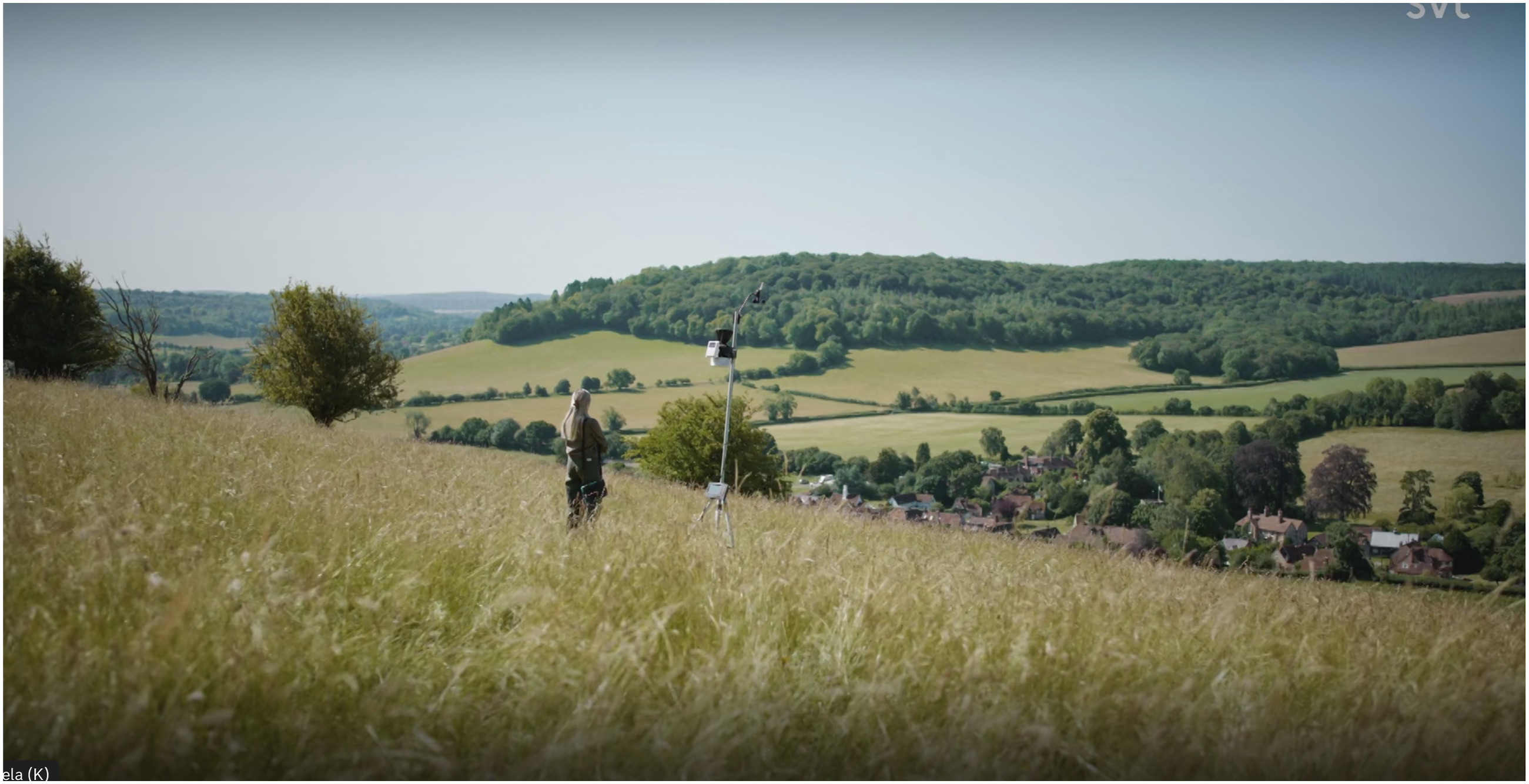
Various measurement devices come into focus before the camera lands on the woman who stands holding an electronic pad in her hands (Figure 2). She is dressed in a green light jacket over a brown t-shirt and green pants and has long blonde hair tied back from her face and low-key makeup. Her brow is furrowed as she looks upwards. Hitherto anonymous woman holding screen device, right arm/hand to camera (MM 2023 © ITV).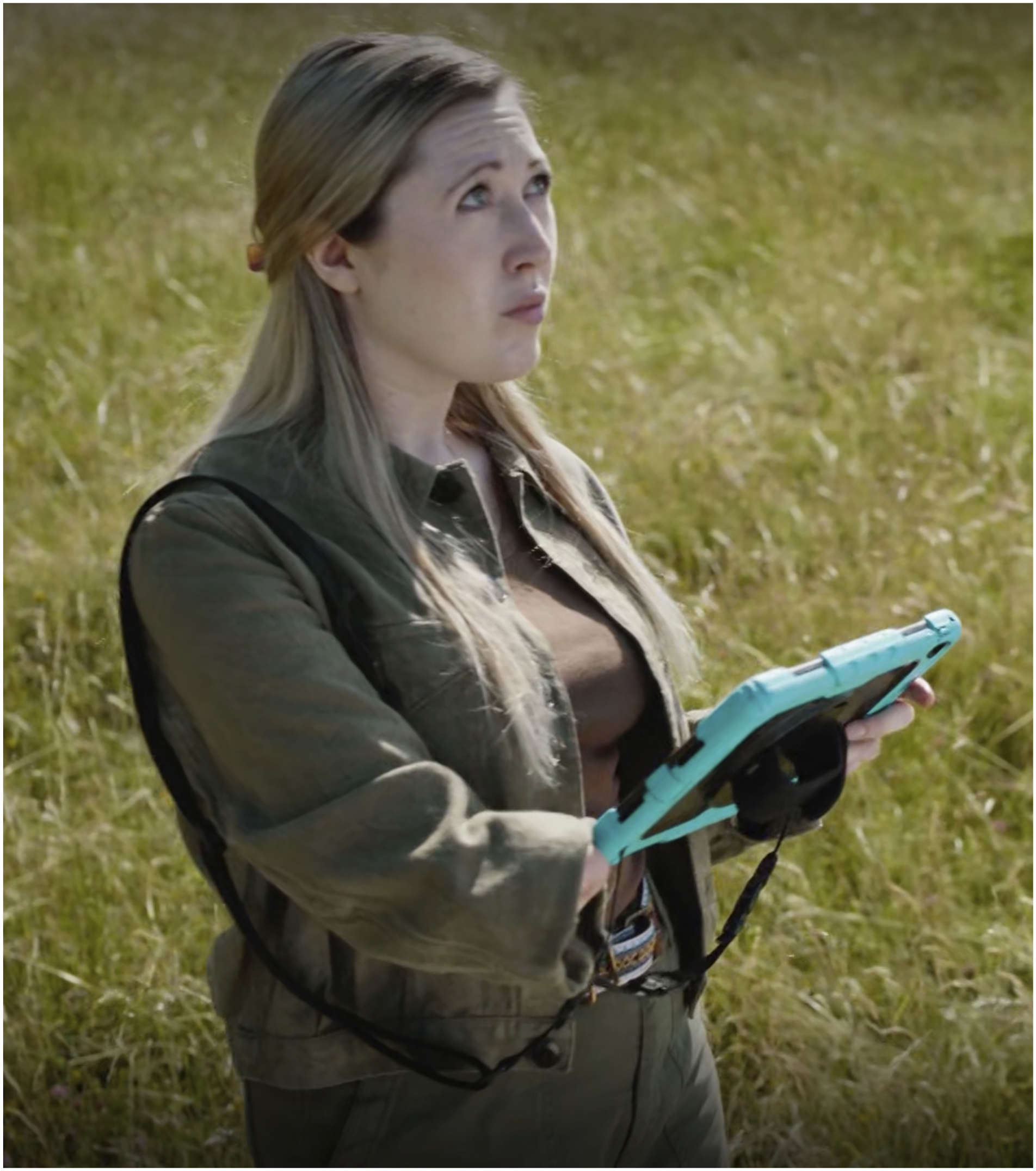
The shot is held for 2 s before moving into a five-second transitional long shot which ends with the woman kneeling by the equipment. The next shot is an extreme close-up of the woman’s left hand pressing a button on what looks like a weather display held for about 3 s. The following shot which goes from a medium to a medium close shot shows the woman getting up from a kneeling position, adjusting a handbag on her right shoulder, crossing her arms and walking a few steps to then stop and look out over the landscape, sighing audibly. The shot lasts for approximately 10 s, and a final wide shot captures the scenery and the woman whose back by the weather equipment is gradually zoomed out to close the scene.
This first scene supplies some essential information to the viewer apart from setting the scene to the green, rural countryside. A Caucasian woman with long blonde hair who wears sensible, practical clothes is shown, thus conforming to a Western, feminine, outdoorsy look and ideal (Figure 2). Her green/brown attire melts into the hues of nature suggesting that she identifies with the environment and/or wants to blend in rather than stand out as a person. It is an eye-level, medium full shot which establishes viewer connection without evaluating her, and the hip-level (‘cowboy’) shot lends her an air of confidence (StudioBinder, 2020). She is positioned slightly turned towards the camera at a somewhat oblique angle to the viewer which could imply detachment in relation to the audience (Kress and Van Leeuwen, 1996). However, the angle serves to position her right side in mid frame creating instead a focus of attention. This focus reveals that she has a partial right arm connoting a particular form of hand/arm impairment. The way in which she effortlessly rests the device on her right arm during a professional activity works to dispel ideas that she would treat this fact as a hindrance in her work. Her partial right arm is seemingly presented as a fact that is ‘to be expected and respected on its own terms in a diverse society’ (Cameron, 2008: 23). This stands in contrast to being constructed within a problem frame in need of audience attention or explanation as is usually the case with disability (Grue, 2014). In the following scene, as the woman is being questioned by the police after having found a dead body, she is introduced as Lana Markham, meteorology researcher and environmental activist.
Close look Scenes 7–9
In Scenes 7–9, Rooster, the supposed oilman and buyer of the village, has a row with Lana in the garden of a building. They are spotted by the two policemen Barnaby and Winter (Nick Hendrix) who join them. Rooster reveals that Lana’s ex-boyfriend Dougie was his brother and that he has come to the village to hopefully find him. Lana says that she was together with Dougie for about a year but that he ‘upped and left’ after she had wanted more from the relationship. Lana and Rooster are first seen in a full shot at a distance from the policeman Winter’s point of view who is in his vehicle. Lana is standing with her right arm to the camera but swiftly turns her body to walk off out of the image in anger. The next shot quickly (1 s) shows Lana’s right arm as she positions herself opposite Rooster in a hip-level shot while arguing angrily, her left arm to the camera (Figure 3). Thus positioned, the shot is held for about 10 s. Lana arguing animatedly with Rooster in the churchyard, left arm/hand to camera (MM 2023 © ITV).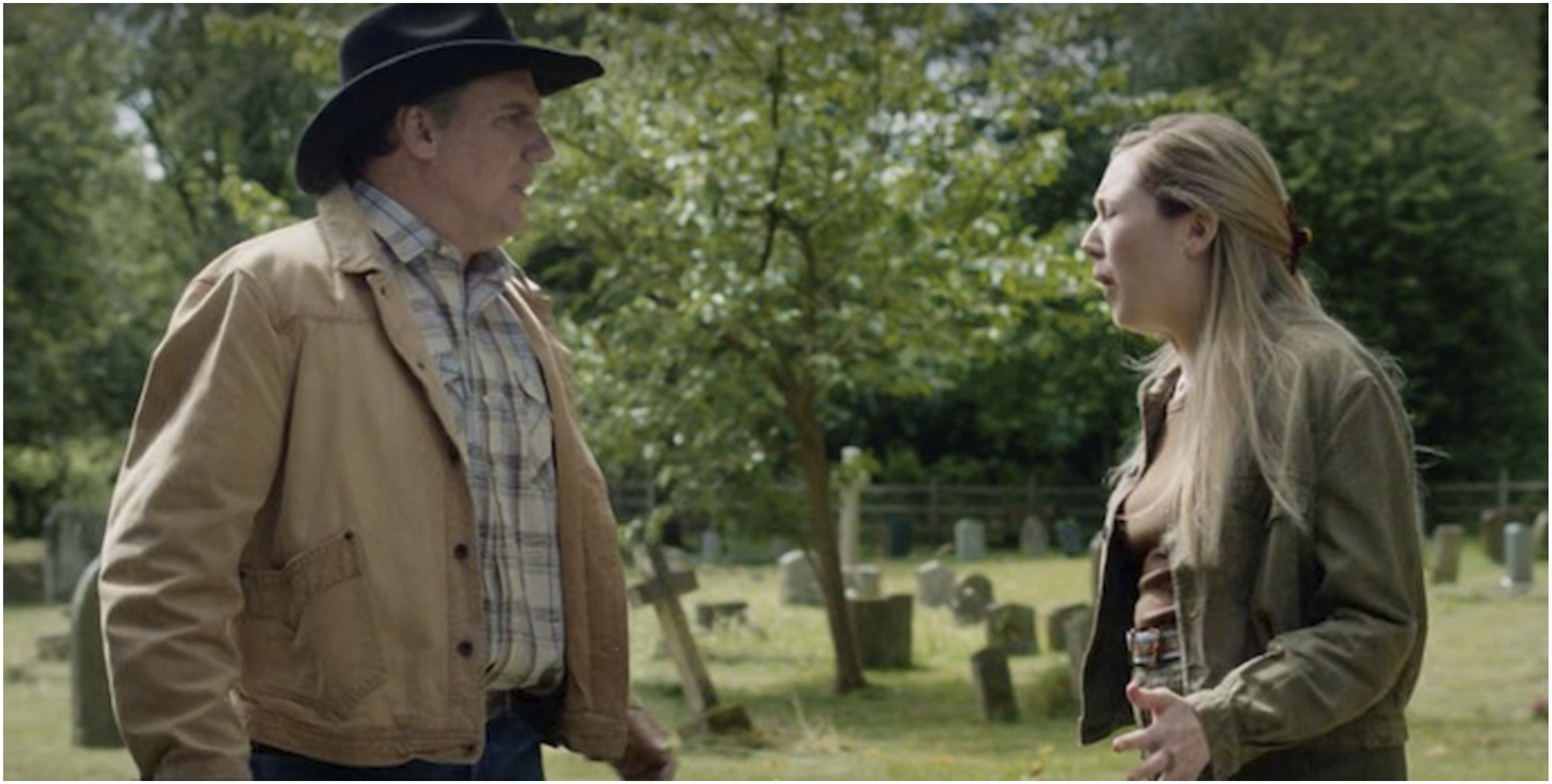
As soon as Lana has fully turned to the front showing both hands to walk away (0.5 s), there is a shot switch to a full shot from a distance where she walks and talks with her left arm to camera (2 s; Figure 4). Lana walking off after her row with Rooster, left arm/hand to camera (MM 2023 © ITV).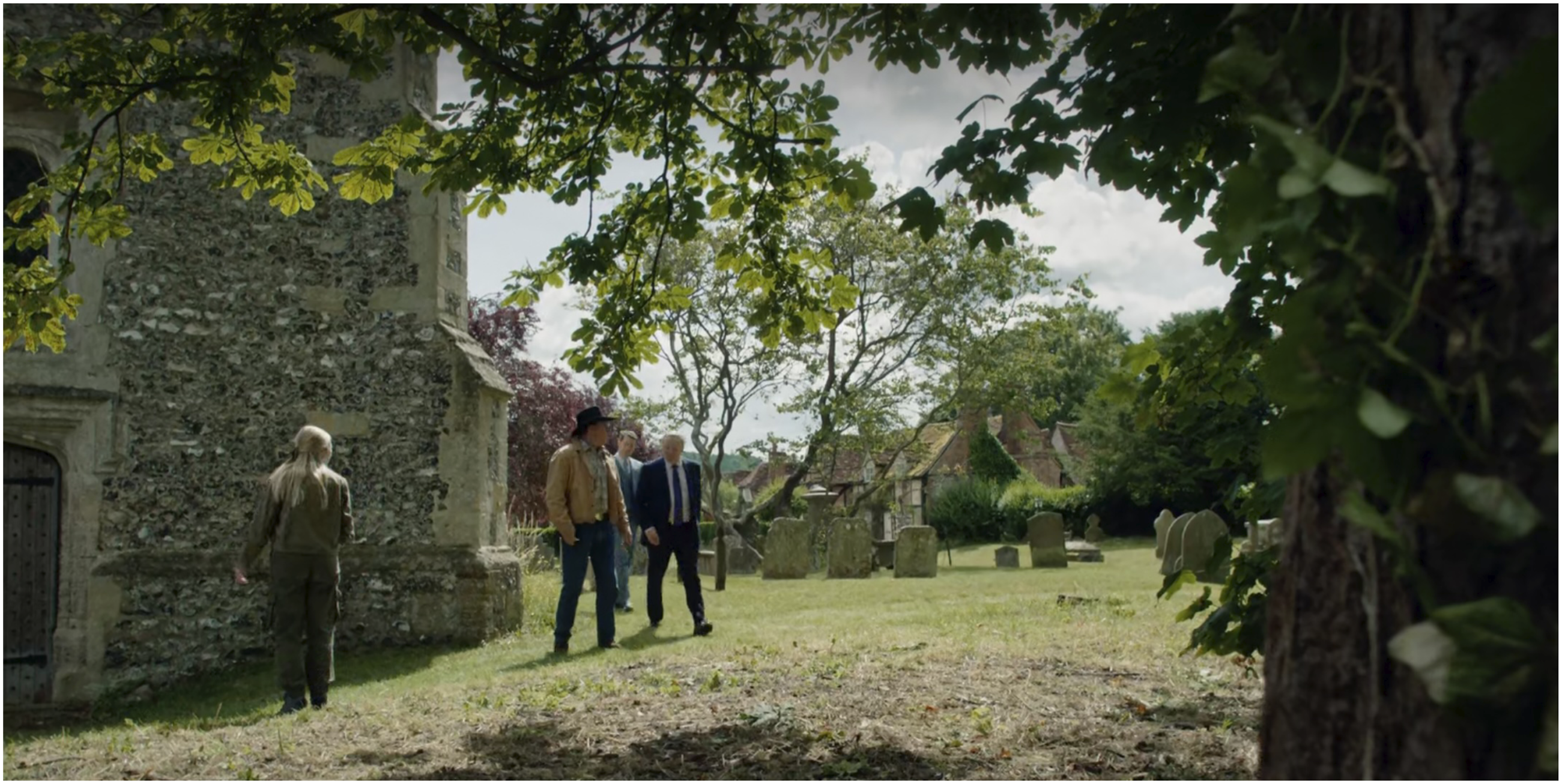
The camera then settles upon the four of them in alternative medium close-up shots from the chest up for about 2 min, capturing their talk and accompanying feelings, including Lana’s disclosure about her and Dougie having been romantically involved.
In Scenes 7–9, some crucial information pieces are revealed, namely, Rooster’s underlying motives and family relation to the vanished Dougie, and Dougie and Lana’s year-long relationship. The sequence starts at a full-shot distance, changes into a medium shot as Lana and Rooster argue animatedly, shifts quickly to a long shot again and then settles on medium close-ups as the four participants speak alternatively. In the action part of the scenes where there is movement and animation, Lana’s partial right arm is seen either at a distance, concealed, or only very quickly exposed (0.5 to 1 s). Once the heat of the conversation dies down and Lana’s romantic involvement with Dougie is told at a slower pace, the medium close ups do not show any physicality below the upper chest. Thus, in these sequences, the shots only briefly expose Lana’s partial hand. This contrasts with two previous shots (not closely examined here) where Lana first looks through a pair of binoculars and later picks up a letter from her doormat. In both of those shots, Lana’s right hand seems strategically exposed in low-paced scenes. These examples indicate a pattern of sorts where slow and undramatic events such as the ones mentioned above may include shots of Lana’s right hand, whereas more dramatic scenes where arm-waving could feature do not.
Close look Scene 13
In Scene 13, Barnaby and Winter are standing at a murder board in the police station looking at pictures of suspects. The part of the scene which is in focus here lasts for about 1 min. Among the various images on the board, the camera rests on a colour photograph of Lana and Dougie for about 2 s as Barnaby and Winter start speculating about his potentially murderous fate. The photo shows a smiling Lana looking up adoringly at an equally smiling Dougie who looks to camera (Figure 5). She is dressed in a white tank top and holds a beer in her left hand, her right hand being fully bare and entirely visible. The shot lasts for about 2 s, but the photograph comes back in focus for another 2 s when Winter suggests that Lana might be a suspect. A medium shot captures both Barnaby as well as the photo at a distance for about 4 s. Lastly, the photo is again focused upon for about 2 s as a scene round off. The lens gradually zooms in on Lana and Dougie as ominous electronic sounds can be heard it, working to cast doubt over what has really happened. Photograph on murder board of Lana and then boyfriend Dougie (MM 2023 © ITV).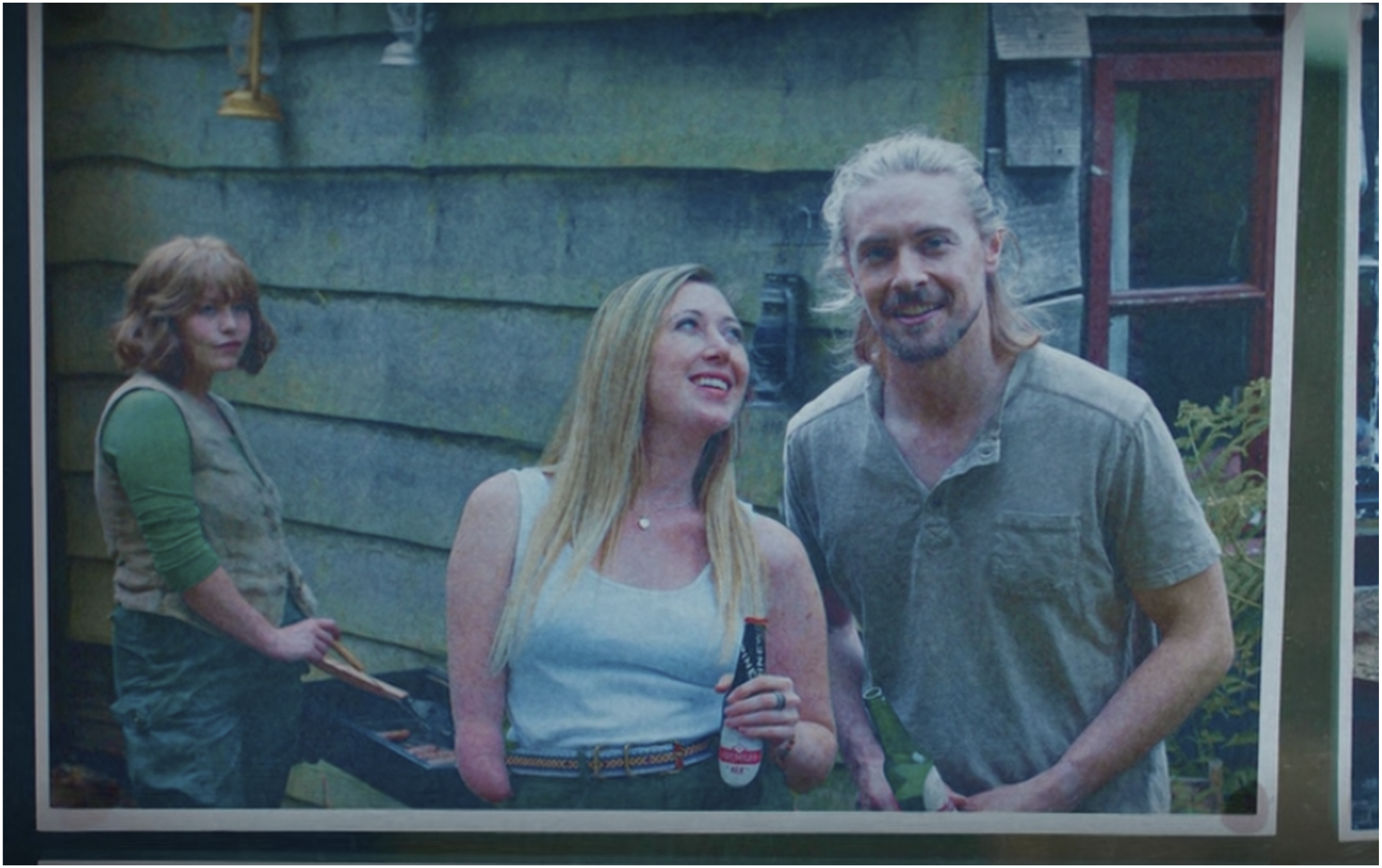
The fact that this photograph is displayed in several longer shots and appears in the background as the policemen talk communicates that it contains significant pieces of information that the producers want the audience to notice. One of these informative elements is the obvious ‘clue’ to the murder provided by the picture, that is, the unknown character lurking to the left. This later turns out to be Lana’s former friend Harper before transforming herself to a bleached-blonde influencer. However, the photograph also contains crucial information about Lana connected to her hand impairment and to Dougie. The photograph confirms her love for Dougie as manifested in her loving gaze and big smile as they stand around casually having a beer. That this is a relationship between a woman with an impairment and a non-disabled man is underscored by Lana’s bared right arm/hand in this picture, the only instance where her impairment is completely exposed. By choosing to display Lana in this situation, fully disclosing her right hand, the producer implicitly challenges at least two stubborn ableist ideas about people with disabilities that often feature in the media. One is the assumption that Lana with a hand impairment would be non-sexual, undesiring or undesirable (Loeser et al., 2018; Schalk, 2016); the other one is that ‘the disabled are undeserving of abled partners, and relationships fail for the disabled solely because of their impairments’ (Botha and Harvey, 2024: 75). At least on the surface, the producers can be said to reject such underlying ideas (although see discussion and conclusion for a critical elaboration).
Closer look Scene 15
In Scene 15, the murderer Harper is revealed in an extended interaction (about 5.5 min) in the church between Winter, Barnaby, Harper’s father, Harper and Lana. Lana walks in quietly and stands behind the policemen as Harper and the others talk. Lana’s right sleeve and partial hand is showing in shorter glimpses, but she is otherwise seen out of focus or only partially visible behind Barnaby and Winter as events unfold (Figure 6). Lana entering the scene in the church but staying in the background (MM 2023 © ITV).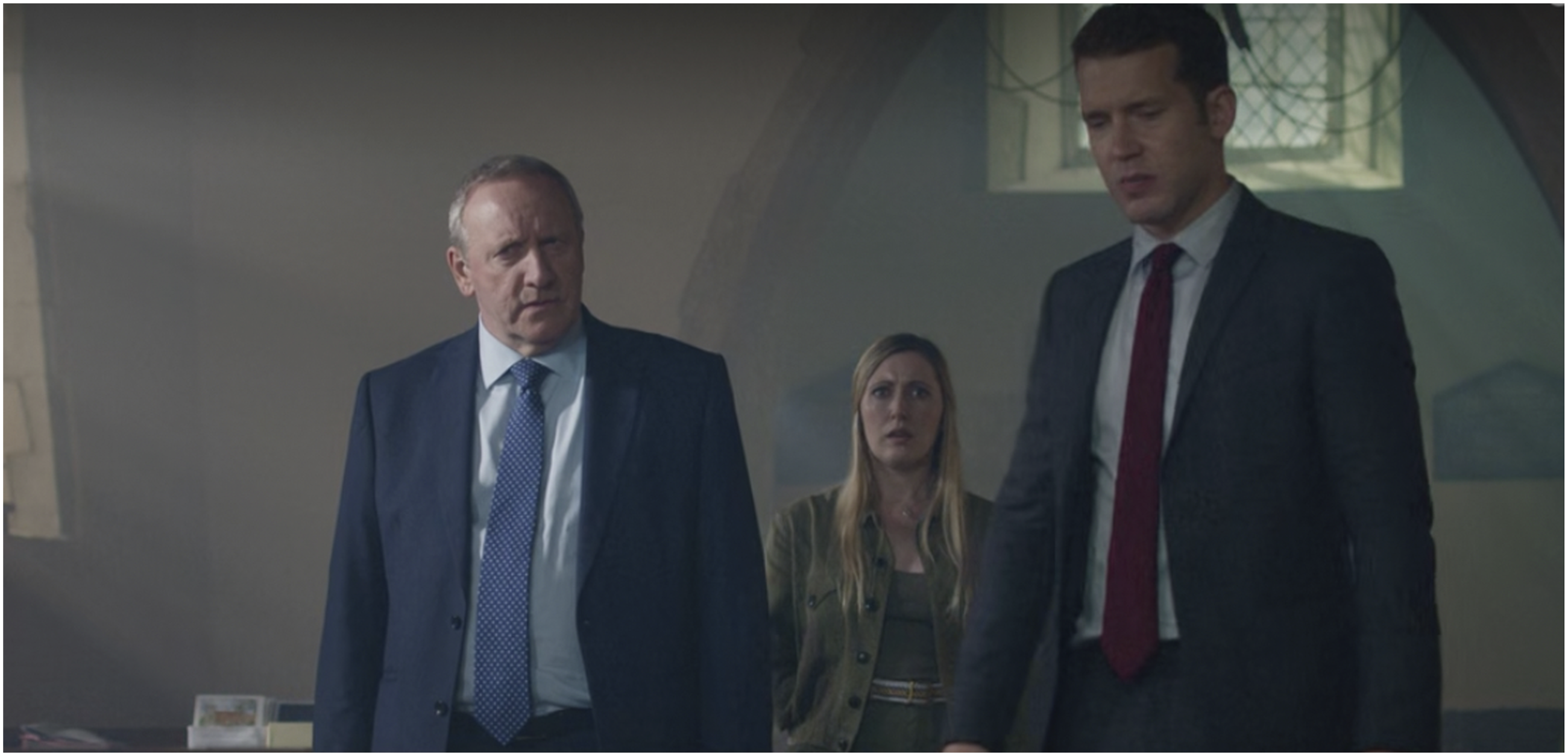
Gradually, it becomes clear that Harper who had also loved Dougie has killed him. As Harper directs a spear dramatically at Lana while saying that he rejected her ‘for her!’, the camera focuses on Lana positioned between the policemen in a medium shot looking distressed, still positioned in the background, her right arm concealed behind Barnaby’s frame (Figure 7). Lana reacts to Harper’s outburst, right arm/hand concealed by Barnaby (MM 2023 © ITV).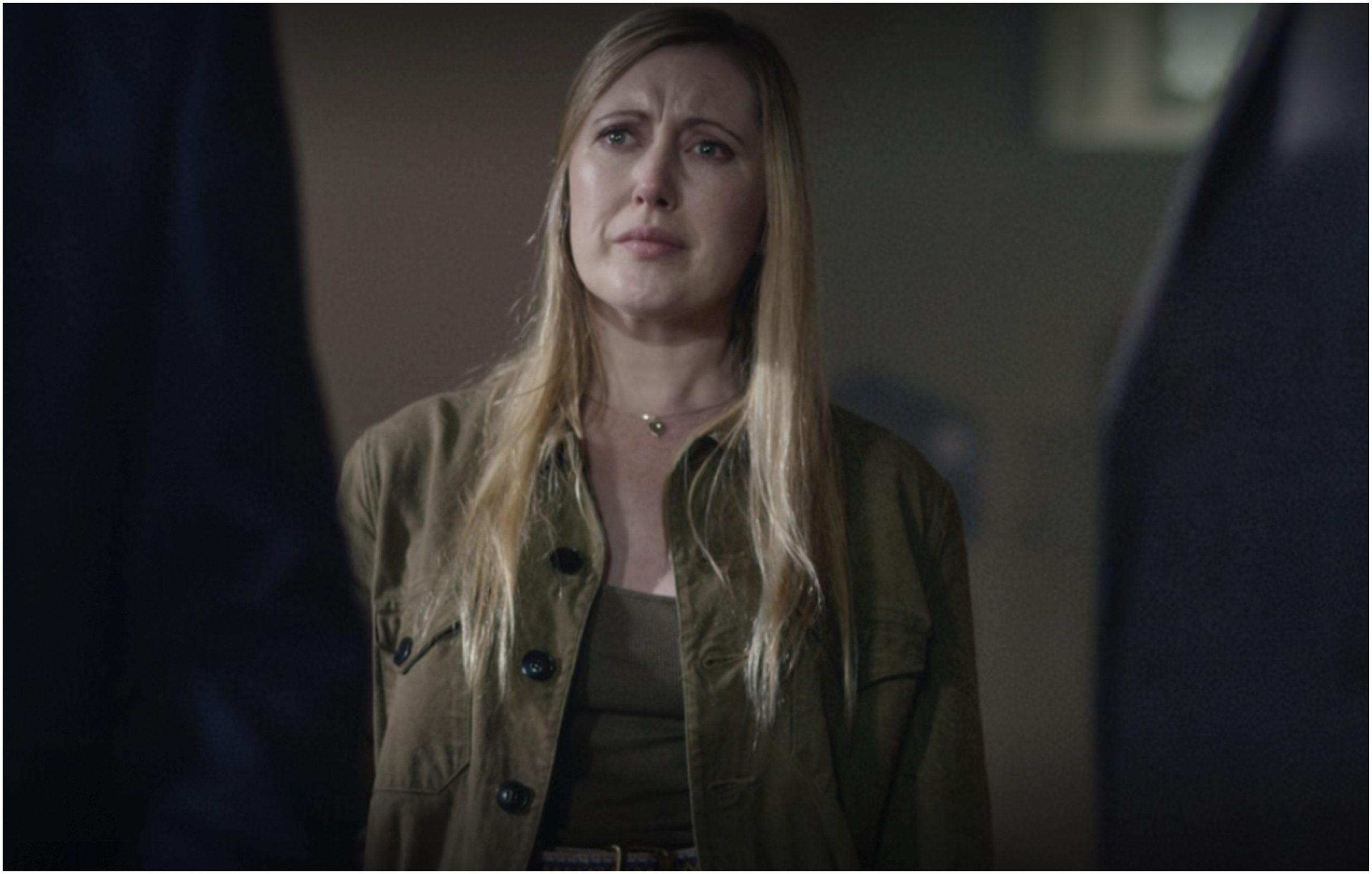
As Harper goes on to talk about Dougie and her having had ‘a bit of fun’, thus revealing that he had been straying, Lana still stays in the background looking troubled but keeping quiet, right hand not on show. As the scene concludes, Lana walks over to Harper and kneels in a medium close shot and asks her where she buried Dougie. Harper tells her and she is presently led away, leaving Lana behind in a full master shot from a distance with her right side to camera, sleeve in pocket.
In this revelatory scene, Lana is the least visible and least active one, keeping herself in the background during most of the scene’s events. Her upper body, especially her right side, is often partially hid behind Barnaby in the shots with occasional glimpses of the sleeve in her right pocket which do not expose her hand. When she walks over to Harper at the end of the scene, she is only shown in mid-chest shots. Given that several betrayals of some scale between the women are revealed, the murder, the burial place, the fact that Dougie had played around with Harper without Lana’s knowledge, it would not be out of place to assume that a high-powered, emotional confrontation would take place between them, perhaps even having them charge at each other. However, the only one who displays any drama in movements and emotionality is Harper. Lana stays put, taking in the drama with only a sad-looking face, and restricting her discursive contributions to a few questions directed at Harper. On the one hand, this could be perceived as Lana being portrayed as the sensible and calm one out of the two, allowing space for Harper’s dramatic outbursts. On the other hand, it also indicates an unwillingness to position Lana in a role where sudden physical movement, dramatic gestures and direct confrontation are integrated parts of the scene. It would be difficult to not include both hands waving and pushing in such a scenario, something which might direct the audience’s attention to Lana’s right hand. Such a focus is smoothly avoided by constructing the scene in the described way.
Scene 16 is the last of the scenes in which Lana features and although not part of an in-depth look it deserves noting. She is standing outside a pub with Ken and Rooster as Barnaby and Winter approach. Lana turns around, and during two medium full shots lasting about 6 s, her right hand is clearly visible while holding a pint. An additional four medium full shots between 1 to 2 s shows Lana with her beer glass with the others listening as they talk (Figure 8). Conclusion scene outside the pub with Lana holding a beer glass in both hands (MM 2023 © ITV).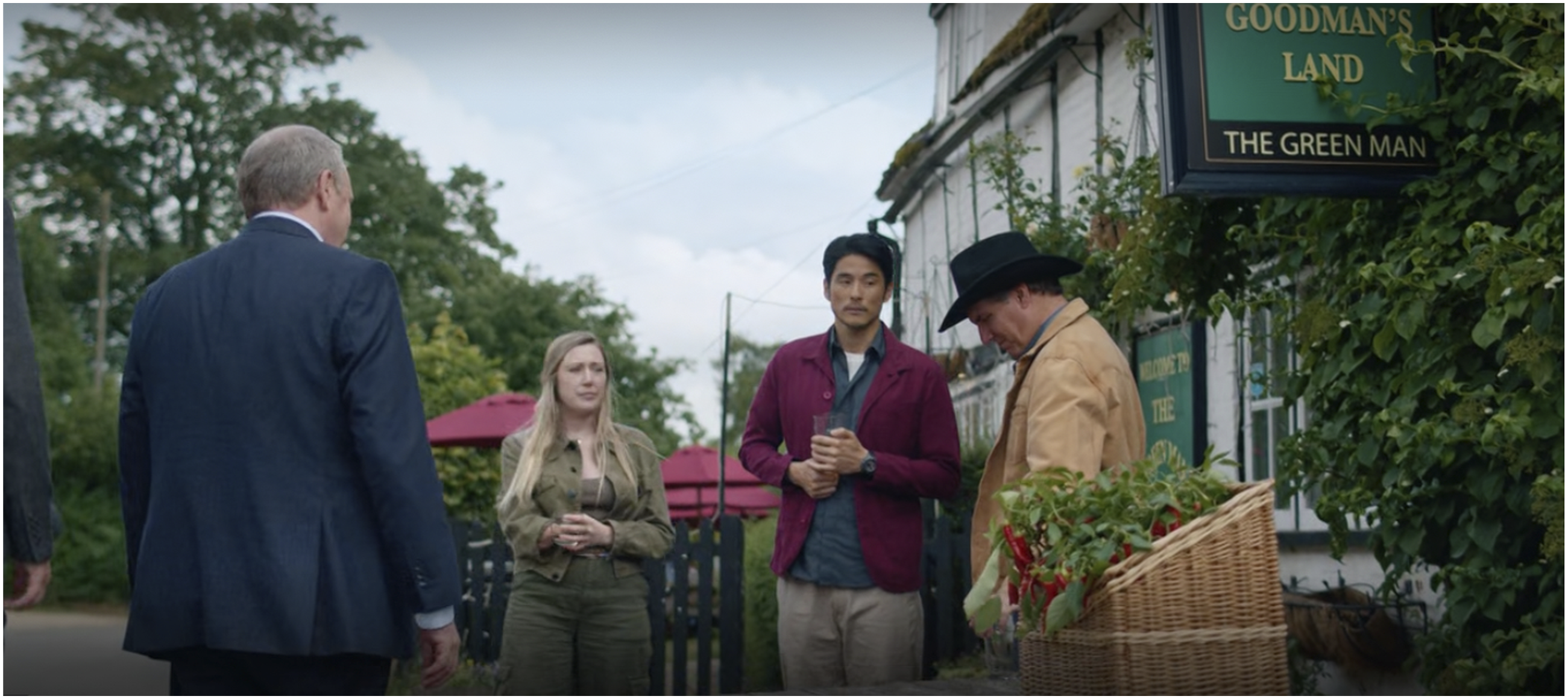
Ken is going to see to it that Lana gets the attention she deserves for her research to which Lana responds with a surprised smile. The episode is then wrapped up by Winter having a chili fruit eating face-off with Rooster. The scene provides the most visibility of Lana’s slightly bared right hand out of all the other scenes where she appears (apart from the indirect visibility on the murder board photograph). This choice indicates that it is now deemed ‘safe’ to show her bared right hand repeatedly and in longer shots without distracting from other visual material or alienating audiences. After all, the episode is about to end.
Lana’s visual and emotional production logic
When considering the entire shot span of Lana’s character in the episode, it is now possible to generate a visual and emotional production logic pertaining to her represented physicality. This logic can be divided into two categories: ‘more likely’ and ‘less likely’ camera shots.
In terms of length, size and pace, more likely shots are signified by being short or very short (0.5 to 1 s), slightly longer (one to 2 s) if appearing at the end of the story (or on a photo), shots from a distance, full shots from behind (e.g. walking away from camera) or slow-moving shots. When it comes to frame and content, most likely shots of Lana are single shots (only Lana), shots capturing subdued activities/scenarios and shots of concealed or partially exposed impairment (invisible/partially visible under sleeve). Being a story that largely develops through conversations between different characters where emotions and atmospheres are essential ingredients, both the medium shot (from under the chest to just above the head) which is considered neutral and the medium close shot (from mid-chest and above head) which conveys a bit more interactional intimacy are very common shot sizes for everybody in Midsomer Murders. However, apart from such shot types where Lana’s impairment is ‘naturally’ invisible, other shots indicate that Lana’s (full) physicality tends to be captured quickly, from a distance, or from behind looking ‘un-impaired’ with hands seemingly in pockets. A few instances worth repeating break with this pattern when it is apparent that the producer has decided to expose her impairment in a strategic way. This happens in the opening scene when she manages a screen device, later when slowly turning to camera holding a pair of binoculars with both hands and then picking up a letter, as well as in her last scene outside the pub holding her glass with both hands exposed. In all of these scenes, though, she is seen acting in a slow, low-keyed and deliberate manner.
The ‘less likely’ shot category of Lana’s physicality when it comes to length, size and pace is manifested in longer shots (extending 2 s), (extreme) close-up shots (non-existent from impairment side), full frontal shots and fast-paced shots (especially from the right-hand side). In terms of frame and content in the less likely camera shot category, we (hardly) see multiple people shots, shots of animated, emotionally charged activities/scenarios or shots of fully exposed impairment (especially in action). Thus, the overall trend is to not show her (full) body in longer shots, close-up shots or fast-paced ones, at least not with her right arm/hand to camera other than very swiftly. Although Lana features arguing with Ken and most vividly with Rooster in Scenes 7–9, the animated scenes with her are sparse. When she does argue on the cemetery lawn with Rooster, her left side is in view in full body shots, whereas the right side may only be glimpsed. Alternatively, her full figure is captured at a distance. Lengthier action scenes, when emotions are running high and the body can be expected to be used as a resource to communicate animation, are decidedly less common featuring Lana than are the emotionally subdued, slower sequences with partial right-hand visibility. This result resonates with Conway’s (2017) observation that, regarding Muslim representations in a Canadian sitcom, television producers felt the need to shy away from strong human emotions such as anger in their diversity representations for the sake of the international saleability of the show. The same process seems to be at play in Midsomer Murders’ disability representations.
Discussion and conclusion
As pointed out by Bethany Klein (2011: 905), entertainment television programming (such as television crime drama) does not only amuse audiences but can be seen as ‘a site through which contemporary social issues may be considered and negotiated’. Beyond providing entertainment, popular media cultural texts illuminate and help us understand what is going on in contemporary society, politics and everyday life (Kellner, 1995). The examined Midsomer Murders’ episode can therefore be argued to provide an optic to illuminate contemporary (and at times contradictory) views, ideas, discourses and ideologies about disability and disability politics in society.
The choice to include Lana in a central role in the Midsomer Murders episode promotes a progressive and anti-ableist representation of disability. Undoubtedly, the broadcaster contributes to a worldwide ‘cultural recognition of disabled people’ (Wilde et al., 2018: 1528), notably, cultural recognition of a woman with a congenital impairment. It is otherwise more common for men with disabilities to occupy roles in big television productions where they portray masculine experiences (Aspler et al., 2022). In addition, the repeated exposition of the whole of Lana’s bare right hand as she stands beside her non-disabled lover on a photograph particularly challenges ableist norms related to love, sex and disability. Thus, ITV manifests an active, social engagement with and for improved (female) disability representation, a kind of social issue activism which they have previously been criticised for lacking (McCaw, 2011). However, following Douglas Kellner’s (1995) reasoning, such a progressive, ideological stance on disability issues poses risks in terms of audience attraction. Therefore, I argue, there are several safety measures in place to mitigate the potentially negative effects of such progressiveness.
One, Melissa Johns as Lana is a rather ‘safe choice’ as an actor with an impairment as she is audience ‘pre-approved’ based on her appearances in a number of popular UK dramas. Moreover, she represents a white, blonde, female (even if here downplayed), conventionally attractive and heterosexual character. Aside from her impairment, these are characteristics that fit with an expected feminine societal norm and are likely not deemed socially disruptive. Two, by avoiding an explanation of how deviance from the ableist norm came about for Lana (Grue, 2014), the producer avoids possible criticism from those who do not want to be confronted with ‘disability activism’ in a crime story. By not explicitly addressing the impairment apart from in uncommented visuals, the broadcaster also adheres to recommendations suggested in scholarly disability literature and reports (e.g. Riley II, 2005; Sancho, 2003).
Three, Lana is constructed within a discourse of ordinariness which is manifested in everything from her subdued looks to her engagement in everyday activities. She is cast as the opposite of an over-achieving supercrip (Hardin and Hardin, 2004) and is thus not portrayed to attract too much attention. Four, even though Lana’s full impairment is exposed in the murder board photograph as she poses with her non-disabled lover, this (bold?) move is moderated in several ways. For one thing, Lana’s infatuated expression is not reciprocated in the photograph as Dougie’s gaze is directed to camera. This could be perceived as an insignificant detail but may subliminally communicate doubt as to their authenticity as a disabled/non-disabled couple. After all, it is also revealed that he had strayed with the non-disabled Harper. A more important matter is that Dougie is already murdered when the episode begins. The photograph is a rather clever visual production strategy to avoid confronting potentially ableist viewers with disabled/non-disabled love in the immediate ‘now’ of the episode’s events. Five, the producers represent Lana with a visual and emotional production logic that allows for strategic but otherwise moderate disability visibility to not risk getting too close and too personal and potentially alienate viewers.
I would argue that the Midsomer Murders’ episode featuring Lana communicates multi-layered social issue messages about people with disabilities which encompass ideas of both unconditional and conditional societal inclusion. That Lana’s impairment does not need to be discursively addressed indicates that she is valued as an equal in the community, something which in turn communicates an overriding idea of unquestioned inclusion in society. At the same time, every-day and work-related tasks are silently showcased in strategically chosen visuals as if to pedagogically educate audiences about her capabilities. This implies a message that we (i.e. non-disabled people) do not take the ableness of people with disabilities for granted in society but that it is an idea that we need to be informed about, and convinced of, to embrace. Also, the camera works to keep Lana’s right hand at a distance or from view in animated scenes and only lets her fully reveal her right hand as well as her love for her non-disabled boyfriend on a murder board photograph. These choices signal a hesitancy to fully embrace the idea that people with disabilities should be allowed to function as non-disabled people do in society. The visual conditions of represented spatial distance, moderate impairment exposure and conveyed emotional neutrality seem to be needed to not appear to alienate audiences. From a Kellner perspective, as reflected here in the transnational television crime drama Midsomer Murders, this result indicates that society’s inclusion of people with disabilities continues to be, at least in part (visually and emotionally), conditional.
In sum, media representations that some see as ‘break[ing] down barriers of disability’, as quoted by actor Rhiannon Clements (Brett, 2024) from Vera, can in fact harbour problematic processes of othering. Of course, this observation comes as no surprise to those who are critically aware of the multidimensional meaning potentials of television productions. After all, similar paradoxical representational patterns (although then focused on race and ethnicity issues) have been referred to as ‘simplified complex representations’ (Alsultany, 2012: 14) and the result of ‘saleable diversity’ (Conway, 2017) in transnational television productions. However, such communicative complexities and contradiction are at least as important to recognise and be critically aware of as the predominantly negative stereotyping focused on in much disability literature.
Finally, a few words from a media scholar with the same impairment as Lana. I recognise and appreciate that ITV shows critical awareness and a willingness to move on from negative stereotypes and stigmatisation to improved, more all-rounded and even (slightly) progressive disability portrayals. However, the fact that these new and improved disability representations also need visual and emotional conditioning to be deemed acceptable to viewers deserves continued critical scrutiny and reflection from broadcasters, scholars, disability activists and media audiences alike going forwards.
Footnotes
Declaration of conflicting interests
The author declared no potential conflicts of interest with respect to the research, authorship, and/or publication of this article.
Funding
The author received no financial support for the research, authorship, and/or publication of this article.
