




Abstract
As viewing shifts from broadcast to streaming, what should be the role for TV studies? Arguing for the need to account for the multi-faceted nature of contemporary television, this provocation proposes an agenda for the future of TV studies. It argues that the technological consequences of shifting to internet-delivered television demand new theorisations of television as software, new digital tools and methods, and audience research that pays more attention to less engaged and unconnected audiences. Such research would ensure that critical policy decisions about the future of television draw on the depth of expertise within TV studies as a discipline.
The one constant of TV studies is that television is in a perpetual state of change. Having started my career as a TV historian particularly interested in studying key moments of change – the emergence of television as a mass medium in the 1950s and 1960s, the disruption of cable TV and increased competition in the 1980s, the arrival of digital television in the 1990s – for the past 10 to 15 years my research has focused on studying change as it happens, with the emergence of video-on-demand, streaming and online TV. In this new period of change, I have been thinking a lot about the future of TV studies and, in particular, what its contribution might be in the context of the rise of platforms and streaming video. In this provocation, I want to propose a seven-point agenda for the future of TV studies. It is important to stress that this is a not the agenda for the future of TV studies. These suggestions come from the issues that have been exercising me over the past 5 years or so as I have struggled to make sense of how and why TV studies matter in a context characterised by the rise of social media, online video and streaming. Consequently, I will be drawing together a range of research strands that have been informing my work for the past decade or so. I will, however, argue that these agenda items are crucial for the future health of the discipline.
Understanding the increased complexity of television as a medium
The components of television as an audiovisual medium.
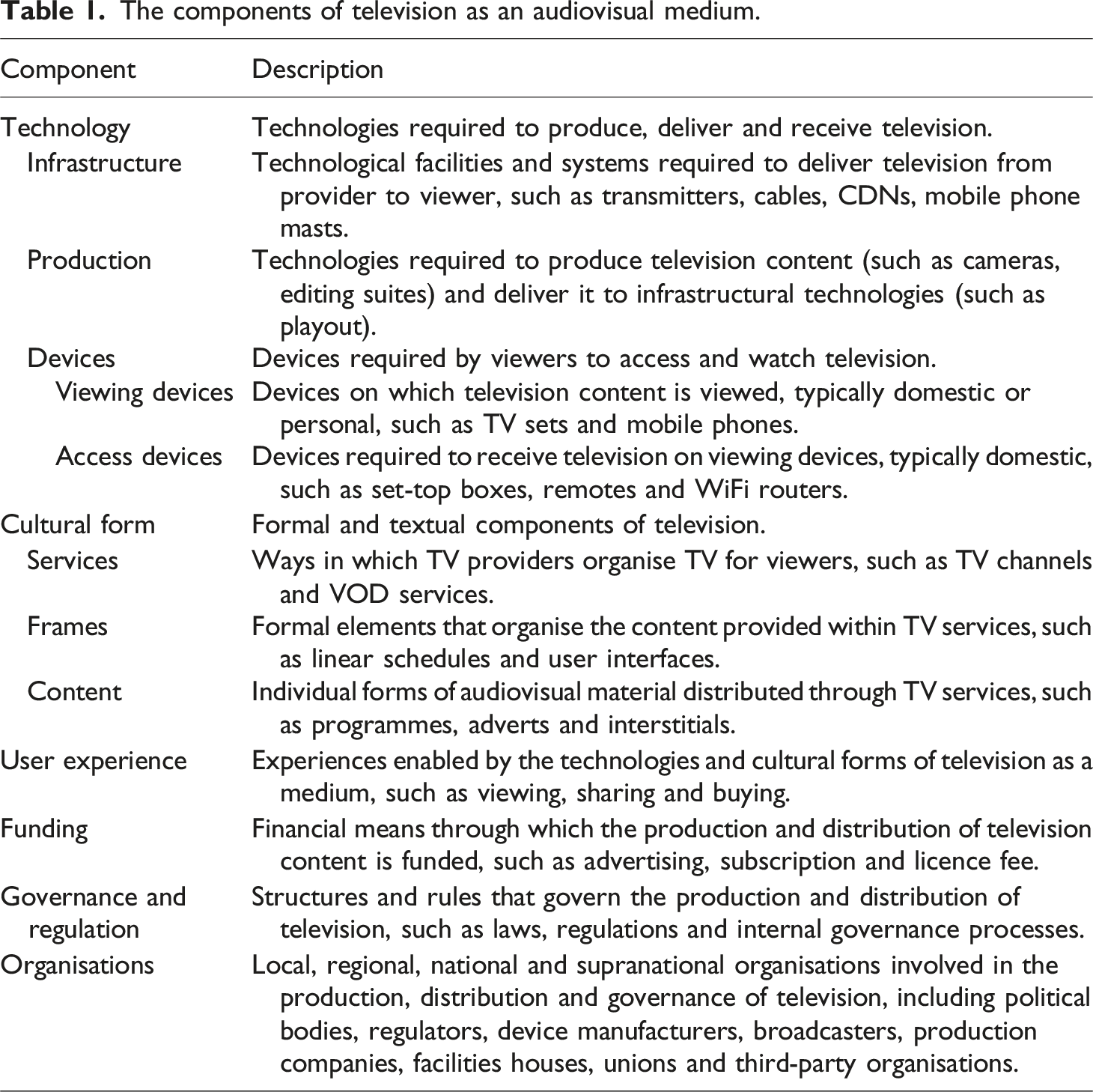
Online TV (2019: 14–16) demonstrated that in the past 10–15 years, television has become more multi-faceted at all levels. These changes are, however, cumulative. While academia and industry alike can become fixated on the new and novel (note the extensive number of recent publications on Netflix, such as Barker and Wiatrowski, 2016; Lobato, 2019; McDonald and Smith-Rowsey, 2016; Wayne, 2022), there is continuity. Streaming is not replacing linear television. Rather linear channels are integrated as an increasingly important facet of streaming technologies, industries and cultures. New viewing technologies, services, production practices and behaviours are distinct, yet connected. Studies that help us understand new industrial and technological developments (such as the excellent work of Lobato, 2019; Lotz, 2022) are valuable, but we need more studies that explore the intersections between different components of television as a medium, examining both continuity and change.
At the same time, it is important to examine the intersections between these different facets of television. This is not a new call, and no study can do everything. But TV studies scholars can tend to focus on certain aspects of Table 1 over others, in particular, content (e.g. Lotz and Lobato, 2023; Richards, 2021), organisations (e.g. Johnson, 2022), and governance and regulation (e.g. Donders, 2021). Such a focus is understandable given that these are the parts of the model that have the greatest impact on television programmes. However, with the rise of streaming and broader processes of platformisation, it is important not to overlook other areas of the model. In particular, I want to make a case for greater attention to be paid to the technological and user experience components of television as a medium.
TV as technology: The rise of IPTV
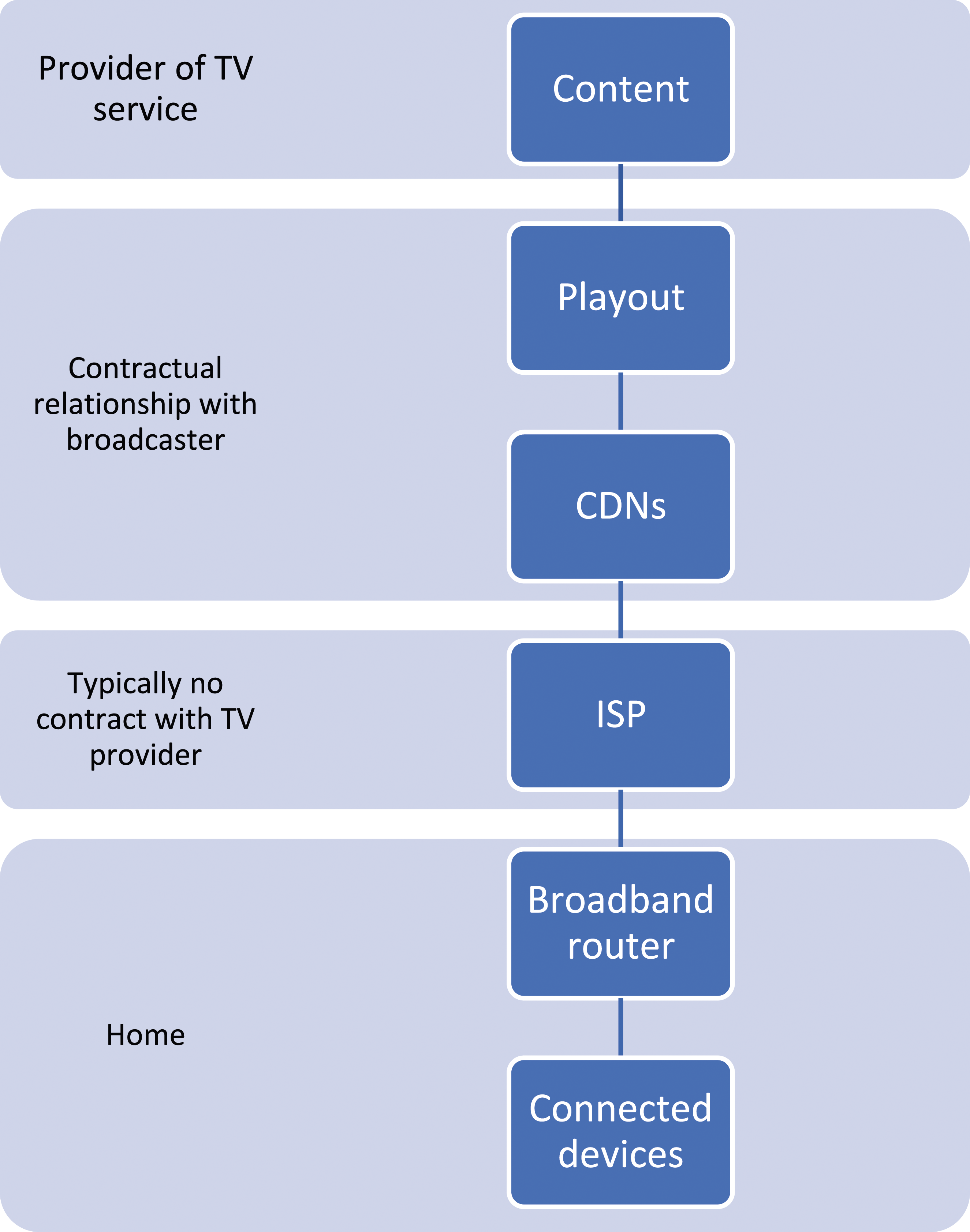
The shift from broadcast to internet technologies fundamentally alters television’s distribution chain in ways that raise questions and demand new skills of TV studies scholars. In the broadcast TV distribution chain (Figure 1), the broadcasters’ content is sent to a playout provider whose signals are delivered via a digital terrestrial (DTT) or cable/satellite network to viewers’ homes. Broadcasters have contractual relationships with playout and network providers ensuring that they can exert control across the distribution chain. In the internet protocol television (IPTV) distribution chain (Figure 2), the TV service provider sends content to one or more content delivery networks (CDNs), that deliver content to the home via an internet service provider (ISP). Where the TV service provider will have a contract with the CDN (or sometimes own one or more CDNs), there are typically no contractual relationships with the ISP, even though the ISP is ultimately responsible for delivering content to the viewer’s home.
2
This technological difference has consequences for the reliability of television and the relationship between viewers and broadcasters/TV providers. Broadcast distribution chain. IPTV distribution chain.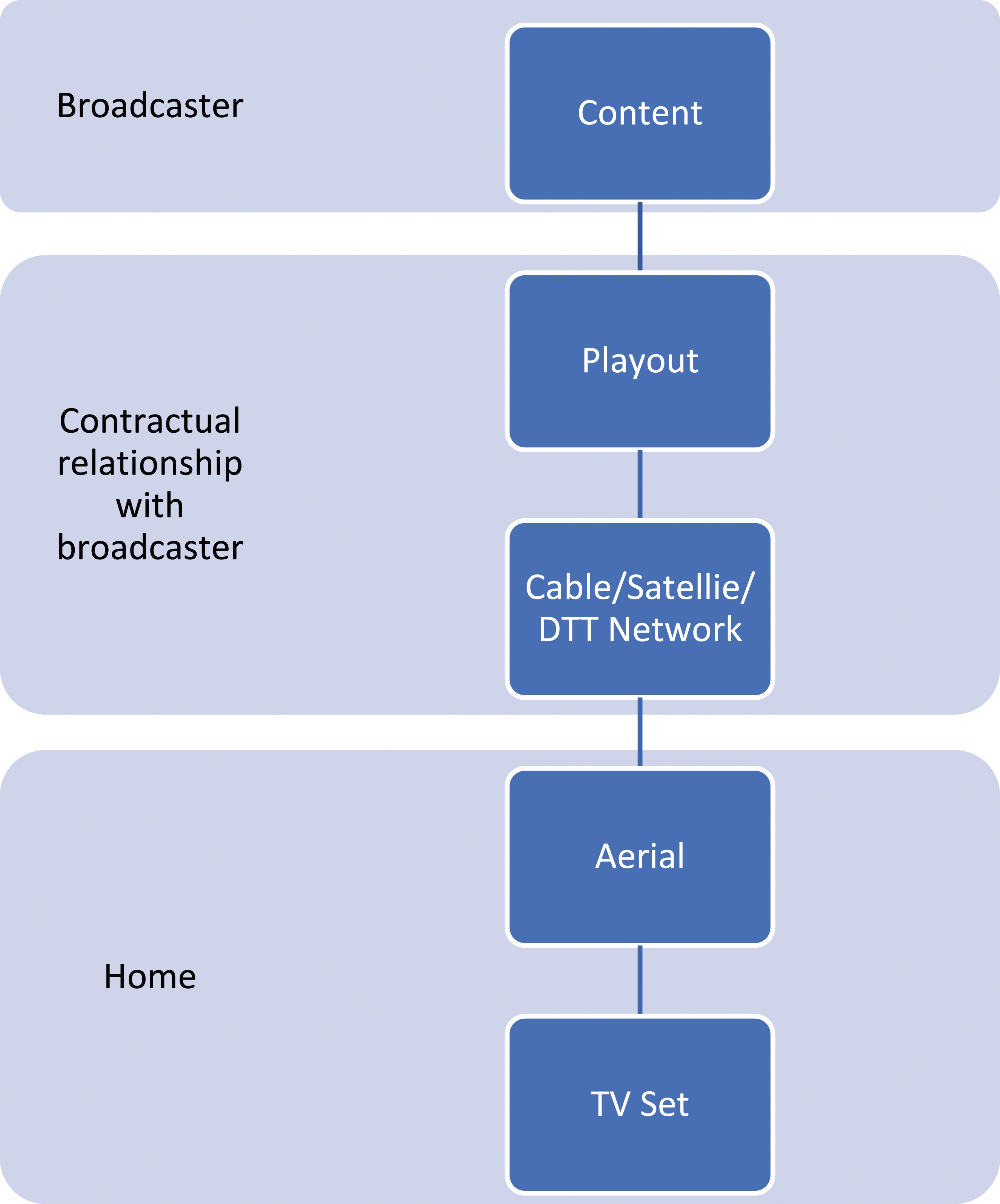
Openreach (2024), responsible for broadband infrastructure in the United Kingdom, for example, revealed that the busiest day for data use in the United Kingdom in 2023 was Boxing Day when the streaming of five Premier League football matches coincided with increased downloads of gaming titles received as Christmas presents and viewing of streamed movies and television programmes. Here the reliability of television reception is subject to factors outside of the television industry’s control (including Openreach). While Openreach, or the ISPs that use its infrastructure, might be able to plan for certain events – such as anticipated increases in video streaming over public holidays or scheduled sports events – they will not necessarily know when major game releases (such as Fortnite) are going to drop. This shift alters the relationship between viewer and TV service provider, as the latter can no longer control the flow of programmes into people’s homes. Viewers, therefore, might attribute buffering, poor picture quality or inaccessible programmes on a streaming service to the TV service provider, that in most cases cannot fully control the quality and reliability of the service they offer. At the same time, however, ISPs and infrastructure providers have been increasingly moving into content acquisition and delivery, becoming TV providers themselves. Given their control over the delivery of TV into people’s homes, this has raised concerns about their ability to engage in anticompetitive distribution practices (Evens and Donders, 2018; Meese, 2020). Infrastructure providers, therefore, become a more important component in the delivery of television content and services, one to which TV studies needs to pay more attention.
The IPTV distribution chain not only introduces new dependencies into the technological infrastructure for television, but it also alters the role of device manufacturers, which are increasingly able to shape the cultural, social and economic value of television programmes and services. In broadcast models, television is accessed through linear channels that are controlled by broadcasters that decide what programmes are aired and in what order. In IPTV models, television programmes and services arrive into people’s homes through devices where the device manufacturer controls the interfaces through which television content and services are accessed. On smart TVs and connected devices (such as Samsung TV sets or Amazon Fire TV Sticks) space within the user interface (e.g. the homepage) is sold as promotional real estate and device manufacturers determine which apps and programmes are pre-installed and most visible in a new ‘economics of prominence’ (Johnson, 2020, see also MTM, 2019; Hesmondhalgh and Lobato, 2019). On mobile devices, such as tablets and smart phones, which apps come pre-installed largely depends on the underlying operating system (e.g. Android vs IOS) and must accord with the rules of the application protocol interfaces (APIs) established by the app provider (primarily Google or Apple). In this sense, device manufacturers emerge as new gatekeepers within the television industry with influence over which TV services and content are most visible to viewers. This, as McKelvey and Hunt (2019: 1) argue, is ‘a kind of media power’, one that, as Eleonora Mazzoli argues, influences ‘what content is deemed worthy – economically, culturally, or socially – to the final users’ (2020: 310). How these relationships play out will vary depending on the dominant technological infrastructure (e.g. DTT vs cable) and devices (e.g. TV sets vs mobile phones) in any given market. As such, we need studies that explore these new industrial and technological dynamics across a range of contexts.
In this new IPTV distribution model, television is reconfigured from electromagnetic spectrum to software and code. The software applications that deliver television are underpinned by code, in the form of algorithms designed to process and make sense of the user data gathered as we use them. And increasingly these algorithms are utilised to offer personalised experiences to users. An exciting vein of current research has been seeking to understand these shifts through the development of new methods designed to analyse the interfaces of VOD services. In their excellent literature review of research methods that have been developed to study VODs, Lobato et al. (2024) note the emergence of digital methods to automate the study of catalogues (i.e. the programmes made available within VOD services) and interfaces (i.e. the ways in which those programmes are organised and presented to viewers). A strand of this research adopts web-scraping tools developed within the digital humanities to extract programme titles and related metadata, often combined with the use of code to clean and analyse the data (see, for example, Grece, 2018; Kelly, 2021; Kelly and Sørensen 2021; Lassen and Sørensen, 2023). The increasing rise of personalisation within VOD services presents additional methodological challenges. Here, researchers have adopted ‘reverse engineering’ by creating different user profiles and comparing their impact on the interface, a process that can be conducted manually (see for example, Pajkovic, 2022) or automated (Bideau and Tallec, 2022). The methods required to study the interfaces of devices, however, are more complex than those for studying VOD interfaces, as it is not possible to utilise existing web-scraping software. Ramon Lobato et al. (2023) have combined qualitative analysis of the interfaces of smart TV sets in Australia with audience research, to try to understand how smart TV adoption might be changing the ways in which TV content is discovered. Yet questions of personalisation also emerge within these spaces that present additional challenges for TV studies scholars seeking to understand the role that devices play in shaping the cultural, social and economic value of television programmes and services.
These questions of value have been historically examined by TV studies through textual and qualitative methodologies. Internet distribution does not invalidate such methodologies, but it does invite TV studies scholars to experiment with digital tools and methods. This requires new skills, not only in the use of digital tools, but also in the critical reflection required to understand the ways in which the design and affordance of those tools might shape the research findings (van Es et al., 2021). TV studies scholars should seek to embrace these new skills and methods and explore the novel ways in which they can be integrated with existing textual and qualitative approaches that have been so foundational to the discipline. Otherwise, we risk ceding this ground to digital humanities and software studies scholars who may lack a rich understanding of television as a medium or overlook television as a site of analysis altogether.
TV as user experience: Re-theorising audiences in the age of platforms
Yet to understand the impact of these transitions, we need to look beyond interfaces and programmes to understand how viewers engage with and utilise television. I began my career as a scholar in the hey-day of TV audience studies in the 1990s. Yet, over the past two decades scholarly interest in TV audiences has waned, replaced by a focus on fans displaying various forms of deep engagement and participatory practices. Despite a growing body of work seeking to examine TV audiences beyond fan studies (such as Evans, 2020; Frey, 2021; Hill, 2019) there remains a tendency to privilege younger, more engaged, tech-savvy and/or heavy TV viewers, often separating out subscription video-on-demand (SVOD) from other forms of TV viewing (such as Lüders and Sundet, 2021; Martinez and Kaun, 2019; Shao, 2024; Valiati, 2019).
In an online survey of 1495 UK adults that I conducted with Cornel Sandvoss and Annaliese Grant in May 2021 as part of the Routes to Content project, we found that 47% of participants reported watching less than 3 hours of television per day, below the reported average of 3.5 hours. 3 Latent class analysis of participants according to the kinds of services people used to watch television identified three categories of viewer (Johnson et al., 2023). 4 ‘All-Watchers’ (53% of participants) watched the widest range of types of TV services, from SVOD and broadcast video on demand (BVOD) to linear television and social media, and were above average in their daily hours of TV viewing. ‘Subscribers’ (17% of participants) primarily watched SVOD and ‘Free Watchers’ (30% of participants) mainly watched linear, as well as other free services, such as BVOD and free video sharing. Both Subscribers and Free-Watchers were below average in their daily hours of TV viewing.
Interrogating these categories in more depth pointed to distinct differences between lighter and heavier TV viewers. Both categories of lighter TV viewer (Subscribers and Free-Watchers) reported a less emotionally rewarding response when watching TV and were more likely to watch alone. They also watched a more selective range of services and genres than All-Watchers. For these lighter viewers, TV appeared to be less important to their everyday lives, particularly when compared with the heavy-TV viewing All-Watchers. By contrast, All-Watchers watched a wide range of TV services and genres and experienced a broad range of emotions when watching television. TV viewing was also a more important part of their everyday sociality. In overlooking lighter and less-engaged TV viewers, then, TV studies has disregarded a significant proportion of the audience (almost half of our participants) whose behaviours, experiences, preferences and attitudes towards television are quite different from the heavy and engaged TV viewers that have dominated audience studies for the past 25 years. These heavier and more engaged viewers, not coincidentally, are also more likely to share the behaviours and values of TV scholars themselves. If we truly want to understand how television is changing with the rise of streaming, platforms and internet distribution, we need to place the study of lighter and less engaged viewers firmly on the agenda of TV studies.
We also found distinct differences between Subscribers and Free-Watchers that point to further reasons for studying lighter TV viewers. Subscribers had an average age of 44, average household income, were least likely to feel challenged and most likely to feel happy when watching TV and were far more likely to get their news from social media than television. Free-Watchers had an average age of 58, lowest household income, were most likely to feel critical about how the world works when watching TV and were high TV news and factual viewers. We hypothesise that there may be generational differences at work here between the Free-Watchers, who grew up in a viewing context dominated by public service broadcasting, and the Subscribers, more likely to have grown up with or be enculturated to online video and social media. If this was the case, then we might see the number of Subscribers increase and the number of Free-Watchers decline over time. As such, lighter and less engaged viewers could be a particularly productive site for understanding the impact of streaming and on-demand viewing on changing audience behaviours over the next two decades.
Although the Routes to Content survey goes a long way to surfacing overlooked audience groups, in being based on an online survey it misses out a significant and important category of ‘unconnected viewers’. Recent research that I have conducted with the University of Exeter, MTM and Real Wireless for the UK government Department of Culture Media and Sport (DCMS) on the future of TV distribution identified 3.9 m households in the UK without internet-connected television. A further 0.7 m homes had a connected set but spent at least 80% of their time watching linear broadcast television. Together these groups accounted for 17% of TV households in the UK in 2023 (Vernon et al., 2024). The demographic characteristics of this group point to significant inequalities in access to connected television, with those in unconnected and linear-heavy households being far more likely to be over 55, of lower socioeconomic class and to have a disability. They were also more likely to live in Scotland, the North-East of England or the Midlands. Researching unconnected groups who are unable to access the internet is significantly harder than studying engaged audiences that are active online. Yet in focusing on easy to reach, engaged and often younger viewers, TV studies is embedding inequalities into its research by excluding participants who are far more likely to be older, lower class and living with a disability.
This becomes even more important given that we found a significant gap in data about these unconnected and linear-heavy households beyond core demographic characteristics. To understand why people do not use connected television, we need more rich qualitative research that situates television viewing within the everyday lives and value structures of individuals and households. TV studies is particularly well equipped to respond to this need, given its strong tradition of qualitative and ethnographic research into television and everyday life (see, for example, Gray, 1992; Lull, 1990; Morley, 1986; Silverstone, 1994). As such, I would join others (such as Gray, 2017; Turner, 2021) in calling for a return to the more ethnographic audience studies of the 1980s and 1990s that sought to understand television as an everyday activity integrated into the politics of people’s interpersonal and domestic lives.
The complexity of television as a medium today, however, makes such research more challenging. Where earlier studies of television and everyday life focused on the household, today television is habitually consumed on multiple devices and services in and outside of the home and ‘television viewing’ encompasses a wide range of textual forms, from user-generated and professional content on social media to movies and long-form programmes on linear channels and VOD services. Our Routes to Content qualitative audience research, for example, assumed a broad definition of ‘television viewing’, inviting participants to discuss watching long-form and short-form professional and user-generated audiovisual content on mobile and domestic devices and across linear, on-demand and social media sites, as was relevant to their own lived experiences (Johnson et al., 2023). A number of our participants described how they would transition between social video (such as YouTube or Twitch), linear TV and/or VOD services when watching on smart TVs, connected and/or mobile devices. Some used social video as a background for other activities, such as doing chores or working from home, in ways that align with earlier studies about the uses of daytime TV (Gauntlett and Hill, 1999). Audience studies, therefore, need to find ways of examining how people utilise the wide range of technologies and textual forms that constitute ‘watching television’ in the twenty-first century within their everyday lives. 5 While our Routes to Content project has focused on the United Kingdom, how these dynamics play out will vary significantly, particularly in contexts where internet adoption is less widespread and/or primarily delivered to mobile phones via Wi-Fi. It is important, therefore, that TV studies explore these questions of how and why TV viewing is changing across multiple contexts.
However, it is not only audience studies that need to address the convergence of television and other forms of online video. The relationship between legacy forms of television and social media continues to blur. In the United Kingdom, for example, Channel 4 has decided to stream full episodes of its long-running soap opera, Hollyoaks, on YouTube. Meanwhile, German and Norwegian public service broadcasters have been experimenting with online and social media storytelling, most famously with the Norwegian TV and web series Skam (NRK3, 2015–2017) and the German social media content network ‘funk’ (Stollfuß, 2021). This raises questions about what constitutes the ‘text’ of television. Again, these debates are not new. When I started my academic career in the mid to late nineties the rise of video prompted reflection on the relationship between television and other forms of audiovisual media (for example, see Casetti, 1996; McLoone, 1996). I then discovered antecedents for these debates as I researched television in the 1950s, when discussion centred on the differences and similarities between the new medium of television and the adjacent media of radio and cinema. More recently, in the early 2010s, amidst the rise of social media, Glen Creeber argued that emergent forms of online video storytelling could be seen ‘as a new transformation of “television” aesthetics’ (2011: 603) with historical precedents in analogue forms of ‘small screen’ representation from the 1950s. Creeber’s call for scholars to draw on histories and theories of television to understand new forms of online video have tended to be eclipsed by studies that have privileged the communicative and participatory facets of social media. Yet, as the boundaries between television and online video distributed through social media platforms become increasingly unstable, I would argue that there is significant potential in bringing a TV studies lens to social video and asking to what extent theories developed to understand television’s aesthetics and audiences could be adapted to help us understand these new forms of ‘small screen’ storytelling and audience-hood.
Beyond academia: Engaging stakeholders to build a TV system that operates in the public interest
In focusing this provocation on the kinds of research needed to understand the current changes to television, I am informed by the work that I have done over the past 15 years or so with non-academic stakeholders in industry, policy and regulation. I have engaged with charities seeking to ensure that the voice of the citizen is represented in media policymaking, regulators looking to understand how to implement and evaluate new policies, policymakers requiring evidence to underpin difficult policy decisions, broadcasters desperately trying to figure out how to adapt to the wave of changes around them, and technology manufacturers and infrastructure providers in need of research to inform innovation. All these different stakeholders are actively seeking research insights to help them to make decisions about the future of television.
One of the reasons I would urge TV studies scholars to engage more closely with industry and policy research agendas is that if we don’t, decisions about the future of television will be based on research dominated by largely quantitative industry data that can lack understanding of the deeply embedded socio-cultural role of television in everyday life. For example, the study we conducted for the DCMS about the future of TV distribution (Vernon et al., 2024) found plenty of data on the demographic characteristics of households without connected TVs, but relatively little extant research on the behaviours, motivations, attitudes, values and lived experiences that might be informing choices these households are making about their TV use. One consequence of this research gap is that it has led policymakers to focus on affordability and media literacy as the key solutions to increasing the uptake of broadband and connected TV. Yet we know far less about the extent to which other factors, such as attitude and emotional response towards TV, genre preferences, household composition and everyday lived experiences might play a part in informing why people do or do not transition to connected TV.
While I am not arguing that the future agenda for TV studies should be solely shaped by the needs of industry and policymakers, I am arguing that the discipline could make a vital contribution to the research base that underpins industrial and policy decisions. And we are at a particular historical moment where these insights are needed more than ever. Across the globe, industry, regulators and policymakers are trying to work out how broadcast policy and strategy needs to adapt to respond to the rise of streaming, from calls for the introduction of ‘prominence’ legislation, to debates about how to retain local and national cultures and industries and the future relevance and funding of public service media. Over the next two decades we may see a wholesale shift from broadcast to IP distribution of television, which will further transform television into a wholly on-demand medium. At this moment of transition, we urgently need the rich, contextual analysis that TV studies can bring, embedded as it is into an historically situated understanding of television as the complex multifaceted medium set out at the start of this provocation.
I am also aware that many scholars baulk at conducting research for or with external stakeholders for fear of being co-opted or losing their academic independence. From my years of experience of doing this kind of work, I have found that academics are particularly valued for the independence of their expertise and the integrity of their research methods. The DCMS’s most recent round of tenders strongly encouraged leadership by academic teams precisely because they wanted research situated within the independent and rigorous traditions of academic inquiry. I have also found that these stakeholders are increasingly recognising the need for more qualitative insights into the social, cultural and institutional aspects of television’s transition, including comparison across different countries/territories. This presents a genuine opportunity for TV studies to be a powerful force for good, by ensuring that vital decisions about the future of the medium are based on the rich, qualitative, contextual and historically embedded understandings of television as a medium that characterise the discipline.
Conclusion
In this provocation, I have sought to set out an agenda for the future of TV studies. This agenda can be summarised as 1. Conduct studies that explore the intersections between different components of television as a medium, examining both continuity and change. 2. Develop a greater understanding of how the rise of IPTV might be altering the distribution chain for television and the impact that this might have on industry, policy and audiences. 3. Re-theorise television as software and experiment with integrating new digital tools and methods into existing qualitative TV studies methods. 4. Broaden TV audience studies to include less engaged and unconnected audiences, including inequalities of access. 5. Adapt existing TV audience studies methods for researching television as a medium embedded into everyday life for a contemporary context in which ‘television viewing’ traverses across a wide range of devices and forms of audiovisual content, including social video. 6. Explore the extent to which TV studies theories and methods could be adapted to understand new forms of ‘small screen’ social video. 7. Actively engage with industry, regulators and policymakers to ensure that decisions about the future of television are based on the rich, qualitative, contextual and historically embedded understandings of television as a medium that characterise TV studies as a discipline.
Here, I have largely drawn on my own research conducted, primarily in the United Kingdom. Yet the ways in which the rise of streaming, on-demand and online video are playing out are highly contextual. In countries where internet adoption is low, or that rely significantly on Wi-Fi infrastructure and mobile phones for internet access, the questions raised within this provocation about the impact of technological shifts and changing audience behaviours will play out quite differently, potentially demanding distinct methods, theories and research questions. It is important that TV studies integrate methods, theories and research questions devised beyond the Western frame into the heart of the discipline.
Furthermore, in basing this provocation on my own personal research interests, I do not mean to denigrate other areas of TV studies research – from insightful textual analyses, archivally rich historical studies and vital work on inclusion and equality in television production and representation – and suggest that they have less value or should not be prioritised. Rather I have sought to spotlight areas that have been overlooked by TV studies scholars and which are crucial if we want to understand the changes to television as it transitions from a broadcast to an online medium. Many of these areas of research are not new, and part of my agenda here is to encourage TV studies scholars to draw on the rich history of the discipline. At the same time, I am equally sure that there are many other overlooked areas that could be added to this agenda. This provocation, then, ultimately seeks to stimulate discussion about how TV studies might need to go through its own transition and to invite the discipline to debate what skills, methods, approaches and theories might be needed to be able to understand television as it continues to change over the coming decades.
Footnotes
Declaration of conflicting interests
The author(s) declared no potential conflicts of interest with respect to the research, authorship, and/or publication of this article.
Funding
The author(s) received no financial support for the research, authorship, and/or publication of this article.
