



Abstract
In this article, I analyse how underground landscapes are represented in the Finnish/Swedish television series, White Wall (2020). Subterranean imaginations, I argue, help reconceptualise the agency of the inorganic, mineral and geological along with that of the biological and social. Juxtaposing the underground with the surface, White Wall unfolds not only horizontal but also vertical ways of thinking about human/non-human relations in the Anthropocene. I also discuss how the series engages with fantastical nineteenth-century stories of Earth’s exploration. Through dialogue with literary predecessors, White Wall grapples with how retrospective and prospective designations of the new geologic epoch collide.
Introduction
We have passed the point of no return. Even those who do not agree with me see that there is no turning back now. In the end we will all disappear into the abyss of oblivion, idiots or not. DJ Lenin (Catrine Lundell), White Wall (S1. E01)
The Finnish/Swedish television series, White Wall (2020), opens with a sinister aerial shot of a sparsely lit industrial terrain comprising rows of high metal containers, several service barracks and a car park beside a small copse of young fir trees. This view shows the world’s largest underground nuclear waste disposal facility. Presented as the series’ central location, the installation was built by a company named ECSO in Norrlund, a fictional mining town in northern Sweden. Situated in the near future of 2050, the narrative starts several days before the official opening of the enterprise. While ECSO is busy promoting itself and Sweden as pioneering, an explosion in the underground tunnel network unveils a small, impenetrable, and white spot lodged in the bedrock. This discovery means that the scheduled burial of the first batch of containers cannot proceed as planned. In time, it will lay bare the entangled political, economic, commercial and scientific interests involved in dealing with such an environmentally sensitive subject as the storage of extreme contaminants: in this case, radioactive waste. In terms of its narrative and aesthetic characteristics, White Wall encapsulates the Nordic noir’s Arctic subgenre, whose triple premise (the crime plot, critical societal plot and cinematic landscape’s storytelling function) it displays (Waade, 2020). Expanding on this triangular relation, the series relies equally on a fourth element in that it employs the devices of speculative fiction. In doing so, it opens an imaginative narrative space, releasing the storyline from the constraints of social realism and broadening it into a more critical exploration of human responses to non-human nature.
White Wall was hailed as innovative from its inception, both because it surpasses the traditional Nordic noir format (adding elements of speculative fiction to the crime plot) and because it represented the first full collaboration between the Finnish and Swedish public broadcasters YLE and STV, which contributed 40 and 60 per cent of its financing respectively (Pham, n/d). It became one of the most expensive TV series ever made in Finland, having the potential to promote Finnish television internationally (Broholm, 2020). The unusual plot, unhurried narration and good acting ensured White Wall’s generally positive reception after its release, the show scoring four out of five stars on moviemeter.com. One viewer noted that, ‘[a]s far as I’m concerned, it’s a series with an intriguing story. Don’t expect impressive special effects, the story is told calmly and had a plot that I did not expect. Great series!’ (Geenidee17, 2022).
The project was driven by the makers’ wish to reach beyond contemporary scientific horizons. ‘The core of the series,’ as the showrunner Roope Lehtinen put it, ‘is humankind’s search for truth, be it on a religious or scientific level. Today, we feel we know everything, but do we? With DNA, we can control a lot, but how much should and can we mess with that? Nuclear waste poses the same kind of questions. We believe the bedrock in the Northern Sea is the safest place to store it, but what effect will it have in 100,000 years on our distant descendants?’ (Pham, n/d)
White Wall’s story was greatly inspired by Michael Madsen’s acclaimed documentary Into Eternity (2010), which focused on future uncertainties and dangers surrounding the long-term underground storage of radioactive waste (Karjalainen, 2020). Filming on location in Finland’s Pyhäsalmi mine posed numerous unprecedented production challenges. Descending 700 metres from the surface to the filming site took over 30 minutes. The underground tunnels were pitch black, humid and hot, requiring a shelter for the crew with fresh air coming through the shaft. With a concrete-reinforced roof, it was the only place in which protective goggles and helmets need not be worn. A psychiatric nurse was present on site, should subterranean work cause anxiety (Broholm, 2020). The crew’s real-life underground experience allowed the narrative to surpass the level of mere speculation. It produced hazardous and dependent modes of seeing and acting, which conventional ‘surface’ filming precludes. Thus, White Wall repays close analysis for its complex treatment of human inter-relations with the subterranean, both inside and outside the diegesis.
In this article, I read this televisual text through the lens of material ecocriticism. Part of the environmental humanities more broadly, material ecocriticism investigates the relation between human creativity and the imagining and narration of nature. Unsettling traditional understandings of matter as passive or inert, it blurs the distinction between human and nonhuman agency (see Coole, 2010), in addition to exploring and theorising the biological, chemical and mineral bases of human ontology. Serenella Iovino and Serpil Oppermann, two leading proponents of material ecocriticism, define it thus [The] study of the way material forms—bodies, things, elements, toxic substances, chemicals, organic and inorganic matter, landscapes, and biological entities—intra-act with each other and with the human dimension, producing configurations of meanings and discourses that we can interpret as stories. (2014: 7)
Geoscientists have proposed the rubric of the Anthropocene to name the era in which humanity’s footprint is recognisable in the geological record (see Crutzen and Stoermer, 2000). More broadly, the term has been taken up as ‘a convenient shorthand for the multiple and complex aspects of the global ecological crisis’ (Horn and Bergthaller, 2019: 20). The anxiety-ridden world of the Anthropocene has become a recurring subject of popular television drama narratives, especially those that mobilise landscapes as both aesthetic material and cultural and (geo)political agents. They feature scenes of environmental devastation that the cultural geographer, David Matless, calls ‘Anthroposcenic’ (2018, 2016), a term intended to carry a style of reflection more common to arts and humanities research over into scientific discourse. The Anthroposcenic allows scholars to theorise how ‘landscape, in all its cultural complexity—material and imaginary, emotional and financial, immediate and intergenerational—might help visualise and represent a coming epoch’ (Matless, 2018: no pagination). Such productions as Chernobyl (2019), Dark (2017–2020), Deadwind (2018–), Fortitude (2016-8), Midnight Sun (2016) and Occupied (2015-2020) highlight the hubris of human ‘domination’ over Earth, unmasking the folly of permanent capitalist growth without end. Their narratives induce the ‘claustrophobic sense of impending ecological limit, the creeping terror that technological modernity, and its consumer lifestyle, may in fact have no future’ (Canavan, 2014: 9; see also Merola, 2018). They issue a warning that futurological imaginings of boundless expansion premised on science and technology can quickly give way to apocalyptic scenarios. Televisual engagement with environmental issues is important: television, and especially complex forms of serial storytelling, have advantages over other media in terms of pedagogical potential and promotion of ecomedia literacy. This is down to the serial drama’s transnational reach, extended duration, and online fandom forums, which allow viewers to develop intimate affective relationships with the depicted places and events.
As part of the growing body of ecocritical television, White Wall mobilises its anticipatory capacity to envisage radioactive waste, which is impervious to decay, as what Timothy Morton seminally termed a ‘hyperobject’ (2013). In so doing, it renders legible the effects of anthropogenic processes and humans’ alienated relationship with Earth. Interrogating this idea of human estrangement from nature, the fictional story considers the ethical and moral ramifications of technological fixes that are informed by the all-pervasive logic of capitalism. Further, the series illustrates how the rise of the Anthropocene has turned critical attention towards the geologic, which is inevitably associated with the subterranean (Clark, 2011). For centuries humans have extracted subterranean resources and used underground terrains extensively for infrastructure, dangerous scientific testing, and the dumping of waste. If this (mis)use of subsurface has long been grounded in a confidence in the stability of Earth system, the Anthropocene is now ‘scrambling that geographical complacency. The underground is in revolt’ (Woon and Dodds, 2021: 351). In this context, ‘underground imaginations’ have become a prime site at which to explore ‘some of the current imaginative challenges we face’ (Hawkins, 2020a: 5), not least because the underground constitutes a threshold ‘where the social meets the geologic, the inorganic and the inhuman’ (Clark and Yusoff, 2017: 20).
White Wall’s underground landscape provides a valuable point of focus for such imaginative labour. Juxtaposed with the stark geometry of the ECSO facility, which looks deceptively pristine under the thick cover of glistening Arctic snow, the subterranean passages introduce the theme of trespass, literalising the notion that humanity is violating Earth’s geological structures. The series’ imagery foregrounds what is often assumed to be the most lifeless of substances: the ‘wet rock’ (Wenzel, 2014: 25) that makes up Earth’s crust, spotlighting its material vitality, integral temporality, agency, and unending motion. The eponymous white wall exemplifies the ‘ecology of the inhuman’ that environmental humanities scholar Jeffrey Jerome Cohen describes thus Despite relegation to a trope for the cold, the indifferent, and the inert, stone discloses queer vivacity, and a perilous tender of mineral amity. … Because of its ardor for unconformity, stone sediments contradiction, there to ignite possibility, abiding invitation to metamorphosis. It offers a stumbling block to anthropocentrism and a spur to ceaseless story. (2015: 6)
Echoing Cohen’s argument, the white wall’s resistance to geological classification is an invitation, perhaps, to think through the implications of ‘“ungrounding” of the Earth’—this is, its continual disinterment and exploitation—for how the relations between humans and non-humans in the Anthropocene are understood (Hawkins, 2020a: 4; see also Hawkins, 2020b). In considering several insights engendered by White Wall’s focus on the subterranean landscape and mysterious wall’s alterity, I pose the following questions. How does this televisual articulation of geological space variously overlap and deviate from both previous imaginations of Earth as hollow and the elevated, top-down gaze that is privileged in conventional imaginations of the planetary environment? What kind of approach to the Anthropocene does its distinct grasp of Earth and its processes enable? How does the series’ juxtaposition of the underground with the surface occasion not only horizontal (and often superficial) but also vertical ways of thinking about ‘anticipatory history’ (DeSilvey, 2012), in which contemporary and bygone landscapes converse? To address these questions, I start by discussing how the series presents the responsibilities, uncertainties, and dangers involved in disposing of radioactive waste underground.
The blinding light of subterranean darkness
I suppose a welcome is in order … Soon the depleted nuclear waste will embark on its final journey. The first batch of uranium rods will be buried in the copper coffins seven hundred meters underground … It takes 100,000 years for the nuclear waste to subside to natural levels. Let’s hope our children, and great-grandchildren wouldn’t judge us too harshly, because someday they will want to have a look at what we’ve done, and it won’t be a pretty sight. DJ Lenin, White Wall (S1. E01)
In the series, DJ Lenin (Catrine Lundell) is a small, dark-skinned woman who works from a backroom of the bar (tellingly named, Ground Zero), where ECSO employees drink. Lenin is known for interlacing her musical broadcasts with apocalyptic prophesies, which become increasingly urgent as the opening of the nuclear waste deposit site approaches. Throughout, her grim commentary on the impending catastrophe provides a narrative frame for unfolding events. Unfortunately, Lenin’s grave radio voice usually merges with ambient sounds, reduced to mere background noise to the main characters’ dialogues. She is the modern incarnation of the famous Greek prophetess, Cassandra: apart from a group of environmental activists conspiring to sabotage ECSO’s public ceremony, the Norrlund community seems deaf to her concerns. This is unsurprising, perhaps, given that many of its members have long depended on this company for their livelihood.
White Wall’s ‘surface’ plot offers an opportunity to ponder environmental and political issues surrounding ‘the urgent need to find ways to store dangerous nuclear waste’ (Kaplan, 2016: 119). In showing that ECSO’s operations have been officially approved—indeed, they are publicised as Sweden’s outstanding technological achievement and even sponsored by the European Union—the series diverges from previous televisual treatments of similar topics. For example, in Deadwind, Dark and Midnight Sun, the central intrigue revolves around the clandestine dumping of radioactive material, whether in abandoned mine shafts (Midnight Sun and Dark) or a sunken quarry (Deadwind). Such plots problematise the illegal disposal of spent nuclear fuel, which is used as a televisual narrative device to unveil pervasive relations of power that are central to interpreting human acts of violence against people and nature. Whereas these series turn on the (illicit) invisibility of nuclear waste, White Wall keeps radioactive remains constantly in full sight. As I have mentioned, the series commences with a long aerial shot of tall waste capsules lined up in long, regular rows. In preparing the public inauguration, ECSO’s PR woman Gina (Karen Bryson) even orders that ‘rusty’ mining equipment scattered around should be removed to present visitors with a more impressive outlook: ‘The opening is supposed to give people peace of mind,’ she explains. ‘Everything needs to support this message. … Everything is going to be neat and clean so that we can focus on one of these shiny capsules disappearing into that hole. Problem solved. Solution sold. Worldwide’.
Disturbingly, Gina’s words reproduce the pervasive capitalist logic that Morton, in Ecology Without Nature, describes as ‘thinking in terms of living rooms’ (2009). Referring to Margaret Thatcher’s greening campaign of ‘tidying’ Britain (which included processing nuclear waste at Sellafield), Morton sarcastically remarks that the British premier acted ‘as if ecology were about rearranging the furniture’ (2009: 109–110). In the fictional near-future of White Wall, green politics has been similarly co-opted by the capitalist principle of lucrative investment. The illusion being sold, here, is that moving tons of uranium to ostensibly ‘safe’ underground depths will solve the problem of nuclear waste. Yet even if they are ‘tidied’ and kept out of sight in this way, the ‘temporality of hyperobjects, like that of plastic, Styrofoam or radioactivity, outlasts considerably the length of a human life’ (Mrozewicz, 2022: 51). In the series, DJ Lenin’s prediction that the radioactive substance will retain its ‘ghostly spectrality’ (Morton, 2013: 169) for 100,000 years, continually harming the area’s ecologies, social infrastructures, and human inhabitants, is largely met with indifference.
The credit sequence intimates the dire consequences of burying uranium rods underground—where they cannot be directly seen, felt, smelled, or heard. Shot in monochrome, the succession of images attempts to render intelligible the ‘blinding and incomprehensible light’ (Petryna, 1995: 197) of ionic radiation. The sequence depicts a rapid descent through a deep circular mine shaft towards a glowing speck of white at the bottom. As the shot accelerates, the tiny patch of whiteness expands and the shaft’s grey walls dissolve under the rays of intense light. The white surface occupies the entire screen, on which the series’ title appears. The final shot foreshadows humanity’s sudden confrontation with one of the unexplored and unexplained strata at Earth’s very core. The colour white’s apparent blankness and emptiness reminds viewers of radiation’s spectrality and prodigious energy. Further, it metaphorizes the distorted perspectives of those characters who are blinded by a desire for economic, political, professional or intellectual gain. Ultimately, the light can be seen as a metaphor of the Western philosophical tradition, from Presocratic thought to the Enlightenment. In this latter period especially, this tradition has been increasingly associated with the growing human domination over nature (see Worster, 1994).
Unlike the soft and spectacular snowy landscape above ground, this blank, colourless colour, which suddenly illuminates the subterranean depths, is unsettling. Throughout the narrative, meandering underground paths—in which one can see only as far as the reach of truck headlights or helmet lamps—are starkly juxtaposed with the wall’s eerie whiteness (Figure 1). Lars (Aksel Hennie) and Magnus (Mattias Nordkvist) looking at the wall. White Wall, S1. E02.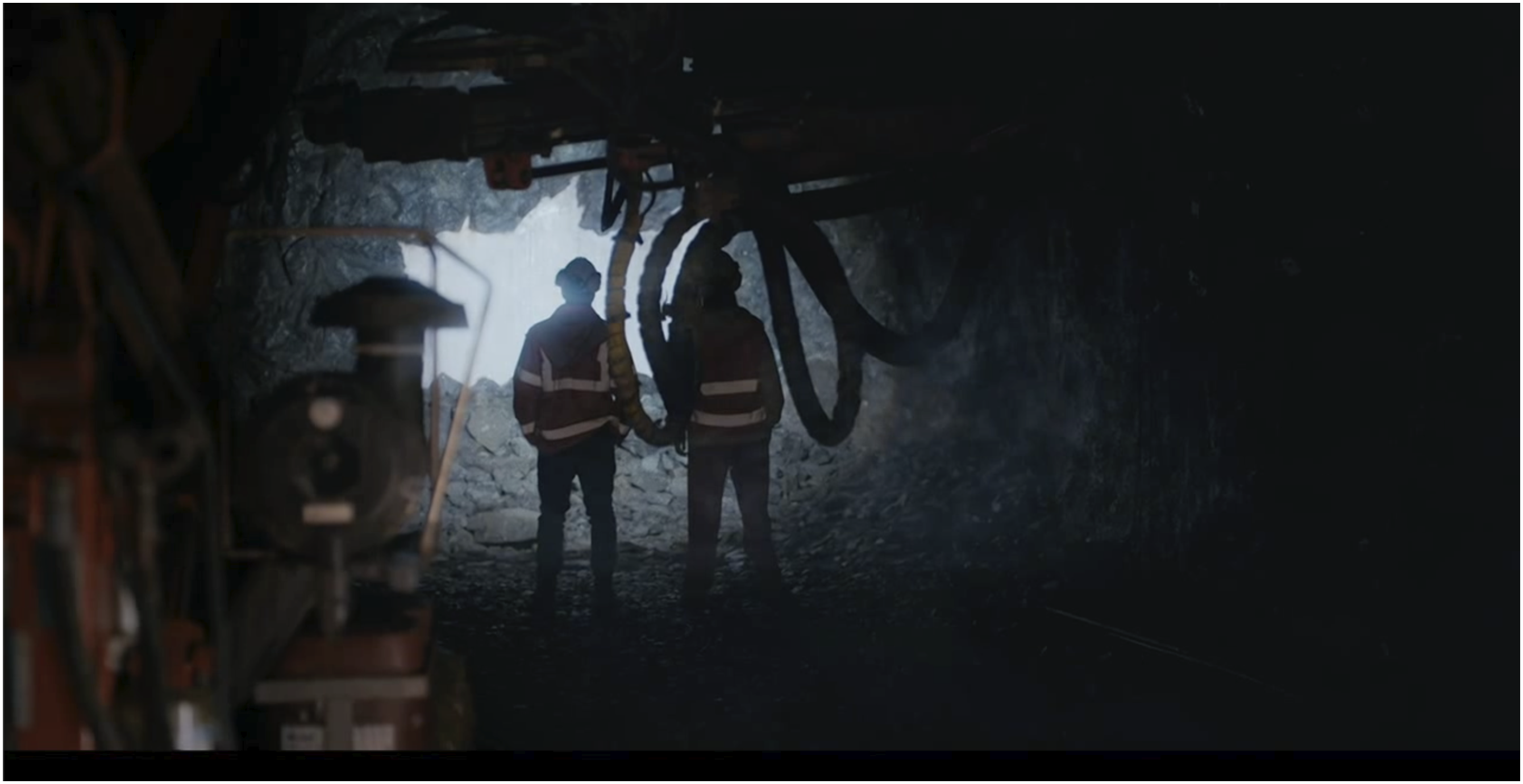
When the geologist Helen Wikberg (Vera Vitali) first approaches the wall, its glistering surface absorbs the light of her torch, transforming her silhouette into a small, luminous blur. The wall’s mesmerising blankness affects each character differently: the mining truck driver, Magnus Ahlbäck (Mattias Nordkvist), becomes haunted by apocalyptic premonitions, Helen is mystified by the wall’s unfamiliar mineral composition, while her eight-year-old autistic son constructs a large elliptical capsule from white Lego blocks. Initially, the engineer and project manager Lars Ruud (Aksel Hennie) perceives the wall as an annoying obstacle to his assignment from ESCO. For him, the wall presents a stark choice: the project team must either press on and explore—and thus destroy—this ‘final frontier,’ or leave the ‘miracle’ untouched and therefore unresolved. Lars appears incapable of resisting his burning ambition to challenge and dominate geologic forces, regardless of the consequences. ‘Focus on how we can remove it,’ he implores the geologists. ‘In one piece or blown to pieces. I don’t care.’ Although controversies surrounding the burial of radioactive capsules continue to inform the plot, they therefore gradually recede into the background. Instead, the titular white wall emerges as a principal narrative agent, which is subjected to the conceited human desire to explain the world rationally, even to the limits of madness and collapse.
Geological thought and underground imaginings
Christopher: I concluded that this wall, this object … is hollow. Lars: A capsule? Christopher: There is something inside, behind the wall that is 400 meters thick. Lars: And how do you suggest we find out what is inside? Christopher: This time you really have to stop and think about it. Do you really, really have to know? Must you know? Lars: I have to know! White Wall (S1.E04)
This dialogue between Lars and Christopher (Claes Ljungmark), a professor of geology, takes place midway through the story. Sophisticated measurements have shown that the exposed white surface constitutes but a small section of an enormous, egg-like hollow structure, about 200 meters high and 43 meters in diameter. The quoted dialogue reflects two diverging outlooks on material science and mining’s social and environmental impacts. Ecofeminist philosopher Carolyn Merchant has claimed, somewhat provocatively, that ‘the world we have lost was organic’ (1993: 274). Until the scientific and technological revolution, Earth was conceived as a nurturing mother, who gave birth to not only animals, plants and human beings, but minerals as well. In this view, minerals were considered organic; they could grow and propagate. Yet modernity’s rationalist, quantifying impulses gradually triumphed over the magical and religious modes of thought that prevailed in ancient and medieval worlds. New images of mastery and domination emerged to ‘sanction’ earth-altering activities and promote industrial and commercial processes (Merchant, 1993: 275). 1 In consequence, the mine lost its spiritual significance, instead coming to exemplify the inorganic, ‘dead’ environment. In modernity, geology has become ‘the science of the inert’ (Kahn, 2016: 90) and the mine represents ‘a dark, a colourless, a tasteless, a perfumeless, as well as a shapeless world: the leaden landscape of a perpetual winter. The masses and lumps of the ore itself, matter in its least organized form, complete the picture’ (Mumford, 2010: 70). Paradoxically though, modernity has also occasioned various scientific and fictional narratives in which the underground is a subject of fascination. In these accounts, Earth’s ‘inner space may no longer be regarded as sacred, but it still is a repository of spiritual value because it is assumed to hold the secrets of lost time. In this archive is imprinted the story of the origins of man, of the globe, even the galaxy’ (Williams, 1992: 24).
As a work of speculative fiction, White Wall falls into step with a long tradition of literary, filmic and televisual utopian, sci-fi and dystopian fables portraying subterranean wonders and horrors. In particular, the series resonates with ‘hollow earth’ narratives, which were popular in the late-nineteenth century and emerged simultaneously with the modern sciences, such as anthropology, palaeontology, archaeology and geology. But whereas these earlier geological imaginations sustained the desire ‘to shape the planet for human-centered purpose’ (Pak, 2016: 2), this contemporary narrative ‘predicts’ as yet unrecorded effects of the long history of large human interventions in Earth’s natural systems. For many nineteenth-century geologists, ‘excavation was seen as a modern version of the mythological quest to find the truth in the hidden regions of the underworld’ (Williams, 1992: 23). Part of that truth, it was proposed, was that Earth was hollow and its inside habitable. American explorer Captain John Cleves Symmes claimed that Earth consisted of a series of concentric spheres, with openings at the poles through which light, heat, and ultimately explorers themselves access the terrestrial interior (Blum, 2012; see also Jones, 2010). Symmes’ views were informed, notably, by the 1741 novel, The Journey of Niels Klim to the World Underground, in which Ludvig Holberg enrolled hollow earth utopias for the purposes of societal satire (see Fitting, 1996). Following Symmes, American, Canadian and British authors of the late-nineteenth century were fascinated by subterranean spaces exposed by geological disruptions such as volcanoes, earthquakes, the sinking of mineshafts and exploratory drilling.
2
It could be that hollow earth novels were early expressions of environmental fiction, in that they imagined subsurface settings as ‘closed, near-planetary ecosystems … with the purpose … of explicating and historicizing the phenomena of a self-sustaining ecology’ (Chang, 2016: 388–9). In these texts, the subsurface contains flourishing non-human organic life; explorers find air, light, water and living organisms. Descending into the underworld often uncovers superior forms of agriculture and the promise of escaping the vice and misery of the crowded, rapidly industrialising cities above. Another reason for the nineteenth century’s obsession with the underground was the fear of natural disasters. These desires and forebodings led to technological experimentation in and on the underground, which could easily engender a ‘lack of self-control lead[ing] to other fears and to other disasters’ (Williams, 1992: 200). Hollow earth fiction also contributed to understandings of time, especially concerning how the familiar chronology of human history relates to geological timescales. Yet, despite two centuries of stratigraphic advances and the urgency surrounding the geological turn named by the Anthropocene, the West’s imagination of subterranean forces continues to present challenges. As Nigel Clark and Kathryn Yusoff write, While the fleshy exuberance of biological life and the ‘spooky’ indeterminacy of sub-atomic particles were roundly enrolled in efforts to reimagine collective life … the basal depths and lumpen masses of the inorganic, the mineral, the geologic, have proved rather more recalcitrant. (2017: 15, original emphasis)
The series echoes this sense that Earth’s interior is unfathomable in that the characters struggle to understand the wall’s origin, strong magnetic powers, and impenetrability. It also recalls premodern theories of organic mineral formation; the small sample that Helen extracts from the wall and keeps in a sterile glass jar suddenly becomes mouldy. On first encountering the white patch embedded in the bedrock, Magnus touches its smooth surface and declares that it emanates soft sounds. This scene comprises shot/reverse shots, implying that the luminescent stone looks (and speaks) back. When Magnus, awestruck, reports to Lars that the unknown thing ‘looks like bone but is harder. It might be something living. I mean that it used to be alive—a large fossil or something. Some unknown animal.’ Lars briskly interrupts these ruminations with a practical imperative: ‘One’s imagination runs wild here. Get some sleep, then get rid of this crap’ (the latter referring to the wall). Again, for the engineer Lars, Earth’s depths are an object of scientific rationalism not spiritual fascination. He considers the wall geological, abiotic: an inconvenient, alien object, significant only insofar as it obstructs further excavation of the underground network: ‘It’s pointless to speculate! Let’s dig the bloody thing out, and then we’ll know.’ Even when the magnitudinous, elliptical and hollow structure begins causing anxiety, prompting Christopher to stop his exploration altogether, Lars’s hubristic will to outsmart the others and remove this last remainder of Earth’s alterity persists. ‘We’ll seal off the section, drill a microscopic hole and then we will know!’ he maintains. To an extent, the character’s self-defeating ambition reflects the condition of modern geoscience, which finds itself confronting ‘an abyss whose reality becomes increasingly uncanny, not less, the more scientific instruments are able to probe it’ (Morton, 2012: 233).
Lars’s behaviour is disturbingly similar to that of a character from an earlier sci-fi account of the subterranean. In Arthur Conan Doyle’s short story, ‘When the World Screamed’ (1989), set in the late-nineteenth century, a fictional, world-famous professor, tellingly named George Edward Challenger, sets out to prove that Earth is circular, flattened at the poles, has a hard outer mantle and soft animate centre, and is therefore a living organism with circulatory, respiratory and nervous systems. To shatter Earth’s ostensible indifference to its human inhabitants, Challenger resolves to sink a shaft into its inner kernel. He succeeds in drilling through the planet’s outer crust and into its soft, sensitive core, overcoming the extreme distance, temperature and pressure involved. The injured Earth responds with a horrifying scream: ‘it was a howl in which pain, anger, menace and the outraged majesty of Nature all blended into a hideous shriek’ (Doyle, 1989: 575). Earth is violently shaken out of its state of passive endurance and imperviousness to human intervention. It responds with a series of cataclysmic events: all over her surface (to use Doyle’s gendered language) oceans heave, land shakes, and volcanoes erupt. Earth destroys the site of Challenger’s experiment, closing the pit ‘with a prolonged high-pitched crash’ and ‘burying’ his scientific equipment in her depths forever (Doyle, 1989: 576).
In her analysis of this tale, geographer Yusoff calls Challenger ‘the dark character of Western scientific reason [who] could be seen to have a parallel in the subjectification of the Anthropocene: a subject—Anthropos—capable of challenging geologic forces and probing deep into the standing stock of the earth (or, of making rocks scream)’ (2017: 107; original emphasis). Here, Yusoff suggests that this classic text can encourage contemporary readers to reassess the geological’s assumed externality to the social and to see ‘how subjective modes—where subjectivity is always derivative from social and material milieu—organize the relations with geology’ (2017: 107). It is notable then that White Wall, which takes place more than a century later, in 2050, shows Lars reproducing the same psychosocial desire to conquer Earth’s supposed indifference to human activity. He also uncannily foreshadows Earth’s impending ‘awakening’ as a living and breathing organism when, shortly before the discovery of the wall, he mocks Helen’s attempts to bore through the unyielding bedrock by screaming, as if he were Earth in pain.
After the wall has been found, Helen urges the technical team to leave the autonomous alien structure undisturbed until further consideration. ECSO’s top brass, however, predictably adopt a ‘tidying up’ strategy, ordering that the problematic tunnel be closed immediately. Yet Lars persists in his wish to penetrate the white capsule’s pulsating interior, ‘to see what it is.’ Having been arrested by ECSO security staff, he manages to escape and descend to the underground by blasting open an old mineshaft that was abandoned and sealed off in 1987 after a mining team encountered a mysterious white patch embedded in the bedrock and a man died desperately trying to uncover its origin. He resumes drilling. After several hours, the wall ultimately gives in. We see Lars peeping inquisitively into the cleanly cut round hole. This shot is taken from the capsule’s hollow inside, focusing on the man’s eye and blinding light of his torch (Figure 2). Again, Earth appears to return the human gaze. Lars looking inside the white capsule. White Wall, S1. E08.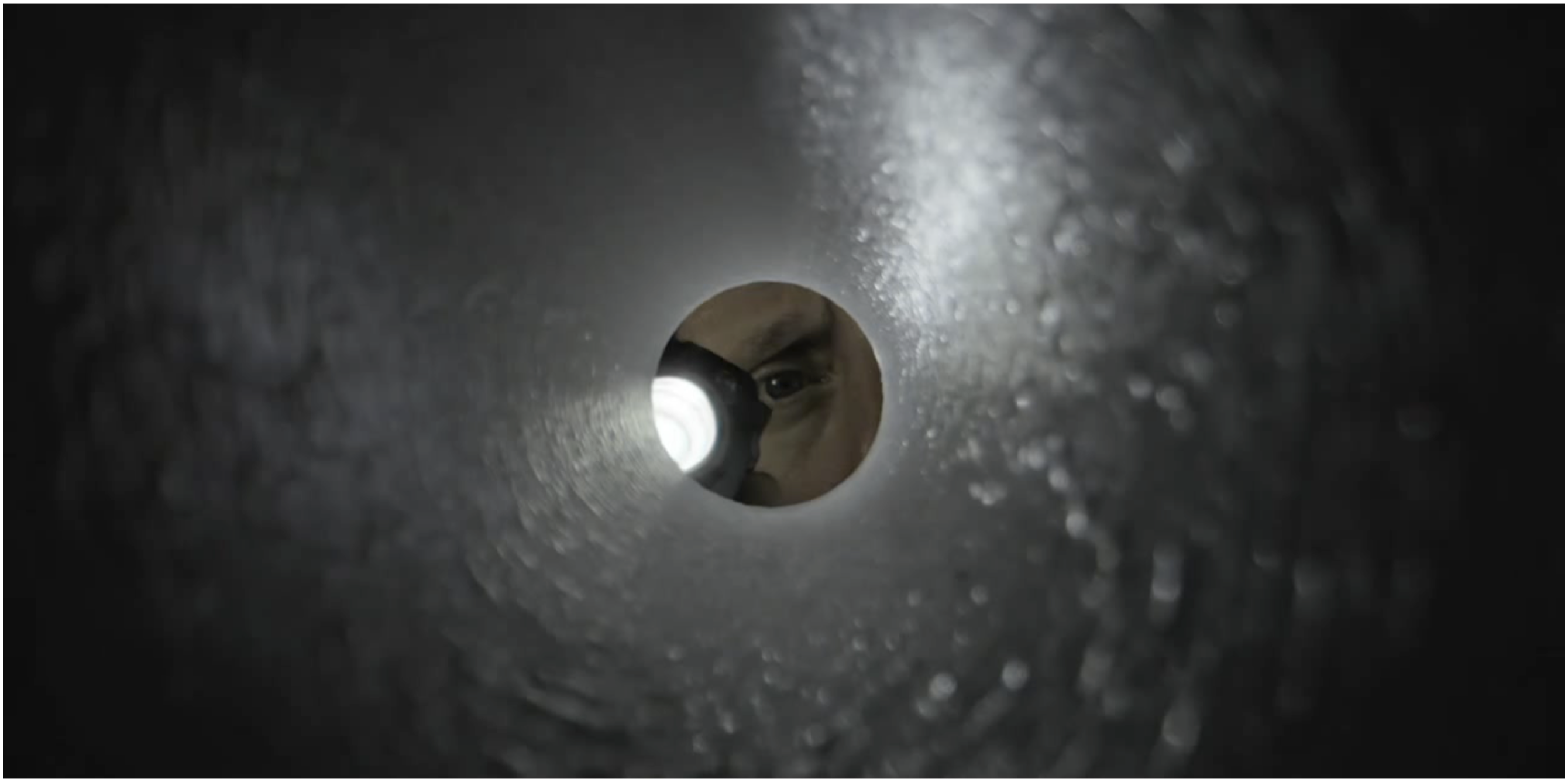
In Doyle’s story, a purple fluid—Earth’s life blood—engulfs the shaft and the drill hole collapses. Despite this, Challenger himself not only survives the catastrophe but receives universal adulation for having turned his ambitious dream into a scientific fact. In comparison, White Wall’s protagonist has no such a heroic finale. Instead, the series’ ending urges the need to acknowledge and appreciate the incessant movement and transformation of the subterranean, reminding viewers that Earth ‘must no longer be thought of as revolving around “us”’ (Buell, 2003a: 106). When Lars finally perforates the wall, the latter, far from screaming, remains silent. Not thick dark blood, but pure freshwater trickles from the tiny hole. Yet Earth’s reaction to its equilibrium being disturbed is as unexpected as it is irreversible. Above ground, the liquid that Lars collected during his expedition expands, making the plastic bottle containing it explode under enormous pressure. In the tunnels, powerful streams of water burst violently through the capsule’s crust, flooding the mining network. The final scene shows huge fountains thrusting through Earth’s surface with a tremendous force. Masses of released water sweep ECSO buildings and faculties away, flowing farther and farther over the snowy landscape towards the horizon. The planet rejects the alleged fixity of geology as well as passive availability to human demands. Instead, it emerges as an incessantly dynamic, unknowable, and uncontrollable system that predated and will, in all probability, outlast humans.
Surface (over)views and vertical visions
White Wall’s fifth episode features the ECSO opening ceremony, held at the facility’s headquarters. While security staff keep an assembled group of eco-activists outside the gates, official guests steadily arrive at the celebratory event. The ubiquitous drones circulating above offer international audiences (and the series’ viewers) a bird’s-eye view of the territory and its spectacular natural surroundings. The drone shots are juxtaposed with the image of Helen descending in a shaft elevator. Underground, she cautiously makes her way through the pitch-black passage, treading over heaps of undifferentiated stone brash and mud. Pools of murky water reach toward a clearing, at the centre of which is the immense, majestic white wall. Getting closer, Helen shines her torch at its luminescent surface. Her small figure is shown from behind, in a circle of light, under the cave’s vault.
This sequence illustrates various visual regimes employed, and implied, throughout the series. Although the drones pertain to the diegetic reality simply insofar as they indicate the ceremony’s wide media coverage, their appearance also helps interrogate Apollo’s-eye perspective (Cosgrove, 2003) or God’s view as an approach to humans’ environmental relationships. In film and photography, an aerial view is usually employed to produce sublime, atmospheric panoramas. Indeed, the series attests to how even the radioactive waste storage grounds’ sinister outline, when seen from on high, appears almost serene as it merges with the white open planes of the nearby lake and fields. Yet this view also provokes an ambivalence regarding the end of conventional landscape representation, for which nature is static and pristine. 3 White Wall’s aerial panorama dispels the impression of untouched nature, seamlessly integrating the infrastructural site into the natural environment. In so doing, it evokes an aesthetic mode that Yves Abrioux calls ‘intensive landscaping’ or ‘landscaping as style, as social promise yet to come’ (2009: 264). Abrioux’s ruminations on landscape could be related to Morton’s project of deconstructing ‘nature’ to the point that it no longer exists, resulting in ‘the ecological thought’ and ‘thinking of interconnectedness’ (2012: 7). Morton sets out to develop a ‘dark ecology’, leading him to the idea that ‘we can’t mourn for the environment because we are so deeply attached to it—we are it’ (2009: 186; original emphasis).
The image of the nuclear waste depository embedded in the vast natural terrain disturbs the easy spectatorial enjoyment of the sparkling snowy planes, reminding us of human-induced environmental devastation and the inevitability of catastrophe. Morton writes: ‘We should be finding ways to stick around with the sticky mess that we’re in and that we are, making thinking dirtier, identifying with ugliness, practicing ‘hauntology’ (Derrida’s phrase) rather than ontology’ (2009: 188). The aerial view of the ‘messy’ industrial site amidst a beautiful landscape precludes a return to some unspoiled natural world. Instead, the viewers are led to acknowledge the destructiveness of the site’s infrastructure, which accumulates and obfuscates the incremental, pervasive toxicity and ‘slow violence’ (Nixon, 2011) of radioactive waste, the hyperobject at the heart of the series. In addition, the bird’s-eye or satellite gaze installs human viewers in a position of superiority over Earth, ensuring their scopic and epistemological privilege. Many environmental scholars have argued that when visualised from above, Earth becomes a surface that is lived upon rather than an encompassing and sustaining milieu (see Wenzel, 2014; Ingold, 2000; Harvey, 1997). And so, the question arises: ‘Who gets to see, and from where? When and how does such empowered seeing become normative?’ (Nixon, 2011: 15).
In contrast to elevated viewpoints, Helen’s subterranean descent establishes another perspective: that from below. The elevator that transports her sinks deeper and deeper into darkness until the light of the surface world disappears completely. The camera is directed upwards during this shot, the source of its field of vision appearing to converge with Earth’s core. 4 Shots that draw the camera down to assume Earth’s perspective distinguish cinematic narratives of the underground from the earlier literary fictions, which, unable to approximate this technique, remained focalised through the human gaze. In the series, such shots can be seen as an invitation to apprehend the world in other-than-human terms. What is more, Helen’s descent in a shaft elevator, followed by her journey through the tunnel, visually (and mentally) simultaneously moves viewers along the vertical and horizontal paths into and across the subterranean realm. These underground views are reminiscent of the genre of mining cinema, which, according to Karen Redrobe, ‘is and has always been a vertical cinema of gravity, and it exerts a downward pull. Shooting inside of real mines generates images and viewing positions that are partially sighted, limited, fumbling, precarious, claustrophobic, and dependent’ (2021: 218–9). By situating the essential part of the narrative action in the subsurface environment, White Wall underscores the intersections (and limitations) of the subterranean optics. Perhaps, such visual regimes also exemplify ‘a geopolitical aesthetic of the subterranean’ (Hawkins, 2020b), in which geopolitics is understood as what Clark calls ‘geologic politics,’ ‘concerned as much with the temporal dynamics and changes of state of Earth systems as it is with more conventional political concerns revolving around territories and nation-state boundaries’ (2014: 19). The series demonstrates how the geopolitical theme it addresses, which involves international solutions for the ‘sustainable’ storage of nuclear waste, becomes inextricably linked with questions of the human use and command of underground spaces, and about these spaces’ materialities, dimensions and dynamics.
Although the subsurface has historically proven fertile for speculative imaginations, it is a relatively new subject for television drama (see Woon and Dodds, 2021). The most prominent televisual treatment of the unground is the previously mentioned Midnight Sun whose central intrigue involves an iron mine in Kiruna, a Swedish town. Perhaps unsurprisingly, the workers call the mine Mother, which might reflect the fact that it is the area’s sole source of employment as well as ancient beliefs in Earth’s fecundity and organicity. Yet the mine in Midnight Sun is not solely benevolent. It is also a place of danger, in which the central (male) characters ultimately drown. But whereas in this series disaster strikes after someone intentionally deactivates the mine’s dewatering system, White Wall’s apocalyptic flood is provoked by humans’ overreaching attempt to dominate Earth. Instead of passively remaining a dark, undifferentiated space, the subterranean realm with the white capsule at its centre inverts the scopic position that privileges the human gaze. In so doing, it reclaims its alterity, which human (predominantly Western) forms of knowledge and practice can never completely determine nor control.
Coda: Where would we go?
Where would we go, not if, but when it happens for real? … If Earth can no longer keep us alive? Then what do we do? Is there a way to start over? … A search for a place where we can start over and forget the planet we’ve left behind. Laid to waste. DJ Lenin, While Wall (S1. E07)
DJ Lenin’s disconcerting monologue resonates with the contemporary ecocritical realisation that ‘the Anthropocene is less about what humanity is doing, than the traces that humanity will leave behind’ (Szerszynski, 2012: 169; see also Zalasiewicz, 2008). The monologue implies that modernity’s imperious dream of conquering and transforming nature has become the nightmare of humankind’s destructive relationship with the environment. The project of managing Earth’s systems is failing and catastrophe is imminent. Indeed, the series’ closing scene confirms both Biblical premonitions of the world ending in a disastrous flood and contemporary uncertainties about disposing ‘sustainably’ of the most destructive substance that humanity ever produced.
But before the apocalyptic finale, White Wall dispels any hope of escape, providing a radically negative answer to DJ Lenin’s question of whether there is ‘a way to start over?’ Throughout, the series develops an auxiliary storyline depicting the survey by rover of Mars’ surface, which Helen’s young son Axel (Zacharias Boustedt) meticulously follows through a livestream on his iPad. To assess the Red Planet’s potential resources to sustain future human missions, the survey probes its soils, weathered rocks, and minerals for the presence of water. This time, the human speculative gaze is directed up and outwards, beyond the terrestrial orbit. Just as Earth is usually apprehended through databases, spreadsheets, and GIS, Mars is digitally mediated as an abstract, flat surface, a brown-red carpet covered in lines of longitude and latitude. This perpetuates the illusion that humans can easily subject planetary environments to bureaucratic technologies of observing, mapping, and governing. Yet a few minutes before Earth’s inscrutable white core performs its spectacular act of resistance, the screening of the rover’s routine, slow progression through the stony landscape is suddenly animated by huge streams of water erupting through Mars’s supposedly stable surface. Demonstrating its intertwinement (and uncanny solidarity) with Earth’s material and energetic systems, the distant planet irrevocably transforms humanity’s cosmic exploits into a desperate grasping for life’s safe continuation elsewhere.
Susan Sontag writes that from ‘a psychological point of view the imagination of disaster does not greatly differ from one period in history to another. But from a political and moral point of view, it does’ (1965: 224). As a work of speculative fiction, White Wall exemplifies the moral and political specificity of contemporary imaginations of disaster. The Anthropocene has overturned the received belief that technology will allow humans to make the best use of nature’s resources for their benefit, while averting natural catastrophes such as floods, earthquakes, volcanic eruptions and droughts. At one level, the series confirms that humans can design, exploit and engineer alien environments to satisfy their various needs (for example, through mining and dumping of nuclear waste); in this way it fosters a progressive view of technology. At another level, though, it shows how technologically altered environments ultimately become sources of existential danger. On Earth, the catastrophe blurs the surface and subsurface. Meanwhile, the dramatic demise of the Mars expedition implies that there exist no easy escape routes, no shelter, and no new world beyond the Anthropocene. It would be naïve to suggest that through installing such visions of environmental apocalypse, popular television narratives such as White Wall necessarily inculcate a sense of (inter)planetary care (see Buell, 2003b; Berger, 1999). The series nonetheless has the potential to attune viewers to the idea that Earth’s unruly forces have always been folded into humans, who have always been biological and geological beings. As such, they must learn how better to feel and understand the signs of the current epoch’s socioecological conditions, as well as to respond to the uncertain future.
Footnotes
Declaration of conflicting interests
The author(s) declared no potential conflicts of interest with respect to the research, authorship, and/or publication of this article.
Funding
The author(s) received no financial support for the research, authorship, and/or publication of this article.
