




Abstract
This article investigates the articulation of complex demands of neoliberal feminism, such as individualism, entrepreneurialism and self-management on the millennial woman in recent streaming series. The portrayal of a fractured female self and its entanglement with millennial angst will shed light on serial depictions of neoliberal individualism and female subjectivity. Search Party, a satirical, genre-bending, half-hour comedy-drama serves as an example through which the contradictory demands of neoliberal feminism are negotiated and questioned. In addition to assessment of the narrative and character framing, paratextual materials and specifically the series’ promotional posters work to further situate the twenty-first century millennial female, underscoring her split self.
Search Party (2016-2022), a dark comedy whose five seasons encompass a variety of genres, works through the fracturing of its protagonist’s self. It does so via satirical renderings of popular tropes and genre conventions in US TV, from the mundanity of the lives of privileged millennials to the missing (white) girl, the amateur detective, the mystery thriller and the psychological thriller, as well as the courtroom drama and the Zombie apocalypse. This article offers an analysis of the ‘angsty’ twenty-first century millennial woman as emblematic of a neoliberal feminist sensibility by way of analysing the representational practices of contemporary TV that render her so. Search Party concluded with its fifth and final season in early 2022. Over the span of its serial narrative, it has provided fertile ground for critical looks at the relationship between neoliberal feminism—particularly its demands on and promises to individual women —and the existential angst or dread that frequently accompanies the televisual portrayal of millennials. It is within this context that Dory, Search Party’s resilient protagonist, warrants an analysis that centres around neoliberal feminist ideals such as individualism, self-management, and entrepreneurialism. The posters advertising Search Party on TBS and HBO Max can tell us a great deal about the position of the female protagonist within a neoliberal feminist context and situate her within the current television landscape. A closer look at these paratexts will shed light on the way in which the ambivalences and contradictions inherent in the rhetoric of neoliberal feminism are negotiated in Search Party and what role paratexts such as promotional posters can play in tracing a character’s trajectory over the course of multiple seasons. The imagery of Dory’s split self is evoked in different ways throughout the series and as Dory is emblematic of a fragmented neoliberal (feminist) self, her major personality changes are expressed through, and mirror, narrative tropes, such as that of the femme fatale in seasons two and three. In this way, ideas of performances in different situations in everyday life and performances of characters according to genre conventions stand in constant dialogue with one another.
As feminist scholar Catherine Rottenberg (2014, 2018) has argued, there has been a rise of neoliberal feminism in the United States starting roughly at the time Anne-Marie Slaughter’s famous Atlantic article titled ‘Why Women Still Can’t Have It All’ was published in 2012, followed by Sandberg's (2013) ‘feminist’ manifesto Lean In: Women, Work, and the Will to Lead the next year. As Rottenberg stresses alongside Gill and Banet-Weiser in a joint 2020 article, neoliberal feminism, postfeminism and popular feminism are still evolving and entangled sensibilities. Angela McRobbie’s theorisation of neoliberal feminism as a common sense that ‘responsibilises’ women in an environment in which ‘those who are deemed highly employable subjects are constantly prevailed upon to be thankful’ (McRobbie, 2020: 76), and neoliberalism’s co-optation of feminism in general (Scharff, 2012; Fraser, 2013; Rottenberg, 2018) are particularly intriguing ideas to explore via pop-cultural texts, including television. In their most recent work, McRobbie and Rottenberg both draw from various media examples to illustrate their theorisations of neoliberal feminism, from magazine covers to reality television and popular series such as The Good Wife (2009-2016), which Rottenberg discusses in The Rise of Neoliberal Feminism (2018). Most recently, Shani Orgad and Gill (2022) have compellingly mapped out the role that confidence plays within neoliberal discourses and as an integral and imperative part of the self-management that is expected of women in particular, gendered ways. With reference to Nikolas Rose’s Inventing Ourselves: Psychology, Power, Personhood (1998), they assert that ‘the confidence cult(ure) becomes part of an ‘obligated freedom’, in which not achieving the required change is framed as moral and psychological failure’ (Orgad and Gill, 2022: 6). Their stylisation of confidence cult(ure), as they explain, ‘captures the sense in which confidence has become an unquestioned article of faith while simultaneously spreading across culture’ (Orgad and Gill, 2022: 5). This article aims to provide a closer look at how neoliberal feminist rhetoric around self-management, entrepreneurialism and individualistic resilience and confidence is articulated and contested in recent fictional serial TV. It also follows the recent work of television scholars who explore questions related to feminism in a neoliberal age, such as Kristyn Gorton’s scholarship assessing resilience and resistance in The Handmaid’s Tale (Gorton, 2021).
Resilience and confidence are major themes that run through all seasons of Search Party. ‘I miss when my problems were about nothing’, Dory exclaims in season two amidst having to cover up an accidental murder that happened at the very end of season one—a highly ironic statement, as the state of not having significant enough problems was what drove Dory further and further into her current predicament. The phrase was put on several promotional posters for season two as a tagline when it was still being produced for TBS, functioning as ‘a framing element of framing elements’ (Mahlknecht, 2015: 414). The statement’s irony is apparent to viewers who are familiar with season one’s narrative events, while the quotation may equally spark potential new viewers’ curiosity as to what these problems are, exactly. The visuals of the poster evoke the crime genre, as we see the legs of a dead body, with one shoe missing. Thus, the tagline and poster complement each other, forming a ‘unified concept’ (Mahlknecht, 2015: 418). As Jonathan Gray asserts in Show Sold Separately, ‘[d]ecisions on what to watch, what not to watch, and how to watch are often made while consuming hype, synergy, and promos, so that by the time we actually encounter ‘the show itself’, we have already begun to decode it and to preview its meanings and effects’ (Gray, 2010: 3, original emphasis). Therefore, taking a closer look at these paratextual examples will provide further details to explain Dory’s subject position within the programme and the ways in which she may be conceived of by the spectator in a wider cultural context.
Search Party’s season one episode titles emulate those of the Nancy Drew mystery novels (comprised of 175 novels and 34 revised stories, starting with The Secret of the Old Clock, first published in 1930 under the pseudonym Carolyn Keene), and in their evocation of the mystery genre as ‘entryway’ paratexts (Gray, 2010: 18) that can shape audiences’ expectations and understanding. The episode titles include references to Chantal’s disappearance that may equally be read as descriptions of the state of Dory’s sense of self, such as ‘The Curious Case of the Lost Soul’, ‘The Unexpected Case of the Missing Identity’, and ‘The Mysterious Disappearance of the Girl No One Knew’. In addition to the official promotional posters for season one, which all feature artwork by Sam Hadley 1 , there are several posters incorporating these episode titles and additional depictions of Dory in the same style with clear allusions to the covers of the Nancy Drew novels, invoking nostalgia for the trope of the amateur sleuth while also establishing Dory as the main character with whom the audience will most likely align. Furthermore, Alia Shawkat’s roles in indie films and, most notably, as Maeby Fünke in Arrested Development (2003-2006;2013-2019) render her somewhat recognisable and therefore, her role as the main character and viewers’ expected familiarity with her face may spark curiosity about the series based on Shawkat’s other performances. In addition, the posters largely (with the exception of a few that include Dory’s ex-boyfriend) show only the programme’s four white protagonists, laying bare Search Party’s place within a category of programmes Nygaard and Lagerwey have identified as ‘horrible white people shows’ with ‘suffering yet still incredibly privileged characters, which despite good intentions, center their perspective, their suffering, and their needs above all else’ (2020: x). As such, Dory can be situated alongside similarly precarious white women in their twenties or thirties, such as the protagonists of Fleabag (Fleabag, 2016), Broad City (2014-2019), or Girls (2012-2017).
Whereas programmes such as Girls embrace a contemporary style and aesthetic both within their diegetic worlds and their paratexts, Search Party, through its play with specific genre conventions from different eras, such as film noir, draws attention to its constructedness as a narrative, which is particularly apparent on its promotional posters. Both posters for season two on TBS emulate the style of posters for films noirs in the 30s, 40s, and 50s, invoking nostalgia, but also raising expectations of the detective genre and visualising Emily Nussbaum’s description of the programme as a ‘noir sitcom’ (Nussbaum, 2016: online). On the first poster (Figure 1(a)), Portia (Meredith Hagner, top right), consistent with her performance within the diegesis, provides comic relief in that she is the only character not looking shocked or worried at the sight of a dead body, but as if she were posing for a photograph. The victim’s body is not immediately recognizable as both posters (Figure 1(a) and (b)) depict him lying face-down on the floor after his murder, thus not spoiling this detail for potential new viewers. Furthermore, this depiction of Keith (Ron Livingston) points to his ultimate insignificance as an individual and his status as a plot device. In a stereotypical detective story, Keith may be the flawed but brilliant white male protagonist. However, in Search Party, he functions as a narrative tool for Dory to receive both professional and sexual validation, only to be killed off, ensuring that the story goes on. (a), (b) and (c) Dory’s most ironic line: “I miss when my problems were about nothing.” Promotional posters courtesy of TBS, Turner broadcasting system, Inc. A warner media company.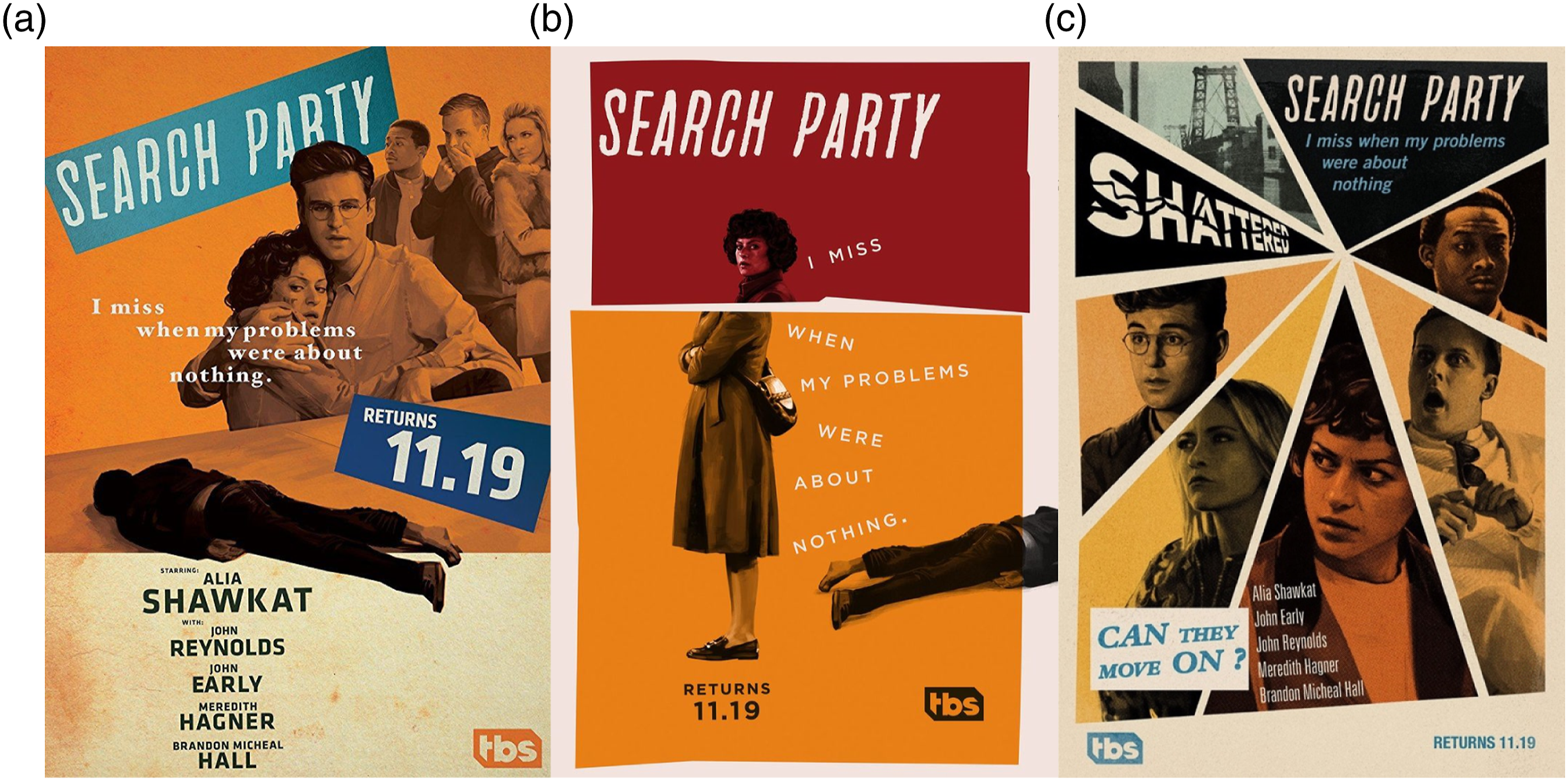
The focus of the posters, as of all promotional posters for Search Party, is on Dory, and thus the posters work to situate her within each season’s respective generic context and to draw attention to her different, fractured selves. The Dories in Figure 1(a) and (b) are, first, the damsel-in-distress comforted by Drew after realising Keith’s demise (Figure 1(a)) and a curious but guarded amateur sleuth (Figure 1(b) and (c)). Dory looks serious in all posters, and it is significant that even though Dory’s pose in the first poster in Drew’s arms may signify the damsel-in-distress trope, Dory’s gaze is not averted as she stares directly at Keith’s body, her eyes wide open in not as much terror as curiosity and, perhaps, an iota of thrill. The second poster signifies a rupture in the form of Dory’s visually separated body, as Dory’s head and neck are physically cut off from the rest of her along with the plain coloured background, dark red on top and dark orange on the bottom and monochrome colour palettes in general. This is another way to emulate the style of movie posters from the 1940s, especially promotional posters for films noirs, such as Out of the Past (1947) or The Lady from Shanghai (1947). Further, Dory faces the implied viewer in the second poster—she is alone and gazing (back) at the implied spectator. Dory’s gaze, alongside all the posters’ nods to noir detective genres, works to establish Search Party as a self-aware popular cultural product. Most significantly, both the fragmentation of Dory’s body on individual posters and the many different versions of Dory on all posters over the course of the show supplement the programme’s rendering of Dory’s split selves with visual foreshadowing.
While Dory’s character is sketched in numerous different ways over the course of Search Party, her status as a (stereo-)typical millennial ‘girl’ remains a constant throughout. As Rebecca Wanzo has observed, there has been a slew of recent programmes lately that revolve around ‘a perpetual girlhood produced not only by the greater economic insecurity faced by middle-class women post-Great Recession (that is, the period following the severe economic crisis experienced worldwide in 2008), but also by the variety of social factors that generate feelings of immobilization and isolation’ (Wanzo, 2016: 29). Wanzo goes on to argue that contrary to some of the newer comedies’ predecessors, the protagonist of the ‘precarious girl comedy’ of the 2010s ‘can escape her feelings of immobility by accepting her abjection as a form of psychological growth and development’ (Wanzo, 2016: 29), with the details of said abjection differing when black characters are portrayed. Arguably, in the last few years, there has been a shift of focus away from abjection as a central and pervasive component of the female-led half-hour comedy-drama. Instead, there is now a sharper focus on exploring the lostness of female leads through a mystery or detective story, with a stronger pull towards drama rather than comedy, such as in Fleabag or I May Destroy You (2020). This shift is also present and explicitly rendered in Search Party. Some notable series with starting points in the mid-to-late 2010s that fall into similar categories (precisely by not falling into any one category) include Undone (2019-2022), Made for Love (2021-2022), Russian Doll (2019-present), The Good Place (2016-2020), Dead to Me (2019-2022) and The Flight Attendant (2020-2022). These series are women-centric and involve concrete mysteries around which the programmes’ plots unfold, while Sci-Fi and fantasy tropes or elements of magical realism are often incorporated as well.
Like other popular half-hour comedy-dramas such as Girls, Search Party revolves around a young woman who is navigating life after graduating from college. Much of the comedy in other such programmes stems from characters’ awkwardness and abjection, as Wanzo has insightfully argued in 2016 with in-depth analyses of Lena Dunham and Issa Rae’s comedies. Indeed, some of the humour in Search Party is expressed through abjection aesthetics and may make viewers ‘cringe’, particularly in season one. However, Search Party is highly satirical and incorporates and plays with specific genre conventions, which leads to increasingly absurd situations. As the programme’s plot progresses, some of its humour is based upon this absurdity, with comical parts of the narrative being more frequently tied to characters other than its protagonist, Dory. In both being the central character but remaining elusive when it comes to articulations of her motivations and desires, Dory consistently embodies the ambivalences and contradictions surrounding neoliberal demands on individuals. Aligning with Portia, Drew, and Elliott—Dory’s friends—becomes more likely throughout the narrative, and even though Dory remains the centre of Search Party, she takes on whichever role she fulfils as part of the genre in each season. Alia Shawkat’s performance often involves emotional restraint, as well as a lack of flashbacks or other narrative devices that would provide any account of Dory’s character history. Due to this lack of charting of her ‘true’ emotions and desires, her connection to the audience is not easily facilitated. At the same time, Dory’s trajectory from angsty, dissatisfied girl to confident lifestyle guru over the course of the five seasons (satirically) exemplifies Orgad and Gill’s idea of a ‘vulnerable heroine’ (Orgad and Gill, 2022: 25) whose ultimate story of success comes from or, indeed, needs a place of vulnerability as its starting point to render it compelling. Yet, Search Party’s satirical tone, and the aforementioned narrative restraint when it comes to conveying Dory’s thoughts and feelings to the audience, constantly destabilises the idea of Dory as a compelling character to align with. Viewers’ likely expectation of Dory as the show’s precarious girl with whom they will ultimately align—albeit with some reluctance and ‘cringe’—and their expectations of genre conventions are constantly raised and then deflated, mirroring the emptiness experienced by millennials such as Dory under neoliberal capitalism. The series’ promotional posters also play a central role in this process, as they raise specific expectations about what kinds of genre conventions viewers may expect, as discussed earlier. In this way, the invocation and deflation of genre conventions, which are visualised in the programme’s promotional posters, also function as a constant mirror of Dory’s fractured self as she is expected to perform according to neoliberal (feminist) ideals.
As a situated, contemporary character, Dory is expected to have clearly outlined career goals and to be grateful for any opportunity she is given within the highly competitive environment in contemporary New York City. However, at the same time, she clearly lacks interest in following these paths and experiences disappointment rather than excitement in most everyday situations, from Sunday brunches to job interviews. As Search Party’s promotional posters chart Dory’s transformation, each poster series underlines the type of person she has become, or is becoming, during the respective part of the overarching narrative. The posters are therefore well-suited to an analysis of the ways in which the contradictory demands of neoliberal feminism, such as self-management, resilience, and confidence are expressed and how the programme maps out millennial angst and its protagonist’s self as shaped and fragmented by such demands.
In the promotional posters for season three, Dory is shown in front of a microphone as if she were about to speak at a press conference, and the accompanying text reads, ‘They’re finally trending’ (Figure 2). In addition to exemplifying the ways in which the posters for Search Party ‘create and continue’ the text itself (Gray, 2010: 10), this poster is particularly meta-referential, as it foreshadows the publicity surrounding Dory and Drew’s murder trial and the significance of the added text about ‘trending’ referring not only to the characters, but also to the narrative itself, as the programme had just been acquired by HBO Max. In season three of Search Party, the aftermath of Keith’s death, and the consequences of Dory’s subsequent behaviour towards her friends, are at the centre of the narrative. In a few instances, especially in the news coverage of Dory and Drew’s murder trial, Dory is referred to as an example of what is wrong with an entire generation (i.e., millennials), as she is portrayed as the embodiment of various stereotypes rather than as an individual. This is reflected in the self-assured poses and facial expressions of Dory, Portia, and Elliott (viewers who are familiar with the narrative will not be surprised that Drew is in the background, looking less self-assured) in the poster as well. When Dory delivers her closing statement in front of the jury, she tells the room that she has been called, ‘a vixen, a monster, a slut, a murderer’ (3: 10). This is an attempt to flip these accusations in a way that helps her present herself as a victim in order to maximise her chances of being acquitted by using feminism strategically by constructing a narrative of herself that renders her vulnerable and in need of saving from the jury. However, this invocation of clichés also emphasises Dory’s fractured self. “They’re finally trending,” as Dory receives media attention within the narrative, which also serves as metacommentary about the show’s switch from TBS to HBO Max. Promotional posters courtesy of HBO Max. A warner media company.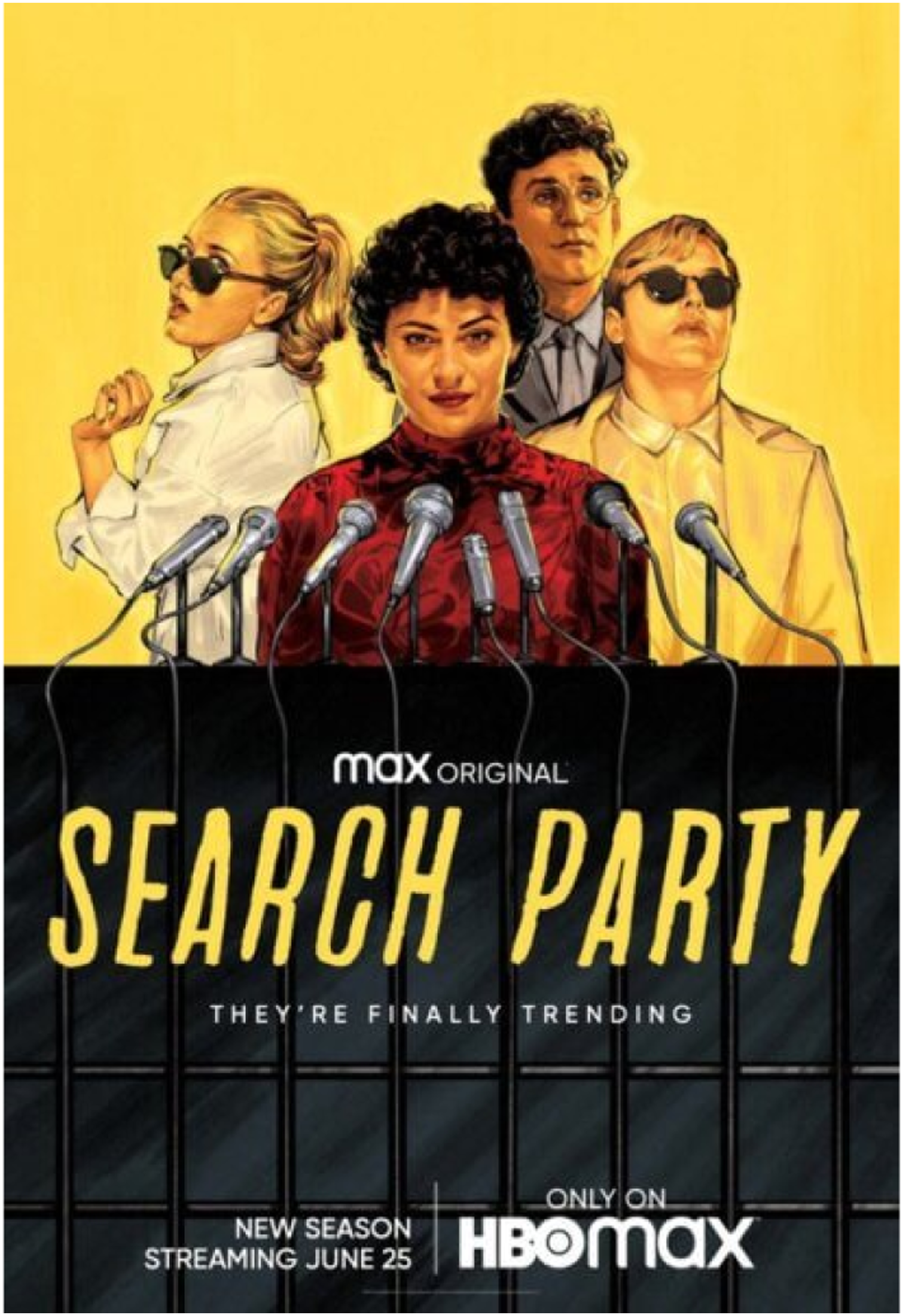
In line with Search Party’s satirical renderings of clichés about privileged New Yorkers in the digital age, Dory is also framed as an emblem of ‘millennial angst’, a concept that permeates in a variety of online discourses, from tweets to memes. ‘My generation loves brunch because it’s two hours of distraction from the fact we’ll never own real estate’, a 2017 tweet by @hipstermermaid reflects (online). Fittingly, Search Party’s first episode introduces its main characters over brunch, and during the course of the show, the characters often discuss mysteries and murders while brunching. This juxtaposition of a mundane and stereotypically ‘millennial’ activity and the morbid issues discussed are also highlighted by Nygaard and Lagerwey, who explain in their charting of ‘horrible white people’ shows (as mentioned above) that this bleak grimness, black humour, and ethos of failure […] unite these disparate comedies in their centering of White precarity’ (Nygaard and Lagerwey, 2020: 5), which complicates the depiction and performance of angst further. In the case of Search Party, characters’ self-awareness and nonchalance regarding their own privilege are frequently at the centre of the programme’s satirical humour. Dory’s trajectory starts with paralysing existential angst that nevertheless becomes the catalyst for her quest to find a missing acquaintance in lieu of herself.
In recent years, more and more series on the US TV landscape have tackled issues pertaining to mental health and distress. Some have woven an awareness and discussion of mental health into their narratives, such as Never Have I Ever (2020–2023) or Russian Doll (2019–present); others have alluded to mental health concerns marginally or in concentrated or self-contained sub-plots lasting for several episodes, such as Girls and Broad City. 2 And there are those series whose entire concepts rest upon depictions of mental health, such as You’re the Worst (2014-2019) and Crazy Ex-Girlfriend (2015-2019), which portray depression and borderline personality disorder, respectively. Frequently, mental health can also become part of a narrative punchline; Shrill’s (2019-2021) Maureen (Jo Firestone), a secondary character who often delivers well-placed one-liners, laments at one point that her elderly male doctor has recently diagnosed her with hysteria (3: 8). The narrative space that is allocated for characters to work through and contextualise mental health issues or the consequences of traumatic experiences is a common element of, and by no means limited to, the aforementioned series.
Dory’s millennial angst is represented via an increasingly fragmented self, both within the serial narrative of Search Party and on the programme’s promotional posters. Angst and anxiety are usually used interchangeably, such as in Jeffrey Kahn’s Angst: Origins of Anxiety and Depression (2013), in which he takes a somewhat evolutionary approach to tracing the usefulness of angst for human survival to modern-day anxiety disorders. There is no extensive literature on millennial angst as a cultural phenomenon or expression. Therefore, for the purpose of contextualising Dory’s millennial angst, we may start by conceiving of angst, or existential anxiety, as a ‘state of anguish or despair in which a person recognizes the fundamental uncertainty of existence and understands the significance of conscious choice and personal responsibility’ (APA Dictionary of Psychology, 2015: 56). At the beginning of Search Party, Dory seems quite apathetic as she monotonously performs everyday tasks. Seeing angst as a result of ‘the sense that one’s existence is devoid of absolute meaning and purpose given that such choices occur in the absence of rational certainty or structure’ (APA Dictionary of Psychology, 2015: 394), Dory serves as an embodiment of the unfocused nature of angst. Considering the APA’s emphasis on choice and personal responsibility, and Sianne Ngai’s assertion in Ugly Feelings that the concept of anxiety ‘has a history of being gendered in Western culture’ (Ngai, 2005: 213) and that it has, indeed, become ‘an “individualizing” and redemptive mode of affective self-discovery’ (Ngai, 2005: 233), it is in the context of neoliberal capitalism in American society that Dory emerges.
In addition to slipping into a variety of genre-specific roles throughout her character arc, Dory never seeks treatment for her angst or trauma, and is only forcibly committed to a mental hospital in its last season. She is also never diagnosed with any specific illness, which, considering the popularity of weaving at least some therapy sessions or diagnoses into any show’s plot, is a noticeable omission. Annie in Good Girls (2018-2021) sees a therapist for a while, and so does Molly in Insecure (2016-2021); Nadia’s ersatz-mother in Russian Doll is a therapist; Devi in Never Have I Ever sees a therapist at school; Mare in Mare of Easttown (2021) starts seeing a therapist towards the end of the show; Grace Fraser in The Undoing (2020) is a psychologist; Elliott in Mr. Robot (2015-2019) sees a psychologist throughout all seasons, and Tony Soprano’s therapy sessions in The Sopranos (1999-2007) are vital to Tony’s character development and have doubtless been influential in television storytelling since. Enlightened (2011-2013), as Kristyn Gorton (2019) points out, uses therapeutic discourse in the form of voiceovers as a framing device for each individual episode. The lack of a diagnosis or other strategies to frame or explicate Dory’s thoughts and feelings within the diegesis of Search Party is integral to the conception of Dory as a twenty-first century angsty millennial whose fractured self mimics cultural shifts and (neoliberal feminist) contradictions.
From the start of Search Party’s narrative, Dory is apathetic and directionless—her relationship does not seem to satisfy her (boring sex and one-sided conversations during which she is not being heard by her partner, Drew) and her job causes disinterest and fatigue rather than fulfilment. On the other side of this apathy, however, there is nothing; no specific goal Dory is working towards, be it a career or a family, and certainly not both. When the narrative provides a focus, it is not something that is there, but someone who is not, an absent person onto whom Dory can finally project her ennui. In this way, Dory’s lethargic movement and way of speaking as she absent-mindedly sits at brunch or hangs curtains for her employer may resonate strongly with the average viewer, while pointing to her embodiment of anxiety as ‘the condition par excellence in the era of neoliberal capitalism’ (Ferguson 2017: 22). By showing Dory’s often paralysing apathy through her facial expressions, the subdued tone in her voice when she speaks, and her gestures and way of walking without providing a counterpoint, this apathy is continuously expressed through Alia Shawkat’s performance. In addition, when looking at the spaces Dory finds herself in and the programme’s mise-en-scene, these performances of ennui are also firmly placed within spaces and situations (such as during conversations with young professionals in hip bars or on rooftops) that demand that Dory presents herself as entrepreneurial and self-reliant. When Dory’s face remains expressionless and when she struggles to show excitement during a job interview or small talk with acquaintances who seem to be successful, she invites viewers to question the merit of these goals, and particularly the aforementioned idea of thankfulness in a neoliberal environment that ‘promotes enterprise and competition’ (McRobbie, 2020: 47). Only when Dory begins to investigate Chantal’s disappearance as standing in for her own lost self—an activity that takes her away from everyday concerns and tasks—is her own (and arguably viewers’) apathy replaced by interest and suspense.
As a serial programme spanning five seasons, Search Party is able to ‘dramatize the length of time characters must endure, adapt, and keep going’ (Gorton, 2021: 240). Dory’s fascination with Chantal’s disappearance, which is introduced in the programme’s very first scene, echoes Dory’s own feelings, and Dory begins to project her own lostness onto Chantal as she sets out to solve Chantal’s disappearance instead of becoming active in changing her own life. Dory is aware of the reason for her investment in the quest for Chantal, who is nothing more than an old college acquaintance, as she tells Keith Powell, a PI, that they had both been ‘overlooked’ in the past (1: 5). Dory’s angst prior to her investment in Chantal’s disappearance is most overtly conveyed visually and verbally in Search Party’s first episode, when Dory has trouble articulating herself (her self) during a job interview and starts stammering more and more, and, within the course of a few brief moments, loses her ability to form coherent sentences and starts sobbing. Shortly thereafter, when Dory begins focussing on Chantal’s disappearance, she is suddenly able to direct her paralysing angst to something outside of herself. Whenever she is engaging in her activities as an amateur sleuth, her facial expressions and her demeanour become self-assured, confident and courageous, which is also visible in her facial expressions in the series’ promotional posters (see Figure 1(a)–(c)). Thus, Chantal is more than an excuse for Dory to engage in a meaningful activity; Dory simply feels lost, but Chantal is actually lost, enacting externally what Dory feels internally. It is a mimic of internal dread expressed externally that is played out through different but interlinked characters, and the narrative displays a degree of self-awareness that makes for comical heights in season four. In this season, all characters eventually impersonate other characters, which is, of course, highly comedic as well as reminiscent of an entire genre of comedies of error (such as the farcical comedy whose humour is based on mistaken identity: the Verwechslungskomödie), but in this context also adds yet another layer to Dory’s split self, which is also expressed through and within other characters. Through these modes of characterisation, viewers’ potential alignment with Dory certainly changes during the course of the narrative, and because Dory, along with genre conventions and tropes, undergoes so many changes, viewers are potentially engaged as ‘active mind readers’ (Mittell, 2015: 132).
The various promotional posters over the years also capture Dory’s changing looks and personality, or, rather, personalities. Dory’s split selves emerge at the end of season four and are stylistically implied on several of Search Party’s promotional posters, visualising the impossibility to retain or construct one coherent self. This visual fragmentation into four versions of Dory, in addition to being self-referential as each Dory embodies a different season of the programme, also echoes Elaine Showalter’s assertion that ‘[t]hree faces are no longer sufficient for the modern multiple heroine; as women’s roles and options increase, so do their alters’ (Showalter, 1997: 167). This development is exemplified in series such as Sex and the City (1998-2004), in which Carrie, Miranda, Charlotte and Samantha all represent distinct personalities that may, in accumulation, stand in for the postfeminist woman of the early 2000s. Search Party’s group of friends also happens to be a foursome, and Dory, Drew, Portia and Elliott each embody different aspects of millennial culture. However, since the narrative ultimately remains focused on providing a character study, it is Dory who eventually splits up into multiple selves (see Figure 3). “Dory Sief’s multiple selves observing her own funeral. Still from Search Party, 2021 (4: 10). HBO Max. A warner media company.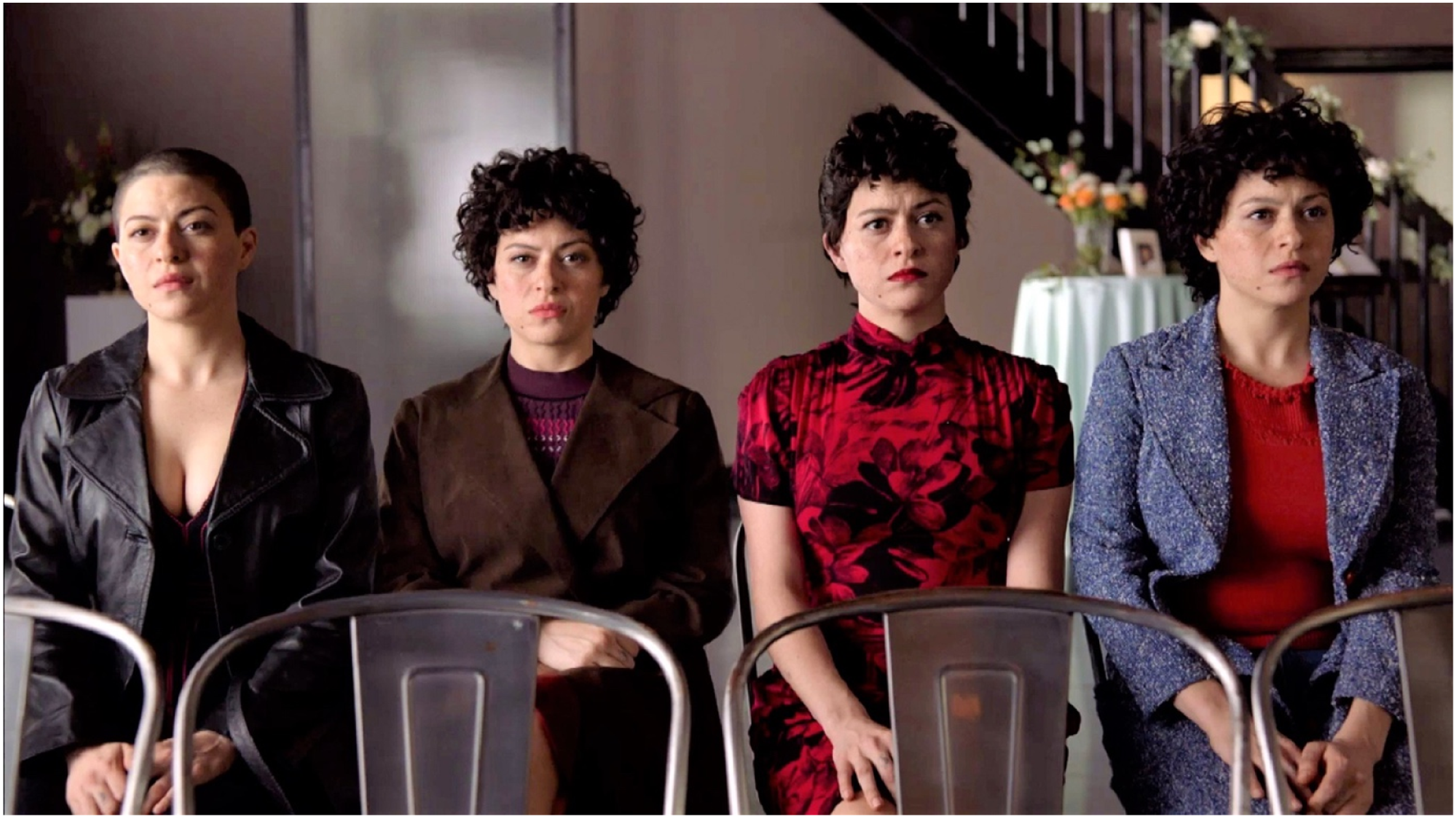
After Dory’s visual split into multiple selves at a particularly vulnerable point during her character’s trajectory at the end of season four (a near-death experience), Search Party’s fifth and last season finally establishes Dory as an entrepreneur. The evocation of 60s and 70s nostalgia in the poster for season five stands in stark contrast to the dark theme pointing to the horror-thriller genre of the previous season, and places this particular season within a television landscape that has seen the emergence of several other popular programmes revolving around lifestyle gurus and self-help; for example, Mike White’s The White Lotus (2021–present) and David E. Kelley’s Nine Perfect Strangers (2021). In contrast to these programmes, which feature larger ensemble casts, Search Party’s last season focuses on exploring the self-help industry through Dory’s individualistic quest, and again, without providing much access to her ‘emotions, thought processes, and morality’ (Mittell, 2015: 129).
Looking more closely at the promotional posters for seasons four and five and contrasting their respective depictions of Dory’s friends in relation to her, provides the clearest picture of Dory’s trajectory as vulnerable-turned-resilient to entrepreneurial. For example, Figures 4(a) and(4b) clearly depict a contrast between two versions of Dory that exemplifies Orgad and Gill’s argument about resilience, confidence, and vulnerability. The Dory in the poster advertising season four is shown with a shaved head and an unmistakably distressed facial expression as she seems to be screaming. This rendering signifies a moment of particular despair and vulnerability in the narrative and thus frames Dory as the ‘vulnerable heroine’ (Orgad and Gill, 2022: 25) whose resilience in season five emerges out of and is legitimised by this low point in her trajectory. Being stripped of her selves (as the fragmented selves depicted above are witnessing Dory’s funeral) is emphasised by Dory’s shaved head, which may also invoke images of the extensive media coverage following Britney Spears’s shaved head and supposed mental health crisis in 2007. The Dory positioned on top of the promotional poster for season five of Search Party stands in stark contrast to this image. The position of Dory’s face in the season four poster suggests that she is lying down, whereas Dory’s pose in the season five poster is triumphant and ‘enlightened’ and shows her with her hair grown back and wearing a white tunic and jewellery that signify a ‘new age’ lifestyle and, perhaps, the illusion of a new and improved, unified self. Furthermore, there is a golden halo emanating from Dory’s head and shoulders, set in opposition to the red brushstrokes on the season four poster, which foreshadow the fire that allegedly consumes Dory at the end of that season, invoking further ideas of cleansing and reinvention. Thus, Dory’s journey from a particularly vulnerable position to one of enlightened entrepreneurialism through her resilience as an individual is clearly mapped on the posters. (a) and (b) From kidnapping victim to self-help guru, Dory transforms yet again in Search Party’s fourth and fifth seasons. Promotional posters courtesy of TBS, Turner broadcasting system, Inc. A warner media company.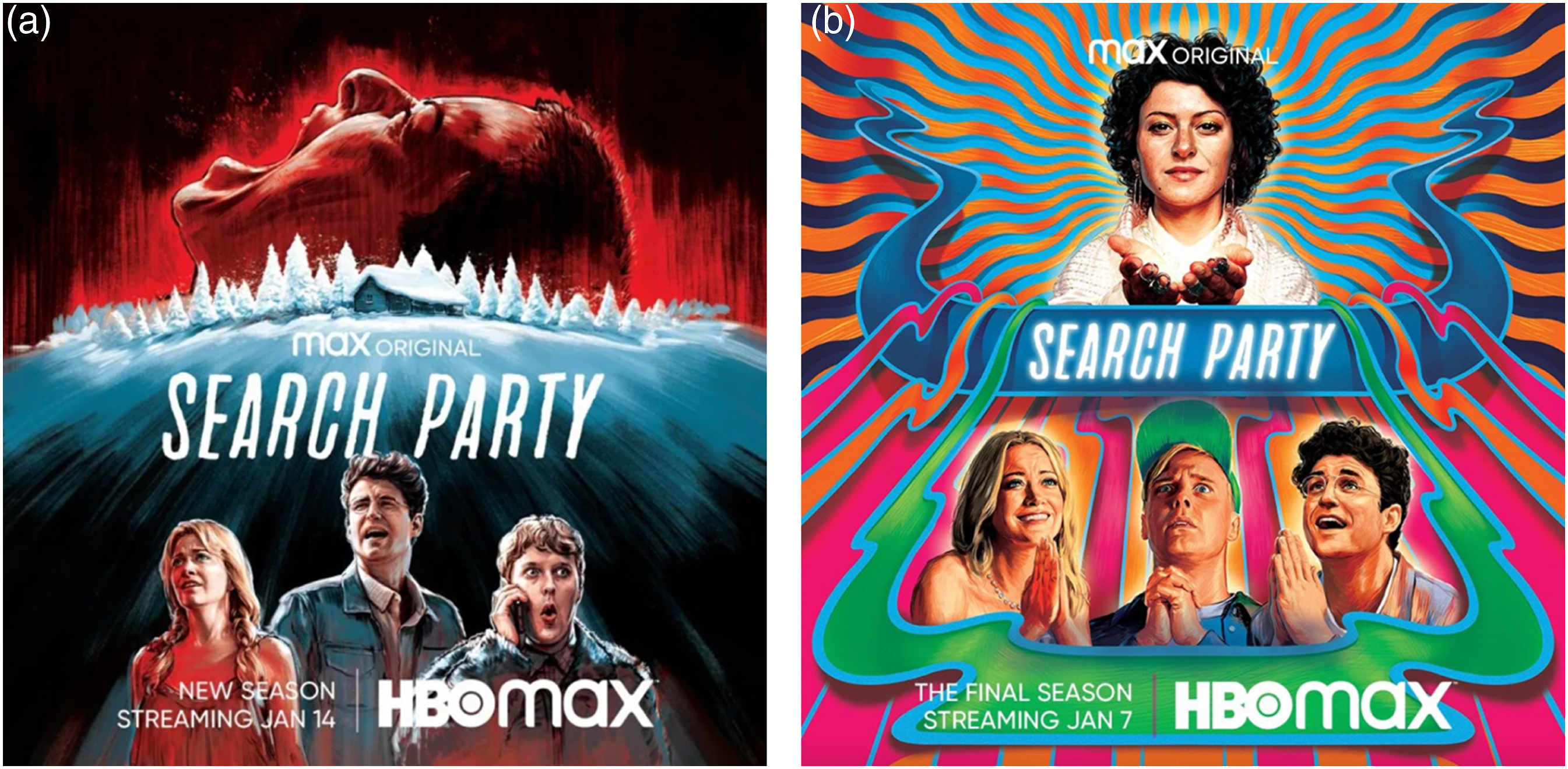
To further explicate Dory’s trajectory from a place of vulnerability to an emblem of a neoliberal lean-in mentality, we may look closer at how Dory becomes a seemingly balanced or unified self. Moving between vulnerability and resilience, Search Party’s characters operate within a narrative defined by satirical absurdity and excess, with the idea of balance in a neoliberal (feminist) sense always out of reach. However, Dory’s relationship to the concept of balance is, again, the most intriguing. In a more general context and taking into account the formation of the self within a wider community or culture, self-realisation involves a balance made up of virtues such as ‘wisdom, justice, moderation, and courage’ (Verhaeghe, 2014: 41). This balance, Verhaeghe continues, is a ‘product of self-knowledge, because self-knowledge leads to self-control. The better we know ourselves, the more we can control ourselves’ (Verthaeghe, 2014: 42). If this idea of balance as a product of self-knowledge and self-control is now specified in terms of the idea of balance in a neoliberal feminist context, Dory embodies the tension between lack of self-knowledge and lack of self-control. This is not least because she also epitomises the angsty personality that, according to Verhaeghe, can emerge out of an extremely open society and ‘constantly has to adjust to the latest hype’ (Vertaeghe, 2014: 33). The idea of balance is questioned and contested in articulations of vulnerability and confidence as well. As Orgad and Gill observe, alongside the cult(ure) of confidence, ‘a seemingly reverse move has emerged in recent years […] toward embracing vulnerability and foregrounding insecurity and pain’ (Orgad and Gill, 2022: 69), which they further explain are, in fact, necessary in forging confidence, as ‘confidence and vulnerability seem to have become complementary and mutually reinforcing of the ideal feminine professional self’ (2020: 71). From this perspective, Dory’s personality appears to be increasingly fragmented into angsty Dory, neo-noir detective Dory, homicidal Dory, and devious Dory. These versions mirror US American society in the second half of the 2010s in that they reflect broader cultural zeitgeist issues such as the simultaneous need to display vulnerability and confidence to forge a coherent narrative of the self. In Search Party, this tension is also explored alongside the meaning of truth during the Trump administration, the ongoing American obsession with celebrity culture and superficial appearance, as well as the problematic role entitlement and privilege play in a neoliberal, capitalist society. The potential success in utilising this formula of vulnerability that ultimately leads to confidence constitutes the core of the fifth, and final, season of Search Party, in which Dory forges a public persona whose appeal rests on her recent vulnerable experiences—a near-death experience and subsequent hospitalisation in a mental institution—which have inspired her to find enlightenment and confidence as a self-help guru. From live-streaming her philosophical take on the world via Instagram to striking a deal with tech-billionaire Tunnel Quinn (Jeff Goldblum) to make Dory’s epiphany available to the masses by manufacturing a pill that lets anyone who takes it experience near-death and subsequent enlightenment, Dory finally becomes an entrepreneur within the self-help industry. Again, possible expectations as to the resolution to the story are turned on their head when the jelly-bean-like enlightenment pills turn their consumers into Zombies, decimating New York City’s population. Dory and her friends are among the few survivors, and the series ends with Dory and Drew getting married and the friends walking through a sanitizing station in a post-apocalyptic Brooklyn. As they walk on, they pass a wall plastered with ‘missing person’ posters looking for individuals who are most likely to have perished as Zombies. Apart from the parallel to walls commemorating Covid-19 and 9/11 victims, this scene marks a return to the series’ beginning with Dory’s discovery of Chantal’s missing person poster. Furthermore, the abundance of posters indicating missing persons work to evoke the Thatcher-era neoliberal idea that there is no such thing as society. This is also emphasised by the self-serving individualism that brought about this post-apocalyptic scene. As Dory and her friends walk on, seemingly content and not traumatised by the mayhem they have caused, Dory’s self remains enigmatic, while the programme’s emphasis on the hollowness and absurdity of existence in a neoliberal capitalist society remains.
Conclusion
In explicating some of the functions of Dory’s millennial angst and its articulation through her fractured self, whose parts embody incongruous neoliberal demands, this article has hopefully contributed to a larger discussion about the contemporary millennial woman on television. The complex rendering of Dory as emblematic of neoliberal feminist demands through her millennial angst arguably creates more room for reflection and interpretation. Search Party’s promotional posters play an important part in the process of representing Dory’s trajectory and the fragmentation of her self. This emphasis on Dory as a character on television. who acts and performs according to genre conventions and often without clearly articulated reasons, arguably encourages the audience to reflect on the ambivalences that are intertwined with the contemporary female antihero’s subjectivity. Moreover, viewers are invited to question the prevalent narrative of the self that starts with vulnerability and ends with the promise of confidence through rigorous self-management. Further consideration of Dory’s entrepreneurial success and rise to fame in the series’ fifth and final season lies beyond the scope of this article, but Search Party’s zeitgeisty themes certainly demand further inquiry. Continued investigations of portrayals of resilient protagonists in contemporary television may deepen our understanding of neoliberal feminist ideals such as individualism, self-management, and entrepreneurialism as common sense. and their role in shaping narratives and character arcs.
Footnotes
Acknowledgements
My thesis supervisors, Kristyn Gorton and Beth Johnson, have provided invaluable guidance and feedback, and their brilliant works serve as constant inspiration.
Declaration of conflicting interests
The author declared no potential conflicts of interest with respect to the research, authorship, and/or publication of this article.
Funding
The author received no financial support for the research, authorship, and/or publication of this article.
