




Abstract
This article introduces quantitative reception aesthetics as a method and demonstrates how big data derived from social media services and textual analysis can be employed to uncover hitherto hidden processes of media spectatorship. It demonstrates how mixing quantitative and qualitative methods allows us to understand textual engagement and how media spectatorship evolves over time. Taking the Norwegian web series, Skam (2015–2017), as its case study, the article demonstrates how (web)television engagement on Instagram is linked to aesthetics and narrative events and how textual engagement is more universal than perhaps post-structuralist reception studies of media reception might have us believe.
Introduction
While television viewing has always been inherently social (Katz and Lazarsfeld, 1955), the influx of interactive media has forced us to further develop our conceptualisations of what it means to engage with a televised media text. Indeed, Jenkins points out that the current media environment in general, and perhaps social media in particular, seem to make ‘[…] visible the once invisible work of media spectatorship’ (2006: 135). Online activities such as ‘second screening’ (see Giglietto and Selva, 2014; Kjeldsen, 2016) while watching streaming entertainment generate veritable torrents of data, providing insight into user behaviour, preferences, action and sentiment. The present article will demonstrate how data derived from social media services – in this case, Instagram – can be employed to uncover hitherto hidden processes of media spectatorship. Based on the combination of perspectives from second screening studies with approaches deriving from fan studies, this study introduces a new method which we argue will help to further analyse and understand media spectatorship – more specifically, television fandom. By combining quantitative analysis of social media data with qualitatively informed textual analysis, the study at hand makes a clear contribution to the broader fields of academic study mentioned above.
For our purpose ‘fandom’ will be a crucial concept. We opt for an understanding of fandom ‘as the regular, emotionally involved consumption of a given popular narrative or text’ (Sandvoss, 2005: 8). Reception studies inspired by perspectives on fandom and cultural studies have mainly relied on qualitative methods, such as in-depth interviews and ethnographic approaches. This work typically focuses on the user and, as a consequence, tends to place less attention on the media texts with which the users engage. To this end, there are a dearth of studies that employ other types of methods, including quantitative varieties, in combination with qualitative inquiry, as a means to detail the media texts as consumed by users (Sandvoss, 2007). Indeed, as Sandvoss argues: ‘In this emphasis on audience activity, fan studies have neglected the act of reading as the interface between micro (reader) and macro (the text and its systems of production)’ (2007: 30). The combination of large scale, quantitative studies and textual analysis have indeed seldom been combined in media studies (Livingston and Das, 2013). In our contribution to this debate, we will focus on how fan textual engagement can be quantified and traced, as it evolves through time and space when the content spreads from its context of origin to a larger, global audience. As a way to flesh out the argument our study trains attention on the fandom surrounding Norwegian web series Skam (2015–2017). The method introduced and exemplified is applicable to similar cases where social media is used to share responses to a television series, and we will identify to some examples for future application later in this study.
Jenkins et al. (2013) point out that the media is transitioning: from a model of distribution to a model of circulation, where the audience itself takes part in spreading media content through networked communities. Our case study – the online serial, Skam – could be considered a prime example of such a grassroot spreading through fan engagement. Produced by the Norwegian Public Service Broadcaster (NRK), Skam is a Norwegian web series originally distributed as short clips, screen grabs of the protagonist’s online messenger logs and Instagram updates in ‘real time’ on a dedicated webpage (skamp3.no) synchronising the diegetic story-time with the viewer’s time. Skam’s innovative distributional, cross-media form, as we will return to shortly, is key to mapping the temporality of media spectatorship. The unique model of distribution encouraged the users to consume Skam on the go and on their phones. The story was segmented into singular, but serialised, narrative events unfolding in ‘real time’ and viewers never knew when new content would appear. This mode of storytelling facilitated a distinct viewer experience, where those taking part had to wait with the characters for events to unfold. Instagram was central in the show’s distribution and several of the main characters had their own Instagram accounts that were integral to the story. Skam is also an illuminating example of how media texts spread through networked cultures and went from being a ‘secret Norwegian online teen drama to an international phenomenon’ (Sundet, 2020) and of a thriving and supportive online culture (Krüger and Rustad, 2019). A few examples: in 2018, it was reported that the series has been downloaded 180 million times on Chinese Weibo (Max, 2018). Furthermore, Skam was the most popular TV show on Tumblr in 2017 (Bartleet, 2017). At the time of writing, Skam is currently being remade in France, Italy, The Netherlands, Spain, Germany and the United States. Without international distribution or any sort of official marketing, pirated fan subtitled versions of the show passed around the Internet, securing the spread of the web series. Skam is thus an intriguing case study with which to explore grassroot media spreadability, fandom growth and textual engagement.
As previously mentioned, our main contribution to the debate is the development of what we label quantitative reception aesthetics as a method, by which we mean converging quantitatively-oriented social media research with qualitative reception aesthetics. We further seek to integrate what could be referred to as two of the main methodological ‘schools’ of media studies, by combining quantitative communication research with the textual analysis of aesthetics. Mixing these methods will, as we demonstrate, allow for a more robust understanding of textual engagement and how media spectatorship evolves over time in tandem with serialised storytelling.
Skam on Instagram: Introducing the case study
Skam focuses on a group of upper-secondary students in the Norwegian capital, Oslo. Each of the four seasons follows one school semester and features a new point-of-view character. As we discuss later, it was during the third season that the show became an international phenomenon and thus will serve as our main case study. The LGBTQ romance of the main characters of season three, Isak (Tarjei Sandvik Moe) and Even (Henrik Holm), turned the show into an international hit which saw the couple win the E!’s top TV-couple of 2017. The third season chronicles Isak’s coming-out story and the love story between him and Even. Isak lives in a shared flat because of problems at home. As the season progresses, we learn that his mum, a devout Christian, struggles with mental illness. Her conservative values influence Isak in his views on being gay, but he soon falls in love with Even; and the season chronicles the ups and downs of their relationship, including Isak’s homophobia and Even’s mental illness.
With regards to data collection, our focus on tracing Skam fandom on Instagram is motivated by two main considerations. Firstly, and perhaps most importantly, the platform under discussion was deeply integrated into the Skam narrative itself. Secondly, even though discussions regarding the web series under scrutiny certainly took place on other platforms and in other forums, Instagram appeared most suitable for our current purposes as its lead demographic of comparably younger users (IPSOS/MMI, 2017) appears to match the intended audience for the show. Thirdly, in a study conducted by Raza (2020), most users said Instagram was their preferred source and platform for their Skam fandom.
With a billion monthly users, Instagram is one the most popular social media platforms in the world. As a social media platform, it brands itself by stating in the Google and Apple app stores that it ‘is a simple way to capture and share the world’s moments. Follow your friends and family to see what they’re up to, and discover accounts from all over the world that are sharing things you love’. This indicates two things: Firstly, the description and the name of the medium emphasise that Instagram is supposed to be instantaneous, content to be shared in the moment. While Manovich (2017) demonstrates that this is not always the case, the platform nevertheless gives the impression of being in the moment: for instance, by means of the use of the hashtag #lategram for photos not posted instantly. Secondly, the description supposes personal engagement by stating ‘share the things you love’. This platform is as such created to be a (re)active social media one, where users share photos of things and events that engage them in the moment. (Though of course, as for many similar services, Instagram use is not necessarily bound to this intention.) Instagram has become a key platform for creating and consuming visual culture and is also a site for grassroots fan cultures and one where fans post images and memes from the series they love. Most research on Instagram has been done within computer sciences (Manovich, 2017: 21) and those studies applying qualitative methods focus on aesthetics, like Manovich’s Instagram and the Image, while others like the work of Marwick (2015) and Abidin (2016) trains attention on influencers, the rise of microcelebrities and aspirational labour. Since the images posted on Instagram in the context of Skam fandom was not the main objective – often the same images recirculated as reposted by the fans, as will be shown later – this article focuses instead on the act of posting and will seek to understand the act of posting as an act of fandom.
Quantitative, large scale data analysis and reception aesthetics as methods
Livingstone and Das suggest that ‘while there has been a general recognition that it is possible to converge these methods [referring to qualitative and quantitative reception methods] in some projects, very few have actually succeeded in such an attempt’ (2013: 22). While quantitative methods can help us gain insights into the overarching characteristics of data, such approaches also serve as starting points to more qualitative endeavours. In that they can help in identifying cases of specific relevance and interest, cases that can subsequently be assessed by means of qualitative methods. This article, then, demonstrates how combining different methods is not only possible but key if we want to further our understand the growth of the audience on social media, as well as of audience engagement with television texts through such platforms. Specifically, we adopt what Creswell (2014) labelled an exploratory sequential mixed methods approach, wherein cases of specific interest identified in the overarching quantitative findings are explained in further detail using qualitative methods.
What could be referred to as more traditional forms of quantitative media and communications research often include applications, such as quantitative content analysis (Krippendorf, 2004), or surveys (Lavrakas, 2008); however, the study of online activities, such as on social media, has in some cases made it possible to employ quantitatively informed approaches to studying traces of actual behaviour – in this case: media user behaviour (see Hargittai and Sandvig, 2015). Indeed, Burrows and Savage contend that ‘the majority of sociological methods – other than those based upon direct observations of actions – rely upon accounts of actions’ (2014: 3; original emphasis). Broadly speaking, the utilisation of quantitative digital methods (see Rogers, 2009) allows us to detail actual user actions rather than accounts of actions, providing us with powerful insights into audience behaviour. However, as with pre-digital quantitative applications, what is gained in terms of breadth is essentially lost in terms of detail (see Moe and Larsson, 2012). This is where qualitative approaches – such as reception studies – can assist in providing richer insights.
Reception studies and, more specifically, fandom studies often present ethnographic observation and in-depth interviews as the preferred method (see Jenkins, 1992; Morley, 1992). As Sandvoss (2007) argues, fan studies, inspired by post-structuralism, has tended to operate from the notion that there are no texts, only readers. Hills elaborates further on how studies of audiences have also tended to take precedence over the textual analysis of television texts. Television studies has frequently taken the audience as its starting point arguing that meanings of texts are not self-evidently ‘just there’, but have to be produced by audiences in their social/cultural contexts. (2006: 93)
For our study this way of thinking is undertaken by means of archiving all Instagram posts carrying the #Skam hashtag, indicating content related to the show under discussion. This data was next made subject to a series of analyses in order to detail the growth of popularity, identifying, among other things, the specific moments during the four seasons that emerged as especially poignant for those engaging with Skam. In so doing, we not only address issues of reception aesthetics, but also those pertaining to the yielding of influence within the specified hashtag, as we detail the users who emerge as particularly influential in terms of having their Instagram posts ‘liked’ and commented on by others.
As previously mentioned, we are inspired by approaches adopted by scholars looking into ‘second screening’, where a ‘secondary device’ such as a mobile phone with the Instagram app ‘is used for comments about programs’ (Giglietto and Selva, 2014: 260). We look at how Instagram fandom and reception is fashioned by means of what McKinney et al. (2013) call ‘social watching’, meaning discussing a mediated text while essentially simultaneously building a community around such texts, reminiscent of what Fiske referred to as ‘audiencing’ (1992).
We collected all Instagram posts carrying the ‘#Skam’ hashtag posted during the entire duration of the series – from 22 September 2015 until 6 June 2017. A common but not necessarily unproblematic basis for data collection in studies like this one, hashtags can perhaps most easily be described as thematic keywords that allow users to easily identify posts of specific interest to them. A drawback of this approach is, of course, that any Skam-related content posted to Instagram during the specified time period not carrying the #Skam hashtag was not included in our sample. However, as we wanted to be sure to focus on ‘the relevant streams of information’ (González-Bailón, 2013: 154), the adopted approach was deemed the most suitable for our purposes. The #Skam hashtag with 1 million uses emerged as the most popular among those watching, with #IsakandEven being the second most used hashtag with 75,000 uses in our data. Indeed, Skam related posts usually carried several Skam related hashtags.
Data collection from social media services such as used in this study usually involves the more or less automated querying of one or more application programming interfaces (henceforth APIs). Often described as a back-end or ‘under-the-hood’-route to a series of online services, APIs are also important for researchers in that they allow for data to be collected from the service and subsequently analysed (Lomborg and Bechmann, 2014). The service used for data collection was MagiMetrics, a now-defunct commercial service that allowed for the archiving of Instagram posts based on search criteria such as the #Skam hashtag employed here. In total, the service returned 375,070 posts (including various forms of metadata) carrying the specified hashtag that had been posted during the previously specified time period. Data analysis is performed once more utilising both quantitative and qualitative approaches. Specifically, our approach involves utilising large-scale analyses of all 375,070 collected posts in the data visualisation application Tableau as a way to identify pivot points or peaks, suggesting periods of heightened audience interest. Subsequently, these peaks were scrutinised in a more qualitative fashion through textual analysis of style and narrative in order to understand the viewer engagement in light of aesthetic characteristics.
The notion that aesthetics matter in terms of meaning-making and that stylistic choices and narrative form facilitate preferred readings, has, as Sandvoss argues (see above), been criticised over the last decades, thus our use of reception aesthetics should be addressed before progressing further. Web series are usually distributed as short segmented clips rather than episodes. As Creeber argues, web series aesthetics marks ‘a reaction against the increasingly “professional” quality of the digitied screen, the webcam aesthetic inspiring the Internet to try and reclaim the original intimacy of television by returning it back to the low-grade “liveness” of the early medium’ (2011: 603). Web series can be understood as a return to the earlier form of episodic and segmented form of television, as described by Ellis (1982), and diverges from the complex, flexi-narrative serial described by among others such as Mittell (2006, 2015), Nelson (1997) and Dunleavy (2017). Flexi-narrative programmes offer soap-like narratives and intertwining storylines in hour-long dramas (Nelson, 1997), and are characterised by Nelson as follows A number of stories involving familiar characters in familiar settings are broken down into narrative bytes and rapidly intercut. Any lack of interest of an audience segment in one set of characters or storyline is thus not allowed to last long as another story with a different group of characters is swiftly taken up, only in turn to give way to another before taking up again the first narrative, and so on in a series of interwoven narrative strands. (1997: 32–33)
Smith (2018) argues narratives are shaped by media, economic, national, audience, institutional and technological specificities that facilitate distinct narrative structures. Skam is, as previously mentioned, a public service-produced (economic and institutional specificity) web series told in real time through video clips and social media chats and Instagram updates (technological and audience specificity) made essentially for Norwegian teen girls (audience and national specificity). Skam’s focus on one character and a single plotline per season is as Rustad (2019) argues a social media television narrative, and the short form and limited point of view imitates the personal and intimate narrative form of social media rather than complex televisual serial.
Produced by NRK, Skam was created to tell socially relevant stories for young Norwegian adults, in a form with which they were familiar (Andem in Faldalen, 2016). The third season is told exclusively through Isak’s point of view and the narrative is structured as a journey where one character must overcome a series of obstacles to reach his goal. Screenwriter Julie Andem based Skam’s narrative structure on Hutzler’s (2006) models of nine-character types and character map to create an emotional character journey. Hutzler’s emotional character journeys are based, in turn, on the three-act structure, made famous by McKee (1997, see below), but adapted to fit less plot-based and more character-based narratives. Skam follows Hutzler’s model. The first act defines a character’s wants, which in the case of Isak is to smoke weed, talk about girls and be one of the boys. In the second act, complications ensue, and the character’s ‘wants’ come into conflict with deeper ‘needs’, as when Isak admits to being gay. In the third act, the character musts choose between his ‘wants’ and ‘needs’ and Isak chooses Even and love. By basing the narrative structure on Hutzler’s (2006) three-act model and focusing exclusively on Isak’s emotional journey, Andem was able to create a simple (in terms of narrative structure but not in terms of emotional complexity) story about one young man coming to terms with his own sexuality.
Taking the above into account we began by conducting an analysis of narrative structure and explored how the peaks corresponded with the most significant narrative events or incidents in Isak’s character journey, or what Chatman calls ‘kernels’, ‘narrative moments that give rise to cruxes in the direction taken by events […] Kernels cannot be deleted without destroying the narrative logic’ (1978: 52). A ‘kernel’ can be understood as a disturbance of status quo, the event that sets off a chain of new events. In the case of season three, this would involve events forcing Isak to choose between his ‘wants’ and ‘needs’.
Having identified these key moments, we conducted an analysis of style – the use and choices in mise-en-scène, cinematography, editing and music – to explore how these choices are used to heighten the emotional experience and increase engagement with the text. Following Smith’s model reflecting on technological and audience specificity, it must be acknowledged that Skam was produced to be watched on a mobile or personalised smart phone screen. The programme, as demonstrated below, adapts a melodramatic style created for the small and intimate screen, which, in turn, further intensifies the experience. Dawson detailing the writing about the short and segmented aesthetics of web series, says ‘shorts may highlight and intensify fleeting moments, isolating clips as short as a few shots and as long as an entire scene from the narrative in which they appear and form television’s broader textual flows’ (2011: 219). The melodramatic aesthetic of Skam adapted to the technological specificity of the smart phone screen, with its intimacy and personalisation, allows viewers to feel much closer to characters. The melodramatic effect is heightened as the user holds the highly personalised screen, and literally Skam’s sound and image, physically closer to the body. As such we explore how stylistic and narrative choices shape the textual experience and effect the level of textual engagement, in line with Iser’s contention that: ‘one task of a theory of aesthetic response is to facilitate intersubjective discussion of individual interpretation’ (1978: x). These qualitative analyses were complemented by further examining the emotional qualities the scenes generated, achieved by analysing the use of emojis (using a combination of resources made available by Mu-An, 2019; Wickham, 2019) in the identified posts.
To put it simply, while triangulation of methods ‘usually implies that the researcher seeks primary data about a research question in two (or more) different ways’ (Schrøder, 1999: 50), there are also other possibilities for combinations. Based on the description above, we used the different methods as auxiliary to each other (Schrøder, 1999). Specifically, in what follows, we first use quantitative approaches to identify time periods of heightened audience activity. Next, we move on to analyse these events in more detail by means of qualitative approaches. Finally, these qualitative analyses are complemented by more fine-grained quantitative analysis, looking into the hashtags and emojis associated with the events as mentioned earlier. As such, our approach can perhaps be described as a mix of the two main formats of triangulation as discussed by Schrøder (1999).
By combining quantitative analysis and textual, qualitative analysis into what we term quantitative reception aesthetics, we understand textual engagement not as it is uncovered from interviews or as an interpretation of the ideal readers of texts, but based on how actual user data cluster around specific events that take place in the studied series. In the remaining part of the article we argue that such pivotal events can be conceptualised as ‘peaks’ of engagement, reminiscent of similar upsurges of attention shown in studies of online political communication (see Bruns and Highfield, 2013) Next, we move on to demonstrate the possibilities and limits of the method proposed by analysing Skam season three.
Quantitative reception aesthetics in practice
As the above illustration (see Figure 1) demonstrates Skam’s Instagram fandom grew from season one through to season four. As evidence in the timeline, this activity – the number of posts carrying the #Skam hashtag – increased significantly after November 2016. This increased interest corresponds with the airing and subsequent spread of season three, which premiered on 29 June 2016. Based on Figure 1, we identified 10 pivotal points where the timeline makes visible peaks of engagement. The timeline can be understood as the trajectory of fan engagement. Reviewing the most popular posts (as in most ‘liked’) during these peaks helps us to understand how Skam spread on Instagram; but at the same time it does not explain the rise and fall of the timeline and why the peaks occur when they do. The timeline illustrated in Figure 1 can thus be seen as a visualisation of the temporal development of fandom engagement. It indicates an intention to a shared appreciation of the show, to take part in the community and convince other followers to watch the web series. Such practices are clearly related to the communal aspects of second screening varieties as discussed above (see also Giglietto and Selva, 2014).
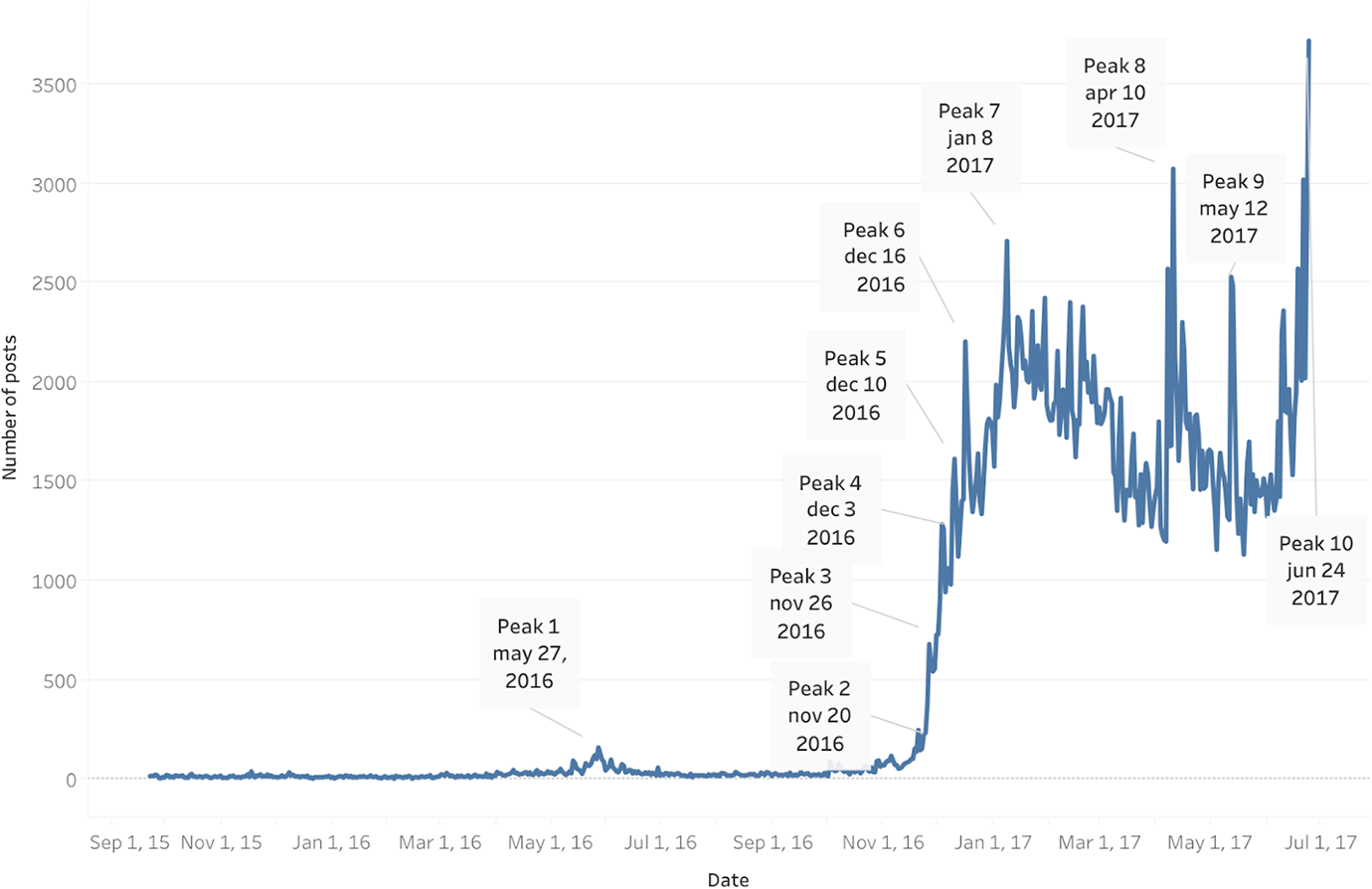
Timeline of #Skam use throughout all four seasons of the Skam series.
If we extract and focus on the data for season three (see Figure 2), fan engagement is seen to steadily increase in distinct peaks of engagement. The ‘real time’ distribution featured in the studied series meant that Skam, unlike most television, but like most social media, was unscheduled and the users never knew when new Skam-related content might be posted on the aforementioned site or the Instagram accounts of the main characters. This model of story distribution allowed us to pinpoint the exact moments of engagement. To understand growth in the trajectory, we cross checked the peaks against the storyline and conducted a textual analysis of the corresponding clips that aired on the days of the peaks. We also allowed for a 2-day time-lag as a way to take into account the international audiences, their subtitling of clips and to ‘catch up’.
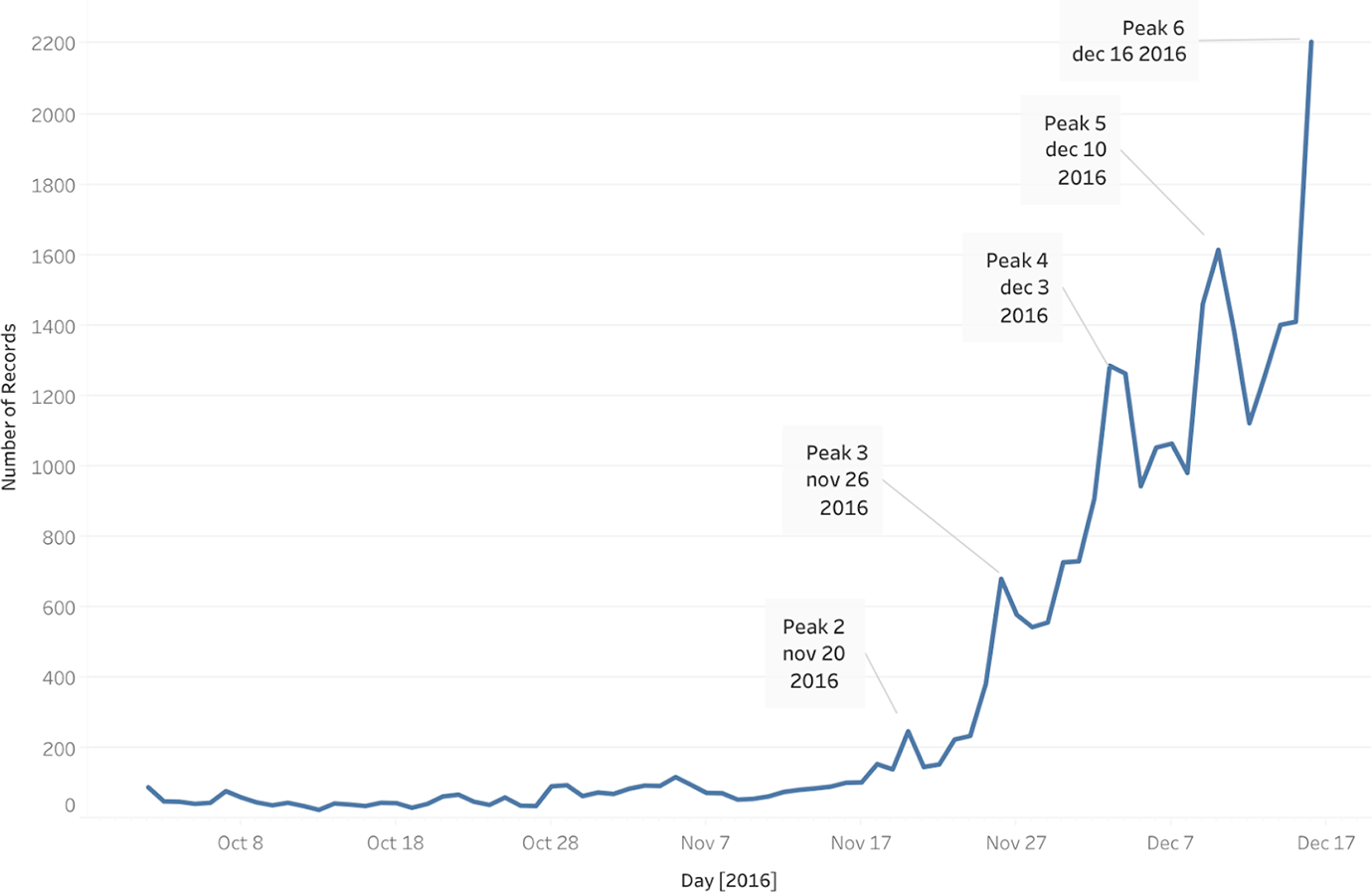
Timeline of #Skam use throughout Season three of Skam with five significant pivot points visible on the timeline. Peak numbers start from number 2 to correspond with data shown in Figure 1.
Narrative engagement
By applying an analysis of style and narrative of the relevant text at the time of these pivot points, we could start to conceive of how the relationship between text and audience engagement functioned. Next we went on to explore the peaks of engagement identified in Figure 2, by conducting a more detailed analysis of narrative structure and the narrative significance of clips corresponding to these peaks. At first glance, it seems as if each peak coincides with major narrative events with a 1 to 2-day time lag. The time lag between peak and clip appears to decrease as the narrative tension intensifies and the fan-subtitled clips were released more swiftly as the Skam fan base grew. During season two, Skam was only a hit in Norway and Denmark, a fact that explains this small but nevertheless visible peak in the timeline. Peaks two through to six coincide with clips released during season three and correspond with the following: ‘Vært litt spes i det siste’ (tr. Been a little weird lately) that aired 18 November 2016. The clip shows Isak coming out to best friend Jonas. The next peak, number three in Figure 2, corresponds with the clip, ‘Slutt å meld meg’ (tr. Stop texting me), which aired on 25 November 2016 where Isak and Even have sex for the first time. Peak four corresponds with the clip, ‘15:15-01:01’ which aired 2 December 2016. In this clip Isak and Even go on a date. The fifth peak, number six as shown in Figure 2, corresponds with the clip. ‘O helga natt’ (tr. Holy Night), aired on 9 December 2016. Here Isak decides to find Even and continue their romance. Peak six thus corresponds with the last episode of season three.
Taking a closer look at the peaks identified in Figure 2, peak two ‘Vært litt spes i det siste’ marks Isak coming to terms with his sexuality. In terms of being a plotted event, this clip gives resolution to his personal conflict based on his sexuality. However, the clip also opens up a new conflict where he is now completely free to pursue Even, and a new question thus arises as to whether the interest is reciprocal. In ‘Slutt å meld meg’ (peak three in Figure 2) users learn that Even is indeed interested in Isak. After the latter struggles to ask him out via a text message, Even suddenly appears on Isak’s doorstep and they have sex for the first time. ‘15:15-01:01’ (peak four in Figure2) marks the largest crisis in the relationship between Isak and Even. Isak finds out that Even has mental health issues when runs naked into the street in the middle of the night. The question arises: can they be together? and can Isak accept Even’s mental condition? Viewers know that Isak’s mother is mentally ill and, because of this, he has problems dealing with mental illness. ‘O helga natt’ (peak five in Figure 2) is the narrative climax of the season, where Isak decides to continue his relationship with Even regardless of the latter’s mental health. The last clip – peak six in Figure 2 – marks the end of the season and offers a narrative resolution and happy ending to Isak and Even’s love story.
The narrative structure of Skam, in other words, follows the character based Hutzler’s three-act model (2006), where each event intensifies Isak’s conflict and forces him to choose between his ‘wants’ and ‘needs’. The season is a classic love story structured around the television trope of ‘will they-won’t they’ (arguably, one of the most commonly used plotted enigmas in soap operas) pushing the narrative forward. Indeed, put together the peaks of engagement identified in Figure 2 align with the rise and fall of the dramatic curve of the classic three-act narrative structure. To be precise, the fandom timeline trajectory shown in Figure 2 largely mirrors the three-act classic narrative structure, with each peak corresponding with a crisis and a climax (as shown in Figure 3).
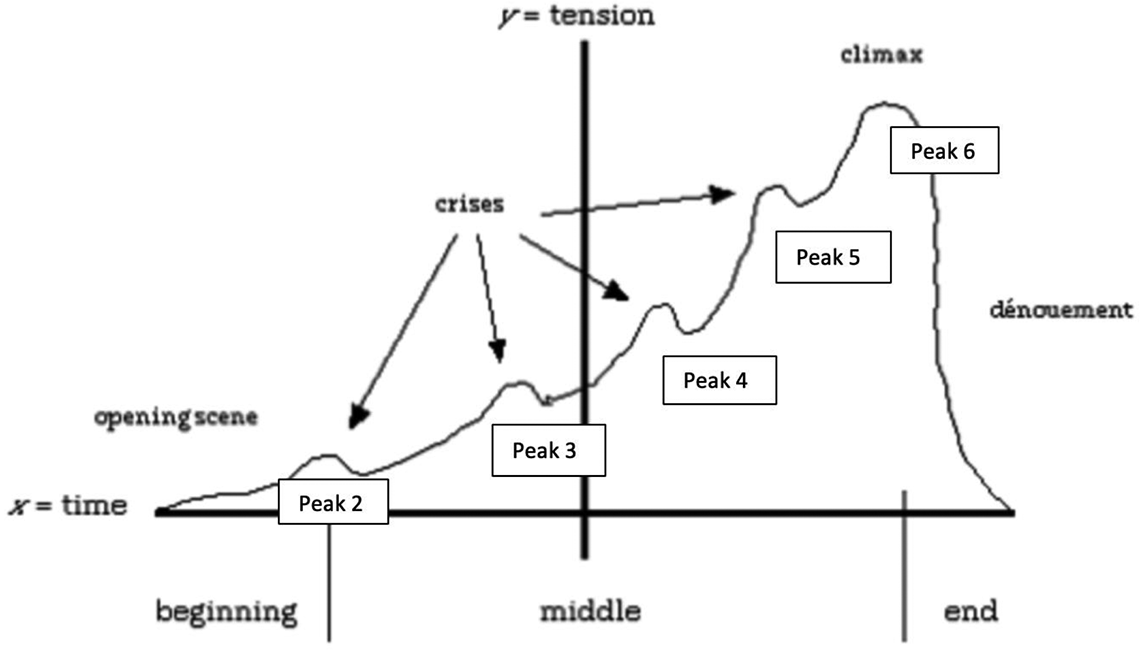
Visualisation of the three-act classic narrative structure as popularised by Robert McKee (1997) in Story: Substance, Structure, Style and the Principles of Screenwriting. Engagement peaks from Figure 2 superimposed on original image so as to show the relationship between the Skam engagement structure in relation to McKee’s model.
The viewers of Skam seem to respond to the most significant, story altering events: the crisis and its resolution. However, viewers not only respond to the narrative events taking place. Web television is a visual medium and also in its use of style Skam seems to deepen that engagement. With this in mind, we shift to co-analyse the use of style against that of emojis in posts with the Skam hashtag for the two most popular, and indeed most dramatic, clips of the season, namely: peaks four and five: ‘15:15-01:01’ (shown as number four in Figure 2 and 3) and ‘O helga natt’ (shown as number five in Figure 2 and 3) to understand what kinds of emotional responses each clip facilitates.
Emotional aesthetic
The captioning for each Instagram post usually displays an emotional response either by the poster writing about their feelings or by means of emojis. To further understand the nature of the emotional engagement, we collected the emojis used in the captioning following all the posts accompanying the clips ‘15:15-01:01’ and ‘O helga natt’. The emoji has become a regular part of social media communication and can be understood as a sort of universal language, though some double meanings, like the peach or the leaf, might exist in different cultures. According to Danesi (2017), the function of emojis are twofold: phatic and emotive. Emojis are, in other words, used to convey a more intimate form of communication, as well as conveying the emotional state of the user. In the context of this article, emojis are seen as symbolising different emotional states (see Danesi, 2017). Thus, we argue that analysing emojis allows us to understand what kinds of emotional responses Skam elicited from the Instagram users. Figure 4 shows the top emojis used for the two identified clips. The upper part of the figure features the ‘15:15-01:01’ clip and the lower ‘O helga natt’. Taking the upper part of Figure 4 as our starting point, we can more clearly compare the emotional response to the two different clips.
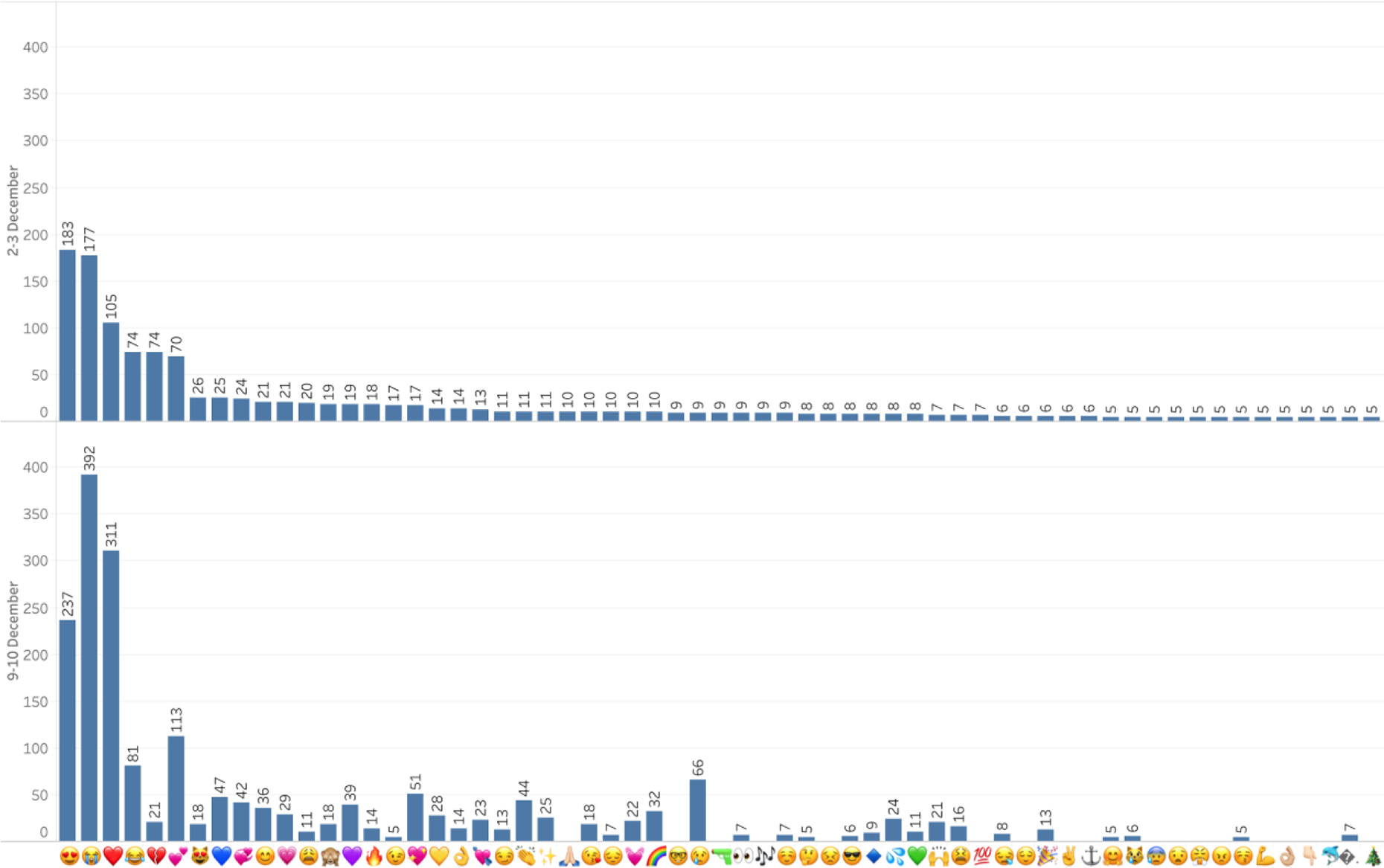
Diagram of emojis used in the Instagram posts captioning on posts with the Skam hashtag on December 2–3 and December 9–10.
As seen in Figure 4, the most popular emojis for both clips are the heart eyes, the red heart, the face with tears of joy and the loudly crying face. The two-heart emoji is slightly more popular than the face with tears of joy in the comments for ‘O helga natt’ (see Figure 4). Overall, though, the most popular emojis consists of hearts in different shapes and colours. Adding them together, 327 hearts were applied by users in their post captions ‘15:15-01:01’ and 732 hearts employed in the ‘O helga natt’ captions. The frequent use of heart emojis and the tears of joy and heart eyes emoji can be seen as an indication of users wanting to express their love for Skam, experiencing a strong emotional engagement of affection reacting to the clips. This strengthens our assumption that the timeline peaks should be read as peaks of engagement.
Going beyond the most popular emojis and comparing the two clips in more detail, the fifth most popular emoji for ‘15:15-01:01’ is the broken heart emoji with 74 occurrences. In comparison, it was only used 21 times in the ‘O helga natt’ captioning. Here it is also relevant to point out that ‘O helga natt’ in general generated more emojis than ‘15:15-01:01’ with respectively 2508 to 1529 emojis and numbers were adjusted for percentage usage. The weary face and See-No-Evil monkey are more popular as a reaction to ‘15:15-01:01’ than ‘O helga natt’ if we adjust for total emojis with respectively around 1.5 per cent versus 0.5 per cent of the total of the top emojis studied here. For ‘O helga natt’, the emojis that stand out are symbols of gay love like the rainbow (32 times) and the men holding hands emoji (25 times). We will now analyse the use of emoji against that of style and tone in the two clips.
Film scholar Affron (1982) argues that image, pace and framing all facilitate an affective response in the viewer. In other words, style creates emotional attachment and affect. Thus, these clips do not stand out only in terms of narrative, as both also feature distinct aesthetic choices usually applied to increase engagement and create affect. For instance, ‘15:15-01:01’ begins with Isak writing a text to his religious mother where he comes out as gay. He meets Even, they check into a hotel suite together and have sex. Later, it becomes apparent that something is not right with Even, as he behaves more and more erratically and incomprehensibly. As Even’s behaviour becomes more incomprehensible to Isak, the visual style becomes more fragmented and incoherent. Thus, the clip is shot and edited to underline Isak’s state of mind. It begins with an establishing shot (8 secs) of Isak sitting in a coffee shop. The next is a medium close-up of Isak writing a text to his mum. This is a static long take with only the handheld camera making subtle movements and lasts for over 2 minutes, mirroring the steadfast conviction Isak finds in coming out to his mum. The calm long take is in sharp relief to the fast editing, time ellipsis, jump cuts and erratic handheld camera movements in the latter half of the clip, as Even becomes more manic and Isak increasingly confused. The disorienting fast editing pace creates tension, but also intimacy inviting the viewer into Isak’s state of mind. Donaldson argues that ‘the cameras’ reactive relationship to physicality, to movement and change appeals directly to a sensory viewing experience’ (2013: 213). She writes about The Shield’s (2002–2008) documentary style: ‘The shaky movement and its rhythmic intensity encourages the feeling of being ‘in’ the action’ (Donaldson, 2013: 213). The point of view and style of ‘15.15-01.01’ thus aligns the viewer with Isak’s emotional state, increasing emotional engagement. The uses of the broken heart emoji, the weary face and see-no-evil-monkey can be read as emotional reactions to this clip mirroring its style and tone as well as Isak’s reactions. The broken heart emoji indicates that the viewers felt as devastated as Isak by the turn of events. The weary face is commonly used to convey feeling emotions of frustration and sadness and the see-no-evil monkey is usually used to express disbelief and not wanting/daring to look. As such, both emojis reflect the tone on which the clip ends, achieved through its stylistic means of disorientation and shock heightening emotions of disbelief, frustration and sadness.
The emoji use in the Instagram comments increases almost 50 per cent accompanying posts related to the ‘O helga natt’ clip. The spike in use of emojis further underlines the clip’s status as the narrative and emotional climax of the season. The loudly crying face is the most popular emoji being used 392 times. The large number of emojis, in particular use of hearts, indicate that the viewers are expressing their love for the show.
Soap opera is often understood as a form of televisual melodrama – a women’s genre for television (see Kuhn, 1997) – and Skam, as creator Julie Andem states, mixes soap opera, social realism and sitcom traits (Faldalen, 2016). Television soap opera differs from film melodrama in its mode of address and open-ended serialisation (Modleski, 1982); but the style is remarkably similar as both genres rely on close-ups, gestures and reaction shots, intimacy, interiors and erupting emotions. The emotional and affective uses of style in film and television is often connected to the melodramatic aesthetic. Given the above the reason why the ‘O Helga natt’ clip elicits such levels of emotional engagement can be connected to its style and tone. Here we train attention on the affective qualities of the melodramatic aesthetic and on melodrama as a stylistic trope rather than mode or genre. Melodrama aesthetics is characterised by a focus on the silence of gestures, reactions, excessive emotions displaced onto decor and through the reading of characters (Elssaser, 2003 [1973]). The TV soap opera style is more ‘invisible’, usually shot on built sound stages with a three-camera setup, but the excessive use of close-ups focusing on reactions, gestures and sound remain similar to film melodrama (Butler, 1986). ‘O Helga natt’ is both melodramatic and soap operatic in its style, with the clip beginning with Isak meeting his estranged parents for a Christmas service when he receives a text from Even. He has not seen Even since ‘15:15-01:01’. Isak reads and rereads the text as a flashback montage of iconic moments of their relationship plays over the screen. Isak gets up and runs out of the church to look for Even, who he finally finds where they first met, in the school yard. The first audible dialogue is uttered 5 minutes and 20 seconds into the 6 minute and 14 seconds long clip. The melodramatic style is a silent one, where emotions are often expressed through an excessive mise-en-scène, or what has been called the ‘baroque style’ (Elsasser, 2003 [1973]; Mulvey, 1977/1978; Nowell-Smith, 1977). The church with its elaborate décor, the flower cross and candlelight, underline the baroque feel of the setting (see Figure 5) and in many ways the mise-en-scène directly references Luhrman’s post-modern baroque, Romeo + Juliette (1996). The main conflict of the clip is played out in close-ups, facial expressions and gestures on Isak’s face, while he decides how to respond to Even’s text. The focus on gestures and facial expressions to tell the story is the most integral part of a melodramatic soap operatic style (Modleski, 2007 [1982]), while the lack of dialogue (unusual in TV soap opera genre but more common in film melodrama) allows the viewer to focus on every small detail of Isak’s face and the lyrics of the Christmas hymn, ‘O Holy Night’, performed by Norwegian artist Nils Bech. Indeed, melodrama is short for melos and drama, drama with music; and music is undeniably employed to heighten the emotional aspects of the scene. Sound is also where the televisual soap opera finds its excess, as Butler writes: ‘Music more than any other element of the mise-en-scène, is responsible for setting the mood and marking intense emotion’ (1986: 66). The sacral timbre of Bech’s voice along with the melancholic string arrangement further emphasise the emotions flashing over Isak’s face and heightens the poignant effect of Isak leaving the church (also symbolically leaving the shame of being gay censored to religious upbringing). Cross cutting a montage of images from Isak and Even’s relationship continue as Isak runs towards Even through the dark winter Oslo night. Isak finally locates Even in the school yard. They walk towards each other, Isak reaching and touching Even’s face, as the first and only line of dialogue of the clip is spoken, ‘You’re not alone’: they kiss.
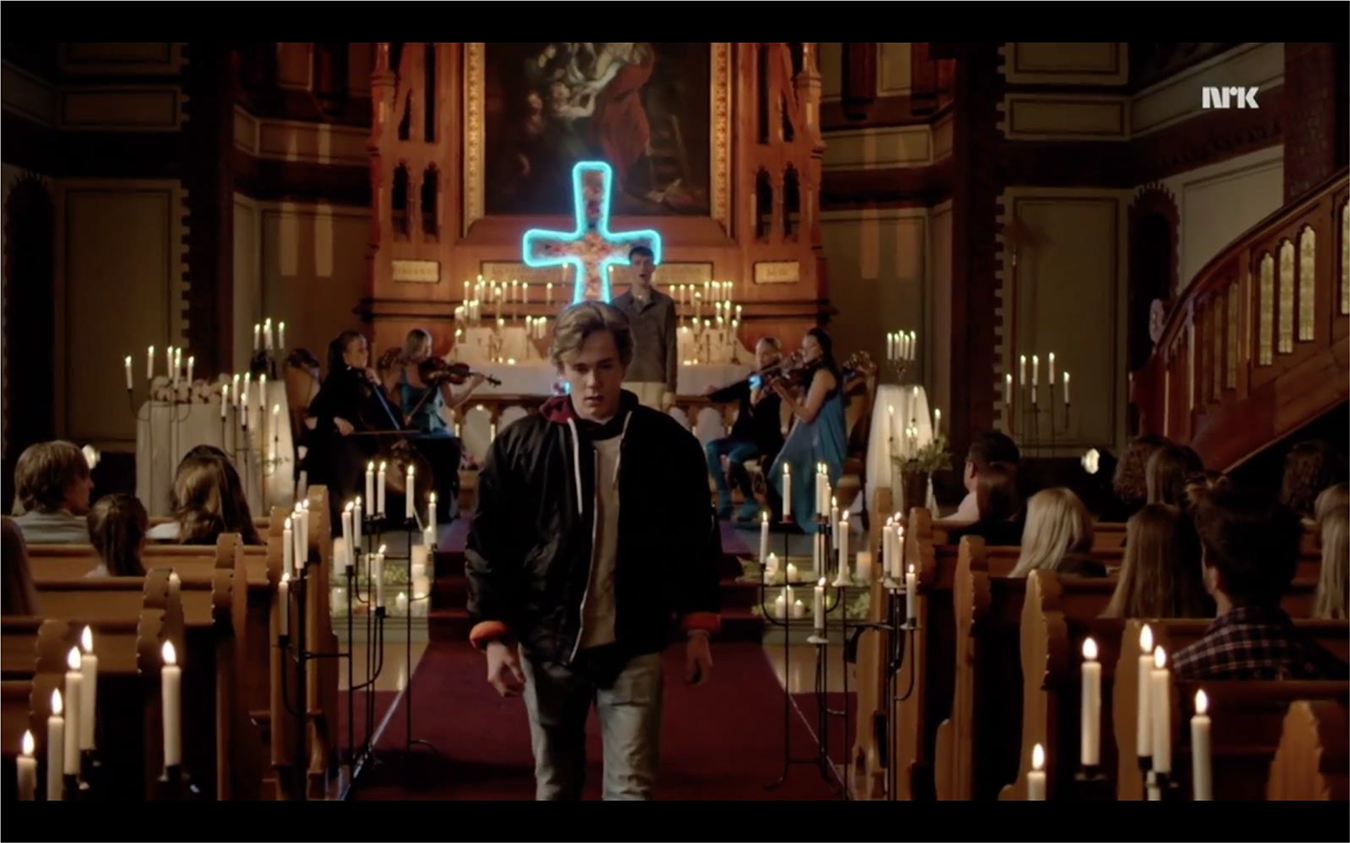
Isak running out of the Church. Screen grab from NRK.
The narrative closure of Isak and Even becoming a couple is key to understanding the emotional impact generated by the clip, as it ends Isak’s journey with him choosing his deepest need. However, the melodramatic style and tone of the clip is also designed to arouse emotions, with stylistic choices long established conventions used to facilitate strong emotional responses. Indeed, as Peterson argues, the style of Skam is generally understood to be emotionally motivated: ‘the use of style [is] motivated by the effective rendering of a character’s emotions’ (2019: 114). As already mentioned, the singular point of view makes the scene between the couple even more emotional as viewers are positioned to side with Isak. The slow build-up, the use of close-ups of Isak’s face, the sacral music, the dramatic mise-en-scène, seeing Isak turning his back on the church and running towards love, facilitates a dramatic, melancholic and emotionally wrought atmosphere. As one of the most popular Instagram posters captioned her/his fan-made video of Isak and Even: ‘I’m so dead after the last episode of Skam!! You don’t know how much I cried’. This poster was not alone in reacting in this manner – as mentioned, the loudly crying face emoji was highly popular in relation to this sequence, indicating how the clip prompted many Skam related tears. Whereas ‘15:15-10:10’ also provoked tears with the break-up of the couple, it also provoked disbelief and frustration. ‘O helga natt’ however, judging from the use of emojis, produced tears of joy rather than sadness and frustration. Indeed, as noted the most used emojis captioning this clip, the rainbow and men holding hands, indicate that the fans celebrated Isak and Even’s union and their LGBTQ love. The use of the rainbow and men holding hands symbolises the unification of these two young men finally ending up together.
As demonstrated above, the timeline of season three corresponds with the classical narrative structure. Moreover, style is used to facilitate textual engagement. As already argued, the use of emojis is in accordance with that in other contexts (Danesi, 2017) and is likely to be a sign of emotional response and engagement. These posts largely consist of memes inspired by the show – images and videos taken from the show with superimposed text and a frequent use of emojis in the captioning. Thus, posting must be understood as a reactive action. In that the intent seems to be either to share the show with other people yet to discover the series and/or to share with the community how much the Instagram poster loves Skam and their emotional response to the show.
Conclusion
This study suggests that (web)television engagement on Instagram is linked to aesthetics and narrative events and that textual engagement is more universal than perhaps post-structuralist reception studies has so far acknowledged. This does not mean that fans are passive or fail to engage in individual readings – indeed, as Gorton (2009) argues, emotional engagement often proves otherwise – but instead that the viewers’ level of emotional engagement on social media can be understood as a shared response to a text’s aesthetic climaxes that can, to some extent, be generalised. Iser contends that one needs to understand the structures of a text to delineate an implied reader, or rather, as he writes: ‘The concept of the implied reader is […] a textual structure anticipating the presence of a recipient without necessarily defining him’ (1978: 34). The implied reader is already part of the text. As Rimmon-Kenan contends, the ‘advantages of talking about an implied reader rather than of textual strategies pure and simple is that it implies a view of the text as a system of reconstruction-inviting structures rather than as an autonomous object’ (1991: 119). The implied reader has formerly been a theoretical construct, but through quantitative reception aesthetics, the implied reader translates into an intersubjective discussion of individual interpretation (Iser, 1978: 34) through data analysis of audiences second screening practices as performed in our study. By applying quantitative reception aesthetics, it is therefore possible to discern how textual engagement plays out in a comparably larger population. Sandvoss proposes that researchers should combine reception aesthetics with fan studies, writing: To remain true to its [fan studies’] own roots our discipline needs to find new vocabulary and concepts to analyze aesthetic value in its function: the process of reading […] we need to formulate aesthetic categories that avoid the absolutism of traditional textual interpretation as much as the relativism of post-structuralism and deconstructionism. (2007: 31)
While we feel that the approach introduced above has clear merits, some caveats must be made. Firstly, we recognise that certain value systems will not allow for the celebration of gay love; indeed, one could imagine viewers protesting the portrayal of gay love and some could use the hashtag in protest. It nevertheless seems unlikely, based on the more detailed analysis of emojis and comments, that this is the case for a substantial number of viewers. Secondly, while we have utilised an analysis of emojis in order to capture the expressions and sentiments of Instagram activity during key moments in Skam, future scholarship should seek to explore the opportunities offered by sentiment analysis (see for example, Benoit et al., 2018). While prospects for such analyses are readily available for languages with plenty of speakers – such as English – such opportunities are arguably fewer for comparably smaller languages like Norwegian. Moreover, with globalised phenomena like the Skam web-series, sentiment analysis becomes further convoluted given the multiple languages involved in the posts studied. Thirdly, future work might find it more productive to more clearly feature the visual aspects of social media. While this might be difficult to do at scale, we imagine that efforts to combine quantitative and qualitative approaches as done here could be performed with a more detailed focus on visual analysis. Fourthly, our material entails only viewers who posted on Instagram, and thus it might be fruitful to reproduce the study on other social media platforms. Given the varying demographics of social media use (see for example, Hargittai, 2018), perhaps different dynamics will emanate from engagement when studied on other services. Indeed, quantitative reception aesthetics could be a suitable approach to explore live tweeting in relation to television series. Live tweeting has become a desirable reception practice for broadcasters and quantitative reception aesthetics might help broaden our understanding of this practice, especially when the temporal situation of viewing is similar to the experience of real-time viewing. The method introduced here could also serve as a tool to explore different forms of distribution like the Netflix model and the broadcast model of one episode a week. Furthermore, even if the study is reproduced, only viewers sharing on social media will be part of the empirical data. However, as initially identified, sharing responses to popular culture on social media has become more ever common, as the media industry operates on a model of circulation (Jenkins et al., 2013) and Skam is arguably a rich example of grassroot spreadability. Finally, the fact that the service employed to collect data for this study is now defunct serves as a reminder of the ever-changing opportunities and limits we as researchers encounter to collect social media data. Some opportunities previously freely available are now behind a paywall or have simply disappeared. A tendency towards monetisation of data access has been noted (see for example, Bruns, 2019), while others have offered suggestions for how to remedy such a move (see for example, Halavais, 2019).
Reception aesthetics has met criticism for not being rooted in reality and not taking the possibility of alternative readings into account (Fiske, 2006 [1987]). The meanings of texts might not self-evidently be ‘just there’, but what our study detailing quantitative reception aesthetics suggest is that audience reactions follow similar patterns to the events and emotions being portrayed on screen. We suggest that sharing the experience of affective televisual moments on social media in a model of circulation increases the communal emotional experience of the text. In turn, this allows fans to participate as part of a global community of second screening and further share their feelings. Our study illustrates that narrative structures and televisual language is engaged with universally and independently of the audiences’ social and cultural contexts, but the contexts where these emotions are interpreted are, of course, culturally and socially specific. Nevertheless, the scene of Isak choosing love is felt as strongly in Scandinavia as elsewhere of the world.
Footnotes
Acknowledgements
The authors wish to thank Prof. Espen Ytreberg for his constructive comments reading the first draft and the anonymous ICA reviewers and the colleagues at ICA that also provided valuable feedback on an earlier paper version of this article. We would also like to thank the anonymous reviewers for their constructive feedback and advise.
Declaration of conflicting interests
The author(s) declared no potential conflicts of interest with respect to the research, authorship, and/or publication of this article.
Funding
The author(s) received no financial support for the research, authorship, and/or publication of this article.
